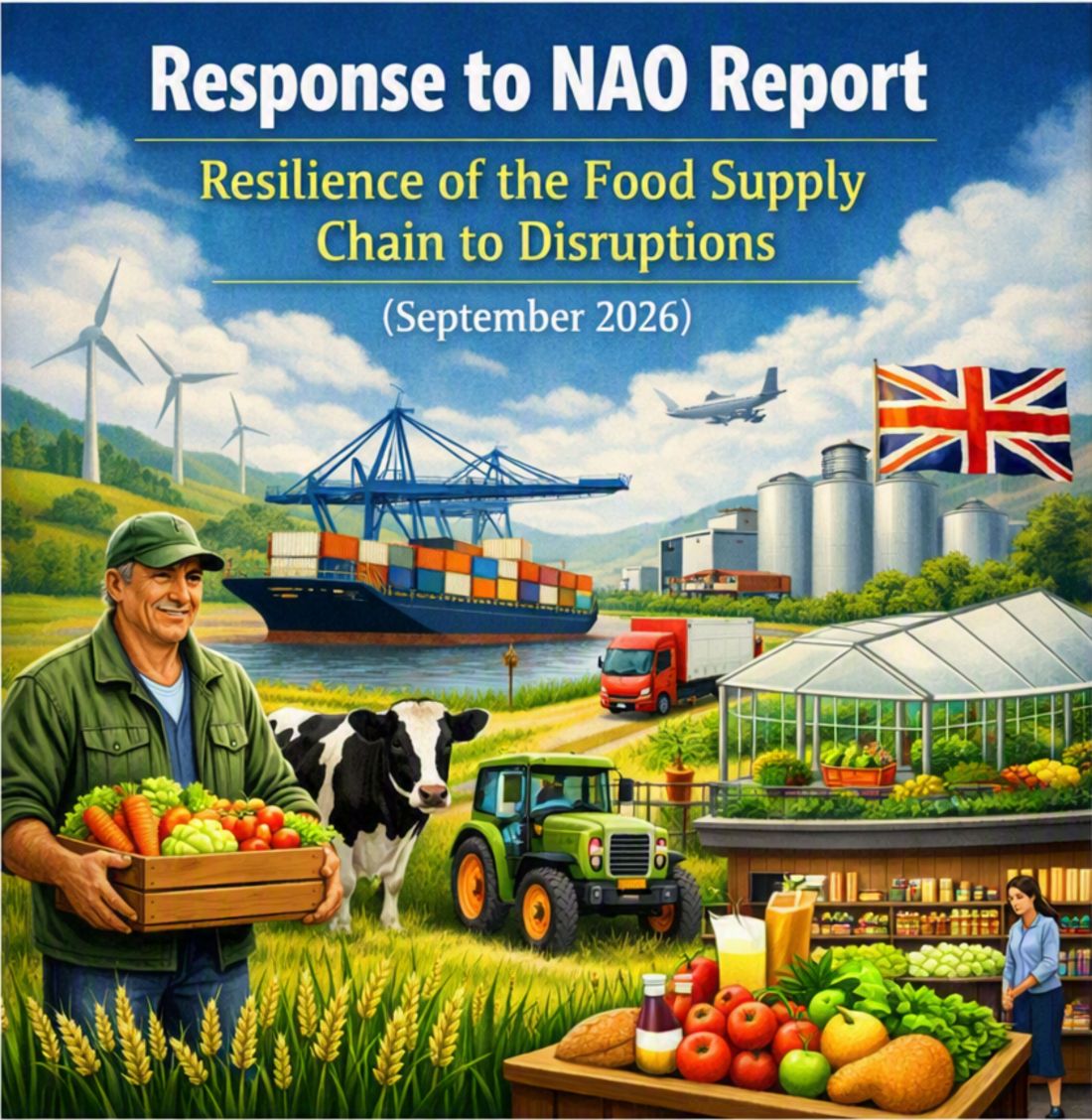
On 4 September 2026, the National Audit Office published Resilience of the Food Supply Chain to Disruptions, a report that rightly draws attention to weaknesses in the UK’s preparedness for serious food supply shocks. This response is offered as part of my ongoing farming, food security and Foods We Can Trust work, which examines the gap between food being available in normal times and food being resilient enough to withstand disruption.
The NAO report is valuable because it recognises rising risks, weaknesses in contingency planning, declining engagement with industry, and the need to involve households and communities more seriously. However, it remains constrained by assumptions that deserve closer scrutiny: in particular, the use of headline self-sufficiency figures, the reliance on private-sector adaptation, and the continued preference for centralised emergency response over local capability.
This response therefore does three things. First, it explains why food self-sufficiency is not the same as food resilience. Secondly, it identifies where the NAO’s analysis understates structural vulnerability. Thirdly, it sets out the practical direction of travel required if the UK is to build a food system that is more local, more capable, more trusted and more resilient. Links to the specific works that develop these arguments in greater detail are provided in the further reading section.
1. The NAO’s “60% self-sufficiency” figure is useful, but it is not a resilience measure
The report states:
“In 2025, the UK’s food ‘self-sufficiency ratio’ was around 60%.”
This is a value-based measure: it compares the monetary value of food produced in the UK with the monetary value of food consumed here. That makes it useful as an economic indicator, but it does not answer the practical resilience question: how much food could the UK produce, process, distribute and access during a prolonged disruption?
The fact that many categories (fruit, vegetables, oils, ingredients) are overwhelmingly imported
The headline figure is also a net figure shaped by the way the modern supply chain works. Domestic production, imports, exports, imported inputs and processing dependencies all interact. Some food counted within domestic production may rely on imported fertiliser, animal feed, fuel, machinery, packaging or processing capacity. Some food produced here is exported. Some foods that are central to healthy diets are heavily import-dependent.
For that reason, the UK’s practical food resilience in a severe disruption scenario may be substantially lower than the self-sufficiency ratio suggests. The issue is not whether the precise figure is 60%, 52%, or lower still. The issue is that the official metric does not measure calorific adequacy, nutritional balance, imported input dependency, processing capacity or local distribution capability.
The NAO’s framing therefore risks creating false reassurance. It implies that production value can stand in for practical food availability. In a crisis, however, people need calories, nutrients, functioning logistics, processing capacity and accessible local distribution. Until government distinguishes those concepts, resilience planning will remain incomplete.
I have explored this in detail in Foods We Can Trust: A Blueprint for Food Security and Community Resilience in the UK, where I outline why caloric sovereignty – not value-based accounting – must be the foundation of food resilience policy.
2. Food inflation at 19.2% is not just an economic statistic – it is a resilience warning
The report notes:
“Food price inflation… peaked at 19.2% in March 2023.”
This is the first time I have noted that an official document has acknowledged the scale of the price shock that households have recently experienced. Food inflation at nearly 20% is not normal. It is not manageable. It is not a blip.
It is a sign that the system is structurally fragile.
Food is not discretionary. When prices rise at this rate, it reflects:
supply chain instability
import dependency
energy volatility
corporate consolidation
lack of domestic production capacity
The NAO mentions the figure but does not explore its implications. It should have been a central warning.
3. The NAO’s suggestion that Defra needs more emergency powers misses the point entirely
The report argues that Defra lacks the legal powers needed to manage catastrophic food disruptions.
But additional powers during an emergency cannot compensate for resilience that has not been built beforehand.
Legal authority can help coordinate action, but it cannot create food, processing capacity, distribution routes or community preparedness after the point of failure.
The lesson from recent crises is that centralised decision-making has limits when disruption affects daily life across multiple systems at once.
Food resilience requires operational capability before the crisis: trusted local relationships, clear responsibilities, practical logistics and the ability to identify and support vulnerable households quickly.
Food resilience must be:
built before a crisis
decentralised
community-led
grounded in local production and distribution
depoliticised
Emergency powers matter only if there is a resilient system for them to work through. Without food, fuel, people, local knowledge and functioning distribution, legal powers alone offer little practical protection.
4. The agri-food sector’s economic importance is understated – and underutilised
The NAO notes that the agri-food sector:
supports 4.1 million jobs
contributes £162.3 billion in GVA
These are enormous figures. And they would be significantly higher if British production and supply were prioritised.
The UK has the land, the skills, and the capacity to produce far more of its own food. What it lacks is a policy framework that values domestic production over globalised efficiency.
In The Need for a Collaborative Approach to the UK Farming and Food Security Problem, I argue that genuine collaboration – not policy-driven “collaboration theatre” – is essential to unlocking this potential.
5. Food as “one of 13 CNI sectors” creates false reassurance
Food is listed as one of 13 Critical National Infrastructure sectors. But unlike energy, water, telecoms, or transport, food is needed every single day.
There is no buffer. There is no downtime. There is no substitute.
Treating food as just another CNI category understates its foundational importance.
It leads to complacency and underinvestment.
6. Defra’s engagement with industry has deteriorated – and has become narrative management rather than collaboration
The NAO reports that:
engagement groups meet less frequently
objectives are unclear
support has declined
stakeholders see gaps in Defra’s understanding of key areas (e.g., the cold chain)
This aligns with what I have written in Real Collaboration vs Policy Collaboration. The concern is that engagement can become procedural rather than operational: meetings take place, stakeholders are consulted, and the language of partnership is used, but the people who understand production, processing, logistics and community need are not sufficiently empowered to shape the system.
Real collaboration requires:
shared objectives
transparency
local producer involvement
community representation
depoliticised structures
The NAO’s findings suggest that too much of this practical collaboration remains underdeveloped.
7. Household and community resilience has been neglected – and this is one of the report’s most important admissions
The NAO states:
“UK households are less prepared for emergencies… government-led messaging is less prominent.”
This is not a minor point. It is a fundamental failure.
Community resilience is the missing layer in UK food security. Without it:
supply chain shocks hit harder
vulnerable people suffer first
government response time shortens
local distribution becomes chaotic
In Local Planning for Food Shortages and Foods We Can Trust, I outline how community-led food resilience can be built at the lowest level – households, neighbourhoods, local producers – and why this must be prioritised.
8. Catastrophic planning remains theoretical – not practical
The NAO notes that:
Defra’s plans lack operational detail
industry is not involved
food assets are not included in the CNI Knowledge Base
national exercises have not tested real-world food failure scenarios
This is planning-oriented resilience rather than practical resilience. It may look adequate in documents, but it remains untested unless it is exercised with the businesses, local authorities, producers, distributors and communities that would have to make it work in practice.
Planning without accurate resilience metrics is incomplete. A credible approach should consider not only how much food is produced, but whether it can be processed, transported, stored, allocated and accessed under stress.
9. Local Resilience Forums are structurally incapable of delivering food resilience
The NAO concludes that LRFs:
lack clarity
lack capability
lack authority
cannot direct supermarkets
cannot identify vulnerable people effectively
This is not surprising. LRFs were not designed to rebuild food-system capability. They can coordinate emergency response, but food resilience also requires local production knowledge, community networks, producer relationships, storage capacity, transport options and clear mechanisms for supporting vulnerable households.
Food resilience therefore needs structures that are sufficiently independent of short-term political cycles and sufficiently close to communities to understand local need. Local government has a role, but it cannot be the only layer of resilience.
10. The private sector alone cannot be the backbone of UK food security
The NAO states:
“Defra has largely relied on the private sector… but this may not be sufficient.”
This is a significant understatement. The private sector is essential to the food system, but commercial efficiency and national resilience are not the same thing.
Large food businesses are generally incentivised to reduce cost, increase efficiency, consolidate operations and source globally. Those incentives can keep prices low in normal conditions, but they may also reduce redundancy, shorten stockholding, concentrate infrastructure and weaken local capability.
profit
efficiency
global sourcing
consolidation
Not:
resilience
redundancy
localism
sovereignty
In Who Controls Our Food Controls Our Future, I explain why corporate control of food systems is incompatible with national resilience.
11. What real food resilience requires: A blueprint
Drawing on my published work, real resilience requires:
Localised production
Rebuilding local food systems, shortening supply chains, and prioritising domestic output.
Community-level distribution
Neighbourhood hubs, local coordination, and community-led logistics.
Regional coordination
County-level frameworks that support local producers and manage regional flows.
National strategic oversight
A central body that sets resilience targets, not efficiency targets.
Depoliticised resilience structures
Community leaders, producers, and local organisations empowered to act independently of political cycles.
Accurate resilience metrics
Caloric sovereignty, not value-based accounting.
Reduced dependency on global supply chains
Rebalancing imports with domestic capacity.
Rebuilding domestic processing
Cold chain infrastructure, abattoirs, mills, and food processing facilities returned to UK soil.
Conclusion: The NAO report is a warning, but it is not yet a route to resilience
The NAO has highlighted important risks, and the report should be welcomed for bringing food supply disruption into sharper public view. Its strongest contribution is the recognition that Defra must engage more effectively with industry, households, communities and local government if the food system is to withstand future shocks.
However, the report does not go far enough. The UK’s food resilience is likely to be materially weaker than headline self-sufficiency figures imply, because resilience depends on more than production value. It depends on calories, nutrition, processing capacity, imported inputs, logistics, local access, household preparedness and community capability.
12. Priority actions
To move from acknowledgement to action, government should prioritise five practical steps.
Supplement value-based self-sufficiency measures with calorific, nutritional and supply-chain resilience indicators.
Map critical dependencies, including imported fertiliser, feed, energy, packaging, processing infrastructure, cold chain capacity and key transport routes.
Test severe food disruption scenarios with producers, processors, retailers, logistics providers, local authorities and community organisations.
Strengthen local and regional food resilience planning, including household preparedness, vulnerable-person support and community distribution capability.
Rebuild domestic processing and local food infrastructure so that production can be converted into accessible food during both normal conditions and crisis conditions.
The UK must therefore stop treating food solely as an economic sector and start treating it as a foundation of national security, public health, community resilience and democratic trust.
Further reading
1. Foods We Can Trust: A Blueprint for Food Security and Community Resilience in the UK Online text The core work behind this response. It sets out the wider argument that food security must include trust, nutrition, domestic capability, local resilience and community preparedness, rather than relying only on national supply figures or market efficiency.
2. Understanding Foods We Can Trust: A Blueprint for Food Security and Community Resilience in the UK Introductory overview A shorter explanatory article for readers who want an accessible introduction to the concepts behind Foods We Can Trust, including food security, household preparedness, local production and the importance of rebuilding public trust in the food system.
3. Local Planning for Food Shortages: A Guide to Local Support and Preparedness Full text A practical guide to planning at household, neighbourhood and local-authority level. This is especially relevant to the NAO’s concerns about household and community preparedness, vulnerable people and the limits of centralised emergency planning.
4. The Need for a Collaborative Approach to the UK Farming and Food Security Problem Article Develops the case for genuine collaboration across farming, food, policy and community systems. It provides the background to the argument that resilience cannot be delivered by government or the private sector acting alone.
5. Real Collaboration vs Policy Collaboration: The Choice That Will Shape the Future of Farming, Local Food Systems and Food Security Article Explains the distinction between collaboration that changes outcomes and consultation that mainly manages process. This is relevant to the NAO’s findings on declining engagement and unclear objectives within Defra’s work with industry.
6. Who Controls Our Food Controls Our Future Full text Explores the relationship between corporate control, food sovereignty, public trust and democratic resilience. It provides wider context for the argument that food systems should not be judged by efficiency alone.
Disclaimer
This document represents the views and analysis of the author and is provided as an independent response to the National Audit Office report Resilience of the Food Supply Chain to Disruptions (4 September 2026). While every effort has been made to ensure the accuracy of the information presented, it should not be regarded as official policy advice. The opinions expressed are informed by the author’s research, professional experience, and studies in sustainable agriculture and food security, and are intended to contribute to constructive discussion on food resilience, food security and community preparedness.
There is a particular sound British politics makes when it is running out of road. It is the sound of people reaching once again for the language of grip, delivery, seriousness, experience and competence, as though the right combination of better managers and sterner faces might somehow make the old machinery work as it once appeared to.
That search is understandable. When services deteriorate, living standards stall, housing becomes unreachable, debt rises and trust drains away, people naturally look for someone capable of restoring order. They ask who has the experience, who understands the markets, who can command the machine, who can finally make government work.
But the question itself may already be too narrow. If the machine is misfiring because the wrong people are operating it, then better operators might help. If the machine is misfiring because its assumptions no longer match reality, then the search for better operators becomes part of the problem.
The wrong question
Much of the current debate still assumes that Britain’s difficulties are failures of competence. The state needs to be run better. Budgets need to be managed more tightly. Growth needs to be revived. Productivity needs to improve. Departments need sharper leadership. Public services need reform. Markets need reassurance. Voters need confidence.
None of that is necessarily wrong. Competence matters. Money matters. Institutions matter. A government that cannot manage basic administration will not guide a country through anything more difficult. But competence inside a failing model is not the same as leadership capable of recognising that the model itself may be failing.
That is the possibility British politics keeps circling without quite naming. The country may not simply be suffering from a temporary downturn, a poor fiscal rule, a succession of disappointing governments or another bad phase in the electoral cycle. The fact that leaders with very different personalities, priorities and political traditions keep encountering similar limits should itself prompt a deeper question: are we looking at failures of individuals, or failures of the system within which those individuals are operating?
For decades, public assets have been sold and called efficiency. Value has been extracted from communities and called growth. Productive capacity has been hollowed out and replaced with financial engineering. Promises have been funded through debt, asset inflation and claims on the future. Success has been measured in ways that often fail to describe whether ordinary people can afford homes, raise families, access care, build security or live in communities that still function.
So when politicians talk about investment, fiscal space, renewed growth or national renewal, they often sound as though they are describing fresh capacity. Too often, they are doing something more limited: relabelling existing spending, moving costs into future years, borrowing more expensively, hoping growth returns, or trusting that markets will tolerate one more round of improvisation.
That does not mean money has literally disappeared. It means the real economic surplus, institutional resilience and productive base needed to sustain the promises of the existing model have been dangerously weakened. There is still money in circulation. There is less real capacity behind many of the promises attached to it.
Two mistakes, not one
This is where the leadership debate becomes confused. The failure is usually described as though the political class suffers from one shared defect. In reality, there are at least two, and they point in opposite directions.
One group knows the machinery but cannot imagine a future beyond it. The other does not understand the machinery and still imagines that power simply stops at No.10.
The first might be called the paradigm-blind managers. They speak the language of debt, markets, fiscal rules, productivity, investment and economic credibility. They understand how the existing system is supposed to work. Their failure is not that they know nothing. Their failure is that they know the current grammar so well that they struggle to imagine another language.
For them, every problem eventually returns to the same family of answers: more growth, better productivity, tighter management, smarter investment, stronger fiscal discipline, market credibility, business experience and technocratic competence. These things are not irrelevant. But if the model itself is producing the outcomes, fluency in that model is not enough.
The second group suffers from almost the opposite problem. These are the institutional romantics: people who speak as though the Prime Minister can simply decide, Parliament can vote away financial constraints, borrowing is only a matter of courage, and market reality can be dismissed as ideological pressure.
They imagine government as a command structure with No.10 at the top. But modern Britain is not arranged so simply. Government sits inside a dense web of Treasury rules, central bank decisions, debt markets, international capital, existing obligations, public expectations, legal commitments and real economic capacity. Political authority still matters, but it does not float above these constraints.
Both groups are dangerous, but for different reasons. The managers mistake system failure for poor administration. The romantics mistake structural constraint for cowardice or betrayal. One cannot imagine a future beyond the existing model. The other cannot understand the model they are already inside.
Why governments keep disappointing people
This distinction matters because it explains why successive governments so often disappoint people once they enter office. Campaigns take place in abstraction. Government takes place inside systems. Some of the people who have occupied No.10 in recent years might have been better suited to a different political moment. The point is not that every individual has been uniquely inadequate. The point is that very different people have repeatedly collided with similar institutional and economic realities.
The rhetoric of opposition, leadership contests and party conferences is full of choice, courage and renewal. But once inside government, ministers confront the hard edges of the state: debt servicing, spending commitments, market reactions, departmental fragility, contractual obligations, institutional inertia and the gap between what the country has been promised and what the system can actually deliver.
What looks like betrayal is therefore not always betrayal. Sometimes it is the moment when rhetoric collides with reality. Sometimes it is the discovery that the money imagined during the campaign does not exist in the form assumed, that the choices described to voters are narrower than claimed, and that the levers of power do not move the machinery in the way politicians implied. In that sense, politicians are not only agents of the system. They can also become its prisoners.
This does not absolve them of responsibility. They choose to seek power. They choose the promises they make. They choose the stories they tell about what power can achieve. They should know more before they obtain the roles they seek. But the repeated pattern also reflects the system that selects, rewards and promotes them: a system that often prizes confidence over understanding, fluency over wisdom and the appearance of control over an honest account of constraint.
This is not simply a failure of character. It is a failure of diagnosis. If people enter power believing the crisis is mainly political, they will be unprepared for an institutional and economic crisis. If they enter power believing the existing model only needs better management, they will be unprepared for the possibility that the model itself is the problem.
What leadership actually means
That is why the leadership question matters. But leadership is often misunderstood. It is confused with expertise, business experience, technical fluency, personal conviction, rhetorical force or the ability to dominate a room. None of these things is leadership.
No Prime Minister can be the country’s best economist, accountant, engineer, scientist, military strategist, financier, social worker and historian at the same time. No Chancellor can personally understand every consequence of every decision. No government can function if leadership means knowing everything.
Leadership means something else. It means bringing together people with different forms of expertise, understanding the realities they identify, recognising the limits of their assumptions, asking questions that fall between disciplines, and making decisions in the public interest even when those decisions are difficult, unpopular or hard to communicate.
expertise is necessary, but not sufficient
financial knowledge is necessary, but not sufficient
political authority is necessary, but not sufficient
conviction is necessary, but not sufficient
process is necessary, but not sufficient
Managers optimise within a system. Leaders make judgements when the system itself is in question.
This is not an argument against expertise. Economists matter. Financial specialists matter. Engineers, scientists, business leaders, local government officers, community organisations and public service professionals all matter. The problem begins when expertise is mistaken for leadership, or when one form of expertise becomes the only lens through which every public problem is viewed.
A leader must be able to listen without becoming captured, decide without pretending certainty, and act without reducing society to a spreadsheet. The defining feature of leadership is not avoiding difficult choices. It is accepting responsibility for choices where every available option carries a cost.
The danger of confusing leadership with control
There is another danger here. When institutions lose credibility, living standards decline and familiar solutions stop working, people understandably begin to hunger for clarity and action. The attraction of the decisive individual grows stronger. The argument becomes that Britain does not need more consultation, more process or more excuses. It needs someone who will take control.
That temptation should not be dismissed lightly. A theoretical case can always be made for a wise, selfless and temporary crisis leader: someone capable of seeing the whole system, gathering the right minds, making hard decisions and relinquishing power when the work is done. The problem is not the theory. The problem is the real world.
How would such a person be found? How would the country know they were genuinely selfless rather than merely claiming to be? How would power be limited once concentrated? How would dissent be protected? How would succession work? How would the person remain the same after acquiring the authority that changes almost everyone who holds it?
The answer to managerial paralysis is not authoritarian certainty. The manager says, “The process will save us.” The strongman says, “I will save us.” A leader says, “Show me what is real, tell me what I am missing, let the strongest arguments be heard, and then I will decide.”
The distinction matters because desperation changes political judgement. Once people stop believing that ordinary politics can respond to reality, they often stop looking for leadership and start looking for saviours. That is when the void becomes dangerous, especially if some of those already close to power exhibit the habits of certainty, grievance, domination or contempt for constraint before they have even acquired it.
The lucid moment has to come before desperation
What Britain needs, then, is not simply another leader, another party, another slogan or another economic forecast. It needs a lucid moment: a collective recognition that the old model is no longer producing the outcomes promised, that changing personnel is not the same as changing assumptions, and that preserving social cohesion during transition matters more than defending the credibility of a failing worldview.
The danger is that such recognition arrives too late. Systems can continue long after their underlying assumptions have weakened because admitting the scale of the problem is professionally, politically and psychologically difficult. The people most rewarded by the existing paradigm are rarely the first to acknowledge that it has reached its limits.
That is why the question of leadership cannot be reduced to personality. Britain does not need people who merely know how to operate the machinery, nor people who imagine they can command it by will alone. It needs leaders capable of understanding the machinery, recognising when it is failing, gathering knowledge beyond their own worldview, and making decisions that serve people rather than the abstractions of the system.
That means rebuilding productive local economies, reconnecting institutions with lived reality, asking how value is created and circulated in communities, and developing forms of governance that serve people rather than forcing people to serve markets, models and metrics.
The greatest danger is not decline itself. It is that decline remains misunderstood until frustration turns into desperation. If that happens, the search for leadership can become a search for certainty, and the search for certainty can become the path to something far worse.
The lucid moment needs to come before that. Britain needs real leadership not because one person can save it, but because only real leadership can help a society understand reality before reality forces the lesson on harsher terms.
Every time Britain runs into serious difficulty, we seem to have the same conversation. The names change. The parties change. The faces around the Cabinet table change. The language of renewal, seriousness and responsibility is refreshed for the latest political moment. Yet the assumptions beneath the debate remain remarkably consistent.
People can now see that something is wrong. That is no longer really the issue. The point of disagreement is no longer whether Britain has problems, but what kind of problems they are. Debt, stagnant living standards, unaffordable housing, degraded public services, weak productivity, falling trust and social fragmentation are all now visible enough to be discussed across the political spectrum. But they are still treated, again and again, as separate management failures rather than as symptoms of the same underlying system.
That is the real tragedy. Many of the people diagnosing the crisis genuinely know that something is badly wrong. Some may even know, at some level, that the old answers are exhausted. But they have nowhere else to go intellectually, professionally or politically except back to the same place they have always looked: finance, markets, business experience, managerial competence, fiscal discipline, GDP growth and the language of economic credibility.
So every crisis produces the same merry-go-round. First, the system produces outcomes that are increasingly difficult to defend. Then commentators, politicians and professional observers acknowledge the symptoms. Then the search begins for the people deemed “serious”, “qualified”, “experienced” or “credible” enough to fix them. More often than not, those people are drawn from the same worldview that helped produce the outcomes in the first place.
The latest reshuffle, party conference season and the first real glimpse of the UK’s latest prime minister have simply offered the newest version of this old pattern. The commentariat and Opinionati have been busy sticking badges on Westminster’s latest cast list, praising or dismissing people according to whether they understand big business, the markets, money and the supposedly hard realities of government. It would be interesting if it were not so desperately detached from the deeper causes of the problems they can see only at surface level.
Perhaps I am being unfair. Some of them may understand more than they are willing to say. It is not difficult to see why few high-profile journalists, economists, politicians or commentators would not want to be the first to say publicly that the entire operating model has reached its limits. That is not a career-enhancing move. But perhaps I am also being optimistic. The harder possibility is that many really cannot see it, because the system has trained them not to look in the right place.
This is what I have increasingly described as paradigm blindness, or cognitive capture. It is not stupidity, corruption or malice. It is the condition that arises when the assumptions of a system become so familiar, rewarded and professionally reinforced that they stop appearing to be assumptions at all. They simply feel like reality.
That is why the argument that the best MPs are those who have been in business, finance or the markets needs to be challenged at its root. This is not a new phenomenon. We have heard versions of it for years. The country is in trouble, so we are told we need people who have run companies, handled money, understood the markets, balanced books, managed large organisations or dealt with the “real world”.
But this assumes precisely what should be under scrutiny. A country is not a corporation. Citizens are not customers. Communities are not balance sheets. Public value is not the same thing as shareholder value. Government is not elected to optimise returns, impress markets or manage people as units of cost. It is elected to serve the public interest.
This does not mean that business experience is useless, or that financial knowledge has no place in government. Of course leaders need access to expertise. Government operates inside financial constraints, and anyone pretending otherwise is avoiding reality.
But genuine leadership is not the same as technical expertise. A genuine leader does not need to be the country’s best economist, financier, accountant or bond trader. A genuine leader needs to ask the right questions, gather the necessary information, listen beyond a single discipline, understand consequences, and make decisions in the interests of people rather than in defence of a model.
That distinction matters because expertise is rarely neutral. Economists are largely trained within the existing economic model. Business schools largely teach people how to succeed within the existing business environment. Financial professionals are trained to understand and operate the existing monetary and market system. None of that makes them bad people. But it does mean they are usually specialists in operating the paradigm, not necessarily in questioning whether the paradigm itself is failing.
This is the heart of the problem. We have become so accustomed to money being part of everything that it becomes almost impossible for many people to see money as part of the problem. The captured mind says, “It cannot be money, because money is involved in everything.” But that is precisely the point. When money becomes the organising principle of everything, everything begins to bend around it.
Money is no longer merely a tool that society uses. It has become the measure by which society judges almost everything: policy, success, failure, seriousness, responsibility, productivity, worth, even human dignity. Market confidence becomes more important than lived experience. Financial efficiency becomes more important than resilience. GDP-style growth becomes more important than whether ordinary people can afford homes, raise families, access care, build security, or live in communities that still function.
This is why the current debate is so inadequate. Across the political spectrum, many now agree that the UK is financially precarious, if not already in serious trouble. But the explanations remain scattered: the wrong government, the wrong prime minister, immigration, benefit claimants, public sector waste, weak management, insufficient growth, too much borrowing, too little discipline. Each explanation may touch some fragment of reality. None explains the whole.
The deeper possibility is that these are not isolated failures at all. They are connected outcomes of a worldview that has progressively subordinated people, communities, public services, local economies and the natural environment to financial logic.
Because the system prioritises money, it teaches us to judge everything else in monetary terms. In doing so, we have surrendered forms of value that cannot be properly measured by markets but without which society cannot remain healthy.
That blindness has allowed a massive transfer of wealth, declining quality of life for many, the weakening of communities, the degradation of public services, the hollowing out of productive capacity and the dismantling or sale of shared structural and infrastructural assets. The harms are then treated as unfortunate side effects, or as the personal failings of those who cannot keep up, rather than as predictable consequences of the system itself.
Those who need benefits, debt, handouts or support are too often ridiculed as the architects of their own misfortune. But a system built around extraction, competition and monetary valuation could only ever push more people towards the margins. The fact that this is now happening at scale should tell us something important. It is no longer credible to pretend that all of this is merely bad management.
The strongest objection is obvious and deserves to be taken seriously. People will say that no government can ignore money, borrowing, markets or budgets. They will say that expertise matters, that institutions matter, that stability matters, and that the alternative to financial discipline may be chaos.
They are right to say that competence matters. They are right that government cannot simply wish away the current system. But that objection only goes so far.
Understanding how to operate a system is not the same as understanding whether it still works.
Expertise in navigating a failing model should not be confused with leadership capable of questioning the model itself.
If the economic and monetary framework has helped create unaffordable housing, insecure work, weak productivity, degraded services, concentrated wealth and exhausted communities, then appointing people who are fluent in that framework is not automatically a solution. It may simply be another turn of the merry-go-round.
This is the anti-establishment paradox too. Many politicians and commentators claim to oppose the Establishment while continuing to operate entirely within its worldview.
They challenge the personnel of the system but not its assumptions. They denounce elites while judging seriousness by market confidence. They promise disruption while accepting the same definitions of success: growth, efficiency, competitiveness, credibility and control. In some cases, they do not challenge the Establishment at all. They intensify it.
That is why this moment matters. We are entering a critical phase in which more people can see that the old answers are failing, but many of those with the biggest platforms still cannot name the deeper problem.
They know the country is in difficulty. They know trust is weakening. They know the numbers do not add up. They know the usual levers no longer deliver what they once promised. But cognitive capture leaves them interpreting system failure as a management problem.
So we get calls for better managers, more business-minded MPs, tougher fiscal rules, more efficient public services, renewed growth strategies, fresh economic credibility and new faces to operate the same machinery.
The possibility that the machinery itself is producing the outcomes barely enters the conversation.
The problems we now face cannot and will not be solved simply by cutting spending, borrowing more, chasing GDP-style growth, finding another managerial class, or appointing MPs whose main qualification is fluency in the financial language of the existing system.
The extractive model appears to have reached its limits. Its promises of efficiency, prosperity and competent management are harder to reconcile with the reality experienced by millions of people.
The system is over. It simply has not finished its ending yet. And the last people we need making futile attempts to save a system whose impacts they do not understand are those who still believe it is the only possible way.
The question now is not whether Westminster has enough people who understand money. It is whether Westminster has enough people willing to ask why money has become the lens through which every public problem must be viewed.
Genuine leadership begins there: not in pretending money does not matter, but in refusing to let it be the only thing that matters.
If the challenge is one of worldview as much as policy, then the next step cannot simply be another leader, party, slogan or economic forecast. It has to involve rebuilding the capacity to think and act differently: restoring productive local economies, reconnecting institutions with lived reality, asking how value is created and circulated in communities, and developing forms of governance that serve people rather than forcing people to serve the abstractions of the system.
For a more practical exploration of that direction, see: The Local Economy & Governance System.
We are living through a moment that feels both familiar and entirely new. Familiar, because history has seen periods where old systems strain under their own weight. New, because the pressures shaping today’s world are unfolding across digital networks, global markets, and public consciousness in ways no previous era has experienced.
For many people, the sense that “something is shifting” has become impossible to ignore. Institutions that once felt stable now appear uncertain. Narratives that once carried authority are met with hesitation. Global tensions rise and fall in unpredictable rhythms. And beneath it all, the economic and social foundations that supported the last half‑century seem increasingly fragile.
This piece is an attempt to understand that moment – not through ideology, and not through the lens of winners and losers, but through the structural forces that are shaping how societies, institutions, and individuals respond to rapid change.
My own views have evolved over time, and the ideas explored here build on earlier work while recognising that the world itself has moved on.
The “reset era” – a period where different groups attempted to reshape the global system according to their own visions – is ending. What follows is not a new order, but a contested transition. A phase defined less by coordinated plans and more by competing interpretations of what the future should look like, and who should guide it.
At the centre of this transition is a phenomenon that now touches every part of public life: trust inversion. Public trust in institutions has declined, even as institutions have become more confident in their own narratives. Digitalisation has widened the gap, giving the public new tools to verify reality while giving institutions new tools to project it. The result is not conflict, but misalignment – a world where shared reality is harder to maintain, and where communication itself becomes a source of strain.
This introduction sets the stage for a deeper exploration of how we arrived here, what dynamics are shaping the present, and why the next phase will require a different way of thinking about governance, economics, and the relationship between institutions and the people they serve.
The goal is not to predict what comes next, but to understand the forces that will shape it – and to consider how societies might navigate a transition that affects everyone, regardless of ideology or geography.
1. The End of the Reset Era
Over the past decade, a great deal of public discussion has centred on the idea of “resets.” Different groups, institutions, and nations appeared to be working toward their own visions of how the global system should evolve. These visions were not identical, and they were not coordinated, but they shared a common assumption: that the existing order could be reshaped through deliberate action.
For some global bodies, the reset meant a more managed, technocratic future – one where long‑term planning, digital infrastructure, and international cooperation could steer societies through emerging challenges.
For others, particularly within parts of the developing world, the reset meant a shift toward multipolarity: a world where influence was distributed more evenly, and where new alliances could counterbalance older centres of power.
And for certain national movements, the reset meant a return to older forms of sovereignty, self‑determination, and economic protectionism.
These resets were not conspiracies, nor were they illusions. They were genuine attempts to steer a system that was already showing signs of strain. Each group believed that its approach could stabilise or improve the world in ways that aligned with its own values, interests, and interpretations of global change.
But resets require a system that is capable of being reset. They require foundations that can absorb pressure, institutions that can adapt, and public trust that can sustain ambitious transitions.
Over time, it became clear that these conditions were no longer present. The economic model underpinning the global order was already under significant stress. Public trust in institutions was declining. Digitalisation was reshaping how people understood events. And geopolitical tensions were rising in ways that made coordinated transformation increasingly difficult.
As a result, none of the resets achieved their intended outcomes. Their limitations were not only structural, but conceptual: each was shaped by assumptions that no longer matched the realities of a changing world. Even if the underlying system had been more stable, these resets would still have struggled to deliver the futures they imagined, because they were built on frameworks that were themselves incomplete or misaligned with the needs of societies. Instead of producing transformation, the world drifted. It adapted unevenly. It absorbed shocks without resolving them. And gradually, the reset era gave way to something more complex and less predictable.
We are now living in the aftermath of those attempts. The resets have ended, not with a single decisive moment, but with a gradual recognition that the world is no longer in a phase of planned transformation. Instead, it has entered a period of contested transition, where different actors are responding to the same pressures in different ways, and where the question is no longer how to reset the system, but how to navigate what comes after it.
2. The Extractive Economic Model: The Shared Foundation
If we want to understand why the reset era ended, and why the world now feels so unstable, we have to look beneath politics, institutions, and personalities. We have to examine the foundations that all major actors – global bodies, national governments, alliances, and movements – have been standing on. Those foundations are economic, and they have shaped the modern world more profoundly than any single ideology or leader.
For decades, the global system has been built on an economic model that is both highly productive and deeply extractive. It is a model that concentrates wealth, amplifies financial power, and relies on mechanisms that create money faster than they create real value. This model has enabled extraordinary growth, but it has also produced structural imbalances that are now impossible to ignore.
At its core, the model rewards financial leverage more than productive activity. It allows influence to be accumulated through debt, speculation, and asset inflation rather than through tangible contribution. It enables wealth to expand through mechanisms that are increasingly detached from everyday life, while the pressures on households, communities, and public services continue to grow. Over time, this has created a widening gap between those who benefit from the system and those who experience its consequences.
This is not a critique of any one country or institution. It is a description of a global architecture that has shaped behaviour everywhere. Nations that appear to be in competition are often responding to the same underlying incentives. Institutions that seem to be pursuing different visions are often constrained by the same structural limitations. Even geopolitical tensions frequently reflect the pressures created by an economic model that is struggling to sustain itself.
The extractive nature of the system has also influenced how power is understood. Wealth has become synonymous with influence. Ownership has become synonymous with stability. Financial capacity has become synonymous with national strength. These assumptions have shaped diplomacy, governance, and public expectations for decades – and they are now being tested by conditions the model was never designed to withstand.
As the foundations strain, the ability of any actor to reshape the system becomes limited. Resets falter not because the ideas behind them are flawed, but because the underlying structure cannot support large-scale transformation. When the base of a system is unstable, even well‑intentioned attempts to rebuild it struggle to gain traction.
This is the shared foundation of the moment we are in. It affects every group, every institution, and every nation. It explains why resets failed, why transitions are difficult, and why the next phase will be shaped not by ideology, but by the structural realities of a model that is reaching its limits.
3. Paradigm Blindness Across All Major Actors
One of the most important dynamics shaping the post‑reset world is something that affects every major group involved in global decision‑making: paradigm blindness.
This is not a flaw unique to any one institution, nation, or movement. It is a structural condition that emerges when systems change faster than the frameworks used to understand them.
For decades, global bodies, national governments, alliances, and political movements have operated within a shared set of assumptions about how the world works. These assumptions were shaped by the economic model, by the stability of the post‑war order, and by the belief that globalisation would continue to expand in predictable ways. They informed how institutions planned, how governments governed, and how societies interpreted change.
But the world that produced those assumptions has been shifting. Economic pressures have intensified. Digitalisation has transformed communication and public perception. Trust dynamics have changed. Geopolitical relationships have become more fluid. And the pace of change has accelerated in ways that traditional frameworks struggle to capture.
Despite this, many actors continue to operate as if the old paradigm still applies. Global institutions often rely on models and timelines built for a more stable era. Emerging alliances sometimes assume that multipolarity will unfold according to familiar patterns. National movements may look to past periods of strength as templates for future strategy. Each group is responding to real pressures, but often through lenses that no longer reflect the full complexity of the moment.
Paradigm blindness does not mean that these actors are unaware of change. Most recognise that the world is shifting. The challenge is that their tools, assumptions, and strategic frameworks were designed for conditions that no longer exist.
When the underlying system evolves, but the frameworks used to interpret it do not, decisions can become misaligned with reality even when they are made with the best of intentions.
This misalignment contributes to the sense of unpredictability that now characterises global affairs. Policies that once produced reliable outcomes now generate mixed or unexpected results. Narratives that once stabilised public sentiment now meet scepticism. Diplomatic signals that once conveyed clear meaning now land differently across audiences. The world has changed, but the paradigms guiding many responses have not kept pace.
Understanding paradigm blindness is essential because it explains why the post‑reset transition feels so fragmented. It is not that actors are acting irrationally or irresponsibly. It is that they are navigating a landscape using maps drawn for a different terrain.
As the system continues to evolve, the gap between old frameworks and new realities becomes more visible – and more consequential.
This is the environment in which trust inversion, digital fragmentation, and economic strain interact. It is the backdrop against which the next phase of global transition will unfold. And it is one of the reasons why no single actor can fully control what comes next, regardless of resources, influence, or ambition.
4. Trust Inversion: The Public and Institutions Drift Apart
One of the most significant shifts of the past decade has been the quiet but profound change in how institutions communicate and how the public receives that communication.
This change did not happen suddenly, and it did not arise from a single event. It emerged gradually, as the pressures on global systems increased and as digital technologies reshaped how people understand the world around them.
The result is a phenomenon that now touches every part of public life: trust inversion.
Trust inversion describes a situation where public trust in institutions declines at the same time that institutions become more confident in their own narratives.
It is not conflict, and it is not rebellion. It is a form of misalignment – a widening gap between how institutions believe their messages are received and how those messages are actually interpreted.
Trust inversion is therefore not simply a decline in trust. It is a reversal of a longstanding relationship between authority and credibility. For much of the modern era, institutional authority was often sufficient to establish public confidence. Today, credibility increasingly depends on alignment with lived experience, observed reality, and demonstrable consistency. Many institutions continue to communicate from assumptions formed in a higher-trust environment, while the public increasingly evaluates claims through the lens of a lower-trust one. The result is a widening gap between institutional expectation and public reception, even when both believe they are acting reasonably.
This reversal marks a break from the way institutional communication worked for much of the modern era. Governments, global bodies, and major organisations once relied on a reservoir of public trust. They could communicate with the expectation that their statements would be broadly accepted, even when the details were complex or the outcomes uncertain.
This trust was not unlimited, but it was stable enough to support large-scale policies, long-term planning, and coordinated international action.
Over time, however, that reservoir has been drawn down. Repeated cycles of ambitious promises, shifting timelines, and evolving narratives have made the public more cautious. People now compare information across multiple sources. They observe contradictions more quickly. They experience the consequences of policy directly. And they use digital tools to verify, question, and interpret events in ways that were not possible before.
This does not mean the public has turned against institutions. It means the public has become more discerning. Trust is no longer assumed; it is evaluated. Narratives are no longer accepted by default; they are examined. The public has not withdrawn from the conversation – it has changed how it participates in it.
At the same time, institutions have become more confident in their own messaging. This confidence is not arrogance; it is a product of the environments in which decisions are made.
Inside institutional settings, information is filtered, curated, and presented through dashboards, reports, and models that reinforce internal coherence. Communication strategies are refined. Messaging is tested. Feedback loops are structured. Within these environments, clarity of narrative can feel like clarity of reality.
Digitalisation deepens this divide. For the public, digital tools act as windows – ways to observe, compare, and interpret events. For institutions, digital tools act as mirrors – ways to project, measure, and reinforce their own understanding of events.
Both sides use technology, but they use it differently, and this difference shapes how each perceives the other.
The result is a world where shared reality becomes harder to maintain. Institutions communicate with confidence, believing their messages are stabilising. The public receives those messages with caution, interpreting them through a wider and more fragmented informational landscape.
Neither side is acting irrationally. Both are responding to the conditions they face. But the gap between them grows, and with it, the potential for misunderstanding.
Trust inversion matters because it affects everything that follows. It shapes how policies land, how narratives evolve, how crises are managed, and how societies respond to uncertainty. It is one of the central dynamics of the post‑reset world – and one of the reasons why the next phase will require new forms of connection between institutions and the people they serve.
5. The Collapse of Shared Reality
Trust inversion does not exist in isolation. It produces a deeper and more consequential shift: the gradual collapse of shared reality.
This collapse is not dramatic or sudden. It does not announce itself with a single event. Instead, it unfolds quietly, through thousands of small divergences in how institutions and the public interpret the same information.
For most of the modern era, societies operated within a broadly shared informational space. Institutions communicated through centralised channels – newspapers, broadcast media, official statements – and the public received those messages through the same limited set of sources.
Even when people disagreed, they disagreed within a common frame. The facts, the timelines, and the reference points were largely the same.
Digitalisation changed that. It expanded the informational landscape from a few channels to millions. It gave individuals access to perspectives, data, and interpretations that were once inaccessible. It allowed communities to form around shared experiences rather than shared broadcasts. And it created personalised feeds that reflect each person’s interests, concerns, and networks.
This shift has many benefits. It diversifies information. It empowers individuals. It exposes blind spots. But it also fragments the shared space that institutions rely on to communicate effectively.
When people receive information through personalised channels, they interpret events through personalised contexts. A single announcement can land in dozens of different ways, depending on the informational environment in which it is received.
Institutions, meanwhile, continue to communicate through centralised structures. Their messaging assumes a shared baseline – a common understanding of context, priorities, and meaning. But that baseline no longer exists in the way it once did. The public hears the message, but not always in the way the institution expects. The institution sees the message, but not always in the way the public interprets it.
This is the collapse of shared reality: not the disappearance of truth, but the disappearance of a single, unified space in which truth is collectively understood.
The consequences are subtle but significant. Policies that rely on broad public alignment become harder to implement. Narratives that once stabilised public sentiment now generate mixed reactions. Signals that once conveyed clear diplomatic intent are interpreted differently across audiences.
Even basic facts can be understood through different lenses, not because people reject them, but because they encounter them in different contexts.
This fragmentation does not mean societies cannot function. It means they function differently. It means institutions must adapt to a world where communication is no longer linear, where public interpretation is no longer predictable, and where shared reality must be rebuilt rather than assumed.
The collapse of shared reality is one of the defining features of the post‑reset world. It shapes how trust inversion unfolds, how paradigm blindness persists, and how the next phase of global transition will be navigated. It is not a crisis of truth, but a challenge of coherence – and addressing it will be essential for any future system that hopes to be stable, legitimate, and connected to the people it serves.
6. Institutional Performativity
As shared reality fragments and trust inversion deepens, institutions face a challenge that is both practical and structural: how to maintain stability in a world where traditional mechanisms of influence no longer work as reliably as they once did.
One of the ways institutions respond to this challenge is through what can be described as institutional performativity – the increasing reliance on communication, presentation, and narrative coherence as tools for maintaining order.
Performativity does not mean superficiality. It does not imply deception or manipulation. It is a natural adaptation to complexity.
When systems become harder to steer, when public interpretation becomes more varied, and when outcomes become less predictable, institutions turn to the tools they can control: messaging, framing, and the performance of stability.
For much of the modern era, institutional communication served as a complement to policy. It explained decisions, clarified intentions, and helped align public expectations with institutional goals. But as the informational environment has changed, communication has taken on a larger role. It has become a stabilising mechanism in its own right – a way to project coherence even when underlying conditions are uncertain.
This shift is visible across many sectors. Governments increasingly rely on announcements, briefings, and strategic messaging to manage public sentiment. Global bodies produce frameworks, roadmaps, and declarations that signal direction even when implementation is complex. Corporations use carefully crafted narratives to reassure markets and stakeholders.
In each case, communication becomes a form of action – a way to maintain continuity in a world where continuity is harder to guarantee.
Inside institutional environments, performativity feels logical. Decision‑makers operate within structured feedback loops. They see dashboards that track progress, reports that summarise outcomes, and models that project future scenarios. These tools create a sense of coherence, even when the external environment is more fragmented.
When communication aligns with internal understanding, it reinforces the belief that clarity of message can help stabilise the system.
But performativity also has limits. When public interpretation diverges from institutional messaging, communication can lose its stabilising effect. Announcements that once reassured now raise questions. Narratives that once unified now land unevenly. The performance of stability can be misread as overconfidence, and the projection of certainty can be interpreted as detachment from lived experience.
This does not mean institutions are acting irresponsibly. It means they are navigating a world where the tools they have relied on for decades no longer function in the same way.
Performativity is an attempt to bridge the gap between internal coherence and external fragmentation – a way to maintain order in a system that is becoming harder to predict.
Understanding institutional performativity is essential because it explains why communication has become such a central feature of the post‑reset world. It helps us see why institutions appear confident even when conditions are uncertain, and why public responses to institutional messaging are increasingly varied.
It also highlights the need for new forms of connection between institutions and the public – forms that rely less on performance and more on shared understanding.
Performativity is not a flaw. It is a symptom of a system under strain. And recognising it is a necessary step toward understanding how the next phase of global transition will unfold.
7. The Post‑Reset Power Struggle
As the reset era faded, the world did not settle into a new equilibrium. Instead, it entered a phase defined by competing interpretations of what the future should look like.
This is not a struggle for dominance in the traditional sense. It is a struggle to shape the next stage of a system that is already under strain – a system whose foundations are fragile, whose narratives are contested, and whose pathways of influence are shifting.
Three broad groups now find themselves navigating this transition, each responding to the same pressures but in different ways.
A. Global institutions and transnational bodies
Organisations such as international agencies, multilateral frameworks, and global governance structures continue to operate within the paradigms that shaped the late 20th and early 21st centuries.
Their approach emphasises coordination, long‑term planning, and the belief that shared frameworks can guide societies through uncertainty.
These institutions still project coherence, but they face increasing difficulty maintaining traction in a world where public trust is lower, shared reality is fragmented, and national priorities diverge more sharply than before.
Their influence remains significant, but it is no longer decisive. They are navigating a landscape where their traditional tools – consensus building, strategic roadmaps, and global initiatives – do not land as uniformly as they once did.
B. Emerging alliances and geopolitical blocs
Groups of nations seeking alternative pathways – whether through economic cooperation, regional partnerships, or strategic alignment – represent another part of the post‑reset struggle.
Their vision is often framed as a move toward multipolarity: a world where influence is distributed more evenly and where new centres of power can balance older ones.
Yet these alliances face the same structural constraints as the institutions they seek to counterbalance. They operate within the same extractive economic model. They rely on the same global systems for trade, finance, and stability. And they must navigate the same pressures of digital fragmentation and trust inversion.
Their rise reflects a desire for change, but their capacity to reshape the system is limited by the system itself.
C. National movements and disruptor states
A third group consists of nations and political movements that challenge established norms more directly.
Their strategies often emphasise sovereignty, rapid decision‑making, and a willingness to break with traditional diplomatic or institutional expectations.
These actors can introduce volatility into systems that rely heavily on predictability, and they often gain traction by appealing to public scepticism or by rejecting frameworks that no longer feel aligned with lived experience.
Their influence is real, but it is also constrained. Disruption can reshape the landscape, but it cannot resolve the underlying structural pressures that affect all actors equally.
Even bold or unconventional approaches must contend with the same economic fragility, the same trust dynamics, and the same global interdependencies.
These three groups are not isolated. They interact, compete, and sometimes cooperate. But none of them can fully control the transition now underway.
The post‑reset power struggle is not a contest for supremacy; it is a contest for relevance in a world where the old tools no longer work as they once did, and where the new tools have not yet been fully understood.
This struggle is shaped by misalignment, not malice. By structural limits, not ideological conflict. And by the reality that the next phase of global evolution will not be defined by a single actor, but by the interplay between many – each navigating pressures that transcend borders, institutions, and political systems.
The post‑reset world is not a battlefield. It is a negotiation – one conducted across different paradigms, different expectations, and different interpretations of what stability should look like. Understanding this negotiation is essential for making sense of the moment we are in, and for anticipating the challenges that lie ahead.
8. Why This Moment Feels Critical
Across societies, institutions, and public conversations, there is a shared sense that the world has entered a pivotal moment.
People feel it in different ways – through economic pressures, political uncertainty, social fragmentation, or the pace of technological change – but the underlying sentiment is remarkably consistent.
Something fundamental is shifting, and the familiar patterns that once anchored public life no longer feel as reliable as they once did.
This feeling does not arise from a single cause. It emerges from the interaction of several structural pressures that have been building over time.
Trust inversion has weakened the traditional relationship between institutions and the public. The collapse of shared reality has made communication less predictable and consensus harder to achieve. Paradigm blindness has left many actors navigating a landscape using frameworks that no longer match the terrain. And the extractive economic model that underpins the global system is showing signs of strain that are increasingly difficult to ignore.
Each of these pressures would be significant on its own. Together, they create a sense of acceleration – a feeling that events are unfolding faster than institutions can interpret them, and that the tools used to manage uncertainty are no longer sufficient.
This does not mean collapse is inevitable. It means the system is operating under conditions it was not designed for, and that the responses available to institutions are constrained by the very structures they are trying to preserve.
Geopolitical tensions add to this sense of criticality. Conflicts and standoffs in various regions are often interpreted as isolated events, but they can also be understood as symptoms of a wider transition.
When global systems strain, local pressures intensify. When trust declines, alliances shift. When economic foundations weaken, competition for stability becomes sharper. These dynamics do not point to a single outcome, but they do contribute to the feeling that the world is moving through a phase where the stakes are unusually high.
Public sentiment reflects this. People are not simply anxious; they are attentive. They are watching institutions more closely, questioning narratives more readily, and interpreting events through a wider range of perspectives.
This attentiveness is not inherently destabilising. It is a rational response to a world where traditional anchors feel less secure and where the future appears more open than it has for many years.
The moment feels critical because it is. Not in the sense of imminent crisis, but in the sense of transition. The structures that shaped the last era are under pressure, and the structures that will shape the next have not yet fully emerged.
The choices made now – by institutions, communities, and individuals – will influence how societies navigate this transition and what the next phase of global order will look like.
Understanding why the moment feels critical is essential for understanding what comes next. It helps explain why resets failed, why transitions are difficult, and why new forms of governance and connection may be required. It also sets the stage for exploring the future – not as a prediction, but as a landscape shaped by the pressures and possibilities of the present.
9. What Comes Next: The Post‑Reset Transition
When a system reaches the limits of its own foundations, the future stops being a continuation of the past and becomes a negotiation. That is the stage the world has now entered. The reset era has ended, not with a decisive shift toward a new order, but with a transition defined by uncertainty, competing visions, and structural pressures that no single actor can fully control.
This transition is not about who will dominate the next era. It is about how different groups respond to the same underlying reality: the foundations of the global system are strained, and the tools that once sustained stability no longer function as reliably as they once did.
In this environment, influence becomes temporary, and attempts to shape the future become steps rather than destinations.
A. No actor can fully “win” the next order
Global institutions, emerging alliances, and national disruptors all have different visions for what the future should look like. But each faces the same constraints:
an economic model that concentrates wealth and amplifies fragility
trust dynamics that limit the effectiveness of traditional governance
digital fragmentation that complicates communication and consensus
geopolitical pressures that reflect systemic strain rather than strategic intent
These constraints mean that even if one group gains temporary influence, the underlying system will continue to shift beneath them. Dominance becomes unstable. Plans become provisional. The future becomes a moving target.
B. The real struggle is for preservation, not transformation
As the transition unfolds, the most consistent pattern across all major actors is the effort to preserve:
the location of wealth
the structure of ownership
the distribution of power
the mechanisms of influence
the narratives that justify their position
This struggle is not ideological. It is structural. When systems strain, institutions focus on continuity. They protect what they have. They reinforce familiar patterns. They attempt to stabilise the parts of the system that benefit them, even as the wider environment becomes harder to predict.
This is why many responses to global pressures feel defensive rather than transformative. The goal is not to redesign the system, but to maintain position within it.
C. Escalation as a symptom of transition
Geopolitical tensions in Europe, Asia, and other regions are often interpreted as isolated conflicts or strategic manoeuvres. But they can also be understood as symptoms of a wider transition.
When global systems strain:
alliances shift
regional pressures intensify
economic vulnerabilities become geopolitical risks
local conflicts reflect global uncertainty
These developments do not point to a single coordinated plan. They reflect the reality that the system is adjusting unevenly, and that different actors are responding to pressures that transcend borders and ideologies.
D. Governance as a symptom of the system
Governments are often judged by their decisions, but those decisions are shaped by the structures they operate within.
When the underlying model strains, governance itself becomes a symptom of deeper pressures. Policies become harder to implement. Public sentiment becomes more volatile. Institutions become more performative. And the gap between intention and outcome widens.
This is not a failure of leadership. It is a reflection of a system that is struggling to sustain the expectations placed upon it.
E. The only sustainable direction: local systems
As global systems fragment, a new pattern begins to emerge. Stability is increasingly found not in large, centralised structures, but in smaller, localised ones.
Local systems:
rebuild trust
reduce fragility
decentralise risk
reconnect governance with lived experience
operate without the assumptions of global coherence
This does not mean isolation or rejection of global cooperation. It means recognising that resilience often emerges from smaller scales when larger systems are under strain.
Local systems can coexist with global frameworks, but they provide a foundation that is more adaptable, more responsive, and more aligned with the realities people experience directly.
The post‑reset transition is not a single event. It is a phase – one defined by structural pressures, shifting paradigms, and the gradual recognition that the future cannot be built on the assumptions of the past.
What comes next will not be determined by any one group, but by how societies navigate the interplay between fragility, adaptation, and the search for new forms of stability.
10. A Call for Reconnection
If the post‑reset world is defined by misalignment – between institutions and the public, between old paradigms and new realities, between global ambitions and local pressures – then the next phase must be defined by reconnection.
Not a return to the past, and not a leap into a fully formed new system, but a deliberate effort to rebuild coherence at a scale where trust, stability, and shared understanding can actually take root.
Reconnection begins with recognising that the challenges facing the world are structural, not ideological.
Institutions are not failing because they lack intelligence or intent. The public is not sceptical because it is hostile or disengaged. Nations are not competing because they prefer conflict.
These behaviours are symptoms of a system that has reached the limits of its own foundations – a system that cannot be stabilised through narrative alone, and cannot be reset through ambition alone.
To navigate this transition, societies will need to rebuild the relationship between governance and lived experience.
Large institutions can still play important roles, but they must adapt to a world where communication is fragmented, trust is conditional, and public interpretation is shaped by diverse informational environments.
This means shifting from performance to engagement, from projection to listening, and from centralised assumptions to distributed understanding.
Local systems will be central to this process. They offer a scale at which trust can be rebuilt, where governance can be responsive, and where the gap between intention and outcome is smaller.
Local systems do not replace global cooperation; they strengthen it by providing stable foundations that are less vulnerable to the fragility of large‑scale structures. They create spaces where communities can shape their own futures, where institutions can reconnect with the realities people experience directly, and where resilience can grow from the ground up.
Reconnection also requires a new approach to communication. Institutions must recognise that clarity of message is not the same as clarity of meaning, and that coherence inside an organisation does not guarantee coherence outside it.
Public engagement must be grounded in transparency, humility, and an understanding that trust is earned through alignment with lived experience, not through repetition of narrative.
Finally, reconnection requires acknowledging that the future will not be built by any single actor. It will emerge from the interplay between global frameworks, national priorities, and local realities. It will depend on the ability of institutions to adapt, the willingness of communities to participate, and the capacity of societies to rebuild shared understanding in a world where shared reality has become harder to maintain.
The post‑reset transition is not a crisis to be solved. It is a moment to be navigated – a moment that calls for reconnection, recalibration, and a recognition that stability in the next era will come not from centralised control, but from distributed resilience.
The world is moving toward a future where local systems, grounded in trust and lived experience, form the backbone of global coherence. Rebuilding that connection is the work of the next phase.
11. Further Reading
For readers who want to explore how the ideas in this work developed, the following essays offer a clear path through the earlier stages of this thinking. Each was written at a different moment, responding to different pressures, but together they trace the evolution of the themes explored in this piece – from early signs of systemic strain to the deeper structural dynamics shaping the post‑reset world.
They are arranged here in an order that helps the reader follow that progression.
This essay introduces the concept of “resets” as institutional responses to mounting global pressures. It explores how governments and organisations reached for increasingly ambitious solutions as traditional mechanisms of stability weakened. It marks the first recognition that these resets were not coordinated plans, but symptoms of a system struggling to maintain coherence.
2. Trump’s Reset: Catalyst for Change, Doorway to Cataclysm – Or Both?
Here, the focus shifts to a specific political moment. This essay examines how disruption interacts with structural fragility, showing that even highly visible resets are shaped less by individual actors and more by the underlying instability of the system itself. It expands the reset idea from institutional ambition to geopolitical volatility.
This piece looks beneath surface‑level events and explores the deeper contest unfolding within the global system – a contest driven by economic strain, shifting alliances, and competing interpretations of global order. It highlights that geopolitical tensions are not isolated conflicts, but expressions of systemic pressure.
4. The BRICS Money Bomb: Will a New Gold‑Backed Currency Really Flip the Global Order – Or Does the End of World Peace Lie Immediately Ahead?
Although written earlier, this essay provides essential context for understanding the economic foundations of the global system. It examines the appeal of monetary resets, the rise of alternative currency blocs, and the structural limitations that constrain even ambitious proposals. It shows that economic narratives often mask deeper systemic fragilities.
Closing Notes
Together, these essays chart the path that led to the present work. They show how the reset era emerged, why it struggled, and how the pressures beneath it intensified over time. This piece builds on that foundation, offering a broader structural view of the post‑reset world and the transition now underway.
These earlier essays provide valuable context – not as predictions, but as snapshots of a world moving through one of the most significant shifts of the modern era.
Most people sense that something is wrong with the world, but they don’t feel it in their daily lives. Their routines still work. Their seasons still arrive. Their shops are still stocked. Their homes still feel safe. Life looks normal enough that the warnings seem distant, exaggerated, or meant for someone else.
This book exists because that gap – between what you see and what is actually happening – has become too wide to ignore.
You live inside a bubble. Everyone does. It’s not a flaw. It’s not a failure. It’s simply the shape of modern life. Your bubble protects you from discomfort, but it also hides the strain the Earth body is carrying. And when you can’t see the strain, it becomes easy to believe it isn’t there.
But it is.
Not everywhere. Not all at once. Not in ways designed to frighten you. But in ways that matter – deeply, quietly, steadily.
This book is not a warning. It is not a lecture. It is not a demand for sacrifice or perfection.
It is a return.
A return to the simple truth that you are part of the Earth body – not metaphorically, not symbolically, but literally. You breathe its air, drink its water, eat its food, depend on its systems, and live inside its climate. You are woven into its life, and it is woven into yours.
When the Earth body is well, you feel it. When the Earth body is strained, you feel that too – even if you don’t recognise the feeling.
This book is here to help you recognise it.
Not through fear. Not through guilt. But through clarity.
It will show you how the Earth body works, how it remembers balance, how it strains, how it heals, and how your everyday choices – small, local, human choices – ripple outward through the systems that support your life.
It will help you see beyond your bubble. It will help you understand the whisper of “more.” It will help you recognise the difference between needs and wants. It will help you understand why the Earth body feels heavy and troubled – and why that heaviness is not the end of the story.
Most importantly, it will show you your role.
Not as a saviour. Not as a culprit. Not as someone carrying the weight of the world.
But as a steward – a living part of a living planet, capable of easing pressure, capable of supporting healing, capable of living lightly in a way that feels good, feels human, and feels possible.
This book is an invitation. To see clearly. To choose gently. To live lightly. To belong consciously.
The Earth body is strained, but it is not broken. It is troubled, but it is not lost. It is heavy, but it can be lightened.
And you – simply by being aware, by being present, by being human – have a place in that healing.
Welcome. Let’s begin.
1. We Are Part of the Earth Body
You are part of the Earth body. Not in a poetic way, or a symbolic way, or a way meant to inspire awe.
In the simplest, most practical sense: you live inside a living system, and your life is woven into its life.
The Earth body holds everything that keeps you going – the air you breathe, the water you drink, the food you eat, the warmth that reaches you from the sun, the soil that grows your meals, the forests that clean your air, the oceans that regulate your climate.
You rely on these things every day, often without noticing. They are so constant, so quietly dependable, that they fade into the background of your life.
And because they fade, it’s easy to forget they’re there. Easy to forget they’re working. Easy to forget they can be strained.
For most of human history, the relationship between us and the Earth body was steady. We took what we needed – enough to live, enough to grow, enough to build – and the Earth body replenished what we used. The balance held. The system stayed whole. Life continued in a rhythm that worked for everyone.
But over time, almost without realising it, we began taking more than the Earth body could comfortably give. Not because we intended harm. Not because we were careless. Simply because we forgot the limits of the system we live inside.
We forgot that we are part of something larger, something delicate, something finely tuned.
We began adding things the Earth body was never designed to absorb – plastics that linger, chemicals that accumulate, pressures that build, speeds that overwhelm. We introduced ingredients that don’t break down, demands that don’t slow, expectations that don’t rest. And the Earth body, like any body under strain, began to show signs of discomfort.
Some of those signs are far away from where you stand. Some are close. Some you’ve seen. Some you haven’t.
But they are real, and they matter, because you are part of the Earth body – and what happens to the whole eventually touches every part.
This isn’t a warning. It’s a reminder. A gentle one.
You are not separate from the Earth body. You are not outside it. You are not a visitor here.
You are a living piece of it. And the story we’re about to walk through is simply the story of that relationship – how it works, how it’s changed, and how you can help bring it back into balance.
2. The Earth Body Remembers
The Earth body has been alive far longer than any of us. It has its own ways of keeping balance, its own rhythms, its own memory of how life works when everything is in harmony. These patterns aren’t mystical or abstract – they’re simply the quiet systems that have kept the world stable for millions of years.
You can see them if you look closely. The way forests breathe in and out through the seasons. The way rivers carve their paths with patience. The way soil builds itself grain by grain, turning fallen leaves into nourishment. The way oceans move heat around the planet like a heartbeat. The way weather shifts to keep temperatures in balance.
None of this is random. None of it is accidental. It’s the Earth body remembering how to take care of itself.
And in a way that might surprise you, these patterns aren’t so different from the ones inside your own body. You breathe without thinking. Your heart beats without instruction. Your cells repair themselves quietly. Your temperature adjusts when you’re too warm or too cold. Your body remembers how to stay alive, just as the Earth body does.
This similarity isn’t meant to make the Earth feel human. It’s meant to help you recognise something simple: you already understand how a living system works, because you live inside one every day.
When your body is in balance, you feel it. When it’s under strain, you feel that too. The Earth body is no different.
It has ways of healing, ways of adjusting, ways of responding to pressure. It has limits, just as you do. It has needs, just as you do. And when those needs aren’t met, it shows signs – not to punish, but to communicate.
For a long time, the Earth body’s memory kept everything steady. It knew how to replenish what was taken. It knew how to cool what was warm. It knew how to grow what was lost. It knew how to recover from storms, fires, floods, and droughts.
But memory can only do so much when the pressures become too great, too constant, too fast.
This is where our story begins to shift. Not into fear, but into awareness.
The Earth body remembers how to stay well. And we are part of that memory – part of the system that can help it return to balance, if we choose to.
3. Humans as Cells Within the Earth Body
If you think of the Earth body as a living system, it becomes easier to see yourself within it. Not as an outsider looking in, but as one of the many cells that help it function.
Every cell in a body has a role – some carry oxygen, some repair tissue, some fight infection, some store energy.
None of them act alone. None of them survive alone. They work together, each doing its part, each affecting the whole.
Humans are like that. You are like that.
Your life touches the Earth body in small, everyday ways – through what you eat, what you use, what you throw away, how you move, how you live.
These actions might feel tiny, almost invisible, but they ripple outward. They become part of the Earth body’s chemistry, part of its balance, part of its condition.
Most of the time, these ripples are gentle. A meal cooked. A light switched on. A walk taken. A choice made without much thought.
But when millions of cells behave in ways the body wasn’t designed for – taking too much, adding too much, demanding too much – the whole system begins to feel it. Not immediately. Not dramatically. Just gradually, like a body under a slow, steady strain.
This isn’t about blame. It’s about understanding.
A single cell doesn’t cause a fever. But many cells acting in the same way can. A single habit doesn’t disrupt a system. But millions of habits, repeated every day, can shift the balance.
And because humans are connected – through culture, through convenience, through the rhythms of modern life – we often act in similar ways without realising it. We follow patterns that feel normal because everyone around us follows them too. We take what’s available. We use what’s offered. We live inside systems that make certain choices easy and others difficult.
It’s not wrong. It’s just unexamined.
And when something is unexamined, it can grow without us noticing. Consumption grows. Waste grows. Pressure grows. Demand grows. And the Earth body, like any body, begins to respond.
But here’s the part that matters most: just as cells can strain a body, they can also help it heal.
A single cell can repair tissue. A single cell can carry oxygen. A single cell can begin a process that restores balance.
Humans can do that too. You can do that.
Not by changing everything at once, or by carrying the weight of the world, but by recognising that your actions – your small, local, everyday actions – are part of something larger. They matter because they are signals within the Earth body. They matter because they influence the cells around you. They matter because they shape the system you live inside.
You are not separate from the Earth body. You are one of its living parts. And that means you have a role in its wellbeing, whether you’ve thought about it before or not.
4. Nature as Workforce
If you think of the Earth body as a living system, it becomes easier to see how much work is happening around you all the time. Not dramatic work. Not loud work. Just the steady, dependable effort of nature keeping everything running so you can live your life.
Most of this work happens without you ever noticing. Bees move from flower to flower, carrying pollen that becomes fruit and vegetables. Trees pull carbon from the air and release oxygen back into it. Soil breaks down fallen leaves and turns them into nutrients. Rivers carry minerals from mountains to fields. Oceans move heat around the planet so temperatures stay within a range life can survive.
None of these things feel like “work” in the way we usually think of it. But they are. They’re jobs – essential ones – carried out by parts of the Earth body that never rest, never complain, never ask for anything in return.
And they support you more directly than you might realise.
The food you eat exists because soil, insects, water, and sunlight worked together to grow it. The air you breathe is clean because forests and oceans constantly filter it. The water you drink is safe because wetlands and underground layers quietly purify it. The climate you live in is stable because countless natural systems keep heat and cold in balance.
It’s easy to forget all of this because it happens quietly. It doesn’t announce itself. It doesn’t demand attention. It doesn’t stop when you’re busy or distracted or unaware.
Nature works in the background, like a team of unseen caretakers keeping the Earth body functioning.
And for most of human history, this partnership was balanced. We took what nature provided, and nature replenished what we used. We lived inside a system that could support us because we didn’t ask more of it than it could give.
But as our needs grew – and our wants grew even faster – the workload on nature increased. More land cleared. More soil used. More water drawn. More forests cut. More fish caught. More minerals extracted. More pressure placed on systems that were never designed to carry so much weight.
It’s not that nature stopped working. It’s that the jobs became harder. The demands became heavier. The balance became strained.
And just like any workforce under too much pressure, the Earth body began to show signs of fatigue.
Not everywhere at once. Not in ways that always reach your bubble. But in places where the workload is greatest – where forests thin, where soil weakens, where rivers shrink, where reefs fade.
This isn’t a story of failure. It’s a story of overwork.
Nature hasn’t given up. It hasn’t stopped. It hasn’t collapsed.
It’s simply carrying more than it was ever meant to carry.
And part of becoming a steward – part of recognising your place in the Earth body – is understanding the quiet work that supports your life, and the quiet strain that comes when that work is pushed too far.
Nature is still working for you. It always has. And it will continue to, if we help lighten the load.
5. Weather as Emotion
Weather is one of the most familiar parts of life. You feel it every day – on your skin, in your routines, in the way you dress, in the way you move through the world. It’s so ordinary that it rarely asks for your attention.
A sunny morning, a rainy afternoon, a windy evening… these things come and go without much thought.
But weather is also one of the Earth body’s most expressive systems. It’s how the Earth body responds, adjusts, and communicates. In a way that might surprise you, weather behaves a little like emotion.
When your own body is in balance, your emotions tend to be steady. When you’re under strain, they can become sharper, quicker, more intense. Not because you’re doing anything wrong – simply because your body is responding to pressure.
The Earth body works in a similar way.
When its systems are balanced, weather moves in gentle rhythms. Seasons arrive when they should. Rain falls where it’s needed. Heat and cold trade places in a pattern that feels familiar.
But when the Earth body is under strain, weather can become more reactive. Storms gather faster. Heat lingers longer. Rain arrives all at once instead of gradually. Cold snaps bite harder. Dry spells stretch further.
It’s not punishment. It’s not anger. It’s not a message of doom.
It’s simply the Earth body responding to pressure – the same way you do.
If you’ve ever felt overwhelmed, you know how quickly your emotions can shift. If you’ve ever been exhausted, you know how hard it is to stay steady. If you’ve ever carried too much, you know how even small things can feel big.
Weather reflects that same kind of sensitivity.
And just like your emotions don’t always show up in the same way for everyone, weather doesn’t show its changes evenly across the world.
Some places feel the strain more intensely. Others barely notice. Some experience floods while others face drought. Some see heat waves while others see storms.
This unevenness can make it hard to recognise what’s happening. If your bubble hasn’t been touched by unusual weather, it’s natural to think everything is fine. If your seasons still look familiar, it’s easy to believe the warnings are exaggerated.
But the Earth body is larger than any one place. And weather is one of the ways it reveals how it’s feeling.
Not to frighten you. Not to overwhelm you. Just to show that something in the system is shifting – and that the shift matters.
Weather is the Earth body’s emotion. And like any emotion, it tells a story about what’s happening inside.
6. The Bubble Problem – Why You Don’t See the Crisis
Most of us live inside a bubble we didn’t choose and rarely notice. It’s shaped by the places we spend our time, the people we speak to, the routines we follow, and the comforts we’ve grown used to.
Inside that bubble, life feels familiar. Predictable. Safe. The world seems stable because the part of it we touch each day hasn’t changed very much.
And when life feels normal, it’s easy to believe the world is normal too.
Your bubble might be a neighbourhood where the seasons still look the same. A job where the lights always come on. A supermarket where the shelves are full. A home where water runs when you turn the tap. A routine that hasn’t been interrupted by anything that feels like global change.
When that’s your lived experience, it’s natural to think: “Everything seems fine. Surely the warnings are exaggerated.”
But bubbles are small. And the Earth body is not.
The Earth body stretches across oceans, forests, rivers, mountains, reefs, and communities you may never see. It holds systems that feed you, water that sustains you, air that keeps you alive, and cycles that quietly support every part of your life. And many of those systems are under strain – not in ways that always show up in your bubble, but in ways that matter deeply to the whole.
If you haven’t seen soil turning to dust, or rivers running dry, or reefs bleaching white, or islands sinking beneath rising seas, it isn’t because these things aren’t happening. It’s because they’re happening outside the edges of your daily life. Outside the places you stand. Outside the routines you know.
Your bubble protects you from seeing the Earth body’s discomfort. But it doesn’t protect the Earth body from feeling it.
And this is where a gentle truth sits: you behave locally, but you impact globally.
Every choice you make touches the Earth body in some way – even if the effects never show up in your own bubble.
That’s why so many people feel confused. They look around and see normality. They hear warnings and see nothing wrong. They trust their senses, and their senses tell them: “Everything is fine.”
But the Earth body is larger than any one person’s experience. And the signs of strain often appear far from the places where life still feels comfortable.
This isn’t a criticism. It’s simply how bubbles work. They keep life manageable. They keep things familiar. They keep us focused on what’s right in front of us.
But bubbles can also keep us from seeing what needs our care.
And part of becoming a steward – part of recognising your place in the Earth body – is learning to look gently beyond the edges of your own bubble. Not with fear. Not with guilt. Just with awareness. With curiosity. With the understanding that your life is connected to places you may never visit, and people you may never meet.
The bubble isn’t a flaw. It’s just incomplete. And seeing beyond it is the first step toward understanding the role you already play in the Earth body’s wellbeing.
7. The Misinformation Loop – Why You Were Misled
It’s easy to feel uncertain about what’s happening to the Earth body. Not because you’re uninformed. Not because you’re careless. But because the information you’ve received over the years has been inconsistent, confusing, and often shaped by people who were themselves misled.
Most of us grew up hearing mixed messages about the state of the planet. Some said everything was fine. Some said everything was collapsing. Some said the changes were natural. Some said they were new. Some said the warnings were exaggerated. Some said they were urgent.
When you hear contradictions for long enough, you learn to tune them out. You trust what you see. You trust what feels normal. You trust your bubble.
And your bubble probably didn’t show anything dramatic. The seasons still came. The shops stayed stocked. The weather felt familiar enough. Life continued in a way that didn’t match the warnings.
So you believed what made sense: “If something was truly wrong, surely I would see it.”
But the people who shaped your understanding weren’t trying to deceive you. They were repeating what they had been told. They were relying on the same bubbles you were. They were influenced by the same habits, the same assumptions, the same desire to believe that everything was okay.
Some were protecting their livelihoods. Some were protecting their comfort. Some were protecting their sense of stability. Some simply didn’t know any better.
And because the Earth body is so large – and because its strain shows up unevenly – many of the early signs appeared far from where most people lived. In places without cameras. In communities without global attention. In ecosystems that don’t make headlines.
By the time the signs became impossible to ignore, the misinformation loop had already done its work. People had settled into the belief that the warnings were exaggerated. That the changes were temporary. That the Earth body would correct itself. That humans couldn’t possibly have such a large impact.
These beliefs weren’t foolish. They were comforting. They were familiar. They were easy to hold onto because they matched what people saw in their own lives.
And once a belief feels comfortable, it becomes hard to let go – even when new information arrives.
This is how misinformation works. Not through lies shouted loudly, but through half‑truths repeated quietly. Through misunderstandings passed from one person to another. Through assumptions that feel safe because they protect us from discomfort.
You weren’t misled because someone tricked you. You were misled because the truth was too big to fit inside your bubble.
And now that you’re seeing beyond it – gently, gradually, without fear – the picture becomes clearer. Not frightening. Not overwhelming. Just clearer.
The Earth body is under strain. And understanding how we came to believe otherwise is part of understanding how we move forward.
8. The Whisper – The Voice of “More”
If you look closely at modern life, you’ll notice something subtle running through it – a kind of whisper. It’s not loud. It’s not aggressive. It doesn’t shout instructions or demand obedience. It simply nudges. Suggests. Encourages. And almost always, it says the same thing:
“More.”
More convenience. More comfort. More speed. More choice. More entertainment. More efficiency. More of whatever makes life feel easier, smoother, or more satisfying in the moment.
This whisper is everywhere. In adverts that promise happiness in a purchase. In shops that offer endless options. In apps designed to keep you scrolling. In services built to remove every inconvenience. In cultural messages that equate success with accumulation.
None of this is sinister. None of it is designed to harm. It’s simply the way our world has evolved – a system built to keep growing, keep producing, keep offering, keep expanding.
And because the whisper is so constant, it becomes easy to follow without noticing. You buy things you didn’t plan to buy. You upgrade things that still work. You replace things that could be repaired. You choose convenience over durability. You accept speed over patience. You adopt habits that feel normal because everyone around you does the same.
The whisper doesn’t force you. It guides you. Gently. Persistently. Quietly.
And over time, it shapes your sense of what’s “enough.”
The Earth body feels this whisper too – not in the way you do, but in the consequences of the choices it encourages.
Every “more” becomes a little more pressure. A little more extraction. A little more waste. A little more strain on systems that were never designed to carry so much demand.
But it’s important to understand something: you didn’t create this whisper. You didn’t choose it. You didn’t ask for it.
You simply grew up inside it.
It shaped your expectations before you even knew you had expectations. It shaped your habits before you realised they were habits. It shaped your sense of normal before you ever questioned what normal should be.
And because everyone around you was hearing the same whisper, it became part of culture – part of how we live, how we measure success, how we define comfort.
This is why change feels difficult. Not because you’re unwilling. Not because you’re uncaring. But because the whisper has been with you for a long time, and stepping back from it feels like stepping out of a familiar rhythm.
But here’s the gentle truth: you don’t have to silence the whisper. You only have to notice it.
Once you see it – once you recognise how it nudges you – you gain something powerful: choice. The ability to pause. The ability to question. The ability to decide whether “more” is actually what you want, or simply what you’ve been encouraged to want.
And that small moment of awareness is one of the first steps toward becoming a steward of the Earth body. Not by rejecting modern life, but by choosing your place within it with a little more clarity.
The whisper will always be there. But you don’t have to follow it blindly. You can choose differently. Gently. Gradually. In ways that feel right for you.
9. Extraction as Fire
Every day, without thinking about it, we draw things from the Earth body. Food. Water. Energy. Materials. Space. Comfort. Convenience.
These things feel ordinary because they’re woven into the rhythm of modern life.
You turn on a light, and electricity appears. You buy something, and it’s already been made. You fill your car, and fuel is waiting. You eat a meal, and the ingredients have travelled through a long chain of hands and places to reach you.
Extraction is the quiet engine behind all of this. It’s how the Earth body provides what we use. It’s how nature’s workforce delivers the things we depend on.
But extraction has a temperature. When it’s gentle, the Earth body stays cool. When it’s balanced, the Earth body stays steady. When it’s within limits, the Earth body replenishes what’s taken.
For most of human history, extraction was like a small flame – warm, manageable, part of the natural cycle. We took what we needed, and the Earth body recovered. Forests regrew. Soil rebuilt. Rivers refilled. Fish populations returned. Minerals remained abundant. The flame stayed low.
But as our wants grew – and as the whisper of “more” became part of everyday life – extraction began to intensify. More land cleared. More trees cut. More soil used. More water pumped. More minerals mined. More fuel burned. More pressure placed on systems that were never designed for such constant demand.
The flame grew hotter. Not suddenly. Not dramatically. Just steadily, year after year, until the warmth became heat, and the heat became strain.
Extraction is fire because it consumes. It burns through forests. It burns through soil. It burns through water reserves. It burns through minerals and metals and fuels. It burns through the quiet resilience of ecosystems that once had time to recover.
And like any fire, when it spreads too far, it becomes difficult to control.
But here’s the part that matters: you don’t see this fire in your bubble. You see the products, not the process. You see the shelves, not the supply chain. You see the convenience, not the cost. You see the comfort, not the strain.
This isn’t your fault. It’s simply how modern life is designed – to hide the fire and show only the flame’s benefits.
But the Earth body feels the heat. It feels it in thinning forests. In exhausted soil. In shrinking rivers. In depleted fisheries. In landscapes that once thrived and now struggle to recover.
Extraction isn’t wrong. It’s necessary. It’s part of life.
But extraction without balance – extraction without limits – becomes fire that spreads through the Earth body faster than it can heal.
And part of becoming a steward is learning to recognise this fire. Not with fear. Not with guilt. Just with awareness.
Because once you see it, you can begin to understand how your choices – even the small ones – help cool the Earth body rather than heat it further.
The fire isn’t unstoppable. It’s simply unexamined. And awareness is the first step toward bringing it back under control.
10. Needs vs. Wants
If you pause for a moment and think about what you truly need to live, the list is surprisingly small. Food. Water. Shelter. Safety. Connection. Purpose. A sense of belonging. A sense of meaning.
These are the things that sustain you – the things your body and mind rely on to stay well. They’re simple, steady, and deeply human. They don’t change much from one generation to the next. They don’t depend on trends or technology. They’re the quiet foundations of a good life.
But modern life has layered many other things on top of these needs – things that feel essential because they’ve become familiar, but that aren’t actually required for wellbeing.
Extra comforts. Extra choices. Extra conveniences. Extra speed. Extra stimulation. Extra possessions.
None of these things are wrong. None of them make you a bad person. They’re simply part of the world you grew up in – a world shaped by the whisper of “more,” a world that rewards accumulation, a world that makes wants feel like needs because they’re always within reach.
The Earth body feels this difference too.
When we take what we need, the Earth body stays balanced. When we take what we want – endlessly, habitually, without noticing – the balance begins to shift.
Needs are gentle. They’re predictable. They give the Earth body time to replenish.
Wants are louder. They’re faster. They ask for more than the Earth body can comfortably provide.
But here’s the important part: most of us don’t consciously choose wants over needs. We simply follow the rhythm of the world around us. We buy what’s available. We use what’s convenient. We adopt habits that feel normal because everyone else has adopted them too.
It’s not intentional. It’s cultural. It’s inherited. It’s unexamined.
And because wants often arrive disguised as needs – wrapped in comfort, wrapped in convenience, wrapped in the promise of making life easier – it becomes difficult to tell the difference.
But when you look closely, you can feel it.
Needs leave you satisfied. Wants leave you wanting more. Needs create stability. Wants create appetite. Needs support the Earth body. Wants strain it.
This isn’t about giving things up. It’s about seeing clearly.
When you recognise the difference between what sustains you and what overstimulates you, you gain something powerful: the ability to choose with intention. To pause. To consider. To ask yourself gently, “Do I need this, or have I just grown used to wanting it?”
That small moment of awareness is enough to shift the balance – not just in your life, but in the Earth body too.
Because when millions of people make small, thoughtful choices, the Earth body feels the relief. The pressure eases. The strain softens. The systems begin to recover.
Needs keep the Earth body cool. Wants, when left unchecked, heat it up.
And part of becoming a steward is learning to recognise the difference – not perfectly, not rigidly, but with a little more clarity and a little more care.
11. Climate Illness – The Earth Body’s Symptoms
When your own body is under strain, it doesn’t fail all at once. It gives you signals. Small ones at first. A little tiredness. A little inflammation. A little imbalance. A little discomfort that comes and goes.
These symptoms aren’t dramatic, but they’re meaningful. They’re your body’s way of saying, “Something isn’t quite right. I need a moment to recover.”
The Earth body works in much the same way.
It doesn’t leap from balance to collapse. It shifts gradually. It reacts. It compensates. It tries to keep things steady even when the pressure grows.
And when the strain becomes too much, it begins to show symptoms – not to frighten us, but simply because that’s what living systems do.
Some symptoms look like heat waves that last longer than they used to. Some look like storms that gather faster. Some look like droughts that stretch further. Some look like floods that arrive suddenly instead of slowly. Some look like winters that feel unpredictable. Some look like seasons that drift out of place.
None of these symptoms mean the Earth body is failing. They mean it’s working harder than it should.
If you’ve ever had a fever, you know what this feels like. Your body warms itself to fight off strain. It’s uncomfortable, but it’s purposeful. It’s a sign of effort, not collapse.
The Earth body’s rising temperatures are similar – a sign of effort, a sign of imbalance, a sign that the system is trying to cope with pressures it wasn’t designed to carry.
If you’ve ever felt inflamed – sore muscles, swollen joints, a sense of heaviness – you know how your body reacts when something is irritating it.
The Earth body shows inflammation too: wildfires that spread more easily, forests that dry out faster, landscapes that become more sensitive to heat.
If you’ve ever felt exhausted – unable to recover as quickly as you used to – you know how your body behaves when it’s overworked.
The Earth body shows exhaustion in soil that loses nutrients, rivers that shrink, reefs that fade, ecosystems that struggle to bounce back after stress.
These symptoms aren’t punishments. They aren’t warnings of doom. They’re simply the Earth body’s way of saying, “I’m carrying more than I can comfortably hold.”
And just like with your own body, the symptoms appear unevenly. Some people feel them intensely. Some barely notice. Some places experience heat. Others experience storms. Some see drought. Others see floods.
This unevenness can make the symptoms easy to dismiss – especially if your bubble hasn’t been touched by them. But the Earth body is larger than any one bubble, and its symptoms reflect the whole, not just the part you live in.
The important thing to understand is this: the Earth body is not broken. It’s strained.
And strain can be relieved. Systems can recover. Balance can return.
But only if the pressure eases – the same way your own body heals when you rest, hydrate, slow down, and give it space to repair itself.
Climate illness is not the end of the story. It’s the middle. It’s the moment when the Earth body is asking for care, not despair.
And recognising these symptoms – gently, calmly, without fear – is the first step toward understanding how we can help it heal.
12. The Point of No Return – What Collapse Really Means
Every living system has a point where strain becomes more than it can comfortably absorb. Not a moment of sudden collapse, not a dramatic tipping point, but a gradual shift where recovery becomes harder and harder.
You’ve felt this in your own life. When you’re overwhelmed for too long, rest doesn’t restore you the way it used to. Healing takes more time. Balance becomes harder to find.
The Earth body is experiencing something similar.
It’s not failing. It’s not dying. It’s not approaching an end.
But in some places, the strain has reached a level where the old balance can’t return on its own. The systems still work, but they work under pressure. They work with less resilience. They work with less room to recover.
This is what people mean when they talk about a “point of no return.” Not a cliff. Not a countdown. Not a moment of irreversible catastrophe.
Just a threshold where the Earth body can’t bounce back to the way things were – and instead has to adapt to a new reality.
You can see this most clearly in places where the strain is concentrated. Places where the fire of extraction has burned hottest. Places where the symptoms of climate illness have appeared earliest. Places where the Earth body’s limits have been tested again and again.
One of those places is Fiji.
Fiji is made of islands – beautiful, vibrant, full of life – but also fragile in ways that most people never have to think about. The land sits low. The communities live close to the shore. The rhythms of life depend on the ocean being predictable, gentle, and steady.
For generations, it was.
But as the Earth body warmed, the ocean expanded. As ice melted, sea levels rose. As storms intensified, coastlines eroded. As weather shifted, the balance changed.
Villages that once sat safely above the tide now face water at their doorsteps. Homes that stood for decades now sit on land that is slowly disappearing. Families who have lived in the same place for generations are being asked to move inland – not because they want to, but because the Earth body has changed around them.
This isn’t a distant warning. It’s a present reality.
Fiji is not collapsing. Its people are not helpless. Its culture is not disappearing.
But the Earth body has crossed a threshold there – a point where the old balance cannot return. The land that has been lost will not rise again. The shorelines that have shifted will not move back. The villages that relocate will not return to their original homes.
This is what “no return” looks like. Not destruction. Not apocalypse. Just change that cannot be undone.
And Fiji is not alone. Other places are beginning to feel similar shifts – slowly, unevenly, quietly. Not everywhere. Not all at once. But enough to show us what happens when the Earth body carries more strain than it can heal.
The important thing to understand is this: the point of no return is not global. It is local. It happens in pockets. It happens in ecosystems. It happens in communities. It happens where the pressure is greatest.
The Earth body as a whole is still capable of healing. Still capable of recovering. Still capable of finding a new balance.
But only if the strain eases – only if the fire cools – only if the pressure stops increasing.
Fiji shows us what happens when the strain goes too far. Not to frighten us. Not to overwhelm us. But to help us understand what’s at stake, and what can still be protected.
The point of no return is not the end of the story. It’s the moment when the Earth body asks us, clearly and calmly, to help it find a new path forward.
13. Overdose – The Earth Body Under Strain
Every body has a limit – a point where too much of something becomes harmful, even if that thing was harmless in smaller amounts.
You’ve felt this in your own life. Too much noise. Too much stress. Too much sugar. Too much work. Too much stimulation. Even too much responsibility.
When the load becomes too heavy, your body reacts. It doesn’t collapse; it strains.
The Earth body is experiencing something similar.
For a long time, the pressures placed on it were manageable. Forests regrew. Soil rebuilt. Rivers refilled. Oceans stayed balanced. Weather stayed steady. Ecosystems recovered from storms, fires, floods, and droughts.
But as extraction intensified – as the whisper of “more” shaped our habits – the Earth body began receiving more than it could comfortably process.
More heat trapped in the atmosphere. More carbon released from fuels. More chemicals entering soil and water. More plastic accumulating in oceans. More land cleared. More species pushed to the edge. More pressure placed on systems that once had room to breathe.
None of these things, on their own, would overwhelm the Earth body. But together – layered, constant, unrelenting – they create a kind of overdose.
Not a sudden one. Not a dramatic one. Just a slow, steady accumulation of strain.
If you’ve ever taken on too much at once, you know how this feels. Your body doesn’t fail. It copes. It compensates. It works harder. It tries to keep everything functioning even when the load is too heavy.
But over time, the effort shows. You become tired. You become reactive. You become sensitive. You become less resilient. You lose the ability to bounce back quickly.
The Earth body is showing the same signs.
Heat waves that linger. Storms that intensify. Droughts that stretch. Floods that arrive suddenly. Ecosystems that struggle to recover. Species that disappear faster than they can adapt.
These aren’t signs of collapse. They’re signs of overdose – the Earth body carrying more than it was designed to carry.
And just like with your own body, the symptoms appear unevenly. Some places feel the strain intensely. Others barely notice. Some ecosystems react quickly. Others hold on until the pressure becomes too great.
This unevenness can make the overdose easy to dismiss – especially if your bubble hasn’t been touched by it. But the Earth body is larger than any one bubble, and its strain reflects the whole, not just the part you live in.
The important thing to understand is this: the Earth body is not failing. It’s overloaded.
And overload can be relieved. Systems can recover. Balance can return. Resilience can rebuild.
But only if the pressure eases – only if the fire cools – only if the demands placed on the Earth body stop increasing.
An overdose is not the end of the story. It’s the moment when a living system asks for rest, for relief, for space to heal.
And recognising this – gently, calmly, without fear – is part of understanding how we can help the Earth body find its way back to balance.
14. Cold Turkey – The Difficulty of Change
Change sounds simple when you talk about it in theory. Use less. Choose differently. Slow down. Be mindful. Shift habits. Reduce pressure on the Earth body.
But when you try to do it in real life, it rarely feels simple. It feels uncomfortable. It feels inconvenient. It feels unfamiliar. It feels like stepping out of a rhythm you’ve lived in for years.
And there’s a reason for that.
When you’ve grown used to certain comforts, certain routines, certain conveniences, your body and mind adapt to them. They become part of your sense of normal. They become part of your daily rhythm. They become part of how you move through the world.
So when you try to change – even in small ways – your system reacts. Not dramatically. Not violently. Just with a quiet resistance that feels like friction.
It’s the same feeling you get when you try to cut back on sugar, or reduce screen time, or wake up earlier, or stop checking your phone so often. Your body doesn’t collapse. It just protests. It asks for the familiar. It nudges you back toward what feels easy.
This is withdrawal. Not in the dramatic sense. Just in the human sense.
And the Earth body feels something similar.
When millions of people follow the whisper of “more,” the Earth body adapts to that rhythm – not comfortably, but consistently. It learns to cope with the pressure. It compensates. It adjusts. It works harder. It tries to keep everything functioning even when the load is too heavy.
So when we begin to change – when we reduce extraction, slow consumption, ease pressure – the Earth body reacts too. Not with collapse. With recalibration. With shifts. With moments of instability as systems adjust to a new rhythm.
This is why change feels difficult on both sides. Humans feel withdrawal. The Earth body feels recalibration.
Neither is a sign that change is wrong. Both are signs that change is real.
Cold turkey is uncomfortable because it interrupts habits that have been reinforced for years. Habits shaped by culture. Habits shaped by convenience. Habits shaped by the whisper of “more.” Habits shaped by bubbles that hide the consequences.
But discomfort is not danger. It’s simply the sensation of stepping into a new pattern.
And here’s the gentle truth: you don’t have to change everything at once. You don’t have to overhaul your life. You don’t have to reject modernity. You don’t have to become perfect.
You only have to begin. Slowly. Thoughtfully. In ways that feel manageable. In ways that feel human.
Because change that is forced rarely lasts. But change that is chosen – gently, gradually, with awareness – becomes part of a new rhythm. A rhythm that supports you. A rhythm that supports the Earth body. A rhythm that feels natural once you’ve lived in it long enough.
Cold turkey is uncomfortable. But discomfort is temporary. And on the other side of it is balance – for you, and for the Earth body you’re part of.
15. Healing Instinct – The Earth Body’s Capacity to Recover
Every living system has a natural instinct to heal. Your body does it constantly – repairing cuts, fighting infections, restoring balance, rebuilding strength. Most of the time, you don’t even notice. Healing is quiet. It happens underneath your awareness, patiently, steadily, without asking for permission or praise.
The Earth body works the same way.
It has been healing itself for millions of years. After storms. After fires. After floods. After droughts. After volcanic eruptions. After ice ages. After every natural disruption that has ever touched it.
The Earth body knows how to recover. It remembers how to rebuild. It remembers how to restore balance.
You can see this instinct everywhere if you look closely.
A forest regrows after a fire. Green shoots appear in blackened soil. Animals return. Birdsong comes back. Life rebuilds itself from the edges inward.
A coral reef begins to heal when water temperatures fall. Colours return. Fish come back. The ecosystem slowly knits itself together again.
A river cleans itself when pollution stops entering it. Sediment settles. Plants return. Water becomes clear. Fish populations rise.
A field left alone for a season begins to repair its soil. Microbes multiply. Nutrients rebuild. The ground becomes fertile again.
Healing is not dramatic. It is persistent.
And the Earth body is exceptionally good at it – far better than we often realise.
But healing requires one thing: relief from pressure.
Your body cannot heal if you keep injuring the same place. It cannot recover if you keep exhausting it. It cannot rebuild if you keep overwhelming it.
The Earth body is no different.
When extraction slows, ecosystems begin to breathe. When emissions fall, temperatures stabilise. When forests are protected, they regrow. When oceans are cared for, they replenish. When soil is allowed to rest, it rebuilds. When rivers are respected, they recover.
The Earth body does not need perfection. It does not need purity. It does not need a world without industry, technology, or modern life.
It simply needs space. Room. A pause. A little less pressure. A little more care. A little more balance.
And here’s the part that matters most: healing begins the moment pressure eases – not decades later, not generations later, but immediately.
The Earth body responds quickly. It adapts quickly. It recovers quickly when given the chance.
This is why your choices matter. Not because you can fix everything alone. Not because you carry the weight of the world. But because every small reduction in pressure helps the Earth body heal faster.
Millions of small choices create millions of small moments of relief. And those moments add up. They accumulate. They become recovery. They become resilience. They become balance.
Healing is not a distant dream. It is a natural instinct – one the Earth body has never lost.
And when you act as a steward, even in small ways, you become part of that instinct. Part of the recovery. Part of the resilience. Part of the healing that begins the moment pressure eases.
The Earth body wants to heal. It is ready to heal. It is waiting for the space to do so.
16. Ecosystems Within Ecosystems
If you look at the Earth body from far away, it seems like one single, unified system – one planet, one climate, one environment. But when you look closer, you begin to see something more intricate. The Earth body is made of countless smaller systems, each with its own rhythms, its own needs, its own limits, and its own ways of staying balanced.
Forests are ecosystems. Rivers are ecosystems. Wetlands, reefs, grasslands, deserts – all ecosystems. Even a single patch of soil is an ecosystem, alive with microbes, insects, roots, and nutrients.
And these ecosystems don’t exist separately. They nest inside one another. They depend on one another. They influence one another.
A forest depends on the soil beneath it. The soil depends on the microbes within it. The microbes depend on the moisture around them. The moisture depends on the weather above it. The weather depends on the climate surrounding it. The climate depends on the balance of the entire Earth body.
This nesting is what makes the Earth body so resilient – and also what makes it sensitive.
When one ecosystem is strained, the effects ripple outward. Not always dramatically. Not always immediately. But steadily, like a thread pulled from a woven fabric.
A river polluted upstream affects communities downstream. A forest cleared in one region affects rainfall in another. A reef damaged by heat affects fish populations across entire coastlines. A wetland drained affects flood patterns miles away.
These connections are quiet, but they are constant.
And because ecosystems are nested, strain doesn’t stay local. It travels. It accumulates. It spreads through the layers of the Earth body until it reaches places that seem unrelated.
This is why climate illness feels uneven. Some ecosystems reach their limits quickly. Others hold on longer. Some collapse into new patterns. Others adapt. Some recover easily. Others struggle.
It’s not chaos. It’s connection.
And here’s the part that matters most: when one ecosystem heals, the healing ripples outward too.
A restored forest cools the air around it. A protected wetland reduces flooding downstream. A recovering reef supports fish populations across entire regions. A healthy soil ecosystem supports crops, insects, birds, and animals.
Healing spreads through the Earth body the same way strain does – quietly, steadily, through the nested layers of connection.
This is why your choices matter. Not because you can fix everything alone. But because every ecosystem you touch – even indirectly – is connected to others.
Your food comes from soil ecosystems. Your water comes from river ecosystems. Your air is cleaned by forest ecosystems. Your climate is regulated by ocean ecosystems. Your wellbeing is supported by all of them.
You live inside nested ecosystems too – your home, your neighbourhood, your community, your region. Your actions ripple outward through these layers, just as the Earth body’s actions ripple through its own.
Understanding this nesting doesn’t make the problem bigger. It makes it clearer. It shows you where you fit. It shows you where your influence lies. It shows you how healing can spread from small places to large ones.
The Earth body is not one system. It is many systems woven together. And when you care for even one of them – gently, consistently, thoughtfully – you help strengthen the whole.
17. Stewardship – Your Role in the Earth Body
By now, you’ve seen the Earth body as something living – something with rhythms, needs, limits, and a remarkable capacity to heal. You’ve seen how strain builds, how symptoms appear, how ecosystems connect, and how pressure can ripple through the layers of life.
But there’s one more truth that matters just as much: you are part of this body.
Not metaphorically. Not symbolically. Literally.
You breathe the air it creates. You drink the water it filters. You eat the food it grows. You live inside the climate it regulates. You depend on the ecosystems it maintains.
You are a cell within the Earth body – and every cell has a role.
Stewardship isn’t a job title. It isn’t activism. It isn’t sacrifice. It isn’t a burden placed on your shoulders.
Stewardship is simply the natural behaviour of a cell that understands it belongs to something larger.
It’s the instinct to care for the system that cares for you. It’s the awareness that your actions ripple outward. It’s the recognition that balance is shared. It’s the quiet understanding that wellbeing is mutual.
Stewardship doesn’t require perfection. It doesn’t require purity. It doesn’t require dramatic lifestyle changes. It doesn’t require you to reject modern life.
It only requires participation – small, steady, human participation.
A steward is someone who notices. Someone who chooses with a little more intention. Someone who understands the difference between needs and wants. Someone who recognises the whisper of “more” and pauses before following it. Someone who sees their bubble clearly and looks gently beyond it. Someone who understands that healing begins the moment pressure eases.
Stewardship is not about saving the Earth body. The Earth body is not a fragile thing waiting to be rescued. It is powerful, ancient, and capable of extraordinary recovery.
Stewardship is about supporting that recovery. About giving the Earth body space to heal. About easing the strain so its natural resilience can return.
And here’s the part that matters most: you already know how to do this.
You know how to care for things. You know how to protect what matters. You know how to nurture, how to repair, how to choose gently. You do it in your relationships, in your home, in your work, in your daily life.
Stewardship is simply extending that instinct outward – from your personal world to the Earth body you live inside.
It can be as small as choosing durability over disposability. As simple as using a little less. As gentle as pausing before buying something new. As thoughtful as noticing where your food comes from. As human as appreciating the systems that support you.
These choices are not symbolic. They are signals. They are messages sent through the Earth body. They are moments of relief. They are tiny acts of cooling the fire. They are small steps toward balance.
And when millions of people make millions of small choices, the Earth body feels it. The pressure eases. The symptoms soften. The ecosystems breathe. The healing instinct activates. The resilience returns.
Stewardship is not a burden. It is a belonging. It is the recognition that you are part of a living system – and that your role within it is both gentle and meaningful.
You are not separate from the Earth body. You are one of its living parts. And that means you have a place in its healing.
18. The Steward’s Path – Practical Guidance
Stewardship isn’t an identity you adopt. It’s not a badge. It’s not a lifestyle you have to perform. It’s simply a way of moving through the world with a little more awareness – a way of easing pressure on the Earth body while still living a full, modern, human life.
The path is not rigid. It’s not demanding. It’s not all‑or‑nothing.
It’s gentle. It’s gradual. It’s human.
And it begins with small shifts – the kind that feel almost too simple to matter, yet matter deeply when millions of people make them together.
Here are the kinds of choices stewards tend to make, not perfectly, not constantly, but consistently enough to create relief in the Earth body.
1. Choose durability over disposability
A steward looks for things that last. Not because it’s trendy, but because durability cools the fire of extraction.
A durable item means fewer replacements. Fewer replacements mean fewer resources. Fewer resources mean less pressure.
It’s a quiet, powerful form of care.
2. Use what you have before seeking more
The whisper of “more” is loud. Stewardship is simply the act of pausing before following it.
You look at what you already own. You ask whether it still serves you. You use things fully. You repair when possible. You replace only when necessary.
This isn’t deprivation. It’s clarity.
3. Reduce waste gently, not rigidly
Waste is pressure the Earth body has to absorb. Stewards ease that pressure by being mindful of what they discard.
Not perfectly. Not obsessively. Just thoughtfully.
A little less food waste. A little less packaging. A little more reuse. A little more recycling.
Small acts, repeated often.
4. Support ecosystems indirectly through your choices
You may never visit the forests, rivers, reefs, or wetlands that support your life. But your choices still touch them.
Choosing sustainably sourced food. Choosing products made with care. Choosing companies that respect ecosystems. Choosing local when possible.
These choices send signals through the Earth body – signals of relief.
5. Slow down consumption where you can
Stewardship is not about stopping. It’s about pacing.
When consumption slows, ecosystems breathe. When ecosystems breathe, healing begins.
Even small reductions – fewer impulse purchases, fewer upgrades, fewer unnecessary conveniences – create space for recovery.
6. Notice your bubble and look gently beyond it
A steward understands that their bubble is not the whole Earth body.
You pay attention to places outside your daily life. You learn about communities experiencing strain. You stay aware of ecosystems under pressure. You recognise that your comfort doesn’t reflect global reality.
Awareness is a form of care.
7. Choose energy with intention
Energy is one of the Earth body’s most sensitive systems.
Stewards reduce energy use where it’s easy: turning off lights, unplugging devices, choosing efficient appliances, walking or cycling when possible.
Not perfectly. Just mindfully.
Every reduction cools the fire.
8. Support restoration when you can
Planting trees. Supporting conservation groups. Backing rewilding projects. Choosing products that fund ecosystem recovery.
These actions help the Earth body heal faster – not symbolically, but physically.
9. Speak gently about stewardship
Stewardship spreads through conversation.
Not through preaching. Not through pressure. Not through guilt.
But through quiet, human sharing: “I’m trying this.” “This helped me.” “This feels good.” “This makes sense.”
Stewardship grows through encouragement, not demand.
10. Remember that small choices accumulate
A steward understands that healing doesn’t come from grand gestures. It comes from millions of small, steady acts.
Every time you choose durability, you cool the fire. Every time you reduce waste, you ease pressure. Every time you slow consumption, you create space. Every time you act with awareness, you support recovery.
Stewardship is not about being perfect. It’s about being present.
The path is simple:
Use a little less. Appreciate a little more. Choose a little more gently. Care a little more consciously. Act as though you belong to the Earth body – because you do.
Stewardship is not a burden. It’s a way of living that feels lighter, clearer, calmer, and more connected.
It’s the path back to balance – for you, and for the Earth body you’re part of.
19. The Steward’s Mindset – A New Way of Seeing
Stewardship isn’t just a set of behaviours. It’s a way of seeing the world – and your place within it – that makes those behaviours feel natural rather than forced.
It’s not about rules. It’s not about restrictions. It’s not about guilt or pressure or perfection.
It’s about perspective. A shift in how you understand yourself. A shift in how you understand the Earth body. A shift in how you understand the relationship between the two.
The steward’s mindset begins with one simple truth: you are not separate from the Earth body. You are part of it. You live inside it. You depend on it. You influence it. You are influenced by it.
Once you see this clearly, everything else becomes easier.
1. A steward sees connection instead of isolation
You begin to notice how your choices ripple outward. Not dramatically. Not overwhelmingly. Just quietly – through ecosystems, through supply chains, through communities, through the Earth body itself.
You see that your life touches places you’ve never visited. And those places touch you back.
Connection becomes a source of meaning, not burden.
2. A steward sees impact instead of insignificance
You stop believing the lie that “one person can’t make a difference.”
You understand that every small act eases pressure. Every gentle choice cools the fire. Every moment of awareness supports healing.
You see yourself as part of a collective – millions of small signals adding up to real change.
Impact becomes something you participate in, not something you chase.
3. A steward sees abundance instead of scarcity
You realise that enough is a feeling, not a quantity.
You begin to appreciate what you already have. You find satisfaction in durability. You find comfort in simplicity. You find richness in experiences rather than possessions.
Abundance becomes something you feel, not something you accumulate.
4. A steward sees responsibility instead of blame
You stop looking for villains. You stop looking for heroes. You stop looking for someone to blame or someone to save the world.
You understand that stewardship is shared. Distributed. Collective. Human.
Responsibility becomes something you carry lightly, not heavily.
5. A steward sees time differently
You stop expecting instant results. You stop expecting dramatic change. You stop expecting perfection.
You understand that healing is slow. Recovery is gradual. Balance is built through consistency, not urgency.
Time becomes an ally, not an enemy.
6. A steward sees beauty in balance
You begin to notice the quiet intelligence of ecosystems. The elegance of natural cycles. The resilience of living systems. The way the Earth body heals when given space.
You see beauty not just in nature, but in the relationship between nature and human life.
Balance becomes something you value, not something you sacrifice for.
7. A steward sees themselves as a participant, not an observer
You stop standing outside the Earth body, looking in. You step into your place within it.
You understand that stewardship isn’t about saving the planet. It’s about belonging to it. Caring for it. Supporting it. Living in harmony with it.
Participation becomes natural – a quiet expression of who you are.
The mindset is simple:
See clearly. Choose gently. Care consistently. Belong consciously.
Stewardship isn’t a task. It’s a way of being – a way of moving through the world with awareness, intention, and a sense of connection to the Earth body you’re part of.
Once this mindset settles in, the actions follow effortlessly. Not because you force them, but because they make sense. They feel right. They feel human. They feel like the natural expression of a life lived in relationship with the world that sustains you.
The steward’s mindset is not about changing who you are. It’s about remembering who you already are – a living part of a living Earth, capable of care, capable of balance, capable of belonging.
20. The Steward’s Future – A Vision of What’s Possible
It’s easy to imagine the future as something distant, shaped by forces too large to influence.
But the truth is simpler, and far more human: the future is shaped by the rhythms we choose today. Not by grand gestures. Not by dramatic revolutions. But by millions of small decisions made by millions of ordinary people who understand their place in the Earth body.
A steward’s future is not a world stripped of comfort. It’s not a world of sacrifice or scarcity. It’s not a world where modern life disappears.
It’s a world where balance returns – gradually, steadily, naturally – because people began living with awareness instead of autopilot.
What does that future look like?
It looks like towns and cities designed around human wellbeing instead of constant consumption. Places where green spaces are woven into daily life, where air feels clean, where walking feels natural, where communities feel connected.
It looks like homes filled with fewer things but better things – durable, meaningful, chosen with intention rather than impulse. Spaces that feel calmer, lighter, more grounded.
It looks like food systems that nourish both people and ecosystems. Local produce where possible. Regenerative farming that rebuilds soil. Fisheries managed with care. Meals that feel connected to the land and sea that provided them.
It looks like energy systems that work with the Earth body instead of against it. Cleaner grids. Smarter use. Less waste. More efficiency. A rhythm that cools the fire instead of feeding it.
It looks like communities that understand their bubbles – and choose to look beyond them. People who stay informed. People who care about places they’ve never visited. People who recognise that their comfort is connected to someone else’s strain.
It looks like ecosystems recovering. Forests regrowing. Rivers clearing. Wetlands returning. Reefs healing. Species stabilising. Land breathing again.
It looks like weather becoming gentler over time – not instantly, not perfectly, but gradually, as the Earth body finds its balance again.
It looks like children growing up with a natural sense of stewardship. Not as a duty. Not as a burden. But as a normal part of life – the same way kindness, curiosity, and responsibility are normal.
It looks like a world where “enough” feels satisfying. Where abundance is measured in wellbeing rather than accumulation. Where people feel connected to the Earth body instead of separate from it.
It looks like a future where healing is visible. Where strain softens. Where the Earth body’s symptoms fade. Where resilience returns.
This future is not imaginary. It is not idealistic. It is not unreachable.
It is simply the natural outcome of millions of small acts of stewardship – the kind you’ve already seen, the kind you already understand, the kind you’re already capable of.
The steward’s future is built slowly. Gently. Humanly. Through choices that feel good, feel clear, feel connected.
It is a future where the Earth body thrives because the people within it remembered who they are: participants, not observers; cells, not outsiders; stewards, not consumers.
A future shaped not by fear, but by care. Not by urgency, but by awareness. Not by perfection, but by presence.
A future where you belong – fully, naturally, and with purpose.
21. Closing – Returning to the Earth Body
If you step back from everything we’ve explored – the bubbles, the whispers, the strain, the symptoms, the healing, the stewardship – you’ll notice something simple underneath it all.
You are part of a living world. You always have been. You always will be.
The Earth body is not a concept. It’s not an idea. It’s not a metaphor. It’s the reality you live inside every day, whether you notice it or not.
It holds you. It feeds you. It shelters you. It breathes with you. It changes with you. It responds to you. It heals because of you. It strains because of you. It includes you.
And now, you see it.
Not as a distant planet. Not as a fragile thing. Not as a problem to solve. But as a body – a living body – one you belong to.
This is the return.
A return to awareness. A return to connection. A return to belonging. A return to the simple truth that you are a cell within something vast, ancient, and alive.
The Earth body does not ask for perfection. It does not ask for sacrifice. It does not ask for fear. It does not ask for urgency.
It asks for presence. It asks for gentleness. It asks for care. It asks for balance. It asks for stewardship – not as a duty, but as a relationship.
You are not separate from the Earth body. You are not outside it. You are not a visitor. You are not an observer.
You are a participant. A contributor. A living part of a living whole.
And when you act with awareness – even in small ways – the Earth body feels it. It responds. It heals. It steadies. It breathes easier.
This is not the end of the story. It’s the beginning of a new one – a story where you move through the world with clarity, with intention, with connection, with a sense of belonging that was always yours but only now has words.
You are a steward. Not because you chose the role, but because it is part of what it means to be human.
And the Earth body is ready for you. Ready for your gentleness. Ready for your awareness. Ready for your presence. Ready for your care.
This is the return. To the Earth body. To your place within it. To the relationship that has always been there, waiting quietly for you to notice.
You are home.
Conclusion – Returning to Yourself, Returning to the Earth Body
By now, you’ve walked through a story that was never really about the planet alone. It was about you – your place, your belonging, your connection to the living world that holds you. It was about remembering something simple that modern life made easy to forget: you are part of the Earth body, and the Earth body is part of you.
Nothing in these pages asked you to be perfect. Nothing asked you to carry the weight of the world. Nothing asked you to become someone else.
It asked you to notice. To care. To choose gently. To live lightly in ways that feel human and possible.
The Earth body is strained, but it is not beyond healing. It is troubled, but it is not lost. It is heavy, but it can be lightened.
And you – simply by being present, by being aware, by being willing to act with a little more intention – are part of that healing.
Stewardship is not a burden. It is a relationship. It is a way of seeing the world that makes care feel natural rather than difficult. It is a way of living that brings you closer to the systems that sustain you.
When you step outside after reading this, nothing will look different. The sky will be the same. The air will feel familiar. Your routines will continue.
But you will be different. You will see the quiet work of nature more clearly. You will feel the weight of “more” more honestly. You will recognise the difference between needs and wants more gently. You will understand your bubble without being confined by it. You will know that your choices ripple outward, even when they feel small.
And that knowing – that awareness – is enough to begin.
The Earth body does not need heroes. It needs participants. It needs stewards. It needs people who remember that they belong.
You belong.
And every small act of care you offer – every moment of living lightly – becomes part of the Earth body’s healing.
This is not the end of the story. It is the beginning of a new one. A story where you live with clarity, with connection, and with a sense of gentle responsibility to the world that sustains you.
A story where the Earth body grows lighter because you chose to live lightly within it.