Every year, the Trussell Trust releases its food bank statistics. And every year, the same ritual unfolds.
This time, a headline announces that more than 2.6 million emergency food parcels were distributed in the past 12 months.
Commentators share the figure. Some frame it provocatively. And the replies fill with denial, contempt, and moral judgement.
But the real problem isn’t the trolls.
It’s that even people who donate to food banks, volunteer in them, or support them politically can still misunderstand what these numbers actually represent.
We think we know what poverty looks like.
We think we know who “the poor” are.
We think we know why people need help.
But we don’t.
And our misunderstanding is not accidental – it is cultural, psychological, and deeply tied to our discomfort with the economic system we all live inside: a system that depends on impoverishing people, then teaches them to feel guilty for being poor.
This essay is about that misunderstanding.
It’s about the stories we tell to avoid seeing the truth.
And it’s about what poverty quietly reveals about all of us.
Part I – What Food Banks Really Are
2. Food banks are not what people think they are
The public imagination treats food banks as if they are walk‑in supermarkets for freeloaders.
This is a myth – and a very damaging one.
To access a Trussell Trust food bank:
• a recipient must obtain a referral voucher
• they must obtain that voucher from a professional agency such as a GP, school, social worker, housing officer, or Citizens Advice
• to get that referral, they must demonstrate that they are in immediate crisis
• and are typically then required to engage with follow‑up support services
This is not casual use.
It is not convenience.
It is not a lifestyle choice.
It is a last‑resort emergency system.
What a food parcel actually contains
A standard emergency parcel provides:
• three days’ worth of nutritionally balanced food
• tinned and dried goods
• basic toiletries
• baby supplies where needed
• sometimes fuel vouchers*
And a typical food bank will today offer recipients signposting to debt, housing, or benefits support – with access to organisations like Citizens Advice Bureau increasingly ‘on-site’.
It is not luxury.
It is not abundant.
It is not designed to sustain anyone long‑term.
It is designed to stop someone from falling off the edge.
* Food poverty and fuel poverty rarely exist in isolation. The same financial pressure that empties cupboards also leaves homes unheated – forcing people to choose, daily, between food and warmth.
3. What the figures really say
When the Trussell Trust reports 2.6 million parcels, it does not mean:
• 2.6 million people are starving
• 2.6 million people are irresponsible
• 2.6 million people are “taking advantage”
It means:
2.6 million emergency interventions were needed to prevent people from going hungry in a wealthy country.
And that number only counts the people who:
• knew help existed
• were willing to ask
• could overcome the shame
• could navigate the referral system
• could physically reach a food bank
• and were not turned away because supplies ran out
The real number of people struggling is far higher.
Part II – The Invisible Reality
4. The millions who never ask for help
There are people in this country – thousands, maybe millions – who:
• skip meals
• water down food
• eat once a day
• pretend they’ve already eaten so their children don’t worry
• live on toast
• live on cereal
• live on nothing
And they will never go to a food bank.
Not because they don’t need help.
But because they believe:
• asking for help is shameful
• poverty is a personal failure
• “other people need it more”
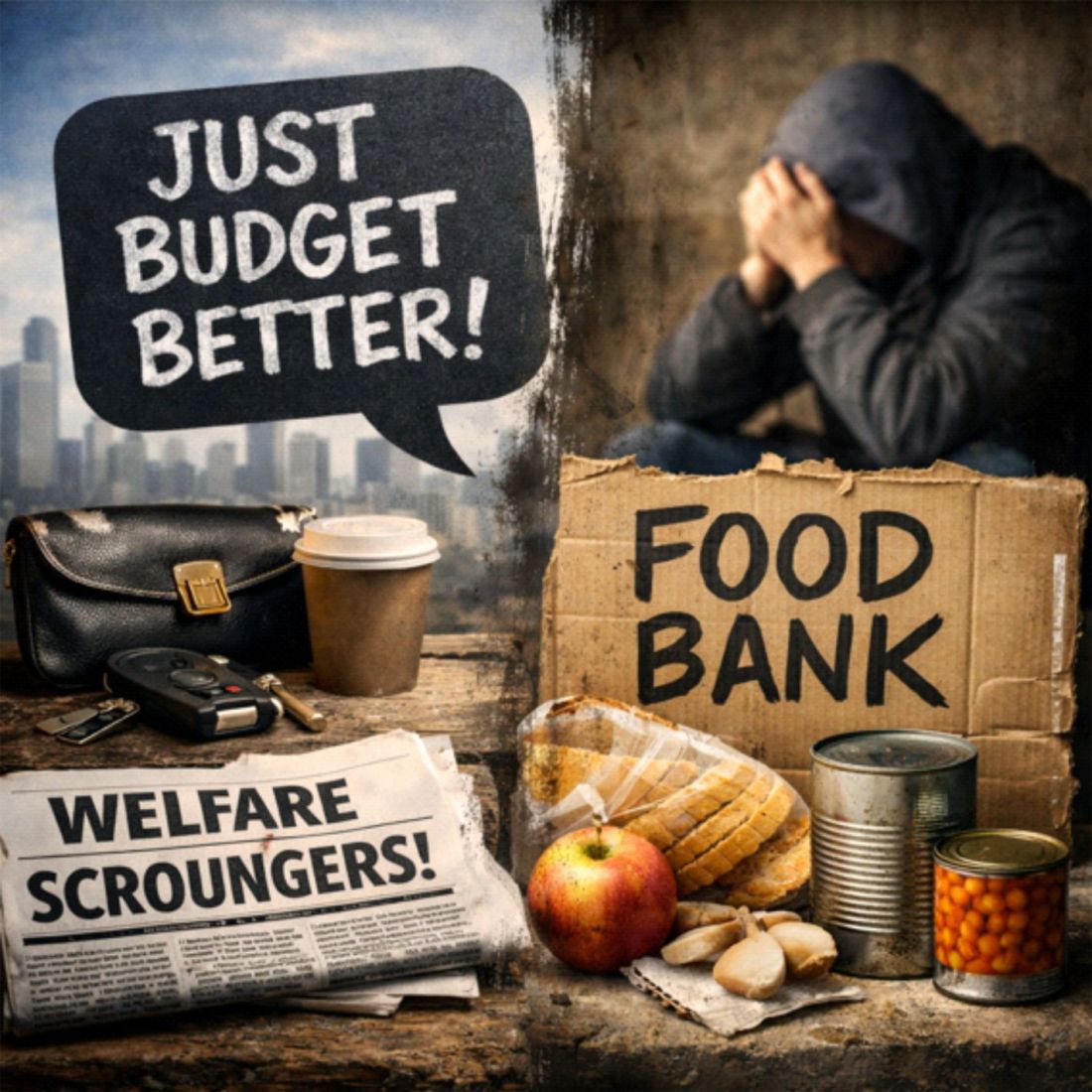
• they should “just budget better”
• they should “cope”
• they should “manage”
These beliefs do not come from nowhere.
They are the product of decades of political messaging, media framing, and cultural conditioning that equates poverty with moral weakness.
The result is a population suffering in silence – invisible to the statistics, invisible to policymakers, and invisible to the very volunteers who believe they are seeing the whole picture.
5. The uncomfortable truth about volunteers
Food banks are run by good people.
People who care.
People who give their time.
People who want to help.
But care is not the same as understanding.
Many volunteers have never experienced poverty themselves.
They have never had a debt collector at the door.
They have never had a benefits sanction.
They have never had to choose between heating and eating.
They have never had a car breakdown that wiped out their month.
They have never had a rent increase that tipped them into crisis.
For some, especially those whose own lives were made stable by wages, housing, pensions, or public services that worked better for them, the system does not look broken. It looks normal.
So when someone turns up for help, they do not always see a system producing poverty.
They see an individual in difficulty.
And once poverty is seen as an individual difficulty rather than a social outcome, the old explanations return:
• bad choices
• poor budgeting
• irresponsibility
That is where charity can become dangerous.
Charity treats the consequences of poverty. Understanding challenges the causes.
Without that understanding, some of the people helping the most visibly can end up helping the least politically, because the suffering is managed, softened, and made bearable – but the system that produces it is left untouched.
This is not a call to stop helping. It is a demand that help stops pretending the crisis begins and ends at the food bank door.
Part III – The System That Creates Poverty
6. The system that punishes default
Here is the part almost nobody talks about:
Most people are far closer to needing a food bank than they realise.
All it takes is:
• a missed paycheque
• a rent increase
• a benefits delay
• a car repair
• a boiler breakdown
• a relationship ending
• a sudden illness
• a debt repayment tipping the balance
The system is not designed to absorb shocks.
It punishes them, then calls the punishment consequence.
If you default on:
• a loan
• a subscription
• a utility bill
• a credit card
• a rent payment
…the system responds with:
• fees
• penalties
• interest
• threats
• collections
• court action
Miss a payment, and you do not simply fall behind. You are charged for falling behind. Penalised for having too little. Pursued because the margin was never there in the first place.
This is not a neutral system of personal responsibility.
This is structural fragility turned into a revenue stream.
The modern household budget is a tightrope.
One gust of wind – one unexpected bill – and the fall is immediate.
7. The devaluation nobody talks about
People often say “inflation is the problem”.
But inflation is only half the story.
The other half is:
Incomes are failing to keep pace with the cost of staying alive.
People aren’t just running harder because prices are rising.
They’re running harder because wages, benefits, and savings buy less against:
• rent
• food
• energy
• transport
• childcare
• debt
• housing
• council tax
• essentials
This is why even people who mock food bank users are often only a few bad weeks away from needing one themselves.
The system is extractive by design because every pressure point becomes an opportunity to take more.
It pulls value upward.
It pushes risk downward.
And it leaves ordinary people running faster and faster just to stay in place.
Part IV – The Narratives That Protect Us From The Truth
8. The collapse of public understanding
This is why social media threads about poverty become so toxic.
A provocative framing.
A misunderstood statistic.
A platform that rewards outrage.
A public conditioned to blame individuals.
A population under financial pressure.
A culture that equates poverty with moral failure.
The result?
A thread full of people:
• denying the problem
• mocking the vulnerable
• insisting it’s all about budgeting
• projecting their own financial fear onto others
• performing toughness to avoid confronting fragility
This is not ignorance.
It is self‑protection.
If poverty is a personal failure, then those who are not poor can reassure themselves that they are safe.
If poverty is structural, then nobody is safe.
And that is a far more frightening truth.
9. What poverty reveals about us
Poverty makes us uncomfortable because:
• it exposes the fragility of our own financial lives
• it reveals how dependent we are on a system we don’t control
• it reminds us that our stability is conditional
• it challenges the myth that hard work guarantees security
• it forces us to confront the extractive nature of the economy
• it shows us that “success” is often luck dressed up as virtue
We prefer to believe:
• “I’m safe because I’m responsible”
• “I’m secure because I work hard”
• “I’m stable because I make good choices”
But poverty whispers a different truth:
You are not as far from the edge as you think.
And that is why we cling to narratives that blame the poor.
Because if poverty is a moral failing, then we can pretend we are morally safe.
Part V – What We Must Change
10. The truth we keep refusing to face
Food banks are not a sign of generosity.
They are a sign of failure.
They are charity doing emergency repairs on an evolving political and economic crisis.
They exist because:
• wages don’t match living costs
• benefits don’t cover essentials
• housing is unaffordable
• debt is punitive
• work is insecure
• crises are common
• safety nets are thin
• shame is weaponised
• narratives are distorted
• charity is mistaken for a solution
And the people who use food banks are not the problem.
The problem is a society that:
• denies structural causes
• blames individuals
• moralises hardship
• misunderstands the data
• and refuses to see how close everyone is to the edge
11. Changing the story
If we want to fix the problem, we have to fix the story.
We need to stop talking about:
• “starving people”
• “scroungers”
• “budgeting failures”
• “irresponsibility”
And start talking about:
• crisis
• fragility
• structural pressure
• systemic failure
• the invisible millions
• the truth behind the numbers
• the difference between treating consequences and challenging causes
Because charity treats the consequences of poverty. Understanding challenges the causes.
And until we understand the causes, we will keep protecting the system that makes charity necessary.
This is not a story about one villain, one party, one prime minister, or one conspiracy. There is no need to imagine a hidden committee deliberately setting out to hollow out a country. The reality is both simpler and more disturbing: systems can produce destructive outcomes without most of the people inside them intending destruction at all.
Power, money and institutional habit tend to protect themselves. Incentives reward certain kinds of behaviour and punish others. Those who adapt to the system rise within it; those who do not are filtered out. In that sense, decline is often passed on less like a plan than like a relay race: each generation inherits a machine already in motion, modifies it slightly, and hands it on to people who fit it, or can be conditioned to fit it.
The tragedy is that many of the people making the decisions never experience the consequences directly. They do not wait for a council repair that never comes, rely on a failing bus route, choose between heating and food, or watch a local high street collapse into betting shops, empty units and managed decline. Distance makes harm abstract. Abstraction makes harm easier to justify. Over time, a money-centred system can teach intelligent, respectable people to describe human damage as efficiency, discipline, reform, or growth.
This essay argues that Britain’s present crisis is best understood as the long result of that process: not a single betrayal, but an accumulated failure of measurement, ownership, accountability and imagination. What once appeared to be modernisation often behaved, in practice, like extraction. What looked like growth often depended on borrowing against the future. And what felt, for a time, like national wealth was too often the conversion of inherited assets into private balance sheets. It is written not as a prosecution of individuals, but as an attempt to describe the machinery clearly enough that people who already sense something is wrong can see how the pieces fit together.
If this feels abstract, it is not. It appears in ordinary life as rent rising faster than wages, public services becoming harder to access, young people locked out of ownership, older people fearing insecurity, councils struggling to meet basic duties, and communities watching essential functions become more expensive, more remote and less accountable. The argument is about systems, but the consequences are human.
Act I – When the map stopped matching the territory
1. 1971: the quiet break no one saw
The story does not start with Thatcher, Blair, or Brexit. It starts in the early 1970s, when three shifts combined in ways almost nobody understood in real time:
Money was cut loose from gold.
GDP became the main scoreboard of “success”.
Britain moved towards the European project and deeper economic integration.
On paper, nothing looked catastrophic. The shops were open, factories still ran, people went to work. But underneath, the rules of the game had changed.
Money was no longer anchored to gold in the way it had been under the post-war monetary order. In the modern economy, most money would increasingly exist as bank deposits created through lending: when commercial banks make loans, they create matching deposits, rather than simply passing on pre-existing savings. This is not a fringe claim; the Bank of England explains that most money in the economy is created in this way, while also stressing that banks are constrained by regulation, profitability, liquidity, capital requirements and monetary policy.
At the same time, GDP became the dominant scoreboard of national success. That mattered because GDP measures activity more easily than quality. It can rise when a factory is built, but also when house prices surge, assets are sold, debt is issued, or disaster is repaired. It can record movement without asking whether a country is becoming more resilient, more skilled, more productive, or more capable of looking after its people.
From that moment, Britain’s leaders were increasingly flying with instruments that described the financial weather but not always the real terrain beneath them.
2. The great masking: the 1980s and 1990s
The next two decades were the masking years.
North Sea oil poured in. The old industrial base – steel, shipbuilding, cars, engineering – was still there, even if shrinking. The City of London began to boom. GDP rose. Wages, for many, rose too. Home ownership expanded. To most people, life looked like it was getting better.
But under the surface, something else was happening.
Public assets were being prepared for sale.
The financial sector was being deregulated.
The logic of “markets know best” was becoming doctrine.
The new fiat-credit system was quietly learning how to feed.
The country still felt solid because there was still something to consume: assets to sell, industries to close or restructure, oil to pump, infrastructure to sweat, and inherited civic capacity to run down. Decline, where it was happening, did not yet feel like collapse. Momentum hid it.
Act II – The extraction engine switches on
3. Money as ledger entries, not savings
By the time we hit the 1980s, the new money system was fully in play.
Private banks did not merely move money around. Through lending, they helped create it. This is not a fringe claim; it is how modern banking is described by the Bank of England. A loan creates both an asset for the bank and a deposit for the borrower. The money appears as spendable purchasing power, even though it is matched by a debt.
This did not mean banks could create money without limit. They were constrained by regulation, confidence, liquidity, capital and the central bank. But it did mean that, once deregulation and global finance accelerated, credit could expand far beyond the old intuition that investment had to come from prior saving.
The same mechanism funded:
Corporate takeovers
Private equity roll-ups
Infrastructure acquisitions
Property speculation
Foreign buyouts of British companies
Leveraged purchases of utilities, ports, airports, energy grids, rail, telecoms
Too many of Britain’s productive and strategic assets were not bought with patiently accumulated wealth. They were bought with debt, and that debt was often then loaded onto the assets themselves.
The water company didn’t just get a new owner; it got a new mortgage. The rail franchise didn’t just change hands; it inherited a balance sheet. The infrastructure that once belonged to the public became collateral in a global credit system.
On the surface, this could look like investment. In some cases it was. But in too many cases, the pattern behaved less like renewal and more like extraction: fees first, dividends first, debt first, maintenance later.
4. Thatcher: liberation on the surface, financialisation underneath
Right to Buy did something similar with housing:
It turned homes into financial assets.
It depleted council housing stock.
It created a political constituency that needed house prices to rise.
From that point on, rising asset prices weren’t just a side effect – they were a political necessity. A government that let house prices fall would be punished at the ballot box.
Thatcher arrives in this context as the political face of a deeper structural shift. She did not invent the forces that followed, and it is too simple to blame one person for them. She did, however, give political form to privatisation, deregulation, home ownership, market discipline, the Big Bang in the City and a smaller role for the state. To many people, these were not cynical ideas. They felt like release from bureaucracy, stagnation and decline.
The problem was not that every reform failed, or that every sale was corrupt. The problem was that these reforms arrived just as credit, deregulated finance and global capital were learning how to scale. Once public assets entered that system, they could be bought, leveraged, merged, sold and refinanced in ways that ordinary citizens could neither see nor control. The supertanker was moving. Whether anyone fully understood its destination is almost beside the point.
Act III – Narrative, identity and institutional capture
5. Blair: modernisation and the softening of resistance
Blair did not reverse Thatcherism; he normalised it and extended it into culture, identity and institutions. Devolution, the creation of the Scottish Parliament and Welsh Assembly, the reshaping of Northern Ireland’s institutions and the attempted regionalisation of England were sold as bringing power closer to people. There was truth in that argument. These reforms answered real democratic pressures. But they also changed the structure of sovereignty. Political authority became more fragmented, and the idea of a single shared British political identity became harder to sustain.
The expansion of higher education also had genuine benefits. It opened doors for many people who would previously have been excluded. But structurally, it also helped turn education into a debt-funded sector whose success was measured by throughput, fees and credentials. Practical, vocational, craft and experiential learning – harder to monetise and harder to flatter through headline targets – lost status.
Blair’s political genius was narrative. Modernisation, opportunity and social justice were compelling enough that many people did not notice the deeper continuity: the financialised model remained intact, citizens were increasingly treated as consumers, and identity became a powerful tool for organising political loyalty.
6. Brown: the state locks itself to the City
Brown’s period in government revealed how closely the British state had become tied to the City. Light-touch regulation, rising tax receipts from finance, an expanding credit boom and the political prestige of London as a global financial centre all reinforced one another. When the Global Financial Crisis arrived in 2008, the dependence became impossible to ignore: the state had little choice but to rescue the banks because the wider economy had become inseparable from them.
After 2008, Britain became more visibly dependent on borrowing, low interest rates and asset support. Public debt rose sharply. The Bank of England entered a world of extraordinary monetary measures. The state had rescued the financial system, but in doing so revealed how dependent it had become on that system’s continued functioning.
The point of no return may not have been a single moment, but the direction was clear: the country could no longer easily separate fiscal policy, housing, banking, pensions, public services and market confidence. They had become one machine.
Act IV – The administrative hollowing-out
7. The EU as structural amplifier
EU membership was not the sole cause of Britain’s decline. It brought trade, cooperation, rights, funding streams and a larger economic framework. Any honest account has to acknowledge that. But it also amplified some existing tendencies in the British model.
The UK becomes the EU’s financial centre rather than its industrial engine.
Procurement rules limit the state’s ability to favour domestic suppliers.
Free movement helps plug labour gaps but masks the collapse of domestic skills and training.
Regionalisation and devolution align with EU “Euro-region” thinking.
The result was not simple cause and effect. It was a reinforcing pattern. Britain leaned further into services and finance, while the political and institutional will to rebuild a serious productive base weakened.
8. The quango state and the death of responsibility
From the 1990s onward, more and more functions of the state are handed to:
regulators
agencies
authorities
commissions
non-departmental bodies
On paper, this looks modern and technocratic. In practice, it diffuses responsibility.
No one is clearly accountable for:
water quality
energy resilience
rail reliability
housing supply
infrastructure planning
productivity strategy
The effect was subtle but profound. Decisions were still made, but responsibility became difficult to locate. Ministers could blame regulators, regulators could cite frameworks, companies could point to contracts, and voters were left trying to work out who was actually in charge. A state that cannot clearly assign responsibility slowly loses the ability to act strategically.
9. The collapse of local government
At the same time, local government is quietly gutted.
Funding is cut.
Assets are sold.
Services are outsourced.
Expertise is lost.
Councils take on debt.
Local authorities were once the practical layer of the state – the people who actually knew where the pipes were, how the roads worked, who needed help, what the town needed.
As local government was hollowed out, the country lost its most grounded layer of public competence. This is where the argument stops being abstract. It shows up as potholes that do not get fixed, social care packages that cannot be funded, libraries closing, planning departments overwhelmed, youth services disappearing, and councils forced into emergency financial measures. The civic fabric frays not all at once, but service by service, street by street.
Act V – Austerity, panic and the first visible cracks
10. Austerity: pretending the system can be managed
After 2008, austerity was sold as living within our means. There was a case, on paper, for worrying about debt and deficits. But austerity also attempted to maintain the appearance of fiscal discipline inside an economy whose deeper problem was weak productivity, over-reliance on asset inflation, and a damaged public realm.
Infrastructure investment is slashed.
Public services deteriorate.
Local government implodes further.
Productivity falls again.
Austerity did not repair the underlying model. In many places, it accelerated the decay of the state’s capacity to respond. Cutting maintenance can make a spreadsheet look better this year while making the eventual bill larger. Britain did this with buildings, roads, courts, prisons, councils, hospitals and people.
11. The triple lock: a small act of mercy
The triple lock was, in part, a political device. But it was also an admission that some people were exposed to a system they could no longer realistically escape. Older people without significant assets, private pensions or family support were vulnerable to poverty in a way that sat uneasily beside the country’s claims about decency.
That does not mean the policy is beyond debate. Any serious fiscal settlement must ask hard questions about intergenerational fairness, working-age poverty and the tax base. But the symbolism matters. When even modest protections are treated mainly as accounting problems, it reveals how little shelter remains for people who did nothing wrong except grow old inside a system that changed around them.
12. The multiplier effect: confession in technocratic language
The multiplier is a real economic concept, not a trick. Public spending can generate more output than it costs, especially when it builds capacity, skills, infrastructure or resilience. But when it becomes the only acceptable justification for doing almost anything, it reveals a deeper anxiety: spending must be defended not because it is necessary for national survival, but because it can be made to flatter the growth figures enough to reassure markets.
In that sense, technocratic language can become a confession. It says: we are no longer arguing from abundance, confidence or strategy. We are arguing from constraint.
13. Defence: the unaffordable necessity
Defence exposes the limits of the system in a different way. Security requires long-term commitments, industrial depth, stockpiles, engineering capacity and political patience. It does not always produce the kind of immediate, flattering GDP effect that short-term fiscal politics prefers.
A country with little fiscal room and a weakened industrial base can promise seriousness more easily than it can fund it. The question is delayed because answering it honestly would expose a hard truth: sovereignty is not a slogan. It is a capability, and capability has to be paid for before the emergency arrives.
Act VI – Permanent crisis and the end of easy recovery
14. The triple shock: Brexit, Covid and Ukraine
From 2016 onwards, crisis stopped being an event and became a governing condition. Brexit, Covid and the war in Ukraine each had different causes and different arguments around them. But each revealed the same weakness: the productive base was too thin, the state too hollowed out, the housing and energy systems too fragile, and the public finances too dependent on confidence. The repeated response was to borrow, inflate, patch and move on.
15. The gilt market: the real constraint in the room
For decades, Britain could borrow because:
It had industry.
It had oil.
It had productivity.
It had political stability.
It had a reputation for seriousness.
Those days are gone.
Now:
Debt is high.
Productivity is low.
Growth is weak.
Assets are foreign-owned.
Infrastructure is degraded.
The tax base is strained.
The gilt market – those who buy and price UK government debt – is not a conspiracy. It is a mechanism. But mechanisms can rule countries as effectively as people do. When debt is high, productivity weak and credibility fragile, the price of borrowing becomes a political force.
A small misstep in borrowing, a hint of fiscal adventurism, and yields can move quickly. The Truss mini-budget offered a glimpse of that vulnerability. Whatever one thinks of the politics, the lesson was stark: market confidence is now part of the constitution in all but name.
The brutal truth is not that Britain cannot borrow at all. It is that borrowing now carries far less room for error than it once did.
16. The IMF shadow: why old rescue routes look weaker now
In the past, an IMF bailout was painful but survivable because:
There was industry to revive.
There were exports to grow.
There were assets to leverage.
There was domestic capital to mobilise.
There was institutional capacity to implement reforms.
Today, those levers are gone.
Industry is hollowed out.
Exports are weak.
Assets are already leveraged or foreign-owned.
Domestic capital is thin.
The state has lost competence.
An external fiscal crisis today would therefore be more than a technical adjustment. It would collide with already stretched households, weakened services, low trust and limited institutional capacity.
Deep cuts to services.
Mass unemployment.
Social unrest.
A collapse in living standards.
Unlike earlier periods of crisis, there is no obvious unused reserve of productive capacity waiting to be revived quickly. The recovery mechanisms have not vanished entirely, but many have been weakened, sold, outsourced or neglected.
Act VII – Politics without power
17. The incentive trap in Westminster
Inside Westminster, the incentives are all wrong.
GDP rewards consumption and asset inflation, not production.
Borrowing boosts GDP in the short term.
Voters punish visible pain and reward short-term stability.
Politicians are on short cycles and think in headlines, not decades.
So they:
Avoid structural reform.
Lean on borrowing.
Talk about “growth” without saying how.
Perform competence rather than exercise it.
This is not because every politician is stupid or malicious. It is because the incentive structure punishes honesty. Voters punish visible pain. Markets punish fiscal recklessness. Parties punish internal dissent. Media cycles punish complexity. The result is a politics that performs control while avoiding the deeper admission that control has been lost.
18. Citizen to consumer, nation to market
Culturally, the shift is complete.
People are treated as consumers, not citizens.
Politics is treated as a product, not a duty.
Identity is fragmented and politicised.
Shared narratives are replaced by targeted messaging.
Institutions that once bound people together – churches, unions, civic groups, local associations – are weakened. The sense of “we” erodes.
A country that no longer sees itself as a collective cannot easily mobilise for sacrifice or renewal. This matters because rebuilding is not only a financial problem. It is a moral and cultural one. People will not accept hardship for a future they do not believe exists, led by institutions they do not trust, in a country they no longer feel part of.
19. The collapse of trust
Trust has drained away:
in government
in media
in experts
in markets
in public services
in the political class itself
Without trust, you cannot ask people to endure pain for a better future. You cannot ask them to believe in a plan. You cannot ask them to hold the line.
So politicians do not ask. They perform. They manage. They delay. They speak in words that sound large – growth, fairness, security, change – but often avoid the smaller, harder question: what capacity do we actually still possess?
Act VIII – Where we are now
We arrive at the present with:
A state that costs more than the country can produce.
A political class that has the appearance of power but very little real agency.
A money system that has already strip-mined the productive base.
A bond market that will not tolerate serious borrowing.
An IMF option that would put people on the streets.
A population already on the edge, with many one shock away from crisis.
Institutions too weak to manage a controlled transition.
A culture too fragmented to agree on what should come next.
Those closest to the numbers can see the bind. Public debt remains high by post-war standards: the Office for National Statistics placed public sector net debt excluding public sector banks at around the mid-90s as a percentage of GDP in 2025, levels last seen in the early 1960s. The Office for Budget Responsibility has also warned that debt has ratcheted upward over the past 25 years, while long-term pressures from demographics, pensions, health, climate risk and weak productivity continue to narrow the room for manoeuvre. The country is not bankrupt in a simple household sense, but it is constrained in ways that make the old political promises increasingly implausible.
The fear in government is not simply losing an election. It is being in office when the illusion finally breaks: when borrowing becomes too expensive, cuts become socially explosive, tax rises become politically intolerable, and growth does not arrive to save the arithmetic.
So they cling to narrative. They talk about “growth”, “investment”, “fairness”, “security”, “change” – but never in a way that confronts the core reality:
We have borrowed against a future that may no longer arrive on the terms we assumed.
We have sold or leveraged assets that could have helped us rebuild.
We have hollowed out institutions that might have managed the transition.
We have allowed money, ownership and measurement to outrun the real economy beneath them.
And now we are at the point where:
More borrowing risks a crisis we cannot recover from.
Less borrowing exposes how little real capacity we have left.
An IMF route would be socially explosive.
Doing nothing just runs the clock down.
Act IX – What comes next
The future is unlikely to be designed successfully by the same thinking that produced the present. Much of current politics still treats a money-centred, growth-led system as the only realistic framework. It is the lens through which problems are defined, and therefore the lens through which solutions are proposed. But if the diagnosis in this essay is even partly right, that framework is no longer enough.
It would have been easier if this had been recognised earlier, when institutions were stronger, public trust was higher and the margin for error was wider. But money is persuasive. It buys access, comfort, insulation, influence and the illusion of control. For those who benefit from a money-centred system, the system can appear not broken but successful. For those outside its protection, its consequences arrive as insecurity, dependency and the steady loss of genuine choice.
The alternative cannot simply be another slogan about growth. It has to begin from a different organising principle: from money-centred to people-centred; from remote control to local responsibility; from maximum financial efficiency to real-world resilience; from treating essentials as opportunities for extraction to treating them as the foundation of human freedom.
That does not mean pretending Britain can retreat from the world, or that every supply chain can be made local. It means asking, honestly, which things are too important to leave entirely exposed to distant markets, fragile logistics, leveraged ownership or geopolitical shocks. Food, energy, water, housing, care, transport, basic services and practical skills are not just sectors of the economy. They are the conditions under which people can live independently and with peace.
A more serious model would rebuild local and regional capacity wherever possible. It would shorten supply chains where doing so improves resilience. It would restore practical competence inside government. It would distinguish between markets that serve people and markets that hold people hostage. It would ask whether a basic living standard should be treated as a civilised floor beneath which no one is allowed to fall, rather than as a residual outcome of whatever the market happens to deliver.
This is where the wider body of work linked below matters. The local economy and governance system, the basic living standard, contribution culture and a people-first society are not decorative appendices to this argument. They are attempts to explore what comes after the diagnosis: how communities might regain agency, how essentials might be secured, how work might be valued beyond extraction, and how governance might be brought close enough to reality that responsibility can once again be seen and felt.
The choice may still be voluntary. But the window is narrowing. If change is not chosen while there is still some room to shape it, it may arrive through necessity: through scarcity, breakdown, fiscal constraint, institutional failure and social pain. The task now is to make the humane alternative visible before circumstances make it unavoidable.
The final question
The question, then, is not whether everything can go on as it is. It cannot. The question is whether change will be shaped honestly and deliberately around people and real communities, or forced on the country by events.
An honest politics would begin by admitting that the old story is over. It would stop pretending that every problem can be solved by another round of borrowing, another slogan about growth, another institutional reform, another private finance structure, another delay. It would ask what Britain must be able to do for itself, what must be rebuilt, what must be protected, and what can no longer be afforded.
When the state costs more than the country can sustainably support, when the system serves itself more easily than it serves the people, and when the tools that once worked now deepen the damage, what matters more: preserving the appearance of government, or preserving the life and dignity of the people?
That is the question this whole story leads to. It is not a call for despair. It is a call for seriousness, responsibility and imagination. A country can survive a great deal if it is willing to look directly at reality and rebuild around the dignity of its people. What it cannot survive forever is a governing class, a financial system and a public conversation built around not seeing what is already in front of us.
Further Reading: Building What Comes After the Old Model
The works below expand the constructive side of this argument.
If Borrowing into Oblivion explains how Britain was hollowed out, these pieces explore how a people‑centred, locally grounded, resilient model could be built in its place.
They are arranged in a logical reading order: foundations → systems → culture → philosophy → future communities → wider context.
A complete, detailed outline of the Basic Living Standard: a guaranteed foundation beneath which no one falls. This text explains the model’s structure, purpose and practical implications, and serves as the core reference for the people‑first framework.
A concise, accessible introduction to the Basic Living Standard. Ideal for readers who want a clear overview before exploring the full technical version.
A deeper exploration of the mechanics behind the model. This piece explains why the Basic Living Standard strengthens communities, reduces fragility and avoids the dependency traps of traditional welfare systems.
A practical blueprint for rebuilding local economies and restoring local governance. It describes how decision‑making can be brought closer to communities, and how real production, skills and civic competence can be revived.
5. The Contribution Culture: Transforming Work, Business and Governance
A vision for shifting society from extraction to contribution. This work explores how businesses, public bodies and communities can operate on shared purpose, mutual responsibility and long‑term value rather than short‑term gain.
6. A Deep Dive Guide to the Philosophy of a People‑First Society
The philosophical foundation for the entire model. This guide explains the values and worldview behind a society organised around people rather than markets, metrics or centralised control.
7. A Future of Communities: Building the New World Without Oil, Manipulated Money and Centralised Control
A long‑form exploration of how communities can thrive in a world where old economic assumptions – cheap energy, easy credit, centralised authority – no longer hold. It describes what resilient, self‑directed communities might look like in practice.
A reflective piece examining how many of the promises of the late‑20th‑century economic model were illusions. It provides the emotional and cultural context for why a new model is not only desirable but necessary.
Source notes
Key factual claims in this essay are supported by publicly available material from the Bank of England on money creation, the Office for National Statistics on public sector finances, and the Office for Budget Responsibility on fiscal risks and debt sustainability. These sources do not prove every interpretation offered here, but they ground the central factual context: modern bank lending creates deposits, UK debt remains high by post-war standards, and official fiscal institutions continue to warn about long-term pressures.
The debate after the Makerfield by-election has been framed as a problem of division:
Too many parties on the right, too many similar candidates, too many votes scattered across too many competing brands.
That is the easy explanation. It is also the wrong one.
The right is not losing because it is divided. It is divided because it is lost.
The familiar argument has already begun again. One party should “step aside” so another can win. A Reform MP has suggested that Restore should withdraw, or would otherwise carry responsibility if Reform failed to take power at the next general election. The Conservatives make the same claim when they insist Reform is splitting “their” vote.
Technically, yes: the vote was split.
But that fact does not prove what its loudest interpreters think it proves.
The numbers in Makerfield point to something more serious:
Even on the generous assumption that the Conservatives, Reform and Restore could have combined their votes, they still would not have beaten Burnham.
That matters because Makerfield was not a neutral test.
Yes, it had its own peculiar dynamics. The “get Burnham, get rid of Starmer” bounce created a surge of anti-Labour government energy that will not automatically repeat elsewhere.
This was a highly specific contest shaped by a high-profile figure, local sentiment and a desire to send a message.
Yet even with those favourable conditions, the result was not good for the right, and it should be setting off alarms in all three party headquarters.
If a by-election with a uniquely energised anti-government mood still could not produce a right-wing contender capable of overtaking Labour, then the problem is not simply the split.
The problem is that none of the parties is yet strong enough, connected enough or trusted enough to win in a way that really matters, even when the wind is supposedly at its back.
Aberdeen South Doesn’t Change the Picture – Even Though the Conservatives Won
If Makerfield exposed the right’s weakness in England, Aberdeen South exposed something just as important in Scotland, but from the opposite direction.
The Conservatives won Aberdeen South, and they are already presenting it as evidence of a comeback.
But that interpretation collapses the moment the context is taken seriously.
Aberdeen South was shaped by one defining issue:
The future of North Sea drilling – a question that cuts across party lines, regional identity and economic survival.
This was a contest in which the Conservatives could position themselves as defenders of local industry against a Labour Party perceived, rightly or wrongly, as hostile to it.
In other words, Aberdeen South was tailor-made for a Conservative win.
That does not make the result meaningless, but it does limit what can honestly be claimed from it.
It shows that the Conservatives can still win where the central issue aligns almost perfectly with their message, their history and their local brand.
That is not a national revival. It is a minimum expectation in conditions that were almost perfectly aligned.
Aberdeen South does not contradict the warning of Makerfield. It reinforces it. If the Conservatives can win only where the stars align perfectly, and Reform and Restore cannot win even when anti-government conditions are favourable, then the problem is not the seats.
The problem is the right itself.
The Entitlement Problem: Three Parties, One Assumption
The demand that another party should step aside is not a strategy.
It is entitlement dressed up as electoral realism.
Each party behaves as though it is the rightful heir to the right’s future:
• The Conservatives believe they deserve priority because they have the machine, the history and the infrastructure.
• Reform believes it deserves priority because it has momentum and a charismatic leader.
• Restore believes it deserves priority because it claims to represent “real conservatism.”
But none of them has earned the authority to make that claim.
All three parties are fighting over a conservatism none of them can reach because none of them has yet shown that it understands what conservatism actually requires.
Conservatism, properly understood, is not merely reaction, nostalgia or grievance. It is a discipline of stewardship: responsibility to place, continuity, community, inherited duty and the moral obligation to preserve what is valuable while repairing what is broken.
If any one of these parties were truly resonating with the public, genuinely connecting with people and the issues shaping their lives, it would matter far less how many similar parties stood against it.
It would still find a way to win.
The fact that none of them can do that right now is the real story of both Makerfield and Aberdeen South.
Reform’s Paradox: Performance at the Top, Weakness Everywhere Else
Reform has one of the most media‑savvy political communicators in the country.
Nigel Farage is, by any measure, a highly effective performer in today’s media-driven politics. But a charismatic leader, and a handful of MPs able to survive the media scramble, is not a formula for government.
The issue is not the candidates themselves. It is the party around them.
Reform’s weakness is structural:
• its candidate-selection process is thin,
• its training and support systems are underdeveloped,
• its organisational culture is still built for insurgency, not governance.
If Reform wants to be a party of power, it has to act like one.
It needs to dress for the job it wants, not the one it already has.
And credibility is not a performance, but a discipline.
In today’s politics, authenticity is often performed for the camera, but Reform is not yet performing seriousness at street level – in its candidate depth, organisation and policy discipline.
Voters can sense when a party is not yet serious about the responsibilities it claims to seek.
Reform’s paradox is simple:
It has a leader who can command a room, but not yet a party that can command the country.
The Conservatives’ Advantage – and Their Curse
Only the Conservatives currently have the basic machinery of a party capable of fighting at scale:
• a functioning candidate‑selection machine,
• media‑ready candidates,
• and the ability to field hundreds of people who can survive the daily media grind.
That does not mean they should lead.
It does not mean they deserve to lead.
And it certainly does not mean they are the right vehicle for renewal.
But it does mean Reform and Restore are still a long way from having the organisational robustness required to compete across the country.
The public is waiting for someone to lead, but the political class is looking the wrong way.
Restore’s Challenge: Values Without Viability
Restore claims to represent “real conservatism”, but it has not yet offered a coherent, interconnected policy framework that speaks to the real issues of the day.
Nor do the Conservatives.
Nor does Reform.
That is the deeper truth:
None of the parties on the right are fundamentally conservative in the sense people need.
They have slogans.
They have instincts.
They have grievances.
But they do not yet have a governing framework grounded in stewardship, locality, responsibility, continuity and community.
Politics without moral purpose becomes performance, not service.
The System Has Changed – And the Right Hasn’t
The assumption that “the right will form the next government anyway” is also a form of entitlement.
A real mandate comes only from:
• winning a majority,
• making clear, deliverable commitments that are thought through and result in the outcomes people need,
• which are then honoured with integrity.
That is difficult today because politics has been absorbed into a wider system:
A system that constrains, redirects and often neutralises the very governments elected to change it – through institutional inertia, legal frameworks, global economic pressures and the permanent machinery of administration.
Governments inherit a system they do not control, and then get blamed for failing to change it.
Any party that does not recognise this, and does not level with the public about where we are, why we are here and how we got here, will find itself in exactly the same position Labour now occupies, and the Conservatives occupied before them.
The right cannot win by pretending the old world still exists.
The Part None of Them Wants to Hear
This is the part none of them wants to hear:
The uncomfortable truth is that none of these parties has yet shown it understands the tradition it claims to represent.
They keep insisting they are conservatives, yet too little in their behaviour suggests they understand what conservatism is, how it was lost, or why the right has collectively ended up in this mess.
They have forgotten the meaning of the very tradition they all claim to defend.
The UK is at a crisis point. The public is weighing the credibility of every option on the right, hoping that this time the label on the tin will match the contents inside.
People are tired of buying promises that evaporate the moment the votes are counted.
The problem is not how the deckchairs are arranged. The problem is that the ship itself is taking on water, and the public knows it. They do not want another reshuffle of the same broken parts. They want to be rescued from the very real risk of the whole UK ship going down.
That requires something more serious than a new slogan or a rearranged alliance.
Not a novelty vessel. Not a rebranded dinghy. Not a patched-up version of the one already taking on water.
It requires a traditional ship: one that recognises its own value, its heritage and its purpose, rather than accepting the value assigned to it by the same forces that have spent decades weakening what it once protected.
Until the right understands that, it is not ready to lead.
The Real Lesson of Makerfield – and Aberdeen South
The lesson of Makerfield and Aberdeen South is not that the right needs fewer parties.
It is that the right needs a purpose strong enough to shape those parties into something capable of governing.
Together, these contests show that:
• The right has energy, but no coherence.
• It has anger, but no shared purpose.
• It has instincts, but no strategy.
• It has parties, but no movement.
• It has performers, but not enough authenticity.
• It has leaders, but not enough of the right candidates.
• It has values, but no viable policies.
• It has ambition, but no understanding of the system it seeks to govern.
Until the right understands the system it is operating in, stops demanding that others step aside, and starts building real connection, depth and honesty, it will keep losing elections it believes it should win.
The right does not need fewer parties.
It needs a purpose that can survive reality.
Until then, “step aside” politics is not strategy. It is avoidance – a distraction from the deeper work none of the parties has yet begun.
Until then, “step aside” politics is not strategy. It is avoidance – a distraction from the deeper work none of the parties has yet begun.
We are living through a moment when people are looking for leadership – and finding performance instead.
But in our moment – a moment of economic fragility, social fracture, and institutional decay – the adults never arrived.
What we have instead is a political class that knows how to look like it is governing, but increasingly struggles to govern with courage, honesty, or purpose.
“People do not need perfect leaders. They need leaders who are real.”
Yet what we see today is not real leadership.
It is the performance of its absence.
1. Politics Is No Longer About Governing
Modern politics is no longer a vocation.
It is a career path, a branding exercise, and a survival game.
That does not mean every politician lacks integrity. Many enter public life for decent reasons. But they enter a machine whose incentives steadily pull them away from service and toward survival.
The incentives are brutally simple:
• Win the selection
• Win the seat
• Keep the seat
• Protect the party
• Protect the narrative
• Protect yourself
Everything else – policy, principle, public service – is secondary.
This is why scandal‑mining, character assassination, and narrative warfare dominate the political landscape.
They are not aberrations.
They are the natural output of a system where optics matter more than outcomes.
“If you are more focused on how politics looks than what politics does, you are already part of the problem.”
Today, that problem is the system itself.
2. This Did Not Happen Overnight
The dysfunction we see today did not appear suddenly.
It is the result of decades of structural drift – and it needs to be understood honestly.
By “the system”, I do not simply mean Parliament, parties, elections, advisers, donors, media cycles, and polling operations. Those are the visible mechanics of politics. They matter, but they are only one layer.
The political system is itself a system within a wider system: a money-centric, extractive order that has captured almost every institution it touches. It is a philosophy of life that places money before people, extraction before care, growth before wellbeing, and measurable value before human value.
That wider system now shapes how politics behaves, how the media frames truth, how public services are funded, how work is organised, how communities are treated, and how success itself is defined.
Nothing functions effectively for long when it is built on a broken philosophy.
Politics has not escaped this logic. It has absorbed it.
Politics became:
• Market‑constrained
• Donor‑dependent
• Media‑shaped
• Poll‑driven
• Risk‑averse
• Narrative‑obsessed
Parties became machines for winning, not governing.
Policy became a branding exercise.
Leadership became a performance.
And morality – the quiet compass that once guided public life – was replaced by legality.
“Real leadership begins where self‑interest ends.”
But in modern politics, self‑interest is the only safe place to stand.
Real leadership would look less like message discipline and more like truth-telling – even when it costs.
5. Scandal Politics Fills the Vacuum Left by the Absence of Real Leadership
When a political system cannot solve real problems, it shifts to the only arena where it can act: narrative warfare.
This is why we see:
• Personal attacks
• Dredging up old stories
• Targeting families
• Manufactured outrage
• Culture‑war distractions
These behaviours are not moral failings.
They are structural inevitabilities.
When the system cannot deliver solutions, it delivers stories.
When it cannot offer leadership, it offers theatre.
When it cannot inspire trust, it manufactures fear.
Scandal becomes the currency of a system that has run out of truth.
When public services strain, housing becomes unaffordable, or communities are left to carry the cost of decisions made elsewhere, the political response is too often not structural reform. It is a change of story, a new slogan, a symbolic fight, or another managed outrage.
6. The Public Sees the Performance – and Withdraws
People are not disengaged.
They are disillusioned.
They see:
• The avoidance of real issues
• The obsession with optics
• The lack of courage
• The absence of vision
• The endless recycling of political theatre
This is why trust collapses.
This is why turnout falls.
This is why populism rises.
This is why “None of the Above” becomes a meaningful political identity.
“People are not rejecting democracy. They are rejecting the people who have hijacked it.”
The public is not apathetic.
They are waiting for adults who never arrive.
7. We Are Watching a Structural Tragedy
Politics today is not a comedy of errors.
It is a tragedy of constraints.
The actors are not villains.
They are trapped.
The system is not malfunctioning.
It is functioning as the wider extractive order requires it to function: to preserve itself, protect its interests, and keep people arguing about symptoms while the underlying philosophy remains untouched.
And until the system changes, the behaviour cannot.
Closing: The Curtain Will Fall – The Question Is What Comes After
Every political system reaches a moment when the performance can no longer continue.
When the gap between what politics pretends to be and what politics is becomes too wide to ignore.
When the public stops applauding and starts demanding something real.
We are living in that moment now.
The tragedy is not that our leaders are inadequate.
It is that the system has made adequacy impossible.
But systems are not permanent.
They are choices repeated until they feel inevitable.
“The moment we stop accepting the world as it is, we begin to create the world as it should be.”
The curtain will fall on this performance.
The only question is whether we will demand real leadership – and a system built around people rather than money – or continue rewarding the performance in its place.
We live in a world where many people quietly carry guilt for failing at dreams they never truly chose.
They look at their lives, see the gap between expectation and reality, and assume the fault must lie within themselves. They believe they lacked discipline, talent, intelligence, resilience, or worth.
But they are not responsible for the dreams they were handed.
They didn’t design the system that shaped them.
They didn’t choose the story they were born into.
The only “mistake” they made – if it can even be called that – was believing a narrative so compelling, so omnipresent, that resisting it felt impossible.
This essay is about that gap: the space between the life people were promised and the life the modern system made possible. It looks at education, work, housing, relationships, community, and faith not as separate problems, but as parts of the same story.
The Story We Inherit
From childhood, we are taught that we are small parts of something vast: society, the economy, the world order.
We are told that the world is too big, too complex, and too specialised for ordinary people to understand. We are encouraged to trust the experts, leaders, institutions, and systems that claim to know better.
And so we do.
We accept the roles we are given.
We chase the dreams placed in front of us.
We measure ourselves against standards we never agreed to.
When those dreams break, we assume we broke them.
But the truth is far simpler:
We are living inside a story written by others.
A Concrete Example: The University Dream
Nowhere is this clearer than in the story told to young people about their future.
For decades, young people have been encouraged – and often pressured – to believe that a bright future begins with university.
They are told that higher education is the gateway to success, stability, and opportunity. They are warned that without a degree, they will fall behind.
But many of these young people are not suited to that pathway.
And worse, the pathway that would suit them often doesn’t exist.
So they follow the script:
They take on debt to study courses that no employer needs.
They graduate into industries that never promised them a place.
They discover that the “glittering career” they were sold doesn’t exist.
They end up in minimum‑wage jobs that cannot support independent living.
They face the spectre of rising debt they can never realistically repay.
And then – heartbreakingly – they blame themselves.
They think they failed.
They think they weren’t good enough.
They think they made bad choices.
But the truth is this:
They were following someone else’s dream – a dream designed by a system that needed them to believe in it.
This is what a broken dream looks like: not a personal failure, but a structural one.
How the System Removed the Pathways That Once Worked
The tragedy runs deeper than individual disappointment. Over the past few decades, the system has quietly removed many of the circumstances, opportunities, and pathways that once allowed ordinary people to build meaningful lives.
This didn’t happen because traditional jobs “couldn’t be monetised.”
It happened because the pursuit of profit and market dominance made their removal more valuable than their preservation.
When globalisation, deregulation, and financialisation took hold, the priority became:
lowering labour costs
increasing shareholder returns
consolidating market power
maximising efficiency
expanding corporate reach
And in that pursuit, the system dismantled the foundations of community‑rooted work.
There was a time when young people who weren’t academic – or simply weren’t ready for academia – could enter the world through apprenticeships, trades, local industries, and community‑based jobs.
These pathways offered:
dignity
identity
belonging
progression
stability
contribution
purpose
But these jobs required long-term investment in people, places, and skills. They created strong communities, and strong communities are harder to control. They produced independence, and independence is harder to monetise indirectly.
So they were moved offshore, automated, consolidated, or eliminated.
Not because they lacked value, but because their destruction generated more value for the system than their continuation.
The experiential route – the one that shaped generations – collapsed under the weight of market logic.
And with those pathways gone, millions of young people were funnelled into the only route the system still recognised: university. Not because it suited them, but because it was measurable, monetisable, and profitable.
The result is a generation carrying debt for qualifications employers do not always need, working in jobs that often do not pay enough to live independently, while believing they failed – when in truth, the system removed many of the alternatives.
And once work no longer guarantees security, the consequences spread into every other part of life.
What a Real Life Once Looked Like
Before the system reshaped everything around extraction and efficiency, a working life offered something simple and profound: enough.
Working a normal week once meant:
your needs were met
you had independence
you had dignity
you had a place in your community
you had peace
It wasn’t glamorous.
It wasn’t excessive.
It wasn’t designed to impress anyone.
But it was enough – and enough was a life worth having.
People did not need to chase endless growth, endless consumption, or endless status.
They did not need to “keep up.” They did not need to perform success. They simply lived, contributed, and belonged.
And the irony – the painful irony – is that many who defend the current system will scoff at this. They will dismiss that kind of life as inadequate, small, or unambitious. They will insist that “people should want more.”
But these are often the same people who are constantly chasing an ever-moving baseline – the invisible line between those who are “keeping up” and those who are being left behind. That line shifts every year, ensuring that nobody ever truly arrives.
The tragedy is that the life they dismiss is the life most people are quietly longing for.
A life where work provides stability, not anxiety.
A life where independence is possible without debt.
A life where value isn’t measured in consumption.
A life where peace isn’t a luxury.
This is what the system took away – not by accident, but because an extractive economy cannot profit from people who already have enough.
This pressure to perform a successful life does not stop at work or money. It reaches into the way people love, commit, and choose partners.
The Relationship Trap
The same forces that reshaped work and opportunity have also reshaped relationships.
Many young people now feel pressure to conform to a relationship ideal that has less to do with genuine connection and more to do with external validation.
They are encouraged to see relationships as:
a marker of adulthood
a symbol of stability
a sign of social success
something that “looks right” to others
And because so many grow up without the social grounding that once came from community life, they often enter relationships without the skills, experience, or self‑knowledge that previous generations absorbed naturally.
For most of human history, young people learned how to understand others – and themselves – through osmosis:
in extended families
in neighbourhoods
in intergenerational communities
in shared public spaces
in workplaces where people mixed across ages and backgrounds
These environments taught subtle but essential skills:
reading intentions
recognising values
understanding boundaries
navigating conflict
spotting red flags
knowing what compatibility actually means
Today, those environments have collapsed.
Young people now learn about relationships from:
distant sources
digital platforms
curated personas
algorithmic feeds
entertainment built on fantasy
These sources cannot teach the realities of human connection.
So when someone appears to “tick the boxes,” many people compromise themselves – not out of weakness, but out of conditioning. They choose relationships based on how they look, how they appear to others, and how neatly they fit the script.
And only later – sometimes years later – do they awaken to who they really are.
By then, the cost can be enormous:
relationship breakdown
divorce
emotional fallout
or staying in a relationship they should never have been in, out of duty or fear
This is another broken dream.
Not because people failed, but because they were never taught the skills that make relationships work.
The same pattern appears again in housing: a basic human need turned into a test of individual worth.
The Housing Illusion
Housing, one of the most basic human needs, has been transformed into one of the most aggressively monetised assets in the modern economy.
What should be a foundation for stability has become a vehicle for speculation, investment, and wealth extraction.
This shift didn’t happen because people suddenly needed more space. It happened because the financial system discovered that housing could be used to generate enormous returns – not for the people who live in homes, but for the people who treat them as assets.
As a result:
house prices have expanded far beyond what any normal person can keep up with
wages have not kept pace
the cost of entry has become prohibitive
and the dream of home ownership has drifted out of reach
Not because people failed.
But because the system changed the rules.
Housing is now one of the key performers in the economic model we live under. Rising house prices inflate GDP, fuel lending, and enrich those who benefit from asset inflation.
And the irony is brutal:
People don’t need more than one home to live in.
But the system rewards those who collect homes, not those who need one.
The people who need the security of a home most are the very people the system refuses to lend to. Meanwhile, those who already have assets are given the loans, the leverage, and the opportunities to profit from the very people who are locked out.
So the people with the least security are placed at the mercy of those who have the most.
This increasingly looks less like a natural market outcome and more like a structural design.
And once again, people blame themselves for failing to achieve a dream that was quietly taken away.
Once people are priced out of security, they are told to prove themselves harder. This is where the myth of meritocracy becomes so powerful.
The Meritocracy Myth
Another broken dream – perhaps the most quietly corrosive of all – is the idea of meritocracy.
People are told that success comes from talent, hard work, and personal merit. But in practice, meritocracy rewards something very different: conformity.
To “get on,” people must:
follow the academic route
accumulate credentials
demonstrate compliance
avoid asking uncomfortable questions
fit neatly into the expectations of the system
This isn’t merit.
It’s alignment.
Because the system defines merit through measurable outputs – grades, salaries, promotions, performance metrics – people are pushed into a lifelong cycle of proving themselves through numbers that never stop moving.
On one side, they must earn more just to keep up with rising costs.
On the other, the real value of their earnings keeps falling.
So they run faster, work harder, and sacrifice more – not to get ahead, but simply to avoid falling behind.
And the people who “succeed” in this system are often those who have learned not to question it. They rise by saying yes, by fitting the mould, by demonstrating reliability through compliance rather than insight.
This is how we end up with a managerial class that can confuse management with leadership: people trained to defer to systems, specialists, and advisers, sometimes without understanding the human realities beneath the decisions they make.
This isn’t a failure of individuals.
It’s the predictable outcome of a system that rewards conformity over clarity, compliance over courage, and credentials over competence.
Yet beneath education, work, housing, and status lies something even deeper: the loss of community itself.
The Collapse of Community
Perhaps the greatest tragedy of all is the collapse of community – the quiet erosion of the environments that once taught people who they were, how to live, and what truly mattered.
For most of human history, community wasn’t an optional extra.
It was the structure that shaped identity, belonging, and meaning.
It taught people:
how to relate
how to contribute
how to resolve conflict
how to care
how to be seen
how to be human
These lessons weren’t taught formally.
They were absorbed through osmosis – in shared spaces, intergenerational relationships, and the natural rhythms of communal life.
But as the modern system reorganised itself around money, efficiency, and individual performance, community became an inconvenience.
It could not easily be monetised. It could not easily be measured. It could not easily be turned into a product.
So it was allowed to wither.
People have been encouraged to see themselves as isolated units – consumers, workers, individuals – rather than members of a shared life.
The narratives shifted from:
“We belong to each other” to “You’re on your own.”
And in that shift, something essential was lost.
We are being conditioned to forget who we really are and what a life with value actually looks like.
A life built on:
people
relationships
shared purpose
mutual support
place
belonging
Instead, we are told that value comes from money – and from everything the narratives claim money can do for us.
But money cannot replace community.
It cannot teach empathy.
It cannot create belonging.
It cannot give identity.
It cannot provide meaning.
It cannot hold you when life breaks.
It cannot teach you how to live.
Community once offered all of this freely.
It was the most effective, cost‑free training for life that anyone could have.
In a world where everything is expected to pay its way, community has been replaced by distant, digital, and commercial substitutes that cannot fully understand the realities of the lives people actually face.
And without community, people lose the mirror that once reflected their worth back to them. They lose the grounding that once told them who they were. They lose the sense of shared humanity that once made life feel meaningful.
This is not a small loss.
It is the collapse of the foundation on which everything else depends.
When community collapses, so does the inner space where reflection, meaning, and faith can take root.
The Collapse of Faith Capacity
This erosion of inner space has consequences far beyond work and opportunity. It may also help explain why institutions such as the Church of England are struggling to hold the attention and trust of modern life.
Faith – in any tradition – requires:
reflection
stillness
imagination
contemplation
humility
a sense of the transcendent
the ability to hold ideas that cannot be measured
These are the exact capacities the modern system has stripped away.
People today are:
overstimulated
overworked
financially stressed
time‑poor
mentally fragmented
constantly distracted
conditioned to think only in measurable terms
Faith is unmeasurable.
Meaning is unmeasurable.
Purpose is unmeasurable.
So the system quietly teaches people to dismiss them – not because they are unimportant, but because they cannot be monetised.
The collapse of faith is not a failure of people.
It is a symptom of the same structural forces that created the world of broken dreams.
Some will argue that modern systems have also brought genuine progress: longer lives, wider education, greater mobility, and opportunities previous generations did not have.
All of that is true. But the question is not whether progress exists. The question is what kind of life that progress has left ordinary people able to live, and what has been lost along the way.
If the old dream is broken, then the answer cannot simply be to try harder inside it. It must be to remember what a human life actually needs: meaningful work, secure shelter, honest relationships, living community, inner stillness, and the freedom to trust one’s own direction.
The Truth We Were Never Taught
The truth is not that we are small.
The truth is not that we must fit into the world as it is.
The truth is not that we must earn permission to be ourselves.
The truth is this:
Your inner guidance is enough.
It always was.
You are already big enough for the life you are meant to live.
You do not need validation from the system.
You do not need permission from society.
You do not need to justify your existence by meeting inherited expectations.
You only need to reconnect with the part of you that the system taught you to ignore – and then begin rebuilding life from that place.
That does not mean retreating from the world. It means seeing the world clearly enough to choose differently within it: to value enough over excess, belonging over status, contribution over performance, and truth over approval.
Reclaiming What Was Always Yours
When you stop blaming yourself, something extraordinary happens:
You stop feeling guilty for failing at someone else’s dream.
You stop apologising for wanting something different.
You stop shrinking to make others comfortable.
You stop mistaking conditioning for truth.
You stop believing you are smaller than you are.
And then, for the first time, you begin to see the world clearly.
You realise that independence isn’t arrogance.
Self‑trust isn’t delusion.
Inner guidance isn’t naïve.
It is the most natural thing in the world.
It is the thing you were born with.
The thing you were taught to forget.
The thing that will not make the old dreams yours – but may finally help you build a life that is.