Humanity at Sea | Why Political Failure on Small-Boat Migration is Putting the RNLI at Risk

Introduction

For two centuries, the RNLI has stood as one of the most extraordinary humanitarian organisations in the world. Its volunteers launch into storms, darkness, and danger to help anyone in distress at sea – without judgement, without hesitation, and without regard for nationality, status, or circumstance.

Their ethos is simple, solemn, and true: Every call for help is met with courage.

Not certainty. Not guarantees. Courage.

Yet today, this remarkable charity finds itself pulled into the centre of a political storm it did not create. The failure of successive governments to resolve the small-boat migration issue in the English Channel has produced a toxic environment in which RNLI volunteers have faced hostility, lifeboat stations have become targets of protest, and the organisation’s reputation has been dragged into a culture-war narrative.

This is not only unjust – it is dangerous.

Because if public anger continues to be misdirected at the RNLI, the consequences will reach far beyond the migrant debate. They will touch every fisherman, sailor, holidaymaker, offshore worker, and coastal community across the UK and Ireland.

The RNLI is not simply a charity. It is critical national safety infrastructure, sustained by volunteers, donors, local communities, and public trust. Political failure now threatens that infrastructure.

1. A Tradition of Unconditional Rescue

The RNLI’s duty is not political. It is humanitarian.

Maritime tradition, international law, and the organisation’s founding principles all demand the same thing: anyone in distress at sea must be responded to.

But response is not the same as rescue. The sea offers no promises. RNLI crews know this every time they launch.

This truth is embodied in the story of the Solomon Browne, the Penlee lifeboat lost with all hands in 1981.

In hurricane‑force winds, the crew launched to save the people aboard the MV Union Star. They knew the risks. They went anyway. Their sacrifice remains a defining example of the RNLI’s moral clarity – a clarity that has guided generations of coastal volunteers.

The RNLI’s humanity lies not in guaranteeing outcomes, but in answering danger with courage.

2. Why Small‑Boat Migration Happens – and Why Public Perception Struggles With It

Small‑boat migration is often framed as a simple choice between “desperation” and “economic migration.” In reality, it is the end‑point of a long, complex chain of forces that most people never see – and that governments rarely explain.

This lack of clarity fuels public anger, fear, and mistrust, shaping the political pressure that ultimately threatens the RNLI.

People see the impact, not the causation

People see:

  • pressure on housing
  • hotels taken over
  • visible signs of government failure
  • communities stretched
  • a sense of lost control

They see these things in their own towns. They feel ignored, dismissed, and patronised by political messaging that insists the reality is very different  to what people across the UK are experiencing every day.

However, what those same people don’t see is the role Western governments – including the UK – have played in shaping the conditions that displace migrants from their own countries and make them mobile.

This does not mean ordinary British people have responsibility for those arriving this way. It means they have not yet been shown the full picture.

The system behind the crisis

For decades, Western governments have:

  • supported regimes for strategic gain
  • intervened in conflicts that destabilised regions
  • backed coups that served geopolitical interests
  • enabled economic extraction through global finance
  • shaped trade policies that hollowed out local economies
  • fuelled conflicts indirectly through arms, alliances, or resource competition

Whether through military interventions, alliances, economic policies, or support for strategically important regimes, Western governments have often been significant actors in regions that later experienced large-scale displacement. These actions have contributed to insecurity, economic collapse, political repression, trafficking networks, and mass mobility.

But the public rarely sees this chain of causation. They see only the final link: arrival.

Fear at home is real

When people see rapid change in their communities without explanation, they feel threatened. When government messaging is inconsistent, they feel deceived. When the system hides its own role, people fill the gaps with whatever narrative is available.

This fear is not ignorance. It is a rational response to poor governance.

Better governance is the only long‑term solution

When a system has played a role in creating the conditions that drive displacement, it should not surprise us that it struggles to address the consequences.

A better model of governance – one that puts human beings first – is needed.

A model that:

  • recognises the complexity of global displacement
  • supports migrants appropriately without overwhelming our communities
  • protects local environments and economies
  • addresses root causes rather than symptoms
  • communicates honestly with the public
  • treats migration as a human challenge, not a political weapon

This does not mean surrendering to anyone who arrives. It means responding with humanity, clarity, and responsibility.

Supporting the RNLI is the smallest – and most essential – act of humanity

In a world shaped by a system that has failed so many people – abroad and at home – supporting the RNLI is a profoundly simple moral act.

The RNLI does not solve the crisis. It does not adjudicate claims. It does not shape policy.

It responds to danger because that is what a civilised society should ask of those entrusted with saving life at sea.

Supporting the RNLI is not political. It is human.

3. Government Failure and the Creation of Avoidable Danger

The small‑boat issue is not new, and it is not simple. But one fact is clear: the UK government has not used all available levers – direct or indirect – to reduce dangerous crossings.

Direct measures could include expanded safe routes, rapid asylum processing, bilateral agreements, or targeted disruption of smuggling networks.

Indirect measures could reduce incentives for irregular arrival by tightening support for those without legitimate claims or speeding up removals.

Some steps have been taken. Many have not. And the result is a Channel where:

  • boats launch in increasingly unsafe conditions
  • smugglers take greater risks
  • vessels are more overcrowded
  • distress becomes more frequent and more lethal

This is not an accident. It is the predictable outcome of political inaction.

4. The RNLI Cannot Distinguish “Legitimate” Distress from “Manufactured” Distress – and MUST NOT be expected to

At sea, there is no such thing as “illegitimate distress.” A vessel is either seaworthy or not. A person is either safe or not. A situation is either survivable or not.

The RNLI cannot:

  • assess asylum eligibility
  • determine legal status
  • evaluate motives
  • decide whether someone “should” be rescued

Its duty is triggered by danger, not politics.

When the government allows conditions that produce avoidable danger, the RNLI must respond – even though it did not create the circumstances.

And when they respond, they do so knowing the outcome is uncertain.

That is the courage at the heart of their work.

5. Public Anger Is Understandable – But Misdirected

Many people are rightly frustrated by the government’s failure to control small‑boat arrivals. But some have turned that frustration toward the RNLI, accusing it of aiding illegal migration or acting as a “taxi service.”

This anger is profoundly misdirected.

The RNLI is not responsible for migration policy. It is not responsible for border enforcement. It is not responsible for the political choices that allow dangerous crossings to continue.

It is responsible only for answering danger with courage.

When volunteers are shouted at, threatened, or protested against, it is not just morally wrong – it is operationally dangerous.

The RNLI depends on volunteers, goodwill, and donations. Its 2025 figures show more than 9,000 lifeboat launches, more than 8,000 people aided by lifeboat crews, and over 36,000 people aided by lifeguards. If public support weakens, the entire maritime safety system weakens with it.

6. The National Consequences of RNLI Erosion

The erosion of the RNLI – whether through declining donations, damaged public trust, or volunteer attrition – would carry consequences far beyond the politics of small‑boat migration.

It would represent a direct threat to the safety of every person who goes to sea around the UK and Ireland, and to the resilience of coastal communities whose lives and livelihoods depend on rapid, reliable maritime rescue.

A critical national safety net at risk

The RNLI provides a capability that the government would struggle to replicate even with billions of pounds of investment.

If the RNLI weakens, the UK and Ireland lose:

  • 238 lifeboat stations
  • thousands of trained volunteers
  • modern rescue vessels
  • lifeguard services
  • a maritime culture of duty and courage

Its erosion would leave gaps that no other organisation is prepared to fill. The RNLI’s own 2025 data records 238 lifeboat stations, more than 9,000 lifeboat launches, and over 56,000 lifeboat crew hours at sea.

Direct danger to coastal communities

If the RNLI’s capacity declines, the consequences will be felt immediately:

  • fishermen lose their primary rescue service
  • merchant vessels face longer response times
  • leisure sailors and kayakers become more vulnerable
  • surfers and swimmers lose lifeguard protection
  • tourism‑dependent towns face increased risk

The RNLI’s erosion would not be symbolic – it would be lethal.

Increased fatalities and slower rescue times

Every minute matters at sea.

A weakened RNLI means:

  • fewer available crew
  • slower launch times
  • reduced coverage
  • overstretched stations

This translates directly into higher fatality rates.

Loss of a unique humanitarian ethos

The RNLI’s unconditional response – answering danger even when the outcome is uncertain – is one of the last remaining expressions of universal humanitarian duty in British public life. Its erosion would diminish that identity.

Economic consequences

The RNLI quietly underpins a wide range of coastal and maritime activity. Its value is not only humanitarian; it is practical, economic, and national.

Its absence would affect:

  • fishing industries
  • tourism
  • commercial shipping
  • local coastal economies

A national vulnerability created by political failure

Political failure on small‑boat migration is creating conditions that threaten the RNLI – and therefore threaten the safety of the entire coastline.

If hostility grows, if donations fall, if volunteers walk away, the RNLI’s ability to protect the nation will weaken. And the consequences will be felt not by migrants alone, but by every person who steps into the sea.

Conclusion: A Call to Protect the RNLI

The RNLI has saved hundreds of thousands of lives over two centuries. It has launched in storms, in darkness, in danger, and in grief. It has never asked who you are, where you came from, or whether you “deserve” rescue.

It has simply met every call for help with courage.

Today, that tradition is at risk – not because of migrants, but because of political failure and misdirected anger.

If you value the RNLI, if you value the safety of our coasts, if you value the courage of volunteers who launch into the unknown, then please continue to support the charity.

Drop coins and notes into the collection tins. Support your local station. Some donors may wish their contributions to support particular stations or local rescue activity.

Whatever form that support takes, the greater danger is not disagreement over policy, but the loss of support for lifesaving services altogether.

Every station matters. Every crew matters. Every launch matters.

The RNLI belongs to all of us. And all of us may one day depend on it.
Tax Cuts and Universal Credit: What Headline Policies Mean Inside Real Household Budgets

A plain-English worked example showing why a headline tax giveaway can become a much smaller household gain once Universal Credit is taken into account

Introduction: why headline tax cuts can feel different in household budgets

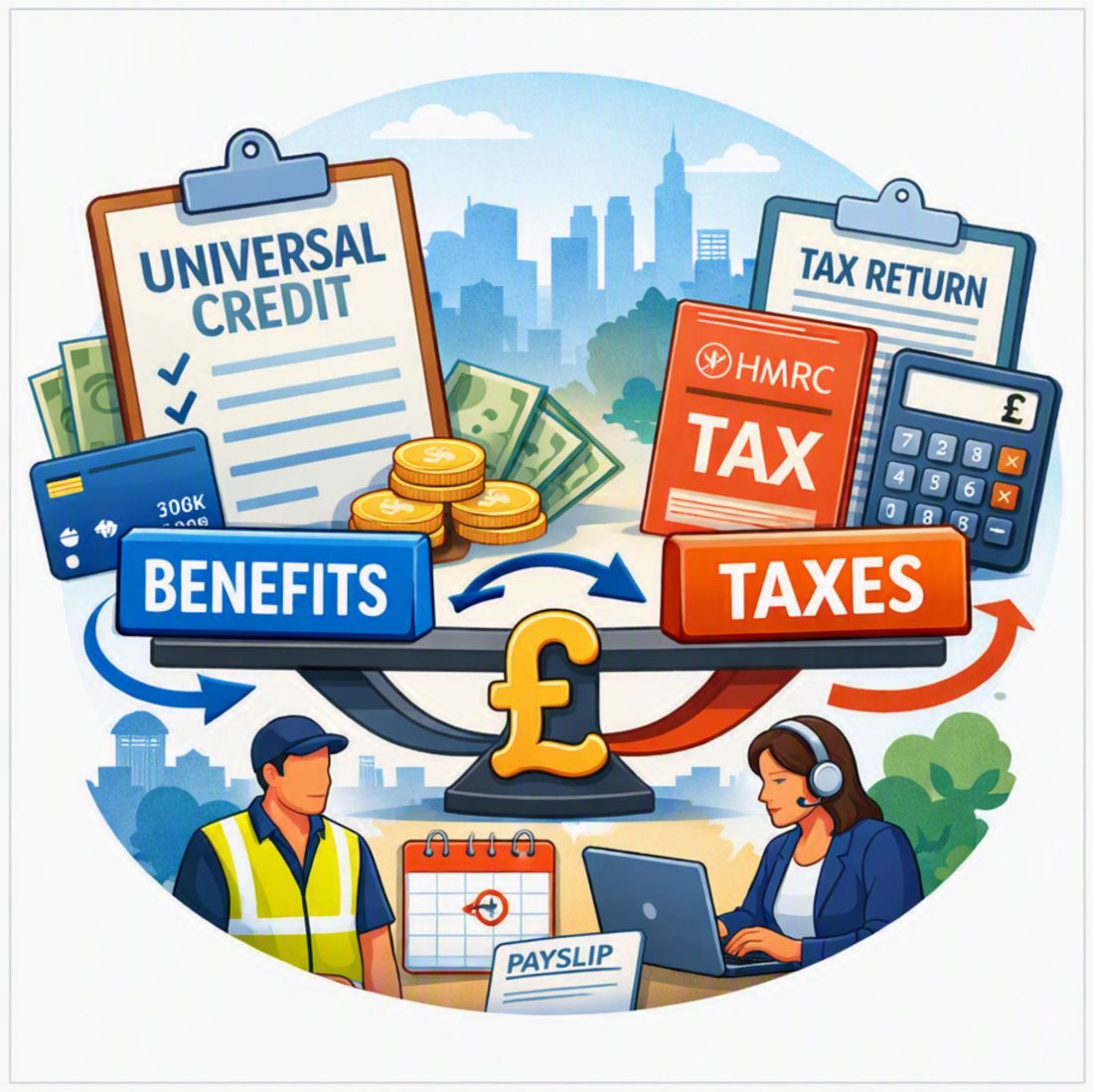
This paper examines a simple but often overlooked question: what happens when a headline tax cut meets the Universal Credit system in a real household budget?

It was written in response to Reform UK’s proposal to raise the income tax personal allowance to £15,000, with a longer-term ambition to reach £20,000. The proposal has been presented as a major gain for workers. For many taxpayers, that may be true in a straightforward tax sense. But for workers who also receive Universal Credit, the position is more complicated.

Universal Credit is designed to reduce as earnings rise. This means that when a worker’s take-home pay increases, part of that increase can be offset by a lower Universal Credit award. The worker is still better off, but not by the full headline amount.

The central finding of this paper is therefore not that the tax cut has no value. It does. The central finding is that the advertised gain can be substantially reduced by the benefit system, leaving both the worker and the public purse with only a modest net change.

The deeper issue is wages. If a person can work 40 hours a week on the statutory minimum wage and still need Universal Credit, then the benefits bill is not only a welfare problem. It is also a low-pay problem. Policies that adjust tax thresholds may improve the appearance of work incentives, but they do not by themselves solve the structural fact that full-time minimum-wage work may still fail to provide financial independence.

This report is intended for a broad readership. It avoids technical language where possible and explains each calculation step by step. The aim is to test a political claim against household reality: not what the policy sounds like, but what it actually leaves in someone’s bank account.

Executive Summary

This report tests a simple claim against a real household budget: whether a headline tax cut delivers the full advertised gain to a worker who also receives Universal Credit.

Policy testedIncrease the income tax personal allowance from £12,570 to £15,000.
Worker testedSingle renter, working 40 hours per week on the April 2026 National Living Wage, receiving Universal Credit.
Headline tax saving£40.50 per month.
Universal Credit reduction£22.28 per month.
Actual household gain£18.22 per month.
Main findingThe worker is better off, but remains on Universal Credit and receives less than half of the headline tax saving as additional disposable income.

In plain English: the policy helps the worker, but it does not transform their position. The household remains dependent on Universal Credit, and the public purse recovers part of the tax cut through a lower benefit award. The deeper unresolved issue is that full-time work at the legal minimum wage can still require means-tested support.

Section 1: The household used in this worked example

This is a realistic illustrative case rather than a claim to represent every Universal Credit household. Actual entitlement depends on age, household composition, rent, Local Housing Allowance, health status, childcare, savings, deductions and assessment-period earnings.

  • Single adult
  • Renting in Cheltenham
  • Working 40 hours/week
  • April 2026 National Living Wage: £12.71/hour
  • Gross annual income: £26,436.80
  • Gross monthly income: £2,203.07
  • Assumed age: 25 or over
  • Household type used for UC work allowance: single adult with limited capability for work or another qualifying basis for a work allowance, and receiving help with housing costs

This person is working full time on the legal wage floor for workers aged 21 and over. That matters because this is not an example of unemployment or unwillingness to work. It is an example of someone already doing what the policy narrative asks them to do: working full time, paying tax and National Insurance, renting privately, and still needing means-tested support.

Sources and assumptions used. The National Living Wage figure of £12.71 per hour from April 2026 is taken from GOV.UK. The Universal Credit taper rate of 55p for every £1 of earnings is taken from GOV.UK guidance on Universal Credit and earnings. The April 2026 Universal Credit standard allowance used here is £424.90 for a single claimant aged 25 or over, based on Citizens Advice guidance on 2026 changes. The housing element is treated as an assumption and should be checked against the relevant Local Housing Allowance rate and the claimant’s actual eligible rent.

The key point is that the example assumes the worker qualifies for a Universal Credit work allowance. That is not true for every single adult. A person with no children and no limited capability for work would normally have no work allowance, which would make the Universal Credit reduction larger. The assumption used here is therefore not designed to exaggerate the result; if anything, it gives the tax proposal a clearer chance to show a positive household gain.

Section 2: Current position before the tax change

Income tax

National Insurance

(£26,436.80 − £12,570) × 8% = £1,109.34 per year = £92.45 per month

Net pay

£2,203.07 − £231.11 − £92.45 = £1,879.51 per month

Universal Credit

  • Work allowance used in this example: £427 per month, because the claimant is assumed to qualify for a work allowance and to receive help with housing costs.
  • Earnings above allowance:

£1,879.51 − £427 = £1,452.51

  • UC taper (55%):

0.55 × £1,452.51 = £798.88

  • UC before taper:

£424.90 standard allowance + £675 assumed housing element = £1,099.90

  • UC after taper:

£1,099.90 − £798.88 = £301.02

Total income (current system)

£1,879.51 + £301.02 = £2,180.53 per month

Section 3: What changes under a £15,000 personal allowance

Income tax

Net pay

£2,203.07 − £190.61 − £92.45 = £1,920.01 per month

Universal Credit

  • Earnings above allowance:

£1,920.01 − £427 = £1,493.01

  • UC taper:

0.55 × £1,493.01 = £821.16

  • UC after taper:

£1,099.90 − £821.16 = £278.74

Total income (Reform UK £15k)

£1,920.01 + £278.74 = £2,198.75 per month

Net gain

£2,198.75 − £2,180.53 = £18.22 per month

The worker keeps £18.22 more per month. That is a real gain, but it is far smaller than the headline tax saving because the Universal Credit award falls as net earnings rise.

The Exchequer recovers £22.28 per month through the lower Universal Credit award, but still gives up £40.50 per month in income tax. The net fiscal cost in this example is therefore £18.22 per month.

This is the central policy lesson. The tax cut does not simply transfer the full saving to the worker. Nor does it simply save the state money. Instead, the gain is split: part reaches the household, and part is recovered through a lower Universal Credit payment. The result is modest for both sides.

Section 4: Beyond the calculation – what the numbers mean in real life

The calculations in Sections 2 and 3 answer the immediate policy question. They show how much tax falls, how much Universal Credit falls, and how much extra money the worker actually keeps.

But the calculation alone does not fully explain the household reality. It tells us the worker is £18.22 per month better off, but it does not tell us whether that change is large enough to alter their financial position in any meaningful way.

This is why the paper now moves from arithmetic to interpretation. The next question is not simply, “Did the worker gain?” The answer to that is yes. The more important question is: “Did the policy create enough extra disposable income to reduce fragility, build independence, or move the household away from Universal Credit?”

To answer that, the paper uses a simple diagnostic framework. The diagnostic is not introduced as a second set of evidence competing with the calculation. It is a way of translating the calculation into plain-English questions about financial security.

The broader Impoverishment Index was created to examine the gap between positive economic narratives and lived experience at a national level. The Universal Credit version applies the same idea at household level: it asks whether a policy that sounds generous actually changes the lived financial reality of someone affected by the benefits system.

The diagnostic looks at four practical questions, followed by a separate narrative mismatch test:

  • How much of the headline gain does the worker actually keep?
  • How much of the gain is offset through the Universal Credit taper?
  • How much of the household’s income is already committed to essentials?
  • How much room is left to absorb shocks, save, or become financially independent?
  • How large is the gap between the headline claim and the lived result?

In that sense, the diagnostic is not the main claim of the report. The main claim remains the worked calculation. The diagnostic simply helps readers understand why a real but modest gain may still leave the household financially constrained.

Section 5: Measuring the real household impact

By this point, the arithmetic has already shown the immediate result: the worker gains £18.22 per month, not the full headline tax saving. The purpose of this section is to ask what that means in practice.

A small gain can still matter. For someone living on a tight budget, £18.22 is not nothing. But public policy should also ask whether a change is large enough to alter the underlying situation. Does it reduce dependence on Universal Credit? Does it create breathing room? Does it help the household build savings, absorb shocks, or move closer to financial independence?

To answer those questions, this report uses a simple household impact diagnostic. It is called a diagnostic because it is not trying to produce an official poverty measure or a scientific ranking. It is trying to diagnose what the policy actually changes inside a monthly budget.

Where a score is used, it is only a shorthand for the explanation that comes before it. A higher number means the policy has created more real household resilience. A lower number means the household remains more financially constrained. The score is therefore a communication aid, not the evidence itself.

The 0–10 scale should be read in plain terms:

  • 0–2: very weak household resilience; the policy does little to change dependence or vulnerability.
  • 3–4: limited improvement; the household gains something, but remains materially constrained.
  • 5–6: moderate improvement; the policy makes a noticeable difference, but does not resolve the underlying pressure.
  • 7–8: strong improvement; the household is significantly more secure.
  • 9–10: very strong improvement; the policy substantially changes the household’s financial position.

This means the reader should not treat the number as a standalone claim. The explanation in each subsection comes first; the score then summarises that explanation in a compact form.

1. How much of the headline tax gain does the worker actually keep?

The first question is simple: if the policy is advertised as a tax gain, how much of that gain actually reaches the household after Universal Credit adjusts?

Result: 4.5/10. The worker keeps 45% of the headline tax gain.

This means work and tax reduction do improve the household’s position, but less than half of the headline saving reaches the worker as additional disposable income.

2. How much of the gain is lost through Universal Credit?

The second question looks at why the headline tax saving does not reach the worker in full. Universal Credit is means-tested. As net earnings rise, the Universal Credit award falls. This is the taper mechanism.

  • Tax: 20%
  • NI: 10%
  • UC taper: 55%
  • Total: 85%

Diagnostic result: 1.5/10. This is low because only a small share of each additional pound meaningfully improves household living standards once tax, National Insurance and Universal Credit withdrawal are considered together.

This is not a cliff edge and it is not a punishment; it is the design of the system. But it does mean that headline gains are diluted before they reach the household budget.

3. How much income is already committed to essentials?

The third question asks whether the household has enough room in the budget for the tax gain to make a practical difference. This matters because £18.22 has a different meaning in a household with spare income than in one where most income is already committed before the month begins.

  • Rent: £800
  • Utilities + council tax: £200
  • Food: £300
  • Transport: £150
  • Other essentials: £150
  • Total: £1,600/month

Essentials ratio = £1,600 ÷ £2,180.53 ≈ 0.73

Score = 10 × (1 − 0.73) = 2.7

Diagnostic result: 2.7/10. This is low because around three-quarters of income is already committed to essentials, leaving limited room for savings, emergencies or ordinary financial resilience.

In this scenario, around three-quarters of monthly income is already committed to basic costs. That leaves little room for savings, emergencies, debt reduction, household replacement costs, or ordinary participation in social life.

4. How much room is left for unexpected costs?

The fourth question asks whether the household has enough margin to cope with normal financial shocks: a rent rise, a reduced shift pattern, a delayed payment, an unexpected bill, a broken appliance or a higher winter energy bill.

  • Savings: < £500
  • Debt repayments: ~£150/month
  • High volatility: rent increases, UC reassessments, variable hours

Diagnostic result: 2/10. This is low because the scenario describes a household with little capacity to absorb disruption. This score is illustrative rather than directly measured.

Because this paper does not use verified household-level evidence about this individual’s savings, debts or monthly volatility, the Stability Deficit score is treated as a scenario assumption. It should not be read as a measured fact about any named person.

5. How large is the gap between the headline and the lived result?

The final question brings the diagnostic together. It asks how far the public-facing story differs from the result inside the household budget. In this example, the headline is a tax cut for workers. The lived result is a much smaller gain, continued Universal Credit entitlement and no major change in financial independence.

Core average = (4.5 + 1.5 + 2.7 + 2) ÷ 4 = 2.675

Inverted:

Narrative mismatch = 10 − 2.675 = 7.3

Diagnostic result: 7.3/10, reported separately. This indicates a large mismatch between the apparent generosity of the headline proposal and the modest improvement in household resilience shown by the worked example.

The narrative mismatch score is not included in the core Index average, because it is derived from the other scores. Reporting it separately avoids double-counting.

Overall result: the household remains financially constrained

Core diagnostic average = (4.5 + 1.5 + 2.7 + 2) ÷ 4 = 2.7

Interpretation: The overall diagnostic result is low because the underlying position has not changed very much. The worker is still working full time, still receiving Universal Credit, still facing high essential costs, and still left with limited space to build financial independence. The tax cut helps, but it does not transform the household’s financial reality.

The diagnostic supports the same conclusion as the worked calculation: the proposal produces a real but modest gain, while leaving the worker financially constrained and still dependent on Universal Credit.

Section 6: What the policy appears to do – and what the calculation shows

At headline level, a higher personal allowance sounds simple and attractive. It can be described as:

  • “A tax cut for workers.”
  • “A reduction in welfare dependency.”
  • “A shrinking welfare bill.”

The worked example shows a more complicated but more honest picture:

1. The worker is better off, but not by the headline amount.

The tax cut increases net pay, but the Universal Credit award then falls. In this example, the worker keeps £18.22 per month from a £40.50 monthly tax saving.

2. The Universal Credit award falls because net earnings rise – not because the household has become independent of support.

The household still receives Universal Credit after the tax change. The lower award does not mean the worker has escaped benefit dependency; it means the benefit system has adjusted to their slightly higher net earnings.

3. Disposable income barely changes.

An extra £18.22 per month may still matter to someone on a tight income. But it is not a transformational change. It is unlikely, on its own, to provide financial independence, build resilience, or remove the need for Universal Credit.

4. The household impact diagnostic remains low.

The diagnostic result remains low because the underlying household pressures remain in place: high essential costs, limited slack, and continued reliance on means-tested support.

5. The Exchequer recovers more than half of the income tax cut through reduced Universal Credit.

The government does not save money overall in this example: it gives up £40.50 in tax and recovers £22.28 through lower Universal Credit, leaving a net fiscal cost of £18.22 per month.

This is the essence of the policy problem:

A tax policy can improve a worker’s position while still leaving their day-to-day financial security largely unchanged. If full-time minimum-wage work still requires Universal Credit, then the unresolved issue is not only tax or welfare design. It is the adequacy of wages themselves.

Conclusion: the real issue is not only tax – it is low pay

This paper shows why tax policy cannot be judged by headline figures alone. For a worker receiving Universal Credit, a higher personal allowance can increase take-home pay, but the benefit system then adjusts because Universal Credit is withdrawn as net earnings rise.

In this worked example, the worker is better off by £18.22 per month after the personal allowance rises to £15,000. The policy therefore helps, but only modestly. The worker does not receive the full headline tax saving, and the household remains on Universal Credit afterwards.

That matters because it reveals the elephant in the room. A benefits system cannot be expected to shrink sustainably if the legal minimum wage for full-time work does not produce financial independence for many households. In that situation, Universal Credit is not simply supporting people who are out of work. It is also subsidising a labour market in which work at the legal minimum can still leave people below the level needed to live independently.

  • work can increase income, but the effective gain may be much smaller than the headline wage or tax change suggests;
  • Universal Credit can provide important support, but it also reduces as earnings rise;
  • tax cuts should be assessed using household-level calculations, not only the headline value of the tax reduction;
  • public claims about making work pay are strongest when they show who gains, by how much, and after which benefit interactions.

The household impact diagnostic is therefore best understood as a translation tool. It takes a policy headline and asks what it means in a real household budget. Used carefully, it can make public debate more concrete, more transparent and easier for non-specialist readers to understand.

The conclusion is not that tax cuts are meaningless. Nor is it that Universal Credit should not taper as earnings rise. The conclusion is narrower and more important: headline tax changes are not a substitute for confronting low pay, high essential costs and the structural reasons why millions of working households remain reliant on means-tested support.

Methodological note

The calculations in this report use rounded monthly figures, so totals may differ by a few pence from payroll software, HMRC tools, DWP systems or a full benefits calculator. The worked example assumes no pension contributions, no student loan repayments, no benefit cap effect, no deductions for advances or sanctions, and no council tax reduction. It also assumes the person qualifies for a Universal Credit work allowance; a single adult with no children and no limited capability for work would not normally receive one. The figures should therefore be read as an illustrative policy test, not as personal entitlement advice.

Further reading and data sources

The Impoverishment Index: https://adamtugwell.blog/2026/05/29/the-impoverishment-index-a-report-on-the-widening-gap-between-official-economic-narratives-and-real-world-lived-experience/

Disclaimer

This report contains illustrative calculations intended to explain how changes to income tax thresholds may interact with Universal Credit awards under current UK welfare rules. All figures, examples and scenarios are provided for general information only. They do not constitute financial advice, legal advice, welfare entitlement advice or professional guidance.

Universal Credit entitlement varies according to individual circumstances, including household composition, age, disability status, childcare costs, rent, Local Housing Allowance, savings, deductions, assessment‑period earnings and council tax liability. The examples in this report use simplified assumptions to demonstrate the interaction between net earnings and the Universal Credit taper. Actual awards may differ from those produced by official Department for Work and Pensions systems, accredited benefits calculators or payroll software.

While reasonable efforts have been made to ensure accuracy at the time of writing, no guarantee is given that the information is complete, up to date or free from error. Policy details, thresholds and rates may change without notice. No liability is accepted for any loss, damage or inconvenience arising from reliance on the contents of this report. Readers should verify all relevant details using authoritative sources such as GOV.UK, Citizens Advice or qualified welfare and tax professionals.

The household impact diagnostic described in this report is a conceptual tool created for illustrative and educational purposes. It is not an official measure of poverty, financial resilience or welfare adequacy. Scores generated using this diagnostic are scenario-based and rely on assumptions that may not reflect any specific household’s circumstances.

This report does not endorse, oppose or promote any political party, policy or proposal. It is intended solely to support public understanding of how tax and welfare systems may interact in practice.

Response to NAO Report Resilience of the Food Supply Chain to Disruptions (September 2026)

Adam Tugwell | 8 September 2026

On 4 September 2026, the National Audit Office published Resilience of the Food Supply Chain to Disruptions, a report that rightly draws attention to weaknesses in the UK’s preparedness for serious food supply shocks. This response is offered as part of my ongoing farming, food security and Foods We Can Trust work, which examines the gap between food being available in normal times and food being resilient enough to withstand disruption.

The NAO report is valuable because it recognises rising risks, weaknesses in contingency planning, declining engagement with industry, and the need to involve households and communities more seriously. However, it remains constrained by assumptions that deserve closer scrutiny: in particular, the use of headline self-sufficiency figures, the reliance on private-sector adaptation, and the continued preference for centralised emergency response over local capability.

This response therefore does three things. First, it explains why food self-sufficiency is not the same as food resilience. Secondly, it identifies where the NAO’s analysis understates structural vulnerability. Thirdly, it sets out the practical direction of travel required if the UK is to build a food system that is more local, more capable, more trusted and more resilient. Links to the specific works that develop these arguments in greater detail are provided in the further reading section.

1. The NAO’s “60% self-sufficiency” figure is useful, but it is not a resilience measure

The report states:

“In 2025, the UK’s food ‘self-sufficiency ratio’ was around 60%.”

This is a value-based measure: it compares the monetary value of food produced in the UK with the monetary value of food consumed here. That makes it useful as an economic indicator, but it does not answer the practical resilience question: how much food could the UK produce, process, distribute and access during a prolonged disruption?

It ignores:

  • UK-produced food that is exported
  • Imported inputs (fertiliser, feed, chemicals, energy)
  • The caloric composition of UK diets
  • The fact that many categories (fruit, vegetables, oils, ingredients) are overwhelmingly imported

The headline figure is also a net figure shaped by the way the modern supply chain works. Domestic production, imports, exports, imported inputs and processing dependencies all interact. Some food counted within domestic production may rely on imported fertiliser, animal feed, fuel, machinery, packaging or processing capacity. Some food produced here is exported. Some foods that are central to healthy diets are heavily import-dependent.

For that reason, the UK’s practical food resilience in a severe disruption scenario may be substantially lower than the self-sufficiency ratio suggests. The issue is not whether the precise figure is 60%, 52%, or lower still. The issue is that the official metric does not measure calorific adequacy, nutritional balance, imported input dependency, processing capacity or local distribution capability.

The NAO’s framing therefore risks creating false reassurance. It implies that production value can stand in for practical food availability. In a crisis, however, people need calories, nutrients, functioning logistics, processing capacity and accessible local distribution. Until government distinguishes those concepts, resilience planning will remain incomplete.

I have explored this in detail in Foods We Can Trust: A Blueprint for Food Security and Community Resilience in the UK, where I outline why caloric sovereignty – not value-based accounting – must be the foundation of food resilience policy.

2. Food inflation at 19.2% is not just an economic statistic – it is a resilience warning

The report notes:

“Food price inflation… peaked at 19.2% in March 2023.”

This is the first time I have noted that an official document has acknowledged the scale of the price shock that households have recently experienced. Food inflation at nearly 20% is not normal. It is not manageable. It is not a blip.

It is a sign that the system is structurally fragile.

Food is not discretionary. When prices rise at this rate, it reflects:

  • supply chain instability
  • import dependency
  • energy volatility
  • corporate consolidation
  • lack of domestic production capacity

The NAO mentions the figure but does not explore its implications. It should have been a central warning.

3. The NAO’s suggestion that Defra needs more emergency powers misses the point entirely

The report argues that Defra lacks the legal powers needed to manage catastrophic food disruptions.

But additional powers during an emergency cannot compensate for resilience that has not been built beforehand.

Legal authority can help coordinate action, but it cannot create food, processing capacity, distribution routes or community preparedness after the point of failure.

The lesson from recent crises is that centralised decision-making has limits when disruption affects daily life across multiple systems at once.

Food resilience requires operational capability before the crisis: trusted local relationships, clear responsibilities, practical logistics and the ability to identify and support vulnerable households quickly.

Food resilience must be:

  • built before a crisis
  • decentralised
  • community-led
  • grounded in local production and distribution
  • depoliticised

Emergency powers matter only if there is a resilient system for them to work through. Without food, fuel, people, local knowledge and functioning distribution, legal powers alone offer little practical protection.

4. The agri-food sector’s economic importance is understated – and underutilised

The NAO notes that the agri-food sector:

  • supports 4.1 million jobs
  • contributes £162.3 billion in GVA

These are enormous figures. And they would be significantly higher if British production and supply were prioritised.

The UK has the land, the skills, and the capacity to produce far more of its own food. What it lacks is a policy framework that values domestic production over globalised efficiency.

In The Need for a Collaborative Approach to the UK Farming and Food Security Problem, I argue that genuine collaboration – not policy-driven “collaboration theatre” – is essential to unlocking this potential.

5. Food as “one of 13 CNI sectors” creates false reassurance

Food is listed as one of 13 Critical National Infrastructure sectors. But unlike energy, water, telecoms, or transport, food is needed every single day.

There is no buffer. There is no downtime. There is no substitute.

Treating food as just another CNI category understates its foundational importance.

It leads to complacency and underinvestment.

6. Defra’s engagement with industry has deteriorated – and has become narrative management rather than collaboration

The NAO reports that:

  • engagement groups meet less frequently
  • objectives are unclear
  • support has declined
  • stakeholders see gaps in Defra’s understanding of key areas (e.g., the cold chain)

This aligns with what I have written in Real Collaboration vs Policy Collaboration. The concern is that engagement can become procedural rather than operational: meetings take place, stakeholders are consulted, and the language of partnership is used, but the people who understand production, processing, logistics and community need are not sufficiently empowered to shape the system.

Real collaboration requires:

  • shared objectives
  • transparency
  • local producer involvement
  • community representation
  • depoliticised structures

The NAO’s findings suggest that too much of this practical collaboration remains underdeveloped.

7. Household and community resilience has been neglected – and this is one of the report’s most important admissions

The NAO states:

“UK households are less prepared for emergencies… government-led messaging is less prominent.”

This is not a minor point. It is a fundamental failure.

Community resilience is the missing layer in UK food security. Without it:

  • supply chain shocks hit harder
  • vulnerable people suffer first
  • government response time shortens
  • local distribution becomes chaotic

In Local Planning for Food Shortages and Foods We Can Trust, I outline how community-led food resilience can be built at the lowest level – households, neighbourhoods, local producers – and why this must be prioritised.

8. Catastrophic planning remains theoretical – not practical

The NAO notes that:

  • Defra’s plans lack operational detail
  • industry is not involved
  • food assets are not included in the CNI Knowledge Base
  • national exercises have not tested real-world food failure scenarios

This is planning-oriented resilience rather than practical resilience. It may look adequate in documents, but it remains untested unless it is exercised with the businesses, local authorities, producers, distributors and communities that would have to make it work in practice.

Planning without accurate resilience metrics is incomplete. A credible approach should consider not only how much food is produced, but whether it can be processed, transported, stored, allocated and accessed under stress.

9. Local Resilience Forums are structurally incapable of delivering food resilience

The NAO concludes that LRFs:

  • lack clarity
  • lack capability
  • lack authority
  • cannot direct supermarkets
  • cannot identify vulnerable people effectively

This is not surprising. LRFs were not designed to rebuild food-system capability. They can coordinate emergency response, but food resilience also requires local production knowledge, community networks, producer relationships, storage capacity, transport options and clear mechanisms for supporting vulnerable households.

Food resilience therefore needs structures that are sufficiently independent of short-term political cycles and sufficiently close to communities to understand local need. Local government has a role, but it cannot be the only layer of resilience.

10. The private sector alone cannot be the backbone of UK food security

The NAO states:

“Defra has largely relied on the private sector… but this may not be sufficient.”

This is a significant understatement. The private sector is essential to the food system, but commercial efficiency and national resilience are not the same thing.

Large food businesses are generally incentivised to reduce cost, increase efficiency, consolidate operations and source globally. Those incentives can keep prices low in normal conditions, but they may also reduce redundancy, shorten stockholding, concentrate infrastructure and weaken local capability.

  • profit
  • efficiency
  • global sourcing
  • consolidation

Not:

  • resilience
  • redundancy
  • localism
  • sovereignty

In Who Controls Our Food Controls Our Future, I explain why corporate control of food systems is incompatible with national resilience.

11. What real food resilience requires: A blueprint

Drawing on my published work, real resilience requires:

  1. Localised production

Rebuilding local food systems, shortening supply chains, and prioritising domestic output.

  • Community-level distribution

Neighbourhood hubs, local coordination, and community-led logistics.

  • Regional coordination

County-level frameworks that support local producers and manage regional flows.

  • National strategic oversight

A central body that sets resilience targets, not efficiency targets.

  • Depoliticised resilience structures

Community leaders, producers, and local organisations empowered to act independently of political cycles.

  • Accurate resilience metrics

Caloric sovereignty, not value-based accounting.

  • Reduced dependency on global supply chains

Rebalancing imports with domestic capacity.

  • Rebuilding domestic processing

Cold chain infrastructure, abattoirs, mills, and food processing facilities returned to UK soil.

Conclusion: The NAO report is a warning, but it is not yet a route to resilience

The NAO has highlighted important risks, and the report should be welcomed for bringing food supply disruption into sharper public view. Its strongest contribution is the recognition that Defra must engage more effectively with industry, households, communities and local government if the food system is to withstand future shocks.

However, the report does not go far enough. The UK’s food resilience is likely to be materially weaker than headline self-sufficiency figures imply, because resilience depends on more than production value. It depends on calories, nutrition, processing capacity, imported inputs, logistics, local access, household preparedness and community capability.

12. Priority actions

To move from acknowledgement to action, government should prioritise five practical steps.

  1. Supplement value-based self-sufficiency measures with calorific, nutritional and supply-chain resilience indicators.
  2. Map critical dependencies, including imported fertiliser, feed, energy, packaging, processing infrastructure, cold chain capacity and key transport routes.
  3. Test severe food disruption scenarios with producers, processors, retailers, logistics providers, local authorities and community organisations.
  4. Strengthen local and regional food resilience planning, including household preparedness, vulnerable-person support and community distribution capability.
  5. Rebuild domestic processing and local food infrastructure so that production can be converted into accessible food during both normal conditions and crisis conditions.

The UK must therefore stop treating food solely as an economic sector and start treating it as a foundation of national security, public health, community resilience and democratic trust.

Further reading

1. Foods We Can Trust: A Blueprint for Food Security and Community Resilience in the UK
Online text
The core work behind this response. It sets out the wider argument that food security must include trust, nutrition, domestic capability, local resilience and community preparedness, rather than relying only on national supply figures or market efficiency.

2. Understanding Foods We Can Trust: A Blueprint for Food Security and Community Resilience in the UK
Introductory overview
A shorter explanatory article for readers who want an accessible introduction to the concepts behind Foods We Can Trust, including food security, household preparedness, local production and the importance of rebuilding public trust in the food system.

3. Local Planning for Food Shortages: A Guide to Local Support and Preparedness
Full text
A practical guide to planning at household, neighbourhood and local-authority level. This is especially relevant to the NAO’s concerns about household and community preparedness, vulnerable people and the limits of centralised emergency planning.

4. The Need for a Collaborative Approach to the UK Farming and Food Security Problem
Article
Develops the case for genuine collaboration across farming, food, policy and community systems. It provides the background to the argument that resilience cannot be delivered by government or the private sector acting alone.

5. Real Collaboration vs Policy Collaboration: The Choice That Will Shape the Future of Farming, Local Food Systems and Food Security
Article
Explains the distinction between collaboration that changes outcomes and consultation that mainly manages process. This is relevant to the NAO’s findings on declining engagement and unclear objectives within Defra’s work with industry.

6. Who Controls Our Food Controls Our Future
Full text
Explores the relationship between corporate control, food sovereignty, public trust and democratic resilience. It provides wider context for the argument that food systems should not be judged by efficiency alone.

Disclaimer

This document represents the views and analysis of the author and is provided as an independent response to the National Audit Office report Resilience of the Food Supply Chain to Disruptions (4 September 2026). While every effort has been made to ensure the accuracy of the information presented, it should not be regarded as official policy advice. The opinions expressed are informed by the author’s research, professional experience, and studies in sustainable agriculture and food security, and are intended to contribute to constructive discussion on food resilience, food security and community preparedness.

What Leadership Means When the System is Failing | Why Britain’s crisis requires neither better managers nor stronger personalities, but a different understanding of leadership itself.

There is a particular sound British politics makes when it is running out of road. It is the sound of people reaching once again for the language of grip, delivery, seriousness, experience and competence, as though the right combination of better managers and sterner faces might somehow make the old machinery work as it once appeared to.

That search is understandable. When services deteriorate, living standards stall, housing becomes unreachable, debt rises and trust drains away, people naturally look for someone capable of restoring order. They ask who has the experience, who understands the markets, who can command the machine, who can finally make government work.

But the question itself may already be too narrow. If the machine is misfiring because the wrong people are operating it, then better operators might help. If the machine is misfiring because its assumptions no longer match reality, then the search for better operators becomes part of the problem.

The wrong question

Much of the current debate still assumes that Britain’s difficulties are failures of competence. The state needs to be run better. Budgets need to be managed more tightly. Growth needs to be revived. Productivity needs to improve. Departments need sharper leadership. Public services need reform. Markets need reassurance. Voters need confidence.

None of that is necessarily wrong. Competence matters. Money matters. Institutions matter. A government that cannot manage basic administration will not guide a country through anything more difficult. But competence inside a failing model is not the same as leadership capable of recognising that the model itself may be failing.

That is the possibility British politics keeps circling without quite naming. The country may not simply be suffering from a temporary downturn, a poor fiscal rule, a succession of disappointing governments or another bad phase in the electoral cycle. The fact that leaders with very different personalities, priorities and political traditions keep encountering similar limits should itself prompt a deeper question: are we looking at failures of individuals, or failures of the system within which those individuals are operating?

For decades, public assets have been sold and called efficiency. Value has been extracted from communities and called growth. Productive capacity has been hollowed out and replaced with financial engineering. Promises have been funded through debt, asset inflation and claims on the future. Success has been measured in ways that often fail to describe whether ordinary people can afford homes, raise families, access care, build security or live in communities that still function.

So when politicians talk about investment, fiscal space, renewed growth or national renewal, they often sound as though they are describing fresh capacity. Too often, they are doing something more limited: relabelling existing spending, moving costs into future years, borrowing more expensively, hoping growth returns, or trusting that markets will tolerate one more round of improvisation.

That does not mean money has literally disappeared. It means the real economic surplus, institutional resilience and productive base needed to sustain the promises of the existing model have been dangerously weakened. There is still money in circulation. There is less real capacity behind many of the promises attached to it.

Two mistakes, not one

This is where the leadership debate becomes confused. The failure is usually described as though the political class suffers from one shared defect. In reality, there are at least two, and they point in opposite directions.

One group knows the machinery but cannot imagine a future beyond it. The other does not understand the machinery and still imagines that power simply stops at No.10.

The first might be called the paradigm-blind managers. They speak the language of debt, markets, fiscal rules, productivity, investment and economic credibility. They understand how the existing system is supposed to work. Their failure is not that they know nothing. Their failure is that they know the current grammar so well that they struggle to imagine another language.

For them, every problem eventually returns to the same family of answers: more growth, better productivity, tighter management, smarter investment, stronger fiscal discipline, market credibility, business experience and technocratic competence. These things are not irrelevant. But if the model itself is producing the outcomes, fluency in that model is not enough.

The second group suffers from almost the opposite problem. These are the institutional romantics: people who speak as though the Prime Minister can simply decide, Parliament can vote away financial constraints, borrowing is only a matter of courage, and market reality can be dismissed as ideological pressure.

They imagine government as a command structure with No.10 at the top. But modern Britain is not arranged so simply. Government sits inside a dense web of Treasury rules, central bank decisions, debt markets, international capital, existing obligations, public expectations, legal commitments and real economic capacity. Political authority still matters, but it does not float above these constraints.

Both groups are dangerous, but for different reasons. The managers mistake system failure for poor administration. The romantics mistake structural constraint for cowardice or betrayal. One cannot imagine a future beyond the existing model. The other cannot understand the model they are already inside.

Why governments keep disappointing people

This distinction matters because it explains why successive governments so often disappoint people once they enter office. Campaigns take place in abstraction. Government takes place inside systems. Some of the people who have occupied No.10 in recent years might have been better suited to a different political moment. The point is not that every individual has been uniquely inadequate. The point is that very different people have repeatedly collided with similar institutional and economic realities.

The rhetoric of opposition, leadership contests and party conferences is full of choice, courage and renewal. But once inside government, ministers confront the hard edges of the state: debt servicing, spending commitments, market reactions, departmental fragility, contractual obligations, institutional inertia and the gap between what the country has been promised and what the system can actually deliver.

What looks like betrayal is therefore not always betrayal. Sometimes it is the moment when rhetoric collides with reality. Sometimes it is the discovery that the money imagined during the campaign does not exist in the form assumed, that the choices described to voters are narrower than claimed, and that the levers of power do not move the machinery in the way politicians implied. In that sense, politicians are not only agents of the system. They can also become its prisoners.

This does not absolve them of responsibility. They choose to seek power. They choose the promises they make. They choose the stories they tell about what power can achieve. They should know more before they obtain the roles they seek. But the repeated pattern also reflects the system that selects, rewards and promotes them: a system that often prizes confidence over understanding, fluency over wisdom and the appearance of control over an honest account of constraint.

This is not simply a failure of character. It is a failure of diagnosis. If people enter power believing the crisis is mainly political, they will be unprepared for an institutional and economic crisis. If they enter power believing the existing model only needs better management, they will be unprepared for the possibility that the model itself is the problem.

What leadership actually means

That is why the leadership question matters. But leadership is often misunderstood. It is confused with expertise, business experience, technical fluency, personal conviction, rhetorical force or the ability to dominate a room. None of these things is leadership.

No Prime Minister can be the country’s best economist, accountant, engineer, scientist, military strategist, financier, social worker and historian at the same time. No Chancellor can personally understand every consequence of every decision. No government can function if leadership means knowing everything.

Leadership means something else. It means bringing together people with different forms of expertise, understanding the realities they identify, recognising the limits of their assumptions, asking questions that fall between disciplines, and making decisions in the public interest even when those decisions are difficult, unpopular or hard to communicate.

  • expertise is necessary, but not sufficient
  • financial knowledge is necessary, but not sufficient
  • political authority is necessary, but not sufficient
  • conviction is necessary, but not sufficient
  • process is necessary, but not sufficient

Managers optimise within a system. Leaders make judgements when the system itself is in question.

This is not an argument against expertise. Economists matter. Financial specialists matter. Engineers, scientists, business leaders, local government officers, community organisations and public service professionals all matter. The problem begins when expertise is mistaken for leadership, or when one form of expertise becomes the only lens through which every public problem is viewed.

A leader must be able to listen without becoming captured, decide without pretending certainty, and act without reducing society to a spreadsheet. The defining feature of leadership is not avoiding difficult choices. It is accepting responsibility for choices where every available option carries a cost.

The danger of confusing leadership with control

There is another danger here. When institutions lose credibility, living standards decline and familiar solutions stop working, people understandably begin to hunger for clarity and action. The attraction of the decisive individual grows stronger. The argument becomes that Britain does not need more consultation, more process or more excuses. It needs someone who will take control.

That temptation should not be dismissed lightly. A theoretical case can always be made for a wise, selfless and temporary crisis leader: someone capable of seeing the whole system, gathering the right minds, making hard decisions and relinquishing power when the work is done. The problem is not the theory. The problem is the real world.

How would such a person be found? How would the country know they were genuinely selfless rather than merely claiming to be? How would power be limited once concentrated? How would dissent be protected? How would succession work? How would the person remain the same after acquiring the authority that changes almost everyone who holds it?

The answer to managerial paralysis is not authoritarian certainty. The manager says, “The process will save us.” The strongman says, “I will save us.” A leader says, “Show me what is real, tell me what I am missing, let the strongest arguments be heard, and then I will decide.”

The distinction matters because desperation changes political judgement. Once people stop believing that ordinary politics can respond to reality, they often stop looking for leadership and start looking for saviours. That is when the void becomes dangerous, especially if some of those already close to power exhibit the habits of certainty, grievance, domination or contempt for constraint before they have even acquired it.

The lucid moment has to come before desperation

What Britain needs, then, is not simply another leader, another party, another slogan or another economic forecast. It needs a lucid moment: a collective recognition that the old model is no longer producing the outcomes promised, that changing personnel is not the same as changing assumptions, and that preserving social cohesion during transition matters more than defending the credibility of a failing worldview.

The danger is that such recognition arrives too late. Systems can continue long after their underlying assumptions have weakened because admitting the scale of the problem is professionally, politically and psychologically difficult. The people most rewarded by the existing paradigm are rarely the first to acknowledge that it has reached its limits.

That is why the question of leadership cannot be reduced to personality. Britain does not need people who merely know how to operate the machinery, nor people who imagine they can command it by will alone. It needs leaders capable of understanding the machinery, recognising when it is failing, gathering knowledge beyond their own worldview, and making decisions that serve people rather than the abstractions of the system.

That means rebuilding productive local economies, reconnecting institutions with lived reality, asking how value is created and circulated in communities, and developing forms of governance that serve people rather than forcing people to serve markets, models and metrics.

The greatest danger is not decline itself. It is that decline remains misunderstood until frustration turns into desperation. If that happens, the search for leadership can become a search for certainty, and the search for certainty can become the path to something far worse.

The lucid moment needs to come before that. Britain needs real leadership not because one person can save it, but because only real leadership can help a society understand reality before reality forces the lesson on harsher terms.

Why We Keep Looking for Answers in the Direction That Created the Problem

Every time Britain runs into serious difficulty, we seem to have the same conversation. The names change. The parties change. The faces around the Cabinet table change. The language of renewal, seriousness and responsibility is refreshed for the latest political moment. Yet the assumptions beneath the debate remain remarkably consistent.

People can now see that something is wrong. That is no longer really the issue. The point of disagreement is no longer whether Britain has problems, but what kind of problems they are. Debt, stagnant living standards, unaffordable housing, degraded public services, weak productivity, falling trust and social fragmentation are all now visible enough to be discussed across the political spectrum. But they are still treated, again and again, as separate management failures rather than as symptoms of the same underlying system.

That is the real tragedy. Many of the people diagnosing the crisis genuinely know that something is badly wrong. Some may even know, at some level, that the old answers are exhausted. But they have nowhere else to go intellectually, professionally or politically except back to the same place they have always looked: finance, markets, business experience, managerial competence, fiscal discipline, GDP growth and the language of economic credibility.

So every crisis produces the same merry-go-round. First, the system produces outcomes that are increasingly difficult to defend. Then commentators, politicians and professional observers acknowledge the symptoms. Then the search begins for the people deemed “serious”, “qualified”, “experienced” or “credible” enough to fix them. More often than not, those people are drawn from the same worldview that helped produce the outcomes in the first place.

The latest reshuffle, party conference season and the first real glimpse of the UK’s latest prime minister have simply offered the newest version of this old pattern. The commentariat and Opinionati have been busy sticking badges on Westminster’s latest cast list, praising or dismissing people according to whether they understand big business, the markets, money and the supposedly hard realities of government. It would be interesting if it were not so desperately detached from the deeper causes of the problems they can see only at surface level.

Perhaps I am being unfair. Some of them may understand more than they are willing to say. It is not difficult to see why few high-profile journalists, economists, politicians or commentators would not want to be the first to say publicly that the entire operating model has reached its limits. That is not a career-enhancing move. But perhaps I am also being optimistic. The harder possibility is that many really cannot see it, because the system has trained them not to look in the right place.

This is what I have increasingly described as paradigm blindness, or cognitive capture. It is not stupidity, corruption or malice. It is the condition that arises when the assumptions of a system become so familiar, rewarded and professionally reinforced that they stop appearing to be assumptions at all. They simply feel like reality.

That is why the argument that the best MPs are those who have been in business, finance or the markets needs to be challenged at its root. This is not a new phenomenon. We have heard versions of it for years. The country is in trouble, so we are told we need people who have run companies, handled money, understood the markets, balanced books, managed large organisations or dealt with the “real world”.

But this assumes precisely what should be under scrutiny. A country is not a corporation. Citizens are not customers. Communities are not balance sheets. Public value is not the same thing as shareholder value. Government is not elected to optimise returns, impress markets or manage people as units of cost. It is elected to serve the public interest.

This does not mean that business experience is useless, or that financial knowledge has no place in government. Of course leaders need access to expertise. Government operates inside financial constraints, and anyone pretending otherwise is avoiding reality.

But genuine leadership is not the same as technical expertise. A genuine leader does not need to be the country’s best economist, financier, accountant or bond trader. A genuine leader needs to ask the right questions, gather the necessary information, listen beyond a single discipline, understand consequences, and make decisions in the interests of people rather than in defence of a model.

That distinction matters because expertise is rarely neutral. Economists are largely trained within the existing economic model. Business schools largely teach people how to succeed within the existing business environment. Financial professionals are trained to understand and operate the existing monetary and market system. None of that makes them bad people. But it does mean they are usually specialists in operating the paradigm, not necessarily in questioning whether the paradigm itself is failing.

This is the heart of the problem. We have become so accustomed to money being part of everything that it becomes almost impossible for many people to see money as part of the problem. The captured mind says, “It cannot be money, because money is involved in everything.” But that is precisely the point. When money becomes the organising principle of everything, everything begins to bend around it.

Money is no longer merely a tool that society uses. It has become the measure by which society judges almost everything: policy, success, failure, seriousness, responsibility, productivity, worth, even human dignity. Market confidence becomes more important than lived experience. Financial efficiency becomes more important than resilience. GDP-style growth becomes more important than whether ordinary people can afford homes, raise families, access care, build security, or live in communities that still function.

This is why the current debate is so inadequate. Across the political spectrum, many now agree that the UK is financially precarious, if not already in serious trouble. But the explanations remain scattered: the wrong government, the wrong prime minister, immigration, benefit claimants, public sector waste, weak management, insufficient growth, too much borrowing, too little discipline. Each explanation may touch some fragment of reality. None explains the whole.

The deeper possibility is that these are not isolated failures at all. They are connected outcomes of a worldview that has progressively subordinated people, communities, public services, local economies and the natural environment to financial logic.

Because the system prioritises money, it teaches us to judge everything else in monetary terms. In doing so, we have surrendered forms of value that cannot be properly measured by markets but without which society cannot remain healthy.

That blindness has allowed a massive transfer of wealth, declining quality of life for many, the weakening of communities, the degradation of public services, the hollowing out of productive capacity and the dismantling or sale of shared structural and infrastructural assets. The harms are then treated as unfortunate side effects, or as the personal failings of those who cannot keep up, rather than as predictable consequences of the system itself.

Those who need benefits, debt, handouts or support are too often ridiculed as the architects of their own misfortune. But a system built around extraction, competition and monetary valuation could only ever push more people towards the margins. The fact that this is now happening at scale should tell us something important. It is no longer credible to pretend that all of this is merely bad management.

The strongest objection is obvious and deserves to be taken seriously. People will say that no government can ignore money, borrowing, markets or budgets. They will say that expertise matters, that institutions matter, that stability matters, and that the alternative to financial discipline may be chaos.

They are right to say that competence matters. They are right that government cannot simply wish away the current system. But that objection only goes so far.

Understanding how to operate a system is not the same as understanding whether it still works.

Expertise in navigating a failing model should not be confused with leadership capable of questioning the model itself.

If the economic and monetary framework has helped create unaffordable housing, insecure work, weak productivity, degraded services, concentrated wealth and exhausted communities, then appointing people who are fluent in that framework is not automatically a solution. It may simply be another turn of the merry-go-round.

This is the anti-establishment paradox too. Many politicians and commentators claim to oppose the Establishment while continuing to operate entirely within its worldview.

They challenge the personnel of the system but not its assumptions. They denounce elites while judging seriousness by market confidence. They promise disruption while accepting the same definitions of success: growth, efficiency, competitiveness, credibility and control. In some cases, they do not challenge the Establishment at all. They intensify it.

That is why this moment matters. We are entering a critical phase in which more people can see that the old answers are failing, but many of those with the biggest platforms still cannot name the deeper problem.

They know the country is in difficulty. They know trust is weakening. They know the numbers do not add up. They know the usual levers no longer deliver what they once promised. But cognitive capture leaves them interpreting system failure as a management problem.

So we get calls for better managers, more business-minded MPs, tougher fiscal rules, more efficient public services, renewed growth strategies, fresh economic credibility and new faces to operate the same machinery.

The possibility that the machinery itself is producing the outcomes barely enters the conversation.

The problems we now face cannot and will not be solved simply by cutting spending, borrowing more, chasing GDP-style growth, finding another managerial class, or appointing MPs whose main qualification is fluency in the financial language of the existing system.

The extractive model appears to have reached its limits. Its promises of efficiency, prosperity and competent management are harder to reconcile with the reality experienced by millions of people.

The system is over. It simply has not finished its ending yet. And the last people we need making futile attempts to save a system whose impacts they do not understand are those who still believe it is the only possible way.

The question now is not whether Westminster has enough people who understand money. It is whether Westminster has enough people willing to ask why money has become the lens through which every public problem must be viewed.

Genuine leadership begins there: not in pretending money does not matter, but in refusing to let it be the only thing that matters.

If the challenge is one of worldview as much as policy, then the next step cannot simply be another leader, party, slogan or economic forecast. It has to involve rebuilding the capacity to think and act differently: restoring productive local economies, reconnecting institutions with lived reality, asking how value is created and circulated in communities, and developing forms of governance that serve people rather than forcing people to serve the abstractions of the system.

For a more practical exploration of that direction, see: The Local Economy & Governance System.