Public narratives have increasingly been used to shape how we interpret major events – often subtly, often through fear, and often in ways that encourage us to accept outcomes that might never have emerged if we had been left to form our own conclusions.
Whether it’s the breathless insistence that an AI takeover is inevitable or the framing of political change as something predetermined, narratives have become tools for steering public belief long before reality has settled.
Sometimes these narratives are deliberately crafted. Other times, even those repeating them may not fully understand the consequences of the stories they help spread.
Either way, the effect is the same: they shape how we see the world during a period that is already turbulent and uncertain.
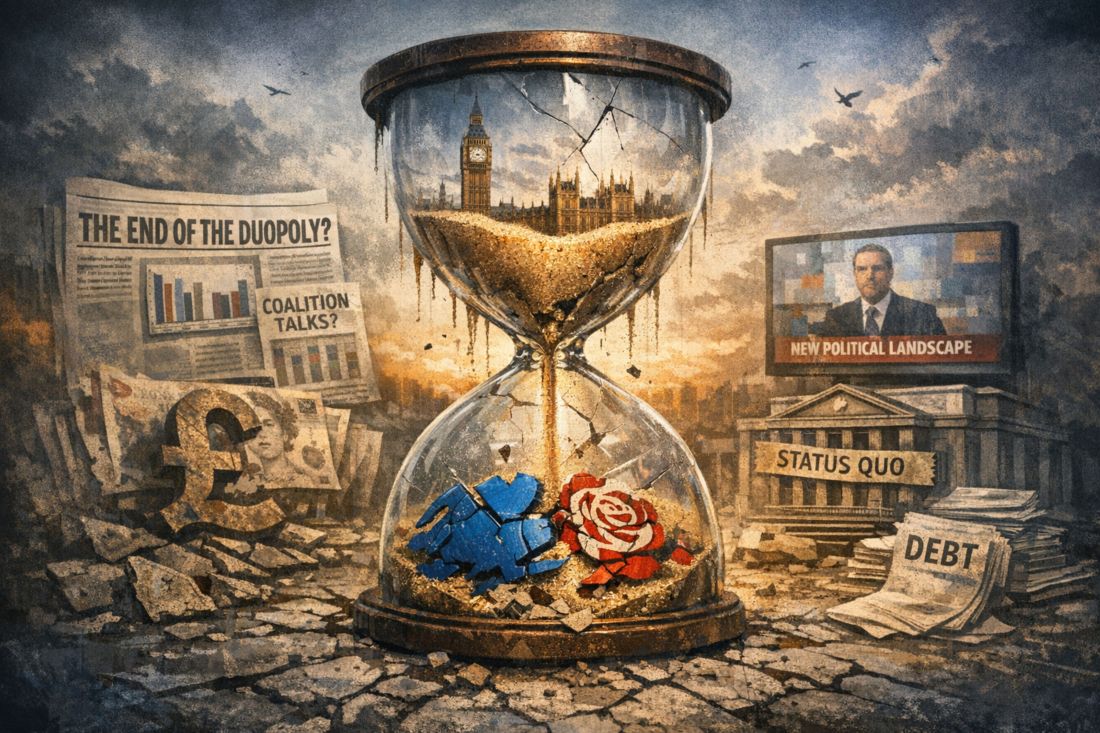
The New Post‑Election Narrative: “The End of the Duopoly”
In the hours following the 2026 UK local election results, a striking uniformity appeared across political commentary. The phrase “end of the duopoly” – referring to the supposed collapse of Labour–Conservative dominance – began appearing everywhere at once.
Even early on Saturday 9 May, with all results declared, the framing had already solidified: the UK is entering a new era of multi‑party politics, with Reform UK positioned as the emerging force.
But what does this narrative actually mean? And more importantly – what does it leave out?
Contextualising the Claim
The UK has never been a strict two‑party system, but the electoral mechanics of First Past the Post have historically produced two dominant blocs.
The new narrative suggests:
Labour and the Conservatives are losing their structural dominance.
Reform UK is becoming the largest force in a fragmented landscape.
A European‑style multi‑party system is emerging.
Specialist pollsters have already produced “like‑for‑like” general‑election projections based on the local‑election vote shares.
These projections – while not predictions – suggest that Reform could become the largest party but still fall short of a majority, requiring cooperation with the Conservatives to govern.
This would conveniently provide an explanation for any undelivered promises: coalition constraints, market pressures, or the need for “stability”.
A Straightforward Interpretation – But an Incomplete One
Yes, the Greens also performed strongly, though not at the levels some earlier polling suggested. Yes, the Conservatives and Labour both suffered significant losses. And yes, this could be read as the new normal for British politics.
But the deeper question is whether this is truly a political realignment – or simply the next step in a much longer, more fundamental breakdown.
The Systemic Problem Beneath the Party Shifts
Most people see politics only at the surface level: parties, personalities, and promises.
But the problems facing the UK today are not primarily the result of individual politicians or even individual parties.
They are the consequences of a system that has been allowed to drift into dysfunction.
The UK’s political‑economic model – neoliberal, globalised, market‑centric, and dependent on fiat‑money expansion – has:
extracted productivity and resilience from the economy
created a bloated but underperforming public sector
generated unsustainable levels of public and private debt
masked deepening poverty through an ever‑expanding benefits system
reduced political leadership to managerialism rather than representation
The expected to be outgoing Prime Minister may be an extreme example of the political class at its worst, but he is not an outlier. His behaviour, motivations, and priorities are symptoms of a political culture that has lost its connection to public service.
Different parties may sound different, but they operate within – and are shaped by – the same system.
Their incentives, constraints, and worldview are aligned far more closely than their rhetoric suggests.
Is This Really a “Shift” – or the Last Gasp of a Failing Model?
What is unfolding may not be a realignment at all. It may be the final attempt by political actors to fix systemic problems using the same tools, rules, and assumptions that created those problems in the first place.
Reform UK could, in theory, be a vehicle for genuine change. But the evidence so far suggests they may simply continue the trajectory set by Labour and the Conservatives – not necessarily because they lack intent, but because once confronted with the realities of governing within the existing system, they will face the same constraints.
The brief premiership of Liz Truss is a cautionary tale: the system can eject a government faster than voters can.
The Bigger Picture
The real seismic shift may not be the 2026 local elections or even the next general election. It may be the slow, grinding collapse of a political‑economic system that no longer works – and the emergence of something new that none of the current political class is prepared for.
The “end of the duopoly” may be less a new beginning and more a sign that the old system is running out of road.
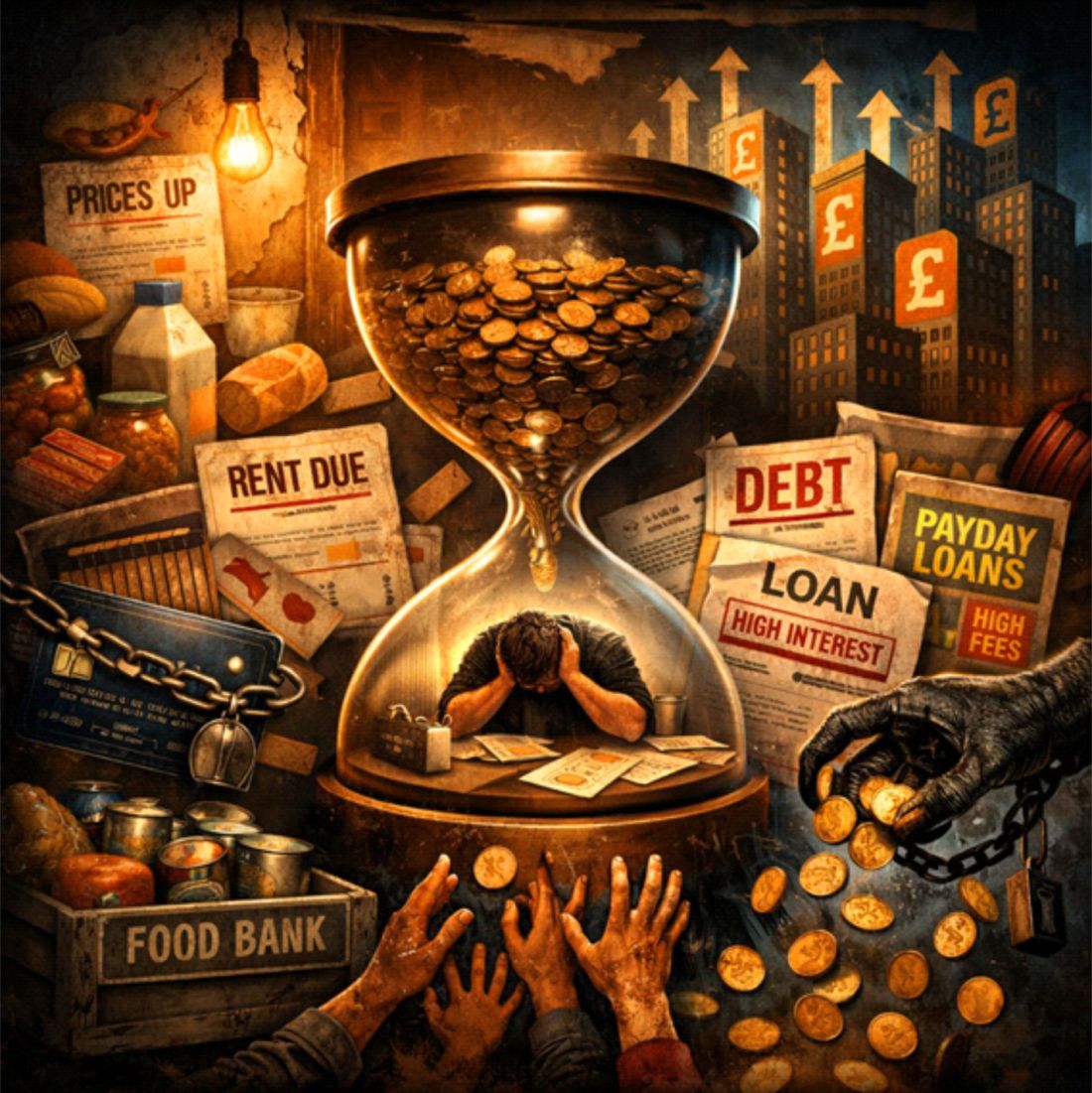
A lot of people quietly believe they’re failing. They think they’re bad with money, or not working hard enough, or somehow falling behind while everyone else is coping. But the truth is far simpler and far less personal: the system has changed around them, and it’s changed in ways that make it harder to stay afloat no matter how responsible or determined they are.
One fact makes this impossible to ignore:
A full‑time job on the national minimum wage no longer covers the basic cost of living for a single adult in the UK.
Not with careful budgeting.
Not with sacrifice.
Not with “smart choices”.
Without benefits, charity, debt, or going without essentials, it simply isn’t enough.
And when full‑time work no longer guarantees survival, something fundamental has broken.
The Minimum Wage That No Longer Meets the Minimum
The minimum wage was meant to ensure that anyone who worked full‑time could afford the basics. That promise has quietly collapsed. Rent, food, energy, transport, council tax – the essentials of life – have risen far faster than wages for years.
Even when inflation slows, prices don’t fall back. They stay where they landed.
People aren’t struggling because they’re irresponsible.
They’re struggling because the numbers no longer add up.
When the minimum wage doesn’t meet the minimum cost of survival, the economy is no longer functioning in a way that supports the people it relies on.
The Essentials That Keep Moving Out of Reach
Inflation as a statistic is one thing. Inflation as a lived experience is another. The weekly shop costs more than it did last year, and the year before that. The rent is higher. The energy bill is higher. The bus fare is higher.
People are being asked to absorb increases that compound year after year while their wages barely move. This isn’t a temporary squeeze. It’s a long‑term erosion of living standards that no amount of budgeting advice can fix.
And yet many people assume the problem is them. They think they’re falling behind.
They’re not. They’re living in a system that has quietly shifted the goalposts.
The Safety Net That No Longer Catches People
For decades, the state softened the blow. When wages lagged behind, support systems helped bridge the gap. But those systems have been worn down. Councils are going bankrupt. Services are stretched thin. Welfare support is harder to access and often too small to make a meaningful difference.
Into that space have stepped food banks, community groups, and personal debt – not as emergency measures, but as permanent parts of how people survive.
A society shouldn’t depend on charity to meet basic needs.
Yet here we are.
The Financial System That Profits From Struggle
There’s another layer to this that’s easy to miss because it has become so normal.
As people run out of money, the financial system doesn’t retreat. It adapts. It finds ways to monetise the gap between what people earn and what life costs.
Credit cards become a way to cover rent shortfalls.
Buy Now Pay Later becomes a way to buy groceries.
Overdraft fees become a regular expense.
Loans marketed as “flexible solutions” become a lifeline that comes with a cost.
None of this is accidental. It’s the logical outcome of a system that treats financial products as the answer to every shortfall.
Poverty becomes a market. Hardship becomes a revenue stream.
And the poorer people get, the more the system finds ways to extract from them – until they can’t participate at all.
How Everything Became Monetised – And Why People Think It’s Their Fault
This is where three forces come together: financialisation, monetisation, and enshittification.
Financialisation is the process of turning more and more of life into something that can be charged for.
Monetisation is the shift from paying once to paying constantly.
Enshittification is what happens when services get worse because they’re redesigned to extract more value from users.
You can see it everywhere.
Things that used to be owned are now rented or subscribed to.
Things that used to be simple now come with fees, penalties, and “options”.
Things that used to work well now work just well enough to keep people paying.
Energy companies bury people in penalties.
Supermarkets shrink products while raising prices.
Digital services start free, then add ads, then add subscriptions, then add penalties for not subscribing.
Renting used to be a stepping stone; now it’s a lifelong drain.
People feel this decline every day, but they rarely see it as something being done to them. They experience it as a personal failure. They think they’re bad with money. They think they’re not working hard enough. They think they’re falling behind.
But they’re not falling behind.
The system is accelerating away from them.
People are not doing anything wrong.
They are not failing.
They are not mismanaging their lives.
They are living inside systems that have been quietly re‑engineered to extract more while giving less – and then encouraged to blame themselves for the consequences.
The Slow Collapse Already in Motion
When you put all of this together – wages that don’t cover the basics, essentials that rise faster than incomes, a safety net that no longer catches people, and a financial system that profits from struggle – it becomes difficult to argue that we’re simply going through a rough patch.
What we’re seeing looks more like a slow, uneven collapse.
Not the dramatic kind that arrives with headlines and market crashes, but the kind that starts with the people who have the least buffer and works its way upward.
A society doesn’t fall apart when the stock market dips.
It falls apart when large numbers of people can no longer meet their basic needs and the systems around them treat that as normal.
We are closer to that point than most official narratives are willing to admit.
The Point Where Extraction Meets Exhaustion
Every economic model has a limit. There comes a moment when too many people fall out of the monetised economy for the system to function.
We are moving toward that moment – not because of ideology, but because of arithmetic.
You cannot keep extracting money from people who no longer have any.
The system is feeding on its own foundations.
And those foundations are wearing thin.
The Question We Can’t Avoid
If full‑time work can’t sustain a single life, how long can the system built on that work sustain itself?
That’s not a dramatic question. It’s a practical one. And answering it honestly means acknowledging that the collapse we worry about in the future may already be happening in the present – quietly, steadily, and in ways we’ve been encouraged to treat as normal.
People aren’t failing.
The system is failing them.
And the sooner we recognise that, the sooner we can start talking about what comes next.
Why the World We Built Can’t Survive the World We’re Entering – And How a Better One Can
There are moments in history when societies change because they choose to, and moments when they change because the foundations they rest on begin to give way.
Today, we are living through the second kind. The signs are everywhere – in the economy, in politics, in energy, in trust, and now in the technologies we are creating faster than we can understand them.
Something is shifting beneath our feet, and the world built on old assumptions is struggling to keep its balance.
This isn’t a story about predicting collapse. It’s a story about recognising that the world we built is running into pressures it was never designed to withstand. And one of the clearest signs of this is the growing misalignment between a system built on scarcity and technologies that operate on abundance.
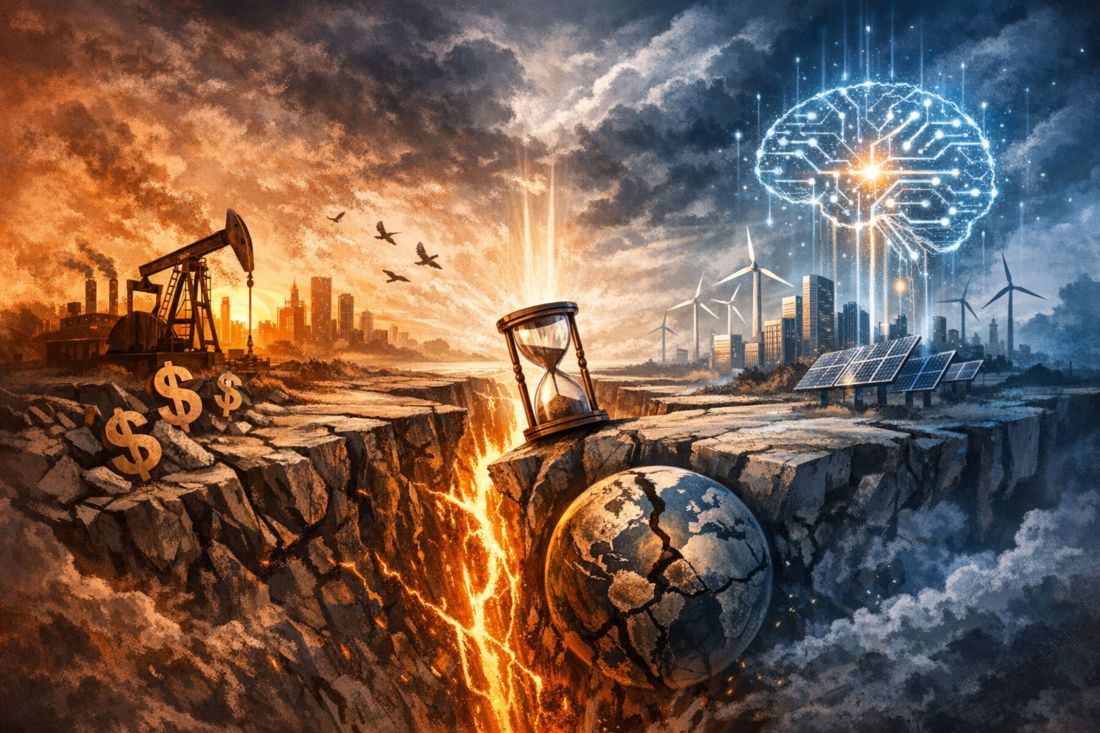
That misalignment is not a theory. It is a lived reality, and it is pushing the world toward a split.
1. The World Built on Scarcity
For more than two centuries, the modern economy has been built on the idea that scarcity creates value.
Scarcity of energy, scarcity of labour, scarcity of resources, scarcity of opportunity.
Scarcity is what gives money meaning. Scarcity is what gives institutions authority. Scarcity is what keeps the machinery of the economy turning.
Oil sits at the centre of this logic. Not because it is magical, but because it is measurable, meterable, and monetisable. Oil became the anchor of the global system because it was the perfect commodity for a world organised around scarcity.
Once oil took that central role, everything else followed. The financial system grew around it. The political system grew around it. The military system grew around it. Even the cultural assumptions about growth, progress, and value grew around it.
Oil didn’t just power the modern world. It shaped the rules of the game.
And because oil is something you can meter, price, tax, and control, the entire system evolved to treat everything as something that could be metered, priced, taxed, and controlled.
That is how we ended up with the financialisation of everyday life – not because people wanted subscriptions for ad-free features or paywalls on basic information and software tools, but because the system’s logic demands that anything which can be monetised must be monetised.
You can see this logic most clearly in the car industry. A car used to be a machine you bought, owned, and maintained. Today, it is increasingly a platform for recurring revenue. Heated seats, acceleration modes, battery capacity, navigation systems – features that physically exist in the vehicle are locked behind monthly payments. Even if you own the car, you do not own the functions.
The machine is no longer the product. You are.
This isn’t happening because it makes engineering sense. It’s happening because the financial system has reached the point where it must extract from everything simply to stay alive.
The same logic destroyed sustainable industries like wool, spinning, weaving, and local textiles. These weren’t inefficient relics. They were resilient, circular, human‑scale systems. But synthetic fibres made from oil were cheaper in financial terms, because the system was designed to make oil‑derived products appear cheap, even when the real costs were enormous.
Entire industries have collapsed not because they failed, but because they were incompatible with the financial logic of a world built on oil.
This is the world AI is being built into. And this is where the contradiction becomes impossible to ignore.
2. The Money System Thinks AI Will Serve It
The people building AI talk about “abundance,” but their definition is still shaped by the world they grew up in.
When they use the word, they are usually talking about growth – more markets, more investment, more compute, more data, more dominance.
They are still thinking in terms of accumulation, not sufficiency.
They talk about “benefiting humanity,” but they are funded by investors who expect exponential returns. They talk about “new jobs,” but they are building systems that reduce the need for human labour. They talk about “safety,” but their business models depend on centralisation and control.
They are trying to build abundance using the logic of scarcity.
It doesn’t work.
And they can feel the contradiction, even if they don’t yet have the language for it.
The money‑centric system believes AI will extend its lifespan – that automation will increase profits, that data will create new markets, that efficiency will keep the old world running a little longer.
But AI doesn’t operate on scarcity. It doesn’t need wages, rest, or resources in the way humans do. And at scale, it doesn’t just consume energy – it demands energy on a level the current system cannot provide.
This is the pressure point.
AI accelerates the system’s need for abundant energy.
Abundant energy breaks the logic of scarcity.
Breaking scarcity breaks the financial model.
Breaking the financial model breaks the system.
This is why the idea of free or abundant energy is so disruptive. Not because it is utopian or mystical, but because it undermines the very foundation of the money‑centric world.
3. Tesla and the First Collision With Abundance
To understand why abundant energy is so threatening to a scarcity‑based system, it helps to look at the story of Nikola Tesla.
Tesla wasn’t just an inventor. He was one of the most gifted engineers of his time – a man who saw possibilities that others couldn’t. He understood that energy could be transmitted wirelessly. He understood that the Earth itself could be used as a conductor. He understood that energy could be made abundant, not scarce.
But Tesla lived in a world where energy companies made their money by selling electricity by the unit. A world where the business model depended on scarcity. A world where abundant energy wasn’t a breakthrough – it was a threat.
So when Tesla proposed systems that would make energy widely available and difficult to meter, he wasn’t dismissed because he was wrong. He was dismissed because what he stood for was incompatible with the economic logic of his time.
The lesson is simple:
When abundance threatens the foundations of a scarcity‑based system, the system pushes back.
But here is the difference today: the technologies emerging now cannot be suppressed the way Tesla was.
The AI industry is global, decentralised, and embedded in every sector. Energy research is no longer confined to a handful of laboratories. Knowledge cannot be buried in filing cabinets.
The internet makes suppression impossible. And the incentives of the AI ecosystem require abundant energy to survive.
The system cannot bury what it cannot control.
4. The New Risk: AI Agents as Instruments of Monetisation and Control
Most people still think of AI as something you open when you need it – a tool you summon. But the next phase of AI is not a tool. It is an agent.
An agent is persistent.
It remembers.
It acts.
It takes initiative.
It manages parts of your life without waiting for you to type a command.
Right now, AI is a conversation.
An agent is a participant in your life.
And in the hands of a money‑centric system, an agent becomes the perfect mechanism for monetising the nth detail of your existence.
Not the big things.
The tiny things.
The temperature of your seat.
The brightness of your lights.
The speed of your car’s acceleration.
The quality of your video call.
The priority of your delivery.
The tone of your notifications.
A device‑level agent can watch your behaviour, anticipate your needs, and frame upsells as care. It can nudge you toward profitable outcomes while appearing to help. It can turn every moment into a potential transaction.
This is not speculation.
It is already happening.
Cars ship with features physically installed but digitally locked.
Phones come with capabilities that require monthly fees to unlock.
Home devices nudge you toward paid upgrades.
Software quietly shifts from ownership to subscription.
A device‑level agent is the next step in this evolution – a personalised monetisation layer.
And that is the point at which the system collapses under its own weight.
Not because people revolt.
Not because governments intervene.
But because the model becomes so granular, so invasive, so relentlessly transactional that it breaks the very trust it depends on.
People begin to feel managed.
They begin to feel nudged.
They begin to feel observed.
They begin to feel monetised.
They begin to feel owned.
And once people feel owned, the system loses legitimacy.
The monetisation of the nth detail is not just greedy.
It is self‑destructive.
5. The Split the World Is Moving Toward
The pressures acting on the world today are not pointing toward a single outcome. They are pointing toward a divergence.
On one side is the path the money‑centric system is drifting into almost without noticing. It assumes that AI will strengthen its position – that automation will increase profits, that data will create new markets, that efficiency will extend the lifespan of a model already stretched thin. It is a quiet, almost passive belief that technology will keep the old world running a little longer.
But this belief rests on an illusion. The illusion is that financialisation can continue indefinitely. The illusion is that everything can be turned into a subscription, a licence, a fee.
The illusion is that people can be endlessly squeezed without consequence.
AI exposes the limits of that illusion. It accelerates the demand for energy the system cannot supply. It automates work faster than new forms of employment can be invented. It pushes the logic of extraction to a point where it simply stops working.
And when the financialisation model hits that wall – when the system can no longer extract enough to sustain itself – the people inside it are not empowered. They are displaced. They are replaced. They are treated as surplus to requirements in a world that has mistaken automation for progress.
That is one direction the world can go.
But it is not the only one.
There is another direction that becomes possible the moment the energy question is resolved – when energy is no longer the bottleneck, when abundance is not a slogan but a physical reality.
In that world, the logic of extraction loses its grip. The need to meter, price, and control every aspect of life dissolves. And when that happens, the relationship between people and the system changes completely.
Instead of being treated as consumers to be monetised, people become contributors to a shared world. Instead of being excluded by cost, they are included by design. Instead of being impoverished by fees, they are enriched by participation.
This isn’t an abstract ideal. It is a practical shift in how society functions.
6. The People‑Centric Alternative: Real, Practical, Ready
A world built on abundance needs a different organising logic – one that treats people not as units of consumption but as participants in a shared human project.
That logic already exists. It is built on four pillars.
Personal Sovereignty
This is the foundation.
It means people own their choices, their data, their direction.
AI becomes a companion that strengthens autonomy, not a gatekeeper that restricts it. It helps people navigate life without monetising their existence.
Basic Living Standard
This is not welfare.
It is infrastructure.
Food, shelter, energy, connectivity – guaranteed because abundance makes it possible.
AI helps optimise distribution, reduce waste, and ensure fairness. It becomes the infrastructure of dignity.
Contribution Culture
In a world where survival is not tied to wages, contribution becomes the centre of value.
People contribute through care, creativity, maintenance, teaching, growing, building, repairing.
AI helps match people to roles, supports their learning, and amplifies their abilities.
Value stops being something taken from people and becomes something created with them.
LEGS (The Local Economy & Governance System)
This is the structure that makes it all work.
Communities govern their own economic activity.
AI acts as a facilitator – coordinating resources, matching needs with contributions, maintaining transparency – without extracting value.
It brings decision‑making back to the level where people actually live, work, and contribute.
In this world, an AI agent is not a monetisation layer.
It is a sovereignty amplifier.
It helps people live, not spend.
It helps them contribute, not comply.
It helps them grow, not submit.
It walks beside them, not ahead of them.
7. What Happens After the Split
When the old system finally reaches the point where it can no longer sustain itself – whether through financial failure, political fracture, energy disruption, or technological misalignment – the world will not pause and wait for instructions. It will move quickly, and people will look for ideas that make sense of what they are experiencing.
They will look for ways of organising that do not depend on extraction.
They will look for ways of contributing that do not depend on employment.
They will look for ways of governing that do not depend on distance.
They will look for ways of living that do not depend on scarcity.
This is where contribution‑based systems, local governance frameworks like LEGS, and the Basic Living Standard become essential.
They offer a way of organising society that aligns with abundance rather than fighting against it, and a way of integrating AI that strengthens communities rather than hollowing them out.
They make the people‑centred alternative not just imaginable, but practical.
8. The Work Ahead
We are not drifting toward a single future. We are approaching a divergence.
One path leads to a world where AI dominates because the system that created it cannot imagine any other use for it. A world where people are replaced because the logic of financialisation leaves no room for them. A world where abundance exists, but only for the few who control the machinery.
The other path leads to a world where abundance dissolves the need for extraction, where contribution becomes the basis of value, and where AI supports a society that is no longer built on scarcity. A world where people are not replaced, because the system is no longer trying to monetise their existence. A world where personal sovereignty is not a slogan, but a lived reality – the freedom to participate, to contribute, to belong.
The split is coming. The direction is not predetermined.
And the work now is to make the second path visible, understandable, and ready – so that when the moment comes, people recognise it as the future they were waiting for, not the future they were afraid of.
Choosing the best of a bad bunch isn’t the same as choosing something good…
People talk about change constantly. They want it, they hope for it, they vote for it, and they argue about it. But beneath all that noise sits a quieter truth: most people aren’t looking for real change at all. Not because they don’t care, but because they’ve been conditioned to believe that real choice comes from outside themselves.
For generations, people have been taught – subtly, consistently, and often invisibly – that the only choices that matter are the ones handed to them. And when you’re only ever offered a narrow set of options, you eventually stop imagining that anything else could exist.
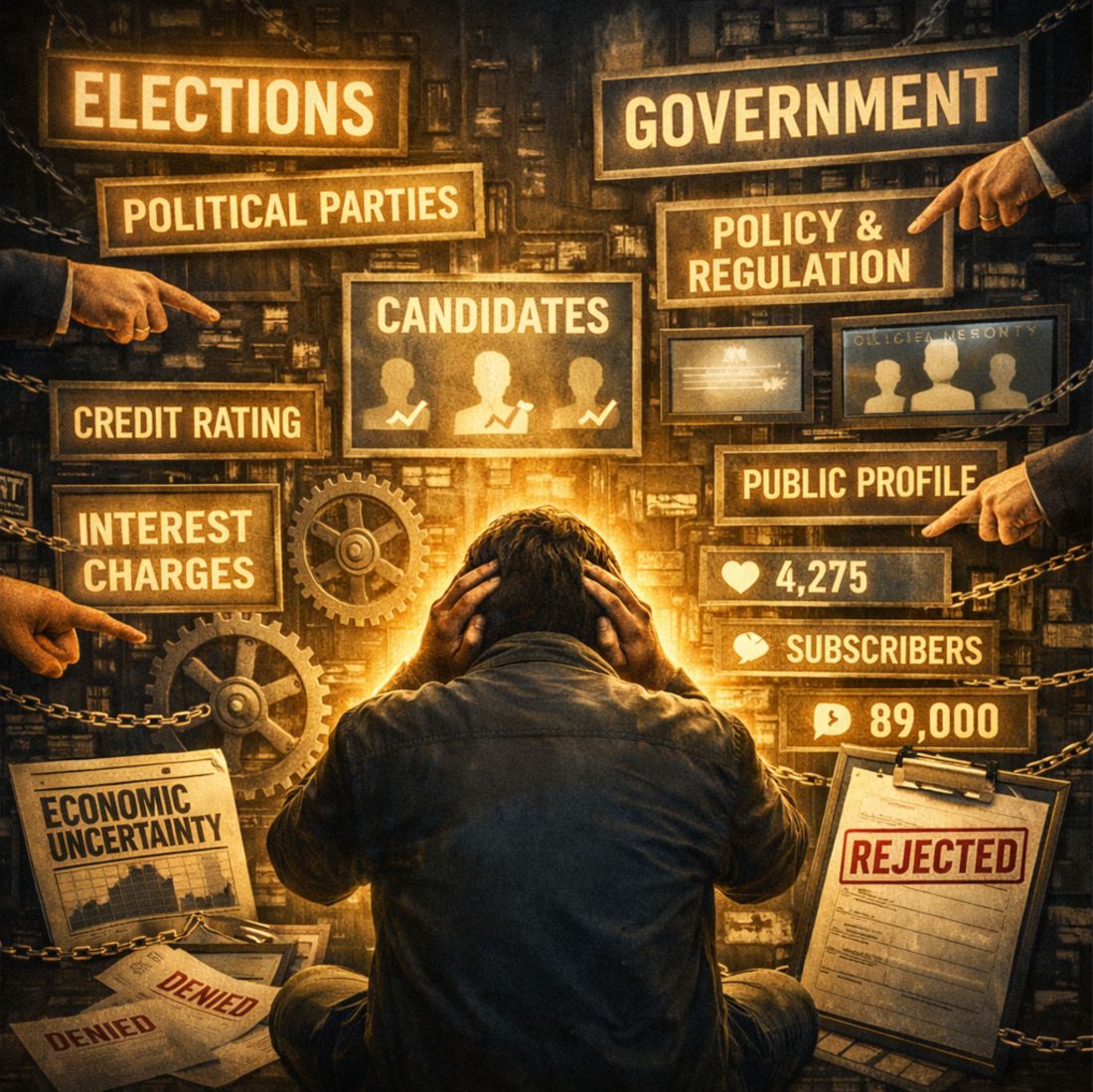
The Illusion of Choice
When people step into a polling booth, they see a list of names and assume those names represent the full range of possible futures.
But the options on that paper were shaped long before the voter arrived. Candidates were selected, narratives were set, and boundaries were drawn by processes the public never sees.
So people choose – but they choose from a list they didn’t write.
And here’s the trap:
Choosing the best of a bad bunch isn’t the same as choosing something good.
Yet people have been conditioned to believe it is.
They’ve been taught that if they pick the “least-worst” option, they’ve made a meaningful choice.
But the least-worst option is still part of the same system that produced the worst ones.
This leads to the unavoidable truth:
You cannot make a good choice if you’re not given any good options.
People aren’t choosing badly.
They’re choosing from what exists – and what exists is often inadequate by design.
How People Learn to Stop Looking
This pattern doesn’t just appear in elections. It runs through almost every part of modern life.
Most of the “choices” people make – what they buy, how they work, what opportunities they can pursue – are shaped by structures they didn’t design.
Over time, people learn to navigate within those boundaries rather than question them. They learn to adapt rather than imagine alternatives. They learn to accept rather than explore.
Eventually, people stop looking for real choice because they no longer believe real choice comes from them.
They’ve been taught that power lives “out there” – in institutions, parties, systems, markets – and that their role is simply to pick from whatever those systems provide.
The Real Question of Power
This is where the deeper issue lies.
Real choice – the kind that leads to real change – always comes from within.
It comes from people recognising their own agency, their own imagination, their own ability to shape what comes next.
But the system we live in depends on people forgetting that.
Everything is handed to us:
the candidates
the narratives
the acceptable opinions
the “realistic” options
the boundaries of debate
the structure of daily life
Most people don’t even see it happening.
Those who do often feel powerless to challenge it, because the problem isn’t individual – it’s systemic.
A system built on external control cannot easily accommodate internal agency.
Why People Feel Powerless
The frustration so many people feel today – the sense that nothing ever really changes – doesn’t come from apathy. It comes from a deeper disconnection between what people want and what they believe is possible.
People feel powerless not because they lack power, but because they’ve been encouraged to forget they have any.
They’ve been taught that:
the system defines the options
the options define the outcome
and their role is simply to choose between them
When that’s all you’ve ever known, you stop looking for anything else.
Real Change Begins Before the Options Exist
The most important shift isn’t political – it’s psychological.
Real change begins when people remember that choices don’t have to come pre‑packaged. That alternatives don’t have to be offered by institutions to be real. That agency doesn’t begin and end with a vote.
A genuine choice is one that:
isn’t manufactured
isn’t constrained by fear
isn’t limited to what already exists
and isn’t defined by someone else’s imagination
Most people have never been encouraged to think in those terms. Many don’t realise they can.
The Cycle Will Continue – Until People Look Beyond the Given Options
New parties may appear. Old ones may rebrand. Movements may rise and fall. But unless people start looking beyond the options placed in front of them, the outcomes will remain the same.
People will hope for change.
They will vote for change.
And they will be disappointed again.
Not because they chose wrongly, but because they were never offered a real choice in the first place – and never encouraged to create one.
The First Step Toward Change
If people genuinely want something different, the first step isn’t to wait for better options.
It’s to recognise that good choices require good options – and those options can be created, not just received.
People want change.
Deeply.
Sincerely.
But until they start looking for it within themselves – rather than in the limited menu the system hands them – they will keep finding only what the system already provides.
Understanding Human‑Scale Leadership, The Revaluation, and LEGS – and Why They Matter to All of Us
Most people can feel that something in society isn’t working anymore. Life feels harder, institutions feel distant, and the systems we rely on seem to be creaking under their own weight.
We sense the symptoms every day – rising costs, failing services, political frustration, and a growing feeling that ordinary people have less and less control over their own lives.
But what if these problems aren’t random?
What if they all come from the same root cause?
And what if there is a coherent, practical alternative?
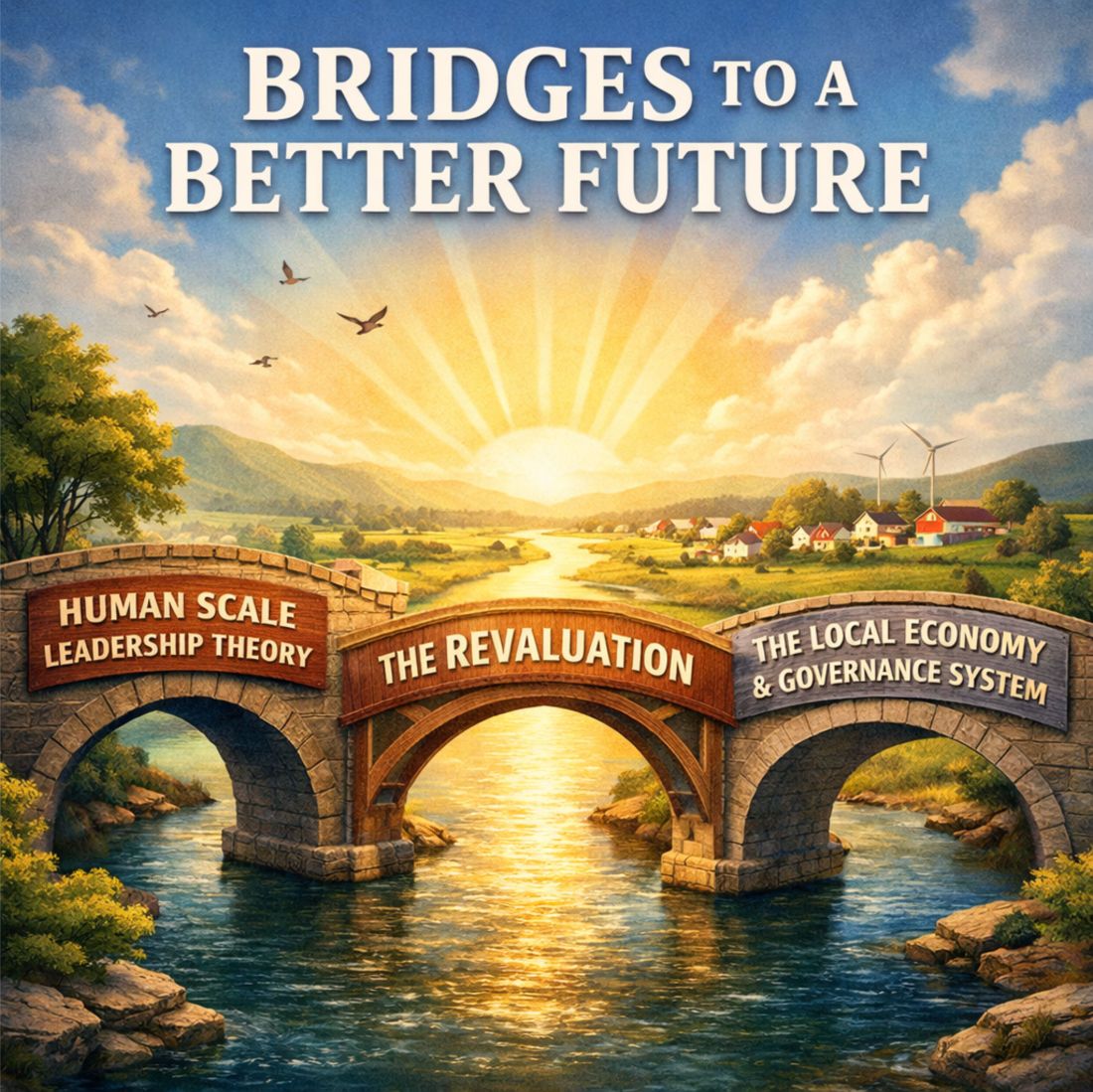
This document introduces three connected ideas that together offer a new way forward:
Human‑Scale Leadership Theory – why leadership has disappeared
The Revaluation – how society transitions from the old world to the new
The Local Economy & Governance System (LEGS) – a practical model for a fair, local, people‑centred society
You don’t need to know anything about these ideas beforehand.
This is your starting point.
1. Why the World Feels Like It’s Falling Apart
Most of us can sense that the systems we live under – political, economic, and social – no longer work the way they should.
We see:
leaders who don’t seem to lead
decisions that feel disconnected from real life
communities losing their identity
an economy that benefits a few while leaving many behind
public services that feel stretched, distant, or broken
These aren’t isolated issues.
They’re symptoms of a deeper structural problem.
Over time, our systems have grown:
too large
too centralised
too complex
too focused on money
too disconnected from everyday people
When systems grow beyond human scale, something vital is lost: leadership.
2. Human‑Scale Leadership Theory: Why Leadership Has Disappeared
Human‑Scale Leadership Theory begins with a simple truth:
Leadership is a human relationship – and it only works at human scale.
Real leadership requires:
knowing the people you serve
understanding their lives
seeing the impact of your decisions
being accountable to them directly
acting with courage and responsibility
But in modern systems, leaders are:
distant
insulated
surrounded by bureaucracy
rewarded for compliance, not courage
disconnected from the people they represent
This isn’t because people today are worse.
It’s because the system makes leadership impossible.
When systems become too big, they don’t produce leaders – they produce managers. People who maintain the system rather than serve the people.
Human‑Scale Leadership Theory explains why this happens and why leadership cannot return unless systems are redesigned around human beings.
3. The Revaluation: The Transition We’re Already Living Through
If Human‑Scale Leadership Theory explains the problem, The Revaluation explains the transition.
The Revaluation is the period – already underway – where society begins to reassess what truly matters.
It’s the shift from a world built around money, hierarchy, and centralisation to one built around people, community, and the environment.
It happens because the old system is failing in ways we can no longer ignore:
money no longer guarantees security
global systems are fragile
public trust is collapsing
inequality is widening
communities feel hollowed out
people feel powerless
The Revaluation is the moment when society collectively realises:
money is not value
growth is not progress
centralisation is not stability
and leadership cannot be manufactured
It is the psychological and cultural reset that makes a new system possible.
4. LEGS: A Practical System for a Better Future
If Human‑Scale Leadership Theory explains why we need change, and The Revaluation explains how we transition, then LEGS explains what comes next.
LEGS – The Local Economy & Governance System – is a complete model for a society built around:
People
Community
The Environment
It is not abstract.
It is not utopian.
It is practical, local, and grounded in lived experience.
What LEGS provides
A new kind of governance
local
democratic
transparent
accountable
rooted in community
free from distant hierarchy
A new kind of economy
local circular economies
community‑issued currency
barter and exchange
time‑limited money to prevent hoarding
social businesses for essential services
a Basic Living Standard for all
A new kind of society
flat hierarchy
personal sovereignty
shared responsibility
community contribution
local decision‑making through the Circumpunct
LEGS is the practical expression of Human‑Scale Leadership Theory.
It creates the conditions where real leadership can re‑emerge.
5. How These Three Ideas Fit Together
These three works are not separate.
They are three parts of one coherent whole.
Human‑Scale Leadership Theory
Explains why leadership has collapsed and why centralised systems fail.
The Revaluation
Explains the transition – the cultural and economic shift we must go through.
LEGS
Provides the practical system that replaces the failing structures.
Together, they form a complete arc:
Why → How → What
Philosophy → Transition → System
Understanding → Transformation → Implementation
This is the full architecture of a better future.
6. Why This Matters to You
You don’t need to be a political theorist.
You don’t need to be an economist.
You don’t need to be an activist.
If you’ve ever felt:
that life is harder than it should be
that leaders don’t listen
that communities feel disconnected
that the economy doesn’t work for ordinary people
that the world is changing in ways that don’t make sense
…then this work is for you.
It offers:
a clear explanation of what’s gone wrong
a practical model for what can replace it
a pathway from the world we have to the world we need
Most importantly, it offers hope – not as a slogan, but as a system.
7. Where to Go Next
If this document has given you a sense of clarity, curiosity, or possibility, the next steps are simple:
explore Human‑Scale Leadership Theory to understand the root causes
dive into LEGS to see how a better system actually works
Each piece deepens the picture.
Together, they offer a complete, humane, and practical alternative to the failing systems of today.