The Time for Performance is Over

The time for performance is over. The music has stopped, and the old system no longer has a chair.

For years, British politics has carried on as if the stage were still set in the old way. Leaders step forward, deliver their lines and reassure us that the familiar rhythms still apply: make the right choices, pull the right levers, announce the right reform, and the country will respond as it once did.

But the stage has changed. The machinery behind it has changed too, and many of the people standing beneath the lights have not yet grasped how completely.

What I Mean by ‘the System’

By ‘the system’, I mean two things that have fused into one. The first is Britain’s post-1980 operating model: an economy organised around growth, consumption, finance, property, flexible labour, centralised fiscal control and the promise that market incentives will allocate resources better than public institutions can. The second is the establishment worldview that treats this arrangement not as one political settlement among others, but as common sense itself.

That worldview is not simply a club of powerful people. It is a shared mental map, carried through the Treasury, Whitehall, political parties, business, the media and much of public life. It assumes that growth will return, that fiscal management is the first test of seriousness, that decisions are safest at the centre, that incentives can repair most failures, and that institutional continuity is preferable to disruptive change.

For a long time, those assumptions worked well enough to look like laws of nature. Growth created room for compromise. Cheap energy and dependable supply chains kept costs down. Borrowing and rising asset values softened conflict. Public services could be asked to do more because the wider model usually produced enough movement to disguise what was being lost.

That is the causal chain at the heart of this essay. The old assumptions shaped the institutions; the institutions narrowed the choices available to government; repeated use of those choices weakened capacity and resilience; and, as the world became less stable, a model built for continuity became less able to absorb change. What looks like a failure of individual leadership is often the final, visible consequence of a much deeper design failure.

This is why capable people can enter government with good intentions and still end up making versions of the same decisions. They are trained to operate the inherited machinery, not to question the worldview that designed it.

The Human Tragedy

If there is a tragedy here, it is not that politicians have suddenly become uniquely foolish or uncaring. It is that they were prepared for a world that is disappearing.

They learned how to build teams, negotiate policy, manage a news cycle and communicate through a crisis. Those skills mattered in a system with functioning levers and thick enough buffers to absorb mistakes. They matter less when the levers are no longer connected to the outcomes they are meant to produce.

So they do what they know. They perform. They reassure. They reorganise a department, rename a programme, launch a review and promise delivery. When the policy meets depleted local capacity, fragile supply chains, high costs or Treasury limits, it slows, shrinks or quietly disappears. The announcement survives longer than the action because the state can still produce language more easily than results.

You can see the strain in the repetition. Every government arrives promising renewal and leaves speaking of ‘tough choices’. Every minister discovers that the service they were asked to reform is tied to half a dozen other systems already under pressure. Pull one thread and the fabric does not become neater; it begins to tear.

None of this absolves leaders of responsibility. People in power still make choices, and choices still have consequences. But blame on its own explains very little. The more useful question is why different people, parties and temperaments are repeatedly funnelled towards the same narrow set of answers.

The answer is that the system does not merely constrain action. It defines what respectable action is allowed to look like.

The Structural Reality

Britain’s operating model depended on conditions that were never permanent: affordable energy, stable geopolitics, reliable imports, manageable debt, rising or at least tolerable living standards, and public institutions with enough spare capacity to absorb shocks.

As those conditions weakened, the model did not adapt. It compensated. Low pay was supported through benefits. Housing costs were carried through household debt and public subsidy. Local government was asked to preserve social stability with fewer resources. Infrastructure maintenance was deferred. Public services pursued efficiency until efficiency became the removal of every margin that might once have absorbed a bad year.

Each response made sense within the worldview of the system. Together, they made the country more vulnerable. When wages lagged behind costs, support payments prevented immediate hardship but also became indispensable to the functioning of the lower half of the economy. When local capacity was cut, central control appeared more necessary. When growth disappointed, more weight was placed on the next forecast of growth. The remedy for each weakness deepened dependence on the model that had created it.

The pandemic exposed this structure and temporarily concealed it. Government could still write cheques on a scale large enough to hold everyday life together. That spending bought time and prevented far worse damage, but it did not rebuild the underlying capacity. It left a more indebted state facing the same structural problems in a harsher fiscal and geopolitical climate.

Today, governments have less room to borrow, institutions have less room to improvise and households have less room to absorb another rise in costs. The runway is shorter because the margins have been spent.

This is why politics feels repetitive and strangely weightless. The language of control remains, but the capacity behind it has thinned. Ministers speak as if the machine were merely jammed. In reality, many of its parts were removed in the name of efficiency, while others were designed for conditions that no longer exist.

The Domino Field

People naturally ask what will set the next crisis off. Energy? Food? Debt markets? Supply chains? AI? A geopolitical event nobody has yet named?

At this stage, the first domino matters less than the field on which it falls. A resilient system contains failure. It has stores, slack, alternative suppliers, institutional memory and people with permission to act. A vulnerable system transmits failure.

Britain has spent decades tightening the connections while thinning the buffers. Energy feeds into food and transport; food and transport feed into inflation; inflation feeds into interest costs and household distress; those pressures feed into public services and political legitimacy. A shock travels because there are fewer places left for it to stop.

The danger is therefore not one spectacular event but a chain: an external pressure raises costs; households and firms cut back; tax receipts weaken while demand for support rises; fiscal rules narrow the response; public and local institutions are asked to carry more with less; delays and failures multiply; trust falls; and the state becomes even less able to mobilise consent for the changes it needs.

AI belongs in this picture as one dependency among many, not as a magical cause or a singular villain. It may raise capability in some places and fragility in others. What matters is whether the systems around it have the energy, skills, governance and resilience to use it without becoming more exposed.

The next crisis will be defined less by where it starts than by what it lands on.

What This Argument Is – and Is Not

This is not a prediction of imminent collapse. Systems can limp on for a long time. Britain remains wealthy, capable and institutionally resourceful, and decline is never a straight line. Nor is this generic declinism: the comforting habit of declaring that everything was better before and that national failure is inevitable.

The argument is more specific. A particular operating model is losing its ability to turn inputs into the outcomes it promises, while the worldview around it keeps excluding alternatives. That can produce sudden crisis, but it can also produce years of drift, uneven deterioration and local adaptation. The point is not to forecast a date. It is to recognise the mechanism while there is still time to change it.

Nor does acknowledging fragility mean denying agency. Quite the opposite. If the problem were simply fate, there would be little to do. If it lies in institutions, assumptions and the distribution of power, then those things can be redesigned.

The Lament

There is no satisfaction in watching the old assurances lose their force. No vindication. Only the weight of what it means for people who rely on services already stretched, for households with no cushion, and for public servants asked to hold together systems that no longer have the strength to hold themselves.

A lament is not despair. It is the honest recognition of what has been lost: spare capacity, local knowledge, institutional confidence, time to think, and the belief that public action can shape the future rather than merely manage decline.

It also asks us to see the people inside the system as people. They are neither all villains nor all fools. Many are conscientious, intelligent and trapped inside incentives that reward continuity. They reach for the familiar because the familiar is what their institutions recognise as serious.

That recognition is painful, but it clears the ground. Once the performance stops, we can ask not how to revive the old rhythm, but what kind of country could function without depending on it.

The Opportunity That Still Exists

The alternative is not a grand blueprint lowered from Whitehall. It is a different distribution of security, capacity and power: a national state strong enough to guarantee a floor and coordinate what must be shared, alongside local institutions trusted and funded to solve what must be rooted in place.

Start with security. A basic living standard would establish a reliable floor beneath income, housing, energy, food and essential services. The purpose would not be to withdraw people from economic life, but to remove the permanent emergency that prevents them from participating in it. Security gives households room to plan, workers room to retrain, carers room to care and communities room to organise.

Then rebuild local capacity. Give councils and community institutions dependable multi-year resources rather than short competitive grants. Let places retain more of the value they create. Restore teams able to plan housing, energy, transport, care and skills together, because those systems meet in real lives even when Whitehall keeps them in separate departments.

Make resilience a practical test of policy. Ask not only whether a service is cheap in a normal year, but whether it still works in a difficult one. Maintain strategic stocks where dependence is dangerous. Support diverse suppliers instead of single brittle chains. Invest in repair, maintenance and redundancy. Treat spare capacity not as waste, but as insurance.

Use national policy to create common standards and long horizons, then allow local variation in how they are met. A coastal town, a former industrial city and a rural county do not need identical institutions. They do need equal dignity, clear rights, accountable decision-making and access to the resources required to act.

Change the measures that govern decisions. Growth can remain useful without being the sole proof of success. Security, health, ecological stability, household resilience, institutional capacity and the time people have to live should matter too. What we measure becomes what officials are permitted to defend.

None of this is quick, and none of it removes the need for hard choices. It changes what those choices are for. Instead of repeatedly sacrificing capacity to preserve the appearance of control, we would invest in the ability of people and places to withstand shocks, learn and adapt.

The new model would be more distributed, but not abandoned to postcode luck; more local, but held within national guarantees; less dependent on endless consumption, but not hostile to enterprise; more cautious about concentrated power, but more ambitious about public purpose.

That is the opportunity hidden inside this moment: not a promise of perfection, but the possibility of building something that works in the world as it is.

The Chair Is Gone

There is a moment in any long performance when the audience realises the actors are still speaking but the play has already ended. The lines continue, the gestures continue, the familiar choreography continues – but the story has moved on.

That is where Britain is now. The rituals of politics remain, but the system that once gave those rituals meaning no longer has the same strength beneath it. The chair the old model relied on – growth, stability, buffers and room to manoeuvre – has been pulled away.

This is not a moment for triumph or fatalism. It is a moment for honesty: about the limits of the inherited model, about the worldview that keeps it in place, about the human cost of pretending, and about the work required to build something else.

The performance is over. The music has stopped. The old system no longer has a chair.

What comes next depends on whether we keep reciting the old lines, or finally face the silence and begin building a system that fits the world as it is – not the world as we once hoped it would remain.

Further Reading

The essays below develop the argument from different directions. Begin with the worldview that defines what the system considers possible, then move through the operating model and its structural consequences before turning to practical alternatives. URLs are shown in full so every source remains usable even where an earlier search-generated link was malformed.

Defining the System and Its Worldview

The Establishment Is Not What You Think It Is

Why the Modern Establishment Is a Worldview, Not a Class – and Why That Makes It So Hard to Escape

Defines the establishment as a shared worldview rather than a social club, and explains why its assumptions survive changes of personnel and party.

The System Is the Problem

Explains why governments with different intentions repeatedly encounter the same constraints and converge on similar decisions.

The Performance of Politics

Shows how political performance becomes a substitute for effective power when institutions can still announce but struggle to deliver.

How the Operating Model Was Hollowed Out

The End of Britain’s Current Operating Model

Sets out how the post-1980 settlement reached its limits and what that means for Britain’s political, economic and social future.

Borrowing Into Oblivion

Traces how debt-fuelled growth concealed the erosion of Britain’s economic foundations and reduced the room available for the next crisis.

The Finger in the Dam

Examines the benefits system as an essential support for a low-wage, high-cost economy, and the consequences of treating it as an isolated expense.

Why Alternatives Are So Easily Dismissed

That Wouldn’t Work

Explores the assumptions that make unfamiliar proposals seem impossible before they have been seriously considered.

Building a Different Future

A New Way Forward

Introduces a more local, resilient and humane direction without pretending that transition will be simple or immediate.

The Basic Living Standard (BLS)

Proposes a secure social floor designed to give people the stability required to participate, plan and withstand shocks.

The Local Economy Governance System (LEGS)

Offers a framework for decentralised governance built around local knowledge, capacity and accountability.

From Principle to Practice

Moves from the principles behind LEGS to the practical work of implementing durable local systems.

The Wider Context

The Age of Circular Fragility

https://adamtugwell.blog/2026/08/28/the-age-of-circular-fragility-why-ai-and-the-world-economy-may-now-rise-and-fall-together

Considers the mutual dependence of AI and the wider economy, and asks how capability can amplify fragility when resilience is neglected.
The Age of Circular Fragility | Why AI and the World Economy May Now Rise and Fall Together

By late August 2026, one uncomfortable reality has become difficult to ignore: artificial intelligence is no longer a separate technological frontier. It has become part of the operating system of the modern world.

AI now helps route goods, price risk, support medical decisions, balance electricity grids, administer public services, and analyse military threats. It is no longer sitting outside society, waiting to be adopted. It is already inside the machinery.

At the same time, the world around it has become more fragile. Energy markets are volatile. Supply chains are stretched. Debt levels are high. Geopolitical tensions are escalating. Climate pressure is increasing. Political trust is weakening.

The result is a new kind of risk. It does not flow in one direction.

AI can be weakened by a breakdown in the world that supports it. The world can also be weakened by a breakdown in the AI systems it has begun to depend on.

This is circular fragility: a situation in which two systems become so dependent on each other that stress in either one can travel back through the other.

This is not a prediction of doom. It is a description of a structural vulnerability that is already taking shape.

The AI Industry Is Built on a Story It Can No Longer Fully Sustain

The public story of AI has been one of unstoppable progress: bigger models, smarter systems, faster adoption, and ever-larger investment.

Underneath that story, however, the economics are far less settled. AI is not software in the old sense: cheap to copy, easy to distribute, and inexpensive to run once built.

Modern AI depends on vast physical infrastructure: specialised chips, data centres, cooling systems, electricity, network capacity, and a continuous pipeline of capital. The International Energy Agency has warned that electricity demand from data centres could more than double by 2030, with AI a major driver of that growth.

That matters because the cost of serving AI does not disappear once a model has been trained. Inference-the everyday process of answering prompts, analysing documents, producing images, writing code, or running agents-continues every hour of every day. As more people use AI for heavier tasks, the running cost compounds.

Yet the price users see is often moving in the opposite direction. Subscription fees are capped. Token prices fall. Free access is used to win market share. Enterprise buyers are becoming more cautious. Open-source competitors are improving rapidly. The gap between what AI costs to provide and what many users are willing or able to pay remains one of the unresolved questions at the heart of the industry.

For now, that gap is being bridged by investment capital, strategic subsidy, government interest, and the expectation that scale will eventually make the whole system profitable. That may prove true. But it is not guaranteed.

The industry is therefore not held together by economics alone. It is held together by a story: that costs will fall, demand will keep rising, investors will remain patient, and infrastructure will arrive quickly enough to support the next wave of use.

Stories can be powerful. They can mobilise money, talent, and political support. But stories are not foundations. When the real-world conditions beneath them change, belief can turn very quickly from fuel into fragility.

The Coming Affordability Crisis

There is another weakness in the AI business model that receives far less attention than energy costs or infrastructure spending: the ability of customers to keep paying for it.

Most discussions of AI economics focus on the supply side. They ask whether providers can continue funding data centres, buying chips, securing energy, and training larger models.

The demand side is discussed far less often.

Yet the same pressures destabilising the wider global economy are also reducing the ability of households, businesses, and governments to spend freely on AI services.

If energy prices rise, disposable income falls.

If food prices rise, discretionary spending falls.

If debt costs rise, corporate investment falls.

If governments face fiscal pressure, technology budgets come under scrutiny.

If businesses enter a recession, experimentation is often one of the first expenditures to be reduced.

AI is frequently presented as a productivity tool that organisations cannot afford to ignore. In many cases that is true. But there is a significant difference between recognising the value of a technology and having the financial capacity to deploy it at scale.

This creates a second economic squeeze.

On one side, AI providers face rising costs from energy, infrastructure, hardware, cooling, and financing.

On the other side, customers face rising costs from food, fuel, housing, wages, debt servicing, insurance, and economic uncertainty.

The result is a narrowing zone in which both sides can remain financially viable.

The assumption underlying much of the current AI boom is that adoption will continue rising quickly enough to compensate for these pressures. That assumption may prove correct. But it depends on a world in which businesses, consumers, and governments retain the financial freedom to spend on new technology even as other essential costs rise.

If that freedom disappears, the consequences for AI could be profound.

A technology that is expensive to provide and increasingly difficult to afford finds itself trapped between two forms of scarcity: the scarcity of capital needed to produce it and the scarcity of money available to consume it.

That is not merely a technology problem.

It is a systemic problem.

AI Has Become Load-Bearing Before Becoming Stable

The deeper problem is not simply that AI is expensive. It is that AI is becoming important before it has become fully resilient.

Across only a few years, AI has moved from experiment to infrastructure. It now supports warehouse scheduling, fraud detection, medical triage, customer service, software development, energy forecasting, military analysis, and government administration. In many places it is not replacing whole systems outright, but it is becoming part of how those systems make decisions and manage pressure.

That distinction matters. A society does not need to hand total control to AI for AI dependency to become dangerous. It only needs to remove enough human capacity, manual fallback, institutional memory, and spare time that operating without AI becomes slower, more expensive, and more chaotic.

AI remains powerful but uneven. It can be brilliant in one moment and unreliable in the next. It still hallucinates. It still depends on enormous computational resources. It still relies on tightly concentrated chip supply chains and cloud infrastructure. It can fail because of model error, power shortage, cyberattack, policy restriction, financial stress, or simple outage.

This creates the first direction of fragility. If AI availability suddenly contracts, the immediate effect may not be dramatic collapse. It may be delay, confusion, degraded service, rising cost, and poor decisions made under pressure. But in highly optimised systems, those small failures can compound quickly.

The danger is not that every system stops at once. The danger is that systems already running with little slack become less able to absorb shock.

The World Around AI Is Now Too Fragile to Support It

The second direction of fragility runs the other way. AI depends on a world that looks increasingly unable to guarantee the conditions AI requires.

AI needs cheap and reliable electricity. It needs specialised chips, servers, fibre networks, water, cooling equipment, skilled technicians, stable regulation, patient investors, and global logistics. It also needs public permission: the willingness of societies to allow such systems into sensitive areas of life.

None of these supports is guaranteed. Energy grids are under pressure. The supply of advanced chips remains geopolitically sensitive. Data centre growth is beginning to compete with other electricity needs. Public trust is fragile. Capital is abundant only as long as investors believe the returns will justify the cost.

This is why AI could falter even without a spectacular technical failure. A spike in energy costs, a shortage of transformers, a restriction on chips, a credit squeeze, a major cyber incident, or a loss of political legitimacy could all limit AI’s availability long before the models themselves stop improving.

AI is therefore fragile in two ways: internally, because it is still technically and economically immature; externally, because it rests on a world whose own foundations are under strain.

Hormuz Is Where the Abstract Becomes Immediate

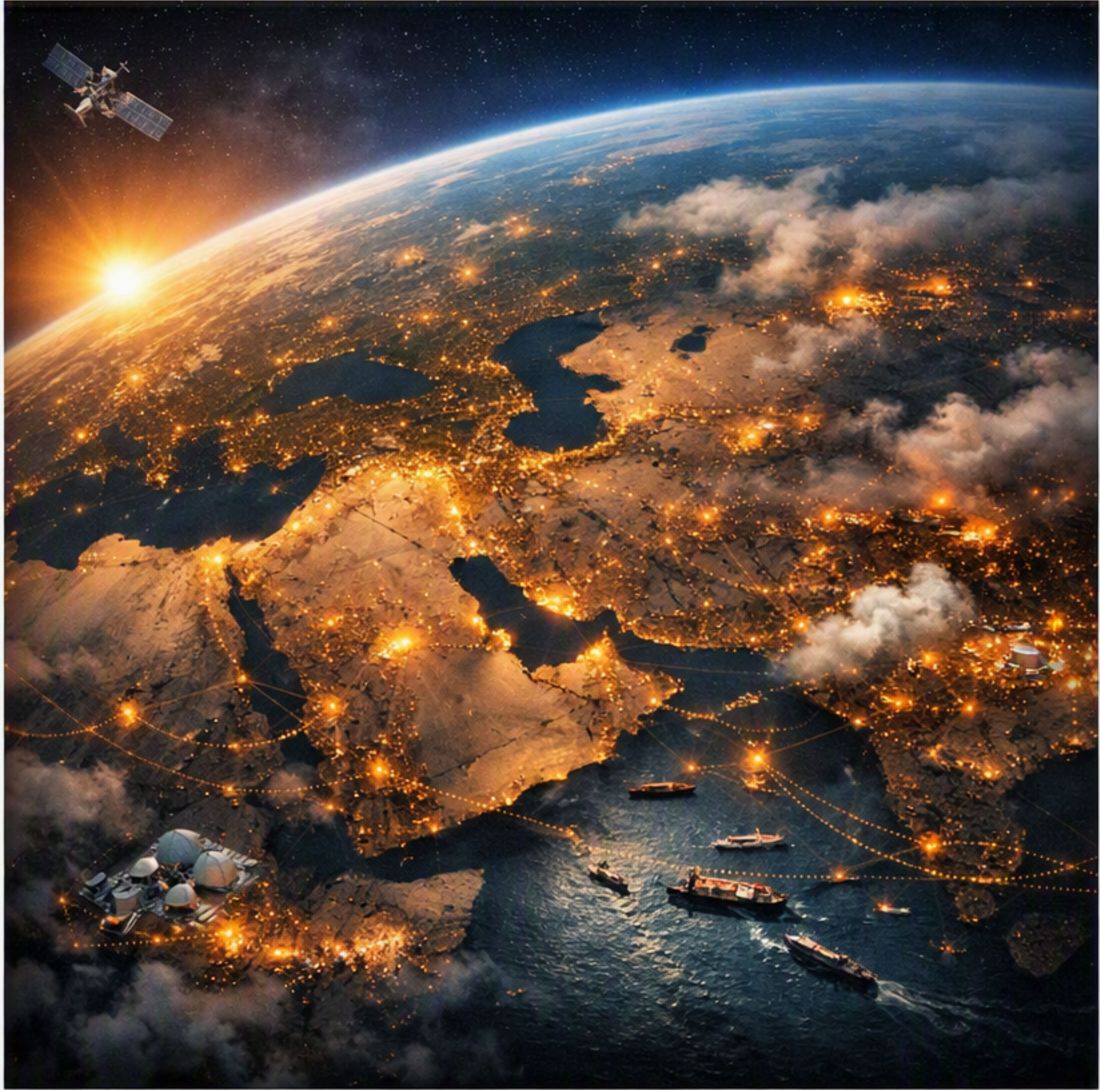
The Strait of Hormuz is not a theoretical example. It is where the abstract argument about circular fragility becomes immediate. By late August 2026, pressure around this narrow corridor is no longer a distant possibility but an active stress running through energy, transport, food, finance, and politics.

In normal conditions, roughly a fifth of global oil supply moves through or depends on Hormuz. The corridor also matters for liquefied natural gas, fertiliser inputs, shipping insurance, and the confidence that global markets can keep moving even under pressure. When stress builds there, it does not stay there.

The pressure did not suddenly appear at the end of the summer. It has been accumulating since the escalation involving Iran at the end of February 2026. What followed was not a clean, visible rupture, but something harder to read: disruption, adaptation, reserve use, rerouting, higher risk premiums, and gradual depletion of buffers. The absence of an obvious public crisis has encouraged the impression that the danger has passed. That may prove to be a serious misreading.

Markets and governments can absorb shocks for a time. Strategic reserves can be released. Inventories can be drawn down. Traders can reroute supply. Prices can be smoothed by policy, subsidy, hedging, and delayed pass-through. But those mechanisms do not remove the stress. They move it, hide it, or postpone it. That matters because a system can look stable at the surface while becoming less resilient underneath.

Diesel is one of the clearest transmission points. It is not simply another fuel. It powers freight, farming machinery, construction, mining, generators, emergency logistics, and much of the heavy physical economy. When diesel becomes short, goods move more slowly, production costs rise, and prioritisation becomes unavoidable. The effect is not confined to petrol stations. It spreads through everything that has to be grown, mined, built, shipped, refrigerated, or repaired.

Behind that energy story sits an agricultural one. Fertiliser supply has already been under pressure, and Australia is one of the places where that pressure matters visibly. Australian grain growers have been forced to make planting and fertiliser decisions under conditions of high cost, uncertain supply, and strained logistics. Those decisions have long lead times. Reduced fertiliser use or reduced planting today does not fully show up today. It shows up later, in lower yields, lower quality, tighter export markets, and higher food prices.

This is why the threat of El Niño matters so much. Specialists are already watching key breadbasket regions because El Niño can shift rainfall, increase heat, intensify drought, disrupt monsoons, and damage harvests. In ordinary conditions, the global food system might absorb some of that stress. But El Niño arriving on top of high fuel costs, constrained fertiliser, disrupted trade routes, and reduced planting decisions is a different proposition.

The risk is not simply that food becomes more expensive. The risk is that parts of the world face genuine food supply disruption in 2027, including famine conditions in the most vulnerable regions. Wealthier countries are not immune. They are less likely to experience famine, but they can still experience shortages, rationing pressure, panic buying, political backlash, and sharp cost-of-living shocks. In a tightly connected food system, scarcity does not respect the old distinction between stable and unstable regions as neatly as many people assume.

For AI, this matters profoundly. AI cannot be separated from the price of electricity, the availability of diesel, the delivery of hardware, the stability of agricultural systems, or the spending power of households, firms, and governments. A food and energy shock does not merely make daily life harder. It compresses the economic space in which AI companies can operate and in which customers can afford to use them.

Hormuz may not be the first domino to fall visibly, and it may not be the decisive one. But it shows the shape of the danger. A geopolitical shock becomes an energy shock. An energy shock becomes a fertiliser shock. A fertiliser shock becomes a food shock. A food shock becomes an inflation, debt, budget, legitimacy, and demand shock. By the time the pressure reaches AI, it has already passed through the systems AI depends on and the customers AI expects to serve.

The Objection: Would AI Really Matter That Much?

A fair objection is that this argument can sound exaggerated. If major AI services disappeared tomorrow, aircraft would not fall from the sky, hospitals would not instantly close, and governments would not cease to exist. Most important institutions still have people, procedures, and legacy systems.

That is true. The issue is not instant collapse. The issue is declining resilience. As organisations design workflows around AI, they may quietly reduce the human capacity needed to operate without it.

Manual processes atrophy. Expertise leaves. Teams shrink. Decisions accelerate. Expectations rise. The fallback still exists on paper, but becomes weaker in practice.

That is how dependency forms: not through one dramatic handover, but through a thousand small conveniences that become assumptions.

Collapse Can Now Flow Both Ways

This is the key point. The risk is no longer simply that AI might fail, or that the world might become unstable. The risk is that each now makes the other more vulnerable.

A global shock can weaken AI by disrupting energy, capital, hardware, logistics, or political support. An AI shock can weaken the global system by degrading the tools now used to manage complexity, reduce cost, allocate resources, and make decisions at speed.

This is what makes circular fragility different from ordinary risk. Ordinary risk asks what happens if one part breaks. Circular fragility asks what happens when the backup system is also dependent on the thing that is breaking.

In that kind of environment, capability is not enough. Resilience matters more.

What We Can Still Save

The good news is that protecting AI does not mean defending the current model at all costs. It may mean letting go of the most fragile version of AI: the centralised, high-compute, high-energy, heavily subsidised model that has dominated the public imagination.

What survives under stress will be the AI that can keep working when conditions are imperfect.

If energy is constrained, the useful model is low-energy and local. If finance tightens, the useful model is smaller and cheaper to maintain. If geopolitics fractures supply chains, the useful model is open, sovereign, and repairable. If public trust declines, the useful model is transparent, accountable, and clearly subordinate to human judgement.

In every scenario, the direction is the same: less centralisation, less dependence on endless scale, more local capacity, more human oversight, and more attention to the conditions under which technology can continue to function during stress.

This is not a smaller vision of AI. It is a stronger one. A tool that communities can understand, govern, repair, and afford is more valuable in a crisis than a spectacular system that only works when everything else is stable.

A Wake‑Up Call, Not a Warning

This is not an argument against AI. It is an argument for saving the parts of AI worth having.

The current AI boom is built on scale, speed, and belief. Those forces have produced remarkable progress. But they have also encouraged a dangerous assumption: that the world will remain stable enough to support ever-larger systems, and that those systems will remain available enough for the world to depend on them.

That assumption no longer looks safe. The future of AI should not be measured only by model size, benchmark scores, or computing power. It should be measured by whether AI can make societies more capable when energy is expensive, supply chains are disrupted, institutions are under pressure, and people need tools they can trust.

The key question is no longer whether AI is powerful. It is whether the systems that depend on AI can remain resilient when AI itself depends on increasingly fragile energy, financial, political, and logistical foundations.

Once dependence runs both ways, resilience becomes more important than capability.

The future will belong not to the biggest systems, but to the systems that can survive shock.

Why High Streets Are Really Failing

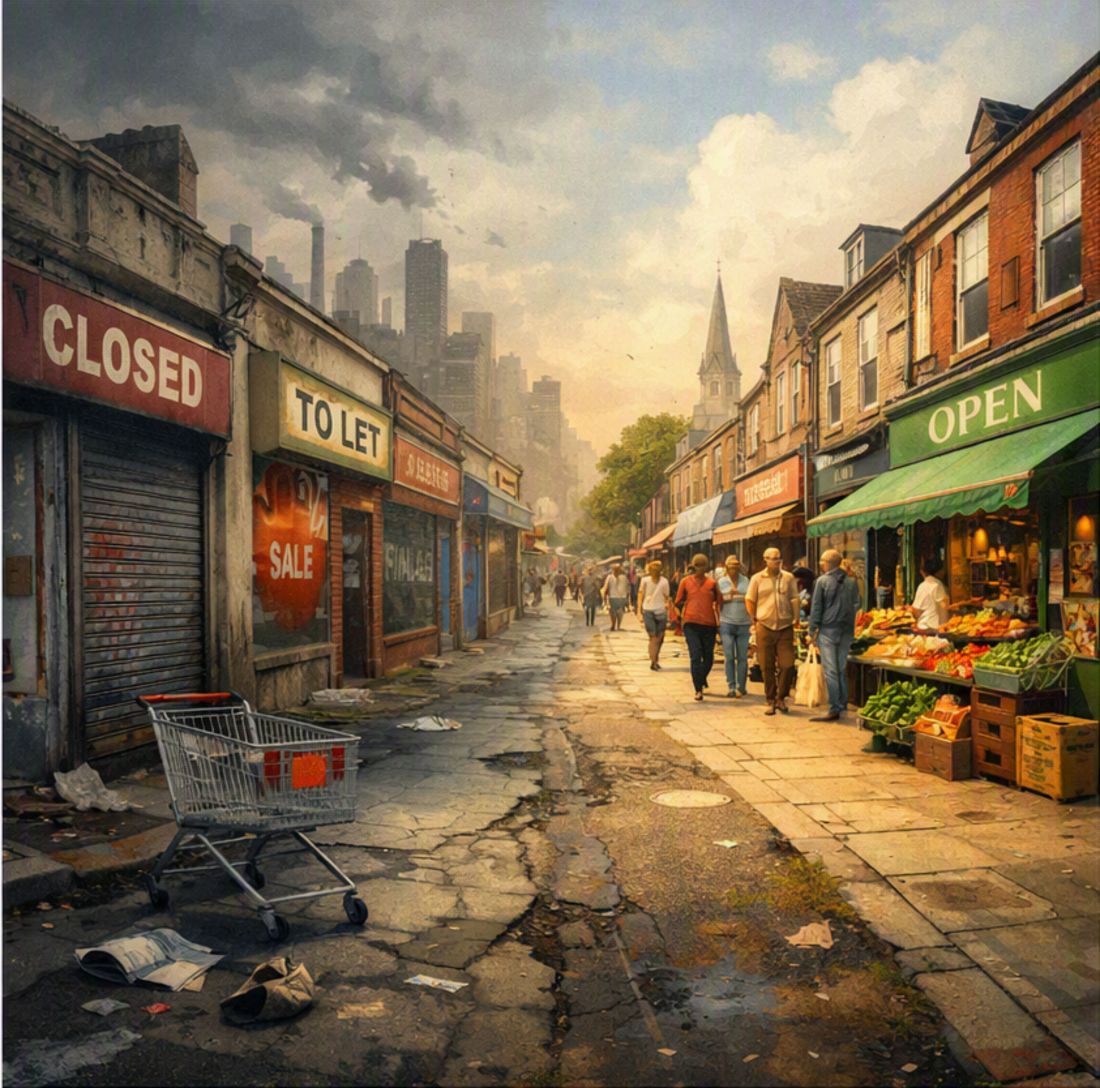
The empty shop is not the disease. It is an early warning sign of a money-centric system running out of road.

High streets are not failing because people suddenly stopped caring about them. They are failing because the economic system that once made them possible has changed so profoundly that the traditional high street no longer fits within it.

The familiar explanations are well known: online shopping, out-of-town retail parks, high rents, business rates, parking, poor planning, and changing consumer habits.

Each of these factors matters. But each is also a consequence of something deeper: a value system that has placed money, return, scale, and efficiency above human participation, local capability, and community life.

The decline of the high street is therefore not just a retail story. It is a visible expression of a wider economic direction. The same system that has hollowed out town centres is now beginning to hollow out work, ownership, contribution, and the human role in economic life itself.

That is why the empty high street matters. It shows us where the system has been, what it has already broken, and where it is now heading.

To understand the problem, we have to follow the chain properly: from local circulation, to financialisation, to centralisation, to digitalisation, to automation, to the false promise of Universal Basic Income, and finally to the question of whether a money-centred system can survive once people are no longer able to participate in it.

The answer begins with the high street, but it ends with the future of society itself.

The high street was built for a different kind of economy

For most of modern history, the high street worked because everyday life was organised locally. People lived near where they shopped. Money moved between households, independent businesses, local trades, nearby suppliers, and community institutions.

Shops were not just places of transaction; they were part of the social infrastructure of a town.

That system depended on local circulation. A pound spent with a local butcher, baker, café, repair shop, market trader, or family-run store was more likely to remain in the area, supporting other local work and relationships.

The high street was therefore sustained not only by demand, but by a pattern of life in which people, money, services, and trust repeatedly moved through the same place.

This is what is meant by a human-scale economy: an economy small enough for people to see the consequences of their choices, know who they are dealing with, and feel that their town is something they participate in rather than merely pass through.

The old high street was not perfect, and it should not be romanticised. But it did reflect a structure in which local presence mattered. That structure has been steadily dismantled.

Financialisation changed the rules

Over recent decades, the economy has shifted away from production, local exchange, and community resilience towards financialisation.

Financialisation means the process by which financial returns, asset values, debt, speculation, and shareholder value become more important than the practical usefulness of the things being financed.

In a financialised economy, the question changes. Instead of asking, “What does this place need in order to thrive?”, the system increasingly asks, “What produces the highest return?”

  • Efficiency is rewarded more than resilience.
  • Scale is rewarded more than locality.
  • Profit is rewarded more than community benefit.
  • Growth is rewarded more than stability.
  • Centralisation is rewarded more than distributed local ownership.

Once those incentives dominate, decline becomes less mysterious. Supermarkets replace local food shops because they operate at scale. Retail parks draw trade away from town centres because they fit car-based convenience. Online platforms bypass local businesses because they can centralise stock, data, logistics, and profit. Landlords and investors may treat property as an asset class before they treat it as part of a living town.

This does not mean every closure is caused by one villain or one policy. It means the wider system increasingly incentivises behaviour that drains value away from local places.

That is what extraction means in this context: value is created in one place, by real people and real communities, but is captured elsewhere by systems, owners, platforms, or institutions that are distant from the consequences.

Financialisation is not the root cause

Financialisation itself did not appear from nowhere. It emerged from a deeper value system that places money at the centre of every part of life.

When money becomes the primary measure of success, institutions begin organising themselves around its accumulation. Communities become markets. Citizens become consumers. Local capability becomes less important than financial efficiency.

The decline of the high street therefore reveals more than a retail problem. It shows what happens when the economy stops asking what creates healthy places and starts asking only what produces measurable financial return.

Digital convenience accelerated the collapse

Digitalisation did not create the underlying problem, but it accelerated it dramatically.

Online retail, delivery apps, automated logistics, targeted advertising, and platform marketplaces all make it easier for spending to leave our towns and communities without ever touching the local economy.

The promise is convenience. The cost is disconnection.

A purchase that once involved a walk or bus ride into town, a conversation, a shopfront, a local wage, and perhaps another local supplier can now become a silent transfer to a centralised platform where no other human being will ever be seen.

The behaviour feels small and therefore insignificant at the level of the individual, but multiplied across millions of transactions it transforms the physical life of towns and cities too.

The high street is expected to compete, but it is not competing on equal terms. It is being measured against businesses that can exploit scale, data, automation, global supply chains, and financial backing that local shops rarely possess.

This is why decline often feels like a one-way street. The system increasingly makes local presence optional, then wonders why local places become vulnerable, underused, and out of step with the economic world being built around them.

Why some high streets still thrive

Some high streets still work, and their existence is important because it proves that decline is not inevitable.

In many places, especially where communities remain socially dense and locally connected, independent businesses continue to play a central role in daily life.

Part of the reason appears to be stronger social cohesion, local spending habits, walkable routines, and community networks. These are not minor details. They are the social conditions that allow local businesses to survive.

Thriving local economies often depend on behaviours such as:

  • regular walking routes through local shops and services
  • dense social networks that create trust and repeat custom
  • loyalty to community-run or family-run businesses
  • localised spending patterns
  • multi-generational knowledge of place
  • a sense that the high street belongs to the community, not only to landlords and retailers

These behaviours naturally sustain local shops because they keep money, attention, and relationships circulating within the area.

The lesson is not that some communities are immune to economic pressure. It is that high streets need more than buildings, grants, or branding exercises.

High streets and urban centres need the social and economic infrastructure that gives people a reason to use them every day.

Where that infrastructure remains, high streets remain more resilient. Where it has been stripped away, regeneration becomes much harder. This is why the answer cannot be limited to retail strategy. The problem is deeper than shopping, and so the solution has to be deeper too.

The high street is the warning, not the destination

The mistake is to treat the decline of the high street as an isolated problem.

It is not. It is an early warning sign of a much larger direction of travel.

The same forces that reduced the need for local shops are now reducing the need for human involvement elsewhere. Automation, artificial intelligence, platform systems, and machine-led logistics all follow the same basic logic: remove friction, reduce cost, increase efficiency, centralise control, and maximise return.

For those who own the platforms, technologies, data, and infrastructure, this appears rational. It looks like progress. But the contradiction is obvious once we look at the system as a whole: a money-centric economy only functions if people continue to earn, spend, consume, and generate returns.

If technology removes the economic role of growing numbers of people, the system does not become magically abundant. It becomes unstable.

The customers, workers, taxpayers, tenants, borrowers, and consumers who are supposed to keep the machinery turning are the same people whose incomes and agency are being eroded.

This is the direction the empty high street points towards. First local shops become unnecessary. Then local ownership becomes unnecessary. Then local labour becomes unnecessary. Eventually, human participation itself is treated as an inefficiency to be managed.

Why UBI has entered the conversation

This is why Universal Basic Income, or UBI, has become attractive to some of the people building the technological future as we are being led to understand it.

They can see that a problem is coming. They can see that automation and artificial intelligence may leave many people without a reliable route to income. They can see that a system built on employment and consumption faces a serious problem if employment becomes scarce.

But recognising that a problem is coming is not the same as understanding the mechanics of the system that created it.

Proposing UBI as the solution assumes that a collapsing money-centric system can be preserved by giving people enough money to keep consuming. It assumes that the same structure that has concentrated ownership, transferred wealth, extracted value, weakened local capability, and reduced human participation can somehow provide a secure income to a population it no longer needs economically.

That is the contradiction. A system built on wages, debt, rent, consumption, tax, and returns cannot sustain a permanently kept population if the people expected to fund and circulate value no longer have stable incomes. Even if the intention were compassionate, the mechanism does not hold.

UBI may soften the appearance of collapse for a time, but it does not reverse the underlying direction. It does not restore local ownership. It does not rebuild capability. It does not give people a meaningful role in production, governance, or community life. It keeps the money-centred frame intact while the social and economic foundations beneath it continue to weaken.

The problem is not that people need support. They do. The problem is believing that support can be delivered through the same system that created the dependency in the first place.

The alternative: LEGS, BLS, and a people-centred economy

If the high street is a symptom of a deeper economic failure, then saving it cannot mean simply filling empty units with new tenants. Nor can it mean relying on another short-term regeneration scheme, marketing campaign, subsidy, or welfare mechanism that leaves the underlying structure untouched.

What is needed is a revaluation: a shift away from treating money as the centre of value and towards treating human wellbeing, contribution, dignity, place, community resilience, and environmental responsibility as the things an economy is supposed to serve.

This is where the Local Economy & Governance System, or LEGS, becomes relevant. LEGS is not simply an economic policy. It is a different operating system for society: one that begins with people, community, and the environment rather than money, growth, and extraction.

Its purpose is to restore local capability, local decision-making, shared responsibility, and meaningful contribution.

Instead of asking how people can be kept alive inside a system that no longer needs them, it asks how society can be organised so that people remain necessary, valued, secure, and sovereign.

The Basic Living Standard, or BLS, is central to that alternative. Unlike UBI, it is not simply a payment distributed within the existing system. It is a structural guarantee that people can meet the essential costs of living through a normal week’s contribution, without debt, charity, or dependency.

It links security to dignity, participation, and a fair structure of life rather than to passive receipt within a collapsing model.

In practical terms, this means rebuilding local economic life around:

  • local capability, so towns can meet more of their own needs
  • local production and repair, so value is created close to where people live
  • local supply chains, so businesses support one another rather than depend entirely on distant systems
  • local ownership, so wealth does not immediately leave the area
  • local governance, so decisions are made closer to their consequences
  • local value circulation, so money, skills, trust, and responsibility move through the community rather than out of it

This is not a call to go backwards. It is a call to re-scale forwards: to use technology, planning, enterprise, and governance in ways that strengthen human capability rather than replace it.

A healthy high street cannot be created by nostalgia. It can only be created by an economy that gives people a real reason, and real ability, to participate locally. The same is true of society as a whole.

The real message of the empty high street

The decline of the high street matters because it exposes a much deeper problem. It shows what happens when financial efficiency becomes more important than human value, local capability, and community resilience.

Empty shops are not the disease. They are the symptom.

The question is therefore not simply how to save the high street. The question is whether we want to keep organising life around a system that produces dependency, centralisation, extraction, and fragility – or whether we are willing to build systems that restore capability, participation, dignity, sovereignty, and belonging.

The difficulty is not that alternatives such as LEGS and the BLS are impossible to understand. The difficulty is that most of us have been conditioned to believe that a money-centred system is the only way life can work.

We have learned to treat money as value itself, rather than as a tool that should serve life.

That is the real lesson of the high street. It is not asking to be saved as a memory. It is asking whether we still value the kind of society that made it possible – and whether we are willing to build a people-centred future before the money-centred one collapses under its own weight.

Further reading: where to go next

The argument in this article is part of a wider body of work exploring value, local economies, technology, governance, and the need for a people-centred alternative to the money-centric system.

The following pieces are best read in this order, as each one builds on the last.

1. The Basic Living Standard Explained
https://adamtugwell.blog/2025/10/24/the-basic-living-standard-explained/
This piece explains the Basic Living Standard, or BLS, which sits at the heart of the people-centred alternative discussed above. It sets out why security should not depend on charity, debt, insecure employment, or passive state support, but on a fair structure that allows people to meet the essentials of life through meaningful contribution.

2. The Local Economy & Governance System
https://adamtugwell.blog/2025/11/21/the-local-economy-governance-system-online-text/
This is the core alternative framework model referred to as LEGS. It develops the practical structure of a local, participatory, people-centred system built around local capability, local governance, shared responsibility, and the restoration of real economic participation.

3. The Power of Local Communities
https://adamtugwell.blog/2026/03/31/the-power-of-local-communities/
This article expands the social side of the argument. It explores why strong local communities matter, how participation and belonging are created, and why local relationships are not sentimental extras but essential infrastructure for any healthy society.

4. When AI Builds a Machine World, This Economy Can No Longer Sustain
https://adamtugwell.blog/2026/07/20/when-ai-builds-a-machine-world-this-economy-can-no-longer-sustain/
This piece follows the direction of travel beyond the high street into automation, artificial intelligence, and the future of work. It explains why a money-centric economy becomes unstable when the people expected to earn, spend, borrow, pay rent, and consume are increasingly removed from meaningful economic participation.

Taken together, these works show the wider arc: the high street reveals the failure of local circulation; the BLS defines the foundation of security; LEGS provides the structural alternative; local communities explain the social basis; and the AI piece shows why the present direction of travel makes a people-centred system increasingly necessary.

The Independence Threshold | A New Definition of Poverty for A Modern Economy

Poverty has always been difficult to define. Governments use income thresholds. Charities use deprivation indicators. Economists use consumption models. But none of these definitions capture the lived reality of poverty in a modern, high‑income country like the United Kingdom.

They measure symptoms.

They do not measure the condition itself.

The Independence Threshold Definition of Poverty begins from a different starting point – one that reflects how poverty actually works in real life.

Poverty begins where independence ends.

A person is in poverty when they cannot meet their essential needs without external support – whether that support comes from the state, charity, family, or debt.

This definition is simple, but it changes everything.

Poverty is always relative to its own economy

Global institutions often define poverty in ways that evoke extreme deprivation – the kind associated with low‑income countries and subsistence economies.

This framing is useful for international development, but it becomes misleading when applied to wealthy nations.

Poverty is not a universal condition.

Poverty is an economic condition.

Poverty must be understood relative to the economy it exists within.

In the UK, poverty is shaped by:

  • UK housing costs
  • UK energy prices
  • UK transport needs
  • UK childcare costs
  • UK wages
  • UK debt structures
  • UK public services
  • UK labour markets

A person can be in poverty in the UK even if they have electricity, sanitation, and a roof over their head – because the cost of maintaining independence within the UK economy may exceed their income or capacity.

Physical conditions differ between economies.

Poverty does not.

Poverty is not defined by physical conditions

Different economies produce different physical environments:

  • Sanitation
  • transport systems
  • infrastructure
  • heating
  • water access
  • housing quality
  • digital access
  • public services

These are environmental features, not indicators of independence.

A person can have:

  • running water
  • paved roads
  • electricity
  • a smartphone
  • a bus route
  • a supermarket nearby

…and still be in poverty if they cannot sustain themselves within the economic system that surrounds them.

This is why arguments like:

  • “People here live like kings compared to country X,”
  • “They have TVs, so they’re not poor”
  • “They have sanitation, so they’re fine”

are structurally false.

They confuse material environment with economic independence.

Poverty is exclusion – and exclusion is universal

When a person cannot sustain themselves within their own economy, they experience exclusion.

This exclusion is not abstract – it is lived, daily, and universal across all societies.

Loss of independence leads to:

  • Hardship
  • Instability
  • mental health deterioration
  • social isolation
  • loss of dignity
  • loss of agency
  • loss of future planning
  • loss of resilience

These outcomes occur in:

  • wealthy countries
  • developing countries
  • rural areas
  • urban areas
  • different cultures
  • different infrastructures

The physical environment changes.

The exclusion does not.

This is why poverty must be defined by independence, not by conditions.

Why traditional definitions fail

Traditional poverty lines are based on income.

But income alone does not determine independence.

Two people earning the same amount can have completely different levels of stability depending on:

  • housing costs
  • childcare costs
  • transport needs
  • health conditions
  • debt burdens
  • regional prices
  • insecure work patterns

Income‑based definitions hide millions of people who are not officially “in poverty” but cannot survive independently.

These are the people living on the poverty trap door – above the line, but one shock away from falling through it.

The Independence Threshold Definition makes them visible.

A definition for policy, research, and public understanding

This definition is not ideological.

It is not tied to any political party.

It is not designed to support or oppose any policy.

It is a lens – a way of seeing poverty clearly.

It can be used by:

  • Policymakers
  • Researchers
  • Charities
  • Journalists
  • Economists
  • Social Scientists
  • Community Organisations

And by anyone who wants to understand the real structure of poverty today.

The Independence Threshold Definition of Poverty

Poverty begins where independence ends.

A person is in poverty when they cannot meet their essential needs without external support – whether that support comes from the state, charity, family, or debt.

Poverty is always relative to the economy it exists within.

Physical conditions – sanitation, transport, infrastructure, heating, water, housing quality – differ between economies, but they do not define poverty.

Poverty is defined by the inability to sustain oneself within one’s own economic environment.

When independence is lost, people experience exclusion: hardship, instability, mental strain, and social isolation. These outcomes are universal, regardless of the physical surroundings.

Poverty is not about global deprivation standards or material conditions.

Poverty is about independence – and the loss of it.

The Two‑Edged Sword of Social Mobility: Why Our System Elevates Narratives, Not Capability

Social mobility is often presented as a simple moral project: remove barriers, widen opportunity, and allow people from disadvantaged backgrounds to rise.

It is a noble ambition, and one that any fair society should pursue. Yet the way social mobility is currently understood – and operationalised – contains a structural flaw that is rarely acknowledged.

It is a two‑edged sword, capable of empowering genuine talent, but equally capable of elevating individuals for their narrative value rather than their capability.

When this happens, the system not only fails the individuals it seeks to help; it also undermines trust in the very idea of social mobility itself.

At the heart of this problem lies a fundamental confusion between help and hand‑up.

Help is empowering. It equips individuals with confidence, skills, and the ability to step forward on their own merit. A hand‑up, by contrast, is elevating. It places individuals into positions they have not yet earned, often because their background fits a narrative that institutions find symbolically useful.

These two approaches are not merely different; they produce entirely different outcomes.

Help opens a metaphorical door. It says: you have value, you have ability, and we will remove the barriers that prevent you from showing it. A hand‑up opens a literal door and pushes someone through it, often without ensuring they are ready for what lies on the other side. Help respects agency and capability. A hand‑up risks creating fragility, because it confers status without building the foundation required to sustain it.

This distinction becomes dangerous when institutions begin selecting individuals who fit a hero‑mould – dramatic adversity, visible difference, a compelling story – rather than those who possess genuine capability.

Hero narratives are emotionally powerful and politically convenient. They allow institutions to demonstrate progress, inspire audiences, and signal virtue. But hero narratives reward the story, not the skill.

When someone is elevated primarily because their background is narratively useful, two predictable consequences follow. First, they may struggle to perform at the level to which they have been elevated. Second, their struggle becomes a referendum on social mobility itself. Critics generalise from the individual to the group, and from the group to the entire project.

The collateral damage is severe. Exceptional talent gets left behind. Many disadvantaged individuals possess extraordinary capability precisely because of their formative experiences.

They have developed resilience, adaptability, emotional intelligence, and problem‑solving skills that cannot be taught in classrooms. But because their adversity is not dramatic enough, or because they do not perform their hardship in a way that fits the hero narrative, they are overlooked.

Meanwhile, individuals whose wounding – whether true, exaggerated, or misunderstood – is narratively compelling are elevated. Their trauma becomes their currency. Their background becomes their qualification. Their story becomes their evidence.

This dynamic is intensified by the way society has come to value education. In a wealth‑centric system, financial productivity becomes the measure of human worth. Academic qualifications correlate with income, so they become the primary gateway to opportunity.

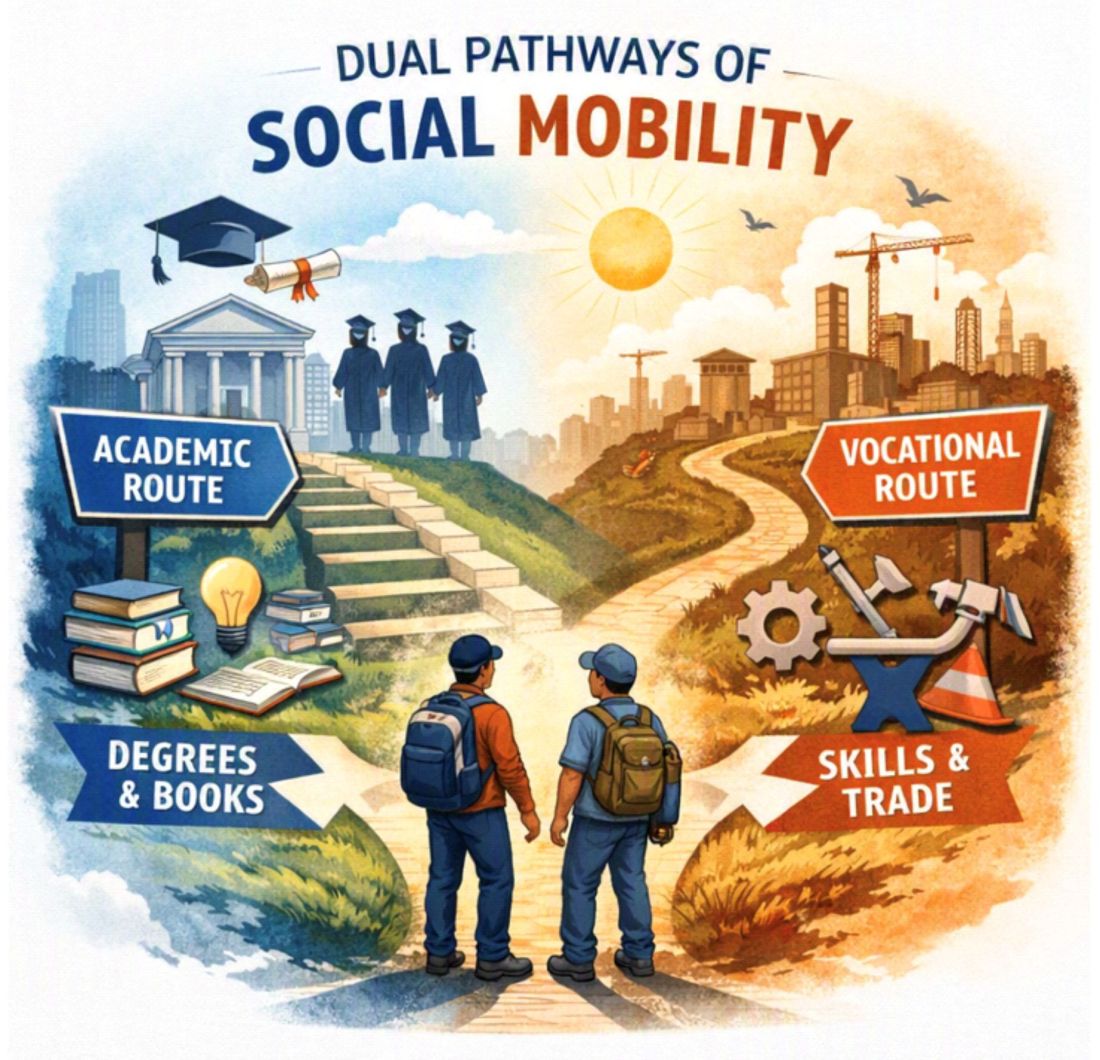
The result is an educational system weighted almost entirely toward academic achievement. The narrative that “everyone should get a degree” sounds egalitarian, but it is built on a false assumption: that academic learning is the universal route to success.

It isn’t. Many people are not academic or consciously cerebral learners. They are experiential, practical, hands‑on – individuals whose intelligence expresses itself through doing rather than theorising.

These young people are not less capable; they are differently capable. Yet the current system treats them as failures because it only recognises one form of intelligence.

A genuinely vocational pathway – beginning at 14 and continuing to 21 – would allow thousands of young people to thrive in ways no degree can replicate. By the time they finish, they would possess experience, maturity, and professional identity that academic pathways cannot provide.

The tragedy is that the system also fails traumatised young people who could be academic. Growing up in poverty, instability, or survival‑mode environments means that adolescence is not a time for learning; it is a time for coping. These young people may have academic potential, but they cannot access it because their teenage years are spent navigating chaos rather than studying. The system punishes them for circumstances they did not choose.

All of this makes social mobility far more complicated than it needs to be. The bottleneck is not so much the lack of opportunity; it is the narrowness of the educational model and the hero‑mould narrative that sits on top of it.

When society values only academic achievement and visible adversity, it elevates the wrong people and overlooks the right ones. It confuses narrative with merit, background with capability, and trauma with qualification.

Fixing this is not a matter of adding certificates or tweaking qualifications. It requires a fundamental shift in how we value people. We must stop treating wealth as the primary marker of worth, academic credentials as the only legitimate pathway, and adversity as the currency of mobility.

We must start recognising all forms of human capability – practical, vocational, emotional, experiential, and intellectual. When we do this, the number of people genuinely being held back becomes far smaller, and far easier to support.

Social mobility should be about empowerment, not optics. It should uncover talent, not manufacture heroes. It should build capability, not confer status.

And it should recognise that human potential comes in many forms – most of which cannot be measured by degrees, narratives, or the visible markers of wealth.