The debate over tariffs on Chinese electric vehicles has been bubbling across social media, and what’s striking is not the policy detail but the discomfort it creates among the market‑orientated commentariat.
These are people who have spent decades insisting that globalisation is the only sensible economic model, that markets should always set the rules, and that any interference – especially by governments – is a step backwards.
Now, faced with the reality that the UK may need to work with EU partners to protect domestic manufacturers, they are being forced into intellectual contortions that reveal just how brittle their worldview has become.
The friction here is not really about cars. It is about the deeper assumption that the economic model we have – a model built on global supply chains, financial expansion, and the relentless pursuit of growth – is the only one that makes sense.
That assumption rests on a one‑directional pull toward opening trade as far as conceivably possible, because that’s supposedly where growth will be found. And growth, in this worldview, is not about people becoming better off. It is about the creation of yet more money, usually through debt, which pushes up GDP and keeps the financial system ticking over.
This obsession with growth hides a fundamental truth: the growth that markets obsess over is not the same growth that most people experience.
GDP can rise while living standards fall. Productivity can increase while wages stagnate. Asset values can soar while home ownership collapses.
Many people still cling to the myth that political growth will make things better – or at least return life to how it used to be – but the numbers have been going up for years while the lived reality has been going down.
To understand why protectionism now makes sense, we have to understand the money system that made globalisation seem inevitable.
The Money System Behind the Illusion
Modern economies run on fiat money – money created not from physical value but from government authority and, crucially, from debt. When banks issue loans, they create new money. When governments borrow, they expand the money supply. Growth, in the political sense, is simply the expansion of this created money.
For decades, this system worked because the newly created money was tied to expanding production. Factories were built. Goods were made. Jobs were created. Communities thrived. The money had something real behind it.
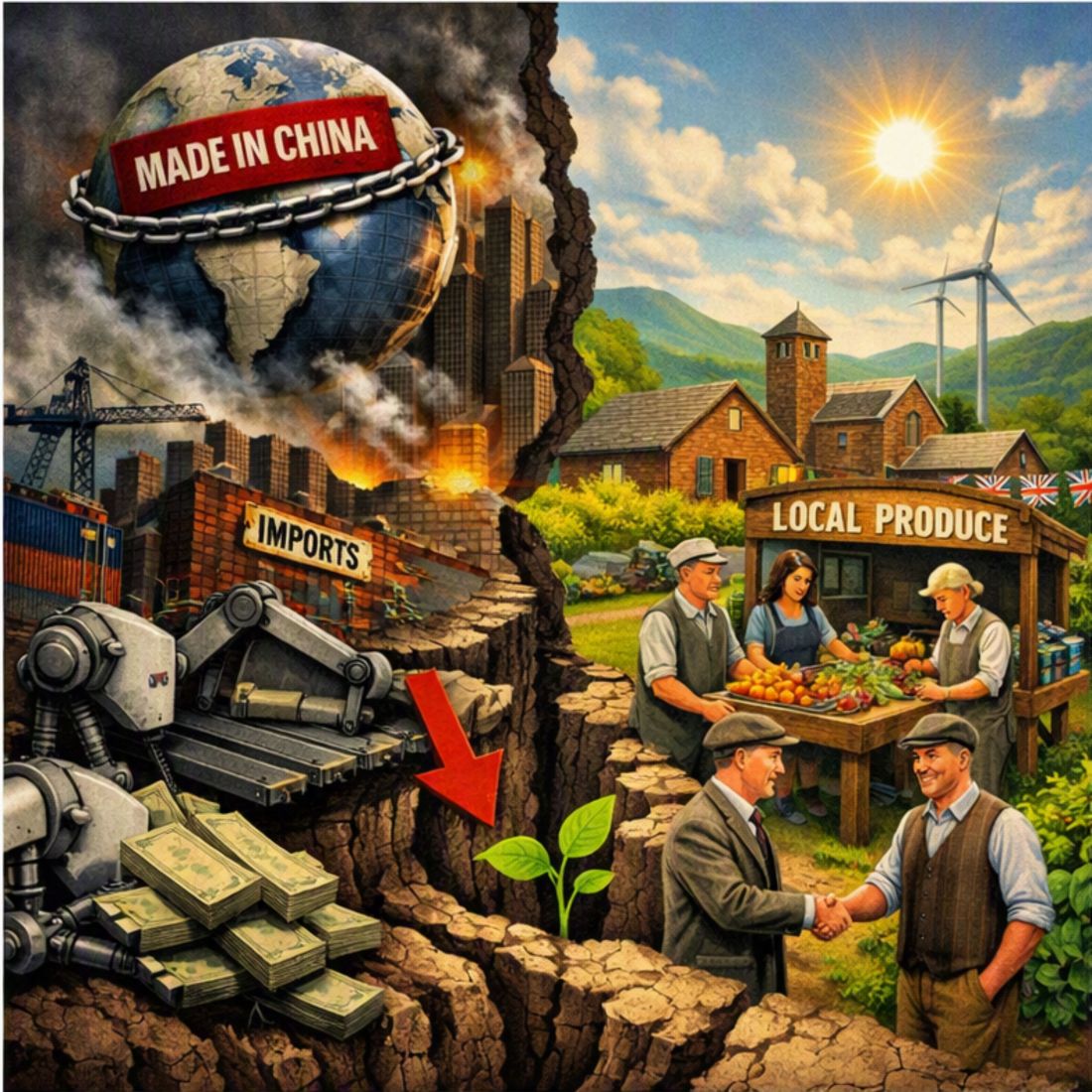
But once production was moved overseas, the link between money creation and real economic activity broke. We kept creating money – but we no longer created the goods, jobs, or value that once justified it. Instead, the West became dependent on consumption funded by debt, while production was concentrated in China and a handful of other countries.
This is where extraction enters the story.
Extraction: The Hidden Cost of Globalisation
Globalisation didn’t just move factories abroad. It extracted value from every part of Western society:
Extraction of jobs – manufacturing, engineering, logistics, and skilled trades hollowed out.
Extraction of wages – pay stagnated while costs rose.
Extraction of communities – towns built around industry lost their purpose.
Extraction of environmental stability – long supply chains increased emissions and resource depletion.
Extraction of political agency – decisions moved from local hands to global markets.
Extraction of national wealth – profits and production flowed outward, not inward.
Above all, globalisation extracted economic power from people and transferred it to corporations, financial markets, and foreign production hubs.
This wasn’t accidental. It was the design. Globalisation was sold as efficiency, but it functioned as a massive wealth transfer mechanism.
Wealth Transfer: The Real Story
The wealth transfer happened in several layers:
1. From wages to profits
When production moved abroad, labour costs collapsed. The savings didn’t go to consumers – they went to corporations and financial markets.
2. From communities to global supply chains
Local businesses couldn’t compete with imported goods. Wealth drained outward.
3. From national economies to China
The West consumed; China produced. The money followed the production.
4. From real economy to financial economy
As production declined, financial speculation replaced industry as the main driver of “growth.”
5. From future generations to the present
Debt expanded to maintain consumption levels that wages could no longer support.
This is why the system feels hollow: because it is.
The Illusion of Efficiency
Globalisation was sold as efficient. But efficiency is fragile.
Efficiency removes redundancy. Redundancy is what makes systems resilient.
Here, redundancy doesn’t mean job losses. It means resilience. In systems terms, redundancy is the spare capacity, backup options, and local alternatives that keep things functioning when something goes wrong. A resilient economy has multiple sources of essential goods, local production alongside imports, and enough slack in its supply chains to absorb shocks. Globalisation removed this kind of redundancy – not by cutting jobs, but by stripping away the buffers that once protected communities, industries, and national security.
Local supply chains, local production, and local skills were once buffers against shocks. Globalisation removed those buffers. It replaced resilience with fragility, and called it progress.
When shocks hit – a pandemic, a war, an energy crisis – the system broke exactly where it had been hollowed out.
The Curious Love Affair With China
This is where the love affair that politicians, industry aficionados and financial players have with China becomes so curious. They praise China’s industrial might, its manufacturing efficiency, and its ability to produce goods at scale and at speed. But they are blind to the realities underpinning the Chinese powerhouse – just as they are blind to how things really work economically here at home.
China’s industrial strength is real, but its economic model is fragile. It is heavily dependent on exports, deeply entangled in debt, and centrally managed in ways that hide structural weaknesses. The property sector has been in crisis for years. Domestic consumption is too weak to sustain growth. And the country’s manufacturing dominance relies on a global system that assumes stability, cheap energy, and constant demand – none of which can be taken for granted.
Yet Western economies outsourced their industrial base to China under the assumption that globalisation was permanent, stable, and mutually beneficial. They believed that moving production overseas would always be cheaper, always be efficient, and always be safe. But globalisation was never a natural law. It was a confidence game – a system that works only as long as everyone believes it will continue working.
Calling globalisation a Ponzi scheme might be too simple, but calling it a worldwide confidence trick is not far off. It requires constant expansion. It depends on trust rather than resilience. It shifts production far from consumption. And it leaves countries vulnerable if supply chains break, energy prices spike, or geopolitical tensions rise.
The truth that must be reckoned with is this: transferring every conceivable part of industrial production to the other side of the world leaves a serious question hanging in the air. What happens here – and what happens there – when the money system that is the lifeblood of this one-directional process comes to a grinding halt?
AI: The Final Blow to the Globalised Model
If globalisation hollowed out production, AI is now hollowing out what is left of the wage‑earning capacity that once kept the system going.
For decades, the global model relied on a simple loop:
The West consumed goods made abroad.
People earned wages to buy those goods.
Governments and banks created money to keep consumption rising.
China produced the goods that consumption demanded.
But AI breaks this loop. It displaces jobs across sectors – not just manufacturing, which was already offshored, but services, administration, logistics, design, media, and even parts of professional work. The very wage base that kept the consumption‑debt cycle alive is eroding.
We now face a situation where:
We no longer produce the goods.
We no longer earn the wages.
We still create the money – but it has nothing real to attach to.
This is the point where the global system begins to fail. You cannot sustain a consumption‑driven economy when the capacity to earn wages is collapsing. You cannot sustain a debt‑driven money system when the underlying productive base has been hollowed out. And you cannot sustain globalisation when the domestic economy no longer has the means to participate in it.
AI is not the cause of the crisis – it is the accelerant that exposes how fragile the system already was.
The Collapse of Demand
The global system requires:
constant production
constant consumption
constant money creation
constant debt expansion
But:
production moved abroad
wages stagnated
AI reduces earning power
debt has reached saturation
demand is collapsing
Once demand collapses, the entire global system fails – and protectionism becomes not ideological, but practical.
EVs: A Redirection, Not a Solution
EVs are being sold as a technological fix, but they are built on the same flawed logic: extract resources, extract labour, extract wealth, and hope the system holds.
The deeper issue is not the fuel that vehicles use. It is the assumption that we need so many vehicles in the first place – an assumption created by an economic system built around long‑distance commuting, centralised employment, fragmented supply chains, and consumer lifestyles that depend on mobility rather than locality.
EVs change the technology but not the underlying logic.
The System Is Failing – And Protectionism Is Becoming Necessary
We cannot continue like this. Soon we will not be able to.
The system that pointed everything toward China, foreign production, and EVs is falling to its knees. The question is whether we wake up in time to address the real issues while we still have a choice – or whether events will push everything we know straight to the floor.
In this context, protectionism not only makes sense – it becomes essential. Not just for cars, but for everything people genuinely need each and every day.
Media discussions about “upsetting China” are irrelevant compared to the question of more pressing matters such as whether everyone can continue to eat during a prolonged crisis.
Like so many other forms of essential production and supply we have hollowed out the UK’s ability to feed itself. Politicians may say we produce around 60% of our own food, but that figure is misleading. Much of that production depends on imported inputs: fertiliser, feed, energy, machinery, labour. If borders fully closed, the real amount of food ready to go directly to the table is closer to 11%.
That means in a real, ongoing crisis, we could feed roughly one in ten people. And this would potentially be the baseline for as long as it would take to change, develop and reestablish UK systems to produce enough food to meet everyone’s basic and essential needs.
To call this situation stupid would be an understatement. It is a growing structural vulnerability that has been ignored for decades because it was easier to believe that global supply chains were permanent and that crises only ever happened somewhere else.
The Only Viable Path Forward
Locality, localism, and an entirely different system – one that puts people first rather than money first – is now the only answer. And it’s the same for everyone else too.
Protectionism, in this context, is not about nationalism or nostalgia. It is about resilience. It is about ensuring that essential goods are produced close to where they are consumed. It is about rebuilding the capacity to feed, clothe, transport, and sustain ourselves without relying on fragile global systems.
This does not mean closing borders or rejecting trade. It means recognising that trade should complement domestic capability, not replace it. It means building systems that can withstand shocks rather than collapse under them. It means prioritising the basics – food, energy, manufacturing, infrastructure – over abstract financial growth.
The globalised model didn’t fail because of ideology. It failed because it extracted too much, transferred too much, hollowed out too much, and left too little behind.
Protectionism isn’t a political choice. It’s a survival strategy.
Further Reading
Understanding why protectionism now makes sense requires stepping back and seeing the wider system that shaped our economy, our politics, and our everyday lives.
The following pieces explore the deeper mechanics behind growth, money creation, economic fragility, AI disruption, and the urgent need for localism.
Each article expands on themes raised in the essay and offers a clearer view of how we reached this point – and how we can move forward.
1. Understanding the Growth Illusion
Why Politicians Obsess Over Growth – And Why It Has Nothing To Do With You
A clear explanation of why political “growth” is not the same as real‑world improvement. This piece shows how GDP has become a political performance metric rather than a measure of public wellbeing, and why the obsession with growth continues even when life gets harder for ordinary people.
The Harmful Truths That Are Hidden Behind Political Growth
This piece exposes the hidden mechanics of an economy that works against normal life. It explains how wage stagnation, rising costs, and the collapse of local industry were engineered by a system designed to extract value rather than support people.
Why Britain Feels Like We Are Being Priced Out of Everyday Life
An explanation of why everyday life has become unaffordable. It challenges the mainstream narratives about inflation and cost‑of‑living pressures, showing how the real causes lie in decades of economic policy that hollowed out domestic resilience.
A guide to understanding economic and political turbulence without falling into panic or misinformation. It helps readers see the structural issues clearly and avoid the fear‑driven narratives that often dominate public debate.
3. Fragility, AI, and the Collapse of the Old Model
The Age of Circular Fragility – Why AI and the World Economy May Now Rise and Fall Together
A crucial exploration of how AI accelerates the fragility already built into the global economy. It explains why job displacement, collapsing demand, and global supply chain dependence form a circular system where shocks amplify each other.
A foundational piece outlining what a people‑first economic system would look like. It explains how money, governance, and local production can be redesigned to serve communities rather than financial markets.
A practical framework for how local economies can be structured, governed, and sustained. It shows how localism can replace global fragility with community‑level resilience and democratic control.
A clear explanation of a baseline living standard that ensures everyone has access to essentials. It connects economic design with human dignity and outlines how a fair, sustainable system can be built from the ground up.
For generations, representative democracy relied on a simple, unspoken contract: those who win seats must use them.
Not occupy them. Not perform within them. Not protect them. But use them – to act, to decide, to govern, to take responsibility for the present.
Yet in today’s politics, that contract has quietly collapsed.
A new behaviour has taken root in Westminster and beyond. It is subtle, structural, and deeply corrosive. It is the habit of taking over seats simply to occupy them – to be seen to be there, to enjoy the insulated safety of incumbency – while rejecting the golden egg that comes with the role: the opportunity, and the responsibility, to do what is right for everyone now.
This is political cuckooism.
Like the cuckoo that lays its eggs in another bird’s nest, today’s political class lays its promises, its reforms, its responsibilities, and its obligations into the future – the next Parliament, the next cycle, the next government. The present becomes a perch. The future becomes a dumping ground.
And representative democracy is the real victim.
1. What Political Cuckooism Really Means
Political cuckooism is not procrastination. It is not caution. It is not long‑term planning.
It is the deliberate practice of deferring meaningful policy into the next Parliament so that incumbents can enjoy safety today.
It works like this:
take the seat
occupy the role
perform competence
announce reform
schedule it for “next time”
avoid consequences
avoid responsibility
and repeat
It is leadership without action. Authority without obligation. Presence without purpose.
It is the political class behaving as if the seat itself is the achievement – not the work that must be done from it.
2. The Golden Egg: The Opportunity They Refuse to Hatch
Every seat in representative democracy comes with a golden egg: the chance to act in the present.
To make decisions that matter. To confront reality. To govern.
But political cuckoos reject the egg.
They sit in the nest. They enjoy the perch. They protect the seat. They perform the role. But they refuse to hatch the egg.
Instead, they push every meaningful decision into the future:
tax reform
public service restructuring
constitutional change
welfare redesign
infrastructure investment
economic strategy
democratic renewal
All of it becomes “next time”.
The egg remains unhatched. The nest remains occupied. The seat remains safe.
And democracy remains unfed.
3. How We Got Here: The End of Britain’s Operating Model
Political cuckooism did not appear out of nowhere. It is the late‑stage behaviour of a political system whose operating model has already failed.
For forty years, Britain relied on a Thatcher‑era framework built on:
deregulation
privatisation
asset inflation
consumption‑driven growth
and the belief that markets could solve structural problems
That model worked – until it didn’t.
By the mid‑2010s, the machinery was visibly failing. By the early 2020s, it was exhausted. By the mid‑2020s, it was no longer capable of delivering meaningful outcomes.
The system now produces obligations rather than opportunities, constraints rather than choices, and risk rather than capacity.
Political cuckooism is the behavioural adaptation to that failure.
When the system can no longer deliver meaningful reform, politicians stop trying to deliver meaningful reform. They start performing it instead.
They occupy the seat. They protect the seat. They defer the egg.
And the system continues to fail.
4. The Contemporary Politicians’ Dilemma: The Mechanism Behind Cuckooism
Once in office, politicians discover a truth that the public never sees:
the system cannot absorb meaningful action – yet they must still appear to act.
They learn that:
every lever they pull has unintended consequences
every reform destabilises something else
every decision carries risks they cannot control
every structural change threatens the machinery
and every attempt at real‑time governance exposes the system’s fragility
So they face a choice:
Act meaningfully and risk collapse,or act symbolically and remain safe.
They choose safety.
They choose symbolism. They choose narrative. They choose performance.
And they choose to defer meaningful policy into the future – where it cannot hurt them.
This is political cuckooism’s engine.
5. The Rise of Performance Politics
Performance politics emerged because:
the machinery no longer responds to real‑time decisions
the levers of government no longer produce predictable outcomes
the public finances no longer support meaningful reform
and the political class no longer understands the system they are managing
So politicians adapted.
They learned to:
narrate competence
perform direction
announce future reform
avoid present‑tense responsibility
Performance became the product. Narrative became the tool. The future became the nest.
Political cuckooism is performance politics applied to policymaking.
When leaders cannot imagine a new model, they cling to the old one. When they cannot act in the present, they promise action in the future. When they cannot confront structural reality, they narrate structural optimism.
This is why so many reforms are framed for “the next Parliament”. It is not strategy. It is not vision. It is not long‑term planning.
It is the inability to act now.
Paradigm blindness turns the future into a storage unit for every difficult decision.
Political cuckooism is the behavioural expression of that blindness.
7. Leadership in a Failing System
Leaders cannot lead if the system cannot respond.
When the machinery is failing:
leadership becomes symbolic
decision‑making becomes performative
accountability becomes abstract
and responsibility becomes deferrable
This is why today’s leaders occupy seats rather than use them.
They are not lazy. They are not cowardly. They are not incompetent.
They are trapped.
The system cannot absorb meaningful action, so leaders stop attempting meaningful action.
Political cuckooism is the survival instinct of leaders inside a system that no longer works.
8. They Sing All the Right Songs
They sing all the right songs. They say all the right things. They perform all the right gestures.
But the actions at the heart of everything tell us the only story we all need to know:
they will not act now.
They will not hatch the egg. They will not confront the present. They will not use the seat for what it is meant for.
They will only occupy it.
This is political cuckooism in its purest form – the performance of leadership without the practice of leadership.
9. The Media’s Role: Mistaking the Nest for the Egg
Political cuckooism thrives because the media consistently misreads future‑facing commitments as present‑tense policy.
The media still reports politics as if:
the system works
timelines are meaningful
governments have agency
and policy announcements reflect real‑time decisions
So when politicians announce reforms “for the next Parliament”, the media treats them as if they are happening now.
This creates:
the illusion of action
the illusion of direction
the illusion of leadership
It allows political cuckoos to occupy the nest without ever hatching the egg.
10. Representative Democracy Cannot Survive Without Present‑Tense Action
Representative democracy relies on one fundamental principle:
Governments must act in the present.
Not the next Parliament. Not the next manifesto. Not the next cycle.
The present is where accountability lives. The present is where consequences exist. The present is where democracy happens.
Political cuckooism destroys this.
When governments push meaningful policy into the future:
accountability evaporates
consequences disappear
mandates become meaningless
elections become theatre
and representation becomes symbolic rather than functional
Democracy becomes a ritual rather than a mechanism.
People vote for change. Politicians promise change. The system defers change.
And the public is left with the performance.
11. The Nest Is Full of Cuckoos – And No One Is Hatching Anything
The problem is not one or two individuals behaving this way. The problem is that the nest is full of cuckoos.
Every seat becomes a perch. Every Parliament becomes a holding pattern. Every government becomes a caretaker administration. Every manifesto becomes a list of future eggs.
And none of them hatch.
The political class has become a colony of cuckoos – each one eager to take control of the seat, each one unwilling to take responsibility for the egg.
The nest is occupied. The egg is ignored. The system is failing.
12. What Happens When “Next Time” Finally Arrives?
Political cuckooism works only as long as the future remains abstract.
But eventually, “next time” becomes this time.
Eventually, the deferred reforms pile up. Eventually, the structural failures converge. Eventually, the system runs out of future.
And when that moment arrives, the political class will face a crisis they cannot defer.
A crisis they cannot narrate. A crisis they cannot perform their way through. A crisis they cannot push into the next Parliament.
Political cuckooism is not sustainable. It is a temporary survival mechanism inside a system that is already failing.
And when it fails, representative democracy will face its reckoning.
13. The Only Honest Conclusion
Political cuckooism is the defining behaviour of the modern political class.
It is the habit of taking over seats simply to occupy them – to be seen to be there – while rejecting the golden egg: the opportunity to do what is right for everyone now.
It is the survival instinct of a political class that no longer knows how to govern.
It is the performance of leadership without the practice of leadership.
They sing all the right songs. They say all the right things. But the actions at the heart of everything tell us the only story we all need to know.
The future has become the nest. The present has become the performance. And democracy has become the victim.
Further Reading
To understand how Britain’s political, economic, and cultural systems have evolved – and why they now appear to be reaching a breaking point – the following essays offer a structured path through Adam’s analysis.
They begin with the broad systemic shift, then move through establishment dynamics, political behaviour, economic assumptions, and finally the personal dilemmas facing today’s leaders.
1. The End of Britain’s Current Operating Model: Thatcherism’s Forty‑Year Reign and the Beginning of the Post‑Thatcher Era
A foundational essay explaining how Thatcherism shaped the UK’s political and economic architecture for four decades – and why its underlying assumptions are now collapsing. This piece provides essential context for all the others, outlining the structural shift Britain is entering.
2. The Establishment Is Not What You Think It Is: Why the Modern Establishment Is a Worldview, Not a Class – and Why That Makes It So Hard to Escape
This essay reframes the “establishment” as a shared worldview rather than a social elite. Adam argues that the real power structure is cultural and psychological, not institutional – making it far more pervasive and difficult to challenge.
3. The Performance of Politics: Why Power No Longer Serves People
A critique of modern political behaviour, exploring how politics has become performative rather than functional. Adam shows how leaders increasingly prioritise narrative, branding, and spectacle over meaningful public service.
4. We Can’t Fix Society Because We Won’t Question Money
An exploration of how deeply‑rooted assumptions about money limit society’s ability to solve major problems. Adam argues that economic orthodoxy has become a cultural belief system that prevents genuine reform.
A shorter, more personal reflection on the pressures facing modern politicians. It highlights how systemic constraints, public expectations, and party dynamics trap leaders in cycles of reactive decision‑making.
Since the October 2026 Conservative Party Conference, a familiar line has resurfaced in political commentary: the Conservatives look like “the adults in the room” again.
Kemi Badenoch’s keynote speech – and the publication of her ideological document, The Right Way – were presented as evidence of a renewed seriousness.
Commentators noted that her tone, discipline, and clarity contrasted sharply with the noise elsewhere in British politics.
But the idea that the Conservative Party represents adulthood in British politics is not supported by the structural reality they face. They are preparing to operate a system that is failing, not preparing to govern through the paradigm shift that is already underway.
The Conservatives are not the adults in the room. They are the last technicians of a dying operating system, still convinced that competence means managing the machinery more tightly, even as the machinery itself fails.
And this problem is not confined to the Conservative Party. It is shared across the entire right.
1. The UK’s crisis is structural, not ideological
The problems facing the United Kingdom today are not the result of a single party, a single leader, or a single policy cycle. They are the result of an economy-based paradigm that has reached the end of its useful life.
Across government, markets, public services, and institutions, the same symptoms appear:
tools that no longer work
systems that no longer respond
incentives that distort outcomes
markets that react unpredictably
public services that cannot deliver
communities that feel abandoned
political actors who cannot adapt
This is not a left‑right problem. It is a system problem.
And system problems cannot be solved by:
left‑wing managerialism
centrist technocracy
populist disruption
cultural reaction
neoliberal acceleration
They can only be solved by people who understand:
locality
community
stewardship
continuity
identity
responsibility
self‑governance
These are conservative principles in the true sense – not the party‑political sense.
Which is why the answer must come from the right. But not necessarily from the Conservative Party.
2. Why the Conservative Party cannot be the adults in the room
The Conservative Party is not failing because it is conservative. It is failing because it is paradigm‑blind.
It is trapped inside a worldview that assumes:
markets are the ultimate arbiters of reality
growth is the measure of success
deregulation is the path to prosperity
fiscal discipline is moral discipline
centralised management is competence
political messaging is leadership
continuity of the system is the goal
These assumptions once made sense. They no longer do.
The Conservatives are using broken tools inside a broken system, guided by broken incentives, responding to broken signals, and trapped in broken feedback loops.
This is not adulthood. This is institutionalised adolescence – a political culture that confuses rigidity with responsibility and obedience with wisdom.
3. The 2026 Conference: seriousness by contrast, not substance
The October 2026 Conference was designed to project maturity:
Andrew Griffith’s “one tax cut per Budget” pledge
The deregulation agenda (housing, planning, environment)
The anti‑net‑zero pivot
The “Britannia Shield” defence announcement
Laura Trott’s anti‑activism education stance
Jeremy Clarkson’s rural‑identity cameo
These were framed as grown‑up realism, contrasted with Labour’s internal confusion and the volatility of Reform and Restore.
This is where the “adult” narrative emerged.
But seriousness in tone is not seriousness in structure. The conference showcased competence within the paradigm, not competence beyond it.
4. The Right Way: preparing for government, not governance
Badenoch’s document, The Right Way, was presented as:
“the bedrock of Conservative policy”
“the foundation for government”
“the serious plan for Britain”
“the right way to govern”
Commentators echoed the sentiment, describing it as a return to grown‑up conservatism.
But The Right Way is not a plan for governance. It is a plan for operating the existing system.
It is:
a Thatcherite reboot
a neoliberal acceleration
market appeasement
system maintenance
managerial discipline
It is preparing for government, not preparing for governance.
This distinction is critical.
5. Government vs governance: the hinge of the argument
Preparing for government
means preparing to:
operate the existing system
manage the existing machinery
use the existing tools
reassure markets
maintain the paradigm
look competent inside a failing structure
Preparing for governance
means preparing to:
confront systemic collapse
break the market–politics symbiosis
rebuild institutions
decentralise power
restore community autonomy
govern beyond neoliberalism
lead through paradigm change
The Conservative Party is doing the first. The country needs the second.
This is why they cannot be the adults in the room. They are preparing to run a system that no longer works.
6. The markets–politics symbiosis: the real enemy of adulthood
The most dangerous structural problem in British politics is the codependent relationship between markets and government.
The Conservatives believe adulthood means:
pleasing markets
calming markets
signalling to markets
obeying markets
reassuring markets
But markets are not adults. Markets are algorithms reacting to signals.
The Conservatives are trapped in a feedback loop:
They use neoliberal tools.
Markets expect neoliberal tools.
Markets punish deviation.
Conservatives panic.
Conservatives double down.
The system worsens.
Markets panic again.
This is not adulthood. This is fear dressed up as maturity.
In 2022 Liz Truss did not break the system. She exposed it.
Her downfall was not a failure of ideology. It was a failure of paradigm awareness.
7. The wider right: unity without understanding is not a solution
The emergence of initiatives like VotingRight.uk shows how deeply the right recognises its fragmentation.
To many, such platforms will sound like a solution:
stop vote‑splitting
unify the right
create a coherent alternative
restore seriousness
bring “adults” together
But unity does not fix blindness. Unity amplifies it.
A coalition of the right – no matter the dynamics – cannot solve a structural crisis if it is still operating inside the same failing worldview.
If the people elected are still:
market‑obedient
neoliberal in instinct
centralising in practice
managerial in mindset
paradigm‑blind
system‑first rather than people‑first
trapped in the markets–politics symbiosis
then the outcome is the same:
They will govern the reality they believe exists, not the reality that actually does.
VotingRight.uk is a tactical response to a structural crisis. It cannot succeed on its own terms – no matter how well intended it may be.
The right must come together – but not around electoral arithmetic. It must come together around paradigm awareness.
8. The right must come together – but not around the Conservative Party
The solution requires:
conservatives who understand community
conservatives who understand stewardship
conservatives who understand responsibility
conservatives who understand identity
conservatives who understand continuity
conservatives who understand locality
conservatives who understand governance
These people exist across the right, not just inside the Conservative Party.
The Conservative Party is not the container for the solution. Nor is any single right‑wing electoral alliance.
The right must come together outside the party structure, not inside it.
9. The real adult in the room will not be a manager – but a breaker or a builder
The next real leader will be someone who:
recognises the paradigm is ending
understands the markets are not adults
sees the system is collapsing
prioritises people over systems
breaks the political–market symbiosis
rebuilds from community upward
leads through collapse rather than managing decline
This is the adulthood the country needs. This is the adulthood the Conservative Party cannot provide. This is the adulthood the right must rediscover. This is the adulthood that requires paradigm awareness. This is the adulthood that requires governance, not government.
10. A final note on political time, uncertainty, and the nature of paradigm change
This position statement is written immediately following the Conservative Party Conference in October 2026, at a moment when political narratives are still settling and the implications of The Right Way are being interpreted in real time. Political conditions change quickly. What appears clear today may look very different in a matter of months, weeks, or even days. Any analysis of the present moment can only ever be a snapshot of where things seem capable of going from here.
It is important to recognise that any political party – left, right, or as yet unknown – could be the one that eventually experiences the lucid moment required to see the full reality of the situation the UK now faces. Paradigm shifts do not respect party lines. They do not follow ideological loyalties. They do not emerge from the places commentators expect. They emerge when circumstances force clarity.
If and when that moment arrives, the political actor who grasps it will not succeed because they are Conservative, Labour, Reform, Restore, or anything else. They will succeed because they have understood the structural nature of the crisis and acted upon it.
And whatever form that response takes, conservatism – in its truest sense – will sit at its core. Not the market‑first, system‑first, centralising version that dominates party politics today. But the deeper conservatism rooted in:
stewardship
locality
continuity
responsibility
community
identity
people‑first governance
This form of conservatism is not exclusive to the right. It is present, often unspoken, at the foundation of anything genuinely progressive that puts people first. It is the shared ground beneath political traditions that currently see themselves as opposites.
For that reason, the eventual solution is likely to bring together people who today believe they sit at entirely different points on the political spectrum – people who currently focus on difference rather than commonality, and who have been conditioned to see each other as opponents rather than potential collaborators. Circumstances are almost certain to demand this perspective shift before long.
Only when that shift occurs – when the political imagination flips from division to shared purpose – are we likely to see the real answers begin to emerge.
This piece should therefore be read not as a prediction, but as a structural reflection on the moment we are in: a moment defined by paradigm blindness, institutional inertia, and the illusion of adulthood in politics. A moment that will change. A moment that must change. And a moment whose eventual transformation will depend on people who can see beyond the boundaries of their own political identities and recognise the deeper reality that now confronts us all.
We talk about democracy as if it’s a simple mechanism: you vote, a party wins, and that party governs. But this narrow view has hollowed out the meaning of democracy until it resembles little more than a consumer transaction.
Every few years, we’re handed a menu of political brands and told to pick the one that offends us least.
This isn’t democracy. It’s the illusion of choice inside a system that has already decided what choices we’re allowed to have.
Real democracy is something much deeper – and we’ve forgotten it.
What Democracy is – and What it isn’t
Democracy, at its root, is majority choice. But that definition is incomplete. Democracy is not simply the act of voting. It is not the ritual of elections. It is not the expectation that “our” party should win and everyone else should step aside.
Democracy is:
The collective power of people to shape the conditions of their own lives
A system that protects everyone’s rights equally – without preference, hierarchy, or special status
A framework for accountability
A method for solving shared problems
A culture of participation, not passive observation
Democracy is not the ballot box. The ballot box is merely the tool.
The purpose of democracy is self-governance – the ability of communities to decide what works for them, based on lived experience rather than ideological dogma.
Where Democracy Came From – and What it Lost Along the Way
Democratic government is most famously associated with Athens in the late 6th and 5th centuries BCE. Following reforms traditionally linked to Cleisthenes, eligible male citizens took part directly in the ekklesia, debating and voting on public decisions. The system excluded women, enslaved people, and resident foreigners, and therefore fell far short of modern standards of political equality. Even so, it established an influential model of citizen self-government rather than rule solely by a monarch or a narrow hereditary elite.
Modern democracy did not develop in a single, continuous line from Athens. It emerged unevenly through conflicts, reforms, institutions, and ideas that gradually broadened political participation and constrained arbitrary power.
Important milestones include:
1215 – Magna Carta
Originally a settlement between King John and rebellious barons, Magna Carta was not a democratic charter in the modern sense. Its later significance lay in the principle that royal authority was subject to law, an idea that helped shape subsequent arguments for constitutional government and legal accountability.
17th–18th centuries – Constitutional conflict and Enlightenment thought
Thinkers including Locke, Montesquieu, and Rousseau developed different accounts of natural rights, limited government, the separation of powers, popular sovereignty, and consent. Their ideas were not identical – Rousseau, for example, was wary of representative politics – but together they profoundly influenced later constitutional and democratic movements.
19th and early 20th centuries – Expansion of suffrage
In many countries, voting rights were extended in stages beyond propertied men to wider sections of the adult population. The process was uneven and often contested, shaped by reform campaigns, labour movements, anti-colonial struggles, and movements for women’s suffrage. Universal adult suffrage was achieved at different times and remained incomplete in practice in some places.
20th century – Post-war constitutions and human rights frameworks
Accountability, equality, and protection from tyranny became foundational.
Each stage widened participation but also centralised administration, gradually shifting democracy from a lived, local experience to a managed national system.
The result is what we see today – a structure that speaks the language of democracy but often forgets its purpose.
What Democracy Should Do
Democracy should be a mechanism that:
Identifies shared priorities
Builds consensus rather than division
Distributes decision-making to the most local level possible
Ensures leaders serve the public, not party machinery
Encourages participation beyond voting
Creates policies that work for everyone, not just for party loyalists
Protects the rights of all people equally – without preference, hierarchy, or special status
Democracy should not be about choosing who gets to manage decline. It should be about building a system where decline is no longer inevitable.
The Problem: Party Politics isn’t Majority Choice
Political parties do not represent majority choice. They represent the choices of party leadership.
Parties are hierarchical organisations with:
Leadership-driven agendas
Internal factions
Donor influences
Strategic calculations
Ideological commitments
When we vote for a party, we are not choosing “the people’s agenda.” We are choosing one group’s pre-written agenda, crafted far from the communities it will shape.
This creates a democratic illusion:
We feel like we’re choosing our future, but we’re mostly choosing between futures someone else has already decided.
Party politics turns democracy into a spectator sport. Citizens become consumers of political brands rather than participants in collective decision-making.
Why National Politics Feels So Distant
National politics is structurally insulated from everyday life:
Decisions are made by people who often don’t live in the communities affected
Representatives are pressured to vote with their party, not their constituents
Media narratives reduce complex issues to tribal conflict
Citizens are treated as spectators until election day
This distance is not accidental – it is built into the system.
As explored in Regional Centralisation: The Rewriting of England’s Democracy Without a Mandate, power is quietly being moved upward into new regional bodies that:
Are not elected
Are not accountable
Are not transparent
Are not local
And were never approved by the public
This is not decentralisation. It is recentralisation – disguised as reform.
When decisions are made too far from the people they affect, democracy becomes symbolic rather than functional.
Why the System Keeps Offering the Wrong Solutions
Whenever public frustration reaches boiling point, the political class responds with a familiar tactic: offer a technical fix that sounds democratic but changes nothing about how power actually works.
This is exactly what we are seeing now with the sudden excitement around proportional representation and alternative voting systems following Andy Burnham’s speech.
The timing is not accidental. The public is angry. Trust is collapsing. The system needs a distraction.
Proportional Representation: The Wrong Answer to the Right Frustrations
PR is being sold as a democratic upgrade – a way to make votes “count” and ensure fairer representation. But as explored in Proportional Representation: The Wrong Answer to the Right Frustrations, PR does not solve the real problem.
PR:
Keeps power in the hands of political parties
Deepens tribalism by empowering smaller ideological factions
Creates permanent coalition governments where deals are made behind closed doors
Removes accountability by making it impossible to know who is responsible for what
Does nothing to restore local sovereignty
And crucially: does not give people more control – it gives parties more control
PR is not a democratic revolution. It is a democratic illusion.
It is a way to change the voting system without changing the power system.
Regional Centralisation: The Quiet Rewrite of Democracy
At the same time, power is being quietly moved upward into new regional bodies that:
Cannot be removed
Cannot be challenged
Cannot be held accountable
Cannot be replaced by local decision-making
While the public debates voting systems, the real constitutional rewrite is happening behind the scenes.
Democracy Has Become a Name Hiding What’s Really Going On
This is the core truth:
Democracy is now the word used to describe systems that prevent democratic power.
We are told we are getting more choice. We are told we are getting more fairness. We are told we are getting more representation.
But what we are actually getting is:
More centralisation
More party control
More distance between people and decisions
More insulation for those in power
More complexity that hides accountability
More structures that cannot be challenged or removed
Democracy has become a brand. A label. A marketing term.
The system is not being reformed. It is being fortified.
And the public is being encouraged to argue about voting systems instead of asking the real question:
Why don’t we have any meaningful power in the first place?
Identity Politics and the Distortion of Democracy
One of the most damaging shifts in modern politics has been the replacement of individual equality with group‑based identity frameworks.
Democracy is built on the principle that every person is equal in rights, responsibility, and consequence. But over recent decades, politics has increasingly treated people not as individuals, but as members of categories.
This shift has distorted democratic behaviour in several ways:
People are encouraged to see themselves as representatives of a group rather than as citizens
Political parties use identity categories as tools for mobilisation, not empowerment
Public debate becomes moralised, with identity used as leverage rather than reason
Policy becomes reactive, designed to appease groups rather than solve shared problems
Accountability becomes blurred, because responsibility is diffused across categories rather than held by individuals
Identity politics reframes democracy as a competition between groups, each seeking preferential treatment, recognition, or protection. But democracy cannot function when rights are distributed according to group membership. It cannot function when political legitimacy is measured by how loudly a category can claim harm. And it cannot function when leaders treat identity as a currency to buy moral authority.
True democracy does not do preferences. True democracy does not do hierarchies of grievance. True democracy does not do special status.
It protects everyone equally – or it ceases to be democracy at all.
Identity politics has not expanded democracy. It has fragmented it.
It has turned citizens into factions. It has turned representation into symbolism. It has turned equality into a negotiation.
And in doing so, it has made the system more fragile, more divided, and more easily manipulated.
This is why so many wheels are now falling off.
How “Minority Protection” Became a Political Weapon
The idea of protecting minorities began as a safeguard – a way to ensure that democratic systems did not allow the majority to strip rights from individuals who were less numerous or less powerful. In its original form, it was a principle of equal protection, not preferential treatment.
But over time, three things happened:
1. Protection became preference
Instead of ensuring equal rights, political actors began using minority status to justify additional rights, special exemptions, or preferential policies. This shifted the principle from equality to hierarchy.
2. Preference became leverage
Once minority status carried political weight, it became a tool. Groups could claim moral authority, political influence, or cultural power by framing themselves as protected categories. This incentivised political actors to amplify identity rather than address shared problems.
3. Leverage became weaponisation
As identity became a political currency, it was used to:
shut down debate
delegitimise opponents
claim moral superiority
demand policy concessions
frame disagreement as hostility
This weaponisation did not protect minorities. It used minorities – as symbols, as shields, and as rhetorical tools.
The result is a system where:
identity is political capital
grievance is political strategy
categories are political assets
and equality is no longer the foundation of democracy
This is not protection. It is distortion.
And it has created a political environment where leaders can manipulate identity to avoid accountability, distract from systemic failure, and divide the public into manageable segments.
Democracy cannot survive when identity becomes a political weapon. Democracy only survives when every person is treated equally – without preference, without hierarchy, and without exception.
Why Democracy Cannot Be Repaired From Within the Existing System
The crisis we face is not simply structural. It is behavioural. It is cultural. It is moral. And this is where two essential truths emerge – truths explored in The Way of Awakened Politics and Officially None of the Above.
The Behavioural Problem: Politics Without Awakening
Democracy cannot function when the people who operate it behave in ways that undermine it.
As explored in The Way of Awakened Politics for Good Government, modern politics rewards:
ambition over service
branding over truth
obedience over integrity
tribal loyalty over public duty
manipulation over transparency
This is why every “reform” offered by the political class – PR, alternative voting systems, regionalisation – ends up reinforcing the same system. The people proposing the reforms are shaped by the system they claim they want to change.
They cannot awaken a democracy they themselves are asleep within.
Awakened Politics argues that democracy requires leaders who:
tell the truth even when it costs them
serve the public rather than their party
act from principle rather than strategy
see power as responsibility, not opportunity
Without this shift, no voting system can deliver democracy.
The Public Problem: Choosing Between Choices That Aren’t Choices
Democracy also cannot function when the public is conditioned to accept false choices.
As explored in Officially None of the Above, people have been taught that:
voting is the only democratic act
choosing the least-worst option is responsible
refusing the ballot is apathy
loyalty to a party is loyalty to democracy
representation means picking a tribe
This conditioning is why the system survives. People keep legitimising it.
“None of the Above” is not disengagement. It is the refusal to endorse a system that no longer represents them.
Democracy Has Become a Ritual Without Power
This is the core truth:
Democracy is now the performance of choice inside a system that prevents real choice.
The behaviour of politicians keeps the system intact. The behaviour of the public keeps the system supplied with legitimacy.
This is why PR will not fix democracy. This is why regionalisation will not fix democracy. This is why alternative voting systems will not fix democracy.
Democracy cannot be repaired by the same actors and incentives that broke it.
It can only be rebuilt by awakening – both political and public – and by returning power to the level where accountability is real: the community.
This is the heart of The Revaluation. This is the foundation of People First governance. This is the path back to democracy that works.
The Revaluation: Rediscovering What Matters
The Revaluation is the process of remembering what democracy is for. It is the shift from a money-centric worldview to a people-first one. It is the recognition that value does not come from profit, but from life itself – from people, communities, and the environment that sustains us.
It is the moment we stop asking:
Which party should win?
And start asking:
What kind of system ensures that everyone’s basic needs are met, everyone’s voice is heard, and no one can accumulate the power to harm others?
This shift is already happening. People feel the system breaking. They feel the disintegration of the old order. They see the failures of centralised governance. They recognise that the train we’re riding cannot be repaired – only replaced.
The Revaluation is not a single event. It is a transition. A pivot. A collective awakening.
Democracy Must Return Home
The most important truth we’ve forgotten is that democracy only works when it is local.
National politics is too distant, too insulated, too captured by interests that have nothing to do with ordinary life.
Real democratic decisions must be made where their consequences are felt – in communities, by the people who live in them.
This is the foundation of the Local Economy & Governance System (LEGS): a model where communities regain control over the essentials of life, where value is measured in human terms, and where governance is built around the principle that People First is not a slogan but a rule.
Local democracy is not a nostalgic idea. It is the only scale at which accountability is real.
When decisions are made by people who know you, who share your environment, who rely on the same services, who walk the same streets, democracy becomes meaningful again.
Democracy Should Deliver What People Actually Need
A functioning democracy should guarantee:
A Basic Living Standard that ensures no one falls below the threshold of a dignified life
Local control of essential resources
A governance framework that prevents exploitation
A culture where contribution is valued more than accumulation
A system where money is a tool, not a master
A marketplace where barter, exchange, and community contribution are normal
A political structure where leaders serve, not rule
Democracy should not be about choosing who gets to manage decline. It should be about building a system where decline is no longer inevitable.
None of the Above: Rejecting False Choice
When the only options on the ballot are parties that serve the same centralised, money-first system, choosing between them is not democracy. It is compliance.
“None of the Above” is not apathy. It is a political statement. It is the refusal to legitimise a system that no longer serves the people it claims to represent.
Democracy begins when people stop accepting the choices they are given and start demanding the choices they need.
The Future of Democracy is Local, Human, and Real
We are living through the collapse of the old world. The question is not whether change is coming. It is whether we will embrace the change that serves everyone, or cling to the system that serves only a few.
Democracy is not the fight between political parties. Democracy is the fight to ensure that people, communities, and the environment come first.
The Revaluation is the rediscovery of democracy’s original purpose: to build a world where everyone has enough, everyone has a voice, and no one has the power to take either away.
This is the democracy we must reclaim. This is the democracy we must rebuild. This is the democracy that works.
Further Reading: Exploring People‑First Democracy and The Revaluation
To deepen your understanding of the ideas behind The Revaluation, People First governance, and the shift away from money‑centric politics, the following works offer a clear pathway through the core concepts.
1. The Way of Awakened Politics for Good Government
A philosophical foundation for People First governance. It explores how politics must evolve beyond party tribalism, ideological entrenchment, and self‑interest. Awakened Politics is presented as a conscious, values‑driven approach to leadership rooted in responsibility and moral clarity.
A challenge to the illusion of democratic choice within the current party system. It argues that refusing to endorse any of the pre‑selected options becomes a legitimate democratic act when all serve the same centralised model.
3. Proportional Representation: The Wrong Answer to the Right Frustrations
A detailed explanation of why PR is not the democratic upgrade it is sold as. It shows how PR entrenches party control, deepens tribalism, and distracts from the real issue: the absence of meaningful public power.
4. Regional Centralisation: The Rewriting of England’s Democracy Without a Mandate
A forensic examination of how England’s governance is being quietly re‑engineered through regional bodies that lack democratic consent. It shows how power is being shifted upward away from local communities and toward unelected administrative structures – under the guise of reform. The piece exposes how this process erodes accountability, weakens local sovereignty, and rewrites democracy without public approval.
Across the past two decades, the UK has experienced repeated systemic failures: the Global Financial Crisis, Brexit, and the COVID‑19 response. Each event exposed the same underlying truths about how the political and administrative system actually functions. These truths are no longer hidden, subtle, or debatable. They are visible, documented, and repeatedly demonstrated. Yet despite this continued exposure, neither government nor the public has meaningfully learned from them.
This paper argues that the core problem is not individual politicians or specific governments, but a persistent structural and cultural pattern within the system itself – and a public tendency to interpret systemic failure as personal failure. As a result, we continue to replace political actors while leaving the underlying machinery unchanged, ensuring that the same mistakes recur across crises.
The analysis identifies three interlinked failures: (1) Systemic fragility – a governance culture that defaults to fear, narrative, and process over judgement. (2) Public misinterpretation – a widespread belief that failures are caused by personalities rather than structures. (3) Credibility fragmentation – the absence of a coherent, trusted, collective voice capable of articulating what the system’s repeated failures actually mean.
The consequence is a cycle in which crises expose the same weaknesses, the public draws the wrong conclusions, and the system continues unchanged. This paper outlines why these patterns persist, why they are becoming more dangerous, and why future crises will produce the same failures unless both system and society confront the truths already revealed.
1. Introduction: Context and Purpose
Over the past two decades, the UK has experienced repeated systemic failures: the Global Financial Crisis, Brexit, and the COVID‑19 response. As the abstract states, “Each event exposed the same underlying truths about how the political and administrative system actually functions.”
These truths were visible, documented, and repeatedly demonstrated.
This paper is the third part of a sequence of work that began during the pandemic. The first two parts – 101: Lockdown Blogs and 202: Another 101 Lockdown Blogs – are collections of the original, unedited blogs written and published in real time throughout the COVID‑19 period. These blogs were published independently on www.adamtugwell.blog as the crisis unfolded, without retrospective adjustment or editorial reinterpretation. Both volumes are publicly available on Amazon.
The vantage point of these books is central to this analysis. The writing was produced contemporaneously by someone with direct experience of how local government and public‑sector systems operate: twelve years as a councillor, four years as a licensing chair, work as a local government officer, regional management for a national health‑related charity, and management of a local charity delivering services funded by and aligned with local authorities and government departments.
This background provided a practical understanding of how public systems behave under pressure, how decisions are made, and how institutional incentives shape outcomes.
The blogs captured the system’s behaviour as events unfolded – its reliance on narrative, its avoidance of responsibility, its inability to manage complexity, and its instinct for self‑preservation. They documented what the system did, how it communicated, and how its weaknesses became visible in real time. This contemporaneous record forms the foundation for the reflective analysis presented in 303.
The earlier crises – the Global Financial Crisis and Brexit – provide essential context.
As the introduction notes, “These events were not isolated. They were not anomalies. They were not unpredictable shocks.” They were sequential demonstrations of the same underlying pattern: a system that consistently fails under pressure, and a public that consistently misinterprets those failures.
Despite this repeated exposure, neither government nor society has meaningfully learned from these events. The abstract states clearly, “Yet despite this continued exposure, neither government nor the public has meaningfully learned from them.” The same assumptions persist, the same behaviours recur, and the same explanations dominate public understanding. We continue to replace political actors while leaving the underlying machinery unchanged.
Purpose of the Paper
This paper begins from a simple premise: “the system has already shown us how it works, repeatedly and unambiguously, yet we continue to behave as if each failure is new, surprising, and personal.”
The purpose of 303 is threefold:
To analyse the structural and cultural patterns that cause the system to fail repeatedly. The abstract identifies three interlinked failures: systemic fragility, public misinterpretation, and credibility fragmentation.
To explain why neither government nor society has learned from the truths already revealed. As the introduction states, “Despite the scale and frequency of these exposures, neither government nor society has meaningfully learned from them.”
To outline why these patterns are becoming more dangerous and why future crises will produce the same failures unless both system and society confront these truths. This purpose is stated directly in the abstract.
Scope of the Paper
303 does not analyse the GFC, Brexit, or COVID‑19 as isolated events. It examines them as milestones that revealed the same structural and cultural weaknesses within the system.
It does not focus on individual politicians or governments. It focuses on the machinery – the incentives, behaviours, and cultural norms that produce predictable failure under pressure.
It does not propose technical reforms or policy adjustments. It identifies the conditions that must change if future crises are to be managed differently.
It is written as a reflection on the real‑time documentation captured in 101 and 202, and as an analysis of why those observations still have not been understood or acted upon.
2. The Pattern of Failure
The systemic failures revealed during the pandemic did not emerge suddenly in 2020. They had already been exposed twice in little more than the decade before.
The Global Financial Crisis demonstrated that when the system is threatened, it protects itself first – even at public expense.
Brexit then demonstrated that when the public issues a democratic instruction that conflicts with institutional preference, the system prioritises its own continuity over the public’s will.
These events form essential context for understanding the failures documented in real time during the pandemic.
COVID did not reveal new weaknesses. It revealed the same weaknesses, but this time with immediate, visible, and unavoidable consequences.
The pattern that emerged – and which 101 captured as it unfolded – can be understood through the following systemic behaviours.
2.1 The System Protects Itself First
The GFC exposed the system’s instinct for self‑preservation. Public money was used to stabilise institutions whose failures had caused the crisis. The priority was not public welfare but institutional continuity.
Brexit reinforced this pattern. The referendum result represented a clear democratic instruction, yet the establishment’s response demonstrated that when public direction conflicts with institutional preference, the system chooses itself.
Rather than treating the referendum as a mandate for a new starting point, Brexit was approached as a managed separation from an existing relationship.
The previous EU framework was treated as the baseline from which any change had to be justified or negotiated.
This approach resembled a divorce in which the history of the relationship determines the terms of separation, rather than a democratic reset defined by the public’s decision.
The consequence was not inherent harm from Brexit itself, but harm arising from the way the system handled it:
reluctance to accept the referendum as a definitive instruction,
attempts to preserve institutional continuity,
negotiation conducted from the perspective of loss rather than opportunity, and
prioritisation of system stability over democratic direction.
COVID then exposed the same instinct again, but with immediate public consequences. Decisions were shaped to avoid blame rather than to achieve outcomes.
Across all three milestones, the system’s priority was its own stability, not the public’s wellbeing.
2.2 The System Cannot Manage Complexity
Brexit revealed the system’s inability to translate a democratic mandate into a coherent administrative plan. The machinery struggled to handle a multi‑dimensional change without reducing it to a narrow, defensive process.
COVID exposed this limitation more starkly. The system collapsed into single‑track thinking, unable to balance multiple variables simultaneously. Complex realities were reduced to simple narratives, and policy was shaped around those narratives rather than the underlying complexity.
2.3 The System Defaults to Narrative Over Competence
This behaviour was visible during Brexit, where political messaging consistently outran administrative capacity.
It became unavoidable during COVID, where narrative became the organising principle of policy. Decisions were made to maintain a story, not to solve a problem.
The real‑time writing in 101 documented this dynamic clearly: narrative coherence was treated as more important than operational competence.
2.4 The System is Managed, Not Led
The pandemic exposed the absence of leadership capacity within the system. There was no strategic leadership, only management: reactive, fearful, and dependent on external validation.
This was not a new behaviour but a continuation of the same pattern visible in earlier crises.
202 expanded this point: the system is structurally incapable of leadership because it does not select, develop, or reward leaders.
It rewards compliance, communication, and continuity.
2.5 The System’s Incompetence Finally Had Immediate Consequences
The GFC harmed the public indirectly. Brexit harmed the public politically and economically through the way it was handled. COVID harmed the public immediately, physically, and visibly.
This is why the pandemic is central to this paper: it was the first time the system’s failures were experienced in real time by everyone, simultaneously.
The incompetence could no longer be absorbed, delayed, or disguised.
2.6 The Pattern is Now Unavoidable
Across all three milestones, the same behaviours recur:
self‑preservation,
avoidance of responsibility,
narrative‑driven decision‑making,
inability to manage complexity,
absence of leadership,
structural fragility.
COVID did not create this pattern. It simply made it impossible to ignore.
This pattern forms the foundation for the analysis that follows: the system has already shown how it works – repeatedly – yet neither government nor society has learned from it.
3. Why the Public Misinterprets System Failure
The repeated exposure of systemic failure across the GFC, Brexit, and COVID has not resulted in a corresponding public understanding of how the system actually works. Instead, public interpretation consistently frames these failures as the result of individual political actors, specific governments, or isolated mistakes.
This misinterpretation is central to why the system continues unchanged and why the same failures recur across crises.
The public’s misunderstanding is not accidental. It is produced by a combination of cultural assumptions, institutional habits, and communication practices that shape how system behaviour is perceived.
3.1 The Assumption of Competence
A foundational public belief is that the system is broadly competent. Titles, roles, and institutional prestige create an expectation that those in positions of authority possess the capability required to manage complex events.
This assumption persists even when evidence contradicts it.
During the pandemic, this belief was visible in the early acceptance of government decisions, the expectation that policies were based on expertise, and the reluctance to question the underlying logic of interventions.
The public interpreted actions as necessary rather than as symptoms of systemic fragility.
3.2 The Personalisation of Failure
Systemic failure is routinely interpreted as personal failure.
The public attributes outcomes to individual politicians rather than to the structure, culture, and incentives of the system.
This personalisation obscures the underlying machinery and reinforces the belief that replacing individuals will produce different outcomes.
This dynamic was evident during COVID, where criticism focused on specific leaders rather than on the systemic behaviours documented in real time in 101 and 202.
The public saw incompetence as a matter of personality rather than as a structural feature.
3.3 The Power of Narrative
Narrative plays a central role in shaping public understanding. Government communication is designed to create coherence, even when coherence does not exist operationally. The public often accepts these narratives because they provide clarity in situations that are otherwise complex and uncertain.
During the pandemic, narrative became the organising principle of policy. The public interpreted narrative as strategy, mistaking communication for competence.
This reinforced the belief that decisions were grounded in expertise rather than in fear, process, or political self‑preservation.
3.4 The Absence of a Credible Collective Voice
One of the most significant factors in public misinterpretation is the absence of a credible, unified voice capable of explaining systemic failure.
Expertise is fragmented, commentary is polarised, and institutional trust is inconsistent.
As a result, no single source is able to articulate the structural nature of the failures or challenge the dominant narratives effectively.
This fragmentation allows the system’s preferred explanations to dominate public understanding.
Without a coherent alternative, the public defaults to familiar interpretations: individual blame, party politics, and short‑term explanations.
3.5 The Cultural Avoidance of Systemic Critique
There is a cultural reluctance to confront systemic failure. Critiquing the system requires acknowledging that the machinery is not what it appears to be – that competence is not guaranteed, that leadership is not assured, and that institutional stability is not inherent.
This is uncomfortable, and the public often avoids it by focusing on more accessible explanations.
COVID made systemic failure visible, but the cultural habit of avoiding structural critique meant that many people continued to interpret events through familiar personal and political lenses.
3.6 The Consequence: Repetition
Because the public misinterprets systemic failure, the system remains unchallenged.
The same behaviours recur across crises, the same weaknesses persist, and the same assumptions endure.
The public continues to expect competence, continues to personalise failure, and continues to accept narrative as strategy.
This misinterpretation is not a side issue. It is a central reason why the system continues to fail in predictable ways and why the lessons of past crises remain unlearned.
4. Why the System Continues to Fail
The persistence of systemic failure is not accidental. It is the predictable outcome of a political‑administrative structure that is designed, incentivised, and culturally conditioned to behave in ways that produce failure under pressure.
The system does not fail because it encounters unprecedented events. It fails because its internal characteristics make effective crisis management structurally impossible.
The failures documented in real time during the pandemic were not deviations from normal behaviour. They were expressions of the system’s underlying design.
4.1 Structural Incentives Prioritise Stability Over Outcomes
The system is built to preserve itself. Its incentives reward continuity, risk‑avoidance, and political safety. Effective outcomes are secondary to maintaining institutional stability.
This dynamic was visible during the GFC, Brexit, and COVID, where decisions were shaped by the need to avoid disruption to the system rather than by the need to achieve public benefit.
When stability is the primary goal, competence becomes optional. Failure becomes inevitable.
4.2 Leadership Is Selected for Compliance, Not Capability
The system does not select leaders based on strategic competence, crisis capability, or judgement. It selects them based on loyalty, communication skill, and alignment with institutional norms. This produces a leadership class that is structurally incapable of managing complexity.
During COVID, this limitation became unavoidable. The absence of leadership was not a temporary weakness; it was a structural feature.
The system is managed, not led, and management collapses under pressure.
4.3 Complexity Is Treated as a Threat
The system cannot handle complexity without reducing it to narrative. Complex realities require judgement, flexibility, and strategic thinking – qualities the system does not cultivate. As a result, complexity is treated as a threat to stability.
During the pandemic, this behaviour was visible in the reduction of multi‑dimensional problems to single‑track narratives. The system responded to complexity by simplifying it, and the simplification produced failure.
4.4 Process Replaces Thinking
When competence is uncertain, process becomes a substitute for judgement. The system relies on procedure to justify decisions, even when procedure is inadequate or irrelevant.
This behaviour was evident in regulatory failures before the GFC, in the defensive handling of Brexit, and in the procedural rigidity of the pandemic response.
Process provides political cover. It does not provide effective outcomes.
4.5 Accountability Is Diffuse and Avoidable
The system’s accountability structure is fragmented. Responsibility is distributed across institutions, committees, and advisory bodies. This diffusion allows failure to occur without consequence. When no one is accountable, no one is incentivised to prevent failure.
During COVID, accountability was consistently displaced: onto advisers, onto modelling, onto external bodies, onto public behaviour.
The system avoided responsibility because it is designed to avoid responsibility.
4.6 The System Cannot Learn
The most significant structural weakness is the system’s inability to learn. Learning requires acknowledging failure, analysing causes, and changing behaviour. The system avoids all three.
After the GFC, the system did not reform. After Brexit, the system did not adapt. During COVID, the system repeated the same behaviours in real time.
The absence of learning is not a cultural flaw; it is a structural condition.
A system built to preserve itself cannot learn from its own failures.
4.7 Failure Is the Logical Outcome
When a system:
prioritises stability over outcomes,
selects leaders for compliance rather than capability,
treats complexity as a threat,
replaces judgement with process,
diffuses accountability, and
cannot learn,
failure is not an anomaly. Failure is the expected result.
The pandemic did not expose a temporary weakness. It exposed the system’s operating model.
5. Why We Still Haven’t Learned Anything
Despite repeated exposure of systemic failure across the GFC, Brexit, and COVID, neither government nor society has meaningfully learned from these events. The same assumptions persist, the same behaviours recur, and the same explanations dominate public and institutional understanding.
The absence of learning is not a passive condition; it is an active, structural and cultural phenomenon that shapes how the system and the public respond to failure.
The real‑time analysis captured in 101 and expanded in 202 demonstrated that even as failures unfolded in front of the entire country, the mechanisms required for learning were absent.
The system could not learn, and the public did not learn.
5.1 Learning Requires Acknowledgement of Failure
Learning begins with recognition. The system must acknowledge that failure occurred, identify its causes, and accept responsibility. None of these steps are structurally possible.
The system is designed to preserve its own legitimacy, and acknowledging failure threatens that legitimacy.
During the pandemic, failures were reframed as unavoidable consequences of unprecedented circumstances. Decisions were justified retrospectively. Responsibility was displaced. The system avoided acknowledgement because acknowledgement would require change.
5.2 Learning Requires Capacity for Self‑Reflection
Self‑reflection demands institutional humility, analytical capability, and a willingness to confront uncomfortable truths. The system lacks all three.
Its culture rewards certainty, narrative coherence, and defensive reasoning. Reflection is treated as weakness, and weakness is treated as risk.
The result is a system that cannot examine its own behaviour. It cannot ask why it failed, because asking the question would expose the structural conditions that make failure inevitable.
5.3 Learning Requires Structural Flexibility
To learn, a system must be able to change. It must be able to alter incentives, restructure processes, and adapt behaviours.
The UK system is structurally inflexible. Its incentives are fixed, its culture is entrenched, and its processes are designed to maintain continuity.
During COVID, even when failures were visible in real time, the system continued to behave in the same way. It could not adapt because adaptation would require structural change, and structural change is incompatible with the system’s self‑preserving design.
5.4 Learning Requires Public Pressure
Public understanding plays a critical role in forcing institutional learning.
When the public recognises systemic failure, it can demand change. But as Section 3 outlined, the public consistently misinterprets systemic failure as personal failure. This misinterpretation prevents meaningful pressure from forming.
The public continues to expect competence, continues to personalise failure, and continues to accept narrative as strategy.
Without accurate public understanding, the system faces no demand to learn.
5.5 Learning Requires Credible External Voices
A system learns when credible external voices articulate its failures and propose alternatives.
These voices must be trusted, coherent, and capable of influencing public understanding.
Such voices do not currently exist. Expertise is fragmented, commentary is polarised, and institutional trust is inconsistent.
The absence of a credible collective voice allows the system’s preferred explanations to dominate.
Without external challenge, internal learning cannot occur.
5.6 Learning Requires Consequences
Systems learn when failure produces consequences.
In the UK system, failure rarely produces consequences for those responsible.
Accountability is diffuse, responsibility is avoidable, and institutional continuity is prioritised over reform.
During the pandemic, even severe failures produced limited consequences. The absence of consequence reinforces the absence of learning.
5.7 The Result: A System That Cannot Learn and a Society That Does Not Learn
The combination of structural inflexibility, cultural avoidance, narrative dominance, public misinterpretation, and the absence of credible external pressure produces a system that cannot learn and a society that does not learn.
The failures of the GFC were absorbed. The failures of Brexit were reframed. The failures of COVID were personalised.
None produced structural change. None produced institutional learning. None produced public understanding.
The system continues to fail because it cannot learn. Society continues to accept failure because it does not learn.
This dynamic ensures that the same failures will recur in future crises, regardless of their nature or scale.
6. The Absence of a Credible Combined Voice
The repeated failures of the system – exposed across the GFC, Brexit, and COVID – have not produced a coherent, trusted, collective voice capable of interpreting those failures or demanding structural change.
This absence is one of the most significant reasons why the system continues to fail and why society continues to misinterpret those failures. Without a credible combined voice, systemic failure remains unchallenged, unexamined, and uncorrected.
The real‑time writing in 101 and the expanded analysis in 202 highlighted this gap repeatedly. Even as the pandemic exposed the system’s weaknesses to the entire country, there was no unified source capable of explaining what those weaknesses meant or how they connected to earlier failures.
6.1 Fragmentation of Expertise
Expertise exists, but it is fragmented. Specialists operate within narrow domains, each focused on their own area of knowledge.
During the pandemic, epidemiologists, behavioural scientists, economists, public health officials, and policy analysts all provided commentary, but their perspectives were isolated rather than integrated.
This fragmentation prevents the formation of a coherent narrative about systemic failure. Each expert sees part of the problem, but no single voice articulates the whole.
6.2 Polarisation of Commentary
Public commentary is polarised. Analysts, commentators, and institutions interpret events through ideological, political, or cultural lenses. This polarisation reduces credibility, as each perspective is seen as partial, biased, or aligned with a particular constituency.
During COVID, commentary often reinforced existing divisions rather than providing clarity. Polarisation prevented the emergence of a unified explanation of systemic failure.
6.3 Institutional Voices Lack Independence
Institutions that could provide authoritative analysis are constrained by political, cultural, or organisational pressures. Their commentary is shaped by the need to maintain relationships, preserve legitimacy, or avoid conflict with the system.
As a result, institutional voices rarely articulate systemic failure directly. They focus on procedural issues, technical details, or incremental improvements rather than confronting the structural conditions that produce failure.
6.4 Public Trust is Inconsistent
A credible combined voice requires public trust. Trust must be broad, stable, and independent of political alignment. In the UK, public trust is inconsistent and often conditional. Different groups trust different sources, and no single voice commands universal credibility.
During the pandemic, this inconsistency was visible in the varied responses to government communication, expert commentary, and media reporting. Without a trusted central voice, public understanding remained fragmented.
6.5 No Mechanism for Collective Interpretation
There is no mechanism within the system or society for collective interpretation of failure. Crises are analysed retrospectively, through inquiries or reports, but these processes are slow, procedural, and disconnected from real‑time understanding. They do not produce a unified explanation or a shared understanding of systemic behaviour.
The absence of such a mechanism means that even when failure is visible, it is not collectively understood.
6.6 The Consequence: Silence Where Clarity Is Needed
The absence of a credible combined voice creates a vacuum.
Into that vacuum flow:
political narratives,
media simplifications,
personalised blame,
fragmented expertise,
polarised commentary, and
institutional defensiveness.
This vacuum ensures that systemic failure is never articulated clearly enough to force change. The public does not receive a coherent explanation. The system does not face unified pressure. The failures documented in 101 and 202 remain unconnected in public understanding.
6.7 Why This Matters for 303
303 exists because this absence is the central unresolved problem. The system has already shown how it works. The failures are visible, documented, and repeated. But without a credible combined voice, those failures cannot be understood collectively, and therefore cannot be addressed.
The absence of such a voice is not a communication problem. It is a structural problem. It is a cultural problem. It is a societal problem.
And it is one of the primary reasons why the system continues to fail and why society continues to accept those failures.
7. The Consequences of Repeating the Same Mistakes
The repeated failures of the UK’s political‑administrative system are not isolated events. They form a pattern that has persisted across multiple crises.
When a system behaves in the same way under pressure, produces the same failures, and avoids the same lessons, the consequences accumulate. These consequences are structural, cultural, and societal. They shape the country’s resilience, its governance capacity, and its ability to respond to future crises.
The real‑time analysis captured in 101 and expanded in 202 demonstrated that the consequences of systemic failure are not theoretical.
They are immediate, visible, and increasingly severe.
7.1 Erosion of Institutional Credibility
Repeated failure without learning erodes institutional credibility. When the system protects itself, avoids responsibility, and relies on narrative rather than competence, public trust declines.
This erosion is gradual but cumulative. Each crisis reduces the system’s legitimacy, making future crises harder to manage.
During the pandemic, credibility was damaged in real time. Conflicting messages, inconsistent decisions, and visible incompetence undermined trust. This erosion did not begin with COVID, but COVID accelerated it.
7.2 Decline in Public Confidence
Public confidence in governance depends on the belief that the system is capable of managing complex events. When failures recur, this belief weakens. The public becomes sceptical, disengaged, or polarised.
Confidence declines not because of political disagreement, but because of repeated exposure to systemic fragility.
The decline in confidence affects compliance, cooperation, and social cohesion. During COVID, public behaviour was shaped by trust – and trust was shaped by competence. When competence was absent, confidence declined.
7.3 Increased Vulnerability to Future Crises
A system that cannot learn becomes increasingly vulnerable. Each failure exposes weaknesses that remain unaddressed.
Over time, these weaknesses accumulate, reducing the system’s resilience. Future crises become harder to manage because the underlying conditions have deteriorated.
The pandemic revealed vulnerabilities that had been present for years. These vulnerabilities were not created by COVID; they were exposed by it.
Without learning, they remain.
7.4 Normalisation of Failure
When failure recurs, it becomes normalised. The public begins to expect incompetence. The system begins to accept failure as inevitable. This normalisation reduces the urgency of reform and reinforces the behaviours that produce failure.
During COVID, failures that would once have been shocking became routine. The system adapted to failure rather than correcting it.
7.5 Fragmentation of Public Discourse
Repeated failure without explanation fragments public discourse. Without a credible combined voice, interpretations diverge. Polarisation increases. The absence of shared understanding prevents collective action and undermines the possibility of structural change.
This fragmentation was visible during the pandemic, where competing narratives replaced coherent analysis. The public lacked a unified explanation, and the system lacked unified pressure.
7.6 Loss of Strategic Capacity
A system that cannot learn loses strategic capacity. It becomes reactive, short‑term, and defensive.
Strategic thinking requires stability, competence, and the ability to integrate lessons from past events. When these conditions are absent, strategy collapses.
During COVID, strategic capacity was absent. Decisions were reactive, narrative‑driven, and shaped by fear.
This was not a temporary condition; it was the result of long‑term systemic behaviour.
7.7 Reinforcement of Systemic Fragility
Each failure reinforces the system’s fragility. The system becomes more dependent on narrative, more reliant on process, and more resistant to change. Fragility becomes a defining characteristic.
COVID exposed this fragility in real time. The system struggled to manage complexity, coordinate institutions, or maintain coherence.
This fragility was not created by the pandemic; it was revealed by it.
7.8 The Consequence: Predictable Future Failure
The most significant consequence of repeating the same mistakes is that future failure becomes predictable.
When a system behaves in the same way under pressure, produces the same outcomes, and avoids the same lessons, future crises will produce the same failures.
This is not speculation. It is the logical outcome of the system’s design.
The failures of the GFC, Brexit, and COVID were not anomalies. They were demonstrations of how the system works.
Without learning, without structural change, and without a credible combined voice, the consequences of systemic failure will continue to accumulate – and future crises will expose the same weaknesses again.
8. What Needs to Change
The repeated failures of the UK’s political‑administrative system are not the result of isolated mistakes or individual shortcomings. They are the predictable outcome of structural incentives, cultural habits, and institutional behaviours that make effective crisis management impossible.
For the system to stop failing in the same way, fundamental changes are required. These changes are not technical adjustments or procedural reforms. They are structural, cultural, and conceptual shifts that redefine how the system operates.
The real‑time analysis captured in 101 and expanded in 202 demonstrated that without such changes, future crises will produce the same failures, regardless of their nature or scale.
8.1 A Shift from Self‑Preservation to Public Purpose
The system must redefine its primary incentive. As long as institutional stability is prioritised over public outcomes, failure will remain inevitable.
A system designed to protect itself cannot serve the public effectively. Changing this incentive requires altering how institutions are evaluated, how leaders are selected, and how accountability is enforced.
Without a shift in purpose, structural change is impossible.
8.2 A Redefinition of Leadership
Leadership must be understood as a capability, not a title.
The system must select leaders based on judgement, competence, and the ability to manage complexity.
This requires abandoning the cultural preference for loyalty, communication skill, and alignment with institutional norms.
During the pandemic, the absence of leadership was not a temporary weakness; it was a structural condition.
Changing this condition requires redefining what leadership means and how it is identified.
8.3 The Development of Strategic Capacity
The system must build strategic capacity. This requires institutions capable of integrating information, managing complexity, and making decisions based on judgement rather than narrative.
Strategic capacity cannot be created through process or procedure. It requires cultural change, institutional redesign, and the development of genuine expertise.
Without strategic capacity, the system will remain reactive, defensive, and fragile.
8.4 The Creation of Mechanisms for Learning
Learning must become a structural function. The system must be able to analyse failure, identify causes, and adapt behaviour.
This requires mechanisms that are independent of political pressure, insulated from institutional defensiveness, and capable of confronting uncomfortable truths.
The absence of learning is one of the system’s most significant weaknesses. Without mechanisms for learning, failure will continue.
8.5 The Establishment of Clear Accountability
Accountability must be direct, meaningful, and unavoidable. The current structure diffuses responsibility, allowing failure to occur without consequence.
Clear accountability requires redefining institutional roles, clarifying lines of responsibility, and ensuring that failure produces change.
Without accountability, incentives remain misaligned, and behaviour remains unchanged.
8.6 The Emergence of a Credible Combined Voice
A credible combined voice is essential for public understanding and institutional pressure.
This voice must be independent, coherent, and trusted. It must be capable of articulating systemic failure, challenging narrative, and providing clarity during crises.
The absence of such a voice is one of the central reasons why the system continues to fail and why society continues to misinterpret those failures.
Without a credible combined voice, structural change cannot occur.
8.7 A Cultural Shift Toward Systemic Understanding
The public must develop a systemic understanding of failure. As long as failure is personalised, misinterpreted, or absorbed into narrative, the system will face no pressure to change. This requires cultural shifts in how the public interprets crisis, how media presents failure, and how institutions communicate.
Without public understanding, structural change will lack legitimacy and momentum.
8.8 Recognition of the System’s Current Limits
The system must recognise its own limits. It must acknowledge that it cannot manage complexity, cannot lead effectively, and cannot learn without structural change.
This recognition is not a weakness; it is a prerequisite for reform.
The pandemic exposed these limits in real time. Ignoring them ensures that future crises will produce the same failures.
8.9 The Consequence of Inaction
If these changes do not occur, the system will continue to fail in predictable ways. Future crises will expose the same weaknesses, produce the same outcomes, and reinforce the same fragility. The consequences will accumulate, and the system’s resilience will continue to decline.
Change is not optional. It is necessary for the system to function.
9. The Risks of Continuing Without Change
The failures exposed across the GFC, Brexit, and COVID demonstrate that the UK’s political‑administrative system is structurally incapable of managing complex crises.
The absence of learning, the persistence of self‑preservation, and the lack of strategic capacity ensure that future crises will produce the same failures.
Continuing without change carries significant risks. These risks are not hypothetical. They are the logical outcomes of a system that behaves predictably under pressure.
The real‑time analysis captured in 101 and expanded in 202 showed that these risks were already visible during the pandemic.
Without structural change, they will intensify.
9.1 Increasing System Fragility
Each crisis exposes weaknesses that remain unaddressed. Over time, these weaknesses accumulate, reducing the system’s resilience. Fragility becomes a defining characteristic.
A fragile system cannot absorb shocks, manage complexity, or maintain coherence under pressure.
COVID revealed this fragility in real time. The system struggled to coordinate institutions, integrate information, or maintain operational stability.
Without change, fragility will increase.
9.2 Declining Public Trust
Repeated failure without learning erodes public trust. Trust is essential for effective governance, particularly during crises. When trust declines, compliance decreases, cooperation weakens, and social cohesion deteriorates.
During the pandemic, trust was damaged by inconsistent decisions, conflicting messages, and visible incompetence.
Continuing without change will accelerate this decline, making future crises harder to manage.
9.3 Reduced Crisis Response Capacity
A system that cannot learn becomes increasingly incapable of responding to crises.
Each failure reduces capacity, undermines confidence, and reinforces reactive behaviour. Crisis response becomes slower, less coherent, and more dependent on narrative.
COVID demonstrated the limits of the system’s crisis response capacity.
Without change, these limits will become more severe.
9.4 Escalation of Policy Errors
When a system relies on narrative rather than competence, policy errors become more frequent and more severe. Errors are not corrected because the system cannot acknowledge them. They accumulate, producing long‑term consequences.
During the pandemic, policy errors were visible in real time. Continuing without change ensures that future crises will produce similar errors, with potentially greater impact.
9.5 Loss of International Credibility
Repeated failure affects international credibility. Other countries observe systemic behaviour, assess competence, and adjust their expectations accordingly.
Loss of credibility reduces influence, weakens partnerships, and limits strategic options.
Brexit and COVID both affected international perceptions of the UK’s governance capacity.
Without change, credibility will continue to decline.
9.6 Increased Social and Economic Vulnerability
Systemic failure has social and economic consequences. When governance is inconsistent, reactive, or incompetent, economic stability is undermined, social cohesion weakens, and public wellbeing declines.
COVID exposed these vulnerabilities. Continuing without change will deepen them, making society more susceptible to future shocks.
9.7 Entrenchment of Systemic Failure
The most significant risk is the entrenchment of systemic failure. When failure becomes normalised, expectations adjust. The public expects incompetence. The system accepts fragility. Failure becomes part of the political landscape.
Entrenchment ensures that future crises will produce the same outcomes. It prevents reform, undermines resilience, and accelerates decline.
9.8 Predictable Future Crises
A system that cannot learn, cannot lead, and cannot manage complexity will fail in future crises. These failures are not speculative. They are predictable. The nature of the crisis may change, but the system’s behaviour will remain the same.
The risks of continuing without change are therefore structural, cumulative, and unavoidable. Without reform, the system will continue to fail, and the consequences will intensify.
10. Conclusion: Confronting What the System Has Already Shown
Across the Global Financial Crisis, Brexit, and the COVID‑19 response, the UK’s political‑administrative system has repeatedly demonstrated how it behaves under pressure.
These events were not anomalies or unpredictable shocks. They were sequential exposures of the same structural and cultural weaknesses: systemic fragility, an inability to manage complexity, a reliance on narrative over competence, and a persistent instinct for self‑preservation.
The real‑time documentation captured in 101: Lockdown Blogs and 202: Another 101 Lockdown Blogs recorded these behaviours as they occurred. Written independently, published contemporaneously on www.adamtugwell.blog, and grounded in practical experience across local government and public‑sector service delivery, those blogs provided a vantage point that removed the distortions of hindsight. They showed the system’s failures as they happened, without retrospective justification or political reframing.
This paper reflects on that record and places it within the wider pattern of systemic behaviour across two decades. The analysis demonstrates that the core problem is not individual politicians or specific governments, but the structure, culture, and incentives of the system itself – and a public tendency to interpret systemic failure as personal failure.
As long as failures are personalised, the underlying machinery remains unchanged, and the same mistakes recur across crises.
The absence of a credible combined voice capable of articulating what these failures mean ensures that public understanding remains fragmented. Expertise is divided, commentary is polarised, and institutional voices lack independence.
Without a coherent explanation, the public defaults to familiar narratives, and the system continues without pressure to learn or change.
The consequence is a cycle in which crises expose the same weaknesses, the public draws the wrong conclusions, and the system remains structurally incapable of improvement.
Each failure erodes credibility, reduces resilience, and increases vulnerability to future shocks. Without confronting the truths already revealed, future crises will produce the same outcomes, regardless of their nature or scale.
303 therefore serves a single purpose: to make explicit what the system has already shown. The failures are visible, documented, and repeated. The lessons are available, but unlearned. The risks are increasing, not diminishing.
Unless both system and society recognise the structural nature of these failures – and the conditions that allow them to persist – the pattern will continue, and the consequences will intensify.
The system has already demonstrated how it works. The question now is whether we are willing to accept what we have already seen.