
Royal Mail: What a Decade of Decline After Privatisation Really Shows Us

When I first wrote about Royal Mail privatisation back in 2013 and 2014, I wasn’t trying to be prophetic. I wasn’t waving a flag or trying to score political points. I was simply describing what I’d seen in my own working life: that some services only work because they’re treated as services that should always be accessible for everyone, not as markets. And that once you start pulling at the threads that hold them together, the whole thing begins to unravel.

Those early pieces were written at the moment the Government was pushing ahead with privatisation. I remember thinking then – and writing openly – that the people making these decisions didn’t understand the mechanics of the thing they were dismantling. They didn’t understand how universal access works. They didn’t understand cross‑subsidy. They didn’t understand what happens when you take a service built on obligation and drop it into a world built on profit.

A decade later, Royal Mail has become the perfect example of what happens when you ignore all of that.

The moment you replace obligation with profit, the service changes

A universal postal service is one of the simplest ideas we have: everyone gets a delivery, wherever they live.

It’s not complicated. It’s not ideological. It’s not even particularly political. It’s just a basic commitment to treat everyone equally.

But once Royal Mail was privatised, that commitment became something else. It became a cost. A burden. A legacy obligation that had to be managed rather than honoured. And when you start looking at a hilltop village or a remote farm through the lens of profitability, they stop being communities and start being problems.

This isn’t about blaming Royal Mail’s leadership or its workforce. It’s about recognising that with privatisation, the logic changed – and once it changed, everything else followed.

Competition didn’t modernise Royal Mail – it carved it up

With privatisation came the ‘promise of competition’. Competition was sold as a way to “open up the market” and “drive innovation”. But competition only ever appeared where profit existed: bulk mail, parcels, urban logistics. It never appeared in the places universalism actually lives: rural routes, remote communities, low‑volume areas.

So what happened?

Private operators took the profitable parts. Royal Mail was left with the expensive ones, or supporting other companies that were taking a cut.

That’s not a failure of the market. That’s the market doing exactly what markets do.

The failure was political – applying competition to a sector where competition cannot function without destroying universality.

Royal Mail didn’t fall because of one thing – it fell because of three kinds of capture

This is the part people rarely talk about, but it’s central to the story.

Royal Mail didn’t just suffer from privatisation. It suffered from three different forms of capture, each pulling it away from its purpose.

Corporate capture

Once privatised, Royal Mail’s priorities shifted. Not because anyone was malicious, but because that’s what happens when shareholders enter the room. The universal service obligation became something to minimise, not something to uphold.

Union capture

Before privatisation, Royal Mail had the opposite problem: union leverage that made modernisation difficult, protected inefficiencies, and often put internal priorities ahead of public need. Again, not malicious – just another form of self‑interest shaping a service that was supposed to serve everyone.

Centralised political capture

And then there was the political layer: competition policy that hollowed out the profitable core, privatisation that removed public purpose, regulation that slowly retreated from protecting universality.

Each form of capture distorted the organisation in a different way. Royal Mail had all three pulling at it, one after another.

That’s why the decline feels so deep. It wasn’t caused by one decision – it was caused by a sequence of decisions that all pointed in the same direction.

Regulators didn’t protect the service – they managed its decline

Ofcom didn’t set out to weaken Royal Mail. But once the organisation was privatised and competition was introduced, the regulator’s job changed.

Instead of protecting universal access, Ofcom became responsible for keeping the privatised operator afloat. That meant relaxing standards, reducing delivery days, tolerating higher prices, and approving structural shrinkage.

Regulation became decline management.

This is exactly what happens when you try to regulate a universal service as if it were a competitive market.

The hollowing‑out wasn’t an accident – it was the destination

The redundancies, the rising stamp prices, the slower deliveries – none of this is accidental. It’s the logical end point of a sector redesigned around competition, shareholder value, and centralised political decisions.

Royal Mail didn’t “fail”. It was reshaped.

And what it has become – a parcel company with a legacy obligation – is exactly what the policy framework was always going to produce.

This is why I’ve been writing about these issues for so long

Over the years, I’ve written about local governance, contribution culture, basic living standards, and people‑first thinking.

Those pieces weren’t about Royal Mail specifically, but they were about the same underlying problem:

Essential services fail when they’re designed around power, profit, or central control rather than people, place, and purpose.

Royal Mail is the proof. It’s the example that shows:

  • why centralisation erodes identity
  • why privatisation erodes universality
  • why union capture erodes accountability
  • why competition erodes economic viability
  • why regulators cannot protect universalism in a market framework

It’s not about mail. It’s about how we organise essential services – and what happens when we get it wrong.

What we should take from the Royal Mail example

Three things stand out:

  • Universal access cannot survive under market logic
  • Essential services cannot be treated as markets
  • Capture – corporate, union, or political – always distorts purpose

These aren’t abstract ideas. They’re lived consequences. And they’re playing out exactly as expected.

Royal Mail isn’t the Only Warning – It’s Just the One We Can’t Ignore

And the thing is, Royal Mail isn’t some strange outlier. It’s not a one‑off collapse or a freak accident of bad management. It’s part of a pattern that’s been unfolding across every essential service we rely on.

If you look at water, energy, transport – even the basic infrastructure that keeps daily life ticking over – you’ll see the same hollowing‑out happening in different ways and at different speeds.

Water companies that treat rivers and coastlines like drains because investment eats into dividends. Energy networks that talk about resilience while whole regions face outages. Transport systems that cost more every year but deliver less, leaving communities cut off and commuters exhausted.

Different sectors, same story.

Once the goalposts were moved through privatisation, the markets became the master. And once money became the priority, people inevitably became the cost.

A service can prioritise people or money – never both. And the moment we pretended it could do both, we set ourselves up for exactly what we’re living through now: rising bills, falling standards, shrinking access, and a growing sense that the basics of daily life are becoming harder, not easier.

Some people look at all this and say, “Well, renationalise it then.” And on the surface, that sounds like the obvious fix. But nationalisation on its own doesn’t solve the problem, because it keeps the centralisation that caused half the issues in the first place. It puts everything back under political control – distant, slow, often out of touch – and it opens the door straight back to union capture, where the threat of strikes becomes a permanent bargaining chip.

You end up with a service that’s still vulnerable, still distorted, still not centred on the people it’s supposed to serve.

And the unions aren’t wrong when they say management is out of touch. How could it not be? When decisions are made hundreds of miles away by people who never experience the consequences, of course they’re out of touch.

That argument disappears when stewardship sits with the people who rely on the service every day.

When communities – everyone in them – are responsible for the essential services they depend on, the dynamic changes completely. There’s no distant management. No corporate boardroom. No union hierarchy negotiating with people who don’t live there. Just local responsibility, local accountability, and local understanding.

Royal Mail shows us what happens when essential services are designed around profit, power, and distance. Water shows us what happens when environmental responsibility becomes secondary to shareholder returns. Energy shows us what happens when resilience is treated as a cost rather than a duty. Transport shows us what happens when access is treated as a commodity rather than a lifeline.

Different sectors, same lesson.

This isn’t just a story about mail. It’s a story about how we treat the things that hold our lives together. And it’s a story about what happens when we forget who those services are supposed to be for.

Further Reading

If the Royal Mail story resonates with you – not just as a postal issue, but as a sign of how essential services can be reshaped in ways that quietly undermine the people they’re supposed to serve when they are privatised and controlled by the markets – you may find the following pieces helpful.

They track this pattern over time, across different sectors, and from different angles. Some were written more than a decade ago, long before the consequences became visible. Others explore the deeper dynamics that sit behind the hollowing‑out we’re now seeing everywhere from mail to water to energy.

Together, they form a kind of timeline: how we got here, what we missed, and what these examples reveal when you look at them closely.

1. Royal Mail Privatisation: It’s Called Privatisation for a Good Reason

(2014) https://adamtugwell.blog/2014/11/19/royal-mail-privatisation-its-called-privatisation-for-a-good-reason-and-politicians-need-to-wake-up-and-realise-that-privately-owned-business-will-never-have-the-general-public-as-its-point-of/

A clear, early warning about what happens when a universal service is handed over to private ownership.

This piece explains why privately owned organisations inevitably prioritise shareholders over the public, and why the universal service obligation becomes a burden rather than a mission once profit enters the equation.

It’s striking now because everything it warned about has since played out.

2. Royal Mail Privatisation: The Coalition Might Be Wise to Reconsider Reinventing the Wheel

(2013) https://adamtugwell.blog/2013/07/10/royal-mail-privatisation-the-coalition-might-be-wise-to-reconsider-reinventing-the-wheel-before-they-help-all-those-on-our-universal-postal-service-to-fall-off/

Written even earlier, this piece lays out the basic mechanics of universal access – cross‑subsidy, obligation, and the simple truth that some routes will always cost more than they earn.

It explains why competition in essential services doesn’t create efficiency; it creates fragmentation.

3. The Local Economy & Governance System

(2025) https://adamtugwell.blog/2025/11/21/the-local-economy-governance-system-online-text/

This work steps back from Royal Mail and looks at the wider question of how everything essential to us all should be governed.

It explains why centralisation creates distance, why nationalisation alone doesn’t fix the problem, and why local stewardship – with proper guardrails – is the only way to keep essential services aligned with the people they serve.

4. The Contribution Culture

(2025) https://adamtugwell.blog/2025/12/30/the-contribution-culture-transforming-work-business-and-governance-for-our-local-future-with-legs/

A deeper look at how work, responsibility, and service can be organised around contribution rather than extraction.

This piece helps explain why union capture and corporate capture both distort essential services – and why neither model can deliver universality or accountability on their own.

5. The Basic Living Standard Explained

(2025) https://adamtugwell.blog/2025/10/24/the-basic-living-standard-explained/

This piece sets out the idea of a guaranteed baseline of essentials – not as a political slogan, but as a practical foundation for fairness and resilience.

It connects directly to the Royal Mail story by showing how universal access should work when it’s designed around people rather than profit or centralised control.

6. Water We Can Trust

(2026) https://adamtugwell.blog/2026/10/04/water-we-can-trust-full-text/

A powerful parallel to the Royal Mail example. This essay shows how water – another essential service – has been hollowed out by the same mix of market logic, distant decision‑making, and the prioritisation of money over people.

It’s a case study in how environmental responsibility collapses when profit becomes the organising principle, and why communities end up paying the price.
When Protectionism Makes Genuine Sense – Even if it Stops Some from Making Money

The debate over tariffs on Chinese electric vehicles has been bubbling across social media, and what’s striking is not the policy detail but the discomfort it creates among the market‑orientated commentariat.

These are people who have spent decades insisting that globalisation is the only sensible economic model, that markets should always set the rules, and that any interference – especially by governments – is a step backwards.

Now, faced with the reality that the UK may need to work with EU partners to protect domestic manufacturers, they are being forced into intellectual contortions that reveal just how brittle their worldview has become.

The friction here is not really about cars. It is about the deeper assumption that the economic model we have – a model built on global supply chains, financial expansion, and the relentless pursuit of growth – is the only one that makes sense.

That assumption rests on a one‑directional pull toward opening trade as far as conceivably possible, because that’s supposedly where growth will be found. And growth, in this worldview, is not about people becoming better off. It is about the creation of yet more money, usually through debt, which pushes up GDP and keeps the financial system ticking over.

This obsession with growth hides a fundamental truth: the growth that markets obsess over is not the same growth that most people experience.

GDP can rise while living standards fall. Productivity can increase while wages stagnate. Asset values can soar while home ownership collapses.

Many people still cling to the myth that political growth will make things better – or at least return life to how it used to be – but the numbers have been going up for years while the lived reality has been going down.

To understand why protectionism now makes sense, we have to understand the money system that made globalisation seem inevitable.

The Money System Behind the Illusion

Modern economies run on fiat money – money created not from physical value but from government authority and, crucially, from debt. When banks issue loans, they create new money. When governments borrow, they expand the money supply. Growth, in the political sense, is simply the expansion of this created money.

For decades, this system worked because the newly created money was tied to expanding production. Factories were built. Goods were made. Jobs were created. Communities thrived. The money had something real behind it.

But once production was moved overseas, the link between money creation and real economic activity broke. We kept creating money – but we no longer created the goods, jobs, or value that once justified it. Instead, the West became dependent on consumption funded by debt, while production was concentrated in China and a handful of other countries.

This is where extraction enters the story.

Extraction: The Hidden Cost of Globalisation

Globalisation didn’t just move factories abroad. It extracted value from every part of Western society:

  • Extraction of jobs – manufacturing, engineering, logistics, and skilled trades hollowed out.
  • Extraction of wages – pay stagnated while costs rose.
  • Extraction of communities – towns built around industry lost their purpose.
  • Extraction of environmental stability – long supply chains increased emissions and resource depletion.
  • Extraction of political agency – decisions moved from local hands to global markets.
  • Extraction of national wealth – profits and production flowed outward, not inward.

Above all, globalisation extracted economic power from people and transferred it to corporations, financial markets, and foreign production hubs.

This wasn’t accidental. It was the design. Globalisation was sold as efficiency, but it functioned as a massive wealth transfer mechanism.

Wealth Transfer: The Real Story

The wealth transfer happened in several layers:

1. From wages to profits

When production moved abroad, labour costs collapsed. The savings didn’t go to consumers – they went to corporations and financial markets.

2. From communities to global supply chains

Local businesses couldn’t compete with imported goods. Wealth drained outward.

3. From national economies to China

The West consumed; China produced. The money followed the production.

4. From real economy to financial economy

As production declined, financial speculation replaced industry as the main driver of “growth.”

5. From future generations to the present

Debt expanded to maintain consumption levels that wages could no longer support.

This is why the system feels hollow: because it is.

The Illusion of Efficiency

Globalisation was sold as efficient. But efficiency is fragile.

Efficiency removes redundancy. Redundancy is what makes systems resilient.

Here, redundancy doesn’t mean job losses. It means resilience. In systems terms, redundancy is the spare capacity, backup options, and local alternatives that keep things functioning when something goes wrong. A resilient economy has multiple sources of essential goods, local production alongside imports, and enough slack in its supply chains to absorb shocks. Globalisation removed this kind of redundancy – not by cutting jobs, but by stripping away the buffers that once protected communities, industries, and national security.

Local supply chains, local production, and local skills were once buffers against shocks. Globalisation removed those buffers. It replaced resilience with fragility, and called it progress.

When shocks hit – a pandemic, a war, an energy crisis – the system broke exactly where it had been hollowed out.

The Curious Love Affair With China

This is where the love affair that politicians, industry aficionados and financial players have with China becomes so curious. They praise China’s industrial might, its manufacturing efficiency, and its ability to produce goods at scale and at speed. But they are blind to the realities underpinning the Chinese powerhouse – just as they are blind to how things really work economically here at home.

China’s industrial strength is real, but its economic model is fragile. It is heavily dependent on exports, deeply entangled in debt, and centrally managed in ways that hide structural weaknesses. The property sector has been in crisis for years. Domestic consumption is too weak to sustain growth. And the country’s manufacturing dominance relies on a global system that assumes stability, cheap energy, and constant demand – none of which can be taken for granted.

Yet Western economies outsourced their industrial base to China under the assumption that globalisation was permanent, stable, and mutually beneficial. They believed that moving production overseas would always be cheaper, always be efficient, and always be safe. But globalisation was never a natural law. It was a confidence game – a system that works only as long as everyone believes it will continue working.

Calling globalisation a Ponzi scheme might be too simple, but calling it a worldwide confidence trick is not far off. It requires constant expansion. It depends on trust rather than resilience. It shifts production far from consumption. And it leaves countries vulnerable if supply chains break, energy prices spike, or geopolitical tensions rise.

The truth that must be reckoned with is this: transferring every conceivable part of industrial production to the other side of the world leaves a serious question hanging in the air. What happens here – and what happens there – when the money system that is the lifeblood of this one-directional process comes to a grinding halt?

AI: The Final Blow to the Globalised Model

If globalisation hollowed out production, AI is now hollowing out what is left of the wage‑earning capacity that once kept the system going.

For decades, the global model relied on a simple loop:

  1. The West consumed goods made abroad.
  2. People earned wages to buy those goods.
  3. Governments and banks created money to keep consumption rising.
  4. China produced the goods that consumption demanded.

But AI breaks this loop. It displaces jobs across sectors – not just manufacturing, which was already offshored, but services, administration, logistics, design, media, and even parts of professional work. The very wage base that kept the consumption‑debt cycle alive is eroding.

We now face a situation where:

  • We no longer produce the goods.
  • We no longer earn the wages.
  • We still create the money – but it has nothing real to attach to.

This is the point where the global system begins to fail. You cannot sustain a consumption‑driven economy when the capacity to earn wages is collapsing. You cannot sustain a debt‑driven money system when the underlying productive base has been hollowed out. And you cannot sustain globalisation when the domestic economy no longer has the means to participate in it.

AI is not the cause of the crisis – it is the accelerant that exposes how fragile the system already was.

The Collapse of Demand

The global system requires:

  • constant production
  • constant consumption
  • constant money creation
  • constant debt expansion

But:

  • production moved abroad
  • wages stagnated
  • AI reduces earning power
  • debt has reached saturation
  • demand is collapsing

Once demand collapses, the entire global system fails – and protectionism becomes not ideological, but practical.

EVs: A Redirection, Not a Solution

EVs are being sold as a technological fix, but they are built on the same flawed logic: extract resources, extract labour, extract wealth, and hope the system holds.

The deeper issue is not the fuel that vehicles use. It is the assumption that we need so many vehicles in the first place – an assumption created by an economic system built around long‑distance commuting, centralised employment, fragmented supply chains, and consumer lifestyles that depend on mobility rather than locality.

EVs change the technology but not the underlying logic.

The System Is Failing – And Protectionism Is Becoming Necessary

We cannot continue like this. Soon we will not be able to.

The system that pointed everything toward China, foreign production, and EVs is falling to its knees. The question is whether we wake up in time to address the real issues while we still have a choice – or whether events will push everything we know straight to the floor.

In this context, protectionism not only makes sense – it becomes essential. Not just for cars, but for everything people genuinely need each and every day.

Media discussions about “upsetting China” are irrelevant compared to the question of more pressing matters such as whether everyone can continue to eat during a prolonged crisis.

Like so many other forms of essential production and supply we have hollowed out the UK’s ability to feed itself. Politicians may say we produce around 60% of our own food, but that figure is misleading. Much of that production depends on imported inputs: fertiliser, feed, energy, machinery, labour. If borders fully closed, the real amount of food ready to go directly to the table is closer to 11%.

That means in a real, ongoing crisis, we could feed roughly one in ten people. And this would potentially be the baseline for as long as it would take to change, develop and reestablish UK systems to produce enough food to meet everyone’s basic and essential needs.

To call this situation stupid would be an understatement. It is a growing structural vulnerability that has been ignored for decades because it was easier to believe that global supply chains were permanent and that crises only ever happened somewhere else.

The Only Viable Path Forward

Locality, localism, and an entirely different system – one that puts people first rather than money first – is now the only answer. And it’s the same for everyone else too.

Protectionism, in this context, is not about nationalism or nostalgia. It is about resilience. It is about ensuring that essential goods are produced close to where they are consumed. It is about rebuilding the capacity to feed, clothe, transport, and sustain ourselves without relying on fragile global systems.

This does not mean closing borders or rejecting trade. It means recognising that trade should complement domestic capability, not replace it. It means building systems that can withstand shocks rather than collapse under them. It means prioritising the basics – food, energy, manufacturing, infrastructure – over abstract financial growth.

The globalised model didn’t fail because of ideology. It failed because it extracted too much, transferred too much, hollowed out too much, and left too little behind.

Protectionism isn’t a political choice. It’s a survival strategy.

Further Reading

Understanding why protectionism now makes sense requires stepping back and seeing the wider system that shaped our economy, our politics, and our everyday lives.

The following pieces explore the deeper mechanics behind growth, money creation, economic fragility, AI disruption, and the urgent need for localism.

Each article expands on themes raised in the essay and offers a clearer view of how we reached this point – and how we can move forward.

1. Understanding the Growth Illusion

Why Politicians Obsess Over Growth – And Why It Has Nothing To Do With You

A clear explanation of why political “growth” is not the same as real‑world improvement. This piece shows how GDP has become a political performance metric rather than a measure of public wellbeing, and why the obsession with growth continues even when life gets harder for ordinary people.

The Harmful Truths That Are Hidden Behind Political Growth

https://adamtugwell.blog/2024/12/06/the-harmful-truths-that-are-hidden-behind-political-growth/ A deeper dive into the mechanics behind growth, revealing how the system relies on debt creation, financial expansion, and the extraction of value from communities. It explains why political growth often hides economic harm rather than progress.

2. How the System Hollowed Out Everyday Life

Why So Many People Are Struggling – And It Was Never Their Fault

This piece exposes the hidden mechanics of an economy that works against normal life. It explains how wage stagnation, rising costs, and the collapse of local industry were engineered by a system designed to extract value rather than support people.

Why Britain Feels Like We Are Being Priced Out of Everyday Life

An explanation of why everyday life has become unaffordable. It challenges the mainstream narratives about inflation and cost‑of‑living pressures, showing how the real causes lie in decades of economic policy that hollowed out domestic resilience.

Thinking Clearly in a Time of Fear

A guide to understanding economic and political turbulence without falling into panic or misinformation. It helps readers see the structural issues clearly and avoid the fear‑driven narratives that often dominate public debate.

3. Fragility, AI, and the Collapse of the Old Model

The Age of Circular Fragility – Why AI and the World Economy May Now Rise and Fall Together

A crucial exploration of how AI accelerates the fragility already built into the global economy. It explains why job displacement, collapsing demand, and global supply chain dependence form a circular system where shocks amplify each other.

4. Building a Better Economic System

An Economy for the Common Good – Full Text

A foundational piece outlining what a people‑first economic system would look like. It explains how money, governance, and local production can be redesigned to serve communities rather than financial markets.

The Local Economy Governance System – Online Text

A practical framework for how local economies can be structured, governed, and sustained. It shows how localism can replace global fragility with community‑level resilience and democratic control.

The Basic Living Standard Explained

A clear explanation of a baseline living standard that ensures everyone has access to essentials. It connects economic design with human dignity and outlines how a fair, sustainable system can be built from the ground up.

Political Cuckooism: How Today’s Politicians Occupy Seats, Reject Responsibility, and Leave Representative Democracy to Fail

For generations, representative democracy relied on a simple, unspoken contract: those who win seats must use them.

Not occupy them. Not perform within them. Not protect them. But use them – to act, to decide, to govern, to take responsibility for the present.

Yet in today’s politics, that contract has quietly collapsed.

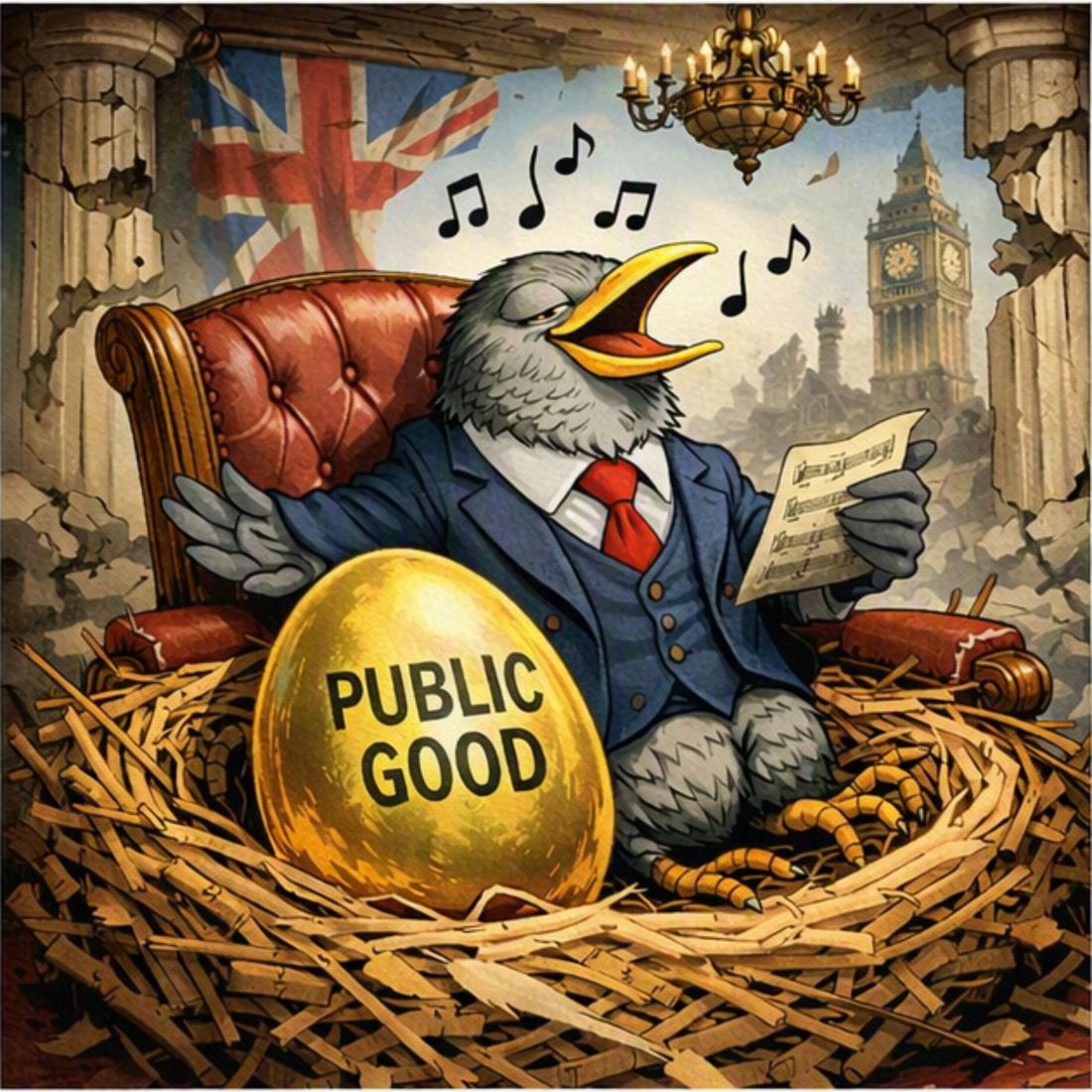
A new behaviour has taken root in Westminster and beyond. It is subtle, structural, and deeply corrosive. It is the habit of taking over seats simply to occupy them – to be seen to be there, to enjoy the insulated safety of incumbency – while rejecting the golden egg that comes with the role: the opportunity, and the responsibility, to do what is right for everyone now.

This is political cuckooism.

Like the cuckoo that lays its eggs in another bird’s nest, today’s political class lays its promises, its reforms, its responsibilities, and its obligations into the future – the next Parliament, the next cycle, the next government. The present becomes a perch. The future becomes a dumping ground.

And representative democracy is the real victim.

1. What Political Cuckooism Really Means

Political cuckooism is not procrastination. It is not caution. It is not long‑term planning.

It is the deliberate practice of deferring meaningful policy into the next Parliament so that incumbents can enjoy safety today.

It works like this:

  • take the seat
  • occupy the role
  • perform competence
  • announce reform
  • schedule it for “next time”
  • avoid consequences
  • avoid responsibility
  • and repeat

It is leadership without action. Authority without obligation. Presence without purpose.

It is the political class behaving as if the seat itself is the achievement – not the work that must be done from it.

2. The Golden Egg: The Opportunity They Refuse to Hatch

Every seat in representative democracy comes with a golden egg: the chance to act in the present.

To make decisions that matter. To confront reality. To govern.

But political cuckoos reject the egg.

They sit in the nest. They enjoy the perch. They protect the seat. They perform the role. But they refuse to hatch the egg.

Instead, they push every meaningful decision into the future:

  • tax reform
  • public service restructuring
  • constitutional change
  • welfare redesign
  • infrastructure investment
  • economic strategy
  • democratic renewal

All of it becomes “next time”.

The egg remains unhatched. The nest remains occupied. The seat remains safe.

And democracy remains unfed.

3. How We Got Here: The End of Britain’s Operating Model

Political cuckooism did not appear out of nowhere. It is the late‑stage behaviour of a political system whose operating model has already failed.

For forty years, Britain relied on a Thatcher‑era framework built on:

  • deregulation
  • privatisation
  • asset inflation
  • consumption‑driven growth
  • and the belief that markets could solve structural problems

That model worked – until it didn’t.

By the mid‑2010s, the machinery was visibly failing. By the early 2020s, it was exhausted. By the mid‑2020s, it was no longer capable of delivering meaningful outcomes.

The system now produces obligations rather than opportunities, constraints rather than choices, and risk rather than capacity.

Political cuckooism is the behavioural adaptation to that failure.

When the system can no longer deliver meaningful reform, politicians stop trying to deliver meaningful reform. They start performing it instead.

They occupy the seat. They protect the seat. They defer the egg.

And the system continues to fail.

4. The Contemporary Politicians’ Dilemma: The Mechanism Behind Cuckooism

Once in office, politicians discover a truth that the public never sees:

the system cannot absorb meaningful action – yet they must still appear to act.

They learn that:

  • every lever they pull has unintended consequences
  • every reform destabilises something else
  • every decision carries risks they cannot control
  • every structural change threatens the machinery
  • and every attempt at real‑time governance exposes the system’s fragility

So they face a choice:

Act meaningfully and risk collapse, or act symbolically and remain safe.

They choose safety.

They choose symbolism. They choose narrative. They choose performance.

And they choose to defer meaningful policy into the future – where it cannot hurt them.

This is political cuckooism’s engine.

5. The Rise of Performance Politics

Performance politics emerged because:

  • the machinery no longer responds to real‑time decisions
  • the levers of government no longer produce predictable outcomes
  • the public finances no longer support meaningful reform
  • and the political class no longer understands the system they are managing

So politicians adapted.

They learned to:

  • narrate competence
  • perform direction
  • announce future reform
  • avoid present‑tense responsibility

Performance became the product. Narrative became the tool. The future became the nest.

Political cuckooism is performance politics applied to policymaking.

6. Paradigm Blindness: Why Leaders Keep Looking Backwards

When leaders cannot imagine a new model, they cling to the old one. When they cannot act in the present, they promise action in the future. When they cannot confront structural reality, they narrate structural optimism.

This is why so many reforms are framed for “the next Parliament”. It is not strategy. It is not vision. It is not long‑term planning.

It is the inability to act now.

Paradigm blindness turns the future into a storage unit for every difficult decision.

Political cuckooism is the behavioural expression of that blindness.

7. Leadership in a Failing System

Leaders cannot lead if the system cannot respond.

When the machinery is failing:

  • leadership becomes symbolic
  • decision‑making becomes performative
  • accountability becomes abstract
  • and responsibility becomes deferrable

This is why today’s leaders occupy seats rather than use them.

They are not lazy. They are not cowardly. They are not incompetent.

They are trapped.

The system cannot absorb meaningful action, so leaders stop attempting meaningful action.

Political cuckooism is the survival instinct of leaders inside a system that no longer works.

8. They Sing All the Right Songs

They sing all the right songs. They say all the right things. They perform all the right gestures.

But the actions at the heart of everything tell us the only story we all need to know:

they will not act now.

They will not hatch the egg. They will not confront the present. They will not use the seat for what it is meant for.

They will only occupy it.

This is political cuckooism in its purest form – the performance of leadership without the practice of leadership.

9. The Media’s Role: Mistaking the Nest for the Egg

Political cuckooism thrives because the media consistently misreads future‑facing commitments as present‑tense policy.

The media still reports politics as if:

  • the system works
  • timelines are meaningful
  • governments have agency
  • and policy announcements reflect real‑time decisions

So when politicians announce reforms “for the next Parliament”, the media treats them as if they are happening now.

This creates:

  • the illusion of action
  • the illusion of direction
  • the illusion of leadership

It allows political cuckoos to occupy the nest without ever hatching the egg.

10. Representative Democracy Cannot Survive Without Present‑Tense Action

Representative democracy relies on one fundamental principle:

Governments must act in the present.

Not the next Parliament. Not the next manifesto. Not the next cycle.

The present is where accountability lives. The present is where consequences exist. The present is where democracy happens.

Political cuckooism destroys this.

When governments push meaningful policy into the future:

  • accountability evaporates
  • consequences disappear
  • mandates become meaningless
  • elections become theatre
  • and representation becomes symbolic rather than functional

Democracy becomes a ritual rather than a mechanism.

People vote for change. Politicians promise change. The system defers change.

And the public is left with the performance.

11. The Nest Is Full of Cuckoos – And No One Is Hatching Anything

The problem is not one or two individuals behaving this way. The problem is that the nest is full of cuckoos.

Every seat becomes a perch. Every Parliament becomes a holding pattern. Every government becomes a caretaker administration. Every manifesto becomes a list of future eggs.

And none of them hatch.

The political class has become a colony of cuckoos – each one eager to take control of the seat, each one unwilling to take responsibility for the egg.

The nest is occupied. The egg is ignored. The system is failing.

12. What Happens When “Next Time” Finally Arrives?

Political cuckooism works only as long as the future remains abstract.

But eventually, “next time” becomes this time.

Eventually, the deferred reforms pile up. Eventually, the structural failures converge. Eventually, the system runs out of future.

And when that moment arrives, the political class will face a crisis they cannot defer.

A crisis they cannot narrate. A crisis they cannot perform their way through. A crisis they cannot push into the next Parliament.

Political cuckooism is not sustainable. It is a temporary survival mechanism inside a system that is already failing.

And when it fails, representative democracy will face its reckoning.

13. The Only Honest Conclusion

Political cuckooism is the defining behaviour of the modern political class.

It is the habit of taking over seats simply to occupy them – to be seen to be there – while rejecting the golden egg: the opportunity to do what is right for everyone now.

It is the survival instinct of a political class that no longer knows how to govern.

It is the performance of leadership without the practice of leadership.

They sing all the right songs. They say all the right things. But the actions at the heart of everything tell us the only story we all need to know.

The future has become the nest. The present has become the performance. And democracy has become the victim.

Further Reading

To understand how Britain’s political, economic, and cultural systems have evolved – and why they now appear to be reaching a breaking point – the following essays offer a structured path through Adam’s analysis.

They begin with the broad systemic shift, then move through establishment dynamics, political behaviour, economic assumptions, and finally the personal dilemmas facing today’s leaders.

1. The End of Britain’s Current Operating Model: Thatcherism’s Forty‑Year Reign and the Beginning of the Post‑Thatcher Era

URL: https://adamtugwell.blog/2026/08/01/the-end-of-britains-current-operating-model-thatcherisms-forty-year-reign-and-the-beginning-of-the-post-thatcher-era-full-text/

A foundational essay explaining how Thatcherism shaped the UK’s political and economic architecture for four decades – and why its underlying assumptions are now collapsing. This piece provides essential context for all the others, outlining the structural shift Britain is entering.

2. The Establishment Is Not What You Think It Is: Why the Modern Establishment Is a Worldview, Not a Class – and Why That Makes It So Hard to Escape

URL: https://adamtugwell.blog/2026/07/15/the-establishment-is-not-what-you-think-it-is-why-the-modern-establishment-is-a-worldview-not-a-class-and-why-that-makes-it-so-hard-to-escape/

This essay reframes the “establishment” as a shared worldview rather than a social elite. Adam argues that the real power structure is cultural and psychological, not institutional – making it far more pervasive and difficult to challenge.

3. The Performance of Politics: Why Power No Longer Serves People

URL: https://adamtugwell.blog/2026/06/18/the-performance-of-politics-why-power-no-longer-serves-people/

A critique of modern political behaviour, exploring how politics has become performative rather than functional. Adam shows how leaders increasingly prioritise narrative, branding, and spectacle over meaningful public service.

4. We Can’t Fix Society Because We Won’t Question Money

URL: https://adamtugwell.blog/2026/01/22/we-cant-fix-society-because-we-wont-question-money/

An exploration of how deeply‑rooted assumptions about money limit society’s ability to solve major problems. Adam argues that economic orthodoxy has become a cultural belief system that prevents genuine reform.

5. The Contemporary Politician’s Dilemma

URL: https://adamtugwell.blog/2024/12/05/the-contemporary-politicians-dilemma/

A shorter, more personal reflection on the pressures facing modern politicians. It highlights how systemic constraints, public expectations, and party dynamics trap leaders in cycles of reactive decision‑making.

The Answers We Lost Are the Ones to Be Found Within

We are living through a time that feels strange not because the world has suddenly changed, but because the systems we built have finally revealed what they really are.

Many people still cling to the hope that today’s problems are temporary and that life will eventually return to how it once was. Yet beneath that hope sits a deeper truth: things cannot go back, because the system we depended on was never human in the first place.

For decades, society has been shaped around money – not people. It has become extractive, hollowing out communities, relationships, meaning, and even the environment itself. When money becomes the only measure of value, humanity becomes secondary. People lose connection with themselves and begin searching for external validation, external answers, and external saviours. They stop looking inward because the system has taught them that nothing inside them has value.

In times of uncertainty, this disconnection becomes overwhelming. People reach outward in every direction, hoping the same system that caused the problems will somehow solve them. Others turn toward spiritual or religious narratives, not because they are seeking truth, but because fear makes them desperate for reassurance. Faith becomes something people reach for only when hardship, scarcity, or death forces them to confront life more seriously.

But both religion and spirituality are multilayered. They can guide, but they can also distract. Anything that offers emotional certainty – whether healthy or unhealthy – can become a doorway that feels like progress but ultimately leads nowhere.

Sensationalism, fear, and charismatic voices often drown out quiet truth. People lose the ability to think critically about the messages they hear, what they mean, and where they come from.

This confusion is amplified by those with power and influence. Many of them access abstract or metaphysical ideas – holographic reality, simulation theory, questions about whether anything is “real.” But instead of using these ideas to deepen responsibility, they use them to justify detachment: if reality is questionable, why care about anyone else?

What they fail to understand is that every decision matters. Every action has consequences. Every cost creates a debt. Only those who believe in one lifetime can pretend there will be no bill to pay.

As the world reveals itself to be in one hell of a mess, people from all backgrounds are searching for something that makes sense of their thoughts and experiences. In times like these, figures such as Jesus or the Antichrist become symbolically powerful. They offer a way for people to give shape to their fears and hopes.

But once these symbolic ideas are given literal form, people start looking for actual characters – physical beings – instead of recognising behaviours and patterns that already exist and explain where we are.

The truth is that the qualities people associate with the Antichrist – deception, exploitation, manipulation, the elevation of wealth above humanity – are already embedded in the system itself. They surround us in countless forms, woven into how the world now works. People wait for a character to appear, when the real danger is a pattern that has already taken root.

And the real answer is not found in prophecy, systems, or saviours. It is found within each person.

Awakening begins when people reclaim their own perception, their own value, and their own responsibility. It begins when they stop lending their power to public figures, celebrities, or mythic characters. It begins when they recognise that there is no hierarchy of human worth.

The toilet cleaner, the person with learning difficulties, the quiet soul who lives simply – any of them may be far more advanced than a billionaire who has spent a lifetime taking from others.

Every decision matters. Every action counts. And the moment people reconnect with themselves, they stop being manipulated by a dehumanising system. They stop searching for external validation. They stop fearing authority. They stop waiting for saviours. They begin to see clearly again.

The real answers lie within. They always have.

And if there is any hope for the world to become human again, it begins with each of us choosing to see clearly, choosing to act consciously, and choosing to reclaim the power we were taught to give away.

Nothing changes until we do.

Are the Conservatives Really the Adults in the Room? | A Structural Examination of a Political Myth

Since the October 2026 Conservative Party Conference, a familiar line has resurfaced in political commentary: the Conservatives look like “the adults in the room” again.

Kemi Badenoch’s keynote speech – and the publication of her ideological document, The Right Way – were presented as evidence of a renewed seriousness.

Commentators noted that her tone, discipline, and clarity contrasted sharply with the noise elsewhere in British politics.

But the idea that the Conservative Party represents adulthood in British politics is not supported by the structural reality they face. They are preparing to operate a system that is failing, not preparing to govern through the paradigm shift that is already underway.

The Conservatives are not the adults in the room. They are the last technicians of a dying operating system, still convinced that competence means managing the machinery more tightly, even as the machinery itself fails.

And this problem is not confined to the Conservative Party. It is shared across the entire right.

1. The UK’s crisis is structural, not ideological

The problems facing the United Kingdom today are not the result of a single party, a single leader, or a single policy cycle. They are the result of an economy-based paradigm that has reached the end of its useful life.

Across government, markets, public services, and institutions, the same symptoms appear:

  • tools that no longer work
  • systems that no longer respond
  • incentives that distort outcomes
  • markets that react unpredictably
  • public services that cannot deliver
  • communities that feel abandoned
  • political actors who cannot adapt

This is not a left‑right problem. It is a system problem.

And system problems cannot be solved by:

  • left‑wing managerialism
  • centrist technocracy
  • populist disruption
  • cultural reaction
  • neoliberal acceleration

They can only be solved by people who understand:

  • locality
  • community
  • stewardship
  • continuity
  • identity
  • responsibility
  • self‑governance

These are conservative principles in the true sense – not the party‑political sense.

Which is why the answer must come from the right. But not necessarily from the Conservative Party.

2. Why the Conservative Party cannot be the adults in the room

The Conservative Party is not failing because it is conservative. It is failing because it is paradigm‑blind.

It is trapped inside a worldview that assumes:

  • markets are the ultimate arbiters of reality
  • growth is the measure of success
  • deregulation is the path to prosperity
  • fiscal discipline is moral discipline
  • centralised management is competence
  • political messaging is leadership
  • continuity of the system is the goal

These assumptions once made sense. They no longer do.

The Conservatives are using broken tools inside a broken system, guided by broken incentives, responding to broken signals, and trapped in broken feedback loops.

This is not adulthood. This is institutionalised adolescence – a political culture that confuses rigidity with responsibility and obedience with wisdom.

3. The 2026 Conference: seriousness by contrast, not substance

The October 2026 Conference was designed to project maturity:

  • Andrew Griffith’s “one tax cut per Budget” pledge
  • The deregulation agenda (housing, planning, environment)
  • The anti‑net‑zero pivot
  • The “Britannia Shield” defence announcement
  • Laura Trott’s anti‑activism education stance
  • Jeremy Clarkson’s rural‑identity cameo

These were framed as grown‑up realism, contrasted with Labour’s internal confusion and the volatility of Reform and Restore.

This is where the “adult” narrative emerged.

But seriousness in tone is not seriousness in structure. The conference showcased competence within the paradigm, not competence beyond it.

4. The Right Way: preparing for government, not governance

Badenoch’s document, The Right Way, was presented as:

  • “the bedrock of Conservative policy”
  • “the foundation for government”
  • “the serious plan for Britain”
  • “the right way to govern”

Commentators echoed the sentiment, describing it as a return to grown‑up conservatism.

But The Right Way is not a plan for governance. It is a plan for operating the existing system.

It is:

  • a Thatcherite reboot
  • a neoliberal acceleration
  • market appeasement
  • system maintenance
  • managerial discipline

It is preparing for government, not preparing for governance.

This distinction is critical.

5. Government vs governance: the hinge of the argument

Preparing for government

means preparing to:

  • operate the existing system
  • manage the existing machinery
  • use the existing tools
  • reassure markets
  • maintain the paradigm
  • look competent inside a failing structure

Preparing for governance

means preparing to:

  • confront systemic collapse
  • break the market–politics symbiosis
  • rebuild institutions
  • decentralise power
  • restore community autonomy
  • govern beyond neoliberalism
  • lead through paradigm change

The Conservative Party is doing the first. The country needs the second.

This is why they cannot be the adults in the room. They are preparing to run a system that no longer works.

6. The markets–politics symbiosis: the real enemy of adulthood

The most dangerous structural problem in British politics is the codependent relationship between markets and government.

The Conservatives believe adulthood means:

  • pleasing markets
  • calming markets
  • signalling to markets
  • obeying markets
  • reassuring markets

But markets are not adults. Markets are algorithms reacting to signals.

The Conservatives are trapped in a feedback loop:

  • They use neoliberal tools.
  • Markets expect neoliberal tools.
  • Markets punish deviation.
  • Conservatives panic.
  • Conservatives double down.
  • The system worsens.
  • Markets panic again.

This is not adulthood. This is fear dressed up as maturity.

In 2022 Liz Truss did not break the system. She exposed it.

Her downfall was not a failure of ideology. It was a failure of paradigm awareness.

7. The wider right: unity without understanding is not a solution

The emergence of initiatives like VotingRight.uk shows how deeply the right recognises its fragmentation.

To many, such platforms will sound like a solution:

  • stop vote‑splitting
  • unify the right
  • create a coherent alternative
  • restore seriousness
  • bring “adults” together

But unity does not fix blindness. Unity amplifies it.

A coalition of the right – no matter the dynamics – cannot solve a structural crisis if it is still operating inside the same failing worldview.

If the people elected are still:

  • market‑obedient
  • neoliberal in instinct
  • centralising in practice
  • managerial in mindset
  • paradigm‑blind
  • system‑first rather than people‑first
  • trapped in the markets–politics symbiosis

then the outcome is the same:

They will govern the reality they believe exists, not the reality that actually does.

VotingRight.uk is a tactical response to a structural crisis. It cannot succeed on its own terms – no matter how well intended it may be.

The right must come together – but not around electoral arithmetic. It must come together around paradigm awareness.

8. The right must come together – but not around the Conservative Party

The solution requires:

  • conservatives who understand community
  • conservatives who understand stewardship
  • conservatives who understand responsibility
  • conservatives who understand identity
  • conservatives who understand continuity
  • conservatives who understand locality
  • conservatives who understand governance

These people exist across the right, not just inside the Conservative Party.

The Conservative Party is not the container for the solution. Nor is any single right‑wing electoral alliance.

The right must come together outside the party structure, not inside it.

9. The real adult in the room will not be a manager – but a breaker or a builder

The next real leader will be someone who:

  • recognises the paradigm is ending
  • understands the markets are not adults
  • sees the system is collapsing
  • prioritises people over systems
  • breaks the political–market symbiosis
  • rebuilds from community upward
  • leads through collapse rather than managing decline

This is the adulthood the country needs. This is the adulthood the Conservative Party cannot provide. This is the adulthood the right must rediscover. This is the adulthood that requires paradigm awareness. This is the adulthood that requires governance, not government.

10. A final note on political time, uncertainty, and the nature of paradigm change

This position statement is written immediately following the Conservative Party Conference in October 2026, at a moment when political narratives are still settling and the implications of The Right Way are being interpreted in real time. Political conditions change quickly. What appears clear today may look very different in a matter of months, weeks, or even days. Any analysis of the present moment can only ever be a snapshot of where things seem capable of going from here.

It is important to recognise that any political party – left, right, or as yet unknown – could be the one that eventually experiences the lucid moment required to see the full reality of the situation the UK now faces. Paradigm shifts do not respect party lines. They do not follow ideological loyalties. They do not emerge from the places commentators expect. They emerge when circumstances force clarity.

If and when that moment arrives, the political actor who grasps it will not succeed because they are Conservative, Labour, Reform, Restore, or anything else. They will succeed because they have understood the structural nature of the crisis and acted upon it.

And whatever form that response takes, conservatism – in its truest sense – will sit at its core. Not the market‑first, system‑first, centralising version that dominates party politics today. But the deeper conservatism rooted in:

  • stewardship
  • locality
  • continuity
  • responsibility
  • community
  • identity
  • people‑first governance

This form of conservatism is not exclusive to the right. It is present, often unspoken, at the foundation of anything genuinely progressive that puts people first. It is the shared ground beneath political traditions that currently see themselves as opposites.

For that reason, the eventual solution is likely to bring together people who today believe they sit at entirely different points on the political spectrum – people who currently focus on difference rather than commonality, and who have been conditioned to see each other as opponents rather than potential collaborators. Circumstances are almost certain to demand this perspective shift before long.

Only when that shift occurs – when the political imagination flips from division to shared purpose – are we likely to see the real answers begin to emerge.

This piece should therefore be read not as a prediction, but as a structural reflection on the moment we are in: a moment defined by paradigm blindness, institutional inertia, and the illusion of adulthood in politics. A moment that will change. A moment that must change. And a moment whose eventual transformation will depend on people who can see beyond the boundaries of their own political identities and recognise the deeper reality that now confronts us all.