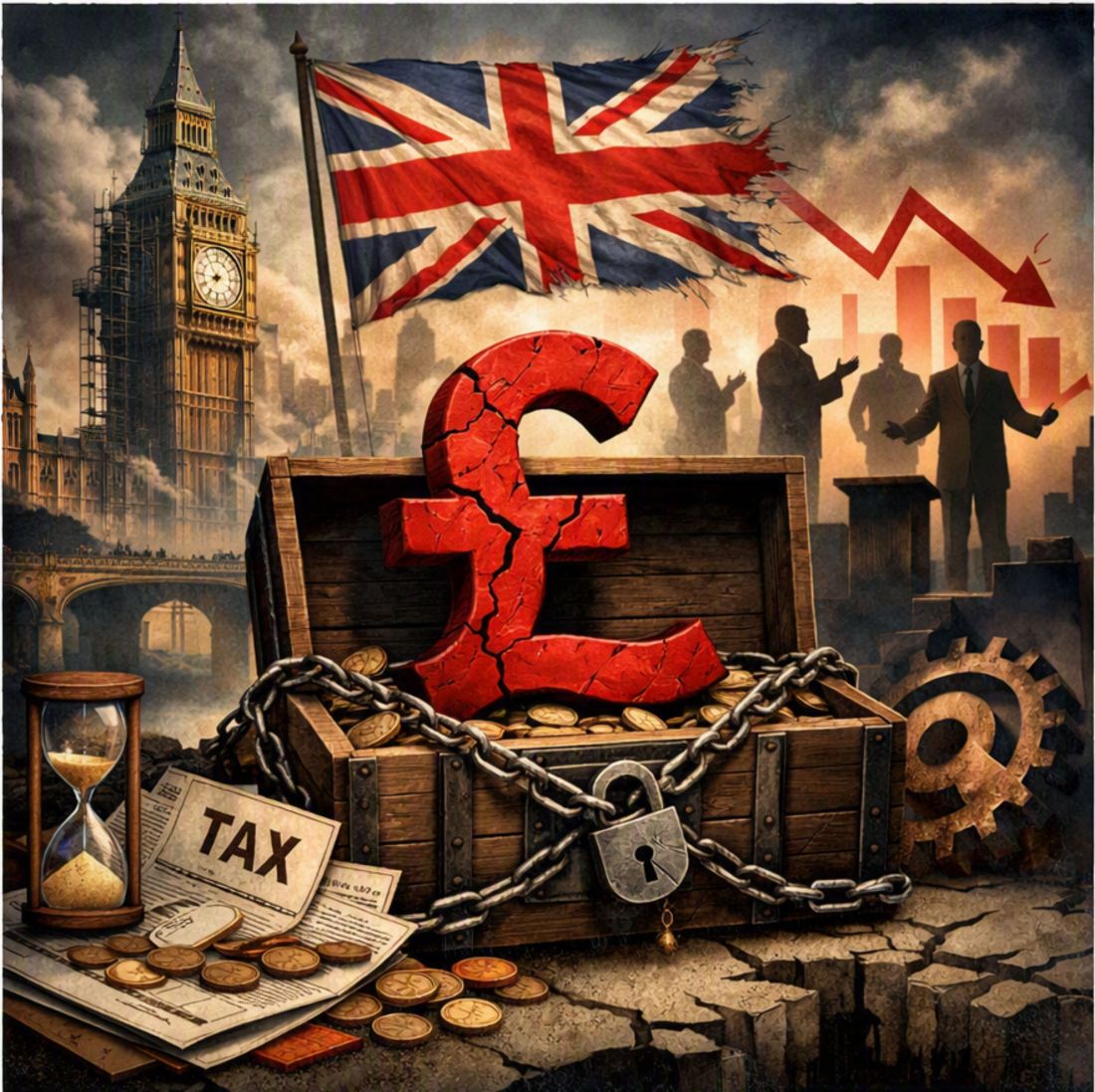
A conversation about how Britain reached a point where taxation is no longer a political choice, but a structural necessity.
Noticing the feeling that something has changed
If you talk to people across the UK – in cafés, on trains, at work – you’ll hear a similar sentiment: “It feels like everything is getting difficult.” Not just financially, but structurally.
Public services feel stretched. Infrastructure feels tired. Politics feels stuck. And when a new government arrives and immediately reaches for tax rises, many people instinctively fall back on familiar narratives: “Well, that’s Labour for you.”
But if we slow down, take a breath, and look carefully at the mechanics underneath, a different picture emerges – one that isn’t about party ideology at all. It’s about a country that has gradually run out of road, and a government that has fewer tools available than at any point in modern history.
This isn’t a story about blame. It’s a story about understanding.
Why the old political story no longer fits
For decades, British politics has been framed around a simple rhythm: Conservatives lower taxes, Labour raises them. It was never entirely true, but it was familiar enough that people accepted it.
Yet the data tells us something different. The UK’s tax burden was already heading toward an 80‑year high before the most recent General Election in the summer of 2024, driven by structural pressures rather than ideology.
Even under Conservative governments, taxes rose steadily – partly through explicit measures, partly through “fiscal drag,” where thresholds fail to rise with inflation and more people are pulled into higher tax bands.
So when the Labour Government raises taxes now, it’s not because they are following a party tradition. It’s because the system they’ve inherited leaves them almost no alternative.
This is the first key idea: taxation today is not ideological – it is mechanical.
The broken toolbox: understanding what governments used to rely on
To understand why tax is the only tool left, imagine the UK government as a mechanic with a toolbox. For decades, that toolbox contained several reliable instruments:
Borrowing – cheap debt allowed governments to smooth over problems.
Spending cuts – austerity was used to rebalance budgets.
Privatisation – selling state assets brought in quick cash.
Growth – rising productivity and investment expanded the tax base.
Efficiency drives – squeezing public services for savings.
But each of these tools has worn out.
Borrowing is no longer cheap
Public debt has nearly tripled since the 2008 global financial crisis (GFC). Markets are more sensitive. Interest rates are higher. Borrowing now comes with real consequences.
Spending cuts have reached their limit
After a decade of austerity, public services are visibly strained. The Resolution Foundation describes the UK as stuck in a “fiscal funk” where cuts no longer fix anything – they simply break things further.
Privatisation has run out of road
Most sellable assets have already been sold. What remains is either essential or politically untouchable.
Growth has stalled
The Institute of Economic Affairs notes that Britain’s long-term growth slowdown is deeply structural, tied to low investment and productivity. Growth can no longer be relied on to “fix” the public finances.
Efficiency savings are a fiction
Public services have been squeezed so hard that further “efficiencies” often mean service reductions, not improvements.
When every tool in the box is broken, the mechanic reaches for the only one left – even if it’s blunt, unpopular, or overused.
That tool is taxation.
The extractive system: how Britain hollowed itself out
To understand why the toolbox is empty, we need to look at the deeper structure of the UK economy – not in a technical way, but in a human way.
For many years, Britain relied on a model that extracted value rather than created it. This wasn’t malicious; it was gradual, almost invisible.
Fiat money and the illusion of prosperity
The UK operates on fiat money – currency backed by trust rather than physical assets.
This allowed governments to borrow cheaply, expand credit, and inflate asset prices.
For a while, this created the feeling of prosperity: rising house prices, booming financial markets, easy credit.
But it didn’t create productivity. It didn’t create resilience. It didn’t create the kind of growth that strengthens a nation.
Financialisation: when money makes more money than work does
Over time, the economy shifted toward financial activity – property, banking, asset management – and away from production, innovation, and infrastructure. The IEA notes that tax policy increasingly discouraged investment, contributing to lower productivity growth.
This meant Britain became very good at moving money around, but less good at building things that last.
The hollowing-out effect
As extraction replaced creation, several things happened:
Public services weakened.
Infrastructure aged.
Local government struggled.
Real wages stagnated.
Social mobility slowed.
Trust in institutions eroded.
People felt the country becoming thinner – not collapsing, but hollowing.
Performance politics: when the story matters more than the substance
Fiat money didn’t just shape the economy. It shaped politics.
For years, governments could rely on cheap borrowing and rising asset values to appear effective. They could announce new initiatives, promise investment, and project confidence – even when the underlying machinery was weakening.
This created what we might call performance politics: politics focused on narrative rather than outcomes.
The ICAEW describes the UK tax system as “trapped by politics,” with reforms blocked because politicians fear creating visible “losers.” This leads to short-term fixes, rushed announcements, and complexity – all symptoms of a system performing rather than governing.
And now we’ve reached the zenith of that performance.
The tragedy: the actors keep performing even though the stage is collapsing
Here is the part that is hardest to talk about, but most important to understand.
Politicians – of all parties – are trapped in a story that no longer works.
They inherited a system that relied on tools that no longer function. They face public expectations shaped by decades of performance politics. And they know that admitting the truth would be politically devastating.
So they keep performing.
They keep promising growth. They keep announcing reforms. They keep projecting confidence.
And when all other tools fail, they reach for taxation – not because they want to, but because it is the only lever that still moves when pulled.
It is immediate. It is predictable. It does not require market confidence. It does not require waiting for growth. It does not require selling assets that no longer exist.
Taxation is the last functioning mechanism in a system that has run out of alternatives.
A fair conclusion: understanding without blaming
This is not a story about Labour. It is not a story about the Conservatives. It is not a story about ideology.
It is a story about Britain – about how decades of structural choices, economic shifts, political incentives, and fiscal pressures have brought us to a point where taxation is no longer a preference, but a necessity.
The wheels of the country are still turning. But they are turning because the government is extracting more from the public than ever before – not out of malice, but out of structural reality.
Understanding this doesn’t make the situation easier. But it does make it clearer.
And clarity is the first step toward imagining something better.
What this means for the future – without predicting anything
It’s important to be clear: this isn’t about forecasting or claiming to know what any government will do next. Politics is human, circumstances change, and unexpected events can reshape the landscape overnight. But when a system reaches a point where taxation is the only reliable tool left, certain patterns tend to emerge – not because of ideology, but because of the mechanics of the situation.
Think of it less as prediction and more as understanding the direction of travel when no other levers are available.
1. Taxation becomes the default response to pressure
When borrowing is constrained, growth is weak, and public services are fragile, governments often turn to tax because it is the only mechanism that produces immediate revenue. This doesn’t mean taxes will rise endlessly; it simply means tax becomes the first tool reached for when something needs funding.
2. The tax base broadens rather than deepens
Instead of dramatic headline tax rises, governments often rely on quieter forms of extraction:
frozen thresholds
expanded eligibility
new categories of taxable activity
adjustments that affect more people rather than a few
These changes feel subtle, but they accumulate.
3. Public services stabilise, but rarely improve
When tax is used to keep the wheels turning, the goal often becomes maintenance, not transformation. Services may avoid collapse, but they struggle to regain strength. The system focuses on preventing failure rather than enabling progress.
4. Political debate becomes narrower
When the toolbox is empty, political arguments often revolve around:
how to tax
who to tax
when to tax rather than deeper questions about structural reform. This isn’t because politicians lack imagination; it’s because the system limits what is realistically possible.
5. The public feels the pressure more directly
As extraction increases, people notice it in everyday life:
higher effective tax rates
reduced disposable income
slower improvements in services
a sense that the state is asking more while delivering less
This isn’t a prediction – it’s simply what tends to happen when a government is forced to rely heavily on a single tool.
6. The system continues until it reaches a natural limit
Every extractive model has a point where it can no longer extract more without causing harm. That point varies by country, by economy, and by political choices. But the principle is simple: a system that relies on taxation alone eventually reaches a point where there is nothing left to tax without changing the model itself.
Again, this is not a forecast. It is an explanation of how systems behave when they run out of alternatives.
A closing thought
None of this is inevitable. None of it is guaranteed. None of it is a prediction.
It is simply the shape of the landscape when a country reaches a moment where taxation is the last remaining lever.
Understanding that shape helps us see the present more clearly – and perhaps imagine a different future more honestly.
If you’re reading this, something probably doesn’t feel right. The world feels unstable. Life feels harder. The things we used to rely on don’t seem to work anymore.
You’re not imagining it – and you’re not alone.
This space exists to help you make sense of what you’re feeling. Not with jargon. Not with politics. Not with complicated theories. But with clear, honest questions – and answers designed to help you think, not tell you what to think.
When things stop making sense, most of us end up asking the same questions, even if we never say them out loud. These nine questions form a pathway – a sequence that moves from confusion to clarity, from instability to understanding. Each question builds on the one before it, guiding you step by step through what’s happening and what comes next.
How to Use This Booklet
Start at Question 1 and move forward in order. Each question opens the door to the next, helping you see how the pieces fit together.
If one question feels especially relevant, you can begin there – but returning to the sequence will help you see the full picture.
Take your time. Reflect. Pause between questions. This isn’t a race; it’s a process of orientation.
The Nine Questions
Why does everything feel unstable?
Why is government not working?
Why isn’t there enough money?
Why is food supply becoming unstable?
Why are politicians not listening?
What’s actually going on?
What comes next?
What can we do locally?
Who should I trust when everyone is claiming to have the answers?
You don’t need to rush. You don’t need to read everything at once. Start with the question that feels closest to what you’re experiencing. Each page is written to help you think clearly, feel grounded, and see the bigger picture without being overwhelmed.
Once you’ve explored the questions that matter to you, you’ll find links to deeper explanations, ideas, and practical steps. These aren’t theories or political arguments – they’re frameworks for understanding what’s happening, and for building what comes next, together.
Whatever you’re feeling right now, you’re not alone. You’re not imagining it. And you’re not powerless.
The future isn’t something that will be decided for us – it’s something we will shape together.
If you’re ready, begin with Question 1: Why does everything feel unstable?
Why does everything feel unstable?
Let’s jump straight in. Things feel unstable because they are unstable.
You’re not imagining it. You’re not being dramatic. You’re not “doomscrolling yourself into a panic.” Much of what we see in the world outside our homes and communities is breaking down – and the reason so many of us have been questioning ourselves is because the people who have power and responsibility keep speaking and acting as if nothing is wrong.
Government isn’t functioning. Politics isn’t working. The public sector isn’t delivering. The prices of everything are becoming increasingly unaffordable. People sound angrier than they used to. The world outside our doors doesn’t feel safe.
And while there are plenty of loud voices shouting about what’s wrong, very few of them offer ideas or solutions that actually sound like they would work. Most of what we hear either feels too simplistic or too complex to make any sense of.
I’m not going to try to talk you through every reason things have become as unstable as they are – not here. There’s simply too much to cover, and trying to cram it all into one place would overwhelm you rather than help. If you want to understand what’s happening, why it has happened, and what we all need to start thinking about next, I can point you to other pieces that will help you ask the right questions and find your footing.
What you do need right now is space. Space to think. Space to ask questions. Space to connect with people who are putting reason before fear and who want to find a way forward that works for everyone – not just for themselves.
And you shouldn’t feel bad for asking this question. Many others are having the same thoughts and feelings you are.
Mainstream media talks around the edges of what matters, touching the surface but rarely explaining anything in a way that helps. Social media is full of people saying the things we want to hear – confirming that our feelings are real – but that’s usually where it stops.
The time has come to look, ask, read, listen, consider, and act in ways that make sense to you, rather than relying on what someone else says.
You’re not alone in feeling this way. And you’re not wrong to ask.
You might be surprised at how many people are asking this same question. But you probably won’t be surprised at how many people also think they already know the answer – and believe they’re “right.”
Talking about government is tricky because it almost always drags us straight into politics. And once politics is involved, most of us start thinking about whichever party or group we usually support. We judge how government is performing through the lens of who we voted for, who we like, or who we can’t stand.
I’m sure you can relate to feeling more forgiving when the people in charge are the ones you support – and much less forgiving when they’re not.
But here’s the part that’s hard for many of us to get our heads around:
It no longer matters.
The reason government isn’t working today has very little to do with politics in the way we usually think about it. That’s why you’ll hear people say things like “they’re all the same” or talk about a “uniparty.” It’s not that all politicians secretly belong to one big club. It’s that every political party we can choose from today is still part of the same way of thinking.
And that way of thinking – not a group of elites, not a secret organisation, not the banks or big business – is what has shaped every decision that has led us to where we are now.
This is what “the establishment” really means. Not a class. Not a conspiracy. A worldview.
A worldview that every major political party shares, even the ones that claim to be “anti‑establishment.” And once you understand that, you start to see why government feels stuck, confused, or unable to fix anything – no matter who gets elected.
How government works today – how politics works, how elections work, how decisions are made, and how those decisions affect you and me – is far too complex to cram into one message here. And trying to do that would only confuse things further.
Yes, we need to understand what has happened, why it has happened, and where politics is heading now. I’ll give you links that will help you explore those questions and ask new ones too.
But for now, what matters just as much – if not more – is finding others who are looking for direction, who want to put reason before fear, and who are open to working together to take positive steps in the same way.
Whatever difficulties lie ahead, we will be far better able to face them together than alone.
If you’ve been struggling and wondering how you’re supposed to keep going financially, you’re not alone. In fact, growing numbers of people have been struggling for a long time. What almost everyone who’s struggling shares is the feeling that they’re facing it by themselves – that this is somehow only happening to them, or worse, that it’s their own fault.
If this is how you feel, it’s important to understand something clearly: you are not alone, and you have not failed. Yes, a few people struggle because of mistakes they’ve made. But most of the people who are asking how they’re going to buy food, pay bills, or simply keep going haven’t done anything wrong. Prices have kept rising, wages haven’t kept up, and the gap between what life costs and what people earn has become impossible to bridge.
How money works today is far more complicated than most people – and even some economists – realise. There’s a lot to understand about why prices keep going up, why the value of the money in our bank accounts keeps going down at the same time, and why it always feels like we’re the only ones who can’t keep up. If you want to begin understanding what’s really happening with money, I’ll share links that will help you start asking the right questions and make sense of what you’re experiencing.
But right now, the most important thing is not the theory. It’s you – and how you can get help, where you can find it, and how you might be able to help others too. As shortages of food, essentials, and money become more visible, some people will approach solutions in ways that don’t help anyone – least of all themselves. The more we understand what’s happening, the better placed we are to support each other rather than compete with each other.
One thing we can be absolutely sure of is this: the people you see using food banks, claiming benefits, or getting other kinds of support are almost never in that situation by choice. They were simply closer to the edge than others, and it has suited some to suggest that they’re struggling because of something they’ve done wrong.
If you need a clearer picture, consider this: a significant number of people who are already on benefits work full time. They need help because the national minimum wage is no longer enough for anyone to live independently on. That’s not a personal failure. That’s a system failure.
And you’re not imagining it.
If you want to explore the deeper causes behind this, you can look at:
Food is really important. We all need it every day, and it’s as essential as the air we breathe and the water we drink – so please don’t feel bad for looking for answers about what’s happening and what’s going wrong.
The strange thing about food – and why questions about food security feel confusing as well as frightening – is that most of us have grown up assuming supermarkets will always have what we need. We’re used to walking in and finding everything on the shelves, or ordering whatever we want for delivery, without ever thinking about how it gets there. We take it for granted that today will be the same as yesterday, and tomorrow will be the same as today.
Unfortunately, that’s how almost everyone has been treating food – including the people who make decisions about how it’s produced, where it comes from, and how it reaches us. Because food is essential, but can also be processed, modified, and sold in forms we don’t actually need but have been encouraged to want, the industries that produce and sell food have focused on those profitable parts for a very long time.
This has changed the UK’s relationship with food drastically over the past 50 years. Most people don’t think about where food comes from or how it gets to us, but the truth is that a very large amount of the food we eat in the UK comes from outside the UK. Supermarkets, takeaways, restaurants – much of what they sell relies on long, fragile supply chains that stretch across the world.
And the world isn’t a stable place right now. We hear about wars, conflicts, political tensions, and economic shocks – but very little is said about how these events affect the food chain, or the supplies like diesel, fertiliser, and animal feed that farmers rely on. When any part of that chain is disrupted, the effects eventually reach us, even if we don’t see them straight away.
It’s a complicated subject, and understanding the real story about food in the UK will take time, thought, and questions. I’ll add some links below if you’d like to begin exploring it. But the most important question right now is this:
How do we make sure everyone has enough of the food we actually need, rather than just the food we’ve become used to wanting?
Working with others in our communities to meet our shared needs – and to make our long‑term food supplies more resilient – is one of the best steps we can take. It will take time, effort, and patience, especially when some of us are already worried about where the next meal will come from. But it’s possible. And it’s necessary.
The good news is that there are practical steps you can take to begin providing at least some of your own food reasonably quickly – even if you don’t have a garden or outside space. Please take a look at the links below.
People feel ignored, dismissed, patronised, unheard. This is the collapse of trust.
And no – you’re not imagining it. It feels like politicians aren’t listening because they aren’t. Or at least, they’re listening to the noise, but they’re not hearing what people are actually telling them.
We’re living through very difficult times, and politics is always a tricky subject because who we support is tied closely to what we believe and the values we hold. That’s why people get so worked up – sometimes even angry – when the parties or politicians they follow are criticised, or when they’re told that their side might be wrong.
Understanding why politics polarises people is just as important as asking why politicians aren’t listening. Because no matter which party or politician any of us support, almost everyone is feeling the same things. We’re all experiencing the same problems. We’re all living with the same instability. And the ideas, motives, and thinking behind political decisions are basically the same across the board – even if the colours, slogans, and messages look different.
Once you strip away the names, the branding, and the promises, you start to see that the political system is working from one shared worldview. That worldview shapes everything – governance, money, values, priorities – and it’s the same worldview that has led us to where we are now.
This is why politics feels stuck. This is why politicians feel disconnected. This is why nothing seems to change.
It’s not because nobody cares. It’s because the system they’re working within is no longer capable of delivering the outcomes people need.
The reality is that while we’ve been taught to believe that the politicians we see on TV, online, or on the radio can make big decisions that will fix the problems we’re worried about, their hands are tied from the moment anyone walks into Number 10. The way the system works – especially the way money works – limits what they can do long before they ever get the chance to try.
To be fair, the realities of government are hard for any of us to understand today. What we believe happens and how things are supposed to work are very different from what we’re experiencing. What makes it even harder is that politicians often sound like they’re talking about the right things. They say they’re going to act. They promise change. And then everything stays the same.
This isn’t because they’re all being dishonest. It’s because they’re performing – quite literally acting out for the media – in the belief that this is the best way to keep everything running. The public sector is doing much the same. Not because people don’t care, but because there is no longer any real sense of a workable alternative.
There’s a lot to think about. And you might not feel it yet, but what you think, what you say, and the contribution you can make are not only important – they’re vital to where all of this goes next.
You’ll hear more and more voices offering “new approaches” or “different ideas.” Some of them sound credible. Some of them have big followings. But most of them still rely on the same belief: “Things would be different if I – or my group – were in charge.”
That belief is one of the biggest problems we face.
Because the truth is this: The only way things can now be different is if we make them different – by thinking differently, acting differently, and working together differently.
Right now, everything is centralised. People we will never meet are making decisions about places they will never visit. That centralisation is one of the biggest reasons everything feels wrong.
I’ll provide links you can explore if you want to understand how politics and governance reached this point. But moving forward isn’t about blaming any party or politician. It’s about looking ahead and taking the steps that will create the best possible future for everyone – instead of obsessing over what has gone wrong in the past.
Before anything else, you need to hear this clearly: you are not imagining a problem. Things are not working as they should – government, the public sector, politics, public services, utilities, money – and the list goes on. Nothing feels right because it isn’t right. And you are not going mad.
You feel uncertain, and you may even be questioning your own thoughts, because what you’ve learned to expect from “the system” and what you’re actually experiencing are now two very different things. More importantly, there’s no clear explanation coming from anywhere that makes sense. Instead, there are lots of loud voices blaming someone or something – usually the current government – as if that explains everything.
It doesn’t.
We tend to think of politicians and government as being in charge of all this. But they aren’t – even though they insist they are, and continue to behave as if they are. The truth is that their thinking is aligned with the system itself. They see the world through the same lens the system was built on, and that lens shapes every decision they make.
The system is complicated. Too complicated to cram into one message when you’re looking for quick answers that at least help you make sense of what’s happening and decide where you want to look next.
But here’s what you need to know right now:
The system we live in has been in place for a very long time – longer than most of us have been alive. It has been shaped and managed by governments of every political colour. It is built on money and economics, and that’s why every solution you hear from politicians or the media almost always comes back to “growth.” Growth of GDP. Growth of spending. Growth of the economy. Because that’s the only measure they’ve been taught to use to decide whether everything will continue to be “okay.”
If you stop and think about it, you’ll see that money affects almost every decision you make in your relationship with the outside world. It shapes what you can do, what you can’t do, and how you feel about your future. We’ve come to believe this is normal – but it isn’t. And everyone making decisions today thinks the same way too. Money has become the only real benchmark for everything.
Once you see that, the next part may give you an “aha” moment:
People are no longer the priority of government or business.Money – and economics – are.
There’s far too much to cover here, but I can provide links that explain what’s happening and how it affects the decisions that shape every part of life.
For now, the most important thing to understand is this:
The system we have can only keep working by taking more and more from most of us, so that those at the centre can take more money, power, and influence. A system like this cannot keep taking without reaching a point where people no longer have enough – and begin to get hurt. This has been happening for a long time, but only recently have enough of us been pushed to the edges, or over them, for it to become clear that we are reaching a place called stop.
The difficulty is that money – appearing to be as important as we’ve been taught to believe – is intoxicating. It drives everything until the moment we are excluded from the way the system works, and begin to understand what it’s like to not have enough, or to spend every spare moment worrying about where more money will come from.
Putting people first – contributing, taking part, and being involved in how everything works – is the only way we can solve the problems society now has. There are no quick fixes. Anyone who suggests that there are, or who promises that “we can go back to how things were if you just follow me,” is offering a trapdoor back to more pain.
I can provide links that explain how the system works and what it has been doing. But more importantly, I can share ideas and solutions that show what we can all do, the contribution each of us can make, and how we can work together to create a world that is balanced and fair for everyone – not just for the privileged few.
The hardest thing for any of us to get our heads around, as we look at the problems we face, is that the solutions are not going to come from the people or the places we expect.
The problems the UK faces today are all connected. Government, politics, the public sector, money, the cost of living, not having enough, not having work, not feeling valued – it doesn’t matter which part you look at. Everything circles back to the same root cause. And that means the way forward has to be something genuinely different.
Something that leaves all of that behind.
It’s not easy to imagine a new way of living and interacting with the world outside ourselves. But once we begin to remember who we really are – and what actually matters – it becomes much clearer.
What comes next isn’t about abandoning technology or pretending we can go back to some nostalgic version of the past. It’s about putting people, community, and the environment we live in first, instead of money or whatever we can access on a screen.
Some people will automatically assume this means rejecting modern life or living in some kind of bubble. It doesn’t. What comes next is about creating a level playing field where everyone has access to the basic essentials they need for life – without anyone else controlling them.
When people have enough, they are free to think, to breathe, to find peace, and to live the best life they can, without the actions or behaviours of others holding them back.
This isn’t utopian. It isn’t socialist. It isn’t communist. And it isn’t capitalist either.
All of those systems – just like commercialisation – rely on centralisation and hierarchy. They all depend on power being held at the top. The alternative doesn’t hide processes or motives because it can’t. It turns everything on its head and makes what is local – your community, your environment, your relationships – the most important part of life. And it puts you, and the people you care about, right at the centre.
There’s a lot to think about, and I’m not going to try to explain the whole Local Economy and Governance System (LEGS) here. What I will say is that it all begins with a benchmark for life called the Basic Living Standard. This means everyone has enough of what they actually need. And through a Contribution Culture, everyone brings value to life by contributing in the ways that work best for them – without taking more than they need from other people, the community, or the environment.
We approach life as a partnership. We take out, but we also put back. We respect the cycles of life for what they are and what they do.
One of the greatest benefits of embracing what comes next is realising how much of our lives today rely on value and reference points outside of ourselves. That’s why so many of us feel powerless, unheard, and unable to control what we can do – or even what we can think or say.
LEGS – and the system for life and governance it describes – works on a very different principle: each of us should be able, and actively encouraged, to rely on our own thinking, our own consideration, and our own agency before we engage with anything else.
It may sound counterintuitive, but when we can think independently, rely on ourselves, and act with confidence, we have a much healthier and more respectful relationship with the world outside us too. And that leads to a kind of happiness that nobody else can control.
Acting locally affects everything globally – even when we can’t see it or hear it happening.
Just as our habits and way of living have contributed to the problems the world now faces, often without us realising, creating a better, happier world doesn’t require us to fix everything “out there.” It only requires us to focus on what matters locally – in our own lives, our own streets, and our own communities.
Whether the existing structures in our communities survive or not, building new ones that bring people together in a genuinely collaborative way is vital. First, to navigate the difficult times ahead. And then, to begin building the new locally‑based system that can only be created from the grassroots up.
Nobody needs to be a leader. In fact, anyone who immediately thinks about being a leader – and what that might do for them – needs to think very carefully about what leadership really means, and who it is for, especially in the context of locality and what comes next.
Everyone has skills, experience, or contributions they can make to help their community through challenges, and to help shape its role in the people‑centric world we need to build. There is a lot to think about, and while I can share links to materials and ideas that explain the framework of a people‑centric system, it’s important to understand that these are only guardrails.
The real decisions, the real actions, the real motivation, and the real effort have to come from people just like you – people willing to look beyond the differences the old world taught us to focus on, and instead work with the things we all genuinely share. The things that matter. The things that make it possible for all of us to live happy, healthy, meaningful lives.
The links will give you plenty to start with. But the real change begins with being ready to listen, consider, share, discuss, build upon, and develop ideas and solutions that tackle the issues you’re facing together – not because a digital device told you what to think, but because these are the real issues you see and experience every day, face‑to‑face, in the communities where you live.
Who should I trust when everyone is claiming to have the answers?
Before anything else, the fact that you’ve found this page should reassure you that you’re thinking clearly – probably more clearly than many – and that you’re right to be concerned about the number of people claiming to have “the answers,” especially when all those answers seem to be different.
It would be easy to judge or be negative, but most of the people using their platforms, positions, or public access to tell the world “how things really are” aren’t doing anything wrong. The chances are they genuinely believe what they’re saying. They genuinely believe their way is the only way.
These voices come from every angle you can imagine. Some are on social media. Some are influencers. Some are podcasters. Some are celebrities. Some are politicians. Some are ideologues, experts, academics. Some are spiritual or religious voices.
Every one of them has an angle based on their own experience. And just because someone has qualifications, a big following, a title, or a platform doesn’t mean they understand what’s happening any better than you – or the people you see and speak to every day.
People in these roles often find themselves heard by default. That can lead some to believe that their ideas are automatically the right ones, or that their perspective should be shared because it must be correct. But in reality, these same people are having the same experiences as you and I. The difference is that they’re talking about them publicly, and when we hear those messages, we recognise parts of our own experience and can fall into the trap of thinking that this is the same thing as listening to leaders.
If you listen carefully, you’ll soon notice that very few of the “solutions” being offered could actually work. A lot of what’s being said is the kind of thing any of us might talk about over coffee or at the pub – ideas about what we’d do if we were in charge, or what we think should happen next.
The problems we face are complicated. Not just because solutions that work for everyone must consider everyone, but because real solutions depend on understanding all the facts that created the problems in the first place. That makes it far too complex to explain everything here – and it also shines a light on the reality that many of the people claiming to have all the answers are well out of their depth too.
This is what makes many of these voices – these “false prophets” – dangerous. Not because they’re bad people, but because they don’t really know what’s going on, and they certainly don’t know what steps it will take to solve the problems that are making life so difficult for so many right now.
The changes we need begin with thinking differently. That means moving away from the “this is what I’d do with what we understand” mentality, and instead embracing the idea that we need to start again with a clean sheet – one that doesn’t begin from the same place that created all the problems we’re facing.
To do that, we need to value what everyone can bring to the table. And that means you.
No political party, agenda, ideology, religion, philosophy, or system that requires us to follow leaders, speakers, or prophets is going to give us the answers society now needs. The answers, outcomes, and solutions can only come from all of us – together.
To find them, we need to put down the digital devices and start looking to the people around us in our everyday lives. People, community, and the environment where we live and work are where the real answers lie. They don’t come tied to qualifications, rules, or requirements that we behave or serve in any particular way.
It’s the people around us – the ones we see face‑to‑face – who we need to listen to, talk with, and work alongside to navigate the difficulties ahead and help us reach the new world we must now move toward.
Before anything else, the fact that you’ve found this page should reassure you that you’re thinking clearly – probably more clearly than many – and that you’re right to be concerned about the number of people claiming to have “the answers,” especially when all those answers seem to be different.
It would be easy to judge or be negative, but most of the people using their platforms, positions, or public access to tell the world “how things really are” aren’t doing anything wrong. The chances are they genuinely believe what they’re saying. They genuinely believe their way is the only way.
These voices come from every angle you can imagine. Some are on social media. Some are influencers. Some are podcasters. Some are celebrities. Some are politicians. Some are ideologues, experts, academics. Some are spiritual or religious voices.
Every one of them has an angle based on their own experience. And just because someone has qualifications, a big following, a title, or a platform doesn’t mean they understand what’s happening any better than you – or the people you see and speak to every day.
People in these roles often find themselves heard by default. That can lead some to believe that their ideas are automatically the right ones, or that their perspective should be shared because it must be correct. But in reality, these same people are having the same experiences as you and I. The difference is that they’re talking about them publicly, and when we hear those messages, we recognise parts of our own experience and can fall into the trap of thinking that this is the same thing as listening to leaders.
If you listen carefully, you’ll soon notice that very few of the “solutions” being offered could actually work. A lot of what’s being said is the kind of thing any of us might talk about over coffee or at the pub – ideas about what we’d do if we were in charge, or what we think should happen next.
The problems we face are complicated. Not just because solutions that work for everyone must consider everyone, but because real solutions depend on understanding all the facts that created the problems in the first place. That makes it far too complex to explain everything here – and it also shines a light on the reality that many of the people claiming to have all the answers are well out of their depth too.
This is what makes many of these voices – these “false prophets” – dangerous. Not because they’re bad people, but because they don’t really know what’s going on, and they certainly don’t know what steps it will take to solve the problems that are making life so difficult for so many right now.
The changes we need begin with thinking differently. That means moving away from the “this is what I’d do with what we understand” mentality, and instead embracing the idea that we need to start again with a clean sheet – one that doesn’t begin from the same place that created all the problems we’re facing.
To do that, we need to value what everyone can bring to the table. And that means you.
No political party, agenda, ideology, religion, philosophy, or system that requires us to follow leaders, speakers, or prophets is going to give us the answers society now needs. The answers, outcomes, and solutions can only come from all of us – together.
To find them, we need to put down the digital devices and start looking to the people around us in our everyday lives. People, community, and the environment where we live and work are where the real answers lie. They don’t come tied to qualifications, rules, or requirements that we behave or serve in any particular way.
It’s the people around us – the ones we see face‑to‑face – who we need to listen to, talk with, and work alongside to navigate the difficulties ahead and help us reach the new world we must now move toward.
Acting locally affects everything globally – even when we can’t see it or hear it happening.
Just as our habits and way of living have contributed to the problems the world now faces, often without us realising, creating a better, happier world doesn’t require us to fix everything “out there.” It only requires us to focus on what matters locally – in our own lives, our own streets, and our own communities.
Whether the existing structures in our communities survive or not, building new ones that bring people together in a genuinely collaborative way is vital. First, to navigate the difficult times ahead. And then, to begin building the new locally‑based system that can only be created from the grassroots up.
Nobody needs to be a leader. In fact, anyone who immediately thinks about being a leader – and what that might do for them – needs to think very carefully about what leadership really means, and who it is for, especially in the context of locality and what comes next.
Everyone has skills, experience, or contributions they can make to help their community through challenges, and to help shape its role in the people‑centric world we need to build. There is a lot to think about, and while I can share links to materials and ideas that explain the framework of a people‑centric system, it’s important to understand that these are only guardrails.
The real decisions, the real actions, the real motivation, and the real effort have to come from people just like you – people willing to look beyond the differences the old world taught us to focus on, and instead work with the things we all genuinely share. The things that matter. The things that make it possible for all of us to live happy, healthy, meaningful lives.
The links will give you plenty to start with. But the real change begins with being ready to listen, consider, share, discuss, build upon, and develop ideas and solutions that tackle the issues you’re facing together – not because a digital device told you what to think, but because these are the real issues you see and experience every day, face‑to‑face, in the communities where you live.
The hardest thing for any of us to get our heads around, as we look at the problems we face, is that the solutions are not going to come from the people or the places we expect.
The problems the UK faces today are all connected. Government, politics, the public sector, money, the cost of living, not having enough, not having work, not feeling valued – it doesn’t matter which part you look at. Everything circles back to the same root cause. And that means the way forward has to be something genuinely different.
Something that leaves all of that behind.
It’s not easy to imagine a new way of living and interacting with the world outside ourselves. But once we begin to remember who we really are – and what actually matters – it becomes much clearer.
What comes next isn’t about abandoning technology or pretending we can go back to some nostalgic version of the past. It’s about putting people, community, and the environment we live in first, instead of money or whatever we can access on a screen.
Some people will automatically assume this means rejecting modern life or living in some kind of bubble. It doesn’t. What comes next is about creating a level playing field where everyone has access to the basic essentials they need for life – without anyone else controlling them.
When people have enough, they are free to think, to breathe, to find peace, and to live the best life they can, without the actions or behaviours of others holding them back.
This isn’t utopian. It isn’t socialist. It isn’t communist. And it isn’t capitalist either.
All of those systems – just like commercialisation – rely on centralisation and hierarchy. They all depend on power being held at the top. The alternative doesn’t hide processes or motives because it can’t. It turns everything on its head and makes what is local – your community, your environment, your relationships – the most important part of life. And it puts you, and the people you care about, right at the centre.
There’s a lot to think about, and I’m not going to try to explain the whole Local Economy and Governance System (LEGS) here. What I will say is that it all begins with a benchmark for life called the Basic Living Standard. This means everyone has enough of what they actually need. And through a Contribution Culture, everyone brings value to life by contributing in the ways that work best for them – without taking more than they need from other people, the community, or the environment.
We approach life as a partnership. We take out, but we also put back. We respect the cycles of life for what they are and what they do.
One of the greatest benefits of embracing what comes next is realising how much of our lives today rely on value and reference points outside of ourselves. That’s why so many of us feel powerless, unheard, and unable to control what we can do – or even what we can think or say.
LEGS – and the system for life and governance it describes – works on a very different principle: each of us should be able, and actively encouraged, to rely on our own thinking, our own consideration, and our own agency before we engage with anything else.
It may sound counterintuitive, but when we can think independently, rely on ourselves, and act with confidence, we have a much healthier and more respectful relationship with the world outside us too. And that leads to a kind of happiness that nobody else can control.