
Epigraph
The purpose of technology is not to make people unnecessary. The purpose of technology is to enhance human capability.
Disclaimer
This book is a conceptual and practical proposal intended to stimulate discussion, research, experimentation, enterprise development, policy consideration and community action.
The systems, economic structures, governance approaches and capability networks described in this book are proposals for consideration rather than completed or universally validated solutions. Implementation would require further research, practical testing, economic assessment, technological development, governance design and community participation.
References to textile production, wool processing, supply-chain resilience, clothing security, community enterprise, cooperative structures, and local capability are intended to support discussion and exploration rather than predict specific future outcomes.
Nothing in this book should be interpreted as legal, financial, regulatory, investment, business, engineering or policy advice. Readers should seek appropriate professional guidance before making commercial, governance, operational or investment decisions.
The views expressed are offered as a contribution to an ongoing discussion about resilience, local economies, human-centred technology, clothing systems, community participation, and the future of productive life.
Why This Book Now
Across the world, people are re‑examining the systems that shape everyday life – how we produce, repair, share, learn, and participate in the creation of the things we depend on. Many of these systems have become highly efficient, but increasingly fragile. They deliver goods, but often weaken capability. They generate output, but frequently reduce participation. They create prosperity, but not always resilience.
The Economy for the Common Good (EFCG) argues that societies flourish when economic activity strengthens human wellbeing, stewardship, participation and shared capability. Yet many modern systems have evolved in the opposite direction: concentrating production, narrowing ownership, reducing practical skills, and disconnecting communities from the means of meeting their own needs.
Clothing is one of the clearest examples. It is essential to dignity, safety, identity and daily life, yet the capability behind it – the ability to create, repair, adapt, maintain and renew – has become increasingly distant from the communities that use it. The same pattern can be seen across food, energy, materials, manufacturing and local enterprise. When capability disappears, dependency grows. When participation declines, resilience weakens.
This book is written now because the questions it raises have become urgent. How do we rebuild capability in ways that strengthen communities rather than bypass them? How do we design systems where technology enhances human contribution instead of replacing it? How do we create economies that measure success not only by efficiency, but by participation, stewardship and shared prosperity?
Wool and natural fibres provide one practical lens through which to explore these questions, but the argument is larger than any single material. It concerns the future of productive life itself – and the possibility of building human‑scale systems that combine modern tools, local capability, distributed enterprise and community participation.
This book is offered as a contribution to that conversation. Not as a blueprint, but as an invitation: to imagine an economy designed for capability, to explore what communities can rebuild, and to consider how people, technology and living systems might work together to create resilience at human scale.
Note to the Reader
This book is not about nostalgia.
It is not an attempt to return to a vanished past, abandon modern technology, or recreate the economy of a previous century.
Nor is it written as a criticism of everyone who participated in the systems that produced today’s world.
Industrialisation brought extraordinary advances. It increased production, improved access to goods, accelerated innovation, and transformed living standards for millions of people.
Yet alongside these achievements, something important was gradually lost.
Many capabilities that once existed throughout communities became concentrated into large systems. Many industries that once supported widespread participation became increasingly specialised, centralised, automated, and eventually relocated elsewhere.
The wool and textile industries tell this story particularly clearly.
Britain still produces wool. Britain still possesses farmers, makers, designers, engineers, craftspeople, entrepreneurs, educators, and innovators.
What is often missing are the capabilities that once connected these people together.
The ability to transform local fibre into local products.
The ability to repair clothing rather than replace it.
The ability to teach practical skills across generations.
The ability to participate directly in the creation of things people need.
This book explores how some of those capabilities might be rebuilt.
Not by rejecting modern technology.
Not by rejecting progress.
But by asking whether progress itself should be measured differently.
Should progress be defined primarily by reducing the number of people required?
Or should it be measured by increasing the number of people able to participate meaningfully in productive life?
This book argues for the second approach.
Its purpose is not to provide a final answer.
Its purpose is to explore the possibility that wool, natural fibres, modern technology, local enterprise, apprenticeship, repair, stewardship, and human creativity might together contribute to a different future.
One built not around consumption alone, but around capability.
Executive Summary
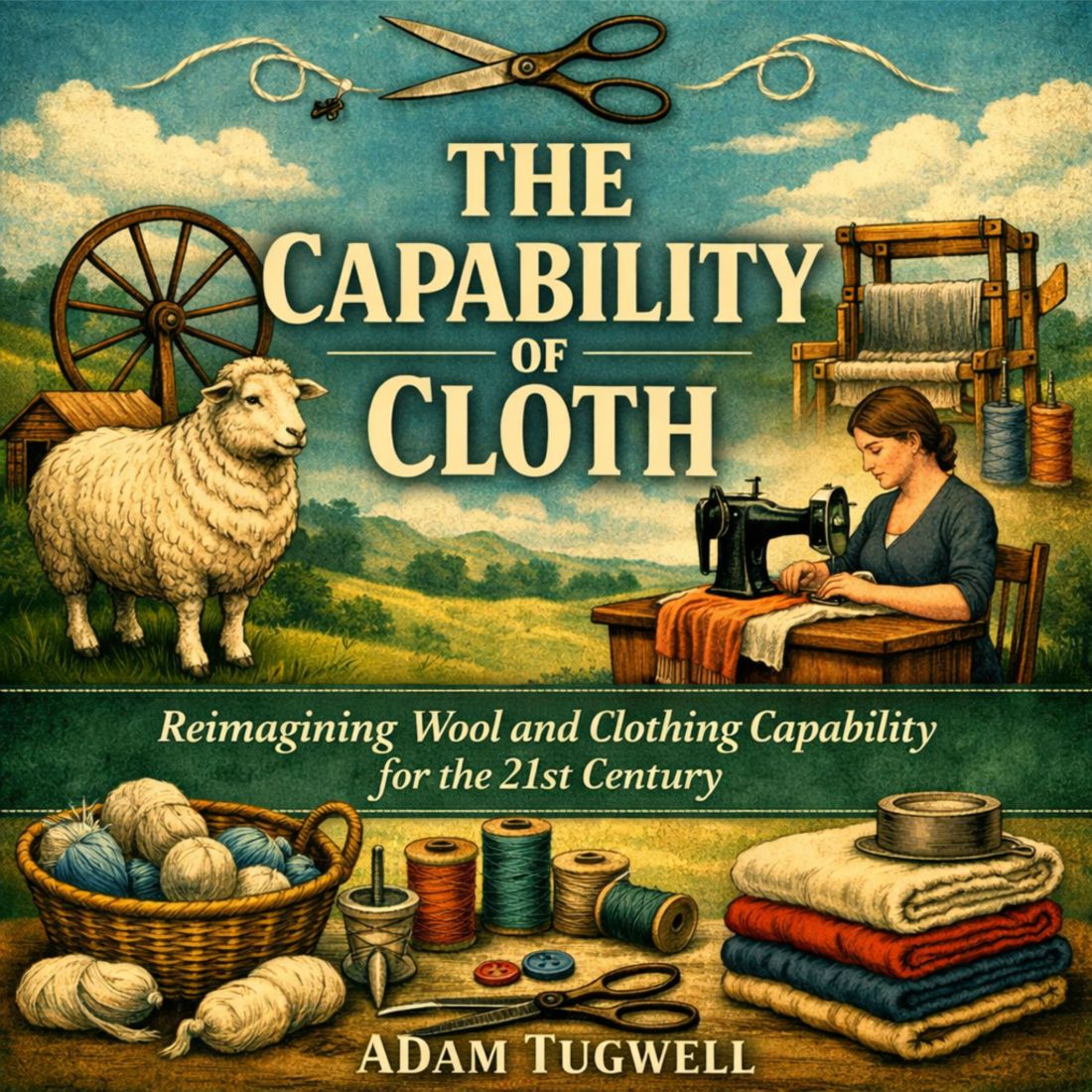
The Capability of Cloth proposes a new approach to fibre, clothing and textile production based upon human-scale industry, local capability, community participation, natural materials and human-centred technology.
The book begins from a simple observation:
Britain continues to produce substantial quantities of natural fibre, particularly wool. According to the British Wool Marketing Board annual report for 2024/2025, the 2024 clip was 19,290,044 kg; the report states that the overall average price achieved for the 2024 clip was 99.5 p/kg and that the total average return to producers, including high-volume premium, was 41.1 p/kg. These figures illustrate both the continuing scale of wool production and the economic pressures surrounding wool.
At the same time, clothing has become increasingly globalised, centralised, disposable and disconnected from the communities that use it. WRAP states that 711,000 tonnes of post-consumer textiles are discarded in general waste annually in the UK. Its UK Textiles Pact sets targets for a 50% reduction in the overall carbon footprint and a 30% reduction in the overall water footprint of new textile products by 2030.
This book argues that clothing should be viewed not merely as a retail product but as a capability system.
Clothing security is not only the ability to buy clothing.
It is the ability to create, repair, adapt, share, reuse, recycle, and renew it.
The book proposes a distributed network of human-scale fibre industries built around:
- wool and natural fibres
- local processing capability
- shared workshops and fibre hubs
- repair and renewal services
- apprenticeship and skills development
- clothing libraries
- cooperative enterprise
- modern manufacturing tools
- AI-supported learning and coordination
- community participation
The objective is not to replace existing textile industries.
Nor is it to recreate historical systems exactly as they once existed.
The objective is to restore capability.
This includes:
- economic capability
- production capability
- repair capability
- educational capability
- community capability
The book further argues that future industrial systems should be designed around a partnership between:
- people
- technology
- living systems
rather than assuming that progress requires the continual removal of people from productive life.
As part of the wider frameworks of LEGS (The Local Economy & Governance System), EFCG (An Economy for the Common Good), Contribution Culture and the Basic Living Standard, the book explores how local textile ecosystems could support resilience, participation, stewardship and human flourishing in the twenty-first century.
Ultimately, this is not a book about wool.
It is a book about capability.
Core Frameworks at a Glance
Figure 1: The Capability Chain
Fibre → Processing → Design → Production → Use → Repair → Reuse → Recycling → Renewal
Figure 2: The Capture Cycle
Capability → Growth → Concentration → Reduced Participation → Dependency
Figure 3: The Human–Technology–Nature Partnership
Nature provides fibre and living systems.
People provide creativity, judgement, care and stewardship.
Technology provides tools, coordination, learning support and production capability.
Capability grows when all three work together.
Figure 4: The 21st Century Village Green
Fibre Producers ↔ Processors ↔ Makers ↔ Repairers ↔ Clothing Libraries ↔ Educators ↔ Cooperatives ↔ Digital Platforms ↔ Community Users
| Concept | Meaning for the Book |
| Capability | The practical ability to create, repair, adapt, share, learn and steward useful systems. |
| Stewardship | The care of materials, skills, people, places and future generations. |
| Participation | The opportunity for people to contribute meaningfully rather than only consume. |
| Human-scale industry | Enterprise designed to preserve meaningful human involvement while using appropriate technology. |
Purpose
To explore how wool, natural fibres, human-scale enterprise, modern technology, and community participation can work together to rebuild clothing capability within a localised and resilient economy.
This book seeks to:
- restore attention to fibre and textile capability as an important component of resilience
- explore new opportunities for human-scale industry
- support apprenticeship, craftsmanship, and practical skills
- strengthen local enterprise and participation
- encourage repair, reuse, and renewal
- examine the role of cooperatives and distributed ownership
- demonstrate how technology can support rather than replace people
- connect textile production to wider local capability systems
- contribute to discussions surrounding LEGS, EFCG, and Contribution Culture
The book is both practical and aspirational.
Practical because it addresses real materials, real skills, real businesses, and real community needs.
Aspirational because it asks readers to imagine a future in which economic systems are designed around human capability as carefully as they are designed around efficiency.
Key Concepts
Clothing Capability
The practical ability to create, repair, adapt, share, maintain, recycle, and renew clothing and textile products.
Clothing Security
Reliable access to appropriate clothing supported by resilient systems of production, maintenance, repair, and renewal.
Fibre Capability
The local ability to transform natural fibres into useful products through knowledge, tools, infrastructure, and community participation.
Human-Scale Industry
An approach to production that combines modern technology and productivity with meaningful human participation, distributed enterprise, stewardship, and local capability.
Contribution Culture
A culture in which people are valued not only for what they consume, but for the capabilities, skills, care, creativity, and service they contribute to others.
The Basic Living Standard
A framework recognising that all people should have reliable access to life’s essential needs, including food, shelter, energy, healthcare, education, participation, and appropriate clothing.
LEGS
The Local Economy & Governance System – a framework for local capability, governance, accountability, enterprise, participation, and resilience.
EFCG
An Economy for the Common Good – a capability-centred economic framework that prioritises human wellbeing, stewardship, participation, resilience, and shared prosperity.
The 21st Century Village Green
A modern network of interconnected local enterprises, community infrastructure, shared spaces, and digital tools that support exchange, participation, learning, and capability at a local scale.
These concepts provide the framework through which the rest of this book should be understood.
Part I – The Case for Clothing Capability
The Central Thesis
This book is built around a simple proposition:
Clothing security is not only the ability to buy clothing. It is the ability to create, repair, adapt, share, renew, recycle, and steward it.
For much of human history, communities possessed many of these capabilities directly.
Today, many people possess unprecedented access to clothing while simultaneously having little connection to how clothing is produced, maintained, repaired, or renewed.
This book does not suggest that all modern systems should be abandoned.
It asks whether some forms of capability deserve to be rebuilt.
It further argues that future textile systems should be designed around a partnership between people, technology and living systems, with each contributing what it does best.
Nature provides fibre.
People provide creativity, judgement, stewardship, craftsmanship, entrepreneurship, teaching, and care.
Technology provides coordination, efficiency, learning, processing, design support, and communication.
The purpose of technology is not to make people unnecessary.
The purpose of technology is to enhance human capability.
Why Clothing Matters
Food, water, shelter, and energy are often recognised as essential foundations of resilience.
Clothing receives far less attention.
Yet clothing remains one of humanity’s most basic needs.
It provides:
- protection
- warmth
- dignity
- identity
- participation
- comfort
- safety
Every person depends on it.
Yet relatively little discussion takes place about where clothing comes from, how it is made, who makes it, how it is repaired, or whether communities retain any capability to provide it locally.
This book suggests that clothing deserves to be viewed differently.
Not merely as a commodity.
Not merely as a consumer product.
But as part of a wider capability system.
A system involving farmers, fibre producers, makers, repairers, educators, designers, entrepreneurs, apprentices, cooperatives, communities, and technology working together.
The story of cloth is therefore larger than textiles.
It is a story about productive life.
About participation.
About stewardship.
About resilience.
And ultimately, about the kind of economy and society we wish to build.
Wool, Cloth, Capability, and the Long Arc of Industrial Change
The Fibre That Helped Shape a Nation
Long before Britain became known for finance, technology, manufacturing, or global trade, it was known for wool.
For centuries, wool was one of the country’s most important economic resources.
Sheep grazed across landscapes that were often unsuitable for intensive crop production, converting grass into one of the most useful and versatile materials available to human society.
Wool provided:
- clothing
- warmth
- bedding
- trade goods
- employment
- local enterprise
- export revenue
The story of British wool is not simply a story about agriculture.
It is a story about how a natural resource became the foundation for entire communities, industries, and ways of life.
The rise of Britain’s textile economy helped shape the development of towns, transport systems, markets, trade routes, and eventually industrialisation itself.
The cloth industry was not a small niche activity.
It was one of the engines that helped drive the emergence of modern Britain.
Before the Factory
Before mechanised production, textile manufacture was deeply distributed.
Wool passed through many hands before becoming cloth.
A typical fibre chain might include:
- shepherds
- shearers
- wool sorters
- carders
- spinners
- dyers
- weavers
- tailors
- merchants
Much of this work took place within homes, workshops, farms, villages, and small towns.
Production, knowledge, skills and capability were widely distributed throughout society.
This did not mean life was easy.
Nor does this book seek to romanticise pre-industrial economies.
Many forms of work were physically demanding, time-consuming, and often precarious.
However, communities possessed something that deserves attention:
They possessed capability.
The knowledge and tools required to transform raw materials into useful products were embedded throughout society.
People understood where clothing came from because they were often involved in its creation.
The First Great Industrial Transformation
Textiles became one of the first sectors to experience large-scale industrialisation.
New technologies transformed production.
Machines increased output.
Processes accelerated.
Manufacturing scaled.
Costs fell.
Productivity rose.
These developments delivered genuine benefits.
Clothing became more accessible.
Production volumes increased.
New forms of enterprise emerged.
Engineering advanced rapidly.
The industrial revolution cannot honestly be understood without recognising these achievements.
This book therefore rejects the notion that industrialisation was simply a mistake.
It was not.
It solved many problems and created many opportunities.
Yet every transformation produces consequences as well as benefits.
The textile industry illustrates both.
The Gradual Concentration of Capability
As machinery became more powerful and production became increasingly centralised, capability began to migrate.
Activities previously carried out across communities increasingly moved into factories.
The economic logic was compelling:
- greater output
- lower unit costs
- centralised machinery
- larger operations
- more efficient workflows
The result was extraordinary productivity.
The result was also concentration.
The chain gradually transformed.
What had once been:
Community → Fibre → Skill → Production
became increasingly:
Factory → Production → Distribution
The change was not immediate.
Nor was it entirely negative.
But the centre of gravity shifted.
Capability became concentrated within fewer places.
Fewer buildings.
Fewer organisations.
Fewer owners.
When Progress Becomes a Single Measurement
One of the most important lessons from the history of textiles is that progress can be measured in different ways.
For much of the industrial era, progress was increasingly evaluated through:
- output
- efficiency
- scale
- cost reduction
- labour reduction
These measures remain useful.
However, they are not the only measures available.
A textile system can become more productive while simultaneously becoming less participatory.
It can become more efficient while becoming less resilient.
It can become larger while supporting fewer local enterprises.
It can generate more output while preserving less capability within communities.
This observation is not criticism.
It is recognition that different goals produce different outcomes.
When productivity becomes the only measure of success, other forms of value can become difficult to see.
The Long Road to Globalisation
Industrialisation was not the final stage of textile transformation; globalisation accelerated the process further.
Production moved internationally, supply chains lengthened, and decision-making became increasingly distant from the communities using the products.
The same forces that had once concentrated production within industrial centres often encouraged production to move wherever costs were lowest.
A remarkable irony emerged.
The textile industry that had helped drive Britain’s industrial rise was itself increasingly displaced by global production systems.
As this happened, many capabilities continued to disappear:
- spinning
- weaving
- tailoring
- repair
- fibre processing
- local manufacturing
- garment alteration
Not everywhere.
Not completely.
But enough to create noticeable gaps within communities.
The Capability That Was Lost
Britain retained wool, creativity, craftsmanship and technological expertise.
What it lost, in many places, were the connections between them.
This distinction matters.
Many communities still possess:
- sheep
- farms
- makers
- designers
- educators
- entrepreneurs
Yet fewer communities possess complete fibre capability chains.
The challenge may therefore be less about recovering lost materials and more about rebuilding lost relationships.
The relationships between:
- fibre and cloth
- production and repair
- learning and practice
- technology and participation
- community and capability
The Capture Cycle
The history of textiles also reveals a wider pattern that appears repeatedly throughout economic history.
A capability emerges; communities develop skills; enterprises grow; production expands; ownership concentrates; decision-making centralises; participation declines; capability weakens; dependency increases; and eventually production relocates or disappears.
This pattern is not unique to textiles.
It can be observed across many industries.
Food systems.
Manufacturing.
Retail.
Services.
Energy.
In each case, the issue is not growth itself.
The issue is what happens when growth becomes disconnected from stewardship and participation.
Understanding this cycle is important because it helps explain why simply rebuilding an industry may not be enough.
The structures that support capability matter just as much as the capability itself.
A Different Question for the Twenty-First Century
The purpose of this book is not to ask whether Britain should reverse industrialisation.
That question belongs to the past.
The more useful question is:
What would a textile industry designed for the twenty-first century look like if human participation, local capability, resilience, stewardship, and technology were treated as equally important design objectives?
What would happen if we combined:
- modern technology
- advanced communications
- AI-supported learning
- digital marketplaces
- cooperative enterprise
- natural fibres
- distributed manufacturing
with the strengths that earlier systems possessed:
- participation
- skill
- stewardship
- local knowledge
- community capability
This is where the history of cloth stops being a story about the past.
It becomes a question about the future.
Not a return to what was.
But an exploration of what might come next.
From Industry to Capability
The story of British textiles is often told as a story of production.
This book suggests another way of reading that history.
It is the story of capability.
The capability to transform fibre into clothing.
The capability to teach skills across generations.
The capability to connect people to productive life.
The capability to create value from local resources.
The capability to participate in meaningful work.
Some of those capabilities remain.
Some have weakened.
Some may yet be rebuilt.
The question is not whether the past can be recreated.
The question is what forms of capability deserve a place in the future.
That question leads directly to the central subject of this book:
What is the Capability of Cloth?
Clothing as Infrastructure, Participation, and Human Capability
Looking Beyond Clothing
Most people think about clothing when they need it.
They buy it.
Wear it.
Wash it.
Replace it.
Beyond these interactions, clothing often remains invisible.
Yet few products are more fundamental to daily life.
Clothing provides:
- protection
- warmth
- safety
- practicality
- identity
- confidence
- dignity
Every person depends upon it.
Most people own it.
Few people participate directly in its creation.
This book argues that this distinction matters.
Because clothing is not merely a product.
It is the outcome of a capability system.
What Is the Capability of Cloth?
The Capability of Cloth refers to the practical ability of a community to:
- produce fibre
- process fibre
- create textiles
- manufacture garments
- maintain clothing
- repair clothing
- adapt clothing
- share clothing
- recycle materials
- teach skills
- pass knowledge between generations
These capabilities can exist at many scales.
They may be held by:
- individuals
- families
- small businesses
- cooperatives
- workshops
- schools
- communities
The important point is that they exist.
Clothing security depends not only on products.
It depends on capability.
Clothing Security
Food security is increasingly recognised as important.
Discussions of food resilience often explore:
- production
- processing
- storage
- distribution
Far fewer conversations address clothing security.
Yet clothing is also an essential human need.
This book therefore introduces a simple idea:
Clothing security is the ability to access appropriate clothing through systems that are resilient, adaptable, maintainable, and capable of renewal.
Such systems do not depend entirely upon new production.
They include:
- repair
- tailoring
- adaptation
- sharing
- reuse
- recycling
The objective is not self-sufficiency.
The objective is capability.
Communities that retain clothing capability possess more options when circumstances change.
The Wardrobe of Consumption
Modern clothing systems are largely organised around consumption.
The typical relationship looks something like:
Money
→ Retail Purchase
→ Use
→ Disposal
This system has delivered remarkable accessibility.
Many people today enjoy access to a greater variety of clothing than previous generations could have imagined.
However, accessibility does not necessarily equal resilience.
A wardrobe built entirely upon replacement assumes that:
- products remain available
- supply chains remain functional
- prices remain affordable
- materials remain accessible
- production remains elsewhere
When these assumptions hold, the system functions well.
The question is what capability remains when they do not.
The Wardrobe of Capability
This book proposes another way of thinking.
A wardrobe can be viewed not only as a collection of garments.
It can also be viewed as a collection of capabilities.
Questions change.
Instead of asking:
How many clothes do I own?
we might ask:
How many of my clothes can be repaired?
How many can be altered?
How many can be handed on?
How many can be renewed?
How many can be recycled?
How many came through trusted and visible supply chains?
The focus moves from accumulation towards stewardship.
The wardrobe becomes part of a living system rather than the end point of a transaction.
Clothing as Infrastructure
Infrastructure is often imagined as:
- roads
- bridges
- energy systems
- communications networks
Yet some forms of infrastructure are less visible.
Skills are infrastructure.
Knowledge is infrastructure.
Repair capability is infrastructure.
Production capability is infrastructure.
The ability to clothe a population is itself a form of infrastructure.
When communities lose the practical ability to provide, maintain, alter, or repair clothing, a capability disappears.
The consequences may not be immediate.
Yet over time dependency increases.
Resilience decreases.
Options narrow.
This book therefore treats textile capability as part of a wider infrastructure of everyday life.
Fibre Capability
At the foundation of every textile system sits fibre.
Historically, communities often possessed a close relationship with their materials.
People knew where wool came from.
They understood how fibres were processed.
They understood their qualities, limitations, and uses.
Today many people remain disconnected from these origins.
This is not a criticism.
It is simply a reflection of how production systems have evolved.
The Capability of Cloth seeks to restore some of this connection.
Not because every person must become a producer.
But because communities benefit when knowledge remains distributed.
Fibre capability includes understanding:
- wool
- hemp
- flax
- natural dyes
- fibre quality
- material characteristics
- processing methods
This knowledge forms the basis of wider textile capability.
Capability Chains
Throughout this book, capability is viewed as a chain rather than a single activity.
The same principle applies here.
A garment does not appear from nowhere.
It emerges from a sequence of interconnected capabilities.
For example:
Sheep
→ Shearing
→ Sorting
→ Carding
→ Spinning
→ Weaving
→ Garment Production
→ Use
→ Repair
→ Reuse
→ Recycling
→ Compost
→ Soil
→ Sheep
Each stage contributes value.
Each stage creates opportunities for participation.
Each stage creates opportunities for learning.
When links disappear, capability weakens.
When links are restored, capability grows.
The Value We Often Fail to Measure
Modern economic systems are very effective at measuring transactions.
They are often less effective at measuring capability.
The value of:
- repairing a garment
- teaching a skill
- mentoring an apprentice
- sharing equipment
- passing on knowledge
- extending product lifespan
can be difficult to express through conventional economic metrics.
Yet these activities create real value.
They reduce waste.
They strengthen resilience.
They preserve knowledge.
They build relationships.
A capability-centred approach seeks to recognise these contributions rather than treating them as economically invisible.
From Product to Process
One of the most important shifts proposed in this book is a movement away from seeing clothing solely as a finished product.
Instead, clothing becomes understood as a process.
A process involving:
- natural systems
- human creativity
- technology
- enterprise
- stewardship
- participation
Understanding clothing as a process opens new possibilities.
It makes room for:
- repair economies
- clothing libraries
- apprenticeship systems
- fibre cooperatives
- local enterprise networks
- shared production facilities
Each becomes part of the wider capability ecosystem.
Clothing and the Basic Living Standard
Within the broader EFCG framework, clothing forms part of the Basic Living Standard.
People require appropriate clothing in order to:
- work
- learn
- participate
- travel
- socialise
- remain healthy
- live with dignity
This perspective changes how textile systems are viewed.
Clothing is no longer merely a consumer choice.
It becomes part of the infrastructure that supports human participation in society.
The question is therefore not simply:
How much clothing can be sold?
but:
How can communities ensure that people have reliable access to appropriate clothing while preserving capability, stewardship, and participation?
A Different Future
This book is not advocating a return to a world before industry.
Nor is it advocating a future dominated entirely by automation and consumption.
It proposes another possibility.
A future in which:
- local capability is valued
- natural materials are respected
- technology supports participation
- repair is normal
- learning is continuous
- enterprise remains human-scale
- communities retain practical skills
In such a future, clothing becomes more than a commodity.
It becomes part of a wider capability system helping people meet needs, contribute meaningfully, and participate in community life.
That possibility begins with a simple recognition:
The value of cloth is not only what it becomes.
The value of cloth is also the capabilities, relationships, knowledge, and participation that it creates along the way.
Part II – Rebuilding the Fibre Capability Chain
Nature, Stewardship, and the Foundations of a Human-Scale Textile Economy
Before Cloth Comes Fibre
Every garment begins long before it reaches a wardrobe.
Before spinning.
Before weaving.
Before sewing.
Before design.
There is fibre.
This is an important distinction because modern clothing systems often focus on products while obscuring the materials and living systems from which those products emerge.
A shirt may appear on a shelf.
A blanket may arrive through a delivery service.
A jumper may be purchased with a few clicks.
Yet behind every textile sits a chain of relationships linking people, materials, landscapes, skills, technology, and time.
This book argues that rebuilding clothing capability begins with rebuilding fibre capability.
Without fibre, there is no cloth.
Without fibre capability, there can be no clothing capability.
The Gift of Living Systems
One of the remarkable characteristics of natural fibres is that they emerge from living systems.
Sheep grow wool.
Flax produces fibre.
Hemp produces fibre.
Dye plants provide colour.
The foundation of textile production is therefore not a factory.
It is a landscape.
This observation matters because it reconnects clothing with stewardship.
The quality of fibre depends upon:
- healthy animals
- healthy soils
- healthy ecosystems
- skilled husbandry
- thoughtful management
The fibre economy begins not in industrial facilities but in relationships between people and the natural systems they care for.
Wool and the British Landscape
Few fibres are more closely connected to the British landscape than wool.
For centuries sheep have shaped:
- upland regions
- lowland grazing systems
- moorland landscapes
- mixed farm environments
Wool is more than a commodity.
It is a by-product of a long-standing relationship between people, animals, land, and climate.
Today many farmers continue to produce wool despite often receiving relatively low returns for it.
As several commentators within the sector have observed, wool can sometimes struggle to compete economically against global synthetic and imported alternatives.
This book does not suggest that wool alone can solve the challenges facing rural economies, nor that every wool-based enterprise will be viable in every place.
It does suggest that a material already being produced deserves renewed consideration within a wider capability framework.
Fibre Beyond Wool
Although wool plays a central role in this book, fibre capability extends beyond sheep.
A resilient textile economy benefits from diversity.
Potential fibres include:
- wool
- flax
- hemp
- alpaca
- mohair
- natural blends
- recycled fibres
Different regions may favour different materials.
Different communities may specialise in different products.
This diversity contributes to resilience.
Just as agricultural systems often benefit from diversity, textile systems can also benefit from multiple sources of capability.
The purpose is not dependence upon a single fibre.
The purpose is creating a broad ecosystem of materials and skills.
Fibre as Strategic Capability
The modern world often treats fibre as something that appears automatically through global markets.
Most of the time this perception is understandable.
Products remain available.
Supply chains function.
Materials arrive when required.
Yet this can obscure an important reality.
Fibre production itself is capability.
The ability to transform raw natural materials into useful products is a form of infrastructure.
Communities possessing this capability have options.
Communities lacking it become increasingly dependent on external systems.
This is not an argument for isolation.
It is an argument for resilience.
Capability creates choice.
Dependency reduces it.
The Forgotten Stages
Many people encounter fibre only after it has become a finished product.
Between fleece and fabric, however, lies a chain of specialist activity:
- shearing
- grading
- sorting
- cleaning
- carding
- spinning
- blending
- dyeing
- weaving
- knitting
- finishing
Each stage contains its own knowledge.
Each stage contains opportunities for enterprise.
Each stage contains opportunities for learning.
When these stages disappear from communities, the capability chain weakens.
The material may remain.
The skills gradually fade.
Rebuilding fibre capability therefore involves rebuilding the stages between raw material and finished product.
Fibre and Stewardship
The concept of stewardship runs throughout this book.
The Capability of Fibre provides one of its clearest practical expressions.
Stewardship asks:
- How do we care for animals?
- How do we care for land?
- How do we care for resources?
- How do we care for future generations?
Natural fibres invite these questions because their origins remain visible.
Wool reminds us of sheep.
Flax reminds us of fields.
Hemp reminds us of cultivation.
When materials retain a connection to living systems, stewardship becomes easier to recognise.
The relationship between consumption and production becomes more transparent.
The Human–Technology–Nature Partnership
One of the central ideas running throughout this book is that the future of textile production is not a choice between traditional methods and modern technology.
The future lies in partnership.
Nature provides:
- fibre
- renewable materials
- regenerative potential
People provide:
- creativity
- judgement
- care
- craftsmanship
- entrepreneurship
- teaching
- stewardship
Technology provides:
- processing capability
- efficiency
- communication
- coordination
- learning support
- manufacturing support
No element stands above the others.
Each contributes something valuable.
This is not a hierarchy.
It is a partnership.
The objective is not to replace people.
Nor is it to reject innovation.
The objective is to use innovation in ways that expand human capability.
Technology as a Fibre Enabler
The future fibre economy is unlikely to look like either the eighteenth century or the twentieth century.
New technologies create possibilities that did not previously exist.
Examples include:
- small-scale fibre processing equipment
- digital manufacturing tools
- online learning platforms
- pattern libraries
- AI-assisted design tools
- cooperative coordination software
- local marketplace applications
The significance of these technologies lies not simply in what they produce.
Their significance lies in whom they enable.
Technology can support distributed production just as effectively as it can support concentration.
The design choice matters.
Fibre and Local Enterprise
One of the most exciting aspects of fibre capability is the variety of enterprises it can support.
Examples include:
- fibre processing
- spinning
- weaving
- dye production
- tailoring
- repair services
- educational workshops
- design services
- textile recycling
- clothing libraries
This diversity matters because it creates multiple pathways for participation.
Not everyone needs to perform the same role.
Not everyone needs the same level of expertise.
Capability grows when many people can contribute in different ways.
Fibre Waste or Fibre Resource?
A capability-centred economy often sees resources differently.
Materials considered waste within one system may become valuable within another.
Wool provides a useful example.
In some circumstances, low-value wool may struggle to find profitable markets.
Yet wool also possesses qualities that make it useful for:
- insulation
- textiles
- felt products
- home goods
- horticultural uses
- craft materials
The question therefore becomes:
How many useful applications can communities discover for the materials already available to them?
Capability often emerges through seeing familiar materials in new ways.
Resilience Begins With Materials
Much discussion about resilience focuses on systems.
Equally important are materials.
A resilient clothing system requires:
- fibre
- skills
- tools
- knowledge
- enterprise
- infrastructure
Remove the fibre and the system cannot begin.
The material foundation therefore deserves attention.
Not because natural fibres are perfect.
Not because synthetic materials have no value.
But because communities benefit when they understand the resources available to them and retain the capability to use them effectively.
Reconnecting Fibre to People
Perhaps the most important contribution of fibre capability is that it reconnects people with the origins of the things they use every day.
It shortens the distance between landscape and garment.
Between producer and user.
Between resource and responsibility.
The purpose is not to eliminate global trade or modern production.
The purpose is to restore awareness of the relationships that make textile systems possible.
Because clothing begins long before the finished garment.
It begins with fibre.
And the future of cloth depends upon the capability to understand, steward, process, and value that fibre once again.
The Missing Link Between Fibre and Cloth
Fibre Alone Is Not Enough
A community may possess:
- sheep
- wool
- hemp
- flax
- skilled people
- willing enterprises
Yet without processing capability, those resources remain largely unrealised.
This is one of the recurring themes throughout this book.
Food requires processing.
Timber requires processing.
Materials require processing.
Capability exists not simply in the raw material itself, but in the ability to transform that material into something useful.
The same is true for fibre.
Wool on a sheep is not clothing.
Flax in a field is not fabric.
Potential exists.
Capability bridges the gap between potential and usefulness.
The Missing Middle
Much like local food systems, textile systems contain a frequently overlooked middle layer.
Most discussions focus on:
- fibre production
- finished products
What is often missed is everything that happens between the two.
For textile systems, the middle includes:
- sorting
- grading
- cleaning
- carding
- combing
- spinning
- winding
- dyeing
- weaving
- knitting
- finishing
These activities are where much of the economic value is created.
They are also where much of the capability has been lost.
Communities may still possess fibre.
They may still possess creativity.
What they often lack is processing capability.
When Processing Leaves a Community
The decline of local textile processing mirrors challenges seen throughout many sectors.
As processing becomes concentrated:
- distances increase
- local options decline
- skills disappear
- ownership concentrates
- economic participation narrows
Over time, communities become producers of raw materials and consumers of finished goods while having little involvement in what happens between those stages.
The result is dependency.
Not because communities lack talent.
Not because communities lack resources.
But because critical infrastructure has disappeared.
The challenge is not merely to produce fibre.
The challenge is to retain meaningful involvement in transforming that fibre into useful products.
Processing as Productive Infrastructure
Throughout this book, capability is treated as infrastructure.
Processing capability is one of the clearest examples.
A carding machine is infrastructure.
A spinning facility is infrastructure.
A shared weaving workshop is infrastructure.
Knowledge of how to operate these systems is infrastructure.
Without them, raw materials must leave the local economy before value can be added.
This is why processing matters.
It is the stage where:
- materials become usable
- enterprises emerge
- skills develop
- apprentices learn
- economic activity multiplies
The processing stage is not simply a technical necessity.
It is a generator of participation.
The Decline of Processing Capability
Britain once possessed extraordinary textile processing capability.
Entire towns developed around:
- spinning
- weaving
- dyeing
- textile finishing
Many of these industries created prosperity, employment, and innovation.
Many also became concentrated over time.
As production globalised, significant portions of this capability diminished.
The purpose of this book is not to suggest that these industries can be rebuilt exactly as they once existed.
Nor should they be.
The question is different:
What forms of processing capability make sense in the twenty-first century?
What technologies now exist that make distributed production possible again?
What scales of operation are practical?
What opportunities have emerged that did not previously exist?
Human-Scale Processing
A key concept within this book is human-scale industry.
Processing capability does not have to exist only at two extremes:
- individual craft production
- giant industrial facilities
There is a large and largely unexplored middle ground.
Examples include:
Home-Based Processing
- hand carding
- drop spindle spinning
- small-scale dyeing
- knitting
- weaving
Community Processing
- shared equipment
- fibre clubs
- maker spaces
- cooperative workshops
Micro-Mills
- mechanical carders
- mini spinning systems
- cone winders
- sewing equipment
- shared production infrastructure
Regional Capability Hubs
- advanced equipment
- training facilities
- specialist services
- research and innovation support
The future is unlikely to be one scale replacing all others.
The future is likely to involve multiple scales working together.
Modern Processing Technology
One of the most important distinctions in this book is that rebuilding capability does not mean rejecting machinery.
On the contrary.
Modern technology creates opportunities that previous generations could only imagine.
Examples include:
- compact carding systems
- low-energy processing equipment
- digital fabrication tools
- computer-assisted textile design
- distributed manufacturing
- cooperative asset sharing
- AI-supported training systems
The goal is not to eliminate technology.
The goal is to use technology differently.
Rather than concentrating capability into fewer places, technology can help distribute capability across many places.
This is a fundamentally different design philosophy.
Processing as a Participation Ecosystem
One of the remarkable features of textile processing is the diversity of roles it creates.
A fibre-processing ecosystem may include:
- fibre graders
- sorters
- carders
- spinners
- dyers
- weavers
- knitters
- machine operators
- repair technicians
- educators
- designers
- apprentices
Not everyone performs the same task.
Not everyone requires the same training.
This diversity matters because it creates multiple pathways into meaningful participation.
A resilient economy benefits when people can contribute through a wide variety of capabilities.
The Cooperative Fibre Hub
A particularly important concept for this book is the fibre hub.
The fibre hub sits between individual production and large-scale industry.
It provides shared access to equipment and expertise that may be impractical for individuals to own independently.
A typical fibre hub might include:
- wool sorting areas
- carding equipment
- spinning equipment
- dyeing facilities
- weaving equipment
- sewing facilities
- repair spaces
- teaching spaces
- equipment maintenance areas
Such hubs could operate as cooperatives, social enterprises, community enterprises, or other locally accountable structures.
The precise governance model matters less than the principle:
Capability is shared rather than concentrated.
Processing and Apprenticeship
Processing is also where many skills are learned.
The decline of processing capability often leads directly to the decline of apprenticeship opportunities.
Without places to learn:
- knowledge disappears
- expertise ages
- communities become dependent on fewer specialists
Rebuilding processing capability therefore becomes an educational objective as well as an economic one.
Every functioning fibre hub becomes:
- a workplace
- a learning environment
- a community asset
- a capability centre
Knowledge remains alive because it is practised.
The Value Added Layer
Economically, processing represents one of the most important stages in the fibre chain.
Raw materials often possess relatively limited value compared to finished products.
The transformation process creates value.
For example:
Wool → Yarn → Cloth → Garment → Tailored Product
Each stage increases capability and creates opportunities for enterprise.
This matters because communities often benefit far more when value creation occurs locally rather than elsewhere.
The purpose is not to eliminate trade.
The purpose is to retain some meaningful participation in the creation of value.
Processing and Resilience
Resilient communities do not merely possess resources.
They possess the capability to transform resources into useful outcomes.
Processing capability is therefore a resilience capability.
A community that can process fibre possesses more options than one that relies entirely on distant systems.
Those options may never be fully required.
Their value lies in their existence.
As with food processing, repair capabilities, or local manufacturing, resilience comes not from isolation but from maintaining pathways that remain available when needed.
The Bridge Between Fibre and Cloth
Ultimately, processing is the bridge.
It connects:
- landscapes and garments
- animals and textiles
- materials and products
- learning and production
- technology and people
Without processing capability, fibre remains potential.
With processing capability, fibre becomes enterprise, participation, stewardship, and value.
This is why processing sits at the heart of the Capability of Cloth.
It is where natural resources, human skill, and modern technology come together to create something greater than any could create alone.
And it is from this foundation that a truly human-scale textile economy can begin to emerge.
Creativity, Identity, and Human-Centred Innovation
Beyond Making Cloth
Fibre alone is not clothing.
Processing alone is not clothing.
Something else is required.
Design.
Design is the point at which materials become intention.
It is where function meets creativity.
It is where practical needs meet culture, identity, aesthetics, and human expression.
For thousands of years, human beings have transformed fibres into garments not merely because they required protection from the weather, but because clothing carries meaning.
It communicates:
- identity
- profession
- community
- culture
- occasion
- personality
- craftsmanship
The Capability of Cloth therefore depends not only upon producing fibre and processing materials, but upon maintaining the capability to design, adapt, and innovate.
The Forgotten Capability
Modern clothing systems often separate consumers from design.
People purchase garments designed far away by people they never meet, manufactured elsewhere from materials they never see.
This arrangement can be convenient and efficient.
Yet it often reduces participation.
Communities may possess:
- creative people
- skilled makers
- practical needs
- local materials
while lacking the means to transform ideas into finished products.
Design capability reconnects these elements.
It allows communities to shape clothing around their own circumstances rather than relying entirely on distant systems.
Design as Local Knowledge
Good design begins with understanding.
Historically, clothing evolved in response to local conditions.
Materials reflected what was available.
Garments reflected climate.
Techniques reflected experience.
Styles reflected culture.
Design was connected to place.
This does not mean communities should reject influences from elsewhere.
It simply means that local conditions still matter.
A garment designed for an urban office may differ significantly from one designed for farming, forestry, outdoor work, cycling, fishing, or community volunteering.
Human-scale design allows clothing to emerge from real needs rather than mass assumptions.
The Relationship Between Function and Beauty
Modern industry often creates an artificial distinction between utility and beauty.
Practical clothing is treated separately from creative clothing.
Functional products are separated from artistic expression.
Historically these distinctions were often less rigid.
Good clothing was expected to be:
- useful
- durable
- repairable
- practical
- attractive
The Capability of Cloth seeks to reconnect these qualities.
Beauty is not an optional extra.
Nor is practicality.
Human beings value both.
A resilient textile culture recognises that good design serves practical needs while enriching human experience at the same time.
Design as Participation
Not everyone is a tailor.
Not everyone is a professional designer.
Yet many people possess creative capability.
Design participation may include:
- garment design
- colour selection
- textile patterns
- knitting patterns
- weaving designs
- natural dye experimentation
- adaptation of existing garments
- repair aesthetics
This diversity matters because creativity is one of humanity’s most widely distributed resources.
A people-centred economy does not reserve creative expression for a handful of specialists.
It creates opportunities for broad participation.
The Designer and the Maker
One of the consequences of industrialisation was the separation of design from production.
Design became a specialised profession.
Production became a separate activity.
Consumers became more distant from both.
There are many advantages to specialisation.
However, something valuable can also be lost.
When makers influence design:
- practicality improves
- repairability improves
- material understanding improves
When users influence design:
- relevance improves
- adaptability improves
- satisfaction improves
Human-scale industry creates opportunities for these relationships to reconnect.
Not because every person performs every task, but because the distance between tasks becomes smaller.
Design for Longevity
Many modern products are designed primarily around initial purchase.
The Capability of Cloth introduces another question:
How should products be designed if their lifespan matters?
Design for longevity might include:
- durable construction
- easy repair
- replaceable components
- adaptable fittings
- timeless styling
- material recovery
This shifts the focus from sales volume towards usefulness.
The objective is not to eliminate consumption.
The objective is to increase the useful life of what is produced.
Good design therefore becomes a form of stewardship.
Design for Repair
One of the most overlooked capabilities in modern clothing systems is repairability.
Many garments become difficult or uneconomic to repair because repair was never considered during design.
This book proposes a different perspective.
Repair should not be viewed as evidence of failure.
Repair can be evidence of value.
A garment worth repairing is often a garment worth designing well in the first place.
Design for repair may include:
- accessible seams
- replaceable components
- repair-friendly construction
- modular features
- durable materials
The goal is not perfection.
The goal is extending useful life.
Design for Sharing
The concept of clothing libraries introduced later in this book creates another design challenge.
Some garments may be used by multiple people over their lifespan.
This raises interesting questions.
How should clothing be designed to support:
- adaptation
- resizing
- repair
- durability
- repeated use
A clothing system built around sharing and stewardship may encourage different forms of design from one built primarily around rapid replacement.
The Role of Technology in Design
Technology is becoming increasingly important within design processes.
Digital tools can support:
- pattern creation
- garment modelling
- fibre optimisation
- sizing systems
- small-batch production
- collaborative development
Artificial intelligence may eventually assist with:
- design exploration
- pattern generation
- historical preservation
- skills training
- material matching
The important question remains the same throughout this book:
What is the purpose of the technology?
If technology expands human creativity, supports learning, enables small enterprises, and helps communities participate, it strengthens capability.
If technology removes people from meaningful participation entirely, capability may weaken.
The distinction lies in design choices rather than the technology itself.
Human-Centred Design in the AI Age
The future of clothing design is unlikely to be entirely manual or entirely automated.
The most promising future may involve partnership.
People contribute:
- imagination
- judgement
- aesthetics
- empathy
- culture
- lived experience
Technology contributes:
- speed
- modelling
- coordination
- experimentation
- analysis
Together they can create outcomes neither could achieve alone.
This mirrors the wider principle found throughout LEGS, EFCG, The AI Age of Heavy Horse, and the broader capability framework:
Technology should enhance human capability, not remove people from productive systems.
Design as Cultural Infrastructure
Design does more than create products.
It shapes culture.
The garments people wear influence:
- identity
- belonging
- self-expression
- local character
Historically, textile traditions often reflected regional knowledge and craftsmanship.
Future systems need not replicate the past exactly.
However, they can create space for local creativity and cultural expression to flourish once again.
This matters because resilient communities are not built solely through economics.
They are also built through shared meaning.
Design helps create that meaning.
The Future of Design
The Capability of Cloth proposes a future in which design becomes more accessible, more participatory, and more connected to the realities of everyday life.
A future where:
- fibre producers influence outcomes
- makers influence designs
- users influence products
- repair is valued
- longevity is rewarded
- technology supports creativity
- communities retain ownership of knowledge
The result is not a return to the past.
It is a modern design ecosystem rooted in participation, stewardship, capability, and human flourishing.
Because before cloth becomes culture, clothing, enterprise, or expression, it must first be imagined.
And the capability to imagine, create, adapt, and improve remains one of humanity’s greatest strengths.
The Capability of Stewardship
The Question Beyond Production
Much of modern economic thinking focuses on production.
How much can be produced?
How quickly?
How efficiently?
How cheaply?
These are important questions.
Yet they are incomplete.
A capability-centred economy asks another question:
What are we responsible for once something has been produced?
This is where stewardship begins.
Stewardship is the recognition that responsibility does not end at the point of production.
It continues through:
- use
- care
- maintenance
- repair
- adaptation
- reuse
- recycling
- renewal
The Capability of Cloth is therefore not simply about creating garments.
It is about creating systems that care for the materials, people, skills, and resources from which those garments emerge.
Stewardship and the Living World
The fibre economy begins with living systems.
Sheep produce wool.
Fields produce flax.
Land provides space for fibre crops and dye plants.
Water, soil, biodiversity, and climate all influence production.
These resources are not infinite.
They are inherited.
The idea of stewardship begins with recognising that humans do not simply consume natural resources.
They care for them.
A steward asks:
- How can this resource remain healthy?
- How can it remain productive?
- How can it continue to serve future generations?
This way of thinking transforms the relationship between economy and environment.
The environment is no longer viewed merely as an input.
It becomes a partner in the ongoing creation of value.
From Extraction to Regeneration
Many modern systems are organised around extraction.
Resources are taken.
Products are made.
Waste is discarded.
The relationship is largely one-way.
Stewardship seeks something different.
Rather than asking:
How much can we take?
it asks:
How much can we sustain, improve, and renew?
The textile sector is particularly suited to this conversation because natural fibres already form part of living cycles.
Wool grows back.
Flax can be replanted.
Natural fibres can often be reused, recycled, and eventually returned to the soil.
This does not make every natural-fibre system automatically sustainable.
However, it creates opportunities for regenerative thinking that deserve attention.
Caring for What We Already Have
Stewardship is not only about production.
It is also about use.
Modern economies often reward replacement more than preservation.
Products are frequently designed to be discarded rather than maintained.
The result can be a cycle of continual consumption.
The Capability of Cloth proposes another perspective.
What if stewardship became part of the design brief?
What if success included:
- longer garment life
- easier repair
- greater adaptability
- material recovery
- reduced waste
In such a system, the useful life of a garment becomes part of its value.
A well-cared-for garment is no longer merely an old garment.
It is evidence of stewardship in practice.
Repair as Stewardship
Repair occupies a special place within this book because it represents one of the clearest examples of stewardship.
Repair says:
This still has value.
This is worth maintaining.
This is worth investing time in.
Historically, repair was normal.
Clothing was often altered, patched, resized, handed down, and repurposed.
Many garments passed through multiple stages of use before reaching the end of their useful lives.
This was not always driven by environmental concerns.
Often it was simply common sense.
The principle remains valuable today.
Every repair extends capability.
Every repair preserves value.
Every repair keeps knowledge alive.
Repair is therefore not merely a technical activity.
It is a cultural expression of stewardship.
Stewardship of Knowledge
Resources are not the only things that require care.
Skills require stewardship as well.
Knowledge can be lost.
Traditions can disappear.
Capabilities can weaken.
This book repeatedly emphasises that:
Skills are infrastructure.
But infrastructure requires maintenance.
Teaching.
Practice.
Apprenticeship.
Mentorship.
Stewardship of knowledge means ensuring that practical capability continues from one generation to the next.
Without this, even abundant resources become difficult to use effectively.
A community may possess wool.
Without spinners, weavers, designers, repairers, and educators, the wider capability chain weakens.
Stewardship of People
Modern economic systems often focus heavily on products and less on the people who create them.
A human-centred economy reverses this perspective.
People become the primary asset.
Stewardship therefore includes:
- supporting meaningful participation
- developing skills
- valuing contribution
- creating opportunities for learning
- maintaining dignity in work
- strengthening community relationships
The goal is not simply to generate goods.
The goal is to help people flourish while producing those goods.
This is one of the most important distinctions between people-centred and purely production-centred systems.
Stewardship in the Basic Living Standard
The Basic Living Standard provides an important foundation for stewardship.
When essential needs are secured:
- food
- housing
- energy
- healthcare
- clothing
- participation
people gain greater freedom to contribute in meaningful ways.
This changes incentives.
Activities such as:
- teaching
- repair
- mentoring
- craftsmanship
- apprenticeship
become easier to sustain.
People can engage because the activity is valuable.
Not simply because survival depends upon it.
This distinction matters because stewardship often requires time, patience, and care.
It flourishes most readily when people possess enough security to think beyond immediate necessity.
Stewardship and Ownership
The way assets are owned influences how they are treated.
Ownership structures matter.
A system designed around short-term extraction may produce different outcomes from one designed around long-term stewardship.
This is one reason cooperative and participatory ownership models play a role within LEGS.
The objective is not to prevent enterprise.
Quite the opposite.
The objective is to ensure that enterprise remains connected to responsibility.
Ownership should encourage:
- care
- participation
- accountability
- long-term thinking
rather than encouraging capability to become concentrated and detached from the communities it serves.
Stewardship and Technology
Technology often raises questions about responsibility.
Will technology replace people?
Will it concentrate power?
Will it disconnect people from productive life?
These concerns are understandable.
Yet technology can also strengthen stewardship when designed with appropriate purposes.
Examples include:
- tracking material lifecycles
- supporting repair networks
- preserving patterns and techniques
- helping coordinate local production
- improving resource efficiency
- supporting education and apprenticeship
The issue is not the technology itself.
The issue is the values that guide its use.
Technology should help communities become better stewards, not remove responsibility from the system altogether.
The Stewardship Economy
Perhaps the deepest shift proposed within this book is moving from a consumption economy towards a stewardship economy.
A consumption economy asks:
- What can be sold?
- How quickly?
- How often?
A stewardship economy asks:
- What should be created?
- What should be maintained?
- What should be repaired?
- What should be shared?
- What should be passed on?
These are different questions.
Not opposing questions.
Different questions.
The Capability of Cloth argues that both production and stewardship are necessary.
One without the other is incomplete.
Stewardship and the 21st Century Village Green
Within the wider LEGS framework, stewardship becomes a community activity as much as an individual one.
The 21st Century Village Green includes:
- makers
- repairers
- educators
- fibre processors
- apprentices
- libraries
- cooperatives
- local enterprises
Each contributes to the maintenance of shared capability.
Stewardship is distributed.
Responsibility is shared.
No single institution carries the burden alone.
The result is not simply a stronger textile system.
It is a stronger community.
Leaving Things Better
At its simplest, stewardship is the practice of leaving things better than they were found.
Better skills.
Better knowledge.
Better materials.
Better relationships.
Better systems.
Better opportunities.
A capability-centred textile economy cannot be measured solely by the garments it produces.
It should also be measured by the capabilities it preserves and the communities it strengthens.
Because the true value of cloth is not only what it provides today.
It is what it enables tomorrow.
And stewardship is the capability that connects the two.
Part III – Participation, Enterprise, and Ownership
Human-Scale Business, Meaningful Participation, and Local Prosperity
Enterprise as Capability
Enterprise is often described in financial terms.
Businesses generate revenue.
Markets create transactions.
Goods and services are exchanged.
All of these things matter.
Yet enterprise is more than money.
At its heart, enterprise is the practical process of transforming human capability into something useful for others.
It is how ideas become products.
How skills become services.
How resources become solutions.
How people create value together.
The Capability of Cloth therefore sees enterprise not as an isolated commercial activity, but as one of the primary mechanisms through which communities organise participation, innovation, and productive life.
The question is not simply:
How do we create profitable businesses?
The question is also:
How do we create businesses that strengthen capability?
The Difference Between Enterprise and Extraction
Not all economic activity creates the same outcomes.
Some forms of enterprise strengthen communities.
Some forms extract value from them.
The difference often lies in purpose.
An extractive model may focus primarily on:
- scale
- consolidation
- market dominance
- labour reduction
- short-term returns
A capability-centred model focuses on:
- participation
- stewardship
- resilience
- long-term value
- human development
- community strength
This distinction does not imply that profit is wrong.
Profit can be an important indicator that an activity creates value.
The issue arises when profit becomes the sole measure of success.
A community may gain financially while gradually losing capability.
A capability economy seeks both.
Viability and participation.
Enterprise and stewardship.
Innovation and resilience.
Human-Scale Enterprise
The Capability of Cloth is built around the idea of human-scale industry.
This does not mean small for the sake of being small.
It means scaling activity in ways that preserve participation, ownership, accountability, and human connection.
Human-scale enterprises might include:
- home-based makers
- fibre processors
- repair specialists
- tailoring services
- dye producers
- educators
- textile designers
- weaving workshops
- cooperative fibre hubs
Some may involve one person.
Others may involve dozens.
The defining characteristic is not size.
It is the relationship between enterprise and capability.
The Entrepreneur as Steward
The modern entrepreneur is often portrayed as a disruptor.
Someone who identifies opportunities, grows rapidly, and scales relentlessly.
There is value in entrepreneurial energy.
However, capability-centred enterprise introduces another model:
The entrepreneur as steward.
A steward entrepreneur seeks to:
- solve problems
- create useful products
- develop skills
- strengthen communities
- support participation
- build long-term value
Growth remains possible.
Innovation remains important.
The difference is that growth is not pursued at the expense of capability.
It is pursued in service of it.
The Opportunity Hidden in Wool
One of the striking features of the fibre economy is the number of potential enterprises it can support.
A single fleece may create opportunities for:
- grading
- cleaning
- carding
- spinning
- dyeing
- weaving
- knitting
- garment making
- repair
- education
- retail
- recycling
Each stage represents a possible enterprise.
Each stage represents a possible livelihood.
Each stage represents a possible apprenticeship.
This diversity is one of the sector’s greatest strengths.
Unlike industries that concentrate value into a small number of highly specialised activities, textile capability naturally creates multiple points of participation.
Microbusiness as Economic Infrastructure
Modern economies often focus on large organisations because they are easier to measure.
Yet many communities rely heavily upon microbusinesses.
These enterprises frequently provide:
- local services
- specialist knowledge
- innovation
- social connection
- flexibility
Within the fibre economy, microbusinesses may include:
- independent makers
- repair specialists
- spinners
- designers
- fibre artists
- sewing services
- educational providers
Individually these businesses may appear small.
Collectively they can form a substantial capability network.
The purpose of the Capability of Cloth is not to create a single giant industry.
It is to support thousands of interconnected enterprises operating within local ecosystems.
Competition and Cooperation
Modern economics often frames business solely as competition.
Competition has benefits.
It encourages innovation.
It can improve quality.
It can increase efficiency.
Yet communities also depend upon cooperation.
A fibre economy naturally encourages both.
Makers may compete creatively.
At the same time they may:
- share equipment
- share knowledge
- mentor apprentices
- participate in cooperatives
- support local marketplaces
The relationship is not either/or.
It is both.
Healthy ecosystems include collaboration as well as enterprise.
The Role of Cooperatives
Within LEGS and EFCG, cooperatives serve an important purpose.
They are not intended to replace private enterprise.
Nor are they intended to impose uniformity.
Their role is different.
They provide shared capability infrastructure.
This may include:
- fibre hubs
- processing facilities
- marketplaces
- training centres
- repair networks
- shared equipment
The purpose is to make participation easier.
To reduce barriers to entry.
To allow independent enterprises to flourish without requiring every participant to own every piece of infrastructure.
In this sense, cooperatives act as capability platforms rather than corporate hierarchies.
Preventing the Capture Cycle
Earlier in this book, we discussed the capture cycle:
Capability → Growth → Concentration → Reduced Participation → Dependency
The fibre economy must learn from this history.
If successful enterprises simply evolve into new forms of concentration, the long-term outcome may differ little from the system they were intended to improve upon.
This is why governance structures matter.
Ownership structures matter.
Participation requirements matter.
Stewardship matters.
Enterprise must remain connected to the communities and capabilities that support it.
Otherwise capability once again becomes concentrated.
Enterprise and the Basic Living Standard
The Basic Living Standard changes the context within which enterprise operates.
Traditionally, many people engage in economic activity primarily because survival depends upon income.
A needs-first economy introduces a different possibility.
When essential needs are secured, people gain greater freedom to:
- innovate
- learn
- teach
- experiment
- create
- contribute
Enterprise becomes less about necessity alone and more about capability.
People may start businesses because they:
- enjoy the work
- care about the outcome
- value the craft
- wish to contribute
- see an unmet need
Financial viability remains important.
The motivation broadens.
Technology and Enterprise
Modern technology creates significant opportunities for human-scale enterprise.
Digital tools can assist:
- design
- manufacturing
- logistics
- learning
- customer discovery
- coordination
AI and digital tools may assist with:
- pattern creation
- skill development
- business administration
- local market matching
The principle remains consistent throughout this book:
Technology should enhance human capability.
A technology that enables a hundred small enterprises may create more community value than one that eliminates the need for those enterprises entirely.
The question is not how advanced the technology is.
The question is what kind of economy it helps create.
The Fibre Economy as a Participation Economy
One of the most exciting aspects of the Capability of Cloth is that it is not merely an industrial vision.
It is a participation vision.
Unlike many sectors where technology progressively reduces human involvement, fibre capability offers opportunities for:
- creativity
- craftsmanship
- learning
- entrepreneurship
- mentoring
- repair
- stewardship
In a contribution-centred society, these activities acquire renewed importance.
They are not treated as hobbies sitting outside the economy.
They become recognised as valuable forms of capability.
Enterprise in the 21st Century Village Green
Within the wider LEGS ecosystem, textile enterprises do not operate in isolation.
They become part of a larger network in which fibre producers, processors, makers, repairers, clothing libraries and community users strengthen one another.
The result is not a collection of disconnected businesses.
It is an ecosystem.
A twenty-first-century village green where economic activity remains rooted in relationships, capability, stewardship, and mutual benefit.
Building Prosperity Through Capability
Ultimately, the Capability of Enterprise is about more than income.
It is about creating systems in which people can:
- participate
- contribute
- innovate
- learn
- teach
- build meaningful livelihoods
Prosperity should not be measured solely by the volume of transactions passing through a system.
It should also be measured by the number of people able to participate meaningfully within it.
The fibre economy provides a compelling example of how this might work.
Its greatest resource is not wool, machinery or technology.
Its greatest resource is people.
It is people with skills, creativity, ideas and a willingness to contribute.
The role of enterprise is to help those capabilities flourish.
From Consumers to Contributors
The Most Abundant Resource
Throughout this book we have discussed:
- wool
- fibre
- processing
- design
- stewardship
- enterprise
Yet none of these is the most abundant resource available to a community.
The most abundant resource is people.
Every community contains:
- skills
- knowledge
- experience
- creativity
- curiosity
- care
- practical ability
The challenge is rarely the complete absence of capability.
More often, the challenge is creating systems that allow capability to emerge.
Participation is therefore not a secondary concern.
It is central.
Without participation there can be no long-term stewardship, no resilience, no apprenticeship, and ultimately no capability economy.
From Consumers to Contributors
Much of modern economic life is organised around consumption.
People are generally recognised through the things they purchase.
Food arrives.
Clothing arrives.
Products arrive.
Participation can be limited to choosing among options created elsewhere.
This has brought many conveniences.
Yet it has also reduced opportunities for involvement in productive life.
The Capability of Cloth proposes another possibility.
People become contributors rather than merely consumers.
This does not mean everyone must become a textile producer.
Nor does it mean everyone must learn traditional skills.
It means communities create pathways for people to participate meaningfully according to their interests, abilities, and circumstances.
Participation at Every Level
One of the strengths of a fibre economy is the diversity of possible roles.
Not everyone needs to spin yarn.
Not everyone needs to weave cloth.
A thriving fibre ecosystem may involve:
Fibre Production
- shepherds
- shearers
- fibre growers
- livestock managers
Fibre Processing
- sorters
- graders
- carders
- dyers
- mill operators
Production
- spinners
- weavers
- knitters
- tailors
- garment makers
Support Roles
- equipment maintenance
- logistics
- administration
- teaching
- marketing
- photography
- design support
Community Roles
- clothing library coordinators
- workshop organisers
- event planners
- apprenticeship mentors
- cooperative coordinators
A healthy ecosystem creates opportunities for many different kinds of participation.
Participation Is Not Employment
A central idea within the Contribution Culture framework is that participation should not be reduced solely to employment.
Many valuable activities generate capability without fitting neatly into conventional employment models.
Examples include:
- teaching a skill
- mentoring an apprentice
- repairing garments
- maintaining tools
- sharing knowledge
- supporting events
- preserving local techniques
These activities contribute real value.
Yet many current economic systems struggle to recognise them.
The Capability of Cloth seeks to make these contributions visible again.
Not as hobbies sitting outside the economy.
But as capabilities that strengthen communities.
The Return of Meaningful Work
For much of human history, productive life was highly visible.
People could often see the results of their efforts directly.
A spinner produced yarn.
A weaver produced cloth.
A tailor produced garments.
The connection between contribution and outcome was clear.
Modern systems often create greater distance.
Many people contribute to processes whose final outcomes they rarely see.
This can sometimes weaken the sense of connection between work and purpose.
A capability-centred textile economy creates opportunities to restore some of that visibility.
People can once again see how their efforts contribute to useful outcomes.
Not because technology has disappeared.
But because participation has been intentionally preserved.
Participation as Learning
Participation is one of the most effective forms of education.
People often learn best by doing.
A living fibre ecosystem creates opportunities for:
- observation
- practice
- experimentation
- mentorship
- skill transfer
Knowledge moves naturally between people because capability remains active.
This is particularly important for younger generations.
Communities that preserve places where people can participate also preserve places where people can learn.
Participation and education are therefore inseparable.
Skills Are Infrastructure
This book repeatedly returns to a simple proposition:
Skills are infrastructure.
A carding machine is infrastructure.
A loom is infrastructure.
A fibre hub is infrastructure.
But so is the ability to use them.
Without skilled people:
- machinery sits idle
- knowledge fades
- capability weakens
Participation protects infrastructure because participation protects skills.
Every new participant strengthens the resilience of the wider system.
The Participation Economy
Within the broader EFCG framework, economic success is measured not only through productivity but through capability.
A participation economy asks a different set of questions.
Instead of asking:
How many people can this technology replace?
it asks:
How many people can this technology enable?
Instead of asking:
How can we reduce labour?
it asks:
How can we increase meaningful participation?
These are fundamentally different design objectives.
The Capability of Cloth belongs firmly within the second approach.
Participation and the Basic Living Standard
The Basic Living Standard changes the conditions under which participation occurs.
When people are preoccupied with securing essential needs, opportunities for contribution can become constrained by necessity.
When basic needs are reliably met:
- food
- shelter
- energy
- healthcare
- clothing
- participation
people gain greater freedom to pursue meaningful activities.
This does not eliminate enterprise.
It does not eliminate ambition.
It does not eliminate work.
Instead, it broadens the reasons people participate.
People participate because:
- they enjoy creating
- they want to contribute
- they care about their community
- they value the craft
- they wish to learn
- they wish to teach
This creates a very different relationship between people and productive activity.
Participation and Technology
Some discussions of technology assume an inevitable conflict between innovation and participation.
This book rejects that assumption.
Technology can support participation in many ways:
- online learning
- digital design tools
- cooperative coordination
- local marketplaces
- production support
- knowledge preservation
The important question is not whether technology is used.
The important question is whether technology is designed to increase or decrease human capability.
A people-centred fibre economy uses technology to expand opportunities for participation rather than eliminate them.
The Social Value of Participation
Participation creates benefits that extend far beyond production.
Communities gain:
- stronger relationships
- shared knowledge
- intergenerational learning
- social connection
- cultural continuity
- community confidence
These outcomes are difficult to measure precisely.
Yet their significance should not be underestimated.
Communities become stronger when people know how to contribute.
People become more confident when their contributions matter.
Capability grows through use.
Participation and Clothing Libraries
Clothing libraries offer an important example of participation in practice.
They are not simply places where garments are stored.
They can become centres of:
- repair
- education
- adaptation
- exchange
- skill sharing
- community engagement
Many different people can contribute to their success.
This illustrates a wider principle.
A capability system should create multiple pathways into participation rather than relying upon a narrow definition of economic activity.
The Capability of Belonging
Perhaps the deepest value of participation is belonging.
People want to feel useful.
They want to contribute.
They want their actions to matter.
A healthy economy should support this.
The Capability of Cloth is therefore about more than garments and fibres.
It is about creating a system in which people can connect their abilities to real needs.
A system in which participation becomes a normal and valued part of community life.
A system in which capability is shared rather than concentrated.
And a system in which people are recognised not only for what they consume, but for what they contribute.
A Society of Contributors
The future envisioned in this book is not one where everyone performs the same role.
It is one where everyone has the opportunity to participate.
Some will create, teach, repair, organise, innovate, mentor or simply help where they can.
Together they form something larger than a supply chain.
They form a capability ecosystem.
And the strength of that ecosystem depends not on how much it produces alone, but on how many people are able to participate meaningfully within it.
Because the greatest asset of any community is not its machinery, fibre or buildings.
It is its people.
And participation is the mechanism through which that capability becomes visible.
The Capability of Renewal: Repair, Reuse, Recycling, and the Circular Life of Cloth
The Problem with Endings
Modern economic systems often assume a linear journey.
Materials are extracted.
Products are manufactured.
Consumers purchase them.
Products are used.
Products are discarded.
The process appears complete.
Yet very little in nature works this way.
Natural systems rarely create true waste.
Materials move through cycles.
Resources are transformed.
Outputs become inputs.
Life renews itself continuously.
The Capability of Cloth begins from a similar observation.
A garment should not be viewed as having a single life.
It should be viewed as participating in a series of renewals.
The future of sustainable textile systems may depend as much upon what happens after purchase as what happens before it.
From Linear Consumption to Circular Capability
The prevailing clothing model often follows a familiar path:
Raw Materials
→ Production
→ Retail
→ Use
→ Disposal
This system has delivered convenience and abundance.
Yet it also produces significant waste, resource consumption, and loss of value.
The Capability of Cloth proposes a different possibility:
Fibre
→ Processing
→ Garment Creation
→ Use
→ Repair
→ Adaptation
→ Sharing
→ Reuse
→ Recycling
→ Composting
→ Renewal
This is not simply a circular economy.
It is a capability cycle.
Each stage creates opportunities for participation, enterprise, stewardship, and learning.
The Forgotten Art of Repair
For much of human history, repairing clothing was ordinary.
Garments were:
- patched
- altered
- resized
- reinforced
- re-stitched
- handed down
The objective was not novelty.
The objective was usefulness.
Repair represented common sense.
The disappearance of repair culture was not inevitable.
It emerged through a combination of:
- inexpensive replacement
- industrial production
- changing economic incentives
- declining visibility of textile skills
The result is that many people now replace items that previous generations would have repaired.
The Capability of Cloth asks whether repair deserves renewed importance.
Not as nostalgia.
As capability.
Repair as Enterprise
Repair is often viewed as the opposite of economic activity.
This book argues the opposite.
Repair is enterprise.
A thriving repair economy can support:
- tailors
- alteration specialists
- clothing restorers
- textile repairers
- educators
- apprentices
Repair creates economic activity while preserving resources.
It extends product life.
It reduces waste.
It teaches skills.
It strengthens local capability.
A garment repaired five times may create more community value than one replaced five times.
Adaptation and Reconfiguration
Repair is only one form of renewal.
Garments can also be adapted.
For example:
- resizing
- shortening
- lengthening
- redesigning
- combining materials
- upgrading functionality
A child’s garment may become another child’s garment.
A damaged coat may become a bag.
A blanket may become insulation.
A jumper may become yarn.
Capability grows when materials remain useful.
Renewal extends usefulness rather than ending it.
Clothing Libraries
One of the most significant opportunities within a capability economy is the development of clothing libraries.
The concept is simple.
Communities develop systems that allow garments to circulate among users rather than remaining permanently attached to individual ownership.
Examples may include:
- formal clothing
- children’s clothing
- maternity clothing
- workwear
- seasonal garments
- specialist outdoor equipment
The benefits may include:
- reduced waste
- lower costs
- improved access
- stronger community participation
- greater utilisation of existing resources
Importantly, clothing libraries are not merely storage facilities.
They can become capability hubs.
Places that support:
- repair
- adaptation
- teaching
- exchange
- stewardship
The Library as Community Infrastructure
Libraries traditionally protect access to knowledge; clothing libraries can protect access to capability.
A well-designed clothing library could include:
- garment lending
- repair services
- tailoring services
- alteration workshops
- sewing classes
- textile reuse programmes
- apprenticeship opportunities
In this model, the library becomes part of the wider textile ecosystem.
Its purpose is not simply to distribute garments.
Its purpose is to preserve participation.
Fibre Recovery and Recycling
Not all garments can be repaired indefinitely.
Not all textiles remain suitable for direct reuse.
The next stage of the capability chain is recovery.
Materials may be recycled through:
- fibre reclamation
- re-spinning
- felt production
- insulation applications
- blended fibre products
The objective is not absolute efficiency.
The objective is retaining value for as long as possible.
Communities benefit when materials remain useful rather than becoming immediate waste.
Compost and Biological Return
Natural fibres possess a unique advantage.
Many can ultimately return to the biological systems from which they originated.
Wool.
Flax.
Hemp.
Natural plant fibres.
Given appropriate conditions, these materials may be composted and returned to the soil.
This creates an elegant relationship between clothing and landscape.
The cycle becomes:
Soil
→ Fibre
→ Garment
→ Use
→ Renewal
→ Compost
→ Soil
The garment no longer represents the end of the process.
It becomes part of a continuing cycle.
Renewal in the Basic Living Standard
Within the Basic Living Standard framework, clothing is recognised as an essential need.
Yet meeting that need does not necessarily require continual new production.
A mature capability system combines:
- production
- repair
- sharing
- adaptation
- recycling
This increases resilience while reducing waste.
More importantly, it creates more opportunities for meaningful participation.
A renewal economy creates roles for:
- tailors
- repairers
- educators
- library coordinators
- recyclers
- designers
- apprentices
Capability expands rather than contracts.
Technology and Renewal
Technology can play an important role in renewal systems.
Examples may include:
- garment tracking
- material identification
- digital repair guides
- AI-supported adaptation advice
- community exchange platforms
- textile recovery systems
The purpose is not to automate stewardship.
The purpose is to support it.
Technology helps communities manage complexity while preserving human participation.
As throughout this book:
Technology supports capability.
It does not replace it.
A Culture of Renewal
Ultimately, renewal is not only a technical process.
It is a cultural one.
A society that values renewal begins asking different questions.
Instead of:
What should we replace?
it asks:
What can we repair?
Instead of:
What should we throw away?
it asks:
What can we adapt?
Instead of:
What can we consume next?
it asks:
What capability can we preserve?
These shifts may appear small.
Over time, they can transform entire industries.
The Circular Life of Cloth
The Capability of Cloth proposes a future in which garments are understood as participants in long and valuable lives.
Lives containing:
- creation
- use
- care
- repair
- sharing
- renewal
- recycling
- return
The purpose is not to eliminate production.
The purpose is to increase stewardship.
To increase value.
To increase participation.
To increase capability.
Because a resilient textile economy is not one that simply produces more clothing.
It is one that creates the greatest possible value from every fibre, every skill, every garment, and every human contribution along the way.
The Capability of Ownership: Enterprise, Cooperatives, and Preventing the Capture Cycle
Rebuilding Capability Is Not Enough
Throughout history, communities have repeatedly demonstrated their ability to create capability.
People build businesses.
People develop skills.
People create industries.
People innovate.
The challenge is rarely creation alone.
The greater challenge is preservation.
Many industries begin as highly distributed networks of participation.
Over time they often become more concentrated.
Ownership centralises.
Decision-making moves further away.
Participation declines.
Eventually, the very capabilities that made the industry successful become weakened or lost.
The textile industry provides one of the clearest examples.
This chapter is therefore not primarily concerned with how capability is created.
It is concerned with how capability is protected.
The Capture Cycle
A recurring pattern can be observed throughout economic history.
A community develops a useful capability.
Businesses emerge.
Markets develop.
Success attracts investment.
Scale increases.
Ownership concentrates.
Participation declines.
Control centralises.
Local capability gradually becomes dependent upon increasingly distant structures.
Eventually the community that created the capability may no longer control it.
This book refers to this pattern as the Capture Cycle.
The Capture Cycle is not unique to textiles.
It can be observed across:
- agriculture
- manufacturing
- food processing
- energy
- retail
- logistics
- technology
Understanding this cycle is important because rebuilding fibre capability without addressing governance and ownership risks simply repeating the same process.
Ownership Shapes Outcomes
Ownership is not merely a legal arrangement.
Ownership shapes:
- incentives
- priorities
- investment decisions
- timescales
- organisational behaviour
Different ownership structures often produce different outcomes.
An enterprise designed primarily for extraction may behave differently from one designed primarily for stewardship.
Neither outcome is automatic.
However, ownership arrangements influence behaviour over time.
This book therefore treats ownership as a capability issue rather than merely a financial issue.
The Role of Independent Enterprise
The Capability of Cloth strongly supports independent enterprise.
Many of the most important participants within a fibre economy are likely to be:
- sole traders
- family businesses
- home-based enterprises
- specialist craftspeople
- local manufacturers
- educators
- repair services
These enterprises often provide:
- flexibility
- innovation
- creativity
- personal accountability
- close relationships with communities
The goal is not to eliminate independent enterprise.
The goal is to create conditions in which it can flourish.
Why Cooperatives Matter
Within the LEGS framework, cooperatives play a specific role.
They are not intended as replacements for all businesses.
They exist to support shared capability.
In practical terms, cooperatives may operate:
- fibre hubs
- processing facilities
- shared workshops
- marketplaces
- educational facilities
- logistics services
- repair centres
They provide access to infrastructure that may be beyond the reach of individual participants.
Most importantly, they allow many independent enterprises to benefit from shared capability without losing their independence.
Shared Capability, Not Centralised Control
One of the risks facing any successful cooperative is that it gradually becomes another form of centralised organisation.
The LEGS approach attempts to avoid this outcome.
The purpose of a cooperative is not to become dominant.
Its purpose is to support participation.
This distinction is important.
The measure of success is not:
- market dominance
- asset accumulation
- organisational size
The measure of success is:
- capability created
- participation enabled
- enterprises supported
- communities strengthened
The cooperative serves the ecosystem.
The ecosystem does not exist to serve the cooperative.
Ownership Through Participation
A key principle within the wider LEGS framework is that ownership should remain connected to contribution.
Ownership becomes a form of stewardship rather than passive investment.
The intention is simple.
People who help direct an enterprise should understand its practical realities.
They should remain connected to the work, the community, and the capability being supported.
This helps align responsibility with decision-making.
It encourages long-term thinking.
It reduces the separation between ownership and productive activity.
Limits and Safeguards
The history of economic concentration suggests that successful systems often require safeguards.
Without safeguards, capability can quickly reconcentrate.
The specific mechanisms adopted by LEGS may evolve over time.
However, the underlying principles include:
- participation over passive ownership
- stewardship over speculation
- local accountability over distant control
- capability preservation over concentration
These principles exist not to restrict enterprise but to protect the conditions that allow widespread participation.
The objective is to prevent successful capability systems from immediately reproducing the structures that previously weakened them.
Local Ownership and Local Responsibility
One reason the textile industry became so important historically was that it connected ownership, decision-making, production, and community life.
As industries centralised, many of these connections weakened.
The Capability of Cloth seeks to restore some of those relationships.
Local ownership does not imply isolation.
Communities will continue to trade, cooperate, and exchange with wider networks.
The principle is simply that communities benefit when some level of ownership remains connected to local capability.
People tend to care more deeply about systems in which they have meaningful participation.
Enterprise as Stewardship
The entrepreneur, the cooperative member, the educator, the repair specialist, and the fibre producer all share a common responsibility.
Each participates in maintaining capability.
This shifts the understanding of enterprise.
Enterprise becomes more than commercial activity.
It becomes stewardship.
Businesses create products.
They also:
- preserve knowledge
- train people
- strengthen communities
- support participation
- maintain infrastructure
The strongest enterprises create capability in addition to income.
Ownership Within the 21st Century Village Green
The wider LEGS ecosystem can be imagined as a twenty-first-century village green.
Not a nostalgic recreation of the past.
A modern network of:
- independent businesses
- cooperatives
- community infrastructure
- educational hubs
- marketplaces
- digital tools
Within this system, ownership remains distributed.
Capability remains distributed.
Decision-making remains close to the communities affected by it.
The objective is not anti-growth.
The objective is growth without capture.
Building Industries That Remain Human
The Capability of Cloth is ultimately concerned with human-scale industry.
A human-scale industry does not reject success.
It does not reject innovation.
It does not reject prosperity.
It asks a different question:
How can success strengthen participation rather than reduce it?
Ownership is part of the answer.
Because the way industries are owned influences the kinds of futures they create.
A capability-centred ownership model seeks to ensure that prosperity remains connected to stewardship, participation, and community wellbeing.
Not only at the beginning of an industry’s life.
But throughout its development.
And that may be one of the most important capabilities of all.
The Capability We Allowed to Disappear
Few activities reveal the assumptions of an economy more clearly than repair.
For most of human history, repair was ordinary.
Clothes were mended.
Shoes were repaired.
Tools were maintained.
Furniture was restored.
Materials were valued because resources, labour, and skill were recognised as meaningful.
Repair was not unusual.
Repair was expected.
Today, many products are replaced rather than repaired.
This is particularly visible within clothing.
Garments are often purchased at prices that make repair appear uneconomic, even when the garment itself remains useful.
The result is a curious paradox.
Many communities possess people capable of repairing clothing.
Many communities possess clothing requiring repair.
Yet the systems connecting the two have weakened.
The Capability of Cloth argues that repair deserves to be treated not as an afterthought, but as an essential capability.
The Difference Between Cost and Value
One reason repair often struggles within modern systems is that cost is easier to measure than value.
A new garment has a visible price.
Repair requires:
- time
- skill
- attention
- judgement
These activities often appear expensive when compared to mass-produced replacements.
Yet this comparison rarely captures the full picture.
Repair preserves:
- materials
- labour
- knowledge
- resources
- capability
A repaired garment contains not only fabric.
It contains a story of care.
An investment in usefulness.
A decision that something remains valuable.
The Capability of Repair asks whether economies should recognise these forms of value more fully.
Repair as Skilled Work
Repair is sometimes presented as a simple activity.
In reality, good repair often requires considerable capability.
Examples include:
- invisible mending
- garment alteration
- seam reconstruction
- patching
- resizing
- re-lining
- reinforcement
- textile restoration
These skills take time to learn.
They require observation, patience, and experience.
Like weaving, tailoring, and design, repair represents a body of knowledge that communities can either preserve or lose.
The loss of repair capability is not merely the loss of a service.
It is the loss of a skill ecosystem.
Repair as Enterprise
One of the most overlooked opportunities within a capability economy is the repair enterprise.
A thriving repair economy may support:
- independent repair specialists
- tailoring services
- alteration businesses
- clothing renewal workshops
- teaching services
- apprenticeships
- cooperative repair hubs
These enterprises create value by extending value.
They produce economic activity without requiring continual extraction of new resources.
This is a very different model from one built primarily around replacement.
Yet it remains entirely compatible with enterprise, innovation, and prosperity.
Repair as Participation
Repair also creates participation opportunities unavailable within highly centralised production systems.
People may contribute through:
- simple repairs
- advanced specialist work
- teaching
- mentoring
- equipment maintenance
- textile assessment
- skills transfer
Not everyone will become a professional repairer.
That is not the objective.
The objective is to ensure that repair capability remains present within communities.
A society capable of repair possesses more options than one that relies entirely upon replacement.
The Psychology of Repair
Repair changes the relationship between people and possessions.
When objects can be repaired, they are often viewed differently.
People invest more care.
They understand construction.
They appreciate quality.
They become participants in a product’s lifespan rather than merely consumers of it.
This shift may appear subtle.
Its cultural implications are significant.
A repair culture encourages stewardship.
A replacement culture encourages disposability.
The Capability of Repair is therefore not only technical.
It is philosophical.
Repair and the Basic Living Standard
Within the Basic Living Standard framework, clothing is recognised as an essential need.
Repair plays an important role in ensuring that essential needs remain affordable, accessible, and sustainable.
A garment that remains useful for years rather than months reduces pressure on:
- households
- supply chains
- producers
- resources
Repair therefore contributes directly to resilience.
The importance of this capability becomes especially visible during periods of economic pressure when replacement may become difficult or undesirable.
Repair and Social Equity
Repair capability also has implications for social equity.
Communities that possess strong repair networks may be better able to:
- extend garment life
- reduce household costs
- support access to clothing
- preserve value
Clothing libraries, community workshops, fibre hubs, and repair enterprises can play important roles within this ecosystem.
The objective is not uniformity.
The objective is broad access to useful capability.
Repair creates options.
Options are a form of resilience.
Repair and Technology
A capability-centred repair economy is entirely compatible with modern technology.
Technology may support:
- digital repair guides
- online training
- pattern archives
- diagnostic tools
- materials matching
- community connection
- skill-sharing platforms
Artificial intelligence may eventually assist with:
- repair recommendations
- pattern reconstruction
- knowledge preservation
- skill development
As throughout this book, the important question is purpose.
Technology should help people repair more effectively.
It should not make human capability irrelevant.
Repair as Education
One of the most powerful aspects of repair is its educational value.
Repair teaches:
- material understanding
- patience
- observation
- problem-solving
- resourcefulness
It reveals how things are made.
It connects people more closely to the products they use.
In this sense, every repair can become a learning experience.
Repair capability therefore contributes to wider forms of practical literacy and self-confidence.
Visible Repair
There is an interesting cultural shift emerging in some communities.
Historically, many repairs attempted to become invisible.
The goal was often to hide evidence that repair had occurred.
Increasingly, some people are embracing visible repair.
Patches.
Reinforcement stitching.
Creative alterations.
Decorative mending.
This approach transforms repair from concealment into celebration.
The repair itself becomes evidence of stewardship and care.
This shift is not required for a repair economy to exist.
However, it illustrates changing attitudes toward value, longevity, and participation.
From Replace to Renew
Perhaps the most important contribution of repair is that it changes the question being asked.
A replacement economy asks:
What should we buy next?
A repair economy asks:
What still has useful life?
This is a fundamentally different mindset.
It encourages:
- stewardship
- creativity
- skill
- resourcefulness
- participation
Repair does not eliminate the need for new production.
Rather, it complements production by increasing the value obtained from what already exists.
The Repair Economy as Capability Infrastructure
Within the broader LEGS and EFCG frameworks, repair is not a marginal activity.
It is capability infrastructure.
It supports:
- resilience
- enterprise
- participation
- sustainability
- stewardship
Most importantly, it reconnects people with productive life.
It reminds communities that value is not created only through manufacturing new things.
Value can also be created through maintaining, improving, adapting, and extending what already exists.
This is a profoundly different understanding of productivity.
Repair as an Act of Stewardship
Ultimately, repair represents one of the clearest expressions of the philosophy underlying this book.
It combines:
- human skill
- practical usefulness
- resource stewardship
- local enterprise
- community participation
Repair is more than a technical activity.
It is a statement about value.
A statement that materials matter.
That skills matter.
That capability matters.
And that things worth using are often worth caring for.
The Capability of Repair therefore sits at the heart of a human-scale textile economy.
Not because it looks backward.
But because it provides one of the clearest examples of how people, technology, and stewardship can work together to create a more resilient future.
Part IV – Community Systems and Shared Infrastructure
The Capability of Community: The 21st Century Village Green
Capability Does Not Exist Alone
Throughout this book we have explored:
- fibre
- processing
- design
- stewardship
- enterprise
- ownership
- repair
- participation
Each of these capabilities matters.
Yet none exists in isolation.
A spinner needs fibre.
A weaver needs yarn.
A repairer needs garments.
An apprentice needs a mentor.
A clothing library needs makers, repairers, and users.
A cooperative needs participants.
The strength of a capability economy lies not simply in the existence of individual skills, but in the relationships between them.
Capability becomes most valuable when it is connected.
This is where community enters the picture.
The Village Green Reimagined
Historically, the village green was rarely just an area of common land.
It was a place of exchange.
People met there.
Goods were traded there.
Skills were shared there.
News travelled there.
Relationships formed there.
Economic and social life often intersected there.
The purpose of this book is not to recreate the village green exactly as it once existed.
The world has changed.
Technology has changed.
Communities have changed.
The challenge is to understand what made such places valuable and how those functions might be recreated in a contemporary form.
This book refers to that possibility as the 21st Century Village Green.
A Network Rather Than a Location
The 21st Century Village Green is not simply a physical place.
Nor is it purely digital.
It is both.
It combines:
Physical Spaces
- fibre hubs
- workshops
- repair centres
- markets
- cooperative facilities
- learning spaces
- clothing libraries
with
Digital Spaces
- local marketplaces
- learning platforms
- skill directories
- cooperative coordination tools
- design libraries
- communication networks
Technology extends community.
It does not replace it.
The physical and digital work together.
The Local Market Exchange
A recurring theme within LEGS is that communities benefit when they possess mechanisms for local exchange.
This does not replace wider markets.
Nor does it prevent regional, national, or international trade.
It simply creates additional pathways.
Within a fibre ecosystem, exchange may occur through:
- local currency
- conventional currency
- barter
- direct exchange
- contribution-based systems
- cooperative arrangements
Different communities may adopt different approaches.
The important principle is flexibility.
A resilient system benefits from multiple ways of recognising and exchanging value.
The Interconnected Economy
One of the weaknesses of many modern systems is that businesses are often forced to operate as isolated units.
The Capability of Cloth proposes a different model.
An interconnected local textile economy may include:
Farmer
→ Shearer
→ Sorter
→ Processor
→ Spinner
→ Weaver
→ Tailor
→ Repairer
→ Clothing Library
→ User
→ Recycler
No participant stands alone.
Each supports the next.
Each creates opportunities for others.
The strength of the ecosystem emerges from cooperation alongside enterprise.
Community as Infrastructure
Infrastructure is often understood as:
- roads
- buildings
- machinery
- energy systems
Yet communities themselves are a form of infrastructure.
Trust is infrastructure.
Relationships are infrastructure.
Cooperation is infrastructure.
Knowledge sharing is infrastructure.
A resilient fibre economy depends upon these invisible assets as much as physical equipment.
Without trust, coordination becomes difficult.
Without relationships, knowledge is lost.
Without cooperation, capability becomes fragmented.
Community therefore deserves recognition as productive infrastructure.
Participation Across Generations
One of the most important functions of community is continuity.
Communities allow capability to move between generations.
Experienced practitioners share:
- skills
- stories
- techniques
- judgement
New participants contribute:
- energy
- ideas
- curiosity
- innovation
The result is a living system of knowledge transfer.
This process cannot be replaced entirely by books, videos, or technology.
Learning remains fundamentally human.
The capability economy depends upon these relationships.
Community and Belonging
Participation creates more than economic value.
It creates belonging.
People often experience deep satisfaction through:
- contributing
- teaching
- learning
- creating
- solving problems together
These social benefits should not be dismissed as secondary outcomes.
Communities are often strongest when people feel useful and connected.
The Capability of Cloth therefore supports not only economic resilience but also social resilience.
People become connected through shared activity rather than passive consumption.
Technology and Community
It is sometimes assumed that technology weakens community.
The reality is more complex.
Technology can isolate.
Technology can also connect.
The question is how it is designed and used.
Within a capability economy, technology may help:
- connect makers
- coordinate resources
- support learning
- facilitate exchange
- preserve knowledge
- strengthen local enterprise
Technology becomes a tool of connection rather than displacement.
This principle appears throughout this book.
Technology should strengthen human relationships, not replace them.
Community Capability During Times of Change
Communities often reveal their greatest strengths during periods of transition.
When circumstances become uncertain, people frequently respond by:
- sharing resources
- sharing knowledge
- supporting neighbours
- creating new enterprises
- solving problems collectively
Capability networks become visible.
The 21st Century Village Green is designed to support exactly this kind of adaptive resilience.
Not only during emergencies.
As a normal way of organising community capability.
The Community of Cloth
The Capability of Cloth is ultimately about more than textiles.
It is about relationships.
Relationships between:
- people and materials
- people and technology
- people and nature
- enterprises and communities
- generations and knowledge
A garment may appear to be an individual object.
Yet every garment embodies the contributions of many participants.
Recognising those relationships changes how we understand value.
Value begins to include:
- capability
- participation
- stewardship
- trust
- community
The 21st Century Village Green
The future imagined in this book is neither a return to the past nor an extension of increasingly centralised systems.
It is a network of communities supported by modern technology, human creativity, local enterprise, and shared capability.
The village green becomes a metaphor for this future.
Not because communities should abandon innovation.
But because innovation should once again serve community.
Within such a system:
- enterprise remains vibrant
- technology remains important
- creativity flourishes
- participation expands
- stewardship deepens
- capability grows
And the making of cloth becomes more than an economic activity.
It becomes part of a wider process through which communities create resilience, belonging, and human flourishing together.
The Capability of Legacy: Stewardship Across Generations
Why Legacy Matters
Every society leaves something behind.
Sometimes it leaves infrastructure.
Sometimes knowledge.
Sometimes institutions.
Sometimes debt.
Sometimes depleted resources.
Sometimes opportunity.
The question is not whether a legacy will exist.
The question is what kind of legacy it will be.
The Capability of Cloth ultimately asks whether communities can leave behind something more valuable than garments alone.
Can they leave behind capability?
Can they leave behind practical knowledge?
Can they leave behind systems that future generations can participate in, adapt, and improve?
This chapter argues that true stewardship is not simply caring for what exists today.
It is ensuring that capability remains available tomorrow.
The Difference Between Products and Capability
Products are valuable.
Capabilities are transformative.
A community may inherit a warehouse full of clothing.
Yet if it lacks the capability to:
- repair
- alter
- produce
- teach
- adapt
that inheritance will eventually disappear.
By contrast, a community possessing capability can continue creating value long after individual products have reached the end of their lives.
This distinction lies at the heart of the entire book.
The ultimate goal is not the production of garments.
The ultimate goal is the preservation and development of the capabilities that make garments possible.
Inheriting More Than Things
Historically, people inherited far more than physical assets.
They inherited:
- practical skills
- local knowledge
- craft traditions
- social relationships
- productive habits
- community expectations
Parents taught children.
Apprentices learned from masters.
Knowledge moved through communities.
Capability became a living inheritance.
Many of these systems weakened as industrial production became increasingly specialised and centralised.
The challenge is not to recreate history.
The challenge is to create modern forms of capability transfer that suit contemporary life.
The Generational Contract
Every capable society depends upon an unwritten agreement.
One generation develops knowledge and capability.
The next generation learns from it.
Then strengthens it.
Then passes it on.
Without this process, capability gradually disappears.
The textile economy provides countless examples.
If:
- weaving is not taught,
- spinning is not practised,
- tailoring is not learned,
- repair is not valued,
then these capabilities weaken.
This is not a criticism.
It is a natural consequence of neglect.
Legacy requires deliberate action.
Apprenticeship as Legacy Infrastructure
Throughout this book, apprenticeship appears repeatedly.
This is because apprenticeship is one of civilisation’s most effective tools for preserving capability.
Apprenticeship transfers:
- technique
- judgement
- experience
- problem-solving
- professional standards
- culture
These things are difficult to preserve through books alone.
They require people.
This is why apprenticeship should be viewed as infrastructure.
Not educational infrastructure alone.
Capability infrastructure.
Every apprentice strengthens the future resilience of the system.
The Responsibility of Capability
Capability creates responsibility.
People who possess useful knowledge become custodians of that knowledge.
Businesses that benefit from community capability inherit responsibilities toward the communities that support them.
Cooperatives inherit responsibilities toward future participants.
Educators inherit responsibilities toward future learners.
Stewardship therefore becomes active rather than passive.
It asks:
- What are we preserving?
- What are we developing?
- What are we passing forward?
Legacy and the Basic Living Standard
The Basic Living Standard creates conditions that support long-term thinking.
When essential needs are reliably met, people gain greater capacity to invest their time and energy in activities that benefit future generations.
Examples include:
- mentoring
- teaching
- repair
- craftsmanship
- volunteering
- community service
- capability development
Many of these activities generate benefits that may not be visible immediately.
Yet over decades they become foundational.
Legacy grows through these investments.
Technology as a Tool of Preservation
Technology can play a valuable role in preserving capability.
For example:
- digital archives
- pattern libraries
- training resources
- video instruction
- AI-assisted learning
- cooperative knowledge systems
These tools can help ensure that valuable knowledge remains accessible.
However, technology cannot replace human transmission entirely.
Knowledge becomes capability when it is practised.
The most resilient systems combine digital preservation with active participation.
Technology stores knowledge.
Communities bring it to life.
A Legacy of Participation
Perhaps the most important legacy is not knowledge alone.
It is participation.
A community where people participate in:
- making
- repairing
- teaching
- mentoring
- learning
- contributing
creates the conditions for capability to renew itself.
Participation becomes self-reinforcing.
People learn because others taught them.
People teach because others taught them.
The cycle continues.
This is how living capability survives.
The Future We Are Building
The Capability of Cloth is often presented as a discussion about wool, fibre, garments, and enterprise.
In reality, it is about something much larger.
It is about the kind of future communities are building.
A future based primarily upon:
- consumption
- dependency
- concentration
produces one kind of legacy.
A future based upon:
- capability
- participation
- stewardship
- resilience
- contribution
This book argues for the second path.
The Capability We Leave Behind
At the end of every generation, a choice remains.
We can leave behind products.
Or we can leave behind capability.
Products eventually wear out.
Buildings eventually require repair.
Machines eventually become obsolete.
Capability survives through people.
It survives through knowledge.
It survives through participation.
It survives through stewardship.
The true success of a fibre economy should therefore not be measured solely by the garments it produces today.
It should be measured by whether future generations inherit the ability to create, repair, adapt, and improve what they have received.
Because the greatest legacy a community can leave is not cloth.
It is the capability to make cloth.
And everything that capability represents.
The Capability of Access: Clothing Libraries, Shared Provision, and the Right to Participate
Access Matters As Much As Production
A community may possess:
- fibre
- skills
- workshops
- enterprises
- repair services
- technology
Yet if people cannot access the outcomes of those capabilities, the system remains incomplete.
The Capability of Cloth is not simply about producing garments.
It is about ensuring that appropriate clothing remains accessible to the people who need it.
This principle becomes particularly important within the wider frameworks of LEGS, EFCG, and the Basic Living Standard.
The purpose of capability is not capability for its own sake.
The purpose of capability is to support human wellbeing.
The Difference Between Ownership and Access
Modern economies often assume that access is achieved through ownership.
If a person requires something, the solution is typically to purchase it.
This approach works effectively in many situations.
However, ownership is not always the most efficient, affordable, or resilient means of providing access.
Examples already exist throughout society:
- public libraries
- tool libraries
- community workshops
- shared transport schemes
These systems demonstrate an important principle.
People do not always need ownership.
Sometimes they simply need reliable access.
The same principle can apply to clothing.
The Clothing Library Concept
A clothing library is proposed here as a community capability resource through which garments remain in active circulation rather than being underutilised, discarded, or unnecessarily duplicated.
Examples may include:
- children’s clothing
- maternity wear
- formal clothing
- specialist workwear
- outdoor clothing
- performance costumes
- seasonal garments
These are categories where ownership sometimes results in long periods of inactivity between uses.
A clothing library allows garments to continue providing value throughout a longer and more useful lifespan.
More Than Borrowing Clothes
The term clothing library can sometimes create the impression of a simple lending service.
This book proposes something richer.
A clothing library can become a capability hub.
Potential functions include:
- garment lending
- repair services
- alteration services
- fitting advice
- textile education
- sewing workshops
- community events
- apprenticeship opportunities
The clothing itself becomes only one part of the system.
The wider purpose is participation.
Access Within the Basic Living Standard
The Basic Living Standard recognises that people require appropriate clothing in order to participate fully in society.
Clothing supports:
- dignity
- health
- work
- education
- community participation
The question therefore becomes:
How can communities ensure reliable access to suitable clothing without depending entirely upon continual new production?
Clothing libraries provide one possible answer.
Alongside:
- local makers
- repair services
- tailoring
- reuse systems
they create additional pathways through which communities can meet real needs.
Extending the Useful Life of Garments
Many garments remain highly functional long after their first owner no longer requires them.
A capability-centred system seeks to capture this value.
A garment may pass through multiple stages:
New Garment
→ First Use
→ Repair
→ Alteration
→ Second Use
→ Library Circulation
→ Reuse
→ Recycling
Each stage creates opportunities for:
- stewardship
- participation
- enterprise
- capability development
The objective is not maximum utilisation at all costs.
The objective is ensuring that useful resources continue serving useful purposes.
Access and Social Equity
Access is closely connected to fairness.
A resilient clothing system should create opportunities for broad participation regardless of income or circumstance.
Clothing libraries can help support:
- families with growing children
- people experiencing financial pressure
- temporary clothing needs
- educational programmes
- community initiatives
Importantly, this should not be framed solely as charity.
The strongest systems are participation systems.
People may contribute as:
- borrowers
- lenders
- repairers
- volunteers
- educators
- makers
- coordinators
The relationship becomes reciprocal rather than one-directional.
Access Creates Participation
One of the most overlooked benefits of shared systems is the way they encourage involvement.
A clothing library needs:
- administration
- maintenance
- repair
- curation
- teaching
- community engagement
These activities create opportunities for contribution.
As throughout this book, capability grows when participation grows.
The objective is not simply distributing garments.
The objective is creating a living ecosystem around them.
Technology and Access
Modern technology can support access in practical ways.
Examples may include:
- inventory systems
- garment tracking
- booking systems
- local exchange platforms
- fitting information
- repair records
Technology helps coordinate complexity.
It does not replace community.
The physical and digital work together to make capability more accessible and easier to manage.
Access Within the 21st Century Village Green
Within the wider LEGS framework, clothing libraries become one of the capability nodes of the 21st Century Village Green.
They connect to:
- fibre producers
- makers
- repairers
- educators
- apprentices
- cooperatives
- local marketplaces
Each strengthens the others.
The library becomes more than a service.
It becomes part of the local capability network.
The Capability of Access
Ultimately, access is a capability in its own right.
Creating a garment is valuable.
Repairing a garment is valuable.
Teaching someone to make a garment is valuable.
Ensuring that people can actually obtain and use appropriate clothing is equally important.
The Capability of Cloth is therefore not only concerned with production.
It is concerned with participation.
It is concerned with inclusion.
And it is concerned with ensuring that the benefits of capability remain connected to the communities they are intended to serve.
Because a resilient clothing system is not measured only by what it can make.
It is also measured by how effectively it enables people to participate in society with dignity, confidence, and belonging.
Part V – Synthesis and Implementation
The Capability of Prosperity: Building Wealth Through Participation, Stewardship, and Local Capability
Rethinking Prosperity
Prosperity is often measured through financial indicators.
Income.
Production.
Investment.
Consumption.
These measures are useful.
However, they tell only part of the story.
A community may generate significant economic activity while simultaneously losing:
- skills
- independence
- participation
- local enterprise
- resilience
Conversely, a community may appear modest in purely financial terms while possessing substantial capability.
The Capability of Cloth invites a broader understanding of prosperity.
Prosperity is not simply the movement of money.
Prosperity is the presence of capability.
The Wealth We Often Overlook
Modern economies are highly effective at valuing transactions.
They are often less effective at valuing the conditions that make those transactions possible.
Examples include:
- trust
- skills
- relationships
- practical knowledge
- stewardship
- participation
- resilience
These may not always appear on balance sheets.
Yet they represent forms of wealth.
Without them, economic systems struggle to function effectively.
A capability-centred textile economy seeks to strengthen these less visible forms of prosperity alongside financial activity.
Prosperity Through Participation
One of the recurring themes throughout this book is that participation itself creates value.
When people contribute through:
- making
- teaching
- repairing
- designing
- mentoring
- organising
communities become more capable.
Capability generates opportunity.
Opportunity generates prosperity.
The relationship is circular.
The more people participate, the stronger the ecosystem becomes.
The stronger the ecosystem becomes, the more opportunities for participation emerge.
Many Small Enterprises, Not One Large Employer
For much of the industrial era, prosperity was often linked to large employers.
A single factory might employ thousands of people.
A single organisation might dominate an entire region.
Such systems created employment and economic activity.
They also created dependency.
When a major employer declined, entire communities could suffer.
The Capability of Cloth proposes a more distributed alternative.
Instead of relying upon a small number of large organisations, prosperity emerges through thousands of interconnected enterprises.
Examples include:
- fibre producers
- micro-mills
- repair businesses
- tailoring services
- design studios
- educators
- clothing libraries
- cooperative facilities
No single enterprise carries the entire burden.
Capability is distributed.
Risk is distributed.
Opportunity is distributed.
Keeping Value in the Community
One of the most significant advantages of local capability is the ability to retain more value within local economies.
Consider a simplified example.
A fleece may be:
- produced locally
- processed locally
- spun locally
- woven locally
- made into garments locally
- repaired locally
At each stage:
- knowledge remains local
- enterprise remains local
- value remains local
This does not eliminate national or international trade.
Nor should it.
It simply increases the proportion of value creation that occurs within the community itself.
Fibre as an Economic Ecosystem
The textile economy should not be viewed as a single industry.
It is an ecosystem.
A healthy fibre ecosystem supports:
Production
- shepherding
- fibre crops
- shearing
Processing
- sorting
- carding
- spinning
- dyeing
Creation
- weaving
- knitting
- tailoring
- design
Renewal
- repair
- alteration
- restoration
- recycling
Education
- apprenticeship
- mentoring
- workshops
- teaching
Each layer creates economic activity.
Each layer creates opportunities for participation.
The whole becomes greater than the sum of its parts.
Prosperity Beyond Consumption
Consumer economies are often measured by how much people purchase.
Capability economies ask a different question:
How much useful value can communities create?
This distinction changes incentives.
Activities such as:
- repair
- maintenance
- mentoring
- knowledge transfer
- material recovery
become recognised as productive rather than peripheral.
Prosperity becomes connected to usefulness rather than consumption alone.
Human-Centred Productivity
Traditional productivity measures often focus on output per worker.
While useful, such measures can overlook broader outcomes.
A capability-centred approach asks:
- How many people are enabled?
- How many skills are developed?
- How much knowledge is preserved?
- How much capability is created?
Technology remains important.
Efficiency remains important.
Yet productivity becomes a means rather than the sole objective.
The ultimate goal is human flourishing.
Prosperity and the Basic Living Standard
Within the EFCG framework, prosperity begins with security.
When basic needs are reliably met, people are better able to:
- learn
- innovate
- experiment
- teach
- contribute
This does not eliminate enterprise.
It often strengthens it.
Creative and productive activity becomes easier when people are not operating entirely from necessity.
Capability expands because participation becomes more accessible.
Prosperity Through Resilience
A resilient community possesses more than income.
It possesses options.
It possesses skills.
It possesses relationships.
It possesses the ability to adapt.
The Capability of Cloth contributes to resilience by creating:
- local enterprise
- distributed ownership
- practical knowledge
- multiple forms of participation
These capabilities strengthen communities during both stable and difficult periods.
Prosperity becomes more durable because it is rooted in capability rather than dependency alone.
A Different Definition of Wealth
The Capability of Cloth ultimately proposes a different understanding of wealth.
Wealth is not measured solely by accumulated assets.
Nor solely by economic output.
A truly prosperous community possesses:
- practical capability
- strong relationships
- useful knowledge
- meaningful participation
- resilient enterprises
- thriving ecosystems
- opportunities for future generations
This broader understanding does not reject economic success.
It expands it.
And within such a framework, the textile economy becomes more than a source of garments.
It becomes a source of capability, participation, stewardship, dignity, and human flourishing.
That is the prosperity this book seeks to explore.
Key takeaway: Prosperity is not only financial output. A prosperous community possesses skills, relationships, practical knowledge, resilient enterprises and opportunities for future generations.
Evidence Snapshot: Circular Textiles
Evidence Snapshot: Cooperative Ownership
Evidence Snapshot: Circular Fashion
Protecting Capability, Preventing Capture, and Sustaining the Common Good
Why Governance Matters
Every economic system is governed.
The only question is how.
Governance determines:
- who makes decisions
- who owns infrastructure
- who benefits from success
- who carries responsibility
- how disputes are resolved
- how capability is protected
- how future development occurs
Throughout history, many industries have successfully created capability.
Far fewer have successfully protected it.
The story of the textile industry demonstrates this clearly.
Communities created capability.
Businesses grew.
Markets expanded.
Wealth increased.
Eventually ownership concentrated, decision-making became more distant, and participation often declined.
The challenge is not creating capability.
The challenge is governing capability in ways that preserve its benefits.
Governance Is Not Bureaucracy
Governance is often associated with forms, regulations, committees, and administration.
These may be part of governance, but they are not its purpose.
Good governance exists to support:
- trust
- accountability
- participation
- transparency
- stewardship
Without governance, capability becomes vulnerable.
Without accountability, trust weakens.
Without participation, communities become disconnected from the systems that serve them.
This book therefore treats governance as capability infrastructure rather than administrative overhead.
The Capture Cycle Revisited
A recurring theme throughout this book is the Capture Cycle.
Capability emerges.
Enterprise develops.
Success grows.
Ownership concentrates.
Participation declines.
Control centralises.
Capability weakens.
Communities become dependent.
The Capture Cycle is not inevitable.
But it is common.
The purpose of governance within LEGS is not to prevent success.
It is to prevent success from becoming capture.
This distinction is crucial.
The objective is not to limit enterprise.
The objective is to ensure that prosperity remains connected to capability and participation.
Governance and Human-Scale Industry
Human-scale industry requires governance that reflects human realities.
This means:
- visibility
- accountability
- participation
- practical decision-making
- local understanding
When decision-making becomes increasingly distant from the people affected by it, governance often becomes less responsive.
When governance remains connected to communities, trust becomes easier to maintain.
This is one reason local enterprise and local governance are closely linked within the LEGS framework.
Capability works best when responsibility remains visible.
The Principle of Stewardship
One of the core principles underlying LEGS governance is stewardship.
Stewardship differs from control.
Control seeks compliance.
Stewardship seeks responsibility.
A stewardship approach asks:
- How do we protect capability?
- How do we strengthen participation?
- How do we support future generations?
- How do we preserve resilience?
This perspective changes the purpose of governance.
Governance becomes less concerned with managing people and more concerned with sustaining capability.
Participation and Governance
A capability-centred economy requires participation not only in production, but in decision-making.
This does not mean every decision must be made collectively.
Nor does it mean every person must participate in governance.
It simply means pathways exist.
People should be able to understand:
- how decisions are made
- who makes them
- how concerns are addressed
- how accountability is maintained
Governance becomes stronger when it is visible.
Trust becomes stronger when it is understandable.
The Role of Cooperatives
Cooperatives occupy an important position within the Capability of Cloth.
Their role is not primarily ideological.
It is practical.
Cooperatives provide shared capability infrastructure.
Examples may include:
- fibre hubs
- processing centres
- training facilities
- repair workshops
- marketplace infrastructure
- clothing libraries
Their purpose is to support participation while reducing barriers to entry.
Within the wider LEGS framework, cooperatives exist to strengthen local capability rather than accumulate power.
Ownership and Responsibility
One of the lessons of history is that ownership and responsibility often drift apart.
Investors become distant.
Decision-makers become removed from practical realities.
Communities lose influence over systems that directly affect them.
LEGS seeks to maintain a connection between:
- ownership
- participation
- responsibility
The principle is straightforward:
People who exercise influence over productive systems should remain connected to those systems.
Ownership should encourage stewardship.
Not passive extraction.
Preventing Concentration
The purpose of governance is not only to enable capability.
It is also to protect it.
Without safeguards, successful systems tend naturally towards concentration.
This book therefore recognises the importance of governance structures designed to preserve:
- diversity
- participation
- local accountability
- distributed ownership
- independent enterprise
These protections are not anti-business.
They are pro-capability.
Their purpose is to ensure that industries remain connected to the communities that sustain them.
LEGS and Place-Based Governance
The Capability of Cloth is firmly rooted within the wider LEGS framework.
LEGS recognises that capability is often place-based.
Fibre comes from landscapes.
Skills emerge within communities.
Enterprise develops through relationships.
Decisions therefore benefit from remaining connected to local realities wherever practical.
This does not eliminate wider coordination.
Nor does it eliminate national and international trade.
It simply recognises that local capability deserves local representation.
Governance and Technology
Technology can support governance just as it supports enterprise.
Digital systems may assist with:
- transparency
- communication
- coordination
- participation
- record keeping
- knowledge management
The purpose of technology is not to replace human judgement.
Governance remains fundamentally human.
Technology supports better decision-making.
People remain responsible for decisions.
This is consistent with a principle that appears throughout this book:
Technology should enhance human capability, not remove human responsibility.
Trust as Capability
One of the most overlooked forms of capability is trust.
Communities function more effectively when people trust:
- each other
- local enterprises
- governance systems
- institutions
- shared processes
Trust reduces friction.
Trust supports cooperation.
Trust encourages participation.
Good governance strengthens trust by making systems:
- visible
- understandable
- accountable
- fair
Trust therefore becomes a form of social infrastructure.
Like skills, relationships, and knowledge, it requires active maintenance.
Governance Within the 21st Century Village Green
The 21st Century Village Green is not simply an economic model.
It is also a governance model.
Independent businesses.
Cooperatives.
Makers.
Educators.
Repairers.
Libraries.
Community infrastructure.
All operate within a wider capability ecosystem.
No single actor dominates.
No single institution controls everything.
Governance becomes distributed, participatory, and connected to real-world activity.
The objective is resilience through diversity rather than control through concentration.
A Governance Model for Capability
The Capability of Cloth requires a governance model designed for capability rather than extraction.
Such a model seeks to:
- protect participation
- prevent unnecessary concentration
- support stewardship
- encourage enterprise
- strengthen resilience
- preserve local accountability
Most importantly, it seeks to ensure that the benefits of success remain connected to the communities and capabilities that created them.
Because governance is not ultimately about control.
It is about care.
Care for capability.
Care for participation.
Care for future generations.
And care for the human-scale systems that allow people, technology, and living systems to thrive together.
Skills as Infrastructure, Learning as Capability, and the Renewal of Knowledge
Capability Must Be Learned
Every capability explored in this book depends upon learning.
Fibre must be understood.
Materials must be recognised.
Tools must be used safely.
Skills must be practised.
Knowledge must be transferred.
Without learning, capability cannot develop.
Without education, capability cannot survive.
This is why education occupies a unique position within the Capability of Cloth.
Education is not simply another supporting activity.
It is the mechanism through which all other capabilities are renewed.
Skills Are Infrastructure
Throughout this book a recurring principle has emerged:
Skills are infrastructure.
We often think of infrastructure as:
- buildings
- machinery
- roads
- workshops
- utilities
Yet the ability to use these assets is equally important.
A carding machine is valuable.
A person who knows how to use, maintain, and improve that machine is often even more valuable.
The same applies to:
- spinning
- weaving
- tailoring
- repair
- design
- enterprise
- governance
Communities that possess knowledge possess capability.
Communities that lose knowledge become increasingly dependent on others.
The Great Disconnection
For much of human history, productive skills were part of everyday life.
People often learned by:
- observing
- helping
- practising
- participating
Knowledge moved naturally through families, workshops, farms, guilds, and communities.
Industrialisation changed this relationship in many positive ways.
Specialisation increased.
Expertise deepened.
Productivity improved.
However, participation often narrowed.
Many people became consumers of products without understanding how those products were created.
The result is a growing separation between people and capability.
The Capability of Cloth seeks to reduce that distance.
Learning Through Participation
One of the most effective forms of education is participation.
People learn differently when they are actively involved.
They learn not only:
- what to do
- how to do it
but also:
- why it matters
- how decisions are made
- how problems are solved
- how systems connect together
A fibre economy creates opportunities for experiential learning throughout the capability chain.
A person sorting wool learns about fibre quality.
A spinner learns about materials.
A repairer learns about garment construction.
A designer learns about practical use.
Knowledge becomes embedded through experience.
The Apprenticeship Tradition
Apprenticeship represents one of the oldest and most successful models of capability transfer.
Its value lies in its simplicity.
People learn from people.
Knowledge moves through practice.
Experience accompanies instruction.
Judgement develops alongside technique.
The Capability of Cloth views apprenticeship not as a historical curiosity, but as a practical model for the future.
Apprenticeship may support:
- textile production
- fibre processing
- tailoring
- design
- repair
- enterprise
- cooperative management
- equipment maintenance
It connects generations while preserving capability.
Every Expert Was Once a Beginner
One of the strengths of a participation-centred economy is that it creates accessible entry points.
Not every participant requires years of specialist training before they can contribute.
People may begin with:
- fibre sorting
- basic repair
- simple sewing
- knitting
- event support
- library coordination
- administrative assistance
As confidence grows, capability grows.
Progression becomes possible.
Education should therefore be understood as a pathway rather than a barrier.
The objective is not gatekeeping.
The objective is capability building.
Community Learning
Not all education takes place in formal institutions.
Communities themselves are powerful learning environments.
Potential examples include:
- fibre clubs
- maker spaces
- repair cafes
- workshops
- community markets
- cooperative training sessions
- intergenerational learning groups
These environments create opportunities for informal skill transfer.
Knowledge that might otherwise disappear remains alive through practice and participation.
Education and Technology
Technology creates unprecedented opportunities for learning.
Modern tools may support:
- online courses
- video instruction
- virtual mentoring
- digital pattern libraries
- collaborative design
- knowledge archives
- AI-assisted learning
These technologies can dramatically increase access to capability.
However, technology should be viewed as a complement rather than a replacement for human learning.
Watching a weaving demonstration is valuable.
Weaving alongside an experienced practitioner is often transformative.
The strongest systems combine both approaches.
AI and the Preservation of Knowledge
Artificial intelligence may eventually play a significant role in preserving textile knowledge.
Potential applications could include:
- skill libraries
- pattern generation
- maintenance advice
- historical technique preservation
- educational support
- local knowledge databases
These possibilities remain developmental and require practical testing.
However, they point towards an important principle.
Technology can help preserve knowledge.
Communities remain responsible for keeping that knowledge active.
Capability survives through use.
Education for Enterprise
A thriving fibre economy requires more than technical skills.
Participants may also benefit from learning:
- business management
- cooperative governance
- marketing
- finance
- leadership
- project management
- digital literacy
Enterprise itself is a capability.
Just as communities teach design and repair, they may also teach entrepreneurship and organisational skills.
This broadens participation while strengthening resilience.
Fibre Academies and Capability Hubs
As local capability grows, opportunities may emerge for more structured learning environments.
These might include:
- fibre academies
- cooperative training centres
- community workshops
- regional capability hubs
Their purpose would not be simply to issue qualifications.
Their primary purpose would be to strengthen practical capability.
Learning would remain connected to participation, production, repair, and enterprise.
Education and real-world activity would reinforce one another.
Education Within the Basic Living Standard
The Basic Living Standard recognises education as one of the foundations of participation.
People cannot contribute effectively if they lack opportunities to learn.
A capability-based economy therefore views education not as a luxury, but as essential infrastructure.
The textile sector provides an excellent example.
Every future capability explored in this book depends upon learning.
Without education:
- repair declines
- enterprise declines
- stewardship declines
- participation declines
Education is therefore the mechanism through which resilience reproduces itself.
The Education Chain
Just as fibre moves through a capability chain, knowledge does as well.
Curiosity → Learning → Practice → Competence → Experience → Mentorship → Teaching → Legacy
Each stage strengthens the next.
The most resilient communities are those capable of sustaining this cycle.
Education becomes self-reinforcing.
Capability continually renews itself.
Learning as a Lifelong Process
One of the most powerful aspects of a participation-centred economy is that learning does not end with formal schooling.
People continue learning throughout life.
They acquire:
- new skills
- new interests
- new responsibilities
- new opportunities to contribute
A healthy textile ecosystem supports this lifelong process.
Beginners become practitioners.
Practitioners become mentors.
Mentors become stewards.
The cycle continues.
The Capability of Education
Ultimately, education is not simply about information.
It is about transformation.
It transforms:
- curiosity into skill
- skill into capability
- capability into participation
- participation into stewardship
The Capability of Cloth depends upon every stage of that process.
Without education, skills fade.
Without education, communities become dependent.
Without education, capability cannot be renewed.
With education, the opposite becomes possible.
Communities gain the ability to create, adapt, repair, innovate, and steward the systems upon which they depend.
Because the most important thing a society can produce is not garments.
It is capable people.
And the Capability of Education is how that future is built.
The Capability of Flourishing: A Human-Centred Economy Beyond Consumption
What This Book Is Asking For
Implementation Pathways
- Map local fibre, farms, skills, repairers, educators, makers, workshops, equipment, and community spaces.
- Begin with small pilots such as repair sessions, fibre clubs, clothing libraries, shared sewing facilities, or local wool projects.
- Develop shared infrastructure through fibre hubs, cooperative equipment, training spaces, and digital coordination tools.
- Create learning pathways through apprenticeships, mentorships, school partnerships, adult education, and community workshops.
- Build local market exchange systems linking producers, processors, makers, repairers, educators, libraries, and users.
- Evaluate outcomes cautiously, including participation, viability, skills gained, waste reduction, access, and local economic effects.
Glossary
Capability: The practical ability to do something useful, including the skills, tools, knowledge, infrastructure, relationships, and governance required to sustain it.
Clothing capability: The ability to create, repair, adapt, share, reuse, recycle, and steward clothing and textile products.
Human-scale industry: Productive activity designed to preserve meaningful human participation while using appropriate modern technology.
Stewardship: The practice of caring for materials, skills, people, communities, infrastructure, and future generations.
Capture Cycle: A recurring pattern in which capability grows, ownership concentrates, participation declines, and communities become increasingly dependent on distant systems.
Further Reading
The ideas explored in The Capability of Cloth connect to a wider body of work on capability, stewardship, participation, and human‑scale economics. The following resources offer deeper insight into textile sustainability, cooperative enterprise, and local resilience. They include both external references and related works by Adam Tugwell, presented with their full URLs.
External Resources
These publications and organisations provide valuable perspectives on textile sustainability, circular economy, cooperative enterprise, and local capability building:
- British Wool Annual Reports – Insight into the state of the UK wool industry, fibre quality, and regional production trends.
- WRAP (Waste and Resources Action Programme) – Reports and guidance on textile recycling, repair, and circular economy initiatives in the UK.
- UK Fashion and Textile Association (UKFT) – Sector analyses and policy updates on British textile manufacturing, skills, and innovation.
- OECD Cooperative and Regional Development Case Studies – International examples of cooperative models and local economic resilience.
- Ellen MacArthur Foundation – Foundational resources on circular economy principles and regenerative design.
- Co‑operatives UK Publications – Guidance and research on cooperative governance, community ownership, and democratic enterprise.
- Academic Literature – Research on textile sustainability, repair economies, community wealth building, and local resilience frameworks.
These sources provide a global and national context for the capability‑based approach discussed throughout this book.
Related Works by Adam Tugwell
The following works expand on the conceptual foundations of The Capability of Cloth, exploring capability, governance, and human‑scale economics across different domains.
Beyond the Farm Gate
Explores how rural and agricultural systems can evolve beyond production into capability‑based local economies, connecting land stewardship with enterprise and community participation.
The AI Age of Heavy Horse
Proposes a hybrid model of mechanisation that combines traditional power sources with modern technology to create a connected, human‑centred, localised economy.
An Economy for the Common Good (Full Text)
Introduces the EFCG framework and its application to local governance, enterprise, and capability development – a key conceptual foundation for this book.
The Local Economy Governance System (LEGS)
Outlines a governance model for local economies that integrates participation, stewardship, and capability into decision‑making and enterprise design.
The Contribution Culture
Examines how work, business, and governance can be transformed through a culture of contribution, aligning with the principles of capability and the common good.
The Basic Living Standard (Explained)
Provides a concise explanation of the Basic Living Standard – a framework for ensuring that every person has access to the essentials required for capability and participation.
The Basic Living Standard (Full Text)
A detailed exploration of the Basic Living Standard as a foundation for equitable, resilient, and human‑scale economic systems.
Final Note
This paper is not ultimately about wool. It is about whether communities retain the capability to meet needs, care for resources, use technology wisely, create meaningful work, and pass practical knowledge forward. Cloth provides the example because it is ordinary, essential, and deeply connected to land, skill, enterprise, repair, dignity, and participation. The capability of cloth is therefore a practical question about clothing. It is also a larger question about the kind of economy communities may choose to build.
A Human-Centred Economy Beyond Consumption
What Is All This For?
Throughout this paper we have explored:
- fibre
- processing
- design
- stewardship
- ownership
- enterprise
- governance
- repair
- participation
- education
- community
Each capability matters.
Yet an important question remains.
Why?
Why rebuild fibre capability?
Why restore textile knowledge?
Why develop repair economies?
Why create clothing libraries?
Why invest in apprenticeships, cooperatives, and human-scale enterprise?
The answer extends beyond clothing.
The deeper purpose of this work is human flourishing.
Beyond Economic Output
Modern societies often measure success through:
- economic growth
- productivity
- consumption
- output
- efficiency
These indicators can be useful.
However, they do not always tell us whether people are thriving.
A system may generate substantial economic activity while simultaneously producing:
- loneliness
- dependency
- fragility
- disconnection
- loss of purpose
This paper suggests that another measure is required.
A flourishing society is one in which people are able to:
- participate
- contribute
- learn
- create
- belong
- develop capability
- support others
- find meaning in productive life
The Capability of Cloth contributes to this broader vision.
The Value of Useful Activity
Human beings often derive satisfaction from useful activity.
People enjoy:
- making things
- repairing things
- solving problems
- learning skills
- teaching others
- contributing to their communities
These activities create value beyond financial reward alone.
They create:
- confidence
- identity
- belonging
- purpose
Yet many modern systems struggle to recognise this value.
A capability-centred economy seeks to bring it back into view.
The objective is not merely employment.
The objective is meaningful participation.
The Flourishing Economy
Within the wider EFCG framework, economic systems exist to support human wellbeing.
Enterprise remains important.
Technology remains important.
Markets remain important.
However, these become means rather than ends.
The central question changes.
Instead of asking:
How much can the economy produce?
we also ask:
How effectively does the economy help people flourish?
This shift may appear subtle.
Its implications are profound.
Capability and Freedom
A recurring misunderstanding is that capability limits freedom.
In reality, capability increases freedom.
A community that can:
- make
- repair
- teach
- adapt
- organise
possesses more choices than one that cannot.
The same principle applies to individuals.
Skills create options.
Knowledge creates options.
Participation creates options.
The Capability of Cloth is therefore not only about resilience.
It is also about freedom.
Not freedom from responsibility.
Freedom through capability.
Human Beings as Assets
Many economic systems implicitly treat people as costs to be minimised.
Labour reduction becomes a goal in itself.
Participation becomes secondary.
The Capability of Cloth begins from a different assumption.
People are assets.
Not simply because they produce.
Not simply because they consume.
Because they possess:
- creativity
- imagination
- judgement
- empathy
- craftsmanship
- curiosity
These qualities are among the most valuable resources any society possesses.
A flourishing economy seeks to develop them rather than eliminate them.
Technology and Human Flourishing
Technology plays a central role in this vision.
The paper does not advocate abandoning modern tools.
Nor does it advocate resisting innovation.
Instead it asks a different question:
Does this technology expand human capability?
Technology that supports:
- learning
- creativity
- participation
- local enterprise
- stewardship
strengthens flourishing.
Technology that systematically erodes these capacities may weaken it.
This principle applies not only to textiles, but to every sector of the economy.
The Return of Productive Communities
Throughout history, communities were often places of production as well as consumption.
People knew where things came from.
They understood how things were made.
They possessed practical involvement in the systems that sustained them.
The future envisioned by this paper does not seek a return to the past.
It seeks the creation of modern productive communities supported by:
- digital tools
- advanced technology
- local enterprises
- shared infrastructure
- modern governance
The goal is not nostalgia.
The goal is participation.
Flourishing Through Contribution
One of the central ideas within Contribution Culture is that people flourish when they can contribute.
Contribution may take many forms:
- teaching
- learning
- making
- mentoring
- organising
- repairing
- caring
- innovating
A healthy society creates opportunities for all of these activities.
The textile ecosystem described throughout this paper offers a practical example of how this might work.
Every stage creates opportunities for contribution.
Every contribution creates value.
Every participant strengthens the wider system.
The Role of the Basic Living Standard
The Basic Living Standard provides the foundation that makes flourishing possible.
When essential needs are secure:
- food
- clothing
- shelter
- energy
- healthcare
- participation
people gain greater freedom to pursue meaningful activity.
This does not eliminate ambition.
It does not eliminate enterprise.
It does not eliminate effort.
It changes the conditions under which those things occur.
People are no longer required to choose between survival and contribution.
They can pursue both.
An Economy Designed Around Life
Ultimately, the Capability of Cloth raises a larger question.
What should an economy be for?
One answer is:
- growth
- consumption
- productivity
Another answer is:
- resilience
- stewardship
- capability
- participation
- flourishing
This paper does not argue that the first answer is entirely wrong.
It argues that it is incomplete.
A healthy economy should support life.
Not merely transactions.
Not merely production.
Life.
The lives of people, communities, and the living systems upon which they depend.
The Capability of Flourishing
The Capability of Cloth began with wool.
It grew into a discussion of fibre, design, repair, enterprise, governance, education, and stewardship.
Yet the destination has always been larger.
The deepest capability discussed in this paper is not fibre capability.
It is human capability.
Because the true purpose of cloth is not simply to cover bodies.
It is to support people.
And the true purpose of an economy is not merely to generate wealth.
It is to create the conditions in which people can live meaningful, connected, creative, capable, and flourishing lives.
That is the possibility explored throughout this paper.
And it is the possibility upon which every other capability ultimately depends.
From Concept to Capability
Turning Vision into Practice
The Capability of Cloth is intentionally ambitious.
It explores how fibre, technology, enterprise, education, stewardship, and participation might contribute to a more capable and resilient society.
However, capability is built through action rather than theory.
The purpose of this section is therefore practical.
What can individuals, communities, businesses, educators, and policymakers do today?
The answer is not to wait for a complete system to emerge.
The answer is to begin where capability already exists and build outward.
Like all resilient systems, a fibre economy grows through many small actions that eventually become connected.
If You Are a Farmer
Farmers sit at the beginning of the fibre capability chain.
Many already produce wool or other fibre materials.
Opportunities may include:
- exploring local markets for fleece
- developing relationships with local makers
- participating in fibre cooperatives
- hosting shearing demonstrations
- supporting educational visits
- trialling fibre diversification projects
- growing dye plants alongside existing activities
- collaborating with local processors
The objective is not simply to sell raw fibre.
It is to become an active participant in the wider capability ecosystem that fibre supports.
If You Are a Maker
Makers occupy one of the most important positions in the entire system.
Whether you:
- knit
- weave
- spin
- sew
- design
- felt
- dye
your work helps connect materials to people.
Possible actions include:
- teaching skills to others
- participating in local markets
- working with local fibres
- collaborating with fibre producers
- supporting repair initiatives
- mentoring newcomers
- contributing to clothing libraries
The future capability economy will require experienced practitioners willing to share knowledge and help others participate.
If You Are a Repair Specialist
Repair capability may become one of the most important sectors within a resilient textile economy.
Possible opportunities include:
- garment repair services
- alteration services
- repair workshops
- visible mending initiatives
- community repair events
- apprenticeship programmes
Repair should not be viewed as a secondary activity.
It is a core capability.
Each repair extends value, preserves resources, and strengthens resilience.
If You Are an Entrepreneur
The fibre economy creates opportunities at many scales.
Potential enterprises include:
- fibre processing
- micro mills
- clothing repair
- tailoring
- design services
- educational workshops
- natural dye production
- garment manufacture
- equipment maintenance
- clothing library management
The objective is not to replicate large-scale industrial models.
The opportunity lies in creating human-scale enterprises that contribute to wider capability networks.
If You Are an Educator
Education is one of the most important long-term investments any community can make.
Educators may contribute through:
- textile workshops
- practical skills education
- maker spaces
- apprenticeship pathways
- local history projects
- enterprise education
- sustainability education
Students benefit not only from learning how products are made but from understanding how systems work.
Education strengthens every capability described throughout this paper.
If You Are a Community Group
Community organisations are often uniquely positioned to build capability.
Potential actions include:
- establishing fibre clubs
- organising repair cafes
- hosting workshops
- creating shared equipment libraries
- supporting clothing exchanges
- developing clothing libraries
- connecting local producers and makers
Many successful capability systems begin through community initiatives long before formal structures emerge.
If You Are a Local Authority
Local authorities can support capability without directly controlling it.
Possible areas of support include:
- making community spaces available
- supporting markets and events
- encouraging apprenticeship programmes
- facilitating local enterprise networks
- supporting cooperative development
- integrating textile capability into wider resilience planning
The role of local government is often most effective when it enables capability rather than attempts to manage every aspect of it.
If You Are a Cooperative
Cooperatives can provide shared infrastructure that individual enterprises may struggle to develop independently.
Examples include:
- fibre hubs
- processing facilities
- training centres
- equipment pools
- shared marketplaces
- repair facilities
- logistics support
Their purpose is not dominance.
Their purpose is participation.
Success should be measured by the number of enterprises and capabilities enabled rather than the size of the organisation itself.
If You Are a Technologist
Technology has a crucial role to play in the future of cloth.
Opportunities may include:
- AI-assisted design tools
- digital pattern libraries
- local marketplace platforms
- cooperative management systems
- learning platforms
- repair knowledge archives
- fibre traceability systems
The guiding principle remains consistent:
Technology should enhance human capability, not replace human participation.
The most valuable technologies may be those that help thousands of small enterprises thrive rather than concentrating activity into fewer hands.
If You Are a Policymaker
The Capability of Cloth is not a call for protectionism, central planning, or industrial nostalgia.
It is a call to recognise capability as an important policy consideration.
Questions worth exploring include:
- How can local fibre processing be supported?
- How can apprenticeship opportunities be expanded?
- How can repair and renewal be encouraged?
- How can participation be increased?
- How can capability loss be avoided?
The objective is not to dictate outcomes.
The objective is to create conditions in which capability can emerge.
If You Are Simply Interested
Many readers may not identify as farmers, makers, entrepreneurs, educators, or policymakers.
That is perfectly acceptable.
Capability grows through curiosity as much as through expertise.
Possible starting points include:
- learning a textile skill
- visiting a local maker
- supporting a repair service
- attending a workshop
- exploring local fibres
- participating in a community project
- learning where clothing comes from
Every capability economy begins with people becoming interested in the systems that sustain their lives.
Start Small. Connect Slowly. Grow Naturally.
One of the most important lessons from resilient systems is that large-scale change rarely begins at large scale.
It begins with:
- one repair
- one workshop
- one apprenticeship
- one maker
- one cooperative
- one fibre hub
- one community project
Capabilities emerge through repetition.
Networks emerge through relationships.
Ecosystems emerge through connection.
The purpose of this paper is not to prescribe a single model.
It is to encourage the development of many connected models adapted to local circumstances.
The Capability of Cloth will never be built through one organisation, one programme, or one policy.
It will be built through people.
People learning.
People creating.
People repairing.
People teaching.
People collaborating.
People choosing to participate in the capabilities that sustain human life.
That is where implementation begins.