Food Banks Are Not Just Charity. They Are Signs of Systemic Failure

1. The crisis we keep misreading

Every year, the Trussell Trust releases its food bank statistics. And every year, the same ritual unfolds.

This time, a headline announces that more than 2.6 million emergency food parcels were distributed in the past 12 months.

Commentators share the figure. Some frame it provocatively. And the replies fill with denial, contempt, and moral judgement.

But the real problem isn’t the trolls.

It’s that even people who donate to food banks, volunteer in them, or support them politically can still misunderstand what these numbers actually represent.

We think we know what poverty looks like.

We think we know who “the poor” are.

We think we know why people need help.

But we don’t.

And our misunderstanding is not accidental – it is cultural, psychological, and deeply tied to our discomfort with the economic system we all live inside: a system that depends on impoverishing people, then teaches them to feel guilty for being poor.

This essay is about that misunderstanding.

It’s about the stories we tell to avoid seeing the truth.

And it’s about what poverty quietly reveals about all of us.

Part I – What Food Banks Really Are

2. Food banks are not what people think they are

The public imagination treats food banks as if they are walk‑in supermarkets for freeloaders.

This is a myth – and a very damaging one.

To access a Trussell Trust food bank:

• a recipient must obtain a referral voucher

• they must obtain that voucher from a professional agency such as a GP, school, social worker, housing officer, or Citizens Advice

• to get that referral, they must demonstrate that they are in immediate crisis

• and are typically then required to engage with follow‑up support services

This is not casual use.

It is not convenience.

It is not a lifestyle choice.

It is a last‑resort emergency system.

What a food parcel actually contains

A standard emergency parcel provides:

• three days’ worth of nutritionally balanced food

• tinned and dried goods

• basic toiletries

• baby supplies where needed

• sometimes fuel vouchers*

And a typical food bank will today offer recipients signposting to debt, housing, or benefits support – with access to organisations like Citizens Advice Bureau increasingly ‘on-site’.

It is not luxury.

It is not abundant.

It is not designed to sustain anyone long‑term.

It is designed to stop someone from falling off the edge.

* Food poverty and fuel poverty rarely exist in isolation. The same financial pressure that empties cupboards also leaves homes unheated – forcing people to choose, daily, between food and warmth.

3. What the figures really say

When the Trussell Trust reports 2.6 million parcels, it does not mean:

• 2.6 million people are starving

• 2.6 million people are irresponsible

• 2.6 million people are “taking advantage”

It means:

2.6 million emergency interventions were needed to prevent people from going hungry in a wealthy country.

And that number only counts the people who:

• knew help existed

• were willing to ask

• could overcome the shame

• could navigate the referral system

• could physically reach a food bank

• and were not turned away because supplies ran out

The real number of people struggling is far higher.

Part II – The Invisible Reality

4. The millions who never ask for help

There are people in this country – thousands, maybe millions – who:

• skip meals

• water down food

• eat once a day

• pretend they’ve already eaten so their children don’t worry

• live on toast

• live on cereal

• live on nothing

And they will never go to a food bank.

Not because they don’t need help.

But because they believe:

• asking for help is shameful

• poverty is a personal failure

• “other people need it more”

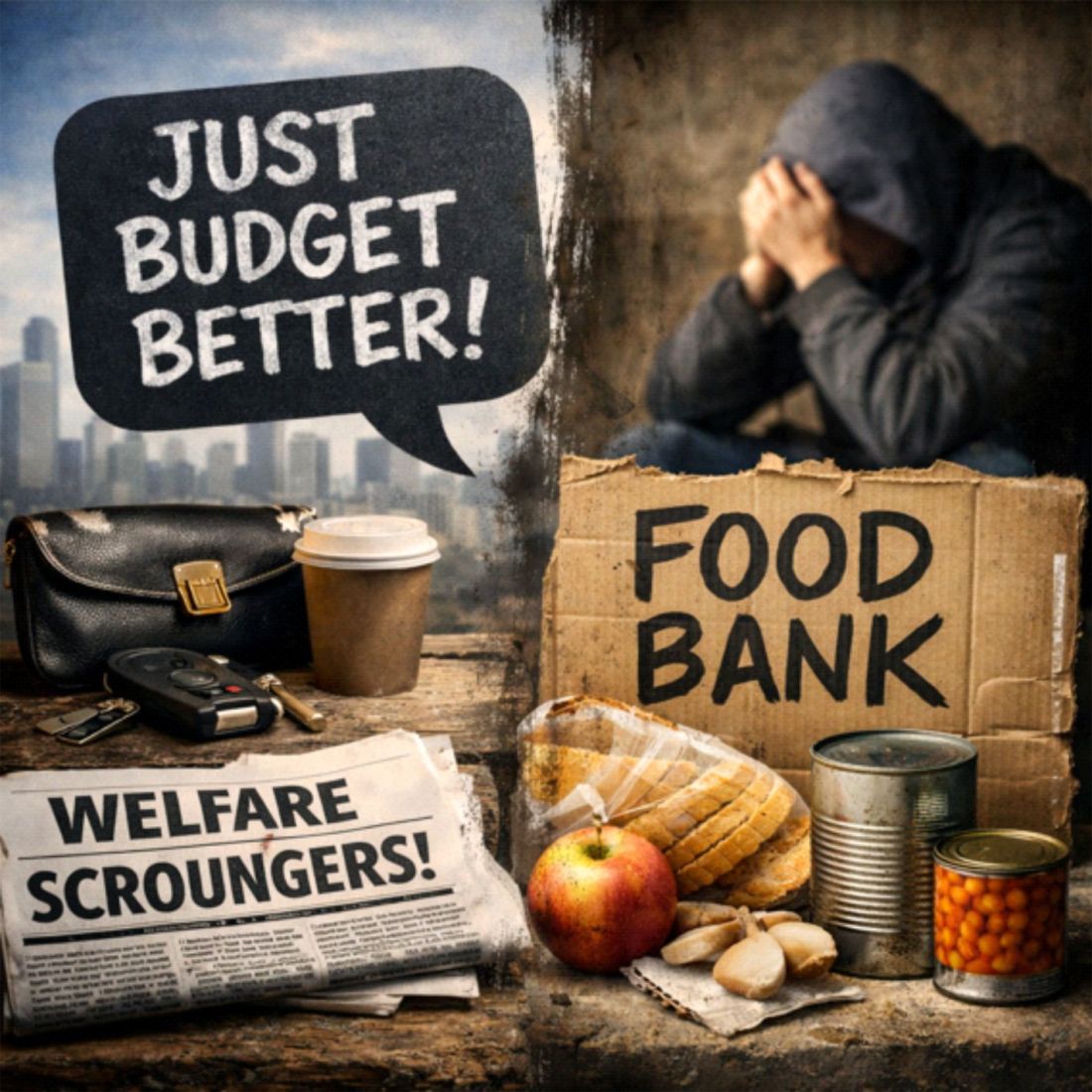
• they should “just budget better”

• they should “cope”

• they should “manage”

These beliefs do not come from nowhere.

They are the product of decades of political messaging, media framing, and cultural conditioning that equates poverty with moral weakness.

The result is a population suffering in silence – invisible to the statistics, invisible to policymakers, and invisible to the very volunteers who believe they are seeing the whole picture.

5. The uncomfortable truth about volunteers

Food banks are run by good people.

People who care.

People who give their time.

People who want to help.

But care is not the same as understanding.

Many volunteers have never experienced poverty themselves.

They have never had a debt collector at the door.

They have never had a benefits sanction.

They have never had to choose between heating and eating.

They have never had a car breakdown that wiped out their month.

They have never had a rent increase that tipped them into crisis.

For some, especially those whose own lives were made stable by wages, housing, pensions, or public services that worked better for them, the system does not look broken. It looks normal.

So when someone turns up for help, they do not always see a system producing poverty.

They see an individual in difficulty.

And once poverty is seen as an individual difficulty rather than a social outcome, the old explanations return:

• bad choices

• poor budgeting

• irresponsibility

That is where charity can become dangerous.

Charity treats the consequences of poverty. Understanding challenges the causes.

Without that understanding, some of the people helping the most visibly can end up helping the least politically, because the suffering is managed, softened, and made bearable – but the system that produces it is left untouched.

This is not a call to stop helping. It is a demand that help stops pretending the crisis begins and ends at the food bank door.

Part III – The System That Creates Poverty

6. The system that punishes default

Here is the part almost nobody talks about:

Most people are far closer to needing a food bank than they realise.

All it takes is:

• a missed paycheque

• a rent increase

• a benefits delay

• a car repair

• a boiler breakdown

• a relationship ending

• a sudden illness

• a debt repayment tipping the balance

The system is not designed to absorb shocks.

It punishes them, then calls the punishment consequence.

If you default on:

• a loan

• a subscription

• a utility bill

• a credit card

• a rent payment

…the system responds with:

• fees

• penalties

• interest

• threats

• collections

• court action

Miss a payment, and you do not simply fall behind. You are charged for falling behind. Penalised for having too little. Pursued because the margin was never there in the first place.

This is not a neutral system of personal responsibility.

This is structural fragility turned into a revenue stream.

The modern household budget is a tightrope.

One gust of wind – one unexpected bill – and the fall is immediate.

7. The devaluation nobody talks about

People often say “inflation is the problem”.

But inflation is only half the story.

The other half is:

Incomes are failing to keep pace with the cost of staying alive.

People aren’t just running harder because prices are rising.

They’re running harder because wages, benefits, and savings buy less against:

• rent

• food

• energy

• transport

• childcare

• debt

• housing

• council tax

• essentials

This is why even people who mock food bank users are often only a few bad weeks away from needing one themselves.

The system is extractive by design because every pressure point becomes an opportunity to take more.

It pulls value upward.

It pushes risk downward.

And it leaves ordinary people running faster and faster just to stay in place.

Part IV – The Narratives That Protect Us From The Truth

8. The collapse of public understanding

This is why social media threads about poverty become so toxic.

A provocative framing.

A misunderstood statistic.

A platform that rewards outrage.

A public conditioned to blame individuals.

A population under financial pressure.

A culture that equates poverty with moral failure.

The result?

A thread full of people:

• denying the problem

• mocking the vulnerable

• insisting it’s all about budgeting

• projecting their own financial fear onto others

• performing toughness to avoid confronting fragility

This is not ignorance.

It is self‑protection.

If poverty is a personal failure, then those who are not poor can reassure themselves that they are safe.

If poverty is structural, then nobody is safe.

And that is a far more frightening truth.

9. What poverty reveals about us

Poverty makes us uncomfortable because:

• it exposes the fragility of our own financial lives

• it reveals how dependent we are on a system we don’t control

• it reminds us that our stability is conditional

• it challenges the myth that hard work guarantees security

• it forces us to confront the extractive nature of the economy

• it shows us that “success” is often luck dressed up as virtue

We prefer to believe:

• “I’m safe because I’m responsible”

• “I’m secure because I work hard”

• “I’m stable because I make good choices”

But poverty whispers a different truth:

You are not as far from the edge as you think.

And that is why we cling to narratives that blame the poor.

Because if poverty is a moral failing, then we can pretend we are morally safe.

Part V – What We Must Change

10. The truth we keep refusing to face

Food banks are not a sign of generosity.

They are a sign of failure.

They are charity doing emergency repairs on an evolving political and economic crisis.

They exist because:

• wages don’t match living costs

• benefits don’t cover essentials

• housing is unaffordable

• debt is punitive

• work is insecure

• crises are common

• safety nets are thin

• shame is weaponised

• narratives are distorted

• charity is mistaken for a solution

And the people who use food banks are not the problem.

The problem is a society that:

• denies structural causes

• blames individuals

• moralises hardship

• misunderstands the data

• and refuses to see how close everyone is to the edge

11. Changing the story

If we want to fix the problem, we have to fix the story.

We need to stop talking about:

• “starving people”

• “scroungers”

• “budgeting failures”

• “irresponsibility”

And start talking about:

• crisis

• fragility

• structural pressure

• systemic failure

• the invisible millions

• the truth behind the numbers

• the difference between treating consequences and challenging causes

Because charity treats the consequences of poverty. Understanding challenges the causes.

And until we understand the causes, we will keep protecting the system that makes charity necessary.

Small Wins, Big Misreadings: Why the Right’s ‘Momentum’ Isn’t What It Seems

The debate after the Makerfield by-election has been framed as a problem of division:

Too many parties on the right, too many similar candidates, too many votes scattered across too many competing brands.

That is the easy explanation. It is also the wrong one.

The right is not losing because it is divided. It is divided because it is lost.

The familiar argument has already begun again. One party should “step aside” so another can win. A Reform MP has suggested that Restore should withdraw, or would otherwise carry responsibility if Reform failed to take power at the next general election. The Conservatives make the same claim when they insist Reform is splitting “their” vote.

Technically, yes: the vote was split.

But that fact does not prove what its loudest interpreters think it proves.

The numbers in Makerfield point to something more serious:

Even on the generous assumption that the Conservatives, Reform and Restore could have combined their votes, they still would not have beaten Burnham.

That matters because Makerfield was not a neutral test.

Yes, it had its own peculiar dynamics. The “get Burnham, get rid of Starmer” bounce created a surge of anti-Labour government energy that will not automatically repeat elsewhere.

This was a highly specific contest shaped by a high-profile figure, local sentiment and a desire to send a message.

Yet even with those favourable conditions, the result was not good for the right, and it should be setting off alarms in all three party headquarters.

If a by-election with a uniquely energised anti-government mood still could not produce a right-wing contender capable of overtaking Labour, then the problem is not simply the split.

The problem is that none of the parties is yet strong enough, connected enough or trusted enough to win in a way that really matters, even when the wind is supposedly at its back.

Aberdeen South Doesn’t Change the Picture – Even Though the Conservatives Won

If Makerfield exposed the right’s weakness in England, Aberdeen South exposed something just as important in Scotland, but from the opposite direction.

The Conservatives won Aberdeen South, and they are already presenting it as evidence of a comeback.

But that interpretation collapses the moment the context is taken seriously.

Aberdeen South was shaped by one defining issue:

The future of North Sea drilling – a question that cuts across party lines, regional identity and economic survival.

This was a contest in which the Conservatives could position themselves as defenders of local industry against a Labour Party perceived, rightly or wrongly, as hostile to it.

In other words, Aberdeen South was tailor-made for a Conservative win.

That does not make the result meaningless, but it does limit what can honestly be claimed from it.

It shows that the Conservatives can still win where the central issue aligns almost perfectly with their message, their history and their local brand.

That is not a national revival. It is a minimum expectation in conditions that were almost perfectly aligned.

Aberdeen South does not contradict the warning of Makerfield. It reinforces it. If the Conservatives can win only where the stars align perfectly, and Reform and Restore cannot win even when anti-government conditions are favourable, then the problem is not the seats.

The problem is the right itself.

The Entitlement Problem: Three Parties, One Assumption

The demand that another party should step aside is not a strategy.

It is entitlement dressed up as electoral realism.

Each party behaves as though it is the rightful heir to the right’s future:

• The Conservatives believe they deserve priority because they have the machine, the history and the infrastructure.

• Reform believes it deserves priority because it has momentum and a charismatic leader.

• Restore believes it deserves priority because it claims to represent “real conservatism.”

But none of them has earned the authority to make that claim.

This is the same problem I explored in What Is the Right Really For? (June 2026):

All three parties are fighting over a conservatism none of them can reach because none of them has yet shown that it understands what conservatism actually requires.

Conservatism, properly understood, is not merely reaction, nostalgia or grievance. It is a discipline of stewardship: responsibility to place, continuity, community, inherited duty and the moral obligation to preserve what is valuable while repairing what is broken.

If any one of these parties were truly resonating with the public, genuinely connecting with people and the issues shaping their lives, it would matter far less how many similar parties stood against it.

It would still find a way to win.

The fact that none of them can do that right now is the real story of both Makerfield and Aberdeen South.

Reform’s Paradox: Performance at the Top, Weakness Everywhere Else

Reform has one of the most media‑savvy political communicators in the country.

Nigel Farage is, by any measure, a highly effective performer in today’s media-driven politics. But a charismatic leader, and a handful of MPs able to survive the media scramble, is not a formula for government.

The issue is not the candidates themselves. It is the party around them.

Reform’s weakness is structural:

• its candidate-selection process is thin,

• its training and support systems are underdeveloped,

• its organisational culture is still built for insurgency, not governance.

If Reform wants to be a party of power, it has to act like one.

It needs to dress for the job it wants, not the one it already has.

And credibility is not a performance, but a discipline.

In today’s politics, authenticity is often performed for the camera, but Reform is not yet performing seriousness at street level – in its candidate depth, organisation and policy discipline.

Voters can sense when a party is not yet serious about the responsibilities it claims to seek.

Reform’s paradox is simple:

It has a leader who can command a room, but not yet a party that can command the country.

The Conservatives’ Advantage – and Their Curse

Only the Conservatives currently have the basic machinery of a party capable of fighting at scale:

• a functioning candidate‑selection machine,

• media‑ready candidates,

• and the ability to field hundreds of people who can survive the daily media grind.

That does not mean they should lead.

It does not mean they deserve to lead.

And it certainly does not mean they are the right vehicle for renewal.

But it does mean Reform and Restore are still a long way from having the organisational robustness required to compete across the country.

The Conservatives’ curse is different:

They have machinery, but no meaning.

This is the argument I made at the heart of Britain is Waiting for Leadership (May 2026):

The public is waiting for someone to lead, but the political class is looking the wrong way.

Restore’s Challenge: Values Without Viability

Restore claims to represent “real conservatism”, but it has not yet offered a coherent, interconnected policy framework that speaks to the real issues of the day.

Nor do the Conservatives.

Nor does Reform.

That is the deeper truth:

None of the parties on the right are fundamentally conservative in the sense people need.

They have slogans.

They have instincts.

They have grievances.

But they do not yet have a governing framework grounded in stewardship, locality, responsibility, continuity and community.

Politics without moral purpose becomes performance, not service.

The System Has Changed – And the Right Hasn’t

The assumption that “the right will form the next government anyway” is also a form of entitlement.

A real mandate comes only from:

• winning a majority,

• making clear, deliverable commitments that are thought through and result in the outcomes people need,

• which are then honoured with integrity.

That is difficult today because politics has been absorbed into a wider system:

A system that constrains, redirects and often neutralises the very governments elected to change it – through institutional inertia, legal frameworks, global economic pressures and the permanent machinery of administration.

This is the dynamic explored in The Contemporary Politician’s Dilemma (Dec 2024):

Governments inherit a system they do not control, and then get blamed for failing to change it.

Any party that does not recognise this, and does not level with the public about where we are, why we are here and how we got here, will find itself in exactly the same position Labour now occupies, and the Conservatives occupied before them.

The right cannot win by pretending the old world still exists.

The Part None of Them Wants to Hear

This is the part none of them wants to hear:

The uncomfortable truth is that none of these parties has yet shown it understands the tradition it claims to represent.

They keep insisting they are conservatives, yet too little in their behaviour suggests they understand what conservatism is, how it was lost, or why the right has collectively ended up in this mess.

This is the argument laid out plainly in What Is the Right Really For? (June 2026):

They have forgotten the meaning of the very tradition they all claim to defend.

The UK is at a crisis point. The public is weighing the credibility of every option on the right, hoping that this time the label on the tin will match the contents inside.

People are tired of buying promises that evaporate the moment the votes are counted.

The problem is not how the deckchairs are arranged. The problem is that the ship itself is taking on water, and the public knows it. They do not want another reshuffle of the same broken parts. They want to be rescued from the very real risk of the whole UK ship going down.

That requires something more serious than a new slogan or a rearranged alliance.

Not a novelty vessel. Not a rebranded dinghy. Not a patched-up version of the one already taking on water.

It requires a traditional ship: one that recognises its own value, its heritage and its purpose, rather than accepting the value assigned to it by the same forces that have spent decades weakening what it once protected.

Until the right understands that, it is not ready to lead.

The Real Lesson of Makerfield – and Aberdeen South

The lesson of Makerfield and Aberdeen South is not that the right needs fewer parties.

It is that the right needs a purpose strong enough to shape those parties into something capable of governing.

Together, these contests show that:

• The right has energy, but no coherence.

• It has anger, but no shared purpose.

• It has instincts, but no strategy.

• It has parties, but no movement.

• It has performers, but not enough authenticity.

• It has leaders, but not enough of the right candidates.

• It has values, but no viable policies.

• It has ambition, but no understanding of the system it seeks to govern.

Until the right understands the system it is operating in, stops demanding that others step aside, and starts building real connection, depth and honesty, it will keep losing elections it believes it should win.

The right does not need fewer parties.

It needs a purpose that can survive reality.

Until then, “step aside” politics is not strategy. It is avoidance – a distraction from the deeper work none of the parties has yet begun.

Until then, “step aside” politics is not strategy. It is avoidance – a distraction from the deeper work none of the parties has yet begun.

What is the Right Really For? – Why Britain’s Conservatives, Reform UK and Restore are Fighting Over Something None of them can Reach

British politics is full of noise, but nowhere is the confusion deeper today than on the political right.

The Conservative Party, Reform UK and Restore are fighting to be recognised as the true voice of the right. Each claims it alone can “save” the country. Each accuses the others of betrayal, weakness or irrelevance. And yet all three are reaching for something that now sits beyond their grasp.

To many voters, this looks like chaos.

To those inside the parties, it feels like a fight for survival.

But the deeper truth is far more important:

All three parties are trying to reclaim the same thing: a form of conservatism that the modern political system no longer allows to exist.

That is the real “race to the bottom”: not a competition to be the most populist or extreme, but a desperate scramble to rediscover a purpose that has slipped out of reach.

In simple terms, this article argues that Britain’s right-wing parties are not merely competing over policies, personalities or slogans. They are fighting over a deeper question: What is the right actually for, when the social, economic and political conditions that once sustained conservatism have been steadily dismantled?

The Right’s Original Purpose: The One Thing They All Should Still Share

Before we can understand the crisis on the right, we need to understand what the right is supposed to be for.

Traditional conservatism was built on six simple but powerful ideas:

  • Locality – decisions made close to the people affected by them.
  • Community – strong social bonds, shared responsibility and mutual obligation.
  • Stewardship – care for land, heritage, institutions and the inheritance passed between generations.
  • Continuity – change that is evolutionary and rooted, rather than sudden and destructive.
  • Identity – belonging grounded in place, memory and shared experience.
  • Self-governance – power held by the governed, not by distant authorities beyond meaningful democratic control.

This is what conservatism is at its root.

This is what the right once existed to conserve.

And this is the foundation that should, in theory, unite the Conservatives, Reform UK and Restore.

But it does not, because the political landscape in which these parties operate no longer supports these principles in any meaningful way.

How the Right Lost Its Purpose – A Story of Drift and Disconnection

To understand today’s fragmentation, we need to understand how the right became detached from its own foundations.

This did not happen all at once. It happened through drift, compromise and disconnection.

1. The 1970s: The Ground Shifts Under the Right’s Feet

From the 1970s onwards, Britain’s move towards more centralised and supranational forms of governance began to erode several of the things on which traditional conservatism depends. Centralisation means decision-making moving upwards, away from towns, counties and communities. Supranational governance means important decisions being shaped beyond the nation state, through institutions and arrangements that sit above national democratic control.

  • local autonomy
  • national decision-making
  • community-rooted politics

Traditional conservatism depends on those things because it is rooted in the belief that people, places and inherited institutions matter.

But much of the right did not see the danger clearly, because it assumed the world it knew would continue unchanged.

2. The 1980s–2000s: Neoliberalism Replaces Conservatism

The decisive break came when neoliberalism began to replace conservatism.

Neoliberalism, in this context, means a market-led, globalised economic outlook that prioritises (corporate) deregulation, competition, finance, corporate scale and consumer choice.

The right increasingly embraced:

  • deregulation
  • financialisation
  • global markets
  • corporate power
  • consumerism
  • managerial politics

These are not conservative values in the traditional sense.

They are economic ideologies and operating assumptions.

Over time, they hollowed out the right’s philosophical core.

Conservatism, rooted in community, identity and stewardship, became a ghost inside a political movement that no longer fully understood itself.

3. The 2000s–2010s: The Hollowing Out Becomes Visible

By the 2000s and 2010s, that hollowing out had become visible.

Without a clear purpose, the right became:

  • reactive
  • fragmented
  • populist in tone
  • technocratic in practice
  • dependent on media cycles
  • unable to articulate what it stands for

This was the moment when the right often appeared to stop conserving people, places and institutions, and instead began conserving the system itself.

That loss of purpose did not remain abstract. It surfaced most clearly in the anti-EU movement.

The Deep Irony: The Anti‑EU Movement was Conservatism’s Last Instinctive Rebellion

Here is the irony that explains much of today’s political confusion:

The anti-EU movement was traditional conservatism trying to save itself, without fully realising that the philosophical ground beneath it had already been removed.

The instincts behind the movement were deeply conservative:

  • local control
  • national self‑determination
  • suspicion of distant authority
  • protection of community identity
  • desire for continuity and rootedness

But the right that led and shaped the movement had already embraced many of the forces – globalisation, centralisation and corporatism – that had made traditional conservatism so difficult to sustain.

So the movement fought the symptoms of the drift, rather than the drift itself.

It tried to reverse a trend that the right had already helped create.

For example, a politics that speaks about local control cannot easily thrive in a country where planning, infrastructure, public services and economic life are increasingly shaped by distant institutions, large corporations, national targets and global pressures.

That is why the argument goes deeper than Europe alone.

The Modern Split: Conservatives, Reform UK and Restore Are Fighting Over the Same Lost Purpose

This is the part we all need to understand.

The Conservative Party, Reform UK and Restore are not divided as they are because they stand for completely different philosophies.

They are divided because they all want to reclaim the same thing – traditional conservatism – but none of them can reach it within the current system.

The Conservatives

The Conservatives are trying to defend a system that no longer reflects conservative values. They carry the name, history and institutional memory of the right, but they have become too closely associated with the very political and economic structures that displaced traditional conservatism.

Reform UK

Reform UK is trying to break the system, or at least disrupt it, without always making clear what durable conservative order should replace it. It channels anger at drift, centralisation and betrayal, but protest is not the same as reconstruction.

Restore

Restore is trying to revive traditional conservatism in a landscape where the conditions that once supported it have been weakened to the point they no longer function the way they once did. Its instinct is to return to first principles, but those principles now have to operate in a system built against them.

The three visible parts of the right are fighting each other because:

  • they feel the same loss
  • they sense the same drift
  • they are chasing the same instincts
  • they are trying to conserve something the system itself has dismantled

Their conflict is therefore not simply ideological.

It is existential.

They are competing to represent a philosophy that the political operating system no longer allows to function.

Why the Left Appears More Unified

This contrast matters.

The left achieved much of its historic mission decades ago:

  • suffrage
  • workers’ rights
  • the NHS
  • the welfare state

These were extraordinary achievements.

Once achieved, the left’s original foundational purpose was essentially complete.

So the left adapted.

It became:

  • flexible
  • narrative‑driven
  • culturally aligned
  • institutionally embedded
  • comfortable with centralisation
  • comfortable with supranationalism

The left arguably appears unified today not because it has a clear purpose, but because it has no foundational mission left to betray.

It can adapt to remain relevant.

The right struggles to adapt cohesively and together because it has forgotten, or lost the conditions for, what it is supposed to conserve.

The Real Problem: Conservatism Cannot Meaningfully Exist in the Current System

This is the truth the right often refuses to face:

Conservatism cannot meaningfully exist within the current system.

Conservatism requires:

  • local decision‑making
  • community autonomy
  • stewardship
  • identity
  • continuity
  • self‑governance

But the current system is built around:

  • centralisation
  • corporatism
  • globalisation
  • managerialism
  • technocracy
  • distant authority

These two worldviews sit in deep tension.

That is why the right is in a race to the bottom.

It is trying to rediscover a purpose that the system itself has made effectively impossible to practise.

In practical terms, this can be seen when local communities feel they have little control over development, when national economies depend on global supply chains, when public institutions are managed through targets rather than relationships, or when identity is treated as a branding exercise rather than a lived bond between people and place.

So What Is the Right Really For?

If the right rediscovered its purpose, it would stand for:

  • Local power
  • Community‑rooted economies
  • Stewardship of land and environment
  • Identity grounded in place and shared experience
  • Governance by the governed
  • Institutions that serve people, not systems

This is not nostalgia.

This is not ideology for its own sake.

This is not populism.

This is real conservatism: the kind that protects people, places, institutions and the bonds between them.

But until the right recognises that the system itself prevents these values from flourishing, it will continue its race to the bottom, mistaking noise for purpose, populism for philosophy, and survival for renewal.

The Message That Needs to Be Heard

Britain’s right-wing parties are not simply enemies.

They are fragments of the same broken whole.

They are all trying to reclaim a conservatism that the modern political system has made effectively impossible to practise.

Until they recognise this, they will keep fighting each other and keep losing sight of the very thing they should exist to protect:

People.

Places.

Communities.

And the continuity that binds them together.

Until the right redefines its purpose for the system as it is, not the one it remembers, it will keep fighting itself instead of shaping the country.

The Real Crisis Behind the Social Media Ban

How fear, fragmentation, and a broken social system are failing our children – and why banning the symptom will not fix the cause

A proposal to ban or heavily restrict social media use for under‑16s is expected to come before Parliament. Predictably, it has triggered the familiar storm of headlines, moral outrage, and political theatre.

Once again, the smartphone is being cast as the villain of modern childhood – the corrupting force supposedly destroying attention spans, mental health, confidence, resilience, and society itself.

There are real reasons to worry about the digital world. Children can be exposed to bullying, harmful content, addictive design, commercial pressure, distorted body image, and material no young person should ever have to encounter.

Families are right to be concerned, and platforms should be held to a far higher standard.

But if we stop the argument there, we miss the deeper crisis entirely.

This debate is not really about smartphones.

It is not even only about children.

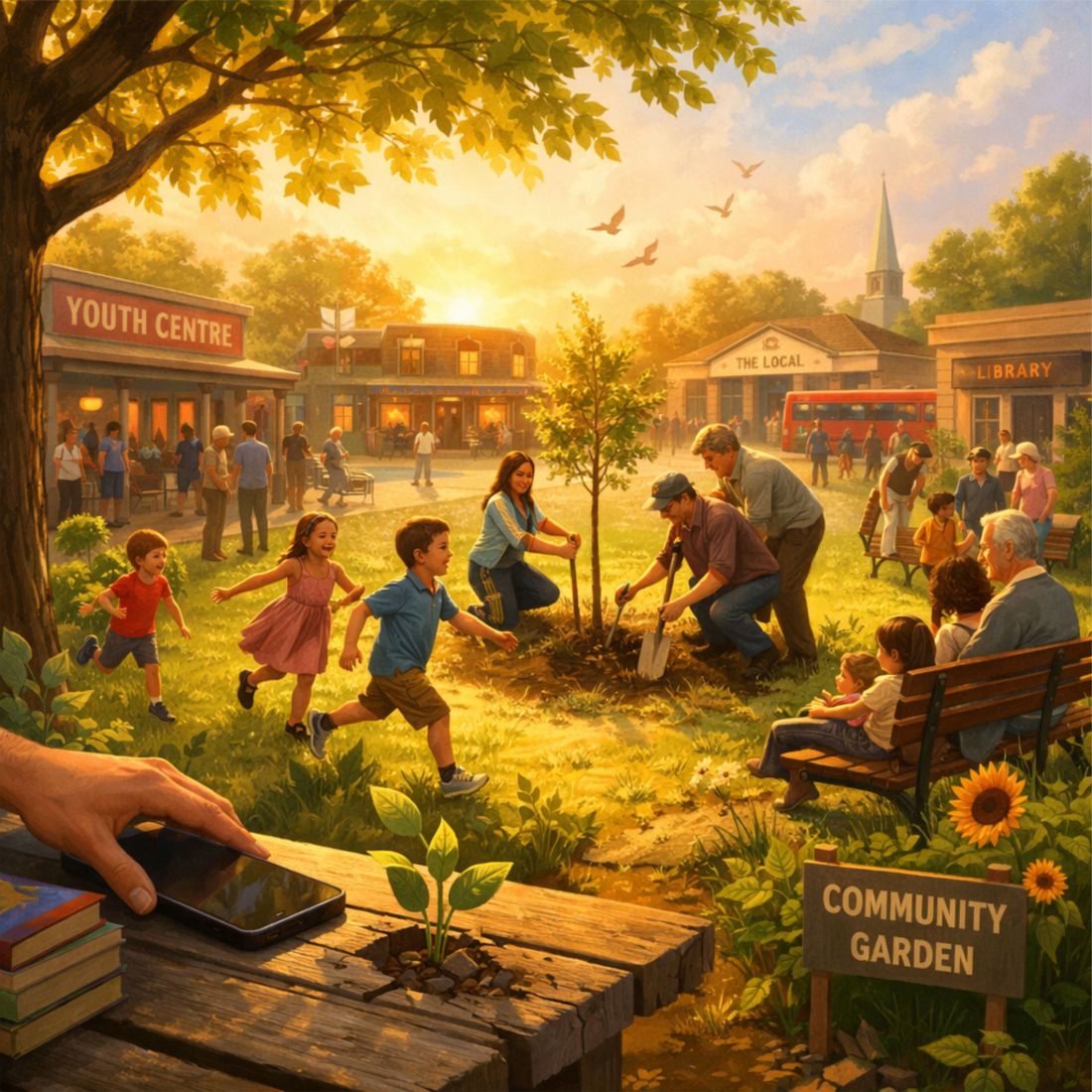
It is about a society that has quietly dismantled the foundations young people once relied on – safe public space, trusted adults, local belonging, meaningful activity, family time, affordable places to gather – and now wants to blame the consequences on a device.

This is not protection.

This is avoidance.

1. Childhood hasn’t collapsed everywhere – but the conditions that support childhood have

It’s easy to point to a new playground, a refurbished park, or a well‑funded youth centre and say, “Look – things aren’t that bad.”

But this misses the point entirely.

The real story isn’t about whether a park exists.

It’s about whether children can use it freely, safely, and socially – and whether the wider conditions of life make that possible.

Across the UK, the underlying ecosystem that once supported childhood has been eroded, even in places where the physical amenities remain.

The decline is structural, not cosmetic.

The evidence is stark. Local authority spending on youth services in England has fallen by around three‑quarters in real terms since 2010, with reports showing cuts of more than £1 billion and hundreds of youth centres lost or hollowed out.

Wales has seen substantial reductions too. These are not marginal changes. They represent the removal of an entire layer of social support that once gave young people somewhere to go, something to do, and adults who were not parents or teachers but still mattered.

But the deeper loss is not the buildings. It’s the conditions that made them matter.

Parents work longer hours and carry more pressure.

Neighbourhood trust has weakened.

Fear dominates public life.

Children’s independent mobility has collapsed over generations.

Public transport is patchy, expensive, or simply not good enough.

Activities that were once free now often carry a cost.

Spaces that once belonged to everyone are increasingly commercialised, regulated, or designed around cars rather than children.

A park is only a park if children can get to it, feel safe in it, and have others to play with when they arrive. A youth centre is only a youth centre if it has people in it. A community is only a community if people trust each other enough to participate.

Even where facilities exist, the conditions that make them meaningful have been stripped away.

And when the offline world becomes harder to access, more expensive to participate in, and more frightening to navigate, children retreat to the only environment that is always available, always open, and always populated: the digital one.

Smartphones didn’t replace childhood. They replaced the conditions that once made childhood possible.

That does not mean technology is harmless. It means technology has become powerful partly because the offline alternatives have been weakened.

The phone did not arrive in a vacuum. It arrived in a society that had already made childhood smaller.

2. Fear hasn’t risen because danger has – fear has risen because community has collapsed

We live in a society where many people genuinely believe danger lurks behind every parked car, every stranger, every unstructured moment.

Some dangers are real. Knife crime, exploitation, online abuse, road danger, and serious violence cannot be dismissed. But the wider picture is more complicated than the emotional climate suggests.

Long‑term crime data in England and Wales shows many traditional forms of crime have fallen over time, even as public anxiety and the visibility of disorder have intensified.

What has risen is the volume of fear‑based messaging.

Fear keeps people watching.

Fear keeps people clicking.

Fear keeps people compliant.

But fear also does something else:

It destroys the social fabric that once kept people safe.

When people fear each other, they withdraw.

When they withdraw, community weakens.

When community weakens, crime finds space to grow.

Crime does not thrive in strong, connected, people‑centred environments. It thrives in the gaps left behind when those environments disappear.

This is the part of the story almost no one tells:

The crime we fear today is often intertwined with the same systemic breakdown that fear itself accelerates.

When youth services vanish, young people lose structure.

When public spaces decline, informal supervision disappears.

When families are stretched thin, support networks collapse.

When communities fragment, accountability evaporates.

When everything becomes transactional, belonging dissolves.

Crime is not simply a moral failing. It is often a social signal – a warning light from a system that no longer supports the people within it.

Fear didn’t rise because danger rose.

Fear rose because community fell.

3. The pub crisis: one case study in how systems fail people – and then blame them

If you want to understand why children spend so much time online, look at what has happened to the places where adults once gathered.

Pubs were once one of the beating hearts of local life – intergenerational, affordable, communal, and human. They were not perfect, and they were never the only form of community infrastructure. Libraries, youth clubs, churches, sports clubs, community centres, parks, working men’s clubs, cafés, and local shops have all played similar roles. But the pub remains a vivid example because it shows what is lost when informal social life is treated as disposable.

But over time, the pub stopped being a community institution and became a financial asset. Corporate ownership, property speculation, debt‑driven business models, and homogenisation hollowed out the soul of the industry.

Many pubs didn’t close because people stopped wanting them; they closed because the system stopped valuing what they were for.

And when pubs disappear, something else disappears with them:

The informal social supervision that keeps communities safe.

The landlord who knew everyone.

The regulars who kept an eye on the street.

The intergenerational mix that built trust.

The shared space where problems were noticed early.

The sense of belonging that kept people anchored.

When these things vanish, crime does not simply “rise” in a neat straight line. Communities are more complicated than that. But risk changes. Isolation deepens. Problems go unnoticed for longer. The informal checks and relationships that once helped people feel seen, known, and accountable start to disappear.

The collapse of the pub is not just an economic story. It is a story about the disappearance of the social immune system.

The same is true for the spaces children use. Close a youth club, price out a sports activity, make buses unreliable, let parks feel unsafe, and then children do not simply stop needing connection. They look for it somewhere else.

4. The political appeal of banning the symptom, not the cause

A social media ban for under‑16s is politically irresistible because it is:

  • simple
  • visible
  • cheap
  • emotionally charged

It allows politicians to say, “We are protecting children,” without having to confront the harder truth:

We dismantled the social fabric that once supported them.

A ban avoids the real questions:

  • Why do children have so few offline opportunities?
  • Why are parents so stretched and unsupported?
  • Why is community life collapsing?
  • Why is everything that used to be free now commercialised?
  • Why is fear the dominant emotion in public life?

These are systemic failures. And systemic failures require systemic solutions.

A ban may reduce some exposure to harm. It may give some parents cover. It may even be part of a wider package if implemented carefully.

But on its own, it is not a solution.

It is a distraction if it allows us to avoid the harder work.

That does not mean we should do nothing online. Quite the opposite. Harmful design, weak age assurance, algorithmic amplification, cyberbullying, predatory behaviour, and exposure to dangerous content all require serious regulation.

Platforms must be made safer. The Online Safety Act must be enforced. Children need digital literacy, parents need support, and companies must not be allowed to profit from avoidable harm.

But a blanket ban risks becoming a political shortcut: a visible act of concern that leaves the underlying conditions untouched.

Worse, if handled badly, it may push some children into less visible and less regulated spaces while doing nothing to rebuild the real‑world places they actually need.

5. The deeper truth: fear is what failing systems use when they cannot offer renewal

When a system is struggling to explain its own failures, it reaches for fear.

Fear divides.

Fear isolates.

Fear distracts.

Fear keeps people looking in the wrong direction.

And right now, fear is being used to:

  • pit parents against technology
  • pit generations against each other
  • pit communities against imagined threats
  • pit society against its own children

The more the system fails, the more it needs fear to justify itself.

6. The real crisis is not only digital – it is social, economic, and moral

If we banned every smartphone tomorrow, would children’s lives improve?

Only if we rebuilt the conditions that make childhood possible:

  • properly funded youth services, open often enough to matter
  • safe, welcoming public spaces that are not designed only for consumption
  • local transport that lets young people move independently
  • affordable sport, arts, music, and social activities
  • libraries, clubs, community centres, and informal “third places” where people can gather
  • support for parents who are stretched by work, housing, childcare, and cost‑of‑living pressure
  • trusted adults beyond the family home and school gate
  • digital literacy taught as a life skill, not a panic response
  • platform accountability, not just parental blame
  • trust, opportunity, belonging, and hope

Without that, removing smartphones would simply expose how little we’ve given children to replace them.

The crisis is not technological.

The crisis is environmental.

The crisis is structural.

The crisis is systemic.

And the crime we fear is not a separate problem. It is a symptom of the same collapse.

Treating social media as the sole cause allows us to avoid asking why so many children are lonely, anxious, bored, supervised but unsupported, connected but not held, visible online but invisible in their own neighbourhoods.

7. Where real hope lives

Hope does not live in bans, restrictions, or fear‑driven policies.

Hope lives in rebuilding communities.

Hope lives in restoring public spaces.

Hope lives in supporting families.

Hope lives in creating opportunities.

Hope lives in teaching digital literacy.

Hope lives in regulating platforms properly.

Hope lives in making offline life rich enough that the online world is no longer the only place children reliably find connection.

Hope lives in reconnecting society with itself.

Hope lives in the recognition that children are not the problem.

Hope lives in the courage to admit that the system is.

Hope lives in the willingness to build something better – not just remove something convenient to blame.

That means moving beyond symbolic politics and asking harder questions: What would it take for a thirteen‑year‑old to walk safely to a park, meet friends there, stay for a few hours, and come home without fear? What would it take for parents to trust their community again? What would it take for young people to be known by adults who are not paid to manage, test, punish, or sell to them?

8. The choice ahead

We can continue down the path of fear, division, and superficial fixes. We can keep treating children as problems to be managed, parents as failures to be blamed, and technology as a monster that appeared from nowhere.

Or we can confront the truth: children have not abandoned the real world. Too often, the real world has withdrawn from them.

Children do not need bans as a substitute for society.

They need protection online, yes – but they also need freedom, belonging, trusted adults, safe places, real opportunities, and a world worth growing up in.

If we want children to spend less of their lives on screens, we must give them more life beyond them.

Proportional Representation: The wrong answer to the right frustrations | And why it risks deepening the crisis its champions claim it will solve

Proportional representation has returned to British politics with the confidence of a solution whose moment has finally arrived. It is presented as the modern, fair, mathematically elegant alternative to first‑past‑the‑post – a system that appears increasingly out of step with public expectations and electoral outcomes.

In an age of shrinking majorities, falling turnout, and widespread disillusionment, PR offers a seductive promise: a democracy where every vote counts and every voice is heard.

But the appeal of PR rests on a dangerous assumption:

That the rest of the political system is healthy enough for PR to work.

It isn’t.

And that is why PR risks making everything worse.

Because proportional representation only works in a political culture that doesn’t need it.

And the UK is nowhere near that place.

The Seductive Simplicity of PR

PR’s promise is mathematical fairness: seats that match votes, representation that mirrors the national mood, and a system where no vote is wasted.

Many inside Westminster sincerely believe this would restore legitimacy. They look at the distortions of the current system and conclude that the counting method is the problem.

But fairness in democracy is not a spreadsheet problem.

It is a relationship between voters and power.

And that relationship is already broken.

The Misunderstanding Built into Modern British Politics

Most voters believe they are choosing a party, a leader, or a national agenda. In reality, they are electing a local representative whose influence is tightly constrained by party machinery.

Over decades, the public has been conditioned to see the party as the unit of democracy – not the person, not the community, not the relationship between the two.

This conditioning didn’t happen by accident.

Parties select candidates.

Parties control messaging.

Parties whip votes.

Parties decide careers.

The logical conclusion is that the party is what matters.

PR doesn’t correct this misunderstanding.

It formalises it.

How PR Deepens Party Control

Under most forms of proportional representation, voters do not choose individuals. They choose party lists. The party decides who appears on the list, in what order, and who ultimately enters Parliament.

The voter’s role becomes even more distant.

The party’s control becomes absolute.

What is currently an informal dominance becomes a structural monopoly.

PR does not empower voters.

It empowers parties.

It does not increase accountability.

It removes it.

It does not bring politics closer to the public.

It pushes it further away.

The Technocratic Trap

PR appeals to those who want a technical fix to a cultural and moral problem. It is the kind of solution that emerges when faith in political behaviour has collapsed and the only remaining hope is to adjust the mechanism.

But the problem is not arithmetic.

The problem is behaviour, values, and the absence of genuine leadership – themes explored in The Way of Awakened Politics for Good Government.

Changing the voting system cannot compensate for a political culture that no longer knows how to lead.

Coalitions Without Consent

PR almost always produces coalition governments.

But voters rarely know before the election what coalition they are actually voting for.

This creates a democratic deficit:

  • Voters choose a party
  • Parties choose their partners after the election
  • The resulting government may have no mandate for its combined programme

This is a transparency problem that PR makes worse, not better.

Accountability Diffusion

Under PR, responsibility becomes blurred:

  • Who is responsible when things go wrong?
  • Who deserves credit when things go right?
  • Who can be removed if change is needed?

PR doesn’t just spread power – it spreads blame until it disappears.

This is a governance accountability issue that PR systems struggle with.

Party Cartelisation

Political scientists call it cartelisation:

Parties behave like a closed shop, protecting each other from outside competition.

PR accelerates this because:

  • parties become the only route into Parliament
  • party lists become the gatekeeping mechanism
  • new voices must negotiate with existing parties to gain influence

PR is not pluralistic.

It is cartel‑friendly.

The Collapse of Local Representation

One of the most damaging consequences of PR – and one of the least discussed – is the erosion of local representation.

PR breaks the link between a community and its representative. It replaces geography with ideology.

Local representation becomes symbolic rather than real.

Communities lose their voice.

Parties gain more control.

This is the opposite of what a healthy democracy requires – a theme explored in The Local Economy Governance System.

The Centralisation Paradox

PR is often sold as a way to make politics more pluralistic.

But in practice it centralises power inside party headquarters.

Why?

Because:

  • candidate selection becomes national
  • party lists are controlled centrally
  • coalition negotiations happen at the top
  • local voices are sidelined

PR strengthens the very centralisation people want to escape.

The Public Expectation Mismatch

People expect PR to:

  • reduce corruption
  • increase honesty
  • improve behaviour
  • make politics more collaborative

But none of these outcomes are guaranteed by PR.

They are cultural, not mechanical.

PR cannot deliver the behaviour people want from politics because behaviour is not created by voting systems – it is created by values.

The Legitimacy Illusion

PR creates the appearance of fairness while masking deeper unfairness:

  • party elites choose candidates
  • coalition deals override manifestos
  • voters lose the ability to remove individuals
  • accountability becomes abstract

PR does not fix legitimacy.

It manufactures the illusion of it.

Why Politicians Want PR Now

There is another dimension to this debate – one rarely acknowledged publicly.

The current political class – increasingly managerial, increasingly reactive – is not leading. It is not solving problems. It is not governing with courage or vision.

As explored in A Leadership Void in a Moment That Calls for Far More Than Westminster Politics, the political class is:

  • reactive, not proactive
  • managerial, not visionary
  • dependent on the system, not independent of it

And because it cannot lead, it is desperate for ways to shore up majorities that are wasting away through public disenfranchisement.

PR offers:

  • a way to preserve relevance
  • a way to maintain influence
  • a way to survive declining public trust
  • a way to lock in position even as legitimacy collapses

This is not about fairness.

It is about self‑preservation.

The Money‑Centric System Behind It All

The political system is in sync with a wider problem – the money‑centric, extractive economic model that is running out of road. As explored in Why MPs Can Afford to Give Away Their Salaries and Voters Can’t, the political class is insulated from the consequences of the system it defends. Voters are not.

PR becomes a tool to:

  • stabilise a political class that cannot stabilise the country
  • protect incumbents from the consequences of their own failures
  • maintain a system that benefits them but harms the public

PR is not a democratic reform.

It is a survival strategy.

The Irony at the Heart of the Debate

The uncomfortable truth is this:

If the UK had the political culture required for PR to work, PR wouldn’t feel necessary.

A healthy system would already have:

  • empowered local democracy
  • independent representatives
  • decentralised power
  • transparent institutions
  • civic responsibility
  • accountability mechanisms

In that environment, PR would be a technical detail – not a salvation narrative.

The fact that PR feels like the answer is itself a symptom of how far the system has drifted from genuine representation.

Further Reading: The Deeper Democratic Crisis

These works explore the structural, cultural, and civic issues that PR cannot fix – and that must be addressed before any voting system can deliver genuine representation:

Conclusion: PR Is Not the Answer – It Is the Distraction

The public is right to be frustrated.

The system is failing.

Representation is broken.

Accountability is weak.

Parties have too much power.

Communities have too little.

The political class is out of its depth.

The economic system is running out of road.

But PR is not the solution.

It is the false fix that diverts attention away from the real democratic crisis.

Until the deeper issues are confronted – party dominance, centralised power, establishment alignment, leadership failure, and the erosion of genuine local representation – no voting system will deliver the democracy people believe they are voting for.

PR does not change the game.

It just changes the scoreboard.