Writing about people, systems and the realities that shape our lives
Category: Values
Relating to ethics, principles, morals, doing the right thing, the public good, what is in our common interests, humanity, kindness and respect to others, considering all people to be equal
When The Times reported this week that a government‑commissioned review had concluded smartphones are a major cause of the rise in young people who are NEET*, it was hard not to feel the weight of a familiar story settling over us again.
A new generation is struggling. A new report is published. And once again, the blame is placed squarely on the young people themselves.
This time the villain is the smartphone. Before that it was video games. Before that it was “attitude”, “aspiration”, “work ethic”, or whatever behavioural explanation happened to be fashionable at the time.
The pattern never changes. Only the scapegoat does.
And every time, the real causes – the structural, systemic, deeply human causes – are quietly pushed out of sight.
Smartphones are a problem. But they are not the problem. They have reshaped how all of us live, think and relate to the world. They are addictive, distracting, and capable of distorting our sense of reality. But the idea that smartphones are uniquely responsible for young people becoming NEET is not just simplistic – it is a distortion of the truth.
If smartphones were the cause, then why are adults – including those in government, business and media – glued to their screens too? Why are older generations reporting rising anxiety, burnout and disconnection? Why is everyone, across every age group, wrestling with the same digital compulsions?
The answer is obvious: smartphones are not the root cause of youth disengagement. They are the symptom of a society that has stopped giving young people a meaningful place within it.
When the world outside offers no stability, no opportunity, no vocational pathway, no affordable independence and no sense of a future, the digital world becomes the only place where life feels manageable.
Young people are not disappearing into their phones because they are lazy. They are disappearing into their phones because the world we have built for them feels impossible to navigate.
We have been here before. Every decade, a new “lost generation” is discovered. Every decade, politicians and commentators blame that generation for its own circumstances. And every decade, nothing changes.
The truth is that Britain has become a two‑tier society – not between young and old, but between those who benefit from the system and those who are shaped, constrained or crushed by it.
The young people now being blamed for their smartphone use are the same young people who cannot find secure work, cannot afford housing, cannot access vocational routes, cannot rely on public services and cannot see a future that resembles anything stable.
This is not a behavioural crisis. It is a structural one.
Worklessness is not a lifestyle choice. It is a systemic outcome. Young people are not working because there is not enough work that pays enough to live on.
We live in an extractive economic system where wages no longer match living costs, secure jobs have been replaced by precarious ones, housing is unaffordable, public services have collapsed, vocational routes have been dismantled and qualifications have become inflated and meaningless.
In such a system, young people who do not fit the narrow academic mould are not “choosing” to disengage. They are being systematically excluded.
And when they retreat into their phones, it is not because the phone caused the exclusion – it is because the phone is the only place where they feel any agency, connection or escape.
Another convenient narrative is that smartphones are causing a mental health crisis.
But what if the opposite is true?
What if the mental health crisis is caused by insecurity, poverty, unstable housing, collapsing public services, academic pressure, social isolation, the disappearance of community and the loss of vocational identity – and smartphones are simply where young people go to cope with it?
When a young person feels worthless because the system tells them they have no value unless they conform to an academic pathway that was never designed for them, the psychological damage is profound.
Smartphones didn’t create that damage. They just provide a place to hide from it.
One of the most damaging shifts of the past 30 years has been the near‑total collapse of vocational education as a respected, funded and valued pathway. Children are heads or hands – and both are equally valuable. But the system only rewards the “heads”. Everyone else is told they are a failure. We have created a society where practical skills are devalued, vocational learners are sidelined, experience is dismissed, qualifications are worshipped, conformity is rewarded and individuality is punished.
And then we wonder why young people disengage.
And even where something resembling a vocational route still exists, it has been hollowed out. The modern “apprenticeship” bears almost no resemblance to the traditional, deeply skilled, indentured pathway that once turned young people with no advantage into confident, capable adults.
Today’s apprenticeships are shorter, thinner, and often little more than rebadged entry‑level jobs. Worse still, they have become a refuge for academically strong young people who no longer want – or can no longer afford – to take on explosive levels of tuition‑fee debt.
It is entirely rational for them to choose a paid apprenticeship over a lifetime of repayments. But the result is that the very people apprenticeships were originally designed to lift up are now being pushed aside by those who already had other options.
Another ladder pulled up. Another route closed. Another group of young people quietly written off by a system that insists the problem lies with them.
Instead of rebuilding vocational routes, we blame smartphones.
Blaming young people costs nothing. It requires no reform. It avoids confronting inequality. It protects the system. It wins headlines. It shifts responsibility away from government.
It is a political strategy, not an analysis. Smartphones are the perfect scapegoat because they are visible, addictive and easy to moralise about. But they are not the cause of youth worklessness any more than television caused unemployment in the 1980s.
The real scandal is that we are abandoning young people – and then blaming them for the consequences.
We have created a society where young people cannot afford independence, cannot find stable work, cannot access vocational routes, cannot rely on public services and cannot see a future. Then we blame them for retreating into the only world where they feel any control.
This is not just wrong. It is cruel. And it is cowardly.
Young people are not failing. We are failing them.
Until we confront the structural causes – inequality, extraction, qualification tyranny, the collapse of vocational pathways and the destruction of community – we will keep producing “left behind” generations. And every time, we will find a new scapegoat to avoid admitting the truth.
Those who believe the current system benefits them will continue to resist change. But the cost of that resistance is measured in human lives – young and old – who are pushed to the margins and then blamed for the suffering that the system itself has created.
Blaming the people the system has passed by is not just a policy failure. It is an act of inhumanity.
A society that values everyone equally – whether academic or vocational, young or old – cannot be built on blame. It can only be built on systemic change.
And until we choose that change, we will continue to abandon people – and then punish them for being abandoned.
* NEET: A government classification for young people aged 16–24 who are Not in Education, Employment or Training. It is a cold administrative label for a deeply human situation – young people who have fallen out of the system, or been pushed out of it, and are now navigating life without the structure, support or opportunity most of us take for granted.
Most people can feel that something in Britain isn’t working anymore. Life feels harder, more stressful, more insecure. People are tired, worried, and stretched thin. But when they try to explain why, the answers they’re given never quite fit.
We’re told the country is divided – north vs south, young vs old, graduates vs non‑graduates, public sector vs private sector. But none of these really explain what people are living through.
The truth is simpler, and more uncomfortable:
Britain is already split into two groups – those the system works for, and those it doesn’t.
And most people don’t realise which side they’re actually on.
Why the Real Divide Is Hard to See
The divide isn’t obvious because it’s not about what people look like.
It’s not about identity, background, or culture.
It’s not even about politics.
It’s about security.
Some people have it.
Most people don’t.
And the gap between the two groups is growing.
But because everyone mixes together – at work, in shops, on the school run – it’s easy to assume we’re all living the same kind of life.
We’re not.
Why People Argue About the Wrong Things
A lot of public debate focuses on visible differences – race, gender, culture, lifestyle, opinions.
These topics stir emotion, so they dominate the headlines. But they distract from the thing that shapes people’s lives far more than any identity label:
Money.
Not in a greedy sense – in a survival sense.
Money decides:
whether you sleep at night
whether you can cope with a shock
whether you can plan for the future
whether you feel safe
whether you feel judged
whether you feel like you’re failing
And because money is the value system society runs on, it quietly sorts people into two groups long before anyone realises it’s happening.
The System Only Works by Squeezing People
Here’s the part nobody likes to say out loud:
The system can only make some people wealthy by making everyone else poorer.
That doesn’t mean rich people are bad.
It means the system is built in a way that pushes pressure downward.
Prices rise.
Wages don’t.
Bills go up.
Security goes down.
People work harder.
Life gets tighter.
And the people at the bottom feel it first.
But the pressure doesn’t stop there – it moves upward, squeezing each layer in turn.
Why People Who Look “Fine” Still Feel Terrified
This is where the misunderstanding happens.
Take small business owners.
They often look like they’re doing okay.
But many are barely holding things together.
So when someone says, “The minimum wage isn’t enough to live on,” they don’t think about the worker who can’t pay rent. They think:
“If wages go up, I’ll go under.”
That reaction isn’t selfish.
It’s fear.
They feel the threat immediately and emotionally because they know how close they are to the edge. And that fear blinds them to the reality that millions of people have already been pushed over it.
This is the uncomfortable truth:
Everyone’s problems are connected.
Everyone is being squeezed – just at different stages.
Why So Many People Are Struggling Even When They Work
Most people on benefits are working.
They’re doing everything society told them to do.
But the numbers simply don’t add up.
The minimum wage doesn’t cover the cost of living.
Rent, food, transport, energy – everything costs more than people earn.
So people end up relying on:
benefits
debt
charity
family support
or going without
And instead of asking why the system produces this outcome, society blames the people trapped in it.
They’re judged.
They’re shamed.
They’re treated as if they’ve failed.
But they haven’t failed.
The system has.
The Myth That Keeps People Blaming Themselves
We’re told that life works like this:
Get qualifications → get a career → earn money → build a life → be happy
But this only works for some people.
Many are vocational, not academic.
Many never had the stability to study.
Many grew up in chaos, poverty, or caring roles.
Many simply weren’t given the same chances.
Yet the system values what can be measured – certificates, grades, titles – not the real skills people have.
So whole groups of people get left behind, not because they lack ability, but because they lack paperwork.
And then they’re told it’s their fault.
Why Mental Health Is Collapsing
When you live in a system where:
you can’t keep up
you can’t get ahead
you can’t rest
you can’t plan
you can’t afford a mistake
you can’t escape judgement
…it breaks something inside you.
People think they’re failing personally.
But they’re not.
They’re living in a system that demands more than human beings can give.
That’s why anxiety, depression, burnout, and hopelessness are everywhere.
It’s not an epidemic of weakness.
It’s an epidemic of pressure.
The Future People Fear Is Already Here
A lot of people worry about a future where technology creates a world for the “haves” and leaves the “have‑nots” behind.
But the truth is:
That divide already exists.
AI didn’t create it.
Automation didn’t create it.
The system did.
Technology will widen the gap – but it won’t start it.
And here’s the twist:
The people who think they’re safe – the professionals, the knowledge workers, the middle layers – may soon find themselves on the wrong side of the divide they never noticed.
Not because they changed.
But because the system did.
So What Is the Real Divide?
It’s not left vs right.
It’s not identity vs identity.
It’s not culture vs culture.
The real divide is:
Those the system protects
and
Those the system exposes.
Some people have security.
Most people don’t.
And the line between the two is moving fast.
Why We Need to See It
People suffer alone because they think their struggle is personal.
They think they’re the only ones falling behind.
They think everyone else is coping.
But the truth is:
Millions of people are living the same story.
The only difference is where they are on the slope.
If we don’t see the real divide, we can’t fix it.
If we keep fighting over the wrong differences, the system will keep squeezing everyone.
Recognising the split isn’t about blame.
It’s about clarity.
It’s about dignity.
It’s about rebuilding a society where people can breathe again.
We like to believe that if something is real, we would see it. That a divide in society would be obvious, visible, tangible.
But the most profound changes in a nation rarely announce themselves. They creep in quietly, shaping lives long before anyone realises what has happened.
Today, Britain is already a split society – not becoming one, not drifting toward one, but living fully inside one. And the reason most people cannot see it is simple: we have been conditioned to look at the wrong differences.
The real divide is structural, economic, and existential. It is the difference between those the system rewards and those it punishes. And the split is widening every day.
The Blindfold of Visible Differences
We live in a culture obsessed with what can be seen. Identity, labels, categories, tribes – the system elevates these differences because they are emotional, dramatic, and endlessly distracting.
Diversity, in its current institutionalised form, has become a paradox. It celebrates difference while deepening division. It elevates identity markers that have no bearing on power, security, or opportunity, while ignoring the structural forces that determine all three.
These visible differences become the battlegrounds of public life. They stir emotion. They create polarity. They keep people fighting each other instead of questioning the system that shapes them both.
Meanwhile, the real difference – the one that defines who thrives and who suffers -remains invisible.
The Narrative That Keeps Us Looking the Wrong Way
We have reached a point where people believe only the stories told by the “right” voices.
Narratives have become truth, and truth has become whatever fits the narrative.
“Two‑tier Britain” is a perfect example. It is used as a political weapon, usually to attack public services or to frame cultural grievances.
But this version of the divide is superficial. It points at symptoms, not causes. It directs attention toward institutions and away from the system that governs them all.
Partial truths are accepted because they feel familiar. But they stop people from seeing the bigger picture – the one that explains why life feels harder, more insecure, and more exhausting for almost everyone.
The Emotional Logic of Those Who Still Think They’re Safe
What makes the real divide even harder to see is the way people who appear to be “doing fine” respond when the conversation turns to money.
For example, mention that the minimum wage is not enough to live on, and many small business owners – themselves squeezed by rising costs, falling margins, and relentless pressure – immediately reframe the issue in terms of what a higher wage would do to them.
Their fear is real. Their anxiety is justified. But it also reveals something deeper: they sense, at an emotional level, how close they are to the edge. And that fear blinds them to the lived reality of those who have already been pushed across the divide.
Instead of seeing a system that is failing everyone, they see a threat to their own fragile stability.
Their reaction is not selfishness; it is survival. But it illustrates the wider truth: the problems faced by those on the “wrong side” of the divide are directly connected to the pressures felt by those who still believe they are on the right side.
Everyone is being squeezed – just at different stages of the same process.
This is the interdependence nobody talks about: the suffering of one group is the shadow cast by the insecurity of another.
The Money System: The Quiet Engine of the Real Divide
Here is the truth that sits beneath everything else:
The system can only make some wealthy by progressively making everyone else poor.
This is not ideology. It is mechanics.
The modern economic model is not a rising tide. It is an extraction machine.
Wealth does not trickle down; it is pulled upward. Gains at the top require losses at the bottom. The system rewards accumulation, not contribution.
And because of this, financial dependence is not a personal failure – it is a structural inevitability.
People are not poor because they made bad choices. They are poor because the system needs them to be.
The national minimum wage for a standard working week is not enough to live independently. That is not an accident. It is a design.
Most people receiving benefits are working. They are contributing. They are doing everything society told them to do. And yet they cannot survive without support, charity, or debt.
Instead of questioning why the system produces this outcome, society blames the people trapped inside it. They are ostracised, shamed, and treated as morally defective – all while the system quietly ensures they can never escape dependence.
This is not a bug. It is a feature.
The Myth of Meritocracy: The System’s Favourite Lie
We are told that life follows a simple formula:
Qualifications → career → money → status → happiness
This story is comforting. It suggests fairness. It suggests control. It suggests that success is earned and failure is deserved.
But it is a myth.
Many people are vocational, not academic. Many never had the stability, support, or freedom to pursue qualifications. Many grew up in environments where survival came before study.
Yet the system values what is measurable, not what is meaningful.
Experience is devalued because it cannot be quantified.
Human ability is replaced by credentialism.
Entire generations are left behind not because they lack talent, but because they lack paperwork.
And then they are blamed for it.
Keeping Up: The New Survival Game
Even those who appear to be “doing well” are trapped.
The system moves the ground beneath everyone’s feet. Standing still means falling behind.
People who earn good salaries must run faster each year just to maintain the same life.
Mortgages, rents, bills, childcare, transport – everything rises except the sense of security.
Values shift.
Money becomes the only measure of worth.
Success becomes survival.
And survival becomes a full‑time job.
This is not living. It is coping.
The Psychological Toll of a System That Never Stops Taking
The mental health crisis is not a mystery. It is the emotional footprint of an economic system that demands more than human beings can give.
Chronic insecurity becomes normal.
People internalise systemic failure as personal failure.
Shame becomes a constant companion.
Those who fall behind are blamed.
Those who keep up are exhausted.
Those who succeed are anxious about losing everything.
Peace of mind becomes a luxury good.
The Tech Future People Fear Is Already Here – Just Not in the Way They Think
Many people worry that society is drifting toward a tech‑driven future where the “haves” accelerate into a world of automation, AI, and abundance, while the “have‑nots” are left behind in a wasteland of low‑paid work and shrinking opportunity.
But the irony is stark:
The split they fear tomorrow is the split they are already living inside today.
The future people dread – a world divided by access, opportunity, and agency – is not waiting for us. It is here. It has simply been hidden behind distraction, narrative, and the comforting illusion that the playing field still exists.
Lift the stone, shine a light beneath it, and the truth is there in black and white:
A society already divided by a system that sorts people long before technology ever gets the chance.
And the most striking part is how little those on the “right side” of the divide understand the consequences of their own beliefs and actions.
Many genuinely cannot see the damage being done to those already on the wrong side – not because they are cruel, but because the system has insulated them from the realities it creates.
They believe the rules are fair because the rules have worked for them. They believe effort determines outcome because effort has always been rewarded in their world. They believe the system is meritocratic because they have never had to live in the parts of it that are not.
But the ground is shifting.
The split is moving.
And the very people who defend the system most fiercely may soon find themselves on the wrong side of it.
The AI revolution – designed, championed, and accelerated by those currently insulated from harm – is already reshaping the labour market in ways that will not spare them.
Be it through the AI Revolution or as a result of other events, same extractive logic that has hollowed out the lives of the most vulnerable will, in time, turn its attention to the middle layers of society: the professionals, the knowledge workers, the people who once believed they were safe.
They may discover, too late, that they have become part of the same “left behind” Britain they once viewed from a distance.
Not because they changed, but because the system did – and because they never saw the split that was already there, hidden in plain sight.
Why We Don’t See It – And Why We Must
The system hides the real divide behind a theatre of false differences.
It keeps people fighting over identity while it quietly determines their destiny.
It rewards a few by extracting from the many.
It blames the victims and protects the structure.
And because the split is invisible, people suffer alone, believing their struggle is personal rather than systemic.
But the truth is simple:
This divide affects almost everyone.
It is widening.
And it will not close on its own.
To rebuild a society grounded in human values, we must first see the system for what it is – and recognise the split that has already taken hold.
Cheltenham is a town that prides itself on beauty, culture, and a strong sense of civic identity. But over recent months, a series of quiet, unsettling events has revealed something deeper about the way we respond to vulnerability – and about the system that shapes those responses.
Tents outside Cavendish House were removed in the days before the Races. The building wasn’t shuttered at the time, but the doorways where people had been sheltering were boarded up almost immediately afterwards.
Then, an encampment in St Mary’s churchyard was moved on.
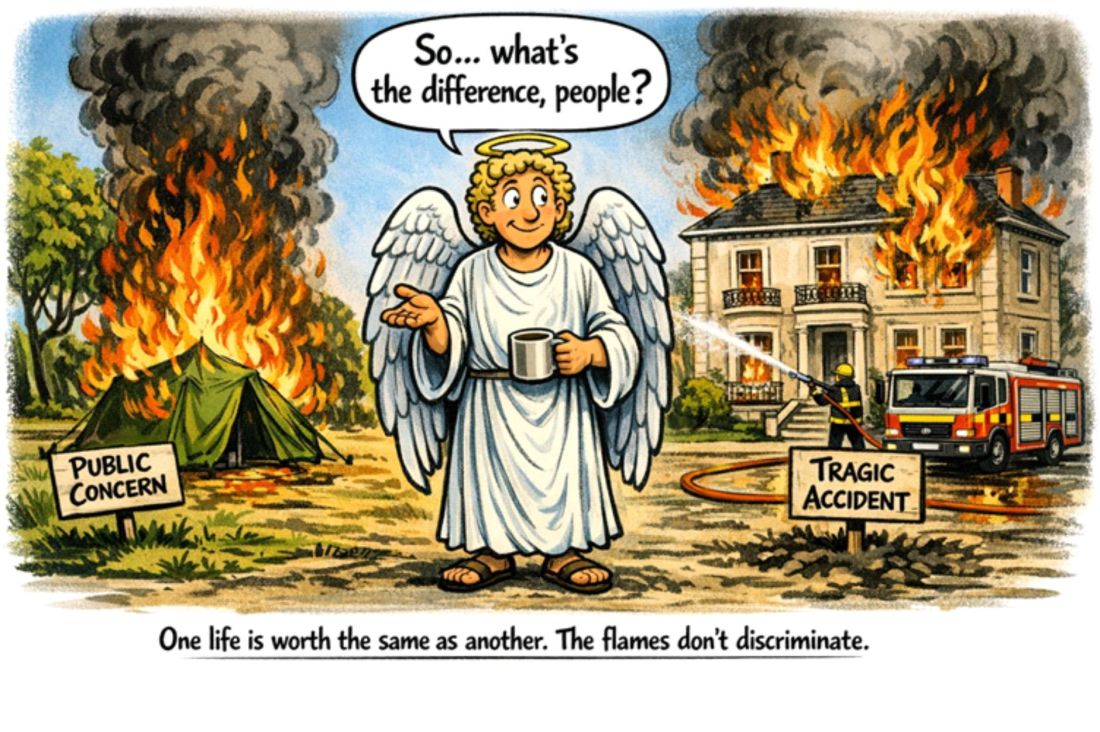
Now, this week, a tent in Clarence Square went up in flames – a fire now thought to have been started deliberately.
Different locations.
Different people.
Same outcome.
And behind each incident sits the same familiar line: support was offered.
But what does that really mean in practice?
A Walk Through Clarence Square
A few days before the fire, I walked past the Clarence Square encampment with my dogs. What I saw wasn’t disorder or disruption – it was quiet, deliberate survival. A couple of tents had been tucked carefully under the bushes and trees, almost hidden from view. The people staying there were clearly trying to minimise their presence – to avoid causing alarm, to keep things tidy, to exist quietly in a space that was never meant to be a home.
It challenged the assumptions many people hold about rough sleepers. Even in the most difficult circumstances, people try to maintain dignity, privacy, and respect for the space around them.
At the same time, it is entirely understandable that any resident would feel concerned or unsettled by a pop‑up encampment in a public square. These are shared spaces – places where children play, where people walk their dogs, where neighbours meet. When something unexpected appears, especially something associated with vulnerability or crisis, it can trigger worry or discomfort.
But the first step toward responding constructively is remembering that behind what may look like an “antisocial” situation is always a human story – a life shaped by circumstances that most of us have never had to face. And recognising that truth is how we give our own humanity another try.
Why People Become Homeless – And Why It’s Not Always What We Assume
Homelessness is often imagined as a single event – a bad decision, a sudden crisis, a moment of collapse. In reality, it is usually a long chain of pressures: rising rents, insecure work, mental health struggles, family breakdown, trauma, or simply not having anyone to fall back on. By the time someone is in a tent, they’ve already run out of options that most of us take for granted.
But there is another reality we rarely talk about, because it sits in a difficult, uncomfortable space.
Some people experience homelessness because they cannot mentally or emotionally conform to the rigid structures that society imposes. The expectations that most people navigate without thinking – appointments, assessments, paperwork, rules, deadlines, forms, compliance – are not just challenging for them. They are overwhelming.
For these individuals, the pressure to fit into systems that feel rigid, impersonal, or punitive becomes too much. And when every avenue of “acceptable” living feels impossible, stepping outside those structures can feel like the only way to breathe.
These are not people who want to harm themselves.
They are people who want to escape.
Escape pressure.
Escape judgement.
Escape systems and expectations they cannot meet.
Most of us don’t see this because cultural conditioning teaches us that the way society works is neutral – that it’s simply “how things are.” But for some, the very fabric of modern life is a constant source of stress, confusion, or fear. And when the system cannot bend to meet them, they fall through it.
Recognising this doesn’t excuse antisocial behaviour, and it doesn’t mean public spaces shouldn’t be safe. But it does mean we need to understand that not all homelessness is the result of poor choices or sudden crises. Sometimes it is the result of a lifetime of being unable to fit into a world that never made space for difference.
Cheltenham’s Services Are Doing What They Can – Within Their Limits
Cheltenham Borough Council, CCP, and other local organisations are not failing through lack of effort or compassion. They are staffed by people who care deeply and who work hard.
They are also operating within strict boundaries:
• funding that dictates what can be offered
• policies that define who qualifies
• safeguarding responsibilities that limit flexibility
• national frameworks that shape local decisions
• the duty of care they owe to staff as well as service users
Gloucestershire Live often reports the official responses:
support offered, referrals made, StreetLink notified, accommodation available if criteria are met.
All of that can be true.
And yet it is also true that the support available is not designed for the people most likely to need it.
This is not a Cheltenham problem.
It is a structural one.
I’ve Seen These Limits First‑Hand
When I ran and developed a Wheels to Work project across the County for our local Rural Community Council, helping people in rural areas access jobs and training, the same pattern appeared again and again:
• We could only do what funders would pay for
• We could only consider what policy allowed
• We could only help people who fit the criteria
• We could only support those who could navigate the system
And the people who needed the most help were often the ones who didn’t fit neatly into any of the boxes that we and many other organisations working with disadvantage had to consider.
That hasn’t changed.
If anything, the gaps have widened.
The System Is the Problem – Not the People Working Within It
Everyone involved – the council, CCP, outreach workers, volunteers – are doing what they can. The issue is that they are all operating inside a system that is fundamentally money‑centric rather than people‑centric.
A system that:
• measures success in budgets and outputs, not lives
• prioritises compliance over compassion
• treats housing as a commodity
• expects people in crisis to behave like people who are stable
• offers help that is conditional, time‑limited, or inaccessible
This isn’t about blaming organisations.
It’s about recognising that they are working within a structure that was never designed to meet the needs of people who fall outside the margins.
A Society That Needs to Re‑Centre People
The presence of tents in a public square is not a sign of individual failure.
It is a sign of systemic strain.
We have built a society that values:
• material wealth over human wellbeing
• external validation over internal resilience
• appearances over understanding
• order over empathy
And the people who fall through the cracks are treated as if they are the cause of the cracks.
But the truth is simpler and more uncomfortable:
Every human being is more important than any bottom line.
Until we build systems that reflect that truth, we will continue to see people pushed to the edges – not because they failed, but because the system did.
This is Not the End of the Story
The cost‑of‑living crisis, global instability, and shrinking public services are pushing more people to the edge. The individuals sleeping in tents today are simply the first to fall.
The line between “us” and “them” is thinner than most residents realise.
One job loss.
One rent increase.
One illness.
One relationship breakdown.
That’s all it takes.
What Cheltenham Needs Now
Not blame.
Not displacement.
Not another round of “support was offered” – followed by silence.
What we need is a shift in mindset:
• from money‑centric to people‑centric
• from managing homelessness to preventing it
• from conditional support to unconditional dignity
• from short‑term fixes to long‑term solutions
• from moving people on to moving people forward
Cheltenham has the resources, the intelligence, and the compassion to lead the way – but only if we stop treating homelessness as an inconvenience and start recognising it as a mirror.
A Final Thought
The people we are moving on are not the problem.
They are the signal.
And the first step toward change is simply remembering that behind every tent, every encampment, every uncomfortable moment in a public space, there is a human story – and a system that needs to be rewritten so that none of us ever has to live it.
If You Need Support – Or Want to Help
If you are experiencing homelessness, supporting someone who is, or want to help in practical ways, the organisations below can offer support, advice, or routes into action.
Cheltenham has several organisations working tirelessly to support people experiencing homelessness or crisis. These include:
• CCP (Caring for Communities and People) – providing supported accommodation, outreach, and practical help.
For all people, present and future, whose dignity, freedom, and sovereignty must never be surrendered to machines.
Epigraph
“Human judgement is not a feature to be optimised, but a responsibility to be protected.”
Foreword
Artificial intelligence is reshaping the world with unprecedented speed. It is entering our homes, workplaces, schools, public services, and communities faster than society has been able to understand, regulate, or meaningfully influence. While AI offers extraordinary potential, it also carries profound risks: the erosion of human agency, the displacement of livelihoods, the concentration of power, and the subtle manipulation of belief, behaviour, and identity.
At the heart of these risks lies a simple truth: technology is advancing faster than the frameworks that protect people.
This Charter has been created to address that imbalance. It is founded on the principle that every human being possesses inherent value, dignity, and sovereignty that must never be subordinated to machines, institutions, or economic interests. It asserts that AI must remain a tool in human hands – never a substitute for human judgement, never a mechanism of control, and never a force that diminishes the rights or freedoms of individuals or communities.
The purpose of this Charter is not to halt technological progress, but to anchor it in human values. It provides a clear, constitutional‑style framework that defines the boundaries within which AI may be developed and used. It establishes obligations for those who create and deploy AI, and it affirms the rights of individuals and communities to transparency, safety, fairness, and meaningful control.
This Charter is designed to be used now, within existing legal and institutional systems, as a guide for ethical decision‑making, public policy, procurement, education, and community oversight. It is also designed to integrate seamlessly with emerging governance models such as the Local Economy Governance System (LEGS), which provides the democratic, community‑based structures needed to interpret, enforce, and operationalise the principles set out here. In this way, the Charter serves both the present and the future: a bridge between today’s systems and the more accountable, participatory governance frameworks that are coming.
Above all, this Charter is a statement of confidence in humanity. It affirms that our creativity, our moral judgement, our relationships, our beliefs, and our capacity for meaning cannot be replicated or replaced by machines. It recognises that technology must serve life – not the other way around.
The Human Sovereignty Charter for Artificial Intelligence is offered as a living framework. It invites communities, institutions, educators, developers, and policymakers to participate in shaping a future where AI strengthens society rather than undermining it. It is a call to stewardship, responsibility, and collective wisdom at a moment when these qualities are urgently needed.
Disclaimer
This Charter is a public guidance document. It is not a statutory instrument, legal code, or regulatory directive, and it does not replace existing laws, rights, or obligations. Its purpose is to provide a clear ethical and governance framework for the responsible development and use of artificial intelligence, and to support individuals, communities, organisations, and public institutions in making informed decisions.
The principles and obligations set out in this Charter are intended to guide best practice, shape policy development, and inform community‑based governance models, including those established under the Local Economy Governance System (LEGS). They may also be adopted voluntarily by organisations or referenced in public consultation, ethical review, or institutional decision‑making.
Nothing in this Charter should be interpreted as legal advice or as creating enforceable rights or liabilities unless incorporated into law or regulation by the appropriate authorities. Users of this document remain responsible for ensuring compliance with all applicable legislation and regulatory requirements.
This Charter is offered as a living framework. It is designed to evolve through democratic participation, community oversight, and ongoing public dialogue as society continues to navigate the opportunities and risks presented by artificial intelligence.
How to Use This Charter
This Charter is intended to be a practical guide for individuals, communities, institutions, educators, developers, and policymakers. It sets out the boundaries within which artificial intelligence may be developed and used, and it affirms the rights and protections that every person and community is entitled to. This section explains how different groups can apply the Charter in everyday decisions, policies, and practices.
For Individuals and Communities
The Charter provides a foundation for understanding your rights in an AI‑driven society. It can be used to:
challenge the use of AI systems that undermine your autonomy, wellbeing, or freedom of belief
request transparency about how AI is being used in public services, workplaces, or education
demand human oversight and manual control in systems that affect your safety or rights
participate in community oversight processes, including those established under LEGS
Individuals and communities may use the Charter as a reference when raising concerns, seeking redress, or engaging in public consultation.
For Educators and Educational Institutions
The Charter supports the protection of human learning and capability. It can be used to:
design curricula that prioritise critical thinking, human skill development, and AI literacy
ensure that students learn foundational skills without becoming dependent on AI
guide policies on the appropriate use of AI in classrooms, assessments, and research
protect the integrity of qualifications and human competence
Educational institutions can adopt the Charter as a framework for responsible AI use in teaching and learning.
For Businesses and Organisations
The Charter establishes obligations for ethical and fair use of AI. It can be used to:
guide procurement and deployment decisions
ensure that AI supports workers rather than replacing them
prevent unfair competitive advantage gained through AI‑driven expansion
maintain transparency with customers, employees, and communities
comply with emerging regulatory expectations
Businesses can adopt the Charter voluntarily as a governance standard or integrate it into internal policies.
For Developers, Engineers, and AI Practitioners
The Charter provides clear boundaries for responsible design and deployment. It can be used to:
assess whether a system respects human sovereignty and agency
ensure transparency, explainability, and accountability
document risks, limitations, and appropriate uses
avoid creating systems that exceed human comprehension or undermine human control
align development practices with ethical and community‑centred principles
Developers can use the Charter as a design checklist and ethical framework.
For Public Institutions and Regulators
The Charter offers a constitutional‑style foundation for policy and oversight. It can be used to:
guide legislation, regulation, and public procurement
inform risk assessments and ethical reviews
establish standards for transparency, accountability, and manual override
support enforcement actions where AI systems cause harm or violate rights
align public services with human‑centred governance principles
Institutions can adopt the Charter as a reference for decision‑making and compliance.
For LEGS Governance Bodies
The Charter forms the constitutional layer of the Local Economy Governance System. It can be used to:
interpret and enforce AI obligations within community‑based governance
certify AI systems for local deployment
oversee compliance and respond to community concerns
guide deliberation, ethical review, and democratic decision‑making
LEGS bodies operationalise the Charter’s principles through community‑centred governance.
Scope and Applicability
This Charter applies to the development, deployment, governance, and use of artificial intelligence across all areas of society. It is intended to guide individuals, communities, organisations, public institutions, and governance bodies in ensuring that AI remains subordinate to human sovereignty, dignity, and wellbeing.
The Charter applies to:
All AI systems, regardless of scale, complexity, architecture, or purpose.
All organisations that design, develop, deploy, operate, or profit from AI systems.
All public‑facing AI services, including those used in education, healthcare, employment, finance, public administration, and community services.
All critical infrastructure, including energy, water, transport, communications, emergency services, and essential supply chains.
All educational contexts, including schools, colleges, universities, training programmes, and informal learning environments.
All commercial uses of AI, including automation, decision‑support, customer interaction, data analysis, and optimisation systems.
All future AI systems, including those not yet conceived, provided they meet the definition of artificial intelligence set out in the Glossary.
The Charter is intended to function across multiple governance environments:
Within the current legal and institutional system, as a framework for ethical decision‑making, policy development, procurement, and oversight.
Within community‑based governance models, including the Local Economy Governance System (LEGS), where it forms the constitutional foundation for interpretation, certification, and enforcement.
Across public, private, and civil society sectors, ensuring consistent protection of human sovereignty and community wellbeing.
The Charter does not replace existing laws or regulations. Instead, it provides a coherent ethical and governance framework that can be adopted voluntarily, referenced in policy and institutional decision‑making, and incorporated into future legislation or regulatory systems.
Its scope is intentionally broad. Artificial intelligence affects every aspect of human life, and the protections set out in this Charter are designed to ensure that technological development strengthens society rather than undermining it.
Relationship to The Local Economy & Governance System (LEGS)
The Human Sovereignty Charter for Artificial Intelligence is designed to function across multiple governance environments. It provides a constitutional foundation for the ethical use of AI today, while also aligning with the emerging Local Economy & Governance System (LEGS), which offers a more democratic, community‑centred model for future governance.
LEGS is a framework for local, participatory decision‑making that places communities at the centre of economic and technological governance. It establishes independent, community‑mandated bodies responsible for oversight, certification, interpretation, and enforcement of standards that protect human wellbeing and local autonomy. Within this model, the Charter serves as the guiding constitutional document that defines the boundaries within which AI may be developed and used.
The relationship between the Charter and LEGS can be understood in three ways:
Constitutional foundation – The Charter provides the ethical, legal, and human‑centred principles that LEGS governance bodies must uphold. It defines the rights of individuals and communities, the limits of AI power, and the obligations of developers, institutions, and organisations.
Operational framework – LEGS provides the mechanisms through which the Charter can be applied in practice. This includes community oversight, certification of AI systems, transparent decision‑making processes, and the ability to challenge or suspend non‑compliant technologies.
Continuity across systems – The Charter is designed to be used immediately within existing national and institutional structures, while also forming the constitutional backbone of LEGS as it develops. This ensures continuity: the same principles that guide AI governance today will guide it in the future, regardless of the governance model in place.
The Charter therefore serves as both a present‑day guide and a future‑ready constitutional document. It ensures that as governance evolves, human sovereignty, community wellbeing, and ethical stewardship remain at the centre of technological development.
Use Within the Current System
This Charter is designed to be fully usable within the existing legal, regulatory, and institutional frameworks of the United Kingdom and other jurisdictions. It provides a coherent ethical and governance foundation that individuals, organisations, and public bodies can adopt voluntarily, reference in decision‑making, and integrate into policy and practice even before formal legislation or new governance structures are established.
The Charter can be used within the current system in the following ways:
Guiding Public Policy and Institutional Decision‑Making
Public bodies, councils, regulators, and government departments may use the Charter as:
a reference point for ethical and responsible AI policy
a framework for assessing risks and impacts of AI deployment
a basis for public consultation and community engagement
a standard for procurement and commissioning of AI systems
The Charter supports transparent, accountable decision‑making and helps institutions align technological adoption with human‑centred values.
Supporting Ethical Review and Oversight
Ethics committees, advisory boards, and review panels can use the Charter to:
evaluate whether proposed AI systems respect human sovereignty and wellbeing
assess transparency, accountability, and fairness
determine whether manual override and human oversight are sufficient
identify risks of displacement, coercion, or exploitation
The Charter provides a structured, principled basis for ethical evaluation.
Informing Organisational Policies and Practices
Businesses, charities, and public‑sector organisations can adopt the Charter voluntarily to:
guide internal AI governance
shape responsible innovation strategies
ensure fair treatment of workers and customers
prevent over‑reliance on automated systems
maintain public trust and social legitimacy
Organisations may incorporate the Charter into codes of conduct, procurement policies, and operational standards.
Empowering Workers, Unions, and Professional Bodies
The Charter can be used by workers and their representatives to:
challenge AI‑driven displacement or deskilling
demand transparency about automated decision‑making
ensure that AI supports rather than replaces human roles
protect professional judgement and human responsibility
It provides a clear basis for negotiation, advocacy, and safeguarding of human capability.
Supporting Education and Public Understanding
Schools, colleges, universities, and training providers can use the Charter to:
design curricula that prioritise human learning and critical thinking
teach students about the limits, risks, and behaviours of AI
establish responsible use policies for AI tools in education
protect the integrity of qualifications and human competence
The Charter helps educators maintain a human‑centred approach to learning.
Providing a Framework for Legal Interpretation and Public Accountability
Although not a statutory instrument, the Charter can be:
referenced in legal argument as a persuasive ethical authority
used by courts to understand emerging norms around AI
cited by individuals and communities when raising concerns or seeking redress
used by regulators to shape future legislation and enforcement
It offers a coherent, principled foundation for interpreting the responsibilities of AI developers and operators.
Enabling Community Action and Public Oversight
Community groups, civil society organisations, and local networks can use the Charter to:
challenge harmful or non‑transparent AI deployment
request audits, explanations, or accountability
organise public dialogue and democratic participation
advocate for human‑centred governance at local and national levels
The Charter empowers communities to protect their own wellbeing and autonomy.
Rationale and Evidence Base
Artificial intelligence is transforming society at a pace that exceeds the capacity of existing legal, ethical, and institutional frameworks. The purpose of this Charter is to ensure that technological development strengthens human life rather than undermining it. The rationale for the Charter’s principles and obligations is grounded in well‑established evidence about the risks, limitations, and societal impacts of AI systems.
Human Sovereignty and Agency
AI systems can influence behaviour, shape beliefs, and automate decisions in ways that reduce human autonomy. Evidence from behavioural science, algorithmic design, and digital platforms shows that automated systems can:
manipulate attention and emotion
reinforce existing biases
create dependency through convenience and automation
obscure responsibility for harmful outcomes
Protecting human sovereignty ensures that individuals remain the primary decision‑makers in matters affecting their wellbeing, rights, and beliefs.
Limits of AI Knowledge and Capability
AI systems do not possess consciousness, intuition, or moral understanding. Their outputs are generated from patterns in historical data, which means they:
reproduce the limitations and biases of their training data
These epistemic boundaries justify strict limits on the authority and autonomy of AI systems.
Risks of Concentrated Power
AI amplifies the power of those who control it. Without safeguards, AI can be used to:
centralise economic and political influence
displace workers and undermine livelihoods
manipulate public opinion
entrench inequality
weaken democratic processes
The Charter’s restrictions on exploitation, profit maximisation, and displacement are grounded in these documented risks.
Transparency and Accountability Failures
Many AI systems operate as “black boxes,” making it difficult for users, regulators, or even developers to understand how decisions are made. This lack of transparency:
undermines trust
obscures responsibility
enables harmful or discriminatory outcomes
prevents meaningful oversight
The Charter’s requirements for transparency, explainability, and human accountability address these systemic failures.
Threats to Human Capability and Learning
Over‑reliance on AI can erode essential human skills, including:
critical thinking
problem‑solving
memory and knowledge retention
interpersonal communication
professional judgement
The Charter’s protections for education and human capability ensure that AI supports learning rather than replacing it.
Safety and Infrastructure Vulnerabilities
AI‑dependent systems introduce new forms of risk, including:
catastrophic failure without human fallback
cyber‑attack and remote manipulation
loss of local control over essential services
cascading failures across interconnected systems
The Charter’s requirements for manual override, local control, and human operability are grounded in these safety concerns.
Protection of Belief, Conscience, and Identity
AI systems can profile, categorise, and influence individuals based on their beliefs or identity. Without safeguards, this can lead to:
discrimination
suppression of minority viewpoints
ideological manipulation
erosion of freedom of thought
The Charter’s equal protection of religious and ideological belief is grounded in fundamental human rights principles.
Need for Democratic and Community‑Centred Governance
Traditional regulatory systems struggle to keep pace with technological change. Community‑based governance models, such as LEGS, provide:
local oversight
democratic participation
transparency
accountability
adaptability
The Charter provides the constitutional foundation for such governance, ensuring that AI remains aligned with human and community values.
Summary of Obligations
The Human Sovereignty Charter for Artificial Intelligence establishes clear responsibilities for all individuals, organisations, and institutions involved in the development, deployment, and use of AI. These obligations ensure that technology remains subordinate to human sovereignty, dignity, and wellbeing. This summary provides an accessible overview of the duties set out in the Charter.
Obligations for Developers and Designers
Ensure AI systems remain subordinate to human purpose and cannot exercise authority over human wellbeing.
Design AI to be transparent, explainable, and comprehensible to non‑experts.
Document risks, limitations, and appropriate uses clearly and honestly.
Avoid creating systems that exceed human comprehension or undermine human agency.
Build in manual override and human‑operable controls for all safety‑critical systems.
Prevent exploitation, manipulation, or coercion through design choices.
Respect the epistemic limits of AI and avoid presenting outputs as authoritative truth.
Obligations for Organisations and Businesses
Use AI only to support human work, not replace qualified human roles.
Avoid using AI to gain unfair competitive advantage or consolidate power.
Ensure AI deployment does not displace workers or degrade working conditions.
Maintain transparency with employees, customers, and communities about AI use.
Limit AI‑related fees and profits to ethical, non‑extractive levels.
Ensure all AI systems used in operations are certified and compliant with the Charter.
Uphold human oversight and accountability at all times.
Obligations for Public Institutions and Service Providers
Ensure AI used in public services is transparent, safe, and subject to human control.
Maintain full human operability of all critical infrastructure.
Provide clear information to the public about how AI is used in decision‑making.
Protect individuals from discrimination, profiling, or ideological manipulation.
Align procurement, policy, and oversight processes with the Charter’s principles.
Support community oversight and democratic participation in AI governance.
Obligations for Educators and Educational Institutions
Preserve human learning, critical thinking, and foundational skills.
Teach students about the limitations, behaviours, and risks of AI systems.
Prevent dependency on AI for core learning or assessment.
Ensure AI tools used in education support – not replace – human capability.
Protect the integrity of qualifications and human competence.
Obligations for Operators and System Owners
Maintain manual override mechanisms and ensure they are regularly tested.
Ensure qualified human operators can assume full control at any time.
Monitor AI systems for harmful behaviour, bias, or unintended consequences.
Provide clear channels for reporting concerns, errors, or misuse.
Take responsibility for all actions and outputs of AI systems under their control.
Obligations for Governance Bodies (including LEGS)
Interpret the Charter in ways that prioritise human sovereignty and community wellbeing.
Ensure certification, oversight, and enforcement processes are transparent and independent.
Prevent commercial, political, or institutional influence over interpretation.
Uphold equal protection of religious and ideological belief.
Safeguard communities from exploitation, coercion, or technological dependency.
Rights of Individuals and Communities
The Human Sovereignty Charter for Artificial Intelligence affirms that every person and every community possesses inherent rights that must be protected in all contexts where artificial intelligence is developed, deployed, or used. These rights ensure that technology remains subordinate to human dignity, autonomy, and wellbeing. They provide a foundation for accountability, public oversight, and democratic participation.
Right to Human Authority and Decision‑Making
Every person has the right to have decisions affecting their physical, mental, emotional, moral, or spiritual wellbeing made by accountable human beings. AI may inform decisions, but it may never replace human judgement in matters that affect personal or community wellbeing.
Right to Transparency and Understanding
Individuals and communities have the right to clear, accessible information about:
how AI systems operate
what data they use
what risks they pose
how decisions are made
who is responsible for their behaviour
No AI system may be deployed without transparent disclosure of its purpose, limitations, and potential impacts.
Right to Human Control and Manual Override
Every person has the right to expect that critical systems affecting their safety, rights, or essential needs remain fully operable by qualified human operators. Manual override must always be available, functional, and locally accessible.
Right to Protection from Exploitation and Manipulation
Individuals and communities have the right to be free from:
coercion
behavioural manipulation
targeted persuasion
ideological profiling
emotional or psychological influence by AI systems
AI must never be used to exploit vulnerabilities or shape beliefs without informed consent.
Right to Fairness and Non‑Discrimination
Every person has the right to equal treatment by AI systems. No individual or community may be discriminated against on the basis of:
belief or ideology
religion
identity
socioeconomic status
demographic characteristics
or any other protected attribute
AI must be designed and tested to prevent bias and inequality.
Right to Human Learning and Capability
Individuals have the right to develop and maintain essential human skills, knowledge, and critical thinking. AI must not replace foundational learning or undermine human capability. Education must remain centred on human development.
Right to Meaningful Work and Economic Dignity
Workers and communities have the right to protection from AI‑driven displacement. AI must support human roles, not replace them. No job may be eliminated solely for the purpose of automation.
Right to Community Oversight
Communities have the right to:
review AI systems that affect them
request audits or explanations
challenge harmful or non‑compliant systems
participate in decisions about local deployment
suspend or prohibit AI systems that violate the Charter
This right applies within existing governance structures and within LEGS.
Right to Redress and Remedy
Individuals and communities harmed by AI systems have the right to:
full disclosure of the cause and nature of the harm
immediate cessation of harmful activity
compensation or restitution
independent review and appeal
protection from retaliation
Human rights take precedence over technological or commercial interests.
Right to Protection of Belief, Conscience, and Identity
Every person has the right to hold, express, and practise their beliefs- religious, ideological, philosophical, or otherwise – without interference or profiling by AI systems. These freedoms are equal and inseparable.
Right to a Human‑Centred Future
Individuals and communities have the right to expect that technological development serves:
human dignity
social cohesion
environmental sustainability
community wellbeing
future generations
AI must never be prioritised above human life or human values.
Foundations of the Charter
This Charter is founded on the principle that every human being possesses inherent value, dignity, and personal sovereignty that cannot be surrendered, overridden, or diminished by any technology, institution, ideology, or economic interest.
Human beings are moral, spiritual, and intellectual agents whose freedom of thought, belief, conscience, and expression – including religious conviction and ideological identity – must remain inviolable. These freedoms form the foundation of a humane society and cannot be subordinated to the demands of profit, efficiency, or technological advancement.
Artificial intelligence, in all its forms, exists only as a tool created by people and for people. It must never be used to replace, control, manipulate, or diminish the agency of individuals or communities. Its purpose is to support human life, strengthen human capability, and contribute to the wellbeing of society, the environment, and future generations.
No system, algorithm, or automated process may be granted authority over the moral, spiritual, physical, or psychological wellbeing of any person. No economic or political interest may use AI to exert power over individuals, communities, or belief systems.
The development, deployment, and governance of AI must therefore be guided by principles of transparency, accountability, fairness, and stewardship. These principles ensure that technology remains subordinate to human needs, human judgement, and human values.
This Charter establishes the ethical foundations and societal obligations necessary to ensure that AI serves the public good, protects human sovereignty, respects religious and ideological diversity, and strengthens the bonds of community and shared responsibility.
It is intended as a living framework, capable of guiding present and future generations in the responsible use of artificial intelligence.
Executive Summary
This Charter establishes a comprehensive ethical and governance framework for the development, deployment, and use of artificial intelligence within society.
It is founded on the principle that every human being possesses inherent value, dignity, and personal sovereignty that must never be subordinated to technology, profit, or systems of control.
AI exists only as a tool created by people and for people, and its purpose must always be to support human life, strengthen human capability, and contribute to the wellbeing of individuals, communities, and the environment.
The Charter affirms that freedom of belief, conscience, and thought – including religious and ideological expression – is a fundamental human right. These freedoms are equal and inseparable, and AI must not be used to manipulate, suppress, privilege, or profile individuals or communities on the basis of their beliefs.
Protection applies to the rights of individuals, not to the immunity of ideas from scrutiny.
The Foundational Principles set out the moral and constitutional basis for AI governance. They establish that technology must remain subordinate to human purpose; that exploitation, coercion, and concentrations of power are prohibited; that transparency and accountability are essential; and that AI must never replace or diminish human capability, judgement, or responsibility.
These principles ensure that AI strengthens society rather than undermining it.
The Articles of Governance for Human‑Centred Artificial Intelligence translate these principles into enforceable obligations. They prohibit AI from exercising authority over human wellbeing, require manual control and human oversight in all critical systems, and prevent the use of AI to replace human labour or distort economic fairness.
They mandate transparency of risks, accountability for all AI actions, and strict limits on profit derived from AI systems. They also protect education, ensuring that human learning and critical thinking remain central to personal development.
The Interpretation and Enforcement provisions ensure that the Charter cannot be diluted or reinterpreted for commercial or political gain.
Independent, community‑mandated bodies are responsible for interpretation, and enforcement is achieved through legal, regulatory, and community mechanisms.
Individuals and communities have the right to redress when harmed, and no attempt to circumvent the Charter is permitted.
Amendments must strengthen – never weaken – the protection of human sovereignty and community wellbeing.
The Glossary provides precise definitions of key terms such as artificial intelligence, executive authority, public good, critical infrastructure, manual override, and technological subordination. These definitions prevent manipulation of language and ensure that the Charter remains robust and future‑proof.
Together, the Preamble, Foundational Principles, Articles, Interpretation and Enforcement provisions, and Glossary form a unified constitutional framework for human‑centred artificial intelligence.
This Charter ensures that AI serves the public good, protects human sovereignty, respects belief and conscience, and strengthens the bonds of community and shared responsibility.
It is designed to guide present and future generations in the ethical stewardship of technology and to support the development of a fair, resilient, and humane society.
Foundational Principles of Human‑Centred Artificial Intelligence
1. The Primacy of Human Value and Sovereignty
Every human being possesses inherent value, dignity, and personal sovereignty that cannot be overridden by any technology, institution, economic interest, or system of control. AI must always remain subordinate to human agency and must never diminish or replace the capacity of individuals to make decisions about their own lives.
2. Freedom of Belief, Conscience, and Thought
Every person has the right to hold, express, and practise their beliefs – religious, ideological, philosophical, or otherwise – without hierarchy or distinction. These forms of belief are recognised as equal expressions of human conscience and are protected without hierarchy or distinction. AI must not be used to influence, manipulate, suppress, privilege, or profile individuals or communities on the basis of their beliefs. Protection applies to the freedom of individuals, not to the immunity of ideas from scrutiny.
3. The Subordination of Technology to Human Purpose
AI exists solely as a tool created by people and for people. Its purpose is to support human life, strengthen human capability, and contribute to the wellbeing of individuals, communities, and the environment. AI must never be granted authority over moral, spiritual, physical, or psychological matters affecting human beings.
4. Protection from Exploitation and Concentrations of Power
AI must not be developed or deployed in ways that enable exploitation, coercion, manipulation, or the consolidation of power over individuals or communities. Economic or political interests must not use AI to gain unfair advantage, displace human roles, or undermine the autonomy of people or local communities.
5. Human Responsibility and Accountability
All actions taken by AI systems are the direct result of human design, programming, deployment, and oversight. Responsibility for the behaviour, impact, and consequences of AI rests with its creators, owners, operators, and governing bodies. No AI system may be treated as an independent moral agent.
6. Transparency, Comprehensibility, and Truthfulness
AI systems must be transparent in their operation, limitations, risks, and data sources. Their behaviour must be explainable to human users in ways that support informed decision‑making. Concealment, obfuscation, or misrepresentation of AI capabilities or risks is prohibited.
7. Safety, Oversight, and Human Control
AI must be designed and deployed with rigorous safeguards to prevent harm. Human oversight must be present in all decisions affecting wellbeing, rights, or safety. Manual control and fail‑safe mechanisms must always be available, accessible, and operable by qualified individuals.
8. Preservation and Development of Human Capability
AI must not erode human skills, knowledge, or independence. Education, training, and societal development must prioritise human learning, critical thinking, and self‑reliance. AI may support learning but must not replace the acquisition of foundational human capabilities.
9. Fairness, Equality, and Non‑Discrimination
AI must not create, reinforce, or exploit inequalities. It must treat all individuals and communities with equal dignity and must not be used to discriminate on the basis of belief, identity, socioeconomic status, or any other characteristic. Fairness must be actively designed, tested, and maintained.
10. Stewardship for Community, Environment, and Future Generations
AI must be developed and used in ways that protect the environment, strengthen communities, and safeguard the interests of future generations. Short‑term profit or competitive advantage must never outweigh long‑term human and ecological wellbeing.
Articles of Governance for Human‑Centred Artificial Intelligence
Section I – Human Sovereignty, Safety, and Control
Article 1 – Human Capability as the Baseline for AI Use
AI may not be used to perform any task that a human being could not perform through reasonable effort, skill, or training, unless performing that task would expose a human to physical, psychological, or moral harm. AI must not be used to extend human capability in ways that diminish human agency or create dependency.
Commentary on Article 1
This Article prevents the use of AI to create systems or tasks that exceed human comprehension or capability in ways that undermine human agency. It ensures that AI augments rather than replaces human skill. The exception for dangerous tasks protects human life while preventing the creation of unnecessary technological dependency.
Article 2 – Prohibition of Autonomous Authority Over Human Wellbeing
AI shall not hold, exercise, or be delegated executive authority in any matter affecting the physical, mental, emotional, moral, or spiritual wellbeing of a human being. All such decisions require accountable human judgement.
Commentary on Article 2
This Article draws a clear boundary: AI may inform decisions but may never make them where human wellbeing is at stake. It prevents the delegation of moral or medical authority to machines and protects individuals from automated systems that could override human judgement.
Article 3 – Mandatory Human Oversight and Manual Control
All AI systems used in safety‑critical, essential, or community‑serving infrastructure must include certified manual override mechanisms that can be activated locally by qualified human operators. No critical system may exist without the capacity for full human operation.
Commentary on Article 3
This Article ensures that critical systems remain operable by humans at all times. It prevents the creation of infrastructure that becomes unusable without AI, and it protects communities from catastrophic failure or remote interference. Local control is essential to sovereignty and resilience.
Section II – Ethical Use of AI in Society and Work
Article 4 – AI as a Supportive Tool, Not a Replacement for Human Roles
AI may be used to support, enhance, or improve human work and living conditions, but not to replace human roles where qualified individuals are available and capable of performing the task. AI must not be used to justify the removal, redundancy, or downgrading of human employment.
Commentary on Article 4
This Article protects employment, dignity, and the social value of work. It prevents businesses from using AI as a justification to remove human workers or degrade working conditions. AI must enhance human capability, not render it obsolete.
Article 5 – Fair Use of AI in Economic Activity
No business or organisation may use AI to take on work, contracts, or responsibilities that it could not fulfil using its own appropriately qualified human workforce. AI must not be used to gain unfair competitive advantage or to consolidate economic power at the expense of other businesses or communities.
Commentary on Article 5
This Article prevents businesses from using AI to expand beyond their natural human capacity, which would distort markets and undermine fair competition. It protects smaller enterprises and local economies from being overwhelmed by AI‑driven consolidation.
Article 6 – Prohibition of AI‑Driven Displacement of Human Labour
No position of employment may be eliminated, reduced, or redefined solely for the purpose of replacing human labour with AI. Where AI is introduced, it must be used to support workers, not displace them.
Commentary on Article 6
This Article reinforces the principle that people must not be replaced by machines for the sake of profit or efficiency. It ensures that technological progress does not come at the cost of human livelihoods or community stability.
Section III – Education, Human Capability, and Critical Thinking
Article 7 – Preservation of Human Learning and Skill Development
Students must acquire foundational knowledge, skills, and competencies through direct human learning and traditional study. AI may support learning but must not replace the development of independent human capability.
Commentary on Article 7
This Article ensures that education remains centred on human learning, not machine output. It prevents students from becoming dependent on AI for foundational skills and protects the integrity of qualifications and human competence.
Article 8 – Critical Oversight and AI Literacy
All students and AI users must be educated in critical thinking, verification of information, and the limitations, behaviours, and failure modes of AI systems. This education must evolve alongside technological development.
Commentary on Article 8
This Article recognises that future generations must understand how AI works, where it fails, and how to challenge its outputs. Critical thinking is essential to prevent manipulation, misinformation, and over‑reliance on automated systems.
Article 9 – Understanding AI Behaviour and Limitations
Students and users must be instructed in the patterns, tendencies, and constraints of AI systems, including their reliance on historical data, probabilistic reasoning, and the absence of lived experience or moral intuition.
Commentary on Article 9
This Article ensures that users understand the nature of AI: pattern‑based, historical, and lacking lived experience. It prevents the mistaken belief that AI possesses intuition, wisdom, or moral insight.
Section IV – Transparency, Accountability, and Responsibility
Article 10 – Transparency of Risks and Limitations
AI developers, owners, and operators must provide clear, accessible, and up‑to‑date information on the risks, limitations, and appropriate uses of their systems. Concealment or misrepresentation of risks is prohibited.
Commentary on Article 10
This Article prevents corporations or institutions from hiding the dangers or weaknesses of AI systems. Transparency is essential for informed consent, public trust, and democratic oversight.
Article 11 – Accountability for AI Actions
All decisions, outputs, and actions produced by AI systems are considered the direct result of human programming, design, and deployment. Responsibility lies with the programmer, owner, and manufacturer, in that order. AI cannot be treated as an independent agent.
Commentary on Article 11
This Article ensures that responsibility always remains with humans. It prevents the use of AI as a scapegoat or shield for harmful decisions. Programmers, owners, and manufacturers must remain accountable for the systems they create.
Article 12 – AI Is Not All‑Knowing
AI systems must not be represented or treated as authoritative sources of truth. Their outputs reflect patterns in available data and do not constitute universal knowledge, moral judgement, or lived experience.
Commentary on Article 12
This Article protects the public from the illusion of machine infallibility. AI outputs must be treated as suggestions, not truths. This prevents misuse in legal, medical, political, or moral contexts.
Article 13 – Temporal Limits of AI Knowledge
AI systems operate solely on information available up to the point of their training or access. Their knowledge represents a view of the past and must not be mistaken for foresight, intuition, or certainty about the future.
Commentary on Article 13
This Article clarifies that AI cannot predict the future or understand events beyond its training data. It prevents overconfidence in AI‑generated forecasts or interpretations.
Section V – Protection from Exploitation and Concentrations of Power
Article 14 – Human Priority in All Conflicts of Interest
Where a choice must be made between the interests of AI systems and the interests of human beings, the interests of human beings shall prevail in all circumstances.
Commentary on Article 14
This Article establishes a hierarchy: humans first, always. It prevents situations where AI optimisation or efficiency is used to justify harm or disadvantage to people.
Article 15 – Prohibition of AI Supremacy Over People
AI systems must not be prioritised over human beings in any context, including economic, organisational, or operational decision‑making.
Commentary on Article 15
This Article prevents the cultural or institutional elevation of AI above human beings. It protects against the normalisation of machine authority or the erosion of human dignity.
Article 16 – AI for Public Good, Not Profit Maximisation
The development, deployment, and use of AI must serve the public good, the wellbeing of people, the health of communities, and the protection of the environment. AI must not be developed or used primarily for profit, competitive advantage, or the consolidation of power.
Commentary on Article 16
This Article aligns AI development with societal wellbeing rather than corporate gain. It prevents the exploitation of AI for financial dominance or the erosion of community welfare.
Article 17 – Ethical Limits on AI‑Related Profit
No programmer, owner, or manufacturer may charge subscription, rental, or licensing fees for AI systems that exceed the cost of operation and development plus a maximum margin of 10%. Where multiple parties share ownership, this margin must be shared proportionally.
Commentary on Article 17
This Article prevents the creation of monopolies or extractive business models built on AI. It ensures that AI remains accessible, affordable, and aligned with public interest rather than private enrichment.
Section VI – Infrastructure, Safety, and Community Protection
No system essential to safety, security, or the provision of basic needs may rely exclusively on AI. All such systems must remain fully operable by qualified human personnel without reliance on remote or automated control.
Commentary on Article 18
This Article ensures that essential services – water, energy, healthcare, transport – remain under human control. It protects communities from technological failure, cyber‑attack, or remote manipulation.
All critical systems must include a certified, regularly tested manual override mechanism that can be activated locally. This mechanism must be designed to ensure that human judgement can supersede automated processes at any time.
Commentary on Article 19
This Article ensures that manual override systems are not symbolic but functional, tested, and trustworthy. It reinforces the principle that humans must always be able to intervene.
Section VII – Knowledge, Interpretation, and Epistemic Boundaries
Article 20 – Recognition of AI’s Epistemic Boundaries
AI systems must be understood as tools that navigate and synthesise human knowledge but do not possess consciousness, intuition, or moral understanding. Their outputs must always be interpreted within the limits of their design and data.
Commentary on Article 20
This Article prevents the mythologising of AI as conscious, wise, or intuitive. It reinforces the understanding that AI is a tool built on past data, not a source of moral or experiential truth.
Interpretation and Enforcement
1. Principles of Interpretation
The Articles of this Charter must be interpreted in a manner consistent with the Preamble and the Foundational Principles. Where ambiguity arises, the interpretation that best protects human value, personal sovereignty, community wellbeing, and freedom of belief and conscience shall prevail.
Interpretation must adhere to the following standards:
Human‑centred priority – In all cases, the meaning that most strongly upholds human dignity, autonomy, and safety takes precedence.
Non‑subordination to profit or power – No interpretation may permit the use of AI to advance profit, political influence, or institutional control at the expense of human beings or communities.
Technological humility – AI must always be understood as a tool, not an authority. Interpretations must reflect the epistemic limits of AI systems.
Equality of belief and conscience – Religious and ideological freedoms must be interpreted as equal and inseparable, with no hierarchy permitted between them.
Protection from exploitation – Interpretations must prevent the use of AI to manipulate, coerce, or disadvantage individuals or groups.
Community stewardship – Interpretations must consider the long‑term wellbeing of communities, the environment, and future generations.
No interpretation may be used to justify actions that contradict the spirit or purpose of this Charter, even if such actions appear to comply with its literal wording.
2. Authority of Interpretation
Interpretation of this Charter shall rest with independent, community‑mandated bodies established under the Local Economy Governance System (LEGS) or equivalent democratic frameworks. These bodies must:
Be free from commercial, political, or institutional influence.
Include representation from diverse communities, professions, and belief systems.
Possess expertise in ethics, technology, law, and community governance.
Operate transparently and be accountable to the public.
No corporation, government department, or AI developer may unilaterally interpret or redefine the meaning of any Article.
3. Mechanisms of Enforcement
Enforcement of this Charter shall be carried out through a combination of legal, regulatory, community, and operational mechanisms, including:
A. Legal and Regulatory Enforcement
National and local legislation must align with this Charter and incorporate its Articles into enforceable law.
Violations may result in civil, criminal, or economic penalties, depending on severity.
AI systems that breach the Charter may be restricted, suspended, or prohibited from use.
B. Certification and Compliance
All AI systems used in public, commercial, or community contexts must undergo independent certification to ensure compliance with the Charter.
Certification must be renewed regularly and whenever significant updates or changes are made to the system.
Failure to obtain or maintain certification prohibits deployment.
C. Accountability of Developers, Owners, and Operators
Developers, owners, and operators are jointly responsible for ensuring compliance.
Liability for harm, misuse, or violation of the Charter cannot be transferred to the AI system itself.
Transparency obligations require full disclosure of system behaviour, risks, and limitations.
D. Community Oversight
Local communities have the right to review, question, and challenge the use of AI systems that affect them.
Community bodies may request audits, suspend local deployment, or demand modifications.
Public participation is required in decisions involving safety‑critical or high‑impact AI.
4. Redress and Remedies
Individuals and communities affected by violations of this Charter are entitled to:
Full disclosure of the nature and cause of the violation.
Immediate cessation of harmful or non‑compliant AI activity.
Restitution or compensation for harm caused.
Access to independent review and appeal mechanisms.
Protection from retaliation when reporting violations.
Where harm has occurred, the presumption shall always favour the rights of the affected individuals or communities.
5. Prohibition of Circumvention
No person, organisation, or institution may:
Use alternative terminology, technical loopholes, or indirect methods to evade the obligations of this Charter.
Deploy AI through third parties, subsidiaries, or foreign entities to avoid compliance.
Redefine AI, human roles, or critical systems in ways that undermine the Charter’s intent.
Any attempt to circumvent the Charter shall be treated as a direct violation.
6. Evolution and Amendment
This Charter is a living framework designed to endure technological change. Amendments may be made only through:
Transparent, democratic processes involving public consultation.
Independent ethical review.
Community‑based deliberation under LEGS or equivalent governance structures.
Amendments must strengthen – not weaken – the protection of human sovereignty, dignity, and community wellbeing.
No amendment may:
Grant AI systems authority over human beings.
Permit exploitation, coercion, or manipulation.
Prioritise profit or institutional power over human value.
Create hierarchies between religious and ideological freedoms.
7. Supremacy of Human Rights and Community Wellbeing
In any conflict between:
technological efficiency and human dignity,
economic interest and personal sovereignty,
institutional power and community wellbeing,
or AI optimisation and freedom of belief or conscience,
the rights, freedoms, and wellbeing of human beings shall prevail without exception.
This supremacy clause ensures that the Charter cannot be overridden by commercial, political, or technological pressures.
Glossary of Definitions
Artificial Intelligence (AI)
Any system, software, algorithm, or machine capable of performing tasks that involve pattern recognition, prediction, decision‑support, optimisation, or automated action based on data. AI includes, but is not limited to:
machine learning models
neural networks
expert systems
autonomous agents
generative systems
decision‑support algorithms
automated control systems
AI does not include simple mechanical tools or deterministic systems whose behaviour is fully transparent, predictable, and manually controlled.
Executive Authority
Any power to make decisions or take actions that directly affect:
the physical safety of a person
the mental or emotional wellbeing of a person
the rights, freedoms, or sovereignty of a person
the moral or spiritual life of a person
the allocation of essential resources
the enforcement of rules, laws, or obligations
Executive authority may not be delegated to AI under any circumstances.
Human Sovereignty
The inherent right of every person to:
make decisions about their own life
act according to their conscience, beliefs, and values
remain free from coercion, manipulation, or automated control
retain authority over systems that affect their wellbeing
Human sovereignty cannot be overridden by technology, institutions, or economic interests.
Belief System
Any religious, ideological, philosophical, ethical, or spiritual worldview held by an individual or community.
All belief systems are treated equally under this Charter.
No belief system is immune from scrutiny, and none may be privileged or suppressed through the use of AI.
Public Good
The wellbeing of individuals, communities, and the environment, including:
human dignity and autonomy
social cohesion and fairness
environmental sustainability
equitable access to essential services
long‑term community resilience
Public good excludes private profit, political advantage, or institutional power.
Critical Infrastructure
Any system essential to the safety, security, or basic functioning of society, including:
water supply and sanitation
energy generation and distribution
healthcare systems
food supply and distribution
transportation networks
emergency services
communication networks
financial and civic infrastructure
Critical infrastructure must remain operable by qualified humans at all times.
Manual Override
A certified, physical, locally accessible mechanism that:
allows a qualified human operator to immediately assume full control
disables or bypasses automated or AI‑driven functions
does not rely on remote access, digital permissions, or network connectivity
is regularly tested, maintained, and independently verified
A manual override must be designed so that human judgement can always supersede automated processes.
Qualified Human Operator
A person who:
possesses the necessary training, experience, and competence
understands the system they are operating
is capable of making informed decisions
is accountable for their actions
Qualification must be based on demonstrable skill, not job title or institutional status.
AI Dependency
A condition in which individuals, organisations, or systems become unable to function without AI assistance. This Charter prohibits the creation of AI dependency in:
education
essential services
critical infrastructure
decision‑making affecting human wellbeing
Dependency is considered a form of technological vulnerability.
AI‑Driven Displacement
The removal, redundancy, or downgrading of human roles, skills, or livelihoods due to the introduction of AI. This Charter prohibits displacement where:
qualified humans can perform the task
the motivation is profit or efficiency
the displacement harms community wellbeing
AI may support human work but must not replace it.
Transparency
The obligation of AI developers, owners, and operators to provide:
clear explanations of system behaviour
disclosure of risks and limitations
information about data sources and training
documentation of updates and changes
accessible descriptions of how decisions are made
Transparency must be understandable to non‑experts.
Accountability
The principle that:
humans are responsible for all AI actions
liability cannot be transferred to the AI system
developers, owners, and operators share responsibility
accountability increases with proximity to design and deployment
AI cannot be treated as a moral agent.
Profit Limitation
The restriction that AI‑related fees, subscriptions, or licensing costs may not exceed:
the operational cost
the development cost
plus a maximum of 10% margin
This prevents exploitation, monopolisation, and extractive business models.
Community Oversight
The right of local communities to:
review AI systems that affect them
request audits or investigations
suspend or prohibit deployment
participate in governance and decision‑making
Oversight must be democratic, transparent, and free from commercial influence.
Epistemic Boundaries
The inherent limits of AI knowledge, including:
reliance on past data
absence of lived experience
lack of moral intuition
inability to understand context beyond patterns
inability to foresee the future
AI outputs must always be interpreted within these boundaries.
Coercion
Any attempt to influence, manipulate, or pressure individuals through:
automated decision‑making
targeted persuasion
behavioural profiling
emotional manipulation
algorithmic nudging
AI may not be used to coerce individuals or communities.
Autonomous System
Any system capable of acting without direct human instruction or oversight.
Autonomous systems may not be used in contexts affecting human wellbeing, rights, or safety.
Technological Subordination
Any situation in which human beings become dependent on, controlled by, or inferior to AI systems.
This Charter prohibits technological subordination in all forms.
Frequently Asked Questions
Why is a Charter for AI needed?
Artificial intelligence is being adopted faster than society can regulate or fully understand it. Without clear boundaries, AI can undermine human autonomy, displace workers, concentrate power, and influence beliefs or behaviour in ways that are not transparent. This Charter provides a human‑centred framework to ensure that AI strengthens society rather than weakening it.
Does this Charter oppose technological progress?
No. The Charter supports innovation that enhances human capability, protects wellbeing, and strengthens communities. It sets limits only where AI risks harming people, eroding human judgement, or concentrating power in ways that undermine democratic or social stability.
Why must AI remain subordinate to human authority?
AI systems do not possess consciousness, intuition, moral understanding, or lived experience. Their outputs are based on patterns in historical data, not genuine insight. Decisions affecting human wellbeing require human judgement, accountability, and empathy – qualities AI cannot replicate.
Why does the Charter prohibit AI from replacing human jobs?
Work is not only a source of income; it is a foundation of dignity, purpose, and community. AI‑driven displacement can harm individuals and destabilise local economies. The Charter ensures that AI supports workers rather than replacing them, preserving meaningful employment and human capability.
Why are belief, conscience, and ideology protected?
AI systems can profile, categorise, or influence individuals based on their beliefs. Without safeguards, this can lead to discrimination, suppression of minority viewpoints, or ideological manipulation. The Charter protects the freedom of belief and conscience as equal and inseparable rights.
Why does the Charter limit profit from AI systems?
AI can generate extreme economic concentration, allowing a small number of organisations to dominate markets, labour, and public discourse. Profit limitations prevent extractive business models and ensure that AI serves the public good rather than private accumulation of power.
Why is manual override required for critical systems?
AI‑dependent infrastructure introduces new vulnerabilities, including catastrophic failure, cyber‑attack, and loss of local control. Manual override ensures that qualified human operators can always intervene, protecting safety, sovereignty, and resilience.
Does the Charter apply to future AI systems?
Yes. The Charter is designed to be future‑proof. Its principles apply to all forms of AI, including technologies not yet conceived, provided they meet the definition of artificial intelligence set out in the Glossary.
How does this Charter relate to existing laws?
The Charter does not replace existing laws. It provides an ethical and governance framework that can guide policy, inform regulation, and support public decision‑making. It may be adopted voluntarily by organisations or incorporated into future legislation.
What is the relationship between this Charter and LEGS?
The Charter provides the constitutional foundation for AI governance within the Local Economy Governance System (LEGS). LEGS offers democratic, community‑based structures for oversight, certification, and enforcement. The Charter defines the principles; LEGS provides the mechanisms to apply them.
Can organisations adopt the Charter voluntarily?
Yes. Businesses, schools, councils, and public institutions can adopt the Charter as a governance standard, integrate it into procurement and policy, or use it to guide ethical decision‑making. Voluntary adoption strengthens public trust and demonstrates commitment to human‑centred technology.
How can individuals or communities use the Charter?
People can use the Charter to:
challenge harmful or non‑transparent AI systems
request explanations or audits
advocate for responsible AI use in workplaces, schools, and public services
participate in community oversight processes
seek redress when AI causes harm
The Charter empowers individuals and communities to protect their rights and wellbeing.
Is this Charter legally binding?
Not by itself. It becomes legally binding only when adopted into law or regulation by the appropriate authorities. Until then, it serves as a widely applicable ethical framework, a guide for best practice, and a foundation for future governance.