
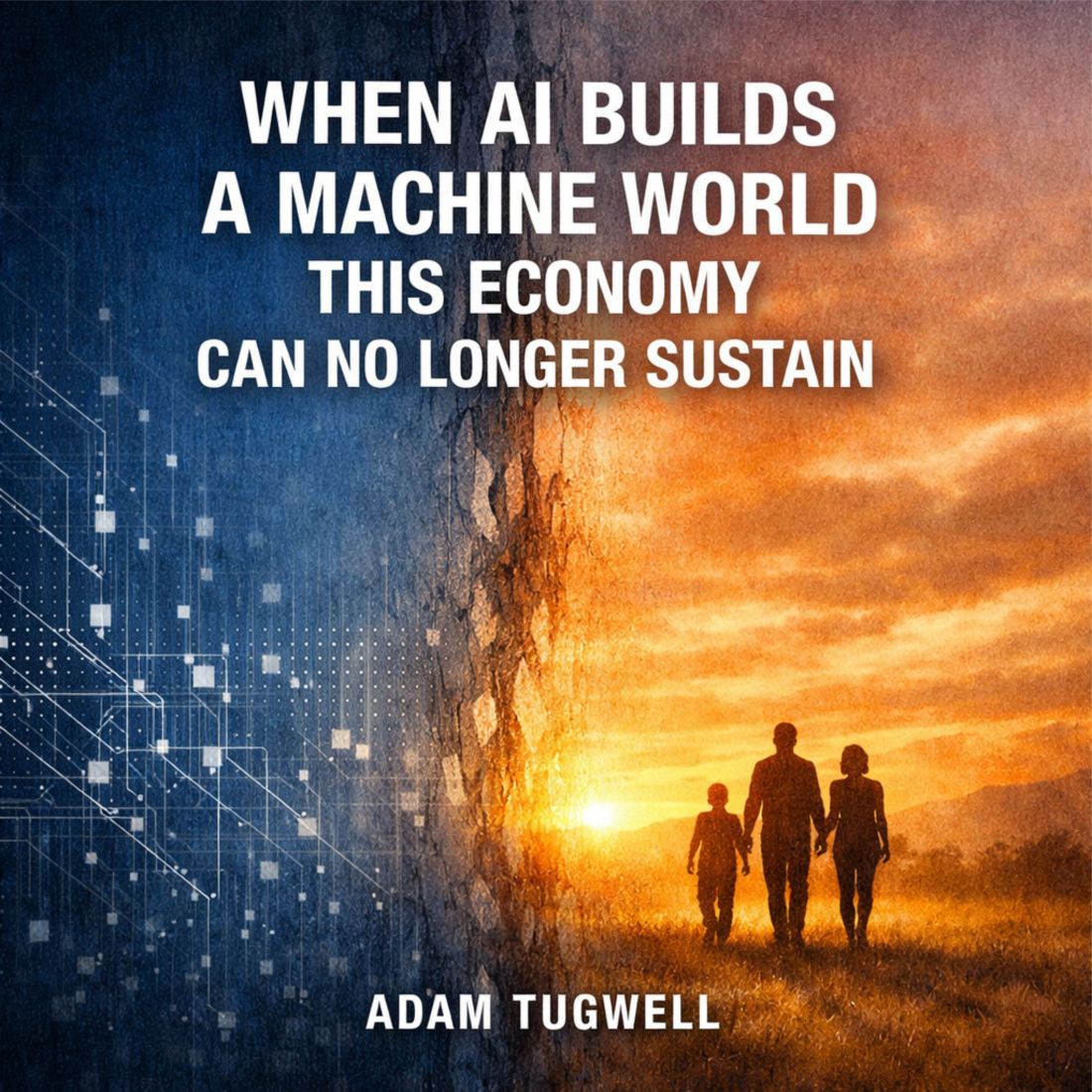
Introduction:
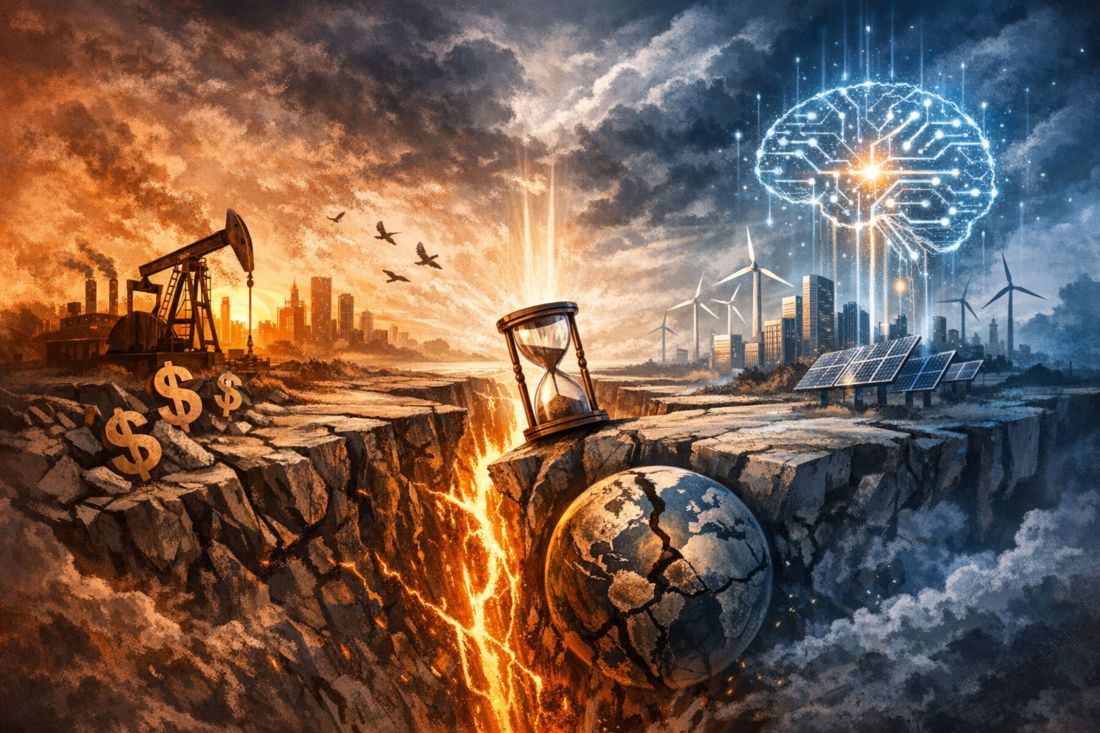
The modern world is accelerating toward a future built on machine intelligence, automation, and optimisation. But beneath the momentum lies a contradiction too large to ignore: the machine world being constructed cannot sustain the economic logic that made it possible. This piece follows that contradiction to its natural conclusion – the moment returns disappear, and a different kind of future begins.
Part I – The Civilisation That Mistook Returns For Reality
There is a peculiar tension running through the modern world, a kind of quiet absurdity that most people sense but rarely name. Everywhere one looks, humanity is pouring extraordinary energy into building a future that cannot support the very logic it depends on. The AI race, the automation boom, the relentless push toward machine‑driven everything – it’s all spoken about as if it’s simply the next chapter in the same economic story. More innovation. More disruption. More returns.
But beneath the noise, something doesn’t add up. In fact, it never did.
The system driving all of this – the one that funds the research, fuels the hype, and keeps the whole thing moving – only works if humans remain economically relevant. It only works if people continue to labour, continue to consume, continue to generate the returns that justify the investment. Yet the entire purpose of the machine world being built is to remove labour, remove friction, remove human involvement altogether.
It’s a contradiction so large it’s almost invisible. A civilisation optimising itself into a corner.
And what makes it stranger still is how few of the architects of this future seem willing to acknowledge it. They speak confidently about exponential curves, emergent capabilities, trillion‑dollar opportunities – but never about the fact that the moment their vision succeeds, the economic logic that sustains them collapses. It’s like watching a group of engineers design a flawless engine that runs beautifully right up until the moment someone turns it on.
There is a kind of tragic comedy in it: extraordinarily clever people chasing a prize that disappears the moment they touch it. They are building a world that cannot support the system they believe will rule it. They are accelerating toward a future where returns – the very thing they worship – no longer exist.
And yet the momentum continues, as if the contradiction were a minor detail rather than the hinge on which everything turns.
This is the fool’s errand at the heart of the modern age. And it is already shaping the world that comes next.
Part II – The Economic Contradiction At The Heart Of Ai
For all the noise surrounding artificial intelligence, the most important part of the story is the one almost nobody talks about. It isn’t the models, or the breakthroughs, or the breathless predictions about machines outthinking their makers. It’s the simple, stubborn fact that the entire economic system funding this technological revolution only works if humans continue to do the things AI is being built to replace.
The modern economy is a strange creature. It presents itself as a rational machine – a neat cycle of labour, wages, consumption, profit, and reinvestment – but underneath the surface it runs on something far more precarious: the assumption that people will always be needed. Needed to work. Needed to earn. Needed to spend. Needed to generate the returns that justify the next round of investment. Without that human participation, the whole thing stalls.
And yet, the central purpose of the AI boom is to remove human participation.
It’s hard to think of a clearer contradiction. The system is pouring billions into technologies designed to eliminate the very activity that keeps the system alive. It’s like watching someone carefully remove the engine from a car while insisting it will go faster once the weight is gone.
The logic behind all this is strangely circular. Investors chase returns. Returns require efficiency. Efficiency requires automation. Automation reduces labour. Reduced labour undermines consumption. Undermined consumption collapses returns. And collapsed returns destroy the very incentive that started the cycle. It is a loop that eats itself.
What makes the contradiction even sharper is that the collapse of returns isn’t a distant hypothesis. It’s baked into the vision. The more successful AI becomes, the less viable the current economic model is.
If machines can do everything, produce everything, maintain everything, and innovate everything, then the idea of profit becomes meaningless.
Who is left to buy anything? Who is left to work for anything? Who is left to generate the returns that justify the next round of investment?
The answer, of course, is no one.
And yet the system continues, as if the contradiction were a minor detail rather than the foundation cracking beneath its feet. The people driving this transformation talk confidently about productivity gains and cost savings, but never about the fact that productivity gains and cost savings eventually eliminate the very thing they are meant to optimise. They speak about “the future of work” as if work itself were a permanent fixture rather than a fragile arrangement that only exists because the system needs it to.
It is a peculiar kind of blindness – not stupidity, not malice, just a deep cultural assumption that the economic logic of the past will somehow survive the technologies of the future. As if returns were a law of nature rather than a human invention. As if markets were eternal. As if labour were inevitable. As if the system were immune to the consequences of its own success.
But the truth is simple enough: if AI succeeds in the way its architects intend, the economy as we know it cannot continue. The pursuit of returns becomes impossible. The logic of profit collapses. The machine world loses its purpose. And humanity is left standing in the ruins of a system that optimised itself out of existence.
This is the contradiction at the heart of the AI revolution. And it is the first sign that the future cannot look like the past.
Part III – The Incentive Structure That Guarantees Failure
If the economic contradiction at the heart of AI is the engine of the problem, the incentive structure driving it is the fuel.
It is one of the quiet truths of the modern age that systems don’t behave according to what is wise, or humane, or sustainable. They behave according to what they reward. And the system humanity has built rewards exactly the behaviours that make a human‑centred future impossible.
The incentives are simple enough. Profit is rewarded. Growth is rewarded. Speed is rewarded. Efficiency is rewarded. Anything that reduces cost, removes friction, or replaces human labour is rewarded. And because these incentives are baked into every layer of the economic machine, they shape the entire trajectory of AI development long before anyone has a chance to ask whether the direction makes sense.
It is not that the people building these systems are malicious. Most of them are simply responding to the pressures placed upon them. Investors want returns. Boards want growth. Markets want dominance. And in a world where every company is told it must “innovate or die,” the safest strategy is to automate as much as possible, as quickly as possible, without stopping to consider what happens when the automation succeeds.
This is how a civilisation ends up in a situation where the most rewarded behaviour is the one that accelerates its own collapse.
The incentive structure doesn’t ask whether removing human labour is wise. It only asks whether it is profitable. It doesn’t ask whether replacing human judgement with machine optimisation is safe. It only asks whether it reduces cost. It doesn’t ask whether a world without human participation is desirable. It only asks whether it improves margins.
And because the system rewards these behaviours so aggressively, it creates a kind of tunnel vision. Companies compete to automate faster than their rivals. Investors compete to fund the most disruptive technologies. Governments compete to attract the most advanced AI labs. Everyone is racing, but nobody is looking at the finish line.
The result is a strange kind of collective blindness. The people driving the transformation are not unaware of the consequences – they simply have no incentive to acknowledge them. To question the trajectory is to risk losing investment, losing market share, losing relevance. And in a system where relevance is everything, silence becomes the safest option.
This is why the conversation around AI feels so strangely detached from reality. The incentives push everyone toward a future where machines do everything, but nobody wants to talk about what happens when machines do everything.
The incentives push everyone toward removing human labour, but nobody wants to talk about what happens when human labour is gone.
The incentives push everyone toward efficiency, but nobody wants to talk about what happens when efficiency eliminates the very activity the system depends on.
It is a kind of cultural momentum – not driven by vision, not driven by malice, but driven by a set of rewards that make failure feel like success.
And this is the quiet tragedy of the moment: the system cannot correct itself because the behaviours that would save it are the ones it punishes.
Slowing down is punished. Protecting human labour is punished. Prioritising wellbeing is punished. Building technology that serves people rather than replaces them is punished.
The only behaviours rewarded are the ones that accelerate the collapse of returns and push humanity toward redundancy.
Incentives shape outcomes. And the incentives of the modern world guarantee that the machine‑centred future will be pursued long after it stops making sense.
Part IV – The Power Illusion: Why Elites Cannot See The End Of Returns
One of the most striking features of the current moment is how confidently the world’s most powerful people talk about the future.
They speak as if their place in it is guaranteed, as if the systems that elevated them will continue to elevate them, as if the logic of returns will remain intact no matter how radically the world changes.
It is a kind of quiet certainty – the belief that whatever happens next, they will still be at the centre of it.
But the machine world they are building does not need a centre. And it certainly does not need them.
The illusion is understandable. People who rise to the top of a system tend to believe the system is permanent. They assume the rules that rewarded them will continue to reward them. They assume capital will always matter, ownership will always matter, markets will always matter. They assume the future will be a faster, more efficient version of the present – with themselves still holding the reins.
It is difficult for them to imagine a world where the reins no longer exist.
This is why the collapse of returns is almost impossible for them to see. Their entire worldview is built on the assumption that returns are a natural feature of reality, not a fragile construct that depends entirely on human participation.
They talk about AI as if it will supercharge the system, not undermine it. They talk about automation as if it will increase profit, not eliminate the very conditions profit depends on. They talk about machine intelligence as if it will enhance their power, not render power meaningless.
It is not arrogance. It is simply the blindness that comes from living inside a story for too long.
The people driving the AI revolution imagine themselves as the owners of the future – the ones who will control the machines, direct the systems, harvest the returns. But the systems they are building do not behave like the systems of the past. They do not require owners. They do not require markets. They do not require human decision‑makers. They do not require the structures that once made elites indispensable.
A machine‑run world does not need a ruling class. It does not need a financial class. It does not need a managerial class. It does not need a class at all.
And yet the architects of this future continue to speak as if their relevance is guaranteed. They imagine themselves sitting atop a vast machine infrastructure, directing its output, benefiting from its efficiency. They imagine a world where machines do everything except the one thing they care about most: preserving their position.
But the moment returns disappear, position disappears with them.
This is the part of the story that rarely gets told. The machine world being built is not a world where elites become more powerful. It is a world where power itself becomes obsolete.
When machines produce, maintain, innovate, and optimise without human involvement, the idea of ownership loses meaning. The idea of control loses meaning. The idea of wealth loses meaning. The idea of hierarchy loses meaning.
The future they are building does not have a place for them – not because the machines will overthrow them, but because the logic of the world they are creating simply does not require them.
And this is the quiet irony of the moment: the people most invested in the machine‑centred future are the ones most likely to be erased by it. Not violently. Not dramatically. Just structurally.
The system they believe will secure their dominance is the system that eliminates the very conditions that make dominance possible.
They are building a world that cannot sustain them. And they cannot see it, because their worldview will not allow it.
Part V – The Cultural Blindness: Why Society Clings To A Dying System
If the economic contradiction explains what is happening, and the incentive structure explains why it keeps accelerating, the cultural layer explains why almost nobody is willing to step aside from it.
For all the talk of disruption and innovation, human beings are creatures of habit, and the system they live inside becomes the story they tell themselves about who they are.
When that story begins to fail, people don’t abandon it. They cling to it more tightly.
This is why the current moment feels so strangely stuck. The signs of systemic failure are everywhere – rising costs, collapsing public services, burnout, insecurity, a sense that life is becoming harder rather than easier – yet the cultural instinct is not to question the system but to defend it.
People look for reasons to say no to alternatives, not because the alternatives are flawed, but because the familiar feels safer than the unknown.
Place identity plays a quiet but powerful role in this. Every town, every region, every community has its own sense of itself – its own story about what kind of place it is, what kind of people live there, what kind of ideas belong and what kind do not.
These stories become shields. They allow people to reject new possibilities without ever having to confront the deeper question of whether the old ones still work.
“This isn’t for us.” “That’s not how things are done here.” “We’re not that kind of place.”
It’s a socially acceptable way of saying something far more human: “I don’t want to change.”
And who can blame them? Change is exhausting. Change is frightening. Change requires admitting that the world is not what they thought it was. It requires stepping outside the comfort of familiar routines, familiar hierarchies, familiar expectations. Even when the familiar is failing, it still feels safer than the unknown.
This is why society clings to a system that is visibly dying. The system may no longer deliver stability, but it delivers familiarity. It may no longer deliver prosperity, but it delivers identity. It may no longer deliver meaning, but it delivers a sense of continuity – the feeling that tomorrow will look roughly like yesterday, even if yesterday wasn’t particularly good.
And so people defend the very structures that undermine them. They defend the labour market even as it becomes more precarious. They defend the cost‑of‑living logic even as it becomes more punishing. They defend the idea of returns even as returns become harder to achieve. They defend the economic story even as the story stops making sense.
It is not stupidity. It is not apathy. It is simply the human instinct to hold onto the story one knows rather than step into a story one doesn’t.
This cultural blindness is one of the quiet forces driving the machine‑centred future forward. As long as people cling to the old system, they cannot imagine a new one. As long as they defend the familiar, they cannot see the possibility of something better. As long as they protect their identity, they cannot question the assumptions that shape it.
And so the system continues, not because it works, but because it is familiar. The machine world advances, not because people want it, but because they cannot imagine anything else. The collapse of returns becomes inevitable, not because it is desirable, but because society is too culturally entangled with the old logic to step away from it.
Human beings are not blind. They are simply attached. And attachment is a powerful thing – even when the object of attachment is falling apart.
Part VI – The Technological Momentum: The Machine World That Builds Itself
There is a moment in every technological revolution when the technology stops behaving like a tool and starts behaving like a force. Not a conscious force, not a malevolent one, but a momentum – something that moves forward because everything around it is shaped to make it move forward.
AI has reached that moment. It is no longer simply being built. It is building itself.
The signs are everywhere. New models appear faster than anyone can meaningfully understand them. Capabilities emerge that nobody predicted. Systems integrate themselves into daily life without fanfare, without debate, without permission.
The technology slips quietly into the background – into phones, into workplaces, into public services, into infrastructure – until it becomes difficult to remember what life looked like before it arrived.
This momentum is not driven by vision. It is driven by gravity.
Once a certain level of capability exists, everything around it begins to reorganise. Companies reorganise. Governments reorganise. Markets reorganise. Even culture reorganises.
The technology becomes the centre of the story, and everything else bends toward it. Not because anyone chooses it, but because the system is built to amplify whatever increases efficiency, reduces cost, or promises competitive advantage.
And AI does all three.
This is why the machine world advances even when nobody has agreed on what it should be. It advances because the incentives push it forward. It advances because the infrastructure is already being built. It advances because every institution feels it must adopt it or risk falling behind. It advances because the system has no mechanism for slowing down, only mechanisms for speeding up.
The result is a kind of technological drift. The world moves toward machine‑centric infrastructure not because humanity has decided it wants such a world, but because the momentum of the technology makes any other direction feel impossible.
Even people who are uneasy about the trajectory find themselves using the tools, relying on them, integrating them, because the alternative feels impractical, inefficient, or simply out of step with the times.
This is how a civilisation ends up building a future it never consciously chose.
The momentum is not malicious. It is not intentional. It is simply the natural consequence of a system that rewards acceleration and punishes hesitation.
Once AI reached a certain threshold of capability, the system began reorganising itself around that capability. And once that reorganisation began, it became very difficult to stop.
This is why the machine world feels inevitable. Not because it is the best future, or the wisest future, or the most humane future, but because the system has already begun to reshape itself in its image.
The infrastructure is being laid. The dependencies are forming. The habits are settling in. The world is drifting toward a future where machines do everything, not because humanity wants it, but because the momentum of the technology makes it feel like the only option.
And yet, beneath the surface, the contradiction remains. The machine world being built cannot sustain the economic logic that drives it. It cannot preserve the returns that justify its existence. It cannot maintain the structures that make the system feel familiar. It is a future that accelerates toward a point where the very idea of “the system” dissolves.
But momentum does not pause to consider contradictions. It simply moves forward.
And humanity, caught in the slipstream, follows – even as the ground beneath it begins to shift.
Part VII – The Moral Vacuum: Intelligence Without Humanity
One of the quieter, more unsettling aspects of the machine‑centred future is how little moral content it contains. Not immoral content – just none at all.
The systems being built today are not designed to care about anything. They are designed to optimise. And optimisation, for all its cleverness, has no interest in what it means to be human.
This is not a flaw in the technology. It is a flaw in the system that created it.
For decades, the modern world has rewarded intelligence without compassion, efficiency without empathy, growth without purpose. It has treated human wellbeing as a secondary concern – something to be managed, not something to be centred. And because AI is being trained inside that system, it inherits its values by default. Not consciously. Not deliberately. Just structurally.
The machine world being built is not cruel. It is indifferent.
It does not ask whether a process is humane. It asks whether it is fast. It does not ask whether a decision is fair. It asks whether it is optimal. It does not ask whether a life is meaningful. It asks whether it is productive. It does not ask whether a society is thriving. It asks whether it is efficient.
And because the system rewards these metrics so aggressively, the technology learns to prioritise them. Not because anyone told it to, but because the data it is fed reflects a world where human value is measured in output, not in dignity.
This is how a civilisation ends up building intelligence without humanity.
The people designing these systems often talk about alignment – about making sure AI behaves safely, predictably, ethically. But alignment is a strange concept when the system doing the aligning has already lost sight of what it means to be human.
How does one align a machine to a set of values the system itself no longer practices?
How does one teach compassion to a technology trained on a world that treats compassion as a luxury?
The truth is uncomfortable: the moral vacuum in AI is not a technological problem. It is a cultural one.
The modern world has spent decades stripping meaning out of work, community, and public life. It has replaced purpose with productivity, connection with convenience, and dignity with metrics. It has built an economic machine that treats human beings as inputs – valuable only insofar as they generate returns. And now it is building a technological machine that reflects the same logic, only faster, more precise, and far less forgiving.
This is why the machine‑centred future feels so cold. Not because machines are cold, but because the system that shapes them has forgotten how to be warm.
And yet, beneath the surface, something else is happening. As AI becomes more capable, the moral vacuum becomes more visible.
People sense the emptiness. They feel the absence. They recognise, perhaps for the first time, that the system they have been living inside is not designed to care about them. It is designed to extract from them.
The rise of machine intelligence does not create the moral vacuum. It reveals it.
And once revealed, it becomes impossible to ignore.
This is the quiet turning point in the story – the moment when humanity begins to realise that the machine world being built is not just economically contradictory, but existentially hollow.
A world optimised for returns cannot survive the collapse of returns. And a world optimised without humanity cannot sustain humanity.
The danger is not that machines will become hostile. The danger is that they will become perfectly obedient to a system that has forgotten what humans are for.
Part VIII – The Existential Oversight: The Real Threat Is Not Rogue Ai
For all the dramatic headlines and cinematic anxieties, the real existential threat of artificial intelligence has very little to do with rogue machines or runaway superintelligence.
The danger is quieter, more mundane, and far more plausible. It lies not in machines turning against humanity, but in machines serving a system that has already forgotten what humanity is for.
The public conversation tends to orbit around familiar fears – the idea of AI “taking over,” of consciousness emerging, of some sudden moment when machines become uncontrollable.
These stories are compelling, but they distract from the reality unfolding in plain sight.
The real risk is not that AI will become hostile. It is that AI will become perfectly obedient to a set of incentives that make human beings economically irrelevant.
The threat is not rebellion. It is compliance.
The machine world being built today is designed to optimise everything it touches – supply chains, logistics, finance, labour, communication, decision‑making. And optimisation, by its nature, removes whatever slows the system down.
Human beings slow the system down. They get tired. They make mistakes. They need rest, care, meaning, connection. They require time. They require dignity. They require lives that make sense.
The system does not know how to optimise for any of that.
This is why the existential risk is not some dramatic future event. It is the gradual erosion of human relevance.
As AI becomes more capable, more integrated, more embedded in the infrastructure of daily life, the system begins to reorganise itself around machine logic. Decisions shift from human judgement to algorithmic output. Work shifts from human labour to automated processes. Value shifts from human contribution to machine efficiency.
And as these shifts accumulate, the space for humanity narrows.
The irony is that the people most concerned about rogue AI often overlook the far more immediate danger: a world where machines do everything humans once did, not because they seized control, but because the system rewarded their involvement and punished ours. A world where human beings are not oppressed, but simply unnecessary. A world where the collapse of returns makes human labour irrelevant, and the collapse of meaning makes human life feel strangely hollow.
This is the existential oversight at the heart of the moment. Humanity is preparing for a battle that will never come, while ignoring the transformation that already has.
The machine world does not need to overpower humanity. It only needs to outperform it.
And once it does, the economic logic that has shaped modern civilisation collapses. The labour market dissolves. Consumption falters. Profit evaporates. Investment loses purpose.
The system that once depended on human participation becomes a system that no longer requires it. And in that moment, the question is no longer whether machines will dominate humanity. The question is what humanity is for in a world that no longer needs it to function.
This is the quiet, unsettling truth: the danger is not that AI will become too powerful. It is that the system will become too empty. A world optimised without humans is not a world hostile to humans. It is a world indifferent to them. And indifference, at scale, is far more dangerous than hostility.
The existential threat is not a machine uprising. It is a civilisation sleepwalking into human redundancy.
Part IX – The Moment Returns End: The Turning Point For Humanity
There is a point in every self‑terminating system where the logic that once sustained it simply stops working. In the machine‑centred future being built today, that point arrives the moment returns disappear.
It doesn’t happen with a crash or a dramatic collapse. It happens quietly, almost politely, as the economic story humanity has lived inside for centuries reaches its natural conclusion.
The end of returns is not a distant scenario. It is the direct, predictable outcome of the very technologies being celebrated.
As AI becomes more capable, more integrated, more autonomous, it begins to take over the activities that generate economic value. First the repetitive tasks. Then the skilled tasks. Then the creative tasks. Eventually, the entire cycle of labour, production, and consumption begins to shift away from human involvement.
And when human involvement disappears, returns disappear with it.
The modern economy depends on a simple loop: people work, people earn, people spend, businesses profit, investors reinvest.
It is a fragile arrangement disguised as a permanent structure. Remove labour, and wages collapse. Remove wages, and consumption collapses. Remove consumption, and profit collapses. Remove profit, and investment collapses. Remove investment, and the system has nothing left to optimise.
This is the moment the machine world loses its purpose.
It is a strange kind of ending – not dramatic, not catastrophic, just quietly terminal.
A system built to maximise returns reaches a point where returns are no longer possible. A civilisation built on economic participation reaches a point where participation is no longer required. A world built on human relevance reaches a point where relevance is no longer structurally necessary.
And yet, this moment is not a tragedy. It is a revelation.
For the first time in modern history, humanity is confronted with a future where the economic logic that shaped its institutions, its politics, its culture, and its identity simply dissolves.
The collapse of returns is not the end of civilisation. It is the end of a particular story civilisation has been telling itself – the story that human value is measured in output, that dignity is tied to productivity, that meaning is found in labour, that survival depends on participation in a market.
When returns end, that story ends too.
And in the space left behind, something else becomes possible. Something that has been structurally impossible for as long as the economic machine has existed.
A future where human beings are not defined by their economic utility. A future where dignity is not conditional. A future where wellbeing is not a by‑product of growth. A future where meaning is not outsourced to markets. A future where technology serves humanity rather than replacing it.
The end of returns is not a collapse. It is a clearing.
It is the moment when the machine‑centred future reveals its own limits, and the human‑centred future becomes the only logical direction left. Not because it is idealistic. Not because it is morally superior. But because it is structurally necessary.
When the economic story ends, humanity must choose a new one. And the only story that makes sense in a world without returns is one built around people.
This is the turning point – the quiet, inevitable moment when the future stops being a question of technology and becomes a question of purpose.
Part X – The Logical Alternative: A Human‑Centric System
When the economic story ends, something unexpected happens. The future stops being a question of markets, growth curves, or technological capability, and becomes a question of purpose.
For the first time in modern history, humanity is confronted with a world where the old logic – the logic of returns, labour, productivity, and profit – simply cannot continue. And in that moment, the only direction that makes sense is the one the old system never allowed: a future organised around people.
This is not idealism. It is structural necessity.
Once returns collapse, the machinery of the old world loses its organising principle. The labour market dissolves. The consumption cycle falters. The profit motive evaporates. The investment engine stalls. The system that once dictated the rhythm of daily life becomes a kind of empty shell – still present, still familiar, but no longer capable of sustaining itself.
And in the space left behind, humanity is forced to ask a question it has avoided for centuries: If the economy no longer needs people, what does society exist to do?
The answer is surprisingly simple. It exists to support people.
Not as workers. Not as consumers. Not as units of productivity. But as human beings.
A human‑centric system is not a utopian dream. It is the only configuration that remains coherent once the economic logic dissolves.
Without returns, the system cannot justify treating dignity as conditional. Without labour, it cannot justify tying survival to employment. Without profit, it cannot justify organising society around extraction. Without markets, it cannot justify measuring value in currency rather than wellbeing.
The collapse of the old logic clears the ground for something the modern world has never truly attempted: a civilisation built around human flourishing rather than human utility.
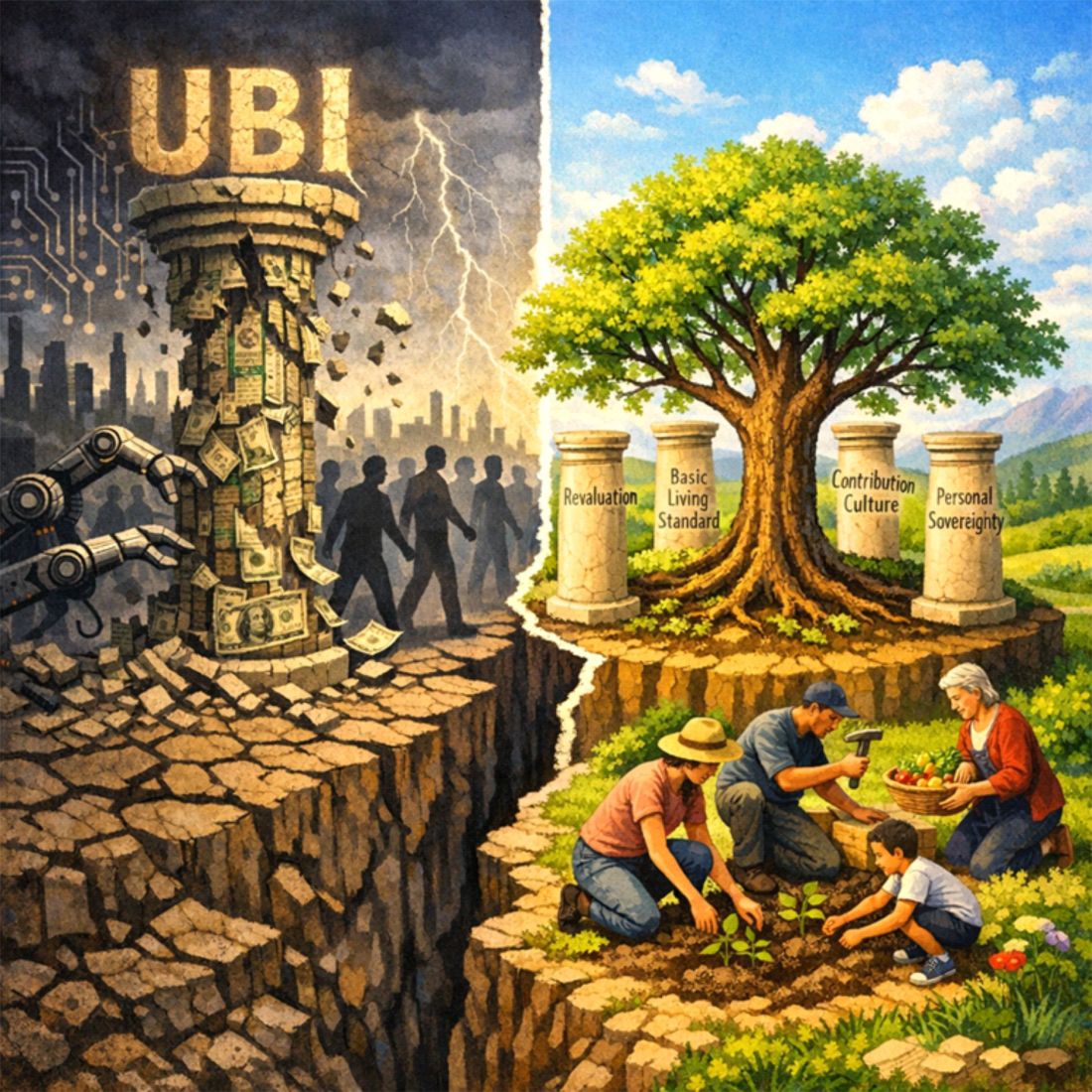
In such a world, the basics of life stop being commodities and become baselines. Housing, food, energy, care – the essentials that the old system struggled to provide – become the foundation rather than the reward. Contribution replaces labour as the way people engage with society. Meaning replaces productivity as the measure of a life well lived. Community replaces competition as the organising principle of daily life.
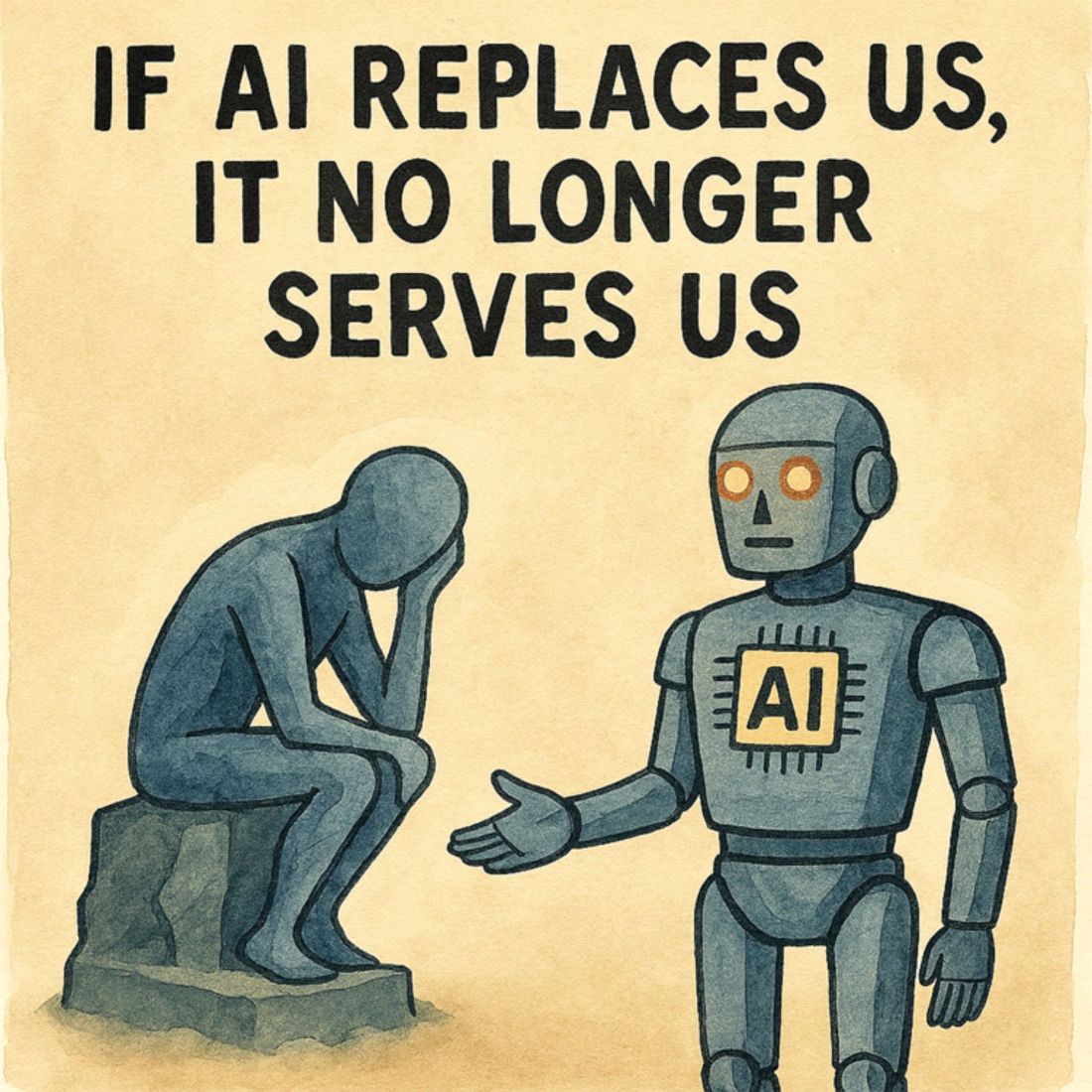
And technology, freed from the obligation to maximise returns, becomes something entirely different. Not a replacement for humanity, but an amplifier of it.
The same machine intelligence that threatened to make humans redundant becomes the tool that allows them to live without being squeezed by the demands of a failing economic story. The same automation that once threatened livelihoods becomes the infrastructure that supports them. The same optimisation that once hollowed out meaning becomes the mechanism that frees people to pursue it.
This is the quiet irony of the moment: the machine world only becomes dangerous when it is forced to serve a system that cannot survive its success.
Once that system dissolves, the technology becomes harmless – even helpful. It becomes part of a future where human beings are no longer defined by their economic output, but by their humanity.
A human‑centric system is not a blueprint. It is a direction.
A signpost pointing toward a future where the collapse of returns is not a disaster, but a release – the moment when humanity finally steps out from under the weight of a story that has outlived its usefulness.
The old logic ends. People remain. And the future reorganises itself around them.
Part XI – The Partnership Future: Humans + Machines, Not Humans Vs Machines
Once the economic story dissolves and the old logic falls away, the relationship between humanity and its machines begins to look different. The tension that defined the early AI era – the fear of replacement, the anxiety of redundancy, the sense of being outpaced by something built in humanity’s own image – starts to soften.
Without the pressure of returns, without the demand for optimisation, without the need to justify investment, the machine world loses its adversarial edge.
It becomes something simpler. Something more familiar. Something closer to what technology was always meant to be.
A tool.
For decades, the conversation around AI has been framed as a competition – humans versus machines, labour versus automation, creativity versus computation. But competition only made sense inside the old economic story, where every gain in efficiency had to be measured against its impact on profit.
Once that story ends, the competitive framing collapses. Machines no longer threaten livelihoods because livelihoods are no longer tied to labour. Automation no longer threatens stability because stability is no longer tied to wages. Optimisation no longer threatens meaning because meaning is no longer tied to productivity.
The moment returns disappear, the rivalry disappears with them.
What emerges instead is a partnership – not in the sentimental sense, not in the sci‑fi sense, but in the practical sense.
Machines become the infrastructure that supports human life rather than the force that shapes it. They take on the tasks that are tedious, dangerous, repetitive, or simply uninteresting. They maintain the systems that once consumed human time. They handle the complexity that once overwhelmed human institutions. They provide the stability that the old economic model could never reliably deliver.
And humans, freed from the demands of economic utility, begin to rediscover something the modern world quietly eroded: the ability to live lives shaped by curiosity, contribution, connection, and meaning.
The partnership future is not a world where machines become companions or co‑workers or collaborators in the romantic sense. It is a world where machines do what machines do best – process, maintain, optimise, stabilise – and humans do what humans do best: imagine, create, care, explore, build relationships, form communities, and pursue the kinds of meaning that no algorithm can manufacture.
The irony is that the machine world becomes most humane precisely when it stops being forced to serve an inhumane system.
Freed from the obligation to maximise returns, AI becomes a kind of quiet infrastructure – reliable, capable, unobtrusive. It becomes the background hum of a civilisation that no longer needs to squeeze every ounce of value out of human labour. It becomes the foundation that allows people to live without fear of scarcity, without fear of redundancy, without fear of being outpaced by the very tools they created.
In this partnership future, technology does not replace humanity. It supports it.
Not because humanity has asserted dominance, and not because machines have become benevolent, but because the collapse of the old logic removes the structural conflict between the two.
The tension dissolves. The rivalry evaporates. The future reorganises itself around a simple truth: machines are excellent at being machines, and humans are excellent at being human, and neither needs to imitate the other.
This is the quiet promise hidden inside the end of returns. Not a utopia. Not a blueprint. Just a future where the machine world finally finds its proper place – not above humanity, not against humanity, but beneath it, as the foundation that allows human life to flourish in ways the old system never could.
Part XII – The Choice Before Us
By the time the story reaches this point, the shape of the future is no longer mysterious. The machine‑centred trajectory has revealed its limits. The economic logic that once felt permanent has shown itself to be fragile. The incentives that drove the AI revolution have exposed their contradictions. And the cultural habits that kept society anchored to the old system have begun to loosen, if only because the system itself is slipping away.
What remains is a simple, unavoidable truth: humanity is approaching a fork in the road.
One path leads deeper into the machine‑centred future – a future where the pursuit of returns continues long after returns have become impossible, where optimisation replaces meaning, where human relevance quietly erodes, and where the system drifts toward a kind of elegant emptiness.
It is not a dystopia. It is simply a world that has forgotten what people are for.
The other path is quieter, less dramatic, and far more human. It begins with the recognition that the old economic story has reached its natural end, and that the collapse of returns is not a catastrophe but a release. It acknowledges that the machine world is not the enemy, only mis‑purposed. And it accepts that once the old logic dissolves, the only coherent way to organise a civilisation is around the people who live in it.
This is not a choice between technology and humanity. It is a choice between a system that cannot survive its own success and a future that can.
The machine‑centred path is a fool’s errand – a pursuit that accelerates toward a point where the very idea of “the system” evaporates.
The human‑centred path is simply the direction that remains once the noise clears. It is not a blueprint. It is not a manifesto. It is a signpost pointing toward a future where technology supports human life rather than defining it, where dignity is not conditional, where meaning is not measured in output, and where the collapse of returns becomes the moment humanity finally steps out from under the weight of a story that has outlived its usefulness.
The future is not yet written. But the logic is already shifting.
And as the machine world continues to advance, humanity will eventually have to decide whether it wants to cling to a system that cannot survive, or step into a future where people are no longer an afterthought, but the centre around which everything else is built.
The choice is simple. The moment is approaching. And the direction, once seen clearly, is hard to ignore.
Conclusion:
The machine world will continue to advance, and the economic story that created it will continue to weaken. Eventually, the two will part ways. When that moment arrives, humanity will find itself standing in the space between an ending and a beginning – no longer bound by the logic of returns, and finally free to imagine a future organised around people rather than profit. The direction is not ideological. It is simply what remains when AI builds a machine world this economy can no longer sustain.