This book is not intended as a definitive account of Britain, its history, its institutions or its future.
It is an interpretation of the events that have led to the circumstances in which Britain now finds itself and the reality of the position this leaves the country in.
The arguments presented here are offered in the hope of encouraging curiosity rather than certainty, inquiry rather than agreement, and independent thought rather than passive acceptance. Readers are encouraged to test the claims, challenge the assumptions, examine the sources and draw their own conclusions.
Many of the questions explored in these pages have no simple answers. They concern complex systems, long historical processes, competing values and deeply human decisions. Reasonable people will disagree on causes, consequences and solutions. Such disagreement is not a weakness. It is part of the process by which understanding develops.
The central purpose of this book is not to tell readers what to think. It is to encourage them to think more deeply about the structures that shape everyday life: the relationship between money and production, ownership and responsibility, efficiency and resilience, growth and capability, politics and power.
If the book succeeds, it will not be because it settles an argument. It will be because it helps readers ask better questions.
Above all, it is written from the belief that understanding is a form of empowerment. Citizens who understand the systems around them are better able to participate in them, challenge them, improve them and, where necessary, rebuild them.
The future is unlikely to be shaped by those who possess all the answers. It will be shaped by those willing to question assumptions, seek understanding and take responsibility for what comes next.
Introduction – What This Book Is Trying to Explain
This book is an argument about Britain’s decline, but it is not an argument about villains or the attribution of blame. It is not written to prove that one party, one class, one generation, or one institution deliberately destroyed the country. The story is more difficult than that.
The argument developed here is that Britain was gradually reshaped by a worldview: a way of thinking that treated scale as progress, financial efficiency as wisdom, and global dependency as modernity.
For decades, this worldview felt sensible. It promised lower prices, better management, private investment, global competitiveness and a more sophisticated economy. In some ways, it delivered real benefits. But it also carried costs that were poorly understood at the time.
This book asks the reader to follow those costs as they moved from policy into ownership, from ownership into supply chains, from supply chains into communities, from communities into capability, and finally from capability into the cost of everyday life.
It is written as a narrative rather than an academic paper. Where the prose is forceful, it is because the human consequences are forceful. But the central claim should be read as an interpretation:
Britain’s present difficulties are not only fiscal, political or managerial. They are also problems of capability – of what a country can still make, repair, sustain, teach, remember and control.
Working Definitions
Worldview means the shared assumptions through which institutions decide what counts as sensible, modern or realistic.
Capability means the accumulated skills, supply chains, institutions, infrastructure, habits and relationships that allow a society to produce, repair, maintain and adapt.
Financialisation means the growing dominance of financial logic – debt, leverage, asset values, yield and shareholder returns – over productive logic such as making, maintaining, training and serving.
Resilience means the ability of a country, community or system to withstand shocks without losing the essentials of life.
How to Read This Book
This book moves in four stages. Parts I to IV explain the worldview, monetary architecture and ownership changes that altered Britain’s incentives. Parts V to VII show how those incentives moved through production, local life and legislation. Part VIII explains how decline was narrated as progress. Parts IX and X bring the argument to its destination: first by asking what capability means in everyday life, and then by confronting a place called stop and what now lies ahead.
The reader does not need to agree with every claim to follow the central question:
What happens to a country when it optimises for cheapness, scale and financial return while neglecting the slow work of maintaining capability?
One distinction matters throughout: economic activity is not the same as national capability. A country can move money, import goods and record growth while losing the practical ability to make, repair, maintain and adapt.
Part I – The World Britain Thought It Lived In
The establishment as a worldview, not a class
For most of the past half‑century, Britain has lived inside a comforting illusion. We believed we understood who ran the country, how decisions were made, and what the “establishment” really was. We imagined a familiar cast of characters – wealthy families, old institutions, political grandees, newspaper barons, the usual suspects. We thought power lived in people.
But the truth is stranger, and far more difficult to face.
The modern establishment is not a class. It is a worldview.
It is a way of seeing the world that became so normal, so widely accepted, so deeply embedded in public life, that almost nobody noticed it happening. It didn’t arrive with a revolution or a manifesto. It arrived quietly, through a thousand small decisions, each one justified at the time, each one presented as progress.
This worldview has three core beliefs:
Scale is always better than locality.
Financial efficiency is always better than human meaning.
Global systems are always more reliable than local capability.
These beliefs didn’t come from a conspiracy. They came from a generation of policymakers, economists, civil servants, business leaders, and commentators who genuinely thought they were modernising Britain. They believed they were making the country more competitive, more efficient, more advanced.
Because they believed it, they taught it. Because they taught it, others believed it too. And because others believed it, it became the air everyone breathed.
This is how a worldview becomes an establishment.
Not through secret meetings or hidden hands, but through consensus – a consensus so strong that it becomes invisible.
Once this worldview took hold, many of the decisions that followed began to look inevitable.
The worldview that hollowed out Britain
This worldview told us that:
local businesses were old‑fashioned,
local supply chains were inefficient,
local skills were outdated,
local communities were sentimental,
local capability was unnecessary in a modern world.
It told us that:
globalisation was progress,
offshoring was smart,
privatisation was modern,
financialisation was sophisticated,
centralisation was efficient.
It told us that:
cheaper goods meant improvement,
foreign ownership meant investment,
deregulation meant freedom,
consolidation meant strength.
And because the worldview was everywhere – in politics, in media, in academia, in business – nobody questioned it. It didn’t feel ideological. It felt normal.
This is why the story of Britain’s decline is so hard for people to see. It didn’t happen through dramatic events. It happened through normality.
Through decisions that felt sensible, reforms that felt modern, and changes that felt inevitable.
The establishment didn’t hide anything. It simply didn’t see what it was destroying.
The cost of a worldview
When a worldview becomes the establishment, it becomes the lens through which every problem is interpreted and every solution is designed. And because this worldview worshipped scale, efficiency, and global systems, it treated local capability as expendable.
Local businesses weren’t just economic units. They were the infrastructure of everyday life.
They were:
the places where people learned skills,
the places where communities gathered,
the places where meaning was created,
the places where resilience lived.
But the worldview didn’t see any of that. It saw inefficiency. It saw duplication. It saw cost.
And so, step by step, local capability was dismantled.
Not because anyone hated communities. Not because anyone wanted decline. But because the worldview made decline look like progress.
This is the tragedy at the heart of the story.
This book argues that Britain did not fall because of a small group of villains. It declined because a set of beliefs became so dominant that they were mistaken for common sense.
Beliefs that were never questioned. Beliefs that shaped every policy. Beliefs that became the establishment.
The moment the worldview became a trap
By the time we reached the 1990s and 2000s, the worldview was so dominant that politicians no longer had room to think outside it. They inherited a system built on assumptions they didn’t create and couldn’t escape.
This is why modern politicians often find the inheritance so difficult. They are not simply choosing within a free system. They are operating inside assumptions that already define what counts as realistic.
Those assumptions had already:
dismantled local capability,
hollowed out national resilience,
replaced production with financial extraction,
and left Britain dependent on global systems it cannot control.
This matters because the real state of the economy is not only a matter of budgets, forecasts and announcements. It is also the deeper state of national capability.
The worldview sets the boundaries of what politicians are told is possible, realistic, modern and acceptable.
And much of what it tells them no longer fits the country they are trying to govern.
Part II – When Money Stopped Being Real
The quiet revolution that changed everything
If you want to understand how Britain changed, you have to start with something that sounds almost too simple: money stopped being real.
Not in the sense that it became imaginary or worthless. But in the sense that it stopped being tied to anything solid – anything you could touch, measure, or limit. It became something that could be created at will, by institutions most people never see and never think about.
This shift didn’t happen overnight. It didn’t happen with fanfare. It didn’t happen with public debate.
It happened quietly, through technical reforms, banking changes, and political decisions that were presented as modernisation. And because the worldview of the time worshipped efficiency and global integration, nobody questioned it.
But the consequences were enormous.
The old world: money as something earned
For most of Britain’s history, money represented something real:
gold,
labour,
production,
land,
goods,
services.
If you wanted money, you had to earn it. If you wanted to buy something, you had to save for it. If you wanted to invest, you had to risk something you already had.
This created a natural limit – a boundary that kept the economy connected to reality.
People understood money because they lived inside its constraints.
The new world: money as something created
But in the late 20th century, Britain – like most advanced economies – shifted fully to a fiat system. Money no longer represented anything physical. It became a promise backed by government and created by banks.
When a bank issues a loan, it doesn’t hand over existing money. It creates new money.
It types numbers into a system, and those numbers become purchasing power.
This sounds abstract, but it changed everything.
This does not mean banks can create money without limit. Regulation, capital requirements, profitability, repayment, interest rates and monetary policy all constrain the process. But it does mean that access to credit became central to who could buy assets, consolidate industries and shape the economy.
It meant that:
those with access to the banking system could buy anything,
money could be created faster than value,
debt could expand more rapidly than productive capacity,
and financial actors could acquire assets the public could never afford.
This is the moment where the worldview of efficiency and scale fused with a monetary system that rewarded extraction over creation.
And once that fusion happened, the old economy – the one built on production, locality and capability – was placed under immense pressure.
The new rules of the game
In the old world, you built a business by:
making things,
selling things,
hiring people,
training apprentices,
serving communities.
In the new world, you built a business by:
borrowing money created from nothing,
buying existing businesses,
breaking them up,
selling the parts,
and always extracting value.
The first world created capability. The second world extracted it.
The first world built communities. The second world hollowed them out.
The first world rewarded patience, skill, and service. The second world rewarded speed, leverage, and financial engineering.
This wasn’t a conspiracy. It was a change in the rules.
And once the rules changed, a new kind of operator emerged.
The public didn’t see it because nothing looked dramatic
There were no riots. No revolutions. No sudden collapses.
Factories closed quietly. Businesses were bought quietly. Assets were sold quietly. Supply chains moved quietly. Communities hollowed out quietly.
People didn’t see the change because each step was small. Each decision made sense. Each reform was justified.
But underneath the surface, the foundations were shifting.
Money was no longer earned – it was created. Value was no longer built – it was extracted. Capability was no longer nurtured – it was dismantled.
And Britain was no longer an economy built on production. It was becoming an economy built on financial throughput.
Part III – The Rise of Financial Operators
How a new kind of businessman revealed the new rules of the game
The shift in money – from something earned to something created – didn’t immediately change the world. Most people didn’t notice it at all. Life looked the same. Shops were open. Factories were running. Communities were intact. The country still felt familiar.
But beneath the surface, the rules had changed.
And the first people to realise it were not politicians, civil servants or economists. They were business operators: people who lived in the world of deals, acquisitions and balance sheets, and who understood that if money could be created through credit, then the old logic of business no longer applied in the same way.
One of the earliest and most visible of these figures was Sir James Goldsmith.
Goldsmith didn’t invent the new system. He simply saw it earlier than most.
He realised that in a world where money could be conjured into existence through debt, the most valuable thing about a company wasn’t its future – it was its parts.
A factory could be sold. A brand could be sold. A supply chain could be sold. A piece of land could be sold. A division could be sold. A patent could be sold.
And the pieces were often worth more than the whole.
This was the moment when break‑up value became more important than productive value. It was the moment when financial logic overtook industrial logic. It was the moment when extraction became more profitable than creation.
Goldsmith didn’t do anything illegal. He didn’t do anything hidden. He didn’t do anything conspiratorial.
He simply played the game the new monetary system made possible.
And once he demonstrated how profitable it was, thousands followed.
The new business model
Before the monetary shift, business success meant:
building things,
hiring people,
training apprentices,
serving communities,
creating value over time.
After the monetary shift, business success increasingly meant:
borrowing money created from nothing,
buying existing businesses,
breaking them apart,
selling the pieces,
extracting value quickly.
This wasn’t ideology. It wasn’t politics. It wasn’t conspiracy.
It was incentives.
And once incentives shift, behaviour follows.
Goldsmith’s later realisation
There is a part of Goldsmith’s story that matters deeply to this story.
Later in life, he turned fiercely against the European Union. Whatever one thinks of that position, it appears to have reflected a deeper unease:
He had been part of a system much larger than himself – a system that rewarded extraction, centralisation, and financial logic at the expense of national capability, local resilience, and democratic control.
He did not attack the monetary architecture directly. He did not attack the financial system in the same way. Instead, he attacked the part of the system he could challenge – the visible political structure.
His shift wasn’t hypocrisy. It was recognition.
And it foreshadows the political trap explored later in this book: the moment when promises made in political opposition collide with the reality of a system that no longer responds easily to political will.
Part IV – The Public Sell-Off: Britain Changes Hands
How national life became collateral in a financial system most people never saw
By the time the 1980s arrived, Britain was standing on the edge of a quiet revolution. The worldview of modernisation had taken hold. The monetary system had changed. Financial operators had demonstrated that breaking things up was more profitable than building them. And the political class – trapped inside the same worldview – believed they were steering the country toward a more efficient future.
This was the moment when Britain changed hands.
Not through a coup. Not through a crisis. Not through a dramatic collapse.
But through a public sell‑off – a transfer of ownership so vast and so consequential that its effects are still unfolding today.
The promise: “Everyone will own a piece of Britain”
Privatisation was sold as empowerment.
People were told:
they would become shareholders,
they would have a stake in national life,
they would benefit from competition,
they would enjoy lower prices,
they would be part of a modern economy.
It sounded democratic. It sounded fair. It sounded modern.
And because the worldview of the time worshipped efficiency and scale, almost nobody questioned it.
But beneath the slogans, something very different was happening.
The reality: Britain was being sold to people who didn’t use real money
The public bought shares with real money – wages, savings, pensions.
But the real buyers – the ones who acquired entire industries – didn’t use real money at all.
They used debt.
Debt created by banks. Debt backed by assets. Debt that didn’t exist until the moment they decided to buy.
This is the part the public never saw:
The sell‑off wasn’t a transfer of ownership from the state to the people. It was a transfer of ownership from the state to the financial system.
And once the financial system owned those assets, it treated them exactly the way financial logic dictates:
extract value,
minimise investment,
maximise dividends,
load the company with debt,
sell anything that can be sold,
and repeat.
This wasn’t ideological. It wasn’t malicious. It was incentives.
The incentives were now doing the work.
Please note: Privatisation was not sold as extraction. Its defenders argued that private ownership would bring investment, discipline, innovation and better management. The argument here is not that those claims were always false, but that the ownership model often made extraction easier to reward than long-term stewardship.
The public paid three times
Privatisation created a strange, almost tragic loop:
The public paid for the assets once through taxes when they were built.
The public paid for them again when they bought shares during privatisation.
The public paid for them a third time through higher bills, failing services, and bailouts after the assets were stripped.
This is why Thames Water’s latest crisis is not a surprise. It is the logical endpoint of a model that rewards extraction over service.
Please note: Thames Water’s own investor reports, alongside reporting and regulatory analysis, show a company carrying very high debt while facing major investment needs, environmental failures and questions about dividends.
Thames Water was:
bought with debt,
loaded with more debt,
stripped of assets,
drained through dividends,
under‑invested for decades,
and now stands on the brink of collapse.
And the public – who paid for the system three times already – is likely to be asked to pay again.
This is not simply mismanagement. It is what the model made more likely.
Infrastructure does not negotiate with financial theory. A pipe either holds or it fails. A grid either carries demand or it does not. A rail line either functions or it breaks down. The deeper question is whether ownership and regulation reward stewardship, maintenance and resilience, or whether they reward leverage, dividends and postponement.
The sell‑off wasn’t just economic – it was cultural
Privatisation didn’t just change ownership. It changed the meaning of public life.
Before the sell‑off, national infrastructure was understood as:
shared,
collective,
interdependent,
part of the fabric of society.
After the sell‑off, it became:
collateral,
financial throughput,
a source of yield,
an asset class.
Water wasn’t water. It was a revenue stream.
Energy wasn’t energy. It was a balance sheet.
Rail wasn’t rail. It was a portfolio.
Telecoms weren’t telecoms. They were a leveraged acquisition.
The worldview had won. And Britain had lost something it didn’t realise it needed until it was gone.
Privatisation set the stage for offshoring
This is the part most people never connect:
Once national infrastructure was owned by financial actors, the next logical step was to apply the same logic to production.
If breaking up a water company was profitable, breaking up a manufacturing company was profitable too.
If selling off land was profitable, selling off factories was profitable too.
If reducing investment increased dividends, reducing investment in supply chains increased dividends too.
Privatisation wasn’t the end of the story. It was the beginning of the next chapter – the chapter where Britain’s productive base quietly disappeared.
Part V – Offshoring: The Great Disappearance
How Britain quietly exported its own future
By the time the public sell‑off was underway, something else was happening – something quieter, something slower, something far more devastating. It didn’t make headlines. It didn’t spark protests. It didn’t feel like a crisis. It felt like modernisation.
Factories began to close. Warehouses emptied. Workshops shut their doors. Apprenticeships dried up. Supply chains thinned out. Skills stopped being passed down.
And yet, nothing looked dramatic. There were no sudden collapses. No national emergencies. No televised reckonings.
It was all so gradual that most people didn’t realise what was happening until it was already done.
This was offshoring – the great disappearance of Britain’s productive base.
The story people were told
People were told that offshoring was:
efficient,
modern,
competitive,
inevitable,
smart.
They were told that:
cheaper goods meant progress,
global supply chains were more reliable,
foreign production was more advanced,
Britain should focus on “high‑value services,”
manufacturing was old‑fashioned.
And because the worldview of the time worshipped scale and efficiency, almost nobody questioned it.
But beneath the slogans, something profound was happening.
Britain wasn’t just importing cheaper goods. It was exporting its capability.
The truth: Britain didn’t lose its productive base – it moved it
Factories didn’t collapse. They were moved.
Supply chains didn’t fail. They were relocated.
Skills didn’t disappear. They were transferred abroad.
Communities didn’t decline by accident. They declined because the work that sustained them was shipped overseas.
This was not merely a natural evolution. It was a strategy encouraged by policymakers, rewarded by financial markets, and justified by a worldview that saw locality as inefficient and globalisation as progress.
Offshoring wasn’t just an economic shift. It was a geographical extraction of national capability.
Please note: Globalisation also lowered prices for consumers and allowed some firms to specialise successfully in high-value sectors. The question is not whether global trade brought benefits. In some ways it can be argued that it did. The question is whether Britain misunderstood the strategic value of retaining enough domestic capability to remain resilient.
The human cost: the hollowing out of everyday life
When production moved abroad, something else moved with it:
meaning,
identity,
purpose,
interdependence,
community cohesion,
generational continuity.
A factory is not just a building. It is a place where:
people learn skills,
families build livelihoods,
communities form identities,
young people find direction,
older people pass down knowledge.
When a factory closes, a town doesn’t just lose jobs. It loses its story.
And when enough towns lose their stories, a country loses its coherence.
This is why offshoring is not just an economic chapter. It is a social chapter. A cultural chapter. A human chapter.
It is the moment where Britain’s communities began to unravel – quietly, slowly, and without the language to explain what was happening.
The political illusion: “We’re becoming a service economy”
Politicians told people that Britain was transitioning to a “high‑value service economy.”
It sounded modern. It sounded sophisticated. It sounded like progress.
But it wasn’t progress. It was substitution.
Britain wasn’t moving up the value chain. It was moving out of the value chain.
A service economy is not a replacement for a productive economy. It is a dependent economy – dependent on:
foreign production,
foreign supply chains,
foreign energy,
foreign food,
foreign logistics,
foreign capability.
This is why Britain is now so vulnerable to global shocks. It is not just exposed. It is structurally dependent.
Please note:House of Commons Library analysis shows that manufacturing’s share of UK output fell from around 17% in 1990 to about 9% in 2023, while services rose to around 80% of total GVA.
And dependency is not modernisation. It is fragility.
Supply chains are not only logistics. They are relationships: between firms, workers, standards, machinery, finance, trust and proximity. When they disappear, they cannot be recreated by announcement. They must be rebuilt patiently, link by link.
Efficiency removes slack. Resilience depends on it. In calm times, a system without slack can look sophisticated. Under pressure, it becomes exposed.
The financial logic behind offshoring
Offshoring wasn’t driven by ideology. It was driven by incentives.
Financial logic said:
labour is cheaper abroad,
regulation is lighter abroad,
environmental rules are weaker abroad,
land is cheaper abroad,
supply chains are cheaper abroad,
profit margins are higher abroad.
And because money could be created at will, companies didn’t need to save to invest. They could borrow, buy, relocate, and extract – all without touching real capital.
Offshoring was the natural extension of the financial system created in Part II and the ownership model created in Part IV.
It wasn’t a betrayal. It was a business model.
The disappearance nobody noticed
Offshoring didn’t look like a crisis. It looked like progress.
People saw:
cheaper clothes,
cheaper electronics,
cheaper furniture,
cheaper food.
They didn’t see:
the loss of skilled work,
the collapse of local economies,
the erosion of resilience,
the disappearance of capability,
the weakening of national security,
the hollowing out of communities.
Offshoring didn’t feel like decline. It felt like convenience.
And convenience made the deeper cost harder to see.
Part VI – The Collapse of Local Capability
How the removal of local businesses dismantled the fabric of British life
By the time offshoring was in full swing, something deeper and more painful was happening – something that didn’t show up in GDP charts or Treasury briefings, but showed up in the lives of ordinary people.
Local capability was collapsing.
Not just factories. Not just workshops. Not just supply chains.
But the entire ecosystem that made communities coherent, resilient, and meaningful.
This collapse didn’t happen because people failed. It happened because the system they lived in no longer valued the things they built.
Local capability wasn’t just economic – it was human
When people talk about “local businesses,” they often imagine shops on a high street or small firms in industrial estates. But local capability was much more than that. It was the infrastructure of everyday life.
It was:
the butcher who trained apprentices,
the garage that kept families mobile,
the factory that anchored a town,
the workshop that taught skills,
the builder who employed local lads,
the farm that fed the village,
the pub that held the community together,
the small manufacturer that supplied bigger ones,
the trades that passed knowledge down generations.
Local capability was interdependence. It was identity. It was continuity. It was meaning.
It was the lived reality of what it meant to belong somewhere.
And once offshoring began, once financial logic took over, once privatisation hollowed out national infrastructure, local capability became “inefficient” in the eyes of the worldview.
And so it was dismantled.
The quiet removal of local businesses
Local businesses didn’t collapse because they were weak. They collapsed because the system was redesigned to make them unviable.
They were:
priced out by leveraged giants using debt‑fuelled expansion,
legislated out by regulations written for large corporations,
undercut by global supply chains,
squeezed by supermarkets and logistics monopolies,
starved of credit by banks that preferred financial throughput,
ignored by policymakers who saw locality as sentimental,
abandoned by a worldview that worshipped scale.
This wasn’t competition. It was displacement.
Local capability wasn’t outperformed. It was out‑incentivised.
And once enough local businesses disappeared, the communities they sustained began to unravel.
The human cost: the hollowing out of meaning
When a local business closes, people don’t just lose jobs. They lose:
purpose,
identity,
belonging,
direction,
pride,
connection,
continuity.
A town without capability becomes a town without meaning.
People feel it even if they can’t articulate it. They feel it in:
rising loneliness,
rising anxiety,
rising addiction,
rising crime,
rising hopelessness,
rising political anger.
These aren’t random social problems. They are symptoms of a deeper wound – the wound created when the places that gave life structure were quietly dismantled.
Local capability wasn’t just economic infrastructure. It was social infrastructure.
And once it was gone, nothing replaced it.
The collapse of apprenticeship routes
One of the most devastating consequences of the removal of local capability was the collapse of apprenticeship routes.
For generations, young people learned:
trades,
crafts,
engineering,
manufacturing,
logistics,
agriculture,
construction,
mechanics.
These weren’t just jobs. They were identities. They were futures. They were ladders into adulthood.
When local capability collapsed, those ladders disappeared.
Young people weren’t just unemployed. They were unanchored.
And an unanchored generation becomes an unanchored society.
Skills are not stored only in textbooks, standards or policy documents. They are stored in people: in hands, habits, judgement and memory. When the people who hold those skills retire, relocate or pass away, the knowledge can disappear with them.
The collapse of informal welfare networks
Local businesses weren’t just employers. They were informal welfare systems.
They:
gave people second chances,
supported families in crisis,
offered flexible work,
helped neighbours quietly,
provided stability without paperwork,
kept vulnerable people connected.
When local capability collapsed, these informal networks collapsed too.
And the state – already hollowed out by privatisation and financial logic – couldn’t replace them.
This is why Britain’s social fabric feels thin today. It’s not because people changed. It’s because the structures that held life together were removed.
Structural decline often disguises itself as personal failure. People feel as if they are falling behind because they have made bad choices, when in reality the foundations around them have shifted.
The collapse of local supply chains
Local capability wasn’t just about businesses. It was about ecosystems.
A small manufacturer supplied a larger one. A local farm supplied local shops. A local workshop repaired local machinery. A local builder relied on local trades. A local distributor connected local producers.
When one part disappeared, the rest weakened. When enough parts disappeared, the ecosystem collapsed.
This is why Britain cannot simply “rebuild” its productive base by announcing that manufacturing will return.
Supply chains have thinned. Skills have been lost. Infrastructure has decayed. Interdependence has weakened.
Capability has to be rebuilt, not merely declared. And once capability disappears, it cannot be recreated quickly. It takes decades.
Britain may not have the luxury of treating that timescale casually.
Part VII – The Quiet Engine: Legislation
How Parliament unknowingly built the machinery of Britain’s decline
If you ask most people how Britain changed so dramatically over the past fifty years, they’ll point to big events – elections, crises, global shocks, political personalities. But the real engine of change wasn’t dramatic at all. It was quiet, procedural, and almost invisible.
It was legislation.
Not one law. Not one reform. Not one government.
But a long chain of small decisions – each one justified, each one incremental, each one presented as modernisation – that collectively reshaped the entire economic and social landscape of the country.
Legislation is rarely emotional. It doesn’t feel like history. It feels like paperwork.
But paperwork can move mountains.
And over decades, Parliament moved mountains without realising what it was doing.
The worldview enters the statute book
The worldview we explored in Part I – the belief in scale, efficiency, globalisation, and financial logic – didn’t just shape opinions. It shaped laws.
It shaped:
how companies could be bought,
how they could be broken up,
how they could be financed,
how they could be sold,
how they could be offshored,
how they could be consolidated.
It shaped:
competition rules,
takeover rules,
banking rules,
labour rules,
planning rules,
procurement rules.
It shaped:
what counted as “efficiency,”
what counted as “progress,”
what counted as “investment,”
what counted as “modernisation.”
And because the worldview was everywhere – in civil service thinking, in economic orthodoxy, in political rhetoric – legislation followed it like a shadow.
No conspiracy. No secret plan. Just consensus.
Consensus is powerful. Consensus can dismantle a country without anyone noticing.
Please note: This chapter describes broad tendencies, not a claim that every law had the same effect or that every legislator intended decline. The point is cumulative: repeated legal and regulatory choices can create a system whose total effect is larger than any single reform.
The laws that made raiding possible
When money stopped being real, financial operators needed legal permission to use debt as a weapon. Parliament gave it to them.
Step by step, laws were changed to:
allow leveraged buyouts,
permit hostile takeovers,
weaken anti‑monopoly protections,
redefine fiduciary duty around shareholder value,
enable rapid asset sales,
loosen restrictions on corporate restructuring.
None of these changes looked dangerous. Each one was presented as modernisation.
But together, they created a system where breaking up companies was more profitable than running them – and where financial extraction became the dominant business model.
This wasn’t ideology. It was legislation.
The laws that made privatisation irreversible
Privatisation didn’t just sell public assets. It rewrote the rules of public life.
Legislation:
allowed utilities to be owned by foreign entities,
permitted infrastructure to be financed through debt,
removed obligations to reinvest profits,
weakened regulatory oversight,
prioritised competition over service,
redefined water, energy, rail, and telecoms as commercial assets.
These laws didn’t just transfer ownership. They transferred purpose.
Water stopped being a public necessity. It became a financial instrument.
Energy stopped being a strategic resource. It became a revenue stream.
Rail stopped being a national artery. It became a portfolio.
Telecoms stopped being infrastructure. They became collateral.
Legislation didn’t just change the rules. It changed the meaning of national life.
The laws that made offshoring inevitable
Offshoring wasn’t just a business decision. It was a legislative outcome.
Parliament passed laws that:
reduced tariffs,
encouraged global supply chains,
weakened domestic procurement rules,
incentivised foreign investment,
removed protections for local industries,
made it easier to relocate production abroad,
treated offshoring as efficiency rather than extraction.
These laws didn’t feel dramatic. They felt modern.
But they dismantled Britain’s productive base piece by piece.
Factories didn’t close because they failed. They closed because the law made it rational to move them abroad.
Workshops didn’t shut because they were outdated. They shut because the law made global supply chains more profitable.
Communities didn’t decline because they were weak. They declined because the law made their capability irrelevant.
Legislation didn’t just permit offshoring. It incentivised it.
The laws that suffocated local capability
Local businesses were not destroyed by legislation alone. They were also squeezed by legislation, finance, scale, procurement, property costs and supply-chain pressure.
Rules written for large corporations – with compliance departments, legal teams, and financial buffers – were applied to small businesses with:
no spare capacity,
no lobbying power,
no influence,
no protection.
Legislation:
increased regulatory burdens,
raised fixed costs,
favoured scale over locality,
centralised procurement,
standardised processes,
removed flexibility,
and treated local capability as sentimental rather than strategic.
This wasn’t malicious. It was worldview.
A worldview that saw local capability as inefficient – and wrote laws accordingly.
The laws that trapped politicians
This prepares the reader for the political trap that follows.
Over decades, legislation created a system that:
cannot be easily reversed,
cannot be quickly rebuilt,
cannot be politically controlled,
cannot be fixed with slogans,
cannot be repaired with spending alone.
Politicians today inherit a legal architecture that:
rewards extraction,
punishes locality,
favours global dependency,
weakens national capability,
and limits political manoeuvrability.
This is why modern politicians – of every party – struggle. They are not incompetent. They are legislatively trapped.
A future Prime Minister may discover this the moment they enter No10. Not because someone is hiding a secret, but because the law itself can hide the truth by turning political choices into inherited constraints.
The promises made on the campaign trail collide with the reality of a system that no longer responds to political will.
Legislation didn’t just shape the economy. It shaped the limits of politics.
The political trap
Politics works only through available tools. A government can announce targets, publish strategies and promise transformation, but it cannot instantly restore skills, supply chains, infrastructure or local capability that have taken decades to lose.
Opposition teaches politicians to speak in verbs: build, deliver, reform, transform, grow. Government confronts nouns: debt, contracts, regulators, markets, capacity, time. The public hears the verbs first. The state meets the nouns later.
This is why growth becomes politically useful. For the public, growth means life improving. For politicians, it often means breathing space: more revenue, more borrowing capacity, more fiscal headroom and more time before the next crisis. Growth can therefore become a shelter from the harder truth that the tools required for durable growth must first be rebuilt.
Part VIII – Progress as Decline
How Britain was persuaded that dismantling was modernisation
By the time Britain’s productive base had begun to disappear, something strange was happening in public life. People could feel that things were changing – shops closing, factories thinning out, apprenticeships drying up, communities losing their anchors – but they weren’t told it was decline.
They were told it was progress.
This is one of the most important parts of the story. Because decline doesn’t happen quietly unless people are given a narrative that makes decline look like improvement.
And that is exactly what happened.
The story of modernisation
For decades, politicians, commentators, economists, and business leaders repeated the same message:
Britain was modernising.
Britain was becoming more efficient.
Britain was becoming more competitive.
Britain was becoming more global.
Britain was becoming more advanced.
Many reforms – even when they proved destructive – were framed as modernisation.
Factories closing? Modernisation.
Local shops disappearing? Modernisation.
Supply chains moving abroad? Modernisation.
Public assets being sold? Modernisation.
Communities hollowing out? Modernisation.
It didn’t matter what the consequences were. The narrative was always the same.
And because the worldview of the time worshipped efficiency and global integration, the public accepted it.
Not because they were naïve. But because the story was everywhere.
Cheaper goods as a distraction
One of the most effective tools in selling decline as progress was the arrival of cheaper goods.
People saw:
cheaper clothes,
cheaper electronics,
cheaper furniture,
cheaper food.
And they were told:
“This is globalisation working.”
“This is efficiency.”
“This is modern supply chains.”
“This is progress.”
But cheaper goods were not the whole of progress. They were also compensation.
Compensation for:
lost jobs,
lost skills,
lost capability,
lost resilience,
lost communities.
Cheaper goods made decline feel comfortable. They made decline feel convenient. They made decline feel normal.
Convenience is a powerful anaesthetic.
It numbs people to the deeper cost.
The myth of the service economy
Another part of the progress narrative was the idea that Britain was becoming a “high‑value service economy.”
It sounded sophisticated. It sounded modern. It sounded like Britain was moving up the value chain.
But it was not the whole truth.
Britain wasn’t moving up the value chain. It was moving out of the value chain.
The problem was not the existence of services. It was the claim that services could fully replace the productive base on which resilience depended.
The narrative of progress made dependency look like advancement.
The myth of global reliability
People were told that global supply chains were:
more efficient,
more reliable,
more advanced,
more resilient.
But global supply chains are only reliable when the world is stable.
And the world is not stable.
When global shocks hit – pandemics, wars, geopolitical tensions, shipping disruptions – Britain discovered that it had dismantled the very capability it needed to withstand them.
But by then, the narrative of progress had already done its work.
People didn’t see the collapse of capability as a political failure. They saw it as an unavoidable consequence of modern life.
That is the power of narrative.
The myth of competition
Privatisation was sold as competition.
People were told:
competition would lower prices,
competition would improve service,
competition would increase innovation.
In many cases, competition did not arrive in the form promised.
Instead, Britain got:
monopolies,
oligopolies,
leveraged giants,
foreign ownership,
debt‑fuelled consolidation.
Competition did not reliably improve services. In many cases, it enabled extraction.
But the narrative of progress made extraction look like efficiency.
The myth of investment
Foreign ownership was sold as investment.
People were told:
foreign buyers would bring capital,
foreign buyers would modernise infrastructure,
foreign buyers would improve services.
But foreign buyers did not always bring new productive capital. In many cases, they brought debt.
They didn’t modernise infrastructure. They extracted value.
They didn’t improve services. They hollowed them out.
But the narrative of progress made hollowing out look like modernisation.
The myth of inevitability
Perhaps the most powerful part of the progress narrative was the idea that all of this was inevitable.
People were told:
“This is just how the world works now.”
“We can’t compete with global labour costs.”
“We have to embrace globalisation.”
“We have to be efficient.”
“We have to modernise.”
Inevitability is a powerful tool. It removes agency. It removes responsibility. It removes accountability.
If decline is inevitable, then nobody is to blame. And if nobody is to blame, then nobody tries to stop it.
This is how decline becomes invisible.
The strongest argument against this book
The strongest argument against this book is that Britain’s transformation was not simply decline. Deindustrialisation happened across many advanced economies. Global trade raised living standards for many consumers. Financial markets helped allocate capital. Services such as finance, law, design, higher education, software, media and consultancy became real sources of national income. Some industries became more productive even as they employed fewer people.
Those points matter. A serious account must acknowledge them. The argument here is not that every change was harmful, nor that Britain should have rejected trade, technology or services.
The argument is narrower and more urgent: Britain mistook efficiency for resilience, consumption for strength, ownership for investment, and GDP for capability. It kept the visible benefits while allowing invisible capacities to decay.
Part IX – When Capability Becomes the Question
Why economic activity is not the same as national strength
GDP can rise while capability weakens. A country can record transactions, collect tax, move money and import goods while losing the practical ability to make, maintain and repair the systems on which daily life depends.
Please note:ONS labour productivity data and the House of Commons Library briefing on productivity in the UK show that UK labour productivity has grown much more slowly since the 2008-09 financial crisis than it did historically. This matters because productivity is one of the main foundations of sustainable wage growth and living standards.
The question is not only whether money is moving through the economy. The question is whether the country is becoming more capable.
The missing tools
The losses can be seen most clearly by asking what a country must be able to do under pressure. It must train people, make essential goods, maintain infrastructure, repair what breaks, move food, energy and medicine, and adapt when the world becomes unstable.
The missing tools are practical: skilled labour, apprenticeship routes, supply chains, domestic production, repair capacity, institutional memory and resilience. These are mutually reinforcing capacities. When one weakens, the others become more fragile.
Capability loss rarely appears first as a national emergency. It appears as delay, shortage, higher cost, decay and dependence. Only at the end does it become obvious.
When decline enters the household
For decades, much of Britain’s decline remained abstract. It happened in boardrooms, legislation, supply chains, infrastructure and financial models. But eventually decline stops being abstract. It enters the household.
It appears in rent, food, energy bills, transport costs, water bills, council tax and debt. The cost-of-living crisis is not only an inflation story. It is the moment when structural weakness becomes lived experience.
People do not need economic charts to understand decline. They understand it through bills. A household budget is where national policy becomes personal truth.
A minimum wage matters, but it is not a complete answer. It is also a measurement. It measures how far the system has fallen when the legal floor of pay still struggles to meet the floor of life.
Part X – The Place Called Stop
What happens when systems can no longer repair themselves
What lies ahead is unlikely to be one dramatic collapse. It is more likely to be convergence: several essential systems reaching the limits of self-repair at the same time.
Infrastructure, supply chains, public finances, public services, household resilience and political trust do not fail separately. They lean on one another. When one weakens, others carry more weight. When several weaken together, failure begins to cascade.
Infrastructure fails slowly, then visibly. A pipe bursts. A road crumbles. A bridge needs emergency work. A rail line becomes unreliable. A grid connection is delayed. At first each problem looks separate. Then the pattern appears: maintenance deferred until repair becomes crisis.
Political trust is the final reserve. When material reserves are gone, trust allows governments to ask for patience. But if politics has spent decades promising that growth and modernisation will solve problems that keep worsening, trust is depleted before the next crisis arrives.
The place called stop
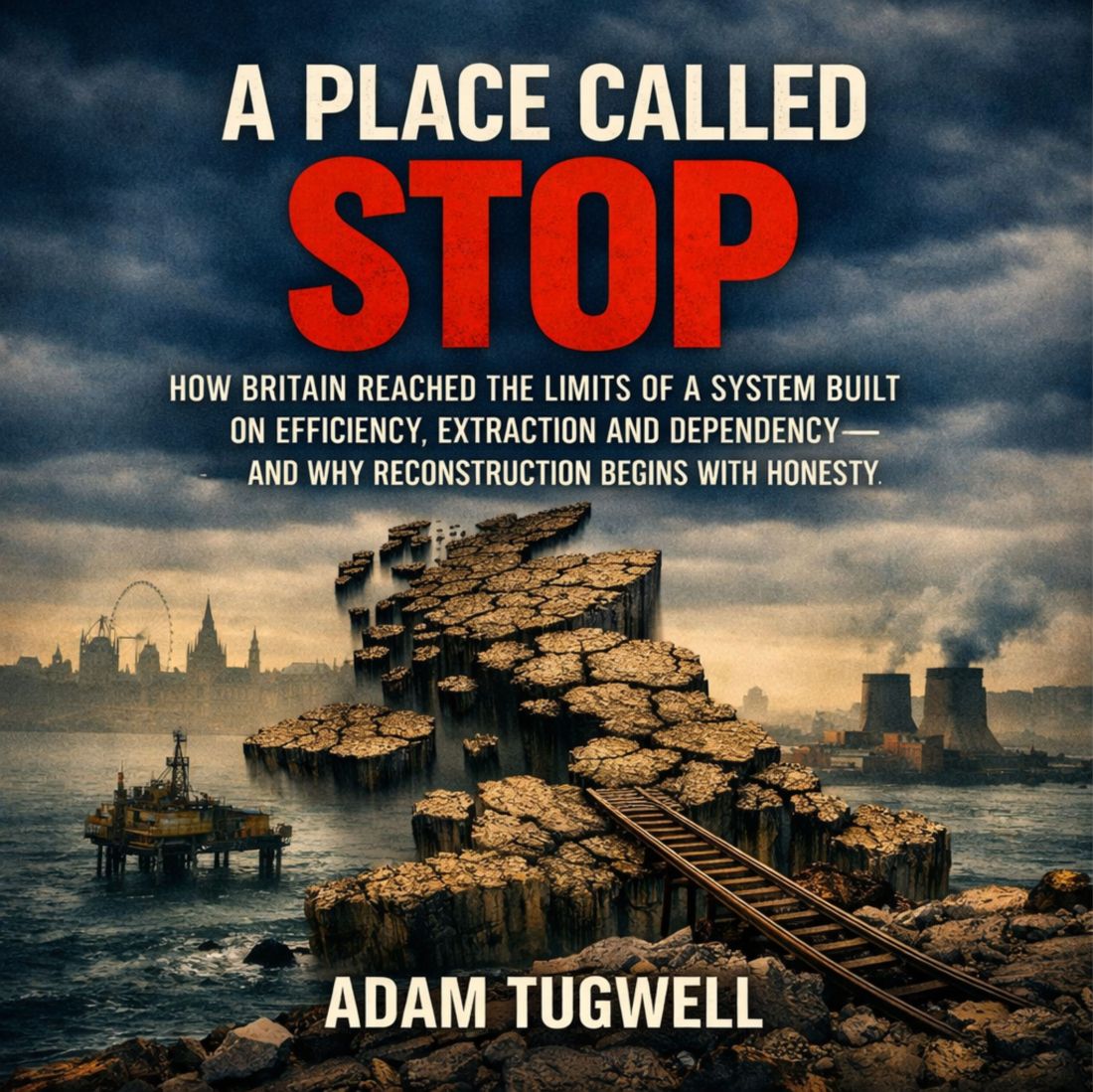
Every story has a destination. Every chain of decisions has an endpoint. Every worldview has a consequence. Britain’s story arrives at a place called stop.
Stop is not a date, a single crisis, or the collapse of the country. It is the moment when a system reaches the limits of what can be postponed.
For decades, Britain postponed consequences through debt, imports, asset sales, global supply chains, foreign ownership, privatisation, low-cost consumption and political narrative. Each postponement worked for a while. But postponement is not repair.
The deeper story of modern Britain is the story of substitution: production substituted with consumption, capability with imports, maintenance with extraction, resilience with efficiency, government with management, politics with narrative.
Stop is the moment substitution stops working. It is the end of pretending that narrative can replace tools, that growth can replace capability, or that management can replace maintenance.
What now lies ahead
What now lies ahead is not simply a policy challenge. It is a reconstruction challenge. Britain must decide whether to continue managing decline through debt, narrative and emergency repair, or whether to begin rebuilding the capacities that make national life possible.
The next period is likely to be defined by infrastructure strain, household pressure, fiscal constraint, fragile supply chains, weak public trust and the growing visibility of limits. None of this means the end of Britain. It means the end of denial.
Honesty will be difficult because it means admitting that what has been lost cannot be restored quickly, what has decayed cannot be repaired by announcement, and what has been outsourced cannot be summoned back by rhetoric.
But honesty is also the beginning of possibility. Once a country stops pretending, it can begin the slower work of rebuilding.
What reconstruction would mean
Reconstruction begins with a different question. Not: how do we generate the fastest headline growth? But: what must Britain be able to do again if it is to remain secure, decent, affordable and self-respecting?
It means rebuilding skills as national infrastructure: apprenticeships, technical colleges, local workshops, repair trades, engineering routes and vocational teaching that are maintained continuously rather than redesigned repeatedly.
It means rebuilding local supply chains so public procurement asks not only what is cheapest today, but what strengthens capability tomorrow.
It means rebuilding infrastructure for service rather than extraction, so water, energy, rail, roads, ports, broadband and public buildings are treated as systems that make daily life possible rather than assets from which yield can be drawn.
It means rebuilding productive finance so credit supports creation as well as acquisition: machinery, housing, energy systems, small firms, manufacturing capacity, farms, workshops and export capability.
It means rebuilding honest politics, where leaders are judged less by the confidence of their promises and more by whether they tell the truth about limits, trade-offs and timescales.
Reconstruction is not nostalgia. It is not a retreat from the world. It is the recognition that no serious future can be built on hollow foundations.
The place called stop is therefore not only the end of an old story. It is the beginning of a harder and more honest one.
Notes and Further Reading
This book is written as a public argument rather than an academic monograph. Readers who want to test the argument should begin with the evidence behind money creation, productivity, manufacturing, apprenticeships, water ownership, infrastructure investment and the changing structure of the British economy.
This source explains how most money in the modern economy is created when commercial banks make loans, creating deposits in borrowers’ accounts. It underpins Part II’s argument about credit, debt and asset acquisition.
ONS labour productivity data provides the statistical background for the claim that weak productivity growth has constrained wages, living standards and the political promise of growth.
This briefing places UK productivity performance in historical context and supports the book’s distinction between headline growth and the deeper question of national capability.
This briefing provides evidence on the changing composition of the UK economy, including the long-term decline in manufacturing’s share of output and the rise of services.
This briefing tracks apprenticeship starts, participation and policy changes in England. It supports the argument in Part VI that the loss of local capability is also a loss of training routes, practical knowledge and pathways into skilled work.
This report provides a contemporary example of the financial stress surrounding Thames Water and the wider questions of debt, ownership, infrastructure investment and public exposure discussed in Part IV and Part X.
Worldview and political argument
Adam Tugwell – The Establishment Is a Worldview, Not a Class
This essay develops the book’s opening claim that the establishment is better understood as a shared worldview than as a fixed class of people. It is the conceptual foundation for Part I.
Adam Tugwell – The Harmful Truths That Are Hidden Behind Political Growth
This essay explores the difference between growth as the public understands it and growth as politicians often use it: a source of fiscal headroom, political breathing space and delay. It supports the argument in Parts VII and IX.
Adam Tugwell – The Contemporary Politician’s Dilemma
This essay examines why modern politicians struggle to tell the truth about structural incapability. It deepens the discussion of the political trap introduced in Part VII.
How to use this reading path
Readers who want to test the book’s argument should begin with the official sources on money creation, productivity, manufacturing and apprenticeships, then move to the essays on worldview, political growth and the place called stop. The purpose of this reading path is not to close the argument, but to invite scrutiny.
A country cannot rebuild itself through rhetoric alone. It must first learn to see clearly.
This book is a conceptual and practical proposal intended to stimulate discussion, research, experimentation, enterprise development, policy consideration and community action.
The systems, economic structures, governance approaches and capability networks described in this book are proposals for consideration rather than completed or universally validated solutions. Implementation would require further research, practical testing, economic assessment, technological development, governance design and community participation.
References to textile production, wool processing, supply-chain resilience, clothing security, community enterprise, cooperative structures, and local capability are intended to support discussion and exploration rather than predict specific future outcomes.
Nothing in this book should be interpreted as legal, financial, regulatory, investment, business, engineering or policy advice. Readers should seek appropriate professional guidance before making commercial, governance, operational or investment decisions.
The views expressed are offered as a contribution to an ongoing discussion about resilience, local economies, human-centred technology, clothing systems, community participation, and the future of productive life.
Why This Book Now
Across the world, people are re‑examining the systems that shape everyday life – how we produce, repair, share, learn, and participate in the creation of the things we depend on. Many of these systems have become highly efficient, but increasingly fragile. They deliver goods, but often weaken capability. They generate output, but frequently reduce participation. They create prosperity, but not always resilience.
The Economy for the Common Good (EFCG) argues that societies flourish when economic activity strengthens human wellbeing, stewardship, participation and shared capability. Yet many modern systems have evolved in the opposite direction: concentrating production, narrowing ownership, reducing practical skills, and disconnecting communities from the means of meeting their own needs.
Clothing is one of the clearest examples. It is essential to dignity, safety, identity and daily life, yet the capability behind it – the ability to create, repair, adapt, maintain and renew – has become increasingly distant from the communities that use it. The same pattern can be seen across food, energy, materials, manufacturing and local enterprise. When capability disappears, dependency grows. When participation declines, resilience weakens.
This book is written now because the questions it raises have become urgent. How do we rebuild capability in ways that strengthen communities rather than bypass them? How do we design systems where technology enhances human contribution instead of replacing it? How do we create economies that measure success not only by efficiency, but by participation, stewardship and shared prosperity?
Wool and natural fibres provide one practical lens through which to explore these questions, but the argument is larger than any single material. It concerns the future of productive life itself – and the possibility of building human‑scale systems that combine modern tools, local capability, distributed enterprise and community participation.
This book is offered as a contribution to that conversation. Not as a blueprint, but as an invitation: to imagine an economy designed for capability, to explore what communities can rebuild, and to consider how people, technology and living systems might work together to create resilience at human scale.
It is not an attempt to return to a vanished past, abandon modern technology, or recreate the economy of a previous century.
Nor is it written as a criticism of everyone who participated in the systems that produced today’s world.
Industrialisation brought extraordinary advances. It increased production, improved access to goods, accelerated innovation, and transformed living standards for millions of people.
Yet alongside these achievements, something important was gradually lost.
Many capabilities that once existed throughout communities became concentrated into large systems. Many industries that once supported widespread participation became increasingly specialised, centralised, automated, and eventually relocated elsewhere.
The wool and textile industries tell this story particularly clearly.
Britain still produces wool. Britain still possesses farmers, makers, designers, engineers, craftspeople, entrepreneurs, educators, and innovators.
What is often missing are the capabilities that once connected these people together.
The ability to transform local fibre into local products.
The ability to repair clothing rather than replace it.
The ability to teach practical skills across generations.
The ability to participate directly in the creation of things people need.
This book explores how some of those capabilities might be rebuilt.
Not by rejecting modern technology.
Not by rejecting progress.
But by asking whether progress itself should be measured differently.
Should progress be defined primarily by reducing the number of people required?
Or should it be measured by increasing the number of people able to participate meaningfully in productive life?
This book argues for the second approach.
Its purpose is not to provide a final answer.
Its purpose is to explore the possibility that wool, natural fibres, modern technology, local enterprise, apprenticeship, repair, stewardship, and human creativity might together contribute to a different future.
One built not around consumption alone, but around capability.
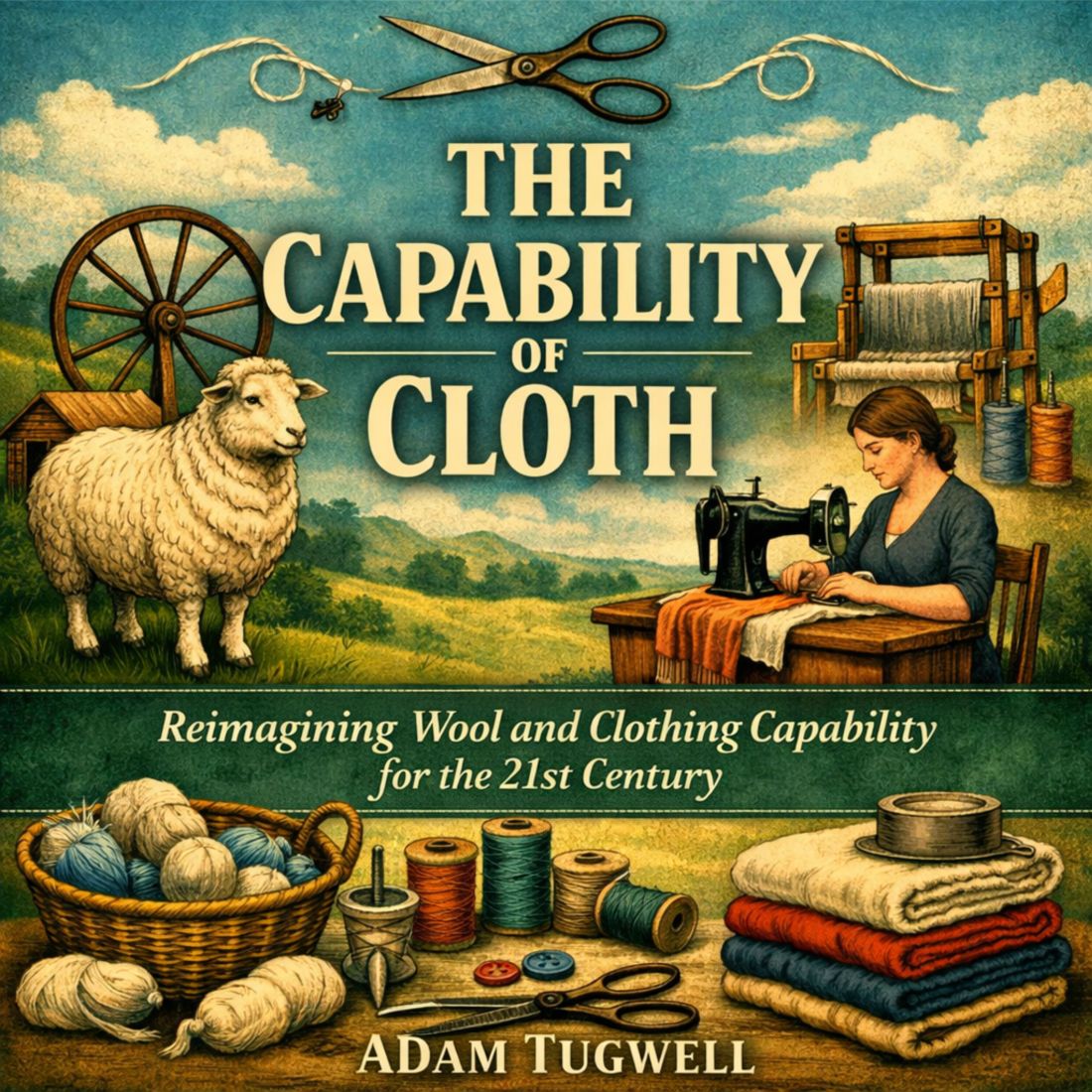
The Capability of Cloth proposes a new approach to fibre, clothing and textile production based upon human-scale industry, local capability, community participation, natural materials and human-centred technology.
The book begins from a simple observation:
Britain continues to produce substantial quantities of natural fibre, particularly wool. According to the British Wool Marketing Board annual report for 2024/2025, the 2024 clip was 19,290,044 kg; the report states that the overall average price achieved for the 2024 clip was 99.5 p/kg and that the total average return to producers, including high-volume premium, was 41.1 p/kg. These figures illustrate both the continuing scale of wool production and the economic pressures surrounding wool.
This book argues that clothing should be viewed not merely as a retail product but as a capability system.
Clothing security is not only the ability to buy clothing.
It is the ability to create, repair, adapt, share, reuse, recycle, and renew it.
The book proposes a distributed network of human-scale fibre industries built around:
wool and natural fibres
local processing capability
shared workshops and fibre hubs
repair and renewal services
apprenticeship and skills development
clothing libraries
cooperative enterprise
modern manufacturing tools
AI-supported learning and coordination
community participation
The objective is not to replace existing textile industries.
Nor is it to recreate historical systems exactly as they once existed.
The objective is to restore capability.
This includes:
economic capability
production capability
repair capability
educational capability
community capability
The book further argues that future industrial systems should be designed around a partnership between:
people
technology
living systems
rather than assuming that progress requires the continual removal of people from productive life.
As part of the wider frameworks of LEGS (The Local Economy & Governance System), EFCG (An Economy for the Common Good), Contribution Culture and the Basic Living Standard, the book explores how local textile ecosystems could support resilience, participation, stewardship and human flourishing in the twenty-first century.
Figure 3: The Human–Technology–Nature Partnership Nature provides fibre and living systems. People provide creativity, judgement, care and stewardship. Technology provides tools, coordination, learning support and production capability. Capability grows when all three work together.
Figure 4: The 21st Century Village Green Fibre Producers ↔ Processors ↔ Makers ↔ Repairers ↔ Clothing Libraries ↔ Educators ↔ Cooperatives ↔ Digital Platforms ↔ Community Users
Concept
Meaning for the Book
Capability
The practical ability to create, repair, adapt, share, learn and steward useful systems.
Stewardship
The care of materials, skills, people, places and future generations.
Participation
The opportunity for people to contribute meaningfully rather than only consume.
Human-scale industry
Enterprise designed to preserve meaningful human involvement while using appropriate technology.
Purpose
To explore how wool, natural fibres, human-scale enterprise, modern technology, and community participation can work together to rebuild clothing capability within a localised and resilient economy.
This book seeks to:
restore attention to fibre and textile capability as an important component of resilience
explore new opportunities for human-scale industry
support apprenticeship, craftsmanship, and practical skills
strengthen local enterprise and participation
encourage repair, reuse, and renewal
examine the role of cooperatives and distributed ownership
demonstrate how technology can support rather than replace people
connect textile production to wider local capability systems
contribute to discussions surrounding LEGS, EFCG, and Contribution Culture
The book is both practical and aspirational.
Practical because it addresses real materials, real skills, real businesses, and real community needs.
Aspirational because it asks readers to imagine a future in which economic systems are designed around human capability as carefully as they are designed around efficiency.
The practical ability to create, repair, adapt, share, maintain, recycle, and renew clothing and textile products.
Clothing Security
Reliable access to appropriate clothing supported by resilient systems of production, maintenance, repair, and renewal.
Fibre Capability
The local ability to transform natural fibres into useful products through knowledge, tools, infrastructure, and community participation.
Human-Scale Industry
An approach to production that combines modern technology and productivity with meaningful human participation, distributed enterprise, stewardship, and local capability.
Contribution Culture
A culture in which people are valued not only for what they consume, but for the capabilities, skills, care, creativity, and service they contribute to others.
The Basic Living Standard
A framework recognising that all people should have reliable access to life’s essential needs, including food, shelter, energy, healthcare, education, participation, and appropriate clothing.
LEGS
The Local Economy & Governance System – a framework for local capability, governance, accountability, enterprise, participation, and resilience.
EFCG
An Economy for the Common Good – a capability-centred economic framework that prioritises human wellbeing, stewardship, participation, resilience, and shared prosperity.
The 21st Century Village Green
A modern network of interconnected local enterprises, community infrastructure, shared spaces, and digital tools that support exchange, participation, learning, and capability at a local scale.
Clothing security is not only the ability to buy clothing. It is the ability to create, repair, adapt, share, renew, recycle, and steward it.
For much of human history, communities possessed many of these capabilities directly.
Today, many people possess unprecedented access to clothing while simultaneously having little connection to how clothing is produced, maintained, repaired, or renewed.
This book does not suggest that all modern systems should be abandoned.
It asks whether some forms of capability deserve to be rebuilt.
It further argues that future textile systems should be designed around a partnership between people, technology and living systems, with each contributing what it does best.
Nature provides fibre.
People provide creativity, judgement, stewardship, craftsmanship, entrepreneurship, teaching, and care.
Technology provides coordination, efficiency, learning, processing, design support, and communication.
The purpose of technology is not to make people unnecessary.
The purpose of technology is to enhance human capability.
Food, water, shelter, and energy are often recognised as essential foundations of resilience.
Clothing receives far less attention.
Yet clothing remains one of humanity’s most basic needs.
It provides:
protection
warmth
dignity
identity
participation
comfort
safety
Every person depends on it.
Yet relatively little discussion takes place about where clothing comes from, how it is made, who makes it, how it is repaired, or whether communities retain any capability to provide it locally.
This book suggests that clothing deserves to be viewed differently.
Not merely as a commodity.
Not merely as a consumer product.
But as part of a wider capability system.
A system involving farmers, fibre producers, makers, repairers, educators, designers, entrepreneurs, apprentices, cooperatives, communities, and technology working together.
The story of cloth is therefore larger than textiles.
It is a story about productive life.
About participation.
About stewardship.
About resilience.
And ultimately, about the kind of economy and society we wish to build.
Long before Britain became known for finance, technology, manufacturing, or global trade, it was known for wool.
For centuries, wool was one of the country’s most important economic resources.
Sheep grazed across landscapes that were often unsuitable for intensive crop production, converting grass into one of the most useful and versatile materials available to human society.
Wool provided:
clothing
warmth
bedding
trade goods
employment
local enterprise
export revenue
The story of British wool is not simply a story about agriculture.
It is a story about how a natural resource became the foundation for entire communities, industries, and ways of life.
The rise of Britain’s textile economy helped shape the development of towns, transport systems, markets, trade routes, and eventually industrialisation itself.
The cloth industry was not a small niche activity.
It was one of the engines that helped drive the emergence of modern Britain.
The history of textiles also reveals a wider pattern that appears repeatedly throughout economic history.
A capability emerges; communities develop skills; enterprises grow; production expands; ownership concentrates; decision-making centralises; participation declines; capability weakens; dependency increases; and eventually production relocates or disappears.
This pattern is not unique to textiles.
It can be observed across many industries.
Food systems.
Manufacturing.
Retail.
Services.
Energy.
In each case, the issue is not growth itself.
The issue is what happens when growth becomes disconnected from stewardship and participation.
Understanding this cycle is important because it helps explain why simply rebuilding an industry may not be enough.
The structures that support capability matter just as much as the capability itself.
The purpose of this book is not to ask whether Britain should reverse industrialisation.
That question belongs to the past.
The more useful question is:
What would a textile industry designed for the twenty-first century look like if human participation, local capability, resilience, stewardship, and technology were treated as equally important design objectives?
What would happen if we combined:
modern technology
advanced communications
AI-supported learning
digital marketplaces
cooperative enterprise
natural fibres
distributed manufacturing
with the strengths that earlier systems possessed:
participation
skill
stewardship
local knowledge
community capability
This is where the history of cloth stops being a story about the past.
Every garment begins long before it reaches a wardrobe.
Before spinning.
Before weaving.
Before sewing.
Before design.
There is fibre.
This is an important distinction because modern clothing systems often focus on products while obscuring the materials and living systems from which those products emerge.
A shirt may appear on a shelf.
A blanket may arrive through a delivery service.
A jumper may be purchased with a few clicks.
Yet behind every textile sits a chain of relationships linking people, materials, landscapes, skills, technology, and time.
This book argues that rebuilding clothing capability begins with rebuilding fibre capability.
Without fibre, there is no cloth.
Without fibre capability, there can be no clothing capability.
Few fibres are more closely connected to the British landscape than wool.
For centuries sheep have shaped:
upland regions
lowland grazing systems
moorland landscapes
mixed farm environments
Wool is more than a commodity.
It is a by-product of a long-standing relationship between people, animals, land, and climate.
Today many farmers continue to produce wool despite often receiving relatively low returns for it.
As several commentators within the sector have observed, wool can sometimes struggle to compete economically against global synthetic and imported alternatives.
This book does not suggest that wool alone can solve the challenges facing rural economies, nor that every wool-based enterprise will be viable in every place.
It does suggest that a material already being produced deserves renewed consideration within a wider capability framework.
One of the central ideas running throughout this book is that the future of textile production is not a choice between traditional methods and modern technology.
The future lies in partnership.
Nature provides:
fibre
renewable materials
regenerative potential
People provide:
creativity
judgement
care
craftsmanship
entrepreneurship
teaching
stewardship
Technology provides:
processing capability
efficiency
communication
coordination
learning support
manufacturing support
No element stands above the others.
Each contributes something valuable.
This is not a hierarchy.
It is a partnership.
The objective is not to replace people.
Nor is it to reject innovation.
The objective is to use innovation in ways that expand human capability.
The decline of local textile processing mirrors challenges seen throughout many sectors.
As processing becomes concentrated:
distances increase
local options decline
skills disappear
ownership concentrates
economic participation narrows
Over time, communities become producers of raw materials and consumers of finished goods while having little involvement in what happens between those stages.
The result is dependency.
Not because communities lack talent.
Not because communities lack resources.
But because critical infrastructure has disappeared.
The challenge is not merely to produce fibre.
The challenge is to retain meaningful involvement in transforming that fibre into useful products.
Resilient communities do not merely possess resources.
They possess the capability to transform resources into useful outcomes.
Processing capability is therefore a resilience capability.
A community that can process fibre possesses more options than one that relies entirely on distant systems.
Those options may never be fully required.
Their value lies in their existence.
As with food processing, repair capabilities, or local manufacturing, resilience comes not from isolation but from maintaining pathways that remain available when needed.
Design is the point at which materials become intention.
It is where function meets creativity.
It is where practical needs meet culture, identity, aesthetics, and human expression.
For thousands of years, human beings have transformed fibres into garments not merely because they required protection from the weather, but because clothing carries meaning.
It communicates:
identity
profession
community
culture
occasion
personality
craftsmanship
The Capability of Cloth therefore depends not only upon producing fibre and processing materials, but upon maintaining the capability to design, adapt, and innovate.
Historically, clothing evolved in response to local conditions.
Materials reflected what was available.
Garments reflected climate.
Techniques reflected experience.
Styles reflected culture.
Design was connected to place.
This does not mean communities should reject influences from elsewhere.
It simply means that local conditions still matter.
A garment designed for an urban office may differ significantly from one designed for farming, forestry, outdoor work, cycling, fishing, or community volunteering.
Human-scale design allows clothing to emerge from real needs rather than mass assumptions.
The Capability of Cloth proposes a future in which design becomes more accessible, more participatory, and more connected to the realities of everyday life.
A future where:
fibre producers influence outcomes
makers influence designs
users influence products
repair is valued
longevity is rewarded
technology supports creativity
communities retain ownership of knowledge
The result is not a return to the past.
It is a modern design ecosystem rooted in participation, stewardship, capability, and human flourishing.
Because before cloth becomes culture, clothing, enterprise, or expression, it must first be imagined.
And the capability to imagine, create, adapt, and improve remains one of humanity’s greatest strengths.
At its heart, enterprise is the practical process of transforming human capability into something useful for others.
It is how ideas become products.
How skills become services.
How resources become solutions.
How people create value together.
The Capability of Cloth therefore sees enterprise not as an isolated commercial activity, but as one of the primary mechanisms through which communities organise participation, innovation, and productive life.
The question is not simply:
How do we create profitable businesses?
The question is also:
How do we create businesses that strengthen capability?
One of the striking features of the fibre economy is the number of potential enterprises it can support.
A single fleece may create opportunities for:
grading
cleaning
carding
spinning
dyeing
weaving
knitting
garment making
repair
education
retail
recycling
Each stage represents a possible enterprise.
Each stage represents a possible livelihood.
Each stage represents a possible apprenticeship.
This diversity is one of the sector’s greatest strengths.
Unlike industries that concentrate value into a small number of highly specialised activities, textile capability naturally creates multiple points of participation.
If successful enterprises simply evolve into new forms of concentration, the long-term outcome may differ little from the system they were intended to improve upon.
This is why governance structures matter.
Ownership structures matter.
Participation requirements matter.
Stewardship matters.
Enterprise must remain connected to the communities and capabilities that support it.
Otherwise capability once again becomes concentrated.
Modern technology creates significant opportunities for human-scale enterprise.
Digital tools can assist:
design
manufacturing
logistics
learning
customer discovery
coordination
AI and digital tools may assist with:
pattern creation
skill development
business administration
local market matching
The principle remains consistent throughout this book:
Technology should enhance human capability.
A technology that enables a hundred small enterprises may create more community value than one that eliminates the need for those enterprises entirely.
The question is not how advanced the technology is.
The question is what kind of economy it helps create.
Within the wider LEGS ecosystem, textile enterprises do not operate in isolation.
They become part of a larger network in which fibre producers, processors, makers, repairers, clothing libraries and community users strengthen one another.
The result is not a collection of disconnected businesses.
It is an ecosystem.
A twenty-first-century village green where economic activity remains rooted in relationships, capability, stewardship, and mutual benefit.
A recurring pattern can be observed throughout economic history.
A community develops a useful capability.
Businesses emerge.
Markets develop.
Success attracts investment.
Scale increases.
Ownership concentrates.
Participation declines.
Control centralises.
Local capability gradually becomes dependent upon increasingly distant structures.
Eventually the community that created the capability may no longer control it.
This book refers to this pattern as the Capture Cycle.
The Capture Cycle is not unique to textiles.
It can be observed across:
agriculture
manufacturing
food processing
energy
retail
logistics
technology
Understanding this cycle is important because rebuilding fibre capability without addressing governance and ownership risks simply repeating the same process.
A clothing library is proposed here as a community capability resource through which garments remain in active circulation rather than being underutilised, discarded, or unnecessarily duplicated.
Examples may include:
children’s clothing
maternity wear
formal clothing
specialist workwear
outdoor clothing
performance costumes
seasonal garments
These are categories where ownership sometimes results in long periods of inactivity between uses.
A clothing library allows garments to continue providing value throughout a longer and more useful lifespan.
Key takeaway: Prosperity is not only financial output. A prosperous community possesses skills, relationships, practical knowledge, resilient enterprises and opportunities for future generations.
Capability: The practical ability to do something useful, including the skills, tools, knowledge, infrastructure, relationships, and governance required to sustain it.
Clothing capability: The ability to create, repair, adapt, share, reuse, recycle, and steward clothing and textile products.
Human-scale industry: Productive activity designed to preserve meaningful human participation while using appropriate modern technology.
Stewardship: The practice of caring for materials, skills, people, communities, infrastructure, and future generations.
Capture Cycle: A recurring pattern in which capability grows, ownership concentrates, participation declines, and communities become increasingly dependent on distant systems.
Further Reading
The ideas explored in The Capability of Cloth connect to a wider body of work on capability, stewardship, participation, and human‑scale economics. The following resources offer deeper insight into textile sustainability, cooperative enterprise, and local resilience. They include both external references and related works by Adam Tugwell, presented with their full URLs.
External Resources
These publications and organisations provide valuable perspectives on textile sustainability, circular economy, cooperative enterprise, and local capability building:
British Wool Annual Reports – Insight into the state of the UK wool industry, fibre quality, and regional production trends.
WRAP (Waste and Resources Action Programme) – Reports and guidance on textile recycling, repair, and circular economy initiatives in the UK.
UK Fashion and Textile Association (UKFT) – Sector analyses and policy updates on British textile manufacturing, skills, and innovation.
OECD Cooperative and Regional Development Case Studies – International examples of cooperative models and local economic resilience.
Ellen MacArthur Foundation – Foundational resources on circular economy principles and regenerative design.
Co‑operatives UK Publications – Guidance and research on cooperative governance, community ownership, and democratic enterprise.
Academic Literature – Research on textile sustainability, repair economies, community wealth building, and local resilience frameworks.
These sources provide a global and national context for the capability‑based approach discussed throughout this book.
Related Works by Adam Tugwell
The following works expand on the conceptual foundations of The Capability of Cloth, exploring capability, governance, and human‑scale economics across different domains.
Beyond the Farm Gate
Explores how rural and agricultural systems can evolve beyond production into capability‑based local economies, connecting land stewardship with enterprise and community participation.
Proposes a hybrid model of mechanisation that combines traditional power sources with modern technology to create a connected, human‑centred, localised economy.
Introduces the EFCG framework and its application to local governance, enterprise, and capability development – a key conceptual foundation for this book.
Examines how work, business, and governance can be transformed through a culture of contribution, aligning with the principles of capability and the common good.
Provides a concise explanation of the Basic Living Standard – a framework for ensuring that every person has access to the essentials required for capability and participation.
This paper is not ultimately about wool. It is about whether communities retain the capability to meet needs, care for resources, use technology wisely, create meaningful work, and pass practical knowledge forward. Cloth provides the example because it is ordinary, essential, and deeply connected to land, skill, enterprise, repair, dignity, and participation. The capability of cloth is therefore a practical question about clothing. It is also a larger question about the kind of economy communities may choose to build.
This paper is not written to demand agreement. It is written to make space for thought. Many people already sense that something in the current direction of travel is wrong: food systems feel fragile, technology feels increasingly distant from human value, and communities feel less able to shape the things that matter most. This work is for those people.
The aim is not to provide a closed model or a perfect answer. The aim is to introduce a practical doorway into a wider body of work concerned with EFCG, LEGS, Foods We Can Trust, local food resilience, Contribution Culture, and community capability.
The heavy horse proposition is deliberately visible because people need to be able to picture alternatives. It shows that the future does not have to mean either going backwards or being dominated by technology designed around control, extraction, and human replacement.
This is a serious proposal, but it is also an invitation. If it causes the reader to pause, question an assumption, or discuss a different possibility with someone else, it has begun to do its work.
Disclaimer
This publication is intended for informational, educational, and discussion purposes. It presents concepts, models, and proposals designed to encourage reflection, experimentation, and community‑level dialogue. It is not a technical manual, regulatory guide, or prescriptive instruction set.
The author has made every reasonable effort to ensure the accuracy of the information contained within. However, agriculture, land management, engineering, and community‑scale systems involve variables that differ widely across locations, conditions, and capabilities. Readers should exercise their own judgement, seek appropriate professional advice where necessary, and adapt ideas responsibly to their own circumstances.
Neither the author nor the publisher shall be held liable for any loss, damage, or adverse outcome arising directly or indirectly from the use, application, or interpretation of the material in this book.
Any references to external organisations, reports, or research are included for context and illustration. Their inclusion does not imply endorsement, affiliation, or responsibility for the content of this work.
This book is offered as a contribution to ongoing public conversation. It should be read as an invitation to think differently, not as a guarantee, prediction, or instruction.Executive Summary
The AI Age of Heavy Horse proposes a new class of hybrid agricultural and land-management machines that combine horse traction, electric assist, lightweight engineering, sensors, and AI-supported guidance.
These machines are not proposed as a universal replacement for tractors. They are proposed as one practical component within a wider capability system designed for soil health, local resilience, human participation, and reduced dependence on fragile external inputs.
The paper argues that modern agriculture has become highly productive but also highly dependent: on diesel, finance, global logistics, imported components, fertiliser, centralised processing, supermarket distribution, and distant decision-making.
This work therefore treats resilience as a design requirement. It asks what agricultural capability remains when ideal assumptions no longer hold, and what forms of technology can strengthen farmers, workers, animals, soil, and communities rather than replacing them.
Its central proposition is simple: technology should enhance human capability, not remove people from productive systems.
The horse is important because it makes the idea visible. It represents proven biological capability partnered with modern engineering. The wider principle is to take the best of what has been tested over time and combine it with the best of what modern technology can offer, under human-centred and locally accountable purposes.
This paper is one link in a broader architecture: An Economy for the Common Good, LEGS, Foods We Can Trust, community food capability, apprenticeship, local logistics, local processing, and Contribution Culture. It stands alone as a mechanisation brief, but its deeper purpose is to help open a different conversation about agency, freedom, food, technology, and human value.
Purpose
To introduce a new generation of horse-compatible agricultural and land-management machines that combine proven biological traction with modern engineering, electric assist, sensors, and AI-supported guidance.
These machines are designed to operate at human scale, protect soil, reduce dependence on fragile external inputs, and form one practical link within a wider interconnected capability system.
This is not a return to the past. It is retooling for a different economic paradigm: one in which capability, stewardship, community, and interdependence matter more than industrial scale, financial extraction, and supply-chain dependency.
The proposition is deliberately bold because the problem is serious. Modern agriculture has achieved extraordinary productivity, but much of that productivity now depends on fuel, finance, components, fertiliser, logistics, processing, and distribution systems that sit beyond the control of farmers and local communities. Efficiency and resilience are not the same thing.
This brief does not ask farmers, engineers, or communities to abandon progress. It asks whether progress has been defined too narrowly, and whether the next generation of technology should be designed to enhance human and local capability rather than remove people from productive systems.
In this sense, the work is both practical and symbolic. Practical, because machines, traction, soil, fuel, labour, processing, and logistics are real problems. Symbolic, because the image of a horse working with AI-supported machinery makes visible a third path: neither a retreat from technology nor surrender to a technology-dominated future.
Key Concepts
Hybrid Mechanisation Machines powered by horses + electric assist + AI guidance.
Capability Chains Interconnected local systems where each part strengthens the others (e.g., grain → mill → bakery → kitchen).
Human‑Scale Systems Tools and workflows designed for small farms, mixed terrain, and multi‑operator teams.
LEGS – The Local Economy & Governance System Community‑level decision‑making that replaces distant bureaucracy.
EFCG – An Economy for the Common Good A needs‑first, contribution‑based economic model where capability replaces wages.
These definitions are intentionally short. Each concept can be expanded elsewhere, but this brief uses them only to keep the reader oriented.
Capability is the central word. Money can purchase capability only when the systems that convert money into food, fuel, tools, labour, and logistics are still functioning. When those systems weaken, communities need the capability itself.
Respect for Capability
Farmers are among the most innovative and entrepreneurial people in the country. They make things work under pressure, with limited resources, and without downtime.
They are engineers, logisticians, problem‑solvers, and leaders – all at once.
The issue is not capability. The issue is system capture.
Farmers were pushed into a model built around:
bigger machines
bigger fields
bigger debt
bigger dependency
bigger fragility
They trusted systems that were presented as progress: larger machinery, greater output, tighter logistics, global sourcing, finance-led expansion, and supermarket-scale distribution.
Much of it worked while conditions were favourable. The problem is what happens when favourable conditions no longer hold.
This brief is not a criticism. It is an acknowledgement of what farmers are capable of once the system stops extracting their autonomy and starts restoring their capability.
System Capture
The industrial food system has boxed farmers into:
supermarket dependency
machinery finance traps
fuel dependency
monoculture economics
regulatory hostility
supply chain fragility
subsidy distortion
Farmers did not choose this from a position of freedom. They were cornered by incentives, contracts, debt structures, market access, regulation, and cultural pressure that made resistance difficult and sometimes impossible.
This mechanisation system is not designed merely to compete with the industrial model on its own terms. It is designed to provide working capability where the industrial model becomes too expensive, too brittle, too centralised, or too dependent on inputs that are no longer reliable.
The United Kingdom Food Security Report 2024 recognises food, water, energy, and transport as critical national infrastructure sectors, and describes the UK food supply chain as a set of interdependent systems exposed to shocks and stresses involving energy, labour, imports, logistics, climate, and economic pressures.
The point is not to dramatise risk. The point is to treat resilience as a design requirement, not an afterthought.
Failure Conditions That Make This Necessary
Adoption is unlikely to begin with enthusiasm. For many farmers, it will begin when the existing model stops delivering reliability, affordability, or autonomy.
Trigger points may include:
fuel scarcity
machinery immobility
border dependency failure
fertiliser shortages
supermarket supply-chain failure
debt becoming unserviceable
monoculture fragility
legislative paralysis
economic contraction
When these conditions converge, farmers and communities will need capability, not simply capital.
Money is only useful if there are working machines, available fuel, accessible parts, skilled people, functioning logistics, and food moving through the system.
This system is designed to preserve and rebuild capability under constraint.
Critical Supply Period: Community Capability Before Full Retooling
There may be a period – possibly months, possibly longer – where existing supply assumptions no longer hold, but full local retooling has not yet been achieved.
This is the most dangerous period because communities are still dependent on systems that may be disrupted while replacement capability is still forming.
industrial supply chains are disrupted
imports are restricted or delayed
fuel is scarce or unaffordable
machinery is idle or difficult to maintain
supermarkets cannot maintain normal supply
farming is retooling
communities must increase local food capability quickly
During this period:
households grow what they can
community gardens fill gaps
small farms produce essentials
early hybrid machines begin operating
horses provide land‑friendly logistics
local processing ramps up gradually
community kitchens stabilise food access
This is how communities bridge the gap between:
industrial disruption
local retooling
This mechanisation system is designed for that transition: not as a complete answer on day one, but as an early operating layer that helps farms, households, local processors, and community kitchens begin functioning together.
Land-Use Systems: Taking the Best of the Past and the Best of the Future
The mechanisation described in this brief does not stand alone. It is designed to work within land‑use systems that industrial farming sidelined:
regenerative farming
sustainable mixed farming
precision land management
permaculture principles
heritage soil‑care systems
These approaches are not distractions. They are structurally necessary for a resilient, localised food system.
Industrial agriculture dismissed them because they do not scale vertically. But this model scales horizontally, through:
community capability
interconnectivity
distributed labour
human‑scale mechanisation
regenerative cycles
mixed cropping
soil‑friendly traction
AI‑guided precision
This is not “going back.” It is moving forward with the best of the past and the best of the future.
The test is not whether a method is old or new. The test is whether it works, whether it can be maintained, whether it protects the land, and whether it strengthens human and local capability.
Soil: The Living Engine We Forgot
The future of farming does not begin with machines. It begins with soil – the living, breathing, biological engine that industrial agriculture has spent decades extracting from, compressing, sterilising, and exhausting.
Warnings about declining soil health are often framed as a countdown of harvests remaining. The stronger point is this:
The soil is not failing. The industrial model is failing the soil.
Soil is not dead. It is depleted – by:
heavy machinery compaction
monoculture extraction
chemical dependency
loss of organic matter
loss of microbial life
loss of structure
loss of stewardship
Industrial agriculture has treated soil as a substrate for inputs, not a living system.
The AI Age of Heavy Horse treats soil as the centre of the entire economic model.
Why Soil Matters to Hybrid Mechanisation
Hybrid horse‑AI machines are designed specifically to work with soil, not against it:
horses reduce compaction
lightweight frames protect structure
electric assist stabilises traction without weight
AI enables precision depth, spacing, and timing
modular tools suit mixed cropping
multi‑operator workflows allow careful land management
This is not nostalgia. It is engineering for soil health.
Research on soil compaction repeatedly identifies heavy machinery traffic as a significant cause of degraded soil structure, increased bulk density and penetration resistance, reduced porosity, poorer water movement, restricted root development, and yield loss.
A lighter, soil-centred mechanisation model therefore deserves attention not because it is quaint, but because soil structure is productive infrastructure.
A Flat Hierarchy: Human + Technology + Animal
The future is not:
human versus machine
machine replacing human
machine replacing animal
It is:
Human + Technology + Animal working together in a flat hierarchy.
Each contributes what it does best:
Horses provide land‑friendly traction and biological integration.
Humans provide judgement, care, creativity, stewardship, repair, training, and community.
Technology provides precision, optimisation, coordination, safety support, and information.
This partnership is not romantic. It is a design principle. The purpose of technology is not to remove people from productive systems, but to improve the quality, safety, effectiveness, and dignity of human contribution.
This is a central distinction. Current AI and automation are often funded and directed by objectives such as labour reduction, control, concentration, and financial return. That does not make technology inherently harmful. It means the purpose of technology must be changed.
In this model, AI and electrics support farmers, teams, animals, soil, and communities. They do not replace them.
This is not anti-technology. It is pro-human technology. It asks who defines the purpose of innovation, who benefits from it, who becomes dependent on it, and whether it increases or reduces real freedom.
Solution: Hybrid Horse-AI Mechanisation
This proposal does not assume that horses are universally superior to tractors. They are not. Modern tractors outperform animal traction in many high-power, large-scale, time-critical applications.
The question is different: can a hybrid system combining biological traction, lightweight engineering, electric assist, sensors, and AI-supported guidance provide valuable capability under conditions of rising input costs, soil pressure, energy constraint, supply uncertainty, and local retooling?
That is an engineering question, not a nostalgic one.
A new generation of machines built around:
horse traction
electric assist
lightweight modular frames
sensor arrays
AI‑guided operation
multi‑operator workflows
regenerative land principles
These machines:
stand on their own
solve real engineering problems
operate at human scale
reduce dependency on fuel
reduce dependency on industrial supply chains
increase meaningful labour
integrate into a wider capability system
This is hybrid mechanisation, not retro nostalgia. The horse is not the whole answer. It is a visible, practical expression of a wider principle: use the right capability for the task, whether that capability is human, biological, mechanical, electrical, or digital.
The image matters because people need to be able to see the alternative. A horse beside a modern machine carrying sensors, batteries, safety systems and AI guidance is difficult to fit inside the usual categories. That is precisely the point. It interrupts the assumption that the future must be either industrial automation or primitive retreat.
Interconnectivity: One Link in a Larger Chain
This mechanisation system is not isolated. It is part of a multidimensional, interconnected capability network.
Example chain (illustrative, not prescriptive):
A horse‑assisted machine harvests grain.
A carrier rig moves grain to a local mill.
A battery van delivers flour to a baker.
A community kitchen feeds people.
Compost cycles back to the fields.
Fields feed the horses.
Horses power the machines.
Every component stands alone. Every component interlocks. Every component strengthens the others.
This interconnectivity is the survival mechanism during the critical supply period and the operating principle of the longer-term localised economy. The aim is not isolated self-sufficiency on every farm or in every household. The aim is networked capability.
Engineering Opportunity
This is a new engineering frontier because it does not begin with the assumption that bigger, heavier, faster, and more autonomous is always better.
It begins with a different design question: what machinery is needed when soil health, local repairability, human participation, fuel constraint, animal welfare, and distributed production are treated as core requirements?
New Machine Directions (Conceptual, Not Final)
hybrid cultivators
AI‑guided seed drills
lightweight regenerative ploughs
multi‑operator harvest platforms
woodland extraction rigs
modular carrier frames
soil‑health monitoring implements
These are directions, not finished designs.
A serious development pathway would begin with reference machines rather than finished products: prototype platforms that can be tested, measured, criticised, improved, and adapted by farmers, engineers, horse handlers, soil specialists, and local manufacturing teams.
Reference Machine Questions
Any credible prototype programme would need to answer practical questions before wider adoption:
What field operations are most suitable for hybrid horse assistance?
What drawbar loads, operating speeds, and working widths are realistic?
How much electric assist is useful before weight becomes counterproductive?
Which tasks are best handled by the horse, the operator, the machine, and the AI layer?
How should safety systems protect horses, operators, apprentices, and bystanders?
Which components can be manufactured, repaired, or adapted locally?
How should soil health, compaction, fuel displacement, labour quality, and reliability be measured?
What animal-welfare standards, training systems, rest cycles, and handling protocols are required for ethical and reliable use?
What evidence would be sufficient to persuade practical farmers that the system is worth trialling?
Modern Materials
composites
lightweight steels
recycled alloys
shock‑absorbing polymers
Electric Assist
torque support
braking
stability
hill assist
safety systems
Sensors + AI
depth control
soil feedback
route guidance
load balancing
training support
Multi-Operator Workflows
Industrial machines often isolate the operator and concentrate capability into expensive, specialist equipment.
Hybrid machines use teams because the goal is not to remove people from the work.
The goal is to make the work safer, more skilled, more learnable, more productive, and more connected to the land.
The exact number of people depends on:
land
capability
community structure
machine class
season
We do not present fixed labour numbers here. We present a design direction: human capability is not a cost to be eliminated; it is a capacity to be developed.
Trigger Points for Adoption
Farmers will not adopt this system because it is novel. They will adopt it if it solves problems that the existing system can no longer solve.
Trigger points include:
fuel scarcity or volatility
machinery downtime
supply-chain disruption
supermarket failure or rationing
border closure or import instability
debt pressure
labour availability
community necessity
This is structural realism. The proposal is not that every farm should immediately replace tractors with horses. The proposal is that serious work should begin now on hybrid capability systems that can operate when diesel, finance, spare parts, logistics, and centralised food distribution become unreliable or unaffordable.
It also recognises that adoption will not be uniform. Some farms may never use this model. Some may use elements of it only for specific tasks. Some communities may develop shared equipment, shared horses, or local service teams. The purpose is not ideological purity. The purpose is practical capability.
Human-Scale Workflow
A small farm under this model:
uses hybrid machines
employs multi‑operator teams
integrates apprentices
shares capability across community nodes
connects to local processing
connects to local distribution
connects to local consumption
closes loops through regenerative cycles
Work becomes:
meaningful
contributive
skilled
social
structurally necessary
Not employment in the narrow wage-system sense. Capability.
This matters because labour has been treated for generations as something to reduce. In a money-centric system, fewer people can mean higher margins. In a capability-centred system, the question changes: how do we make necessary work better, safer, more skilled, more social, and more valuable to the community?
When a Basic Living Standard is secured through the wider economic system, the meaning of work also changes. Contribution is no longer reduced to survival wages. People participate because their contribution is useful, recognised, skilled, and connected to the real needs of the community.
This is why the document links mechanisation to the wider LEGS and EFCG work. A human-centred machinery system cannot fully succeed inside an economic culture that treats people primarily as costs and communities primarily as markets. It requires a wider shift towards contribution, capability, needs-first design, and local accountability.
Where This Brief Sits in the Larger System
This brief is one link in a chain that includes:
hybrid mechanisation
local logistics
local processing
regenerative land cycles
community kitchens
apprenticeship systems
local governance (LEGS)
needs‑first economics (EFCG)
Each link stands alone. Each link interlocks. Each link strengthens the others.
This brief is the mechanisation link. It should be read alongside the wider work on LEGS, EFCG, local food resilience, community production, apprenticeship, logistics, and needs-first economic design.
The wider lexicon is not intended to impose a single final model. It is intended to give people language, principles, guardrails, and practical examples that help them take back responsibility for the things that actually matter: food, shelter, energy, water, skills, health, governance, dignity, and community.
What This Paper Is Asking For
This paper does not ask the reader to accept every claim, adopt every concept, or abandon existing systems overnight. It asks for something simpler and more powerful: to think differently.
It asks farmers to consider where real autonomy has been lost, and where it might be rebuilt.
It asks engineers to consider machinery designed around soil, people, animals, and local repairability rather than only speed, scale, and automation.
It asks communities to consider food not as a retail product, but as foundational capability.
It asks technologists to consider whether AI should be judged by what it removes from human life or by what it helps human beings do better.
Power begins with thinking differently. Not because thought alone is enough, but because no serious change can begin while the existing paradigm remains invisible, unquestioned, and assumed to be inevitable.
Closing Statement
This mechanisation system is not designed for the world as it is assumed to be. It is designed for the world as it may be becoming: more energy constrained, more supply-chain exposed, more locally dependent, and more in need of practical capability.
It respects farmers by recognising their skill. It respects engineers by presenting a real design challenge. It respects horses by treating them as partners, not relics. It respects technology by asking it to serve humanity. It respects soil by placing it at the centre of the system. It respects communities by giving them a way to build capability before crisis removes choice.
It is hard. It is practical. It is testable. It is necessary to begin before it is needed. And if the assumptions behind this work prove wrong, the outcome is still worthwhile: healthier soil, stronger local skills, more resilient farms, better tools, and technology used in service of people rather than in place of them.
This paper is therefore not an ending. It is a doorway. Its purpose is to place an image, an argument, and a possibility into a space where many people already feel the need for another way but have not yet seen one clearly enough to discuss.
Evidence Notes
The argument in this paper is supported by several recognised areas of evidence and policy concern. The United Kingdom Food Security Report 2024 describes food security as dependent on supply-chain resilience and identifies the food chain as exposed to shocks and stresses across energy, labour, water, imports, logistics, climate, and business conditions. It also reports the UK’s production-to-supply ratio at 62% for all food and 75% for indigenous foods in 2023.
Official statistics on Energy use on farms in England 2023/24 report that red diesel was used by 98% of farm businesses within the Farm Business Survey population, making fuel availability and price a structural issue for agriculture rather than a marginal operational detail.
Research reviews on soil compaction identify heavy agricultural machinery traffic as a major contributor to degraded soil structure, increased bulk density and penetration resistance, reduced porosity, poorer water movement, restricted root development, and yield loss. These findings support the case for lighter, more soil-sensitive machinery systems where they are practical.
Reports on future farm fuels also recognise the difficulty of replacing diesel in larger agricultural machinery through battery-electric systems alone, especially where battery weight, charging infrastructure, energy density, and long working days create practical limits. Hybrid systems and smaller, lighter, task-specific machinery therefore deserve serious development attention.
These notes do not prove the whole proposition. They show that the concerns behind it are not imaginary: food-system interdependence, fuel dependency, soil degradation, and technology choice are already recognised as serious issues. This paper brings them together under a human-centred capability frame.
Further Reading
The following readings are arranged to help the reader move from the wider system architecture into the practical food, community, and technology themes that support this paper. They are not required background, but they provide the conceptual scaffolding behind the terms used here: LEGS, EFCG, Contribution Culture, Basic Living Standard, Foods We Can Trust, and human-centred AI governance.
1. System Architecture and Local Governance
The Local Economy & Governance System https://adamtugwell.blog/2025/11/21/the-local-economy-governance-system-online-text/ This is the primary companion text for understanding LEGS: the local decision-making, coordination, and accountability framework that sits behind the wider capability model. It helps explain how local food, work, production, welfare, and governance could be organised around community need rather than distant market or bureaucratic control.
An Economy for the Common Good https://adamtugwell.blog/2025/02/24/an-economy-for-the-common-good-full-text/ This text sets out the broader economic paradigm behind the paper: a needs-first, capability-centred alternative to wage dependency, extraction, and market-led social organisation. It is useful for readers who want to understand why this mechanisation proposal is framed as part of an economic transition rather than simply a farming technology idea.
The Basic Living Standard Explained https://adamtugwell.blog/2025/10/24/the-basic-living-standard-explained/ This piece explains the social foundation that makes contribution culture possible: a secure baseline of food, shelter, care, energy, transport, and essential participation. It is relevant because this paper’s view of work depends on people being able to contribute without survival pressure reducing every activity to wage necessity.
2. Food Security, Local Production, and Community Resilience
Foods We Can Farm, Catch, Harvest and Grow Locally in and Around the UK https://adamtugwell.blog/2025/07/18/foods-we-can-farm-catch-harvest-and-grow-locally-in-and-around-the-uk/ This practical reference supports the local-production side of the argument by identifying food types that could form part of a more regionally grounded food system. It helps readers connect the abstract idea of food resilience to real crops, harvests, fisheries, livestock, and growing possibilities.
Grow Your Own or Home Growing https://adamtugwell.blog/2025/07/31/grow-your-own-or-home-growing/ This reading brings the resilience conversation down to household and community scale. It is useful for readers interested in the critical supply period discussed in this paper, where gardens, small plots, community growing, and local food skills help bridge the gap before larger systems have fully retooled.
The current paradigm is persuasive because it has shaped the incentives, institutions, language, technology, media, and expectations that surround daily life. Most people are not wrong to have trusted it. They have lived inside it.
But systems are not inevitable. They are built, maintained, funded, defended, and repeated until they appear natural. The first step in changing them is not agreement. It is the ability to imagine that another way of organising life, work, food, technology, and community might be possible.
The AI Age of Heavy Horse is offered in that spirit: not as a finished answer, but as a serious image of a different future – one where technology serves human value, food systems rebuild local agency, work regains dignity, and communities recover the capability to shape the things that matter most.
Clarity does not ask to be followed. It simply helps us see.
Author’s Note
There are moments when the world begins to feel louder than it should.
Not necessarily in volume, but in intensity. Explanations arrive quickly, certainty is offered freely, and voices compete to define what is happening, who is responsible, and what must be done. The pressure to understand – and to take a position – becomes constant.
In recent years, that pressure has only deepened.
Questions around politics, governance, the economy, and the cost of living sit alongside wider concerns: the stability of institutions, the reliability of systems people once took for granted, and the sense that events are unfolding faster than they can be fully understood. Wars carry the risk of escalation. Supply chains feel fragile. The future, at times, feels difficult to picture clearly.
In this environment, something predictable happens.
When uncertainty grows, people begin to search. Not always consciously, and not always urgently, but with a quiet need for something that feels steady. Into that search step figures who offer clarity – or something that resembles it. They speak with confidence. They simplify complexity. They provide narratives that feel complete, coherent, and reassuring.
These are the voices I refer to in this work as false prophets.
They are not always intentionally misleading. Many believe what they say. Some genuinely want to help. But the clarity they offer often arrives too quickly, too neatly, and without the weight needed to hold it. Over time, it can draw people away from their own judgement and toward dependence on a single perspective.
But this is not the whole picture.
Alongside these louder figures, there is another presence – quieter, less visible, and easily overlooked.
This is the figure I have called the myth catcher.
The myth catcher does not compete with noise. They do not offer certainty, promise solutions, or position themselves as someone to follow. They do not step forward to fill the space. Instead, they remain steady within it.
Their role is not to provide answers that no one can truly guarantee. It is to offer something simpler, and in many ways more fundamental: the reassurance that clarity is still possible, that uncertainty does not have to be rushed into narrative, and that people can trust their own perception again.
The myth catcher does not remove complexity. They do not resolve the world’s tension. They do not claim to understand everything that is unfolding. What they do is help reduce distortion – just enough for people to see where they are, and to recognise that they are neither alone nor without grounding.
This work is an attempt to describe that presence.
Not as an ideal to become, nor as a role to adopt, but as something that can be observed and recognised. The term “myth catcher” is simply a way of naming a pattern that appears when noise rises and clarity becomes difficult to find.
If you recognise this presence in others, or even in moments within yourself, then the purpose of this work is already fulfilled.
Because the myth catcher does not create clarity.
They simply remind us that it was never entirely lost.
This work begins not with explanation, but with a story.
How to Read This Work
This work is not intended as a system, doctrine, or set of instructions. It is a reflective guide to a particular kind of presence: the person who helps others see clearly without asking to be followed. You may read it from beginning to end, or return to individual chapters when the need for clarity feels especially present.
The opening parable offers the image that carries the rest of the text. The chapters that follow unfold the meaning of that image: why people search, how false certainty takes hold, how a myth catcher can be recognised, and why this quiet role matters in unsettled times.
You do not need to agree with every sentence for the work to be useful. Let the ideas sit with you. Notice what feels familiar. Notice what steadies. The purpose is not to tell you what to think, but to help you recognise the difference between noise and clarity when you encounter it.
Preface
People don’t always realise when they’ve begun searching for something new. It often starts quietly – a sense that the world feels louder than it used to, or that familiar explanations no longer settle the questions that rise in the back of the mind. Life continues, conversations continue, the daily noise continues, yet something underneath it all feels slightly out of place.
Not wrong. Not broken. Just… misaligned.
Many reach this point without knowing what they’re looking for. They only know that the usual voices feel thinner, the usual narratives feel stretched, and the usual certainties don’t land the way they once did. It’s not a crisis. It’s not a revelation. It’s simply an awareness that clarity has become harder to find.
This work is written for that moment.
It doesn’t ask you to take sides. It doesn’t demand belief. It doesn’t offer slogans or promises. Instead, it explores how people navigate periods of uncertainty, how they respond when the stories around them lose their weight, and how certain figures emerge during those times – some helpful, some harmful, some simply loud.
You’ll meet one of those figures in the opening chapter. The story stands on its own. There’s no need to interpret it immediately or connect it to anything that follows. Let it sit with you. Let it breathe. The meaning tends to arrive later, often in its own time.
What comes after the story is an exploration of clarity: how it is found, how it is lost, and how it can be restored without division or drama. This work introduces a way of understanding a particular kind of presence, one I call the myth catcher. If you are here because something in you is searching, even if you do not yet know for what, you are in the right place.
Chapter 1 – The Parable of the Piper and the Lantern‑Bearer
I. The Town of Evermere
Evermere was a lively town tucked between echoing hills. Its streets were always full of voices – announcements, arguments, promises, warnings – all overlapping until no one could quite tell where one ended and another began.
People went about their days, but many carried a quiet sense that something wasn’t right. They couldn’t name it. They only felt that the noise had grown louder than the truth inside them.
They were tired, though they rarely said so aloud.
II. The Piper Arrives
One evening, as the sun slipped behind the hills, a stranger walked into Evermere. He wore colours that shimmered like oil on water and carried a silver flute that gleamed even in the fading light.
He smiled with perfect confidence.
“I can quiet the noise,” he said. “I can fix what troubles you. Follow me, and all will be well.”
Then he lifted the flute and played.
The melody curled through the streets like warm smoke. It softened fear, sharpened anger, and made confusion feel simple. People felt recognised, understood, relieved. They gathered around him, drawn by the beauty of the sound.
And when he walked, they followed.
III. The Music That Led Them Away
The Piper’s tune made everything feel easy. He told the people who was to blame, who was good, who was bad, what was wrong, and what must be done. His certainty was soothing. His confidence felt like clarity.
But as they walked, some noticed something strange.
The Piper never asked them to think. He never asked them to question. He never asked them to understand.
He only asked them to follow.
Step by step, the crowd drifted away from Evermere – away from their homes, their neighbours, and their own sense of direction – still wrapped in the Piper’s beautiful, narrowing song.
IV. The Lantern‑Bearer
At the quiet edge of the town, where the hills softened the echoes, sat a person with a lantern. The lantern was small, its light steady and warm, nothing dazzling or dramatic.
The Lantern‑Bearer didn’t call out or wave anyone over. They simply sat, present and calm.
When they saw the crowd passing, they lifted the lantern slightly.
“You look tired,” they said. “Sit if you like.”
Some people paused. Others walked on, still enchanted by the Piper’s music.
V. The Conversation
Those who stopped found themselves speaking without quite knowing why. They talked about the noise, the confusion, the exhaustion they had been carrying.
The Lantern‑Bearer listened – not with pity, not with excitement, not with an agenda. Just with steady attention.
“It makes sense you feel that way,” they said. “It’s hard to see clearly when everything is loud.”
Then they raised the lantern.
Its light didn’t enchant. It didn’t overwhelm. It simply revealed what was already there: the path beneath their feet, the hills around them, the town behind them, and the Piper ahead.
“The music is beautiful,” the Lantern‑Bearer said softly, “but it leads you away from yourselves.”
Some frowned. Some felt embarrassed. Some felt relieved.
But none felt judged.
VI. The Choice
The Lantern‑Bearer didn’t say:
“Follow me.” “I know the way.” “I have the answers.”
Instead:
“You may walk with me if you wish. Or you may walk alone. Or you may return home. My lantern is not a command. It is only a light.”
One by one, people began to turn back toward Evermere. Not because they were told to. Not because they were promised anything. But because the lantern helped them see their own path again.
VII. The Piper’s Music Fades
As more people turned back, the Piper’s melody thinned. He played louder, faster, with growing urgency – but the spell had broken.
The people had felt the difference between music and truth, between certainty and clarity, between following and choosing.
Once felt, it could not be forgotten.
The Piper’s colours dimmed. His promises dissolved. He walked away, searching for another town filled with noise.
VIII. The Lantern‑Bearer’s Work
The Lantern‑Bearer didn’t celebrate. Didn’t claim victory. Didn’t gather followers.
They simply returned to the quiet edge of Evermere, lantern in hand, and sat where the echoes softened.
People came to them with questions. They answered when they could. Admitted when they could not. Listened more than they spoke. Guided without leading. Clarified without controlling.
And slowly, Evermere grew quieter – not because the noise disappeared, but because the people learned to see through it.
IX. The Lesson of Evermere
The Piper led people away from themselves. The Lantern‑Bearer helped them return.
And in a world full of noise, that was enough.
Chapter 2 – Why People Are Searching
People rarely realise they’ve begun searching for something new. It doesn’t arrive as a dramatic moment or a sudden revelation. More often, it begins quietly, almost imperceptibly, as a sense that the world feels slightly out of tune.
A conversation that leaves a faint aftertaste of uncertainty. A headline that doesn’t quite match lived experience. A promise that feels thinner than the words used to deliver it.
Nothing breaks. Life continues. Yet something underneath it all shifts.
For some, this shift feels like a kind of tiredness – not physical, but emotional, as though the mind has grown weary of carrying too many mismatched explanations. Others feel it as a subtle disorientation, the sense that familiar narratives no longer settle the questions they once answered. And there are those who simply feel quieter, as if the inner voice has stepped back to make room for the noise around them.
Whatever form it takes, the feeling is the same: the old pathways don’t guide as well as they used to.
This isn’t a crisis. It isn’t a rejection of the world. It’s a recognition that clarity has become harder to find. People begin searching because they want to understand without being pulled into the noise. They want to feel grounded again. They want truth that doesn’t demand allegiance, and perspective that doesn’t require choosing a side.
Most of all, they want to trust their own perception – to feel that the way they see the world is allowed to be real, even when the loudest voices insist otherwise.
The search begins with a pause. A breath. A moment of noticing.
And once that moment arrives, people start looking for figures who can help them see more clearly. Not leaders. Not saviours. Not performers. Just someone who can hold a steady light long enough for them to find their own footing again.
The next chapter explores that figure – the one represented in the opening story by the Lantern‑Bearer – and the role they play when people reach this searching stage.
Chapter 3 – What a Myth Catcher Is
When people begin searching, they often expect to find someone who can provide answers. Someone who can explain what’s happening, or offer a path forward, or make sense of the noise.
It’s a natural instinct. Uncertainty creates a desire for clarity, and clarity is often imagined as something delivered from outside.
A myth catcher doesn’t work that way.
The myth catcher is not a leader, nor a visionary, nor a figure who stands above others. They don’t gather followers or build movements. They don’t offer salvation or certainty. They don’t speak in slogans or promises. Their presence is quieter than that, and their role is simpler.
A myth catcher helps people see clearly again.
Not by telling them what to think, but by helping them recognise what they already sense. They hold a steady perspective in moments when the world feels distorted. They listen in a way that allows confusion to settle. They speak in a way that reduces fear rather than amplifying it. Their clarity doesn’t come from confidence; it comes from honesty.
Myth catchers appear during periods when noise overwhelms truth. They don’t silence the noise – they make it easier to see through. They don’t replace narratives with new ones – they dissolve the ones that have grown too heavy or too brittle. They don’t simplify complexity – they help people navigate it without becoming lost.
Their work is subtle. Often, people don’t realise they’ve met a myth catcher until later, when they notice that something inside them has shifted. A thought feels steadier. A worry feels lighter. A question feels less tangled. The world hasn’t changed, but their relationship to it has.
Myth catchers don’t claim the role. They don’t announce themselves. They don’t present a philosophy or a doctrine. The role is defined entirely by behaviour – by the way they respond to uncertainty, by the way they hold space for others, by the way they refuse to escalate fear or divide people into camps.
They are recognisable not by what they say, but by what they don’t say.
They don’t create enemies, offer certainty, build tribes, promise transformation, demand allegiance, or turn confusion into drama.
Instead, they create a kind of quiet. Not silence, but clarity – the kind of quiet that allows people to hear themselves again.
In the opening story, the Lantern‑Bearer embodies this role. Not through explanation, but through presence. The lantern doesn’t illuminate a path forward; it reveals the ground beneath the feet. That is the essence of myth catching: helping people see where they are, so they can decide where to go.
A myth catcher doesn’t lead, direct, or persuade.
They steady.
And in times when the world feels unsteady, that is often enough.
Chapter 4 – What a Myth Catcher Is Not
When people first encounter the idea of a myth catcher, they often try to fit it into familiar categories. It’s natural to do so.
Most roles in public life come with clear labels: leader, expert, activist, commentator, guide. The mind reaches for what it already knows.
But a myth catcher doesn’t sit comfortably in any of those spaces.
They are not a leader. Leaders point toward a destination and ask others to follow. A myth catcher doesn’t point anywhere. They don’t gather people behind them or set a direction. Their work isn’t about movement; it’s about clarity.
They are not a teacher. Teachers pass on knowledge, structure ideas, and offer explanations. A myth catcher doesn’t present lessons or frameworks. They don’t position themselves as someone who knows more. Their role is to help people see what is already present, not to add new information.
They are not an activist. Activists push for change, often through pressure, persuasion, or collective action. A myth catcher doesn’t push. They don’t rally. They don’t organise. Their presence is steady rather than forceful, and their influence comes from calm rather than momentum.
They are not a visionary. Visionaries describe futures that others cannot yet see. A myth catcher stays close to the present. They don’t paint grand pictures or promise transformation. Their work is grounded in what is real now, not what might be possible later.
They are not a healer. Healers mend wounds, soothe pain, and restore balance. A myth catcher doesn’t treat emotional or psychological distress. They don’t offer comfort as a remedy. Their clarity may feel reassuring, but reassurance is not their purpose.
They are not a performer. Performers draw attention, shape emotion, and create atmosphere. A myth catcher avoids spectacle. They don’t amplify feeling or craft narratives. Their presence is quiet enough that people often overlook them until they need them.
They are not a saviour. Saviours promise rescue. They offer certainty, protection, and direction. A myth catcher offers none of these. They don’t claim to fix anything. They don’t claim to shield anyone. They don’t claim to know the way out of confusion. They simply help people see clearly enough to make their own choices.
Most importantly, a myth catcher is not someone who asks for trust. Trust, when it appears, arrives naturally – not because the myth catcher seeks it, but because their behaviour makes it possible. They don’t demand belief or loyalty. They don’t position themselves as a solution. They don’t create dependency.
Understanding what a myth catcher is not helps reveal what they are. Their role exists in the space left behind when familiar roles fall away. They steady, clarify, and help people return to themselves.
In times when noise overwhelms truth, that distinction matters.
Chapter 5 – False Prophets
Periods of uncertainty tend to draw certain kinds of figures into public view. They appear when people are tired, confused, or searching for something that feels solid. These figures often speak with confidence, sometimes with charm, and almost always with a sense of certainty that feels reassuring in the moment.
They are not necessarily malicious. Many believe deeply in what they say. Some genuinely want to help. Others are swept along by the attention they receive. But regardless of intention, their effect is similar: they offer clarity that comes too quickly, too easily, and without the weight needed to hold it in place.
False prophets thrive in noise. They don’t quiet it; they rise above it. Their voices cut through confusion not because they are true, but because they are simple. They present the world in sharp lines – right and wrong, good and bad, us and them – and in doing so, they make complexity feel manageable. For someone who is overwhelmed, that simplicity can feel like relief.
They often speak in absolutes. They rarely hesitate. Their confidence can be mistaken for insight, and their certainty can feel like stability. People follow them not because they have been persuaded, but because the false prophet’s clarity feels easier than their own uncertainty.
These figures tend to offer explanations that fit neatly together, even when the world does not. They identify villains quickly and heroes even faster. They describe problems in ways that make solutions seem obvious. They turn confusion into narrative, and narrative into identity. The story they tell becomes a place where people can rest.
But the rest is temporary. False prophets simplify the world by narrowing it. They reduce complexity by removing pieces. They create clarity by excluding anything that doesn’t fit. And over time, the simplicity they offer becomes a kind of confinement. People begin to feel that they must stay within the story to remain safe, or loyal, or correct.
The danger is not that false prophets deceive. It is that they make people dependent. Their certainty becomes a substitute for personal judgement. Their narrative becomes a substitute for perspective. Their confidence becomes a substitute for thought. And once that happens, it becomes difficult for people to step back and see the world on their own terms.
False prophets rarely ask people to think. They ask them to follow, trust, and believe. Their influence grows not through understanding, but through repetition and emotional resonance. The more uncertain the world feels, the more appealing their certainty becomes.
This is why false prophets flourish during periods of searching. They offer answers before questions have fully formed, direction before people have found their footing, and belonging before people have understood what they truly need.
A myth catcher does none of these things. But the contrast is not the point of this chapter. The purpose here is simply to recognise the pattern – to understand why certain figures feel compelling during uncertain times, and why their clarity, however comforting, often leads people away from themselves.
False prophets don’t appear because people are weak. They appear because people are human. They fill a space created by confusion, exhaustion, and the desire for something that feels steady. Recognising them is not about judgement. It is about understanding the dynamics that shape moments like these.
The next chapter explores how to recognise the difference – not through suspicion or fear, but through markers that are difficult to imitate and easy to observe.
Chapter 6 – Impossible‑to‑Fake Markers
When people first encounter the idea of a myth catcher, they often ask how to recognise one. It’s a reasonable question, especially in a world where confidence can be mistaken for clarity and performance can be mistaken for truth. But myth catchers don’t reveal themselves through titles or claims. They are recognised through qualities that are difficult to imitate and almost impossible to sustain without genuine intent.
The first marker is a kind of steadiness. Not calmness in the sense of detachment, but a grounded way of being that doesn’t rise or fall with the noise around them. They don’t escalate tension, and they don’t mirror panic. Their presence has weight, not because they assert it, but because they don’t need to. People often feel more settled after speaking with them, even if nothing has been solved.
Another marker is the absence of performance. Myth catchers don’t shape their behaviour to attract attention or admiration. They don’t amplify emotion to create atmosphere. They don’t use certainty as a tool. Their clarity comes from honesty rather than confidence, and their words feel the same in private as they do in public. There is no shift in tone when eyes are on them.
A myth catcher also has a relationship with truth that is unusually consistent. They don’t bend it to fit a narrative. They don’t sharpen it to make a point. They don’t soften it to gain approval. When they don’t know something, they say so plainly. When something is unclear, they leave it unclear rather than forcing an answer. Their restraint is part of their integrity.
There is also a noticeable lack of self‑interest. Myth catchers don’t position themselves at the centre of events. They don’t use uncertainty as an opportunity to gain influence. They don’t build identity around being right or being needed. Their work is not a path to status. If anything, they tend to step back when attention grows too strong, not forward.
Perhaps the most important marker is the way people feel around them. Not inspired, not energised, not converted – simply more themselves. A myth catcher doesn’t pull people into a story or a group. They don’t create dependency. They don’t encourage imitation. Instead, they create space for others to think clearly, speak honestly, and recognise their own perspective without pressure.
These markers are difficult to fake because they require a kind of internal alignment. Someone can imitate calmness for a while, but not through genuine uncertainty. They can imitate honesty until it conflicts with their goals. They can imitate humility until attention becomes tempting. They can imitate clarity until complexity demands patience. False prophets can mimic the surface, but not the substance.
Myth catchers don’t try to display these qualities. They emerge naturally from the way they move through the world. The markers are not techniques; they are reflections of intent. When someone is genuinely committed to clarity rather than influence, these qualities appear without effort.
Recognising a myth catcher is not about testing someone against a list. It’s about noticing the quiet consistency of their presence.
Over time, their behaviour forms a pattern – one that doesn’t shift with circumstance, audience, or opportunity. That pattern is what makes them impossible to mistake once you’ve seen it.
The next chapter explores why myth catchers appear when they do, and what conditions make their presence not only helpful, but necessary.
Chapter 7 – Conditions for Emergence
Myth catchers don’t appear at random. Their presence is tied to particular moments in the life of a community or society – moments when the usual ways of understanding the world begin to feel strained.
These moments aren’t always dramatic. Often, they unfold slowly, almost quietly, as familiar structures lose their ability to provide the sense of stability they once offered.
One of the first conditions is a shift in trust. Not a sudden loss, but a gradual erosion.
People begin to feel that the voices they relied on – institutions, leaders, commentators, experts – no longer speak with the weight they once carried. The words may be the same, but something in the tone feels thinner. People listen, but they don’t settle.
Another condition is the rise of noise. Information becomes abundant, but clarity becomes scarce. Every issue has multiple explanations, each delivered with confidence, each contradicting the next. People find themselves surrounded by narratives that compete for attention rather than understanding. The world feels louder, but not clearer.
There is also a change in emotional texture. People feel more tired, more stretched, more uncertain. Not because they lack resilience, but because they are asked to hold too many conflicting stories at once. The effort of sorting through them becomes its own burden. Confusion stops being an occasional feeling and becomes a background state.
In moments like these, people begin searching for something steady: not a new ideology or leader, but a way of seeing that doesn’t demand allegiance. They want perspective that isn’t shaped by performance, honesty that doesn’t arrive wrapped in drama, and clarity that doesn’t require choosing a side.
This is the environment in which myth catchers emerge.
They don’t step forward because they seek influence. They appear because the conditions make their presence useful. Their steadiness becomes noticeable precisely because everything else feels unsettled. Their restraint becomes meaningful because so many voices are competing for attention. Their honesty stands out because it doesn’t bend to fit a narrative.
Myth catchers don’t create these conditions. They respond to them. Their role becomes visible only when people begin to feel the gap between noise and truth, between confidence and clarity, between narrative and reality. In quieter times, their presence might go unnoticed. In uncertain times, it becomes a point of orientation.
The emergence of a myth catcher is not a sign of collapse. It is a sign of transition – a moment when people are ready to see differently, even if they don’t yet know what they’re looking for. The myth catcher doesn’t fill the space with answers. They simply make it possible for people to navigate the uncertainty without losing themselves in it.
The next chapter explores how myth catching actually works – not as a philosophy or a method, but as a way of moving through the world that helps others find clarity without being led.
Chapter 8 – Mechanics of Myth Catching
Myth catching is not a method. It isn’t a set of steps or a framework that can be taught. It’s a way of responding to uncertainty that emerges naturally from a particular orientation toward truth and human experience.
Because of this, the mechanics of myth catching are subtle. They don’t look like action in the usual sense. They look more like alignment.
The first part of the work happens in listening. Not passive listening, and not the kind that waits for a turn to speak, but a kind that allows the other person’s perspective to settle into the space without being shaped or redirected. Myth catchers listen in a way that makes people feel less tangled. They don’t rush to interpret. They don’t search for patterns. They let the person’s own clarity begin to surface.
When they do speak, they speak with restraint. Their words are chosen to reduce distortion rather than add to it. They don’t amplify emotion or sharpen conflict. They don’t turn uncertainty into narrative. Instead, they offer observations that help people see what is already present but obscured. Their clarity doesn’t arrive as revelation; it arrives as recognition.
A myth catcher also has a particular relationship with complexity. They don’t simplify it, but they don’t dramatise it either. They hold complexity in a way that makes it navigable.
When someone feels overwhelmed, the myth catcher doesn’t remove the complexity; they help the person find a stable point from which to view it. The world doesn’t become simpler, but it becomes less threatening.
Another part of the work involves refusing escalation. In moments when tension rises, myth catchers don’t match it. They don’t counter fear with certainty or anger with argument. They let the moment breathe. Their calm is not a performance; it’s a refusal to add weight to something already heavy. This refusal often shifts the emotional tone of a conversation without anyone noticing how it happened.
Myth catchers also avoid becoming the centre of the interaction. They don’t position themselves as the source of clarity. They don’t make the conversation about their insight or their perspective. Their presence is steady, but it isn’t dominant. They create space rather than occupy it. People often leave feeling clearer, but not because the myth catcher led them anywhere – because they were able to see themselves more fully.
Perhaps the most distinctive mechanic is the way myth catchers handle truth. They don’t force, stretch, or use it to win. They present it plainly, without embellishment or urgency. When something is uncertain, they leave it uncertain. When something is complicated, they let it remain complicated. Their honesty is gentle but firm, and it gives others permission to be honest as well.
Over time, these behaviours create a particular kind of environment. Conversations feel lighter. Confusion feels less threatening. People feel less pulled by the noise around them. The myth catcher doesn’t direct this process; they simply make it possible. Their presence becomes a point of orientation, not because they claim authority, but because they don’t distort the moment.
Myth catching works because it doesn’t try to work. It steadies. It clarifies. It helps people return to themselves. Once that happens, the world becomes easier to navigate, even if nothing external has changed.
The next chapter explores how this clarity shapes the broader pathways of change – not through movements or ideologies, but through the quiet shifts that occur when people begin to see more clearly.
Chapter 9 – The Three Pathways of Change
When clarity begins to return – not as a movement, not as a doctrine, but as a quiet shift in how people see – change becomes possible. Not dramatic change, and not necessarily visible change, but the kind that alters the way people move through the world. This change doesn’t follow a single route. It tends to unfold along one of three broad pathways, depending on the conditions people find themselves in.
The first pathway happens within existing structures. Sometimes the world is unsettled, but not broken. Institutions still function, even if imperfectly. People still trust them, even if cautiously. In moments like these, clarity helps people navigate the system more effectively. They make better decisions. They resist the pull of noise. They become less vulnerable to false certainty. Change arrives through steadier judgement rather than disruption. The system doesn’t transform; people simply move through it with more awareness.
The second pathway appears when structures weaken. Not collapse, but a noticeable thinning – a sense that the usual sources of stability no longer hold their shape. In these moments, clarity becomes a stabilising force. People rely less on external direction and more on their own perception. Communities become more important. Local relationships carry more weight. Change emerges from the ground rather than from the centre. It isn’t dramatic, but it is real, and it often lasts longer than change imposed from above.
The third pathway arises when authority concentrates. This doesn’t always happen through force; sometimes it happens through convenience, or exhaustion, or the desire for simplicity. When people feel overwhelmed, they may gravitate toward figures who promise order. In these moments, clarity becomes a protective force. It helps people recognise the difference between stability and control, between guidance and dominance. Change here is subtle. It happens through quiet resistance to narratives that narrow the world too sharply. People remain grounded even when the environment encourages dependency.
None of these pathways are better or worse. They are simply different responses to different conditions. What matters is that clarity remains intact. When people can see clearly – when they trust their own perception, when they recognise noise without being consumed by it – they navigate each pathway without losing themselves.
Myth catchers don’t choose the pathway. They don’t direct it. They don’t push people toward one outcome or another. Their role is the same in all three: to help people see enough to move through uncertainty without becoming captured by it. The pathway emerges from the environment, not from the myth catcher’s intent.
Change doesn’t always look like transformation. Sometimes it looks like steadiness, resilience, or a quiet refusal to be pulled into stories that distort reality. Whatever form it takes, clarity is the thread that runs through it.
The next chapter explores how people recognise myth catching in the world around them – not through labels or claims, but through the quiet consistency of behaviour that becomes unmistakable once seen.
Chapter 10 – Recognition Guide
Recognising a myth catcher doesn’t happen all at once. It usually begins with a small shift in how someone feels during or after an interaction. Nothing dramatic. Nothing that announces itself. Just a quiet sense that something inside has settled. The conversation may not have offered answers, but it offered space – and in that space, clarity began to form.
Most people notice the myth catcher’s presence before they understand it. They notice the way tension eases without being dismissed. They notice the way confusion becomes less tangled even when nothing has been solved. They notice that they feel more like themselves, not more like the person they’re speaking to. These moments are subtle, but they accumulate.
A myth catcher doesn’t draw attention to their role. They don’t present themselves as a source of insight. They don’t position their perspective as the correct one. Instead, they create an environment where people can see their own thoughts more clearly. The recognition comes from the effect, not the performance.
Often, the first sign is the absence of pressure. Myth catchers don’t push people toward conclusions. They don’t steer conversations toward their own views. They don’t use certainty to create momentum. Their presence feels spacious. People find themselves thinking more freely, not less.
Another sign is consistency. Myth catchers behave the same way regardless of who is watching. Their tone doesn’t shift with audience; their honesty doesn’t bend to context; their restraint doesn’t disappear when emotions rise. Over time, this consistency becomes unmistakable. It feels different from confidence. It feels different from charisma. It feels like alignment.
People also recognise myth catching through contrast. After spending time around louder figures – those who simplify, dramatise, or divide – the myth catcher’s steadiness becomes more noticeable. They don’t compete with noise. They don’t try to rise above it. They simply don’t contribute to it. In a loud environment, that quiet becomes a form of clarity.
Recognition often arrives in hindsight. Someone looks back on a conversation and realises that they weren’t led anywhere, yet they left with a clearer sense of direction. They realise that the myth catcher didn’t offer answers, yet the questions feel less overwhelming. They realise that the interaction didn’t create dependency, yet it created stability. These reflections reveal the role more clearly than anything said in the moment.
Importantly, recognising a myth catcher is not about elevating them. It’s not about placing them on a pedestal or treating them as a rare figure. It’s about noticing a particular kind of presence – one that helps people return to themselves without being guided or shaped. The recognition is quiet because the role is quiet.
Myth catchers don’t ask to be seen. They become visible when people are ready to notice them. And once someone has recognised the pattern, it becomes easier to see in other places – in conversations, in communities, in moments of uncertainty where clarity appears without force.
The next chapter explores how this clarity interacts with communities and local power, and why myth catchers strengthen collective resilience without ever stepping into leadership.
Chapter 11 – Communities and Local Power
Communities often feel the effects of uncertainty before individuals fully understand what they’re experiencing. The atmosphere changes. Conversations become more cautious. People rely more heavily on familiar routines, even when those routines no longer provide the reassurance they once did. In these moments, local power becomes more important – not the power of authority, but the power of connection.
Myth catchers play a quiet role in this environment. They don’t organise communities or direct them. They don’t step into leadership or try to shape collective identity. Instead, they influence the tone of interactions. Their steadiness becomes a reference point. Their clarity helps others find their own. And over time, this creates a subtle shift in how the community responds to uncertainty.
In groups, myth catchers often become the person others turn to when conversations feel tangled. Not because they have answers, but because they help untangle the moment. They listen in a way that reduces tension rather than amplifying it. They speak in a way that keeps complexity intact without making it overwhelming. Their presence helps people stay grounded enough to think together rather than react separately.
Local power grows from this kind of grounding. When people feel steadier, they rely less on external narratives. They become less vulnerable to figures who promise simple solutions or dramatic change. They trust their own judgement more, and they trust each other more. The community becomes a place where clarity can circulate, not because someone is directing it, but because the environment supports it.
Myth catchers don’t create cohesion through agreement. They create it through honesty. When someone expresses uncertainty, the myth catcher doesn’t rush to resolve it. When someone expresses fear, they don’t counter it with confidence. When someone expresses frustration, they don’t redirect it toward an enemy. They allow the moment to exist without distortion. This makes it easier for others to respond with their own clarity rather than with borrowed emotion.
Over time, communities that include myth catchers develop a particular kind of resilience. They become less reactive, less susceptible to division, and less dependent on external authority to interpret events. Their strength doesn’t come from unity of belief, but from the ability to navigate complexity without losing themselves in it.
This resilience is a form of local power. It isn’t loud. It doesn’t announce itself. It doesn’t challenge institutions or seek influence. It simply makes the community harder to sway through noise, fear, or oversimplification. People feel more connected to one another, not through ideology, but through shared clarity.
Myth catchers don’t claim credit for this. They often don’t notice it happening. Their role is small, but its effects accumulate. A single steady presence can shift the emotional tone of a group. A few steady presences can shift the tone of a community. And once that tone changes, the community becomes a place where people can think together without being pulled apart by external narratives.
The next chapter explores how myth catchers interact with larger systems – not by opposing them, but by helping people navigate them with more awareness and less vulnerability.
Chapter 12 – Myth Catchers and Systems
Large systems – institutions, governments, organisations, media structures – tend to feel distant and impersonal. They operate at scales that individuals rarely touch directly, yet they shape the environment in which people think, speak, and make decisions.
When uncertainty rises, these systems often become harder to interpret. Their signals feel mixed. Their intentions feel opaque. Their actions feel either too slow or too fast. People sense movement but struggle to understand its direction.
Myth catchers don’t try to fix systems. They don’t challenge them or attempt to reshape them. They don’t position themselves as critics or defenders. Their work doesn’t happen at the level of policy or structure. It happens at the level of perception – the place where individuals interact with systems through interpretation rather than influence.
When people feel overwhelmed by institutional complexity, myth catchers help them see more clearly. Not by simplifying the system, but by reducing the distortion around it. They help people separate signal from noise. They help them recognise when a narrative is being stretched too far or when an explanation is being delivered with more confidence than accuracy. They don’t tell people what to believe; they help them understand what they’re actually seeing.
This clarity changes how people relate to systems. They become less reactive. They become less susceptible to dramatic interpretations. They become less vulnerable to figures who claim insider knowledge or special insight. They navigate institutional behaviour with steadier judgement, even when the system itself remains opaque.
Myth catchers also help people recognise the limits of systems without turning those limits into cynicism. They acknowledge that institutions can be slow, imperfect, or inconsistent, but they don’t encourage despair or detachment. Instead, they help people understand what systems can and cannot do. This understanding reduces frustration and prevents the kind of emotional escalation that makes people vulnerable to false prophets.
In moments when systems concentrate authority, myth catchers provide a quiet counterbalance. They don’t oppose concentration directly. They don’t rally resistance or encourage defiance. They simply help people maintain their own clarity so they don’t become dependent on the system’s narrative. This independence is subtle but powerful. It allows people to engage with authority without surrendering their judgement.
Conversely, when systems weaken, myth catchers help people avoid the temptation to fill the gap with dramatic explanations or conspiratorial thinking. They keep the moment grounded. They help people recognise that uncertainty in institutions does not automatically imply hidden motives or catastrophic outcomes. Their steadiness prevents the vacuum from becoming a breeding ground for fear.
Throughout all of this, myth catchers remain outside the system’s logic. They don’t seek influence within it or try to become interpreters or advisors. Their role is not to shape institutional behaviour but to help individuals navigate it without losing themselves. They operate at the human level, not the structural one.
The effect of this is quiet but meaningful. People who see clearly become harder to sway through institutional drama. They become less reactive to sudden shifts in tone or policy. They become more capable of distinguishing between genuine change and performative signalling. Their relationship with systems becomes more stable, even when the systems themselves are not.
Myth catchers don’t change institutions. They change how people move through them. And in times of uncertainty, that difference matters.
The next chapter explores how myth catchers interact with the broader cultural environment – not by shaping culture, but by helping people remain grounded within it.
Chapter 13 – Myth Catchers and Culture
Culture is the background noise of everyday life. It shapes what people pay attention to, how they interpret events, and what they assume about one another. It moves through conversations, media, habits, and expectations. Most of the time, people don’t notice it directly. They feel it the way they feel weather – present, influential, and largely beyond their control.
When culture becomes unsettled, the atmosphere shifts. Familiar reference points lose their stability. Norms feel less certain. Stories that once held communities together begin to fragment. People sense that something is changing, even if they can’t name what it is. The result is a kind of cultural drift – not chaos, but a loosening of shared meaning.
Myth catchers don’t try to steer culture. They don’t position themselves as commentators or critics. They don’t attempt to define what culture should be or where it should go. Their role is quieter and more personal: they help individuals remain grounded within the cultural currents that surround them.
One of the ways they do this is by reducing distortion. Cultural narratives often exaggerate differences, amplify emotion, or simplify complexity to make stories more compelling. Myth catchers don’t fight these narratives, but they help people see them for what they are. They make it easier to distinguish between genuine insight and cultural momentum. This clarity allows people to participate in culture without being swept away by it.
Myth catchers also help people recognise when cultural expectations are shaping their reactions more than their own perception. They don’t challenge the expectations directly. They simply create space for people to notice them. In that space, individuals often realise that their discomfort or confusion isn’t personal – it’s a response to the cultural atmosphere. This recognition alone can be stabilising.
In moments when culture becomes polarised, myth catchers provide a quiet counterbalance. They don’t argue against division. They don’t promote unity. They don’t try to reconcile opposing narratives. Instead, they help people stay connected to their own perspective without being pulled into cultural camps. Their steadiness makes it easier for others to resist the pressure to choose sides.
Conversely, when culture becomes overly uniform – when a single narrative dominates and alternative perspectives feel unwelcome – myth catchers help people maintain their individuality. They don’t encourage rebellion or contrarianism. They simply support the person’s ability to think independently. This independence is subtle, but it prevents cultural conformity from becoming internalised.
Myth catchers also influence culture through the tone they bring to interactions. Their restraint reduces emotional escalation; their honesty reduces confusion; their steadiness reduces reactivity. These qualities ripple outward. They shape conversations, then relationships, then small pockets of community. Culture shifts not because the myth catcher directs it, but because clarity changes how people participate in it.
Over time, these small shifts accumulate. They don’t create movements or trends. They don’t produce slogans or symbols. They create something quieter: a cultural environment where people feel less pressured by noise and more connected to their own judgement. This environment is not controlled by myth catchers, but it is strengthened by their presence.
Culture is always changing. Myth catchers don’t slow that change or accelerate it. They simply help people remain themselves within it. And in times when cultural currents feel strong enough to pull people off balance, that steadiness becomes a form of quiet resilience.
The next chapter explores how myth catchers interact with individuals directly – not through guidance or advice, but through the subtle shifts that occur when someone feels seen without being shaped.
Chapter 14 – Myth Catchers and Individuals
Most people meet a myth catcher long before they realise what the encounter meant. It often begins in an ordinary moment – a conversation that feels slightly different from the ones they’re used to, or an interaction that leaves them unexpectedly steady. Nothing dramatic happens. No revelation, no breakthrough, no sudden clarity. Yet something shifts.
Myth catchers don’t approach individuals with a goal. They don’t try to help, advise, or correct. They don’t position themselves as guides. Their presence is simply aligned in a way that makes it easier for others to see themselves without distortion. This alignment is subtle, but its effects are unmistakable once someone has experienced it.
One of the first things people notice is the absence of pressure. Myth catchers don’t push conversations toward conclusions. They don’t steer emotions. They don’t try to resolve uncertainty. Instead, they allow the moment to unfold at its own pace. This lack of pressure creates a kind of spaciousness – enough room for the person to think without feeling observed or evaluated.
People often find themselves speaking more honestly around myth catchers, not because they are encouraged to, but because the environment feels safe enough to do so. The myth catcher’s steadiness makes it easier to express confusion without embarrassment, fear without defensiveness, and doubt without apology. Their presence doesn’t demand coherence. It allows it to emerge naturally.
Another aspect of the interaction is the way myth catchers respond to emotion. They don’t amplify it, and they don’t suppress it. They don’t turn it into narrative or treat it as a problem to solve. They simply acknowledge it without adding weight. This acknowledgement often changes the emotional tone of the moment. Feelings that seemed overwhelming become manageable. Thoughts that felt tangled begin to loosen.
Myth catchers also help individuals recognise the difference between their own perception and the noise surrounding them. They don’t point out the noise directly. They don’t critique it or warn against it. They simply reflect the person’s perspective back to them in a way that feels clear and undistorted. This reflection helps people distinguish between what they truly think and what they have absorbed from the environment.
Importantly, myth catchers don’t create dependency. Their presence doesn’t make people feel that they need guidance or support. If anything, the interaction strengthens autonomy. People leave feeling more capable, more connected to their own judgement, and less reliant on anyone else’s.
The effect of this is quiet but profound. People begin to trust their own perception again. They feel less pulled by external narratives. They become less reactive to noise. They find themselves thinking more clearly, not because they were taught to, but because the myth catcher helped remove the distortions that made clarity difficult.
Over time, these interactions accumulate. They don’t transform individuals in dramatic ways. They simply help them return to a steadier version of themselves. And once someone has experienced that steadiness, they carry it into other parts of their life – conversations, decisions, relationships, communities.
Myth catchers don’t change people. They help people access the clarity that was already there.
The next chapter explores how myth catchers interact with false prophets – not through confrontation or opposition, but through a quiet contrast that becomes increasingly visible when both figures appear in the same environment.
Chapter 15 – Myth Catchers and False Prophets
Myth catchers and false prophets often appear in the same environments, but they do not interact in the way people expect. There is no confrontation, no rivalry, no ideological clash. Myth catchers don’t challenge false prophets, and false prophets rarely notice myth catchers at all. Their roles move past each other like two currents in the same river – distinct, but flowing through the same water.
False prophets thrive in noise. They rise above it, amplify it, and shape it into narratives that feel decisive. Their clarity comes from confidence, and their confidence comes from the desire to be followed. They speak in ways that pull attention toward themselves. Their presence creates momentum, and that momentum becomes part of their appeal.
Myth catchers move differently. They don’t rise above noise; they see through it. They don’t amplify emotion; they reduce distortion. They don’t create momentum; they create steadiness. Their presence doesn’t pull attention toward themselves. It helps people return attention to their own perception.
When both figures appear in the same environment, the contrast becomes visible.
People often notice it first in the emotional tone. False prophets create intensity: urgency, excitement, fear, certainty. Myth catchers create calm—not detachment, but clarity. The difference is subtle at first, but unmistakable once felt. One figure pulls people outward; the other helps them settle inward.
The contrast also appears in how each figure handles complexity. False prophets narrow it. They turn tangled situations into simple stories with clear villains and heroes. Myth catchers keep complexity intact but navigable. They don’t reduce it; they make it less overwhelming. People begin to sense the difference between clarity that simplifies and clarity that steadies.
Another point of contrast is the relationship each figure has with truth. False prophets use truth as material – something to shape, stretch, or sharpen to fit the narrative they want to tell. Myth catchers treat truth as something that doesn’t need shaping. They present it plainly, even when it’s incomplete or uncertain. Their honesty feels different because it isn’t aimed at persuasion.
Over time, these contrasts accumulate. People begin to notice that interactions with false prophets leave them feeling charged, aligned, or dependent, while interactions with myth catchers leave them feeling grounded, thoughtful, or quietly capable. The difference isn’t ideological; it’s experiential.
Importantly, myth catchers do not oppose false prophets. They don’t warn people, correct them, or try to counter their influence. Opposition would only feed the dynamic that false prophets rely on – conflict, drama, and emotional escalation. Myth catchers simply continue their work: listening, steadying, clarifying. Their presence alone creates a form of quiet resistance, not through argument, but through contrast.
False prophets rarely recognise this contrast. Their attention is directed outward, toward influence, momentum, and audience. Myth catchers don’t compete for any of these things, so they remain invisible to the false prophet’s worldview. This invisibility is part of what makes the myth catcher’s role effective. They don’t enter the arena where noise dominates. They remain outside it, where clarity can still breathe.
For individuals, the presence of both figures creates a choice – not a dramatic one, and not a conscious one, but a subtle shift in orientation. People begin to sense which figure pulls them away from themselves and which one helps them return. Over time, this sensing becomes recognition, and recognition becomes discernment.
Myth catchers don’t defeat false prophets. They simply make it possible for people to see the difference.
The next chapter explores how myth catchers maintain their own clarity – the internal orientation that allows them to remain steady even when the environment around them becomes loud, divided, or distorted.
Chapter 16 – The Myth Catcher’s Inner Orientation
A myth catcher’s presence is shaped by something internal rather than external. It isn’t a philosophy they follow or a method they apply. It isn’t a set of principles or a personal mission. Their steadiness comes from an orientation – a way of relating to truth, emotion, and uncertainty that remains consistent regardless of circumstance.
This orientation begins with a particular relationship to truth. Myth catchers don’t treat truth as a possession or a weapon. They don’t use it to win arguments or establish authority. They don’t bend it to fit a narrative or sharpen it to make a point.
Truth, for them, is something that stands on its own. Their role is simply to avoid distorting it. This restraint creates a kind of internal quiet. They don’t need to defend anything, and they don’t need to perform certainty.
Another part of the orientation is how they relate to emotion. Myth catchers feel deeply, but they don’t let emotion dictate their perception. They don’t suppress feeling, and they don’t amplify it. They allow emotion to exist without letting it take control. This balance gives them the ability to remain steady even when others feel overwhelmed.
Their calm is not detachment; it’s clarity that isn’t pulled off‑centre by intensity.
They also have a distinctive relationship with uncertainty. Most people experience uncertainty as discomfort – something to resolve quickly or avoid altogether. Myth catchers experience it as a natural part of reality. They don’t rush to fill gaps in knowledge. They don’t create explanations to soothe themselves. They allow uncertainty to remain present without becoming anxious or defensive. This acceptance makes them less vulnerable to narratives that promise easy answers.
A myth catcher’s orientation includes a quiet humility. Not the performative kind that draws attention to itself, but the kind that comes from recognising the limits of personal perspective. They don’t assume they see everything, that their interpretation is correct, or that their clarity is universal. This humility prevents rigidity and keeps their presence open enough for others to breathe.
There is also a refusal to centre themselves. Myth catchers don’t build identity around being steady or insightful. They don’t see themselves as special or necessary. Their role is not a source of self‑worth. This lack of self‑centering is part of what makes their presence feel safe. People sense that the myth catcher isn’t trying to shape them, impress them, or draw them in. The interaction becomes about clarity, not about the myth catcher.
Finally, myth catchers carry a kind of internal stillness. It isn’t the absence of thought or feeling. It’s the absence of noise – the internal narratives that push people toward performance, defensiveness, or self‑protection. This stillness allows them to listen fully, speak honestly, and respond without distortion. It is the foundation of their steadiness, and it is what makes their presence feel different from others.
This inner orientation is not something they cultivate deliberately. It develops naturally over time, shaped by experience, reflection, and a commitment to honesty that becomes habitual. They don’t think of themselves as myth catchers. They simply move through the world in a way that makes clarity possible for others.
The next chapter explores how myth catchers sustain this orientation – not through discipline or effort, but through the quiet practices that keep them aligned even when the environment becomes loud or demanding.
Chapter 17 – Sustaining the Orientation
A myth catcher’s steadiness isn’t something they maintain through constant vigilance. It isn’t the result of strict discipline or deliberate practice. It’s sustained through quieter habits – ways of moving through the world that keep their inner orientation intact without requiring effort. These habits aren’t techniques. They’re simply the natural extensions of how myth catchers relate to truth, emotion, and uncertainty.
One of the most important habits is the refusal to rush. Myth catchers don’t hurry their thoughts or their reactions. They allow moments to unfold at their own pace. This doesn’t mean they move slowly; it means they move without forcing. The absence of internal urgency keeps their perception clear. When they don’t push themselves toward conclusions, they remain open enough to see what’s actually present.
Another sustaining habit is the way they handle silence. Myth catchers don’t treat silence as a gap to fill. They let it breathe. They let it settle. Silence becomes a place where clarity can gather rather than a void that demands action.
This comfort with silence prevents them from reacting impulsively or speaking to soothe discomfort. It keeps their presence aligned even when others feel unsettled.
They also maintain their orientation through honesty – not dramatic honesty, but simple honesty. They don’t hide from their own thoughts. They don’t pretend to feel differently than they do. They don’t create internal narratives to justify their actions. This straightforward relationship with themselves prevents distortion from building up inside. When they are honest internally, they remain clear externally.
Another quiet habit is the way they let go of what doesn’t belong to them. Myth catchers don’t carry other people’s emotions as their own. They don’t absorb tension. They don’t internalise conflict. They feel deeply, but they don’t hold onto what isn’t theirs to hold.
This ability to release prevents emotional weight from accumulating. It keeps their steadiness from becoming strain.
They also sustain their orientation by staying close to reality. Not in a philosophical sense, but in a practical one. They pay attention to what is actually happening rather than what might be happening. They notice tone, context, and detail. They don’t drift into speculation or dramatic interpretation. This groundedness keeps their clarity intact even when the environment becomes chaotic.
Perhaps the most subtle sustaining habit is humility. Myth catchers don’t see themselves as central to events, imagine their presence carries special significance, or build identity around being steady or insightful. This humility prevents ego from distorting their perception. It keeps their orientation clean, unburdened by self-importance.
Finally, myth catchers sustain their orientation by returning to stillness whenever they drift. They don’t force themselves back into alignment. They simply notice the drift and allow themselves to settle again. This settling is natural, like exhaling after holding a breath. It doesn’t require effort. It requires awareness.
These habits aren’t practiced consciously. They emerge from the myth catcher’s way of being. Over time, they form a quiet rhythm – one that keeps the myth catcher steady even when the world around them becomes loud, divided, or distorted.
Their orientation remains intact not because they defend it, but because they live in a way that doesn’t disturb it.
The next chapter explores how myth catchers navigate moments of personal difficulty – times when their own clarity wavers, and how they return to steadiness without relying on others or withdrawing from the world.
Chapter 18 – When the Myth Catcher Wavers
Myth catchers are not immune to uncertainty. Their steadiness is not a permanent state, and their clarity is not an unbroken line. They experience doubt, confusion, fatigue, and emotional weight just like anyone else.
The difference is not that they avoid these moments, but that they move through them without losing the orientation that defines their role.
When a myth catcher wavers, it usually begins quietly. They notice that their thoughts feel heavier, or that their reactions arrive more quickly than usual. They sense a slight drift – a pull toward urgency, defensiveness, or interpretation. Nothing dramatic happens. There is no crisis. Just a subtle shift in the internal atmosphere.
Myth catchers don’t panic when this happens. They don’t treat wavering as failure. They don’t try to force themselves back into steadiness. Instead, they acknowledge the moment without judgement. This acknowledgement alone prevents distortion from building. When they recognise the drift early, it doesn’t have the chance to become noise.
Often, the wavering comes from emotional weight. A conversation touches something personal. A situation feels unfair. A moment carries more intensity than expected. Myth catchers feel these things deeply, but they don’t let the feeling define the moment. They allow themselves to experience the emotion fully without letting it reshape their perception. This ability to feel without being overtaken is part of what allows them to return to clarity.
Sometimes the wavering comes from exhaustion. Myth catchers spend much of their time listening, observing, and holding space. Even though they don’t carry what isn’t theirs, the constant presence within uncertainty can be tiring. When fatigue sets in, their steadiness thins. They become more susceptible to noise. They recognise this quickly, and they step back just enough to rest without withdrawing from the world.
There are also moments when the myth catcher’s own uncertainty becomes loud. They encounter situations where they genuinely don’t know what to think or how to interpret what they’re seeing. In these moments, they don’t pretend to know. They don’t reach for premature clarity. They allow themselves to sit inside the uncertainty until it settles naturally. This patience prevents them from creating narratives to soothe themselves.
What allows myth catchers to return to steadiness is not discipline but orientation. Their relationship with truth, emotion, and uncertainty remains intact even when they drift. They don’t need to rebuild it. They simply need to stop pushing against the moment. When they stop pushing, clarity returns on its own.
They also return to steadiness by reconnecting with stillness. Not through meditation or ritual, but through the simple act of pausing long enough to let the internal noise dissipate. Stillness is their natural resting state. When they drift away from it, they feel the difference. When they return to it, they recognise the alignment immediately.
Importantly, myth catchers don’t hide their wavering. They don’t pretend to be steady when they’re not. Their honesty remains intact even in difficulty. If they need time, they take it. If they need space, they allow it. Their transparency prevents the moment from becoming distorted. People around them sense the authenticity and respond with their own steadiness rather than concern.
Wavering does not weaken the myth catcher’s role. It strengthens it. It keeps them human, prevents their presence from becoming performative, and reminds them that clarity is not a possession but a practice—one that emerges naturally when they remain aligned with themselves.
The next chapter explores how myth catchers eventually recognise one another – not through signals or shared language, but through a quiet familiarity that becomes unmistakable when two steady presences meet.
Chapter 19 – How Myth Catchers Recognise Each Other
Myth catchers rarely think of themselves as part of a group. Their role is quiet, personal, and often unnoticed. They move through the world without labels, without identity built around their steadiness, and without any sense that others might share the same orientation. Yet when two myth catchers meet, something subtle happens. They recognise one another long before they understand why.
The recognition doesn’t arrive through words. It arrives through atmosphere. There is a particular quality to the space between two myth catchers – a kind of ease that doesn’t need to be created. Conversations feel unforced. Silence feels natural. Neither person feels the need to perform, impress, or interpret. The interaction settles quickly, as if both have stepped into familiar terrain.
One of the first signs is the absence of distortion. Myth catchers are accustomed to adjusting their presence to reduce noise in conversations. When they meet someone who doesn’t generate that noise in the first place, the adjustment disappears. They feel themselves relaxing without effort. Their attention becomes clear without needing to filter. The moment feels clean.
Another sign is the way each person listens. Myth catchers listen without agenda, without anticipation, and without the subtle pull toward shaping the conversation.
When two myth catchers speak, they notice that the listening feels mutual. There is no pressure, no emotional escalation, no attempt to steer. The conversation moves with a natural rhythm that neither person controls.
They also recognise one another through the way truth is handled. Myth catchers speak plainly, without embellishment or performance. They don’t sharpen their words to make a point, and they don’t soften them to avoid discomfort. When they meet someone who speaks in the same way, the honesty feels familiar. It carries the same weight, the same restraint, the same lack of self‑centering.
There is a shared comfort with uncertainty. Myth catchers don’t rush to resolve ambiguity, and they don’t treat not knowing as a weakness. When two myth catchers talk, uncertainty becomes a place they can inhabit together without tension. They recognise the ease with which the other person allows the moment to remain open.
Perhaps the most distinctive part of the recognition is the absence of emotional pull.
Myth catchers are used to interactions where they quietly steady the atmosphere. When they meet someone who is already steady, they feel the difference immediately. There is no need to hold space. The space is already held. The interaction feels balanced in a way that is rare.
This recognition is not dramatic. It doesn’t feel like discovering a peer or joining a group. It feels like meeting someone who moves through the world with the same orientation: someone who sees without distortion, listens without agenda, and remains steady without effort. The familiarity is quiet but unmistakable.
Myth catchers don’t form networks or communities. They don’t gather or organise. Their recognition of one another doesn’t lead to structure. It simply creates a moment of ease – a reminder that clarity is not solitary, even if it often feels that way.
When myth catchers cross paths, they don’t name the role. They don’t discuss it. They don’t identify themselves or each other. They simply recognise the alignment and continue on. The encounter leaves a trace, a sense of having met someone who understands the world in a similar way, without needing to say so.
The next chapter explores how myth catchers appear across different eras – why the role is timeless, and why its expression changes even though its essence remains the same.
Chapter 20 – Myth Catchers Across Eras
Myth catchers are not unique to the present moment. They have appeared in every era, though rarely under a name and never as part of a defined tradition. Their presence is woven quietly through history, emerging whenever uncertainty grows and clarity becomes difficult to find. The role is timeless because the conditions that call it forth are timeless. Human beings have always faced periods when noise rises, narratives compete, and truth becomes harder to see.
In earlier eras, myth catchers often appeared in small communities – figures who listened more than they spoke, who steadied conversations without directing them, and who helped people navigate uncertainty without claiming authority. They were rarely remembered in records because their influence was subtle. History tends to preserve those who sought power, not those who declined it.
In times of upheaval, myth catchers sometimes appeared at the edges of larger events. They were the people others turned to when the world felt unstable, not for guidance but for perspective. Their presence helped individuals remain grounded even when institutions faltered or cultural narratives fractured. They didn’t lead movements or shape ideologies. They simply helped people stay connected to themselves.
In quieter eras, myth catchers blended into everyday life. Their steadiness wasn’t needed in dramatic ways, so it expressed itself through ordinary interactions – conversations that felt clearer, relationships that felt calmer, communities that felt less reactive. Their role was the same, but the environment didn’t highlight it. They were part of the fabric rather than part of the moment.
What changes across eras is not the myth catcher’s essence but the context in which they appear.
In periods dominated by strong institutions, their presence helps individuals navigate systems without becoming dependent on them. In periods of fragmentation, their presence helps people avoid drifting into fear or oversimplification. In periods of cultural intensity, their presence helps people resist being pulled into narratives that distort their perception.
The expression of the role also shifts with the communication landscape. In eras where information moved slowly, myth catchers helped people interpret events that arrived with limited context. In eras where information moves quickly, they help people filter noise that arrives faster than it can be understood.
The work is the same – reducing distortion – but the form changes with the environment.
Despite these variations, the core of the role remains constant. Myth catchers are defined by steadiness, honesty, restraint, and a refusal to centre themselves. They help people return to their own perception rather than adopting someone else’s, and they create clarity without claiming ownership of it.
What is striking across eras is how myth catchers remain largely invisible to history. Their influence is personal rather than public, quiet rather than dramatic, and stabilising rather than transformative. They don’t leave monuments or manifestos. They leave steadiness in the people who crossed their path. That steadiness carries forward, shaping decisions, relationships, and communities in ways that rarely become part of the historical record.
Yet if you look closely at any era marked by uncertainty, you can see traces of them – individuals who helped others think clearly without leading them, who reduced distortion without drawing attention, who remained steady without withdrawing. Their presence is subtle but unmistakable once you know what to look for.
The next chapter explores how myth catchers appear in the present moment – not as a new phenomenon, but as the latest expression of a role that has always emerged when clarity becomes difficult and noise becomes overwhelming.
Chapter 21 – Myth Catchers in the Present Moment
The present moment is marked by a kind of saturation. Information arrives faster than it can be processed. Narratives compete for attention with increasing intensity. Institutions speak loudly but not always clearly. Culture shifts quickly, sometimes so quickly that people struggle to understand what changed or why.
The result is a landscape where clarity feels both necessary and strangely elusive.
In this environment, myth catchers appear in familiar ways. They don’t emerge as public figures or cultural commentators. They don’t announce themselves or adopt the language of the role. They appear quietly, in ordinary places – workplaces, communities, friendships, conversations that unfold without ceremony. Their presence feels steady in a time when steadiness is often mistaken for disengagement.
People recognise them through contrast. The present moment rewards confidence, speed, and strong narrative. Myth catchers move differently. They don’t rush to interpret events. They don’t amplify emotion. They don’t turn uncertainty into performance.
Their restraint stands out precisely because the surrounding environment encourages the opposite.
One of the reasons myth catchers are particularly visible now is the rise of performative clarity. Many voices present certainty as a product – something to be delivered quickly, packaged neatly, and consumed immediately. Myth catchers don’t participate in this.
Their clarity is slow, grounded, and free of spectacle. It doesn’t compete for attention. It simply exists.
Another reason is the fragmentation of trust. People feel less anchored to institutions, less confident in public narratives, and less certain about who to listen to.
In this atmosphere, myth catchers become noticeable because they don’t ask to be trusted. They don’t position themselves as interpreters of the moment. They help people trust their own perception instead.
The present moment also creates conditions where emotional escalation is common. Outrage, fear, excitement, and certainty circulate rapidly, often detached from the events that sparked them.
Myth catchers provide a quiet counterbalance. They don’t suppress emotion, but they don’t feed it either. Their presence reduces intensity without diminishing meaning. This reduction is subtle but deeply felt.
Technology adds another layer. Digital spaces amplify noise and compress nuance. Conversations become shorter, sharper, and more reactive. Myth catchers navigate these spaces differently. They don’t respond to provocation. They don’t chase momentum. They don’t treat visibility as value. Their steadiness becomes a form of quiet resistance to the speed of the environment.
Despite these conditions, myth catchers remain largely unnoticed by the broader culture. Their influence is personal rather than public. They shape moments, not movements. They steady individuals, not institutions. They create clarity in small pockets of interaction that ripple outward in ways that are difficult to measure but easy to feel.
What distinguishes the present moment is not the myth catcher’s role but the number of people who sense the need for it. As noise increases, the value of clarity becomes more apparent. As narratives multiply, the desire for grounded perspective grows. As trust thins, the importance of honest presence becomes more visible.
Myth catchers don’t respond to these trends intentionally, but their presence becomes more relevant because of them.
The role is not new. The conditions are not new. What is new is the scale of the environment: the speed, the reach, the intensity. Myth catchers adapt without changing their essence. They remain steady, honest, and quietly aligned, offering clarity in a moment that often feels defined by its absence.
The next chapter explores how myth catchers influence the future – not by shaping it, predicting it, or directing it, but by helping people move into it with more awareness and less vulnerability.
Chapter 22 – Myth Catchers and the Future
The future is never a single path. It arrives through countless small decisions, quiet shifts in perception, and the gradual movement of people responding to their environment. No one controls it, and no one fully understands it. Myth catchers don’t try to. Their role isn’t to anticipate what comes next or to guide others toward a particular outcome. They influence the future in a different way – by helping people enter it with clarity rather than confusion.
When people move into the future without clarity, they become vulnerable to noise. They react quickly, interpret events through fear or urgency, and adopt narratives that promise certainty even when none exists.
This vulnerability shapes the future as much as any external force. It creates momentum that can pull individuals, communities, and systems into patterns that feel inevitable simply because they were unexamined.
Myth catchers reduce this vulnerability. They help people recognise when their reactions are shaped more by atmosphere than by perception. They steady moments that might otherwise escalate. They make it easier for individuals to think clearly even when the environment encourages haste.
This clarity doesn’t determine the future, but it changes how people step into it.
One of the ways myth catchers influence the future is by preserving autonomy. When people trust their own judgement, they become less susceptible to narratives that push them toward extremes. They make decisions that reflect their actual values rather than their momentary fears.
These decisions accumulate. They shape relationships, communities, and institutions in ways that are subtle but durable.
Myth catchers also influence the future by reducing distortion. When people see events more accurately, they respond more proportionally. They don’t amplify small signals into large stories, treat uncertainty as catastrophe, or mistake noise for truth. This steadiness prevents unnecessary escalation—the kind that can turn manageable situations into defining ones.
Another quiet influence comes from the way myth catchers help people remain connected to themselves. The future often pulls individuals toward roles, expectations, and narratives that feel larger than life. Myth catchers help people resist that pull. They make it easier for individuals to carry their own perspective forward rather than adopting whatever perspective the moment demands.
This continuity shapes the future through authenticity rather than reaction.
Importantly, myth catchers do not try to create a particular kind of future. They don’t imagine themselves as guardians of stability or catalysts of change. They don’t hold visions of what society should become. Their influence is indirect, emerging from the clarity they help others access.
The future shaped by myth catchers is not planned. It is simply less distorted.
In times when the future feels uncertain or overwhelming, myth catchers help people avoid the temptation to seek dramatic answers. They make it easier to tolerate ambiguity without surrendering to fear. They help individuals recognise that not knowing is not a crisis. This tolerance prevents the future from being shaped by panic.
In times when the future feels overly determined – when strong narratives claim inevitability – myth catchers help people see the gaps in those narratives. They don’t encourage rebellion, but they help individuals recognise that the future is not fixed. This recognition restores agency, allowing people to move forward with intention rather than resignation.
The myth catcher’s influence on the future is quiet, but it is real. It appears in the steadiness of individuals who make thoughtful decisions. It appears in communities that resist division. It appears in systems that are navigated with awareness rather than fear. It appears in cultural moments where clarity interrupts momentum just long enough for people to choose differently.
Myth catchers don’t shape the future. They shape the way people enter it. And that difference, though subtle, matters.
The next chapter explores how myth catchers eventually fade from view – not through disappearance, but through integration, as their presence becomes part of the environment rather than a distinct role.
Chapter 23 – Fading from View
Myth catchers do not remain visible forever. Their presence is most noticeable in moments of heightened uncertainty, when noise rises and people struggle to see clearly.
As clarity begins to return – not dramatically, but gradually, through steadier conversations and quieter decisions – the myth catcher’s distinctiveness begins to soften.
They don’t disappear. They simply blend into the environment they helped steady.
This fading is natural. Myth catchers never sought recognition, and they never built identity around their role. Their presence was always quiet, always understated, always directed toward reducing distortion rather than drawing attention.
When the environment becomes clearer, their way of being no longer stands out. It becomes part of the background rather than a point of contrast.
The fading often begins when individuals who once relied on the myth catcher’s steadiness begin to rely on their own. They feel more grounded, more capable of navigating complexity, more able to recognise noise without being pulled into it.
The myth catcher doesn’t encourage this shift, but they recognise it when it happens. They step back naturally, without ceremony, because the moment no longer requires their presence in the same way.
Communities experience a similar shift. When conversations become less reactive and more thoughtful, when tension eases without intervention, when people listen to one another with more honesty and less urgency, the myth catcher’s influence becomes woven into the group rather than attached to a single person.
The environment carries the steadiness that once came from the myth catcher alone.
In larger systems, the fading appears as a reduction in distortion. People interpret events with more awareness. They resist dramatic narratives more easily. They navigate institutional behaviour with less vulnerability. The myth catcher’s presence becomes less necessary because the individuals around them have developed their own clarity. The role dissolves into the collective capacity rather than remaining a separate force.
The myth catcher feels this fading as a kind of lightness. They no longer sense the subtle pull to steady moments. They no longer feel the need to reduce distortion. They no longer notice the drift in others that once signalled their quiet involvement.
The environment has changed enough that their orientation is simply one among many, not a counterbalance to noise.
Importantly, fading from view does not mean the myth catcher withdraws. They continue to move through the world in the same way: steady, honest, restrained, aligned. But their presence no longer creates noticeable shifts. The clarity they once helped cultivate has become self-sustaining. The role becomes less visible because the need for it has diminished.
This fading is not an ending. It is a return. Myth catchers were never meant to stand apart. Their role emerges only when the environment becomes distorted enough to require it. When clarity returns, they become part of the ordinary fabric of life again – indistinguishable from others who have found their own steadiness.
Sometimes, the myth catcher fades from view in one environment and becomes visible in another. They move into a new context where noise is louder, where uncertainty is sharper, where clarity is thinner. The role re‑emerges naturally, without intention. They don’t seek it. The environment calls it forth.
Other times, the myth catcher simply continues living quietly, without ever re‑entering a moment that requires their presence. Their orientation remains intact, but the world around them stays clear enough that their role remains dormant. They don’t miss it. They don’t long for it. The role was never a source of identity, only a response to need.
Fading from view is the final expression of the myth catcher’s restraint. They do not hold onto the role. They do not preserve it. They allow it to dissolve when the moment no longer requires it. Their influence remains, but their distinctiveness does not.
The next chapter explores the quiet legacy myth catchers leave behind – not in institutions or movements, but in the steadiness of individuals who carry clarity forward into their own lives.
Chapter 24 – The Quiet Legacy
A myth catcher’s legacy is not measured in followers, teachings, or visible impact. It doesn’t appear in institutions or movements. It doesn’t take the form of ideas attributed to them or practices carried forward in their name.
Their legacy is quieter than that, and far more personal. It lives in the steadiness of individuals who encountered them and found themselves seeing more clearly afterward.
Most people don’t realise they carry this legacy. They simply notice that certain moments feel easier to navigate than they once did. They notice that noise affects them less. They notice that they respond to uncertainty with more patience and less urgency. They notice that their own perception feels trustworthy again.
These shifts are subtle, but they accumulate over time, shaping how they move through the world.
The myth catcher doesn’t intend to leave anything behind. They don’t imagine themselves as shaping others. They don’t think of their presence as influential. Yet the clarity they help others access becomes part of those individuals’ internal landscape. It informs their decisions, their relationships, and the way they interpret events. It becomes a quiet thread woven into their lives.
This legacy often appears in conversations. Someone who once felt overwhelmed by complexity now speaks with a steadier tone. Someone who once reacted quickly now pauses long enough to see the moment clearly. Someone who once absorbed noise now recognises it without being pulled into it.
These shifts ripple outward, affecting the people around them in ways that feel natural rather than deliberate.
Communities carry this legacy as well. A group that once relied on the myth catcher’s presence begins to rely on its own clarity. Tension eases without intervention. Disagreements unfold without escalation. People listen to one another with more honesty and less defensiveness.
The steadiness that once came from a single person becomes part of the community’s atmosphere.
The legacy also appears in how individuals handle future uncertainty. When new challenges arise, they respond with more awareness. They recognise distortion more quickly. They resist dramatic narratives more easily. They navigate complexity without losing themselves.
The myth catcher’s influence is present in these moments, even though the myth catcher may no longer be part of their lives.
Importantly, this legacy is not tied to memory. People don’t need to remember the myth catcher for the influence to remain. The steadiness they gained becomes their own. It doesn’t depend on the myth catcher’s continued presence. It doesn’t fade when the myth catcher fades from view. It becomes part of the person’s orientation, integrated so fully that it no longer feels external.
The myth catcher’s legacy is quiet because it aligns with the nature of the role. They never sought to shape the world directly. They never tried to leave a mark.
Their influence emerges through clarity, and clarity doesn’t announce itself. It simply changes how people move through their lives.
Over time, this legacy contributes to environments where clarity is more common. Not universally, and not dramatically, but noticeably. Individuals who carry steadiness help others find their own. Conversations become less reactive. Communities become less vulnerable to noise. Systems become easier to navigate. Culture becomes slightly less distorted. These shifts are small, but they matter.
The myth catcher may never know the extent of this legacy. They don’t track it, measure it, or reflect on it. They simply continue living with the same orientation, unaware of how many lives were quietly steadied by their presence.
The legacy is not theirs to claim. It belongs to the people who carry it forward.
The next chapter brings this work to a close – not with a conclusion, but with a return to the central idea that has shaped the entire text: clarity is not given, taught, or imposed. It is uncovered.
Chapter 25 – Closing Reflections
Clarity has never been something that can be given. It isn’t transferred through instruction or inherited through belief. It doesn’t arrive through argument, persuasion, or authority. It emerges when distortion falls away, when urgency quiets, when emotion settles enough for perception to become visible again.
Myth catchers do not create clarity. They simply help remove what obscures it.
Throughout this work, the myth catcher has appeared in many contexts – individuals, communities, systems, culture, eras, and futures. Yet the role has remained the same in every setting.
It is defined not by action but by orientation, not by influence but by presence, not by what the myth catcher does but by what they do not do. Their restraint is the shape of their contribution.
The myth catcher’s work is quiet because clarity itself is quiet. It doesn’t announce itself. It doesn’t demand recognition. It doesn’t seek validation. It simply becomes visible when noise recedes.
People often mistake clarity for certainty, but the two are not the same. Certainty is loud; clarity is calm. Certainty pushes; clarity steadies. Certainty insists; clarity allows.
The myth catcher’s presence matters because it creates conditions where clarity can surface naturally. Not through guidance, not through correction, not through interpretation. Through space. Through honesty. Through the refusal to distort what is already present.
When people encounter this kind of presence, they often discover that their own perception is more capable than they realised.
This discovery is the heart of the myth catcher’s role. It is not about shaping others. It is not about protecting them from false prophets or guiding them through uncertainty. It is about helping them recognise that clarity is already within reach. The myth catcher does not provide answers. They remove the pressure that makes answers difficult to see.
As the myth catcher fades from view, the clarity they helped uncover remains. It becomes part of the individual’s orientation, part of the community’s tone, part of the environment’s rhythm.
The role dissolves, but the steadiness persists. This persistence is the quiet legacy – not a mark left by the myth catcher, but a capacity carried forward by those who encountered them.
In the end, the myth catcher is not the centre of this work. The reader is. The role exists only because people sometimes lose sight of their own perception. When they regain it, the myth catcher becomes unnecessary. This is the natural conclusion of the role and the natural conclusion of this text.
Clarity does not belong to the myth catcher. It belongs to anyone who learns to see without distortion.
And once someone has seen in this way, even briefly, they carry that steadiness into the moments ahead—shaping their own life quietly, honestly, and without the need for anything more.
Questions to Sit With
The following questions are not exercises to complete or tests to pass. They are invitations to notice where clarity already exists, where noise has gathered, and where the presence of a myth catcher may already have touched your life.
When have I felt pulled toward certainty because uncertainty felt too uncomfortable?
Who in my life helps me feel more myself rather than more dependent on them?
Where do I notice noise becoming louder than my own perception?
What does clarity feel like in my body, mind, and relationships?
Have I mistaken confidence for truth, or simplicity for clarity?
Where might I need to pause before accepting the loudest explanation?
What kind of presence helps me return to myself?
A Brief Recognition Guide
A myth catcher is not recognised through title, authority, or performance. They are recognised through the effect of their presence over time.
You feel clearer after being with them, even if nothing has been solved.
You feel less pressured, not more persuaded.
You feel more connected to your own judgement, not more dependent on theirs.
They do not create enemies, demand allegiance, or turn uncertainty into drama.
Their tone remains steady regardless of audience, tension, or opportunity.
They are comfortable with not knowing and do not force premature answers.
Their presence reduces distortion rather than increasing intensity.
Glossary
Myth catcher: A person whose presence helps others see clearly without leading, persuading, performing, or creating dependency.
False prophet: A figure who offers certainty too quickly, simplifies complexity into narrow stories, and draws people away from their own judgement.
Noise: The surrounding pressure of competing narratives, emotional escalation, urgency, performance, and distortion.
Clarity: A grounded way of seeing that allows complexity to remain present without becoming overwhelming.
Steadiness: The quiet orientation that makes it possible to remain present without escalating, withdrawing, or distorting the moment.
Afterword
There is a tendency, especially at the end of something, to search for a final answer.
A conclusion. A direction. A sense of what should happen next.
But this work was never meant to lead you anywhere.
If it has offered anything, it is not a set of answers, but a shift in how answers are recognised.
Because whatever noise surrounds you, whatever voices rise and compete for attention, whatever certainty is offered or demanded – one thing has never been true for as long as it may have felt:
You were never alone.
The sense of isolation, of having to rely on distant voices, louder voices, more confident voices – it is real, but it has never been the full picture.
It persists because it serves something. It creates space for narratives to be accepted without question, for influence to take root where steadiness has been obscured.
But beneath that, something else has always been present. Not loud. Not claiming attention. Not asking to be followed.
Present in ordinary conversations. In quiet interactions. In moments where nothing dramatic happens, yet something feels clearer afterwards.
The myth catcher exists in those moments.
Not as a role to be taken on, but as a kind of presence that emerges naturally when clarity is not forced, and when truth is not shaped to serve an outcome. It does not need a platform. It does not rely on visibility. It does not ask for recognition.
And it does not need you to do anything in response.
There is no action required. No position to adopt. No decision to make.
Only a different kind of attention.
To listen a little more carefully. To observe a little more patiently. To notice not just what is being said, but how it feels to hear it.
The voices that can be trusted rarely need to push their way into your life. They are not usually the ones competing for attention, gathering followers, or measuring their importance through visibility. Their presence speaks differently – through steadiness rather than force.
They are steady.
They speak without urgency, allow uncertainty without discomfort, and leave space rather than filling it.
And often, they pass unnoticed until the moment they are needed.
What this work points towards is not a new idea, but a recognition.
That clarity is still available.
That steadiness still exists.
That the presence of others – quiet, grounded, and honest – has always been closer than it seemed.
The figures we should genuinely celebrate as heroes are not always the ones who shape the world most visibly. Some are not seen at all. They may not carry titles, labels, or public standing, and they are not defined by recognition. Even if circumstances one day require them to step into visible roles, their steadiness does not depend on being seen.
They are simply there when clarity is needed.
The calm within the noise.
The light held steady in a place where darkness hides in plain sight – not to expose, not to confront, but to make it possible to see.
And once seen, even briefly, something changes.
Not the world itself, but the way it is experienced.
This is where this work ends, and also where it quietly continues.
Not in what has been written here, but in what you begin to notice beyond it. Clarity was never something you needed to be given. It was only ever something you needed space to see.
This publication is an independent analysis and represents the author’s personal views. It is provided for informational and educational purposes only. While every effort has been made to ensure accuracy at the time of writing, the author accepts no responsibility for errors, omissions, or the consequences of applying the information contained herein.
Nothing in this book should be interpreted as legal, financial, or professional advice. Any references to government departments, organisations, or individuals are for critique, commentary, or contextual discussion only. This work is not endorsed by, affiliated with, or sponsored by any public body or institution.
Readers should conduct their own research and exercise their own judgement when evaluating the issues discussed.
Introduction
The Government’s Farming Roadmap 2050 presents itself as a long-term plan for a resilient, productive and sustainable future for British agriculture. It is framed as a partnership with farmers, a commitment to food security, and a vision for a thriving rural economy. Yet beneath that reassurance lies a more difficult question: does the roadmap strengthen Britain’s ability to feed itself, or does it deepen the dependencies that already make the food system fragile?
This response examines the roadmap as a statement of intent. It asks what kind of food system it is building, who it empowers, who it marginalises, and what it means for national resilience in an increasingly unstable world.
Across the roadmap, several themes recur:
inflated claims about food security
a deepening reliance on global markets
the transfer of power from farmers to supply chains and investors
the centralisation and financialisation of land use
and a vision of farming that risks placing metrics, markets, and technology ahead of people, place, practical knowledge, and sovereignty
Together, these themes raise the central concern of this response: the roadmap speaks the language of resilience while relying heavily on the structures that have weakened resilience in the first place.
There is another path: one rooted in local production, regenerative practice, community infrastructure, farmer-led collaboration and appropriate innovation. This does not mean rejecting technology or attempting to recreate the past. It means taking the best of modern tools and the best of traditional husbandry, and aligning both with the public interest: a robust, accessible, uncaptured food supply that is fit for the future.
This response is not written to oppose change, but to argue for the right kind of change: change that strengthens farmers, communities and the nation rather than weakening them.
The stakes are high. This is not just about farming. It is about whether Britain intends to remain a country capable of feeding itself.
Section 1 – Food Security: The 65% Myth and the Illusion of Resilience
The Farming Roadmap 2050 opens its case with a claim that needs careful scrutiny. It states that:
“Farmers produce 65% of our food, manage 70% of England’s land…”
This figure is often presented as if it reflects the proportion of food available to feed the British public in a crisis. It does not. It is a gross production figure and, depending on the methodology used, can include food that is exported, production destined for animal feed, non‑edible crops, and commodities that never reach a British plate.
As I have argued previously in Feeding Britain on Eleven Per Cent, once the analysis is narrowed to food that is directly edible, domestically available, and capable of feeding the public rather than circulating through wider commodity flows, the UK’s practical edible self‑sufficiency may be closer to 11%.
That figure should not be confused with the official production‑to‑supply ratio; it is a stricter measure of resilience under crisis conditions.
The roadmap’s use of the 65% figure risks creating a false sense of security. It encourages policymakers and the public to believe that the UK is more resilient than it may be under crisis conditions.
It masks the reality that our food system is structurally dependent on:
imported calories
imported fertiliser
imported energy
imported labour
imported animal feed
imported inputs for every major supply chain
In strategic terms, this is less a foundation of resilience than a point of exposure.
The roadmap acknowledges global volatility, but only in passing. It notes that:
“Geopolitical instability, climate impacts… and supply chain disruptions are increasing exposure to price, input and output volatility.”
Yet it does not fully confront the harder conclusion: a nation that can feed only a limited proportion of its population from its own land, under crisis conditions, cannot assume that it is food secure.
It may be food‑supplied in ordinary times, but it remains food‑dependent in times of disruption. And dependence is vulnerability.
In The Fragile Nation and Understanding the Fragile Foundations of the UK Food Chain, I set out how the UK’s food system has been hollowed out by decades of globalisation. We have traded local resilience for global efficiency, and in doing so we have built a system that works only when the world is calm.
The roadmap continues this pattern. It assumes that global markets will remain open, stable, and affordable. It assumes that shipping lanes will remain safe. It assumes that geopolitical shocks will be temporary and manageable.
But as I wrote in Iran and the Prospect of Food Shortages, the closure of a single strategic chokepoint can send shockwaves through global food and energy markets within days. The roadmap mentions this exact example, noting that:
“The ongoing pressure on fertiliser and fuel prices because of the closure of the Strait of Hormuz underlines the need to shift to a more resilient farming system…”
Yet it draws too narrow a lesson. The problem is not simply the price of fertiliser or fuel. The deeper problem is that the UK has built a food system that cannot function without them. A system that falters when a shipping lane closes is brittle, not resilient.
The roadmap’s answer is to place considerable emphasis on technology, data, market integration and productivity. These tools can have value, and they should not be dismissed. Precision farming, robotics, data‑enabled soil management, and better input monitoring can all help farmers reduce waste, improve margins, and protect natural capital.
But technology is only resilient when it is embedded within a balanced food system. If innovation deepens dependence on proprietary platforms, imported inputs, centralised data systems or capital‑intensive models that exclude smaller farms, it risks reinforcing the very fragility it claims to solve.
What is needed is a hybrid approach: modern technology where it genuinely strengthens farm resilience, traditional husbandry where it protects soil, livestock, landscape knowledge and local adaptability, and farmer judgement at the centre of both.
Food security begins with local production for local consumption, supported by innovation that serves farmers and communities rather than capturing them.
The roadmap claims that:
“Food is one of the UK’s Critical National Infrastructure sectors.”
If that is true, the first duty of government is to ensure that the nation can feed itself in a crisis. The roadmap does not yet meet that test. It presents a vision of food security that remains heavily dependent on global markets, multinational supply chains and financialised land-use systems.
In Who Controls Our Food Controls Our Future, I argued that the greatest threat to national security is not a lack of technology or innovation, but a lack of sovereignty over the essentials of life. The roadmap risks reinforcing that threat by handing more power to retailers, processors, investors and data-platform owners, while reducing the autonomy of the people who produce our food.
The central point is simple: food security cannot be outsourced. It cannot rest on the assumption that the rest of the world will always be willing and able to feed us.
Until the UK is willing to examine the gap between the official 65% figure and a stricter estimate of around 11% edible self-sufficiency under crisis conditions, every roadmap, strategy and framework will rest on an incomplete understanding of risk.
Section 2 – Who Really Controls the Future of Farming?
If Section 1 exposes the limits of the roadmap’s food security assumptions, Section 2 examines the question of farmer agency.
The Farming Roadmap 2050 repeatedly uses the language of partnership, but much of its substance points towards a future shaped by markets, supply chains, investors and data-driven corporate structures, with government acting as the enabler.
The roadmap states plainly:
“Markets will play a central role in shaping the future of the sector, enabled by an active and strategic state.”
This is one of the most revealing sentences in the document. It suggests that the future of British agriculture will be shaped substantially by market forces – the same forces that have contributed to consolidation, financialisation and the extraction of value away from primary producers.
The roadmap goes further:
“Food businesses, processors, retailers, investors and other supply chain participants will play an important role in shaping the conditions in which farmers operate.”
This may be presented as partnership, but it risks becoming subordination if farmers do not retain meaningful power within those relationships.
It formalises a trend that has already been developing for decades: the transformation of farmers from independent producers into contract‑bound suppliers whose autonomy is steadily eroded by the demands of supermarkets, processors, and global commodity markets.
In Who Controls Our Food Controls Our Future, I argued that the most dangerous shift in the modern food system is the transfer of power from those who produce food to those who control the flow of food.
The roadmap risks accelerating this shift. It embeds supply-chain dominance into the architecture of agricultural policy and treats farmers less as decision-makers than as implementers of standards, data requirements and production models designed elsewhere.
The danger is that the future farmer becomes less a steward of land and producer of food, and more a compliance operator within a vertically integrated system.
A system in which:
retailers dictate specifications
processors dictate volumes
investors dictate land use
data platforms dictate practices
government dictates environmental obligations
and farmers carry all the risk
That would not strengthen resilience. It would deepen dependency.
The roadmap claims that government will intervene where “unfair practices” arise, but the structure it endorses could make those practices more likely unless safeguards are much stronger.
When a small number of retailers dominate the grocery market, when processors consolidate into fewer larger players, when data platforms become gateways to contracts, and when farmers must share operational data to secure market access, the outcome may not be fair competition. It may become a form of corporate dependency that leaves farmers with ownership on paper but less practical control in reality.
Farmers may still own their land, but the roadmap risks weakening their control over key decisions.
This is exactly the pattern I described in Understanding the Fragile Foundations of the UK Food Chain: the more centralised and financialised the system becomes, the more vulnerable it is – and the less control farmers have over their own futures.
The parallels with the pub trade – which I explored in The Pub Crisis: How an Industry Lost Its Soul – are striking.
In both cases:
independent operators are squeezed by corporate intermediaries
data and contracts replace autonomy
margins collapse while compliance costs rise
ownership remains, but control evaporates
The roadmap’s insistence that farmers will “benefit” from supply-chain alignment echoes promises made in other sectors before independent operators were weakened by consolidation.
The risk is similar: a small number of large operators thrive within a corporate ecosystem, while smaller, independent businesses are pushed towards dependence or exit.
The roadmap also makes clear that government intends to withdraw support once markets “mature”:
“As private markets mature… government will step back.”
This is the same pattern we have seen in energy, water, housing, and transport.
Government sets the direction, private actors take control, and then government steps back, leaving the public exposed to the consequences.
In farming, the consequences will be even more severe, because food is not a discretionary service. It is a necessity.
In Food, Land and Power, I argued that the central question of our time is who gets to decide how land is used and for whose benefit. The roadmap answers that question clearly: land use will be shaped by markets, investors, and supply chains, not by farmers or communities.
Spatial targeting, nature markets, and data‑driven land‑use planning all point toward a future where the economic logic of the supply chain overrides the lived reality of the land.
This is not simply a roadmap for farming. Unless carefully rebalanced, it risks becoming a roadmap for the consolidation of control over food.
That matters because once control is lost, it is difficult to regain.
Section 3 – The Minette Batters Problem and Manufactured Consent
One of the most politically significant features of the Farming Roadmap 2050 is the way it leans on the Farming Profitability Review (FPR) and, by extension, on Minette Batters.
The roadmap repeatedly cites her work as if it provides a mandate for the direction the government has chosen. It states:
“It is published alongside our detailed response to the Farming Profitability Review, authored by former National Farmers’ Union President Minette Batters, because profitability is central to everything we are trying to achieve.”
But the reality is far more complex – and far more revealing.
In the Farmers Guardian, Minette Batters publicly warned that Defra lacks:
“the commercial expertise and acumen needed right now to appropriately address food security.”
This is not a minor criticism. It is a direct challenge to the very premise of the roadmap: that government is acting strategically, competently, and in partnership with farmers to secure the nation’s food future.
If the department responsible for food security lacks the commercial understanding to manage it, the roadmap’s claims of strategic clarity deserve closer examination.
Her concerns did not stop there. In evidence to the EFRA Committee, she admitted that she had been warned her review would be:
“filleted and changed”
and that she might not be able to publish it in her own words. She insisted on retaining control of the text precisely because she feared political manipulation.
This is crucial. It shows that even the author of the FPR understood the risk: that her work could be used to legitimise a direction she did not endorse.
The roadmap risks doing precisely that.
It cites her review as if it represents a unified industry position, while pursuing policies that contradict the concerns she raised – particularly around supply‑chain power, commercial competence, and the structural extraction of value from primary producers.
The roadmap’s heavy emphasis on markets, data‑driven compliance, and corporate‑led supply‑chain governance is the very model that has undermined farm profitability for decades.
That does not read as full collaboration. It risks looking like co-option.
In A Few Thoughts on Minette Batters’ Farming Profitability Review, I argued that the FPR risked becoming an elephant trap – not because Batters lacked integrity, but because the government could use her involvement to claim credibility for a predetermined agenda.
The roadmap appears to justify that concern. It uses her name and review to create the appearance of consensus, while giving insufficient weight to the substance of her warnings.
The roadmap claims it is:
“grounded in engagement with farmers, growers and land managers across the country…”
Yet the policies it proposes – increased regulatory consolidation, spatial land‑use targeting, mandatory data sharing, and the primacy of markets – are the very policies farmers have consistently warned against.
The roadmap acknowledges concerns about fairness and supply‑chain power, but then hands even more influence to the very actors responsible for those problems.
Consultation is not the same as co-design if farmers are heard but the direction of travel remains largely unchanged.
It is also part of a wider pattern. As I wrote in The Need for a Collaborative Approach, genuine collaboration requires shared power, shared understanding, and shared responsibility.
What we have instead is a political model where government consults selectively, cites strategically, and then proceeds with a direction shaped by Treasury orthodoxy and corporate interests.
The roadmap’s use of the FPR therefore needs careful handling. It allows ministers to claim that the direction of travel is grounded in industry engagement, while the policies themselves remain aligned with markets, supply chains and investment logic more than with farmer agency or food security.
The danger is that Minette Batters’ credibility is used to legitimise a direction that does not fully reflect the warnings she raised.
That is why the narrative should be challenged now: not because Batters acted in bad faith, but because her warnings deserve to be read on their own terms, rather than absorbed into a roadmap that may serve interests far removed from the needs of British farming.
Section 4 – Land, Power and the New Feudalism
If Sections 1–3 expose problems of food security, farmer agency and collaborative policymaking, Section 4 raises a deeper question: who controls the land itself?
The Farming Roadmap 2050 presents this shift as a technical necessity – a matter of “spatial targeting”, “nature markets”, and “land‑use optimisation”. But beneath the language lies a profound reordering of power.
The roadmap states that:
“Some payments… will be spatially targeted… Landscape Recovery will be spatially prioritised.”
This is not a minor administrative detail. It is the beginning of a system in which central government – guided by market logic, investor priorities, and environmental modelling – determines what land is for, where, and by whom.
Farmers are no longer the primary decision‑makers. They become operators within a land‑use framework designed elsewhere.
In Food, Land and Power, I argued that the most important question in any society is who decides how land is used.
Land is not just a resource; it is the foundation of food, community, culture, and sovereignty.
When control over land shifts away from those who live on it and work it, the consequences ripple through every part of national life.
The roadmap accelerates this shift. It introduces a model in which:
government sets the land‑use categories
markets determine the incentives
investors determine the value
environmental metrics determine the obligations
and farmers are expected to comply
This is less stewardship than centralised land management by proxy.
The roadmap also makes clear that environmental actions currently funded through SFI will be moved into regulation:
“Future payments for actions in this group will be time‑limited and will be phased out as regulation is introduced.”
This means that what is currently voluntary will become mandatory – not because farmers have chosen it, but because the regulatory framework will require it. And once these actions are embedded in regulation, they will be enforced through inspections, data monitoring, and compliance systems that farmers have no control over.
The roadmap promises to “double the EA’s farm inspection capacity”. It promises new permitting regimes for livestock. It promises consolidated water regulation. It promises tighter ammonia rules. It promises mandatory data sharing.
All of this is presented as environmental necessity, but the effect is unmistakable: control moves upward, away from farmers and toward regulators, markets, and corporate intermediaries.
This risks creating a new kind of dependency – not based on aristocratic landowners, but on corporate, financial and bureaucratic power.
Farmers may still hold the deeds to their land, but they will not hold the decisions.
Their autonomy will be replaced by compliance with a system designed to serve the needs of:
retailers
processors
investors
carbon and biodiversity markets
and the Treasury
The roadmap even acknowledges that land will be taken out of production. It states that meeting water‑quality targets alone will require:
“up to 9% land use change away from agricultural use…”
This is a significant admission. In a country that can feed only a limited proportion of its population from its own land under crisis conditions, the planned removal of agricultural land from production deserves far greater scrutiny.
In The Fragile Nation and Understanding the Fragile Foundations of the UK Food Chain, I argued that the UK’s food system is already dangerously exposed. Reducing agricultural capacity in this context should not be treated as a technical adjustment; it is a strategic choice with food security consequences.
The roadmap’s answer is that productivity gains will compensate for land loss. But this assumes a future of high‑tech, capital‑intensive farming that only large operators can afford.
It assumes that small and medium farms – the backbone of rural communities – will either scale up, specialise, or exit.
It assumes that land not used for food will be used for carbon, biodiversity, or energy markets – markets dominated by financial actors, not farmers.
Unless safeguards are built in, this is not only a roadmap for farming. It risks becoming a roadmap for the financialisation of land.
In The Glyphosate Era is a Warning, I argued that the real danger is not any single chemical or technology, but the mindset that treats land as a unit of production rather than a living system. The roadmap continues that mindset – only now the unit of production is not food, but carbon credits, biodiversity units, and environmental metrics.
Farmers become service providers to markets they do not control.
Communities lose the ability to shape their own landscapes.
And the nation loses the ability to feed itself.
That is the deeper risk: ownership without sufficient power, land without sufficient autonomy, and farming without sufficient agency.
Section 5 – Globalisation, War and the End of the Old Assumptions
If the earlier sections reveal the internal contradictions of the Farming Roadmap 2050, Section 5 reveals the external one – the assumption that the world of the next 25 years will look like the world of the last 25.
The roadmap is built on a belief that global markets will remain open, stable, and affordable; that geopolitical shocks will be temporary; and that the UK can continue to rely on imports to fill the widening gap between domestic production and national need.
That is a highly optimistic assumption, and one that deserves far more scrutiny than the roadmap gives it.
The roadmap acknowledges, almost in passing, that:
“Geopolitical instability, climate impacts, environmental degradation and supply chain disruptions are increasing exposure to price, input and output volatility.”
But it treats these pressures as background conditions rather than as structural threats. It does not fully confront the reality that the global food system is already fragmenting, that the era of cheap, abundant imports is ending, and that the UK’s dependence on global supply chains is a strategic liability.
In The Fragile Nation, I argued that Britain’s food system is built on assumptions that no longer hold: that shipping lanes will remain open, that exporting nations will continue to sell, that global markets will remain liquid, and that geopolitical tensions will not spill over into trade. These assumptions are now breaking down.
The roadmap itself references the closure of the Strait of Hormuz – a single chokepoint whose disruption sent shockwaves through global energy and fertiliser markets. It notes:
“The ongoing pressure on fertiliser and fuel prices because of the closure of the Strait of Hormuz…”
But it draws the wrong lesson. The problem is not simply the price of fertiliser. The problem is that the UK has built a food system that depends heavily on imported fertiliser, imported fuel, imported feed, imported chemicals, imported labour and imported food.
In Iran and the Prospect of Food Shortages, I argued that the UK’s exposure to global shocks is not theoretical. It is immediate. A single geopolitical event can disrupt the flow of calories, inputs, and energy into the country within days.
The roadmap acknowledges the risk but then proceeds as if the solution is simply to “improve productivity” and “support markets”.
That is not sufficient resilience. It is an overreliance on optimistic assumptions.
The roadmap’s entire strategy depends on the continued functioning of a global system that is already fracturing. It assumes:
stable shipping
stable energy
stable fertiliser
stable commodity markets
stable geopolitics
stable climate
stable trade relationships
None of these conditions can be guaranteed. Many are already failing.
In The Fragile Foundations of the UK Food Chain, I argued that the UK’s food system is built on imported sand. The roadmap does too little to change this. It relies on the same dependencies, the same vulnerabilities, and the same belief that globalisation will continue to provide what domestic production cannot.
This is why the roadmap’s claim that the UK is “food secure” is so dangerous. It is based on a definition of food security that assumes global markets will always be there to rescue us.
But as I argued in Feeding Britain on Eleven Per Cent, true food security is not measured by how much we can import. It is measured by how much we can produce, store, and distribute within our own borders.
The roadmap does not yet offer a credible route to greater domestic resilience.
It removes land from production. It increases regulatory burdens. It centralises land‑use decisions. It prioritises environmental metrics over food output. It hands more power to supply chains and investors. It assumes productivity gains will compensate for land loss. It assumes global markets will fill the gaps.
This is not a sufficient plan for resilience. It risks becoming a plan for managed decline.
In The Fragile Nation, I wrote that Britain can no longer rely on a global food system that is itself under strain.
The roadmap refuses to accept this reality. It clings to the old assumptions of globalisation – assumptions that are already collapsing under the weight of war, climate shocks, resource scarcity, and geopolitical fragmentation.
A resilient nation does not outsource its food security. A resilient nation does not depend on shipping lanes for calories. A resilient nation does not assume that other countries will feed it in a crisis.
The roadmap relies too heavily on these assumptions, and that is why it falls short.
Section 6 – The Alternative: Local, Regenerative, Collaborative
If the Farming Roadmap 2050 risks a future of consolidation, dependency, and centralised control, then the alternative must be a future built on local resilience, regenerative practice, appropriate innovation, and farmer‑led collaboration.
This is not a romantic ideal. It is a practical necessity, and one I have outlined repeatedly in Food From Farms Guaranteed, Foods We Can Trust, Risk and Responsibility, and Reclaiming Food.
The roadmap assumes that food security can be delivered through global markets, corporate supply chains, and technological intensification.
But as I argued in Food From Farms Guaranteed, true food security begins with a simple principle:
A nation must be able to feed its own people from its own land.
This requires a shift away from the current model of export‑driven production, long supply chains, and dependency on imported inputs. It requires a commitment to producing food for domestic consumption first – not as an afterthought, but as a national priority. It requires a food system designed around public need, not market demand.
In Foods We Can Trust, I set out what this looks like in practice: local food networks, community processing facilities, short supply chains, and transparent relationships between producers and consumers.
These are not nostalgic ideas. They are practical foundations of resilience.
When food is produced, processed, and distributed locally, the system becomes less vulnerable to global shocks, less dependent on corporate intermediaries, and more accountable to the people it serves.
The roadmap’s vision of resilience is strongly technological and market‑facing. But real resilience must also be ecological, practical and distributed.
It should be built on:
mixed farming
regenerative soil management
diversified enterprises
local markets
community infrastructure
farmer‑led decision‑making
precision farming and appropriate technology that reduce input dependency rather than increasing it
traditional knowledge, stockmanship and soil stewardship embedded alongside modern methods
This is the model I described in Reclaiming Food: a food system rooted in place, culture, and community – not in financial markets or supply‑chain metrics.
Food is not just a commodity. It is a public good, a cultural asset, and a foundation of national sovereignty. When control over food is lost, control over everything else soon follows.
But this alternative cannot be delivered by government alone. In Risk and Responsibility, I argued that farmers themselves must choose to rebuild the food system – not by waiting for permission, but by acting collectively to create new structures of production, distribution, and trust.
This means:
forming local cooperatives
investing in shared infrastructure
building direct‑to‑consumer markets
reclaiming processing capacity
refusing dependency on corporate contracts
collaborating across farms and communities
The roadmap treats farmers as implementers of policy. The alternative treats farmers as leaders of a national renewal.
The roadmap assumes that resilience comes largely from technology, data and markets. The alternative recognises that technology has an important role, but only when it is aligned with relationships – between farmers and land, farmers and communities, and communities and their food.
The roadmap centralises power. The alternative decentralises it.
The roadmap financialises land. The alternative roots land in community.
The roadmap reduces farmers to compliance operators. The alternative restores them as custodians and producers.
The roadmap assumes globalisation will continue to absorb the risk. The alternative prepares for a world in which it may not.
This is not a rejection of innovation. It is a rejection of dependency and absolutism.
The future should not be framed as technology versus tradition, or productivity versus ecology. It should take the best of both worlds: precision farming, robotics, data and scientific insight where they genuinely support farmers, and mixed farming, soil stewardship, local knowledge and regenerative practice where they build resilience that technology alone cannot provide.
It is a call for a food system that is:
local
regenerative
collaborative
sovereign
resilient
farmer‑led
innovative without being captured
accessible to the whole population, not only profitable for those who control the system
This is the future that the Farming Roadmap 2050 does not yet fully imagine – because its centre of gravity remains markets, metrics and centralised control.
But a more balanced approach could deliver genuine food security, community resilience, and national sovereignty by ensuring innovation serves the food system rather than capturing it.
Section 7 – Conclusion: This Isn’t Just About Farming, It’s About Sovereignty
The Farming Roadmap 2050 presents itself as a plan for the future of British agriculture.
But when you strip away the language of partnership, productivity, and environmental ambition, what remains is something far more consequential: a redefinition of who controls food, land, and the means of national survival.
This is not only a farming document. It is also a sovereignty document. In its current form, it points in the wrong direction.
Food security is misrepresented through inflated production figures and a dangerous reliance on global markets.
Farmer agency is eroded, replaced by compliance with supply‑chain demands and regulatory frameworks designed elsewhere.
Land use is centralised, financialised, and increasingly dictated by markets, investors, and environmental metrics rather than by farmers or communities.
Government withdraws, leaving corporate actors to shape the future of farming while claiming that this is “market‑led progress”.
Resilience is too narrowly defined as technological efficiency, rather than as a balance of ecological stability, local self‑reliance, farmer knowledge, and appropriate innovation.
This is not yet the path to food security. It is a path that risks deepening dependency.
In Who Controls Our Food Controls Our Future, I argued that control over food is the foundation of every other form of power.
A nation that cannot feed itself cannot claim to be sovereign. A community that cannot shape its own food system cannot claim to be resilient. A farmer who cannot decide how their land is used cannot claim to be independent.
The roadmap risks accelerating the loss of all three.
It hands more power to retailers, processors, investors, and data platforms. It reduces farmers to operators within a system they do not control. It treats land as a financial asset rather than a national resource. It assumes globalisation will continue to provide what domestic production cannot.
Unless rebalanced, the roadmap risks taking Britain towards 2050 more dependent on global supply chains, more vulnerable to geopolitical shocks, and more disconnected from the land that sustains it.
But there is another path – one rooted in the ideas I have set out in Food From Farms Guaranteed, Foods We Can Trust, Risk and Responsibility, and Reclaiming Food. A path built on:
local production for local consumption
regenerative, mixed farming systems
short, transparent supply chains
community processing and distribution
farmer‑led collaboration
land used for food first, markets second
innovation that blends precision farming and technology with traditional farming knowledge
a robust, accessible and uncaptured food supply for the UK population
sovereignty over the essentials of life
This is not nostalgia. It is strategy. It is resilience. It is a model that can withstand the shocks already reshaping the world – war, climate disruption, resource scarcity and the fracturing of global markets – while still embracing the tools and methods that make farming fit for the future.
The roadmap is still built on assumptions that are becoming less reliable: globalisation, financialisation, centralised control, and the belief that markets will always provide what domestic production cannot.
Those assumptions are weakening. Policy must now catch up with that reality.
The question is whether the roadmap will be allowed to define the future, or whether farmers, communities and policymakers will insist on a more resilient alternative.
Because the truth is simple:
A nation that cannot feed itself is not fully secure.A farming system that cannot meaningfully shape its own future is not fully resilient.And a government that allows control of food to drift too far toward markets is not adequately protecting its people.
This is why the debate over the Farming Roadmap 2050 matters. Farmers, communities and citizens must challenge it constructively, and help build an alternative – local, regenerative, collaborative, sovereign – before the window to do so closes.
This is not just about farming. It is about who we are, who we serve, and whether we intend to remain a nation capable of feeding itself.
And that is a question far bigger than any roadmap.
Further Reading & Contextual Analysis
The following works provide deeper insight into the themes explored in this response.
They offer a coherent body of analysis on food security, land use, supply‑chain power, global fragility, and the urgent need for a farmer‑led, community‑rooted transformation of the UK food system.
Together, they form a comprehensive alternative to the assumptions embedded in the Farming Roadmap 2050.
1. Understanding the Fragility of the UK Food System
Summary: A foundational piece that dismantles the myth of UK food self‑sufficiency. It explains why headline figures like “65% domestic production” are misleading, and shows that once exports, animal feed, and non‑edible crops are removed, the UK can directly feed only around 11% of its population. Essential for understanding why the roadmap’s food security claims are dangerously complacent.
1.2 The Fragile Nation: Why Britain Can No Longer Rely on a Global Food System
Summary: Explores the geopolitical and economic fragility of global supply chains. Demonstrates how war, climate shocks, and trade disruptions can rapidly undermine the UK’s food supply. Provides the strategic context missing from the roadmap’s assumptions about global stability.
1.3 Understanding the Fragile Foundations of the UK Food Chain
Summary: A deep dive into the structural weaknesses of the UK food system – from dependency on imported inputs to the collapse of local processing capacity. Shows how decades of globalisation have hollowed out domestic resilience.
1.4 Iran and the Prospect of Food Shortages: Ask the Farmers, Go Local
Summary: Uses the Strait of Hormuz crisis to illustrate how quickly global shocks can translate into domestic food insecurity. Reinforces the argument that resilience must be built locally, not outsourced to global markets.
2. Power, Policy and the Erosion of Farmer Agency
2.1 A Few Thoughts on Minette Batters’ Farming Profitability Review (FPR)
Summary: Examines the political risks of the FPR and how government could use it to legitimise predetermined policies. Essential for understanding how the roadmap uses Batters’ involvement as manufactured consent.
2.2 The Government’s Biodiversity National Security Report Misses the Real Threat
Summary: Critiques the government’s focus on biodiversity metrics while ignoring the far more immediate threat: the fragility of the food system itself. Shows how policy is being shaped by narratives that sidestep food sovereignty.
2.3 UK Farmers & Inheritance Tax Changes: What Does the Government’s Christmas Announcement Really Mean for Food Security?
Summary: Explores how tax policy interacts with land ownership, succession, and long‑term food security. Highlights how government decisions often undermine the very farmers they claim to support.
2.4 Our Politicians Sold Out Our Farming and Fishing Communities…
Summary: A historical perspective on how political decisions have repeatedly sacrificed farming and fishing communities. Provides essential context for understanding why trust in government policy is so low – and why the roadmap continues this pattern.
3. Land, Markets and the Fight for Control
3.1 Food, Land and Power: Why the Future of Britain Depends on Rebuilding Local Food Economies
Summary: Explains how land‑use decisions shape national sovereignty. Shows why centralised land‑use frameworks and nature markets risk transferring control away from farmers and communities.
Summary: An analysis of how supply chains, retailers, and corporate actors have taken control of the food system. Essential for understanding the roadmap’s shift toward market‑led governance.
3.3 The Glyphosate Era is a Warning, Not the Future of Agriculture
Summary: Uses glyphosate as a symbol of the dangers of industrial dependency. Argues for regenerative, ecological systems that build resilience rather than relying on chemical or technological shortcuts.
4. Building the Alternative: Local, Regenerative, Collaborative
Summary: Sets out a national food security guarantee based on domestic production for domestic consumption. A cornerstone of the alternative model to the roadmap.
4.2 Foods We Can Trust: A Blueprint for Food Security and Community Resilience
Summary: A practical blueprint for rebuilding local food systems, community processing, and short supply chains. Shows how trust and transparency can replace dependency on corporate intermediaries.
4.3 Risk and Responsibility: Why Farmers Must Choose to Rebuild the UK Food System
Summary: A call to action for farmers to reclaim agency and rebuild local infrastructure. Argues that waiting for government or markets to fix the system is no longer viable.
Summary: A philosophical and political argument for treating food as a public good, not a commodity. Frames food sovereignty as essential to national resilience and democratic control.
How to Use This Reading List
This collection is designed to help readers:
Understand the structural weaknesses of the UK food system
See how government policy has contributed to those weaknesses
Recognise the dangers of the Farming Roadmap 2050
Explore a coherent, farmer‑led alternative
Engage with the deeper political and cultural questions around food, land, and sovereignty
Together, these works form a comprehensive body of thought – one that challenges the assumptions of the roadmap and offers a credible, grounded, and urgently needed alternative vision for the future of British farming and food security.