Yes – Taxi Driver Qualification could be tighter, but further centralisation of the rules will discriminate against good driver applicants as well as bad

One of the most tragic ways that MPs and Politicians fail the Electorate, is by giving excessive weight to the advice and input from membership organisations that sell and portray themselves as representative of entire demographics or communities, when they aren’t.

Regrettably, such organisations are susceptible to the very same biases, tunnel vision and levels of self interest on the part of their representatives and leaders, and MPs would probably benefit from talking to any one person who works in the industry, alone.

All too often, Ministers who have little or no real-world experience of their brief or the wherewithal to understand how lobbyists and activists operate will respond in knee-jerk fashion to what they are told and act on the basis that they are being informed by experts – no matter what the biases at work might be.

They are under the misapprehension that the words of such representatives genuinely reflect the will and desires of whole swathes of the Electorate, when reality is that they rarely do so.

With four years experience as a Licensing Chair that ended in 2015, I was intrigued to hear the news that the Government is now to Consult on changing the qualification rules for Taxi, Hackney and Private Hire Drivers.

The direction of travel indicated openly, suggests that the rules governing their Regulation should become more uniform, and therefore centralised, so that an applicant or driver dealing with one Licensing Authority would now be effectively be dealing with them all, as one.

In principle this sounds good. There is definitely a disconnect between the reality that Drivers are often only Registered or ‘Licensed’ by one Local Authority. Yet  in almost every case other than a large Licensing Area such as London, they will cross into the jurisdiction of at least one and possibly many others, every day.

This does leave grey areas over infringements in the regulatory sense. But where existing Taxi Drivers and their Operating Companies are concerned, there is a big issue over outsiders treading on toes.

Vehicles from other areas can be perceived as stealing business from ‘local firms’, with the subsequent suggestion that the Licensing Authority concerned employs a policy where anything goes.

Because Taxi Licensing Policy is open to localised tweaks, additions and therefore non-adoption of policies which might have been adopted elsewhere, it is easy to give fictitious credence to the arguments built upon the myth that every Local Authority is run differently.

The reality is that the rules governing all forms of Licensing are already heavily centralised, have been set in London and that basic issues like driver qualifications, are almost universally consistent wherever you might go.

Unfortunately, the Taxi Lobby has form when it comes to influencing Politicians to change rules for their own ends.

A decade ago, changes to the Local Government (Miscellaneous Provisions) Act 1976 closed a loop-hole preventing private car owners from attracting a fee for transporting Special Educational Needs Students between their homes, schools and colleges.

Sold as a way to raise safety standards, the outcome of this ring-fencing of local authority contracts to the closed audience that lobbied for it, landed Local Educational Authorities with an average additional annual bill of at least £1 Million. There was no indication that the benefit to the end user was in any way improved.

Yes, there is always a need to make sure that the rules are tight, especially where public safety is concerned. But rules can also be twisted to benefit those with the most to gain whilst no consideration is given to the significant cost to others.

We should all be very concerned about the potential for further regulation, sold as being in the best interests of the Public, that may only favour certain operators, whilst having the potential to price others out of the marketplace and put prices up for all customers.

All this comes at a time when Taxis are increasingly the only lifeline available for people disadvantaged by the remote nature of their communities, where the commercialisation of public transport services has failed them more than most.

Like Planning Law, which is wrongly perceived as being set locally by District Level Authorities, Licensing is predominantly set centrally. It is only interpreted by Local Licensing Authorities.

In a quasi-judicial setting that some would recognise as being very similar to the Magistrates Court, License applications and reviews that cannot be determined by Officers under delegated powers are heard by a panel or bench of three of the Council’s Licensing Committee Members.

Such settings are not perfect and there is regrettably always a chance that because of the inconsistency in the quality, approach and motivation of local Politicians – as within Parliament – you will get a different outcome from a hearing. It is very much dependent upon who is sitting, who is chairing and facilitating, how they interpret the evidence given, how they are advised by Licensing Officers and yes – just because it’s the way that everything went that day.

It is here that the real inconsistency within the Licensing system is at work.

This inconsistency needs to be tackled with measures put in place to ensure that there is consistency in determinations. That impartiality is the guiding factor in all outcomes and that nobody sitting in ‘judgment’ is allowed to influence a decision because of personal bias, experience or because they are on a power trip and want to get their own way that day.

The risk in moving towards a national form of Licensing administration is that the process will remove what little flexibility is left within the system. Flexibility that needs to be monitored and improved, but not overlooked, forgotten or ignored.

Not everyone wants to be a Taxi Driver. Many people take on the role as an in-between job to keep themselves working, whilst the move between more substantial roles. Some take on the work because they do not like being employed, but do not want the responsibility of being self-employed in the generally accepted sense. They are literally making the very best of things that they can.

Yes, there have been some very serious cases of Taxi Drivers abusing the responsibility and the trust that they have been given. 

What those individuals have done may be wrong. But the cases now being used as a reference point for changing a whole industry are statistically very few. And like many areas where Government Policy is being used to pursue the passions of the few, there is an inherent danger that the tail is being used to wag the whole dog.

By tightening up rules which are arguably already working well – when you consider that you will never create the perfect system, there are many would-be Taxi Drivers who could be assets to an industry facing challenging times, that will be denied entry to these roles, at an incalculable cost.

Dehumanising the system might be reflective of the world at large. But the disadvantage and cost of such steps will be much more far-reaching than what will only ever be a perceived and tangible benefit to a few.

A job may have responsibilities but political responsibility is not just a job

Despite the reality that the coercive undercurrent of all legislation to uphold rights in the workplace and in just about every other area of life overlooks and simply redirects the true nature of the problems to even greater depths, we should at least be grateful that the existence of issues has been recognised and that that in itself is a positive step.

Recognising that rights legislation simply encourages people in positions of influence to hide prejudices which very few people would find themselves without, should they be facing precisely the same decisions in the same circumstances, is in itself controversial. It gives the lie to the premise that the way we all think can be conditioned by forcing us to behave in particular ways.

Regrettably, the passion for rights implementation, whilst full of the best intentions, is nonetheless a highly quixotic pastime. Not least of all because it overlooks the intricacies of every circumstance, attempting to whitewash every situation as being fundamentally the same, just in the very same way that the legislation used is flawed because it doesn’t allow for the potentially infinite number of ways that each and every person thinks.

Workplace legislation is neither friend to employee or to employer once you look beyond the universality of the rules and focus on the different circumstances of the individuals and the specific organisations or operations concerned.

There is absolutely no doubt that the way employees have been treated in less enlightened times has been terrible and the source of much fear. Yet we have moved on considerably from the point where a sensible balance was reached.

We have now entered a dangerous period of having laws for laws sake. The areas of life, business and government where the champions of social justice are now taking aim may gain a superficial benefit for the few, but it will inevitably result in a much higher cost for us all.

With the ongoing debate over the status of those ‘self employed’ involved in the gig economy, we are seeing the damage that can be done to whole business ecosystems by new market entrants who exploit loopholes in law to create what appear to be industry changing business models. Technology based wonders that are little more than modern day exploitation or slavery models which make massive profit whilst their true nature remains unaddressed. Meanwhile destroying the ability of traditional providers to continue in legitimate marketplaces being destroyed by business models only sustainable because they can undercut as they exploit.

The cost is immeasurable. In a society increasingly obsessed by the drug which is supply and response at the touch of a button, with no requirement for physical journeys or interaction in between, we are indeed sleepwalking into a nightmare scenario akin to a cultural prison, where the unscrupulous will remain anonymous as they inflict great pain on others as part of what we are being sold as the ‘consumer society win-win’.

Our social justice warriors, focused rightly but nonetheless superficially on changing the rules to create rights for these exploited employees who are technically self employed, do not look beyond to address the model of industrial tyrany which sits beyond it. Nor do they consider the inevitable impact of what their new rules will have upon real life for others who neither want nor can afford to operate and develop real businesses with the shackles placed around their business which are being created by everything that do-gooders have idealistically done.

The greatest level of responsibility any one person can have in business is to be a sole trader, responsible for every aspect of a business, including the delivery of the service or product, the time and effort expended – all of which forms the basis upon which success or failure will be built and what the future fir them and that business will become.

Restrictions placed upon these entrepreneurs, professionals and tradespeople by people who have no understanding of what the life choice of self employment actually requires of them in what they do, will restrict creativity and the viability of small businesses and with it, everything they do for us as a society beyond.

Giving rights to everyone in every situation without thinking through the consequences is a danger to everyone. The example of being a sole trader demonstrates the existence of a job which isn’t and shouldn’t be treated as a job, but there is another example which exists where the misplaced implementation of ‘workplace rights’ has an impact upon everyone and not just those directly involved.

Perhaps the greatest responsibility that anyone can have is that of being elected on behalf of and to represent others.

Being a Councillor, Mayor, Police & Crime Commissioner or MP is a significant, potentially open-ended responsibility and so much more than a job.

Yet these Public Roles are positions increasingly treated as simply being jobs and therefore worthy of attracting the terms that a normal employee would expect in the workplace, when the responsibilities which come with the Role go way beyond those which any employee would expect or have.

Some of the similarities between self employment and being an elected representative are striking. The reality is that either are what we would ever call 9-5, 5 day week with bountiful holiday roles. Yet that is exactly how they are now viewed and are being treated. And when it comes to those with the responsibility for legislating on behalf of us all, simply treating being an MP as being nothing more than a career or a job is a frightening endorsement of how trivialised the responsibility of being a Representative of the People in this Country has now become.

The difference between them is that when you become a Representative of the People, you should put others before yourself in every sense.

Such responsibility requires a level of flexibility and commitment which overrides all the normal trappings of being an employee. The fact that many of our Westminster incumbents now treat the whole experience as being about their own working conditions and the privileges that they can secure speaks volumes about why Brexit has become such a ridiculous mess.

This is simply not what being an MP or Politician in a democracy is about. It’s not the way that good Government works and how meaningful things which affect everyone get done.

A job may have responsibilities but responsibility itself is not just a job.

MPs need to stop thinking about themselves, remember how to represent the People who Elected them and get on with doing whatever is necessary to get this Country sorted, no matter the time or commitment needed.

The responsibility of being an MP must come before anything else. It is not a job. It is an Elected role and the People have the right to expect 100% commitment from incumbents.

Otherwise they should stand aside and let others stand in their place who will be dedicated and put others first. Not simply treat the role as being all about them, which is what Parliament to current MPs who think they have a job is all it has become.


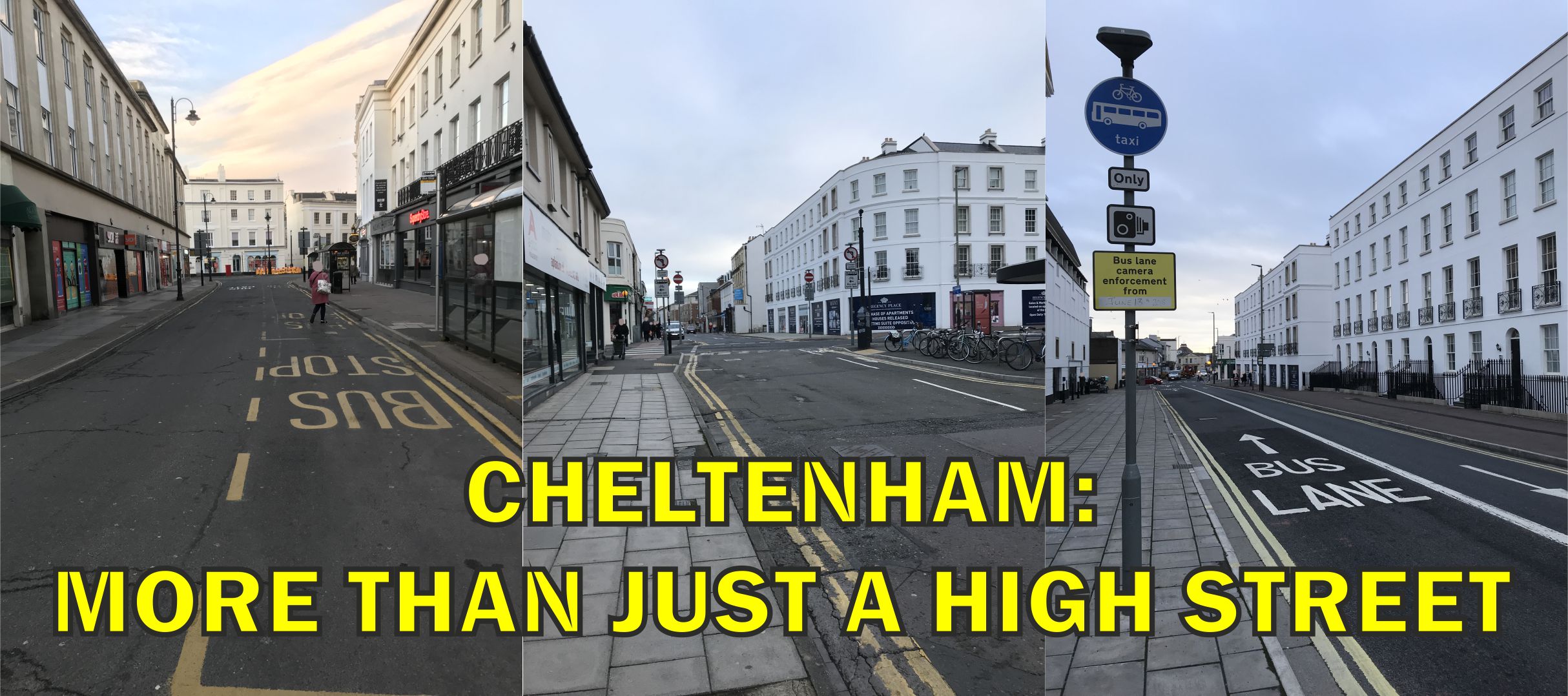
Boots Corner closed for 6 Months and the consequences for Cheltenham appear very much ‘out of sight, out of mind’

Boots Corner montage 2

Yes, that’s right. The Boots Corner debacle, the traffic problems It has created for everyone beyond the Planners masterpiece and the now ghost-like roads just a stones throw from the Town Centre have been an evolving problem facing local People and Businesses for 6 Months.

The glad-handing and self-congratulation that we see pouring out in response to every legitimate concern that is tabled, wouldn’t be a problem for anyone outside the Council and the ‘project’ itself, if it weren’t absolutely clear to everyone else that the passage of time and every new thing being added is making the problems worse and worse.

Be in no doubt, the quantitative data that will be used to legitimise this train wreck of a Town Traffic Plan will inevitably support everything that Officers and Councillors say.

What it won’t do is consider any of the qualitative or experiential impacts which are the real consequence for local People, Businesses and frequent visitors or commuters to the Town. Simply because that was never what this vanity project was about.

Out in the real world, Cheltenham’s many passionate Small Business Owners know what does and doesn’t work in the Town Centre. They’ve done the trial and error already, many times over and know intrinsically how footfall and the number of customers who enter through their doors is directly affected and proportional to the cars and traffic that travel past and have direct access and line-of-sight knowledge of who they are and what they are offering to customers.

They possessed this knowledge long before the Boots Corner project got underway and have since increased their level of knowledge and understanding in a very practical way. Information which the arrogance and ‘we know best’ attitude of the controlling Councillors and the Planners both before and since the Scheme was launched has been overlooked.

The only figures and data which now matters to the Council are the number of feet on the High Street. And the answer to the question which should automatically follow this reality simply raises many more questions and a justifiably significant level of concern about what the priorities of Cheltenham’s District Authority now are as opposed to what they should actually be.

Take a walk in the streets behind boots, M&S and John Lewis and only the most unaware of people could walk away from the experience without recognising the physical and atmospheric change to what is still a part of Cheltenham Town Centre.

Whilst the confusing mish-mash of changes to what used to be a straightforward and accessible road system may seem much safer to some faceless bureaucrat in an office somewhere, the strange silence of these roads doesn’t foretell a beneficial change taking place for any of the businesses that cannot afford the significant rents and mortgages of the revamped High Street, forcing them to go beyond.

No, it tells us that the priority in Cheltenham is only big retail business, and that the lifeblood of the town which will always be it’s plethora of Small Businesses is being condemned by both the actions and words of both elected and appointed Public Representatives.

Unpalatable as it may be to idealistic Councillors and influential Officers who have been culturally conditioned to believe that they have no other way to respond, people notice and remember the places that they want to go when they are travelling through the Town in their cars.

Yes we may have a wider, cultural problem with the dependency upon four wheels that there is.

But there is nothing practical in trying to pretend there are not natural laws at work and that human behaviour itself dictates that the lack of foresight and absence of intuitive consideration of what these changes to the Town Centre have already and are set to do, confirms that this Council will only ever deliver on its own ideas, whilst paying scant regard to the consequences of its actions upon others. Namely the very people it exists for and is there to serve.

What is effectively the closure of what used to be the inner ring road is an avoidable blight on a large swathe of Cheltenham Town Centre which will mean existing businesses will fail, new ones will never get the footfall that they need to keep going, and instead of being a destination of business opportunity for the many, this idealistic approach to managing a Town Centre will instead only really be of benefit yet again to the deep pocketed few.

For the people who know and love Cheltenham for the great Town that it already is and has been for a considerably long time, John Lewis and The Brewery are great enhancements for the Town to have. But they should never be interpreted by anybody as being all that Cheltenham is now about.

Changing this Council may be the only way that Cheltenham can now overturn this injustice, as political action is the only way that self-serving Councillors are likely to be pushed to respond to any thoughts, feelings or ideas other than their own.

The UK must have the ability to Regulate the Internet, control and respond to data management issues in ways that we never will with the rules-for-the-sake-of-rules EU involved

How we govern the Net, it’s use, the transfer, storage and sharing of data is a Policy area that like many others our Government should be on top of and ahead of the game.

That it isn’t and that many of our politicians simply have no understanding of what is happening around us in the parallel world of data is not, however, a sign that we need the EU Bureaucracy to take over and install a set of draconian and out of touch rules that demonstrates Brussels has even less understanding of the changing world than Westminster does.

Scare stories some might think.

But the reality of what the EU is attempting to do is very real and the iceberg which is coming is very much deeper beneath the surface than the relatively tame tip we now know to be GDPR.

Right now, we could be well on the way to being legally unable to share material such as newslinks from the Internet, or even take pictures of or in public places because of what the EU is now attempting to deem as being assumed copyright for things like buildings.

Idealistic, dangerously impractical and without any real regard for how life works within the world of the Internet and in its relationship with everything else, unelected bureaucrats lurking in an office somewhere in Brussels are about to take nanny-stating and big brotherish concepts to a whole new level.

If we either Remain or worse still, embrace May’s deal, we will have no choice but to accept these undemocratic and choking restrictions however far reaching and personally restricting they might be.

In governmental terms, the arrival of Internet based technology and the online universe has caught legislators napping.

To many, a fallacious idea now exists where the Net has broken down geographical boundaries and barriers and heralds a new age where concepts such as cryptocurrencies and blockchain will make localised governance systems redundant and that markets will now reach across the world and take care of everything that crops up in between.

They won’t.

The reason they won’t, is that no matter what we do online, be it personally or for our business or employer, the dehumanisation of relationships which the rise of the internet has already inflicted upon us has shown that real life requires a level of tangibility and physical stimulation that technology will never offer us, even through virtual reality.

Centralising and ceding power to the EU over data and the rules which govern our Internet access and use would be a catastrophic abuse and denial of the real opportunity to take control and influence the response necessary to the powerful technological and informational changes taking place around us. And to do so for the better.

Our businesses, our people and the physical environment across the UK are very different to the 27 other Countries that make up the EU.

We must have regulation which is sensitive, tailored and responsive to UK needs. Regulation must not be set on a one-size-fits-all basis which at best will be modelled on a false commonality between 28 very different Countries and more likely will be much worse, offering no basis of practicality at all or any sense in which we could identify consideration of any specific UK need – either domestically, or for our interactions with the whole of the outside World.

This will not be possible if the UK’s choice to Leave the EU is ignored. Or through the dishonesty and lack of responsibility to the Electorate on the part of Politicians, the UK is coerced into a much closer and technically irreversible union with the EU as will be the outcome of May’s deal being adopted, or an alternative series of false choices are created which mislead us to Remain.

We will only have the flexibility, the adaptability and the necessary cultural intuitively to give the UK the right Data Policies that we need, if we Leave the EU, take complete control of our own Policy making once again, and then push our self-orientated Political classes to get on and deliver the key Policy areas like Data which will return the UK to the place where we can meet opportunity or crisis from wherever it may come, head on.


image thanks to entrepreneur.com

The travesty of Tuition Fees was the commercialisation of education, the myth of qualification-related Social Mobility and the creation of lifetime debt for those who can least afford it

img_1723


Somewhere, there was a cheer last week. Quieter than the Government was expecting. Bringing noises that didn’t sound quite as expected.

Yes, the dropping of Tuition Fees does sound good. But the question we should all be asking – just as we should have when they were first brought into being is ‘at what cost?’.

Living in the age of political idealism made manifest as we currently do, it is all too easy to get distracted by the noise from the media as new public policies are launched.

We fail to look beyond and see the true consequences of what the Government of the day is doing with our money, and what the legacy – and yes, what the fallout will actually be from everything they do.

The creation of Tuition Fees was one of the biggest travesties of them all, simply because it all sounded so good, whilst the negative impact and knock on effects across so many different areas of policy were simply too-far reaching to justify anything about it which was tangibly good.

The UK’s Education System has been failing us all for a long while anyway. But the impact from Tuition Fees was never going to deliver much that really helped anyone in the way that the genuine concept of equality in education for all really should.

That so many former, existing and future students are now destined to have a lifetime of debt must surely now be a given.

Yet it is through the accompanying shift of emphasis from quality of teaching to fee-generation and profit alone within the Further and Higher Education Sectors which has secured the Blair era one of its darkest, yet most unrecognisable legacies as the true cost of ‘degrees for everyone’ becomes manifest and begins to become widely known.

It should come as little surprise that the leaders of the Institutions in these Sectors are now worried that a restriction on Fees may begin a process where ‘struggling’ universities are set to close.

That is the true price of making education a business, where money should never have been the target of a reprioritisation of direction. And certainly not in a place where the benefit to the student, our industries and the National interest itself are so very closely entwined.

Beware the siren calls and suggestion of this being an attack on Social Mobilty too. Academic qualifications have only ever been a very small part of what it takes to get any one person through the perceptual barriers which hold so many people back. Whether they be school-age students, young people, graduates, career changers, returners or retirees, we all have a part to play in everyone else’s future too.

The reality is that the State should pay for everyone’s education. But in doing so, we must be practical and realistic about how access to education is applied and how much benefit is derived to us all from the provision of each and every course.

We must recognise that there is just as much value to be gained by opening up truly vocational opportunities for the less-academically-inclined at the age of 14.

And that as a result of doing so, not only would we release many young people from the painful and unnecessary realities of being in debt, we can also exploit the opportunity to create a parallel track of time-served and experienced trainees to support all of our businesses in a way that the obsession with degree level education has all but denied.

It would be far more sensible to begin this process of change now, accepting that neither the student nor the Nation itself can afford the process of awarding superfluous and non-beneficial degrees. And help the Sector to change through reform, rather than through a process brought on by necessity, which is what is currently sure to happen, if Politicians continue to think that money is the only benchmark by which the future of education can and should be defined.