The Basic Living Standard: Freedom to Think, Freedom to Do, Freedom to Be with Personal Sovereignty that Brings Peace to All

The Illusion of Freedom

One of the biggest misunderstandings of the time and culture we live in is the way we understand, respond to, and relate to what freedom really is.

Many of us believe that we are free: that we can do what we want, think what we want, say what we want, and be what we want.

Yet we all live under rules that must be followed – rules which few would deny are becoming more intrusive, more prescriptive, and increasingly powerful in the consequences they impose if we fail to use our “freedom” in the way someone else has dictated it must be perceived and lived.

The Everyday Policing of Speech

Some reading this may respond with something like “Tell me something I don’t know.” And that would be fair enough, given the growing body of anecdotal evidence confirming that freedom of speech is not what it seems.

Almost everyone we might consider “ordinary” – those without an agenda, simply wishing to get on with their lives – now finds themselves policing their own relationships and interactions with the outside world.

Speaking truths rooted in common sense, or even in the way things have always been, increasingly risks offending those who demand the world operate according to their own design.

The Marginalisation of Independent Thought

Even reflecting on what is, at best, the marginalisation of independent thinking – and at worst, the steady criminalisation of individual thought – opens up a maze of debates.

These debates inflame questions about the role, scope, and power of groupthink, and how establishment narratives are not only shaping, but increasingly dictating blueprints for how everyone must live their lives.

Encroachment by the Establishment

To believe we are free in a world, country, and culture where the establishment seeks not merely to encroach but to manage every part of life is alarming enough.

Yet it becomes even more disturbing when we recognise that these restrictions and attacks on freedom are not created for the common good, but to benefit someone else.

The Role of Money as Gatekeeper to Life, Peace, Happiness and Freedom that is Governed by Someone and Something Else

Freedom Defined by Money, Not Ourselves

Yes, we are already in a fight for those freedoms outlined above.

The fight is increasingly hard because a division has already been created between what we believe freedom is, and what we believe we already know it to be – which itself isn’t what we are experiencing.

That we continually look outside of ourselves for validation should make sense, because when we think about the difference between what we imagine freedom to be – doing whatever we want – and what society actually allows us to do, shaped by those who create the narratives that control society, we quickly begin to see that there is a significant difference involved.

The Manipulation of Meaning

Creating circumstances where somebody can change the meaning of something so that a word comes to mean something very different from what we know it to be could never happen in an environment where people are confident in who they are, their communities, their culture, and what it ultimately means just to be themselves.

We have now reached the point where even the term common sense is being brought into question, sometimes considered offensive or demeaning.

This is because the fundamental basics of life – the value set that upholds the framework for a good life – have been replaced by a system that places money at the heart of everything.

Money at the Centre of Every Choice

Money has become so ingrained in every part of life that, without even questioning our motives, it dictates the decisions and choices we make.

Everything in life is based on what we can afford, earn, save, accumulate, or the cost and risk of cost.

Jobs are about what we earn now and in the future. Insurance is about betting against risk. Education is about securing a career that pays more than a working wage. The house we live in depends on the mortgage and deposit we can save or borrow. What we own depends on money already earned or borrowed. Holidays depend on savings or loans. Cars depend on leases or borrowing, unless bought outright.

Contracts Before Basic Essentials

It doesn’t matter who we are or what we earn. The world now requires us to sign up, subscribe, or rent services and products we once simply bought.

These arrangements are backed by contracts that must be paid before any income can be considered disposable.

Only food and basic essentials remain in the realm of pay-as-you-go – and even those are increasingly tied to credit cards, buy-now-pay-later schemes, or payday loans.

Judgement Through Wealth and Appearance

We judge people by their appearance, their property, their clothes, or their transport – signals of “who the world tells us they are.” And when we consider how much future earnings and financial security matter, even ordinary people outside the elites evaluate partners and marriage commitments based on what a potential partner can afford.

The Private Turmoil of Dependence

Few can see just how powerful, overwhelming, and controlling money has become.

Fewer still talk about it comprehensively.

Yet the reality is that what we do, what we have, how we are perceived, and whether we are accepted or rejected all revolves around money.

This leaves us in private turmoil and pain – what some might call or know as hell – because parts of life, or what is respected as life today, are cut off or restricted by money’s role.

The System’s Sick Success

This system is not natural. It has been deliberately created for the benefit of those who already have much more than they will ever need.

Its success lies in convincing the masses that freedom and status are directly proportional to wealth.

Meanwhile, the mechanics of the system ensure that resources flow away from those who have every right to them, leaving them dependent on credit and enslaved by debt.

In return, people have unwittingly surrendered property, ownership, and the peace of mind that comes only from self-sufficiency.

Fear as the Final Driver

Everything in life is driven by money – or more precisely, by the fear of not having it.

Everyone, at every level, makes decisions and behaves according to financial implications.

When people or businesses are pushed into dependence on external finance, even reason itself is abandoned. Questions of viability or self-sufficiency are ignored, as survival becomes the only priority.

When this mindset dominates, it doesn’t matter who someone is or what position they hold. They become vulnerable to the power and control of whoever influences what happens next.

This is the world we live in today. The plans, strategies, and changes overtaking life – many of which defy common sense – have taken hold because someone, somewhere, intended and created it to be this way.

This Is by Design

Where this all becomes difficult to accept is in recognising that nothing about the journey which has brought the world to this point is accidental.

It is by design.

The reason is simple: people who know they are free, cannot be controlled.

Freedom Cannot Be Controlled

If people cannot be controlled, they will not accept, take part in, or contribute to a system that is stripping away everything from them.

Everything that should, and always will, remain naturally theirs.

The Drive to Own and Control

Those who want more – who want to control more, own more, and take everything from everyone else – cannot succeed unless they first control people themselves.

They cannot take everything away unless they make the process appear legitimate.

Control must come first, because without it, the system suffocates and then collapses, under the weight of its own injustice.

Freedom Does Not Look Like This

Because most of us are not physically imprisoned and we face each day with choices that seem to be ours, many believe we are free and living free lives.

However, what we are experiencing – where we are coerced by narratives, advertising, groupthink, the media, and even the “free-minded” influencers we follow online to keep up – is not freedom at all.

Coercion Disguised as Choice

Beyond the natural requirement to meet the basic and essential needs of maintaining human life, anything that influences our behaviour or sets frameworks for “acceptable” choices is not freedom.

It is an infringement upon freedom.

At its most basic level, it is simply doing what we are told.

Money as the Measure of Freedom

Because of the way the money system has been designed, people believe they are free if they have enough money to do what they want or to buy what they think will meet their needs, as the system suggests them to be.

But money has become the value itself – rather than the work, the products, the property, the services, or the people involved.

We now believe we can only have anything, whether it is to meet needs or wants, if we have or can obtain the money to pay for it – and that these things are all the same.

Our freedom is dictated entirely by our relationship with money.

The Illusion of Value

If money were as real as we believe it to be, the value of the money in our pockets or the salary we earn would not reduce without us doing anything that changes anything.

Yet it does.

And the value of our money changes, because money is under someone else’s control.

The game, or rather the whole deck of life, is stacked in someone else’s favour.

The Mathematics of Decline

In the UK, inflation typically reduces the value of the £Pound by 2–3% each year.

This means prices rise, and your money buys less over time.

  • Inflation is measured by the Consumer Price Index (CPI).
  • If inflation is 3%, £100 today will buy only what £97 did a year ago.
  • The effect compounds: after 5 years at 3% inflation, £100 is worth about £85.87 in real terms.
YearReal Value (£100 Start)
0£100.00
1£97.00
2£94.09
3£91.27
4£88.53
5£85.87

To keep up, your income must rise at least as fast as inflation. Otherwise, your purchasing power declines each year. And in truth, when we look more closely at the figures against what it costs to buy the things that we rally need, inflation seems to be putting those prices up a whole lot more.

Running to Stand Still (Revised)

Because inflation in the UK typically reduces the value of the £Pound by at least 2–3% each year, you must increase your income by at least this amount just to maintain your current standard of living.

The effect compounds: after five years at 3% inflation, £100 is worth only about £85.87 in real terms.

This means you are running uphill simply to stay in the same place.

Of course, this is assuming the official rate of inflation is accurate – if the real rate is higher, the decline in purchasing power is even greater.

It Doesn’t Have to Be This Way – The Alternative Is The Basic Living Standard and an economy that puts People First

Because money sits at the heart of everything in life, very few of us can visualise a way of living that works differently. And as we’ve already discussed, you aren’t supposed to – because this is how you come to believe you are free, when in fact you have been enslaved.

Money as the Toolkit of Control

Money, in the way we use it today, is the toolkit of the greatest crime ever inflicted on humanity.

Its genius lies in the way it convinces people to participate in, and even further, the very crime being committed against themselves.

In this system, money is the only god. But it is not benevolent or caring.

It is unjust, unfair, and strikes no balance when it comes to equity, equality, or what is good for mankind.

Two Masters Cannot Be Served

Man cannot have two masters.

For as long as money and the money system remain the only god, people, community, the environment, and basic human values will never be what life is truly about.

The system is designed to keep us dependent, fearful, and compliant. Whilst it slowly takes or destroys everything that is genuinely important and of value to us all.

The Alternative: The Basic Living Standard

There is an alternative. And although it may sound radical to suggest that one rule changes everything, the truth is that a future awaits where real freedom is not only possible for some, but becomes the way of the world for all.

The Basic Living Standard (BLS) is that rule.

It guarantees that everyone’s essential needs – food, shelter, energy, water, clothing, healthcare, and the means to participate in society – are met.

It is not charity, welfare, or a handout. It is a universal right, paired with universal responsibility.

Real Freedom Through Self-Sustainability

By meeting everyone’s basic and essential needs, the BLS creates the foundation for self-sustainability and genuine freedom.

It dismantles the false god of money by ensuring that survival is no longer dependent on debt, wages, or exploitation.

This is the only way to achieve real freedom: freedom to think, freedom to do, freedom to be, and personal sovereignty that gives peace to all.

What Financial Freedom Is and What It Means

The simple difference between the world that is destroying us and the world we need is this principle: We should only take what we need to meet our basic and essential needs, and reject completely the idea that there is anything good in accumulation, control, or influence beyond that.

No person or organisation should have the right to hold or control any more than they need for themselves or those they have direct and meaningful responsibility for.

Abundance

Natural abundance is the state of having our basic needs met and knowing they will continue to be met through our contribution and work – without interference or control from others.

Yet what we have come to believe abundance to be is wholly manufactured. It equates to accumulating, owning, and controlling as much as possible, regardless of the cost to others or to the environment.

When we recognise that true abundance is simply safety, security, health, happiness, and the basics that sustain them, we will also understand that these are the real foundations of inner peace. And peace is what abundance is really all about.

The Peace to Relax

Think carefully about how you feel when you no longer have to worry about what you will earn, borrow, or buy; how people will judge your clothes or job title; or anything else that creates fear of loss, anxiety about the future, or depression about what you think you may have already lost.

Yes, life has its own natural anxieties – relationships, health, and personal challenges.

But these are not manufactured to benefit someone else or a system that exploits us in every conceivable way.

When you have natural peace – because you are not in a constant race to keep up (while condemned to fall behind unless you add more than 3% value to your financial ‘worth’ each year) – if you are not already too far behind – you begin to see life through an entirely different lens.

Freedom to Think

When we have the freedom to think, we have the freedom to learn what life is really about.

We can be open to joys and pleasures that appear too simple or meaningless when we are trapped in pursuit of someone else’s agenda.

These joys hold value and meaning that help us grow into the human beings we truly are.

With this level of freedom, we see life’s mechanisms and systems in a healthier way.

Our expectations become simple. We develop patience with others and understand that we are not defined by what we have or earn, but by how we treat and respect others – even when there is no advantage to gain.

Freedom brings the ability to experience natural joy, not happiness sanctioned by someone else’s criteria.

It allows us to make and learn from mistakes, seeing them as value rather than cost – a perspective denied by the money-centric world.

Personal Sovereignty

Freedom on this level opens the door for us to be exactly who we are meant to be.

It facilitates personal sovereignty – the ability to make real, independent, and meaningful choices that affect only us, without fear of consequences from outside of ourselves.

This sovereignty exists beyond the participation and contribution required of us within the community to do our part, ensuring that everyone’s basic and essential needs are met.

It is the balance between individual freedom and collective responsibility, and it is the essence of financial freedom.

The Framework for a People-Centred Life

The Basic Living Standard is the formulaic basis of the life we all need.

It guarantees that everyone has access to everything necessary to meet their basic and essential needs, in return for each person contributing through work and activity to ensure that every necessary process – and yes, every business – is completed so that everyone’s needs are met.

Businesses That Serve Needs, Not Greed

The entire system revolves around this formula.

Businesses and organisations exist only where a basic or essential need must be met.

They never grow beyond the size necessary to serve the community in which they are located and involved.

This ensures that the purpose of business is not accumulation or profit, but service to people and the environment.

Technology as Support, Not Replacement

In this system, people are supported and aided — but not replaced — by technology and AI. The need for human contribution remains central, because participation is not about money or profit. It is about people, community, and the environment around which our lives revolve, and the experiences we share together.

The Same Rules Must Apply to Everyone

For fairness, balance, and justice to exist, the same rules must apply to all.

Part of the human condition is the instinct to survive – an instinct that quickly evolves into selfishness.

It drives us to use any advantage, whether through opportunity or design, to take more, hold more, or obtain power over more than we actually need.

We often justify this behaviour by believing it makes us special compared to others, or by using it to visibly demonstrate superiority.

Survival Instinct vs. Shared Responsibility

Yes, it can be argued that this is how humanity naturally behaves.

But just because it appears to be the default response to fear of lack, it does not mean it is right.

When there is enough of everything for everyone, and when we have the knowledge and understanding to build and manage a world that works for all – as we now have, the pursuit of excess is neither natural nor justified.

The True Depth of the Basic Living Standard

In this sense, the Basic Living Standard is not just a benchmark or guarantee of dignity and financial independence.

It is also a framework that requires everyone and everything to function with its principles in mind.

Every process, system, and mechanism must flow from and to its implementation.

The BLS is not simply about meeting needs – it is about ensuring that the way society operates is aligned with fairness and responsibility.

No Special Rules, No Hierarchies, No Excerptions

There can be no special rules for anyone. No exceptions or hierarchies where some hold more power or influence than others. No materially based differences that allow one person to be perceived as fundamentally different from another.

Only when everyone and everything plays by these basic but essential rules, can the integrity of the system be assured.

Integrity Between Person, Community, and Environment

Ultimately, it is the integrity of the relationship between person, community, and environment that must be protected.

This integrity ensures that fairness is not just an ideal, but a lived reality – one that sustains balance and justice for all.

The Local Economy & Governance System (LEGS)

The Local Economy & Governance System offers the framework and societal structure that enables the Basic Living Standard to function.

It ensures that everyone can thrive and enjoy the freedom to think, to be, and to do – the personal sovereignty that guarantees peace for all.

A Human Economy

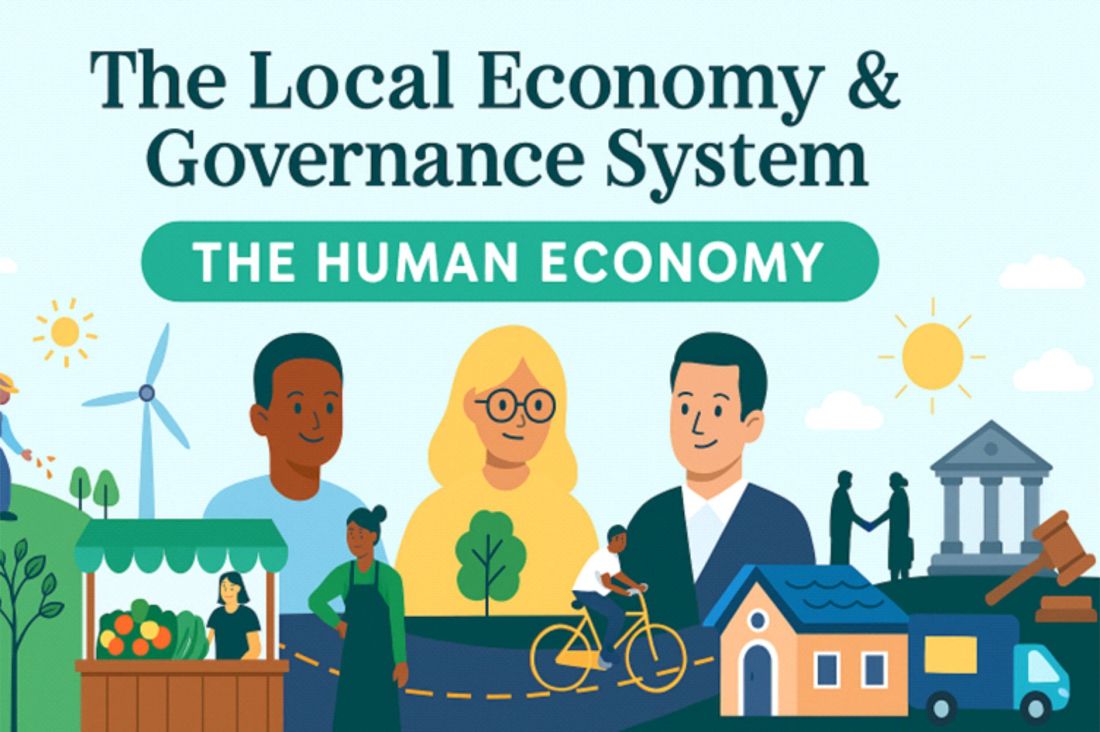
LEGS is a human economy.

Everyone who can, works or contributes, and contribution replaces currency as the foundation of exchange.

This means that the value of each person’s effort is measured not in money, but in the way it sustains people, community and the environment.

The End of Inequality

Most of the social issues we experience today are the effects of inequality – wealth inequality, social inequality, and the distortions created by a money-centric system.

In LEGS, these issues disappear. They no longer exist because the system is built on fairness and the natural law of cause and effect: when everyone contributes and takes fairly, everyone’s needs are met.

Businesses That Serve Communities

As described in the Basic Living Standard framework, businesses and organisations exist only to meet essential needs.

They remain the size necessary to serve their communities, never expanding into monopolies or profit-driven empires.

This ensures that resources are not hoarded, and that abundance is measured by access, not accumulation.

Technology as a Partner, Not a Master

Technology and AI support people but do not replace them.

The purpose of contribution is not profit, but participation.

Work is about sustaining life, community, and environment – not about chasing growth or accumulation.

In this way, LEGS ensures that human dignity and responsibility remain at the centre of society.

A System Built for People

The Basic Living Standard cannot work within the collapsing money-centric system that we have today.

It requires a new foundation – and LEGS provides that foundation.

By reorienting governance and economy around people, community, and environment, LEGS makes possible a society where freedom is real, sovereignty is respected, and peace is shared.

Benefits of the Basic Living Standard and LEGS

The benefits of the Basic Living Standard (BLS) and the Local Economy & Governance System (LEGS) are wide-ranging.

They work not only at the individual level, but also across communities and the environment.

Together, they create a framework where fairness, responsibility, and sustainability replace fear, inequality, and exploitation.

Reducing Crime

When everyone’s essential needs are guaranteed, desperation disappears.

Crime rooted in poverty, scarcity, or inequality declines because survival is no longer at stake.

Contentment and Peace of Mind

True abundance is not accumulation, but having enough.

By ensuring that everyone has what they need, BLS and LEGS foster contentment.

People are free to live without constant anxiety about money, status, or survival, creating peace of mind and stability across society.

Removing the Mental Health Crisis

Much of today’s mental health crisis is driven by insecurity, debt, and the relentless pressure to “keep up.”

With BLS, those pressures dissolve. Freedom to think, be, and do allows people to experience natural joy, rather than manufactured happiness tied to wealth or possessions.

Ending the Benefits Problem

The current welfare system is built on dependency and stigma.

BLS replaces this with a universal guarantee: everyone has what they need, and everyone contributes what they can.

This ends the cycle of benefits, bureaucracy, and inequality, creating dignity and independence for all.

Sustainable Living and the End of Overuse

Because businesses under LEGS exist only to meet essential needs, they never grow beyond the size and capacity required by the communities they serve.

This prevents monopolies, overproduction, and exploitation of resources.

Communities consume sustainably, and the environment is protected.

Work and Contribution as Valid Beyond Pay

Contribution replaces currency. Work is valued not by wages, but by its role in sustaining the community.

Whether paid or not, every contribution matters – from caring for others to maintaining essential services.

Valuing Every Kind of Work

In a system where survival is guaranteed, people see the value in every kind of work.

No job is “beneath” anyone, because all jobs contribute to sustaining life.

Happiness in Any Role

People become happy and content to do any kind of job, because work is no longer about survival or status.

It is about contribution, community, and purpose.

Experience as a Shared Tool

Life experience itself becomes valued as a tool for the benefit of all.

Wisdom, skills, and lessons learned are shared within communities, enriching collective wellbeing.

Care Rooted in Community

Care for those who may be too young, too old or unable to contribute for any other reason is carried out by members of the community who are best able, and who still receive what they need to meet their basic and essential needs.

This ensures that care is not commodified or dependent on profit, but is a natural part of community life.

A System That Benefits All

The benefits of BLS and LEGS extend beyond individuals.

They strengthen communities, restore dignity to work, protect the environment, and create peace of mind.

By removing scarcity, inequality, and fear, they build a society where freedom, sovereignty, and justice are not privileges, but universal realities.

Life Beyond Survival

Freedom Creates Time for Life

When freedom and personal sovereignty are real — when the compulsion to “keep up” is gone – something remarkable happens. Time and space open up.

Social activities, sports, and hobbies stop being luxuries or calculated uses of “spare” time that isn’t really spare at all. They become normal parts of everyday life.

The Basic Living Standard and LEGS make this possible by removing the constant pressure of survival and competition.

Instead of chasing money or status, people can invest their energy in pursuits that bring joy, health, and connection.

Communities thrive when individuals have the freedom to play, to create, and to participate in activities that enrich life rather than drain it.

Yet the greatest gift of this freedom is not only the chance to do more, but the chance to be more.

With peace of mind and comfort secured, people gain the space to think differently and expansively about who they are and what their existence really means.

Freed from fear and scarcity, we can explore our true selves, discover new perspectives, and embrace the human experience in full.

Rediscovering Real Relationships

Equally important is the refocusing and repurposing of face-to-face, in-person, real-life relationships.

In the money-centric system, digital interactions and transactional exchanges have all too often replaced genuine human connection. But under the Basic Living Standard, relationships regain their rightful place at the centre of life.

The priceless social skills and social learning that come from real-world interaction equip every person for a happy, healthy life.

They foster empathy, cooperation, and understanding – qualities that cannot be replicated by algorithms or screens.

When survival is guaranteed and competition is replaced by contribution, people are free to build communities rooted in trust and shared experience.

This is not just a benefit of the system; it is its very purpose.

Human beings are not data points or consumers. We are social creatures, and our wellbeing depends on the strength of our relationships.

Conclusion: A Future Built on Real Freedom

The journey through this essay has shown that what we call freedom today is little more than an illusion.

Rules, narratives, and the money system have combined to create a world where survival is dictated by fear, debt, and inequality.

Yet this system is not natural – it is by design, and it benefits only those who already have more than they will ever need.

The Basic Living Standard and the Local Economy & Governance System offer a different path.

Together, they dismantle the false god of money and replace it with a framework built on fairness, contribution, and sustainability.

They guarantee that everyone’s essential needs are met, that businesses serve communities rather than greed, and that technology supports rather than replaces people.

The benefits of this transformation are not limited to crime reduction, mental health, or dignity in work. They reach far wider – across personal wellbeing, community strength, and environmental sustainability.

They reshape how we understand abundance, how we value relationships, and how we live in balance with the world around us.

They restore the integrity of the relationship between person, community, and environment, ensuring that freedom is not just an individual experience but a shared reality.

Beyond these practical gains, BLS and LEGS deliver something even greater – the freedom to live fully.

Time for hobbies, sports, and social activities becomes normal, not a luxury. Real relationships are rediscovered, and the social skills that equip us for happy, healthy lives are restored.

This is not utopia. It is a practical, people‑centred system that aligns with the natural law of cause and effect: when everyone contributes, everyone’s needs are met.

It is a vision of a world where freedom is not defined by money, but by sovereignty; where justice is not a privilege, but a universal reality; and where peace is not manufactured, but lived.

The choice before us is simple. We can continue down the path of fear, inequality, and exploitation and the destruction of humanity that it guarantees. Or we can embrace the Basic Living Standard and LEGS, and build a future where freedom, fairness, and community are the foundations of life.

The Basic Living Standard and LEGS create a human economy, where balance, fairness, and justice underpin life. They place people before money, with priorities fixed upon community and environment. The BLS is the simple benchmark rule — the rule of all rules – upon which all systems of trade and commerce are aligned. By recognising abundance in its natural form, where everyone has enough to meet their needs but not their wants, the dynamics of life are transformed. Every need beyond the tangible can then be met, because peace, freedom, and personal sovereignty flow from financial independence. This is what allows each of us to enjoy and learn from the human experience in full.

Glossary of Key Terms

Basic Living Standard (BLS):
A universal framework that guarantees everyone’s essential needs—such as food, shelter, energy, water, clothing, healthcare, and the means to participate in society—are met. It is not charity or welfare, but a right paired with responsibility.

Local Economy & Governance System (LEGS):
A proposed societal structure that replaces currency with contribution, ensuring that the value of each person’s effort is measured by its impact on people, community, and environment. LEGS supports the BLS and aims to eliminate inequality and exploitation.

Personal Sovereignty:
The ability to make real, independent, and meaningful choices that affect only oneself, without fear of external consequences. It is the balance between individual freedom and collective responsibility.

Contribution Economy:
An economic system where work and participation are valued by their role in sustaining the community, not by monetary reward. Contribution replaces currency as the foundation of exchange.

Universal Rights and Responsibilities:
The principle that everyone has the right to have their basic needs met, and the responsibility to contribute to the wellbeing of the community so that others’ needs are also met.

Abundance (Natural):
A state where basic needs are met and will continue to be met through contribution and work, without interference or control from others. True abundance is defined by safety, security, health, and happiness—not accumulation or control.

Money-Centric System (Moneyocracy):
A societal structure where money is at the heart of every decision, relationship, and opportunity, often leading to inequality, dependence, and loss of freedom.

Groupthink:
The tendency for collective narratives or establishment views to shape and dictate how individuals think and behave, often at the expense of independent thought and personal freedom.

Self-Sustainability:
The ability for individuals and communities to meet their own basic needs without reliance on debt, wages, or exploitation. It is a foundation for genuine freedom.

Universal Guarantee:
A commitment that everyone’s essential needs will be met, removing the stigma and dependency associated with traditional welfare systems.

Further Reading:

To help deepen understanding of the ideas behind the Basic Living Standard (BLS) and the Local Economy & Governance System (LEGS), the following resources are grouped by theme.

This structure will help you explore the foundational critiques, proposed solutions, mindset shifts, economic mechanisms, and personal perspectives that underpin the vision for a fairer, people-centred society.

Each link includes a brief summary to guide your reading.

Understanding the Problem

The Basic Living Standard & LEGS Framework

Mindset and Social Change

Economic Mechanisms and Work

Personal Transformation

LEGS: The Human Economy – A Blueprint for Transformation

Introduction

In a world increasingly shaped by the pursuit of economic growth and the dominance of monetary values, our understanding of what truly matters has become distorted.

The language of economics, once intended to serve human wellbeing, now often justifies systems that place money above all other forms of value.

This Local Economy & Governance System (LEGS) challenges the prevailing money-centred worldview, exposing the myths that underpin it and the consequences for individuals and society.

By re-examining the purpose of the economy and redefining value at the level of the individual, we offer a blueprint for transformation – one that places human needs, freedom, and wellbeing at the heart of economic life.

The following pages invite you to reconsider what it means to live well, to recognise the moral costs of excess, and to envision an economy built on natural abundance, justice, and personal sovereignty.

The Rise of a Money‑Centred Worldview

Over time, the words economy, economics, economic policy, and economic theory have been shaped by a money centred worldview.

They became part of a language and narrative designed to justify systems that placed money above all other forms of value.

This worldview gradually embedded itself into culture, until money was positioned at the centre of almost every aspect of life and treated as the primary measure of worth.

How Policy Reinforced the Myth of Economic Growth

Governments, politicians, and established institutions reinforced this belief by placing the economy at the heart of public policy.

They encouraged the idea that a good life was only possible if the economy was considered healthy and growing.

Measures such as GDP were promoted as the ultimate indicators of national wellbeing, and people were led to believe – often without explanation – that their personal success was somehow tied to the financial success of the economy itself.

Reducing Human Value to Economic Data

By turning everything of tangible value into something economic, measurable, and defined only in relation to the economy, society gradually stripped away the inherent value of each person.

Individuals became reduced to data points – digits on a screen – an effect amplified by digital tracking and the rapid development of AI.

The Hidden Myth of External Power

The central myth that upheld this money centric system was not only the false belief that money is inherently valuable.

The deeper, more powerful myth was the idea – never openly stated but widely accepted – that real power lies outside the individual.

Because money appears external to us, it became easy to believe that our worth and our agency also exist outside ourselves.

The Illusion of Money as Value

In truth, money has no intrinsic value. It is simply a tool for exchange.

The belief that money is value created the foundation for many of society’s problems.

The FIAT System and the Concentration of Power

This belief was further exploited through the rise of the modern FIAT monetary system, which used complexity, misplaced trust, and practices that would otherwise be considered unethical or criminal to shift wealth – and therefore power – from the many to the few.

All of this was presented as progress. As the natural direction of a modern world.

The Moral Cost of Excess

Yet in any genuinely civilised society, there is no moral justification for one person to hold more than they need when that excess comes at the expense of others.

When someone accumulates far beyond their needs, someone else – often someone they will never meet – is forced to go without the essentials required for a life free from deprivation.

How Scarcity Is Manufactured

Taking more than we need, in any form, inevitably creates shortage elsewhere.

Possession alone does not justify allowing others to suffer lack.

No individual has the fundamental right to hold more than they require when doing so directly or indirectly harms others.

Economics as a Tool of Justification

In this way, the language of economics became a tool to legitimise imbalance and injustice.

It normalised greed and elevated the pursuit of material wealth and power to something admirable – something to be celebrated above all else.

The Local Economy & Governance System: Defining the Economy and Economics for a Humane Existence and Way of Life

Real value does not exist within money itself, nor within the material possessions that money – despite having no intrinsic substance – can be used to persuade others to “buy or sell.”

True value can only be defined at the level of the individual. It arises from the meaning and importance a person attributes to something from within themselves, not from any external price tag or monetary label.

Money is simply a practical tool. Its purpose is to make the exchange of value easier when direct barter or exchange – trading goods, services, or labour – is not possible or convenient.

Money is a facilitator. Not the source of value itself.

In reality, people are the economy.

People are the reason the economy exists, the purpose behind it, and the driving force within it.

Every meaningful economic activity begins and ends with human needs, human choices, and human wellbeing.

With this understanding, the LEGS interpretation of economy can be defined as follows:

Economy is the collective presence, activity, and contribution of people working together to provide and supply all the goods, services, and forms of support that are essential for every individual within a community to live well.

Its purpose is to ensure that no person experiences need or scarcity severe enough to undermine the natural state of abundance – a condition in which all basic and essential needs are reliably met.

In this state of abundance, individuals are freed from the pressures of deprivation or want, allowing them to experience a form of personal freedom that is not compromised by the struggle to secure the necessities of life.

Thus, the economy is not merely a system of production and exchange, but a shared human effort to sustain the conditions that make genuine freedom, well‑being and the experience of Personal Sovereignty possible for all.

Summary

These pages challenge the prevailing money-centred worldview, revealing how economic language and policy have often placed monetary value above human wellbeing.

They expose the myths that underpin this system – especially the illusion that real power and value exist outside the individual – and highlight the moral costs of excess and manufactured scarcity.

The Local Economy & Governance System (LEGS) offers a transformative blueprint: it redefines the economy as a collective human effort, focused on meeting essential needs and fostering abundance, justice, and personal sovereignty.

True value, as argued here, arises from within each person – not from external price tags or monetary labels.

Money is a facilitator, not the source of value itself.

By placing human needs, freedom, and wellbeing at the heart of economic life, The Local Economy & Governance System envisions an economy where no individual suffers deprivation, and everyone is empowered to live well.

The path forward is one of re-examining our assumptions, recognising the moral imperative to share resources fairly, and building systems that sustain genuine freedom and wellbeing for all.

Breaking The Money Myth: Rethinking Value, Exchange, and Equality

An Economy That Cannot Function Without Money Will Not Work for Anything Else

Coming to terms with the role money plays in our lives is challenging for most people. But the difficulty doesn’t end there.

We have come to value money not just as a tool, but as the benchmark by which we measure everything in life.

This leads us to a deeper truth—one that must be faced, rejected, and overcome: an economy that functions for money, with money, or through money cannot, will not, and does not work for anything else.

An economy should always serve People, Community, and the Environment. These are the only foundations that truly support a good life and foster genuine equality for all.

Most people instinctively reject the idea that any form of economy or trade could operate without money. This reaction stems not from truth, but from habit. We’ve grown so accustomed to money being present in every transaction that we take it for granted—not because it’s inherently necessary for exchange.

The reality is this: an economy designed for the people must be capable of operating without money, currency, or any medium whose value can be universally—or nationally—controlled or manipulated by external parties.

Instead, value must be determined solely by those directly involved: the buyer, the seller, and the facilitator (or a community body that sets local trade rules for the exchange of essential goods and services).

This doesn’t mean money or currency must be eliminated entirely. Rather, it means that their value must remain free from inflationary or deflationary forces.

Any variation in exchange value must reflect only the true worth of the goods, services, or contributions involved.

The Moneyless Economic System

The essential shift—both in action and mindset—is from a system where money is required in every transaction, to one where the exchange of life’s necessities does not inherently depend on money at all.

One of the fundamental truths of our world is that not all things are equal. However, the way we treat people and the planet should be equal and fair for all.

It follows, then, that money—or any form of currency used as a medium of exchange—should not be governed by a universal benchmark, especially when that benchmark can be manipulated by a powerful few to serve their own interests.

It is normal that we all contribute work to meet our needs. Therefore, the things we need should be accessible to everyone, based on the value of what they can offer through their work.

The imbalance in this equation today arises not from scarcity, but from the greed of those who control access to what others need.

This imbalance is reinforced by systems of privilege, power, and the illusion of ownership that steps beyond the requirements of genuine personal need.

Future Economics must be tied only to people, their contribution, what is important to sustain good, fair and balanced lives, and legal currency must never again be open to speculation and manipulation

You don’t need to be a trained economist to know that the model of economics the world uses and the way economics is revered like work of the gods today is wrong.

In fact, it is probably better if you aren’t, and that you aren’t involved in economics, banking or corporate wealth creation either. As you are much more likely to be objective and untainted by ‘being in the tent’ in some way.

The misplaced ingenuity of the economic system and how it works has made it as complex as it is mind boggling. But that doesn’t give any surety or guarantee that how it works and what it achieves is in any way good.

For those actually thinking about why money is the common factor in everything across the world that is now going wrong, the complexity of the economic system is being exposed to light as the smokescreen that it is giving the hallucination of credibility to all the darkness and malevolence that has been so cleverly hidden within.

How can something so clever and complex not be real, is a question that many would employ as a riposte to counter the suggestion that there is absolutely no legitimacy to the FIAT monetary system, MMT, Free Markets, Globalisation and Neoliberal Orthodoxy that we have been subjected to for 5 decades or more.

But isn’t it the case that any good game that feels good to play is only good for those playing, because of the complexities and therefore levels for ‘the players’ that are involved?

How many carrots does it cost to buy a wheel?

To really understand why the world now has got the relationship with money so wrong – even though it was deliberately made this way by corrupt interests who have changed the laws so that their crimes have been legitimised and wiped clean – we really do need to stop for a moment, count to ten and think about what money is, or rather was really intended for.

In so far as the accepted narrative of human history goes, the whole pathway of our development has been progress that moved towards today in a linear fashion, stepping off from very primitive times when man couldn’t even speak, let alone farm for food.

The point here is not to argue whether or not any accepted version of the evolution of man is true. But to set the first picture back at a point when everything was considerably more simple. Long before more and more of those complex ideas or complexities became involved in how people trade.

Then, as now; different people did different things and produced different foods, goods and services to others as the direct result of whatever it was that they did.

For the purposes of this explanation, let’s assume that there are already fishers, farmers, growers, millers, bakers, saddlers, farriers, blacksmiths, cheese and butter makers, butchers, water carriers and pretty much someone or some small business providing all the different forms of foods, goods and services that we need to provide for life, from around a village green.

Some days a baker doesn’t want fish and a fisher certainly doesn’t want a saddle or leather goods daily. Even though they probably need something made to protect them against the elements from time to time.

However, everyone needs something regularly. Whether it’s for their own consumption, or it’s there to help them complete and provide output or goods from their own work.

Bartering and exchange, or swapping goods or even hours of work are of course a very straightforward and sensible way for two parties to make a transaction when one has something available that the other needs.

But the real benefit of bartering and exchange comes from being localised. And its weakness soon showed when the transactions were required to take place over distance, or for items – like that saddle or something equally special – which in day-to-day terms, are rather obscure.

Money, or coins of some kind used at first, created a transactional value, or to be more accurate, a medium of exchange.

The creation of a medium of exchange meant that one person’s goods or efforts could be exchanged for coins that could then be exchanged for whatever that person wanted themselves. All without there being any excessive delays or the need for a very complex or convoluted chain of different transactions to be involved.

The beauty of the system, at that point, was that the money in use could only relate to the agreed value of the transaction.

It would have been good for everyone, once the related practicalities involved were ironed out, if that system had continued without further ‘progress’. The relationship we all have with money could then have remained the same in relative terms – as that unit of exchange and nothing more.

Unfortunately for mankind, progress very quickly created wealth disparity or what we call wealth inequality today.

This imbalance was itself made progressively worse by the inter-generational transfer of property and wealth (and the power it buys) which has snowballed over time. Quite literally meaning that people can be advantaged or disadvantaged by birth, even before any one of the many other factors that skew life opportunities can come into view.

One of the most unfortunate elements of the human condition is the innate desire to always possess and accumulate more. For no better reason than the basic fear we all have of experiencing lack. With the rather perverse dimension that those who have more guard it more jealously than others, probably because they believe they have much more to lose.

The power and influence that money has given people who really weren’t fit to have the responsibility they had over the lives of others, has only got worse over time.

As industry and technology has improved and made it easier and easier to avoid genuine consideration for the consequences of their actions upon others, the human cost has become increasingly irrelevant, whenever the opportunity to make more profit was involved.

When promissory notes or what we know as cash came into being, a giant leap forward was taken towards the system that we have now, where the accepted wisdom is that the value of the money – or what we are agreeing to exchange as being representative of money – is being exchanged under a mutual understanding of trust, that is shared across society, and not just between the people where the specific transactions are involved.

Trust is of course belief. And as those with power and influence at the centre of the banking system realised that having currencies pinned or anchored to anything meant that they could only ever use or suggest they were able to use the money or sensible multiples of the money that they knew they either held, were owed or could earn within a certain time frame, they knew that they would have to create a new system that would release these chains. So that in terms of the money that they could create and use in the future, the only restraints would be dictated by them.

We should be under no illusion that this process of creating an economic system that could lead to limitless wealth and the control of everything for those who controlled it, wasn’t a plan that developed overnight.

The economic system that we have today was created and implemented over decades and carefully constructed so that it would make life much easier for the interests and in particular the politicians who needed to be bought. So that the useful idiots who gained power under the illusion of democracy would obligingly pave the way with system changes that have legitimised this otherwise criminal system at every step of the way therein.

When everything is about money, the answers to every question can only be found in monetary terms.

The money we have today and the way that it comes to and is taken from us – the economy – is the direct result and design of this massive, corrupt and inhuman game that the worlds wealthy, powerful and influential – the elites, decided to play.

The money we have in our pockets, bank accounts and have the ability to earn changes value quickly at the will or as a result of the actions of others.

Meanwhile, the direction of travel for the general population has always been that we are and always would become increasingly poor, as the value of the money which is typically what the poorest in society have only been able to hold, decreases faster than the rate at which our skills and experience develop or there is any chance to earn more so that we can keep up with or counteract the fall.

It was always intended to be this way. As those with wealth always knew that the real wealth was the control of assets and anything and everything that could then rented out to everyone. All as the world became increasingly poorer and their ability to grow control and rent out everything the money they created had bought them gave them even more.

It is ironic that billionaires now have so many zeros on their balance sheets. As everyone who has been a victim of what is probably mankind’s greatest con is now beginning to realise that they have been left with zero. Or if they are lucky, a diminishing amount of liquid capital that isn’t worth a lot more.

I would like to add at this stage that this essay is not an attack on any individual for whatever it is that they may believe they possess, control or have influence over today. Many of those with excessive wealth, power and influence today have just played along with the rules of a very clever game. One that has removed the balance, Justice and morality from every part of life and has done it so successfully that the poison it has replaced values with is embedded across cultures and normal life to the point that even the academics and leaders in finance and economics believe in the legitimacy and correctness of an entire system which is bewilderingly anti-human at its very core.

In simple terms

The simplicity of the mechanics of an economic system and more specifically a monetary system that revolves around private banks creating money from nothing – a process which is carefully hidden from view – so that government always looks like it is borrowing  or rather selling bonds to private interests to finance everything, whilst those banks also lend money that doesn’t exist to us through loans, finance, credit cards and even pay day loans, really do make it horrendously difficult to accept that this is one massive confidence scam. Especially as everything is hidden in plain sight by little more than the disinterest that we typically have in anything that goes beyond having our perceived needs met.

However, let’s think about it as if we were reading a story about two friends at the start of their working lives; one with the motivation to work hard and deliver through their own industry, whilst the other has had life easy and just wants to find another easy way to get more, and we can then perhaps see how this gargantuan scam rolls out when exposed to light.

The diligent and easy living friends talk one day, looking at property that they would both like to own.

The diligent friend commits to working hard and earning the money to buy what they would like to own and leaves, promising to catch up when this outcome has been achieved.

Meanwhile, the easy living friend knows that he has the contacts and ideas necessary to go away and print enough of the money he needs to buy that same property today. And that he can do this from nothing, which will work out well for him but not his friend, so long as he doesn’t speak openly about what he’s doing. Uses his contacts to change a few rules so that what he’s doing is legal. And he doesn’t keep printing more money to buy everything else so that it becomes obvious what he’s been doing all along. Afterall, nobody will know if he uses the money he then earns from renting out that property to pay all that money back…

The money that the easy living friend has created, has just increased the amount of money that exists.

This means that because there isn’t actually any more property, production or anything else with ‘real’ value that corresponds to the increasing  pool of money, all of the money that’s available is now worth much less than it was.

The real world impact of this fantasy being made reality is that the diligent friend will have to worker harder, longer or both, to pay for the property that the easy living friend has just taken without effort.

What is more, the easy living friend is now offering to rent the property he’s bought to the diligent friend who now realises that he may never be able to afford to buy it.

If you can see and understand the basic mechanics of how this situation works, you only need scale up the same principles to understand how the massive, growing amount of money – and the ridiculous inflation and the growing cost of living problem we are all facing, has been created and is now growing at a ridiculous rate.

It is an unavoidable, inescapable fact that if one person or set of people are able to buy real, tangible things that have value to us – whatever those things might be – with money that doesn’t actually exist, they can take lawful possession of those things and do with them whatever they so choose – as any legitimate owner would be able to do so.

However, the illegitimate creation of the money and the legitimised theft of assets, businesses, infrastructure and everything else imaginable that it has financed means what they have been doing is just one part of a multifaceted crime against everyone else.

The crimes that follow the created money pathways include the impoverishment of the masses.

Yet they become even worse when we consider that public services and infrastructure such as utility companies have been bought up with fake money.

Entire business sectors like the pub trade and small, local shops have also all become unviable because fake money has financed industry expansion of big retail and all their centralised supply chains, that would not otherwise have been possible.

To cap that all off, markets and the practices of big business and finance have been deregulated through the drive for ‘Free Markets’. So that those making money can make more and more, because the rules that once protected us all and small independent businesses have been removed, whilst regulations that cost us, exclude us and disqualify us from our own independence and from taking part have instead been imposed under the pretence that they help and protect us.

The whole pathway of illegitimate money creation using the FIAT system leads or rather has led to the doorstep of nothing less than worldwide system control.

The only thing that now gives us the opportunity to save ourselves from a very challenging fate is the reality that those with their hands in the till have already broken too many of the rules of their own game.

The whole system is starting to collapse before the great reset or imposition of the next new world order has conclusively been imposed.

The Future of Money

I could stop there. But in lifting the stone or exposing what lies beneath it to light I am certainly not alone.

Before continuing further, I would encourage anyone who has read this far to do their own research and use as many different sources and mediums as they can to uncover and draw their own conclusions about all of this and what is really going on.

My real interest and passion is what happens next for us and for our future. Once we have got through this horrid time and whatever turbulence and challenges that we now face, once we have got to the other side and left them all behind.

Whilst I have written extensively about what a good working model for our future society would look like in Our Local Future, I have also spent time sharing thoughts and ideas about the way money and commerce would work, in books from Levelling Level, to An Economy for the Common Good and The Basic Living Standard too.

What we should perhaps all be able to conclude – once we have dealt with our own addictions and attachment to the way that endless money supposedly works for us all now – is that money should never hold its own value. Should never be speculated upon, and the power of its creation and policing should never be under private control.

What is more, the value of legal currency should never be pinned to anything that can itself vary in value, especially when whatever that currency is pinned to is in short supply or can be controlled manipulatively or otherwise at will.

People are the only legitimate economic constant

If everyone did what they do, only took what they need and were happy to share or exchange what they didn’t with whoever needed it in return for something they did in return, there would never be need of money of any kind, ever again.

Whilst I can see that to many the idea that everyone just does what they do today for nothing and that in return, they get just enough of what they need of everything else in return might seem fanciful, this suggestion does nonetheless make a very important point about everyone only taking or expecting to have access to what they actually need.

Need is NOT the same thing as want.

Too much want is what has led to a situation where there are people right across the world today who don’t have access just to the things that they need.

An economy – a legitimate economy – will function only to provide for the needs of people within it.

There isn’t an argument that can counter this legitimately. Any argument made against this, no matter how compelling or well elucidated, is inevitably built upon one person being able to obtain or accumulate more things than others. Because the alternative system favours their interests more.

These are the fundamental basics of greed.

Locality based economies and economics

Everyone who can, should play their part or contribute to the function of a legitimate economy, in whatever role they are able. So that everyone who is active, then comes together to become the sum of all the parts – with the sum of those parts being the community, which because of what members can do together collaboratively, will be greater than what everyone would be able to do by working alone.

The value of a legitimate economy should therefore be based upon the number of people who are active within it and include what they input or contribute to that economy individually and therefore collectively.

If every member of the community does what they should be doing, and the needs of everyone being met are always prioritised and planned for or budgeted for as they should be, the whole system will move closely towards self-containment, with the amount of money in circulation always being closely related to the number of heads within the population.

A localised and online local market exchange system that focuses on bartering and exchange for foods, goods, services and work being made universally available alongside cash and digitally transferable money, should also exist so that everything works in a circular fashion and everyone’s particular needs are always met in ways that favour everyone.

The needs for public service, infrastructure, community activities and everything beyond should be met by everyone who is able to work volunteering the equivalent of 1/10 of their working week and their skills or experience to the community. Thereby meeting whatever needs and community income generation requirement there may then be.

Excess goods produced, surplus service capacity and over production which is specialist to the community would also be traded with other communities and traded where any additional requirements beyond the scope of community production exist.

The blight of greed-driven thinking

The only reason that an economic system that will work like this, which promotes freedom and financial independence of the masses, would not work, is because those who would no longer be able to define themselves as being different to others through the accumulation of additional and unnecessary wealth will argue that it isn’t practical and cannot work.

Even within a genuinely egalitarian approach to economics based along these lines, it is a fact that some could always do better, because they choose to do so through their own industry. Whilst many others – and the majority at that, would be happy to just make the contribution that was absolutely necessary, knowing that they would be happy, healthy, safe and secure because all of their basic and essential needs were being met.

It is part of the capitalist myth that entrepreneurialism and creativity in commerce cannot exist when the ability to earn or rather profit is capped.

The real truth of the matter is that everyone will be productive and make a valuable contribution when anything that goes beyond what it takes to look after themselves and those who depend on them is a choice and the ability to just live a normal life without dependency on anything beyond themselves hasn’t been denied by the actions of others.

Nobody has the right to take or have more than they need and certainly not when it can only come to them through the exploitation and infliction of pain and suffering of any kind upon others.

Further Reading (Updated 14/1/26):

1. Breaking the Money Myth: Rethinking Value, Exchange and Equality

https://adamtugwell.blog/2025/11/12/breaking-the-money-myth-rethinking-value-exchange-and-equality/
Summary:
Challenges conventional beliefs about money, exploring how value and exchange have been distorted by modern economic systems. This article lays the groundwork for understanding why current monetary practices are problematic and why rethinking these fundamentals is essential for a fairer society.

2. The Basic Living Standard Explained

https://adamtugwell.blog/2025/10/24/the-basic-living-standard-explained/
Summary:
Explains the concept of a “basic living standard” – the minimum requirements for a dignified life. It discusses how economies should prioritise meeting everyone’s essential needs, and why this principle is central to building a legitimate, people-focused economy.

3. An Economy for the Common Good (Full Text)

https://adamtugwell.blog/2025/02/24/an-economy-for-the-common-good-full-text/
Summary:
Presents a comprehensive vision for an economy designed to serve the common good, rather than private interests. It explores practical models and policies that could shift economic priorities toward collective wellbeing and sustainability.

4. The Role of Barter and Exchange in the Local Economy Governance System

https://adamtugwell.blog/2025/12/03/the-role-of-barter-and-exchange-in-the-local-economy-governance-system/
Summary:
Delves into how barter and local exchange systems can strengthen community resilience and independence. Offers practical insights into alternative economic mechanisms that bypass traditional currency, supporting the idea of locality-based economies.

5. The Local Economy Governance System (Online Text)

https://adamtugwell.blog/2025/11/21/the-local-economy-governance-system-online-text/
Summary:
Provides a detailed framework for governing local economies, emphasizing community participation, transparency, and sustainability. Ties together previous concepts, showing how they can be implemented at the local level for maximum impact.

The power behind Everything vital to the functions of life and supporting people to live must be restored to the people and communities living those lives themselves

Whilst so-called socialists and capitalists alike will continue to argue that their destination would have been different, until whoever is in power takes the rap for destroying everything at the time – and then the other tries desperately to convince everyone that there’s still time for them, just to be sure, the very perverse and somewhat disturbing truth that is now coming into our view of reality is that the direction of both left and right political thinking takes humanity to exactly the same place.

What all these ‘philosophies’ – the ideas of academics, thinkers, economists, industrialists, tech moguls, agitators, the aggrieved, life’s bitter victims, entitled shirkers, greedy and selfish bastards – have in common, is the centralisation of power into the hands of one or just a select few – who for whatever purpose intended – control everything, so that they can enjoy their own lives and positions more than anyone they see as different to themselves and therefore as being a threat.

Verging on enlightened thinking, as many will surely argue their heroes and inspirations to have written these works will have been, enlightenment doesn’t revolve around creating environments that centre purely on a beneficial vacancy at the top. Which the design of these solutions surely was the intention, resulting from whatever experiences the authors had themselves experienced up until the time of writing.

None of these accepted visionaries were wrong. Or at least they were not wrong in the sense that we all are the sum of our experiences and our position looking upon or perception of life in any given moment will be correct, for us personally, in terms of what those experiences have taught us and what we have therefore concluded that they should be, right up to that same moment in time.

Let’s face it. The world is a very shitty place to be. Whether you have nothing and cannot escape poverty because of the boot that rides rough-shod over you; or at the other extreme you are as financially wealthy as it is possible to be and all you quietly worry about is protecting yourself, your wealth and how you are going to accumulate even more.

The pain that hides behind our eyes hasn’t changed over decades and centuries in human time.

Yes, the surroundings, clothes, transport, technology and everything else may seem different. But the nature of the experiences we are all having on our different pathways are in relative terms very much the same.

Wherever we may sit across this spectrum, 200 or more years ago at the dawning of the Industrial Revolution or right now as we are being prepared for the AI takeover, we all have an idea of what the perfect world for us would be.

It is regrettable that only some of us find ourselves able to share those ideas and thoughts and have them taken seriously by enough others for them to be seen to matter – which itself doesn’t mean they are genuinely enlightened or of benefit to greater humankind.

It’s simply the case that even when complete idiots or utterly selfish bastards are heard, their thoughts and views are swallowed up like nectar by people who themselves have a back catalogue of difficult experiences that identify with what they read or hear.

They pick those ideas – those philosophies – up and run with them, no matter how twisted or damaging in the longer term they might be. Leaving ideas behind in the dirt that the chaos they unleash leaves behind to fester for years and possibly centuries, that would otherwise deliver for the good of everyone when implemented.

We must be clear that all the ideas and philosophies for the world, whether they fall under the socialist or capitalist umbrellas or not, are without fail just ideas and suggestions.

Whether well intended or not, these philosophies were all packaged with the pretense that they were the ingredients, nuts and bolts or technicalities of a model of the perfect working world, for all people.

As history has demonstrated only too well, the actions of those underneath these umbrellas lead to both the imprisonment and oppression of the masses under the yoke of world elites.

We are fooled into believing there is a difference in outcomes because one system gets straight to work by enforcing its ideologies on people and the systems of the world as it tightens its grip and pushes those who are left into the cage. Meanwhile, the other drugs everyone with every conceivable high that they believe they like, creating mass addiction to ways of living that mean there is little hope of sobriety for anyone who has bought in and become addicted, until the very heavy jail cell door will have already slammed shut behind us all.

Centralisation is the flaw in all of these philosophies. Because it is impossible to centralise every part of life, for every single person across every country and across the entire world, without life, values, happiness, health, wellbeing and all the mechanics of essential function and civic society collapsing in their wake.

The clever tools and devices used by capitalists, globalists and neoliberals are ultimately no different to the level-playing-fields, street revolutions and guns employed by communists and socialists to enforce and police their point.

The painful outcomes that these forms of idealistic thinking inflict upon the masses always have agendas behind them, and none of those paying the real cost of these ideological-turned-material crimes ever agreed to the world being run this way.

The elites and those behind all of this have of course been aided by technological advances and the many different ways that the world has opened up and the distances between us all have been bridged.

Yet the point has always and pretty much systematically been missed that humanity and our morality based values system do not need and never needed to change to keep up with the material changes in the world, which have always been about the things that appear to be important beyond and outside of people.

Indeed, the changes that have been made to our frameworks for behaviour have always been made to suit those in power, with influence and who are directly benefitting from those changes. Those who perceive that the only way they can benefit more is for the old ways or ways that benefit others with fairness and balance must be left behind. Because they will otherwise get in the way.

So, was there ever a point in history where humanity genuinely got the whole thing right?

There is good reason to believe not. Or that if that moment of genuine balance has ever existed so far, it was momentary and could only really have been so, because the opportunity didn’t actually then exist to end the self-interest, anger, frustration, greed and every other dark part of the human condition that drives generation after generation to ingeniously, creatively and ignorantly to exactly the same things over and over again.

We may not see it, nor appreciate nor even find value in the suggestion. But a centuries-long pathway of humanity being led and controlled by interests that are not in any way genuinely shared, has led us all to a place where those who have benefited from that control and the generations following behind them, can no longer maintain that control. Because the whole pathway is about to have gone too far, before that door can be slammed shut and the final adjustments to the oppressed fate of humankind can be made.

The intention underlying of all these ideologies was that everything and everyone would be controlled throughout the journey, until that control was necessary no more.

Yet the systems we have been conditioned into accepting, like the out of control value of money, the rules that are supposedly there to protect and help whilst they disadvantage us, and the process of making very intelligent people doubt themselves or force them to believe and support ideas which run contrary to common sense or that are completely untrue, have all contributed to a situation where many already know the world is out of balance. People know that whatever is behind all of this has gone too far.

Natural, universal, unspoken rules have always existed that require each and every one of us to have the freedom to learn, to grow and to develop if we so choose to do so.

Because of the persistent actions of these patriarchal few and those who have followed them, that freedom for everyone to learn grow and develop, no matter their background or position in life, no longer exists. Because the way the system of the world has been developed now means that many no longer have the opportunity to experience the personal sovereignty to which every man is entitled. No matter how, where or to whom they were born.

A collapse is coming. That collapse is already underway. We are all within it and experiencing it at subjective levels that keep us from the objectivity that would make it much easier to define.

The critical point that is now approaching will be the moment that something happens, that could be civil unrest, financial collapse, the extension of foreign wars, civil war or something else, when each and every one of us realises and accepts that we have a Choice. And that we no longer have to be passengers or passively accept whatever someone else has engineered to be our fate.

The curse of overcentralisation is the never-ending desire of those who are at the centre of that centralisation process to centralise even more. Simply because of the greater rewards and control that they believe it will bring.

The outcome of the overcentralisation is that nobody ever has enough of any of the things they really need. When in a world and time when we have so much available to everyone, this has become a first-hand tragedy for us all to experience indeed.

The only centre that we need and that we should ever seek is the community, locality and to share responsibility for everything amongst the people we see face to face and interact with each day.

This is real life that doesn’t come to us through media channels, digital technology or through rules that have been made by some name without a face.

This system is the only resource and ecosystem that we need to sustain us, that we need contribute to and that can be relied upon to create frameworks and governance for life that will always be in our best interests.

It is the only system that will provide and leave us with the genuine freedom necessary to enjoy every aspect of a good life, as the majority of us would want and like to experience.

The decision to make this change and embrace the power to do so is ours already, if we actually want it.

But we all do need to make The Choice.

There is no need for hierarchies, for top-down systems and procedures, for political parties, financial markets and devices, globalised business and supply chains, or anything else that makes life cheaper. When life being cheapened any further is the very last thing that any of us need.

Local communities that are genuinely local and locality driven, and the ecosystems and self contained economies that they will create, offer us everything that we will need to have to experience valuable lives, where the basics and essentials are always in place.

Locality driven communities offer a system of governance meaning that no matter the life choices any one of us makes, we can all live independently of help – and therefore will not experience the forms of lack that are responsible for so many of societies social problems as their root cause.

The value of every one of us is exactly the same and nothing can change this.

No matter what we do, wear, what we have or how we are seen to be, not one of us should be positioned to advantage ourselves by disadvantaging others.

This is where the fundamental basis and genesis of a new world philosophy must be able to begin. One that is designed by us all for everyone rather than by a few who want everything controlled and for that control to be in the hands of one.

***

Over the past 3 years, I have been writing about the different aspects of what is happening; what is likely to happen and how we can all get from here to a much better place.

Whilst the rules and frameworks that govern a new world that will genuinely be of benefit to everyone, must be designed and agreed freely by us all, we still need an idea or vision of the outcomes that we can expect.

Our Local Future is a model for future life that I believe to capture this, which I would invite you to consider. Before someone else has considered and though out an alternative, that when the time has come to make the choice that is genuinely good for us, will instead steal that opportunity and take its place.

Whatever you do next, please remember to beware the many false prophets who are shouting the attractiveness of populism and anarchy now.

Don’t listen to those who tell you they are putting people first.

Keep watching for those who are doing so.

The only centre we need is within our communities themselves. Everything will make sense when everything important throughout our lives revolves around everything we can experience daily at first hand in this way.