Bankrupt Britain: Is the death of Local Public Service provision avoidable and will it lead communities to provide their own not-for-profit services?

Whilst it may not be generating the media frenzy or sensationalist prose that usually grabs everyone’s attention, recent days have seen a number of different stories emerge that confirm much about the state of Local Government and the services we contribute towards with our Council Tax.

The common theme is of course money – or rather the lack of it.

Those of us taking the collapse of local public services seriously may already be well aware of the perilous state of funding and how bleak the outlook actually is.

However, despite the many cuts and reductions in services that people have witnessed across the UK already, it is the continuing reliance that today’s politicians have placed in using yesterday’s methods to solve tomorrows problems should perhaps give us even greater cause for concern.

This week alone, one Police & Crime Commissioner covering a Conservative area has suggested that he will seek a referendum on raising the local Police Precept element of Council Tax by no less than 25%, whilst the Leader of Newcastle City Council is now on the record as suggesting that the reduction of funding may soon lead to social unrest, with an expectation that an incoming Labour Government will simply change the ‘settlement’ – and thereby solve the problem after May.

Whilst both of these Politicians are in unenviable positions, neither plan would work in the best interests of the electorate, even if they were to be seen to solve the problems in the immediate term. And by immediate term, we are probably talking just 12 months before the very same problem is there to be solved all over again.

Adding yet more to the Tax burden of individuals and households may be an easy decision for politicians, but isn’t sustainable for the people who are paying.

Meanwhile, more money coming from central Government when the Country is already effectively bankrupt spells disaster of another kind, as the accumulation of National Debt simply cannot continue with each successive Government that comes along attempting to shelve today’s problems for tomorrow by printing money like it was all some kind of game without any real cost.

The system of local public service delivery is broken not just because of a lack of funding today, but because of decades of mismanagement focused on targets, working conditions and the development of the protectionist culture which serves everyone’s interests but those of the very people who the services were initially created to serve.

These cultural and institutional problems have not been created locally, but they are certainly propagated locally.

One of the most serious ‘injustices’ served upon every Council Tax Payer, is the seismic amount of our contributions that actually go into the Local Government Pension Scheme. It has increasingly done so since the then Labour Chancellor Gordon Brown raided Pension Funds in 1997 and left the general public to pick up the tab for the subsequent deficit which would otherwise have surely obliterated gold-plated Local Government Pensions.

It would certainly be advisable to have a look at your Local Council’s Annual Budget and see just how much of your money goes into this Scheme. A good guess would be that rather than being anywhere near the red, your local services would be well and truly in the black if you weren’t funding someone else’s retirement plan, just because of the last Labour Government’s fiscal free-for-all, which removed many of the regulations that actually helped a great many of the very people who supported them.

Solving the problem of how to afford what local public services cost us without losing services, reducing services or there being a need to dispose of assets which basically belong to us all, may have already reached a stage where it will seem impossible to do so without the measures already discussed.

But with such options not being real choices, we will all soon have to accept that the way local public services are delivered is going to change; and that the change that comes may not be in anyway better.

Service sharing between Authorities and even Police Forces is now well under way and is likely to accelerate significantly as the reality of the UK’s financial predicament continues to bite hard.

However, the distinct irony of this pathway is that sharing services does indeed take the management and handling of public services further away from the people themselves. And the point should not be lost on anyone that the real cause of much of today’s political disquiet – i.e. taking decisions further away from people will only be made worse by what is yet to come as a result of this.

The political and government infrastructure that could have solved problems like those raised by the Scottish Independence question has already existed for at least two generations in the forms of Parish & Town Councils, District Level Councils and County Councils.

The problem is that Westminster based politicians do not want to empower local representatives at any cost.

Whilst continually paying lip service through concepts such as ‘Localism’ – which has been such a big sound bite of the Coalition era, the reality has been that all changes within Local Government have simply been pushing more and more power back to London, rather than devolving local decisions to local people as any Government focused upon what is really best for the electorate surely would.

This reality may well give the lie to the ‘vow’ which we all awoke to on the morning after the Scottish Referendum. It almost certainly paints a picture which doesn’t look good for us all locally. But when local politics is itself arguably just as rotten and as focused on itself as Westminster is, what can we really expect?

The reality of what lies ahead should hit us hard, because much of what we today take for granted in terms of services supporting both communities and individuals may soon be simply unaffordable – even though we seem to be paying through the nose for it.

With Government Organisations and structures maintained by a culture which nobody is willing to reform, Local Authorities are likely to lean ever more heavily in the future upon contractors and trading companies.

This is a considerable leap in the direction of privatisation and one which could very quickly lead to the token ability of Local Council’s to affect change and decision making on the part of the communities that they represent to be seen for what it really is.

It is a very real prospect that the only services that many people perceive as being what they receive for their money will be handled by private contractors. Companies who are delivering services to the public whilst making a profit at a lower price than what it would cost the public to deliver itself.

With even fortnightly bin collections now at risk, it is not in any way hard to imagine paying for your rubbish to be collected by a company you pay directly – as you would do with electricity, gas or your phone. Indeed it may be little accident that ‘utility’ companies already run such services on behalf of Councils and many of us will quickly wonder what we are paying Council Tax for if we don’t see any Police on the streets and have our rubbish collected by someone else.

Without immediate and meaningful reform, it is a good guess that social enterprise will be the only way that we will be able to have local public services delivered, which are seen to be free at point of delivery or kept at a cost which is both affordable for users and sustainable for the organisations delivering them.

This is unlikely to be restricted to just local service delivery, and whilst utilities, transport and communications are currently little more than the cash cows of the City and its Pension Funds, keeping it real dictates that sooner or later the political classes will have to accept that allowing our society to function at its most basic level requires nothing less than that all services provided for the benefit of the wider community and the individuals within it must be provided on a not-for-profit basis and with best value to the end user firmly in mind.

Regrettably, with much of the infrastructure already disposed of which will facilitate this at National Level, and the same process now progressively happening through the back door at local level, it is communities themselves that may well have to raise the funds to create the new trading companies that will do this.

With crowd funding a good example of the options now available, it is certainly possible to do so.

But as we also wonder why we are paying more tax on everything but receive even less for what we give…won’t we all be asking the question why?


image: dailymail.co.uk 


Is progressive liberalism sleepwalking us backwards into an age of tyranny?


businessman was scared  person in his inner emotionsHow often do you find yourself in a situation when you hear that inner voice questioning whether you can do, say or act in a particular way, just in case it directly ‘offends’ someone, or perhaps ever more likely could inadvertently be seen to offend that someone – but only in the eyes of someone else?

Chances are that you will have this experience a whole lot more than you realise and if you are aware of the influence that ‘rights’ and the instances when something you say or do could offend someone else, you may just begin to understand how even our thoughts are beginning to be affected by political correctness to such a degree that it is influencing the way that we function as a society.

No right-minded person can question the validity of the principles of balance and fairness which accompany the right to be treated equally – irrespective of any difference which can be seen or perceived by others. But where does the just protection of that right for an individual or group end, and what has become the very real reflective prejudice against all others actually begin?

This past week has seen some worrying developments relating to the way that political correctness is changing and indeed threatening the fabric of our society in just the one area relating to religious and cultural background with Ofsted denying a School an ‘outstanding’ rating because it lacks diversity, and the latest news of radicalisation risk at 6 Muslim Schools in London.

On one hand, we are hearing the message that it is no longer right or correct to be as we are and as we have always been as the indigenous or historical population. On the other, we are seeing evidence that supports the view that not only are new cultures within our own most welcome to comprehensively retain their own identities and remain separate from a system which we are ourselves told must continue to be opened. We witness all of this taking place at potentially great cost to the very culture that opened its arms and warmly welcomed so many others to join us here.

The nature of the way we now ‘think’ as a society suggests that to even acknowledge the reality that many Governments have failed to encourage and maintain fully integrated communities, is to be prejudiced or indeed to have a right-wing outlook.

But the reality is that such statements are neither prejudiced nor judgemental in any way. A statement like this is observational.

As well as reflecting what is actually happening, it also demonstrates the cause of much fear and yes – misunderstanding, which could have been avoided if politicians had actually been thinking about the implications and consequences of everything they were doing all along.

Instead, the situation we face together, whatever the structure of our communities may be is very real; it threatens us all – no matter our background; and it is risking our future in ways that the liberalist elite will never have even considered as they philosophise and grandstand over what they think is right and should be seeking to inflict upon everyone else next.

What seems to have been missed by the idealists is the fact that freedom and liberation for one soon becomes the oppression of others if respect for that freedom is not then reciprocated.

It doesn’t matter whether the question concerns colour, race, religion, age, sexual orientation, gender, disability, education, background, wealth or other status. The dangers of focusing benefits for the few at the cost of the many should be only too apparent and we are together experiencing neither a fair nor balanced society at large.

Yet even given all of the other problems that the UK is currently facing, the self-righteous belief of the liberal elite to push for what is itself a system of legitimised privilege, created through the inappropriately named course of positive discrimination, seems to also leave them strangely unable or equipped to speak out and say enough is enough – or indeed, accept that we have reached a place called stop.

It might not be so bad if the very same people were not so quick to ridicule and encourage the isolation of those who do speak out. It is as if the principles behind what is in fact driving a tyranny which oppresses people from within by enslaving the way they actually think can still end in some place which will be happy for us all.

The growing acknowledgement of people that something is fundamentally wrong with the way the system works is well illustrated by the rise of UKIP, which now appears to be on a roll, despite every chance taken by the establishment to write them off as bigots, racists and loonies.

In time, they may well be proven to be little more than the focus of the protest vote of the Coalition era. But their popularity today says much about the fact that people want change and no longer want to feel like they have reason to be afraid of their own shadows.

It is political idealism which has been propagated by the established political parties which has led to this very situation, and irrespective of what philosophies we may be told exist as the backdrop of the Conservative, Labour or Liberal Democrat machines, it is the lack of real principle within them all which is allowing the real threats from the monster they have together created to manifest in forms such as the radicalisation of the young, and the risk that they now pose to the communities in which they have previously been encouraged and nurtured.

Through the personal prisons of the mind that progressive liberalism and the age of rights has created, a tyranny is manifesting of a kind that all of the worst characters of history could have only dreamed about for its power and ability to control; one which could soon make Orwell’s 1984 look like a standard entry in a daily diary.

Worst of all of it is the fact that those who have responsibility for it have now bought into it themselves and whilst nobody leads us who is prepared to take the risk of standing up and saying ‘no more’, the situation is only going to get a whole lot worse and may lead to tyranny of a fully totalitarian kind.

Whether they accept it or not, the liberalist project has long since passed its point of good and as we are led further and further into living an idealist and impractical nightmare, we must surely now ask, is progressive liberalism sleepwalking us backwards into an age of tyranny?

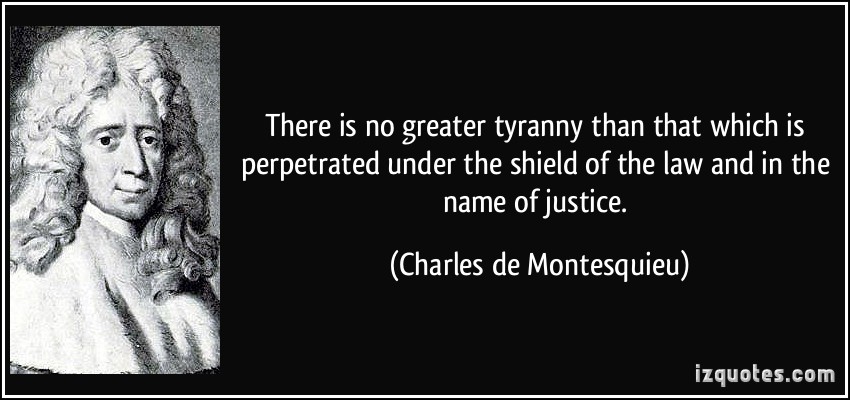
quote-there-is-no-greater-tyranny-than-that-which-is-perpetrated-under-the-shield-of-the-law-and-in-the-charles-de-montesquieu-166586


image top – source unknown


Homes are not commodities and treating them as if they are shows the level of contempt that investors have for the lives of the people who live within them…

toilet-paper-money-1024x672

The obsession that the Nation has with property may be paying dividends for builders, mortgage companies and investors alike, but the cold hard reality is that we are on the road to making many people homeless.

With whole developments now being snapped up by private companies who are only interested in maximising the level of return, escalating prices will inevitably lead to increasing numbers of applicants for social housing, whilst pushing the next occupants ever closer to the circumstances which would have led to the last tenants having to leave in the first place.

Owners may not have anything to worry about now as they concentrate on the apparently lucrative areas of today such as London. But this problem will almost certainly fan-out across the country, and will become ever bigger for as long as house prices continue to grow and people cannot afford to buy the homes which we are continually told are being built to help them. When have you ever seen newly built houses sold at a lower price than other houses in the area with comparable value?

With local authorities potentially unable to afford to house people in the very near future, the idea that having a home is only a luxury could again soon become a reality for many people. Even the remotest prospect of the return of slums in Great Britain should be sending a shiver down the spines of us all, yet politicians have far from even acknowledged the true depth of the problem.

Like it or not, Government will soon have to accept that there must be controls over the way the property market operates.

This may at the very least require formal regulation to ensure that prices can no longer be inflated by the commission on sales for estate agents; an industry that almost certainly carries a high portion of the responsibility of pushing prices upwards at every opportunity since the time that Right to Buy arrived.

However, steps are also likely to be required to freeze prices and possibly even begin to reduce them so that owning or renting a home is affordable in all areas of the Country for those who are earning a basic wage.

The money men may not like it. But the irresponsible creation of the hollow money which is being used to effectively price people out of their own homes can no longer be countered by the continuing creation of money by Government. The National Debt of over £1 Trillion is accumulating at a rate of over £5000 per second in the interest payments alone – before we even begin to consider the Deficit.

The days when politicians could keep borrowing money today and by doing so defer problems for those who will be in power tomorrow are coming to an end.

The question is, how many more people have to experience their own personal hell before those in power realise that tomorrow was a when, not an if, and that it has already arrived?

image: source unknown 

Politicians and Political Parties should never automatically assume the respect of the people, nor that when they do, it equates to silence…

article_img

Getting a true glimpse of the true nature of the respect that our politicians have for us isn’t an everyday event by any means. Yet recently, we have been treated to a series of insights in to the way we are all viewed by the people who either do, or soon hope to govern us. It doesn’t make particularly happy reading.

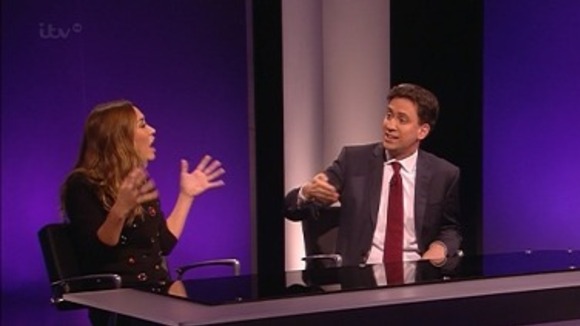
The fairytale halving of the £1.7 Billion bill from the EU and the Parliamentary vote on the European Arrest Warrant that never was, were both perhaps very telling of the way the current Coalition Government does its business. But it was the comments from the Labour Party following Ed Milliband’s workout with Myleene Klass on the ITV’s ‘The Agenda’ on Monday night which may have represented the lifting of a much bigger stone.

Watching the programme made good viewing. We rarely get the opportunity to see the kind of challenge which Myleene made, telling Ed why Labour’s Mansion Tax Policy isn’t going to work and effectively showing the whole idea up for the hollow, headline-grabbing and socially-divisive-pigeon-holing stunt that it is.

Apparently unable to deal with the broadside at the time, Tuesday morning not only saw a belated attempt by Ed to try and turn it around with a parody relating to Ms Klass’s time in the Band Hear’Say; it also brought comments from the Party suggesting that she had failed to show Mr Milliband respect, and also tweets from a Labour MP apparently suggesting that she should leave the Country.

All well and good to demand respect if you have actually earned it. But these guys all seem to think that being an MP is qualification in itself. Isn’t it right that we should have the right to question what they do?

The fact is that the UK is in the perilous state that it is right now, in no small part because of the inability of Party-affiliated MP’s to safely ask the kinds of questions or make points of this nature without fear of reprisal from their Political Parties.

Ed Milliband may well walk in to 10 Downing Street as the next Prime Minister in less than six months time. But if Labour will not accept the legitimacy of questions which show the lack of thought and consideration which has obviously gone into their policies now, what hope will there be for us all when they start to enact them?

image: itv.com

Royal Mail & Privatisation: Its called privatisation for a good reason and politicians need to wake up and realise that privately owned business will never have the general public as its point of primary concern…

The-true-cost-of-Royal-Mail-privatisation-820x615

In July 2013 – before the privatisation of Royal Mail took place, I wrote a blog about the process and discussed why it was a bad idea and briefly, what the implications would most likely be for the future of the universal delivery service.

Sadly, the news today that the privatised Company has experienced a £74 Million fall in profits and that it is already pointing the finger of blame at competition in profitable areas comes as little surprise.

We will no doubt soon experience further questions over the viability of rural and unprofitable delivery routes.

Whether the Government likes it or not, the reality of surrendering public ownership of a service which was created to ensure parity of service for all in the way that only a not-for-profit operation can do so, is soon going to bite.

It is simply impossible for Government to dictate the operational structure of a private business when profit is at risk – unless they choose to subsidise the service. If that happens, the question will surely yet again be why did they dispose of Royal Mail in the first place?

Whatever our politicians may think, privatisation of services which are there for the benefit of everyone is never a good idea; however hard to run; however much they cost; however much can be earned from their sale.

These services are essential to deliver a basic standard of living for all, which Government is currently failing to do by not dealing with the profit-led management policies of all the privatised services which the public once owned. What is more, it is set to continue compounding the problem by having so recently disposed of Royal Mail and by taking very big steps in the direction of privatisation of the NHS through the Commissioning Process.

It stands to reason that the managers of privately owned firms are going to focus on the practices and methods of working which deliver a good bottom line.

Whereas Government and Social Enterprise will be very happy if they are simply covering their costs, private owners simply don’t get up each day and think about how they can remove all their profits from one area of their business to subsidise the services they offer in another – when they cost them money to do so.

Sooner or later, someone – certainly not this Government – is going to have to begin picking up the pieces from what has been the serial offloading of a whole range of public services which once gave all British people unhindered access to the tools of a modern life which were once the envy of all.

The Country may already be secretly bankrupt. But selling up everything that we own is not the answer.

Top to bottom reform is now inevitable. It’s just a question of when; not if – and what the cost will be to us all whilst we wait for the leadership of politicians who are big enough to get all of the jobs done in the best interests of everyone and not just themselves.


image: europeanceo.com