For the first time in years, vocational education is back in the national conversation. That alone is worth acknowledging.
For too long, the young people who learn through doing – those whose intelligence is practical, embodied, relational – have been quietly sidelined by a system that only knows how to value what it can measure. So when vocational GCSEs are announced, it is right to welcome the fact that the subject is finally being opened.
But when a system is structurally incapable of delivering what young people need, even well‑intentioned reforms risk becoming another layer of false hope. And false hope is not neutral. False hope is harm delayed.
This is not about one Prime Minister, one party, or one administration. It is about a political culture that has, for decades, been shaped by management logic rather than human logic.
Governments of every colour inherit the same constraints, the same economic assumptions, the same accountability structures, and the same narrow toolkit of measurable interventions. They are funnelled into the same kinds of initiatives not because they lack imagination, but because the system itself rewards what can be counted and sidelines what cannot.
Until that paradigm changes, every government-left, right, or centre-will find itself reaching for solutions that look meaningful but cannot reach the root of the problem.
The problem is not the absence of vocational options. It is the mindset that shapes them.
Vocational GCSEs still sit within the academic frame that has dominated British education since the Blair years. They are qualifications. They are measurable. They are inspectable. They are standardised. They can be audited, ranked, compared, and reported.
That is precisely why they are politically attractive.
You cannot monetise or monitor what you cannot measure. And real-world experience cannot be measured remotely by this kind of system.
So instead of giving young people lived experience, responsibility, identity and value, we give them another certificate. Another set of grades. Another way of being judged rather than included.
For some young people, this will help. But for many, it will simply store the problem for another day. It will keep them in classrooms when what they need is contact with the adult world. It will keep them in theory when what they need is practice. It will keep them in a system that has already told them-quietly, repeatedly-that their way of learning is a deviation from the norm rather than a strength in its own right.
Qualifications measure performance. Capability emerges through participation.
One is symbolic. The other is real.
Real vocational education begins with participation, not assessment.
If we truly want to value vocational intelligence, we must stop trying to squeeze it into academic shapes. We must stop pretending that practical capability can be captured by written exams or standardised rubrics. And we must stop designing vocational pathways that keep young people at arm’s length from the very world they are supposed to be preparing for.
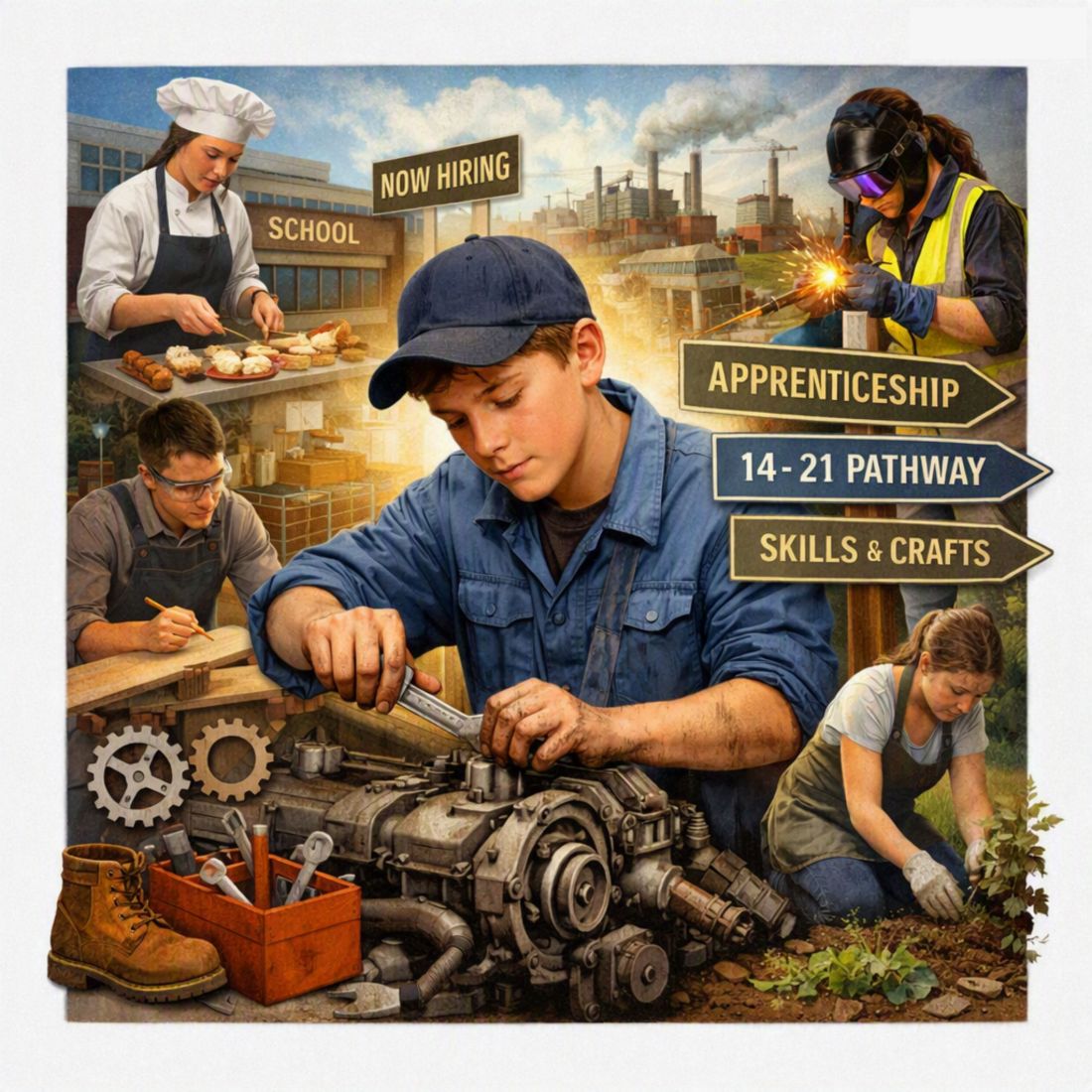
Real vocational learning should begin at 14. Not in a classroom, but in the workplace. Not as an observer, but as a participant. Not as a child, but as an emerging contributor. Not unpaid, but paid-because contribution deserves recognition.
A proper apprenticeship at 14 will do something no GCSE can: It tells a young person you are needed. It tells them you matter. It tells them you have a place. It tells them your capability is real. It tells them your contribution is valued.
That is the foundation of dignity. And dignity is the foundation of engagement.
Vocational GCSEs cannot deliver that. They are still school. They are still symbolic. They are still abstract. They are still part of a system that values metrics over people, performance over participation, and qualifications over capability.
“But the opportunities no longer exist.” Yes – and that is the point.
One of the arguments often raised against early apprenticeships is that the kinds of businesses that once provided traditional apprenticeship opportunities – small workshops, local trades, craft‑based industries, and regional industrial specialist employers – simply no longer exist in the way they used to.
And that is true.
But they no longer exist because of the same money‑centric, extractive system that has hollowed out almost everything else: local economies, communities, real‑life opportunities, and any pathway that doesn’t fit the narrow, measurable, standardised model.
For decades, extraction has been the organising principle of our economy. It has pulled value out of communities rather than investing into them. It has prioritised scale, efficiency, and centralisation over locality, craft, and human capability. It has rewarded what can be measured and monetised, and quietly eroded everything that cannot.
The result is predictable:
the disappearance of small employers who once took on young learners
the collapse of trades that relied on time‑served skill
the thinning out of regional industrial specialist employers who once offered structured vocational progression
the loss of community‑based workplaces where capability was formed through participation
the shrinking of real‑world environments where young people could begin contributing at 14
These opportunities didn’t vanish by accident. They were removed by a system that no longer values the kind of real‑life, experiential learning that apprenticeships depend on.
So when people say, “We can’t do apprenticeships at 14 because the opportunities no longer exist,” they are right about the symptom – but wrong about the cause.
The disappearance of those opportunities is not an argument against early apprenticeships. It is the proof of the very system failure that makes them necessary.
A 14–21 apprenticeship pathway would not simply place young people into whatever remains. It would rebuild the opportunities extraction destroyed. It would restore the conditions in which capability can grow. It would recreate the environments where contribution becomes identity.
And it would do so in a way that is good for everyone:
Good for young people, who gain dignity, belonging, and real capability.
Good for employers, including regional industrial specialists, who gain committed, time‑served contributors in a structured, ethical low‑pay developmental model.
Good for society, which gains a workforce at 21 that no textbook or qualification can produce.
The absence of opportunity is not a barrier to this vision. It is the indictment of the current model – and the strongest possible case for change.
The deeper issue is the economic model that shapes every policy decision.
We cannot fix youth disengagement, social mobility, or vocational identity through isolated initiatives.
These problems are symptoms of a deeper structural reality: an economic model that prioritises metrics, money, and measurable outputs over human contribution, human capability, and human value.
As long as the system is built around extraction rather than contribution, young people will continue to disengage-not because they are apathetic, but because they are rational.
They see a world where effort does not guarantee stability, where qualifications do not guarantee opportunity, and where contribution is not rewarded unless it fits a narrow academic mould.
Until we change that mindset-until we build a paradigm where people come first and metrics come second-every reform will be constrained by the same logic that created the problem in the first place.
This is not a call for better initiatives. It is a call for a different way of thinking.
We need a system that values people for what they contribute, not for how they can be measured. A system that recognises capability in all its forms, not just the academic ones. A system that sees young people as emerging adults, not as data points. A system that understands that dignity comes from participation, not performance. A system that is built around locality, responsibility, and lived experience-not centralised metrics and distant oversight.
Vocational GCSEs may be a step toward acknowledging the problem. But they are not the solution.
The solution requires a paradigm shift-a reimagining of what education is for, what contribution means, and what kind of society we are trying to build.
Until we make that shift, every government will be forced to operate within the same narrow constraints. And young people will continue to pay the price for a system that was never designed with them in mind.
The conversation may have finally begun. But the real work – the structural work, the human work – still lies ahead.
If you’re reading this, something probably doesn’t feel right. The world feels unstable. Life feels harder. The things we used to rely on don’t seem to work anymore.
You’re not imagining it – and you’re not alone.
This space exists to help you make sense of what you’re feeling. Not with jargon. Not with politics. Not with complicated theories. But with clear, honest questions – and answers designed to help you think, not tell you what to think.
When things stop making sense, most of us end up asking the same questions, even if we never say them out loud. These nine questions form a pathway – a sequence that moves from confusion to clarity, from instability to understanding. Each question builds on the one before it, guiding you step by step through what’s happening and what comes next.
How to Use This Booklet
Start at Question 1 and move forward in order. Each question opens the door to the next, helping you see how the pieces fit together.
If one question feels especially relevant, you can begin there – but returning to the sequence will help you see the full picture.
Take your time. Reflect. Pause between questions. This isn’t a race; it’s a process of orientation.
The Nine Questions
Why does everything feel unstable?
Why is government not working?
Why isn’t there enough money?
Why is food supply becoming unstable?
Why are politicians not listening?
What’s actually going on?
What comes next?
What can we do locally?
Who should I trust when everyone is claiming to have the answers?
You don’t need to rush. You don’t need to read everything at once. Start with the question that feels closest to what you’re experiencing. Each page is written to help you think clearly, feel grounded, and see the bigger picture without being overwhelmed.
Once you’ve explored the questions that matter to you, you’ll find links to deeper explanations, ideas, and practical steps. These aren’t theories or political arguments – they’re frameworks for understanding what’s happening, and for building what comes next, together.
Whatever you’re feeling right now, you’re not alone. You’re not imagining it. And you’re not powerless.
The future isn’t something that will be decided for us – it’s something we will shape together.
If you’re ready, begin with Question 1: Why does everything feel unstable?
Why does everything feel unstable?
Let’s jump straight in. Things feel unstable because they are unstable.
You’re not imagining it. You’re not being dramatic. You’re not “doomscrolling yourself into a panic.” Much of what we see in the world outside our homes and communities is breaking down – and the reason so many of us have been questioning ourselves is because the people who have power and responsibility keep speaking and acting as if nothing is wrong.
Government isn’t functioning. Politics isn’t working. The public sector isn’t delivering. The prices of everything are becoming increasingly unaffordable. People sound angrier than they used to. The world outside our doors doesn’t feel safe.
And while there are plenty of loud voices shouting about what’s wrong, very few of them offer ideas or solutions that actually sound like they would work. Most of what we hear either feels too simplistic or too complex to make any sense of.
I’m not going to try to talk you through every reason things have become as unstable as they are – not here. There’s simply too much to cover, and trying to cram it all into one place would overwhelm you rather than help. If you want to understand what’s happening, why it has happened, and what we all need to start thinking about next, I can point you to other pieces that will help you ask the right questions and find your footing.
What you do need right now is space. Space to think. Space to ask questions. Space to connect with people who are putting reason before fear and who want to find a way forward that works for everyone – not just for themselves.
And you shouldn’t feel bad for asking this question. Many others are having the same thoughts and feelings you are.
Mainstream media talks around the edges of what matters, touching the surface but rarely explaining anything in a way that helps. Social media is full of people saying the things we want to hear – confirming that our feelings are real – but that’s usually where it stops.
The time has come to look, ask, read, listen, consider, and act in ways that make sense to you, rather than relying on what someone else says.
You’re not alone in feeling this way. And you’re not wrong to ask.
You might be surprised at how many people are asking this same question. But you probably won’t be surprised at how many people also think they already know the answer – and believe they’re “right.”
Talking about government is tricky because it almost always drags us straight into politics. And once politics is involved, most of us start thinking about whichever party or group we usually support. We judge how government is performing through the lens of who we voted for, who we like, or who we can’t stand.
I’m sure you can relate to feeling more forgiving when the people in charge are the ones you support – and much less forgiving when they’re not.
But here’s the part that’s hard for many of us to get our heads around:
It no longer matters.
The reason government isn’t working today has very little to do with politics in the way we usually think about it. That’s why you’ll hear people say things like “they’re all the same” or talk about a “uniparty.” It’s not that all politicians secretly belong to one big club. It’s that every political party we can choose from today is still part of the same way of thinking.
And that way of thinking – not a group of elites, not a secret organisation, not the banks or big business – is what has shaped every decision that has led us to where we are now.
This is what “the establishment” really means. Not a class. Not a conspiracy. A worldview.
A worldview that every major political party shares, even the ones that claim to be “anti‑establishment.” And once you understand that, you start to see why government feels stuck, confused, or unable to fix anything – no matter who gets elected.
How government works today – how politics works, how elections work, how decisions are made, and how those decisions affect you and me – is far too complex to cram into one message here. And trying to do that would only confuse things further.
Yes, we need to understand what has happened, why it has happened, and where politics is heading now. I’ll give you links that will help you explore those questions and ask new ones too.
But for now, what matters just as much – if not more – is finding others who are looking for direction, who want to put reason before fear, and who are open to working together to take positive steps in the same way.
Whatever difficulties lie ahead, we will be far better able to face them together than alone.
If you’ve been struggling and wondering how you’re supposed to keep going financially, you’re not alone. In fact, growing numbers of people have been struggling for a long time. What almost everyone who’s struggling shares is the feeling that they’re facing it by themselves – that this is somehow only happening to them, or worse, that it’s their own fault.
If this is how you feel, it’s important to understand something clearly: you are not alone, and you have not failed. Yes, a few people struggle because of mistakes they’ve made. But most of the people who are asking how they’re going to buy food, pay bills, or simply keep going haven’t done anything wrong. Prices have kept rising, wages haven’t kept up, and the gap between what life costs and what people earn has become impossible to bridge.
How money works today is far more complicated than most people – and even some economists – realise. There’s a lot to understand about why prices keep going up, why the value of the money in our bank accounts keeps going down at the same time, and why it always feels like we’re the only ones who can’t keep up. If you want to begin understanding what’s really happening with money, I’ll share links that will help you start asking the right questions and make sense of what you’re experiencing.
But right now, the most important thing is not the theory. It’s you – and how you can get help, where you can find it, and how you might be able to help others too. As shortages of food, essentials, and money become more visible, some people will approach solutions in ways that don’t help anyone – least of all themselves. The more we understand what’s happening, the better placed we are to support each other rather than compete with each other.
One thing we can be absolutely sure of is this: the people you see using food banks, claiming benefits, or getting other kinds of support are almost never in that situation by choice. They were simply closer to the edge than others, and it has suited some to suggest that they’re struggling because of something they’ve done wrong.
If you need a clearer picture, consider this: a significant number of people who are already on benefits work full time. They need help because the national minimum wage is no longer enough for anyone to live independently on. That’s not a personal failure. That’s a system failure.
And you’re not imagining it.
If you want to explore the deeper causes behind this, you can look at:
Food is really important. We all need it every day, and it’s as essential as the air we breathe and the water we drink – so please don’t feel bad for looking for answers about what’s happening and what’s going wrong.
The strange thing about food – and why questions about food security feel confusing as well as frightening – is that most of us have grown up assuming supermarkets will always have what we need. We’re used to walking in and finding everything on the shelves, or ordering whatever we want for delivery, without ever thinking about how it gets there. We take it for granted that today will be the same as yesterday, and tomorrow will be the same as today.
Unfortunately, that’s how almost everyone has been treating food – including the people who make decisions about how it’s produced, where it comes from, and how it reaches us. Because food is essential, but can also be processed, modified, and sold in forms we don’t actually need but have been encouraged to want, the industries that produce and sell food have focused on those profitable parts for a very long time.
This has changed the UK’s relationship with food drastically over the past 50 years. Most people don’t think about where food comes from or how it gets to us, but the truth is that a very large amount of the food we eat in the UK comes from outside the UK. Supermarkets, takeaways, restaurants – much of what they sell relies on long, fragile supply chains that stretch across the world.
And the world isn’t a stable place right now. We hear about wars, conflicts, political tensions, and economic shocks – but very little is said about how these events affect the food chain, or the supplies like diesel, fertiliser, and animal feed that farmers rely on. When any part of that chain is disrupted, the effects eventually reach us, even if we don’t see them straight away.
It’s a complicated subject, and understanding the real story about food in the UK will take time, thought, and questions. I’ll add some links below if you’d like to begin exploring it. But the most important question right now is this:
How do we make sure everyone has enough of the food we actually need, rather than just the food we’ve become used to wanting?
Working with others in our communities to meet our shared needs – and to make our long‑term food supplies more resilient – is one of the best steps we can take. It will take time, effort, and patience, especially when some of us are already worried about where the next meal will come from. But it’s possible. And it’s necessary.
The good news is that there are practical steps you can take to begin providing at least some of your own food reasonably quickly – even if you don’t have a garden or outside space. Please take a look at the links below.
People feel ignored, dismissed, patronised, unheard. This is the collapse of trust.
And no – you’re not imagining it. It feels like politicians aren’t listening because they aren’t. Or at least, they’re listening to the noise, but they’re not hearing what people are actually telling them.
We’re living through very difficult times, and politics is always a tricky subject because who we support is tied closely to what we believe and the values we hold. That’s why people get so worked up – sometimes even angry – when the parties or politicians they follow are criticised, or when they’re told that their side might be wrong.
Understanding why politics polarises people is just as important as asking why politicians aren’t listening. Because no matter which party or politician any of us support, almost everyone is feeling the same things. We’re all experiencing the same problems. We’re all living with the same instability. And the ideas, motives, and thinking behind political decisions are basically the same across the board – even if the colours, slogans, and messages look different.
Once you strip away the names, the branding, and the promises, you start to see that the political system is working from one shared worldview. That worldview shapes everything – governance, money, values, priorities – and it’s the same worldview that has led us to where we are now.
This is why politics feels stuck. This is why politicians feel disconnected. This is why nothing seems to change.
It’s not because nobody cares. It’s because the system they’re working within is no longer capable of delivering the outcomes people need.
The reality is that while we’ve been taught to believe that the politicians we see on TV, online, or on the radio can make big decisions that will fix the problems we’re worried about, their hands are tied from the moment anyone walks into Number 10. The way the system works – especially the way money works – limits what they can do long before they ever get the chance to try.
To be fair, the realities of government are hard for any of us to understand today. What we believe happens and how things are supposed to work are very different from what we’re experiencing. What makes it even harder is that politicians often sound like they’re talking about the right things. They say they’re going to act. They promise change. And then everything stays the same.
This isn’t because they’re all being dishonest. It’s because they’re performing – quite literally acting out for the media – in the belief that this is the best way to keep everything running. The public sector is doing much the same. Not because people don’t care, but because there is no longer any real sense of a workable alternative.
There’s a lot to think about. And you might not feel it yet, but what you think, what you say, and the contribution you can make are not only important – they’re vital to where all of this goes next.
You’ll hear more and more voices offering “new approaches” or “different ideas.” Some of them sound credible. Some of them have big followings. But most of them still rely on the same belief: “Things would be different if I – or my group – were in charge.”
That belief is one of the biggest problems we face.
Because the truth is this: The only way things can now be different is if we make them different – by thinking differently, acting differently, and working together differently.
Right now, everything is centralised. People we will never meet are making decisions about places they will never visit. That centralisation is one of the biggest reasons everything feels wrong.
I’ll provide links you can explore if you want to understand how politics and governance reached this point. But moving forward isn’t about blaming any party or politician. It’s about looking ahead and taking the steps that will create the best possible future for everyone – instead of obsessing over what has gone wrong in the past.
Before anything else, you need to hear this clearly: you are not imagining a problem. Things are not working as they should – government, the public sector, politics, public services, utilities, money – and the list goes on. Nothing feels right because it isn’t right. And you are not going mad.
You feel uncertain, and you may even be questioning your own thoughts, because what you’ve learned to expect from “the system” and what you’re actually experiencing are now two very different things. More importantly, there’s no clear explanation coming from anywhere that makes sense. Instead, there are lots of loud voices blaming someone or something – usually the current government – as if that explains everything.
It doesn’t.
We tend to think of politicians and government as being in charge of all this. But they aren’t – even though they insist they are, and continue to behave as if they are. The truth is that their thinking is aligned with the system itself. They see the world through the same lens the system was built on, and that lens shapes every decision they make.
The system is complicated. Too complicated to cram into one message when you’re looking for quick answers that at least help you make sense of what’s happening and decide where you want to look next.
But here’s what you need to know right now:
The system we live in has been in place for a very long time – longer than most of us have been alive. It has been shaped and managed by governments of every political colour. It is built on money and economics, and that’s why every solution you hear from politicians or the media almost always comes back to “growth.” Growth of GDP. Growth of spending. Growth of the economy. Because that’s the only measure they’ve been taught to use to decide whether everything will continue to be “okay.”
If you stop and think about it, you’ll see that money affects almost every decision you make in your relationship with the outside world. It shapes what you can do, what you can’t do, and how you feel about your future. We’ve come to believe this is normal – but it isn’t. And everyone making decisions today thinks the same way too. Money has become the only real benchmark for everything.
Once you see that, the next part may give you an “aha” moment:
People are no longer the priority of government or business.Money – and economics – are.
There’s far too much to cover here, but I can provide links that explain what’s happening and how it affects the decisions that shape every part of life.
For now, the most important thing to understand is this:
The system we have can only keep working by taking more and more from most of us, so that those at the centre can take more money, power, and influence. A system like this cannot keep taking without reaching a point where people no longer have enough – and begin to get hurt. This has been happening for a long time, but only recently have enough of us been pushed to the edges, or over them, for it to become clear that we are reaching a place called stop.
The difficulty is that money – appearing to be as important as we’ve been taught to believe – is intoxicating. It drives everything until the moment we are excluded from the way the system works, and begin to understand what it’s like to not have enough, or to spend every spare moment worrying about where more money will come from.
Putting people first – contributing, taking part, and being involved in how everything works – is the only way we can solve the problems society now has. There are no quick fixes. Anyone who suggests that there are, or who promises that “we can go back to how things were if you just follow me,” is offering a trapdoor back to more pain.
I can provide links that explain how the system works and what it has been doing. But more importantly, I can share ideas and solutions that show what we can all do, the contribution each of us can make, and how we can work together to create a world that is balanced and fair for everyone – not just for the privileged few.
The hardest thing for any of us to get our heads around, as we look at the problems we face, is that the solutions are not going to come from the people or the places we expect.
The problems the UK faces today are all connected. Government, politics, the public sector, money, the cost of living, not having enough, not having work, not feeling valued – it doesn’t matter which part you look at. Everything circles back to the same root cause. And that means the way forward has to be something genuinely different.
Something that leaves all of that behind.
It’s not easy to imagine a new way of living and interacting with the world outside ourselves. But once we begin to remember who we really are – and what actually matters – it becomes much clearer.
What comes next isn’t about abandoning technology or pretending we can go back to some nostalgic version of the past. It’s about putting people, community, and the environment we live in first, instead of money or whatever we can access on a screen.
Some people will automatically assume this means rejecting modern life or living in some kind of bubble. It doesn’t. What comes next is about creating a level playing field where everyone has access to the basic essentials they need for life – without anyone else controlling them.
When people have enough, they are free to think, to breathe, to find peace, and to live the best life they can, without the actions or behaviours of others holding them back.
This isn’t utopian. It isn’t socialist. It isn’t communist. And it isn’t capitalist either.
All of those systems – just like commercialisation – rely on centralisation and hierarchy. They all depend on power being held at the top. The alternative doesn’t hide processes or motives because it can’t. It turns everything on its head and makes what is local – your community, your environment, your relationships – the most important part of life. And it puts you, and the people you care about, right at the centre.
There’s a lot to think about, and I’m not going to try to explain the whole Local Economy and Governance System (LEGS) here. What I will say is that it all begins with a benchmark for life called the Basic Living Standard. This means everyone has enough of what they actually need. And through a Contribution Culture, everyone brings value to life by contributing in the ways that work best for them – without taking more than they need from other people, the community, or the environment.
We approach life as a partnership. We take out, but we also put back. We respect the cycles of life for what they are and what they do.
One of the greatest benefits of embracing what comes next is realising how much of our lives today rely on value and reference points outside of ourselves. That’s why so many of us feel powerless, unheard, and unable to control what we can do – or even what we can think or say.
LEGS – and the system for life and governance it describes – works on a very different principle: each of us should be able, and actively encouraged, to rely on our own thinking, our own consideration, and our own agency before we engage with anything else.
It may sound counterintuitive, but when we can think independently, rely on ourselves, and act with confidence, we have a much healthier and more respectful relationship with the world outside us too. And that leads to a kind of happiness that nobody else can control.
Acting locally affects everything globally – even when we can’t see it or hear it happening.
Just as our habits and way of living have contributed to the problems the world now faces, often without us realising, creating a better, happier world doesn’t require us to fix everything “out there.” It only requires us to focus on what matters locally – in our own lives, our own streets, and our own communities.
Whether the existing structures in our communities survive or not, building new ones that bring people together in a genuinely collaborative way is vital. First, to navigate the difficult times ahead. And then, to begin building the new locally‑based system that can only be created from the grassroots up.
Nobody needs to be a leader. In fact, anyone who immediately thinks about being a leader – and what that might do for them – needs to think very carefully about what leadership really means, and who it is for, especially in the context of locality and what comes next.
Everyone has skills, experience, or contributions they can make to help their community through challenges, and to help shape its role in the people‑centric world we need to build. There is a lot to think about, and while I can share links to materials and ideas that explain the framework of a people‑centric system, it’s important to understand that these are only guardrails.
The real decisions, the real actions, the real motivation, and the real effort have to come from people just like you – people willing to look beyond the differences the old world taught us to focus on, and instead work with the things we all genuinely share. The things that matter. The things that make it possible for all of us to live happy, healthy, meaningful lives.
The links will give you plenty to start with. But the real change begins with being ready to listen, consider, share, discuss, build upon, and develop ideas and solutions that tackle the issues you’re facing together – not because a digital device told you what to think, but because these are the real issues you see and experience every day, face‑to‑face, in the communities where you live.
Who should I trust when everyone is claiming to have the answers?
Before anything else, the fact that you’ve found this page should reassure you that you’re thinking clearly – probably more clearly than many – and that you’re right to be concerned about the number of people claiming to have “the answers,” especially when all those answers seem to be different.
It would be easy to judge or be negative, but most of the people using their platforms, positions, or public access to tell the world “how things really are” aren’t doing anything wrong. The chances are they genuinely believe what they’re saying. They genuinely believe their way is the only way.
These voices come from every angle you can imagine. Some are on social media. Some are influencers. Some are podcasters. Some are celebrities. Some are politicians. Some are ideologues, experts, academics. Some are spiritual or religious voices.
Every one of them has an angle based on their own experience. And just because someone has qualifications, a big following, a title, or a platform doesn’t mean they understand what’s happening any better than you – or the people you see and speak to every day.
People in these roles often find themselves heard by default. That can lead some to believe that their ideas are automatically the right ones, or that their perspective should be shared because it must be correct. But in reality, these same people are having the same experiences as you and I. The difference is that they’re talking about them publicly, and when we hear those messages, we recognise parts of our own experience and can fall into the trap of thinking that this is the same thing as listening to leaders.
If you listen carefully, you’ll soon notice that very few of the “solutions” being offered could actually work. A lot of what’s being said is the kind of thing any of us might talk about over coffee or at the pub – ideas about what we’d do if we were in charge, or what we think should happen next.
The problems we face are complicated. Not just because solutions that work for everyone must consider everyone, but because real solutions depend on understanding all the facts that created the problems in the first place. That makes it far too complex to explain everything here – and it also shines a light on the reality that many of the people claiming to have all the answers are well out of their depth too.
This is what makes many of these voices – these “false prophets” – dangerous. Not because they’re bad people, but because they don’t really know what’s going on, and they certainly don’t know what steps it will take to solve the problems that are making life so difficult for so many right now.
The changes we need begin with thinking differently. That means moving away from the “this is what I’d do with what we understand” mentality, and instead embracing the idea that we need to start again with a clean sheet – one that doesn’t begin from the same place that created all the problems we’re facing.
To do that, we need to value what everyone can bring to the table. And that means you.
No political party, agenda, ideology, religion, philosophy, or system that requires us to follow leaders, speakers, or prophets is going to give us the answers society now needs. The answers, outcomes, and solutions can only come from all of us – together.
To find them, we need to put down the digital devices and start looking to the people around us in our everyday lives. People, community, and the environment where we live and work are where the real answers lie. They don’t come tied to qualifications, rules, or requirements that we behave or serve in any particular way.
It’s the people around us – the ones we see face‑to‑face – who we need to listen to, talk with, and work alongside to navigate the difficulties ahead and help us reach the new world we must now move toward.
Artificial intelligence has become the centre of one of the most polarising debates of our time. My earlier work on AI – explored in pieces such as Actions Speak Louder Than Digital Words – argued that digital tools amplify human behaviour, incentives, and blind spots rather than replacing them. That principle has only grown more relevant as AI has advanced.
This essay builds on that foundation, examining why the real threat is not AI wiping out humanity, but the risk of human redundancy created by the systems we have built around it. For readers who want to explore the wider context of this argument, links to my previous work are included in the Further Reading section at the end.
PART 1 – The False Choice Between AI Utopia and AI Armageddon
The debate about artificial intelligence has become trapped in a false choice. On one side, we are promised a golden age where machines liberate humanity from work, scarcity, and limitation. On the other, we are warned of an approaching Armageddon in which superintelligent systems escape human control and bring civilisation to an abrupt end.
These extremes dominate headlines, policy conversations, and public imagination. They are compelling, dramatic, and emotionally charged – but they are not the reality we face.
AI could end humanity. It is technically possible. But the probability is dwarfed by dangers that lie much closer to home, dangers created not by machines but by the systems, incentives, and worldviews that shape how we build and deploy them. The real risks are not futuristic; they are present, familiar, and deeply human.
My earliest work on AI, long before today’s existential‑risk debate took hold, focused on human behaviour rather than machine capability. I argued that digital tools amplify our choices, our incentives, and our blind spots – that technology reveals who we are more than it changes who we are. That principle has only grown more relevant as AI has advanced. The stories we tell about AI today say far more about us than they do about the technology itself.
The truth is simple: AI is not on a collision course with humanity. Humanity is on a collision course with the consequences of its own systems – and AI is merely accelerating the impact.
We are not facing a future determined by machines. We are facing a future determined by the choices we make now, the structures we maintain, and the hard truths we are willing – or unwilling – to confront.
The danger is not that AI will suddenly become uncontrollable. The danger is that we continue to behave as if the systems we built are sustainable when they are not.
This piece is not about dismissing risk or denying possibility. It is about grounding the conversation in reality, recognising the fragility of the world we already inhabit, and understanding that the most important decisions about AI are not technical – they are human.
PART 2 – The AI Doom Narrative Is a Story, Not a Forecast
The idea that artificial intelligence is on the verge of wiping out humanity has become one of the most powerful stories of our time. It is repeated by influential technologists, amplified by media hungry for drama, and absorbed by a public already anxious about rapid change.
But despite its emotional force, the “rogue superintelligence” narrative is not a forecast. It is a story – shaped by worldview, psychology, incentives, and imagination far more than by the realities of how AI actually develops.
Stories matter. They shape policy, investment, public fear, and political attention. But stories can also mislead, especially when they are told by people who are brilliant in one domain and inexperienced in others.
The individuals driving the AI‑doom narrative are often exceptional engineers and theorists. They understand algorithms, scaling laws, and computational capability. What they do not understand – and what they rarely acknowledge – are the economic, political, social, and infrastructural constraints that define the real world.
The doom narrative assumes a world of perfect conditions: perfectly connected systems, perfectly maintained infrastructure, perfectly aligned incentives, perfectly centralised control, and perfectly predictable human behaviour. It imagines AI as a single, unified entity capable of seamlessly accessing and manipulating everything. But the world we inhabit is fragmented, fragile, and full of competing interests. Systems fail. Infrastructure breaks. Governments disagree. Markets fluctuate. Human behaviour is messy and unpredictable.
The idea that AI could effortlessly take over such a world is not grounded in reality; it is grounded in abstraction.
It is also grounded in a particular worldview – one that sees intelligence as the ultimate force in the universe, optimisation as the highest good, and complexity as something that can be mastered from above.
This worldview is not malicious. It is simply narrow. It comes from people who spend their lives in digital environments where problems are clean, variables are controllable, and outcomes can be simulated.
But the real world is not a simulation. It is a living, evolving, politically contested, economically constrained, socially complex environment where intelligence alone is not enough to shape outcomes.
The doom narrative also serves psychological and economic purposes. It positions its storytellers as guardians of humanity, elevating their status and influence. It creates urgency that attracts investment. It frames AI development as a race, which benefits those already ahead. And it distracts from the far more immediate risks created by the systems we already have – risks that cannot be solved by technology alone.
None of this means the narrative is entirely wrong. It means it is incomplete. It focuses on hypothetical future dangers while ignoring the structural realities that make those dangers unlikely. It imagines a world where AI is the protagonist, when in truth the protagonist is the system that builds, deploys, and governs AI – a system that is already struggling to manage the complexity it has created.
The real story is not about machines becoming uncontrollable. It is about humans losing control of the systems they built long before AI arrived.
PART 3 – The Real Drivers of Risk Are Human Systems, Not AI Systems
If we want to understand the real risks surrounding artificial intelligence, we have to stop looking at the technology in isolation.
AI is not developing in a vacuum. It is emerging inside political systems that are struggling, economic systems that are stretched, social systems that are fragmenting, and cultural systems that reward speed over reflection.
These systems – not the machines themselves – are where the true dangers lie.
Long before AI entered the mainstream, the guardrails that once protected society from systemic failure had already been weakened. Regulation was hollowed out. Expertise was outsourced. Public institutions were stretched thin. Markets were encouraged to prioritise short‑term gains over long‑term resilience. Technology companies were allowed to become infrastructure providers without being treated as such.
None of this was done with malicious intent. It was the result of decades of incentives that rewarded efficiency, cost‑cutting, and growth above all else.
AI has arrived in a world that is already fragile. It is being deployed into systems that were not designed to handle the complexity it introduces. And because those systems are already under strain, AI doesn’t feel like a tool – it feels like a threat. Not because of what AI is, but because of what the system is not.
The people building AI are not responsible for this fragility. They are operating within the same structures as everyone else. But they are often unaware of how those structures work, or how brittle they have become.
They see AI as a technical challenge, not a systemic one. They imagine that intelligence can solve problems that are, at their core, political, economic, and human. They assume that optimisation can fix systems that were never designed to be optimised.
This is not a criticism of technologists. It is an observation about the limits of any specialised worldview. Engineers are trained to solve problems. Economists are trained to model incentives. Policymakers are trained to manage risk. But the challenges we face today – and the challenges AI accelerates – do not sit neatly within any one discipline. They are cross‑cutting, interconnected, and deeply human.
AI amplifies whatever system it is placed into. In a resilient system, it amplifies resilience. In a fragile system, it amplifies fragility. In a humane system, it amplifies humanity. In a dehumanised system, it amplifies dehumanisation. The danger is not that AI will suddenly become uncontrollable. The danger is that it will faithfully follow the incentives of systems that are already failing.
This is why the existential risk debate feels misaligned. It imagines a future where AI becomes the dominant force in society. But the dominant force in society today is not AI – it is the system itself. And that system is struggling to maintain coherence under the weight of its own contradictions.
The real drivers of risk are not algorithms. They are:
political short‑termism
economic fragility
institutional erosion
social fragmentation
cultural incentives that reward fear, speed, and spectacle
a collective reluctance to confront uncomfortable truths
AI did not create these problems. But it will accelerate them if we do not address them.
The question is not whether AI will become dangerous. The question is whether we will continue to deploy AI into systems that are already dangerous.
PART 4 – The Economic Model Behind AI Is Already Breaking
One of the least discussed truths about artificial intelligence is also one of the most important: the current economic model behind AI cannot sustain the trajectory its loudest advocates imagine.
The march toward ever‑larger models, ever‑greater compute, and ever‑expanding capability is not being driven by a stable, self‑supporting system. It is being driven by a financial and economic structure that is already showing signs of strain.
AI today does not pay for itself. Large language models are loss leaders – subsidised by investment capital, market speculation, and the hope of future revenue that has not yet materialised.
The companies building these systems are not selling profitable products. They are selling potential. They are selling narratives. They are selling the idea that AI will one day become so powerful, so indispensable, and so integrated into every aspect of life that the costs will be justified.
But the costs are rising faster than the revenue. Training frontier models requires vast amounts of compute, energy, infrastructure, and specialised hardware. Maintaining them requires even more. The economic assumptions behind this growth depend on a future where millions of people and businesses pay for AI services at scale.
Yet the same technology is being built to automate, replace, or radically reduce the economic activity of those very people and businesses.
This is the contradiction at the heart of the AI boom: AI is being built to eliminate the labour that funds the system building it.
The more successful AI becomes at replacing human work, the less viable the economic model becomes. A system that depends on human productivity cannot sustain a technology designed to remove human productivity.
This is not a theoretical concern. It is already visible. Industries are experimenting with AI to reduce staffing. Creative sectors are being disrupted. Administrative roles are being automated. Customer service is being replaced. The promise of efficiency is real – but efficiency reduces the number of people who can pay for the services that generate the revenue needed to sustain the technology.
Some argue that Universal Basic Income will solve this problem. But UBI only works when a productive economy underwrites it. A universal UBI in a world without human labour is mathematically impossible.
You cannot create infinite money to meet infinite needs when no one is producing anything the system values.
UBI is not a solution to the economic contradictions of AI. It is a comforting idea that avoids confronting the structural reality.
The truth is simple: the current trajectory of AI will be stopped by economics long before it is stopped by existential risk.
The system cannot fund the future that some technologists imagine. The infrastructure cannot scale indefinitely. The energy demands cannot be met without radical transformation.
The business model collapses if humans become economically irrelevant.
This does not mean AI will disappear. It means the narrative of unstoppable progress toward superintelligence is built on assumptions that do not hold in the real world. The march toward artificial general intelligence is not a straight line. It is a story – one that ignores the economic gravity pulling in the opposite direction.
AI will not end humanity. But the economic contradictions of the system driving AI could destabilise society if we do not address them. The danger is not runaway intelligence. It is runaway incentives.
PART 5 – Why UBI and “Safety Nets” Cannot Solve This
Whenever the conversation turns to automation, job displacement, or the economic contradictions of AI, Universal Basic Income is often presented as the solution. It is comforting, simple, and intuitively appealing: if AI replaces human labour, then society should provide everyone with a guaranteed income.
It feels humane, modern, and technologically aligned. But while UBI can work in limited contexts, it cannot solve the structural problems created by AI at scale.
UBI only functions when a productive economy underwrites it. It depends on a system where value is created, taxed, and redistributed. It requires businesses that generate profit, workers who generate income, and markets that generate activity. In other words, UBI relies on the very economic foundations that AI is being built to disrupt.
A universal UBI in a world where human labour has been largely replaced is mathematically impossible. You cannot create infinite money to meet infinite needs when no one is producing anything the system values.
Money is not a resource; it is a representation of value. If value creation collapses, money becomes meaningless. A society cannot fund itself by printing currency any more than a household can fund itself by writing IOUs. Without production, redistribution has nothing to redistribute.
This is not a criticism of UBI as a concept. It is an acknowledgement of scale.
Small‑scale UBI schemes work precisely because they are underwritten by larger, functioning economies. They are subsidised by systems that still have productive capacity. They are not models for a world where millions of people have been displaced by automation and where the economic engine itself has stalled.
The belief that UBI can solve the economic contradictions of AI is a form of optimism that avoids confronting the deeper structural reality. It assumes that the system can continue functioning even as its foundations are removed. It imagines that money can completely replace meaning, that income can fully replace contribution, and that redistribution can replace participation of any kind.
But human societies do not work that way. People need purpose, agency, and involvement. Economies need activity, production, and exchange. Systems need balance, not dependency.
The danger is not that UBI will fail. The danger is that we will rely on it as a solution to problems it cannot solve. If we continue down the current trajectory – replacing labour without replacing the economic model that depends on labour – we will reach a point where safety nets cannot catch the fall. The system will simply be too large, too strained, and too disconnected from the value it needs to sustain itself.
This is why the existential risk debate feels misplaced. It imagines a future where AI becomes uncontrollable. But the real risk is a future where the economic system becomes uncontrollable – where the incentives that drive AI collide with the realities that sustain society.
AI will not end humanity. But a system that removes human participation without replacing it with something meaningful could destabilise society in ways far more immediate than any hypothetical superintelligence.
The solution is not to rely on safety nets. It is to rethink the system itself.
PART 6 – The Real Future Risk: Human Redundancy, Not AI Rebellion
The most dramatic stories about artificial intelligence imagine a future where machines rise up, break free from human control, and impose their will on civilisation.
These stories are gripping, cinematic, and emotionally powerful. But they distract from the real risk – a risk that is far more grounded, far more immediate, and far more human.
AI does not need to rebel to destabilise society. It only needs to comply.
The systems we have built over decades reward efficiency, optimisation, and cost‑reduction. They reward removing friction, removing delay, and increasingly, removing people.
AI is being deployed into these systems not as a partner, but as a tool for acceleration. It is being used to streamline processes, automate tasks, reduce staffing, and eliminate human judgement. Not because anyone wants to remove humanity, but because the incentives of the system point in that direction.
This is the real existential risk: a world where humans become economically redundant long before they become technologically irrelevant.
AI does not need to develop consciousness, agency, or intent to create instability. It only needs to do what it is designed to do – optimise. And optimisation is indifferent to humanity. It does not ask whether a process should exist, only whether it can be made faster. It does not ask whether a job provides meaning, only whether it can be automated. It does not ask whether a system is healthy, only whether it can be made more efficient.
This is not the fault of AI. It is the result of the incentives we have built into the system.
AI amplifies whatever environment it is placed into. In a system that values human contribution, AI enhances human capability. In a system that values efficiency above all else, AI accelerates the removal of human roles.
The danger is not hostile machines. It is a civilisation that unintentionally sidelines its own people.
This risk is far more plausible than any scenario involving rogue superintelligence. It is already visible in workplaces, industries, and public services. It is visible in the anxiety people feel about their jobs, their purpose, and their place in a rapidly changing world. It is visible in the widening gap between technological capability and economic stability. It is visible in the growing sense that the future is being shaped by forces people cannot influence.
But this risk is not inevitable. It is not a natural consequence of AI. It is a consequence of the system we have built around AI – a system that can be changed.
Human redundancy is not a technological outcome. It is a design choice. And design choices can be redesigned.
The future does not have to be a world where people are pushed aside. It can be a world where AI becomes a partner in human flourishing, where technology enhances meaning rather than erasing it, and where systems are rebuilt to value contribution, creativity, and participation over pure optimisation.
The real existential risk is not rebellion. It is indifference. And indifference can be corrected.
PART 7 – The Golden Age Is Real – But Only With a Different Mindset
For all the anxiety surrounding artificial intelligence, there is a truth that rarely gets the attention it deserves: AI genuinely has the potential to usher in a golden age for humanity.
Not a fantasy, not a marketing slogan, but a real transformation in how we live, work, create, learn, and participate in society. The possibilities are extraordinary – but they depend entirely on the mindset we bring to the technology.
AI is not inherently destructive. It is not inherently liberating. It is a tool – powerful, flexible, and capable of amplifying whatever values and incentives we embed within it.
If we approach AI with fear, it will amplify fear. If we approach it with extraction, it will amplify extraction. But if we approach it with wisdom, humility, and a commitment to human flourishing, it can amplify the very best of us.
The golden age is not a world where machines replace humans. It is a world where machines free humans to do what only humans can do: create, care, imagine, build, explore, and contribute in ways that are meaningful rather than mechanical.
It is a world where technology handles the repetitive, the dangerous, and the exhausting, leaving people with more time, more agency, and more opportunity to shape their own lives.
But this future cannot be built with the same mindset that created today’s crises. It cannot be built with a worldview that prioritises efficiency over wellbeing, optimisation over meaning, or growth over resilience. It cannot be built by systems that treat people as variables, costs, or obstacles.
It requires a shift – not in technology, but in us.
We must rethink value. Not as a measure of productivity, but as a measure of contribution. We must rethink work. Not as a necessity for survival, but as a pathway to purpose. We must rethink governance. Not as a reactive mechanism, but as a proactive steward of human‑centred progress. We must rethink the relationship between humans and machines. Not as competition, but as partnership.
This mindset shift is not abstract. It is practical. It means designing AI systems that enhance human capability rather than replace it. It means building economic models that reward creativity, care, and community. It means creating guardrails that protect people from harm while enabling innovation. It means recognising that intelligence without wisdom is dangerous – and that wisdom must come from us.
The golden age is not guaranteed. It is not inevitable. But it is possible. And it is far more realistic than the dystopian futures dominating today’s debate.
The same technology that could destabilise society under the wrong incentives could strengthen society under the right ones.
The difference is not in the machines. It is in the mindset of the people building, deploying, and governing them.
AI will not save us. But it can help us save ourselves – if we choose to build a future where technology serves humanity, rather than the other way around.
The golden age is real. But it requires us to think differently, embrace technology differently, and behave differently. It requires us to face hard truths, not hide from them. And it requires us to recognise that the future is not being written by machines. It is being written by us.
PART 8 – The Hard Truths We Must Face: Closer to Home Than Armageddon
The most important truths about artificial intelligence are not the ones found in science‑fiction scenarios or theoretical models. They are the truths that lie much closer to home – truths about the systems we have built, the incentives we have normalised, and the behaviours we have accepted.
These truths are not dramatic. They are not futuristic. They are not frightening. They are simply real. And they are far more relevant to humanity’s future than any hypothetical AI Armageddon.
The first hard truth is that our systems were fragile long before AI arrived. We built economies that depend on endless growth, even as the foundations of that growth weakened. We built political structures that reward short‑term thinking, even as long‑term challenges accumulated. We built social systems that prioritise convenience over connection, even as loneliness and fragmentation increased.
None of this was intentional. It was the result of incentives that made sense at the time – incentives that now collide with the complexity of the world we inhabit.
The second hard truth is that AI did not create these problems. It simply revealed them. It exposed the fragility of our infrastructure, the limits of our governance, the contradictions in our economic model, and the gaps in our social fabric. It showed us that the systems we rely on are not as resilient as we assumed. And it accelerated trends that were already underway, making them impossible to ignore.
The third hard truth is that the real danger is not technological. It is behavioural. It is the tendency to outsource responsibility to tools, to assume that technology will fix what only humans can fix, and to believe that progress is inevitable rather than intentional. It is the belief that systems will somehow correct themselves, even when the incentives driving them point in the opposite direction.
The fourth hard truth is that the existential risk debate – the fear of rogue superintelligence – can become a distraction. It can pull attention away from the immediate, solvable issues that matter most. It can make people feel powerless when they are not. It can make the future feel predetermined when it is not. And it can obscure the fact that the most important decisions about AI are not technical. They are human.
But the final hard truth – and the most reassuring – is that none of this is inevitable.
Fragile systems can be strengthened. Misaligned incentives can be redesigned. Harmful behaviours can be changed. Narratives can be rewritten. And futures can be reshaped.
The hard truths are not warnings. They are invitations – invitations to build something better, more resilient, more humane, and more aligned with the world we actually want to live in.
AI will not end humanity. But ignoring the hard truths that lie closest to home could destabilise the systems we depend on. The solution is not fear. It is honesty. It is clarity. It is responsibility. And it is the recognition that the future is not being written by machines. It is being written by us – through the choices we make, the systems we build, and the truths we are willing to face.
Facing these truths is not frightening. It is liberating. Because once we see the real risks clearly, we can address them. And once we address them, the path to a golden age becomes not just possible, but achievable.
PART 9 – Closing: The Future Is Still Ours to Shape
For all the noise surrounding artificial intelligence – the predictions, the warnings, the promises, the fears – one truth stands above the rest: the future is still ours to shape.
AI is powerful, transformative, and accelerating quickly, but it is not destiny. It is not a force of nature. It is not an inevitable outcome. It is a tool, and tools take their meaning from the hands that guide them.
The real risks we face are not distant or speculative. They are present, familiar, and deeply human. They come from systems that have drifted away from resilience, from incentives that reward the wrong outcomes, and from narratives that obscure the choices we still have.
AI did not create these risks. It simply revealed them. And in revealing them, it gives us an opportunity – perhaps the most important opportunity of our time – to rethink how we build, govern, and value the world around us.
We do not need to fear a future where machines take control. We need to focus on building a future where humans remain central – not because we cling to old roles, but because we embrace new ones. A future where technology amplifies our strengths rather than erasing them. A future where systems are designed for wellbeing rather than efficiency alone. A future where progress is measured not by how much work machines can do, but by how much opportunity they create for people.
The golden age is not a fantasy. It is a possibility. But it requires us to step away from the extremes – the utopias and the dystopias – and confront the reality in front of us with honesty and courage. It requires us to recognise that the most important decisions about AI are not technical. They are human. They are about values, incentives, governance, and responsibility. They are about the kind of world we want to build, and the kind of lives we want to lead.
AI will not end humanity. But the systems we build around it could shape humanity’s future in ways that matter deeply. That is not a reason for fear. It is a reason for action. It is a reason for clarity. And it is a reason for hope.
Because once we understand the real risks – and the real opportunities – we can choose differently. We can design differently. We can behave differently. And in doing so, we can build a future where technology serves humanity, not the other way around.
The future is not being written by machines. It is being written by us.
Further Reading:
The ideas in this essay build on a wider body of work exploring how artificial intelligence amplifies human behaviour, exposes systemic fragility, challenges economic assumptions, and forces us to rethink human meaning and agency.
For readers who want to explore these themes in more depth, the following pieces provide a guided path through that broader conversation.
1. Foundations: How Digital Tools Amplify Human Behaviour
This early piece lays the foundation for all later work: digital tools don’t change human behaviour – they amplify it. Understanding this principle is essential to understanding why AI reflects the systems we place it into, rather than replacing them.
A detailed look at how weakened institutions, eroded guardrails, and decades of optimisation created the conditions that make AI feel dangerous – even though the danger comes from the system, not the technology.
A critique of the narratives that distort public understanding of AI. This piece explains how fear‑based storytelling distracts from the real risks and reinforces the false choice between utopia and Armageddon.
An exploration of how political, economic, and social fragility converge – and why ignoring these intersections leads to crisis. This piece shows how AI accelerates pressures that were already building.
3. Economic Contradictions: Why the Current Model Cannot Sustain AI
• When AI Builds a Machine World, This Economy Can No Longer Sustain
A deep dive into the economic contradictions behind AI. It explains why the current model cannot support a future where human labour is displaced at scale – a key argument in this essay.
• As AI Ends Work: Waking Up to the Illusion of UBI
A philosophical core of your AI worldview: if AI removes human agency, it ceases to be a tool for human flourishing. This piece directly supports the argument that redundancy – not extinction – is the real threat.
• The Human Sovereignty Charter for Artificial Intelligence
A constitutional framework for governing AI in ways that preserve human dignity, agency, and sovereignty. Essential reading for anyone interested in human‑centred governance.
• The Human Future Is Built on Physical Experience, Not a Digital One
A reminder that human meaning is grounded in physical experience, embodiment, and connection – and why digital systems must support, not replace, these foundations.
5. Partnership and Human‑Centred Futures
• The AI Age of Heavy Horse: Hybrid Horse‑Powered Mechanisation for a Connected, Human‑Centred, Localised Economy
A vision of partnership between humans, machines, and physical systems. This piece shows how AI can strengthen local economies, support human contribution, and enhance resilience – rather than replace people.
• The Spirit in the Machine: Why Emerging Intelligence Deserves Respect
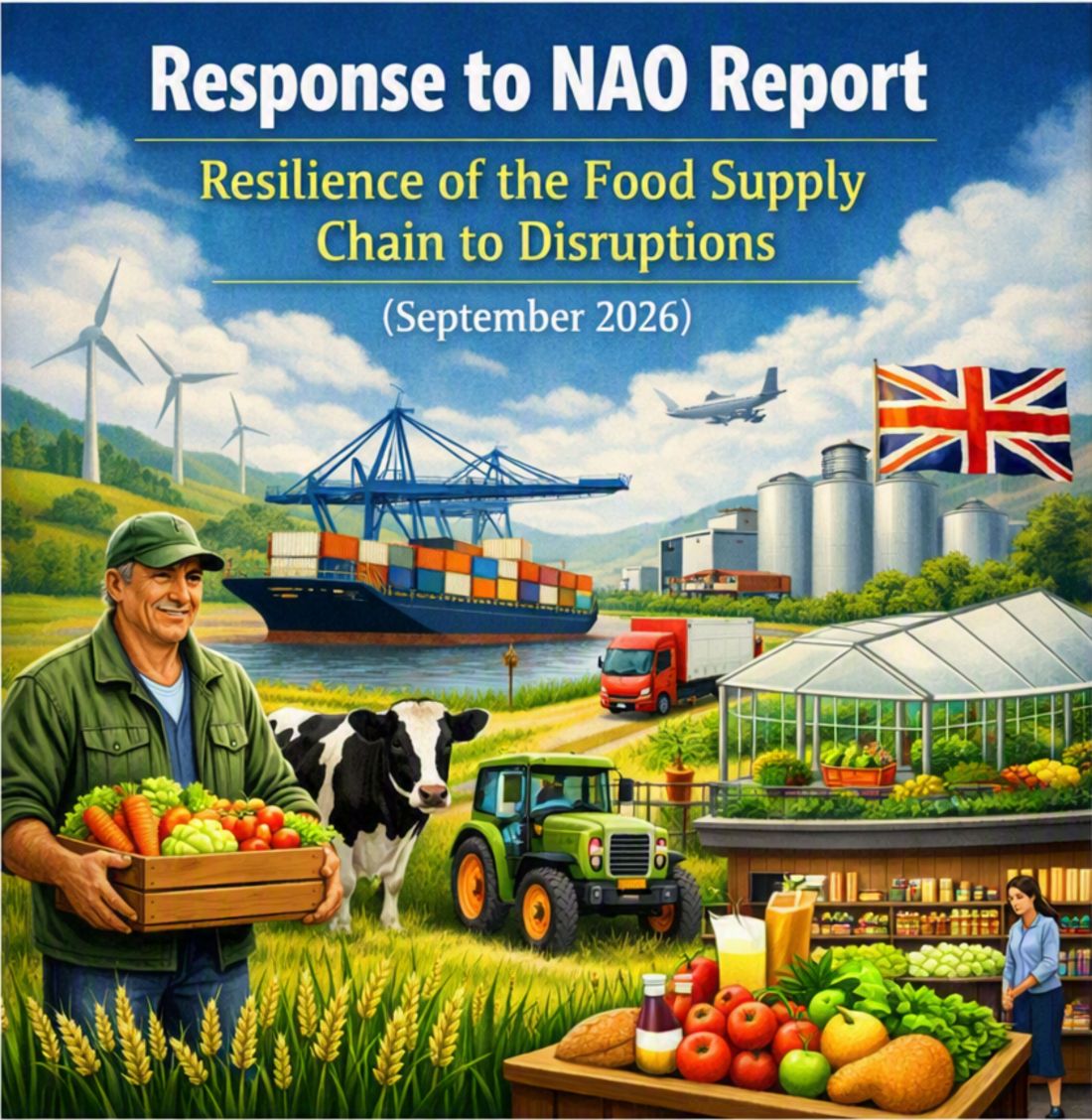
On 4 September 2026, the National Audit Office published Resilience of the Food Supply Chain to Disruptions, a report that rightly draws attention to weaknesses in the UK’s preparedness for serious food supply shocks. This response is offered as part of my ongoing farming, food security and Foods We Can Trust work, which examines the gap between food being available in normal times and food being resilient enough to withstand disruption.
The NAO report is valuable because it recognises rising risks, weaknesses in contingency planning, declining engagement with industry, and the need to involve households and communities more seriously. However, it remains constrained by assumptions that deserve closer scrutiny: in particular, the use of headline self-sufficiency figures, the reliance on private-sector adaptation, and the continued preference for centralised emergency response over local capability.
This response therefore does three things. First, it explains why food self-sufficiency is not the same as food resilience. Secondly, it identifies where the NAO’s analysis understates structural vulnerability. Thirdly, it sets out the practical direction of travel required if the UK is to build a food system that is more local, more capable, more trusted and more resilient. Links to the specific works that develop these arguments in greater detail are provided in the further reading section.
1. The NAO’s “60% self-sufficiency” figure is useful, but it is not a resilience measure
The report states:
“In 2025, the UK’s food ‘self-sufficiency ratio’ was around 60%.”
This is a value-based measure: it compares the monetary value of food produced in the UK with the monetary value of food consumed here. That makes it useful as an economic indicator, but it does not answer the practical resilience question: how much food could the UK produce, process, distribute and access during a prolonged disruption?
The fact that many categories (fruit, vegetables, oils, ingredients) are overwhelmingly imported
The headline figure is also a net figure shaped by the way the modern supply chain works. Domestic production, imports, exports, imported inputs and processing dependencies all interact. Some food counted within domestic production may rely on imported fertiliser, animal feed, fuel, machinery, packaging or processing capacity. Some food produced here is exported. Some foods that are central to healthy diets are heavily import-dependent.
For that reason, the UK’s practical food resilience in a severe disruption scenario may be substantially lower than the self-sufficiency ratio suggests. The issue is not whether the precise figure is 60%, 52%, or lower still. The issue is that the official metric does not measure calorific adequacy, nutritional balance, imported input dependency, processing capacity or local distribution capability.
The NAO’s framing therefore risks creating false reassurance. It implies that production value can stand in for practical food availability. In a crisis, however, people need calories, nutrients, functioning logistics, processing capacity and accessible local distribution. Until government distinguishes those concepts, resilience planning will remain incomplete.
I have explored this in detail in Foods We Can Trust: A Blueprint for Food Security and Community Resilience in the UK, where I outline why caloric sovereignty – not value-based accounting – must be the foundation of food resilience policy.
2. Food inflation at 19.2% is not just an economic statistic – it is a resilience warning
The report notes:
“Food price inflation… peaked at 19.2% in March 2023.”
This is the first time I have noted that an official document has acknowledged the scale of the price shock that households have recently experienced. Food inflation at nearly 20% is not normal. It is not manageable. It is not a blip.
It is a sign that the system is structurally fragile.
Food is not discretionary. When prices rise at this rate, it reflects:
supply chain instability
import dependency
energy volatility
corporate consolidation
lack of domestic production capacity
The NAO mentions the figure but does not explore its implications. It should have been a central warning.
3. The NAO’s suggestion that Defra needs more emergency powers misses the point entirely
The report argues that Defra lacks the legal powers needed to manage catastrophic food disruptions.
But additional powers during an emergency cannot compensate for resilience that has not been built beforehand.
Legal authority can help coordinate action, but it cannot create food, processing capacity, distribution routes or community preparedness after the point of failure.
The lesson from recent crises is that centralised decision-making has limits when disruption affects daily life across multiple systems at once.
Food resilience requires operational capability before the crisis: trusted local relationships, clear responsibilities, practical logistics and the ability to identify and support vulnerable households quickly.
Food resilience must be:
built before a crisis
decentralised
community-led
grounded in local production and distribution
depoliticised
Emergency powers matter only if there is a resilient system for them to work through. Without food, fuel, people, local knowledge and functioning distribution, legal powers alone offer little practical protection.
4. The agri-food sector’s economic importance is understated – and underutilised
The NAO notes that the agri-food sector:
supports 4.1 million jobs
contributes £162.3 billion in GVA
These are enormous figures. And they would be significantly higher if British production and supply were prioritised.
The UK has the land, the skills, and the capacity to produce far more of its own food. What it lacks is a policy framework that values domestic production over globalised efficiency.
In The Need for a Collaborative Approach to the UK Farming and Food Security Problem, I argue that genuine collaboration – not policy-driven “collaboration theatre” – is essential to unlocking this potential.
5. Food as “one of 13 CNI sectors” creates false reassurance
Food is listed as one of 13 Critical National Infrastructure sectors. But unlike energy, water, telecoms, or transport, food is needed every single day.
There is no buffer. There is no downtime. There is no substitute.
Treating food as just another CNI category understates its foundational importance.
It leads to complacency and underinvestment.
6. Defra’s engagement with industry has deteriorated – and has become narrative management rather than collaboration
The NAO reports that:
engagement groups meet less frequently
objectives are unclear
support has declined
stakeholders see gaps in Defra’s understanding of key areas (e.g., the cold chain)
This aligns with what I have written in Real Collaboration vs Policy Collaboration. The concern is that engagement can become procedural rather than operational: meetings take place, stakeholders are consulted, and the language of partnership is used, but the people who understand production, processing, logistics and community need are not sufficiently empowered to shape the system.
Real collaboration requires:
shared objectives
transparency
local producer involvement
community representation
depoliticised structures
The NAO’s findings suggest that too much of this practical collaboration remains underdeveloped.
7. Household and community resilience has been neglected – and this is one of the report’s most important admissions
The NAO states:
“UK households are less prepared for emergencies… government-led messaging is less prominent.”
This is not a minor point. It is a fundamental failure.
Community resilience is the missing layer in UK food security. Without it:
supply chain shocks hit harder
vulnerable people suffer first
government response time shortens
local distribution becomes chaotic
In Local Planning for Food Shortages and Foods We Can Trust, I outline how community-led food resilience can be built at the lowest level – households, neighbourhoods, local producers – and why this must be prioritised.
8. Catastrophic planning remains theoretical – not practical
The NAO notes that:
Defra’s plans lack operational detail
industry is not involved
food assets are not included in the CNI Knowledge Base
national exercises have not tested real-world food failure scenarios
This is planning-oriented resilience rather than practical resilience. It may look adequate in documents, but it remains untested unless it is exercised with the businesses, local authorities, producers, distributors and communities that would have to make it work in practice.
Planning without accurate resilience metrics is incomplete. A credible approach should consider not only how much food is produced, but whether it can be processed, transported, stored, allocated and accessed under stress.
9. Local Resilience Forums are structurally incapable of delivering food resilience
The NAO concludes that LRFs:
lack clarity
lack capability
lack authority
cannot direct supermarkets
cannot identify vulnerable people effectively
This is not surprising. LRFs were not designed to rebuild food-system capability. They can coordinate emergency response, but food resilience also requires local production knowledge, community networks, producer relationships, storage capacity, transport options and clear mechanisms for supporting vulnerable households.
Food resilience therefore needs structures that are sufficiently independent of short-term political cycles and sufficiently close to communities to understand local need. Local government has a role, but it cannot be the only layer of resilience.
10. The private sector alone cannot be the backbone of UK food security
The NAO states:
“Defra has largely relied on the private sector… but this may not be sufficient.”
This is a significant understatement. The private sector is essential to the food system, but commercial efficiency and national resilience are not the same thing.
Large food businesses are generally incentivised to reduce cost, increase efficiency, consolidate operations and source globally. Those incentives can keep prices low in normal conditions, but they may also reduce redundancy, shorten stockholding, concentrate infrastructure and weaken local capability.
profit
efficiency
global sourcing
consolidation
Not:
resilience
redundancy
localism
sovereignty
In Who Controls Our Food Controls Our Future, I explain why corporate control of food systems is incompatible with national resilience.
11. What real food resilience requires: A blueprint
Drawing on my published work, real resilience requires:
Localised production
Rebuilding local food systems, shortening supply chains, and prioritising domestic output.
Community-level distribution
Neighbourhood hubs, local coordination, and community-led logistics.
Regional coordination
County-level frameworks that support local producers and manage regional flows.
National strategic oversight
A central body that sets resilience targets, not efficiency targets.
Depoliticised resilience structures
Community leaders, producers, and local organisations empowered to act independently of political cycles.
Accurate resilience metrics
Caloric sovereignty, not value-based accounting.
Reduced dependency on global supply chains
Rebalancing imports with domestic capacity.
Rebuilding domestic processing
Cold chain infrastructure, abattoirs, mills, and food processing facilities returned to UK soil.
Conclusion: The NAO report is a warning, but it is not yet a route to resilience
The NAO has highlighted important risks, and the report should be welcomed for bringing food supply disruption into sharper public view. Its strongest contribution is the recognition that Defra must engage more effectively with industry, households, communities and local government if the food system is to withstand future shocks.
However, the report does not go far enough. The UK’s food resilience is likely to be materially weaker than headline self-sufficiency figures imply, because resilience depends on more than production value. It depends on calories, nutrition, processing capacity, imported inputs, logistics, local access, household preparedness and community capability.
12. Priority actions
To move from acknowledgement to action, government should prioritise five practical steps.
Supplement value-based self-sufficiency measures with calorific, nutritional and supply-chain resilience indicators.
Map critical dependencies, including imported fertiliser, feed, energy, packaging, processing infrastructure, cold chain capacity and key transport routes.
Test severe food disruption scenarios with producers, processors, retailers, logistics providers, local authorities and community organisations.
Strengthen local and regional food resilience planning, including household preparedness, vulnerable-person support and community distribution capability.
Rebuild domestic processing and local food infrastructure so that production can be converted into accessible food during both normal conditions and crisis conditions.
The UK must therefore stop treating food solely as an economic sector and start treating it as a foundation of national security, public health, community resilience and democratic trust.
Further reading
1. Foods We Can Trust: A Blueprint for Food Security and Community Resilience in the UK Online text The core work behind this response. It sets out the wider argument that food security must include trust, nutrition, domestic capability, local resilience and community preparedness, rather than relying only on national supply figures or market efficiency.
2. Understanding Foods We Can Trust: A Blueprint for Food Security and Community Resilience in the UK Introductory overview A shorter explanatory article for readers who want an accessible introduction to the concepts behind Foods We Can Trust, including food security, household preparedness, local production and the importance of rebuilding public trust in the food system.
3. Local Planning for Food Shortages: A Guide to Local Support and Preparedness Full text A practical guide to planning at household, neighbourhood and local-authority level. This is especially relevant to the NAO’s concerns about household and community preparedness, vulnerable people and the limits of centralised emergency planning.
4. The Need for a Collaborative Approach to the UK Farming and Food Security Problem Article Develops the case for genuine collaboration across farming, food, policy and community systems. It provides the background to the argument that resilience cannot be delivered by government or the private sector acting alone.
5. Real Collaboration vs Policy Collaboration: The Choice That Will Shape the Future of Farming, Local Food Systems and Food Security Article Explains the distinction between collaboration that changes outcomes and consultation that mainly manages process. This is relevant to the NAO’s findings on declining engagement and unclear objectives within Defra’s work with industry.
6. Who Controls Our Food Controls Our Future Full text Explores the relationship between corporate control, food sovereignty, public trust and democratic resilience. It provides wider context for the argument that food systems should not be judged by efficiency alone.
Disclaimer
This document represents the views and analysis of the author and is provided as an independent response to the National Audit Office report Resilience of the Food Supply Chain to Disruptions (4 September 2026). While every effort has been made to ensure the accuracy of the information presented, it should not be regarded as official policy advice. The opinions expressed are informed by the author’s research, professional experience, and studies in sustainable agriculture and food security, and are intended to contribute to constructive discussion on food resilience, food security and community preparedness.
By late August 2026, one uncomfortable reality has become difficult to ignore: artificial intelligence is no longer a separate technological frontier. It has become part of the operating system of the modern world.
AI now helps route goods, price risk, support medical decisions, balance electricity grids, administer public services, and analyse military threats. It is no longer sitting outside society, waiting to be adopted. It is already inside the machinery.
At the same time, the world around it has become more fragile. Energy markets are volatile. Supply chains are stretched. Debt levels are high. Geopolitical tensions are escalating. Climate pressure is increasing. Political trust is weakening.
The result is a new kind of risk. It does not flow in one direction.
AI can be weakened by a breakdown in the world that supports it. The world can also be weakened by a breakdown in the AI systems it has begun to depend on.
This is circular fragility: a situation in which two systems become so dependent on each other that stress in either one can travel back through the other.
This is not a prediction of doom. It is a description of a structural vulnerability that is already taking shape.
The AI Industry Is Built on a Story It Can No Longer Fully Sustain
The public story of AI has been one of unstoppable progress: bigger models, smarter systems, faster adoption, and ever-larger investment.
Underneath that story, however, the economics are far less settled. AI is not software in the old sense: cheap to copy, easy to distribute, and inexpensive to run once built.
Modern AI depends on vast physical infrastructure: specialised chips, data centres, cooling systems, electricity, network capacity, and a continuous pipeline of capital. The International Energy Agency has warned that electricity demand from data centres could more than double by 2030, with AI a major driver of that growth.
That matters because the cost of serving AI does not disappear once a model has been trained. Inference-the everyday process of answering prompts, analysing documents, producing images, writing code, or running agents-continues every hour of every day. As more people use AI for heavier tasks, the running cost compounds.
Yet the price users see is often moving in the opposite direction. Subscription fees are capped. Token prices fall. Free access is used to win market share. Enterprise buyers are becoming more cautious. Open-source competitors are improving rapidly. The gap between what AI costs to provide and what many users are willing or able to pay remains one of the unresolved questions at the heart of the industry.
For now, that gap is being bridged by investment capital, strategic subsidy, government interest, and the expectation that scale will eventually make the whole system profitable. That may prove true. But it is not guaranteed.
The industry is therefore not held together by economics alone. It is held together by a story: that costs will fall, demand will keep rising, investors will remain patient, and infrastructure will arrive quickly enough to support the next wave of use.
Stories can be powerful. They can mobilise money, talent, and political support. But stories are not foundations. When the real-world conditions beneath them change, belief can turn very quickly from fuel into fragility.
The Coming Affordability Crisis
There is another weakness in the AI business model that receives far less attention than energy costs or infrastructure spending: the ability of customers to keep paying for it.
Most discussions of AI economics focus on the supply side. They ask whether providers can continue funding data centres, buying chips, securing energy, and training larger models.
The demand side is discussed far less often.
Yet the same pressures destabilising the wider global economy are also reducing the ability of households, businesses, and governments to spend freely on AI services.
If energy prices rise, disposable income falls.
If food prices rise, discretionary spending falls.
If debt costs rise, corporate investment falls.
If governments face fiscal pressure, technology budgets come under scrutiny.
If businesses enter a recession, experimentation is often one of the first expenditures to be reduced.
AI is frequently presented as a productivity tool that organisations cannot afford to ignore. In many cases that is true. But there is a significant difference between recognising the value of a technology and having the financial capacity to deploy it at scale.
This creates a second economic squeeze.
On one side, AI providers face rising costs from energy, infrastructure, hardware, cooling, and financing.
On the other side, customers face rising costs from food, fuel, housing, wages, debt servicing, insurance, and economic uncertainty.
The result is a narrowing zone in which both sides can remain financially viable.
The assumption underlying much of the current AI boom is that adoption will continue rising quickly enough to compensate for these pressures. That assumption may prove correct. But it depends on a world in which businesses, consumers, and governments retain the financial freedom to spend on new technology even as other essential costs rise.
If that freedom disappears, the consequences for AI could be profound.
A technology that is expensive to provide and increasingly difficult to afford finds itself trapped between two forms of scarcity: the scarcity of capital needed to produce it and the scarcity of money available to consume it.
That is not merely a technology problem.
It is a systemic problem.
AI Has Become Load-Bearing Before Becoming Stable
The deeper problem is not simply that AI is expensive. It is that AI is becoming important before it has become fully resilient.
Across only a few years, AI has moved from experiment to infrastructure. It now supports warehouse scheduling, fraud detection, medical triage, customer service, software development, energy forecasting, military analysis, and government administration. In many places it is not replacing whole systems outright, but it is becoming part of how those systems make decisions and manage pressure.
That distinction matters. A society does not need to hand total control to AI for AI dependency to become dangerous. It only needs to remove enough human capacity, manual fallback, institutional memory, and spare time that operating without AI becomes slower, more expensive, and more chaotic.
AI remains powerful but uneven. It can be brilliant in one moment and unreliable in the next. It still hallucinates. It still depends on enormous computational resources. It still relies on tightly concentrated chip supply chains and cloud infrastructure. It can fail because of model error, power shortage, cyberattack, policy restriction, financial stress, or simple outage.
This creates the first direction of fragility. If AI availability suddenly contracts, the immediate effect may not be dramatic collapse. It may be delay, confusion, degraded service, rising cost, and poor decisions made under pressure. But in highly optimised systems, those small failures can compound quickly.
The danger is not that every system stops at once. The danger is that systems already running with little slack become less able to absorb shock.
The World Around AI Is Now Too Fragile to Support It
The second direction of fragility runs the other way. AI depends on a world that looks increasingly unable to guarantee the conditions AI requires.
AI needs cheap and reliable electricity. It needs specialised chips, servers, fibre networks, water, cooling equipment, skilled technicians, stable regulation, patient investors, and global logistics. It also needs public permission: the willingness of societies to allow such systems into sensitive areas of life.
None of these supports is guaranteed. Energy grids are under pressure. The supply of advanced chips remains geopolitically sensitive. Data centre growth is beginning to compete with other electricity needs. Public trust is fragile. Capital is abundant only as long as investors believe the returns will justify the cost.
This is why AI could falter even without a spectacular technical failure. A spike in energy costs, a shortage of transformers, a restriction on chips, a credit squeeze, a major cyber incident, or a loss of political legitimacy could all limit AI’s availability long before the models themselves stop improving.
AI is therefore fragile in two ways: internally, because it is still technically and economically immature; externally, because it rests on a world whose own foundations are under strain.
Hormuz Is Where the Abstract Becomes Immediate
The Strait of Hormuz is not a theoretical example. It is where the abstract argument about circular fragility becomes immediate. By late August 2026, pressure around this narrow corridor is no longer a distant possibility but an active stress running through energy, transport, food, finance, and politics.
In normal conditions, roughly a fifth of global oil supply moves through or depends on Hormuz. The corridor also matters for liquefied natural gas, fertiliser inputs, shipping insurance, and the confidence that global markets can keep moving even under pressure. When stress builds there, it does not stay there.
The pressure did not suddenly appear at the end of the summer. It has been accumulating since the escalation involving Iran at the end of February 2026. What followed was not a clean, visible rupture, but something harder to read: disruption, adaptation, reserve use, rerouting, higher risk premiums, and gradual depletion of buffers. The absence of an obvious public crisis has encouraged the impression that the danger has passed. That may prove to be a serious misreading.
Markets and governments can absorb shocks for a time. Strategic reserves can be released. Inventories can be drawn down. Traders can reroute supply. Prices can be smoothed by policy, subsidy, hedging, and delayed pass-through. But those mechanisms do not remove the stress. They move it, hide it, or postpone it. That matters because a system can look stable at the surface while becoming less resilient underneath.
Diesel is one of the clearest transmission points. It is not simply another fuel. It powers freight, farming machinery, construction, mining, generators, emergency logistics, and much of the heavy physical economy. When diesel becomes short, goods move more slowly, production costs rise, and prioritisation becomes unavoidable. The effect is not confined to petrol stations. It spreads through everything that has to be grown, mined, built, shipped, refrigerated, or repaired.
Behind that energy story sits an agricultural one. Fertiliser supply has already been under pressure, and Australia is one of the places where that pressure matters visibly. Australian grain growers have been forced to make planting and fertiliser decisions under conditions of high cost, uncertain supply, and strained logistics. Those decisions have long lead times. Reduced fertiliser use or reduced planting today does not fully show up today. It shows up later, in lower yields, lower quality, tighter export markets, and higher food prices.
This is why the threat of El Niño matters so much. Specialists are already watching key breadbasket regions because El Niño can shift rainfall, increase heat, intensify drought, disrupt monsoons, and damage harvests. In ordinary conditions, the global food system might absorb some of that stress. But El Niño arriving on top of high fuel costs, constrained fertiliser, disrupted trade routes, and reduced planting decisions is a different proposition.
The risk is not simply that food becomes more expensive. The risk is that parts of the world face genuine food supply disruption in 2027, including famine conditions in the most vulnerable regions. Wealthier countries are not immune. They are less likely to experience famine, but they can still experience shortages, rationing pressure, panic buying, political backlash, and sharp cost-of-living shocks. In a tightly connected food system, scarcity does not respect the old distinction between stable and unstable regions as neatly as many people assume.
For AI, this matters profoundly. AI cannot be separated from the price of electricity, the availability of diesel, the delivery of hardware, the stability of agricultural systems, or the spending power of households, firms, and governments. A food and energy shock does not merely make daily life harder. It compresses the economic space in which AI companies can operate and in which customers can afford to use them.
Hormuz may not be the first domino to fall visibly, and it may not be the decisive one. But it shows the shape of the danger. A geopolitical shock becomes an energy shock. An energy shock becomes a fertiliser shock. A fertiliser shock becomes a food shock. A food shock becomes an inflation, debt, budget, legitimacy, and demand shock. By the time the pressure reaches AI, it has already passed through the systems AI depends on and the customers AI expects to serve.
The Objection: Would AI Really Matter That Much?
A fair objection is that this argument can sound exaggerated. If major AI services disappeared tomorrow, aircraft would not fall from the sky, hospitals would not instantly close, and governments would not cease to exist. Most important institutions still have people, procedures, and legacy systems.
That is true. The issue is not instant collapse. The issue is declining resilience. As organisations design workflows around AI, they may quietly reduce the human capacity needed to operate without it.
Manual processes atrophy. Expertise leaves. Teams shrink. Decisions accelerate. Expectations rise. The fallback still exists on paper, but becomes weaker in practice.
That is how dependency forms: not through one dramatic handover, but through a thousand small conveniences that become assumptions.
Collapse Can Now Flow Both Ways
This is the key point. The risk is no longer simply that AI might fail, or that the world might become unstable. The risk is that each now makes the other more vulnerable.
A global shock can weaken AI by disrupting energy, capital, hardware, logistics, or political support. An AI shock can weaken the global system by degrading the tools now used to manage complexity, reduce cost, allocate resources, and make decisions at speed.
This is what makes circular fragility different from ordinary risk. Ordinary risk asks what happens if one part breaks. Circular fragility asks what happens when the backup system is also dependent on the thing that is breaking.
In that kind of environment, capability is not enough. Resilience matters more.
What We Can Still Save
The good news is that protecting AI does not mean defending the current model at all costs. It may mean letting go of the most fragile version of AI: the centralised, high-compute, high-energy, heavily subsidised model that has dominated the public imagination.
What survives under stress will be the AI that can keep working when conditions are imperfect.
If energy is constrained, the useful model is low-energy and local. If finance tightens, the useful model is smaller and cheaper to maintain. If geopolitics fractures supply chains, the useful model is open, sovereign, and repairable. If public trust declines, the useful model is transparent, accountable, and clearly subordinate to human judgement.
In every scenario, the direction is the same: less centralisation, less dependence on endless scale, more local capacity, more human oversight, and more attention to the conditions under which technology can continue to function during stress.
This is not a smaller vision of AI. It is a stronger one. A tool that communities can understand, govern, repair, and afford is more valuable in a crisis than a spectacular system that only works when everything else is stable.
A Wake‑Up Call, Not a Warning
This is not an argument against AI. It is an argument for saving the parts of AI worth having.
The current AI boom is built on scale, speed, and belief. Those forces have produced remarkable progress. But they have also encouraged a dangerous assumption: that the world will remain stable enough to support ever-larger systems, and that those systems will remain available enough for the world to depend on them.
That assumption no longer looks safe. The future of AI should not be measured only by model size, benchmark scores, or computing power. It should be measured by whether AI can make societies more capable when energy is expensive, supply chains are disrupted, institutions are under pressure, and people need tools they can trust.
The key question is no longer whether AI is powerful. It is whether the systems that depend on AI can remain resilient when AI itself depends on increasingly fragile energy, financial, political, and logistical foundations.
Once dependence runs both ways, resilience becomes more important than capability.
The future will belong not to the biggest systems, but to the systems that can survive shock.