Education is currently failing the UK because the system we have in place today is based on the flawed idea that Equality is about sameness. True Equality comes with acceptance of the real differences that exist between us and in giving each and every one of us the best shot possible…

images (2)Equality is one of the greatest aims for any Country to have, whilst perhaps one of the most misinterpreted and therefore destructive concepts that that the UK has embraced.

Negative forms of discrimination have made many thinkers believe that the solution comes in the form of their positive counterparts. Yet the point has been severely missed that prejudicial forms of discrimination always relate to a form of favouritism or bias as a flipside on the other, and that this inevitable partnership necessarily follows wherever a form of positive discrimination may be used.

Just as racism and colour prejudice, sexism, discrimination against the elderly or disabled have and arguably in some cases continue to been a problem for many, giving special treatment or creating favourable circumstances for specific or what some prefer to call ‘underrepresented groups’ can be equally destructive and in some cases will actually affect many more, through little more than a legitimised form of disadvantage which many are simply too afraid to even talk about.

Social engineering is nothing new. But the silent subjugation which hides beneath the velvet glove of political correctness and an often misguided war for equalities is something entirely different. It now risks the identity of culture which has been at the heart of British life for many generations and which arguably kept us at the forefront of world industry, science and learning well in to the 20th Century.

Of all the parts of life where we should be getting the fight for the equality of opportunity ‘right’, Education is probably the most essential, because of the key role that it plays for individuals, communities, industries and therefore the evolution of our entire culture – en-masse.

But at some point, somebody somewhere confused practicality with idealism. They exchanged the reality that being fair to everyone by giving them the educational opportunities that most fit individual need will give us all the best start in life, with the idealist view that putting everyone in the same environment and using the same forms of education, would somehow lead to everyone turning out the same.

It doesn’t. And the reason it doesn’t is because the only difference that should matter when it comes to education is that whatever the circumstances or how we are physically perceived by others, we are all different and we all learn differently.

So no matter what background we come from; whether we are rich or poor; black or white; male or female; able bodied or disabled, we all accumulate knowledge in different ways and will only achieve the very best that we as individuals can, if diversity within educational opportunities matches the diversity that exists with learning ability and indeed counters the factors which are external to learning but upon which learning and the ability to learn have been for too long so foolishly placed.

Whilst ‘dumbing-down’ or developing an educational standard based upon little more than ‘the lowest common denominator’ fills those who abhor anything even perceptively elitist in nature with complete joy, lowering academic standards for the more-academically-inclined simply reduces the numbers of those who would otherwise excel and therefore contribute differently and arguably more greatly to our society as a whole.

However, the real tragedy in all this is based upon all those who are not academically attuned at school age. Many who are unequipped to rise to such theoretical standard, perhaps because of nothing more than circumstances in their lives. Many, who just need their learning to be more practically and vocationally inclined – perhaps only at that time.

We all lose from the approach that has been adopted, as what is in effect manifest ignorance of those whose ability lies not with their heads but with their hands, is or has created a lost generation which unwittingly and in most cases unwillingly lend themselves to many of the welfare, benefits and crime statistics that so many of us know to be so wrong, but have to accept as being just the way that it is.

The lack of foresight and basic understanding of our fellow man that has led these socialist agendas which have pursued this ideology of everyone being the same, are not only destroying the lives and future chances of individuals who could make a considerable contribution to our society – were they given the fullest opportunity to do so; they are contributing to the creation an entire sub-culture of socially disadvantaged, socially inept and socially immobile people who are blighted by the media propagated caricatures that have been landed upon them by the same libertarian and quixotic idealists who inadvertently put those same people there.

Glorification of celebrity, fame, sensationalism and money have led many of us to forget that the very basic forms of all occupations are about us; about life; about putting food on the table; about being healthy; about being happy; about getting us where we need to go. Our values have somehow gone wrong and we have forgotten that every job or occupation is important and that we should all value them as such for the contribution that they make in our lives and the value that they bring to our society.

The ironies of this saga do not stop there. If we continue to flat-line the contribution that we make to the opportunities we give to the up-and-coming generations in the form of free education, the best opportunities really will be left as the preserve of the financially rich who can arguably afford a tailored level of education for their children which simply becomes unavailable anywhere else. If you are of those who think that Politics is skewed in favour of a privately educated elite right now, look what could soon begin to follow in the not too distant future.

Both socialism and liberalism as they exist are flawed. They are little more than idealistic philosophies that make no allowance for the realities of cause and effect, and if we don’t address this failure to address the need for balance in every aspect of life and policy that Government touches soon, the results simply do not bear thinking about.

The role that education plays in all our lives and how it reaches and extends into all parts of our culture, make it probably the very best place to start in addressing what could easily be called the regressive steps that the drive for ill-considered forms of equality have so far engineered.

Every part of the education system needs reform, which will only be controversial for those who continue to put their own ideas first, above the needs and requirements of others. Perhaps we could:

Reintroduce Grammar Schools in every District: The pathway of education for children to which so many parents aspire, Grammar Schools offer a benchmark in education and discipline that it has become unfashionable to appreciate vocally. This social anathema should be dispelled for the foolishness that it is and the opportunity should exist for all academically able children to gain a place at a Grammar School if they can attain the examination standards required and do not have alternative means to access a like-for-like education.

Reintroduce the 11+: With Numeracy and Literacy Skills at a low point, we simply must return to an acceptable level of basic education at this key age so that children are equipped to engage fully during adolescence in our increasingly information-based age, and employers can be sure that young people can not only understand, but also be understood. (Please follow this link for an insight on the 11+.)

Reintroduce real and vocationally based Apprenticeships at 14: Probably the most vital step that needs to be taken is to recognise that not all children are academically inclined and that the system today is failing too many young people because it has not nurtured them in a way which fits their learning processes. In simple terms, children are usually ‘head or hands’ and therefore more theoretically or practically able in their learning processes. In isolation, neither of these qualities is a sign of intelligence, yet children who simply aren’t academically able to make the best of the school environment are all too often considered disruptive and can of course be an unnecessary distraction for those who are suited to school learning. As we grow older, we can all appreciate how little we knew but how much we thought we knew when we were in our teens and providing a stewarded environment from 14 for young people who are better suited to life outside the academic environment would give them the opportunity to take guided steps into the adult world, whilst earning an appropriate level of pay and giving a staffing option to commerce and industry that could make a significant difference to business. Either subsidising roles or supporting complimentary training courses at Tertiary Colleges could still deliver a saving in real terms, whilst providing an investment in the individual, taking them off the streets, whilst supporting British industry with a potentially parallel vocational route to age 21 that would more than adequately make up in time-served experience and the hands-on accumulation of skills for life what academically biased young people gain via a complete route of full-time education.

Reintroduce National Service: With a break or shorter form of Apprenticeship, those young people taking the vocational route could perhaps choose to finish their training in the Armed Services from 18-21, with the option being there as a requirement to attend for all young people not being in education or Apprenticed vocational training between those ages. Those ‘finishing’ training could bring skills from industry that the armed services need at a time that a pool of such experience could be highly beneficial. Either way and however those young people came to join, there is no question that a military grounding would provide a sense of value and self-worth for people who might otherwise never receive it. Such a pathway could open the door either to an extended military career or to the motivation and direction to move forward and make the best of the other opportunities that are on offer to those who value themselves and what they will inevitably gain to do it.

Return to more challenging forms of Exams at 16 and 18: The earlier part of this Coalition Government saw a series of attempts by Education Secretary Michael Gove to reform exams and return to the former O’ Level and A ‘Level or Baccalaureate standards. It’s a desperate shame that he was prevented from doing so as the realities of the flaws in our Education system would quickly become evident and would perhaps highlight just how severely our children are being failed by a system which is currently geared to treating everyone as if they were exactly the same; a system that is benchmarked for its quality not by aspiration, but by the rule of the lowest common denominator. Life is by its very nature challenging and the exams that we take at 16 and 18 should genuinely represent the milestones that they are, rather than just being something that we do. If degrees are to again have the meaning to industry that they once had, it necessarily follows that these checkpoints of the educational pathway should be high on expectation too.

Restructure the way that Higher Education is funded: The Government cannot afford to fund the number of places within Higher Education that the drive to give everyone a degree has required. The fallout from this has of course been the creation of Tuition Fees which in themselves are creating lifetimes of debt for students who may have been a great deal happier taking other routes to learning. The fragility of funding streams has driven many Higher Education establishments to behave more and more like businesses as their focus moves from providing the best education for students to ensuring the survival of the organisations – and the jobs that they provide. This does not contribute to society on a wider level and the focus needs to return to providing the best Degrees possible and not necessarily the ones that generate the best fees from providing them. Bringing the return of value to pre-University level and parallel vocational forms of education would counter much of this, but as with areas such as the NHS and Local Government, there has to be a recognition of the need for overall change as part of a new bigger and reforming picture. This could realistically mean the loss of University Status or even closure for some institutions. But what was really wrong with polytechnics anyway.

Refocus on exam-based scholarship entry opportunities to all private schools for children whose families would otherwise be unable to afford them: Whilst some would happily see the demise of private schools in much the same way as Grammars have all but disappeared, Private Schools should always have their place, if nothing more than to allow those who can afford to pay the choice to do so. However, such institutions should also be available to children who would thrive with the support of such an environment and the schools themselves should be required to make a certain number of places available through exam-based scholarships each year for children who have the academic ability to meet the standards of each specific school, but would otherwise be held back by lack of financial resources.

Stop bringing the blame-claim-culture into schools and let teachers get on with educating: Parents do have a role to play too and I will not be alone in remembering the absolute horror which our parents would experience upon learning that we had been in trouble or had been reprimanded for being disruptive in school. The balance has changed and there is now an unwritten expectation that all children are perfect and that they can never be at fault. The complaints culture and accompanying insinuation that a complaint is just a step away from a claim is paralysing disciplinary standards with the creation of fear on the part of Teachers to act against unruly children who only 30 years ago would have had a string of detentions or worse from the school, along with a right good rollocking from their parents just as soon as they returned home.

Introduce standard educational apps on all electronic devices which will be used by children: Technology and the influence that it has upon us all is marching ahead at a hellish pace. Children are already using tablet computers before they can do many other things. We are currently missing the opportunity to work with manufacturers and potential sponsors to utilise these devices which immediately make fascinated children a captive audience.  The development of standard apps which can be used to develop reading, language and other skills for the benefit of children and that of the education system which will very soon follow could be immeasurable. There is no doubt that Government should be working closely with manufacturers and Companies such as Google, to develop acclimatised software which is included within the operating platform of the machines at the point of sale and makes the very best of the learning opportunity which is literally presented for them there at hand.

Education by its very nature is supposed to assist the evolution of people, rather than becoming a tool which does little more than help a society to regress. Great ideas will not help all people if they are not developed with the needs of every single person in mind and education is currently failing in the UK because the system we have in place today is based on the flawed idea that Equality is about sameness.

It’s time that we stopped trying to force people to change in ways that they simply cannot be changed; accept the good that exists in the real differences between us, and start giving each and every one of our children and young people their very best shot.

images (31)

Source of top Image unknown

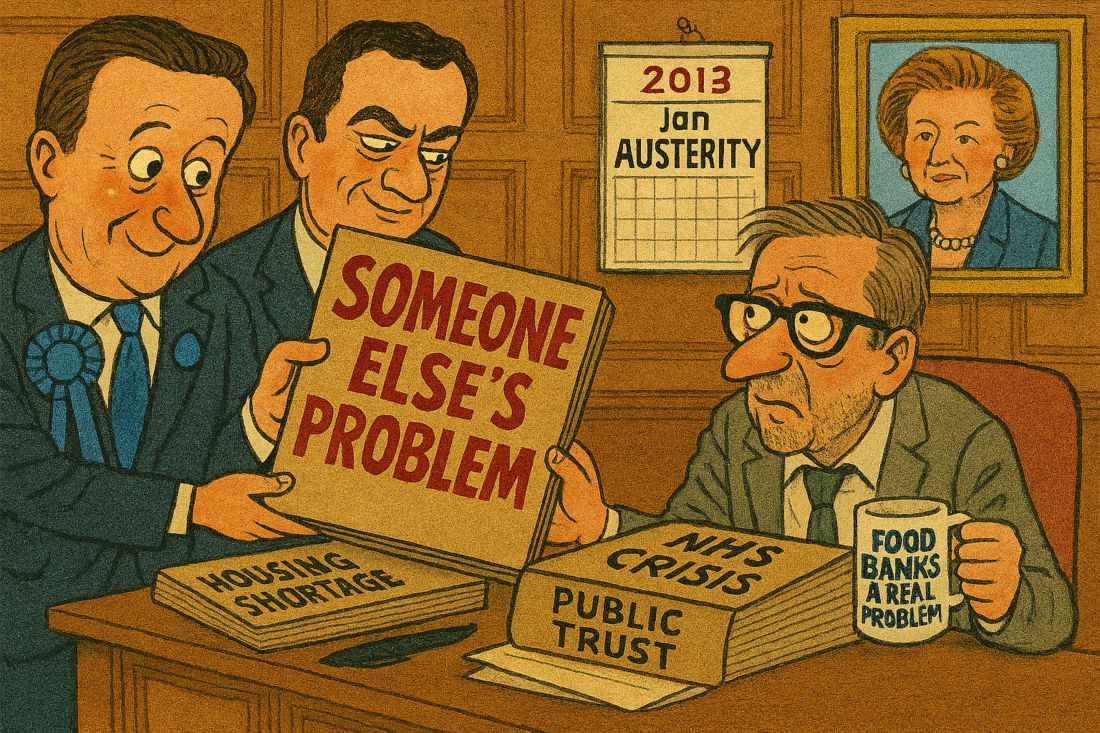
Food banks are here to stay for as long as Politicians keep acting as if poverty is someone else’s problem

Fill yourself with festive cheer, for the deficit should be defunct in just a few more years!

The Government does indeed seem to be peacock-proud of its fiscal management which has manifested itself in the form of great optimism during the recent Autumn Statement.

Strange then that little mention should be made or focus placed upon the spiralling debt mountain that as a Nation, we the UK currently sit upon, or what might happen if economic forces beyond Osborne and the Bank of England dictate that borrowing money can no longer remain so inordinately cheap.

However, insulated as we may seem from the realities of an economic meltdown bluffingly put on hold whilst politicians still have the ability to do nothing more than concentrate on the next election, the fact is that the only real difference between the debt that the Government ‘manages’ on our behalf and the financial problems facing so many of the Voters who unwittingly put them there is that people living in the real world have no elaborate schemes or devices to hide the problems that they currently face.

Being in touch with the painful realities of UK life for those who have the worry of meeting their monthly bottom line is a gift which seems to have eluded many of the Political Class.

Only this week, Lord Freud intimated that Local Authorities should pick up responsibility for funding food banks; an act which in itself demonstrates the severe lack of understanding that those in Government have of the problems which people genuinely face.

It is all too clear that they have no idea what steps really need to be taken simply to arrest the backward slide in living standards which is already stretching far beyond the realms of the financially poor. It is an unspoken truth that is changing the way that just about everyone without the joy of having a surplus income before pay day are having to cope with, each and every month.

Localism has of course given the lie to the idea that more and more services and methods of support will be provided at local level, by local organisations for local people.

What the Localism Agenda doesn’t contain within all the talk that has gone with it however, is that whilst Westminster politicians audibly pass the buck to their Local Authority counterparts with one hand, they are systematically stripping them of the resources and ability to maintain their existing responsibilities with the other.

Without cutting existing services, raising Council Tax beyond 5%, using savings, cashing in publically owned property or borrowing, there is simply no way that Local Authorities can take on a National problem locally without outside help to do it. And when the only politicians that have the ability to tackle the causes of the problems facing so many people head on are sat in London, it is at best disingenuous if not bordering on pure fantasy to even hint that the real cost of living crisis is something which confines itself to communities at a very local level.

People would be starving right now, were it not for the tremendous efforts of the organisations and individuals who are working so hard to help those many people who are already experiencing a regular sequence of hours in need.

Food banks are a treatment for a problem, but by no means a cure.

Ministers really must start recognising this now, rather than seeming to be content to do little more than pretend that the problem doesn’t exist; or worse still, to behave in such a way to suggest that the many people experiencing both the extremities and day-to-day realities of contemporary poverty have somehow knowingly chosen to be there.

download (19)

If you have found this article whilst researching food banks, further information about Tewkesbury Food bank can be found at www.tewkesbury.foodbank.org.uk or for those in other areas, please see this link on the Trussell Trust Website.

Marine A: Battlefields are not today’s UK’s streets and we must accept that civilian rules and understanding inflicted upon the work and actions of military personnel will be little more than a pathway to disarmament, making us all the same

download (16)Scant attention is being paid to the seismic consequences for UK Defence that may now follow the conviction and subsequent imprisonment of Royal Marine Sgt. Alexander Blackman.

Found guilty of Murder in a battlefield situation, there is little question that to all of us who have read the publicised details of this saga, it does indeed sound like a barbaric and cold blooded execution.

Indeed very few of us like to think of any situation where a human being is apparently dispatched in such a seemingly brutal way and certainly not by the hand of a Member of our Armed Services, whom we are still led to believe sit at the forefront of military professionalism, despite the continuing cuts which at some point will make such notions entirely mythical.

Very few of us have actually experienced the trauma of battle first hand and it would be my sincerest hope that this will always remain the case for as many of us as will ever be possible. But, one thing that is certain is that the environment created by warfare of any kind is very different to that which we as a majority have today ever experienced in our civilian lives.

We must therefore ask the question of whether we are now allowing the values and expectations of our peacetime, ‘civilised’ and liberally enlightened society to be projected and therefore inflicted upon the very environments in which our Service Personnel operate and who by the very nature of the warfare they are exposed to daily are experiencing something entirely different?

It is of course ironic that if the insurgents, terrorists or fighters that our troops are facing were themselves operating under a like-for-like code of conduct as we expect of those sent to the front line to protect us, this would in itself indicate the existence of a set of values and consideration for others on their part which would probably have meant there was never a need for violent conflict between any of us in the first place.

But this is what we and our ‘allies’ are up against; Itinerant warfare which recognises honour in killing, maiming and the installation of maximum fear in its enemies, whilst celebrating glory from martyrdom and death.

It is beyond foolish for any of us to expect that combat personnel will always ‘get it right’ when exposed to acts of violence and terror which run contrary to everything we have ourselves been taught. It is potentially disastrous when those making such a judgement are unlikely to have any meaningful appreciation of the very personal and specific way that individuals can be affected by these experiences and the effects that these emotional explosions will surely have.

Failure to recognise the steps that we have already taken on this slippery slope to considering combat or service related roles as being a normal or an everyday job are already seeing ambulance-chasing payouts to those who see the opportunity for personal gain. We can only wonder if the emergence of battlefield lawyers who judge whether every single act undertaken by troops are indeed righteous is just a matter of time away.

One thing is for certain and that is that if our armed service personnel are increasingly likely to be faced with criminal charges for actions which are taken completely out of context, it wont just be budget cuts and white elephant spending on the part of the Government and the Ministry of Defence that keep reducing the numbers of those who are willing to put their lives on the line and fight.

Image thanks to Reuters/www.dailymail.co.uk

MP’s Pay: How will an 11% pay rise help Voters when we aren’t exactly getting value for money now?

images (30)

Would you like a pay rise? Yes? You will probably agree that most people would. But should our MP’s really be getting an 11% ‘salary’ rise in order that their wages reflect the work that they do and the level of responsibility that they have?

If MP’s were actually undertaking and carrying out a ‘job’ in it’s truest and therefore ‘functional’ sense, I think I would probably agree that they should be salaried at a higher level than they already are. But MP’s are not actually ‘doing a job’ in the sense that the IPSA Consultation which has been carried out would suggest.

It is the very fact that becoming an MP is now seen as being a ‘job’ that has facilitated the rise of the ‘career politician’ and much of the difficulty and disenfranchisement which faces voters as the result of electing people whos aim is little more than to turn up for ‘work’, promote themselves to the media or get promoted as they focus on the date of the next Election, rather than go out and give a real and meaningful voice to the people who put them there.

The Legislation which governs Elections should be the biggest clue to anyone seeking elected office that they are not applying for a job, but a serious responsibility.

The Representation of the People Act says in four simple words everything that any existing or aspiring politician needs to understand about what they are or have undertake on behalf of others. But of course party politics has created a situation where would-be politicians do indeed ‘apply’ for seats, and when they are fortunate enough to be selected for one which any of the parties can consider to be ‘safe’, they will indeed find themselves with a job for life – just as long as they do what the party wants and don’t rock the boat by doing something trivial like putting constituency matters first.

This is simply wrong. Neither politician nor their respective parties should be able or feel morally correct in treating the roles and responsibilities of politicians as a job – whatever level of Government to which the politician may have been elected.

Arguments are of course made that the remuneration for MP’s needs to be higher in order to attract those who have better knowledge, experience or indeed exposure to life to the roles. But the danger here is that a faulty and already self-serving system will just be enhanced and propagated further with even more inexperienced and unworldly applicants who lack the wherewithal and real world understanding to represent all others adequately, jumping on board the gravy train – perhaps even earlier than many of them are attempting to do so even now.

Politics should be recognised as being vocational service to others, rather than a professional and self-serving occupation. It would thereby extend a welcome to those who can best represent others by understanding, communicating and fighting to address real – rather than perceived need, whether it be at family, street, community, town, city, county, country or international level.

Very few of our politicians currently even attempt to take this approach and thereby put the people who they were Elected to represent first.  The result is openly marked by just how out-of-touch and aloof policy making has become.

Whilst pay remains both a priority and incentive for politicians, none of us will have any chance of receiving the best representation that we possibly can.

Put simply, politicians weren’t and aren’t elected to do a job. Politicians are elected to assume and carry out the responsibilities of representing and addressing need.

Nonetheless, it is just a job that most of them are doing and how will an 11% pay rise help the Electorate when we aren’t exactly getting value for money now?

Image thanks to keepcalm-o-matic.co.uk.

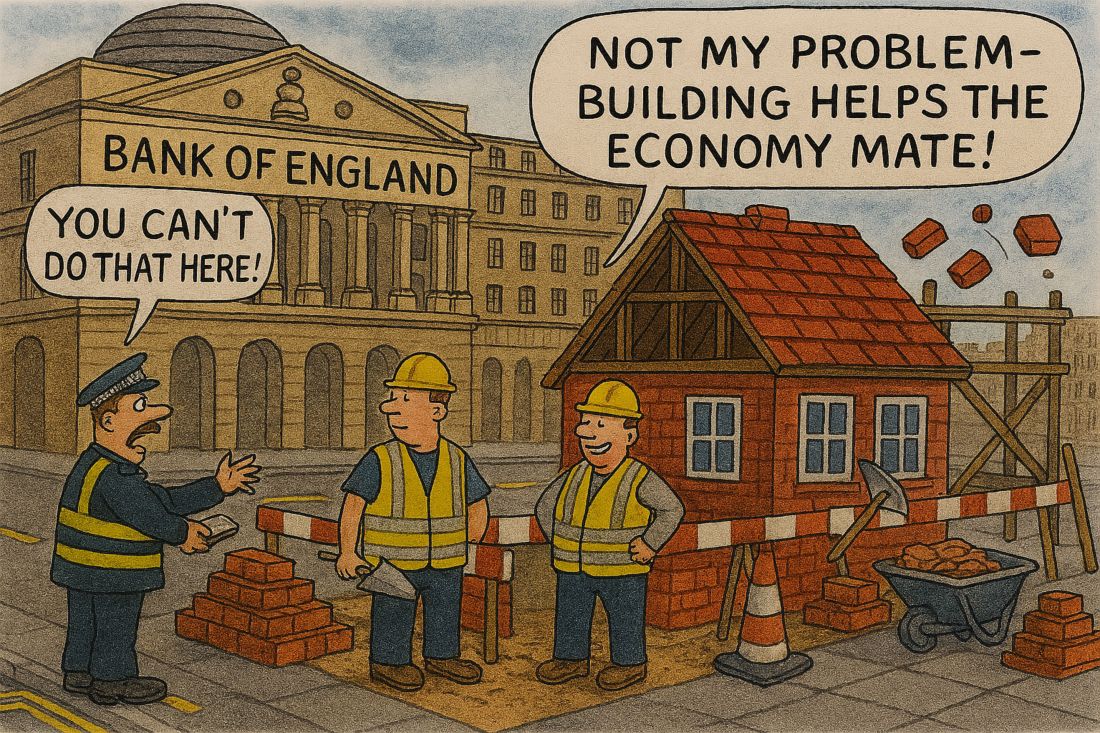
People need new homes. But pumping houses into the economy isn’t the only answer and may be more destructive as an isolated solution than Quantitative Easing will surely prove to be…

Has anyone noticed how politicians love to pick up an issue that plays on people’s minds and then they play with it, mutilate it and reshape it to suit their own ends?

Party Conference Season is of course a great time to see this approach to taking responsibility in its finest form and Nick Clegg’s sound-bites about the Lib Dem role as the moral anchor of future Coalition Government and Ed Milliband’s socialist branding on the Cost of Living Crisis and Energy Prices are themselves very fitting examples of cynical – and impractical views or policy, which in reality would demonstrate just how out of touch these people really are.

Policy bandwagons that appeal to public opinion, but lack the depth and thought for their real and long term implications are by far the worst, because in appearing to solve a problem, they actually create a whole lot more besides and usually in ways which are far more damaging to individuals, communities and businesses than the initial problem ever had been.

Perhaps the most notable of these policy faux pas that politicians keep lining themselves up to commit is with strategic planning for development and house building in particular. I know that I am far from alone in wondering just how practical, ‘real world’ and problem solving our leaders think this continuous drive to concrete across this Country actually is…

In terms of the day-to-day political scene, house building has become an almost obsessive issue for all of the Parties and one that they would happily have us all believe can only be addressed by significant development.

Generally speaking, the spin that politicians place on these plans is that building more houses will make them cheaper and therefore more available. But how many new developments have you seen being sold at less than the local like-for-like rate or at a rate which genuinely reflects the cost to build plus a realistic profit margin?

They say that building houses will create jobs. But other than within the industry that builds houses and the services that will then provide them, what jobs ever get created by the construction of a house?

They tell us that building houses is good for the economy. But how can that be so when prices keep going up, people have to borrow to afford them and the houses built are rarely located where people can benefit most from them without commuting and spending a whole lot more money on travel, from which they will rarely be left with very little afterwards to show?

They legislate that housing ‘supply’ should be determined up to 20 years in advance. But how can anyone in any location or Local Authority area truly know or understand what housing need there will be unless it actually exists already or they make a judgement on what may be needed within a year or two, based on what jobs may be coming to the area?

In Westminster derived terms, politicians are convinced and in turn try to convince us of the need to build, build, build. But the housing problem looks very different to those who are experiencing it firsthand. Where are the policies that consider that:

The entire housing market is overpriced. Commission-hungry estate agents, easy borrowing, speculation, buy-to-let ownership, investment, property developers and builders; all have contributed to the sometimes exponential house price rises. The value of property is vastly inflated and a major contributing factor to the vulnerability of the banks and financial system – as illustrated by the banking collapse in 2008. Devaluation of the entire UK property portfolio would be the answer, but would cause as much mayhem and fallout in isolation as devaluation of the Pound will, should the UK’s Debt, Deficit and economic situation go where it very well could.

Lower priced housing is rarely located where people would most like it. Rarely is development of any good size located where people most need it, and where it is, the prices are even more overinflated than they are elsewhere. People have to commute sometimes long distances to the homes that they can afford which itself is financially costly, but is also very expensive in terms of commuting time – and this is private time that can never be replaced.

Mortgage deposits are too high. The Chancellors Help to Buy Scheme is noted. But it doesn’t escape from the fact that one of the main reasons that people can’t afford mortgage deposits is that the housing market is overpriced and the value of an average house in the UK is currently £242,415.00 compared with the average wage of £26,500.00; over 9 times bigger. Insuring buyers is not a longer term solution and the Government has to get prices back within the reach of average-wage-earner ownership without using the easy promise of Taxpayers money to help.

The rental market is overpriced. Properties of all kinds and sizes are required for rental, but the houses most commonly sought are 2-3 bedroom properties which are typically the same as those sought by first time buyers and those in the buy-to-let market. This interest creates a false floor in pricing and Landlords who do not have mortgages have little to gain by undercutting those who do.

There isn’t enough Social Housing. There will always be a requirement for social housing but the deficit between what Local Authorities can access and what they require needs to be significantly smaller. Right to Buy hasn’t helped with availability when Councils haven’t replaced stock which has been sold through the scheme.

There isn’t enough of the right kinds of social housing. Probably the greatest number of housing related enquiries I ever have from residents within my own Council Ward is from those seeking social housing who cannot obtain a tenancy because there isn’t one that meets their needs or that of their families. Social housing development is very prescriptive and doesn’t currently reflect the normal diversity in family types and sizes that generally exist in most communities.

Second homes are leaving local people without having the option of just one. People now have the ability to travel distances like never before and this has made second home ownership much more practical for weekend use. It has however meant that property prices in rural and seaside locations have exploded as high earning city folk have found it easy to buy such property. The downside is that they have priced local traditionally-low-earners out of their own markets. With inadequate levels of social housing and responsive development which is ‘affordable’, people who want to leave home and remain in the communities in which they grew up are now finding that they simply no longer have that choice.

House ownership has become speculative beyond basic investment and security. People now buy property as an investment and typically seek the same properties as first time buyers, thereby eliminating many of the opportunities for owner-occupation, whilst forcing house prices and rental values up at the same time.

These are the real and for many, very painful aspects of the UK housing market as they stand today, and they will not be addressed simply by allowing development on a scale which is only certain to exacerbate the problems as they stand, potentially create a whole lot more problems beside and only truly benefit the developers whom the whole Planning system seems to have been created for.

Politicians must do much more to recognise and understand the issues facing people as they consider their next home. They then must develop genuine well-thought-out solutions that actually help and assist the people who need the help to avoid or remove themselves from misery and doesn’t reward those who deliberately or otherwise make profit from creating more of it.

There is so much more that our politicians could do. For instance, why don’t they:

  • Add additional stamp duty to buy-to-let mortgages on 2-3 bed homes – those typically bought by private property investors.
  • Add a tax or levy to the monthly repayments on buy-to-let mortgages on 2-3 bed homes
  • Restrict or halt new property transactions to foreign nationals who will not be UK Taxpayers.
  • Place an obligation on developers to provide a percentage of the properties on a new development for social housing use which is not dedicated or allocated at their choice OR alternatively provide an alternative or additional site within the same Local Authority area which reflects that same percentage and types and sizes of housing, relative to their own developments granted permission within that financial year.
  • Legislate that future or existing sales revenue from Council owned stock must either be used to build new properties or purchase existing ones with a priority given to property types most sought on the local Waiting List.
  • Penalise weekday or week-time non-occupation of homes through a tax or levy.
  • Legislate to require the deposit or equity value on second home mortgages to be 50% of value or even higher.
  • Require Estate Agents to work on a fixed-fee, non-commission basis.
  • Consider outlawing ‘gazumping’

Without more creative thinking and policy intervention, the role that housing development could play in contributing to the economic never-never fantasy land that has been under construction is quite frightening.

Just as Quantitative Easing (QE) is having a detrimental and savage effect on the savings of many people who have been responsible with the accumulation of their wealth, continuous building at the rates that Government would have us believe necessary, whilst failing to address all the other underlying issues facing those who need homes, will surely prove to be just as damaging for many more, if not worse.

You can’t address real problems without real solutions and its time that politicians thought about the real consequences of their actions rather than the power and electability they will achieve by playing with sound-bites and words.

What is in effect “quantitative building” might make good headlines, but it isn’t going to help those who need new homes most right now and the only long-term beneficiaries will be the money men who own the companies that build them.