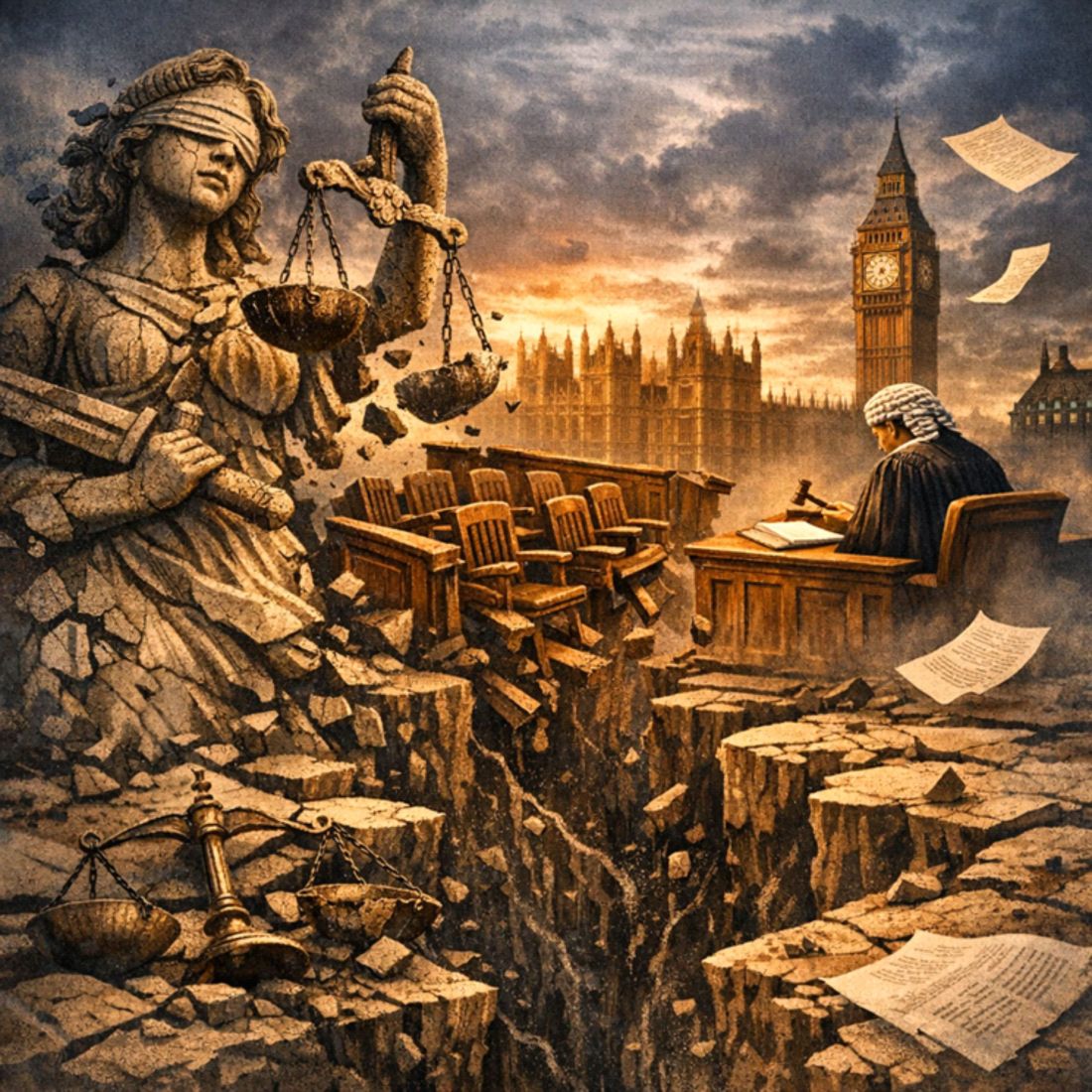
The Dismantling of Trial by Jury – And Why It Matters to Everyone

For centuries, trial by jury has been one of the defining features of British justice – a democratic safeguard that ensured no individual could be deprived of liberty without the judgement of ordinary citizens. It has been the remaining beacon of legitimacy in a system increasingly strained by political interference, regulatory overreach, and a culture of legal interpretation that often feels detached from the lived realities of the people it serves.

Yet today, that safeguard is being quietly dismantled. The government’s move to remove jury trials for offences that can still lead to imprisonment is being presented as a practical response to delays and backlogs.

But the implications reach far deeper than administrative efficiency. This is not a minor procedural reform. It is a fundamental shift in the relationship between the public and the state.

The Law Exists by Consent – Not Command

Politicians often forget that the law is not a one‑way instrument. It is a social contract. It functions because the public accepts its legitimacy and agrees to be bound by its outcomes. When the state begins to remove the mechanisms that ensure fairness, independence, and public participation, that consent begins to erode.

Jury trials have long been the clearest expression of that consent. They ensure that justice is not simply something done to people, but something done with them.

Why Barristers Themselves Are Sounding the Alarm

Some of the strongest voices opposing these changes come not from activists or commentators, but from barristers – the very people who work within the system every day. Their warnings are not ideological. They are practical, grounded, and deeply informed.

They argue, rightly, that judges are legal specialists, not life specialists. They are experts in statute, precedent, and procedure – but not in the full spectrum of human experience, nuance, and context that shapes real‑world events. And crucially, judges are not immune to the pressures of their environment.

They speak openly about issue fatigue: the psychological narrowing that comes from hearing similar‑looking cases day after day. What appears repetitive to a judge may in fact be profoundly different for the individuals involved. Every person is different. Every case is different. No two experiences are the same. A jury, drawn from a cross‑section of society, is far better placed to recognise that diversity of experience.

The Myth of Judicial Objectivity

We like to imagine that judges operate in a vacuum of perfect neutrality. But recent years have shown that judicial decisions can be influenced – consciously or not – by political climates, public pressure, institutional expectations, and personal beliefs. Judges are human. They are shaped by the same cultural forces as the rest of us.

A jury, by contrast, dilutes individual bias. It brings together twelve people who have not been steeped in the same professional culture, who have not spent decades seeing humanity through the narrow lens of criminal litigation, and who are far less likely to be influenced by the priorities of the government of the day.

Efficiency as a Trojan Horse

The official justification for removing juries is the need to speed up the justice system. But efficiency is a dangerously convenient excuse.

Once the principle is broken – once the state can imprison people without the involvement of their peers – the scope of cases affected can expand with alarming ease.

History shows that rights rarely disappear in one dramatic moment. They erode through small, “practical” adjustments that seem harmless until the cumulative effect becomes impossible to ignore.

A System at Risk of Arbitrary Justice

If the law were as clear, consistent, and responsive as it should be, perhaps the removal of juries would be less alarming. But we are not in that place. We are in a moment where interpretation often trumps principle, where political expediency shapes legal outcomes, and where public trust in institutions is already fragile.

Removing juries in this context risks creating a system where convictions are shaped not by moral or ethical correctness, but by what is convenient or beneficial to those in power. That is not justice. It is administration masquerading as fairness.

The Disguised Destruction of a Foundational Right

Trial by jury is not an outdated relic. It is one of the fundamental tenets that made Britain a place where ordinary people could trust that the state would not act arbitrarily.

 It is a democratic guardrail, a cultural inheritance, and a practical mechanism for ensuring that justice reflects the society it serves.

To remove it – and to do so under the guise of practicality – is not reform. It is destruction dressed up as efficiency.

And once gone, it will not easily return.

Britain Must Defend Free Expression – Even When It’s Uncomfortable

One of the most difficult conversations in Britain today is not about any single community, but about the way cultural sensitivities, political incentives, and legislative overreach are beginning to reshape the foundations of our democracy.

The government’s latest attempt to define and legislate a new standard for “Islamophobia” has triggered widespread concern – not because people wish to discriminate, but because the proposed framework risks criminalising legitimate criticism, debate, and scrutiny.

These are not fringe anxieties; they are the concerns of citizens who recognise that free expression is the bedrock of a free society.

For years, parts of the establishment have been gripped by the belief that offence itself is a form of harm that must be eradicated. This obsession with policing emotional discomfort – as if the state can or should guarantee that no one ever feels offended – helps no one. Least of all the people such rules are supposedly designed to protect.

When governments attempt to legislate feelings, they inevitably drift toward policing thought. That is not equality; it is conditioning.

The deeper issue is democratic, not cultural. Laws in a free society must be universal.

When legislation is crafted around specific identity groups rather than principles that apply to all citizens equally, it creates a hierarchy of rights. It sets a precedent that future governments can exploit for other groups, interests, or political gains. Once the law becomes a tool for managing identity rather than protecting liberty, the entire constitutional balance begins to tilt.

The term “Islamophobia” itself illustrates the problem. It is contested, imprecise, and often conflates hatred of individuals with criticism of ideas, doctrines, or political movements. As John Cleese has argued, the term can be used to make reasonable scepticism appear irrational or malicious. A society that cannot distinguish between criticism of ideas and hatred of people is a society that has lost its grip on free thought.

This is not a new pattern. Progressivism, when stripped of practicality, has produced many casualties over the years. The slow erosion of cultural confidence, national identity, and shared values has not happened by accident. Whether through distraction, incompetence, or ideological zeal, much of the political class has allowed – or even encouraged – the dismantling of the norms that once held the country together.

Increasingly, it appears that some politicians are willing to reshape the country not out of principle, but to secure reliable voting blocs. This is not leadership; it is self‑preservation at the public’s expense.

When political incentives reward identity‑based policymaking, the result is legislation that prioritises electoral arithmetic over social cohesion.

The irony is stark. Those who have long championed equal rights now risk enabling systems of behaviour or belief that are fundamentally at odds with the rights they once fought for – particularly the rights of women and girls. A society cannot defend equality while simultaneously shielding any set of ideas from scrutiny.

The real danger is not cultural takeover; it is institutional mismanagement that fuels polarisation. When people feel they cannot speak openly, they do not become more tolerant – they become more resentful. Suppressing discussion does not prevent extremism; it drives it underground. History shows that societies which restrict open debate always experience a rise in radicalisation, not a decline.

Many people already feel that the political system no longer serves them. They see laws being reshaped, language being policed, and public debate being narrowed. They sense that the rules are being rewritten without their consent.

In the absence of leaders who speak honestly and responsibly, people will inevitably turn to voices on the extremes. Today that may manifest as a protest vote. Tomorrow it may take forms that are far more destabilising.

Our political class has been creating this environment for decades. The difference now is that the consequences of their decisions are becoming impossible to ignore.

When politicians prioritise their own interests over the interests of the country, they erode trust, fuel division, and invite reactions they cannot control.

Britain does not need less debate – it needs more. It needs leaders who can hold two truths at once: that minority communities deserve protection from discrimination, and that free expression must remain non‑negotiable. That cultural diversity can be respected, and national values can be defended. That equality means equal rights for all, not special protections for some.

The challenge before us is not to silence difficult conversations, but to have them openly, honestly, and without fear. A democracy that cannot tolerate scrutiny is not a democracy that can endure.