
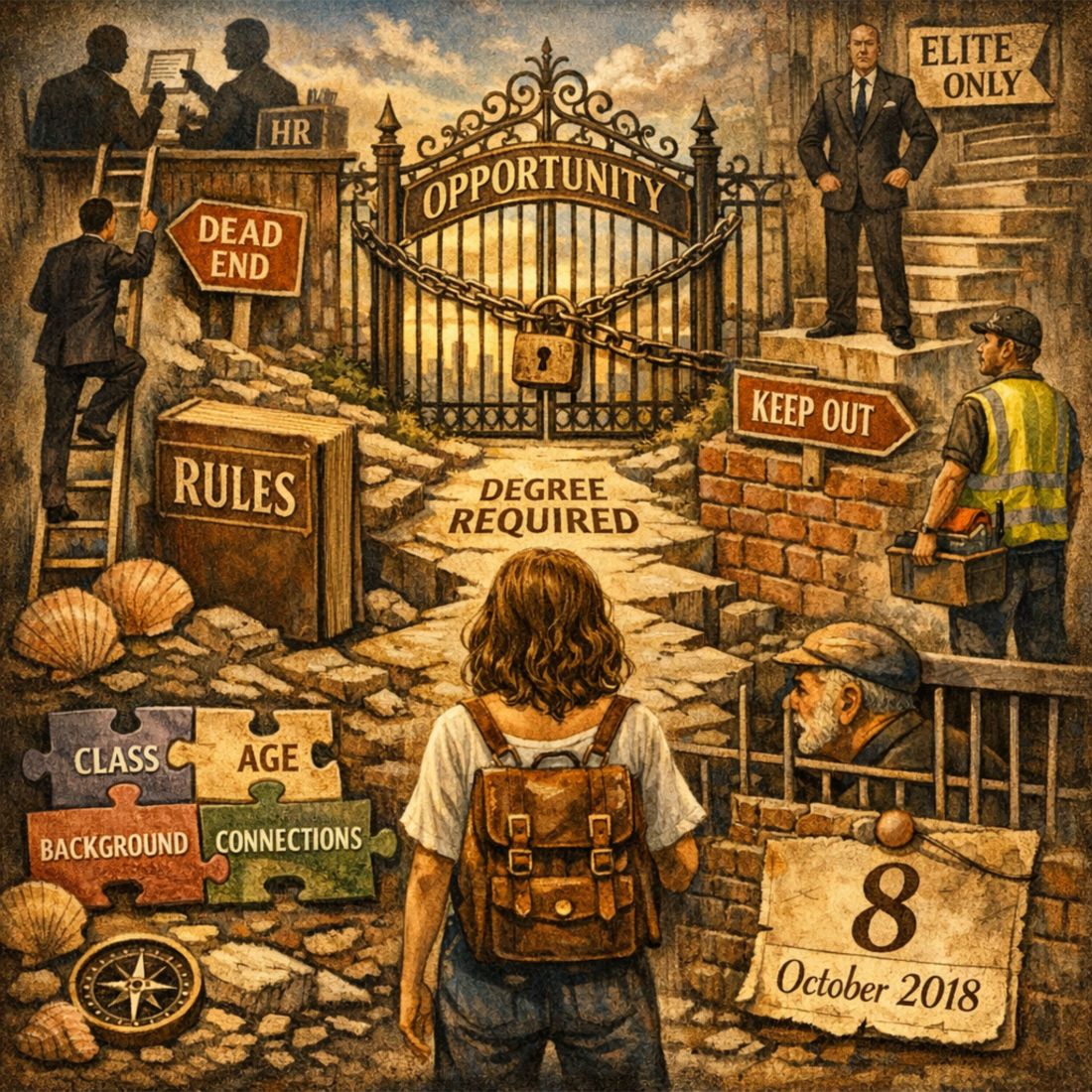
The three key misunderstandings and fallacious barriers to Social Mobility are:
- That Social Mobility issues only affect young people who are in their career development years
- That the only way to improve Social Mobility is through ensuring that everyone achieves a ‘full’ academic education and that the attainment of degrees is key
- That Social Mobility issues relate to the achievement, progress or outlook of the individual and nobody else
With one evolution of the Social Mobility Commission having resigned because of lack of Government support and another now appointed in the image of all the same Establishment ideas, the key issues underpinning lack of progress in tackling the barriers to Social Mobility are still being overlooked and this travesty is set to continue further still.
As is often the case when a cause is given a label, the Social Mobility problem is an issue which has become closely aligned with just one interpretation of its cause. This closes down debate and dialogue about the much wider range of issues which attribute to reducing opportunities. It also excludes consideration of a wider malaise and certainly overlooks the real impact on not only the individuals affected themselves, but also upon the wider community as a whole.
Yes, many young people are overlooked because of the start they had in life. The place in which they lived. The schools which they did and did not attend. The qualifications which they did or didn’t gain.
But the reality is that it is a very long list of factors which prevent any one person from progressing.
The interpretation of someone’s validity on the road to progress and passing these barriers is not simply restricted to that of employers, educators or any of the external gatekeepers of opportunity.
No. The perception of not being good enough to overcome any barrier to Social Mobility can be that of the individual all on their own.
The obstruction to unhindered Social Mobility, is the many prejudices which are not and cannot be managed by regulation or by the methods of review and reform which have become the cultural norm in this Country.
In a society which has learned to make effect synonymous with cause, we overlook the real causes of societal problems and as such have no way to address the consequential effects.
The social justice warriors, the politically correct, the rights lobby and liberal left all congratulate themselves on the strangle hold of regulation which decades of manipulation and social engineering have helped them impose.
Yet the rules which govern Equality of Opportunity in their purest sense have actually made prejudices easier to employ.
Only now, beyond the scope of the processes which assure us that prejudices have been all but removed, they are less likely to be evidenced and hide in plain sight.
Yes, we have regulation against gender and sex discrimination. Race discrimination. Disabilities discrimination, Religion, Age and sexual orientation too.
But in creating these frameworks or safety notes, the idealistic engineers of this ill-considered social plan have provided the perfect opportunity for people to surrender ethical responsibility to being seen to adhere to the set of rules which now exist. They have been given a set of pillars that once worshipped, allow them to do whatever they want to by behaving in ways which legitimately go around these rules or sit somewhere in the spaces in between.
We now not only have a situation where decision makers can quietly be racist, sexist, or are allowed to quietly indulge any other prejudice we might not collectively like. They can continue to do so unimpeded.
The consequences of this ‘big vision’ engineering project create many other problems too. Problems which include disadvantaging the already disadvantaged and building barriers to progress which the very same people will now never cross.
And guess what. Yes. We find again that achievements exist only for the same few to easily win all over again.
Take for example the assault on the education system that the Blair Government undertook, with the overt aim of giving everyone the opportunity to gain a degree.
The result has been the commercialisation of the further and higher education system, leading to the prioritisation of winning fees, rather than focusing on the quality and commercial durability of the education provided. Running education as a business has almost certainly put its future in serious doubt.
It is a process which has already led hundreds and thousands of hopeful young people to begin professional life in serious debt and with academic qualifications which are to many businesses completely worthless.
Yet the debt-laden graduates only find out too late that these quack qualifications don’t mean much at all to the world around them once they have left the supposed safety of the academic universe behind.
The world of big business and its new world of ‘created roles and specialisms’ has responded to the glorifying of academic qualification over the benefit of time-served experience by recognising degrees as a standard for anybody worth looking at. Not as a way to recognise specialism in itself. But as a like-for-like replacement in recent years for what would previously have been well illustrated by the attainment of 3 A ‘Levels, and only a few years before that just 5 GCSE’s.
Not everyone is cut out to be a CEO, Director or even a manager and non-academic people bring value to business which only when added to the contribution of real academics can it add up to a formula which is so much more.
The dangerous mix created by this non-stop meddling has fuelled the entitlement culture. Qualification has become more valuable than experience and experience is not of value to those who have qualifications.
Letters on a CV are seen as more important than attitude, motivation, or the many other life skills which business used to intrinsically value, which they now overlook. The system now unwittingly leads them to place applications from people who could and should be the next generation of commercial superstars straight in the bin.
It doesn’t stop there, and within a tick box, risk-averse culture where Recruiters and HR Officers – that’s people who have and never will do these jobs themselves – have overwhelming power over recruitment processes, there is an untamed focus on identifying reasons to not even shortlist candidates – usually because they don’t have a degree.
Good people are now denied jobs where they can thrive and the employers and companies themselves never gain access to the wider pool of candidates where the real benefits of selecting people with the right experience rather than just a paper qualification lies.
The consequences of this social meddling are already far reaching indeed and because the UK could never afford to provide education to 21 years as a standard – which in itself was never needed, it was inevitable that a new form of educational discrimination would introduce itself. And it’s the worst one of all. The preclusion from opportunity for even more young people based simply on cost.
Just in this one example of social meddling focusing on education alone, where impractical idealists have tried to impose a system of restrictions based upon no experience that they have or have in no way never known, we can see how far reaching the impact on consequences of quixotic thinking can be.
This is a pattern which is unfolding itself over and over again within all the areas of our lives where lack of consideration has been applied to the consequences of imposing the ‘consideration’ of rights and ‘positive’ discrimination on a society which will always have its own mind and not the one which political busy-bodies wish to create for it.
The barriers to Social Mobility are all about the way that we think.
But the change needed and the tools which will enable us to break down those barriers and make that change will only come when decision makers with the power and therefore the ability to oversee that change go through a voluntary process of accepting that they themselves need to think differently.
That change will come about as a direct result.
That change cannot and never will be imposed.

 Adam Tugwell