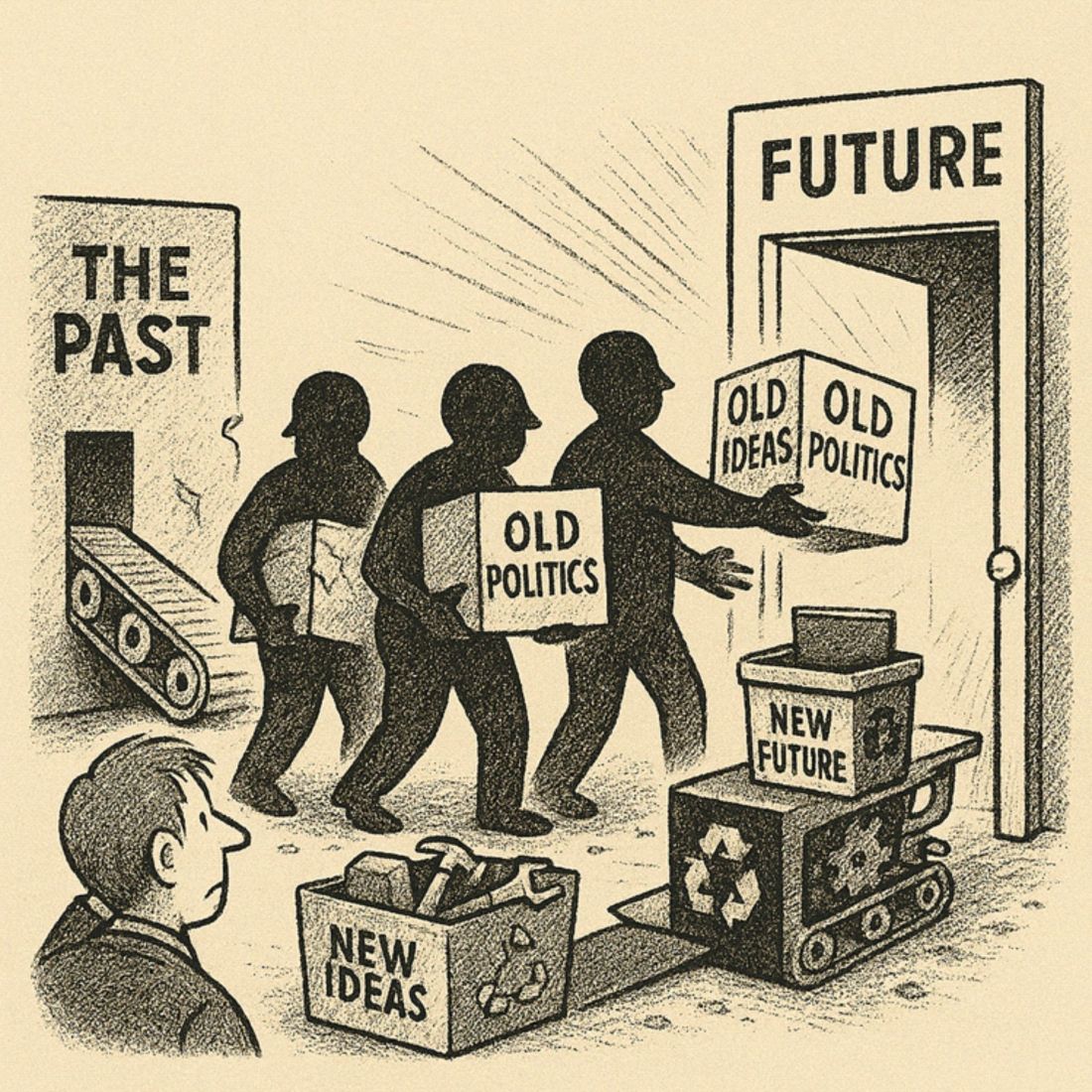
You cannot Build the Future with the Architects of the Past

It’s been quite a week for Reform, and without the current political backdrop, the events unfolding would have probably been enough to suggest that the evolution of the Reform project would grind to a halt – no matter what came next.

Until now, the party – new in name only – has been riding high in the polls, cultivating the appearance of a government‑in‑waiting that could do no wrong. Their greatest advantage has been simple: unlike Labour, the Conservatives or the Liberal Democrats, Reform has not yet been involved in creating the problems that have brought the country to its knees.

For many voters, that alone has been enough. It’s why so many have been willing to overlook the party’s patchy record in local government since taking over a number of councils last May.

But for others, things have never been so straightforward. A growing list of unsettling questions has followed today’s party of Nigel Farage, particularly around its fixation on grand, US‑style DOGE plans and other plans for the future such as parachuting in business‑world advisers to take charge where they already recognise that inexperienced politicians cannot.

These plans may sound impressive to a disillusioned electorate, but – like the words and policies of every government in recent living memory – they tend to obscure reality rather than confront it head on.

The name “Reform” has always been a question in itself. But its evolution is even more important to consider now, given its position on the political right.

Reform was born of the Brexit Party, which was itself born of UKIP (the pre‑2016, EU Referendum version), which itself emerged from the often‑forgotten Anti‑Federalist League.

Many of the same people have moved through each iteration. And while today’s Reform claims to draw support from across the political spectrum, its origins lie firmly in the fissures of the Conservative Party. Cracks visible since the time of Heath, that widened after Thatcher’s departure and during Major’s distinctly Eu-phile premiership.

What began as an anti‑EU movement became a home for many disenfranchised Conservatives – including Farage himself. However, beyond the anti‑EU narrative that he and others have pushed so effectively, he has never shown much inclination to challenge how the system itself works when you get into the mechanics of how everything really functions and who it all serves.

Those who have watched closely – the language, the policies, the motivations, the hands being shaken – could always see that “Reform” risked being a deeply misleading name.

Instead of providing inspiration and genuine reason for hope, each new development has instead reinforced the fear that this movement is less about genuine reform and more about resetting the same establishment machinery under a different banner – essentially being about preserving everything in our system of economics and governance that is fundamentally wrong and doing the most harm.

So, when Laila Cunningham was announced as the London mayoral candidate a few days ago, there appeared to be good reason to wonder whether this might finally be the moment that everything changed – and be a sign that Reform could still recalibrate and chart a different course. But within days, the party took a massive and arguably defining leap backwards, confirming once again that the instincts I had for a moment hoped were misplaced were, regrettably, right all along.

Nadhim Zahawi’s defection from the Conservatives – bringing with him a pile of political baggage symbolising everything wrong with not just the Tories but the entire political class – was the moment any germinating bubble burst.

The shift in messaging across the media landscape was also immediate. And anyone at Reform HQ would have done well to heed the sudden change in tone emerging from sources that had previously been supportive that sat outside the echo chamber of dedicated ‘reformists’ who still believe that Farage’s machine is capable of doing no wrong.

Then came Robert Jenrick. His “sacking” and expulsion from the Conservatives morphed into a full Reform defection in under six hours yesterday.

Like Zahawi, Jenrick was deeply embedded in everything the Johnson and Sunak governments were about. And the circumstances and emerging detail of his departure suggest a politician looking backwards to more of where we have already been; not forwards, as few outside politics really doubt will need to be the direction of travel – built on a definable break with and departure from the past.

Reform now faces a critical question: with its growing (re)alignment to establishment figures and money‑centric politics, is it just becoming a reformed version of the very party that it was ostensibly re-formed to replace?

The identity crisis within conservatism and the political right that has existed since the days of the Common Market – now seems to be reappearing within Reform. And with each defection eagerly embraced by Farage, and in ways that suggest they were always part of the very same machine, just with different interpretations of how it should work, the chance of a genuinely different future emerging from the right appears to be quickly slipping away.

In the end, it all comes back to the same unavoidable truth:

You cannot build the future with the architects of the past.

Reform’s recruitment strategy signals a retreat into old habits, and their words and policies suggest they will either fall into line with the current establishment trajectory or simply trash whatever remains after Labour has finished with it – IF they take power after the General Election takes place – as many people desperate for change still hope they will do.

Regrettably, those tired and bewildered people who believe they are the answer may not see it or wish to accept it, but Reform, Reconservatives, Reformatives, ReCons, Conservatives 2.0, or whatever they really are in their current form isn’t what the UK or anyone genuinely need.

There is nothing about them that suggests that they are willing, able or indeed ready to deliver on behalf of us all.

Boldness and clarity are essential for building a better future. Not a thickening cloud of uncertainty, pinned by figures from the past that people looking forward know it would be much healthier to leave behind.

Yes, Reform are looking good. But the Tories could out reform Reform, IF they can remember what being conservative really is

Reform’s performance in the Local and Helsby and Runcorn by Elections really does look good.

Anyone looking on can immediately see why so many of the political pundits and members of the opinionati are now backing Reform for a similarly groundbreaking General Election result in 2029.

The uncomfortable truth that many supporters will fail to recognise is the only reason that Reform could achieve a seismic turnaround of the kind that would instantaneously drop Nigel Farage into No.10, would be that when compared to all the others, Reform could still be the only real unknown quantity, and therefore different enough to hoover up the majority of a very fatigued Electorates votes.

Unfortunately for the Electorate, without a significant change in their direction, voting Reform into power at the next General Election would once again be voting without due regard for the Law of Unintended Consequences. Just as it was last July when those who did vote put Labour into Government.

Nonetheless, it could and may well happen.

The real depth and direction of Reform are being hidden by Britain’s Political Perfect Storm

It won’t matter what problems the new Reform Administrations in Local Government create, being directed from Reform HQ, as if everything must now be run and controlled from the very top.

The unavoidable disintegration of the UK public sector that is already well underway will almost certainly hide whatever Reform Councils do from public scrutiny and view.

Because Labour, the Tories and Lib Dem Councils are going to struggle in this climate either not to go bankrupt or find other ways to avoid royally stuffing things up.

Reform aren’t reforming anything other than the public discourse over the issues that the majority of people can see and associate with the effects of the problems that are effecting society.

No matter how far detached those perspectives might be focused from the real cause.

Farage’s approach might at best be viewed as becoming increasingly aligned with the establishment and the global thinking that sits behind so many of the problems and the direction of travel that even this Labour government has.

The irony of this should not be lost, that whilst the parts of the political right that are falling in behind Reform either believe Brexit didn’t happen or that under a Reform government Brexiteers will get to finish the job, the reality is that everything that drove the EU project that Farage’s UKIP and Brexit Party so vocally championed against, also had globalism and the centralised global political model at its heart.

Once it becomes clear that a UK version of the Trumpian DOGE (Department of Government Efficiency) has no basis within the realities that underpin how our current dysfunctional public sector works, there may well be a moment when those Reformers with elected roles, who are taking their responsibilities to local electors seriously, will realise that there are many things that can still be done. Whilst there are many others that simply cannot.

At some point, the rather large penny must drop, that there is a very careful and considered game to be played that without otherwise torching the entire system and structure of government delivery and bringing it all to a halt, will require the buy-in of key Government officers, nonetheless.

To those watching closely, Farage has already shown his hand.

Whilst it might not be prudent to visit the bookies and begin trying to get odds just yet, as far as the next General Election goes, whenever that actually will be, the perfect storm that has engulfed British politics may well deliver a Reform win.

But it will be the U.K. and our people, rather than whatever is left of the political opposition, that will lose in that Election if Reform have ‘won’ under their current modus operandi and plans.

A Zero-Sum Game?

A rather interesting perspective of the seemingly unassailable position that Reform now has, is that as far as the future goes for the Tories, they currently face a zero-sum game. One that applies whether they capitulate to Reform or carry on as they have done before. As they clearly are continuing to do so, now.

Yes, there remains truth in the suggestion that Reform might never govern without the cooperation or collaboration of today’s Tories in some way.

However, Farage is unlikely to ever accept anything less than remaining in control. And as head of any collaboration and apparent PM in waiting, the real difficulties will begin for us all just as soon as the leadership has a lucid post-victory moment. Probably not unlike like Starmer et al did on the 5th of July last year, when those who had arrived in No.10 realised that unless they were big enough to risk precipitating an immediate collapse of the entire system, pretty much everything would still need to go on as before, and that even though they were in government, they themselves would be required simply to do as they are told.

Picture it now; a coalition that includes what is left of the Conservative Party, all subservient to a government of the kind that will almost certainly be filled with very angry activists. Ideologues who will have been promised much from outside of power, who took it all at face value; all without any of the understanding of how government really works. People who will quickly be looking for someone else to blame.

Now may be the Tories only available Watershed Moment

To say that the choice the Tories have sits between change immediately or die, might sound extreme. But it is a genuine reflection on where the future of this once revered political machine now lies.

The way the Tories would now out reform Reform, would be to reject and distance themselves from the establishment, globalist and accepted positions on just about everything. And not just say, but put everything about the UK and our people, first.

The choice to change cannot mean anything other than putting people and our communities back at the very heart of everything they do.

The Conservatives must return to the basic principles of conservatism and remember what it is to lead and deliver for others, selflessly, and with the key motivation to conserve.

The caveat would be that the Conservatives will also be required to restore and return a model of U.K. governance and related infrastructure to us that can recapture the sense of cultural belonging and shared feeling that our system is fair, balanced and just.

The point being missed across all of British politics today, is that by engaging the public correctly and re enfranchising people and communities appropriately and restoring real trust, people would quickly focus on a very different model of political engagement.

They would not need the myths, false promises and clever narratives to explain away the pain that disenfranchisement has caused for so many before.

Can the Tories actually change, rather than just talk it up?

Whilst being able to stand up and say ‘We have for too long got this all wrong’ is a very important part of getting any credibility back, it will be the actions of Today’s Conservative Party that count.

The rump of what’s left of the Conservative Party must stop pretending that with the level of uncertainty in the world as we have now, they actually have 4 years to try out and give wasted chances to new leaders who still believe that all the Tories need do to remain relevant, is wait until the political merry-go-round does its thing and it’s ‘their turn’ to return to power, once again.

No politician who is a genuine public servant has time to waste. And as it would be correct to say to any would-be political leaders who are ready and willing to do the right thing by the people who put them there, the time to change and begin working as they always should have, is now.