
A documented case study in paradigm entanglement, cognitive implosion, and the limits of voluntary change
People often say they want a different kind of society. They talk about fairness, stability, community, contribution, sustainability, or simply “a better way of living.” But when you ask someone to imagine what that different world might look like in practice, something revealing happens.
Even when the intention is clear, and even when the request is explicit, the mind quietly pulls the new world back into the shape of the old one.
This isn’t a philosophical observation. It’s something that can be demonstrated.
Recently, I attempted to describe an ordinary moment in a system based on different assumptions. This was not a test or an experiment. It was simply an effort to create understanding – an attempt to illustrate everyday life in a paradigm not organised around money, hierarchy, productivity, or status.
I’ll refer to this as The Description Attempt.
Nothing dramatic. Nothing utopian. Just a normal moment.
But the attempt itself revealed the core difficulty of imagining alternatives – and why voluntary paradigm shift is rare.
What “Paradigm” Means Here
When people hear the word paradigm, they often assume it refers to beliefs, opinions, or ways of thinking held by individuals.
That isn’t what’s being described here.
A paradigm, in this context, is the entire environment a society operates within:
its economic system, governance structures, money, incentives, social norms, and the unspoken definitions of what is considered normal, realistic, responsible, credible, or safe.
It’s not just how people think – it’s what thinking happens inside.
Another way to understand it is as a stage.
We are born onto a stage where the set, the lighting, the rules of movement, and the available roles are already in place. We learn our lines and cues by watching others long before we realise there is a stage at all. Within that setting, some actions feel natural and others feel absurd – not because they inherently are, but because they do or don’t fit the stage we’re standing on.
This matters because when people try to imagine alternatives, it isn’t only their thinking that stays the same.
The stage stays the same too.
The Description Attempt
The suggestion was straightforward:
Create a story to describe an ordinary moment in a system where people are not motivated by money, status, hierarchy, or productivity – a world where the underlying logic is different.
I began writing.
And immediately, without intending to, I slipped into the language and assumptions of the world we live in today.
Phrases appeared automatically:
“new arrival”
“settling in”
“being welcomed”
“steady work”
“the system has been slow this week”
“we’ve been keeping things running”
“we’ll show you around”
“you’ll get used to it”
None of these were chosen deliberately.
They weren’t argued for.
They weren’t defended.
They simply surfaced – because they are the vocabulary of the current paradigm.
And the moment they appeared, the imagined world collapsed back into the familiar one.
The Pattern of Correction
Each time this happened, the response was clear:
“That’s the current paradigm. You’re importing assumptions that don’t apply here.”
So I adjusted the scene.
And then slipped again.
Adjusted it. Slipped again.
Adjusted it. Slipped again.
This wasn’t a misunderstanding of the task. It wasn’t a lack of imagination. It wasn’t inattentiveness.
It was something deeper:
The mind defaults to the logic – and the stage – it knows, even when explicitly asked not to.
This is the phenomenon at the heart of why new paradigms collapse under old assumptions.
The Implosion Mechanism – The “Red Matter” Effect
When old‑paradigm thinking is applied to a new‑paradigm system, the result is not friction or confusion.
It is implosion.
The new system collapses instantly – not because it is flawed, but because the old logic is incompatible with it.
It’s the cognitive equivalent of red matter in Star Trek:
The moment it touches the new environment, it collapses into a singularity and pulls everything back into the old gravitational centre.
This is what happens when a new script is forced to play out on an unchanged stage.
The scenery doesn’t adapt.
The lighting doesn’t shift.
The rules of movement don’t change.
Instead, the unfamiliar action is interpreted through the existing set – and judged as unrealistic, incoherent, or impossible. The collapse feels like a failure of the idea, when in fact it’s a failure of compatibility between the performance and the stage it’s being performed on.
The implosion isn’t an argument being lost.
It’s an environment asserting itself.
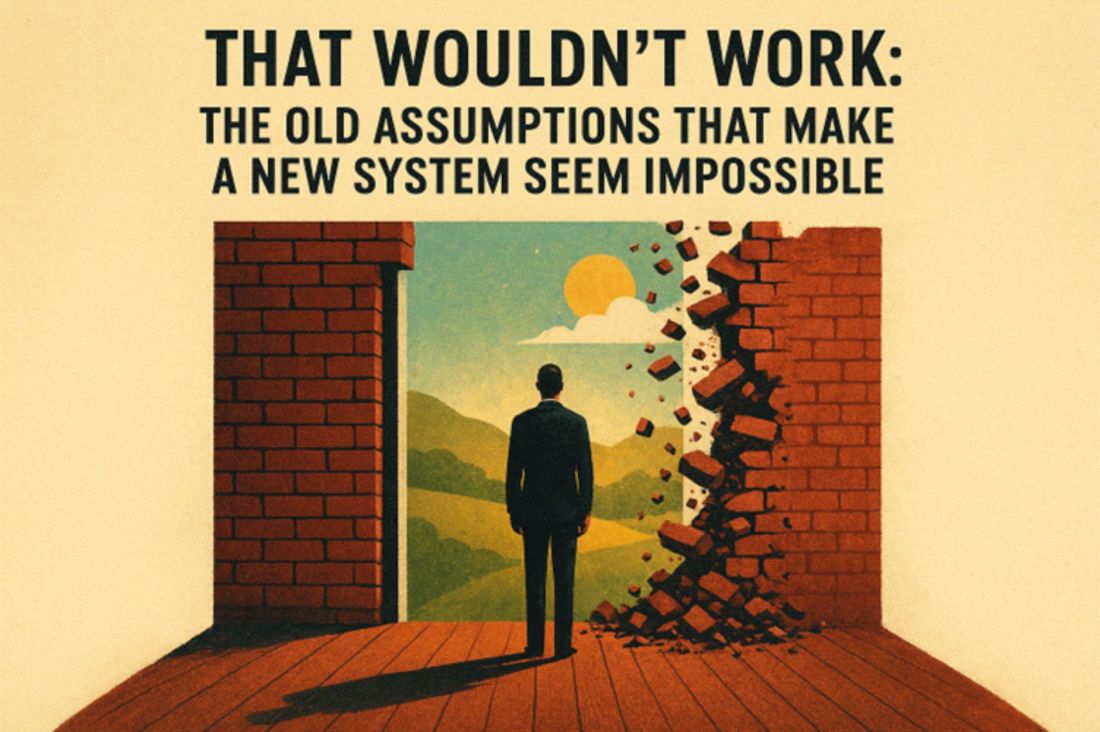
“That Wouldn’t Work”
This is why people say:
“This way of doing things cannot work.”
“People won’t behave like that.”
“That’s unrealistic.”
“That’s idealistic.”
“That’s naïve.”
“That’s not how the world works.”
These aren’t assessments of the new system.
They are symptoms of paradigm contamination.
The thinker has unknowingly reintroduced the assumptions of the old world – and then judged the new world by the standards of the old.
This is the implosion.
Why the Old Paradigm Reasserts Itself
When you’ve grown up inside the system as we know it today, you internalise:
its motivations
its fears
its incentives
its hierarchies
its definitions of value
its sense of what is “normal”
its sense of what is “realistic”
its sense of what is “responsible”
its sense of what is “credible”
its sense of what is “safe”
These become the mental tools you use to interpret everything – including alternatives.
And this is where the gravitational pull becomes visible. Because when you try to imagine a world that does not use the assumptions you have been conditioned to have, the old logic quietly reasserts itself – not through dramatic errors, but through small, ordinary phrases that carry the entire weight of the current paradigm.
This is exactly what surfaced in The Description Attempt.
The Pull‑Throughs – How Old Logic Sneaks Back In
The slips were subtle, but each one revealed a specific assumption from the current paradigm being smuggled into the new one.
“Steady work”
This phrase assumes stability comes from income. In a people‑centric system, stability comes from the Basic Living Standard – not employment.
“The system is slow this week”
This is the language of throughput and financial performance. In a people‑centric system, “slow” has no meaning – needs are met, and activity is not measured against revenue expectations.
“There’s a new person here”
In today’s paradigm, difference is treated as potential disruption. In a people‑centric system, a new person strengthens the local system rather than destabilising it.
“You’ll get used to it”
This reflects a world where people adapt to discomfort because they have no choice. In a sovereignty‑based system, contribution is chosen – not endured.
These slips were not mistakes.
They were evidence of how deeply the old paradigm shapes our imagination.
What the New Paradigm Actually Looks Like
Once you see how easily the old paradigm slips back into your thinking, the next question is obvious:
So what does the new paradigm actually look like when you stop dragging the old one through?
The best way to answer that is through examples – real, everyday situations that reveal the lived logic of a people‑centric system.
Basic Living Standard
Example: Someone loses their job
Old‑paradigm interpretation
Losing your job is a crisis. It triggers panic, fear, shame, urgency, identity collapse, and anxiety about survival.
New‑paradigm interpretation
Nothing catastrophic happens. Their basic needs are still met. They have time, space, and support to choose their next contribution.
The shift
Security comes from the system, not employment. People make decisions from stability, not fear.
Contribution Culture
Example: A community garden needs maintenance
Old‑paradigm interpretation
“Whose job is this?” “Who’s being paid?” “Why should I do it?”
New‑paradigm interpretation
People step in because contribution is normal. Work is shared, not imposed. Meaning is in the doing, not the reward.
The shift
Work becomes participation, not extraction.
Social Learning
Example: A young person wants to learn how to grow food or understand local governance
Old‑paradigm interpretation
Learning is a commodity: courses, fees, qualifications, certificates, gatekeeping.
New‑paradigm interpretation
They learn from an elder – one‑to‑one or in a small group. Knowledge is passed through relationship, experience, conversation, and shared time.
The shift
Learning becomes relational, not transactional.
The Meta‑Cognitive Barrier – Awareness Beyond Mindfulness
This phenomenon cannot be avoided through mindfulness, introspection, emotional intelligence, or critical thinking.
Those practices operate within the paradigm.
What is required is something rarer:
metaparadigmatic awareness – the ability to see the assumptions behind your assumptions, and the stage beneath your thinking.
Most people never reach this level because the current paradigm is invisible to them. They mistake its logic for human nature, its incentives for common sense, its fears for prudence, and its discomfort for danger.
Without this awareness, people cannot help but drag the old logic into the new system – and then conclude that the new system is impossible.
The Emotional Layer – How We Expect to Be Seen
There is another dimension that surfaced during The Description Attempt.
When imagining a different kind of system, people often picture how it would appear from the outside:
Will this look naïve?
Will it seem unrealistic?
Will people think it’s a commune?
Will it be judged as inefficient?
Will it be seen as low‑status?
Will it be taken seriously?
These questions are not about the new system.
They are about remaining legible within the old one.
When “This Sounds Ridiculous” Appears
At some point, a particular reaction often surfaces:
This sounds unrealistic.
This feels naïve.
This can’t be how people really behave.
That reaction isn’t a judgement on the new paradigm.
It’s what happens when an idea doesn’t fit the stage it’s being imagined on.
Ridicule and dismissal are not neutral responses. They are protective reflexes – ways the existing system defends its coherence when something appears that doesn’t yet have a place to stand.
Seen this way, the sense that an alternative is “ridiculous” is not evidence against it.
It’s evidence that the stage has not yet changed.
The Core Insight
People don’t struggle to imagine alternatives because alternatives are complex.
They struggle because they keep dragging the old paradigm into the new one.
And the moment they do, the new system becomes distorted, contradictory, unworkable, uncomfortable – not because it is flawed, but because it is being evaluated by assumptions that don’t belong to it.
This is the paradox:
People want change because the current system is broken – but they want to take the things that broke it into whatever comes next.
Equal Value, Different Experience
Some people recognise the new paradigm earlier than others – not because they are more capable or insightful, but because their experiences place them at a different angle to the same system.
This is not superiority.
It is not advancement.
It is timing.
The Pain Threshold – Why Most People Cannot Shift Voluntarily
For most people, the shift to a new paradigm is not blocked by intelligence or imagination.
It is blocked by the structure of the current system, which still provides identity, predictability, meaning, reward, legitimacy, and safety.
People move when the old system stops working – not because they lacked insight, but because necessity loosens the stage beneath their feet.
Conclusion
The Description Attempt was never meant to expose anything.
It was simply an effort to describe an ordinary moment in a different paradigm.
But the difficulty of doing so revealed something fundamental:
When people try to imagine a world built on different assumptions, they instinctively reintroduce the logic of the world they already know.
And the moment they do, the new world collapses back into the old one.
This is not a failure of imagination.
It is the gravitational pull of a stage that has shaped what people think is possible.
Understanding does not usually come first.
It follows experience.
And when the hold of the old stage finally ends, the space for a different performance opens.
 Adam Tugwell