
Without realising that we even do so, it is quite normal for us to look upon any situation and even the content of a conversation in terms of how its content affects us personally at some level.
Fear permeates the decisions that people make at the deepest levels and whilst this can easily prove to be a self-destructive trait, it can also lead to arguably selfish acts in the extreme, when considering the impact and consequences these decisions can have upon others.
Most of us grew up conditioned to think this way and unaware of the processes at work. It is therefore possible to become quite blasé about the way we talk about issues which may not seem to affect us directly, but nonetheless have the effect of pushing a deeply concealed emotional ‘button’ that twangs our personalities just the same once pressed.
Death is one such issue and one that provokes all kinds of responses from people. Probably because of the many unknowns that surround it and the very definite nature of its existence for us as part of our human experience.
When I suffered the acute stages of a serious illness that nearly killed me at 28, I was forced to look my own mortality in the eye. In doing so, I became aware of how self-focused and personal the issues surrounding death can be for partners, relatives and friends who are not going through the experience physically themselves.
My own experience provided invaluable insight and understanding when dealing with the terminal illness and decline of my father, whom I hope may have been at some advantage by having such nearby support.
Sadly, others forced to deal with their own mortality and the many conditions that facilitate terminal decline do not receive that same level of understanding and selflessness that they need from us all and it seems incredible that rules are made for the dying by a majority who have never or may never have experienced what it could be like to be terminally ill, when their perspective on mortality may be dramatically different from what it may be right now.
Our inherent fear of death and the lack of control that we have over it does mean that for many the issue of Assisted Suicide or Right to Die is undoubtedly a personal one. Rather than it being a matter of ethics as many in the world would prefer us to believe.
Very few people are likely to covet death at any time; even those who commit suicide without any form of premeditated suggestion that they are readying themselves to do so.
Suicide is itself a matter of escape and release at a very personal level. It is unlikely that any other person will ever understand the complexity of issues, emotions and pain that any suicidal person is experiencing at that time – no matter how learned they are or how well they have been trained.
It is the same for those contemplating the need for Assisted Suicide or their Right to Die.
As a society, we now not only need to recognise this; we must put personal feelings and perceptions aside and provide help to those who have reasoned and concluded that it would be better for them to be assisted to end their life, without any threat of recourse or stigma being attached to those who have provided or would willingly facilitate that help.
Our fear of Legalising Assisted Suicide and the taboo of the subject are borne from the concern that through illness or debilitation, we could find ourselves or loved-ones unable to communicate with or have influence with the outside world as we now know it. That subsequently, the decision will be made to end our own or their life in that situation whether we consent to it or not.
Such perceptions have been helped little by interpretations of Health Authority Policies such as The Liverpool Pathway. But this should not prevent us from dealing with the subject as we should. If anything, this is the strongest evidence that everything possible must now be done to get this difficult subject addressed in the right way for everyone – and not least of all those who it really concerns.
With input from the Medical Profession, the Government could easily legislate to put the necessary stop-guards in place that would provide the best assurances possible against abuses of a Right to Die.
This could include processes such as a perquisite consultation with 3 independent Doctors and/or Psychologists. Professionals who are likely to know quickly, if an Assisted Death is the right solution if they are able to selflessly put the interests of the patient in question first without any other influences coming in to play.
There is no doubt that those suffering with horrific and terrifying conditions such as Locked-in Syndrome or those who have such low quality of life because of their physical conditions or deterioration should have the right to end their lives, with help, if they so choose.
We must all now be big enough to put our own fears aside and make it as easy as it can be for them to do so.
Without Legalising the Right to Die, it is an uncomfortable truth that in terms of our approach to ease of suffering, we are selfishly kinder to our animals than we are to other human beings.
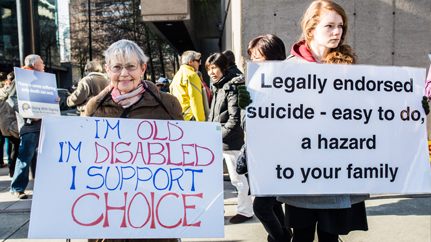
image thanks to http://www.sunnewsnetwork.ca
 Adam Tugwell