The Basic Living Standard: Not a Fix for a Collapsing Money-Centric System, but the People-Centric Foundation of a New One

Although initially overlooked after I first introduced it in my book Levelling Level, published on Amazon on 31 March 2022, the Basic Living Standard (BLS) has increasingly attracted interest from readers and visitors to my blog.

However, I have noticed that when people search for BLS using AI, a whole chain of stories and information—often including quotes attributed to me—has emerged, much of which is either out of context or entirely fabricated.

This is concerning, especially when those outside the mainstream are trying to share solutions and perspectives that challenge the compliance and blindness of today’s system.

We must recognise that the so-called AI takeover is being built on delivery levels that, in many cases, are no better than the efforts of a lazy teenager responding to an encouraging parent. And the outright creation of false information and narratives—even regarding work from independent voices—is troubling.

Given that AI now tells those seeking a quick overview that the Basic Living Standard is a way to fix our broken economic system, I feel it is time to clarify: while I believe BLS is a pivotal solution, it cannot and will not work within the current economic paradigm.

The integral priority of BLS is to put people, not money, first.

The Basic Living Standard: Not Intended for the Current Economic System

I have never created or published financial models or projections to ‘cost’ or predict the impact of BLS on the current economy or financial system, because the two are mutually exclusive.

BLS was not designed to be part of, or to work within, the existing paradigm, which makes it impossible to do so.

Decision-makers, legislators, and their influencers will not openly admit that our system is structured against equity and equality.

It is only because the system works progressively against these values that the disproportionate levels of wealth and benefits enjoyed by those in power can exist as they do.

Paying Lip Service to Parity

While the National Minimum Wage should be the benchmark or minimum earnings floor necessary for financial independence, the reality is that no person can be financially independent or live free of benefits, charity, or debt on this wage when working a typical 40-hour full-time week.

The current economic and financial system survives because the National Minimum Wage does not reflect the genuine cost of living for the lowest paid, who must then be subsidised by government benefits, seek help from charities such as food banks, or go into debt to meet the growing cost of living.

The FIAT, Neoliberal, Global-Driven Money System: The Perfect Crime?

A hard truth about our broken and collapsing system is that its design centres on wealth transfer and impoverishment, relying on the ongoing creation and addition of new money to the economy.

Currency debasement devalues the worth and ownership of the masses, while creating additional wealth for the elites and enabling them to secure property, public infrastructure, and ownership of everything devalued by their actions.

System Collapse and the Choice We Must Make

The finite lifetime of what may one day be considered one of the greatest ongoing crimes against humanity is fast approaching its end.

How the masses respond to financial and systemic collapse will dictate whether the Basic Living Standard, or a similar benchmark, forms the basis of a new people-centric economic and governance system.

This new system would put people back at the heart of everything, rather than the money-centric focus we have now.

The current system is collapsing because it is fundamentally corrupt and wrong.

Introducing a system like BLS within the current system—even under the name National Minimum Wage—could not achieve its true purpose, because implementing it honestly would speed up, if not immediately collapse the current money-centric system – and that’s why nobody in power today who benefits from this system will ever agree or willingly help for it to be done.

Embracing the Shift: Making Life About People, Not Money

If we accept and adopt an economy and governance system cantered on People, Community, and Environment, we will naturally move away from financial modelling, projections, profit margins, and all the tools that reinforce money as the only important value in life.

The Basic Living Standard provides a clear focus for the paradigm shift from money-centric beliefs to what everyone needs—not wants—and establishes the basic standard for independent living without dependency.

However, BLS is not a policy that can work in isolation or as an add-on to the current system. It is a fundamental building block of the universal change we must choose and embrace, because we cannot fix what cannot be fixed.

The Basic Living Standard: The Basis of a New Way of Living

By restarting, reestablishing, regenerating, reforming, and replacing our economic and governance systems, the Basic Living Standard becomes the benchmark for guaranteeing that the lowest paid can sustain themselves and be financially independent in return for a standard working week.

It requires all businesses, organisations, and systems within a new framework of economy and governance to realign with ensuring that every person experiences this minimum standard as the foundation of society, business, and culture.

Improving lives today really should be as simple as creating a Minimum Wage and changing everything for those who need help in one day. But changing perceptions is not the same as changing the way everyone thinks.

That is why the introduction of a system that genuinely works for everyone cannot be openly embraced before the pain of collapse and the reality it brings.

Everything we know today exists because of a system built around money as a value set—a flawed belief system we have all been conditioned to accept.

Only when this system fails and excludes people, step by step, do those affected awaken to the reality that something is fundamentally wrong.

Yet those excluded are often viewed by those still inside the system as the ones who are guilty and wrong.

Out of Our Problems, an Opportunity Awaits

The collapse offers a moment when the balance can flip, and those who have been excluded may reach a critical mass that signals to everyone participating in the money game that a better, equitable way exists.

However, ordinary people must see, understand, and accept this en masse.

Whatever happens next will lead to wholesale change—whether we choose it or simply go along with it.

Only by being aware and honest about what we need, rather than what we want, can we take the leap of faith necessary to change everything and contribute to the creation of a new system where people, community, and environment come first.

The Basic Living Standard offers a benchmark for the frameworks and opportunities of a new way of living. Yet, it will remain unknown and inaccessible to those unwilling to step away from the comfort of an unsustainable relationship with the past.

Money, democracy, ownership, business priorities, and practices are just the tip of the iceberg when it comes to the breadth and depth of necessary change.

Everyone must own and be part of the transformation ahead, because the change is about the needs of everyone, not just the wants of a privileged few.

There’s More…

In the coming days, and hopefully as soon as this week, my next book will be published, building on all I have been writing and sharing for over three and a half years.

Evolving directly from Our Local Future, first published in summer 2024, this latest work brings more detail and focus to the mechanics of implementing a new system for economy and governance, while simplifying previous concepts to make them more accessible and relatable.

The Basic Living Standard lies at its heart, and I am confident that we can flip everything to work for People, Community, and Economy, once we see the benefits and share the determination to implement a system and new code for life that truly works with equity and equality for all.

Facing the Economic Collapse: the Real Crisis Behind Money, Wages, and Freedom

Facing Uncomfortable Truths

It is regrettable that most people avoid confronting uncomfortable truths about the crisis we’re in.

Many actively ignore or dismiss what they know deep down to be true, preferring comfort over honesty.

But this habit of hiding from inconvenient realities isn’t new. It’s been passed down for generations. People have often chosen what feels good over what’s obviously right, leading us to our current predicament.

Pretending everything is normal, focusing only on ourselves, and letting others make decisions for us has brought us to the brink of systemic collapse.

The comfortable system we rely on is failing, and we must face this reality.

The Source of the Problem: Money

Many prefer to hear hard truths from trusted figures like academics or politicians, but deep down, we know the truth doesn’t depend on who says it.

It’s time to think, research, and analyse for ourselves.

At the heart of our problems is the money system. We’ve been conditioned to believe money is everything, shaping our choices and values around financial cost, reward, and status.

Yet, the money system itself is artificial. A belief system manipulated by private bankers, big businesses, and the politicians they control.

They change the rules to enrich themselves, transferring wealth and ownership away from ordinary people, all under the guise of normality.

Imminent System Collapse

Politicians obsess over “growth.” But for them, growth means increasing the size of the economy (GDP). Not helping small businesses or working people.

Real productivity has vanished as industries and assets have been sold off to those who profit from the system, while jobs have been outsourced.

GDP figures are misleading, counting money created through private finance and government borrowing multiple times. Politicians have tried to spend their way out of trouble, but even that strategy is failing.

With rising unemployment due to AI and unproductive sectors and a government so possessed by fear that they are regularly changing their minds, lenders are now worried the scam will be exposed.

Desperation has set in, and the government seems set to resort to ever-increasing taxes, hoping to keep the system afloat and their secrets hidden.

The System Enriches the Few

Prices keep rising while wages lag behind, making it harder for most people to keep up.

This isn’t new—it’s how the system was designed.

Once, a single working adult could support a family. But now, financial independence is reserved for the wealthy, while dependence and poverty are imposed on the rest of us.

The Myth of the Minimum Wage

The national minimum wage is misleading. It’s not enough to live on, but rather the lowest acceptable wage set by those in power, regardless of the real cost of living.

However, even the average wage isn’t enough for genuine financial freedom.

Financial Freedom Is the Solution

Almost every social problem can be traced back to the fact that the lowest-paid jobs don’t pay enough for people to live independently.

Admitting this would expose the system’s flaws and those who benefit from it.

The system survives by prioritizing money over people. Every decision made by those in power serves the money system. Not human needs.

Choosing People Over Money

If we want a better world, we must redirect government, business, and our rules to prioritize people, not money or the economy.

Unfortunately, our political leaders hide the truth instead of addressing it, covering up the growing cracks in the system.

Collapse Is Inevitable. But We Have a Choice

Systemic collapse is inevitable. But we can choose what comes next and who benefits.

If we do nothing, things will only get worse.

Those who created this mess believe they can protect themselves with wealth and security, but ordinary people will lose freedom.

The powerful will restrict our freedoms to protect their own interests.

Paradoxically, a collapse could be an opportunity.

If we embrace it, we can build a freer, fairer system for everyone. Something only possible when the current corrupt system is removed.

Technology and Artificial Intelligence Should Only Fill Jobs When No Humans Are Available

The rise of artificial intelligence offers a stark and accessible example of how technology can be misused—driven by profit and control at the expense of people, communities, and the environment.

A difficult truth we must confront is that new technologies—whether in the form of methods, machines, or information—have often been adopted with little regard for the consequences they bring to those displaced by their implementation.

The prioritisation of technology over humanity has not only led to the loss of jobs, businesses, and local economies. It has also ushered in more exploitative and dehumanising working conditions for both adults and children. In many cases, human lives have been treated as expendable, so long as the final product appears perfect and profitable—concealing the harsh realities of its creation.

Technology and innovation themselves are not the enemy. The real threat lies in the motives of those who pursue profit and power, seeking to build a world tailored to their own interests while disregarding the value of others. What could have been a golden age for humanity is instead becoming a moment where humanity’s very existence is at risk.

If we continue to allow technology to be controlled by narrow interests—those who manipulate governance systems to serve themselves—we risk a future where human life is increasingly devalued.

Even the few who currently hold power may find that the very technologies they’ve harnessed will ultimately destroy them, or the environment they’ve shaped for their own survival.

The evidence of technological misuse is already clear. We must not allow systems that enable such manipulation to persist.

Future frameworks for governance must quietly but firmly embed safeguards that protect people.

These systems should make it clear that jobs and community contributions are more valuable than any technology designed to eliminate them.

The worth of human work and its role in society must always outweigh the perceived convenience or efficiency of technological replacements.

No matter how advanced technology becomes, the importance of meaningful work—for every individual and for the health of our communities—must always surpass the allure of automation.
Choosing Outcomes Over Comfort: A Path to a Better Future

If we truly want a better life, we must prioritise needs and outcomes over wants and the desire to control how things look along the way.

Most of us no longer believe that what we’re living through is “normal.” Yet many still cling to two opposing desires: either to return to a time when life felt better, or to reshape everything so that the world functions perfectly for us alone.

Strangely, there’s little space between these extremes. Nostalgia for a past we cannot reclaim, and fantasies of a future moulded entirely to individual preferences, are both unrealistic and harmful. No system can work for everyone if it’s built solely on the desires of a few.

What we often fail to grasp is that life demands a choice: we can either commit to a meaningful outcome—accepting the discomfort and change required to reach it—or we can try to dictate every step of the journey and hope we arrive comfortably. But these two paths are mutually exclusive. Just as wants and needs differ, so do outcomes and the conditions we try to impose.

Every outcome is a choice. Every condition we set is also a choice. And every choice carries consequences—some powerful enough to reshape lives.

Today, the world feels increasingly chaotic. The systems we’ve long relied on—money, politics, business, hierarchies, globalisation—are nearing collapse. Yet again, we find ourselves split: some want to restore the old ways, while others want to control the terms of change.

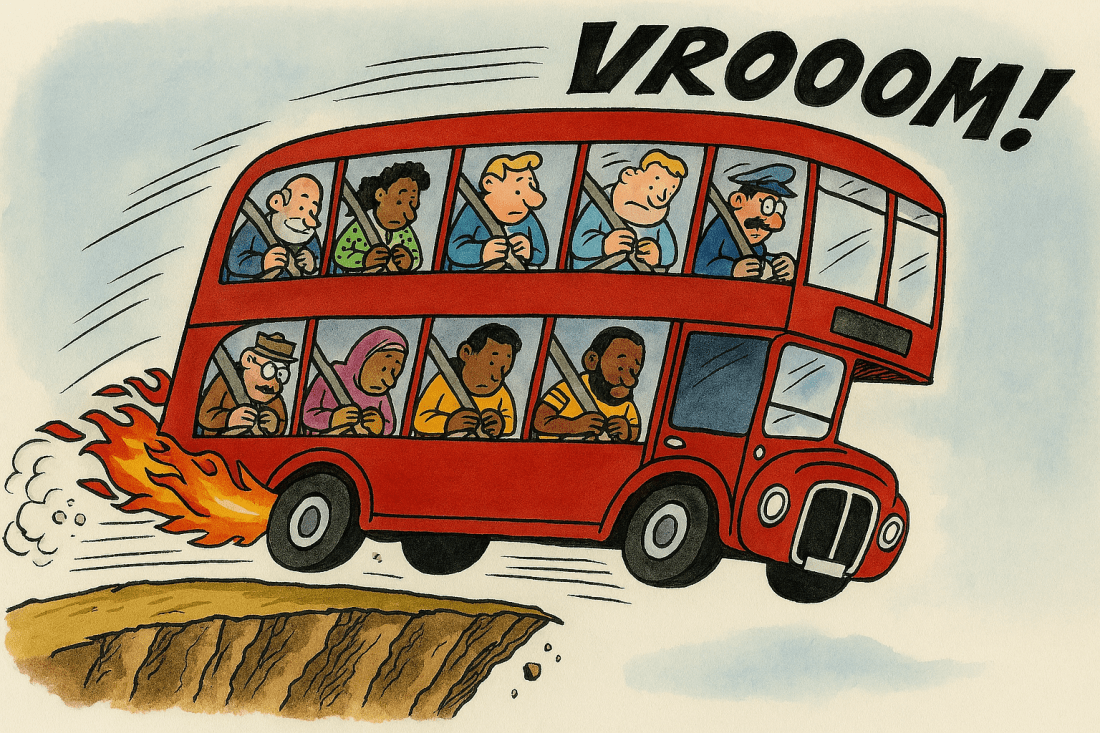
A fitting analogy is this: we’re all passengers on a bus speeding toward a cliff we quietly acknowledge but refuse to confront. Instead of working together to stop the bus or take control, we focus on our own comfort—tightening seatbelts, adjusting seats—ignoring the looming drop that threatens everything we hold dear.

It’s uncomfortable to accept, but whether driven by nostalgia, selfishness, or idealism, the system—the bus—is heading off that cliff. Unless we take a leap of faith and jump, the outcome is sealed. The chance to forge a new path, one that could lead to a better future, will vanish.

After the Collapse: Who Gets the Blame?

The Crime We Enabled, The Reckoning We Face

The era and system we are leaving behind have inflicted profound harm on countless individuals, communities, and the environment—driven by nothing more than the pursuit of profit.

Exploitation intensified at every available opportunity. Once all legal avenues had been exhausted to enrich and empower those in control, laws, leadership, and even the cultural values of entire nations were reshaped—through corruption, manipulation, or acts of war—to ensure that nothing could obstruct their dominance. This power was sustained by the flow and accumulation of money and material wealth.

There is no crime without consequence. When wrongdoing is legitimised through the manipulation of moral and legislative frameworks, its impact extends far beyond those directly involved. The consequences ripple outward, affecting society at large.

To restrict, obstruct, manipulate, disenfranchise, impoverish, exclude, or punish individuals through a system of governance deliberately designed to criminalise or disadvantage them is among the gravest of injustices. Especially when such a system is constructed to appear not only legal but morally justified—implying that the victims are wrong simply for being victims, while the perpetrators and their enablers remain shielded by the very structure they created.

Few will ever fully grasp the complexity, depth, and reach of this crime against humanity. And while many of its architects and agents may claim ignorance—saying, “we didn’t understand what was happening”—the truth is that their contributions required active consent. At some point, each person involved had to suppress or ignore the moral questions that would have inevitably surfaced in their conscience.

These reflections may seem to call for punishment of every official, politician, or influential figure involved. But before we demand retribution, we must confront a difficult truth: nearly all of us have, in some way, contributed to the perpetuation of this system. Many of us have benefited from its processes and outcomes, even if unknowingly.

Though we may not be innocent, our participation has not always been conscious. The system’s reach and success have made it nearly impossible to function in the world without engaging with it. We must consider that many who enabled its continuation may have genuinely believed they were simply “going along with it” or doing things “the way they’ve always been done.”

In some cases—particularly in junior roles involving routine tasks rather than decision-making—this may warrant forgiveness. But for those who actively sought positions of influence, whose decisions directly affected the lives of others, there is a deeper question: were they truly suited to those roles if they failed to act in the best interests of all?

Seeking power or public office for self-serving reasons, especially in roles meant to serve others, may not be a crime in itself. Yet it reveals a troubling lack of awareness or concern for the consequences of failing to meet the responsibilities those roles demand.

We must recognise that the system has evolved to favour individuals who are malleable—less likely to question their role in perpetuating harm. Their selfishness and moral indifference complicate the question of punishment, especially when victims have also participated, and some perpetrators may themselves be unwitting victims.

Ultimately, the true blame lies with the architects, designers, and strategists who built the mechanisms of exploitation and manipulated others into fulfilling their roles within it. Even then, their actions stem not from empathy or understanding, but from the darker impulses of human nature.

Anger toward those who knowingly or unknowingly participated is understandable. But it cannot justify retaliation.

True accountability lies not in vengeance, but in removing these individuals from positions of influence—ensuring they can never again exploit others, communities, or the environment through their decisions or actions.