Is it just food price inflation that costs us more?

Hands up; I love Jaffa Cakes. And I’m betting there’s a very good chance that you love Jaffa Cakes too.

In fact, instead of making me have second thoughts about this McVities Product, the recent BBC ‘Inside the Factory’ Episode from Series 7, that took us through the whole production process only made me feel like I’d grown to enjoy these must eat the whole packet now they are open treats even more.

And yes. Jaffa Cakes are very much a treat and to be fair, they do fall well outside of the Basic and Essential foods that The Growing UK Food Problem and this Blog are all about. However, they can illustrate one of the big issues about pre-packaged foods and related products that we buy from supermarkets and what food inflation – and dare I say it, manipulation looks like, without many of us even noticing that there are some very questionable practices within the food/retail industry at work.

Whilst I’ve mentioned Tesco in Cheltenham a couple of times already, I’m not anti-Tesco. I shop there at least once a week and I have made a conscious and considered decision to do so, based on accessibility to all the items that I will need in the smallest number of shops necessary, and at a price that is (hopefully) the best it can then be.

Yes, I like Tesco – because it makes sense for me to shop there. But in terms of the retailers’ ethics, morality – and most importantly to me, their pricing policy, it certainly doesn’t mean that I agree with everything that they do!

Right. Let’s get back to Jaffa Cakes.

Earlier this week, I bought a small (single) pack of Jaffa Cakes from the Tesco Express, which is located right next to the new John Lewis flagship store on Cheltenham High Street.

This morning, I picked up another small (single) pack of Jaffa Cakes from a Coop Partnership store on Cheltenham’s Hewlett Road – which is about a 5-minute walk between the two.

Although these are both ‘convenience’ stores, rather than ‘proper’ supermarkets, and its generally accepted that these types of stores have a premium attached, the reality is that Tesco and the stores that come under their umbrella such as One Stop, tend to be at least a little cheaper than the smaller retailers and independents – because of the economics of scale – if nothing more.

From this point of view alone, there’s not really a lot of juice that can be squeezed out of an argument about pack price – even when there isn’t a Clubcard Offer or the equivalent, on.

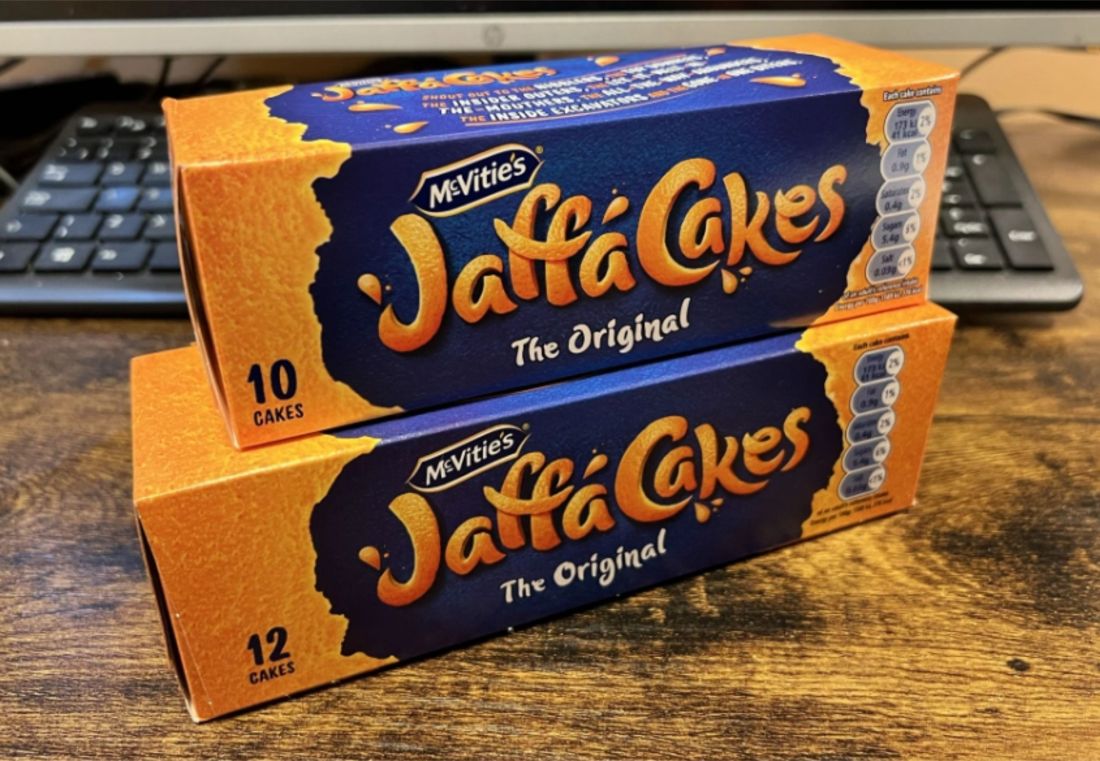
However, what does raise a red flag, and perhaps not in the way that you might think, is the question of how many ‘Cakes’ come from these different stores, when you go in and buy a ‘single’ pack?

What I learned this week, is there isn’t just one size of ‘single’ box of Jaffa Cakes. There are in fact at least two!

From the Tesco Store, I purchased a ‘Single’ box that contained ten (10) Jaffa Cakes, whereas my trip earlier today yielded me a ‘Single’ Box that contained twelve (12) Jaffa Cakes – albeit with every other aspect about the product contained within the boxes being exactly the same.

Put in this context, the price we pay for what we believe to be the same thing with the BIG retailer suddenly doesn’t feel quite as keen in comparison to buying from the smaller company, and it has certainly made me wonder just how many other items on supermarkets should be falling into the category of ‘buyer beware’ – because even when we believe we are paying the same, there is actually less in terms of content, and so we are actually paying a lot more?

Eat better to make eating better much easier

In the Book ‘Levelling Level’ I discussed the food issues relating to what we need vs what we want, and how the future is primed to require that we return to a very simple relationship with the food that we eat – because much of what we ‘live on’ today, may soon become unavailable, unaffordable or in all likelihood both.

The foods that we eat are making us ill. In some cases, they are actually killing us. And the only real reason that we have been and continue to fall over ourselves to eat foods that are fashionable and apparently taste good, is someone somewhere makes a lot of money when we buy into a narrative that’s based on nothing that is easy to see.

Regrettably, it’s no longer as simple as parents and self-sufficient adults choosing between healthy eating and eating ultra processed foods or living on takeaways.

Food that’s good for us is expensive to buy. Healthy food can be expensive to prepare. And life is conditioned to make us believe that fast everything is good for us and is the very best way to live – no matter the damage it does in ways that many would find hard to believe.

The stories and marketing campaigns that make the system work this way are convincing. Because they always contain a small element of truth. No matter how irrelevant to the key subject it might be.

Bad food certainly tastes good. But how do you feel after you’ve eaten it?

Ultra processed food certainly appears to be the quicker and easier option and it seems to always be available here and now. But have you ever considered the real cost – that’s the cost beyond what we pay for food that has no identifiable resemblance to whatever it contains?

Basic, or rather essential foods, are the vegetables, meats, fish, dairy products and breads that require no processing or very simple and straightforward processing to prepare for eating that we might call traditional and would be carried out by hand or simple mechanical processes such as milling through a water powered or wind powered windmill.

Basic or Essential Foods are those that we can prepare ourselves or can access them with only one or perhaps only two steps of handling or preparation between our front door and the farm gate, orchard or quayside from where the raw ingredients were harvested or unloaded from the catch.

Good, healthy and nutritious basic foods that come from the  UK or around our shoreline only seem to be expensive now, because the whole food production system has been engineered in such a way that UPFs and foods that come via very large supply chains are considered to now be normal. However, they are only normal because they are the most cost effective ie profitable way for the big companies retailers and commercial interests that make ridiculous profits from a system that otherwise defies all logic.

If you are ready to eat healthy and embrace sourcing and preparing food that is nutritious – and delicious in its unadulterated forms, you could be helping to increase U.K. food security by making this very positive switch.

The more we buy local vegetables, dairy products, breads, pies, cakes, fish, hams, bacon, sausages, other meats and foods like these that local farmers, growers and fishers offer us, the better the offering will become and the better the prices will be for us all.

Demand will help producers to switch their business models and the operational processes within them to working in ways that are not only sustainable, but with every step will help make the U.K. food supply more and more secure.

If you have access to a farm shop, farmers market or fresh fish delivery round that connects with one of the UKs amazing fishing ports, please use them – even if only as a special treat. Tell everyone you can where they are and what they do.

You’ll be helping our producers to change their businesses in a very positive way.

But above all, you’ll be helping U.K. farmers, producers and growers to help you!

Is £8.38 of your weekly shop too much profit for the supermarket to charge you?

Awake in the early hours of this morning, I went through my social media feeds and didn’t have to travel far before a post from Reuters popped up that flagged the upcoming profit announcement from Tesco, which as a BIG retail business currently holds a 27% share of the U.K.s grocery market.

You’ll probably agree that £3.3 Billion is a lot of money. But to be fair (I thought), if you were to roll that out against the number of people and the number of shopping trips per week, it would probably only be something like a quid (£1) – which on a £100 a week shop would surely seem very reasonable.

To be fair, I wasn’t convinced.

I decided to do the maths. And once I’d gone through a quick recap of formulas for MS Excel (because I couldn’t get the calculator to work easily with figures in the billions), I had a quick dig around for the latest figures I could find on UK population (67 Million in 2021) and the average number of people per household (2.4).

To make it easier on my early hours and flu ridden brain, I decided to narrow the figures down to the equivalent of one weekly shop per household. The purists amongst us would argue that it needs to be more precise (I use a Tesco Express as well as the local superstore and am sure many others do to). But for the purposes of getting some perspective, the results are pretty much the same.

What I ended up with (and please feel free to correct me if my 2am mathematics was out) is that of the households that shop weekly at Tesco, an average £8.38 of the cash price of that shop or the payment is pure profit for Tesco. Or, rather, that is the money they pay to their shareholders via dividends at the end of their company year.

My guess is, that’s plus or minus the equivalent of 10% of most of our shopping bills. When you put it into this context, it seems rather a lot.

And that’s before thinking about what all the big corporate interests that sell goods to Tesco make, when they are big enough and have clout enough to dictate to a retailer of this size and with this level of market share what the prices and margins will be.

However, the question ‘What is an acceptable level of profit?’ does become cloudy when we add the perspective that a local farm shop or food trader at a local farmers market may not be able to function with a percentage profit margin, that for a very SMALL business is likely to be catastrophically low.

The issues around our food supply and how we make production sustainable across the UK whilst also making it secure and fully accessible to all are very complex indeed.

The Growing UK Food Crisis

One of my greatest frustrations, is the reality that growing numbers of us know there’s a big problem growing with food and keeping us all well fed. But nothing really helpful is happening, because the positions that all the stakeholders have, really aren’t in any way joining up.

‘But the problem is clear!’ I hear you say. And yes, to you, whether you are a farmer, a grower, a fisher, a retailer, a consumer or whatever; the way you see the food problem or any one of a number of them may well be very clear indeed.

The trouble is, everyone is seeing the food problem or rather problems, from their own perspectives and therefore, in a range of very different and sometimes conflicting ways.

Regrettably, being able to see the reality of the situation is one thing. Getting so many different stakeholders or groups of stakeholders to accept that there are alternative perspectives that are just as real as their own perspective to others, is entirely different.

It doesn’t matter whether the perspective is correct, incorrect, misled or only partially formed. If it makes up part of your belief system, the chances are that you are emotionally tied into it and won’t find it easy to see the situation easily in any other way.

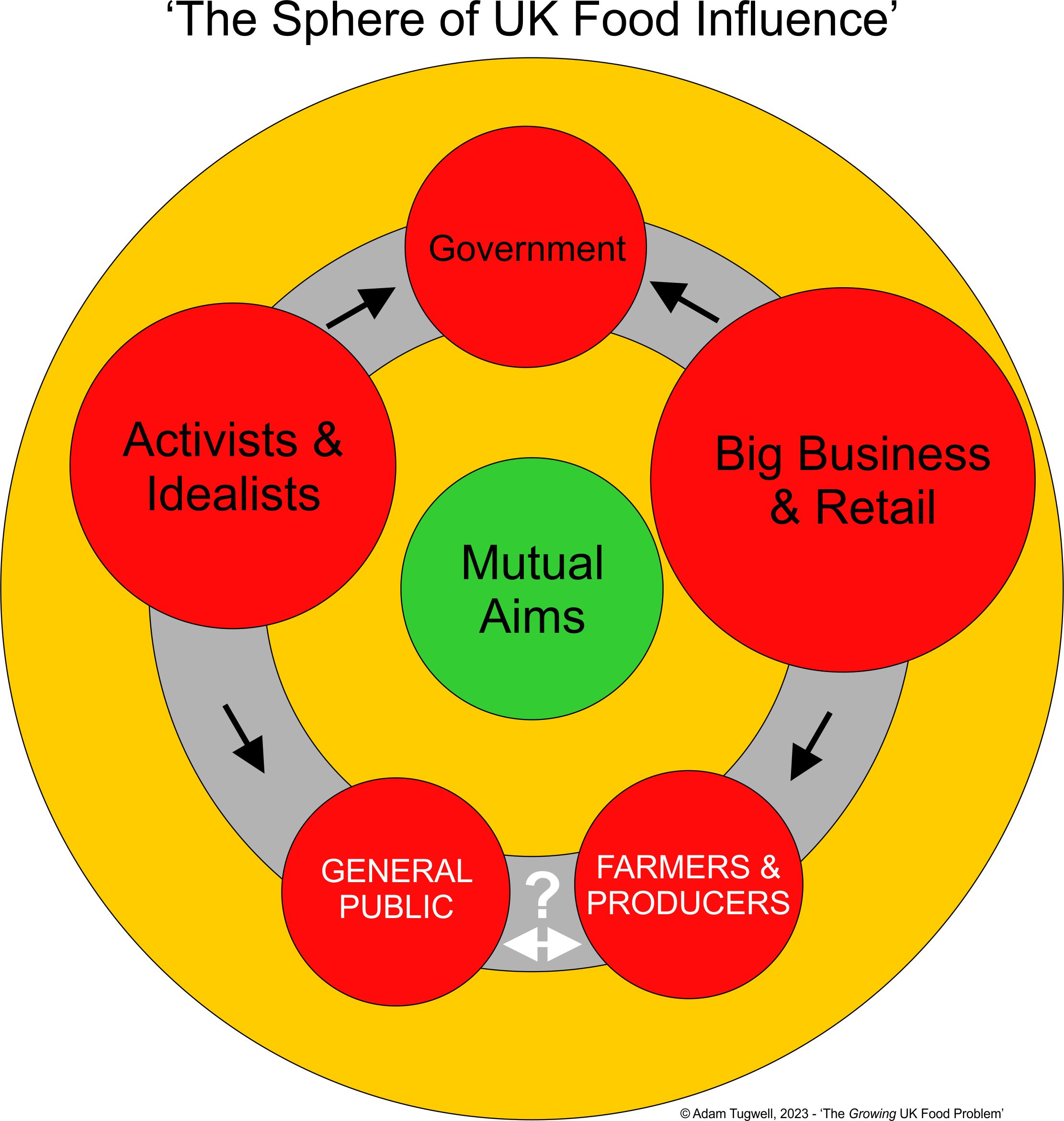
The way that influences on food production really work today. Government is who we all expect to be ‘in charge’. Whereas the reality we face is that Big Business & Retail run the food show to an overwhelming degree, with any remaining influence being in the hands of activists and lobbyists. The irony is that the most important stakeholders are the general public – ‘The Consumers’, and the Farmers and Growers, or ‘The Producers’. Yet, other than farm shops and farmers markets, there is basically no meaningful relationship in-between.

During the research and outreach that I have planned as part of The Growing UK Food Problem, I intend to focus on as many of the different perspectives as possible. However, with the risk of a food crisis being very real, and with nobody appearing to even think about how we feed the UK if for instance the borders to our Country  should be bolted closed, it’s the outlook of our Farmers and Producers that is the most important to think about – right beside that of the general public or end consumer i.e. that of our own.

I expect to be challenged at the very least by some of the great farmers that I already know. But what is very clear to me is farmers and producers have become dependent on financial incentives, subsidies and contractual arrangements with big businesses (that in some cases at least arguably have no real reason to be in farming other than making a profit).

This ‘dependency’ on government and ‘free cash’ has already done significant damage to key UK sectors whose participants are arguably some of the most entrepreneurial and creative around. But have been done a massive disservice (as we have) by centralised EU rule making, that is nothing more than globalisation in a localised, franchised or more publicly acceptable form.

Like many of you, I have read of the frequent attempts made by Industry lead Minette Batters on behalf of the NFU, to warn of the impending food security crisis that is very much here already, when considering that only around 50% of our food (or rather the equivalent of) is grown and produced here at home, in the UK.

Instead of listening, the payback is the political stupidity of out of touch politicians. Perhaps best illustrated by the recent comments made by Jacob Rees-Mogg, that echo decades of inept political thinking that stumbles from one crisis to another by out-of-touch rules such as none of the food the UK Population needs to survive, needs come from within the UK.

Farmers and Producers don’t see the alternative way of thinking. Because culturally they see the way things work today as being ‘just the way that it is’.

Yes, there are good reasons why an industry that’s already on its knees doesn’t want to take on the role and responsibilities of repurposing and redefining their role in the food supply chain. At least not without the financial help that a proactive and risk-aware government and political system would have already prioritised for the safety and security of the people it is supposed to represent, perhaps years ago.

But without stepping away from the shibboleths and the ‘ties that bind us’ to the same thinking that created this whole mess, there is a genuine and very credible risk that what is left of UK farming wouldn’t be able to feed the nation if a national emergency were to arrive in a way that many looking more closely now expect. Potentially VERY soon.

And that if the direction of travel should continue, where farmers and producers continue to be led by people and interests who either don’t have a clue, or have other vested interests that are in no way aligned wither with UK food security or sustainable agriculture, we are really no great distance from a situation where the infrastructure and resources that could be redirected to local production today, simply wont be there for us to do so within a very short period of time.

Does the history of money matter?

For the second time in what is probably a week, I’ve just seen an article linked about the history of money.

The timing is unlikely to be an accident, given that the money system we have is being rapidly inflated towards a systemic collapse. And that was before the BRICS partners began taking meaningful steps towards the destruction of the Petrodollar and the US Dollar Reserve Currency Status.

It is often said that history is written by the victors of wars. Perhaps it should also be applied to controllers of any monetary system – that is when money or currency has itself taken on a role which means it is valued in such a way that gives power when the system can be controlled.

Money isn’t real. It isn’t a thing. Its true purpose – before that purpose was wilfully misrepresented and manipulated – is to be a medium of exchange for anything and everything that has value.

Money is a tool and nothing more.

Instead, Money has become the ‘thing of value’ itself. Meaning that everything else, whether it’s the effort of a labourer, the time of a professional, the purchase price of a house, or the cost to buy and cook the essential food that everyone needs, no longer holds the real value that it should.

The value of things in life that really do have value, that should be dictating the size, scope and way that economics work, are instead dictated by the technicalities of how a very sick and self-serving monetary system operates.

The history of anything only matters if you intend to make it real or legitimise it or whatever you intend to anchor to it. That’s why so many politically correct and woke people are falling over themselves to rewrite and manipulate history to give ‘truth’ to whatever it really is that they intend to do.

The question is, why do the architects of the coming monetary collapse feel it is so important to focus on the history of money right now?