Santa, Public Transport and a fold-up battery powered bike

20 Years ago, I was in the final months of running and developing the JumpStart Project for the Gloucestershire Rural Community Council before I moved over to Shire Hall at the beginning of the following February.

I’d been with GRCC for a couple of years and really enjoyed developing new services for a Charity project operating around the rural Districts of Gloucestershire that helped unemployed people who were trying to access jobs or training and couldn’t get there because they didn’t have any transport.

We were already lending out mopeds and bicycles, as well as buying people their first weekly bus ticket or just opening another door to someone else who might be able to help them.

I was looking for creative ways to provide more options for the people we were helping, that would also encourage the local Councils and our existing partners to keep supporting us by experiencing even better results.

One day, I saw an editorial for what may have been the first or certainly one of the very first companies to start importing battery powered bikes into the UK at the time. You may not believe it, but sustainability was already a big thing outside of the mainstream and I quickly concluded that these bikes were just the thing that we needed and really would provide a win-win.

The funders I approached agreed with me too. In fact, our main partner on this new offering was the local Rural Transport Partnership who had recently taken on a PR guy called Stuart Bexon, who I still suspect had got lost on his way somewhere else and thought he’d just have six months out whilst he was here and see if he could humour the public sector in some way.

When I met Stuart for the first time to talk about the funding we’d just won, we hit it off in comical style and it felt like a meeting of caper-driven minds and a bit of a coming home.

Very keen to make the best of the opportunity for publicity that we realised we had; we bantered our way through one of the funniest brainstorms you could imagine.

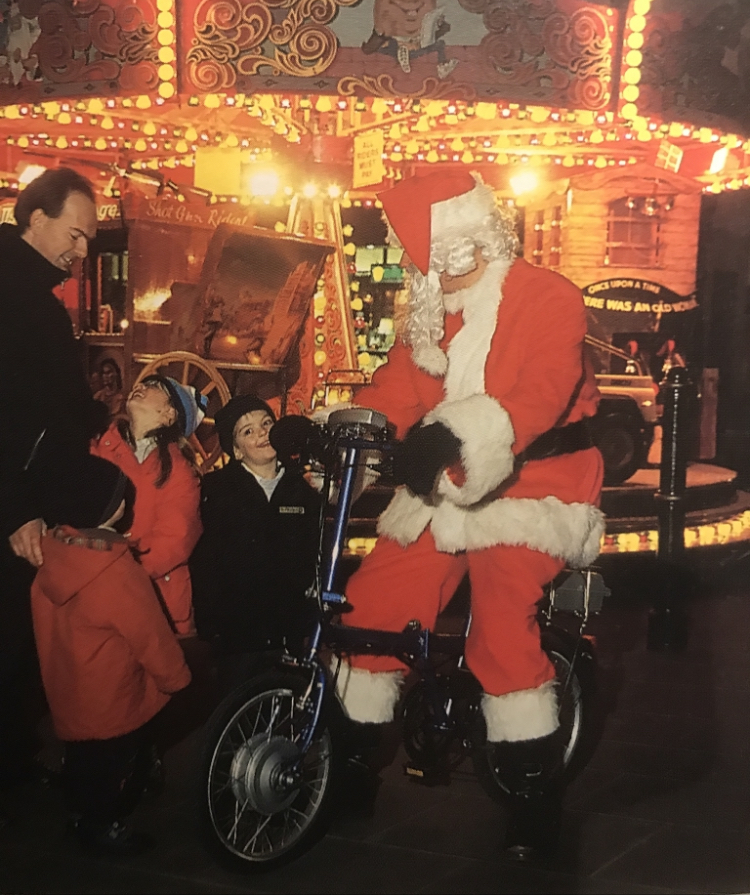
Armed with the sense that we had been tasked to promote the concept of integrated transport in its most literal form, we soon concluded that the best way to do so would be to take a fold-up battery powered bike around the whole of Gloucestershire’s Public Transport network – with yours truly dressed as Santa Clause.

Over three days in mid-December 2001 using the borrowed Toyota Prius ‘support car’ that Stuart had blagged from Bill Allen Toyota – the Cheltenham Toyota Dealer at the time, we set about delivering on our ridiculous – but very successful plan.

The local media absolutely loved it. Wherever we ended up or passed through, a reporter or journalist wasn’t very far away and the picture here that I borrowed from the Countryside Agency Publication ‘Two Wheels Work’ was taken on Cheltenham Promenade shortly after we ended what I believe was the final day at the front door of John Dower House – which was the base of the CA at the time.

I think my only (possible) regret was the look of bewilderment on the face of a very young child when they got on to the bus to Cirencester at the next stop after we started in Tetbury and sat opposite Santa for the whole journey. It was quite clear they were wondering where the hell the Reindeer and Sleigh had gone and why Santa had turned up early riding on the same bus with his giant arm draped over a fold-up bike!!!

Will the closure of the bridge linking Brookfield Road in Churchdown with Badgeworth only be 12 months? Shouldn’t local life be the priority over keeping the M5 open day and night?

If you’ve ever wanted to witness the consequences of having a public sector that operates without joined up thinking or consideration for the impacts on real life that its actions will have, you won’t need to look much further than the structural work that Highways England are undertaking on bridges around the Junction 11 area of the M5.

As a regular user of the road between the B4063 near Gloucestershire Airport (what many will remember the lights at The Plough), and The Gallagher Retail Park or Crosshands on The A4019 Tewkesbury Road in Cheltenham passing the House in the Tree, I’ve been experiencing the impact of one of the associated road closures for over a year now.

When Staverton Bridge was closed in the summer of 2020 – for what everyone was told would be a period of some 13 months (the signs said July 2020 – August 2021), it was very quickly clear that very little thought had been given to the project in terms of how drivers would respond and how they would then find their way around.

With many drivers choosing to reach their destination by diverting through Staverton Village and Boddington, local residents have already had over a year of speeding torture and dangerously broken up roads. Those problems have only been made worse by the apparent rescheduling of the works which took place this Summer, meaning that the work to Staverton Bridge and the road closure will not end until at least next spring.

Although I have often thought about publishing a picture of the great plywood back door of a speed camera van that the Villagers in Staverton have created to encourage passing motorists to slow down, it was the news I have seen today published in the My Churchdown Magazine recently about the upcoming closure of the bridge between Churchdown and Badgeworth on Brookfield Road that made me feel it was really the right time to write.

As a Borough Councillor, I experienced how the different agencies of Government interacted and worked – or rather didn’t work together over projects like these, and how the truth about small matters like consultations and handling bad news to the public would be spun and manipulated so that people would react in the most favourable way possible, rather than creating problems for decision makers which were in the majority of cases based upon very reasonable thinking rather than over the top demands.

With the experience that I have, I do not believe that it was ever the intention that Staverton Bridge would be finished within 13 months as initially suggested, and that the arrival of scaffolding over the Bridge in only the past couple of weeks for the reconstructive phases of the project demonstrates that planners will have almost certainly known just how long it would take to carefully complete such a specialist task.

The reality is that those responsible know that if they had gone straight in with a two-year time frame for Staverton Bridge to be closed, there would have been a public outcry of a level that would have been too much politically for them to withstand. Instead, it appears that they have cynically and deliberately strategically moved the goalposts, right at the time when people had got used to the change and were least likely to open up publicly to make a stand.

I believe this view relevant, as the work that will close one of the two direct routes to Cheltenham from Churchdown is likely to be closed for much longer than the 12-month time frame suggests, and with the chaos to commuters, bus routes, school journeys and all other forms of travel that depend on this link every day of the year, this is a project that has a cost to the local area that under these plans is simply too high just to be imposed upon us by a public sector organisation which is under no direct political control.

Yes, the bridge work needs to be done. But why does it have to be done in this way?

Whichever way Highways England complete this work, it will be expensive. But the real, expense needs to be calculated in terms of what the cost will be not just to their own budget, but to everyone else too.

Many of you will have seen the video on social media where a railway bridge in Germany is closed, demolished and completely replaced and open again within 4 days. It begs the question why the authorities and the powers that be cannot think like this and use holidays and night times to minimise disruption and the time that key local roads have to be closed – rather than maintaining this obsession that the roads (motorways) under their supervision must at all costs remain open, unless it is for a purpose that they should choose.

No, MPs should NOT have second jobs. After all, being an MP is NOT a job anyway

The ongoing row over second jobs for MPs has certainly proven to be an interesting one. Yet it has also become increasingly concerning to follow as it has become ever more obvious that so very few of the journalists, commentators and people working around the political sphere have any real consideration or respect for what the role of an MP and public representative should really be all about.

The comments and arguments for second jobs range from the suggestion that MPs with second jobs enrich links with and understanding of the real world, to additional money being the only way to make the job worthwhile. Whilst those against include suggesting that it would be fine to ban second jobs for MPs, but only if they were given a ‘realistic’ salary’.

Nobody seems to have mentioned that being an MP or public representative is not a job.

Being an MP is a responsibility to others. It’s not one that should be taken if the individual concerned cannot guarantee that their responsibility to others will not be compromised by prioritising income, career opportunities, fears, influences of any kind, or any other motivations that put their own needs before anyone else at any time, at any level or in any way.

It is part of the human condition that we can only be loyal to one master. MPs are no different to anyone else. If an MPs priority is income or career at any level, it will not be focused on anyone else.

There are simply no grey areas with this. It really is very black and white.

If an MP can be swayed in their decision making by any factor which will reflect on them personally at any level and in absolutely any way before anything or anyone else, they can be bought. As such, they cannot be relied upon to represent the general public and the voters within the constituency who elected them.

Being an MP or elected politician of any kind requires people who have the life experience, understanding of others and are at a stage within their own lives where they can willingly and unswervingly put the needs of others before themselves in every meaningful way.

It is because we have for so long had a Parliament full of MPs on all sides of the political divides that are ruled by self interest at some level and in some way, that the British Political system – and as a result the whole of the UK – is in the mess that it is in today.

Public service can be the only master of any politician who wants to fulfil the obligations of the role with which they have publicly been entrusted. There simply is no other way.

For as long as we keep electing politicians in this Country and allow them to frame their own roles as careers and jobs, their attitude will continue to focus their attention on nothing other than what the impact and consequences of their actions will be for their future and for themselves before anything else.

There will be many who suggest that this is the way that the system works and that you can only change the system from within. The regrettable truth is that this is a myth perpetrated only for the benefit and furtherance of the interests of those already within that system. People who have a massive investment in ensuring that nothing happens which could bring about the comprehensive systemic change that would serve to help and benefit us all.

Sadly, until we all come together and accept that the people leading this country in government, the establishment and the wider public sector are not working to put our collective best interests, we are doomed to live the same experience. Public policy is today created in all areas of life where the decisions have been made not with us as the priority, but with what is important to the people we elected being always put first.

We only have ourselves to blame for each and every day that this sordid and perverse idea of democracy continues to rule, impinge and inflict avoidable pain and chaos in our lives.

None of the Political Parties that we have on offer to us today are focused on all of us in the way that they should be.

It is we who must make the decision to elect MPs and politicians of all kinds who will make promises and then keep them. Because they are there in our Parliament because politics is a calling or a vocation for them, rather than just an interpretation of a career or a job. One that to them is nothing more than getting the maximum return for themselves for the least amount of work.

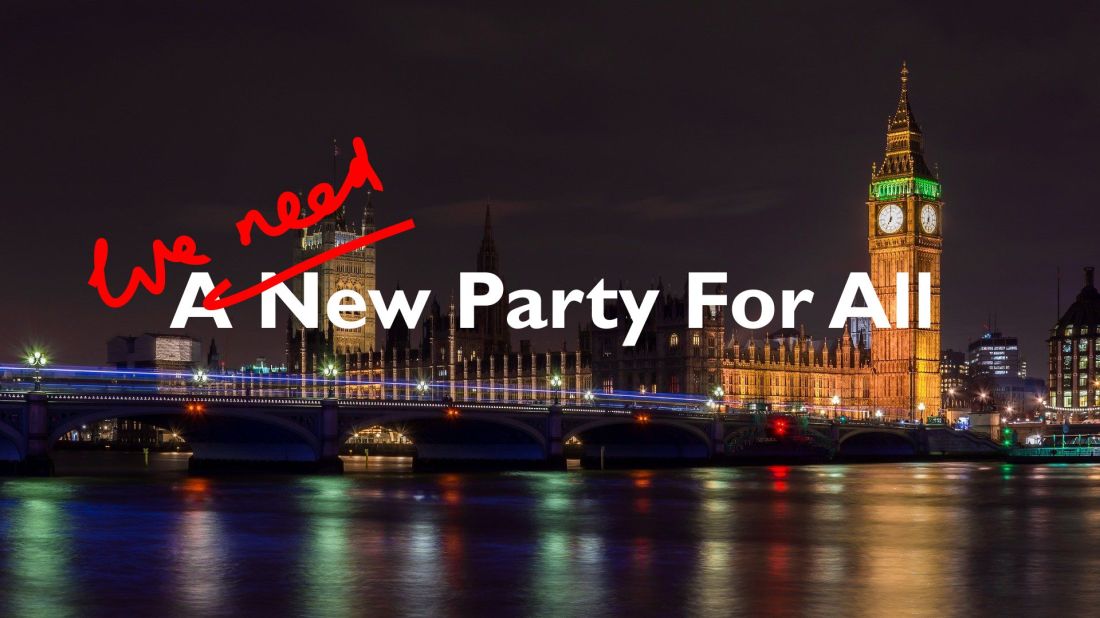
We need a real choice in politics. We need MPs who understand and genuinely care. We need #ANewPartyForAll for the next General Election.

To achieve this, we need to start thinking differently and begin to build the alternative to the madness we have got right now.

If you really want all this to change, please visit www.anewpartyforall.org and think about the power that you have to input and help to bring about change.

Online Anonymity and protection for those who genuinely need it, whilst ending the damaging free-for-all for trolls is not only possible, it should have been done before

We are regrettably navigating our way through times where emotions and the fear that drives them are having a disproportionate level of influence on what government and society collectively does.

Knee jerk reactions and decision making are the order of the day. Rather than reasoned, well thought out and methodical thinking that brings its rewards. Not through the extinguishing of immediate baseless worries, but by achieving the results that are right but unlikely to be clear at that precise moment in time.

There is no way to describe the murder of an MP in the middle of his local constituency clinic held in a church in any way other than being absolutely horrific. But there is also a significant danger that the emotional and fear driven responses to this dreadful event we are now witnessing may push immediate changes to public policy that could prove to be highly damaging to our society.

Those with a public voice within the discussion and debate taking place haven’t paused to consider just how raw emotions now are – including their own.

Taking a deep breath and counting to ten before thinking through the wider dynamics and consequences of the decisions they are now pushing would be a much better and more productive approach for us all.

Of the issues remerging between tackling Islamic extremism and the security of public representatives, both physically and online, it is the topic of online anonymity which seems to be shining through as the one where the crowd has focused its finger of blame.

As yet, and as may never be proven to be the case, there is no clear or overwhelming evidence yet that online anonymity even played a part in radicalising the individual who allegedly committed this crime, if as suggested, extremism was the motivating cause.

To hear or read the way the issue is being addressed by the public court of opinion, you could easily conclude that this is not the case. That the series of events and the way they unfolded are already unequivocally known by all, and that it is as such fair to conclude that online anonymity must be ended for all.

However, as with most situations, the question of whether having to identify yourself and who you are must be a requirement to have any kind of voice on an online public platform is a long way from being black or white or cut and dried.

The Trolls

There is a real problem with online trolling, abuse, woke activism and ‘piling-in’ from social media accounts that do nothing to identify the source or who is involved.

As things stand, setting up one or multiple anonymous social media accounts is very easy. There are no real systems or procedures in place to stop anyone who knows how the online platform sign-up processes work from using a range of user identities. They can do so simply to attack or criticise others, to publicise fake news or propaganda, or to build up very successful campaigns that could radicalise, promote conspiracies or built upon nothing but a tissue of lies.

Whilst the Police or Security Services can of course trace sources using IP addresses and other methods too, the reliance upon this system of reverse-engineering the process to find people who have broken existing laws or need to be warned puts an unnecessary burden on already stretched resources. That is of course if the alleged offence is considered troubling enough to be pursued.

Social Media account holders effectively have a free-for-all if they so desire.

So, if you are angry, frustrated and have it all underpinned by idealistic views and a sense of entitlement that the way social media account anonymity does nothing to counteract, you really can go to work on social media causing problems for others and saying whatever you want, pretty much without fear of consequence, unless you choose to use language that very few would see as a risk-free choice.

Whistle-blowers and Truth-tellers

Many of the comments ripping their way around the social media channels at the moment focus on a demand to legislate to end online anonymity. What they don’t do is address the argument that supports the need for anonymity for those with legitimate reasons, whilst excluding only those who have a malevolent purpose or simply get a kick out of being a troll.

With cancel culture and the explosion of woke or idealistic thinking based on lack of life experience and experience of others and a lack of tolerance for the views of others too, there exists a significant number of people who have knowledge and understanding that we all need to experience. These are people who can help everyone, but who are too afraid to speak out and put their name to what they say for fear of the consequences. Attacks and abuse that most people would agree are built upon nothing more than unreasoned and unacceptable hate.

The truth is only painful to those who need to hear it or wont accept it.  And in an age like the one we are now in, we have never needed the truth to be shared about everything with everyone in the way that we do right now.

With the protectionist and self-serving cultures that exist across high-level business and the public sector, we also need to protect those who want to bring light to the realities that underpin all the ills that society currently faces, without fear of professional repercussion or unnecessary overt risk.

Beyond those with a legitimate need for the protection of online anonymity, there are those of us who have simply not yet found the confidence to put a name to their voice. And if these individuals want to speak and do so without any intent to cause others any kind or any level of harm, why should they be discouraged from doing so?

Afterall, the very step of removing that online anonymity may be the one factor that halts their journey from one kind of life to another. Just another barrier to social mobility where lack of consideration of others could easily take away yet another individuals choice.

Social Media Platforms as online policeman

In an ideal world, we should be able to expect the owners and operators of the social media channels to already be dealing with these problems by tackling them before they even begin.

But the social media platforms aren’t doing anywhere near enough to tackle the problems that exist within the social media sphere.

Controversy, bad news and negative information are the catnip for posts going viral and as such the source of massive revenue generating clicks, they have little incentive to deal with or implement an effective way to police this behaviour when their master is profit and commercialism, rather than the wellbeing of the public that they tell us they are there to serve.

Online Anonymity for those who need it and a paper trail for all

Online anonymity is a privilege. Not a right.

Simply ending online anonymity will be a massive attack on freedom of expression and freedom of speech. Yet there must be a system that removes the voice and influence of those who wish harm upon others, simply because they disagree with them or want to impose an alternative view or truth.

The social media platforms could create a forward process of verification that would amount to the same thing as an application to gain a username, which could allow users to post anonymously, simply because their verified details are stored and therefore known.

However, you can bet that if the media platforms thought that there was a profitable or beneficial reason for them doing so, they would have already implemented such a system voluntarily by choice.

Such a lack of attention to this need and the existence of verification systems like that on Twitter which are seen by users as a badge to impress followers with rather than one which should give confidence in the legitimacy of their voice, realistically mean that these commercially-driven enterprises cannot be relied upon to develop and administrate a system that basically puts the needs of the public good first.

It necessarily follows that the best way to administer such a system would be to place it within impartial, third-party hands, where personal data is reliability kept safe, but where the level of legitimacy exists that will give confidence to all the parties involved.

The way to do this would be to do something like expand the scope of the services provided by the Information Commissioners Office (ICO), and require all users of public online (social media) platforms to register with them for a small fee, where their details will be logged and in return they can be given a unique identification number that the user can then register with online platforms to gain (or renew) their username, with the platform then continuing to allow them to exercise anonymity if it is the users choice.

Being given what is in effect a license to participate in public forums where privacy or protection cannot be assured as there is an absence of other appropriate regulations or rules would mean that all users immediately have skin in the game, as this method of access is something that could itself be withdrawn.

Yes, the system would be reliant upon having a robust system of governance in place which meant that it could not itself be abused or used to restrict access for anyone just because of who they are.

But at a time when the social media platforms are themselves restricting the publication of political material and the content of posts from people they don’t approve of or like, the fact is that an impartial qualification for users of this kind, might well have hidden benefits that could bring balance back to a heavily skewed system and help us to get things right.

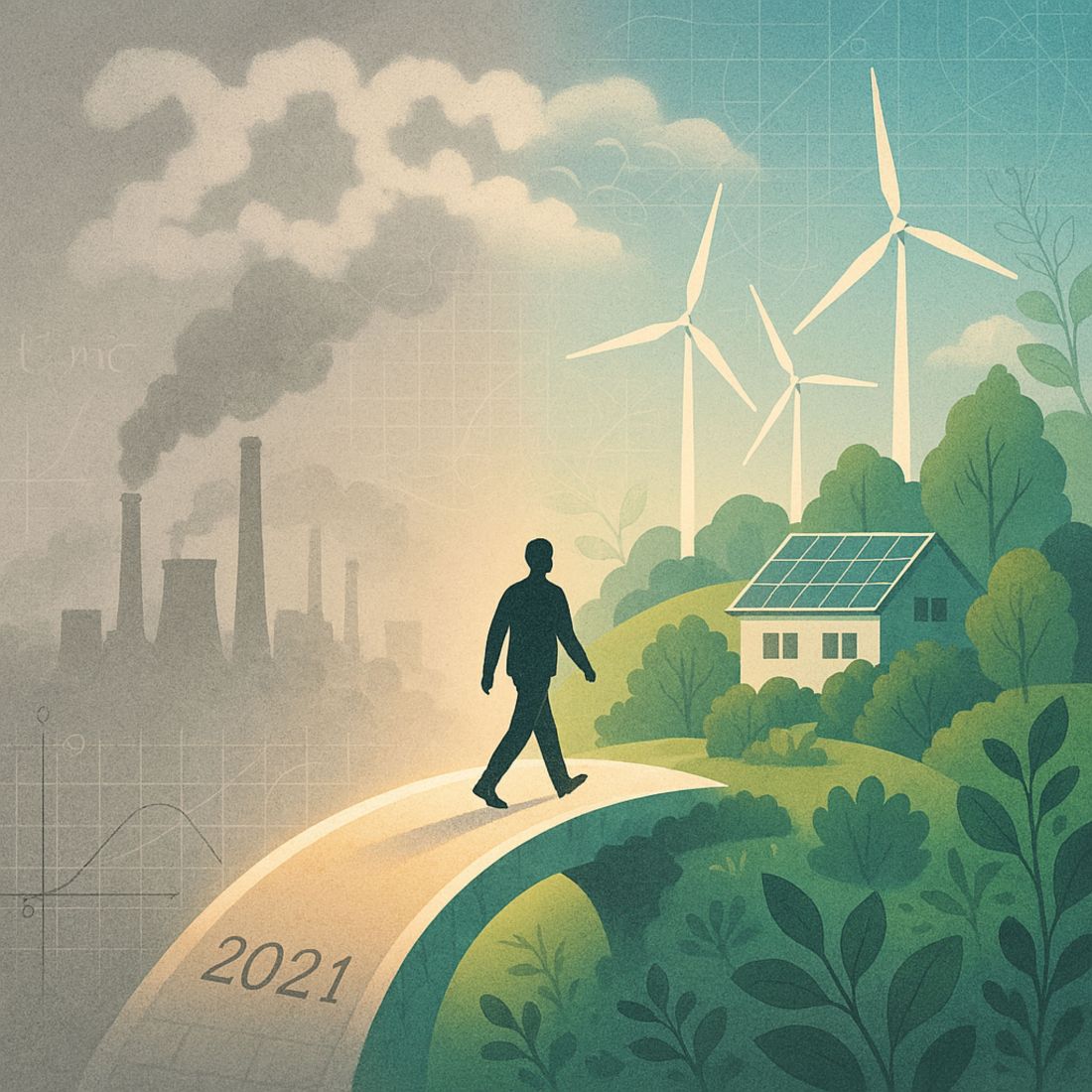
Net Zero is not only possible, we MUST aim for it too. However, it is an objective that requires inspiration and true statesmanship to deliver and it’s foolish to believe it can simply be imposed

Probably one of the most unhelpful arguments being conducted, then pushed by the media is the question over climate change, global warming and who or what is to blame or at fault.

It’s a dead cat debate, doing considerably more harm than good, simply because it is preventing reasoned discussion and action being taken to alleviate the impact on us all from the changes to the weather that are already evident and plain for us to see.

I cannot disagree with the concerns and arguments about the approach of big business and the consequences for the environment and serious risk to our quality of life from industrialisation, mechanisation, globalisation and the driving forces of greed and the motivation for achieving profit whatever the true cost.

But before we can even begin to tackle that problem in a way that will prove to be meaningful for all, there has to be an epiphany in governments right across the world. With it the recognition that public policy and the responsibility of government sits at the heart of the entire environmental debate, and that there are few areas of public policy which do not touch or fail to be influenced by the green question and environmental issues in some way.

The UK itself is already facing a range of problems from the climate changes taking place. A very good example of how different policy areas overlink in ways that are very serious, whilst being overlooked by our MPs and politicians would be the increasing problems that we are experiencing with flooding. Here, a rather large blind eye is also being covered over too, simply because housebuilding has become the obvious answer to a housing crisis that our politicians will not deal with in more appropriate ways. In so doing. Our political class are condemning existing homes, the villages, communities and towns around them to what might soon be very serious flooding problems, when taking responsibility and doing things differently could make this in many cases much easier to avoid.

Building green policy on what looks good in the media, what wins votes and what is easy to do is no way to tackle a worldwide crisis. One that will reach an inescapable point where its impacts are going to become very serious for us all.

Government cannot avoid the way the world works and why people and businesses are invested so heavily in things remaining as they are.

Ironically, the behavioural science that has been so heavily relied upon to coerce people into doing what the government wanted them to do as part of the political response to the Covid Pandemic, could be put to much better and constructive use. It could be applied to providing ‘nudges’ that govern the way people are thinking about their own impact on the environment and what they can independently do to help us all to go green.

However, using policies to force people to change does not consider the practical realities such as affordability, accessibility and what other policies green policy itself will impact – bearing in mind that you can be certain that with each step taken, there will be practical and in many cases hard-hitting consequences for us all.

To hear the Government, the media, the activists and academics preach, you could easily conclude that the UK is one of the worst sinners of the World. But it is not.

Whilst Government may feel galvanised in its ability to ‘impose’ green solutions on us all by the ‘success’ it has ‘achieved’ in forcing the UK to indulge all the unnecessary and costly responses to the Covid Pandemic it has imposed, taking this stupidity even further into the imposition of green technologies will end up in a disaster for this Country. One that will arrive much quicker and be far more consequential for all of us than the alternative of starting to deal with climate change the hard way and the right way. Currently, they are taking the easy route, as control freaks inevitably always do, concluding that giving this date or that date and a reliance on technology that doesn’t even exist, that future change is safe to impose upon us all.

In terms of the environment and the wider green issues that are involved, it is important to remember that the idealist’s viewpoint is that the problem will be solved with unilateral solutions that only affect people and businesses based in the UK. Yet isolated action will only hurt us, whilst doing nothing to address a problem that is the worlds, not just the UKs to own.

The reality is that we will not influence anyone or any other Country in a way that will be helpful to anyone, if our politicians just force through legislation such as heat pumps for homes, that are wholly impractical and consider none of the impacts on anything other than the environment itself – just as the Johnson Government has been doing by undertaking all policy decisions in isolation where Covid has been involved.

One of the biggest obstacles to progress on environmental issues worldwide, is the sordid fact that money is always and inevitably involved.

Money motivates people deeply in an emotionally entrenched way. And people who have lots of it and want more of it will not let issues that don’t agree with their own narrative get in their way.

Corporate interests are a massive part of the climate change problem. They will continue to be so until those responsible can be convinced that the same or more profit can be achieved for them, by conducting their business in a very different and environmentally friendly way.

Sadly, like most things historically, the biggest profits and margins are to be made when whatever you are doing means that you are in a position to exploit.

Morality and ethics are at a rare premium in business these days. It is the same people who are accumulating this wealth who already possess the deep pockets that our politicians suck up to and treat as if they are sacred cows.

There is as such a dangerous inevitability about the level of damage that is going to be done, before that moment of reason land collectively, and everyone starts working together voluntarily to address the issues and work better – because they have come to the decision as an informed and unselfish choice.

The saving grace to all this – strange as it may sound, may turn out to be the Covid Pandemic itself and the decisions that poor politicians have made in response.

Covid has literally seen governments around the world take decision after decision that has exponentially speeded up every problem that poor leadership has created over decades.

It means that a point is approaching where going greener will simply become the way that we all start to do things, rather than us having to wait on people who are so far choosing not to make the green choice.

Globalisation is over and done with in the way that we have known it before. The media are making very little of what is happening with shipping, supply chains and the provision of goods from around the world. But goods are not going to be available as they were before, and as the coming financial crisis beds in for the long haul, the realities of genuine localism, food and the supply of essential daily items from within a very local area, if not the immediate community itself, is going to become prevalent once again.

However, to make the very best of the opportunities that will come from a very serious crisis, it is vital that we have the right people influencing and making all of the key decisions that will need to be made.

Whatever happens next, it is essential that the decisions being made are not aimed purely at an electoral echo chamber as they have been now for decades.

Every decision being taken from now onwards will have very serious consequences for us all.