Businesses are not inherently academic, so why are degrees becoming the prerequisite skill?

Latest news suggests that without more degree level education based skills, the UK will experience an exodus of jobs overseas to emerging economies. But when we already have students doing degrees just for the sake of doing them and a basic education system which sees school-leavers failing to possess even basic literacy and numeracy skills, should we really be thinking about pushing more through a university education as the immediate priority?

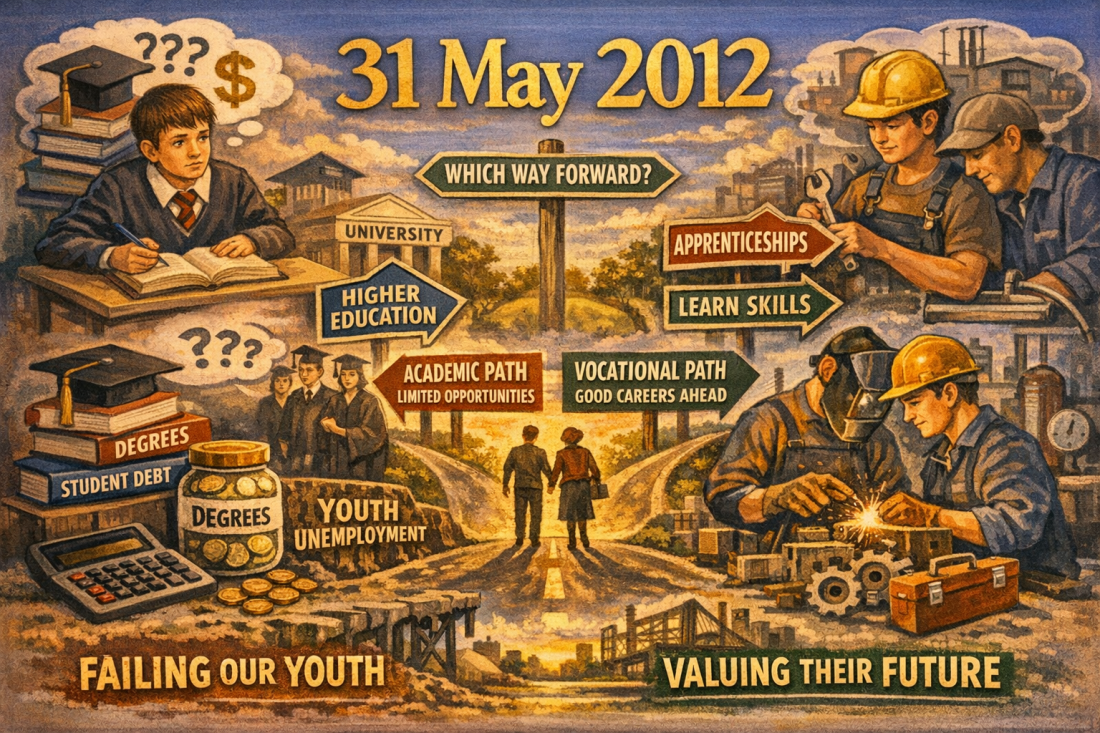
Like it or not, many young people are neither cut out nor ready for an academic pathway from or even during secondary education. Simply creating more courses to include a wider selection of students is hardly the answer and is fast leading to the existence of meaningless degrees, which won’t help business, and don’t help the students themselves who these days will have had to sell their soul to get it.

One of the greater injustices of recent political times is the idea propagated by New Labour during the 1997-2010 period of Government that everyone could be the same and do the same things. Such socialist ideology permeates itself by changing – or rather levelling systems throughout society to treat everyone the same under the ideal that to do so is providing ‘equal opportunities’.  However, as we are all different – and often in ways that cannot be seen with the naked eye – this method is not only obtuse in the extreme, it has contributed to the creation of a society where younger generations are becoming lazy and without ambition. When you add to this the burden of taxation which is placed upon higher wage earners for daring to do well and the resentment they experience if they do so, neither do you leave in place any real motivation to be any different or encourage the social mobility that the same idealist meddlers suggest to be a milestone of progress.

The good behind many ideas, policies and concepts is often lost when change is enacted simply for the sake of change and this is no less so within education as elsewhere. Whilst the technology age has altered the requirements for skills throughout the industries, the historic format of leaving school at 14 and becoming ‘apprenticed’ was a much better way to foster learning in those who were more ‘hands than head’ at the time, and could as such provide lessons in forming the basis of a very radical and effective way to change the way that we develop our National skills base for business and industry.

Why not:

  • Remove the burdens of red tape which govern the working environment for younger people.
  • Develop an effective subsidy allocation and training scheme to assist participant businesses to replace unused school places, ‘young to work’ schemes and unemployment benefits.
  • Give business a cost-effective motivation to support vocational or ‘on-the-job’ training for 14-21 year olds who in that time, may well have attained the equivalent of academic training in parallel skills and real-world experience, which may in fact have far more use to companies than ‘green’ graduates who refuse to stuff envelopes because they have a degree.

Business can only get the best from employees if they have been nurtured within a system which allows and encourages them to be their best – in whatever way that may be. Even the suggestion that you must have a degree level education to make an effective contribution is not only short sighted; it fails to recognise that a true acceptance of diversity goes way beyond embracing race, impairment, sexuality, location or social group and that each pathway to learning can be highly beneficial to society with real opportunities put in place to appreciate it.
If your Business wasn’t started just to create jobs, why should you have to run it like you did?

Businesses are not established with the aim of creating jobs. Yet we hear and see an increasing amount of news about wages, employee benefits and employment Laws which would strongly suggest otherwise and leave many of us wondering exactly when the micromanaging hand of Government and European Legislation will actually be stopped in its tracks. SME’s in particular are burdened with rafts of Legislation which many owners are simply not able to afford to manage by hiring specialist management or consultancy input that would otherwise be unnecessary.

When you set up a small business on the back of a particular skills set which then begins to grow and requires staff, should a financially-strapped Government really be placing barriers in the way of entrepreneurial growth and survival by insisting that you understand and enact the many stages and steps that you have to chronologically take before you can remove a bad, perhaps livelihood-threatening employee?

I’m sure I was not alone in wondering if at last some sense were beginning to prevail following the announcement in March that the Government had began a Consultation on ‘No Fault Dismissals’ and that perhaps hard working business people and innovators would now be trusted not only to grow their enterprises, but to also look after the staff who ultimately look after them.

Like every situation in life, a workplace will have its share of good and not so good employees, but it is simply ridiculous to place the burden of proof upon an employer in order for them to expeditiously remove disruptive, troublesome and sometimes poisonous staff who can potentially destroy a business through their actions and continued presence. The bottom line is after all that it is only in extreme circumstances that any genuine SME employer realistically wants to have to take the trouble to remove any employee on an immediate and individual basis, unless they simply can’t afford to keep them anyway. Redundancy is and should always remain a different thing entirely.

At this point, the argument that simple staff under-performance would result in unfair summary dismissal as a result of changes is likely to be introduced. But for any of us who have employed and managed people within an SME setting where you don’t have the benefit of dedicated HR or Recruiter resources at your call, we know only too well how much time and expense it actually takes to recruit a replacement employee for any job and especially those roles which will be key to growth and continuance. It is hardly therefore likely that most of us would do anything other than make the maximum effort to bring staff up to the required standard if it is actually possible to do so.

It is sensible to accept that there will always be those employers who will abuse trust and operate in an unscrupulous manner towards their employees. Thankfully, I believe that they are now very few in number and with staff basically being the primary asset of any business, those leaders who treat them badly will soon reap the rewards of what they have sown without the interference of unnecessary legislation and the all-too-often misused threat of Employment Tribunals hanging over them.

Having seen all too many potentially great small businesses halted in their tracks, simply because the owner doesn’t want the problems associated with employing staff and also witnessed larger businesses brought to a standstill because of the self-serving militancy of charismatically influential individuals, it’s high time that Laws which have been created for the sake of having such laws were repealed and taken back to the point where most of us would accept they were actually doing some good.

Equality in Education has been destroyed by the idea that all can make the best of the same opportunities

images (31)

I seem to have the phrase ‘cause and effect’ branded in my thought processes right now as I look at all of the problems with Government and no less so when recently reading yet more bad news about struggling school pupils failing to catch up.  But is anybody really surprised?

One of the greatest problems with modern government and law-making is that once an issue has been addressed, the people who have been put in place to deal with that issue then have nothing to do – unless of course they create something else to justify their existence. Have a good look at every area of life where some kind of policy has been created or exists and you might just begin to see what I mean.

The problem with this process is that whilst you can easily see that some things do benefit from being revised from their original form to meet a need which was not originally considered or indeed, to bring that a policy or law up-to-date to meet or to be applicable to contemporary need, the rise of the bureaucrat and ‘professional’ politician has led to unnecessary meddling and the creation of having laws for laws sake. This is particularly evident in matters such as education.

The value of education has been appreciated for a long time but the system we have probably began the headlong descent that we are now experiencing when the concept of real apprenticeships was lost and the school leaving age was raised to 16 in 1972. Speak to what some might call ‘old school’ educators and they will tell you that children were either ‘heads or hands’; the inference being that they were academic or practically inclined. Would you hear a teacher say the same in a similar conversation today? No.

The 1997-2010 New Labour project oversaw much of the destructive push towards blanket qualification levels which now seem to be the accepted way to enhance an evolving society. Put simply, the approach of such meddlers is to work on the basis that the easiest way to improve education is to make the education fit the population, rather than encourage the population to meet the demands of the time. Now is that real equality or just a twisted view of it which is taking our once highly educated and envied Nation backwards?

Everyone is different for many reasons, not least because of their genetics, demographics and social conditioning. It is therefore sheer folly to believe that by applying the one-size-fits-all mentality that you will create a perfect and fully functioning society by making everyone equal ‘by default’. We currently see high levels of youth unemployment and dissatisfaction with the system (Something apparently highlighted by the August 2011 Riots), but again no real attempts to address the causes of these problems being made by the very people who could genuinely make a difference.

There are many young people who don’t want to be in ‘school’ and others who just don’t get the benefit from a dumbed-down degree system where 3 years of undergraduate study provides what could be a lifelong debt and a qualification that industry views as useless, all against the backdrop of a Government that cannot afford to provide such diversions in the first place. The balance has been lost and somebody needs to get this all back where it should be so that each and every individual can follow a route to a career which gives them the best opportunities to realise all that they can achieve based on what they are capable of doing; not what some idealist in London thinks it right that they should do.

Rather than scratching heads about the escalating problems created by the decline in standards in education, why not get back to a basic appreciation of the fact that everyone has something unique to offer and that in itself requires real diversity of opportunities and not one which is offered by an encyclopaedic exam syllabus. Put 14 year-olds who have no academic inclination – or don’t recognise one at that age – into real 7-year vocational apprenticeships in industry and SME’s where time and application give them the career footing that they would otherwise never achieve?

Why not begin to rebuild the ‘time-served’ bank of talent and experience that no amount of schoolroom activity can provide our dwindling industries and hungry-for-help businesses with, in a cost effective way which reduces the burden on the State and will probably address all manner of other issues hurting society at the same time such as youth crime?

I can almost hear the ‘it won’t work because…’ right now. What – because of employment laws or other legislation? – That’s exactly the point and the very reason we are getting into more and more of a mess isn’t it?

Without Government Funding, many Not-for-Profit services are unviable…

News has been making its way into Today’s agenda regarding Charities struggling as a result of Government budgets shrinking. But this story itself alludes to the differences between what are in some cases little more than not-for-profit organisations carrying out low-cost public services on behalf of perhaps a number of government organisations and what most of us would consider to be Charities in their ‘truest sense’, which are those specific cause-focused organisations which are rarely anything but funded by donations, fundraising and private support.

All enjoy varying levels of volunteer support and share the commonality of reduced incomes  – a factor not just brought about by the economies required by the times, but also by the sheer number of Charities which now exist, many of which duplicate the work and aims of others at least in part, if not entirely – literally creating competition for donors.

Together as the Third Sector, Charities and Not-for-Profit ‘service delivery’ organisations face very different issues in the drive to fill the gaps left by cuts and the short reach of Government and it is a little more than ironic that at a time when David Cameron’s ‘Big Society’ looks to the service delivery specialisms of the Not-for-Profit providers, that the Government is itself reducing the funds which are their very lifeblood.

What many of us may not readily understand is that whilst there will always be some members of the public who are motivated to donate what are sometimes sizable amounts to service providers such as Rural Community Councils and Dial-a-Rides, the community focussed work that these very worthwhile 3rd Sector Organisations carry out, in simply assisting people in their everyday lives fails to have the same donation draw as a Charity with a cause which fires the imagination, passion and dare I say it fear of many – thereby  motivating them to put their hands in their pockets.

In simple terms, this leaves the practical reality that Government – whether Central or Local or through NGO’s – will always have to support the Not-for-Profit service providers within the 3rd Sector if they wish them to continue to provide services, as the public will never provide the level of support voluntarily to make public services provided in a different name available.

Whilst the services that these organisations provide may be low in cost and a cheap option for the Government to take, politicians do not have the option of stepping away from supporting them with some kind of misplaced idea that the public will directly choose to pick up the bill. They won’t and shouldn’t have to, because that’s one of the reasons they pay Tax…