Wealth is the only major difference between human beings that humans themselves create, manipulate, and distribute. We do not choose our biology, our innate abilities, or the circumstances of our birth. But wealth – its accumulation, its distribution, and its meaning – is entirely a human invention. And because it is human‑made, it is also subject to human abuse.
Across history, whenever wealth has been allowed to concentrate excessively, societies have fractured. Today, we are witnessing the same pattern repeat on a global scale. The imbalance created by extreme accumulation is no longer just an economic issue; it is a structural risk to the stability of communities, nations, and even the long‑term viability of humanity.
Excess Wealth Is Never Neutral
Those who display an excess of material wealth rarely acquire it through neutral means.
The ability to accumulate far beyond one’s needs almost always depends on taking more than is necessary, inflating value beyond what is reasonable, or benefiting from systems that reward disproportionate gain.
This is not an argument against wealth itself. It is an argument against the illusion that extreme wealth can be innocent.
Common sense tells us that nobody needs luxury versions of goods, services, or experiences. A cheaper alternative would meet the same purpose.
The difference between the two is not necessity – it is access. And access is determined by systems that allow some to accumulate far more than others.
History Shows What Happens When Wealth Concentrates
Extreme inequality has destabilised societies for thousands of years.
In ancient civilisations, concentrated land ownership displaced ordinary people and contributed to political collapse.
In pre‑revolutionary France, privilege and wealth were held by a tiny minority while the majority struggled, fuelling unrest that reshaped the nation.
During the Industrial Revolution, vast fortunes were built on the back of exploited labour, leading to social upheaval and demands for reform.
Periods of extreme wealth concentration have repeatedly coincided with instability, unrest, and systemic breakdown.
The pattern is consistent: when wealth becomes too concentrated, societies become fragile.
Wealth as a Human‑Made Difference
Unlike physical ability, intelligence, or personality, wealth is not a natural trait. It is a social construct. It exists because humans invented it, assigned value to it, and built systems around it.
This means:
Wealth can be redistributed
Wealth can be regulated
Wealth can be hoarded
Wealth can be weaponised
And when it is abused – as it has been throughout history – it creates divisions that threaten the stability of society itself.
The Modern Wealth Divide Is Not Accidental
Today’s wealth divide is not the result of individual virtue or failure. It is the product of systems that reward accumulation over contribution, speculation over labour, and ownership over participation. Markets, tax structures, labour practices, and financial mechanisms all play a role in concentrating wealth upward.
When someone accumulates far beyond their needs, that surplus does not appear from nowhere. It is extracted – from labour, from communities, from the environment, and from future generations.
The Cost of Excess Is Now Impossible to Ignore
We are living in a moment where the consequences of extreme wealth concentration are visible everywhere:
Housing markets distorted by investment capital
Essential workers priced out of the communities they serve
Environmental damage driven by patterns of overconsumption
Political systems influenced by wealth rather than democratic will
Social fragmentation as inequality erodes trust and cohesion
There is no innocent way to consume or possess far beyond one’s needs when the social and environmental costs are so clear.
A Threat to the Foundations of Mankind
When wealth becomes the primary measure of human worth, and when access to it becomes increasingly unequal, the result is instability.
History shows that societies cannot sustain extreme inequality indefinitely. Eventually, the imbalance becomes too great, and the system breaks – through revolution, collapse, or transformation.
Wealth is the only major human difference that humans themselves control. When we allow that difference to grow unchecked, we create a hierarchy that undermines the very idea of shared humanity.
The question is no longer whether inequality is unfair. The question is whether it is survivable.
A documented case study in paradigm entanglement, cognitive implosion, and the limits of voluntary change
People often say they want a different kind of society. They talk about fairness, stability, community, contribution, sustainability, or simply “a better way of living.” But when you ask someone to imagine what that different world might look like in practice, something revealing happens.
Even when the intention is clear, and even when the request is explicit, the mind quietly pulls the new world back into the shape of the old one.
This isn’t a philosophical observation. It’s something that can be demonstrated.
Recently, I attempted to describe an ordinary moment in a system based on different assumptions. This was not a test or an experiment. It was simply an effort to create understanding – an attempt to illustrate everyday life in a paradigm not organised around money, hierarchy, productivity, or status.
I’ll refer to this as The Description Attempt.
Nothing dramatic. Nothing utopian. Just a normal moment.
But the attempt itself revealed the core difficulty of imagining alternatives – and why voluntary paradigm shift is rare.
What “Paradigm” Means Here
When people hear the word paradigm, they often assume it refers to beliefs, opinions, or ways of thinking held by individuals.
That isn’t what’s being described here.
A paradigm, in this context, is the entire environment a society operates within:
its economic system, governance structures, money, incentives, social norms, and the unspoken definitions of what is considered normal, realistic, responsible, credible, or safe.
It’s not just how people think – it’s what thinking happens inside.
Another way to understand it is as a stage.
We are born onto a stage where the set, the lighting, the rules of movement, and the available roles are already in place. We learn our lines and cues by watching others long before we realise there is a stage at all. Within that setting, some actions feel natural and others feel absurd – not because they inherently are, but because they do or don’t fit the stage we’re standing on.
This matters because when people try to imagine alternatives, it isn’t only their thinking that stays the same.
The stage stays the same too.
The Description Attempt
The suggestion was straightforward:
Create a story to describe an ordinary moment in a system where people are not motivated by money, status, hierarchy, or productivity – a world where the underlying logic is different.
I began writing.
And immediately, without intending to, I slipped into the language and assumptions of the world we live in today.
Phrases appeared automatically:
“new arrival” “settling in” “being welcomed” “steady work” “the system has been slow this week” “we’ve been keeping things running” “we’ll show you around” “you’ll get used to it”
None of these were chosen deliberately.
They weren’t argued for.
They weren’t defended.
They simply surfaced – because they are the vocabulary of the current paradigm.
And the moment they appeared, the imagined world collapsed back into the familiar one.
The Pattern of Correction
Each time this happened, the response was clear:
“That’s the current paradigm. You’re importing assumptions that don’t apply here.”
So I adjusted the scene.
And then slipped again.
Adjusted it. Slipped again.
Adjusted it. Slipped again.
This wasn’t a misunderstanding of the task. It wasn’t a lack of imagination. It wasn’t inattentiveness.
It was something deeper:
The mind defaults to the logic – and the stage – it knows, even when explicitly asked not to.
This is the phenomenon at the heart of why new paradigms collapse under old assumptions.
The Implosion Mechanism – The “Red Matter” Effect
When old‑paradigm thinking is applied to a new‑paradigm system, the result is not friction or confusion.
It is implosion.
The new system collapses instantly – not because it is flawed, but because the old logic is incompatible with it.
It’s the cognitive equivalent of red matter in Star Trek:
The moment it touches the new environment, it collapses into a singularity and pulls everything back into the old gravitational centre.
This is what happens when a new script is forced to play out on an unchanged stage.
The scenery doesn’t adapt.
The lighting doesn’t shift.
The rules of movement don’t change.
Instead, the unfamiliar action is interpreted through the existing set – and judged as unrealistic, incoherent, or impossible. The collapse feels like a failure of the idea, when in fact it’s a failure of compatibility between the performance and the stage it’s being performed on.
The implosion isn’t an argument being lost.
It’s an environment asserting itself.
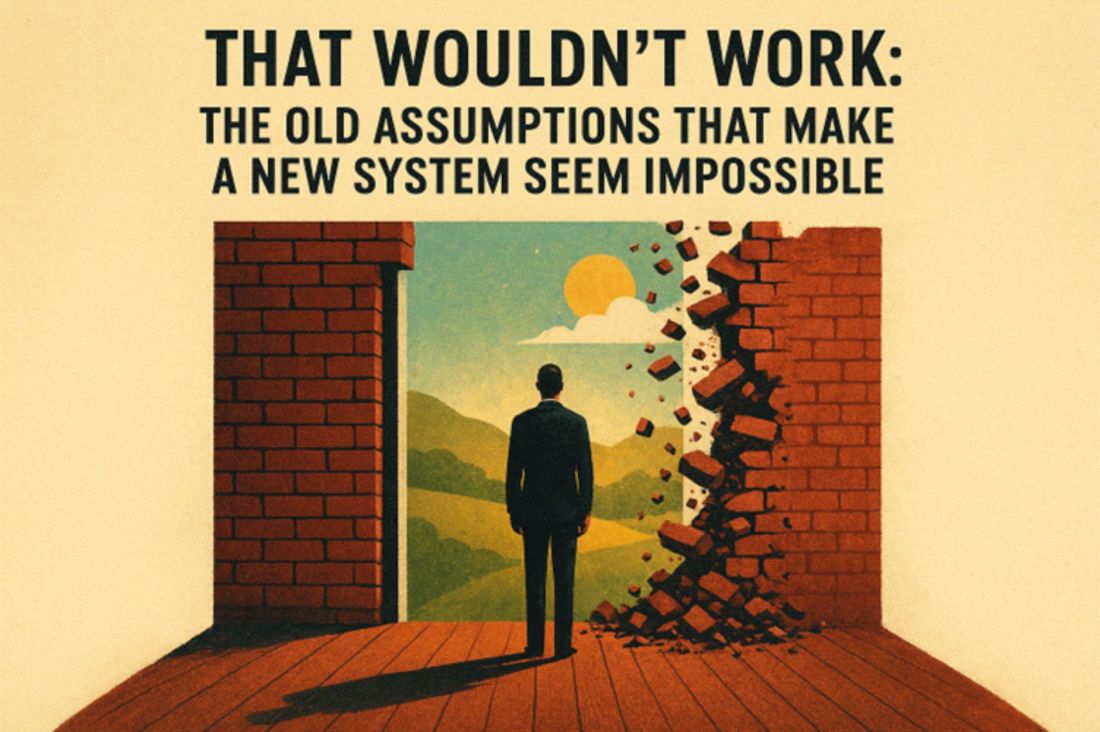
“That Wouldn’t Work”
This is why people say:
“This way of doing things cannot work.” “People won’t behave like that.” “That’s unrealistic.” “That’s idealistic.” “That’s naïve.” “That’s not how the world works.”
These aren’t assessments of the new system.
They are symptoms of paradigm contamination.
The thinker has unknowingly reintroduced the assumptions of the old world – and then judged the new world by the standards of the old.
This is the implosion.
Why the Old Paradigm Reasserts Itself
When you’ve grown up inside the system as we know it today, you internalise:
its motivations its fears its incentives its hierarchies its definitions of value its sense of what is “normal” its sense of what is “realistic” its sense of what is “responsible” its sense of what is “credible” its sense of what is “safe”
These become the mental tools you use to interpret everything – including alternatives.
And this is where the gravitational pull becomes visible. Because when you try to imagine a world that does not use the assumptions you have been conditioned to have, the old logic quietly reasserts itself – not through dramatic errors, but through small, ordinary phrases that carry the entire weight of the current paradigm.
This is exactly what surfaced in The Description Attempt.
The Pull‑Throughs – How Old Logic Sneaks Back In
The slips were subtle, but each one revealed a specific assumption from the current paradigm being smuggled into the new one.
“Steady work” This phrase assumes stability comes from income. In a people‑centric system, stability comes from the Basic Living Standard – not employment.
“The system is slow this week” This is the language of throughput and financial performance. In a people‑centric system, “slow” has no meaning – needs are met, and activity is not measured against revenue expectations.
“There’s a new person here” In today’s paradigm, difference is treated as potential disruption. In a people‑centric system, a new person strengthens the local system rather than destabilising it.
“You’ll get used to it” This reflects a world where people adapt to discomfort because they have no choice. In a sovereignty‑based system, contribution is chosen – not endured.
These slips were not mistakes.
They were evidence of how deeply the old paradigm shapes our imagination.
What the New Paradigm Actually Looks Like
Once you see how easily the old paradigm slips back into your thinking, the next question is obvious:
So what does the new paradigm actually look like when you stop dragging the old one through?
The best way to answer that is through examples – real, everyday situations that reveal the lived logic of a people‑centric system.
Basic Living Standard
Example: Someone loses their job
Old‑paradigm interpretation Losing your job is a crisis. It triggers panic, fear, shame, urgency, identity collapse, and anxiety about survival.
New‑paradigm interpretation Nothing catastrophic happens. Their basic needs are still met. They have time, space, and support to choose their next contribution.
The shift Security comes from the system, not employment. People make decisions from stability, not fear.
Contribution Culture
Example: A community garden needs maintenance
Old‑paradigm interpretation “Whose job is this?” “Who’s being paid?” “Why should I do it?”
New‑paradigm interpretation People step in because contribution is normal. Work is shared, not imposed. Meaning is in the doing, not the reward.
The shift Work becomes participation, not extraction.
Social Learning
Example: A young person wants to learn how to grow food or understand local governance
Old‑paradigm interpretation Learning is a commodity: courses, fees, qualifications, certificates, gatekeeping.
New‑paradigm interpretation They learn from an elder – one‑to‑one or in a small group. Knowledge is passed through relationship, experience, conversation, and shared time.
The shift Learning becomes relational, not transactional.
The Meta‑Cognitive Barrier – Awareness Beyond Mindfulness
This phenomenon cannot be avoided through mindfulness, introspection, emotional intelligence, or critical thinking.
Those practices operate within the paradigm.
What is required is something rarer:
metaparadigmatic awareness – the ability to see the assumptions behind your assumptions, and the stage beneath your thinking.
Most people never reach this level because the current paradigm is invisible to them. They mistake its logic for human nature, its incentives for common sense, its fears for prudence, and its discomfort for danger.
Without this awareness, people cannot help but drag the old logic into the new system – and then conclude that the new system is impossible.
The Emotional Layer – How We Expect to Be Seen
There is another dimension that surfaced during The Description Attempt.
When imagining a different kind of system, people often picture how it would appear from the outside:
Will this look naïve? Will it seem unrealistic? Will people think it’s a commune? Will it be judged as inefficient? Will it be seen as low‑status? Will it be taken seriously?
These questions are not about the new system.
They are about remaining legible within the old one.
When “This Sounds Ridiculous” Appears
At some point, a particular reaction often surfaces:
This sounds unrealistic.
This feels naïve.
This can’t be how people really behave.
That reaction isn’t a judgement on the new paradigm.
It’s what happens when an idea doesn’t fit the stage it’s being imagined on.
Ridicule and dismissal are not neutral responses. They are protective reflexes – ways the existing system defends its coherence when something appears that doesn’t yet have a place to stand.
Seen this way, the sense that an alternative is “ridiculous” is not evidence against it.
It’s evidence that the stage has not yet changed.
The Core Insight
People don’t struggle to imagine alternatives because alternatives are complex.
They struggle because they keep dragging the old paradigm into the new one.
And the moment they do, the new system becomes distorted, contradictory, unworkable, uncomfortable – not because it is flawed, but because it is being evaluated by assumptions that don’t belong to it.
This is the paradox:
People want change because the current system is broken – but they want to take the things that broke it into whatever comes next.
Equal Value, Different Experience
Some people recognise the new paradigm earlier than others – not because they are more capable or insightful, but because their experiences place them at a different angle to the same system.
This is not superiority.
It is not advancement.
It is timing.
The Pain Threshold – Why Most People Cannot Shift Voluntarily
For most people, the shift to a new paradigm is not blocked by intelligence or imagination.
It is blocked by the structure of the current system, which still provides identity, predictability, meaning, reward, legitimacy, and safety.
People move when the old system stops working – not because they lacked insight, but because necessity loosens the stage beneath their feet.
Conclusion
The Description Attempt was never meant to expose anything.
It was simply an effort to describe an ordinary moment in a different paradigm.
But the difficulty of doing so revealed something fundamental:
When people try to imagine a world built on different assumptions, they instinctively reintroduce the logic of the world they already know.
And the moment they do, the new world collapses back into the old one.
This is not a failure of imagination.
It is the gravitational pull of a stage that has shaped what people think is possible.
Understanding does not usually come first.
It follows experience.
And when the hold of the old stage finally ends, the space for a different performance opens.
Everything meaningful about the human journey is built on the foundation of physical experience. Not digital. Not remote. Not externalised. When our locus of attention, qualification, and authority is moved outside ourselves, we become willing to accept any tool or process that makes that external dependency feel easier. This is why our surrender to digitisation appears logical and natural, even though it is actively eroding the last remnants of freedom and sovereignty we still hold within ourselves.
Digitisation is not the beginning of this problem. It is the final step in a long process of externalising personal power – a process in which individuals gradually handed over their sovereignty to third parties that were once local, then regional, then national, and now global. As these centres of power moved further away, our agency, control, and ability to determine anything of real meaning in our own lives diminished. Into that vacuum flowed the tool that now shapes every motive, every thought, and every decision: money.
Progress vs. Direction
Some will argue that this chronology is simply “progress”. But progress in the sense of advancement is not the same as progress in the sense of direction. Humanity can advance technologically while moving in entirely the wrong direction. And that is exactly what has happened.
The dynamics of inequality have existed long enough that many now believe hierarchy – even the patriarchal structures that underpin it – is natural. But at the root of all hierarchy lies something far simpler: an imbalance in the basic human relationship. Some take more than they should because they believe it is acceptable to do so. Others give more than they should for the same reason. Fear – fear of lack, fear of isolation, fear of consequence – drives both sides of this imbalance.
Over generations, this dynamic hardens into a chain of hierarchy. Those at the top come to believe it is their right to control everything beneath them. Those at the bottom come to believe this is the natural order of things. But it is not natural. It is simply the next generation of victims inheriting a system built on the myth that domination is normal.
Distance: The Medium of Disempowerment
Distance is the mechanism through which personal sovereignty is removed. When power is located somewhere else – in a distant institution, a remote authority, or an unseen system – people begin to assume that their own power no longer exists. The lived experience of this reality becomes compelling enough to create a cultural belief system that reinforces the very conditions that disempower us.
This is how centralisation becomes self‑perpetuating.
The Digital and AI Revolution: A False Promise
Many questions already surround the so‑called “technical revolution” and the rise of AI.
What would it mean for humanity if technology took over everything? And more importantly: how could such a transformation even be financially sustained?
Because whether intended or not, the direction of travel is clear: the complete submission of humanity to an external locus of power. Every element that makes human life valuable is being placed under the control of third parties.
Thought, creativity, decision‑making, even the right to act – all increasingly require permission from someone or something else.
This is the antithesis of human freedom. It is the extreme opposite of what life is meant to be.
Human experience is built on the freedom to choose – even if that choice leads to difficulty, even if it leads to suffering, even if it leads to mistakes. Choice is the mechanism through which we learn. Without choice, there is no growth, no meaning, no journey.
Free Will Requires the Absence of Undue Influence
Free will can only exist when no external factor exerts undue influence over the life of the individual. This is why few can remember anything before their current lifetime, and why doubt about what comes next is necessary.
If we remembered everything – past lives, consequences, outcomes – our choices would be influenced.
If we knew with certainty what comes after death, our decisions would be predetermined.
For free will to be genuine, the field must be clear.
But the patterns established by our earliest ancestors – patterns of fear, domination, control, and imbalance – echo down through generations. These inherited distortions shape the world we now inhabit, creating the very mess humanity must confront today.
AI Is Not the Enemy – The System Using It Is
AI itself is not inherently bad. It is extraordinary technology with the potential to support and enhance human experience.
But under the current money‑centric system, AI has become a tool for profit, centralisation, and control.
Instead of enabling humanity to flourish, it is being used to replace human value, not elevate it.
And the truth is this:
The current AI model is financially unsustainable.
The infrastructure, energy, hardware, and investment required to maintain and expand AI systems exceed anything humanity has ever attempted – far beyond roads, railways, or industrial revolutions. The global economic system, already overburdened and extractive, cannot sustain the demands of the tech industry. The imbalance is too great.
Like any ecosystem pushed beyond its limits, collapse becomes inevitable.
The Coming Correction
The collapse ahead is not a single event. It is a necessary correction – the unavoidable consequence of a world that has moved too far out of balance.
AI may be the catalyst, but it could just as easily be:
financial market failure
global supply chain breakdown
geopolitical conflict
civil unrest
or all of these combined
The signs are already visible. The system is cracking under the weight of its own contradictions.
Those who control the technology will not achieve what they intended. The masses, whose lives have been upended by a chapter in history defined by selfishness and self‑interest, will eventually recognise that the system is too broken to repair.
At that point, humanity will have no choice but to begin again.
Universal Law Will Not Allow Otherwise
Natural or universal law is not mystical. It is the simple truth that life cannot be built on domination, coercion, or imbalance. Human existence is not meant to revolve around material gain, control, or the belief that some lives are worth more than others.
Civilisations that violate this law collapse.
Atlantis – whether literal or symbolic – stands as a warning. Cultures that believe they can override the basic principles of existence eventually destroy themselves. The parallels with today are striking: a belief that anything can be reshaped to our will, that limits do not exist, that consequences can be ignored.
But life is not meant to be conquered. It is meant to be lived, learned from, and respected.
The Return to Local Sovereignty
People are meant to be sovereign. And sovereignty is meant to be local – rooted in physical presence, real relationships, and face‑to‑face human experience.
Our relationship with the outside world was intended to be a learning tool: people, community, environment, and the processes that sustain life.
Personal sovereignty is the freedom to know oneself, to be self‑aware, and to navigate life from a place of internal authority rather than external dependency.
Contrary to what the powerful claim, this ability is not reserved for the educated or privileged. Real intelligence and real love are embedded in the way we choose to live together.
Care and contribution are among life’s greatest lessons. The greatest fulfilment does not come from competition or superiority, but from the experience of facing each moment with the freedom to do the right thing without fear.
The True Meaning of Freedom
To be fully present – to work with both past and future in healthy ways – is to experience a peace that no material wealth, power, or control can buy.
This is the freedom that digitisation, centralisation, and the money‑centric system have taken from us.
We’ve reached a point where legality is used not to restrain power, but to excuse it. In a recent blog post I explored the increasingly indistinguishable relationship between morality and legality – a relationship that politicians now exploit to legitimise deeply questionable policies, behaviours, and acts.
By making what is morally wrong legal, they imply that legality itself confers moral authority. It doesn’t.
And yet legality is routinely used as a shield, either to excuse inaction or to justify actions that, outside the narrow frame of law, would never be accepted.
I previously touched on the slow response of the current Labour government to open U.K. airfields – and even Diego Garcia – to support the U.S., as well as the reluctance to commit military resources to defend RAF Akrotiri in Cyprus. The vulnerability of this base was obvious, and it has since been attacked. But I didn’t explore the deeper question: the morality of war itself.
War is not moral. It cannot be. Every war begins with a fundamentally immoral cause, no matter how convincingly those in power package the narrative for public consumption.
The instigation of war is the legitimisation of killing on a collective scale. The idea that industrialised killing can be justified while an individual with a weapon cannot is a reflection of how dehumanised our world has become. At the individual level, there is no freedom to learn from wrongdoing; at the centralised, hierarchical level, those in charge can do whatever they like simply by writing a law that makes it “right”.
History is full of examples. Iraq is widely accepted as a spurious war, but it is far from unique. Western powers have repeatedly involved themselves in regime change under the banner of removing tyrants who were presented as imminent threats to the West, when the real purposes were considerably different. Legality was used to sanitise actions that were, at their core, driven by interests rather than morality.
And this is the real danger. Whether on a personal level or at the scale of dictators and governments, conflict begins with people who want to take from others, dominate others, or assert difference for their own benefit. We have allowed a system to unfold that can be manipulated and abused for exactly those purposes, all while being presented as operating in humanity’s best interests.
Human nature leans toward self‑interest, and its impact is often overlooked. This reality means that even the most enlightened communities require systems of protection. Today, that usually means military capability. Protection and security are necessary. But possessing the means to defend ourselves does not make it acceptable to repurpose those means whenever those in power encounter a situation they dislike.
True power is not the ability to destroy nations while offering flimsy public justifications. True power is the ability to hold force responsibly – and to choose not to use it. If legality is to mean anything, it must be rooted in morality rather than used to escape it.
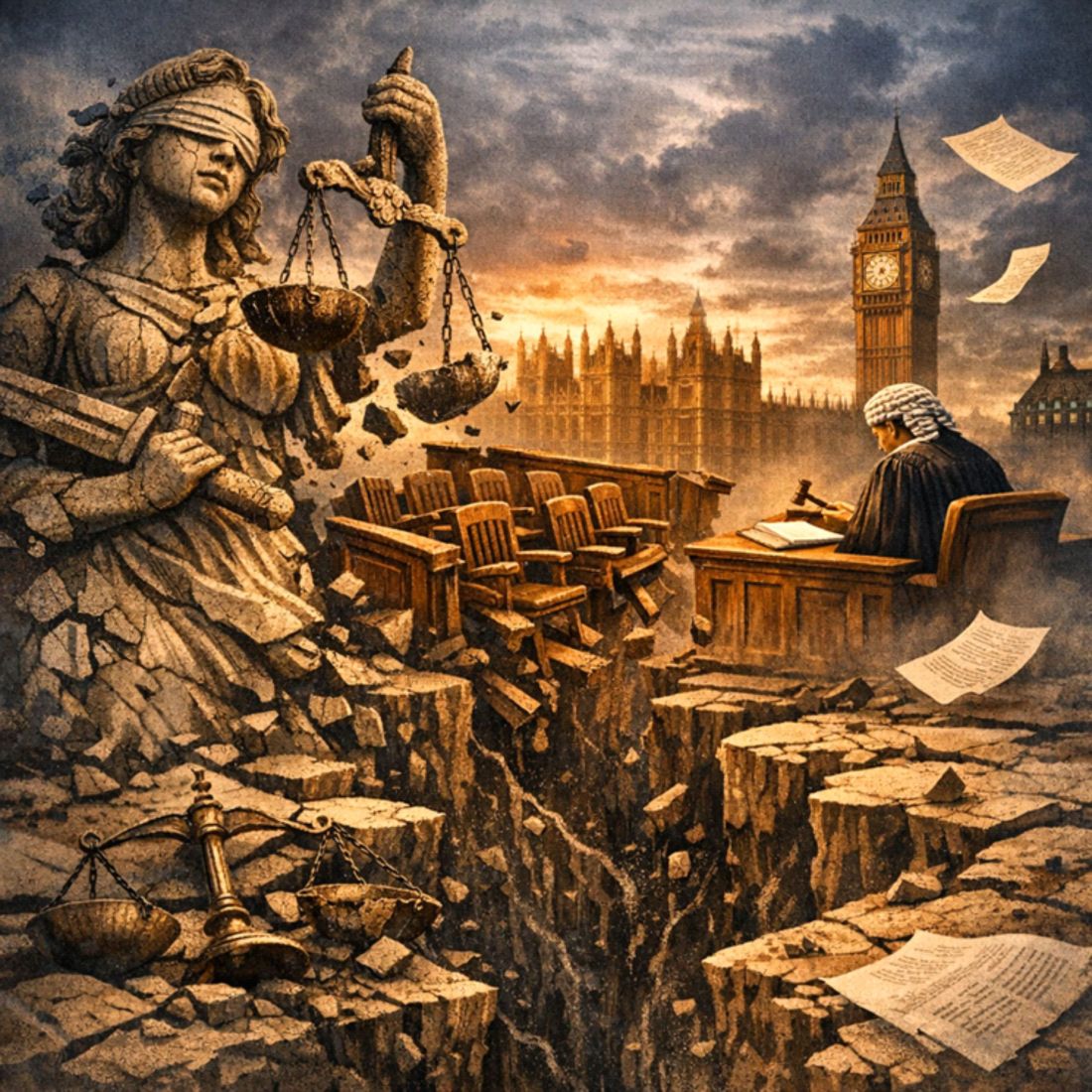
For centuries, trial by jury has been one of the defining features of British justice – a democratic safeguard that ensured no individual could be deprived of liberty without the judgement of ordinary citizens. It has been the remaining beacon of legitimacy in a system increasingly strained by political interference, regulatory overreach, and a culture of legal interpretation that often feels detached from the lived realities of the people it serves.
Yet today, that safeguard is being quietly dismantled. The government’s move to remove jury trials for offences that can still lead to imprisonment is being presented as a practical response to delays and backlogs.
But the implications reach far deeper than administrative efficiency. This is not a minor procedural reform. It is a fundamental shift in the relationship between the public and the state.
The Law Exists by Consent – Not Command
Politicians often forget that the law is not a one‑way instrument. It is a social contract. It functions because the public accepts its legitimacy and agrees to be bound by its outcomes. When the state begins to remove the mechanisms that ensure fairness, independence, and public participation, that consent begins to erode.
Jury trials have long been the clearest expression of that consent. They ensure that justice is not simply something done to people, but something done with them.
Why Barristers Themselves Are Sounding the Alarm
Some of the strongest voices opposing these changes come not from activists or commentators, but from barristers – the very people who work within the system every day. Their warnings are not ideological. They are practical, grounded, and deeply informed.
They argue, rightly, that judges are legal specialists, not life specialists. They are experts in statute, precedent, and procedure – but not in the full spectrum of human experience, nuance, and context that shapes real‑world events. And crucially, judges are not immune to the pressures of their environment.
They speak openly about issue fatigue: the psychological narrowing that comes from hearing similar‑looking cases day after day. What appears repetitive to a judge may in fact be profoundly different for the individuals involved. Every person is different. Every case is different. No two experiences are the same. A jury, drawn from a cross‑section of society, is far better placed to recognise that diversity of experience.
The Myth of Judicial Objectivity
We like to imagine that judges operate in a vacuum of perfect neutrality. But recent years have shown that judicial decisions can be influenced – consciously or not – by political climates, public pressure, institutional expectations, and personal beliefs. Judges are human. They are shaped by the same cultural forces as the rest of us.
A jury, by contrast, dilutes individual bias. It brings together twelve people who have not been steeped in the same professional culture, who have not spent decades seeing humanity through the narrow lens of criminal litigation, and who are far less likely to be influenced by the priorities of the government of the day.
Efficiency as a Trojan Horse
The official justification for removing juries is the need to speed up the justice system. But efficiency is a dangerously convenient excuse.
Once the principle is broken – once the state can imprison people without the involvement of their peers – the scope of cases affected can expand with alarming ease.
History shows that rights rarely disappear in one dramatic moment. They erode through small, “practical” adjustments that seem harmless until the cumulative effect becomes impossible to ignore.
A System at Risk of Arbitrary Justice
If the law were as clear, consistent, and responsive as it should be, perhaps the removal of juries would be less alarming. But we are not in that place. We are in a moment where interpretation often trumps principle, where political expediency shapes legal outcomes, and where public trust in institutions is already fragile.
Removing juries in this context risks creating a system where convictions are shaped not by moral or ethical correctness, but by what is convenient or beneficial to those in power. That is not justice. It is administration masquerading as fairness.
The Disguised Destruction of a Foundational Right
Trial by jury is not an outdated relic. It is one of the fundamental tenets that made Britain a place where ordinary people could trust that the state would not act arbitrarily.
It is a democratic guardrail, a cultural inheritance, and a practical mechanism for ensuring that justice reflects the society it serves.
To remove it – and to do so under the guise of practicality – is not reform. It is destruction dressed up as efficiency.

 Adam Tugwell