In the Book ‘Levelling Level’ I discussed the food issues relating to what we need vs what we want, and how the future is primed to require that we return to a very simple relationship with the food that we eat – because much of what we ‘live on’ today, may soon become unavailable, unaffordable or in all likelihood both.
The foods that we eat are making us ill. In some cases, they are actually killing us. And the only real reason that we have been and continue to fall over ourselves to eat foods that are fashionable and apparently taste good, is someone somewhere makes a lot of money when we buy into a narrative that’s based on nothing that is easy to see.
Regrettably, it’s no longer as simple as parents and self-sufficient adults choosing between healthy eating and eating ultra processed foods or living on takeaways.
Food that’s good for us is expensive to buy. Healthy food can be expensive to prepare. And life is conditioned to make us believe that fast everything is good for us and is the very best way to live – no matter the damage it does in ways that many would find hard to believe.
The stories and marketing campaigns that make the system work this way are convincing. Because they always contain a small element of truth. No matter how irrelevant to the key subject it might be.
Bad food certainly tastes good. But how do you feel after you’ve eaten it?
Ultra processed food certainly appears to be the quicker and easier option and it seems to always be available here and now. But have you ever considered the real cost – that’s the cost beyond what we pay for food that has no identifiable resemblance to whatever it contains?
Basic, or rather essential foods, are the vegetables, meats, fish, dairy products and breads that require no processing or very simple and straightforward processing to prepare for eating that we might call traditional and would be carried out by hand or simple mechanical processes such as milling through a water powered or wind powered windmill.
Basic or Essential Foods are those that we can prepare ourselves or can access them with only one or perhaps only two steps of handling or preparation between our front door and the farm gate, orchard or quayside from where the raw ingredients were harvested or unloaded from the catch.
Good, healthy and nutritious basic foods that come from the UK or around our shoreline only seem to be expensive now, because the whole food production system has been engineered in such a way that UPFs and foods that come via very large supply chains are considered to now be normal. However, they are only normal because they are the most cost effective ie profitable way for the big companies retailers and commercial interests that make ridiculous profits from a system that otherwise defies all logic.
If you are ready to eat healthy and embrace sourcing and preparing food that is nutritious – and delicious in its unadulterated forms, you could be helping to increase U.K. food security by making this very positive switch.
The more we buy local vegetables, dairy products, breads, pies, cakes, fish, hams, bacon, sausages, other meats and foods like these that local farmers, growers and fishers offer us, the better the offering will become and the better the prices will be for us all.
Demand will help producers to switch their business models and the operational processes within them to working in ways that are not only sustainable, but with every step will help make the U.K. food supply more and more secure.
If you have access to a farm shop, farmers market or fresh fish delivery round that connects with one of the UKs amazing fishing ports, please use them – even if only as a special treat. Tell everyone you can where they are and what they do.
You’ll be helping our producers to change their businesses in a very positive way.
But above all, you’ll be helping U.K. farmers, producers and growers to help you!
Awake in the early hours of this morning, I went through my social media feeds and didn’t have to travel far before a post from Reuters popped up that flagged the upcoming profit announcement from Tesco, which as a BIG retail business currently holds a 27% share of the U.K.s grocery market.
You’ll probably agree that £3.3 Billion is a lot of money. But to be fair (I thought), if you were to roll that out against the number of people and the number of shopping trips per week, it would probably only be something like a quid (£1) – which on a £100 a week shop would surely seem very reasonable.
To be fair, I wasn’t convinced.
I decided to do the maths. And once I’d gone through a quick recap of formulas for MS Excel (because I couldn’t get the calculator to work easily with figures in the billions), I had a quick dig around for the latest figures I could find on UK population (67 Million in 2021) and the average number of people per household (2.4).
To make it easier on my early hours and flu ridden brain, I decided to narrow the figures down to the equivalent of one weekly shop per household. The purists amongst us would argue that it needs to be more precise (I use a Tesco Express as well as the local superstore and am sure many others do to). But for the purposes of getting some perspective, the results are pretty much the same.
What I ended up with (and please feel free to correct me if my 2am mathematics was out) is that of the households that shop weekly at Tesco, an average £8.38 of the cash price of that shop or the payment is pure profit for Tesco. Or, rather, that is the money they pay to their shareholders via dividends at the end of their company year.
My guess is, that’s plus or minus the equivalent of 10% of most of our shopping bills. When you put it into this context, it seems rather a lot.
And that’s before thinking about what all the big corporate interests that sell goods to Tesco make, when they are big enough and have clout enough to dictate to a retailer of this size and with this level of market share what the prices and margins will be.
However, the question ‘What is an acceptable level of profit?’ does become cloudy when we add the perspective that a local farm shop or food trader at a local farmers market may not be able to function with a percentage profit margin, that for a very SMALL business is likely to be catastrophically low.
The issues around our food supply and how we make production sustainable across the UK whilst also making it secure and fully accessible to all are very complex indeed.
One of my greatest frustrations, is the reality that growing numbers of us know there’s a big problem growing with food and keeping us all well fed. But nothing really helpful is happening, because the positions that all the stakeholders have, really aren’t in any way joining up.
‘But the problem is clear!’ I hear you say. And yes, to you, whether you are a farmer, a grower, a fisher, a retailer, a consumer or whatever; the way you see the food problem or any one of a number of them may well be very clear indeed.
The trouble is, everyone is seeing the food problem or rather problems, from their own perspectives and therefore, in a range of very different and sometimes conflicting ways.
Regrettably, being able to see the reality of the situation is one thing. Getting so many different stakeholders or groups of stakeholders to accept that there are alternative perspectives that are just as real as their own perspective to others, is entirely different.
It doesn’t matter whether the perspective is correct, incorrect, misled or only partially formed. If it makes up part of your belief system, the chances are that you are emotionally tied into it and won’t find it easy to see the situation easily in any other way.
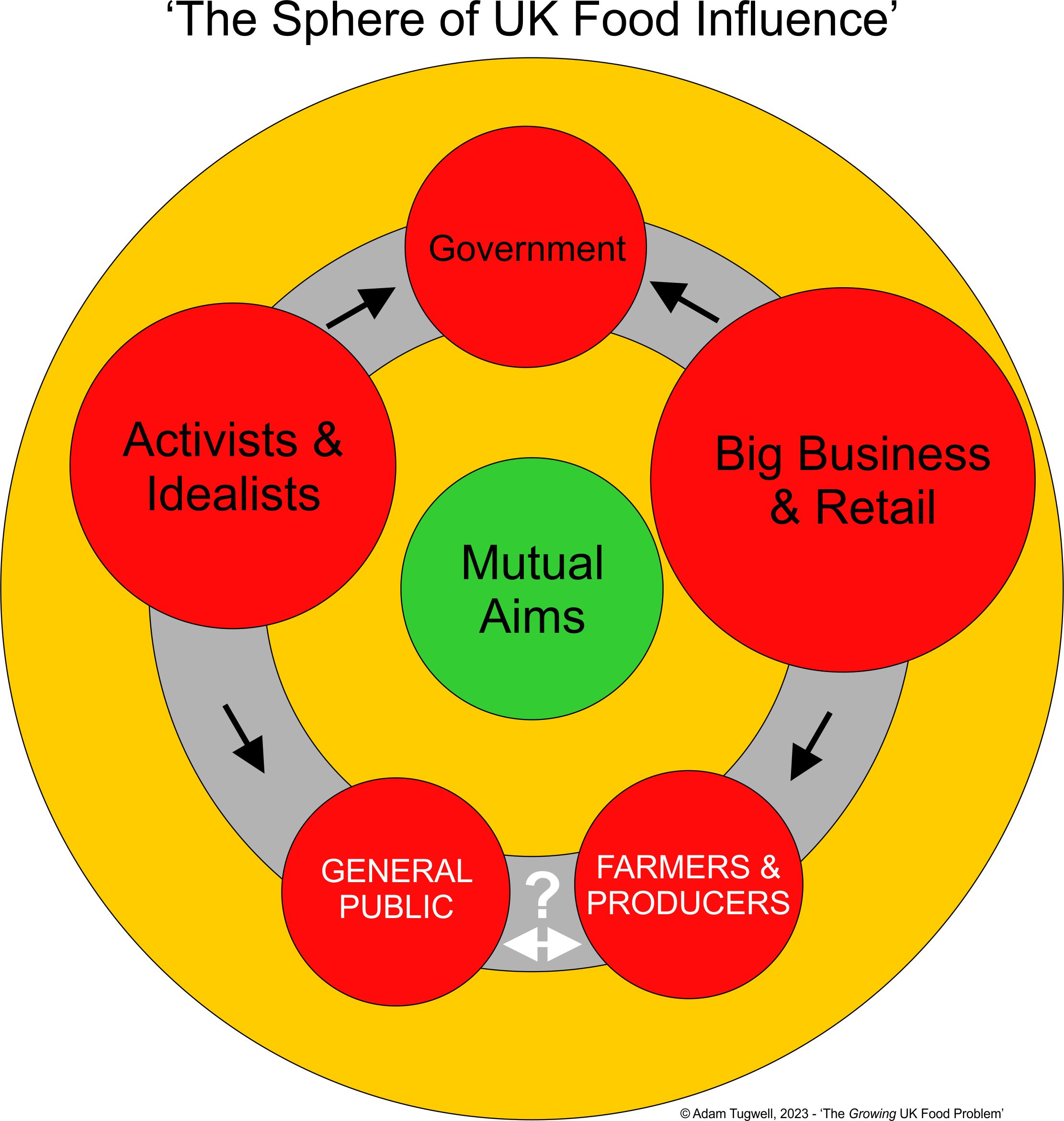
The way that influences on food production really work today. Government is who we all expect to be ‘in charge’. Whereas the reality we face is that Big Business & Retail run the food show to an overwhelming degree, with any remaining influence being in the hands of activists and lobbyists. The irony is that the most important stakeholders are the general public – ‘The Consumers’, and the Farmers and Growers, or ‘The Producers’. Yet, other than farm shops and farmers markets, there is basically no meaningful relationship in-between.
During the research and outreach that I have planned as part of The Growing UK Food Problem, I intend to focus on as many of the different perspectives as possible. However, with the risk of a food crisis being very real, and with nobody appearing to even think about how we feed the UK if for instance the borders to our Country should be bolted closed, it’s the outlook of our Farmers and Producers that is the most important to think about – right beside that of the general public or end consumer i.e. that of our own.
I expect to be challenged at the very least by some of the great farmers that I already know. But what is very clear to me is farmers and producers have become dependent on financial incentives, subsidies and contractual arrangements with big businesses (that in some cases at least arguably have no real reason to be in farming other than making a profit).
This ‘dependency’ on government and ‘free cash’ has already done significant damage to key UK sectors whose participants are arguably some of the most entrepreneurial and creative around. But have been done a massive disservice (as we have) by centralised EU rule making, that is nothing more than globalisation in a localised, franchised or more publicly acceptable form.
Like many of you, I have read of the frequent attempts made by Industry lead Minette Batters on behalf of the NFU, to warn of the impending food security crisis that is very much here already, when considering that only around 50% of our food (or rather the equivalent of) is grown and produced here at home, in the UK.
Instead of listening, the payback is the political stupidity of out of touch politicians. Perhaps best illustrated by the recent comments made by Jacob Rees-Mogg, that echo decades of inept political thinking that stumbles from one crisis to another by out-of-touch rules such as none of the food the UK Population needs to survive, needs come from within the UK.
Farmers and Producers don’t see the alternative way of thinking. Because culturally they see the way things work today as being ‘just the way that it is’.
Yes, there are good reasons why an industry that’s already on its knees doesn’t want to take on the role and responsibilities of repurposing and redefining their role in the food supply chain. At least not without the financial help that a proactive and risk-aware government and political system would have already prioritised for the safety and security of the people it is supposed to represent, perhaps years ago.
But without stepping away from the shibboleths and the ‘ties that bind us’ to the same thinking that created this whole mess, there is a genuine and very credible risk that what is left of UK farming wouldn’t be able to feed the nation if a national emergency were to arrive in a way that many looking more closely now expect. Potentially VERY soon.
And that if the direction of travel should continue, where farmers and producers continue to be led by people and interests who either don’t have a clue, or have other vested interests that are in no way aligned wither with UK food security or sustainable agriculture, we are really no great distance from a situation where the infrastructure and resources that could be redirected to local production today, simply wont be there for us to do so within a very short period of time.
What does Climate Change mean for you? What does Net Zero mean for everybody? When does pollution become a critical problem?
Are you really sure?
On the face of it, the politicians who already represent us or wish to do so know what you think and more importantly, what you want. In fact, they are so confident of your concern about Climate Change, your commitment to Net Zero and when pollution matters, that they are making decisions for you, that are going to cost you, so that they can deliver whatever it is they know that you want.
But did they come to your door, talk to you and check that ULEZ, Low Traffic Neighborhoods and in fact any form of non-criminal fine implementation – or rather what we should more honestly call supplementary fundraising and do anything that confirmed it was what you want?
Conversely, I would like to bet that no political candidate or their representatives have EVER knocked on your door or put any leaflet, newsletter or manifesto through your letterbox at election time that has made the claim ‘Vote for me and MY party, so that we can do whatever the hell we want to make our lives easier in power and then get reelected’.
What do you Vote for?
The problem, for us, is that Politicians have been telling us, our parents and our grandparents before them, whatever they needed to when an election was coming, without making clear that unless most of the other politicians they are running with get elected too, the chances of them being able to do whatever they have promised you could easily be as much as nil.
And do please bear in mind that when politicians do get elected as part of a working majority of candidates – as this Government did in 2019 with an 80-Seat-Majority, when it was elected with Boris Johnson in No.10 – politicians have a very nasty habit of not even delivering on the commitments they have made to you, even then.
Regrettably, the non-democracy that we have in the UK (and across the Western World) means that Politicians have to create stories or what are called narratives, that will fool enough of us into believing what they say, so that the politicians can then create and implement public policies that aren’t really public focused policy at all. But policies that exist just to help them to stay in power, to further their own interests, to win and to keep winning.
The more emotive and fear-provoking the policy, the better. Because when you are scared of what could happen if the solution to the problem they have created isn’t achieved, the chances are that for you, the future will look very grim.
Because they told you so.
What is the con, and how long has the con been on?
Politicians have been doing this to all of us for a very long time. But they have never been doing it as comprehensively and effectively lying about everything in the way that they are doing so right now.
Now, before you get the idea that Climate Change isn’t real, please just hold that thought for a moment.
Climate Change is most certainly happening.
However, what even the scientists cannot be certain of, is how much of Climate Change, if any, is down to industrialisation and man-made pollution. Or how much of it is down to the natural cycles of change that have occurred on the Planet that is our home, probably from the moment that it came into being, whenever that was and however it occurred.
Either way, the biggest problem that isn’t talked about by politicians or the many large and often global companies that regularly sell you things, is that the real problems that we face come from the unnecessary overuse of natural resources, and the habits that we have all been conditioned to have.
Habits that become our truth, that make a few people very rich, make us believe we are happy, but are quickly making life unaffordable whilst destroying the quality of all the life-supporting functions of the World that we do have.
To put some perspective on this, if you live in a house with three other adults, does your household really need to run four cars?
It is important to consider this point. Because just as there is a truth about climate change that makes the whole political fear factory work, there is another truth that is very uncomfortable for all of us that rests on the reality that we don’t need all the things that we have, and we certainly don’t need to do all the things that we do.
Climate Change is a political Trojan Horse that hides the bigger truth hidden within
So then. Right now, we are all the guilty bastards. And that guilt is being used to help create the myth that we all must accept whatever the politicians do, whenever it comes to addressing Climate Change, implementing Net Zero, and yes, whatever else the politicians next tell us it is imperative for them to do.
What the politicians aren’t telling anyone very loudly – even though all the information and case history is out there in the public domain for us to see – is that the real reason for all of these urgent schemes to be implemented not comprehensively across the UK – but at very localised levels and in very area specific ways, is that they are all about raising sufficient revenue and additional funding, to prevent the government organisations or authorities from going bankrupt.
Because for one reason or another, these authorities have already spent all of their income – which is typically your Council Tax and then other money that comes from central government funds.
The solutions to worldwide problems aren’t only City-wide.
The problems and the depth they have reached are very localised too.
This is why we have a situation where the Labour Mayor of London has rolled out a much wider ULEZ scheme that can easily be linked to covering the costs of the London Transport bailout from the Government. All arguably given on the basis that Khan had to make the overall cost of what he is doing sustainable – which in our language doesn’t mean being ‘green’; it means making sure that whatever income he raises is actually enough to cover all the costs.
If you live in the London area that is now covered by the ULEZ, it really doesn’t matter what your politics is, or whether you voted for the election of Mayor Khan or not. The Climate and Pollution story he has been telling everyone is almost certain to be a fractional truth. But the bigger truth is that the ULEZ scheme is a device that the mayor is using to treat Residents, Businesses and Visitors as a cash cow.
And he needs the money that ULEZ fees and fines will give him, because he cannot cover the costs of poor management, with profligate and unnecessary spending across his administration in any other way.
Yes, the Truth can seem stranger than Fiction.
You may not believe this view, or you may not want to. But if the London Mayor were to be honest and say to you, ‘The only way I can keep you happy and make sure you keep voting for me is to spend, spend, spend and spend more of your money – because I don’t know how to run London in any other way’, Would you really be happy to reach into your pocket and allow him to charge you to cover those costs in a more open or transparent way?
All parts of Government are now a business. A business about power and keeping it, and it’s the powerless spectators who will be forced to pay the rising fees that provide less and less.
It may sound like I’m having a downer on Sadiq Kahn. I’m not. I don’t even know the guy, personally.
It’s not personal. He’s just gone out and asked for the People of London to trust him as Mayor, when he clearly cannot do the job that he asked to be trusted to do.
On the basis of the ULEZ debacle itself, it’s far from certain that Khan will be reelected, whenever the next London Mayoral Election race is run.
However, local authorities and the Westminster Parliament itself are filled to overflowing with thousands more politicians that think like him, who are going to use every myth, narrative and story that they can to justify passing the bill to you, on top of everything else that you already overpay.
The uncomfortable truths that we all have to face if we don’t want things to continue the same way.
What few realise and even fewer accept, is the role that we are all playing in this. And what changes WE need to make, if we want to be treated by government and by business as human beings, rather than the source of the income that allows just them to keep on doing whatever they want to do.
If we want public representatives to represent us, we cannot continue to allow the political parties to run a monopoly on government between them, that closes the door to good leaders, and allows the interests of the few to be prioritized above all others – often with costs attached for the victims that politicians will never understand.
However, it doesn’t stop there. We all have to start waking up to the realities of the unsustainable and care-free way of living we are indulging, that comes with a ridiculous level of cost to our health, our way of life, our communities and our future too.
The irony is that if we were not as obsessed with all the things we want and how everything looks, and learned to be happy buying and using only the foods, goods, equipment and services that we genuinely need, the Climate and ENIRONMENTAL problems that are part of the growing list of problems that EVERYONE’S behaviour has helped to create, would quickly be solved – and without useless politicians pretending they have helped in some way or done their part too.
Our behaviour is making it easy for charlatans to take power and use it to control our lives. You have the power to change all of this. What is the next thing you are going to do?
It is often said that history is written by the victors of wars. Perhaps it should also be applied to controllers of any monetary system – that is when money or currency has itself taken on a role which means it is valued in such a way that gives power when the system can be controlled.
Money isn’t real. It isn’t a thing. Its true purpose – before that purpose was wilfully misrepresented and manipulated – is to be a medium of exchange for anything and everything that has value.
Money is a tool and nothing more.
Instead, Money has become the ‘thing of value’ itself. Meaning that everything else, whether it’s the effort of a labourer, the time of a professional, the purchase price of a house, or the cost to buy and cook the essential food that everyone needs, no longer holds the real value that it should.
The value of things in life that really do have value, that should be dictating the size, scope and way that economics work, are instead dictated by the technicalities of how a very sick and self-serving monetary system operates.
The history of anything only matters if you intend to make it real or legitimise it or whatever you intend to anchor to it. That’s why so many politically correct and woke people are falling over themselves to rewrite and manipulate history to give ‘truth’ to whatever it really is that they intend to do.
The question is, why do the architects of the coming monetary collapse feel it is so important to focus on the history of money right now?



 Adam Tugwell