
The world is now spiralling into a level of crisis that has been quietly baked into the global system for decades. The only real unknown was which straw or rather event would finally snap the camel’s back – or which domino would fall first and set off a chain reaction that spreads in every direction at once. That moment appears to have now arrived, and a crisis is unfolding faster than many in power are prepared to admit.
For a UK government already under immense pressure – and for an economy that was flatlining long before the current occupant of the White House decided it was time to begin a war with Iran – the explosion in petrol prices initially looked like a political gift. It offered the chancellor and prime minister a brief, open‑goal opportunity to blame someone else for the problems they face. But that moment evaporated quickly.
As the scale of what was coming into view became clearer, we can be sure that a collective deep breath was taken across the corridors of Westminster. Those responsible for designing policy began to realise that this crisis is not a temporary shock. It is the beginning of something much bigger.
Why This Oil Shock Is Different
Escalating fuel prices are not new. The UK has weathered oil‑related crises before. But this time is different – and dangerously so.
The immediate reduction in fuel supply aside, each day brings new evidence of significant damage to key oil infrastructure across the Persian Gulf. The consequences are twofold:
• Gulf states are being forced to adjust production, raising serious questions about the volume and reliability of future supplies.
• Iran’s continued threat to shipping through the Strait of Hormuz means even the oil that is available may not be able to move freely.
Markets around the world are already shaking simply on the question of future oil and gas supply. And that’s before anyone begins to peel back the deeper layers – the uncomfortable truth that fossil fuels, despite decades of wishful thinking and political slogans about net zero, remain the foundation of every part of modern life.
Energy is not just another commodity. It is the bloodstream of the entire system. And a very BIG penny is dropping in London.
The Government Knows This Is Not Normal
While the mainstream media continues to maintain a narrative that everything is fine, and that the War around the Gulf is just another one of those things, the government’s behaviour tells a different story. Ministers have already talked up help for households dependent upon fuel oil supplies that fall outside of other forms of energy price capping. Now they are openly discussing targeted support for those struggling with energy costs across the board.
This is not the language of a government that believes the situation is temporary or manageable. It is the language of a government that knows the crisis is snowballing – and that the public must not yet be allowed to see how bad things could become.
Help for those with very little is essential. But the scale of the challenge is shifting. In the coming weeks and months, the issue may become less about price and more about supply and rationing.
Fuel poverty is already closely aligned with food poverty for millions. The growth of food bank use across the UK tells a story of people lacking access to life’s most basic essentials – a story successive governments have tiptoed around while are offered soundbites like those about “working people” that never quite explain who, or what they mean.
The Real Cost of Independent Living – And the Gap Government Won’t Admit
To understand why targeted support is politically dangerous, we first need to look at what it actually costs to live independently in the UK today.
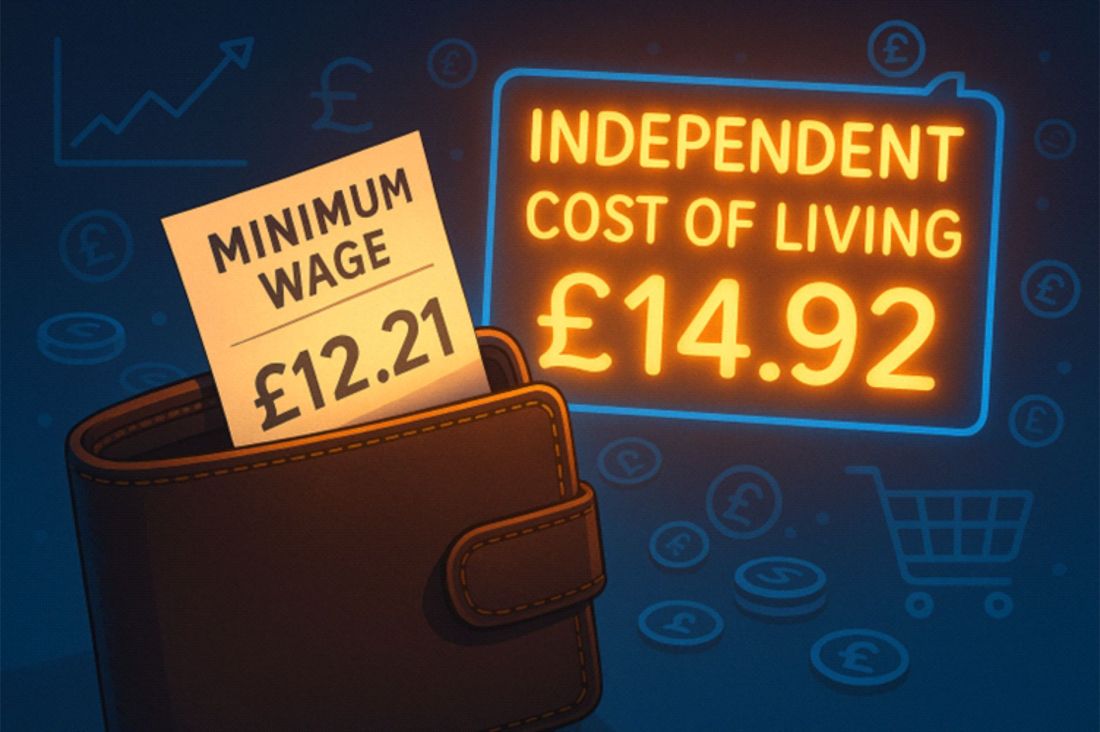
In late 2023, I ran an exercise to calculate what it costs a single adult – not a family, not a household with shared bills, but one person living alone – to survive without help of any kind. The figure was £14 per hour for a 40‑hour week.
Using the real rate of inflation between October 2023 and March 2026 – 6.6% – that figure rises to £14.92 per hour.
The current national minimum wage is £12.21.
That leaves a shortfall of £2.71 per hour, or £108.40 per week, for a single adult working full‑time.
This is not a marginal gap. It is a structural one. And it exposes a truth that governments of all colours have avoided for decades:
Millions of people in this country cannot afford to live independently.
They survive only because the system quietly accepts that they need:
• benefits
• charity support (including food banks)
• debt
• or help from family and friends
The phrase “cost of independent living” matters. It forces us to confront how much support is required simply to keep people afloat – support that is only necessary because wages are too low and living costs too high.
The Hidden Truth About Wages, Poverty, and Government Subsidy
The government now says it wants to target energy support only at those who need it most.
On the surface, that sounds reasonable. But it raises an obvious question:
Why don’t they already know who needs help?
The truth is they do know. They have known for years.
Government systems already hold:
• HMRC income data
• DWP benefits data
• council tax and housing records
• energy performance and property data
• debt and arrears information
If the government wanted to identify every household in financial distress, it could do so in days – not months.
The real problem is this:
If the government targets help accurately, it will be admitting that it already knows the minimum wage is too low and that the economy only functions by allowing businesses to underpay workers while taxpayers subsidise the gap.
This is the political truth they cannot afford to say out loud.
Why Previous Governments Could Hide the Truth – And Why This One Can’t
When previous governments rolled out broad, untargeted bailouts, they could afford to. Public borrowing was lower. Fiscal headroom existed. They could firehose money in every direction without having to explain why so many people needed help in the first place.
But today’s government does not have that luxury.
The crisis is too big. The debt is too high. The room for manoeuvre is gone.
If they overspend now, the markets will punish them.
If they target support accurately, the public will see the truth.
They are trapped between economic reality and political survival.
The Lie Only Works If They Overspend – And They Can’t Overspend Anymore
The political class has always relied on one method to hide systemic unfairness: spend more than necessary so nobody asks why so many people need help.
That was no small part of the logic behind the 2020 pandemic response, when money was thrown in every direction to keep the system from being exposed.
But this time, the scale of the crisis is far greater. Covering energy costs for the poorest households for a few months will be a drop in the ocean if events continue to unfold as they are now.
And the real crisis – the one that cannot be solved with money, even if the country could afford it – is the one that comes next.
From Energy Poverty to Food Supply: The Crisis That Could Define the Next Decade or More
Energy is not just a household bill. It is the foundation of every supply chain. And when energy becomes unstable, the next domino is always food.
If energy supply becomes unstable, food supply will follow. Everything about modern food production, processing, storage, and distribution depends on energy.
If fuel becomes scarce or unaffordable, food availability becomes the issue – not just food prices.
I explored this in detail in my Foods We Can Trust blueprint for UK food security. And the political dilemma facing contemporary politicians is laid out here.
The government can hide the truth about wages. It can hide the truth about living costs. It can hide the truth about the economic model that enriches a few by impoverishing many.
But it cannot hide empty shelves.
Conclusion: The Truth They Can No Longer Spare
A properly targeted energy bailout will reach those who need it most. But it will also expose the truth that government has spent decades avoiding:
• wages are too low
• living costs are too high
• millions cannot live independently
• the economy is structurally dependent on underpayment
• and the state has been quietly subsidising this imbalance all along
One way or another, the crisis now unfolding will force these truths out into the open. Energy is only the beginning. Food will be the moment when the public finally sees the scale of the problem.
The government can no longer spare the truth. And the country can no longer afford the lie.
 Adam Tugwell