
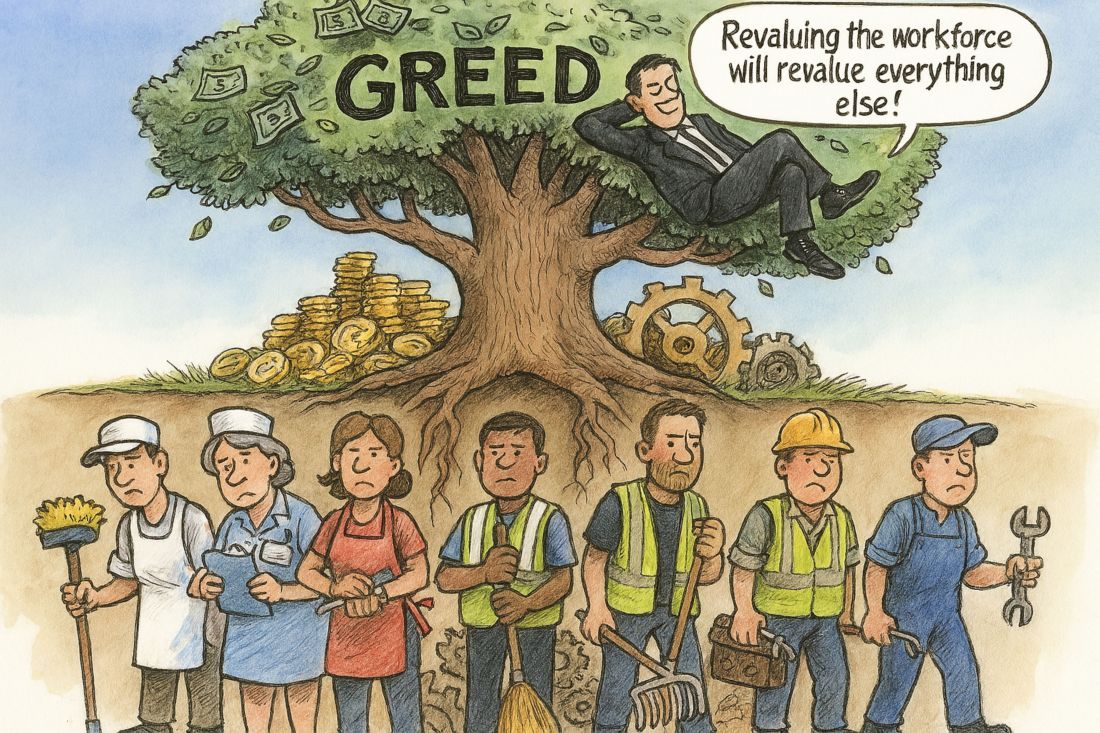
Life didn’t become expensive because it had to be. It became expensive because too many people wanted more than they needed, and in chasing profit they made freedom unaffordable for millions.
That greed has shaped the way we live, the way we work, and even the way we imagine what’s possible.
The Illusion of Permanence
We’ve been conditioned to accept the system as if it has always been this way and always will be.
For those who benefit, that’s convenient blindness. For those who suffer, it’s a kind of brainwashing – convincing them that change is impossible.
But everyday life tells a different story. Anyone who shops regularly knows how quickly prices rise.
A £3 item can jump by 30p in a week, far beyond the official inflation rate. At Christmas, tins of chocolates are dressed up as “reduced,” even though they cost 20 to 50% more than they did a year ago. And energy bills keep climbing even when wholesale prices fall. These aren’t natural increases; they’re engineered.
The Myth of Big
This manipulation is reinforced by another illusion: the myth of big.
We’re told that scale equals legitimacy, that size equals strength. But “big” doesn’t mean better. It means the system has grown so vast that exploitation can hide behind its scale.
The bigger it gets, the smaller we feel – and the easier it becomes to believe we can’t change it.
The Machinery of Exploitation
Once you see through the myth, the machinery becomes clearer.
Supply chains and hierarchies strip away accountability, amplifying selfishness until exploitation feels normal.
At the heart of it all sits money – created, policed, and controlled by those with power.
Profit comes first, people last, and the system is designed to make us accept it as normal.
The Human Cost
This isn’t about people failing. It’s about people being failed.
Lives are destroyed not because individuals did something wrong, but because others took more than they needed.
The uncomfortable reality is that we don’t have to live like this.
There is another way.
Redefining What We Value
We’ve been taught to believe success means others must lose, that material wealth defines worth.
That’s the great lie. It externalises our humanity, making us dependent on possessions instead of recognising our intrinsic value.
To change course, we have to learn to value who we are, not what we own.
Putting People First
Imagine a system where everyone’s basic needs are guaranteed.
This isn’t a pipe dream or a challenge to the “law of the jungle.” It’s simply the right thing to do.
A good life depends on the contributions we all make together, knowing that at the end of the week we’ve done our part and received what we need.
Beyond Division
We are not isolated individuals. We are members of the human race.
Hierarchies and divisions are tools of oppression, legitimising greed and selfishness.
Those who benefit from them do so only by exploiting the needs of others, however distant those others may seem.
A Framework for Fairness
Enshrining the Basic Living Standard in law would be the transformative step toward a society where dignity and security are guaranteed for all.
This principle ensures that every individual’s essential needs are met, fostering resilience and social stability.
The adoption of the Local Economy & Governance System and the framework it offers would strengthen communities by decentralising decision-making and empowering local actors.
Such a system encourages sustainable growth, supports small businesses, and keeps resources circulating within the community, thereby reducing dependency on distant, impersonal structures.
Together, these frameworks dismantle exploitation, promote fair contribution, and prevent the concentration of wealth and power that undermines collective prosperity.
By prioritising fairness and local empowerment, society will lay the foundations for enduring economic vitality and shared well-being.
 Adam Tugwell