People need new homes. But pumping houses into the economy isn’t the only answer and may be more destructive as an isolated solution than Quantitative Easing will surely prove to be…

Has anyone noticed how politicians love to pick up an issue that plays on people’s minds and then they play with it, mutilate it and reshape it to suit their own ends?

Party Conference Season is of course a great time to see this approach to taking responsibility in its finest form and Nick Clegg’s sound-bites about the Lib Dem role as the moral anchor of future Coalition Government and Ed Milliband’s socialist branding on the Cost of Living Crisis and Energy Prices are themselves very fitting examples of cynical – and impractical views or policy, which in reality would demonstrate just how out of touch these people really are.

Policy bandwagons that appeal to public opinion, but lack the depth and thought for their real and long term implications are by far the worst, because in appearing to solve a problem, they actually create a whole lot more besides and usually in ways which are far more damaging to individuals, communities and businesses than the initial problem ever had been.

Perhaps the most notable of these policy faux pas that politicians keep lining themselves up to commit is with strategic planning for development and house building in particular. I know that I am far from alone in wondering just how practical, ‘real world’ and problem solving our leaders think this continuous drive to concrete across this Country actually is…

In terms of the day-to-day political scene, house building has become an almost obsessive issue for all of the Parties and one that they would happily have us all believe can only be addressed by significant development.

Generally speaking, the spin that politicians place on these plans is that building more houses will make them cheaper and therefore more available. But how many new developments have you seen being sold at less than the local like-for-like rate or at a rate which genuinely reflects the cost to build plus a realistic profit margin?

They say that building houses will create jobs. But other than within the industry that builds houses and the services that will then provide them, what jobs ever get created by the construction of a house?

They tell us that building houses is good for the economy. But how can that be so when prices keep going up, people have to borrow to afford them and the houses built are rarely located where people can benefit most from them without commuting and spending a whole lot more money on travel, from which they will rarely be left with very little afterwards to show?

They legislate that housing ‘supply’ should be determined up to 20 years in advance. But how can anyone in any location or Local Authority area truly know or understand what housing need there will be unless it actually exists already or they make a judgement on what may be needed within a year or two, based on what jobs may be coming to the area?

In Westminster derived terms, politicians are convinced and in turn try to convince us of the need to build, build, build. But the housing problem looks very different to those who are experiencing it firsthand. Where are the policies that consider that:

The entire housing market is overpriced. Commission-hungry estate agents, easy borrowing, speculation, buy-to-let ownership, investment, property developers and builders; all have contributed to the sometimes exponential house price rises. The value of property is vastly inflated and a major contributing factor to the vulnerability of the banks and financial system – as illustrated by the banking collapse in 2008. Devaluation of the entire UK property portfolio would be the answer, but would cause as much mayhem and fallout in isolation as devaluation of the Pound will, should the UK’s Debt, Deficit and economic situation go where it very well could.

Lower priced housing is rarely located where people would most like it. Rarely is development of any good size located where people most need it, and where it is, the prices are even more overinflated than they are elsewhere. People have to commute sometimes long distances to the homes that they can afford which itself is financially costly, but is also very expensive in terms of commuting time – and this is private time that can never be replaced.

Mortgage deposits are too high. The Chancellors Help to Buy Scheme is noted. But it doesn’t escape from the fact that one of the main reasons that people can’t afford mortgage deposits is that the housing market is overpriced and the value of an average house in the UK is currently £242,415.00 compared with the average wage of £26,500.00; over 9 times bigger. Insuring buyers is not a longer term solution and the Government has to get prices back within the reach of average-wage-earner ownership without using the easy promise of Taxpayers money to help.

The rental market is overpriced. Properties of all kinds and sizes are required for rental, but the houses most commonly sought are 2-3 bedroom properties which are typically the same as those sought by first time buyers and those in the buy-to-let market. This interest creates a false floor in pricing and Landlords who do not have mortgages have little to gain by undercutting those who do.

There isn’t enough Social Housing. There will always be a requirement for social housing but the deficit between what Local Authorities can access and what they require needs to be significantly smaller. Right to Buy hasn’t helped with availability when Councils haven’t replaced stock which has been sold through the scheme.

There isn’t enough of the right kinds of social housing. Probably the greatest number of housing related enquiries I ever have from residents within my own Council Ward is from those seeking social housing who cannot obtain a tenancy because there isn’t one that meets their needs or that of their families. Social housing development is very prescriptive and doesn’t currently reflect the normal diversity in family types and sizes that generally exist in most communities.

Second homes are leaving local people without having the option of just one. People now have the ability to travel distances like never before and this has made second home ownership much more practical for weekend use. It has however meant that property prices in rural and seaside locations have exploded as high earning city folk have found it easy to buy such property. The downside is that they have priced local traditionally-low-earners out of their own markets. With inadequate levels of social housing and responsive development which is ‘affordable’, people who want to leave home and remain in the communities in which they grew up are now finding that they simply no longer have that choice.

House ownership has become speculative beyond basic investment and security. People now buy property as an investment and typically seek the same properties as first time buyers, thereby eliminating many of the opportunities for owner-occupation, whilst forcing house prices and rental values up at the same time.

These are the real and for many, very painful aspects of the UK housing market as they stand today, and they will not be addressed simply by allowing development on a scale which is only certain to exacerbate the problems as they stand, potentially create a whole lot more problems beside and only truly benefit the developers whom the whole Planning system seems to have been created for.

Politicians must do much more to recognise and understand the issues facing people as they consider their next home. They then must develop genuine well-thought-out solutions that actually help and assist the people who need the help to avoid or remove themselves from misery and doesn’t reward those who deliberately or otherwise make profit from creating more of it.

There is so much more that our politicians could do. For instance, why don’t they:

  • Add additional stamp duty to buy-to-let mortgages on 2-3 bed homes – those typically bought by private property investors.
  • Add a tax or levy to the monthly repayments on buy-to-let mortgages on 2-3 bed homes
  • Restrict or halt new property transactions to foreign nationals who will not be UK Taxpayers.
  • Place an obligation on developers to provide a percentage of the properties on a new development for social housing use which is not dedicated or allocated at their choice OR alternatively provide an alternative or additional site within the same Local Authority area which reflects that same percentage and types and sizes of housing, relative to their own developments granted permission within that financial year.
  • Legislate that future or existing sales revenue from Council owned stock must either be used to build new properties or purchase existing ones with a priority given to property types most sought on the local Waiting List.
  • Penalise weekday or week-time non-occupation of homes through a tax or levy.
  • Legislate to require the deposit or equity value on second home mortgages to be 50% of value or even higher.
  • Require Estate Agents to work on a fixed-fee, non-commission basis.
  • Consider outlawing ‘gazumping’

Without more creative thinking and policy intervention, the role that housing development could play in contributing to the economic never-never fantasy land that has been under construction is quite frightening.

Just as Quantitative Easing (QE) is having a detrimental and savage effect on the savings of many people who have been responsible with the accumulation of their wealth, continuous building at the rates that Government would have us believe necessary, whilst failing to address all the other underlying issues facing those who need homes, will surely prove to be just as damaging for many more, if not worse.

You can’t address real problems without real solutions and its time that politicians thought about the real consequences of their actions rather than the power and electability they will achieve by playing with sound-bites and words.

What is in effect “quantitative building” might make good headlines, but it isn’t going to help those who need new homes most right now and the only long-term beneficiaries will be the money men who own the companies that build them.

Money: Terrorism, the cost of living crisis and the collapse of religion & morality

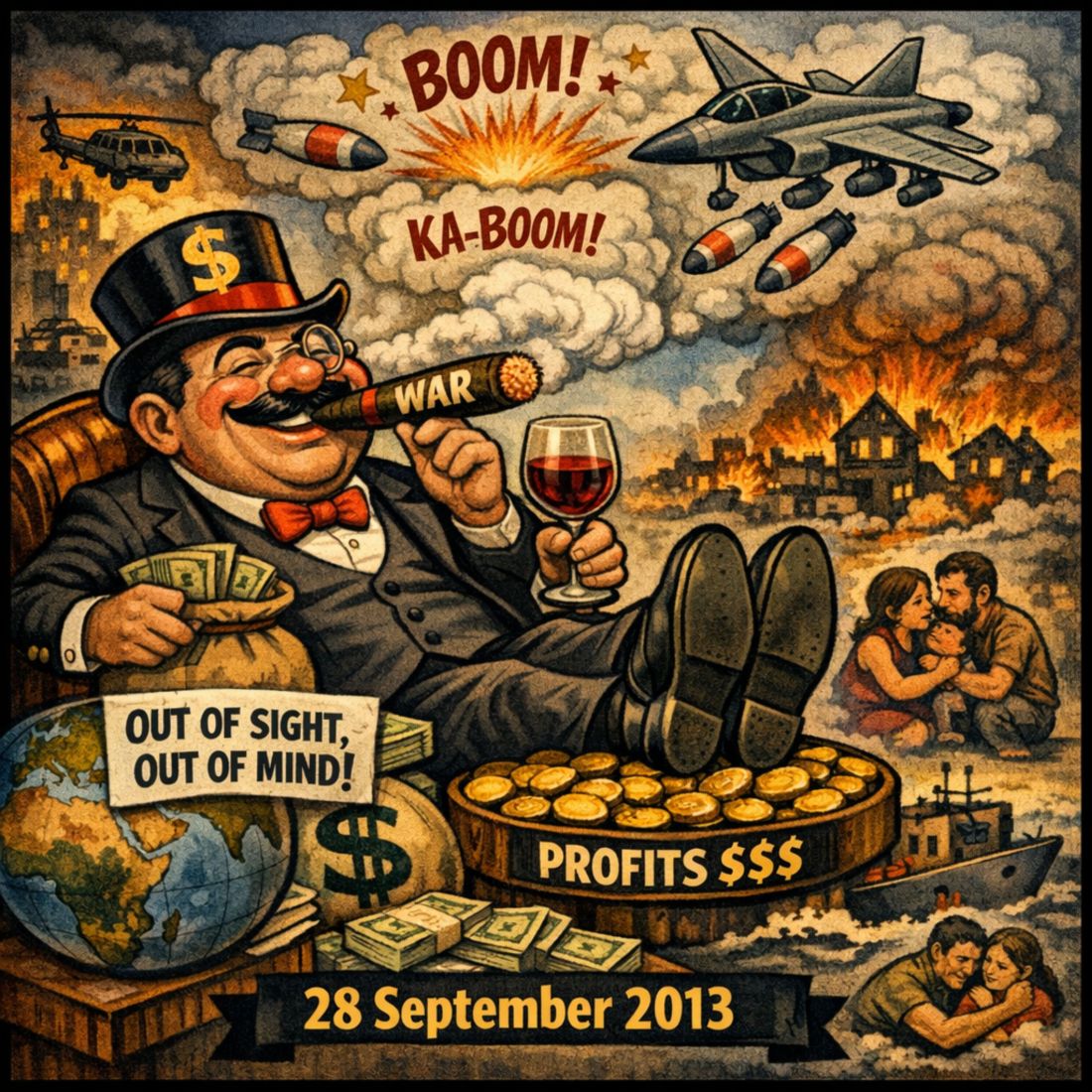
MonopolyMan“Money is the root of all evil” was a phrase I often heard as I grew up. I like to think that it was a simple ruse that both my Mother and Grandmother employed to make the lack of cash and the weekly wait for Thursday morning’s ritual trip to the Post Office to ‘cash the giro’  seem all that more holy. But years in Businesses, Charities and Local Government have given me a very different view and it is now clear that this New Testament derived saying has an application which is a whole lot more universal.

Like it or not almost every facet of life has some link with money. Making money, spending money, borrowing money, saving money, winning money, being awarded money, being in some way dishonest for money, selling for money, earning money, playing for money or just thinking about money will almost certainly have a relationship with something that any one of us is doing at any one time whether we realise it or not.

What is in many cases an unconscious or involuntary obsession with money has become so ingrained within our present day existences that many of us have reached a point where we simply overlook the part that it plays in virtually every part of life and how its influence, directly or otherwise is on the way to making communities and cultures within Great Britain, Europe and far beyond almost unrecognisable from what they were less than a hundred years ago.

The “money men” of today and their commercialisation of just about everything that we could imagine are no doubt responsible for many of the problems that people are now experiencing. But payday loans, credit worthiness, spiralling energy bills and the explosion of food prices are only one part of the problem; just as ineptitude on the part of politicians who through successive Governments have taxed almost everything whilst they have taken borrowing to bankruptcy and beyond is another.

The far reaching and what could yet prove to be devastatingly real implications of decisions taken many years ago, primarily based upon freedoms and rights, but effectively about money, ownership and the formulation of private wealth have yet to fully manifest themselves. But to many, the harsh realities of an effectively unregulated free-market in the hands of those out to make money without any sense of ethics, morality or whatever the true cost may be, are already very real indeed.

The apparent liberation of the masses from servitude and the arrival of our perceived freedoms has been accompanied by the growth of a culture which recognises the accumulation of personal wealth and standing above all else.

People en masse are no longer content just to ‘be’, but relate their position in the world to what they do or don’t have and as such take a far more self-centred or self indulgent approach to life, even when they have very little to show for it.

Perhaps one of the the noticeable casualties of this change may be the Church of England which has arguably witnessed a significant if not exponential fall in congregation size in parallel with this change. It is fast becoming ill equipped to maintain its standing as the default faith within what the Libertarians amongst us would have us believe to be a secular state – which itself was just a station at where the UK stopped and which our population may have already left way behind it.

It’s not just those who are now struggling to pay their bills who will have noticed; in fact, they have come pretty late to the game.

To those outside the UK and the West, a cultural obsession with money and its related exploitation of people and resources is even more historical than the change that has taken place for individuals in just Great Britain alone. The resentment and in many cases hatred that this has fostered is now manifesting itself in some of the most frightening ways possible through the rise of Islamic Fundamentalism and the extremist acts of terror by which it is closely accompanied.

It is ironic that the very same causes of the problems that we are now experiencing because of money and our obsession with it in this Country may well be the very same motivator that fuels the fire of extremism amongst people who have already recognised it through different eyes and want to deal with it, but in a way that would see us returned to the dark ages.

Sadly and as in most cases where one form of religious or political philosophy is at work and in control, those who are opposed to what some may call the money-based malignancy of this Westernised culture simply want to see it replaced with one which is oppressive in a wholly different way. Regrettably, the indifference of the majority towards what are two extremes does not reduce the likelihood that one could just be replaced by the alternative in any way.

Indifference itself is only exacerbated by the rights culture which has installed a sense of unjustified wrongdoing and often guilt when people speak out about changes and what are effectively the removal of freedoms that we may one day have to fight to regain.

The ‘rights’ of what are minorities within minorities are being preserved, promoted and upheld at the cost of not only the majority of UK Citizens, but the majorities within those very communities too, and we are being frogmarched towards a whole new and unrecognisable culture within the UK at the cost of what two generations fought and suffered for in the First and Second World Wars and the identity-bearing British traditions that we have held dear for so very long.

Many think that if there should be a World War III or Armageddon, it will be a wholly violent conflict that originates in the Middle East and then spreads to physically embrace the World, probably using weapons which will do unspeakable harm. Acts of terrorist violence such as 9/11, 7/7, Mumbai, Woolwich and Nairobi Westgate serve only to bring the news time realities of armed conflicts in Egypt, Libya and Syria all that closer to us.

The arrival of violence on our own shores – albeit on a comparatively small scale – is just another terrible warning of the realities that lie ahead if our politicians and the people with monetary power over our lives continue to go about their work without any real thought for the consequences of their actions.

The human condition dictates that group think will always encourage a level of emotional buy-in, servitude or passion within individuals whom given the right motivation will override any feeling of humanity towards their fellow man.

Encouraged by the belief that the ‘haves’ are somehow deliberately seeking to harm the ‘have not’s’ as part of some elaborate conspiracy – this indirect consequence is enough for indoctrinated people to see no value in their own life and therefore have no respect for that of others. Picking up the gun and delivering their messages with bombs is then just a simple step beyond.

However, whilst this really is the extreme end of the wedge in every possible sense, we should be grateful that the polarised or violent aspects of the rise of this ‘god called money’ have so far affected us at home to date in such limited ways.

It will not remain this way if radical Islam continues its rise within the communities of Britain or worse still, if the financial or cost of living crisis that is facing a significant and growing number of British households continues to be ignored, and frustrated and frightened people reach the point where they feel the time has come to take to the streets.

So could these terrorist attacks, Middle-Eastern battles, wars and the rise of radical Islam really be just be the symptom of the next Great War which is already underway?

If they are such a symptom, terrifying as terrorism and even civil disorder can be, tackling both may only be a small part of dealing with any turmoil that lies ahead, and an issue that our crowd-pleasing political classes will only find slightly harder to deal with than continually focussing on what it takes to win the next elections. Instructing and unleashing the police and security services from the realms of political correctness and claim culture will after all be an easy decision by comparison to dealing with the powers associated with money and reigning in a force beyond nature which has saturated our lives so deeply that it affects the very way that almost every one of us actually thinks.

If you need any evidence of the real battlefield that already exists around us, look at the hollow lives that some in Britain already live.

There are normal everyday people in this Country who feel empty and go in search of meaning. Where some of them once felt happy and content within their communities, they have withdrawn into solitary lives obsessing about what they have or what they don’t have. They seek distractions in whatever form they come, whether it manifests as obsessive behaviour with drink, drugs, sex, junk food, video games, TV, mobile phones, porn, the internet or perhaps even the fringe forms of religion which offer the same addictive power as all of the above and fill the void now deserted by a much happier and less monetary orientated world, where people found a much less invasive form of contentment with a whole lot less.

Whatever direction people who feel empty take; whatever they look for to fill their void; whatever they already possess; people will always willingly accept something if it is perceived to be ‘free’.

Cynical, self-serving politicians know this and flourish off the back of giveaways that somebody somewhere will always end up paying for. This rule extends across party lines, demographics, occupations or whatever your level of wealth or personal standing.

It won’t be difficult to get agreement that others need to change their behaviour from any one of us. But at the level of the individual, this reality will rarely prove to be the problem.

The failure of Westminster Politicians from successive Governments to consider the consequences of their actions or lack of them when it comes to dealing with a cultural and economic problem of this magnitude is astounding. It would be frankly quite laughable, were it not the case that for many people and businesses right across the UK, the outcomes already are and will progressively become so much more serious if nothing is done.

Time is running out for democracy in the way that we have come to know it, and if we don’t begin to witness the evolution of British politics to a form where fairness, what is right and what’s best for everyone becomes the priority and motivation of all in power and of those who aspire to having it, the consequences could be far more extreme for many than even living within a medieval caliphate where heads roll as easy as marbles and women are allowed to do very little other than simply exist.

It really is therefore difficult to conclude anything other than that all the evils facing our society have money unquestionably at their root and whatever your take on it, there is certainly nothing holy about any of it.

images (3)

Images with thanks to sources unknown.

Drink-related antisocial behaviour: Drunk Tanks, Minimum Pricing or new Laws won’t make any meaningful difference on their own and Government must accept that everyone involved has to play their part in tackling the fallout from this form of drug abuse…

image thanks to www.telegraph.co.uk

Since I was first elected to the Chair of Tewkesbury Borough Council’s Licensing Committee, I have been grateful not only for my experience as someone who appreciates the concept of the Great British Pub, but also from that as a former CAMRA member and as a Personal License Holder in the work that has followed. It certainly helped in formulating a broad understanding of the current Licensing Laws and how they work in everyday practical terms.

Alcohol abuse and its knock on effects are and will continue to be a point of contention for anyone dealing with Licensing Law for so long as alcohol exists. The fact remains that were it to be discovered today, Alcohol in drink form would in all likelihood be classified as a Class A drug and under this guise would perhaps make many more people think differently towards its use than they currently do.

The reality is however that Alcohol hasn’t just been invented and with the genie having been well and truly out of the bottle for a considerable period of time, good regulation and management are the only effective ways that you will deal with this ‘legal high’ in a meaningful and long lasting way.

With this in mind, it is concerning to read that in response to the current discussion over privately-run ‘drunk tanks’, a Police Chief Constable has gone on the record to rubbish the 2003 Licensing Act and call for it to be scrapped when many of the principles within it do encourage a much improved level of professionalism and accountability within the Licensed Trade. The Law itself arguably only falls down because of the half hearted and ill-considered way that it has been rolled out.

To say that the issues surrounding Licensing are complex would be an understatement. The tail-end reforms of the 2003 Act within the Coalition’s Police Reform and Social Responsibility Act 2011 have ironed out a few of the rough edges left by the changes made to Licensing Law by the Blair Government. But it is still the overwhelming desire of Westminster Politicians to keep control of what those in Local Government do which creates the most harm when dealing with its application; all when the public are repetitively told that ‘Localism’ is supposed to be what the Coalition Government is all about.

One of those changes from 2011 which does give a small opportunity of genuine discretion to Licensing Authorities in what they do has been criticised by the Police because of its apparently slow roll out.

The ‘Late Night Levy’ or what is in practice a late hours surcharge for Licensed Premises opening into the early hours has in effect been left at the discretion of the Authorities themselves. Here we finally have an area of Local Government policy-making which might genuinely reflect the views of locally-elected Members and allow for consideration of the true impact that ballooning Regulatory Charges will have on existing pub businesses which in many cases simply couldn’t afford or justify them.

Understandably, this doesn’t sit well with Police Forces who not unlike just about every other public service throughout the Country are all looking for ways to increase income at a time when budgets are being repetitively slashed by Central Government.

This however isn’t good enough reason to rubbish the Licensing Laws as they stand, just as the problems with binge drinking and late night drink-related anti social behaviour should not be directly attributed to the Law itself.

It is the case that the problems should be attributed to the way the Policy has been applied and the failure of both this and the last Government to tie up the loose ends and then to proactively support the system that they have put in place between them.

Ironically, the 2003 Act provided Licensees – or Premises License Holders, with far more autonomy and responsibility for Licensed activities than they ever had before. Through the requirement of training and Licensing of Designated Premises Supervisors and the broad emphasis on promoting and embracing a culture of good practice, Licensed Premises should at least in theory be the safest places for Alcohol to be consumed and therefore the environment that Government really should be supporting.

The reality is however that the unhindered ease with which Retailers can obtain a Premises License both for ‘on’ or ‘off’ the premises consumption has made it horrifyingly simple for supermarkets to stack ‘em high and keep ‘em cheap when it comes to drink, without any real responsibility for what happens when the drink they have sold is consumed thereafter.

Local Licensing Authorities simply have no definitive power to dictate terms of Licenses which would reflect the true needs and requirements of any particular locality.

The one-size-fits-all approach of centrally-derived Licensing Regulation leaves Licensing Authorities being little more than administrators, unable to make truly ‘locality’ based decisions.

When they attempt to do so, applicants can simply appeal to the local Magistrates Court and will usually have little trouble getting anything overturned if their application technically meets Government guidelines – whatever the local issues and impact might actually be. I can clearly state that when the best that the Law allows a Licensing Committee to do is have their ‘concerns’ documented in the minutes of a hearing, you know that something simply isn’t working right.

Put a little more in context. ‘unregulated’, ‘unsupervised’ or drinking outside of a Licensed premises is a direct consequence of what some would consider to be a Licensing free-for-all and the frighteningly low prices at the tills that have made binge drinking as much – if not more of an issue than the ages old problem of alcoholism which itself is much more likely to be monitored and flagged with the watchful eyes of good publicans than it will do when simply kept behind closed doors.

Rather than support the resource and sometimes centralised social points for communities that pubs actually can be, successive Governments continue to oversee their demise and certainly fail to back up the application of their own Policies by stabilising and supporting these important hubs which could do so much more to assist in tackling what are very serious social issues if they were simply encouraged and aided to do so.

However, as things stand some 12 pubs close each and every week. In the majority of cases, these and their potential benefit will be lost to the communities around them forever.

Some will happily argue that pubs no longer have the appeal that they once did and this is why they are closing. There is some truth in this statement and not many can deny that the criminalisation of drink driving had a far reaching if unspoken affect on some venues as many people realised that the risks of having ‘a few’ were simply too high. Subsequently, social drinking for many lost the regularity that it may formally have had.

The Industry changed, especially so in isolated or rural locations where decision makers soon realised that pubs now had to have wider appeal and become a ‘destination’ – a route that for many has been found through serving food and the rise of the gastropub, where people now travel to eat, with drinking just being a consequence.

The ‘boozer’ as it was has since mutated to become what many now know as the ‘sports bar’ and it is perhaps these types of establishments which just revolve around drinking that are actually needed most of all but are more vulnerable to closure because taxation and the onset of the PubCo – the property portfolio owning organisations that charge ridiculous levels of rent for the pubs they own and then seek to take unrealistic margins off just about everything a pub sells via a ‘must buy through us’ caveat or ‘tie’ that makes many already struggling pubs simply impossible to run profitably.

Because of such ‘ties’, rented or leased pubs are left selling overpriced alcohol to customers who in today’s climate are driven greatly by price and rarely by the venue itself when alcohol consumption is the primary reason for going out.

Young people do much of their drinking before they even get to late night venues consuming cheap supermarket drink and yet there seems to be a view that it is these late night premises-based businesses that should pick up the tab, simply because they were the last place that the antisocial drunks had visited.

Few of us appreciate or actually condone antisocial behaviour, but the issues that lead people to behave in the way that they clearly do are reflective of a plethora of social issues which go way beyond the sale of Alcohol itself. As drug taking and drinking is considered by many to be an act of escapism for people who are unhappy at a deeper level, a good place for those in power to start this journey might very well be to ask the simple question ‘why’?

As a Licensing Chair, I do not believe the Government has anywhere near the full measure of the situation beyond that which it sees on paper. It is only through a process of change and of considering the full impact of all elements which are at play within the UK drinks industry and then by making policy changes which are real-solutions driven and take into account the role that all will play, that we will then have Laws in place that really will serve drinks producers, retailers, drinkers and the general public as best they can.

Without taking a comprehensive or ‘holistic’ approach like this, problems will continue and may well reach a point where options available right now, simply don’t exist even in the near future because the resources no longer exist to support them. My starting suggestions would be:

Level the playing field:

  • Stop what is in effect pub ‘franchising’ and prevent price escalation through profiteering by PubCo’s. A simple way to do this would be to make it illegal for the owner or premises leaseholder of pubs to let or sub-let a pub to a third party within a contract that also places an obligation upon that tenant to buy any product from their landlord, their landlords agents or any company nominated by them.
  • Forget minimum prices across the board, but stop off licenses and supermarkets from selling at or below the equivalent price of pubs in their Licensing Area. Making it illegal for retailers to undercut pubs would almost certainly make pubs more attractive for drinkers than they have been and take a lot of drinking off the streets. Retailers could be required to pay the additional margin or an appropriate tax into a scheme which could support local Policing and facilities such as drunk tanks, which with public services continuing to shrink, could still very much have a place.

Incentivise pub use:

  • Lower duty on barrel and bulk supplied alcohol. This would potentially make pub alcohol cheaper still and would have the added environmentally friendly bonus of removing the need for all that packaging with pub glasses being reusable!
  • Replace Business Rates on Pubs with a turnover related fee or supplementary tax. This would help new and struggling businesses to keep contributions relative to what they are earning and would have the benefit to the Local Authority of potentially contributing more when pubs are or have become more successful.

Give Licensing Authorities more scope:

  • Let Licenses be set locally and limit the right of appeal. The Government should simply set Licensing principles and give the autonomy back to Councils to decide upon what terms Licenses should be granted against these with the balance of power in their interpretation placed back with the Authorities themselves and not ultimately with Magistrates who will arguably see Licensing Appeals as an unnecessary drain on their time. Local representatives are best placed to deal with local issues and no business should be able to just do what they want simply because they have the money available to exhaust the process to a level where those deciding are too far away from the issues placed within their care.

Tighten the existing Regulations:

  • Make it a requirement that there is always a Personal License Holder either serving or within supervisory reach when a pub is serving. This would ensure that someone properly qualified and aware of the requirements of Licensing Legislation – but more importantly that the focus on responsible drinking are always maintained is on site and available to make decisions at all times.

There are likely to be many other tried, tested and also innovative ways that problems like drink related antisocial behaviour can be addressed, but this whole issue is a classic iceberg metaphor and very few of those with influence are looking very hard at what lies beneath the surface.

The wrong voices have too much power when it comes to Licensing related issues and more notice must be taken of UK wide interest groups like CAMRA and more localised community organisations, who have a definable cause promoting the interests of end users or the people who are actually affected at street-by-street level, rather than simple referral to the default-setting or usual suspect reference points such as Brewers, PubCo’s, Supermarkets and yes, the Police – all of whom do have particular and usually very specific motivations for pursuing a particular approach.

As with many areas of life where the Government is responsible for some form of legislation or service provision, the issues and key elements of the situation are often much more widespread than many realise.

The point here is that the general public simply will not experience genuine and long-term improvement until those in power actually consider all these factors and then delivers solutions which really are in the best interests of all the stakeholders involved, but primarily the people who put them there first.

Like Planning, Licensing must be put back in to local hands where an appropriate and real-life form of discretion can be applied to its use.

Rather than just tell us that they are all about Localism, the Government should actually be all about Localism and tackling the real-world realities of drink abuse, the behaviour of the industries behind it and the Licensing related issues which affect it would be one on a very long list of good places to start.