I’ve just picked up an article published by the BBC that says Food Banks are reporting a 9% surge in demand for help – all from families with children, between April and September this year.
In the same article, the Department of Work and Pensions is quoted as saying that ‘there are 1.7 Million fewer people in absolute poverty since 2010’, and it’s fair to say that anyone who hasn’t really had reason to think about this issue in any depth would be forgiven for wondering if both statements can be true.
The regrettable reality is that both statement certainly can be true, and depend very much on how data – and therefore the reality that real people are facing – is interpreted.
What was clear when a well-known Conservative MP recently declared that real poverty last existed in the 70’s, is that there are different interpretations of what poverty really is and how it can be identified,
Sadly, it serves the purposes of some to be able to declare that people who need help aren’t actually poor in a way that they can ‘hand on heart’ tell the world is right. But as I discussed in my recent blog about the hourly wage that the lowest paid single person really needs to earn before deductions are made, the difference between the figures the government is using to qualify people for help, versus the reality that people are living through when they genuinely do need help, are likely to be two very different things.
Food Banks are the acceptable face of a culture that believes for some to be rich, others must therefore be poor. And the fact that the need for them is growing – and very quickly too, is something that should give us all considerable cause for concern.
Before anything, I will say that the Red Tractor Scheme was a good idea, even though with my consumer hat on, I’m not convinced it really meant all that much to shoppers.
On that note rests the question of who really gets the value from it, and from that perspective, its possible to begin joining up the dots regarding the latest row that has developed around future changes and the relationship between the Scheme and ‘green farming’.
Whilst everything looks very simple, the truth is that complexity rules the day and many of us don’t understand the relationships and motives that lie behind many of the problems that agriculture and businesses are facing.
At face value, most people simply wouldn’t believe what’s actually happening and what corporate interests are doing to entire industries as they seek to control every part of the food supply chain across the UK. Acting as if even the farms they buy produce from, are no more than facilities that they own.
Regrettably, big money interests want more profit than they already have and they have successfully hidden behind the lie thar is ‘free markets’ and yes, Globalisation, to trash genuine government and regulations and then replace it with a system of their own that they control.
My concern is that whilst overtly created with the best of intentions for Farming and Food Production, devices like the green agenda are just new ways of ratcheting down more and more control of the food production system. So that every penny of profit or ‘the fat’ that exists at any point within the entire food supply chain is controlled and funnelled into the hands of those who control it.
Consider this scenario:
Many farmers – perhaps every farmer, has at some point signed up to some kind of contract sale arrangement for their crops, animals or produce, perhaps with a dairy, a big retailer or an agent of some kind.
Within these relationships, it has been considered normal or necessary to share just about every bit of data about the farm, what equipment is used, the number of animals, number and type of staff – and much, much more.
Afterall, what does it matter when you are working for the same goals and these are people you can trust?
It’s likely that right now, an unworldly economics graduate, perhaps sat in a commuter town HQ, somewhere near London, is looking at every detail their employer has hoovered up through this process of ‘granting contracts’ or ‘beneficial arrangements’ of some kind. That’s the one mentioned above where they have insisted that they are the farmers friend and that all this information helps to raise standards, meet targets, and no doubt of late ‘helps to achieve Net Zero, or make the industry green’.
What they didn’t tell you is that from this data, this analyst or someone like them that the farmer will never meet, can work out exactly what everything is costing on that farm. They can then then use statistical averages and data of the kind that inform our politicians, to make decisions on what the farmer is ‘entitled’ to earn – knowing exactly what their spreadsheets have told them the farmer should ‘charge’ to cover the costs of their ‘wage’ and absolutely everything else.
***
Yes, the chances are that the companies and retailers that farmers ‘sell’ to are working out what they believe those farmers need so that they earn the average wage (if they are lucky), and without the farmer even being aware, nothing is any longer that farm business owners’ choice.
If farms are dependent on these companies and their contracts – no matter how well intended or how they were sold, the business that the farmer is contracted too basically owns the farm.
As such, farmers are right to be very concerned about where so-called standards are taking the industry, as the level of data and therefore control that these interests will have and will be able to exert, is only likely to grow, whilst politicians continue to fail to represent the interests not only of the food producing industries, but of the public at large.
Right now, the destination is already over the cliff. But it could get worse, with Supermarkets now trying to claw back whatever they can from what they clearly believe to be over generous relationships with the key suppliers within the UKs Food Supply Chain.
It’s strange what you start thinking about when you are awake and unable to sleep in the small hours of the morning.
One thing that has been fascinating me (for all the wrong reasons) is just how committed our politicians and public figures are to the idea that the National Minimum Wage is enough for someone on a basic full time wage to live on, with the unspoken suggestion that anyone who can’t manage on that must be some kind of financial delinquent.
The journey to discovering truths can be a rocky one. Especially when you uncover the data that makes the argument for whoever you disagree with. That is, until you then take the series of steps and start looking beyond what they believe, based on what they have said.
Today, the National Minimum Wage is £10.42 per hour, for an adult of 23 years of age or older.
The question I really wanted to answer was ‘How is it our legislators are so confident that they are right about this rate – which in turn becomes the benchmark upon which the UKs basic standard of living is calculated?
The Average Living Rate
There’s a lot of data available through the Internet (Although I would strongly suggest doing the research for yourself rather than using AI if you want to try this).
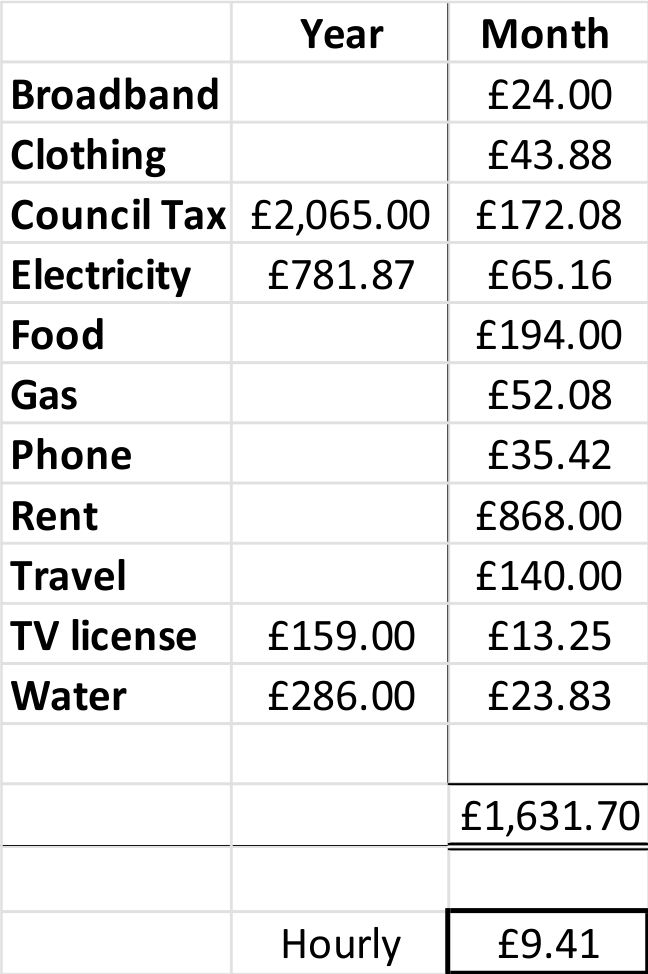
On an Excel Spreadsheet, I set out a list of all the key expenses that a single person would need to cover – without the added extras like holidays and big beer accounts. I looked up all the relevant figures for the average spend if you are a single person, and then did the maths to work out how much a single person on a basic, minimum or living wage needs to earn every hour, without deductions, to cover those costs, for themselves.
Initially, this was the point where I had that moment and thought ‘Are these people actually right: Do they have a point?’.
The figure I reached, based on a person working a 40 hour week, was £9.41, which with a National Minimum Wage rate of £10.42 per hour, would mean that person would have £1.01 per hour SPARE, if they were only on Minimum Wage.
But then I thought a little more.
As I said, my sums for these figures is based on the accepted average costs for travel, utilities, phones, food, clothes, rent and all you need, adds up to the grand total of £9.41 per hour, for a 40 hour week.
So, the reality that this calculation indicates a single person on a Minimum Basic Wage has £40.40 SPARE per week, certainly made me understand where our public representatives find the confidence to talk down at the poor and vulnerable with conviction that really can only come from believing they are right.
But are averages real? Do average expense costs really reflect what it costs a single person on a low income to live in the UK today?
I’m afraid, I certainly don’t think so. And I’m not going with the idea that because a politician or a public figure says so, it must naturally follow that they are automatically right!
The Real Living Rate
Averages are all well and good. But in my experience, they don’t redirect real life.
So I started all over again and this time, applied the figures that I believe to be accurate as a minimum expense so that I could see just where the real world experience of what it costs an everyday ‘normal’ person lies.
Here is how I did my working:
You’ve probably heard the phrase ‘lies, damn lies and statistics’. (Mark Twain or Disraeli?) And whilst there will always be a need for reliable data, the rather obvious truth is that average data can be completely skewed by just one figure that is disproportionately different to all the others.
However, that difference can very easily be big enough to suggest that the average is very different to what it actually is.
Having studied Statistics at A-Level many moons ago, the wide portfolio of statistical methods available to present data is mind boggling.
But within that spectrum of options also comes the option to use methods which serve the interests of biases of the researcher or whoever is paying for the research, by manipulating the data so that it looks very different to what it really is.
From this standpoint alone, real world experience is likely to be a much better guide. One that demonstrates for factors such as transport costs for a single person, commuting across a city using buses shows the costs of travel are likely to be significantly different to the many others who live in rural areas or even market towns where it cannot be assumed as practical to use a bus as there is limited public transport and normal life requires the use of a car.
Just as important is the reality that costs like broadband and phones aren’t just as simple as a connection and a basic handset.
Today’s culture revolves around smart technology. The reality is that for anyone of working age, limited access to tech means limited access to work – as it does increasingly in every other sense. The argument that nobody needs the latest iPhone simply doesn’t fly – especially when very few people buy them outright and pay an overinflated purchase cost over a period of perhaps 24-36 months.
If you feel prickly about the idea that someone classed as poor is ‘fully connected’, please ask yourself if you would feel disadvantaged if you were to give your phone up?
Finally, and perhaps most controversially, I’ve added what I’m going to call the Pleb Premium at 10%, with this figure representing the extra that people who have very little get charged because of the ‘perceived risk’ that poor people represent (To those who really should know better).
What I found was quite alarming and suggests that the real rate of the National Minimum Wage in October 2023 should be no less than £14 an hour (based on a 40 hour working week)!
More troubling is that in relation to current living standards or rather what is culturally deemed acceptable or even expected, these figures may still be some way lower than what it would take for a single person to support themselves fully, without the need to go into debt or call upon the charity or support of a third party or the benefits system.
And if these figures don’t make you gasp, they probably should.
One of the most challenging phenomena about the current cost of living crisis is the suggestion that people on the average wage – currently just under £28k, cannot afford to buy food.
If you consider that a 40 hour week at £14 per hour, adds up to an annual salary of just over £29k, you will understand that this leaves even the average wage earner over £1000 a year underpaid or £20 a week short.
So, never mind being only £20 a week short. What does it look like if you are expected to be happy that you are being paid the National Minimum Wage at £10.42 per hour for that 40 hour week?
In basic terms, on National Minimum Wage today, set against the figures suggested here, you would be underpaid by £3.58 per hour, £143.20 per week, or by £7,446.40 per year.
Go figure.
This Blog has been borrowed from The Growing UK Food Problem, which will be available to read very soon.
The upshot, which has found itself in at least one newspaper, suggests that there could be civil unrest related to food shortages within the next 10-15 years.
Whilst I have found the work helpful in view of the questions that I am hoping to answer through the research I have been doing, it concerns me greatly that what was clearly a well thought out piece of work doesn’t go further than building a warning for the future, based upon the opinions of stakeholders.
To be fair, if anyone were to say ‘there will be a food crisis this time next week’, they might get a moments attention at the time, but are just as likely (if not more so) to face ridicule if the crisis suggested doesn’t materialise on time. With the inherent risk that in this day and age, there will be the risk of getting sued.
But does this mean we are not getting the messages – and warnings, that we really need?
My reason for being here is the concern that I have about the coming food crisis and what it will mean if none of the people who should be taking proactive steps now, have done so at the point in time that crisis then begins.
I am as sure as I can be that a lot more of us see the direction of travel than we might be led to believe, especially when so many of us fall into the trap of focusing on our own perspective or what the parts of the wider issue are, that have an affect on us.
However, the content and benefit of that thought means nothing, if we haven’t brought it all together, made sense of it and found the common ground to walk on, as one.
There’s a lot of difficult news out there today, but one thing that seems to have passes everything else by are the comments made by the International Monetary Fund about the Bank of England’s forecasts for Inflation over the next few years.
A BBC Business Report today revealed that The IMF ‘warned Bank of England rates would peak at 6% and stay around 5% until 2028’.
‘Accepted’ Interest Rates are currently 5.25% and with a General Election perhaps only months away, it sadly comes as little surprise that the mainstream Political Parties are playing down the issues surrounding inflation and making claims that they have the strategy to get a grip on the problem.
The trouble for anyone struggling to make ends meet – and specifically to keep buying the food that they may still be able to now – is that even if the real rate of Inflation were to fall to around 3% per year, that would mean that the cost of food, goods and everything else would still be rising by at least £3 for every £100 that we spend.
Contrary to the way that Politicians talk about this very serious issue on the news, Prices are not falling and are not going to fall anytime soon, whilst thinking remains the same.
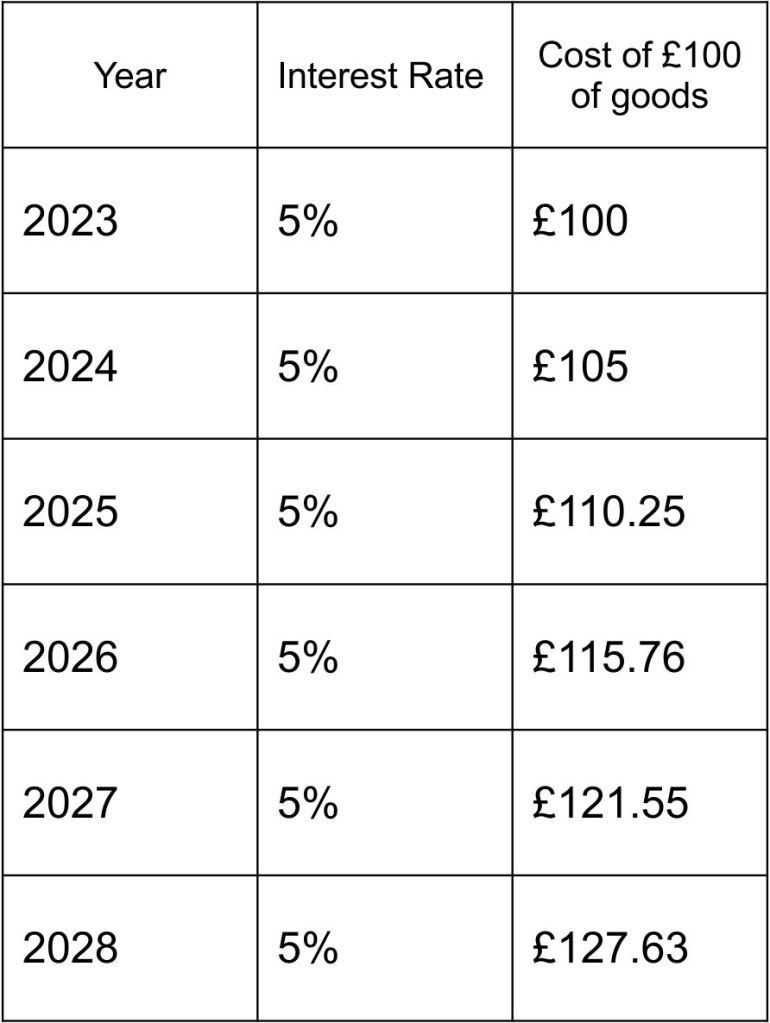
To illustrate the point that the IMF was making, I quickly ran through the upward changes that just a 5% interest rate would have on the value of buying £100 worth of food or goods for each of the next 5 years – until 2028.
The reality is that by 2028, and a 5% yearly price rise, we will already be paying over a quarter of the prices that we are again.
Wages and incomes are not going to meet this kind of rise – assuming that nothing else other than the politicians who are in power change, between now and 2028.





 Adam Tugwell