The Basic Living Standard: How & Why It Works

A deeper exploration of fairness, responsibility, and the true meaning of abundance

Imagine entering this world with no advantages whatsoever. No inherited wealth. No family connections. No safety net. No possessions. No one to call for help.

Imagine seeing and feeling life without the comforts, protections, and privileges you currently rely on—many of which you may not even notice because they have always been there.

Now imagine that from the very beginning, the deck is stacked against you. Your starting point in life is so far behind others that you spend every day running uphill. You chase money, opportunities, and stability – not from a foundation where your essential needs are already secure, but from a position where survival itself is a struggle. You never get to pause. You never get to breathe. You never get to simply be.

Instead, you live under constant pressure:

  • to earn enough
  • to prove yourself
  • to meet standards set by people who have never lived anything like your reality
  • to justify your existence in a system that rewards advantage and punishes disadvantage

And what if, despite all your effort, the distance between you and those ahead of you doesn’t shrink – but grows?

What if it becomes clear that only extraordinary luck – luck comparable to winning the lottery – could ever lift you out of that position?

What if the more you try, the further behind you fall?

For millions of people, this is not a thought experiment. It is daily life. And as economic, technological, and social pressures intensify, many more will find themselves in the same position – not only the poor or vulnerable, but people who once believed they were secure.

This is the context in which the Basic Living Standard becomes not just an idea, but a necessity.

Abundance Is Not Accumulation – That’s Greed

The modern world has elevated money to the centre of everything.

Money defines power, influence, status, and even identity.

We are taught – subtly and explicitly – that success means having more: more money, more possessions, more property, more influence, more everything.

But this is not abundance. This is manufactured scarcity, wrapped in the illusion of abundance.

True abundance is simple:

Abundance is having everything we need – not everything we want.

The desire to take more than we need is easy to justify when:

  • the system rewards accumulation
  • rules can be bent or rewritten
  • distance hides the consequences
  • we believe others would do the same if they could

Throughout history, this behaviour has been common enough to appear normal. But normal does not mean right. And in a world where we now have the knowledge, technology, and capability to ensure that every human being can have their essential needs met, the moral justification for excess collapses.

When we hold more than we need – whether it’s money, property, resources, or influence- we are not simply “fortunate.” We are occupying space that others require to meet their basic needs. We are benefiting from a system that allows some to accumulate while others go without.

This is not a judgement of individuals. It is a recognition of a systemic truth.

Power Is Not a Title – It’s Every Choice We Make

Power is often imagined as something held by leaders, executives, or institutions.

But power exists in every choice we make, because none of us lives in isolation.

Every action has consequences, even when those consequences are invisible to us.

When we buy more than we need, someone else goes without.
When we waste resources, someone else loses access.
When we accumulate wealth, someone else is pushed further into scarcity.
When we treat wants as needs, we distort the entire system.

The greatest danger of modern life is the distance between our actions and their consequences. When harm is invisible, it becomes easy to ignore. When suffering is out of sight, it becomes easy to forget.

This distance is not accidental. It is built into the structure of the system.

A Twisted System Built on Manufactured Abundance

The idea that abundance means accumulating as much as possible – regardless of cost – has warped our values.

Centralisation, globalisation, and digital life have created layers of separation between action and consequence.

The internet age has amplified this distortion.

It has:

  • dehumanised relationships
  • turned people into data points
  • created new forms of exploitation
  • widened the gap between those who “succeed” and those who are treated as disposable

In such a system, it becomes easy to believe that some lives matter more than others.

But this belief is false.

Every human being has universal value, regardless of wealth, status, or circumstance.

Distance does not erase responsibility.
Ignorance does not erase impact.
Comfort does not erase obligation.

The Basic Living Standard: A Universal Guarantee

The Basic Living Standard is a guarantee that every person must both receive and respect.

The Basic Living Standard ensures that every individual has enough to meet their essential needs – food, shelter, energy, water, clothing, healthcare, and the means to participate in society.

But it also requires something deeper:

No person may take, hold, control, or influence anything that is – or could be – used to meet the essential needs of others.

This applies even when it appears there is “more than enough.” Because abundance is not measured by quantity – it is measured by access.

The Basic Living Standard is not charity.

It is not welfare.

It is not a handout.

A Basic Living Standard is a universal right, paired with a universal responsibility.

The Cultural Refocus

To implement the Basic Living Standard, society must undergo a profound cultural shift.

We must move from a system that prioritises money to one that prioritises human needs.

This shift will feel uncomfortable.

Manufactured abundance has conditioned us to believe that happiness comes from accumulation.

But natural abundance – the state of having enough – creates freedom, not fear.

When essential needs are guaranteed for all, something remarkable happens:

  • competition becomes cooperation
  • fear becomes security
  • isolation becomes community
  • profit becomes secondary to purpose

A society built around essential needs becomes a society driven by people, not profit.

The Requirement: Everyone Plays Their Part

A system that guarantees essential needs for all requires participation from all.

This does not mean everyone must earn money. It means everyone who can must also contribute time, skills, and effort to the system that sustains them.

Contribution replaces currency.
Responsibility replaces entitlement.
Community replaces competition.

The rules that uphold the Basic Living Standard are simple:

  1. Every person has the right to everything they need.
  2. Every person who can must contribute to the system that provides it.
  3. No person may take more than they need.
  4. No person may control resources essential to others for their own use or benefit.

This is not restriction.

This is fairness.

A Different Kind of Future

The Basic Living Standard is not just a policy. It is a re‑orientation of society around what truly matters: human wellbeing, shared responsibility, and the recognition that abundance already exists – if we stop hoarding it.

When we stop chasing manufactured abundance, we rediscover natural abundance.

When we stop competing for excess, we rediscover community.

When we stop fearing scarcity, we rediscover freedom.

This is the world the Basic Living Standard makes possible.

Please read The Local Economy & Governance System, to begin.
LEGS: The Human Economy – A Blueprint for Transformation

Introduction

In a world increasingly shaped by the pursuit of economic growth and the dominance of monetary values, our understanding of what truly matters has become distorted.

The language of economics, once intended to serve human wellbeing, now often justifies systems that place money above all other forms of value.

This Local Economy & Governance System (LEGS) challenges the prevailing money-centred worldview, exposing the myths that underpin it and the consequences for individuals and society.

By re-examining the purpose of the economy and redefining value at the level of the individual, we offer a blueprint for transformation – one that places human needs, freedom, and wellbeing at the heart of economic life.

The following pages invite you to reconsider what it means to live well, to recognise the moral costs of excess, and to envision an economy built on natural abundance, justice, and personal sovereignty.

The Rise of a Money‑Centred Worldview

Over time, the words economy, economics, economic policy, and economic theory have been shaped by a money centred worldview.

They became part of a language and narrative designed to justify systems that placed money above all other forms of value.

This worldview gradually embedded itself into culture, until money was positioned at the centre of almost every aspect of life and treated as the primary measure of worth.

How Policy Reinforced the Myth of Economic Growth

Governments, politicians, and established institutions reinforced this belief by placing the economy at the heart of public policy.

They encouraged the idea that a good life was only possible if the economy was considered healthy and growing.

Measures such as GDP were promoted as the ultimate indicators of national wellbeing, and people were led to believe – often without explanation – that their personal success was somehow tied to the financial success of the economy itself.

Reducing Human Value to Economic Data

By turning everything of tangible value into something economic, measurable, and defined only in relation to the economy, society gradually stripped away the inherent value of each person.

Individuals became reduced to data points – digits on a screen – an effect amplified by digital tracking and the rapid development of AI.

The Hidden Myth of External Power

The central myth that upheld this money centric system was not only the false belief that money is inherently valuable.

The deeper, more powerful myth was the idea – never openly stated but widely accepted – that real power lies outside the individual.

Because money appears external to us, it became easy to believe that our worth and our agency also exist outside ourselves.

The Illusion of Money as Value

In truth, money has no intrinsic value. It is simply a tool for exchange.

The belief that money is value created the foundation for many of society’s problems.

The FIAT System and the Concentration of Power

This belief was further exploited through the rise of the modern FIAT monetary system, which used complexity, misplaced trust, and practices that would otherwise be considered unethical or criminal to shift wealth – and therefore power – from the many to the few.

All of this was presented as progress. As the natural direction of a modern world.

The Moral Cost of Excess

Yet in any genuinely civilised society, there is no moral justification for one person to hold more than they need when that excess comes at the expense of others.

When someone accumulates far beyond their needs, someone else – often someone they will never meet – is forced to go without the essentials required for a life free from deprivation.

How Scarcity Is Manufactured

Taking more than we need, in any form, inevitably creates shortage elsewhere.

Possession alone does not justify allowing others to suffer lack.

No individual has the fundamental right to hold more than they require when doing so directly or indirectly harms others.

Economics as a Tool of Justification

In this way, the language of economics became a tool to legitimise imbalance and injustice.

It normalised greed and elevated the pursuit of material wealth and power to something admirable – something to be celebrated above all else.

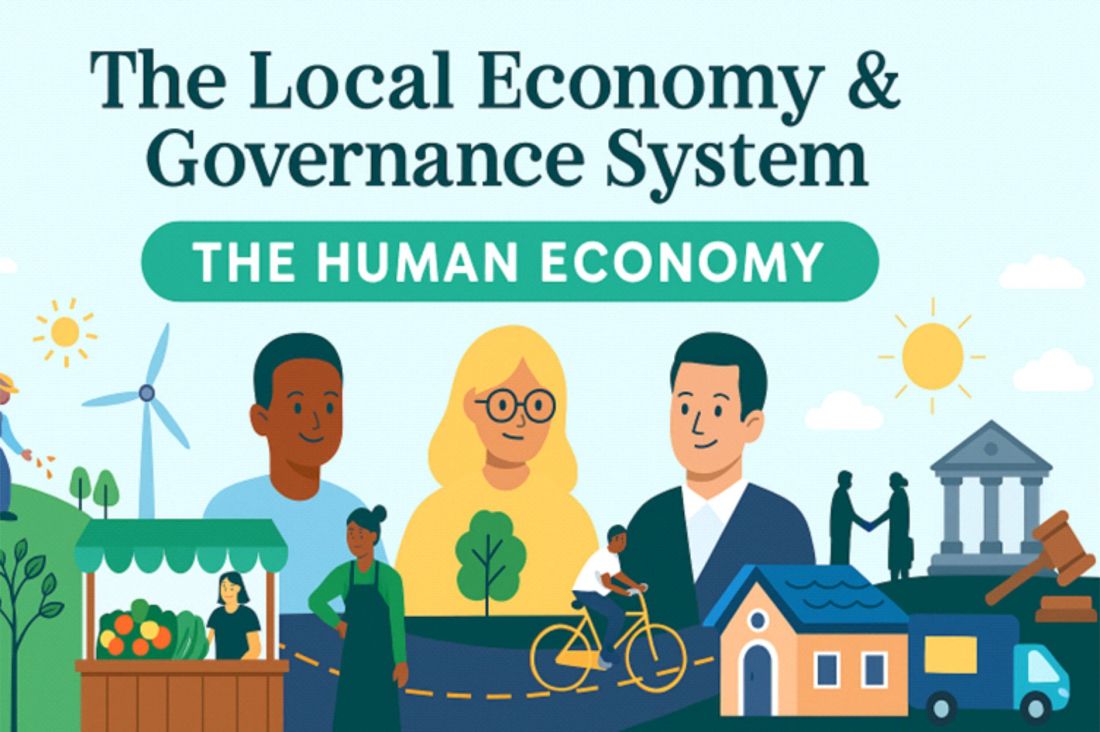
The Local Economy & Governance System: Defining the Economy and Economics for a Humane Existence and Way of Life

Real value does not exist within money itself, nor within the material possessions that money – despite having no intrinsic substance – can be used to persuade others to “buy or sell.”

True value can only be defined at the level of the individual. It arises from the meaning and importance a person attributes to something from within themselves, not from any external price tag or monetary label.

Money is simply a practical tool. Its purpose is to make the exchange of value easier when direct barter or exchange – trading goods, services, or labour – is not possible or convenient.

Money is a facilitator. Not the source of value itself.

In reality, people are the economy.

People are the reason the economy exists, the purpose behind it, and the driving force within it.

Every meaningful economic activity begins and ends with human needs, human choices, and human wellbeing.

With this understanding, the LEGS interpretation of economy can be defined as follows:

Economy is the collective presence, activity, and contribution of people working together to provide and supply all the goods, services, and forms of support that are essential for every individual within a community to live well.

Its purpose is to ensure that no person experiences need or scarcity severe enough to undermine the natural state of abundance – a condition in which all basic and essential needs are reliably met.

In this state of abundance, individuals are freed from the pressures of deprivation or want, allowing them to experience a form of personal freedom that is not compromised by the struggle to secure the necessities of life.

Thus, the economy is not merely a system of production and exchange, but a shared human effort to sustain the conditions that make genuine freedom, well‑being and the experience of Personal Sovereignty possible for all.

Summary

These pages challenge the prevailing money-centred worldview, revealing how economic language and policy have often placed monetary value above human wellbeing.

They expose the myths that underpin this system – especially the illusion that real power and value exist outside the individual – and highlight the moral costs of excess and manufactured scarcity.

The Local Economy & Governance System (LEGS) offers a transformative blueprint: it redefines the economy as a collective human effort, focused on meeting essential needs and fostering abundance, justice, and personal sovereignty.

True value, as argued here, arises from within each person – not from external price tags or monetary labels.

Money is a facilitator, not the source of value itself.

By placing human needs, freedom, and wellbeing at the heart of economic life, The Local Economy & Governance System envisions an economy where no individual suffers deprivation, and everyone is empowered to live well.

The path forward is one of re-examining our assumptions, recognising the moral imperative to share resources fairly, and building systems that sustain genuine freedom and wellbeing for all.

Why Yesterday’s Tory Budget “Triumph” Was All Performance – And No Substance

Any Conservative leader today will struggle to make meaningful progress in the polls for one simple reason: the Party’s outlook, methods, allegiances and overall direction of travel remain exactly the same. Nothing fundamental has changed.

Yet in the political theatre that UK politics has now become, sound and appearance often matter far more than substance. And against the backdrop of the slow‑motion car crash Labour are currently steering, Kemi Badenoch’s rapid‑fire response to Rachel Reeves’ Budget did create a moment of clear contrast.

On performance alone, she outshone the government front bench and delivered the kind of punchy, headline‑friendly attack that modern politics rewards.

But that’s the problem. Parliament has drifted so far into theatrics and amateur dramatics that its real purpose — truth, accountability and the serious business of governing — has been pushed aside.

The Deputy Speaker’s intervention, acknowledging the “accidental” early release of the OBR report while hinting at the government’s obsession with narrative control, underlined just how far ministers now prioritise managing the story over respecting the institution.

Everyone already had a good idea of what was coming long before the OBR stepped out of line. Yet the contemptuous performances from both the Prime Minister and the Chancellor were quickly overshadowed by Badenoch’s attack‑dog delivery. For a brief moment, it even looked – at least to some watching – as if she might have what it takes to be the next occupant of No.10.

However, what went almost entirely unnoticed was the absence of anything resembling a coherent Conservative policy platform. There was no indication of how the Party would fix the mess that, until just 17 months ago, they were still enthusiastically helping to create.

Nor was there any suggestion that, if returned to power, the Tories would do anything fundamentally different from Labour: cling on, run down the clock, and hope the public doesn’t notice that the country continues to deteriorate while politicians prioritise survival over service.

We should be able to expect that our political leaders have a deep, meaningful grasp of what is actually happening in the country. Many people still assume they do.

Yet the evidence – from those who want to be the next Prime Minister to the ambitious ranks lining up behind them – suggests they understand very little about how the world they seek to govern really works.

Worse still, they seem oblivious to the consequences of treating politics as a career, a game, or a performance rather than a responsibility.

This was painfully clear in Badenoch’s patronising reference to “benefits street”. Her point – that Labour is fire‑hosing money the country cannot afford while taxing struggling families to pay for it – was overshadowed by the tired fixation of the political right on the idea that being on benefits is a lifestyle choice.

Yes, the rising benefits bill is a serious concern. But what politicians consistently fail to grasp – whether through ignorance or wilful blindness – is that the people being mocked and blamed for the problem are not there by choice.

They are the inevitable product of the same broken system that has pushed Britain to the brink. A system that creates a small number of disproportionately comfortable winners by impoverishing everyone else and stripping away the financial independence and basic security that should be available to all.

Rhetoric and polished performances in the Commons or on TV are all well and good. But without real power, the soundbites and counter‑narratives offered by any opposition party are meaningless. And even when a party does hold power, it means nothing if the people standing at the despatch box lack the right motives, the right understanding, and the courage to deliver the deep change the UK now desperately needs.

Whoever stands to the Speaker’s right in the future will make no difference to our lives unless they are genuinely committed to rebuilding this country – its people, its communities and its environment – regardless of the personal or political cost.

The Borrowed Time Budget: A System Running Out of Road

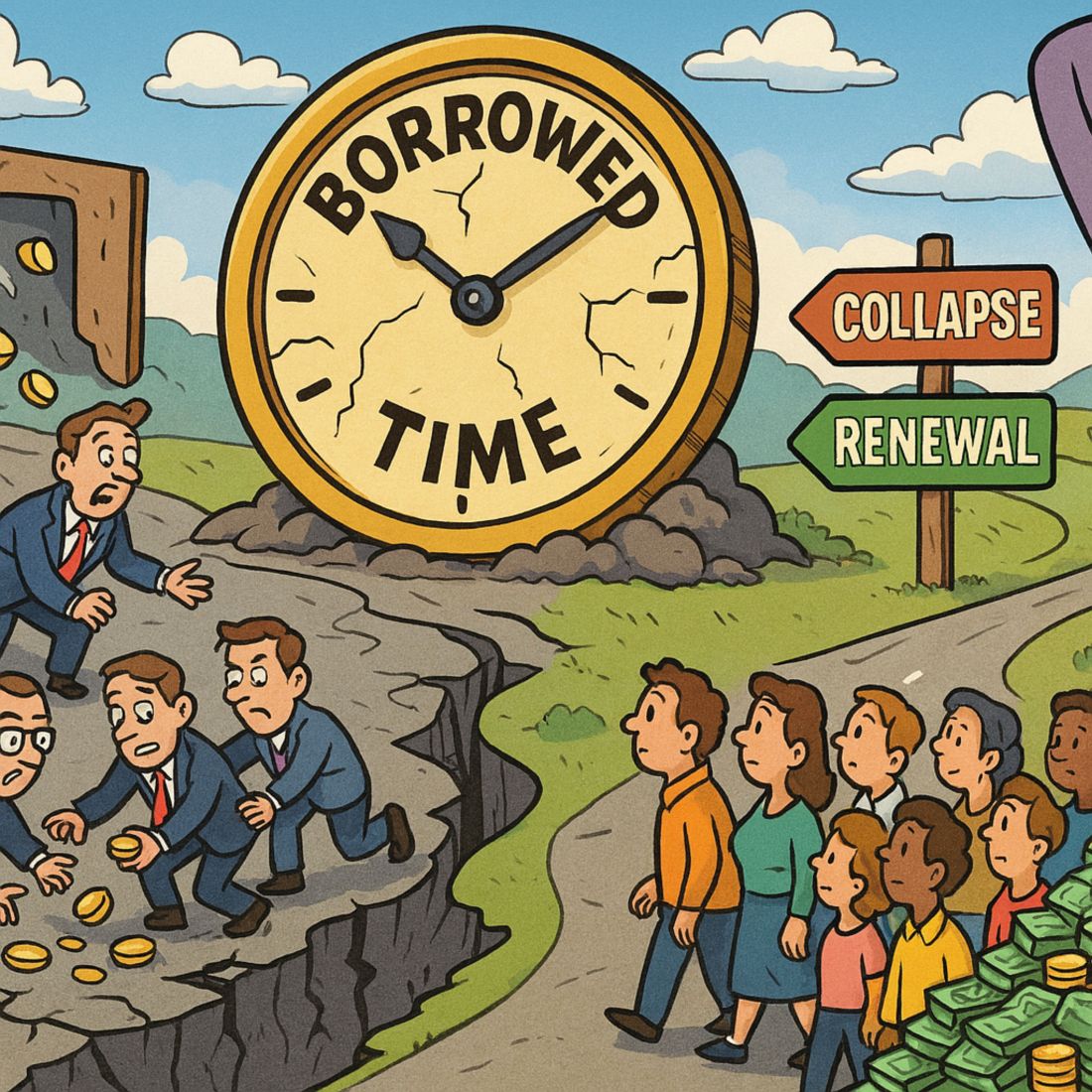
The November budget, with its push toward higher taxation, is not simply a matter of fiscal policy. It is a warning sign, a flare in the night sky that tells us the system we live under is running out of road.

Few people recognise what this shift truly signals, and fewer still are willing to confront it. That blindness is not accidental. Our economy has been carefully designed to mislead, to disguise its fragility, and to keep even the sharpest minds chasing illusions.

For decades, governments have expanded the flow of money, not by creating genuine value, but by inflating the system.

They bailed out the banks that caused the crash of 2007- 08, rewarding failure with public funds. Later, they unleashed torrents of money during the Covid pandemic, not to rebuild resilience, but to keep the machine ticking over.

These interventions did not repair the foundations; they merely propped up a broken structure. The result is a distorted reality in which the government can no longer borrow what it needs to sustain public services. Instead, it faces crises that today’s politicians are neither prepared nor equipped to lead us through.

To keep the illusion alive – to make it appear that everything is functioning as normal – the government must find money somewhere.

If banks cannot provide it (and in truth, they never had it to lend in the first place), then the state will take it from us. Taxation becomes not a tool of governance but a desperate grab for survival, a way to scrape together whatever can be found to keep the plates spinning.

This is the trap of the political class. They value their positions and the power they believe they hold more than the consequences of their choices.

Whether they admit the truth now or continue draining the public first, the end is the same: collapse.

The system is already hurting millions, and it cannot endure indefinitely. The only uncertainty is whether we lose what remains of our wealth before the collapse, or when it finally arrives.

The bitter irony is that our money is tied to nothing of real value. That emptiness is what has allowed politicians and elites to manipulate the system for so long. Could anyone become an overnight billionaire if wealth were grounded in tangible worth? Of course not. Their fortunes exist because people buy into offerings with money that, in essence, does not even exist.

This government – and likely the next one too – is living on borrowed time. Real change will only come when leaders emerge who understand the true nature of the crisis and are willing to act decisively to rebuild on solid ground.

Until then, the charade continues – as does the damage that it causes.

Few will welcome the upheaval that is coming, but it is inevitable: the world will soon operate very differently than it does today.

That shift need not be catastrophic. We still have choices, and we still have the chance to take a better path.

But this requires honesty. It requires accepting that the obsession with money at the centre of everything must end.

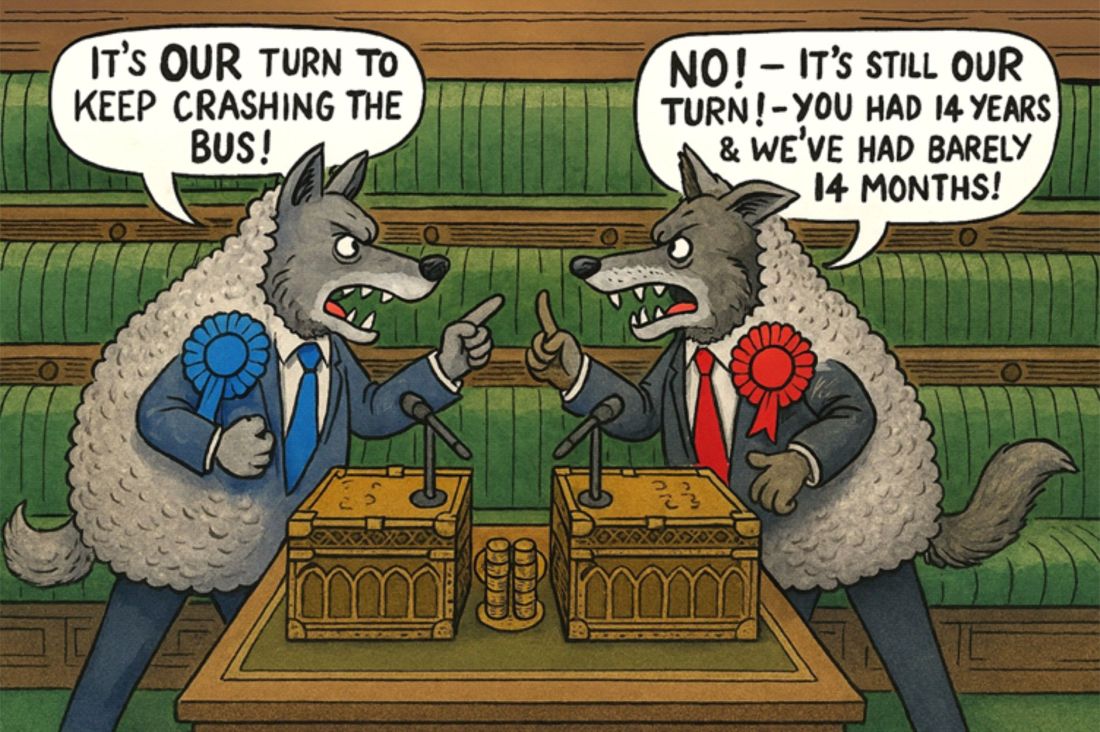
Unlike the politicians driving the UK bus towards the cliff, we must recognise that we have already reached a place called stop.

From here, the only way forward is to put people first.

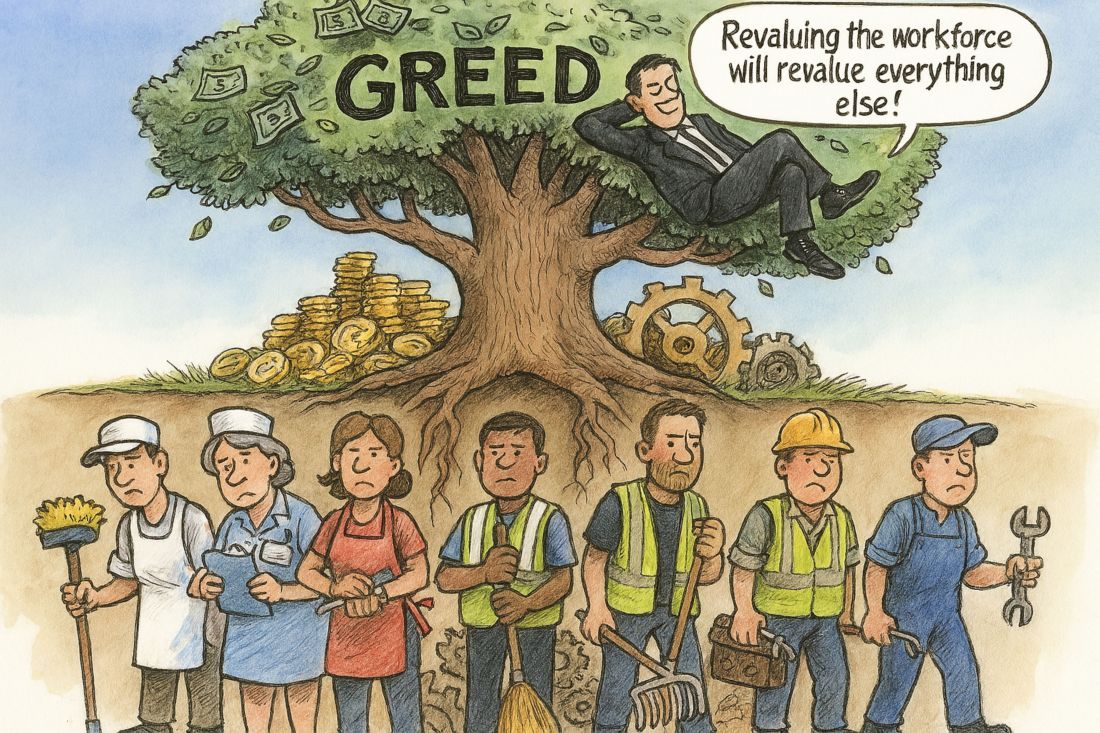
Revaluing the Workforce: Escaping the Grip of Greed

Life didn’t become expensive because it had to be. It became expensive because too many people wanted more than they needed, and in chasing profit they made freedom unaffordable for millions.

That greed has shaped the way we live, the way we work, and even the way we imagine what’s possible.

The Illusion of Permanence

We’ve been conditioned to accept the system as if it has always been this way and always will be.

For those who benefit, that’s convenient blindness. For those who suffer, it’s a kind of brainwashing – convincing them that change is impossible.

But everyday life tells a different story. Anyone who shops regularly knows how quickly prices rise.

A £3 item can jump by 30p in a week, far beyond the official inflation rate. At Christmas, tins of chocolates are dressed up as “reduced,” even though they cost 20 to 50% more than they did a year ago. And energy bills keep climbing even when wholesale prices fall. These aren’t natural increases; they’re engineered.

The Myth of Big

This manipulation is reinforced by another illusion: the myth of big.

We’re told that scale equals legitimacy, that size equals strength. But “big” doesn’t mean better. It means the system has grown so vast that exploitation can hide behind its scale.

The bigger it gets, the smaller we feel – and the easier it becomes to believe we can’t change it.

The Machinery of Exploitation

Once you see through the myth, the machinery becomes clearer.

Supply chains and hierarchies strip away accountability, amplifying selfishness until exploitation feels normal.

At the heart of it all sits money – created, policed, and controlled by those with power.

Profit comes first, people last, and the system is designed to make us accept it as normal.

The Human Cost

This isn’t about people failing. It’s about people being failed.

Lives are destroyed not because individuals did something wrong, but because others took more than they needed.

The uncomfortable reality is that we don’t have to live like this.

There is another way.

Redefining What We Value

We’ve been taught to believe success means others must lose, that material wealth defines worth.

That’s the great lie. It externalises our humanity, making us dependent on possessions instead of recognising our intrinsic value.

To change course, we have to learn to value who we are, not what we own.

Putting People First

Imagine a system where everyone’s basic needs are guaranteed.

This isn’t a pipe dream or a challenge to the “law of the jungle.” It’s simply the right thing to do.

A good life depends on the contributions we all make together, knowing that at the end of the week we’ve done our part and received what we need.

Beyond Division

We are not isolated individuals. We are members of the human race.

Hierarchies and divisions are tools of oppression, legitimising greed and selfishness.

Those who benefit from them do so only by exploiting the needs of others, however distant those others may seem.

A Framework for Fairness

Enshrining the Basic Living Standard in law would be the transformative step toward a society where dignity and security are guaranteed for all.

This principle ensures that every individual’s essential needs are met, fostering resilience and social stability.

The adoption of the Local Economy & Governance System and the framework it offers would strengthen communities by decentralising decision-making and empowering local actors.

Such a system encourages sustainable growth, supports small businesses, and keeps resources circulating within the community, thereby reducing dependency on distant, impersonal structures.

Together, these frameworks dismantle exploitation, promote fair contribution, and prevent the concentration of wealth and power that undermines collective prosperity.

By prioritising fairness and local empowerment, society will lay the foundations for enduring economic vitality and shared well-being.