My focus on Agri politics and the mass of issues that surround UK Food Security, Sustainable Agriculture and the growing problem of Food Poverty in the UK has made the past few months and my time at the Royal Agricultural University highly beneficial. Especially as I have began to look further and further outside my own social and professional circles to see if the troubling patterns that I already recognised, were evident in the same way elsewhere.
I have to be blunt and say that nothing I have experienced has given me any comfort. In all honesty, everything that I have seen has made me realise that the UKs Food Security and self-sustainability issues are significantly worse than I’d already concluded, and they are getting worse the whole time.
As you will have already read, Sustainability and Sustainable Agriculture are issues that are important to what I wish to share. However, the English language, the way that we multipurpose words and the obsession with subtext that most of us have, make communicating difficult issues that need to easily be grasped very difficult. Especially when alternative terms and their meanings can be used as a barrier that allow emotional ties to get in the way of progress and constructive dialogue.
There are very important distinctions to be made about Sustainable Farming in the context of what sustainability really is. Given that terms such as Regenerative Agriculture, Conservation Agriculture and Rewilding have been pushing their way into the Rural, Green, Environmental and Agricultural lexicon. As despite what should be very distinctive threads of commonality running throughout all of them, the differences between them and more importantly what everyone believes to be the most important priorities of each of them, are endlessly getting in the way.
Misunderstanding, misinterpreting and misrepresenting key benefits and issues is preventing everyone coming together to build upon shared commonality to identify and implement ways of working for the future that are meaningful and beneficial for everyone involved.
To add to the complication of addressing these issues, there is also a need to focus on methods and thinking that are likely to seem counterintuitive in a way that requires many of the most logical and business minded people that we could meet, to think about a future that looks very different to how it does today. A comfort zone we are resistant to leaving where every system, policy and story we encounter tell us all that the basics of everything that we accept without thinking, are always set to remain the same.
So, this is a statement that will need some more thought. Surely it’s the case that every business is run to make money, isn’t it?
On the face of it, the argument that all businesses exist to make a profit is very sound. However, it is only sound because of the way that the world currently works and how we think, placing money at the heart of everything. Instead of prioritising the real reasons that any business exists, which are the products or the services that they provide to customers (or end users).
We can take this thought further. The real reason for providing those goods or services are to help, support or enable people to live, in whatever way that product or service will help those people to do so.
At risk of stating what should be obvious to everyone but actually isn’t, UK Agriculture, Food Production and UK Farms are about or should be about providing the UK population with a secure, accessible, ongoing supply of healthy, nutritional basic or essential foods. And they should do this collectively on the basis of providing the UK Population with the widest variety that is available to us from being grown, ideally as local to the end user as possible, but at the very least, from somewhere from within the geography of the nation state that we all share.
I don’t know a farmer who isn’t passionate about what they do.
Farming isn’t just a business. Farming is a vocation and lifestyle choice for all those who are genuinely committed to the industry, in what I will suggest is a healthy way.
However, as we have moved further and further away from subsistence farming the scale of risk has grown at the same pace as the commitment to production growth.
It has naturally followed that the power that Farmers and Food Producers in the UK once had, has progressively been surrendered to whoever will guarantee the greatest longevity of income. Even though it has now been arguably many years since such guarantees have also offered anything like what we would likely agree to be viable prices.
One of the reasons that Clarkson’s Farm on Amazon Prime has been such a good champion for UK Farmers is that it has lifted the lid on just how precarious Farming in the UK has now become. Yet few Farmers have the opportunity to do TV work or lean on the marketing power of celebrity to make a new farm shop or a brewery buy-in an instant hit.
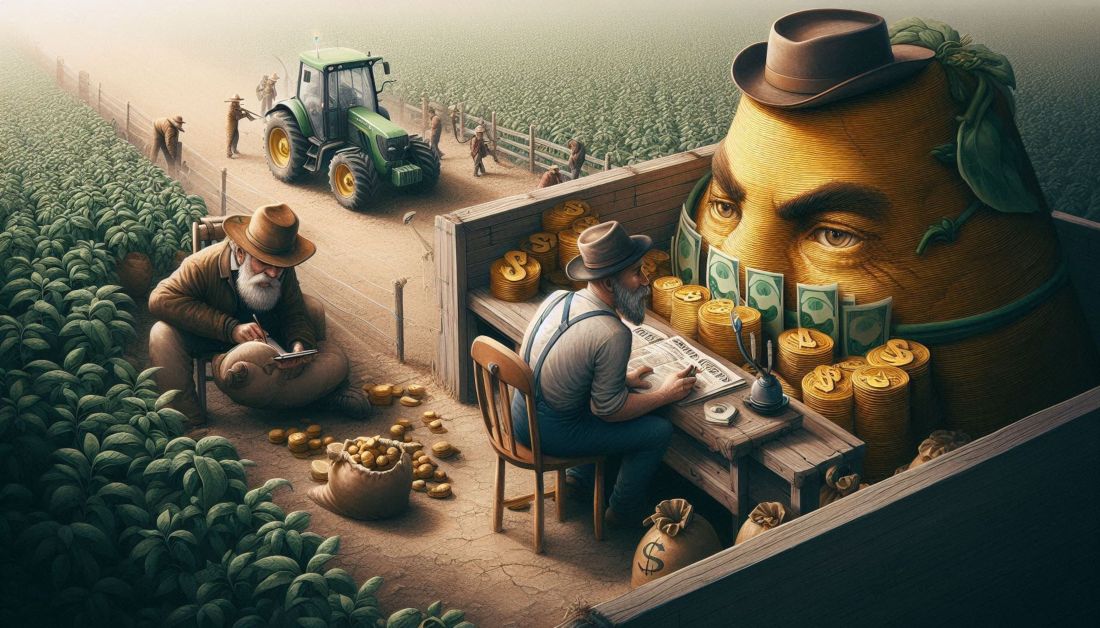
The reality is that for many Farmers, it has been the culture of payments and subsidies that have taken over everything in Agriculture, alongside the ‘deals with the devil’ that have been made with traders and supermarkets, that are the only reason that what should be ridiculously successful food producing businesses stay afloat.
It is impossible for Farmers to stand still at a static or subsistence level as it once was, as ‘growth’ and therefore growing ‘turnover’ is the only way that earnings can be kept static.
The alternative for many being either to sell up or go broke.
Farmers, Food Producers and the entire UK Agricultural Industry are vulnerable to whatever the supermarkets, retailers, traders and the establishment demands of them next. Because they have surrendered their power to money, and forgotten how to do what they really do best.
Current thinking and every message that we hear tells us that big and bigger are the only way that things can now go. That ‘growth’ equals progress. Yet none of this is in any way true.
The future of Farming is the return to being a predominantly local, community-focused industry with emphasis on the production of foods and goods that local people need. Not what some want and only they can afford.
I realise that the immediate argument that will come back from many farmers who are thinking about the situation that they are really now in, will be that the infrastructure, support networks and governance (laws, rules and regulations) simply don’t exist to make anything like this work without financial support, and that just this factor alone, before anything like the economies of scale are considered, make any such move one that would be impossible to work.
It certainly looks that way. But without UK Farmers, Food Producers and Agriculturally aligned industries taking back their own power by taking those risks necessary for themselves now, the reality is that within perhaps only a few years, Farming as we recognise it in the UK today, will simply no longer exist.
So obsessed have we become with tech, the next big thing and the apparent ease with which we can get everything that we want, that we have forgotten what’s actually important in life. And when it comes to the basic essentials for life, there’s likely to be nothing more important than what we eat.
Just like the air that we breathe, it’s easy to take the supply of food for granted. Unless you are already one of the growing number of us who cannot always afford to buy enough.
Yet, it’s not even as simple as having access to the food that we genuinely need.
For half a century and probably more, the food we eat, the systems, the supply chains that provide it and the governance that is supposed to be there in place to maintain supplies of the things that meet our basic needs have been changed, manipulated and replaced from top to bottom and from left to right. For no better reason than to allow someone somewhere to make more and more money, without any regard for consequences or what for us – and for our farmers and growers, is already becoming a very high price.
To really grasp the horror story currently unfolding, there is need to have understanding of our political system, of human nature and how money runs the world and makes everything work. Not in the sense of how we see it or how we talk about it. But in the sense of how it all really is.
This past weekend saw Channel 4 give a platform to yet another attack on meat production and specifically beef farming, leaning very much upon the narrative that to tackle global warming, cutting down and ideally stopping eating meat is the best place for everyone to begin.
Never mind the queues of private jets lining up at the very same time to fly an ‘elite group’ of very rich people to a meeting where they can all work out plans to force more of their green rules on the public, all in the comfort of luxury hotel suites in Dubai.
Regrettably, many of the people gifted high profile platforms to speak passionately about the guilt people trying to eat a balanced diet should expereince for eating properly have become the useful idiots of a very cynical strategy. One being pushed by people who were never elected to their roles and so recognise that to have control over everything, they must gain control of any basic essentials for life that everyone seeking to exert their own freedoms and will must automatically prioritise first.
What they forget to mention – even when these same people have responsibility for public health, is that good, healthy and nutritious food, as part of a balanced natural diet, is the essential building block and foundation of a happy life.
So, why would anyone of sound mind want to destroy or kick the foundation of good, healthy and nutritious diets away?
You can be sure that its not anything to do with the methane that animals, humans and just about every natural biological process produces. But it certainly has a lot to do with money and the two things that come with it: power and control.
Yes, it sounds like a conspiracy theory. But everything that the world is doing to itself today is thoroughly unsustainable.
The irony is that it is the same people, businesses and financial minds that created the false ‘need’ we have bought into who are responsible. On one hand, they have normalised unsustainable behaviour that has depleted the planets resources for no good reason. On the other they have systematically destroyed the governance and infrastructure that would make it easier for us to choose and adopt alternative ways of living that would be much healthier, affordable and sustainable too.
It is these same selfish and self-serving minds that are now determined to dictate the solutions to the problems they caused, so that we change and then behave in ways that will work better for them.
Food is power
Whilst it will make uncomfortable reading for farmers, including many great friends that I know, an entire industry populated by some of the most creative and entrepreneurial people imaginable has been reconditioned to accept grants, subsidies and ‘guaranteed’ contracts with big business and retailers as being ‘normal’. Instead of using their own freedom to do all the things that only British farmers and growers know how to do best.
The consequences of what is happening because of greed and self-interest are very serious indeed.
Yes, farms are going out of business and land is being taken out of production at an alarming rate. But the fact the food the U.K. grows or is capable of growing doesn’t often find itself into the mouths of the very people who live closest to the farms where it was grown is both part of the nightmarish reality that people in food poverty are suffering obesity and diabetes, and the accompanying reality that basic healthy fruit, veg and and high quality meat and fish that resembles its origin in an unadulterated form is now for many, simply too expensive to eat.
It shouldn’t be this way. Yet the travesty doesn’t end there.
Whilst we should all be able to depend on the public representatives that we have elected to put our health and the security of UK food production first, the reality we all have to face is that whether it’s the Conservatives this year, Labour or anyone else occupying No. 10 and the green benches to the right of the Speaker, next, none of these politicians have any idea of just how fragile the UK food supply is right now. Nor how serious even a few shortages of outside food supplies could make things get.
U.K. agriculture has reached the point where farmers, growers and the industries that are inextricably linked to U.K. food production will either choose to accept the risk of taking the steps necessary to facilitate its own revival or wait perhaps no more than just a couple of years and see everything that still exists swallowed up by some impractical idealists 2030-based agenda of some kind.
Farmers and the public are the two key stakeholders in U.K. food production and accompanying supply relationship. Yet neither farmers nor consumers have anything like the genuine say and influence that they should have.
It’s money, self interest and other people’s agendas at every step of the way.
The UKs Farmers shouldn’t have to lead the revolution of reality. But the reality is that a meaningful commitment to changing U.K. food supply and recreating the local infrastructure that would be able to make that work, will soon gather growing public support once the work has really begun.
Its then and only then that our hapless politicians will have no option but to follow.
Before anything, I will say that the Red Tractor Scheme was a good idea, even though with my consumer hat on, I’m not convinced it really meant all that much to shoppers.
On that note rests the question of who really gets the value from it, and from that perspective, its possible to begin joining up the dots regarding the latest row that has developed around future changes and the relationship between the Scheme and ‘green farming’.
Whilst everything looks very simple, the truth is that complexity rules the day and many of us don’t understand the relationships and motives that lie behind many of the problems that agriculture and businesses are facing.
At face value, most people simply wouldn’t believe what’s actually happening and what corporate interests are doing to entire industries as they seek to control every part of the food supply chain across the UK. Acting as if even the farms they buy produce from, are no more than facilities that they own.
Regrettably, big money interests want more profit than they already have and they have successfully hidden behind the lie thar is ‘free markets’ and yes, Globalisation, to trash genuine government and regulations and then replace it with a system of their own that they control.
My concern is that whilst overtly created with the best of intentions for Farming and Food Production, devices like the green agenda are just new ways of ratcheting down more and more control of the food production system. So that every penny of profit or ‘the fat’ that exists at any point within the entire food supply chain is controlled and funnelled into the hands of those who control it.
Consider this scenario:
Many farmers – perhaps every farmer, has at some point signed up to some kind of contract sale arrangement for their crops, animals or produce, perhaps with a dairy, a big retailer or an agent of some kind.
Within these relationships, it has been considered normal or necessary to share just about every bit of data about the farm, what equipment is used, the number of animals, number and type of staff – and much, much more.
Afterall, what does it matter when you are working for the same goals and these are people you can trust?
It’s likely that right now, an unworldly economics graduate, perhaps sat in a commuter town HQ, somewhere near London, is looking at every detail their employer has hoovered up through this process of ‘granting contracts’ or ‘beneficial arrangements’ of some kind. That’s the one mentioned above where they have insisted that they are the farmers friend and that all this information helps to raise standards, meet targets, and no doubt of late ‘helps to achieve Net Zero, or make the industry green’.
What they didn’t tell you is that from this data, this analyst or someone like them that the farmer will never meet, can work out exactly what everything is costing on that farm. They can then then use statistical averages and data of the kind that inform our politicians, to make decisions on what the farmer is ‘entitled’ to earn – knowing exactly what their spreadsheets have told them the farmer should ‘charge’ to cover the costs of their ‘wage’ and absolutely everything else.
***
Yes, the chances are that the companies and retailers that farmers ‘sell’ to are working out what they believe those farmers need so that they earn the average wage (if they are lucky), and without the farmer even being aware, nothing is any longer that farm business owners’ choice.
If farms are dependent on these companies and their contracts – no matter how well intended or how they were sold, the business that the farmer is contracted too basically owns the farm.
As such, farmers are right to be very concerned about where so-called standards are taking the industry, as the level of data and therefore control that these interests will have and will be able to exert, is only likely to grow, whilst politicians continue to fail to represent the interests not only of the food producing industries, but of the public at large.
Right now, the destination is already over the cliff. But it could get worse, with Supermarkets now trying to claw back whatever they can from what they clearly believe to be over generous relationships with the key suppliers within the UKs Food Supply Chain.
Young children are now suffering health problems that just decades ago were likely only to be experienced by a much older and very unlucky few. Obesity not only affects a significant part of the population, but it is also being championed as if it is normal, and we are vilified for daring to speak openly about such a point of view.
Like the rise in so many different health related conditions that are seriously compromising far too many people’s quality of life, the biggest proportion of all of them would be no more than an afterthought, if we were to bring back healthy eating and balanced diets in the form of basic and essential foods.
Sadly, the belief that cheap, sweet, salty, easy to buy, quick to eat ‘food’ is healthy for us is a well-crafted and massively convincing lie. We have had this nonsense repackaged by advertisers and the media in the same way that we are being told that if everyone were to consume healthy, basic and unprocessed foods, it would be more expensive than it is for us to eat it as the apparently luxury we have been conditioned to believe that it has now become.
We have been encouraged to eat the way that we eat and to feed our families the way that we do, not because it will benefit any of us. But because the foods, drinks and treats that we have become addicted to make somebody somewhere VERY rich.
What many of us don’t even realise that all of these ‘wonderful’ foods – and even the takeaways that have become a staple diet for some rather than just being an irregular treat – will have travelled many miles and been constructed artificially using ingredients that themselves may have been made in many different factories. They have traveled across continents before the end product you recognise has even been made.
It’s all part of the con called globalisation. A lie we are told we must celebrate and embrace as the legitimised truth. Because globalisation is all about international trade – which is how wars are stopped and how good relationships between different countries are made.
What the Establishment salesmen never talked about, and their pet media ignored, was the reality that jobs and communities have been lost, as well as the livelihoods that went with them.
Stupidly, we never really questioned the whole process because we were taught to become obsessed with speed of delivery, availability and what we still believe to be the lowest cost.
The reprogramming of our buying habits has contributed to or given the excuse necessary for almost all hope of this Country being Self-Sustainable in Essential Food Production being destroyed.
Meanwhile, the equally destructive EU policies that were supposed to be good for our economy within a so-called single market, also represented an advanced politicised form of the globalisation franchise. EU doctrine on food production has progressively made UK Farms all but impossible to run.
Globalisation was good whilst it lasted. Or rather, that’s what the majority of us are still expected to believe.
However, because of many different reasons that only include government responses to Covid, to Brexit, The War in Ukraine and the idiocy of Free Markets and Neoliberalism in the way that everything has been run, the supply chains that crisscross the world are now collapsing.
Forced change and possible shortages too, are only a matter of time.
As part of the so-called Great Reset or Agenda 2030, the solution to this coming problem that the elites created themselves isn’t to go back to basics and focus on localised supply chains. Indeed, whilst they actively ignore the crisis within UK Farming and in other countries where their counterparts are actively taking steps to see highly productive farms destroyed, they are instead telling us that we will all be happy eating ground up crickets and foods that have been made in a lab.
There is no good or humane reason for People to be treated this way, other than it being part of a strategy or plan to ensure that those who hold power over us now, remove our ability to support ourselves in the future.
As the crisis the Elites have created takes deeper and deeper hold, the agenda they are pursuing will ensure they will have and be able to maintain their grip on power, and we will all be dependent to a dystopian system where these few have absolute control. Unless we use the opportunity, their stupidity and greed has created, to take our own power back.
As part of The Grassroots Revolution and the rejection of everything held dear by the leaders of this dying ‘old world’, we MUST embrace a return to the most localised forms of food production and supply chains.
Food production must focus on healthy, basic and essential food items, using the absolute minimum of additional ingredients, so that our basic diets are home-produced, and this system of production is prioritised over everything else, so that the food we need, will always be available to us all in the cheapest and most accessible form.
Regrettably, because UK Agriculture has been deliberately pointed in the wrong direction for a very long time, younger generations of farmers have no working experience of anything like a truly localised food growing-to-production-to-retail system in anything like the way it historically was and will be needed now.
This means that the process of change will take time and that for reasons outside of our control, certain foods may become short.
It is therefore essential that everyone who is able use gardens, allotments, window boxes and whatever form of growing space available to ‘grow your own’. So that there will be sufficient basic and healthy essential foods available, whilst we all get behind our Farmers and develop the resources and cooperatives that will be necessary in every area.
We must do this to ensure that we have Food Security for the UK and achieve the National Self Sufficiency that we would have long since had, if politicians had been doing their job, and the greed and self-interest of the few, hadn’t been allowed to flourish and lead instead.
I have covered the subject of Basic Foods and Home Growing in detail within Levelling Level, the first book in the series leading to The Grassroots Manifesto. To read Levelling Level online or Download a FREE PDF copy, please Click HERE.
Levelling Level discusses the wider issues that we now face, how we got here and begins focusing on many of the things that we and our communities have the power to do.
In Part 3 of The Grassroots Manifesto, a series of Public Policies have been suggested for a new people-centric age. This is one of a number that relate specifically to this issue:
The Grassroots Manifesto | Policy 4 | Food Production, Security & Supply | Home Growing | xviii
Self-sufficiency of people is essential to achieving the aim of the UK becoming self-sufficient in food production and providing the Community with Food Security.




 Adam Tugwell