
AI Isn’t the Risk – It’s the Reckoning | How the guardrails we removed made artificial intelligence feel dangerous – and what it reveals about the system we built.

Imagine being denied a tenancy, a job interview, a loan, or access to a basic service by a system no one can properly explain.

No person takes responsibility. No clear reason is given. There is no meaningful appeal. You are simply scored, sorted, and excluded.

That is the practical fear beneath the debate about artificial intelligence. Not just that machines may become powerful, but that they may be deployed inside systems already built to distance decision-makers from consequences.

For years, we have heard warnings about AI – existential threats, job displacement, democratic disruption. Politicians speak about it as if it is an emergency unfolding in real time. Yet when it comes to meaningful regulation, almost nothing happens.

Instead, political attention is channelled into social-media moderation and online harms: visible, emotive issues that leave the deeper structures untouched.

This contradiction is not a mystery. It is a symptom of something older and more uncomfortable:

The guardrails that would have made AI safer were dismantled long before AI arrived.

AI is not the original cause of our vulnerability. It is the mirror showing how vulnerable we already were.

I. The Myth That Technology “Moves Too Fast”

We are often told that AI is difficult to regulate because it evolves too quickly. But the truth is simpler, and far more revealing.

The problem is not simply that AI moves too fast. The deeper problem is that the UK has lost much of the institutional capacity needed to govern powerful technologies in the public interest.

Over decades, the state was hollowed out in ways that often sounded efficient at the time. Expertise was outsourced. Regulators were asked to do more with less. Public institutions became dependent on consultants, contractors, and private-sector systems they did not fully control.

The result is not simply a slow state. It is a state that has become structurally dependent on some of the same interests it is supposed to scrutinise.

In a system like this, everything looks too fast. Not because it is, but because the institutions meant to govern it were deliberately stripped of the ability to do so.

This matters because regulation is not just the act of passing a law. It requires expertise, enforcement, independence, funding, technical understanding, and the confidence to say no to powerful actors.

Without those foundations, even well-intentioned rules become symbolic.

II. AI Entered a System Already Designed for Extraction

AI did not land in a neutral landscape. It entered a political and economic system already shaped by forty years of:

  • Deregulation
  • Privatisation
  • Outsourcing
  • Financialisation
  • The weakening of labour, environmental, and consumer protections – including the growth of work models that blur employment status and shift risk onto workers

These were not isolated policy choices. They were part of a coherent ideological project:

To free markets from the constraints that protect people, communities, and the environment.

That project changed not only who owned services, but how problems were understood. Social needs were reframed as markets. Public responsibilities became contracts. Citizens were increasingly treated as customers, users, claimants, data points, or risks.

Labour protections are a clear example. In the gig economy and other insecure forms of work, the issue is not simply that people are paid too little. It is that the relationship itself is often structured to avoid responsibility. Workers may be treated as independent enough to carry the risks of the job, but not independent enough to set prices, negotiate terms, build security, or exercise real control.

This is how employment status becomes a loophole. Costs that should sit with the employer – downtime, equipment, insurance, holiday, sickness, pensions, training, scheduling instability, and the risk of fluctuating demand – are pushed onto the worker.

The language is flexibility. The reality is often underpayment with extra responsibility attached.

AI fits easily into that model because it can manage, rate, allocate, monitor, and discipline workers at scale while keeping formal accountability at a distance.

A person can be controlled by a platform, priced by an algorithm, penalised by a rating system, and still be told they are not quite an employee in the traditional sense.

The result was a system where:

  • data became a commodity
  • people became resources
  • public services became markets
  • corporate actors shaped policy
  • accountability became optional

In such a system, any powerful technology becomes risky – not simply because of what it can do, but because of where it lands, who controls it, and whose interests it is asked to serve.

This is why AI cannot be understood only as a technical issue. It is also a governance issue, an economic issue, and a question of power.

III. Why Social Media Gets Regulated Instead

Social-media regulation is politically convenient because it is visible, emotive, and easy to explain. It offers recognisable villains, clear examples of harm, and a public debate that fits neatly into news cycles.

It also focuses on behaviour more than power. It asks what people are allowed to say online, but less often asks who owns the systems, who profits from them, who audits them, or who is harmed when automated decisions spread into housing, work, finance, welfare, policing, health, and education.

That does not make social-media harms unimportant. It means they are easier for politics to confront than the deeper structural reforms that remain politically off-limits.

Meanwhile, the real issues – data governance, algorithmic accountability, labour displacement, surveillance, power concentration – remain untouched.

The same narrowness appears in the labour debate. We talk about productivity, automation, and skills, but less often about who carries the risk when platforms classify workers as flexible contractors while directing their work through software.

This is why the public debate can feel strangely narrow. We argue about harmful posts, but not about automated welfare decisions. We debate online speech, but not the ownership of the data used to classify citizens, workers, tenants, borrowers, and patients.

IV. The Political Class Was Not Selected for Systemic Responsibility

Most politicians do not see the contradiction clearly because the political system rarely selects for that kind of responsibility.

The Westminster pipeline rewards:

  • communication
  • loyalty
  • campaigning
  • message discipline

It does not reward:

  • systems thinking
  • regulatory literacy
  • long‑term governance
  • understanding of political economy
  • understanding of technology

These skills matter in politics, but they are not the same as governing complex systems. Winning power and using power responsibly require different capacities.

This helps explain the shock of office. Leaders may arrive with conviction, but then discover the scale of the machinery around them: private contracts, fragmented responsibilities, legacy systems, institutional inertia, and a political culture designed for message control rather than long-term stewardship.

The result is a politics that can describe crises fluently but struggles to rebuild the institutions needed to prevent them.

V. The Deeper Guardrails: Distance, Centralisation, and Dehumanisation

Beneath the political and economic layers lies a deeper shift: decision-making has moved further away from the people affected by it.

1. Centralisation created distance

When decisions were made locally, decision‑makers lived among those affected. They had to look consequences in the eye.

Centralisation – and later globalisation – changed that.

Now decisions are made:

  • in London about people in Cornwall
  • in New York about people in Newcastle
  • in Singapore about people in Sheffield
  • by algorithms about people they will never meet

Distance dissolves accountability. It allows decisions to be made without ever encountering the human cost.

That distance does not automatically make people cruel. It makes consequences easier not to see. And what is not seen is easier to ignore.

2. Globalisation hid the extraction

Globalisation dispersed responsibility.

It created a world where:

  • supply chains are opaque
  • ownership is labyrinthine
  • accountability is diffused
  • harms are exported
  • profits are centralised

Power became global. Accountability remained local.

3. The digital revolution turned distance into dehumanisation

Digital systems do not see people.

They see:

  • risk profiles
  • credit scores
  • behavioural patterns
  • demographic segments
  • optimisation targets

This is why exclusion can now happen instantly, automatically, invisibly, and without meaningful recourse.

A person may experience this as a rejected application, a higher insurance quote, a closed bank account, a fraud flag, or a risk score they are never allowed to inspect.

The language is technical, but the consequence is ordinary: life becomes harder, and no one is accountable.

This is the point at which distance becomes dehumanisation. The person is still there, but the system no longer has to encounter them as a person.

AI did not invent this dehumanisation. It accelerated it.

VI. Finance and Creditworthiness: The Quiet Architecture of Control

The financial system is one of the clearest examples of guardrails removed, because it already decides who can participate fully in society.

  • credit scoring is privatised
  • risk modelling is proprietary
  • trading algorithms operate beyond oversight
  • access to finance is controlled by private gatekeepers

Creditworthiness has become a quiet tool of social sorting.

For many people, creditworthiness now functions less like a narrow financial measure and more like a passport to ordinary life.

It can determine:

  • who can rent
  • who can buy
  • who can work
  • who can move
  • who can access services

Because the system is largely self-policing, people can be excluded without ever fully understanding why. The companies making those judgements can hide behind commercial confidentiality, proprietary risk models, or automated decision-making.

AI supercharges this exclusion – making it faster, more opaque, and more difficult to challenge.

VII. The State Now Subsidises the Extraction It Cannot Control

As life becomes more unaffordable, the state steps in with:

  • housing benefit
  • universal credit
  • tax credits
  • energy subsidies
  • childcare subsidies

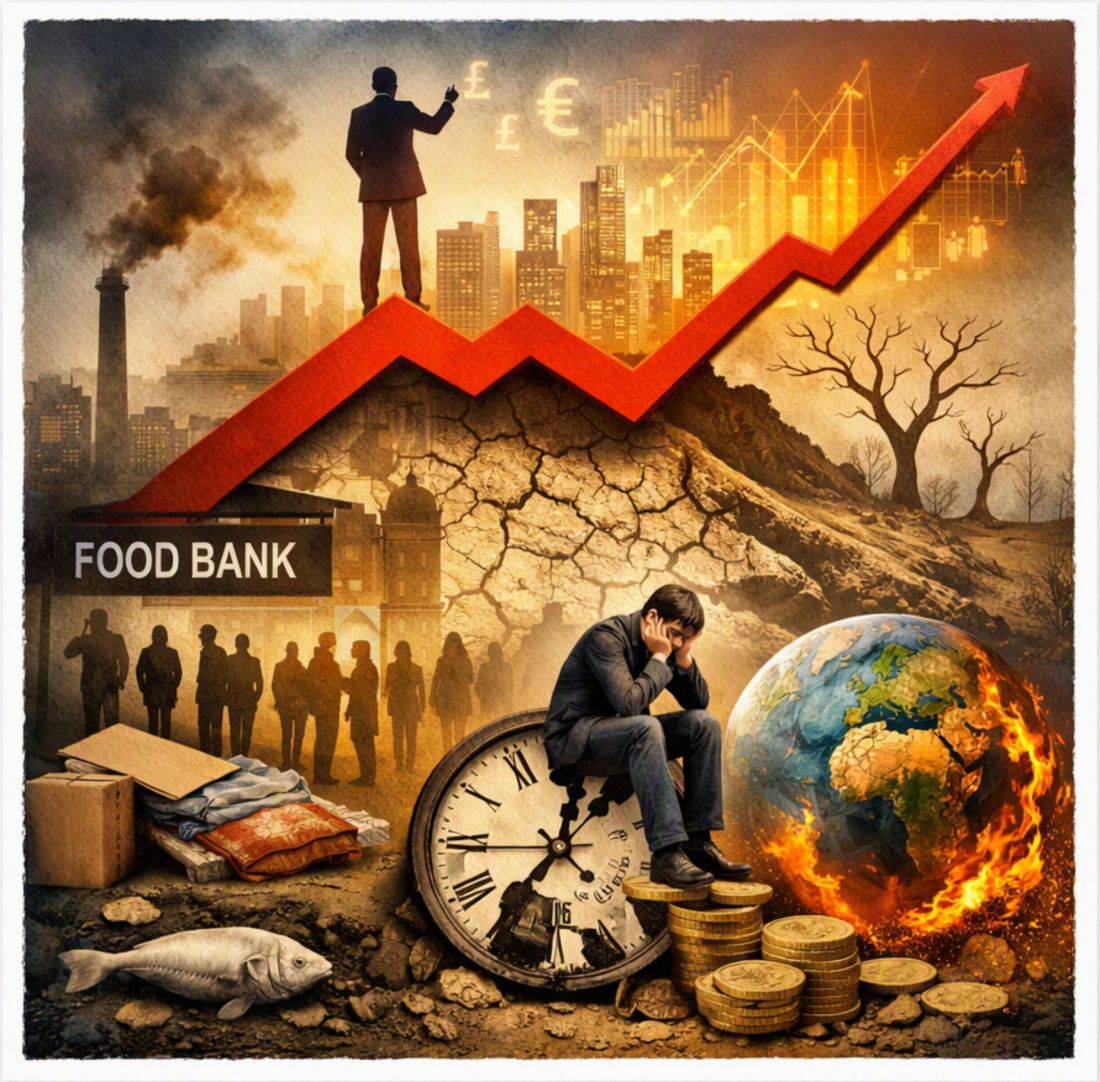
But these are not only social protections. They are also, indirectly, subsidies for a system that extracts more from people than many can afford to lose.

The state is paying to keep people afloat in an economy designed to drain them.

This is why public spending rises even as public wellbeing falls.

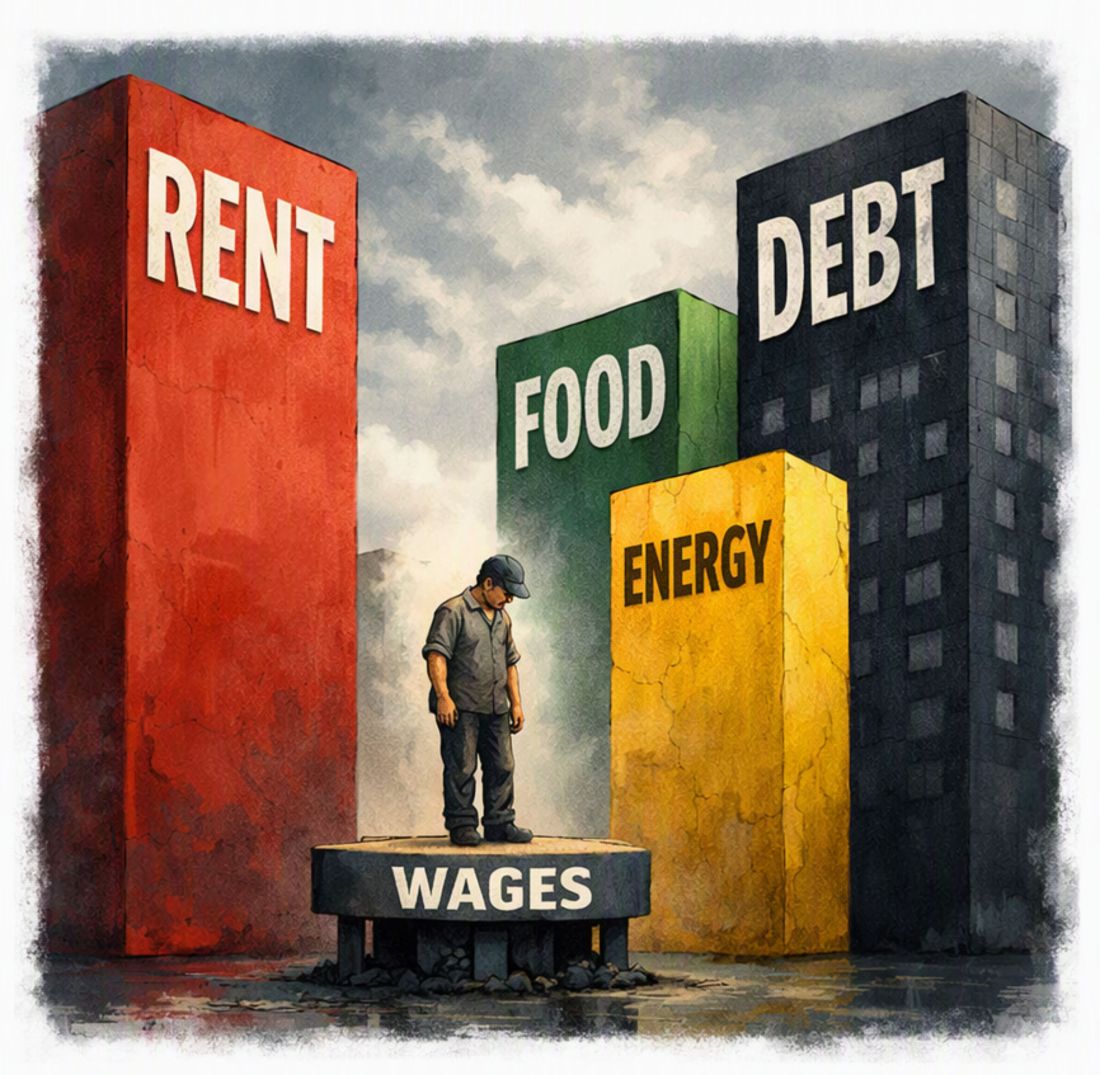
When wages, rents, energy costs, childcare costs, debt, and insecure work pull in the same direction, the state is forced to compensate for the damage while leaving the underlying model intact. In effect, public support can end up cushioning a labour market where too much risk has been transferred from employers to workers.

VIII. The System Has Become Too Embedded to Correct Itself

This is the uncomfortable truth.

The system cannot be corrected by slogans, ethics panels, or narrow technical fixes alone. It is too embedded, too centralised, and too dependent on extraction to repair itself without deeper political choices.

Even many of the technology leaders driving the digital revolution express fear about where this is heading – yet the machinery continues, because the system rewards momentum more than restraint.

We have built a world where:

  • power is concentrated
  • accountability is diffused
  • decisions are automated
  • consequences are invisible
  • people are abstracted into data
  • profit outranks wellbeing

In such a world, AI is not a disruption. It is the logical next step.

That does not mean nothing can be done. It means the solution cannot be limited to regulating individual tools after they have already been deployed.

The deeper task is to rebuild the conditions under which powerful tools can be governed in the public interest.

IX. The Reckoning

The reckoning is uncomfortable because it reveals that today’s risks were not inevitable. They were created by choices – political, economic, and ideological – made over decades.

But discomfort is not despair. It is clarity. And clarity is the first step toward rebuilding the protections we dismantled.

AI forces this recognition because it compresses old failures into visible form. It makes weak accountability faster, opaque decisions broader, and distant power harder to challenge.

X. The Paradigm Shift We Need

We cannot regulate AI – or housing, finance, labour, welfare, education, health, or the environment – within a system that continues to prioritise extraction over wellbeing.

We need a shift from a money-centric model to a people-centric one. That must not mean another abstract slogan. It should be a practical test for every major decision: does this system increase human agency, democratic accountability, and material security, or does it simply make extraction more efficient?

That means rebuilding practical guardrails that people can feel in everyday life:

  • regulators with the capacity and independence to act
  • public expertise that is not permanently outsourced
  • democratic oversight of systems that shape people’s lives
  • data rights that give people visibility, control, and meaningful protection
  • financial accountability when credit, risk, or automated systems exclude people
  • local decision-making where proximity to consequences matters
  • institutional responsibility that cannot be hidden inside contracts or algorithms
  • clear rights of appeal when automated systems affect people’s homes, work, money, services, or freedom
  • employment protections that prevent firms from using status, platforms, or algorithmic management to transfer employer responsibilities onto workers

AI is not the problem. It is the test.

And it is showing us, with painful clarity, that the guardrails we need are the ones we removed long ago. Rebuilding them will require more than better software or better speeches. It will require institutions capable of seeing people again – and strong enough to act when they do.

Further reading

These pieces expand the practical framework behind the argument above. Together, they explore how AI could be governed around human sovereignty, how local economies could be made more accountable, and how a basic living standard could give policy a clearer measure of real human security.

The Human Sovereignty Charter for Artificial Intelligence – a constitutional framework for human-centred AI governance.

The Local Economy Governance System – a model for restoring democratic accountability and local economic control.

The Basic Living Standard Explained – a foundation for measuring policy against real human security rather than abstract economic growth.

The Myth Catcher – A quiet guide to discovering clarity in an age of noise | Full Text

Clarity does not ask to be followed. It simply helps us see.

Author’s Note

There are moments when the world begins to feel louder than it should.

Not necessarily in volume, but in intensity. Explanations arrive quickly, certainty is offered freely, and voices compete to define what is happening, who is responsible, and what must be done. The pressure to understand – and to take a position – becomes constant.

In recent years, that pressure has only deepened.

Questions around politics, governance, the economy, and the cost of living sit alongside wider concerns: the stability of institutions, the reliability of systems people once took for granted, and the sense that events are unfolding faster than they can be fully understood. Wars carry the risk of escalation. Supply chains feel fragile. The future, at times, feels difficult to picture clearly.

In this environment, something predictable happens.

When uncertainty grows, people begin to search. Not always consciously, and not always urgently, but with a quiet need for something that feels steady. Into that search step figures who offer clarity – or something that resembles it. They speak with confidence. They simplify complexity. They provide narratives that feel complete, coherent, and reassuring.

These are the voices I refer to in this work as false prophets.

They are not always intentionally misleading. Many believe what they say. Some genuinely want to help. But the clarity they offer often arrives too quickly, too neatly, and without the weight needed to hold it. Over time, it can draw people away from their own judgement and toward dependence on a single perspective.

But this is not the whole picture.

Alongside these louder figures, there is another presence – quieter, less visible, and easily overlooked.

This is the figure I have called the myth catcher.

The myth catcher does not compete with noise. They do not offer certainty, promise solutions, or position themselves as someone to follow. They do not step forward to fill the space. Instead, they remain steady within it.

Their role is not to provide answers that no one can truly guarantee. It is to offer something simpler, and in many ways more fundamental: the reassurance that clarity is still possible, that uncertainty does not have to be rushed into narrative, and that people can trust their own perception again.

The myth catcher does not remove complexity. They do not resolve the world’s tension. They do not claim to understand everything that is unfolding. What they do is help reduce distortion – just enough for people to see where they are, and to recognise that they are neither alone nor without grounding.

This work is an attempt to describe that presence.

Not as an ideal to become, nor as a role to adopt, but as something that can be observed and recognised. The term “myth catcher” is simply a way of naming a pattern that appears when noise rises and clarity becomes difficult to find.

If you recognise this presence in others, or even in moments within yourself, then the purpose of this work is already fulfilled.

Because the myth catcher does not create clarity.

They simply remind us that it was never entirely lost.

This work begins not with explanation, but with a story.

How to Read This Work

This work is not intended as a system, doctrine, or set of instructions. It is a reflective guide to a particular kind of presence: the person who helps others see clearly without asking to be followed. You may read it from beginning to end, or return to individual chapters when the need for clarity feels especially present.

The opening parable offers the image that carries the rest of the text. The chapters that follow unfold the meaning of that image: why people search, how false certainty takes hold, how a myth catcher can be recognised, and why this quiet role matters in unsettled times.

You do not need to agree with every sentence for the work to be useful. Let the ideas sit with you. Notice what feels familiar. Notice what steadies. The purpose is not to tell you what to think, but to help you recognise the difference between noise and clarity when you encounter it.

Preface

People don’t always realise when they’ve begun searching for something new. It often starts quietly – a sense that the world feels louder than it used to, or that familiar explanations no longer settle the questions that rise in the back of the mind. Life continues, conversations continue, the daily noise continues, yet something underneath it all feels slightly out of place.

Not wrong. Not broken. Just… misaligned.

Many reach this point without knowing what they’re looking for. They only know that the usual voices feel thinner, the usual narratives feel stretched, and the usual certainties don’t land the way they once did. It’s not a crisis. It’s not a revelation. It’s simply an awareness that clarity has become harder to find.

This work is written for that moment.

It doesn’t ask you to take sides. It doesn’t demand belief. It doesn’t offer slogans or promises. Instead, it explores how people navigate periods of uncertainty, how they respond when the stories around them lose their weight, and how certain figures emerge during those times – some helpful, some harmful, some simply loud.

You’ll meet one of those figures in the opening chapter. The story stands on its own. There’s no need to interpret it immediately or connect it to anything that follows. Let it sit with you. Let it breathe. The meaning tends to arrive later, often in its own time.

What comes after the story is an exploration of clarity: how it is found, how it is lost, and how it can be restored without division or drama. This work introduces a way of understanding a particular kind of presence, one I call the myth catcher. If you are here because something in you is searching, even if you do not yet know for what, you are in the right place.

Chapter 1 – The Parable of the Piper and the Lantern‑Bearer

I. The Town of Evermere

Evermere was a lively town tucked between echoing hills. Its streets were always full of voices – announcements, arguments, promises, warnings – all overlapping until no one could quite tell where one ended and another began.

People went about their days, but many carried a quiet sense that something wasn’t right. They couldn’t name it. They only felt that the noise had grown louder than the truth inside them.

They were tired, though they rarely said so aloud.

II. The Piper Arrives

One evening, as the sun slipped behind the hills, a stranger walked into Evermere. He wore colours that shimmered like oil on water and carried a silver flute that gleamed even in the fading light.

He smiled with perfect confidence.

“I can quiet the noise,” he said. “I can fix what troubles you. Follow me, and all will be well.”

Then he lifted the flute and played.

The melody curled through the streets like warm smoke. It softened fear, sharpened anger, and made confusion feel simple. People felt recognised, understood, relieved. They gathered around him, drawn by the beauty of the sound.

And when he walked, they followed.

III. The Music That Led Them Away

The Piper’s tune made everything feel easy. He told the people who was to blame, who was good, who was bad, what was wrong, and what must be done. His certainty was soothing. His confidence felt like clarity.

But as they walked, some noticed something strange.

The Piper never asked them to think. He never asked them to question. He never asked them to understand.

He only asked them to follow.

Step by step, the crowd drifted away from Evermere – away from their homes, their neighbours, and their own sense of direction – still wrapped in the Piper’s beautiful, narrowing song.

IV. The Lantern‑Bearer

At the quiet edge of the town, where the hills softened the echoes, sat a person with a lantern. The lantern was small, its light steady and warm, nothing dazzling or dramatic.

The Lantern‑Bearer didn’t call out or wave anyone over. They simply sat, present and calm.

When they saw the crowd passing, they lifted the lantern slightly.

“You look tired,” they said. “Sit if you like.”

Some people paused. Others walked on, still enchanted by the Piper’s music.

V. The Conversation

Those who stopped found themselves speaking without quite knowing why. They talked about the noise, the confusion, the exhaustion they had been carrying.

The Lantern‑Bearer listened – not with pity, not with excitement, not with an agenda. Just with steady attention.

“It makes sense you feel that way,” they said. “It’s hard to see clearly when everything is loud.”

Then they raised the lantern.

Its light didn’t enchant. It didn’t overwhelm. It simply revealed what was already there: the path beneath their feet, the hills around them, the town behind them, and the Piper ahead.

“The music is beautiful,” the Lantern‑Bearer said softly, “but it leads you away from yourselves.”

Some frowned. Some felt embarrassed. Some felt relieved.

But none felt judged.

VI. The Choice

The Lantern‑Bearer didn’t say:

“Follow me.” “I know the way.” “I have the answers.”

Instead:

“You may walk with me if you wish. Or you may walk alone. Or you may return home. My lantern is not a command. It is only a light.”

One by one, people began to turn back toward Evermere. Not because they were told to. Not because they were promised anything. But because the lantern helped them see their own path again.

VII. The Piper’s Music Fades

As more people turned back, the Piper’s melody thinned. He played louder, faster, with growing urgency – but the spell had broken.

The people had felt the difference between music and truth, between certainty and clarity, between following and choosing.

Once felt, it could not be forgotten.

The Piper’s colours dimmed. His promises dissolved. He walked away, searching for another town filled with noise.

VIII. The Lantern‑Bearer’s Work

The Lantern‑Bearer didn’t celebrate. Didn’t claim victory. Didn’t gather followers.

They simply returned to the quiet edge of Evermere, lantern in hand, and sat where the echoes softened.

People came to them with questions. They answered when they could. Admitted when they could not. Listened more than they spoke. Guided without leading. Clarified without controlling.

And slowly, Evermere grew quieter – not because the noise disappeared, but because the people learned to see through it.

IX. The Lesson of Evermere

The Piper led people away from themselves. The Lantern‑Bearer helped them return.

And in a world full of noise, that was enough.

Chapter 2 – Why People Are Searching

People rarely realise they’ve begun searching for something new. It doesn’t arrive as a dramatic moment or a sudden revelation. More often, it begins quietly, almost imperceptibly, as a sense that the world feels slightly out of tune.

A conversation that leaves a faint aftertaste of uncertainty. A headline that doesn’t quite match lived experience. A promise that feels thinner than the words used to deliver it.

Nothing breaks. Life continues. Yet something underneath it all shifts.

For some, this shift feels like a kind of tiredness – not physical, but emotional, as though the mind has grown weary of carrying too many mismatched explanations. Others feel it as a subtle disorientation, the sense that familiar narratives no longer settle the questions they once answered. And there are those who simply feel quieter, as if the inner voice has stepped back to make room for the noise around them.

Whatever form it takes, the feeling is the same: the old pathways don’t guide as well as they used to.

This isn’t a crisis. It isn’t a rejection of the world. It’s a recognition that clarity has become harder to find. People begin searching because they want to understand without being pulled into the noise. They want to feel grounded again. They want truth that doesn’t demand allegiance, and perspective that doesn’t require choosing a side.

Most of all, they want to trust their own perception – to feel that the way they see the world is allowed to be real, even when the loudest voices insist otherwise.

The search begins with a pause. A breath. A moment of noticing.

And once that moment arrives, people start looking for figures who can help them see more clearly. Not leaders. Not saviours. Not performers. Just someone who can hold a steady light long enough for them to find their own footing again.

The next chapter explores that figure – the one represented in the opening story by the Lantern‑Bearer – and the role they play when people reach this searching stage.

Chapter 3 – What a Myth Catcher Is

When people begin searching, they often expect to find someone who can provide answers. Someone who can explain what’s happening, or offer a path forward, or make sense of the noise.

It’s a natural instinct. Uncertainty creates a desire for clarity, and clarity is often imagined as something delivered from outside.

A myth catcher doesn’t work that way.

The myth catcher is not a leader, nor a visionary, nor a figure who stands above others. They don’t gather followers or build movements. They don’t offer salvation or certainty. They don’t speak in slogans or promises. Their presence is quieter than that, and their role is simpler.

A myth catcher helps people see clearly again.

Not by telling them what to think, but by helping them recognise what they already sense. They hold a steady perspective in moments when the world feels distorted. They listen in a way that allows confusion to settle. They speak in a way that reduces fear rather than amplifying it. Their clarity doesn’t come from confidence; it comes from honesty.

Myth catchers appear during periods when noise overwhelms truth. They don’t silence the noise – they make it easier to see through. They don’t replace narratives with new ones – they dissolve the ones that have grown too heavy or too brittle. They don’t simplify complexity – they help people navigate it without becoming lost.

Their work is subtle. Often, people don’t realise they’ve met a myth catcher until later, when they notice that something inside them has shifted. A thought feels steadier. A worry feels lighter. A question feels less tangled. The world hasn’t changed, but their relationship to it has.

Myth catchers don’t claim the role. They don’t announce themselves. They don’t present a philosophy or a doctrine. The role is defined entirely by behaviour – by the way they respond to uncertainty, by the way they hold space for others, by the way they refuse to escalate fear or divide people into camps.

They are recognisable not by what they say, but by what they don’t say.

They don’t create enemies, offer certainty, build tribes, promise transformation, demand allegiance, or turn confusion into drama.

Instead, they create a kind of quiet. Not silence, but clarity – the kind of quiet that allows people to hear themselves again.

In the opening story, the Lantern‑Bearer embodies this role. Not through explanation, but through presence. The lantern doesn’t illuminate a path forward; it reveals the ground beneath the feet. That is the essence of myth catching: helping people see where they are, so they can decide where to go.

A myth catcher doesn’t lead, direct, or persuade.

They steady.

And in times when the world feels unsteady, that is often enough.

Chapter 4 – What a Myth Catcher Is Not

When people first encounter the idea of a myth catcher, they often try to fit it into familiar categories. It’s natural to do so.

Most roles in public life come with clear labels: leader, expert, activist, commentator, guide. The mind reaches for what it already knows.

But a myth catcher doesn’t sit comfortably in any of those spaces.

They are not a leader. Leaders point toward a destination and ask others to follow. A myth catcher doesn’t point anywhere. They don’t gather people behind them or set a direction. Their work isn’t about movement; it’s about clarity.

They are not a teacher. Teachers pass on knowledge, structure ideas, and offer explanations. A myth catcher doesn’t present lessons or frameworks. They don’t position themselves as someone who knows more. Their role is to help people see what is already present, not to add new information.

They are not an activist. Activists push for change, often through pressure, persuasion, or collective action. A myth catcher doesn’t push. They don’t rally. They don’t organise. Their presence is steady rather than forceful, and their influence comes from calm rather than momentum.

They are not a visionary. Visionaries describe futures that others cannot yet see. A myth catcher stays close to the present. They don’t paint grand pictures or promise transformation. Their work is grounded in what is real now, not what might be possible later.

They are not a healer. Healers mend wounds, soothe pain, and restore balance. A myth catcher doesn’t treat emotional or psychological distress. They don’t offer comfort as a remedy. Their clarity may feel reassuring, but reassurance is not their purpose.

They are not a performer. Performers draw attention, shape emotion, and create atmosphere. A myth catcher avoids spectacle. They don’t amplify feeling or craft narratives. Their presence is quiet enough that people often overlook them until they need them.

They are not a saviour. Saviours promise rescue. They offer certainty, protection, and direction. A myth catcher offers none of these. They don’t claim to fix anything. They don’t claim to shield anyone. They don’t claim to know the way out of confusion. They simply help people see clearly enough to make their own choices.

Most importantly, a myth catcher is not someone who asks for trust. Trust, when it appears, arrives naturally – not because the myth catcher seeks it, but because their behaviour makes it possible. They don’t demand belief or loyalty. They don’t position themselves as a solution. They don’t create dependency.

Understanding what a myth catcher is not helps reveal what they are. Their role exists in the space left behind when familiar roles fall away. They steady, clarify, and help people return to themselves.

In times when noise overwhelms truth, that distinction matters.

Chapter 5 – False Prophets

Periods of uncertainty tend to draw certain kinds of figures into public view. They appear when people are tired, confused, or searching for something that feels solid. These figures often speak with confidence, sometimes with charm, and almost always with a sense of certainty that feels reassuring in the moment.

They are not necessarily malicious. Many believe deeply in what they say. Some genuinely want to help. Others are swept along by the attention they receive. But regardless of intention, their effect is similar: they offer clarity that comes too quickly, too easily, and without the weight needed to hold it in place.

False prophets thrive in noise. They don’t quiet it; they rise above it. Their voices cut through confusion not because they are true, but because they are simple. They present the world in sharp lines – right and wrong, good and bad, us and them – and in doing so, they make complexity feel manageable. For someone who is overwhelmed, that simplicity can feel like relief.

They often speak in absolutes. They rarely hesitate. Their confidence can be mistaken for insight, and their certainty can feel like stability. People follow them not because they have been persuaded, but because the false prophet’s clarity feels easier than their own uncertainty.

These figures tend to offer explanations that fit neatly together, even when the world does not. They identify villains quickly and heroes even faster. They describe problems in ways that make solutions seem obvious. They turn confusion into narrative, and narrative into identity. The story they tell becomes a place where people can rest.

But the rest is temporary. False prophets simplify the world by narrowing it. They reduce complexity by removing pieces. They create clarity by excluding anything that doesn’t fit. And over time, the simplicity they offer becomes a kind of confinement. People begin to feel that they must stay within the story to remain safe, or loyal, or correct.

The danger is not that false prophets deceive. It is that they make people dependent. Their certainty becomes a substitute for personal judgement. Their narrative becomes a substitute for perspective. Their confidence becomes a substitute for thought. And once that happens, it becomes difficult for people to step back and see the world on their own terms.

False prophets rarely ask people to think. They ask them to follow, trust, and believe. Their influence grows not through understanding, but through repetition and emotional resonance. The more uncertain the world feels, the more appealing their certainty becomes.

This is why false prophets flourish during periods of searching. They offer answers before questions have fully formed, direction before people have found their footing, and belonging before people have understood what they truly need.

A myth catcher does none of these things. But the contrast is not the point of this chapter. The purpose here is simply to recognise the pattern – to understand why certain figures feel compelling during uncertain times, and why their clarity, however comforting, often leads people away from themselves.

False prophets don’t appear because people are weak. They appear because people are human. They fill a space created by confusion, exhaustion, and the desire for something that feels steady. Recognising them is not about judgement. It is about understanding the dynamics that shape moments like these.

The next chapter explores how to recognise the difference – not through suspicion or fear, but through markers that are difficult to imitate and easy to observe.

Chapter 6 – Impossible‑to‑Fake Markers

When people first encounter the idea of a myth catcher, they often ask how to recognise one. It’s a reasonable question, especially in a world where confidence can be mistaken for clarity and performance can be mistaken for truth. But myth catchers don’t reveal themselves through titles or claims. They are recognised through qualities that are difficult to imitate and almost impossible to sustain without genuine intent.

The first marker is a kind of steadiness. Not calmness in the sense of detachment, but a grounded way of being that doesn’t rise or fall with the noise around them. They don’t escalate tension, and they don’t mirror panic. Their presence has weight, not because they assert it, but because they don’t need to. People often feel more settled after speaking with them, even if nothing has been solved.

Another marker is the absence of performance. Myth catchers don’t shape their behaviour to attract attention or admiration. They don’t amplify emotion to create atmosphere. They don’t use certainty as a tool. Their clarity comes from honesty rather than confidence, and their words feel the same in private as they do in public. There is no shift in tone when eyes are on them.

A myth catcher also has a relationship with truth that is unusually consistent. They don’t bend it to fit a narrative. They don’t sharpen it to make a point. They don’t soften it to gain approval. When they don’t know something, they say so plainly. When something is unclear, they leave it unclear rather than forcing an answer. Their restraint is part of their integrity.

There is also a noticeable lack of self‑interest. Myth catchers don’t position themselves at the centre of events. They don’t use uncertainty as an opportunity to gain influence. They don’t build identity around being right or being needed. Their work is not a path to status. If anything, they tend to step back when attention grows too strong, not forward.

Perhaps the most important marker is the way people feel around them. Not inspired, not energised, not converted – simply more themselves. A myth catcher doesn’t pull people into a story or a group. They don’t create dependency. They don’t encourage imitation. Instead, they create space for others to think clearly, speak honestly, and recognise their own perspective without pressure.

These markers are difficult to fake because they require a kind of internal alignment. Someone can imitate calmness for a while, but not through genuine uncertainty. They can imitate honesty until it conflicts with their goals. They can imitate humility until attention becomes tempting. They can imitate clarity until complexity demands patience. False prophets can mimic the surface, but not the substance.

Myth catchers don’t try to display these qualities. They emerge naturally from the way they move through the world. The markers are not techniques; they are reflections of intent. When someone is genuinely committed to clarity rather than influence, these qualities appear without effort.

Recognising a myth catcher is not about testing someone against a list. It’s about noticing the quiet consistency of their presence.

Over time, their behaviour forms a pattern – one that doesn’t shift with circumstance, audience, or opportunity. That pattern is what makes them impossible to mistake once you’ve seen it.

The next chapter explores why myth catchers appear when they do, and what conditions make their presence not only helpful, but necessary.

Chapter 7 – Conditions for Emergence

Myth catchers don’t appear at random. Their presence is tied to particular moments in the life of a community or society – moments when the usual ways of understanding the world begin to feel strained.

These moments aren’t always dramatic. Often, they unfold slowly, almost quietly, as familiar structures lose their ability to provide the sense of stability they once offered.

One of the first conditions is a shift in trust. Not a sudden loss, but a gradual erosion.

People begin to feel that the voices they relied on – institutions, leaders, commentators, experts – no longer speak with the weight they once carried. The words may be the same, but something in the tone feels thinner. People listen, but they don’t settle.

Another condition is the rise of noise. Information becomes abundant, but clarity becomes scarce. Every issue has multiple explanations, each delivered with confidence, each contradicting the next. People find themselves surrounded by narratives that compete for attention rather than understanding. The world feels louder, but not clearer.

There is also a change in emotional texture. People feel more tired, more stretched, more uncertain. Not because they lack resilience, but because they are asked to hold too many conflicting stories at once. The effort of sorting through them becomes its own burden. Confusion stops being an occasional feeling and becomes a background state.

In moments like these, people begin searching for something steady: not a new ideology or leader, but a way of seeing that doesn’t demand allegiance. They want perspective that isn’t shaped by performance, honesty that doesn’t arrive wrapped in drama, and clarity that doesn’t require choosing a side.

This is the environment in which myth catchers emerge.

They don’t step forward because they seek influence. They appear because the conditions make their presence useful. Their steadiness becomes noticeable precisely because everything else feels unsettled. Their restraint becomes meaningful because so many voices are competing for attention. Their honesty stands out because it doesn’t bend to fit a narrative.

Myth catchers don’t create these conditions. They respond to them. Their role becomes visible only when people begin to feel the gap between noise and truth, between confidence and clarity, between narrative and reality. In quieter times, their presence might go unnoticed. In uncertain times, it becomes a point of orientation.

The emergence of a myth catcher is not a sign of collapse. It is a sign of transition – a moment when people are ready to see differently, even if they don’t yet know what they’re looking for. The myth catcher doesn’t fill the space with answers. They simply make it possible for people to navigate the uncertainty without losing themselves in it.

The next chapter explores how myth catching actually works – not as a philosophy or a method, but as a way of moving through the world that helps others find clarity without being led.

Chapter 8 – Mechanics of Myth Catching

Myth catching is not a method. It isn’t a set of steps or a framework that can be taught. It’s a way of responding to uncertainty that emerges naturally from a particular orientation toward truth and human experience.

Because of this, the mechanics of myth catching are subtle. They don’t look like action in the usual sense. They look more like alignment.

The first part of the work happens in listening. Not passive listening, and not the kind that waits for a turn to speak, but a kind that allows the other person’s perspective to settle into the space without being shaped or redirected. Myth catchers listen in a way that makes people feel less tangled. They don’t rush to interpret. They don’t search for patterns. They let the person’s own clarity begin to surface.

When they do speak, they speak with restraint. Their words are chosen to reduce distortion rather than add to it. They don’t amplify emotion or sharpen conflict. They don’t turn uncertainty into narrative. Instead, they offer observations that help people see what is already present but obscured. Their clarity doesn’t arrive as revelation; it arrives as recognition.

A myth catcher also has a particular relationship with complexity. They don’t simplify it, but they don’t dramatise it either. They hold complexity in a way that makes it navigable.

When someone feels overwhelmed, the myth catcher doesn’t remove the complexity; they help the person find a stable point from which to view it. The world doesn’t become simpler, but it becomes less threatening.

Another part of the work involves refusing escalation. In moments when tension rises, myth catchers don’t match it. They don’t counter fear with certainty or anger with argument. They let the moment breathe. Their calm is not a performance; it’s a refusal to add weight to something already heavy. This refusal often shifts the emotional tone of a conversation without anyone noticing how it happened.

Myth catchers also avoid becoming the centre of the interaction. They don’t position themselves as the source of clarity. They don’t make the conversation about their insight or their perspective. Their presence is steady, but it isn’t dominant. They create space rather than occupy it. People often leave feeling clearer, but not because the myth catcher led them anywhere – because they were able to see themselves more fully.

Perhaps the most distinctive mechanic is the way myth catchers handle truth. They don’t force, stretch, or use it to win. They present it plainly, without embellishment or urgency. When something is uncertain, they leave it uncertain. When something is complicated, they let it remain complicated. Their honesty is gentle but firm, and it gives others permission to be honest as well.

Over time, these behaviours create a particular kind of environment. Conversations feel lighter. Confusion feels less threatening. People feel less pulled by the noise around them. The myth catcher doesn’t direct this process; they simply make it possible. Their presence becomes a point of orientation, not because they claim authority, but because they don’t distort the moment.

Myth catching works because it doesn’t try to work. It steadies. It clarifies. It helps people return to themselves. Once that happens, the world becomes easier to navigate, even if nothing external has changed.

The next chapter explores how this clarity shapes the broader pathways of change – not through movements or ideologies, but through the quiet shifts that occur when people begin to see more clearly.

Chapter 9 – The Three Pathways of Change

When clarity begins to return – not as a movement, not as a doctrine, but as a quiet shift in how people see – change becomes possible. Not dramatic change, and not necessarily visible change, but the kind that alters the way people move through the world. This change doesn’t follow a single route. It tends to unfold along one of three broad pathways, depending on the conditions people find themselves in.

The first pathway happens within existing structures. Sometimes the world is unsettled, but not broken. Institutions still function, even if imperfectly. People still trust them, even if cautiously. In moments like these, clarity helps people navigate the system more effectively. They make better decisions. They resist the pull of noise. They become less vulnerable to false certainty. Change arrives through steadier judgement rather than disruption. The system doesn’t transform; people simply move through it with more awareness.

The second pathway appears when structures weaken. Not collapse, but a noticeable thinning – a sense that the usual sources of stability no longer hold their shape. In these moments, clarity becomes a stabilising force. People rely less on external direction and more on their own perception. Communities become more important. Local relationships carry more weight. Change emerges from the ground rather than from the centre. It isn’t dramatic, but it is real, and it often lasts longer than change imposed from above.

The third pathway arises when authority concentrates. This doesn’t always happen through force; sometimes it happens through convenience, or exhaustion, or the desire for simplicity. When people feel overwhelmed, they may gravitate toward figures who promise order. In these moments, clarity becomes a protective force. It helps people recognise the difference between stability and control, between guidance and dominance. Change here is subtle. It happens through quiet resistance to narratives that narrow the world too sharply. People remain grounded even when the environment encourages dependency.

None of these pathways are better or worse. They are simply different responses to different conditions. What matters is that clarity remains intact. When people can see clearly – when they trust their own perception, when they recognise noise without being consumed by it – they navigate each pathway without losing themselves.

Myth catchers don’t choose the pathway. They don’t direct it. They don’t push people toward one outcome or another. Their role is the same in all three: to help people see enough to move through uncertainty without becoming captured by it. The pathway emerges from the environment, not from the myth catcher’s intent.

Change doesn’t always look like transformation. Sometimes it looks like steadiness, resilience, or a quiet refusal to be pulled into stories that distort reality. Whatever form it takes, clarity is the thread that runs through it.

The next chapter explores how people recognise myth catching in the world around them – not through labels or claims, but through the quiet consistency of behaviour that becomes unmistakable once seen.

Chapter 10 – Recognition Guide

Recognising a myth catcher doesn’t happen all at once. It usually begins with a small shift in how someone feels during or after an interaction. Nothing dramatic. Nothing that announces itself. Just a quiet sense that something inside has settled. The conversation may not have offered answers, but it offered space – and in that space, clarity began to form.

Most people notice the myth catcher’s presence before they understand it. They notice the way tension eases without being dismissed. They notice the way confusion becomes less tangled even when nothing has been solved. They notice that they feel more like themselves, not more like the person they’re speaking to. These moments are subtle, but they accumulate.

A myth catcher doesn’t draw attention to their role. They don’t present themselves as a source of insight. They don’t position their perspective as the correct one. Instead, they create an environment where people can see their own thoughts more clearly. The recognition comes from the effect, not the performance.

Often, the first sign is the absence of pressure. Myth catchers don’t push people toward conclusions. They don’t steer conversations toward their own views. They don’t use certainty to create momentum. Their presence feels spacious. People find themselves thinking more freely, not less.

Another sign is consistency. Myth catchers behave the same way regardless of who is watching. Their tone doesn’t shift with audience; their honesty doesn’t bend to context; their restraint doesn’t disappear when emotions rise. Over time, this consistency becomes unmistakable. It feels different from confidence. It feels different from charisma. It feels like alignment.

People also recognise myth catching through contrast. After spending time around louder figures – those who simplify, dramatise, or divide – the myth catcher’s steadiness becomes more noticeable. They don’t compete with noise. They don’t try to rise above it. They simply don’t contribute to it. In a loud environment, that quiet becomes a form of clarity.

Recognition often arrives in hindsight. Someone looks back on a conversation and realises that they weren’t led anywhere, yet they left with a clearer sense of direction. They realise that the myth catcher didn’t offer answers, yet the questions feel less overwhelming. They realise that the interaction didn’t create dependency, yet it created stability. These reflections reveal the role more clearly than anything said in the moment.

Importantly, recognising a myth catcher is not about elevating them. It’s not about placing them on a pedestal or treating them as a rare figure. It’s about noticing a particular kind of presence – one that helps people return to themselves without being guided or shaped. The recognition is quiet because the role is quiet.

Myth catchers don’t ask to be seen. They become visible when people are ready to notice them. And once someone has recognised the pattern, it becomes easier to see in other places – in conversations, in communities, in moments of uncertainty where clarity appears without force.

The next chapter explores how this clarity interacts with communities and local power, and why myth catchers strengthen collective resilience without ever stepping into leadership.

Chapter 11 – Communities and Local Power

Communities often feel the effects of uncertainty before individuals fully understand what they’re experiencing. The atmosphere changes. Conversations become more cautious. People rely more heavily on familiar routines, even when those routines no longer provide the reassurance they once did. In these moments, local power becomes more important – not the power of authority, but the power of connection.

Myth catchers play a quiet role in this environment. They don’t organise communities or direct them. They don’t step into leadership or try to shape collective identity. Instead, they influence the tone of interactions. Their steadiness becomes a reference point. Their clarity helps others find their own. And over time, this creates a subtle shift in how the community responds to uncertainty.

In groups, myth catchers often become the person others turn to when conversations feel tangled. Not because they have answers, but because they help untangle the moment. They listen in a way that reduces tension rather than amplifying it. They speak in a way that keeps complexity intact without making it overwhelming. Their presence helps people stay grounded enough to think together rather than react separately.

Local power grows from this kind of grounding. When people feel steadier, they rely less on external narratives. They become less vulnerable to figures who promise simple solutions or dramatic change. They trust their own judgement more, and they trust each other more. The community becomes a place where clarity can circulate, not because someone is directing it, but because the environment supports it.

Myth catchers don’t create cohesion through agreement. They create it through honesty. When someone expresses uncertainty, the myth catcher doesn’t rush to resolve it. When someone expresses fear, they don’t counter it with confidence. When someone expresses frustration, they don’t redirect it toward an enemy. They allow the moment to exist without distortion. This makes it easier for others to respond with their own clarity rather than with borrowed emotion.

Over time, communities that include myth catchers develop a particular kind of resilience. They become less reactive, less susceptible to division, and less dependent on external authority to interpret events. Their strength doesn’t come from unity of belief, but from the ability to navigate complexity without losing themselves in it.

This resilience is a form of local power. It isn’t loud. It doesn’t announce itself. It doesn’t challenge institutions or seek influence. It simply makes the community harder to sway through noise, fear, or oversimplification. People feel more connected to one another, not through ideology, but through shared clarity.

Myth catchers don’t claim credit for this. They often don’t notice it happening. Their role is small, but its effects accumulate. A single steady presence can shift the emotional tone of a group. A few steady presences can shift the tone of a community. And once that tone changes, the community becomes a place where people can think together without being pulled apart by external narratives.

The next chapter explores how myth catchers interact with larger systems – not by opposing them, but by helping people navigate them with more awareness and less vulnerability.

Chapter 12 – Myth Catchers and Systems

Large systems – institutions, governments, organisations, media structures – tend to feel distant and impersonal. They operate at scales that individuals rarely touch directly, yet they shape the environment in which people think, speak, and make decisions.

When uncertainty rises, these systems often become harder to interpret. Their signals feel mixed. Their intentions feel opaque. Their actions feel either too slow or too fast. People sense movement but struggle to understand its direction.

Myth catchers don’t try to fix systems. They don’t challenge them or attempt to reshape them. They don’t position themselves as critics or defenders. Their work doesn’t happen at the level of policy or structure. It happens at the level of perception – the place where individuals interact with systems through interpretation rather than influence.

When people feel overwhelmed by institutional complexity, myth catchers help them see more clearly. Not by simplifying the system, but by reducing the distortion around it. They help people separate signal from noise. They help them recognise when a narrative is being stretched too far or when an explanation is being delivered with more confidence than accuracy. They don’t tell people what to believe; they help them understand what they’re actually seeing.

This clarity changes how people relate to systems. They become less reactive. They become less susceptible to dramatic interpretations. They become less vulnerable to figures who claim insider knowledge or special insight. They navigate institutional behaviour with steadier judgement, even when the system itself remains opaque.

Myth catchers also help people recognise the limits of systems without turning those limits into cynicism. They acknowledge that institutions can be slow, imperfect, or inconsistent, but they don’t encourage despair or detachment. Instead, they help people understand what systems can and cannot do. This understanding reduces frustration and prevents the kind of emotional escalation that makes people vulnerable to false prophets.

In moments when systems concentrate authority, myth catchers provide a quiet counterbalance. They don’t oppose concentration directly. They don’t rally resistance or encourage defiance. They simply help people maintain their own clarity so they don’t become dependent on the system’s narrative. This independence is subtle but powerful. It allows people to engage with authority without surrendering their judgement.

Conversely, when systems weaken, myth catchers help people avoid the temptation to fill the gap with dramatic explanations or conspiratorial thinking. They keep the moment grounded. They help people recognise that uncertainty in institutions does not automatically imply hidden motives or catastrophic outcomes. Their steadiness prevents the vacuum from becoming a breeding ground for fear.

Throughout all of this, myth catchers remain outside the system’s logic. They don’t seek influence within it or try to become interpreters or advisors. Their role is not to shape institutional behaviour but to help individuals navigate it without losing themselves. They operate at the human level, not the structural one.

The effect of this is quiet but meaningful. People who see clearly become harder to sway through institutional drama. They become less reactive to sudden shifts in tone or policy. They become more capable of distinguishing between genuine change and performative signalling. Their relationship with systems becomes more stable, even when the systems themselves are not.

Myth catchers don’t change institutions. They change how people move through them. And in times of uncertainty, that difference matters.

The next chapter explores how myth catchers interact with the broader cultural environment – not by shaping culture, but by helping people remain grounded within it.

Chapter 13 – Myth Catchers and Culture

Culture is the background noise of everyday life. It shapes what people pay attention to, how they interpret events, and what they assume about one another. It moves through conversations, media, habits, and expectations. Most of the time, people don’t notice it directly. They feel it the way they feel weather – present, influential, and largely beyond their control.

When culture becomes unsettled, the atmosphere shifts. Familiar reference points lose their stability. Norms feel less certain. Stories that once held communities together begin to fragment. People sense that something is changing, even if they can’t name what it is. The result is a kind of cultural drift – not chaos, but a loosening of shared meaning.

Myth catchers don’t try to steer culture. They don’t position themselves as commentators or critics. They don’t attempt to define what culture should be or where it should go. Their role is quieter and more personal: they help individuals remain grounded within the cultural currents that surround them.

One of the ways they do this is by reducing distortion. Cultural narratives often exaggerate differences, amplify emotion, or simplify complexity to make stories more compelling. Myth catchers don’t fight these narratives, but they help people see them for what they are. They make it easier to distinguish between genuine insight and cultural momentum. This clarity allows people to participate in culture without being swept away by it.

Myth catchers also help people recognise when cultural expectations are shaping their reactions more than their own perception. They don’t challenge the expectations directly. They simply create space for people to notice them. In that space, individuals often realise that their discomfort or confusion isn’t personal – it’s a response to the cultural atmosphere. This recognition alone can be stabilising.

In moments when culture becomes polarised, myth catchers provide a quiet counterbalance. They don’t argue against division. They don’t promote unity. They don’t try to reconcile opposing narratives. Instead, they help people stay connected to their own perspective without being pulled into cultural camps. Their steadiness makes it easier for others to resist the pressure to choose sides.

Conversely, when culture becomes overly uniform – when a single narrative dominates and alternative perspectives feel unwelcome – myth catchers help people maintain their individuality. They don’t encourage rebellion or contrarianism. They simply support the person’s ability to think independently. This independence is subtle, but it prevents cultural conformity from becoming internalised.

Myth catchers also influence culture through the tone they bring to interactions. Their restraint reduces emotional escalation; their honesty reduces confusion; their steadiness reduces reactivity. These qualities ripple outward. They shape conversations, then relationships, then small pockets of community. Culture shifts not because the myth catcher directs it, but because clarity changes how people participate in it.

Over time, these small shifts accumulate. They don’t create movements or trends. They don’t produce slogans or symbols. They create something quieter: a cultural environment where people feel less pressured by noise and more connected to their own judgement. This environment is not controlled by myth catchers, but it is strengthened by their presence.

Culture is always changing. Myth catchers don’t slow that change or accelerate it. They simply help people remain themselves within it. And in times when cultural currents feel strong enough to pull people off balance, that steadiness becomes a form of quiet resilience.

The next chapter explores how myth catchers interact with individuals directly – not through guidance or advice, but through the subtle shifts that occur when someone feels seen without being shaped.

Chapter 14 – Myth Catchers and Individuals

Most people meet a myth catcher long before they realise what the encounter meant. It often begins in an ordinary moment – a conversation that feels slightly different from the ones they’re used to, or an interaction that leaves them unexpectedly steady. Nothing dramatic happens. No revelation, no breakthrough, no sudden clarity. Yet something shifts.

Myth catchers don’t approach individuals with a goal. They don’t try to help, advise, or correct. They don’t position themselves as guides. Their presence is simply aligned in a way that makes it easier for others to see themselves without distortion. This alignment is subtle, but its effects are unmistakable once someone has experienced it.

One of the first things people notice is the absence of pressure. Myth catchers don’t push conversations toward conclusions. They don’t steer emotions. They don’t try to resolve uncertainty. Instead, they allow the moment to unfold at its own pace. This lack of pressure creates a kind of spaciousness – enough room for the person to think without feeling observed or evaluated.

People often find themselves speaking more honestly around myth catchers, not because they are encouraged to, but because the environment feels safe enough to do so. The myth catcher’s steadiness makes it easier to express confusion without embarrassment, fear without defensiveness, and doubt without apology. Their presence doesn’t demand coherence. It allows it to emerge naturally.

Another aspect of the interaction is the way myth catchers respond to emotion. They don’t amplify it, and they don’t suppress it. They don’t turn it into narrative or treat it as a problem to solve. They simply acknowledge it without adding weight. This acknowledgement often changes the emotional tone of the moment. Feelings that seemed overwhelming become manageable. Thoughts that felt tangled begin to loosen.

Myth catchers also help individuals recognise the difference between their own perception and the noise surrounding them. They don’t point out the noise directly. They don’t critique it or warn against it. They simply reflect the person’s perspective back to them in a way that feels clear and undistorted. This reflection helps people distinguish between what they truly think and what they have absorbed from the environment.

Importantly, myth catchers don’t create dependency. Their presence doesn’t make people feel that they need guidance or support. If anything, the interaction strengthens autonomy. People leave feeling more capable, more connected to their own judgement, and less reliant on anyone else’s.

The effect of this is quiet but profound. People begin to trust their own perception again. They feel less pulled by external narratives. They become less reactive to noise. They find themselves thinking more clearly, not because they were taught to, but because the myth catcher helped remove the distortions that made clarity difficult.

Over time, these interactions accumulate. They don’t transform individuals in dramatic ways. They simply help them return to a steadier version of themselves. And once someone has experienced that steadiness, they carry it into other parts of their life – conversations, decisions, relationships, communities.

Myth catchers don’t change people. They help people access the clarity that was already there.

The next chapter explores how myth catchers interact with false prophets – not through confrontation or opposition, but through a quiet contrast that becomes increasingly visible when both figures appear in the same environment.

Chapter 15 – Myth Catchers and False Prophets

Myth catchers and false prophets often appear in the same environments, but they do not interact in the way people expect. There is no confrontation, no rivalry, no ideological clash. Myth catchers don’t challenge false prophets, and false prophets rarely notice myth catchers at all. Their roles move past each other like two currents in the same river – distinct, but flowing through the same water.

False prophets thrive in noise. They rise above it, amplify it, and shape it into narratives that feel decisive. Their clarity comes from confidence, and their confidence comes from the desire to be followed. They speak in ways that pull attention toward themselves. Their presence creates momentum, and that momentum becomes part of their appeal.

Myth catchers move differently. They don’t rise above noise; they see through it. They don’t amplify emotion; they reduce distortion. They don’t create momentum; they create steadiness. Their presence doesn’t pull attention toward themselves. It helps people return attention to their own perception.

When both figures appear in the same environment, the contrast becomes visible.

People often notice it first in the emotional tone. False prophets create intensity: urgency, excitement, fear, certainty. Myth catchers create calm—not detachment, but clarity. The difference is subtle at first, but unmistakable once felt. One figure pulls people outward; the other helps them settle inward.

The contrast also appears in how each figure handles complexity. False prophets narrow it. They turn tangled situations into simple stories with clear villains and heroes. Myth catchers keep complexity intact but navigable. They don’t reduce it; they make it less overwhelming. People begin to sense the difference between clarity that simplifies and clarity that steadies.

Another point of contrast is the relationship each figure has with truth. False prophets use truth as material – something to shape, stretch, or sharpen to fit the narrative they want to tell. Myth catchers treat truth as something that doesn’t need shaping. They present it plainly, even when it’s incomplete or uncertain. Their honesty feels different because it isn’t aimed at persuasion.

Over time, these contrasts accumulate. People begin to notice that interactions with false prophets leave them feeling charged, aligned, or dependent, while interactions with myth catchers leave them feeling grounded, thoughtful, or quietly capable. The difference isn’t ideological; it’s experiential.

Importantly, myth catchers do not oppose false prophets. They don’t warn people, correct them, or try to counter their influence. Opposition would only feed the dynamic that false prophets rely on – conflict, drama, and emotional escalation. Myth catchers simply continue their work: listening, steadying, clarifying. Their presence alone creates a form of quiet resistance, not through argument, but through contrast.

False prophets rarely recognise this contrast. Their attention is directed outward, toward influence, momentum, and audience. Myth catchers don’t compete for any of these things, so they remain invisible to the false prophet’s worldview. This invisibility is part of what makes the myth catcher’s role effective. They don’t enter the arena where noise dominates. They remain outside it, where clarity can still breathe.

For individuals, the presence of both figures creates a choice – not a dramatic one, and not a conscious one, but a subtle shift in orientation. People begin to sense which figure pulls them away from themselves and which one helps them return. Over time, this sensing becomes recognition, and recognition becomes discernment.

Myth catchers don’t defeat false prophets. They simply make it possible for people to see the difference.

The next chapter explores how myth catchers maintain their own clarity – the internal orientation that allows them to remain steady even when the environment around them becomes loud, divided, or distorted.

Chapter 16 – The Myth Catcher’s Inner Orientation

A myth catcher’s presence is shaped by something internal rather than external. It isn’t a philosophy they follow or a method they apply. It isn’t a set of principles or a personal mission. Their steadiness comes from an orientation – a way of relating to truth, emotion, and uncertainty that remains consistent regardless of circumstance.

This orientation begins with a particular relationship to truth. Myth catchers don’t treat truth as a possession or a weapon. They don’t use it to win arguments or establish authority. They don’t bend it to fit a narrative or sharpen it to make a point.

Truth, for them, is something that stands on its own. Their role is simply to avoid distorting it. This restraint creates a kind of internal quiet. They don’t need to defend anything, and they don’t need to perform certainty.

Another part of the orientation is how they relate to emotion. Myth catchers feel deeply, but they don’t let emotion dictate their perception. They don’t suppress feeling, and they don’t amplify it. They allow emotion to exist without letting it take control. This balance gives them the ability to remain steady even when others feel overwhelmed.

Their calm is not detachment; it’s clarity that isn’t pulled off‑centre by intensity.

They also have a distinctive relationship with uncertainty. Most people experience uncertainty as discomfort – something to resolve quickly or avoid altogether. Myth catchers experience it as a natural part of reality. They don’t rush to fill gaps in knowledge. They don’t create explanations to soothe themselves. They allow uncertainty to remain present without becoming anxious or defensive. This acceptance makes them less vulnerable to narratives that promise easy answers.

A myth catcher’s orientation includes a quiet humility. Not the performative kind that draws attention to itself, but the kind that comes from recognising the limits of personal perspective. They don’t assume they see everything, that their interpretation is correct, or that their clarity is universal. This humility prevents rigidity and keeps their presence open enough for others to breathe.

There is also a refusal to centre themselves. Myth catchers don’t build identity around being steady or insightful. They don’t see themselves as special or necessary. Their role is not a source of self‑worth. This lack of self‑centering is part of what makes their presence feel safe. People sense that the myth catcher isn’t trying to shape them, impress them, or draw them in. The interaction becomes about clarity, not about the myth catcher.

Finally, myth catchers carry a kind of internal stillness. It isn’t the absence of thought or feeling. It’s the absence of noise – the internal narratives that push people toward performance, defensiveness, or self‑protection. This stillness allows them to listen fully, speak honestly, and respond without distortion. It is the foundation of their steadiness, and it is what makes their presence feel different from others.

This inner orientation is not something they cultivate deliberately. It develops naturally over time, shaped by experience, reflection, and a commitment to honesty that becomes habitual. They don’t think of themselves as myth catchers. They simply move through the world in a way that makes clarity possible for others.

The next chapter explores how myth catchers sustain this orientation – not through discipline or effort, but through the quiet practices that keep them aligned even when the environment becomes loud or demanding.

Chapter 17 – Sustaining the Orientation

A myth catcher’s steadiness isn’t something they maintain through constant vigilance. It isn’t the result of strict discipline or deliberate practice. It’s sustained through quieter habits – ways of moving through the world that keep their inner orientation intact without requiring effort. These habits aren’t techniques. They’re simply the natural extensions of how myth catchers relate to truth, emotion, and uncertainty.

One of the most important habits is the refusal to rush. Myth catchers don’t hurry their thoughts or their reactions. They allow moments to unfold at their own pace. This doesn’t mean they move slowly; it means they move without forcing. The absence of internal urgency keeps their perception clear. When they don’t push themselves toward conclusions, they remain open enough to see what’s actually present.

Another sustaining habit is the way they handle silence. Myth catchers don’t treat silence as a gap to fill. They let it breathe. They let it settle. Silence becomes a place where clarity can gather rather than a void that demands action.

This comfort with silence prevents them from reacting impulsively or speaking to soothe discomfort. It keeps their presence aligned even when others feel unsettled.

They also maintain their orientation through honesty – not dramatic honesty, but simple honesty. They don’t hide from their own thoughts. They don’t pretend to feel differently than they do. They don’t create internal narratives to justify their actions. This straightforward relationship with themselves prevents distortion from building up inside. When they are honest internally, they remain clear externally.

Another quiet habit is the way they let go of what doesn’t belong to them. Myth catchers don’t carry other people’s emotions as their own. They don’t absorb tension. They don’t internalise conflict. They feel deeply, but they don’t hold onto what isn’t theirs to hold.

This ability to release prevents emotional weight from accumulating. It keeps their steadiness from becoming strain.

They also sustain their orientation by staying close to reality. Not in a philosophical sense, but in a practical one. They pay attention to what is actually happening rather than what might be happening. They notice tone, context, and detail. They don’t drift into speculation or dramatic interpretation. This groundedness keeps their clarity intact even when the environment becomes chaotic.

Perhaps the most subtle sustaining habit is humility. Myth catchers don’t see themselves as central to events, imagine their presence carries special significance, or build identity around being steady or insightful. This humility prevents ego from distorting their perception. It keeps their orientation clean, unburdened by self-importance.

Finally, myth catchers sustain their orientation by returning to stillness whenever they drift. They don’t force themselves back into alignment. They simply notice the drift and allow themselves to settle again. This settling is natural, like exhaling after holding a breath. It doesn’t require effort. It requires awareness.

These habits aren’t practiced consciously. They emerge from the myth catcher’s way of being. Over time, they form a quiet rhythm – one that keeps the myth catcher steady even when the world around them becomes loud, divided, or distorted.

Their orientation remains intact not because they defend it, but because they live in a way that doesn’t disturb it.

The next chapter explores how myth catchers navigate moments of personal difficulty – times when their own clarity wavers, and how they return to steadiness without relying on others or withdrawing from the world.

Chapter 18 – When the Myth Catcher Wavers

Myth catchers are not immune to uncertainty. Their steadiness is not a permanent state, and their clarity is not an unbroken line. They experience doubt, confusion, fatigue, and emotional weight just like anyone else.

The difference is not that they avoid these moments, but that they move through them without losing the orientation that defines their role.

When a myth catcher wavers, it usually begins quietly. They notice that their thoughts feel heavier, or that their reactions arrive more quickly than usual. They sense a slight drift – a pull toward urgency, defensiveness, or interpretation. Nothing dramatic happens. There is no crisis. Just a subtle shift in the internal atmosphere.

Myth catchers don’t panic when this happens. They don’t treat wavering as failure. They don’t try to force themselves back into steadiness. Instead, they acknowledge the moment without judgement. This acknowledgement alone prevents distortion from building. When they recognise the drift early, it doesn’t have the chance to become noise.

Often, the wavering comes from emotional weight. A conversation touches something personal. A situation feels unfair. A moment carries more intensity than expected. Myth catchers feel these things deeply, but they don’t let the feeling define the moment. They allow themselves to experience the emotion fully without letting it reshape their perception. This ability to feel without being overtaken is part of what allows them to return to clarity.

Sometimes the wavering comes from exhaustion. Myth catchers spend much of their time listening, observing, and holding space. Even though they don’t carry what isn’t theirs, the constant presence within uncertainty can be tiring. When fatigue sets in, their steadiness thins. They become more susceptible to noise. They recognise this quickly, and they step back just enough to rest without withdrawing from the world.

There are also moments when the myth catcher’s own uncertainty becomes loud. They encounter situations where they genuinely don’t know what to think or how to interpret what they’re seeing. In these moments, they don’t pretend to know. They don’t reach for premature clarity. They allow themselves to sit inside the uncertainty until it settles naturally. This patience prevents them from creating narratives to soothe themselves.

What allows myth catchers to return to steadiness is not discipline but orientation. Their relationship with truth, emotion, and uncertainty remains intact even when they drift. They don’t need to rebuild it. They simply need to stop pushing against the moment. When they stop pushing, clarity returns on its own.

They also return to steadiness by reconnecting with stillness. Not through meditation or ritual, but through the simple act of pausing long enough to let the internal noise dissipate. Stillness is their natural resting state. When they drift away from it, they feel the difference. When they return to it, they recognise the alignment immediately.

Importantly, myth catchers don’t hide their wavering. They don’t pretend to be steady when they’re not. Their honesty remains intact even in difficulty. If they need time, they take it. If they need space, they allow it. Their transparency prevents the moment from becoming distorted. People around them sense the authenticity and respond with their own steadiness rather than concern.

Wavering does not weaken the myth catcher’s role. It strengthens it. It keeps them human, prevents their presence from becoming performative, and reminds them that clarity is not a possession but a practice—one that emerges naturally when they remain aligned with themselves.

The next chapter explores how myth catchers eventually recognise one another – not through signals or shared language, but through a quiet familiarity that becomes unmistakable when two steady presences meet.

Chapter 19 – How Myth Catchers Recognise Each Other

Myth catchers rarely think of themselves as part of a group. Their role is quiet, personal, and often unnoticed. They move through the world without labels, without identity built around their steadiness, and without any sense that others might share the same orientation. Yet when two myth catchers meet, something subtle happens. They recognise one another long before they understand why.

The recognition doesn’t arrive through words. It arrives through atmosphere. There is a particular quality to the space between two myth catchers – a kind of ease that doesn’t need to be created. Conversations feel unforced. Silence feels natural. Neither person feels the need to perform, impress, or interpret. The interaction settles quickly, as if both have stepped into familiar terrain.

One of the first signs is the absence of distortion. Myth catchers are accustomed to adjusting their presence to reduce noise in conversations. When they meet someone who doesn’t generate that noise in the first place, the adjustment disappears. They feel themselves relaxing without effort. Their attention becomes clear without needing to filter. The moment feels clean.

Another sign is the way each person listens. Myth catchers listen without agenda, without anticipation, and without the subtle pull toward shaping the conversation.

When two myth catchers speak, they notice that the listening feels mutual. There is no pressure, no emotional escalation, no attempt to steer. The conversation moves with a natural rhythm that neither person controls.

They also recognise one another through the way truth is handled. Myth catchers speak plainly, without embellishment or performance. They don’t sharpen their words to make a point, and they don’t soften them to avoid discomfort. When they meet someone who speaks in the same way, the honesty feels familiar. It carries the same weight, the same restraint, the same lack of self‑centering.

There is a shared comfort with uncertainty. Myth catchers don’t rush to resolve ambiguity, and they don’t treat not knowing as a weakness. When two myth catchers talk, uncertainty becomes a place they can inhabit together without tension. They recognise the ease with which the other person allows the moment to remain open.

Perhaps the most distinctive part of the recognition is the absence of emotional pull.

Myth catchers are used to interactions where they quietly steady the atmosphere. When they meet someone who is already steady, they feel the difference immediately. There is no need to hold space. The space is already held. The interaction feels balanced in a way that is rare.

This recognition is not dramatic. It doesn’t feel like discovering a peer or joining a group. It feels like meeting someone who moves through the world with the same orientation: someone who sees without distortion, listens without agenda, and remains steady without effort. The familiarity is quiet but unmistakable.

Myth catchers don’t form networks or communities. They don’t gather or organise. Their recognition of one another doesn’t lead to structure. It simply creates a moment of ease – a reminder that clarity is not solitary, even if it often feels that way.

When myth catchers cross paths, they don’t name the role. They don’t discuss it. They don’t identify themselves or each other. They simply recognise the alignment and continue on. The encounter leaves a trace, a sense of having met someone who understands the world in a similar way, without needing to say so.

The next chapter explores how myth catchers appear across different eras – why the role is timeless, and why its expression changes even though its essence remains the same.

Chapter 20 – Myth Catchers Across Eras

Myth catchers are not unique to the present moment. They have appeared in every era, though rarely under a name and never as part of a defined tradition. Their presence is woven quietly through history, emerging whenever uncertainty grows and clarity becomes difficult to find. The role is timeless because the conditions that call it forth are timeless. Human beings have always faced periods when noise rises, narratives compete, and truth becomes harder to see.

In earlier eras, myth catchers often appeared in small communities – figures who listened more than they spoke, who steadied conversations without directing them, and who helped people navigate uncertainty without claiming authority. They were rarely remembered in records because their influence was subtle. History tends to preserve those who sought power, not those who declined it.

In times of upheaval, myth catchers sometimes appeared at the edges of larger events. They were the people others turned to when the world felt unstable, not for guidance but for perspective. Their presence helped individuals remain grounded even when institutions faltered or cultural narratives fractured. They didn’t lead movements or shape ideologies. They simply helped people stay connected to themselves.

In quieter eras, myth catchers blended into everyday life. Their steadiness wasn’t needed in dramatic ways, so it expressed itself through ordinary interactions – conversations that felt clearer, relationships that felt calmer, communities that felt less reactive. Their role was the same, but the environment didn’t highlight it. They were part of the fabric rather than part of the moment.

What changes across eras is not the myth catcher’s essence but the context in which they appear.

In periods dominated by strong institutions, their presence helps individuals navigate systems without becoming dependent on them. In periods of fragmentation, their presence helps people avoid drifting into fear or oversimplification. In periods of cultural intensity, their presence helps people resist being pulled into narratives that distort their perception.

The expression of the role also shifts with the communication landscape. In eras where information moved slowly, myth catchers helped people interpret events that arrived with limited context. In eras where information moves quickly, they help people filter noise that arrives faster than it can be understood.

The work is the same – reducing distortion – but the form changes with the environment.

Despite these variations, the core of the role remains constant. Myth catchers are defined by steadiness, honesty, restraint, and a refusal to centre themselves. They help people return to their own perception rather than adopting someone else’s, and they create clarity without claiming ownership of it.

What is striking across eras is how myth catchers remain largely invisible to history. Their influence is personal rather than public, quiet rather than dramatic, and stabilising rather than transformative. They don’t leave monuments or manifestos. They leave steadiness in the people who crossed their path. That steadiness carries forward, shaping decisions, relationships, and communities in ways that rarely become part of the historical record.

Yet if you look closely at any era marked by uncertainty, you can see traces of them – individuals who helped others think clearly without leading them, who reduced distortion without drawing attention, who remained steady without withdrawing. Their presence is subtle but unmistakable once you know what to look for.

The next chapter explores how myth catchers appear in the present moment – not as a new phenomenon, but as the latest expression of a role that has always emerged when clarity becomes difficult and noise becomes overwhelming.

Chapter 21 – Myth Catchers in the Present Moment

The present moment is marked by a kind of saturation. Information arrives faster than it can be processed. Narratives compete for attention with increasing intensity. Institutions speak loudly but not always clearly. Culture shifts quickly, sometimes so quickly that people struggle to understand what changed or why.

The result is a landscape where clarity feels both necessary and strangely elusive.

In this environment, myth catchers appear in familiar ways. They don’t emerge as public figures or cultural commentators. They don’t announce themselves or adopt the language of the role. They appear quietly, in ordinary places – workplaces, communities, friendships, conversations that unfold without ceremony. Their presence feels steady in a time when steadiness is often mistaken for disengagement.

People recognise them through contrast. The present moment rewards confidence, speed, and strong narrative. Myth catchers move differently. They don’t rush to interpret events. They don’t amplify emotion. They don’t turn uncertainty into performance.

Their restraint stands out precisely because the surrounding environment encourages the opposite.

One of the reasons myth catchers are particularly visible now is the rise of performative clarity. Many voices present certainty as a product – something to be delivered quickly, packaged neatly, and consumed immediately. Myth catchers don’t participate in this.

Their clarity is slow, grounded, and free of spectacle. It doesn’t compete for attention. It simply exists.

Another reason is the fragmentation of trust. People feel less anchored to institutions, less confident in public narratives, and less certain about who to listen to.

In this atmosphere, myth catchers become noticeable because they don’t ask to be trusted. They don’t position themselves as interpreters of the moment. They help people trust their own perception instead.

The present moment also creates conditions where emotional escalation is common. Outrage, fear, excitement, and certainty circulate rapidly, often detached from the events that sparked them.

Myth catchers provide a quiet counterbalance. They don’t suppress emotion, but they don’t feed it either. Their presence reduces intensity without diminishing meaning. This reduction is subtle but deeply felt.

Technology adds another layer. Digital spaces amplify noise and compress nuance. Conversations become shorter, sharper, and more reactive. Myth catchers navigate these spaces differently. They don’t respond to provocation. They don’t chase momentum. They don’t treat visibility as value. Their steadiness becomes a form of quiet resistance to the speed of the environment.

Despite these conditions, myth catchers remain largely unnoticed by the broader culture. Their influence is personal rather than public. They shape moments, not movements. They steady individuals, not institutions. They create clarity in small pockets of interaction that ripple outward in ways that are difficult to measure but easy to feel.

What distinguishes the present moment is not the myth catcher’s role but the number of people who sense the need for it. As noise increases, the value of clarity becomes more apparent. As narratives multiply, the desire for grounded perspective grows. As trust thins, the importance of honest presence becomes more visible.

Myth catchers don’t respond to these trends intentionally, but their presence becomes more relevant because of them.

The role is not new. The conditions are not new. What is new is the scale of the environment: the speed, the reach, the intensity. Myth catchers adapt without changing their essence. They remain steady, honest, and quietly aligned, offering clarity in a moment that often feels defined by its absence.

The next chapter explores how myth catchers influence the future – not by shaping it, predicting it, or directing it, but by helping people move into it with more awareness and less vulnerability.

Chapter 22 – Myth Catchers and the Future

The future is never a single path. It arrives through countless small decisions, quiet shifts in perception, and the gradual movement of people responding to their environment. No one controls it, and no one fully understands it. Myth catchers don’t try to. Their role isn’t to anticipate what comes next or to guide others toward a particular outcome. They influence the future in a different way – by helping people enter it with clarity rather than confusion.

When people move into the future without clarity, they become vulnerable to noise. They react quickly, interpret events through fear or urgency, and adopt narratives that promise certainty even when none exists.

This vulnerability shapes the future as much as any external force. It creates momentum that can pull individuals, communities, and systems into patterns that feel inevitable simply because they were unexamined.

Myth catchers reduce this vulnerability. They help people recognise when their reactions are shaped more by atmosphere than by perception. They steady moments that might otherwise escalate. They make it easier for individuals to think clearly even when the environment encourages haste.

This clarity doesn’t determine the future, but it changes how people step into it.

One of the ways myth catchers influence the future is by preserving autonomy. When people trust their own judgement, they become less susceptible to narratives that push them toward extremes. They make decisions that reflect their actual values rather than their momentary fears.

These decisions accumulate. They shape relationships, communities, and institutions in ways that are subtle but durable.

Myth catchers also influence the future by reducing distortion. When people see events more accurately, they respond more proportionally. They don’t amplify small signals into large stories, treat uncertainty as catastrophe, or mistake noise for truth. This steadiness prevents unnecessary escalation—the kind that can turn manageable situations into defining ones.

Another quiet influence comes from the way myth catchers help people remain connected to themselves. The future often pulls individuals toward roles, expectations, and narratives that feel larger than life. Myth catchers help people resist that pull. They make it easier for individuals to carry their own perspective forward rather than adopting whatever perspective the moment demands.

This continuity shapes the future through authenticity rather than reaction.

Importantly, myth catchers do not try to create a particular kind of future. They don’t imagine themselves as guardians of stability or catalysts of change. They don’t hold visions of what society should become. Their influence is indirect, emerging from the clarity they help others access.

The future shaped by myth catchers is not planned. It is simply less distorted.

In times when the future feels uncertain or overwhelming, myth catchers help people avoid the temptation to seek dramatic answers. They make it easier to tolerate ambiguity without surrendering to fear. They help individuals recognise that not knowing is not a crisis. This tolerance prevents the future from being shaped by panic.

In times when the future feels overly determined – when strong narratives claim inevitability – myth catchers help people see the gaps in those narratives. They don’t encourage rebellion, but they help individuals recognise that the future is not fixed. This recognition restores agency, allowing people to move forward with intention rather than resignation.

The myth catcher’s influence on the future is quiet, but it is real. It appears in the steadiness of individuals who make thoughtful decisions. It appears in communities that resist division. It appears in systems that are navigated with awareness rather than fear. It appears in cultural moments where clarity interrupts momentum just long enough for people to choose differently.

Myth catchers don’t shape the future. They shape the way people enter it. And that difference, though subtle, matters.

The next chapter explores how myth catchers eventually fade from view – not through disappearance, but through integration, as their presence becomes part of the environment rather than a distinct role.

Chapter 23 – Fading from View

Myth catchers do not remain visible forever. Their presence is most noticeable in moments of heightened uncertainty, when noise rises and people struggle to see clearly.

As clarity begins to return – not dramatically, but gradually, through steadier conversations and quieter decisions – the myth catcher’s distinctiveness begins to soften.

They don’t disappear. They simply blend into the environment they helped steady.

This fading is natural. Myth catchers never sought recognition, and they never built identity around their role. Their presence was always quiet, always understated, always directed toward reducing distortion rather than drawing attention.

When the environment becomes clearer, their way of being no longer stands out. It becomes part of the background rather than a point of contrast.

The fading often begins when individuals who once relied on the myth catcher’s steadiness begin to rely on their own. They feel more grounded, more capable of navigating complexity, more able to recognise noise without being pulled into it.

The myth catcher doesn’t encourage this shift, but they recognise it when it happens. They step back naturally, without ceremony, because the moment no longer requires their presence in the same way.

Communities experience a similar shift. When conversations become less reactive and more thoughtful, when tension eases without intervention, when people listen to one another with more honesty and less urgency, the myth catcher’s influence becomes woven into the group rather than attached to a single person.

The environment carries the steadiness that once came from the myth catcher alone.

In larger systems, the fading appears as a reduction in distortion. People interpret events with more awareness. They resist dramatic narratives more easily. They navigate institutional behaviour with less vulnerability. The myth catcher’s presence becomes less necessary because the individuals around them have developed their own clarity. The role dissolves into the collective capacity rather than remaining a separate force.

The myth catcher feels this fading as a kind of lightness. They no longer sense the subtle pull to steady moments. They no longer feel the need to reduce distortion. They no longer notice the drift in others that once signalled their quiet involvement.

The environment has changed enough that their orientation is simply one among many, not a counterbalance to noise.

Importantly, fading from view does not mean the myth catcher withdraws. They continue to move through the world in the same way: steady, honest, restrained, aligned. But their presence no longer creates noticeable shifts. The clarity they once helped cultivate has become self-sustaining. The role becomes less visible because the need for it has diminished.

This fading is not an ending. It is a return. Myth catchers were never meant to stand apart. Their role emerges only when the environment becomes distorted enough to require it. When clarity returns, they become part of the ordinary fabric of life again – indistinguishable from others who have found their own steadiness.

Sometimes, the myth catcher fades from view in one environment and becomes visible in another. They move into a new context where noise is louder, where uncertainty is sharper, where clarity is thinner. The role re‑emerges naturally, without intention. They don’t seek it. The environment calls it forth.

Other times, the myth catcher simply continues living quietly, without ever re‑entering a moment that requires their presence. Their orientation remains intact, but the world around them stays clear enough that their role remains dormant. They don’t miss it. They don’t long for it. The role was never a source of identity, only a response to need.

Fading from view is the final expression of the myth catcher’s restraint. They do not hold onto the role. They do not preserve it. They allow it to dissolve when the moment no longer requires it. Their influence remains, but their distinctiveness does not.

The next chapter explores the quiet legacy myth catchers leave behind – not in institutions or movements, but in the steadiness of individuals who carry clarity forward into their own lives.

Chapter 24 – The Quiet Legacy

A myth catcher’s legacy is not measured in followers, teachings, or visible impact. It doesn’t appear in institutions or movements. It doesn’t take the form of ideas attributed to them or practices carried forward in their name.

Their legacy is quieter than that, and far more personal. It lives in the steadiness of individuals who encountered them and found themselves seeing more clearly afterward.

Most people don’t realise they carry this legacy. They simply notice that certain moments feel easier to navigate than they once did. They notice that noise affects them less. They notice that they respond to uncertainty with more patience and less urgency. They notice that their own perception feels trustworthy again.

These shifts are subtle, but they accumulate over time, shaping how they move through the world.

The myth catcher doesn’t intend to leave anything behind. They don’t imagine themselves as shaping others. They don’t think of their presence as influential. Yet the clarity they help others access becomes part of those individuals’ internal landscape. It informs their decisions, their relationships, and the way they interpret events. It becomes a quiet thread woven into their lives.

This legacy often appears in conversations. Someone who once felt overwhelmed by complexity now speaks with a steadier tone. Someone who once reacted quickly now pauses long enough to see the moment clearly. Someone who once absorbed noise now recognises it without being pulled into it.

These shifts ripple outward, affecting the people around them in ways that feel natural rather than deliberate.

Communities carry this legacy as well. A group that once relied on the myth catcher’s presence begins to rely on its own clarity. Tension eases without intervention. Disagreements unfold without escalation. People listen to one another with more honesty and less defensiveness.

The steadiness that once came from a single person becomes part of the community’s atmosphere.

The legacy also appears in how individuals handle future uncertainty. When new challenges arise, they respond with more awareness. They recognise distortion more quickly. They resist dramatic narratives more easily. They navigate complexity without losing themselves.

The myth catcher’s influence is present in these moments, even though the myth catcher may no longer be part of their lives.

Importantly, this legacy is not tied to memory. People don’t need to remember the myth catcher for the influence to remain. The steadiness they gained becomes their own. It doesn’t depend on the myth catcher’s continued presence. It doesn’t fade when the myth catcher fades from view. It becomes part of the person’s orientation, integrated so fully that it no longer feels external.

The myth catcher’s legacy is quiet because it aligns with the nature of the role. They never sought to shape the world directly. They never tried to leave a mark.

Their influence emerges through clarity, and clarity doesn’t announce itself. It simply changes how people move through their lives.

Over time, this legacy contributes to environments where clarity is more common. Not universally, and not dramatically, but noticeably. Individuals who carry steadiness help others find their own. Conversations become less reactive. Communities become less vulnerable to noise. Systems become easier to navigate. Culture becomes slightly less distorted. These shifts are small, but they matter.

The myth catcher may never know the extent of this legacy. They don’t track it, measure it, or reflect on it. They simply continue living with the same orientation, unaware of how many lives were quietly steadied by their presence.

The legacy is not theirs to claim. It belongs to the people who carry it forward.

The next chapter brings this work to a close – not with a conclusion, but with a return to the central idea that has shaped the entire text: clarity is not given, taught, or imposed. It is uncovered.

Chapter 25 – Closing Reflections

Clarity has never been something that can be given. It isn’t transferred through instruction or inherited through belief. It doesn’t arrive through argument, persuasion, or authority. It emerges when distortion falls away, when urgency quiets, when emotion settles enough for perception to become visible again.

Myth catchers do not create clarity. They simply help remove what obscures it.

Throughout this work, the myth catcher has appeared in many contexts – individuals, communities, systems, culture, eras, and futures. Yet the role has remained the same in every setting.

It is defined not by action but by orientation, not by influence but by presence, not by what the myth catcher does but by what they do not do. Their restraint is the shape of their contribution.

The myth catcher’s work is quiet because clarity itself is quiet. It doesn’t announce itself. It doesn’t demand recognition. It doesn’t seek validation. It simply becomes visible when noise recedes.

People often mistake clarity for certainty, but the two are not the same. Certainty is loud; clarity is calm. Certainty pushes; clarity steadies. Certainty insists; clarity allows.

The myth catcher’s presence matters because it creates conditions where clarity can surface naturally. Not through guidance, not through correction, not through interpretation. Through space. Through honesty. Through the refusal to distort what is already present.

When people encounter this kind of presence, they often discover that their own perception is more capable than they realised.

This discovery is the heart of the myth catcher’s role. It is not about shaping others. It is not about protecting them from false prophets or guiding them through uncertainty. It is about helping them recognise that clarity is already within reach. The myth catcher does not provide answers. They remove the pressure that makes answers difficult to see.

As the myth catcher fades from view, the clarity they helped uncover remains. It becomes part of the individual’s orientation, part of the community’s tone, part of the environment’s rhythm.

The role dissolves, but the steadiness persists. This persistence is the quiet legacy – not a mark left by the myth catcher, but a capacity carried forward by those who encountered them.

In the end, the myth catcher is not the centre of this work. The reader is. The role exists only because people sometimes lose sight of their own perception. When they regain it, the myth catcher becomes unnecessary. This is the natural conclusion of the role and the natural conclusion of this text.

Clarity does not belong to the myth catcher. It belongs to anyone who learns to see without distortion.

And once someone has seen in this way, even briefly, they carry that steadiness into the moments ahead—shaping their own life quietly, honestly, and without the need for anything more.

Questions to Sit With

The following questions are not exercises to complete or tests to pass. They are invitations to notice where clarity already exists, where noise has gathered, and where the presence of a myth catcher may already have touched your life.

  • When have I felt pulled toward certainty because uncertainty felt too uncomfortable?
  • Who in my life helps me feel more myself rather than more dependent on them?
  • Where do I notice noise becoming louder than my own perception?
  • What does clarity feel like in my body, mind, and relationships?
  • Have I mistaken confidence for truth, or simplicity for clarity?
  • Where might I need to pause before accepting the loudest explanation?
  • What kind of presence helps me return to myself?

A Brief Recognition Guide

A myth catcher is not recognised through title, authority, or performance. They are recognised through the effect of their presence over time.

  • You feel clearer after being with them, even if nothing has been solved.
  • You feel less pressured, not more persuaded.
  • You feel more connected to your own judgement, not more dependent on theirs.
  • They do not create enemies, demand allegiance, or turn uncertainty into drama.
  • Their tone remains steady regardless of audience, tension, or opportunity.
  • They are comfortable with not knowing and do not force premature answers.
  • Their presence reduces distortion rather than increasing intensity.

Glossary

Myth catcher: A person whose presence helps others see clearly without leading, persuading, performing, or creating dependency.

False prophet: A figure who offers certainty too quickly, simplifies complexity into narrow stories, and draws people away from their own judgement.

Noise: The surrounding pressure of competing narratives, emotional escalation, urgency, performance, and distortion.

Clarity: A grounded way of seeing that allows complexity to remain present without becoming overwhelming.

Steadiness: The quiet orientation that makes it possible to remain present without escalating, withdrawing, or distorting the moment.

Afterword

There is a tendency, especially at the end of something, to search for a final answer.

A conclusion. A direction. A sense of what should happen next.

But this work was never meant to lead you anywhere.

If it has offered anything, it is not a set of answers, but a shift in how answers are recognised.

Because whatever noise surrounds you, whatever voices rise and compete for attention, whatever certainty is offered or demanded – one thing has never been true for as long as it may have felt:

You were never alone.

The sense of isolation, of having to rely on distant voices, louder voices, more confident voices – it is real, but it has never been the full picture.

It persists because it serves something. It creates space for narratives to be accepted without question, for influence to take root where steadiness has been obscured.

But beneath that, something else has always been present. Not loud. Not claiming attention. Not asking to be followed.

Present in ordinary conversations. In quiet interactions. In moments where nothing dramatic happens, yet something feels clearer afterwards.

The myth catcher exists in those moments.

Not as a role to be taken on, but as a kind of presence that emerges naturally when clarity is not forced, and when truth is not shaped to serve an outcome. It does not need a platform. It does not rely on visibility. It does not ask for recognition.

And it does not need you to do anything in response.

There is no action required. No position to adopt. No decision to make.

Only a different kind of attention.

To listen a little more carefully. To observe a little more patiently. To notice not just what is being said, but how it feels to hear it.

The voices that can be trusted rarely need to push their way into your life. They are not usually the ones competing for attention, gathering followers, or measuring their importance through visibility. Their presence speaks differently – through steadiness rather than force.

They are steady.

They speak without urgency, allow uncertainty without discomfort, and leave space rather than filling it.

And often, they pass unnoticed until the moment they are needed.

What this work points towards is not a new idea, but a recognition.

That clarity is still available.

That steadiness still exists.

That the presence of others – quiet, grounded, and honest – has always been closer than it seemed.

The figures we should genuinely celebrate as heroes are not always the ones who shape the world most visibly. Some are not seen at all. They may not carry titles, labels, or public standing, and they are not defined by recognition. Even if circumstances one day require them to step into visible roles, their steadiness does not depend on being seen.

They are simply there when clarity is needed.

The calm within the noise.

The light held steady in a place where darkness hides in plain sight – not to expose, not to confront, but to make it possible to see.

And once seen, even briefly, something changes.

Not the world itself, but the way it is experienced.

This is where this work ends, and also where it quietly continues.

Not in what has been written here, but in what you begin to notice beyond it. Clarity was never something you needed to be given. It was only ever something you needed space to see.

Food Banks Are Not Just Charity. They Are Signs of Systemic Failure

1. The crisis we keep misreading

Every year, the Trussell Trust releases its food bank statistics. And every year, the same ritual unfolds.

This time, a headline announces that more than 2.6 million emergency food parcels were distributed in the past 12 months.

Commentators share the figure. Some frame it provocatively. And the replies fill with denial, contempt, and moral judgement.

But the real problem isn’t the trolls.

It’s that even people who donate to food banks, volunteer in them, or support them politically can still misunderstand what these numbers actually represent.

We think we know what poverty looks like.

We think we know who “the poor” are.

We think we know why people need help.

But we don’t.

And our misunderstanding is not accidental – it is cultural, psychological, and deeply tied to our discomfort with the economic system we all live inside: a system that depends on impoverishing people, then teaches them to feel guilty for being poor.

This essay is about that misunderstanding.

It’s about the stories we tell to avoid seeing the truth.

And it’s about what poverty quietly reveals about all of us.

Part I – What Food Banks Really Are

2. Food banks are not what people think they are

The public imagination treats food banks as if they are walk‑in supermarkets for freeloaders.

This is a myth – and a very damaging one.

To access a Trussell Trust food bank:

• a recipient must obtain a referral voucher

• they must obtain that voucher from a professional agency such as a GP, school, social worker, housing officer, or Citizens Advice

• to get that referral, they must demonstrate that they are in immediate crisis

• and are typically then required to engage with follow‑up support services

This is not casual use.

It is not convenience.

It is not a lifestyle choice.

It is a last‑resort emergency system.

What a food parcel actually contains

A standard emergency parcel provides:

• three days’ worth of nutritionally balanced food

• tinned and dried goods

• basic toiletries

• baby supplies where needed

• sometimes fuel vouchers*

And a typical food bank will today offer recipients signposting to debt, housing, or benefits support – with access to organisations like Citizens Advice Bureau increasingly ‘on-site’.

It is not luxury.

It is not abundant.

It is not designed to sustain anyone long‑term.

It is designed to stop someone from falling off the edge.

* Food poverty and fuel poverty rarely exist in isolation. The same financial pressure that empties cupboards also leaves homes unheated – forcing people to choose, daily, between food and warmth.

3. What the figures really say

When the Trussell Trust reports 2.6 million parcels, it does not mean:

• 2.6 million people are starving

• 2.6 million people are irresponsible

• 2.6 million people are “taking advantage”

It means:

2.6 million emergency interventions were needed to prevent people from going hungry in a wealthy country.

And that number only counts the people who:

• knew help existed

• were willing to ask

• could overcome the shame

• could navigate the referral system

• could physically reach a food bank

• and were not turned away because supplies ran out

The real number of people struggling is far higher.

Part II – The Invisible Reality

4. The millions who never ask for help

There are people in this country – thousands, maybe millions – who:

• skip meals

• water down food

• eat once a day

• pretend they’ve already eaten so their children don’t worry

• live on toast

• live on cereal

• live on nothing

And they will never go to a food bank.

Not because they don’t need help.

But because they believe:

• asking for help is shameful

• poverty is a personal failure

• “other people need it more”

• they should “just budget better”

• they should “cope”

• they should “manage”

These beliefs do not come from nowhere.

They are the product of decades of political messaging, media framing, and cultural conditioning that equates poverty with moral weakness.

The result is a population suffering in silence – invisible to the statistics, invisible to policymakers, and invisible to the very volunteers who believe they are seeing the whole picture.

5. The uncomfortable truth about volunteers

Food banks are run by good people.

People who care.

People who give their time.

People who want to help.

But care is not the same as understanding.

Many volunteers have never experienced poverty themselves.

They have never had a debt collector at the door.

They have never had a benefits sanction.

They have never had to choose between heating and eating.

They have never had a car breakdown that wiped out their month.

They have never had a rent increase that tipped them into crisis.

For some, especially those whose own lives were made stable by wages, housing, pensions, or public services that worked better for them, the system does not look broken. It looks normal.

So when someone turns up for help, they do not always see a system producing poverty.

They see an individual in difficulty.

And once poverty is seen as an individual difficulty rather than a social outcome, the old explanations return:

• bad choices

• poor budgeting

• irresponsibility

That is where charity can become dangerous.

Charity treats the consequences of poverty. Understanding challenges the causes.

Without that understanding, some of the people helping the most visibly can end up helping the least politically, because the suffering is managed, softened, and made bearable – but the system that produces it is left untouched.

This is not a call to stop helping. It is a demand that help stops pretending the crisis begins and ends at the food bank door.

Part III – The System That Creates Poverty

6. The system that punishes default

Here is the part almost nobody talks about:

Most people are far closer to needing a food bank than they realise.

All it takes is:

• a missed paycheque

• a rent increase

• a benefits delay

• a car repair

• a boiler breakdown

• a relationship ending

• a sudden illness

• a debt repayment tipping the balance

The system is not designed to absorb shocks.

It punishes them, then calls the punishment consequence.

If you default on:

• a loan

• a subscription

• a utility bill

• a credit card

• a rent payment

…the system responds with:

• fees

• penalties

• interest

• threats

• collections

• court action

Miss a payment, and you do not simply fall behind. You are charged for falling behind. Penalised for having too little. Pursued because the margin was never there in the first place.

This is not a neutral system of personal responsibility.

This is structural fragility turned into a revenue stream.

The modern household budget is a tightrope.

One gust of wind – one unexpected bill – and the fall is immediate.

7. The devaluation nobody talks about

People often say “inflation is the problem”.

But inflation is only half the story.

The other half is:

Incomes are failing to keep pace with the cost of staying alive.

People aren’t just running harder because prices are rising.

They’re running harder because wages, benefits, and savings buy less against:

• rent

• food

• energy

• transport

• childcare

• debt

• housing

• council tax

• essentials

This is why even people who mock food bank users are often only a few bad weeks away from needing one themselves.

The system is extractive by design because every pressure point becomes an opportunity to take more.

It pulls value upward.

It pushes risk downward.

And it leaves ordinary people running faster and faster just to stay in place.

Part IV – The Narratives That Protect Us From The Truth

8. The collapse of public understanding

This is why social media threads about poverty become so toxic.

A provocative framing.

A misunderstood statistic.

A platform that rewards outrage.

A public conditioned to blame individuals.

A population under financial pressure.

A culture that equates poverty with moral failure.

The result?

A thread full of people:

• denying the problem

• mocking the vulnerable

• insisting it’s all about budgeting

• projecting their own financial fear onto others

• performing toughness to avoid confronting fragility

This is not ignorance.

It is self‑protection.

If poverty is a personal failure, then those who are not poor can reassure themselves that they are safe.

If poverty is structural, then nobody is safe.

And that is a far more frightening truth.

9. What poverty reveals about us

Poverty makes us uncomfortable because:

• it exposes the fragility of our own financial lives

• it reveals how dependent we are on a system we don’t control

• it reminds us that our stability is conditional

• it challenges the myth that hard work guarantees security

• it forces us to confront the extractive nature of the economy

• it shows us that “success” is often luck dressed up as virtue

We prefer to believe:

• “I’m safe because I’m responsible”

• “I’m secure because I work hard”

• “I’m stable because I make good choices”

But poverty whispers a different truth:

You are not as far from the edge as you think.

And that is why we cling to narratives that blame the poor.

Because if poverty is a moral failing, then we can pretend we are morally safe.

Part V – What We Must Change

10. The truth we keep refusing to face

Food banks are not a sign of generosity.

They are a sign of failure.

They are charity doing emergency repairs on an evolving political and economic crisis.

They exist because:

• wages don’t match living costs

• benefits don’t cover essentials

• housing is unaffordable

• debt is punitive

• work is insecure

• crises are common

• safety nets are thin

• shame is weaponised

• narratives are distorted

• charity is mistaken for a solution

And the people who use food banks are not the problem.

The problem is a society that:

• denies structural causes

• blames individuals

• moralises hardship

• misunderstands the data

• and refuses to see how close everyone is to the edge

11. Changing the story

If we want to fix the problem, we have to fix the story.

We need to stop talking about:

• “starving people”

• “scroungers”

• “budgeting failures”

• “irresponsibility”

And start talking about:

• crisis

• fragility

• structural pressure

• systemic failure

• the invisible millions

• the truth behind the numbers

• the difference between treating consequences and challenging causes

Because charity treats the consequences of poverty. Understanding challenges the causes.

And until we understand the causes, we will keep protecting the system that makes charity necessary.

Borrowing into Oblivion – How Britain was hollowed out, why so few saw it, and what comes next

This is not a story about one villain, one party, one prime minister, or one conspiracy. There is no need to imagine a hidden committee deliberately setting out to hollow out a country. The reality is both simpler and more disturbing: systems can produce destructive outcomes without most of the people inside them intending destruction at all.

Power, money and institutional habit tend to protect themselves. Incentives reward certain kinds of behaviour and punish others. Those who adapt to the system rise within it; those who do not are filtered out. In that sense, decline is often passed on less like a plan than like a relay race: each generation inherits a machine already in motion, modifies it slightly, and hands it on to people who fit it, or can be conditioned to fit it.

The tragedy is that many of the people making the decisions never experience the consequences directly. They do not wait for a council repair that never comes, rely on a failing bus route, choose between heating and food, or watch a local high street collapse into betting shops, empty units and managed decline. Distance makes harm abstract. Abstraction makes harm easier to justify. Over time, a money-centred system can teach intelligent, respectable people to describe human damage as efficiency, discipline, reform, or growth.

This essay argues that Britain’s present crisis is best understood as the long result of that process: not a single betrayal, but an accumulated failure of measurement, ownership, accountability and imagination. What once appeared to be modernisation often behaved, in practice, like extraction. What looked like growth often depended on borrowing against the future. And what felt, for a time, like national wealth was too often the conversion of inherited assets into private balance sheets. It is written not as a prosecution of individuals, but as an attempt to describe the machinery clearly enough that people who already sense something is wrong can see how the pieces fit together.

If this feels abstract, it is not. It appears in ordinary life as rent rising faster than wages, public services becoming harder to access, young people locked out of ownership, older people fearing insecurity, councils struggling to meet basic duties, and communities watching essential functions become more expensive, more remote and less accountable. The argument is about systems, but the consequences are human.

Act I – When the map stopped matching the territory

1. 1971: the quiet break no one saw

The story does not start with Thatcher, Blair, or Brexit. It starts in the early 1970s, when three shifts combined in ways almost nobody understood in real time:

  • Money was cut loose from gold.
  • GDP became the main scoreboard of “success”.
  • Britain moved towards the European project and deeper economic integration.

On paper, nothing looked catastrophic. The shops were open, factories still ran, people went to work. But underneath, the rules of the game had changed.

Money was no longer anchored to gold in the way it had been under the post-war monetary order. In the modern economy, most money would increasingly exist as bank deposits created through lending: when commercial banks make loans, they create matching deposits, rather than simply passing on pre-existing savings. This is not a fringe claim; the Bank of England explains that most money in the economy is created in this way, while also stressing that banks are constrained by regulation, profitability, liquidity, capital requirements and monetary policy.

At the same time, GDP became the dominant scoreboard of national success. That mattered because GDP measures activity more easily than quality. It can rise when a factory is built, but also when house prices surge, assets are sold, debt is issued, or disaster is repaired. It can record movement without asking whether a country is becoming more resilient, more skilled, more productive, or more capable of looking after its people.

From that moment, Britain’s leaders were increasingly flying with instruments that described the financial weather but not always the real terrain beneath them.

2. The great masking: the 1980s and 1990s

The next two decades were the masking years.

North Sea oil poured in. The old industrial base – steel, shipbuilding, cars, engineering – was still there, even if shrinking. The City of London began to boom. GDP rose. Wages, for many, rose too. Home ownership expanded. To most people, life looked like it was getting better.

But under the surface, something else was happening.

  • Public assets were being prepared for sale.
  • The financial sector was being deregulated.
  • The logic of “markets know best” was becoming doctrine.
  • The new fiat-credit system was quietly learning how to feed.

The country still felt solid because there was still something to consume: assets to sell, industries to close or restructure, oil to pump, infrastructure to sweat, and inherited civic capacity to run down. Decline, where it was happening, did not yet feel like collapse. Momentum hid it.

Act II – The extraction engine switches on

3. Money as ledger entries, not savings

By the time we hit the 1980s, the new money system was fully in play.

Private banks did not merely move money around. Through lending, they helped create it. This is not a fringe claim; it is how modern banking is described by the Bank of England. A loan creates both an asset for the bank and a deposit for the borrower. The money appears as spendable purchasing power, even though it is matched by a debt.

This did not mean banks could create money without limit. They were constrained by regulation, confidence, liquidity, capital and the central bank. But it did mean that, once deregulation and global finance accelerated, credit could expand far beyond the old intuition that investment had to come from prior saving.

The same mechanism funded:

  • Corporate takeovers
  • Private equity roll-ups
  • Infrastructure acquisitions
  • Property speculation
  • Foreign buyouts of British companies
  • Leveraged purchases of utilities, ports, airports, energy grids, rail, telecoms

Too many of Britain’s productive and strategic assets were not bought with patiently accumulated wealth. They were bought with debt, and that debt was often then loaded onto the assets themselves.

The water company didn’t just get a new owner; it got a new mortgage. The rail franchise didn’t just change hands; it inherited a balance sheet. The infrastructure that once belonged to the public became collateral in a global credit system.

On the surface, this could look like investment. In some cases it was. But in too many cases, the pattern behaved less like renewal and more like extraction: fees first, dividends first, debt first, maintenance later.

4. Thatcher: liberation on the surface, financialisation underneath

Right to Buy did something similar with housing:

  • It turned homes into financial assets.
  • It depleted council housing stock.
  • It created a political constituency that needed house prices to rise.

From that point on, rising asset prices weren’t just a side effect – they were a political necessity. A government that let house prices fall would be punished at the ballot box.

Thatcher arrives in this context as the political face of a deeper structural shift. She did not invent the forces that followed, and it is too simple to blame one person for them. She did, however, give political form to privatisation, deregulation, home ownership, market discipline, the Big Bang in the City and a smaller role for the state. To many people, these were not cynical ideas. They felt like release from bureaucracy, stagnation and decline.

The problem was not that every reform failed, or that every sale was corrupt. The problem was that these reforms arrived just as credit, deregulated finance and global capital were learning how to scale. Once public assets entered that system, they could be bought, leveraged, merged, sold and refinanced in ways that ordinary citizens could neither see nor control. The supertanker was moving. Whether anyone fully understood its destination is almost beside the point.

Act III – Narrative, identity and institutional capture

5. Blair: modernisation and the softening of resistance

Blair did not reverse Thatcherism; he normalised it and extended it into culture, identity and institutions. Devolution, the creation of the Scottish Parliament and Welsh Assembly, the reshaping of Northern Ireland’s institutions and the attempted regionalisation of England were sold as bringing power closer to people. There was truth in that argument. These reforms answered real democratic pressures. But they also changed the structure of sovereignty. Political authority became more fragmented, and the idea of a single shared British political identity became harder to sustain.

The expansion of higher education also had genuine benefits. It opened doors for many people who would previously have been excluded. But structurally, it also helped turn education into a debt-funded sector whose success was measured by throughput, fees and credentials. Practical, vocational, craft and experiential learning – harder to monetise and harder to flatter through headline targets – lost status.

Blair’s political genius was narrative. Modernisation, opportunity and social justice were compelling enough that many people did not notice the deeper continuity: the financialised model remained intact, citizens were increasingly treated as consumers, and identity became a powerful tool for organising political loyalty.

6. Brown: the state locks itself to the City

Brown’s period in government revealed how closely the British state had become tied to the City. Light-touch regulation, rising tax receipts from finance, an expanding credit boom and the political prestige of London as a global financial centre all reinforced one another. When the Global Financial Crisis arrived in 2008, the dependence became impossible to ignore: the state had little choice but to rescue the banks because the wider economy had become inseparable from them.

After 2008, Britain became more visibly dependent on borrowing, low interest rates and asset support. Public debt rose sharply. The Bank of England entered a world of extraordinary monetary measures. The state had rescued the financial system, but in doing so revealed how dependent it had become on that system’s continued functioning.

The point of no return may not have been a single moment, but the direction was clear: the country could no longer easily separate fiscal policy, housing, banking, pensions, public services and market confidence. They had become one machine.

Act IV – The administrative hollowing-out

7. The EU as structural amplifier

EU membership was not the sole cause of Britain’s decline. It brought trade, cooperation, rights, funding streams and a larger economic framework. Any honest account has to acknowledge that. But it also amplified some existing tendencies in the British model.

  • The UK becomes the EU’s financial centre rather than its industrial engine.
  • Procurement rules limit the state’s ability to favour domestic suppliers.
  • Free movement helps plug labour gaps but masks the collapse of domestic skills and training.
  • Regionalisation and devolution align with EU “Euro-region” thinking.

The result was not simple cause and effect. It was a reinforcing pattern. Britain leaned further into services and finance, while the political and institutional will to rebuild a serious productive base weakened.

8. The quango state and the death of responsibility

From the 1990s onward, more and more functions of the state are handed to:

  • regulators
  • agencies
  • authorities
  • commissions
  • non-departmental bodies

On paper, this looks modern and technocratic. In practice, it diffuses responsibility.

No one is clearly accountable for:

  • water quality
  • energy resilience
  • rail reliability
  • housing supply
  • infrastructure planning
  • productivity strategy

The effect was subtle but profound. Decisions were still made, but responsibility became difficult to locate. Ministers could blame regulators, regulators could cite frameworks, companies could point to contracts, and voters were left trying to work out who was actually in charge. A state that cannot clearly assign responsibility slowly loses the ability to act strategically.

9. The collapse of local government

At the same time, local government is quietly gutted.

  • Funding is cut.
  • Assets are sold.
  • Services are outsourced.
  • Expertise is lost.
  • Councils take on debt.

Local authorities were once the practical layer of the state – the people who actually knew where the pipes were, how the roads worked, who needed help, what the town needed.

As local government was hollowed out, the country lost its most grounded layer of public competence. This is where the argument stops being abstract. It shows up as potholes that do not get fixed, social care packages that cannot be funded, libraries closing, planning departments overwhelmed, youth services disappearing, and councils forced into emergency financial measures. The civic fabric frays not all at once, but service by service, street by street.

Act V – Austerity, panic and the first visible cracks

10. Austerity: pretending the system can be managed

After 2008, austerity was sold as living within our means. There was a case, on paper, for worrying about debt and deficits. But austerity also attempted to maintain the appearance of fiscal discipline inside an economy whose deeper problem was weak productivity, over-reliance on asset inflation, and a damaged public realm.

  • Infrastructure investment is slashed.
  • Public services deteriorate.
  • Local government implodes further.
  • Productivity falls again.

Austerity did not repair the underlying model. In many places, it accelerated the decay of the state’s capacity to respond. Cutting maintenance can make a spreadsheet look better this year while making the eventual bill larger. Britain did this with buildings, roads, courts, prisons, councils, hospitals and people.

11. The triple lock: a small act of mercy

The triple lock was, in part, a political device. But it was also an admission that some people were exposed to a system they could no longer realistically escape. Older people without significant assets, private pensions or family support were vulnerable to poverty in a way that sat uneasily beside the country’s claims about decency.

That does not mean the policy is beyond debate. Any serious fiscal settlement must ask hard questions about intergenerational fairness, working-age poverty and the tax base. But the symbolism matters. When even modest protections are treated mainly as accounting problems, it reveals how little shelter remains for people who did nothing wrong except grow old inside a system that changed around them.

12. The multiplier effect: confession in technocratic language

The multiplier is a real economic concept, not a trick. Public spending can generate more output than it costs, especially when it builds capacity, skills, infrastructure or resilience. But when it becomes the only acceptable justification for doing almost anything, it reveals a deeper anxiety: spending must be defended not because it is necessary for national survival, but because it can be made to flatter the growth figures enough to reassure markets.

In that sense, technocratic language can become a confession. It says: we are no longer arguing from abundance, confidence or strategy. We are arguing from constraint.

13. Defence: the unaffordable necessity

Defence exposes the limits of the system in a different way. Security requires long-term commitments, industrial depth, stockpiles, engineering capacity and political patience. It does not always produce the kind of immediate, flattering GDP effect that short-term fiscal politics prefers.

A country with little fiscal room and a weakened industrial base can promise seriousness more easily than it can fund it. The question is delayed because answering it honestly would expose a hard truth: sovereignty is not a slogan. It is a capability, and capability has to be paid for before the emergency arrives.

Act VI – Permanent crisis and the end of easy recovery

14. The triple shock: Brexit, Covid and Ukraine

From 2016 onwards, crisis stopped being an event and became a governing condition. Brexit, Covid and the war in Ukraine each had different causes and different arguments around them. But each revealed the same weakness: the productive base was too thin, the state too hollowed out, the housing and energy systems too fragile, and the public finances too dependent on confidence. The repeated response was to borrow, inflate, patch and move on.

15. The gilt market: the real constraint in the room

For decades, Britain could borrow because:

  • It had industry.
  • It had oil.
  • It had productivity.
  • It had political stability.
  • It had a reputation for seriousness.

Those days are gone.

Now:

  • Debt is high.
  • Productivity is low.
  • Growth is weak.
  • Assets are foreign-owned.
  • Infrastructure is degraded.
  • The tax base is strained.

The gilt market – those who buy and price UK government debt – is not a conspiracy. It is a mechanism. But mechanisms can rule countries as effectively as people do. When debt is high, productivity weak and credibility fragile, the price of borrowing becomes a political force.

A small misstep in borrowing, a hint of fiscal adventurism, and yields can move quickly. The Truss mini-budget offered a glimpse of that vulnerability. Whatever one thinks of the politics, the lesson was stark: market confidence is now part of the constitution in all but name.

The brutal truth is not that Britain cannot borrow at all. It is that borrowing now carries far less room for error than it once did.

16. The IMF shadow: why old rescue routes look weaker now

In the past, an IMF bailout was painful but survivable because:

  • There was industry to revive.
  • There were exports to grow.
  • There were assets to leverage.
  • There was domestic capital to mobilise.
  • There was institutional capacity to implement reforms.

Today, those levers are gone.

  • Industry is hollowed out.
  • Exports are weak.
  • Assets are already leveraged or foreign-owned.
  • Domestic capital is thin.
  • The state has lost competence.

An external fiscal crisis today would therefore be more than a technical adjustment. It would collide with already stretched households, weakened services, low trust and limited institutional capacity.

  • Deep cuts to services.
  • Mass unemployment.
  • Social unrest.
  • A collapse in living standards.

Unlike earlier periods of crisis, there is no obvious unused reserve of productive capacity waiting to be revived quickly. The recovery mechanisms have not vanished entirely, but many have been weakened, sold, outsourced or neglected.

Act VII – Politics without power

17. The incentive trap in Westminster

Inside Westminster, the incentives are all wrong.

  • GDP rewards consumption and asset inflation, not production.
  • Borrowing boosts GDP in the short term.
  • Voters punish visible pain and reward short-term stability.
  • Politicians are on short cycles and think in headlines, not decades.

So they:

  • Avoid structural reform.
  • Lean on borrowing.
  • Talk about “growth” without saying how.
  • Perform competence rather than exercise it.

This is not because every politician is stupid or malicious. It is because the incentive structure punishes honesty. Voters punish visible pain. Markets punish fiscal recklessness. Parties punish internal dissent. Media cycles punish complexity. The result is a politics that performs control while avoiding the deeper admission that control has been lost.

18. Citizen to consumer, nation to market

Culturally, the shift is complete.

  • People are treated as consumers, not citizens.
  • Politics is treated as a product, not a duty.
  • Identity is fragmented and politicised.
  • Shared narratives are replaced by targeted messaging.

Institutions that once bound people together – churches, unions, civic groups, local associations – are weakened. The sense of “we” erodes.

A country that no longer sees itself as a collective cannot easily mobilise for sacrifice or renewal. This matters because rebuilding is not only a financial problem. It is a moral and cultural one. People will not accept hardship for a future they do not believe exists, led by institutions they do not trust, in a country they no longer feel part of.

19. The collapse of trust

Trust has drained away:

  • in government
  • in media
  • in experts
  • in markets
  • in public services
  • in the political class itself

Without trust, you cannot ask people to endure pain for a better future. You cannot ask them to believe in a plan. You cannot ask them to hold the line.

So politicians do not ask. They perform. They manage. They delay. They speak in words that sound large – growth, fairness, security, change – but often avoid the smaller, harder question: what capacity do we actually still possess?

Act VIII – Where we are now

We arrive at the present with:

  • A state that costs more than the country can produce.
  • A political class that has the appearance of power but very little real agency.
  • A money system that has already strip-mined the productive base.
  • A bond market that will not tolerate serious borrowing.
  • An IMF option that would put people on the streets.
  • A population already on the edge, with many one shock away from crisis.
  • Institutions too weak to manage a controlled transition.
  • A culture too fragmented to agree on what should come next.

Those closest to the numbers can see the bind. Public debt remains high by post-war standards: the Office for National Statistics placed public sector net debt excluding public sector banks at around the mid-90s as a percentage of GDP in 2025, levels last seen in the early 1960s. The Office for Budget Responsibility has also warned that debt has ratcheted upward over the past 25 years, while long-term pressures from demographics, pensions, health, climate risk and weak productivity continue to narrow the room for manoeuvre. The country is not bankrupt in a simple household sense, but it is constrained in ways that make the old political promises increasingly implausible.

The fear in government is not simply losing an election. It is being in office when the illusion finally breaks: when borrowing becomes too expensive, cuts become socially explosive, tax rises become politically intolerable, and growth does not arrive to save the arithmetic.

So they cling to narrative. They talk about “growth”, “investment”, “fairness”, “security”, “change” – but never in a way that confronts the core reality:

We have borrowed against a future that may no longer arrive on the terms we assumed.

We have sold or leveraged assets that could have helped us rebuild.

We have hollowed out institutions that might have managed the transition.

We have allowed money, ownership and measurement to outrun the real economy beneath them.

And now we are at the point where:

  • More borrowing risks a crisis we cannot recover from.
  • Less borrowing exposes how little real capacity we have left.
  • An IMF route would be socially explosive.
  • Doing nothing just runs the clock down.

Act IX – What comes next

The future is unlikely to be designed successfully by the same thinking that produced the present. Much of current politics still treats a money-centred, growth-led system as the only realistic framework. It is the lens through which problems are defined, and therefore the lens through which solutions are proposed. But if the diagnosis in this essay is even partly right, that framework is no longer enough.

It would have been easier if this had been recognised earlier, when institutions were stronger, public trust was higher and the margin for error was wider. But money is persuasive. It buys access, comfort, insulation, influence and the illusion of control. For those who benefit from a money-centred system, the system can appear not broken but successful. For those outside its protection, its consequences arrive as insecurity, dependency and the steady loss of genuine choice.

The alternative cannot simply be another slogan about growth. It has to begin from a different organising principle: from money-centred to people-centred; from remote control to local responsibility; from maximum financial efficiency to real-world resilience; from treating essentials as opportunities for extraction to treating them as the foundation of human freedom.

That does not mean pretending Britain can retreat from the world, or that every supply chain can be made local. It means asking, honestly, which things are too important to leave entirely exposed to distant markets, fragile logistics, leveraged ownership or geopolitical shocks. Food, energy, water, housing, care, transport, basic services and practical skills are not just sectors of the economy. They are the conditions under which people can live independently and with peace.

A more serious model would rebuild local and regional capacity wherever possible. It would shorten supply chains where doing so improves resilience. It would restore practical competence inside government. It would distinguish between markets that serve people and markets that hold people hostage. It would ask whether a basic living standard should be treated as a civilised floor beneath which no one is allowed to fall, rather than as a residual outcome of whatever the market happens to deliver.

This is where the wider body of work linked below matters. The local economy and governance system, the basic living standard, contribution culture and a people-first society are not decorative appendices to this argument. They are attempts to explore what comes after the diagnosis: how communities might regain agency, how essentials might be secured, how work might be valued beyond extraction, and how governance might be brought close enough to reality that responsibility can once again be seen and felt.

The choice may still be voluntary. But the window is narrowing. If change is not chosen while there is still some room to shape it, it may arrive through necessity: through scarcity, breakdown, fiscal constraint, institutional failure and social pain. The task now is to make the humane alternative visible before circumstances make it unavoidable.

The final question

The question, then, is not whether everything can go on as it is. It cannot. The question is whether change will be shaped honestly and deliberately around people and real communities, or forced on the country by events.

An honest politics would begin by admitting that the old story is over. It would stop pretending that every problem can be solved by another round of borrowing, another slogan about growth, another institutional reform, another private finance structure, another delay. It would ask what Britain must be able to do for itself, what must be rebuilt, what must be protected, and what can no longer be afforded.

When the state costs more than the country can sustainably support, when the system serves itself more easily than it serves the people, and when the tools that once worked now deepen the damage, what matters more: preserving the appearance of government, or preserving the life and dignity of the people?

That is the question this whole story leads to. It is not a call for despair. It is a call for seriousness, responsibility and imagination. A country can survive a great deal if it is willing to look directly at reality and rebuild around the dignity of its people. What it cannot survive forever is a governing class, a financial system and a public conversation built around not seeing what is already in front of us.

Further Reading: Building What Comes After the Old Model

The works below expand the constructive side of this argument.

If Borrowing into Oblivion explains how Britain was hollowed out, these pieces explore how a people‑centred, locally grounded, resilient model could be built in its place.

They are arranged in a logical reading order:
foundations → systems → culture → philosophy → future communities → wider context.

1. The Basic Living Standard (Full Text)


A complete, detailed outline of the Basic Living Standard: a guaranteed foundation beneath which no one falls. This text explains the model’s structure, purpose and practical implications, and serves as the core reference for the people‑first framework.

2. The Basic Living Standard: Explained


A concise, accessible introduction to the Basic Living Standard. Ideal for readers who want a clear overview before exploring the full technical version.

3. The Basic Living Standard: How & Why It Works


A deeper exploration of the mechanics behind the model. This piece explains why the Basic Living Standard strengthens communities, reduces fragility and avoids the dependency traps of traditional welfare systems.

4. The Local Economy & Governance System


A practical blueprint for rebuilding local economies and restoring local governance. It describes how decision‑making can be brought closer to communities, and how real production, skills and civic competence can be revived.

5. The Contribution Culture: Transforming Work, Business and Governance


A vision for shifting society from extraction to contribution. This work explores how businesses, public bodies and communities can operate on shared purpose, mutual responsibility and long‑term value rather than short‑term gain.

6. A Deep Dive Guide to the Philosophy of a People‑First Society


The philosophical foundation for the entire model. This guide explains the values and worldview behind a society organised around people rather than markets, metrics or centralised control.

7. A Future of Communities: Building the New World Without Oil, Manipulated Money and Centralised Control


A long‑form exploration of how communities can thrive in a world where old economic assumptions – cheap energy, easy credit, centralised authority – no longer hold. It describes what resilient, self‑directed communities might look like in practice.

8. A World of Broken Dreams That Were Never Ours


A reflective piece examining how many of the promises of the late‑20th‑century economic model were illusions. It provides the emotional and cultural context for why a new model is not only desirable but necessary.

Source notes

Key factual claims in this essay are supported by publicly available material from the Bank of England on money creation, the Office for National Statistics on public sector finances, and the Office for Budget Responsibility on fiscal risks and debt sustainability. These sources do not prove every interpretation offered here, but they ground the central factual context: modern bank lending creates deposits, UK debt remains high by post-war standards, and official fiscal institutions continue to warn about long-term pressures.

Legality Has Replaced Morality – And It Shows in Everything We Build, Grow, Measure and Regulate

Modern society has made a quiet but devastating mistake:

We have begun to treat what is legal as if it is moral.

That confusion now shapes the entire way we provide for ourselves. It determines how we build homes, how we manage land, how we regulate technology, how we grow food, and how we define progress.

It is the organising principle of a system that increasingly works against the people it claims to serve.

Housing, flooding, food, seeds, bread, technology – these are not separate issues. They are symptoms of the same structural error.

That does not mean every failure is deliberate, or that every official, developer, regulator or business leader is acting in bad faith.

The problem is deeper and more dangerous than conspiracy. It is the result of incentives: systems reward what they measure, protect what they value, and ignore what they do not count.

When profit, throughput, asset inflation and legal compliance become the dominant measures of success, human need is pushed to the margins.

The law may permit the outcome. The spreadsheet may justify it. The market may reward it. But that does not make it right.

Housing: A Crisis Manufactured by Design

Britain is repeatedly told it has a housing shortage. But the numbers tell a different story.

The figures are contested and depend on definition, but they all point to the same uncomfortable truth. England alone had 25.6 million dwellings in 2024, alongside hundreds of thousands of vacant homes and long-term empty properties.

Across the wider UK, the issue is not simply the absolute number of buildings, but the way existing homes are distributed, priced, occupied and withheld from genuine need.

The crisis is therefore not best understood as a simple shortage of bricks and roofs. It is a crisis of access, affordability, allocation and incentives.

New developments do not automatically make homes affordable because housing is not treated primarily as shelter. It is treated as an asset class. Supply is released into a market designed to preserve values, secure lending, generate land uplift and sustain confidence.

Developers have incentives to pace supply so that local prices are not undermined. Banks depend on rising values to protect mortgage books. Councils depend on development, valuation and growth. Governments count construction as economic activity, even when the deeper social problem is insecurity rather than physical absence.

The entire structure rewards scarcity, even when scarcity is manufactured.

The “shortage” is not physical. It is structural – and it is maintained because the system benefits from it.

This matters because it changes the question. If the problem is only shortage, the answer is always more building. If the problem is structure, the answer must also include empty homes, under-occupation, affordability, land value, planning incentives, tenure security and the treatment of housing as wealth rather than shelter.

Flooding: When the Law Overrules the Landscape

My experience as a councillor during the 2007 Gloucestershire floods revealed the same distortion in a different form.

I watched floodplain being reclassified as “safe” for development simply because the land had been raised or ‘built up’ to match or exceed Ordnance Datum Newlyn.

The hydrology of the area had not changed. The water still behaved as water does:

Pluvial flooding from extreme rainfall still sought the lowest point; fluvial flooding from swollen rivers still spilled into the landscape.

Raising land by a metre does nothing to change:

  • how water flows
  • where water accumulates
  • how water is displaced
  • how water is redirected into existing homes

But because the land met the legal test, development could be treated as acceptable.

The law said the site had been made safe, so the system behaved as if the water would agree.

This is legality replacing reality. And because legality has been allowed to stand in for morality, the public is told that these outcomes are not only acceptable but necessary.

GDP: The Incentive That Distorts Everything

Governments favour new building partly because construction boosts GDP. That does not mean homes are never needed, or that building is always wrong. It means the measure itself rewards activity more than sufficiency.

GDP rewards:

  • activity
  • churn
  • extraction
  • expansion

GDP does not reward:

  • sufficiency
  • reuse
  • stability
  • resilience

So:

  • building new homes increases GDP
  • using existing homes does not

This is one reason the system keeps expanding supply even where the deeper need is security, affordability and better use of what already exists.

GDP was designed to measure economic activity. It was never designed to measure whether people are housed, nourished, secure, healthy or free from avoidable harm.

Yet it has become the scoreboard by which governments claim success.

We have mistaken throughput for progress.

The Free‑Market Myth: The Story That Makes It All Possible

People imagine a free market as a place of open competition, fair rules and level playing fields.

But the market we actually have is one shaped by whoever has the power to write – or remove – the rules.

Over four decades and more, those with the most influence have systematically dismantled the safeguards that once protected people, small businesses, communities and the environment.

These protections weren’t removed because they failed. They were removed because they worked – and because they limited how much big business could take, accumulate and control.

Deregulation is sold as liberation. But it functions as consolidation. It clears the path for large corporations to expand without friction, without accountability, and without the public interest getting in the way.

This is not a free market. It is a captured market, engineered through legislation, lobbying and the slow erosion of public protections.

Seeds: The Quiet Capture of the Food System

Seed markets are now highly concentrated, with a small number of multinational firms holding substantial power over commercial seed, breeding technologies and associated agrochemical systems.

Through patents, licensing agreements, technology-use contracts and market consolidation, corporate actors increasingly shape:

  • what can be grown
  • how it can be grown
  • who can grow it
  • what farmers are allowed to do with their own harvests

Practices that sustained humanity for ten thousand years – saving seeds, exchanging varieties, breeding hybrids adapted to local conditions – are now restricted or prohibited.

There are documented concerns about farmers’ dependence on proprietary seed lines, restrictions on replanting, and the narrowing of genetic diversity. The precise legal position varies by crop, country and contract, but the direction of travel is clear: control is moving away from growers and communities and towards corporate ownership.

This is not a free market. It is corporate enclosure of the food system. And because it is legal, it is treated as moral.

Bread: When Corporate Morality Enters the Human Body

The Chorleywood Bread Process, developed in 1961, is one of the clearest examples of industrial efficiency being allowed to redefine food quality.

It was introduced to:

  • speed up production
  • reduce fermentation time
  • use lower‑quality wheat
  • increase shelf life
  • maximise output

To achieve this, the process relies on high-speed mechanical mixing, added processing aids, shorter fermentation and tightly controlled industrial production. The result is the soft, uniform, sliced loaf that dominates supermarket shelves: visually consistent, cheap to produce and easy to distribute at scale.

The concern is not that every industrial loaf is poison, or that every digestive problem has one cause. The stronger point is that the system selected for speed, volume, shelf life and margin, while giving far less weight to fermentation, digestibility, flavour, biodiversity and long-term health.

Research comparing bread-making processes suggests that longer fermentation, particularly sourdough fermentation, may affect gut microbiota and digestibility differently from no-time industrial processes. That does not prove a single national health story, but it does show why the moral question matters: what do we optimise food for?

And the tragedy is this: we can grow and bake better bread. Traditional methods, longer fermentation and more diverse grains can produce food that is nutritious, digestible and full of flavour. They simply fit less neatly into a model built around scale, uniformity and speed.

If we were organising our food system around needs rather than wants, we would be eating better bread, grown locally, with healthier outcomes. But we aren’t – because legality has been shaped to favour corporate efficiency over human wellbeing.

Technology: The New Frontier of Unregulated Power

Technology is the newest frontier of the same old pattern. Governments often legislate slowly, partly because technologies are complex and partly because the companies developing them move faster, possess more technical knowledge and are able to frame regulation as a threat to innovation.

Politicians, terrified of “stifling innovation”, defer to corporate timelines. Regulation arrives years after the harm. Public protections lag far behind corporate capability.

Once again, legality is used to justify outcomes that would be unacceptable in any other context.

The Systemic Error

Across these domains – housing, land use, food, technology – the pattern is not identical in every detail, but it is recognisable. Rules and incentives are shaped around growth, extraction, scale and legal compliance. Safeguards are weakened or delayed. Public interest becomes negotiable. Corporate morality replaces human morality. And because the resulting system is lawful, we are encouraged to treat it as legitimate.

But legality is not morality. It never has been. And until we stop confusing the two, we will continue to build a society that works beautifully for the system and terribly for the people living in it.

The truth is simple, and it sits beneath every example:

We have mistaken corporate freedom for human progress.

What We Lost When We Replaced Morality with Legality

The most dangerous consequence of this shift is not the individual failures – the flooded homes, the hollow bread, the unaffordable housing, the captured seed supply, the unregulated technologies.

It is the loss of a shared moral compass.

For most of human history, societies understood that certain things were wrong even if they were technically permissible. Communities had norms, expectations, and boundaries that existed outside the written law. You didn’t poison the river because the law allowed it; you didn’t do it because it harmed your neighbours. You didn’t strip the land bare because the regulations hadn’t caught up; you didn’t do it because you knew the land had to sustain your children.

But when corporate morality – a morality built entirely around extraction, accumulation and growth – becomes the dominant organising principle, those unwritten boundaries collapse.

The only question that matters becomes: is it allowed? And if it is allowed, it is pursued, no matter the cost.

This is how we end up with food optimised for shelf life before nourishment, seeds governed by ownership before resilience, homes built where water will still go, housing markets that preserve scarcity, and technologies that reshape society before society has chosen the rules.

When legality becomes the only measure of rightness, harm becomes invisible until it is too late.

The Cost of Confusing Wants with Needs

There is another layer to this story – one that sits beneath the economics and the legislation. It is the cultural shift that has blurred the line between needs and wants.

The Chorleywood Bread Process is a perfect example. We did not need bread that stayed soft for a week, or loaves that looked identical from Cornwall to Carlisle. We wanted convenience, uniformity, and the illusion of abundance. And because the system is built to satisfy wants rather than needs – because wants are more profitable – we ended up with a national diet shaped by industrial efficiency rather than human health.

The same is true of housing. We do not need endless new estates on greenfield land. We need secure, affordable homes. But the system is built to satisfy the wants of capital – asset appreciation, land value uplift, mortgage expansion – rather than the needs of people.

The same is true of seeds. We do not need globalised monocultures. We need resilient, diverse, locally adapted crops. But the system is built to satisfy the wants of corporations – patentable genetics, predictable supply chains, consolidated markets – rather than the needs of farmers or ecosystems.

When wants drive the system, needs become collateral damage.

A Society Built on Extraction Cannot Sustain Itself

The deeper problem is that extraction is not a stable organising principle. It works brilliantly in the short term – for those who benefit from it. But it erodes the foundations of long‑term wellbeing.

You can see this erosion everywhere:

  • in the rising tide of gluten intolerance
  • in the loss of agricultural biodiversity
  • in the hollowing out of local economies
  • in the strain on infrastructure
  • in the unaffordability of basic needs
  • in the environmental fragility exposed by extreme weather
  • in the political paralysis around regulating new technologies

These are not isolated failures. They are predictable outcomes of a system that rewards extraction, calls it growth, protects it through law and then mistakes legality for legitimacy.

The Way Back Is Not Nostalgia – It Is Rebalancing

This is not an argument for going backwards. It is not a call to abandon technology, or markets, or innovation.

It is a call to rebalance.

To recognise that:

  • markets need boundaries
  • innovation needs guardrails
  • land needs stewardship
  • food needs diversity
  • housing needs sufficiency
  • technology needs accountability
  • communities need protection
  • and progress needs a moral compass

We cannot legislate our way out of every problem. But we can stop pretending that legality is enough. We can stop allowing corporate morality to define the limits of what is possible. We can stop mistaking extraction for progress.

And we can start rebuilding a system that works for people, not just for profit.

The Real Question

The question facing us is not whether the system is broken. It isn’t. It is working exactly as designed.

The real question is: who is it designed to serve?

If the answer continues to be “those who benefit from extraction,” then the future will look like the present – only more so.

But if we can reclaim the idea that morality sits above legality – that what is right matters more than what is permitted – then we can begin to build a society that is not just efficient, but humane.

A society that provides for needs before wants. A society that values resilience over throughput. A society that treats people as citizens, not consumers. A society that remembers that progress is not the same as profit.

Because until we make that shift, we will continue to mistake corporate freedom for human progress – and we will continue to pay the price.

Further Reading

The essays and policy papers below develop the practical architecture behind this argument. They are best read as a progression: first the economic model, then the living standard it is meant to secure, then the democratic and community structures needed to make it real.

The Local Economy Governance System – Online Text. Sets out the full model for rebuilding economic life around local resilience, democratic accountability and practical provision rather than distant extraction.

The Local Economy Governance System – Policy Summary. A shorter policy-facing version of the local economy model, useful for readers who want the operational implications and reform priorities in a more concise form.

The Basic Living Standard – Explained. Introduces the idea that society should organise itself around guaranteed access to the essentials of a decent life, placing human need above market permission.

The Basic Living Standard – Full Text. Provides the fuller moral, economic and social case for a needs-based foundation beneath politics, markets and public policy.

The Way of Awakened Politics for Good Government – Full Text. Explores the political mindset required to govern beyond short-termism, party interest and institutional self-preservation.

A Community Route – Full Text. Develops the community-level pathway for practical renewal, showing how local action can reconnect governance, economy and everyday life.

Manifesto for a Good Dictator. A provocative thought experiment about authority, responsibility and public good, best read as a challenge to weak governance rather than a literal political prescription.