Watching the continuing bewilderment, frustration, fear and anger from so many across the UK farming community is not easy.
But the real difficulty for someone like me isn’t the wholly avoidable tragedies that are part of the much bigger engineered tragedy that is unfolding.
It is the reality that we cannot do a thing about what is happening, and why it is happening, until many more of us, and not least of all people from within farming and its related industries, begin to accept that what we are seeing, experiencing and increasingly becoming victims to, bears no relationship with our reasoned expectations of government and governance. But is instead being driven by a different set of truths that are very difficult to accept.
Whilst many within the farming industry may feel that you can only understand and relate to the turmoil that this one change in public policy has caused, if you are a farmer and have obvious skin in the game yourself, the action taken by the government and its failure to respond to months of concern, in any way which makes sense, is far from being isolated. Not least of all because the Tax that could be raised by the policy is in public spending terms trivial and was never what the change was really about.
Indeed, what appears to just be a nasty attack on ‘rich farmers’, was, is and will continue to be all about food and the independence that locally controlled food production gives us. It’s this that should be concerning us all more than anything.
It is vitally important for anyone who wants to address the real issues that UK food production faces to stop and look beyond the question of Farmers IHT itself.
To begin understanding how the bigger and deliberately complicated picture works, we all need to see how the IHT policy didn’t arrive in isolation. But was in fact just the next step in a long and calculated chain of policy changes and their implementation, which have been reforming, remodelling and slowly strangling, if not killing off all parts of UK food production for a period that now exceeds 50 years.
We should be under no illusion that the Farm Inheritance Tax Policy is part of a much bigger strategy and plan. One that places the end of independent farming and food production of all kinds across the UK at its very heart.
So those who wish to have control over everything – including people and how we are allowed to live and behave – want to secure complete control of the food chain. Simply because of the absolute control that it will shortly allow them to impose, if the status quo continues, unopposed.
The last thing an establishment already struggling to hide its totalitarian and authoritarian plans for the future wants, is for anyone or any business to exist that can provide any person or any community with the independence that could very quickly derail and wreck everything they aim to do.
Whilst this malfeasant but cleverly legitimised strategy is being slowly but very surely implemented across every area of life today to restrict freedoms, including just about every rule that’s meant to create safety and switch to digital and online alternatives to ‘real life’ that there is, there are none that have quite the same level of potential impact on all of us as food and the supply of it.
Many of those farming smaller, ‘family sized farms’ or rather farm businesses that lie outside of corporate control, understandably perceive a specialised business landscape that cannot exist without subsidies, commercial contracts and the revival of the golden egg – which is a fair income from whatever they produce.
However, contrary to the accepted narrative that tells us ‘This is just how things work’ or this is where ‘progress’ has taken food production in the 21st century, the truth that we all have to wrestle with a very serious paradox indeed, namely:
The only business sector that can genuinely provide UK Food Security, and with it the freshest, most nutritious, healthiest, most cost-effective food supply, that every person’s body across the UK needs at least twice daily is unable to provide the producers with a viable, unsupported or independent income.
Truly, the idea that growing the food that we genuinely need is not possible, can only begin to make sense when we accept that the whole problem has been created for farmers (and consumers), so that specific interests can be advantaged above others and that this was the deliberate choice of whoever has and is now controlling the levers of government.
Far from being the anachronism that many of today’s two-faced politicians would like voters to believe, small independent family farms are the future of food as a part of a great future for us and for our communities.
The relatively easy to solve problem for farmers and consumers that really is a very big concern of the establishment, is the threat that we will rediscover the legitimacy of food independence, whilst realising that we don’t need centralised power structures and business models to thrive and have much better life experiences on our own.
It’s this that the establishment really doesn’t like and is quietly terrified of.
All the rules that have slowly choked small farmers out of business, following policy change after policy change, heralded by Trojan horses like the Common Agricultural Policy, and bureaucratic initiatives that have cascaded down into practical business operations in ways that have made support industries like abattoirs unviable, through health, environmental and quality rules, have all been created with long term outcomes in mind.
Policy after policy has been created, changed and implemented that have at best been intended to redirect and at worst destroy businesses that could have and still could adapt to the needs that people genuinely have for food. Needs that could otherwise already be being fully met by functioning and supported UK food producers, rather than what is left of UK food producing industries being the victims of engineered circumstances that tell everyone they are unnecessary and are therefore done.
Whilst even now, many reading this essay may well scoff at what I am sharing, I’m afraid that the evidence of all this is now beginning to shout very loudly as it emerges into public view at breakneck speed.
To be fair, it certainly defies the logic and expectations of so many of us, who have always believed that we could trust public representatives to actually do what’s best for us.
Dealing with this problem should be as simple as getting politicians to change their minds. Perhaps do a U-turn. Or even waiting until the next government comes in behind just the latest in a long line who everyone believes to be solely responsible for wrecking everything today.
But it’s not as simple as that in any kind of way.
Government and politics no longer work anything like we expect them to. Or in any way as they should.
With many of the politicians we can publicly identify being incapable of leading as they should and they themselves being wholly reliant upon the advice and direction of many other people and influencers who are both considered to be ‘experts’ (in what?!) and who we are unlikely to ever know of, we have to begin to understand that what and why the politicians we have are doing what they are doing may actually be for reasons that may be very different to what we expect.
Even then, if we knew what the politicians honestly believe, the genuine purpose or truth behind what they are being advised or directed to do may not even then be something that they themselves would easily believe.
Regrettably and rather worryingly, the establishment and any political party, group or movement that is aligned with the establishment, rather than the people and what remain of al independent businesses themselves, will not change the direction of travel of any of this, until they either succeed or their plans are stopped.
This means that to reshape and redirect UK food production, farmers, growers and fishers must themselves voluntarily step away from the reliance and expectation historically placed upon the establishment as well as those who wish to become part of it.
Food producers must take all steps necessary to develop a new, direct relationship with the public and therefore go it alone.
Regrettably, the alternative is to keep shouting whilst continuing to accept the status quo, whilst in effect sitting back and watching as UK food production and everything that still remains able to provide us with genuine freedom is destroyed, right up to the point that traditional, ‘natural’ farming and food growing practices no longer exist, and people will never be able to function independently and away from the control of the establishment ever again.
I have very mixed feelings about government strategies and reports.
Experience has proven that the real story usually lies hidden in how they say what they do say, what they actually say and why they say they’ve said it.
So, it’s only by carefully reading the political double speak, seeing what’s been missed or is merely present so it’s seen to be there, and then capturing what they really mean, that even people with real-life roles in the UK Food Chain have any chance of working out what’s really going on.
The use and misuse of There, Their and They’re perhaps offer a very quick analogical likeness of how different words, whole phrases and sentences that look and sound exactly the same are used by government to mean different things to us as opposed to what they mean to them.
Deliberately, with the intention to manipulatively mislead in ways that can later be used to suggest we were aware all along, relevant topics such as the intended use or application of technology are very carefully presented to us by those who supposedly serve the public, in the knowledge that anyone reading these carefully crafted messages, who isn’t pretty much fluent in the underlying language, will very quickly misread and therefore misunderstand the intentions, direction and desired outcomes.
The fact that a Food Strategy arrives on the Internet in polished form without anyone I or probably you would know from our daily lives and the communities around us having ever been asked or given the opportunity to genuinely engage, is a good indicator that what anyone on the receiving end of the policies in question thinks really doesn’t matter to whoever is driving their implementation.
When we begin to read about the consulting organisations and see that it appears at least some of them are newly created with the intent that they will do their bit at a time and place to be determined up ahead, we get a real feel for what the context of this policy direction instrument is likely to be. Given that food production is a subject that is deliberately played down politically – even though it should – as the intended backdrop of this document suggests – be a key issue of our time.
Rather than just provide a general commentary on the Food Strategy, for the purposes of this post, I have opted instead to pick out the points that are most important and then explain why they impact in that way.
Before anything else, you can read A UK Food Strategy For EnglandHERE and I will be very happy for you to comment on what I’ve written or what you’ve taken away from this page or from the Food Strategy itself.
Direction and the Outcomes Sought
“Food is a big part of life in the United Kingdom. It gives us energy, brings us joy, and helps us feel connected to our communities.”
The Food Strategy opens with this statement. And to be fair, it really does sound like the point is nailed immediately.
However, it’s important to think about that opening line and what it says much more carefully. After all, these are the words or statement that most readers will pay attention to before they glaze over – which is often the plan.
This first line tells us much about the real direction of travel and what this Food Strategy is really about. And it’s not about all the different things that are carefully included throughout this and the adjoining documents that are linked in the way we are intended to think.
So before breaking it down, let’s be clear about the message that should be jumping out in the first blast of the Ministerial Foreword instead:
Food isn’t just a big part of life; Food IS life and without it, we simply don’t have one.
Food is so much more than something that gives us energy and joy – which are the only real issues that the establishment are focused on when it comes to keeping public opinion on side.
After all, in their minds, as long as the food we eat means we don’t experience hunger and we are all are happy after eating, that’s all they need worry about.
Food – and Foods We Can Trust require a different approach and values set entirely and none of this is that in any real sense at all.
In so far as talking about the links to communities and the mentions of the word community are concerned, the concept of community is very important when it comes to the future of our Food Supply and Food Security.
But the use of community in this Strategy is just for the purposes of making it sound like the establishment is aligned with where the priorities of food and food production should be. Which as discussed within my recent works ‘What is Food Security’ and ‘Our Local Future’ is very much about locality in every sense and not just a badge that suggests politicians and government officers are reliable and ‘on side’ – just because they’ve again used words that say what they believe we want to hear.
The Food System
“With the right leadership, we can become a world leader in sustainable healthy food production – tackling climate change, boosting resilience and securing our food future”
This statement really sums up the political position of the establishment and what might be best called the ‘accepted narrative’.
This statement is the collection of key phrases that relate to the priorities that the establishment has in mind when it is thinking about Food, and what they want it to mean to the public.
Once again, the statement sounds like its targeted in just the right way with talk of becoming a world leader in sustainable healthy food production.
But sustainable can mean many different things. And whilst the document refers to sustainable a number of times, the Food Strategy doesn’t directly talk about Sustainable Agriculture, growing or indeed any other forms of natural, farmed food production in the UK itself. And whilst even some farmers would currently disagree, it is only as part of a wholly Regenerative Farming or Traditional Farming approach being adopted throughout UK Farming will be the only way that genuine Sustainable Farming can be achieved in a way that makes the UK genuinely Food Secure.
Resilience is another word that at first glance makes it sound very much like this is a government that means what it says when it comes to our future experiences of Food. After all, who wouldn’t want us to have a resilient food supply?
The problem is that resilience said, and resilience done are two very different things.
As the influences at work on this Food Strategy such as the relationship with the EU come into play, the resilience that is being talked about assumes that resilience will always be based and assured upon the existence of the import and export dynamics that exist today. Yet in a very uncertain world, any good politician or government leader would be foolish to assume these will always remain in place.
The reality we face is that this supply chain could collapse at any time.
“We are committed to transforming the food system – making nutritious, locally grown British food more accessible and affordable for all”
I really like this statement. I would love for it to be true. But I don’t believe it for a second. Because these words simply do not correlate with the actions of the government that to date have been fully in view.
Most people reading these words will assume or take away the idea that the government and all the organisations supporting the Food Chain or Food Supply are going to gather or coalesce around a community-centric transformation of the existing system and do everything within their power to make this happen – in the best interests of all.
Unfortunately, it really doesn’t work that way and isn’t going to work that way with the massive range of profit and agenda led interests that already have very influential roles throughout the Food Chain and which I discussed in ‘Who Controls Our Food Controls Our Future’.
The key thing that we all need to be clear about and accept – is that the transformation must be funded by private money, as this Food Strategy makes clear the government is committed to through the statement; “Government has an important role to play in supporting and creating the right environment for investment, but the majority of investment will come from the private sector’.
Whilst I’m sure that my views have annoyed many from the farming community for whom I have great respect, there is no question that if UK Food Production systems are going to be transformed and lead to an outcome where UK Agriculture, Growers and the UK Fishing Industry are restored to their rightful and appropriate place, it will be the Farmers, Growers and Fishers (and the industries that are aligned with them) themselves that will have to ‘privately fund’ this change.
That should make us all very happy. Because that’s where we need to be.
However, it’s certainly not where we are.
The majority of Farmers are still expecting that government will put up the money for any required changes – even though this statement makes explicit that the direction of travel will be funded by private interests.
If Farmers, Growers and Fishers aren’t the private interests that pay for and therefore own the direction of change, the private interests that dictate the future of our Food will be the big corporations, banks and financiers.
If big money interests fund the future of UK Farming (as there is much evidence to confirm they have already started) the vision of what Community Food Systems are and will become, will look very different to what anyone from todays UK Farming industry will believe they should be.
Its clear here, in black and white, in this Food Strategy who and what is really driving everything.
Farmers, Growers and Fishers still have the power to turn this all around and reject the inevitability with which this Food Strategy has been presented.
However, everyone within the Farming, Growing and Fishing communities that wants to save UK Food Production really does have to start collaborating; wake up to the reality that underpins the mood music and the subtext that is already at play, which is fast becoming direct messaging – all as the establishment concludes that these traditional industries no longer really matter and are so confident in what they are doing that they openly behave like they couldn’t care less.
‘Established in the early 20th century’
As the Food Strategy develops, it begins to make statements that have an estranged relationship with the truth at best. Like this one that talks about the existing Food System being established in the early 20th Century.
Be under no illusion; this is what the establishment want everyone to think.
The suggestion paints the picture that this Food Strategy is now being created and will be implemented to ‘save’ us from an antiquated and out of date way of ‘doing food’, which is no longer fit for purpose.
Yes, the Food System and Food Chain that we have today really isn’t fit for purpose. But it’s not fit for purpose because it doesn’t deliver Foods We Can Trust.
Today’s UK Food Chain certainly doesn’t prioritise human food consumption in the way that we should be able to expect government to prioritise something as important to human beings as the consumption of water and air.
The Food System in the UK – and across the world – is vastly different to what it was and what it was like a century ago – which to be clear would be a quarter into the 20th Century in 1925.
World War II made a significant impact on food production in the UK. As up until the outbreak of war, a similar complacency had taken hold of the food question, and the Country was left dangerously exposed by the reliance that we then had on imports from around the world.
The Battle of the Atlantic and considerable effort made by the German Navy to sink merchant shipping supplying the UK on all approaching trade routes helped pressure the strategy for domestic food production back towards self-sufficiency and a productionist or output-orientated approach that was then supported heavily by government once the war had ended.
Whilst the UK really has no excuse to not be self sufficient in the supply of essential food supplies, the change in post war financial dynamics, following the Bretton Woods Agreement in 1944, soon meant that commercial priorities took over and the productionist or output-driven agenda was adopted both by business and the neoliberal orthodoxy which fed into the push for globalisation that really took over formally in 1971.
It was the obsession with output, aligned with what seemed like the unimportant transition of industrial processes that had been created and pushed towards arms production and then repurposed into fertilizer production that helped with the strategy to move away from traditional, sustainable and environmentally beneficial farming practices. Moving to easy fixes that certainly made all kinds of land seem highly profitable for a short time but then fell afoul of the EU (Common Market and Common Agricultural Policy) that heralded British Agriculture’s definitive decline upon arrival.
Farmers being re-educated to the point where they have forgotten to be creative and entrepreneurial and instead have become reliant upon subsidies and then the contracts that the removal of organisations like the Milk Marketing Board led Farmers becoming beholden to, have all contributed to the highly vulnerable situation that the industry faces across the UK today.
This deliberately engineered mess has led to a level of Food Insecurity in the UK that is critically dangerous, with around only 11% of the food we consume being immediately or directly available to the UK population today, if we were for any reason to experience a real crisis that shut down imports for any prolonged period of time.
It is the strategy and those behind it – including the big global and corporate businesses, that have dictated the way that the UK has been farming for at least the past half-century.
It is massively disingenuous of the government and the establishment to speak or make any policy moves that suggest the farming methods of a century ago are the same as they are now. And that the only way that the UK can have a sustainable, robust and secure Food Policy is to leave the natural-orientated, genuinely traditional forms of farming behind – whilst they are actually methods of producing Food that have not formed the real basis of the way British Agriculture has worked, for at least that amount of time.
‘As our largest agri food trade partner, how the EU approaches these challenges are particularly relevant’
The influence of the EU and the current governments push, not only to realign but to reintegrate Food Policy with them is massively troubling. Not least of all because every step taken is one backwards from a genuine democratic plebiscite where the majority of the UK voting population voted for the UK to leave the EU – which in reality, it never did anyway.
Ironically for all those who believe that the now crumbling EU was and always will be the very best place for the UK to be, the whole EU project is and always has been nothing less than a continental franchise of the globalisation project.
The political takeover of nation states and the creation of centralised world government is at its very heart, and this is regrettably best demonstrated by the close and beholden relationship that all those committed to the WEF (World Economic Forum) throughout politics have in turn with the EU.
These are all organisations that are historically shown to have been exceptionally good at buying support by appealing to the base instincts of voters. Meanwhile hiding deregulation that hands power to big business, and then regulating people and small independent businesses more and more by creating rules, regulations and systems that supposedly raise standards, encourage safety and promote high quality, but do in fact control, exclude and shut down independent businesses – particularly in all parts of the Food Chain, that when able to operate and function independently as and within localised ecosystems are a complete threat to centralised control.
Shortly after this statement, the Food Strategy suggests that the relationship will cut red tape, which is genuinely hilarious, bearing in mind that the red tape they are talking about being cut is only that which will be removed by the UK once again having those systems not just aligned with but under the control of the EU.
“The next key milestone will be the development of metrics, indicators and implementation plans for the food strategy outcomes.”
If the realities of this document already discussed were not concerning enough already, we then move on to the development of metrics (that’s measuring progress), indicators (so the things that show their plans are proving to be successful) and the implementation itself, which should probably be seen more as a rubber stamping of the latest actions, rather than anything that may or may not be left to chance in the future.
Yes, talk of something that has been called the Good Food Cycle sounds very good when taken at face value.
But we are in times when words and terms that politicians and government officials use are deliberately misleading (as we discussed earlier with There, their and They’re). And when this catchy term is put in its objective context, there is every chance that the Food we all end up with will not have anything within it that’s in any way good about it at all!
Ending mass dependence on emergency food parcels would of course be a truly fantastic outcome to have achieved. But only in relation to how things are working now and not in the context which this Strategy could all too easily mean.
Based upon the way government is now behaving, the way that this Food Strategy is written is almost certainly just another step in plans for every part of life that will lead to at least 2 tiers of society. A situation where the poorest, vulnerable and by then those engineered to be unemployed using the AI takeover will be fed in the same way with Foods that simply have no relationship with natural food production. Thereby complicating removing what’s left of the remaining but nonetheless real component of the majority of the Foods that are available to us at exploding prices now.
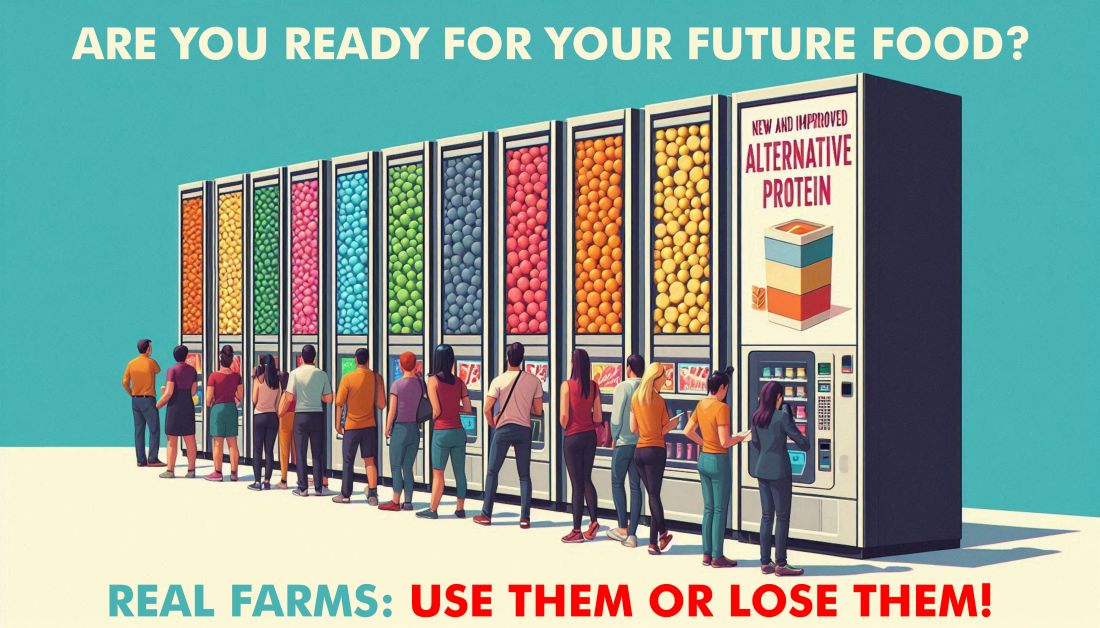
Alternative proteins
Alternative Proteins are mentioned at different points throughout the Food Strategy.
If you weren’t concerned enough already, this is where this already dark Food Strategy starts to go completely black. As Alternative Proteins is the accepted term for synthesised and artificially created foods, that this whole Strategy is laying the way for.
General Comment
My real concern about this Food Strategy is that so few who read it and consider how seemingly well put together it appears, will see the content and direction for what it all really is.
Legitimacy to this ‘work’ has been given by the participation and ‘contribution’ of advocacy organisations such as the NFU (National Farmers Union) who are providing exceptional membership services to the members who they face. But have not got any genuine ability to advocate through the fear they have of having the relationships with government and the public sector cancelled or burned.
The advocacy organisations pay lip service and certainly make much noise when it comes to the issues. But they fear being excluded from the process, much more than what the outcome of what that process actually will be.
Lines like ‘We need to restore pride in and build on our unique food heritage and cultures’ and then the reference to the production of Food being ‘Patriotic’ certainly play to the whims of the growing populist movement that is becoming a massive threat to both the government and the public sector, and of which the Starmer led government is massively afraid.
But they are in no way related to what this Strategy really is or is about.
Regrettably, the damage that could already have been done to what is left of the UKs ability to feed itself once more, by the time we have a new government actually capable of driving reversal, will have already gone too far and the chance of the UK becoming self-sufficient in food production and therefore Food Secure in the real sense will have been completely undone.


 Adam Tugwell