I’m a fan of Clarkson’s Farm. It’s doing a lot for farmers and consumers. But it could do even more

Like most people whose comments I’ve seen, I am a big fan of Clarkson’s Farm. I don’t think there’s one episode of the 22 I’ve already watched that hasn’t ticked all of the boxes for good, all-round entertainment in a field which isn’t exactly full of other big beasts.

In case it’s important, I’ve watched 6 of the 8 episodes of series 3 and the final 2 will probably work their way into the weekend schedule as some kind of diversionary treat.

Just as I’ve previously tweeted in responses to comments and thoughts by the Farming Press and some of the Farmers I follow, my view as someone who has maintained links with Farming whilst I’ve worked for charities, run my own businesses and was an elected local councillor for 12 years, is that the series has done a massive amount in breaching the gap between farmers and the food chain, and the public or consumers. Something that’s very important bearing in mind that it’s where the strongest and most meaningful relationship in the UKs food chain really should be.

Whether we consider Clarkson’s ‘Let’s test everything I can think of’ approach to farming 1000 acres in the Cotswolds as contrived or planned, or quite literally as anyone new to farming with enough money to experiment in every direction might behave, the fact remains that there is real public benefit to this show and what it shares.  

The money spent and the honesty, transparency or insight being provided hasn’t failed to demonstrate just how complex and bureaucratic UK Farming has become, and how difficult being a Farmer in the UK really now is.

What is more and perhaps most importantly, Clarkson’s Farm openly demonstrates that UK Agriculture is at massive risk.

British Farming simply doesn’t generate the income for landowners and agricultural workers that an industry providing one of the most essential and non-negotiable parts of our daily lives really should.

Meanwhile, the shops that sell everything ‘on their behalf’ are achieving billions in profits as a return.

Whilst I’m not sure the leaps in thinking made by Amazon Prime subscribers will have yet reached a point where everyone recognises that there’s probably an equivalent to Diddly Squat in the form of a farm gate farm shop that’s much closer to home, Clarkson’s Farm is shining a light on real-World or rather real-UK Food Security issues that no other rural-life programme has or could.

If there’s anything annoying about the programme at all, it’s the attitude and approach on the part of so many involved, who have probably stood in the way of this very popular series doing a whole lot more for us all.

The reality that not only Jeremy Clarkson, but all UK farmers have to face is that whatever the level of government, whether it’s a local council in Oxfordshire, DEFRA or any department in Whitehall, the whole of the public sector system works in its own particular way.

There is a way of working with everyone who sits within the processes where decisions are made and few Civil Servants and Government Officers will value anyone telling them how anything they have control over or responsibility for, should work. No matter who those telling them are or who they might be.

Wrong as it may be, its just the way that things work.

The problem is made significantly worse because so much of the legislation and directives set at the centre or in London are left ‘open to translation’ at local level. And interpretation can go either way, depending upon many things under consideration which often fall way outside how any logical explanation or understanding would suggest everything works.

Like it or not, Clarkson was pretty much on a date with destiny from the start. It was inevitable that there would be a clash of cultures when it came to working with any formal body.

As a councillor, I experienced and at least tried to console the distress that the feeling of unfairness and injustice of the government system visits on people who are morally correct in their position, but nonetheless feel very let down by the way the technical legality of the system works.

I really do wish that Clarkson might have taken a different approach. He almost certainly could have demonstrated that for both Diddly Squat and an entire Industry that’s now in deep trouble, real success and long-term benefits are achievable, just by stepping back, counting to ten and approaching ‘the game’ in a very different way.
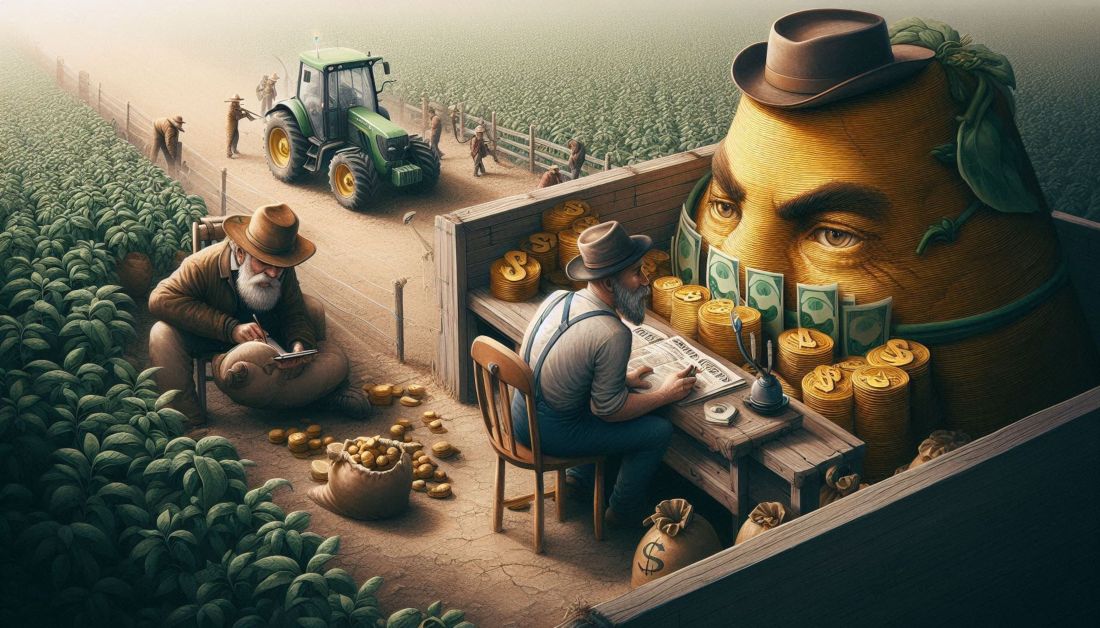
The priority of Farmers today is money. But farms cannot run profitably with profit being the priority anymore

So, this is a statement that will need some more thought. Surely it’s the case that every business is run to make money, isn’t it?

On the face of it, the argument that all businesses exist to make a profit is very sound. However, it is only sound because of the way that the world currently works and how we think, placing money at the heart of everything. Instead of prioritising the real reasons that any business exists, which are the products or the services that they provide to customers (or end users).

We can take this thought further. The real reason for providing those goods or services are to help, support or enable people to live, in whatever way that product or service will help those people to do so.

At risk of stating what should be obvious to everyone but actually isn’t, UK Agriculture, Food Production and UK Farms are about or should be about providing the UK population with a secure, accessible, ongoing supply of healthy, nutritional basic or essential foods. And they should do this collectively on the basis of providing the UK Population with the widest variety that is available to us from being grown, ideally as local to the end user as possible, but at the very least, from somewhere from within the geography of the nation state that we all share.

I don’t know a farmer who isn’t passionate about what they do.

Farming isn’t just a business. Farming is a vocation and lifestyle choice for all those who are genuinely committed to the industry, in what I will suggest is a healthy way.

However, as we have moved further and further away from subsistence farming the scale of risk has grown at the same pace as the commitment to production growth.

It has naturally followed that the power that Farmers and Food Producers in the UK once had, has progressively been surrendered to whoever will guarantee the greatest longevity of income. Even though it has now been arguably many years since such guarantees have also offered anything like what we would likely agree to be viable prices.

One of the reasons that Clarkson’s Farm on Amazon Prime has been such a good champion for UK Farmers is that it has lifted the lid on just how precarious Farming in the UK has now become. Yet few Farmers have the opportunity to do TV work or lean on the marketing power of celebrity to make a new farm shop or a brewery buy-in an instant hit.

The reality is that for many Farmers, it has been the culture of payments and subsidies that have taken over everything in Agriculture, alongside the ‘deals with the devil’ that have been made with traders and supermarkets, that are the only reason that what should be ridiculously successful food producing businesses stay afloat.

It is impossible for Farmers to stand still at a static or subsistence level as it once was, as ‘growth’ and therefore growing ‘turnover’ is the only way that earnings can be kept static.

The alternative for many being either to sell up or go broke.

Farmers, Food Producers and the entire UK Agricultural Industry are vulnerable to whatever the supermarkets, retailers, traders and the establishment demands of them next. Because they have surrendered their power to money, and forgotten how to do what they really do best.

Current thinking and every message that we hear tells us that big and bigger are the only way that things can now go. That ‘growth’ equals progress. Yet none of this is in any way true.

The future of Farming is the return to being a predominantly local, community-focused industry with emphasis on the production of foods and goods that local people need. Not what some want and only they can afford.

I realise that the immediate argument that will come back from many farmers who are thinking about the situation that they are really now in, will be that the infrastructure, support networks and governance (laws, rules and regulations) simply don’t exist to make anything like this work without financial support, and that just this factor alone, before anything like the economies of scale are considered, make any such move one that would be impossible to work.

It certainly looks that way. But without UK Farmers, Food Producers and Agriculturally aligned industries taking back their own power by taking those risks necessary for themselves now, the reality is that within perhaps only a few years, Farming as we recognise it in the UK today, will simply no longer exist.