LEGS: A Manifesto

A Declaration for a People‑Centred Future

We stand at the end of an age defined by fear, scarcity, and the quiet belief that life must be harder than it needs to be.

For too long, society has been shaped by a system that places money at the centre of everything – a system that measures worth in wages, success in accumulation, and freedom in purchasing power.

This system has failed us.

It has divided communities, exhausted workers, devalued essential roles, and placed the environment under relentless strain.

It has taught us to compete instead of cooperate, to endure instead of thrive, and to accept insecurity as the price of survival.

We refuse to accept this any longer.

We believe in a future where People, Community, and the Environment are placed at the centre of life – not at the margins.

We believe in a future where work is contribution, not coercion.

Where survival is guaranteed, not earned.

Where governance is local, not distant.

Where value is human, not financial.

Where freedom is real, not conditional.

This is the future offered by the Local Economy & Governance System (LEGS).

1. People Are the Value of the Economy

The economy does not exist without people.

Value does not come from markets, speculation, or profit.

Value comes from human contribution – from growing food, caring for others, repairing what we depend on, teaching, creating, and sustaining the life of the community.

Every person has value.

Every contribution matters.

No one is disposable.

2. Essentials Must Be Guaranteed for All

A good society begins with security.

Food, shelter, heat, water, clothing, healthcare, communication, and the ability to participate in community life are not luxuries. They are the foundations of dignity.

The Basic Living Standard (BLS) ensures that every person has what they need to live – not as charity, not as welfare, but as a universal right.

When survival is guaranteed, fear dissolves.

When fear dissolves, freedom begins.

3. Work Must Be Human, Local, and Meaningful

Work should not be the price of survival.

Work should be the expression of contribution.

In LEGS:

  • everyone contributes 30 hours per week
  • roles are chosen, not imposed
  • work is matched to ability and interest
  • contribution is shared fairly
  • no one is exploited
  • no one is left behind

Work becomes visible, valued, and connected to real life.

Work becomes human again.

4. Food Is the Centre of Community Life

Food is the foundation of security, health, and resilience.

It must be local, trustworthy, and produced in ways that regenerate the land.

Communities grow what they can, trade what they cannot, and treat food as a public good – not a commodity.

When food is local, communities thrive.

When food is trustworthy, people thrive.

When food is central, life becomes grounded.

5. Governance Must Be Local, Transparent, and Participatory

Power must return to the people it affects.

The Circumpunct replaces hierarchy with shared responsibility.

Decisions are made openly, locally, and with accountability.

Leadership is service, not status.

Authority is earned through contribution, not granted through position.

A community that governs itself is a community that cannot be captured.

6. Money Must Serve People – Not Control Them

Money is a tool, not a treasure.

It must circulate, not accumulate.

It must reflect real value, not distort it.

The LEGS Coin, the annual money cycle, and the expiry of currency ensure that money cannot be hoarded, weaponised, or used to create inequality.

Money supports life.

It does not define it.

7. Community Is the Natural Structure of Society

Human beings are not meant to live in isolation.

We are meant to live in connection – with each other, with the land, and with the rhythms of life.

LEGS restores community as the centre of daily life:

  • shared work
  • shared spaces
  • shared responsibility
  • shared celebrations
  • shared governance

A strong community is the greatest source of security.

8. The Environment Is Not a Resource – It Is a Relationship

We are part of the natural world, not separate from it.

The land, water, soil, and ecosystems that sustain us must be treated with respect, care, and stewardship.

Regenerative practices replace extraction.

Local production replaces global exploitation.

Sustainability becomes the default, not the exception.

A healthy environment is the foundation of a healthy society.

9. Freedom Comes From Security, Not Scarcity

Real freedom is not the ability to buy more.

Real freedom is the ability to live without fear.

When essentials are guaranteed, when work is meaningful, when community is strong, and when governance is local, people gain the freedom to:

  • think
  • create
  • learn
  • contribute
  • rest
  • grow
  • be themselves

Freedom is not a privilege.

It is a birthright.

10. A Better Future Is Not Only Possible – It Is Necessary

The old money-centric system cannot be repaired.
It was built on the wrong foundations.

LEGS is not an alternative economy.
It is a new way of living – one that restores balance, dignity, and humanity to daily life.

We do not need to wait for permission.

We do not need to wait for collapse.

We do not need to wait for leaders who will never come.

We can begin now – in our communities, in our relationships, in our choices, in our understanding.

The future belongs to those who build it.

This is LEGS: A Manifesto.

This is our declaration.

This is our invitation.

A world built on People, Community, and the Environment is not a dream.

It is a design.

It is a choice.

It is a path.

And it begins with us.
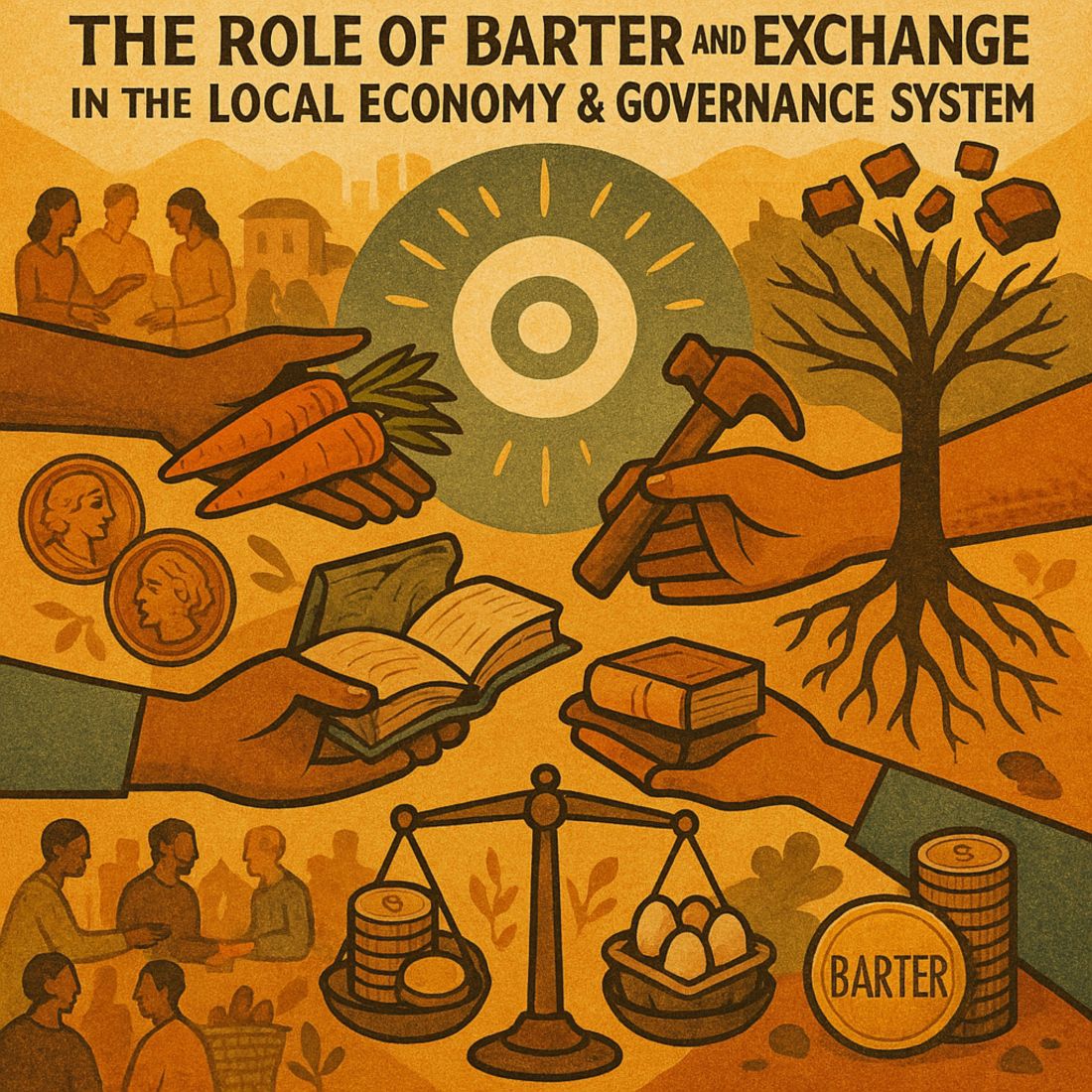
The Role of Barter and Exchange in The Local Economy & Governance System

Introduction: Understanding Key Dimensions of Trade Through the Lens of LEGS

In today’s money‑centric Old World system, barter and direct exchange are rarely practiced or legitimised. This absence disadvantages those who could benefit most from trading their goods and skills directly for the things they need, in ways that are simple and achievable.

An economy built on the recognition of human value safeguards and embraces contributions that cannot be measured or constrained by volume or transactional worth in universally accepted terms, while also accommodating goods, services, and contributions that can be.

At its core, the Local Economy & Governance System upholds The Basic Living Standard, affirming that economic value resides in people themselves. It must never be surrendered to the control of any third party – however legitimised or credible – that might manipulate the worth of individual contributions or exclude people altogether by imposing rules over a value system it dictates for universal use.

Money becomes a corrupt, authoritarian policeman when distance erases integrity and the wrong, out of sight forces are in control

The Local Economy & Governance System (LEGS) challenges us to rethink every part of how society functions – from governance and public services to food, housing, and work.

Trade is no exception. If we are to build a fair, resilient, and people‑centred society, we must re‑examine the foundations of how value moves between individuals, businesses, and communities.

For too long, trade has been defined exclusively through money. This narrow view has distorted our understanding of value, restricted our autonomy, and placed unnecessary barriers between people and the things they need.

The belief that money is the only legitimate medium of exchange has allowed governments and financial institutions to centralise control, monitor every transaction, and shape economic life in ways that benefit the few at the expense of the many.

Barter and Exchange offer a different path – one that aligns with the principles of LEGS and restores the freedom to trade directly, fairly, and without interference. They allow value to circulate locally, strengthen community resilience, and empower people to meet their needs through cooperation rather than dependency on distant systems.

This article develops the discussion already begun within LEGS by exploring the mechanics of trade in a fair society. It explains why Barter and Exchange are essential, how they work within the Local Market Exchange (LME), and how they support the wider transformation toward a system built on People, Community, and The Environment.

1. Why Barter Matters: Reclaiming the Meaning of Value

The Psychology of Value and Exchange

Money-centric society has conditioned us to believe that value exists only when expressed in money.

This belief is so deeply embedded that many struggle to imagine a world where value can be recognised or exchanged without a price tag.

Yet value is not inherent in money.

Value is inherent in people, skills, time, and the things we create.

Direct exchange restores:

  • Human‑scale value – worth defined by usefulness, not speculation
  • Relational value – trust, cooperation, and mutual respect
  • Intrinsic value – meaning that exists beyond financial measurement

Barter is not primitive. It is profoundly human.

2. The Ethical Foundation of Direct Exchange

Legitimacy Beyond Money

The Moneyocracy created the illusion that all legitimate trade must pass through regulated currency. This allowed governments and financial institutions to monitor, tax, and control every aspect of what they sanctioned and identified as economic life.

Within LEGS, the ethical foundation for Barter and Exchange is clear:

  • People have the inherent right to exchange value directly
  • Communities have the right to determine how value circulates locally
  • No authority has the moral right to restrict non‑monetary exchange when the essential needs are met

Barter is not a loophole.

It is a legitimate, ethical, community‑centred form of trade that compliments an economy with People, Community and The Environment at its heart.

3. How Barter Works: Everyday Practical Examples

Person‑to‑Person, Business‑to‑Business, and Mixed Exchanges

Barter is practical, flexible, and already familiar to most people.

Person‑to‑Person

  • A neighbour repairs a bicycle in exchange for vegetables
  • A retired teacher tutors a child in return for gardening help

Business‑to‑Business

  • A café trades baked goods with a farmer for eggs
  • A carpenter exchanges shelving units with a printing shop for marketing materials

Mixed Exchanges

  • Working time, plus local currency for a refurbished smartphone
  • Goods plus working time to settle a larger exchange

Community‑Level

  • Seasonal swap days – exchanging additional time and skills for goods and services
  • Collective repair events where the community provides people with home repair or servicing of equipment for additional community contributions
  • Multi‑party trades facilitated by the LME

Barter adapts to any scale and any need.

4. Barter as a Pillar of Local Resilience

Strengthening Communities Through Direct Exchange

Barter strengthens local systems by:

  • Reducing dependency on external supply chains
  • Encouraging repair, reuse, and resourcefulness
  • Keeping value circulating locally
  • Building trust and cooperation
  • Providing stability during economic shocks

When money becomes scarce, barter continues.

When supply chains fail, local exchange thrives.

5. Barter and Local Currency: A Complementary System

How the LME Balances Flexibility and Stability

Barter and local currency are complementary tools.

Local currency exists to:

  • Facilitate exchanges where direct barter is impractical
  • Provide a stable, community‑governed medium of exchange
  • Prevent speculation or hoarding
  • Keep value circulating locally

Barter is ideal when two parties have mutually desired goods or services.

Local currency is ideal when they do not.

The LME allows both to operate seamlessly.

6. Safeguards and Fairness in the LME

Preventing Abuse, Hoarding, and Manipulation

The LME incorporates safeguards to ensure fairness:

  • Prohibition of hoarding essential goods
  • Transparent values for Basic Living Standard items
  • Community oversight through The Circumpunct
  • Limits on accumulation of local currency and/or property ownership beyond essential use
  • Rules preventing speculation or artificial scarcity
  • Open dispute resolution

These measures ensure Barter and Exchange remain tools for empowerment.

7. Transitioning from Money to Exchange

Practical Pathways for Individuals, Businesses, and Communities

Transition is gradual and supported by community infrastructure.

Individuals

  • Start with small exchanges
  • Use the LME to find trading partners
  • Combine barter with local currency

Businesses

  • Accept partial payment in goods or services
  • Use barter to reduce waste
  • Join and promote the LME network

Communities

  • Host swap events
  • Encourage local producers to list goods
  • Integrate barter into community projects

Transition is organic, practical, and accessible.

8. Addressing Common Concerns and Misconceptions

Removing Barriers to Understanding

“Barter is too complicated.”

The LME simplifies valuation and facilitates multi‑party exchanges.

“How do you ensure fairness?”

Community‑agreed values and transparent governance prevent exploitation.

“What if someone cheats?”

Dispute resolution is local and immediate.

“Isn’t this going backwards?”

Barter restores autonomy and resilience, recognising that progress is not one dimensional and does not erase actions and processes that work in the best interests of all.

“What about large transactions?”

Barter can be combined with local currency or working time.

Objections dissolve through experience.

9. The Historical and Anthropological Argument for Barter & Exchange

Why Barter Is Not Primitive – It Is Proven

Historically:

  • Communities relied on mixed economies of barter, gifting, and shared labour
  • Money became dominant not because barter failed, but because it seemed easier and its use was encourage or coerced as elites sought control
  • Many societies used barter alongside currency for centuries
  • Modern barter networks thrive during crises

Barter aligns with human social instincts far more closely than money ever did.

10. The Philosophy of Exchange

Barter as an Expression of Human Connection

Barter reflects:

  • Reciprocity
  • Trust
  • Mutual recognition
  • Shared purpose
  • Community interdependence

Money reduces relationships to transactions.

Barter restores relationships to relationships.

It is not simply a method of trade. It is a philosophy for living.

Conclusion: The Return of Human‑Centred Trade

Barter and Exchange are essential components of a fair, resilient, and people‑centred economy.

They restore autonomy, strengthen community bonds, and ensure that value circulates locally rather than being extracted by distant systems.

This article demonstrates that within the LEGS Human Economy model:

  • Value is defined by people, not money
  • Direct exchange empowers individuals and communities
  • Barter strengthens resilience and reduces dependency
  • Local currency complements barter within the LME
  • Safeguards ensure fairness and prevent abuse
  • Transition is practical and accessible
  • Barter reflects the deeper philosophy of LEGS

And that

  • History and anthropology validate mixed economies

Trade, when reclaimed from the distortions of money-centric economics, becomes a tool for dignity, cooperation, and shared prosperity.

Barter and Exchange are not relics of the past.

They are the foundations of a future where fairness, autonomy, and community define how we live and trade together.