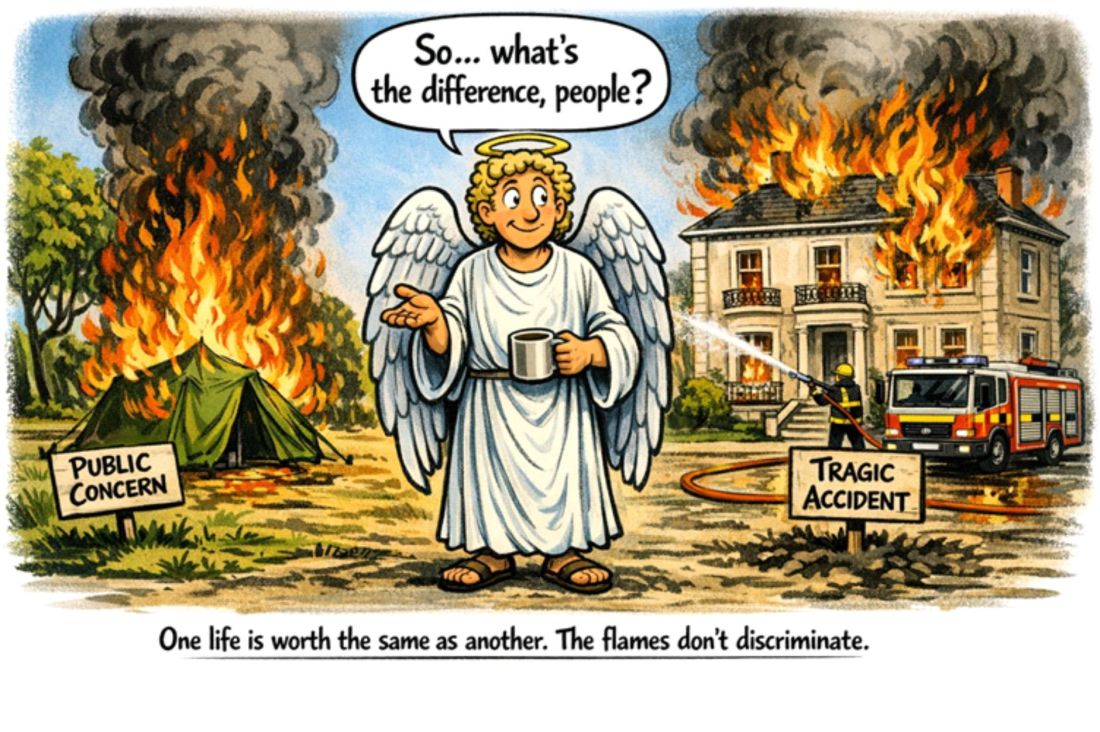
Hidden Tents, Visible Flames: Cheltenham’s Quiet Crisis | What a burning tent in a Regency square tells us about Britain’s wider homelessness crisis

Cheltenham is a town that prides itself on beauty, culture, and a strong sense of civic identity. But over recent months, a series of quiet, unsettling events has revealed something deeper about the way we respond to vulnerability – and about the system that shapes those responses.

Tents outside Cavendish House were removed in the days before the Races. The building wasn’t shuttered at the time, but the doorways where people had been sheltering were boarded up almost immediately afterwards.

Then, an encampment in St Mary’s churchyard was moved on.

Now, this week, a tent in Clarence Square went up in flames – a fire now thought to have been started deliberately.

Different locations.

Different people.

Same outcome.

And behind each incident sits the same familiar line: support was offered.

But what does that really mean in practice?

A Walk Through Clarence Square

A few days before the fire, I walked past the Clarence Square encampment with my dogs. What I saw wasn’t disorder or disruption – it was quiet, deliberate survival. A couple of tents had been tucked carefully under the bushes and trees, almost hidden from view. The people staying there were clearly trying to minimise their presence – to avoid causing alarm, to keep things tidy, to exist quietly in a space that was never meant to be a home.

It challenged the assumptions many people hold about rough sleepers. Even in the most difficult circumstances, people try to maintain dignity, privacy, and respect for the space around them.

At the same time, it is entirely understandable that any resident would feel concerned or unsettled by a pop‑up encampment in a public square. These are shared spaces – places where children play, where people walk their dogs, where neighbours meet. When something unexpected appears, especially something associated with vulnerability or crisis, it can trigger worry or discomfort.

But the first step toward responding constructively is remembering that behind what may look like an “antisocial” situation is always a human story – a life shaped by circumstances that most of us have never had to face. And recognising that truth is how we give our own humanity another try.

Why People Become Homeless – And Why It’s Not Always What We Assume

Homelessness is often imagined as a single event – a bad decision, a sudden crisis, a moment of collapse. In reality, it is usually a long chain of pressures: rising rents, insecure work, mental health struggles, family breakdown, trauma, or simply not having anyone to fall back on. By the time someone is in a tent, they’ve already run out of options that most of us take for granted.

But there is another reality we rarely talk about, because it sits in a difficult, uncomfortable space.

Some people experience homelessness because they cannot mentally or emotionally conform to the rigid structures that society imposes. The expectations that most people navigate without thinking – appointments, assessments, paperwork, rules, deadlines, forms, compliance – are not just challenging for them. They are overwhelming.

For these individuals, the pressure to fit into systems that feel rigid, impersonal, or punitive becomes too much. And when every avenue of “acceptable” living feels impossible, stepping outside those structures can feel like the only way to breathe.

These are not people who want to harm themselves.

They are people who want to escape.

Escape pressure.

Escape judgement.

Escape systems and expectations they cannot meet.

Most of us don’t see this because cultural conditioning teaches us that the way society works is neutral – that it’s simply “how things are.” But for some, the very fabric of modern life is a constant source of stress, confusion, or fear. And when the system cannot bend to meet them, they fall through it.

Recognising this doesn’t excuse antisocial behaviour, and it doesn’t mean public spaces shouldn’t be safe. But it does mean we need to understand that not all homelessness is the result of poor choices or sudden crises. Sometimes it is the result of a lifetime of being unable to fit into a world that never made space for difference.

Cheltenham’s Services Are Doing What They Can – Within Their Limits

Cheltenham Borough Council, CCP, and other local organisations are not failing through lack of effort or compassion. They are staffed by people who care deeply and who work hard.

They are also operating within strict boundaries:

• funding that dictates what can be offered

• policies that define who qualifies

• safeguarding responsibilities that limit flexibility

• national frameworks that shape local decisions

• the duty of care they owe to staff as well as service users

Gloucestershire Live often reports the official responses:

support offered, referrals made, StreetLink notified, accommodation available if criteria are met.

All of that can be true.

And yet it is also true that the support available is not designed for the people most likely to need it.

This is not a Cheltenham problem.

It is a structural one.

I’ve Seen These Limits First‑Hand

When I ran and developed a Wheels to Work project across the County for our local Rural Community Council, helping people in rural areas access jobs and training, the same pattern appeared again and again:

• We could only do what funders would pay for

• We could only consider what policy allowed

• We could only help people who fit the criteria

• We could only support those who could navigate the system

And the people who needed the most help were often the ones who didn’t fit neatly into any of the boxes that we and many other organisations working with disadvantage had to consider.

That hasn’t changed.

If anything, the gaps have widened.

The System Is the Problem – Not the People Working Within It

Everyone involved – the council, CCP, outreach workers, volunteers – are doing what they can. The issue is that they are all operating inside a system that is fundamentally money‑centric rather than people‑centric.

A system that:

• measures success in budgets and outputs, not lives

• prioritises compliance over compassion

• treats housing as a commodity

• expects people in crisis to behave like people who are stable

• offers help that is conditional, time‑limited, or inaccessible

This isn’t about blaming organisations.

It’s about recognising that they are working within a structure that was never designed to meet the needs of people who fall outside the margins.

A Society That Needs to Re‑Centre People

The presence of tents in a public square is not a sign of individual failure.

It is a sign of systemic strain.

We have built a society that values:

• material wealth over human wellbeing

• external validation over internal resilience

• appearances over understanding

• order over empathy

And the people who fall through the cracks are treated as if they are the cause of the cracks.

But the truth is simpler and more uncomfortable:

Every human being is more important than any bottom line.

Until we build systems that reflect that truth, we will continue to see people pushed to the edges – not because they failed, but because the system did.

This is Not the End of the Story

The cost‑of‑living crisis, global instability, and shrinking public services are pushing more people to the edge. The individuals sleeping in tents today are simply the first to fall.

The line between “us” and “them” is thinner than most residents realise.

One job loss.

One rent increase.

One illness.

One relationship breakdown.

That’s all it takes.

What Cheltenham Needs Now

Not blame.

Not displacement.

Not another round of “support was offered” – followed by silence.

What we need is a shift in mindset:

• from money‑centric to people‑centric

• from managing homelessness to preventing it

• from conditional support to unconditional dignity

• from short‑term fixes to long‑term solutions

• from moving people on to moving people forward

Cheltenham has the resources, the intelligence, and the compassion to lead the way – but only if we stop treating homelessness as an inconvenience and start recognising it as a mirror.

A Final Thought

The people we are moving on are not the problem.

They are the signal.

And the first step toward change is simply remembering that behind every tent, every encampment, every uncomfortable moment in a public space, there is a human story – and a system that needs to be rewritten so that none of us ever has to live it.

If You Need Support – Or Want to Help

If you are experiencing homelessness, supporting someone who is, or want to help in practical ways, the organisations below can offer support, advice, or routes into action.

Cheltenham has several organisations working tirelessly to support people experiencing homelessness or crisis. These include:

• CCP (Caring for Communities and People) – providing supported accommodation, outreach, and practical help.

Tel: 03003658999

Website: Home › CCP

• Cheltenham Borough Council’s Housing & Homelessness Team – offering assessments, prevention support, and referrals.

Tel: 01242 387615

Website: Housing options and homelessness | Cheltenham Borough Council

Email: housing.options@cheltenham.gov.uk

• P3 Charity – supporting people with complex needs across Gloucestershire.

Tel: 01158 508190

Website: Homepage | P3 Charity

Email: info@p3charity.org

• Emmaus Gloucestershire – offering community‑based support and meaningful work opportunities.

Tel: 01452 413095

Website: Emmaus Gloucestershire – Homelessness Charity

• National homelessness charities such as Crisis, Shelter, and St Mungo’s, which offer advice, advocacy, and emergency support.

Life for the Many, or Money for the Few?

A common reaction to this question is, “how about more money for everyone?”

And that response alone should already be telling us something important about what we all need to recognise.

A Grim Outlook as 2026 Begins

As we roll into 2026, it’s difficult to picture anyone feeling genuinely happy or hopeful about the year ahead. Few would disagree that the road in front of us looks bleak.

That feeling alone would be reason enough for concern. But when we look ahead from the wide range of perspectives, backgrounds and political standpoints that even the quietest or least informed among us hold, very few believe there is an obvious solution that will make life feel good again in the months and years to come.

The only exception might be those who believe that gaining power for themselves will somehow deliver positive change for everyone – simply because they assume their own improved circumstances would be mirrored across society.

What We’re Told… and What We’re Not

Through the lens of the mainstream media (including many who insist they are anything but), the picture is stark.

Tax rises from every direction. Food prices climbing while we’re told inflation is falling. Thousands crossing the Channel seeking a better life that the state can no longer afford to provide. Digital ID policies creeping in through every possible back door. A government full of incompetents who barely bother to hide their ambitions for power. And now, even they openly appear to admit – just as the recently ousted Tories have done so – that civil servants don’t listen to them anyway.

Then there’s what isn’t being discussed openly, yet sits in plain sight the moment you look behind the sofa and chairs of this same living room.

The price of silver has surged. The current US administration’s approach to global policy resembles an economic war on everyone else. Iran may be on the verge of a revolution that many elsewhere may soon find themselves wishing for. And behind all of this lies the deeper reality: the harm caused by the West’s obsession with a money‑centric system that ignores the human cost, and the understandable desire of the rest of the world to have their own moment – once the West falls and they believe their time has come.

Hope in the Wrong Places

Yes, there is hope. But for most people, that hope is pinned on the idea that the same system and the same tools that brought us here will somehow save us – just as long as they are placed in different hands.

And this is where the dose of reality must come in.

Why Changing Politicians Won’t Change the System

There is a hard truth that many people are still trying to avoid: changing the politicians will not change the system.

Even the newest parties, even the ones that claim to be different, even the ones people are now pinning their hopes on – such as Reform – are still trying to work with the same broken tools.

They are still operating within a framework built around money, competition, corruption, centralisation and control. And no matter how sincere their intentions, no matter how fresh their faces, they cannot escape the reality that a system designed around money will always produce outcomes that serve money first.

Even if a party like Reform managed to sort out its recruitment problems, its leadership problems, its internal contradictions – it would still be trapped. Because the problem isn’t the personnel. It’s the operating system they are all trying to ‘win’ within.

And you cannot fix a failing operating system by installing new users.

You have to replace the system itself.

Money Can No Longer Solve the Problems Money Created

Because money – and more specifically the value of money – sits at the heart of everything we say, think and do, it feels natural to assume that money is also where the solutions lie.

Be honest with yourself, as so many now need to be: if you simply had more money -enough to pay for everything you want as well as everything you need – you believe that you’d feel happier about life, and it wouldn’t matter who was in charge, would it?

That’s how it feels to many of us. The solution appears simple, the outcomes easy to imagine. And that is precisely why we have become addicted to an unsustainable way of living that destroys everyone and everything to make a very small number of people very wealthy, while pushing aside everything that once held real value to humankind.

Money – and this money‑centric system of Moneyocracy – is responsible for almost every practical problem the world faces. Yet our so‑called leaders and elites, obsessed with it, continue trying to use it to create solutions when solutions that help all of us no longer exist within that framework.

The Illusion of Progress

As long as the system continues to function, we will still be able to earn, borrow or obtain more money. But because the deck is stacked and the flow of money is rigged, the numbers may rise while the value stays the same – or more likely, falls.

This paradox allows politicians to use doublespeak and gaslighting to convince us that things are, or will be better than ever.

In monetary terms – figures on a page – there will always be a way to manipulate statistics or analysis to argue that point with a straight face. But a system that can only succeed by impoverishing the many to benefit the few can only ever produce outcomes measured in money.

The real, non‑financial cost to humanity is beyond calculation, and it is spiralling out of control.

Everything about humanity and the human experience has been trashed so that money can rule, and those who benefit from the system can consolidate their control and keep making more.

A System That Has Reached Its End

The problem is that there is no “more” left for them to make. They already own everything that once had real value.

Now they are using that ownership to box everyone else into a corner through laws and regulations crafted for this very purpose – laws created by usefulidiot politicians like too many of those we have today, replacing the protections that once existed to prevent exactly this kind of tyranny being inflicted upon us, as they are now under the Moneyocracy.

This is not happiness.

Lack is not happiness.

Always feeling pressure to better ourselves is not happiness.

Mental health crises are not happiness.

Joblessness is not happiness.

Division is not happiness.

Financial servitude is not happiness.

Poverty is not happiness.

Yet we are expected to believe these things don’t matter – so long as we aren’t experiencing them personally.

What LEGS and BLS Offer That the Old System Never Can

This is where the Basic Living Standard and the Local Economy & Governance System stand apart.

They are not about swapping one set of politicians for another. They are not about trying to make a money‑centric system behave like a people‑centric one.

They are about building a foundation where people, community and environment come first – not as slogans, but as the structural basis of how life works.

LEGS and BLS don’t pretend that everyone is the same.

They make everyone the same in the only way that matters:

by ensuring that every person has the freedom, resources and security to meet their needs without fear, without servitude, and without dependence on the whims of markets or the ambitions of politicians.

This is personal sovereignty in the truest sense. Not the fantasy version sold by the money centric system. But the lived reality of having enough to live, enough to contribute, and enough to participate fully in the decisions that shape your community.

It is a contribution culture rather than a consumption culture.

A participatory democracy rather than a spectator democracy.

A system where value is measured in human terms, not monetary ones.

A Kind of Freedom Nobody Alive Today Has Truly Experienced

Because this system puts people first, not money, it offers something that almost nobody alive today has ever naturally experienced:

the feeling of being free simply because your needs are met, your community is strong, and your life is not defined by debt, scarcity or competition.

Most of us have only ever had a false version of that feeling – a temporary illusion created by credit, convenience or consumption.

But real freedom, the kind that comes from security, dignity and shared purpose, is something entirely different. And it is only possible when the foundations of society are built around people rather than profit.

We Still Have a Choice

The truth beneath all of this is that we do have a choice.

None of this would have been possible without generations of us blindly going along with it and playing our part.

We have already chosen money – and money as we know it is coming to its end.

If we do not choose life instead, life in any sense that has meaning will end with it.

***

Further Reading: Expanding the Conversation

The challenges outlined above – rising inequality, political stagnation, and the dominance of a money-centric system – are not isolated issues. They are deeply interconnected, shaping every aspect of our lives and the choices available to us.

To truly understand the roots of these problems and explore meaningful alternatives, it’s essential to look beyond headlines and political soundbites, and engage with broader perspectives and deeper analysis.

The following selection of articles and essays offers a structured journey through the wider context: from the origins and consequences of our current system, through the political and social dynamics that sustain it, to the human cost and the possibilities for genuine change.

Each piece is accompanied by a short summary to help you navigate the themes and insights they provide.

Whether you’re seeking to understand how we arrived at this crossroads or looking for practical ideas to help build a better future, these readings will help illuminate the path ahead.

1. Understanding the Core Problem: The Money-Centric System

2. The Consequences: Collapse, Exploitation, and Social Harm

3. Political Dynamics and the Illusion of Change

4. The Human and Social Cost

5. Alternatives and Solutions: Building a People-Centric Future