
A response to HM Government – Global biodiversity loss, ecosystem collapse and national security: A National Security Assessment (Published 20 January 2026)
When the UK Government publishes a national security assessment warning that global biodiversity loss and ecosystem collapse threaten our food supply, you would expect honesty, clarity, and a sober assessment of the risks we face.
Instead, the report released on 20 January 2026 offers a strange mixture of stark warnings and comforting illusions – particularly around the UK’s food security.
It acknowledges that ecosystem degradation could destabilise global food production, disrupt supply chains, and trigger geopolitical competition for food. All of that is true.
But then it slips in a familiar, misleading reassurance:
“The UK imports 40% of its food.”
This figure is presented as if it reflects our real‑world vulnerability. It doesn’t.
It’s a net figure, not a resilience figure.
And it hides the truth that the UK is far more dependent on foreign food systems than the report admits.
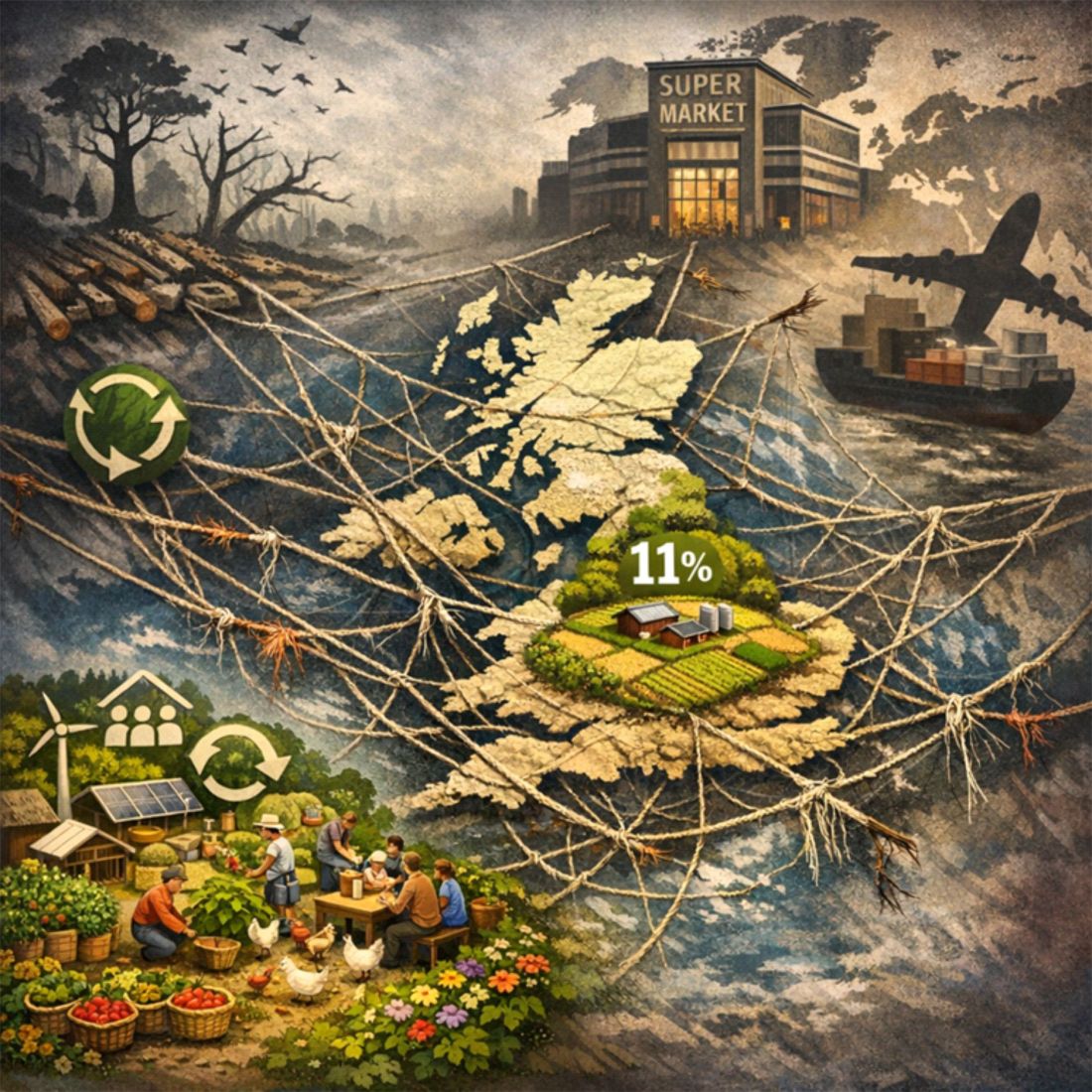
In fact, if the UK’s borders closed tomorrow, the amount of food immediately available for the population is closer to 11%.
That is the real national security threat – and it has nothing to do with future ecosystem collapse.
It is the result of decades of political choices, corporate control, and a food system designed around globalisation rather than public need.
The 40% Myth: A Convenient Political Fiction
The government’s “40% import dependence” statistic is based on food by value, not food by:
- calories
- volume
- nutritional availability
- immediate edibility
- or domestic accessibility
It also ignores the dynamic reality of the UK food chain:
1. UK‑produced food is routinely exported
Much of what we grow or rear here is not eaten here.
We export beef, lamb, dairy, fish, cereals, and vegetables – then import substitutes.
2. “British food” often depends on foreign inputs
Even domestic harvests rely on imported:
- fertiliser
- feed
- seed
- chemicals
- machinery
- packaging
- labour
A UK-grown crop is not a UK-secure crop.
3. The UK’s food system is globally entangled
Ingredients cross borders multiple times before becoming something we can eat.
A “British” ready meal may contain components from 10–20 countries.
4. The UK cannot feed itself under current systems
Even the report admits:
“The UK cannot currently produce enough food to feed its population based on current diets.”
But it fails to explain why:
Because the UK no longer has a food system designed to feed its own people.
The Real National Security Threat is Already Here
The government frames biodiversity loss as a future risk. But the UK’s food insecurity is a present reality, engineered over decades.
This is the uncomfortable truth:
The UK dismantled its own food resilience long before ecosystems began collapsing.
- Traditional farming was replaced by industrial, globalised supply chains.
- Local food systems were hollowed out.
- Supermarkets and processors gained total control over production.
- Farmers became contract‑bound suppliers rather than independent producers.
- Policy after policy pushed the UK away from self-sufficiency.
The result?
A nation that produces food – but cannot feed itself.
This is why the 11% figure matters.
It reflects the food that is:
- edible immediately
- consumed domestically
- not dependent on foreign inputs
- not locked into export contracts
- not reliant on overseas processing
This is the food that would still be available if global supply chains failed.
And it is terrifyingly small.
Biodiversity Collapse Will Hurt Us – But It Will Hit a System Already Broken
The government report is right about one thing:
Ecosystem collapse will make global food production more volatile.
But the UK’s vulnerability is not caused by ecological decline.
It is caused by:
- globalisation
- supermarket dominance
- financialisation of land
- industrialised processing
- loss of local food infrastructure
- policy choices that prioritised profit over people
Ecosystem collapse will simply expose the fragility we have already created.
The Missing Piece: A Food System Built Around People, Not Profit
The report warns that the UK must “increase food system resilience”.
But it offers no meaningful pathway to achieve it.
It talks about:
- lab-grown protein
- AI
- alternative proteins
- technological innovation
But it barely mentions the one thing that actually works:
Traditional, regenerative, localised farming.
The kind of farming that:
- Builds soil
- Restores biodiversity
- Strengthens communities
- Reduces dependency on imports
- Shortens supply chains
- Produces real food, not processed substitutes
- Keeps value circulating locally
- Increases national resilience
This is the farming model that the UK abandoned.
And it is the farming model we must return to.
LEGS: A Framework for the Food Security We Actually Need
The Local Economy & Governance System (LEGS) offers exactly the kind of structural shift the government report refuses to contemplate.
Under LEGS:
Food is treated as a Public Good
Not a commodity.
Not a profit centre.
Not a tool of corporate control.
Local farming is prioritised
Communities produce the food they eat.
Farmers regain independence.
Supply chains shrink.
Resilience grows.
Traditional and regenerative methods become the norm
Because they work.
Because they protect ecosystems.
Because they feed people.
Because they build long-term security.
The economy becomes circular and local
Value stays within communities.
Food sovereignty becomes real.
Dependency on global systems collapses.
People, Community, and The Environment become the organising principles
Not money.
Not shareholder value.
Not global trade flows.
This is the only credible pathway to genuine food security.
The Government Report Is a Warning – But Not the One It Thinks It Is
The report warns that biodiversity loss threatens our food supply.
It’s right.
But the deeper warning is this:
The UK’s food system is already so fragile that any external shock – ecological, geopolitical, or economic – could collapse it.
We do not need to wait for the Amazon to fall or coral reefs to die.
We are already exposed.
The real national security threat is not future ecosystem collapse.
It is the current food system, built on:
- Global dependency
- Corporate control
- Industrial processing
- Financialised land
- Political complacency
We cannot fix this with technology, trade deals, or emergency stockpiles.
We fix it by rebuilding the one thing that has always fed people:
Local, traditional, community-rooted farming.
And we fix it by adopting a governance and economic model – like LEGS – that puts food, people, and the environment back at the centre of national life.
If the Government Is Serious About Food Security, It Must Change Course Now
The UK cannot continue:
- Exporting food we need
- Importing food we could grow
- Relying on global supply chains
- Allowing supermarkets to dictate farming
- Treating food as a commodity
- Ignoring the collapse of local food systems
If we want real food security, we must:
- Rebuild local food production
- Restore traditional farming
- Shorten supply chains
- Treat food as a public good
- Prioritise people over profit
- Adopt community‑based governance
- Embrace the principles of LEGS
Because the truth is simple:
A nation that cannot feed itself is not secure.
A nation that depends on global systems is not resilient.
A nation that abandons its farmers abandons its future.
The government’s report is a wake‑up call.
But the real alarm has been ringing for years.
It’s time we listened.
Further Reading: Navigating the Real Threats to UK Food Security
The blog’s central argument is that the UK’s food system is already dangerously fragile -not just because of future biodiversity loss, but due to decades of policy choices that prioritised global supply chains and corporate control over local resilience.
The following resources are curated to help readers move from understanding the government’s official stance, through critical analysis, to actionable frameworks for rebuilding food security.
1. Official Context: The Government’s Assessment
Nature security assessment on global biodiversity loss, ecosystem collapse and national security
https://www.gov.uk/government/publications/nature-security-assessment-on-global-biodiversity-loss-ecosystem-collapse-and-national-security
Summary:
This is the UK Government’s own national security assessment, published on 20 January 2026. It warns that global biodiversity loss and ecosystem collapse threaten food supply and national security. While it acknowledges risks to food production and supply chains, the report is critiqued in this blog for offering misleading reassurances about UK food resilience and failing to address the deeper, present-day vulnerabilities in the food system.
(Please note that a copy of the Report can be downloaded as a PDF below)
2. Critical Analysis & Solutions: The Author’s Portfolio
Adam’s Food and Farming Portfolio: A Guide to Books, Blogs, and Solutions
https://adamtugwell.blog/2025/12/18/adams-food-and-farming-portfolio-a-guide-to-books-blogs-and-solutions/
Summary:
This curated portfolio gathers key writings, books, and practical solutions from the blog’s author. It’s designed for readers who want to go beyond critique and discover actionable ideas for food system reform, regenerative agriculture, and community-based resilience. The portfolio reflects the blog’s ethos: prioritising people, local economies, and ecological health over profit and global dependency.
3. Deep Dive: The LEGS Ecosystem
Visit the LEGS Ecosystem
https://adamtugwell.blog/2025/12/31/visit-the-legs-ecosystem/
Summary:
LEGS (Local Economy & Governance System) is the framework proposed in the blog as the structural shift needed for genuine food security. This resource introduces LEGS in detail, showing how it treats food as a public good, rebuilds local farming, and fosters circular economies. It’s essential reading for those interested in systemic change and practical pathways to resilience.
4. In-Depth Reference: LEGS Online Text
The Local Economy Governance System – Online Text
https://adamtugwell.blog/2025/11/21/the-local-economy-governance-system-online-text/
Summary:
For readers seeking a comprehensive understanding of the LEGS framework, this online text provides the full theoretical and practical foundation. It expands on the principles outlined in the blog, offering guidance for communities, policymakers, and advocates aiming to rebuild food sovereignty and resilience from the ground up.
Guidance for Readers
Start with the government’s official report to understand the mainstream narrative and its limitations.
Move to the author’s portfolio for critical analysis and practical solutions.
Explore the LEGS resources to discover a transformative framework for food security rooted in local economies and regenerative practices.
This order will help readers progress from context, through critique, to concrete action – mirroring the blog’s call for urgent, systemic change in the UK’s approach to food and farming.

 Adam Tugwell