Food, Land and Power: Why the Future of Britain Depends on Rebuilding Local Food Economies | Some Thoughts on The Land Use Framework

When the Government released England’s first Land Use Framework this week, most people saw a technical document about planning, farming, nature recovery and renewable energy. But within its pages was a signal that recreational gamebird shooting may soon require statutory licensing – a move that, on the surface, appears to be about environmental management.

Look deeper, however, and a very different picture emerges.

The debate over pheasant shooting is not really about pheasants.

Just as farm inheritance‑tax changes were never really about tax fairness.

Just as farm subsidy reforms were never really about environmental improvement.

These policies are symptoms of something much bigger: a long‑running shift in who controls Britain’s land, Britain’s food, and ultimately Britain’s future.

And unless farmers and communities recognise what is happening – and act – the UK will continue down a path that weakens independent food production, centralises power, and leaves the country even more dangerously exposed.

The Hidden Thread: Food as a Tool of Control

If you want to understand why land‑use policy is changing, why farming is being squeezed, and why rural industries are being picked off one by one, you have to start with a simple truth:

Food is power.

Food is one of the three basic essentials of human survival – air, water, and food – but it is the only one that is fully embedded in a market system.

  • Air remains untouched – for now.
  • Water is sold, transported, and commodified – but still regulated as a public utility.
  • Food, however, is treated as a free‑market commodity, even though it is a basic human need.

And that’s the lie at the heart of the system:

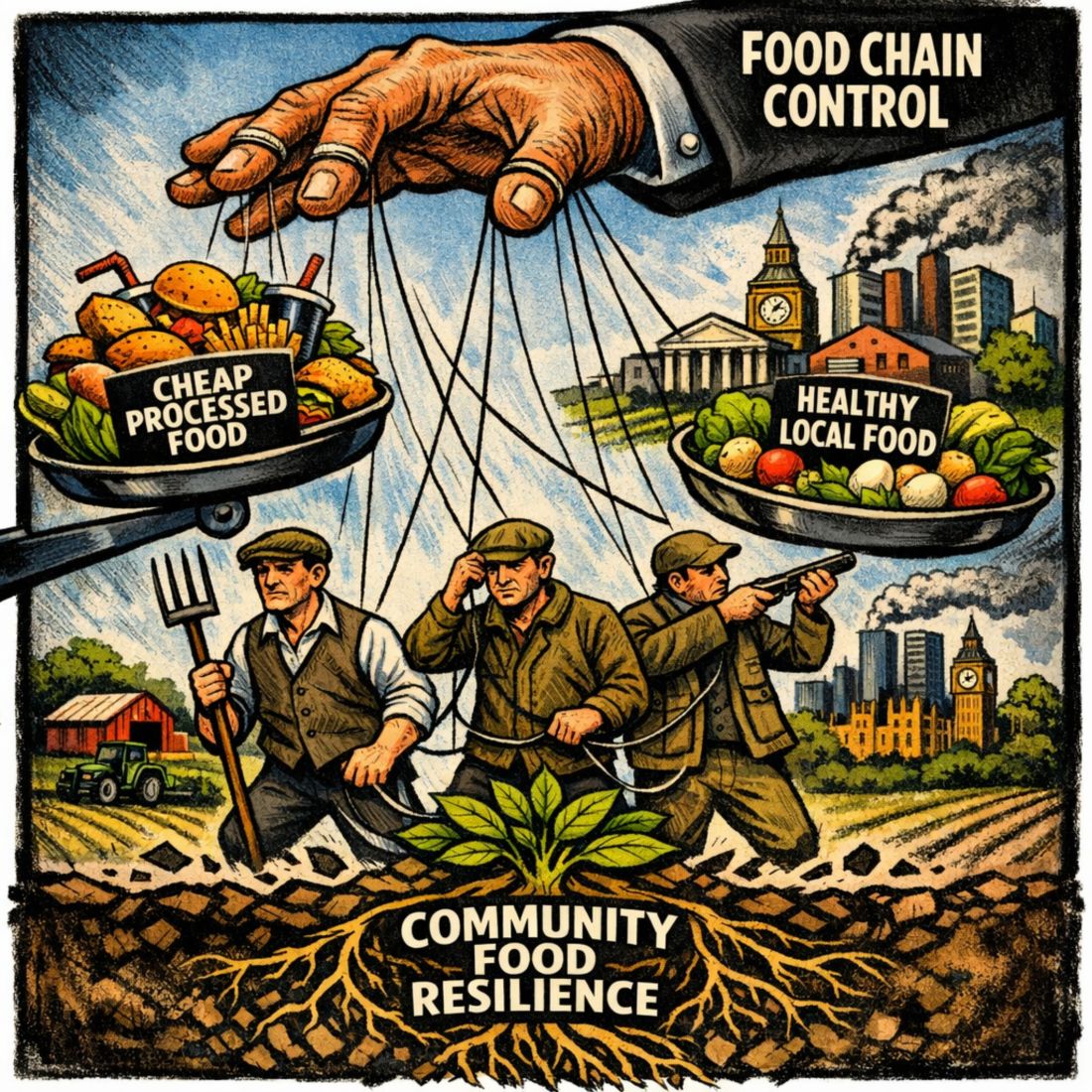
We pretend food is governed by market logic, but the market itself is rigged – by subsidies, monopolies, global supply chains, and policy distortions.

For decades, the UK has allowed its food system to drift into the hands of:

  • multinational processors
  • supermarket oligopolies
  • global supply chains
  • financial markets
  • and political actors who see food not as a public good, but as a strategic asset

The result is a contradiction so absurd it should be impossible:

The healthiest, freshest, most local and most nutritious food – the food that should be cheapest – is now the most expensive.

Meanwhile:

  • ultra‑processed foods
  • imported ingredients
  • long supply chains
  • and nutritionally empty calories

…are the cheapest and most accessible.

This is not an accident.

It is the predictable outcome of a system designed around profit, not health; control, not resilience.

And it is the backdrop against which every rural policy – including gamebird licensing – must be understood.

Why Food Costs Are a Smokescreen

Politicians justify the dominance of ultra‑processed food by claiming it keeps costs down for consumers. But this is a smokescreen.

Cheap food is not cheap.

It is subsidised by:

  • poor health
  • environmental damage
  • collapsing rural economies
  • and the erosion of local food production

The “low cost” argument is used to justify a system where:

  • food travels thousands of miles
  • ingredients are processed beyond recognition
  • supply chains are fragile
  • and communities have no control over what they eat

This is the real hidden thread.

Not hunting.

Not shooting.

Not even farming subsidies.

It is the deliberate centralisation of the food chain – because the more dependent people are on distant suppliers, the more power those suppliers hold.

Where Gamebird Licensing Fits In

This is why the government’s interest in pheasant shooting is not really about environmental impact. If it were, the policy would look very different.

The real significance is symbolic:

  • It extends state oversight into another area of rural land use.
  • It reinforces the narrative that rural practices are morally suspect.
  • It distracts from the far more consequential issue: the collapse of independent food production.
  • And it divides rural communities at the very moment they need unity most.

The irony is that pheasant shooting rarely displaces food production at all.

It coexists with farming, forestry and conservation.

And if every bird shot entered the food chain, the “waste” argument would evaporate.

But rural industries often undermine themselves by failing to adapt, failing to collaborate, and failing to see the bigger picture.

Farmers Are Under Attack – But They Also Undermine Themselves

Farmers are being squeezed by:

  • inheritance‑tax changes
  • subsidy reforms
  • supermarket power
  • planning restrictions
  • and land‑use centralisation

But they also weaken their own case when they:

  • defend practices that don’t feed the nation
  • expect special treatment while criticising others
  • fail to build alliances across rural sectors
  • cling to the belief that government policy is based on common sense

The same is true of shooting.

The same is true of every rural industry that assumes policymakers understand or value the countryside.

They don’t.

And they haven’t for a long time.

The Land Use Framework: A Turning Point

The new Framework is presented as a rational attempt to balance competing demands on land. But once government begins ranking land uses, it inevitably begins ranking the people who depend on them.

The Framework:

  • centralises decision‑making
  • prioritises energy and carbon markets
  • treats food production as one priority among many
  • and opens the door to licensing activities that were previously self‑regulated

This is not accidental.

It is structural.

And it is happening at the same time as:

  • inheritance‑tax changes that weaken family farms
  • subsidy systems that reduce output
  • planning rules that favour corporate agriculture
  • and supermarket power that leaves farmers with no bargaining strength

The direction of travel is unmistakable.

The Future Must Be Food‑Centred – And Community‑Led

Here is the part that matters most.

The UK cannot fix its food‑security crisis through government policy alone – because the political system is not designed to prioritise resilience over control.

A change of government will not fix this.

It has not fixed it before.

It will not fix it next time.

The only sustainable future is one where:

  • food production is embedded in communities
  • farmers are partners, not suppliers
  • local economies are built around food
  • short supply chains replace fragile global ones
  • communities regain control over what they eat

This is not nostalgia.

It is survival.

Food is as essential as air and water – but it is the easiest to manipulate, the easiest to profit from, and the easiest to centralise. That is why it has been allowed to drift into the hands of a small number of powerful actors.

Reversing that drift will not come from Westminster.

It will come from farmers, communities, and local food networks that refuse to wait for help from the very people invested – knowingly or unknowingly – in their decline.

A Call to Action

The writing is on the wall.

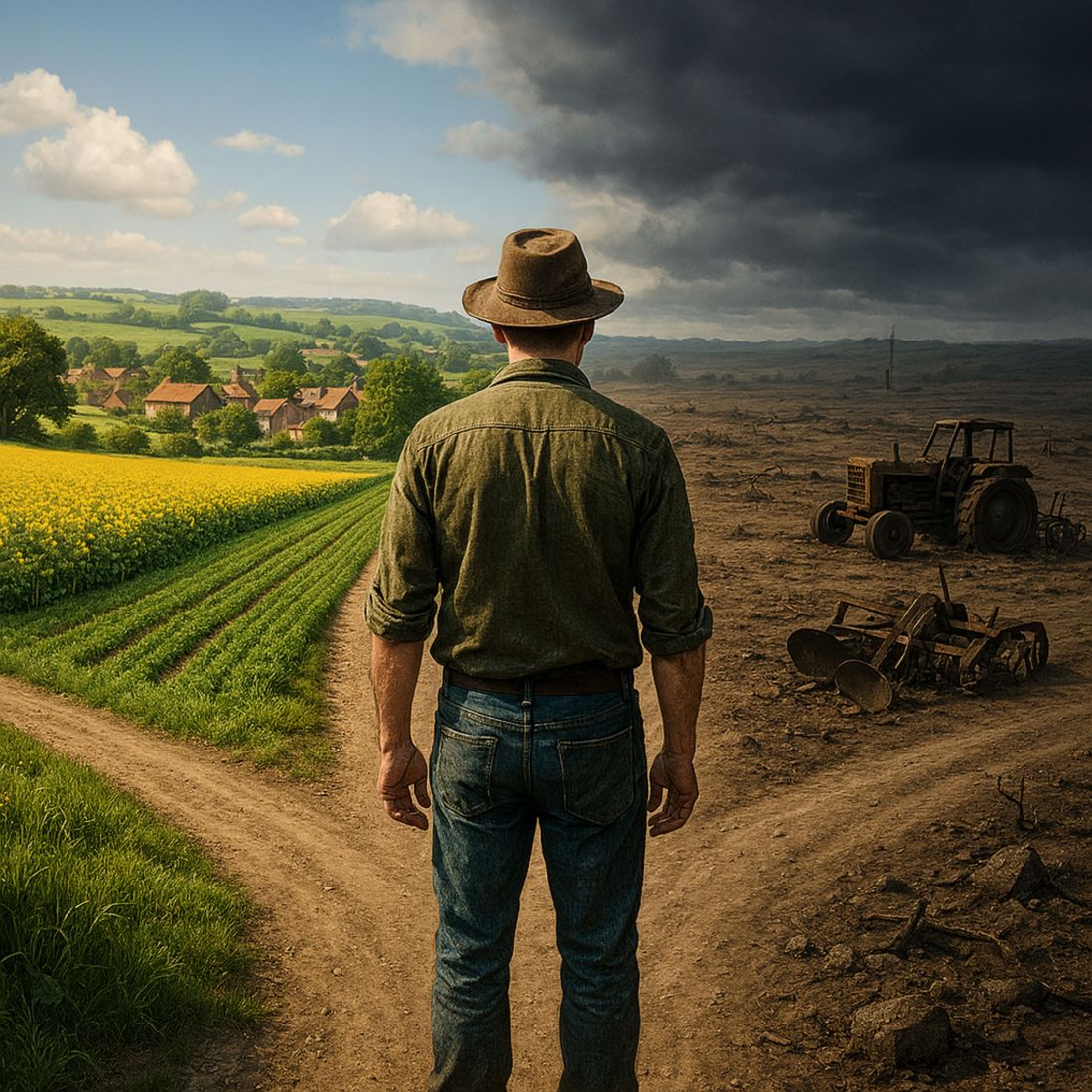
The UK is at a crossroads.

One path leads to deeper dependency, weaker food security, and a countryside shaped by distant interests.
The other leads to resilient communities, empowered farmers, and a food system built around people rather than profit.

The choice will not be made in Parliament.

It will be made in fields, villages, towns, and local markets across the country.

Farmers and communities must lead the change.

Because if they don’t, the future of Britain’s food – and Britain itself – will be decided by those who see land not as a living resource, but as a tool of power.
Rationing & Health: The Surprising Benefits

I recently heard someone say that ‘People were the healthiest thy ever had been during the Second World War, because of Rationing’.

Whilst the immediate reaction of some might be, ‘No way!’ – for no better reason than for many the natural reaction would be to conclude that rationing means having less Food to eat, I was certainly intrigued.

Afterall, the suggestion that Rationing could be beneficial in some way would certainly fit with what could happen when the choice to overeat no longer exists.

As I’ve written about Rationing before and regrettably consider it a real possibility if the UKs Food Security should be stretched any further than it is now, I thought it would be a good idea to look at the realities of what people experienced when we had Rationing for a prolonged period.

Is there an up-side to Rationing, as opposed to the default perception that Rationing can only be bad?

What is, or rather was Rationing?

Early in World War 2 (1939-45), the British Government introduced Rationing to overcome shortages of Foods and Commodities.

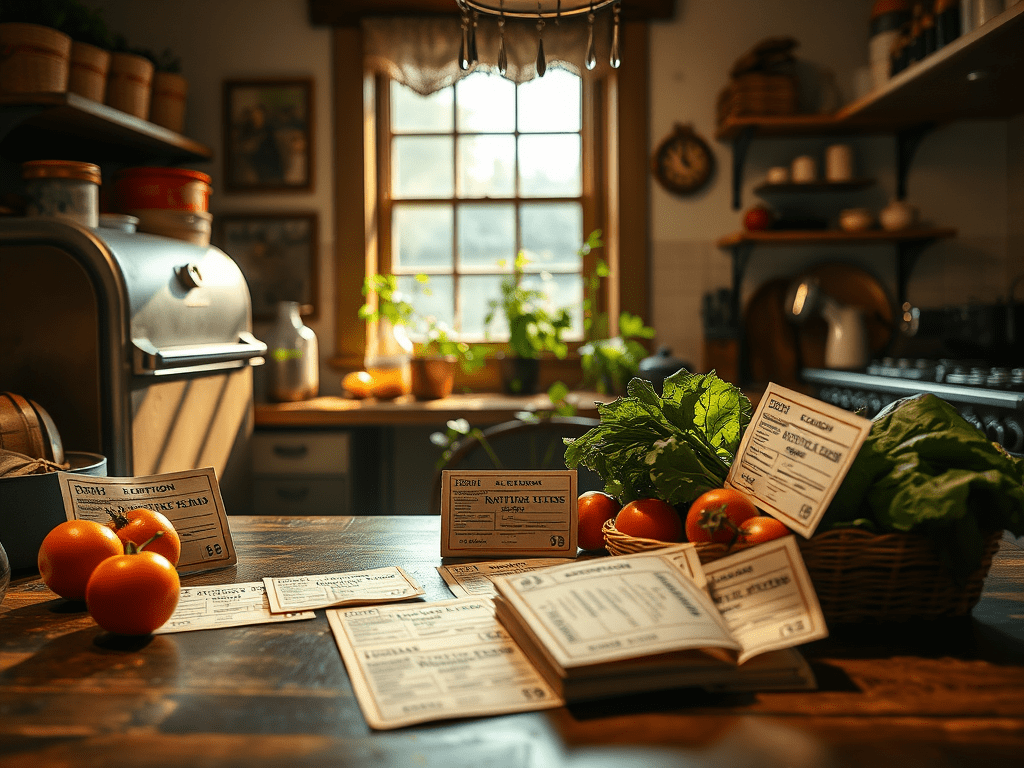
Rationing was basically an administration system, using coupons and points, that ensured essential basic Foods that included sugar, meats and cheese were shared out fairly. With some small prioritisations made for certain items for groups such as children and expectant mothers when it came to the distribution specific items like tinned Foods and Biscuits.

Fruit and Vegetables were never rationed, and bread wasn’t rationed until 1946.

However, with the impact of the War, the final Rationing restrictions weren’t lifted until 1954 – That’s 9 years after the War ended!

Why did Great Britain have Rationing?

The Wartime Government really had little choice but to introduce Rationing. Because like now, so much of the Food that people were eating, was coming from Overseas.

You may have heard of The Battle of The Atlantic already. But the truth is that wherever ships were coming from to brings us the things that we needed that we either weren’t able to produce, or we weren’t producing enough of, the German Navy made a significant impact on our supplies by sinking as many merchant cargo ships as they could. Quite literally with the intent of ‘starving us out of the War’.

Being an Island Nation and with no other way to ship Food and commodities in, Rationing was really a matter of life and death for everyone.

Rationing meant that for at least a few years, minds really did focus on what Food we needed and what we could produce more of ourselves.

Dig for Victory

Although they weren’t Rationed, Fruit and Vegetables were certainly in short supply. This meant that Home Growing or Grow Your Own became a very popular way for people to help themselves and those around them by putting gardens and available open space to work and good use as vegetable gardens and allotments.

Bearing in mind that in the 1940’s, there wasn’t the access to the equipment like miniature glass houses, grow bags, garden machinery and even hydroponics like there we have today, the Dig for Victory scheme illustrates what is really possible in times of need when people put their minds to it.

Nutrition and the impact of Rationing on Health

The interesting, beneficial dimensions of Rationing were:

  • Those with diets before Rationing that contained too much of certain Foods that could cause harm, had no choice but to eat less of them and became healthier as a result.
  • Those with diets before Rationing that didn’t contain enough of the right Foods also found themselves eating a more balanced diet and became healthier as a result.

Yes, these conclusions raise questions such as ‘Why would people suddenly eat more of anything when Food is in short supply’.

But that could easily be answered by them not having as much to eat of what they had done previously and then deciding to eat more of the things that were available AND were actually good!

Was Rationed Food FREE?

Rationed Foods weren’t Free and had to be bought with money, just like the Food we buy today.

The difference was that the buyer had to be qualified by being able to exchange a coupon for a certain amount of anything that they were then able to buy, and there was also a points system that prioritised some whose dietary needs were considered to be a priority for certain reasons.

How much Food were people able to Eat during Rationing?

From a look through some of the very interesting web pages and blogs that an internet search will find and that are linked to this page, the following list gives an idea of what a typical weekly Ration allowance looked like for an adult:

  • Bacon & Ham 4 oz
  • Other meat to the value of 1 shilling and 2 pence (Typically 2x Chops)
  • Butter 2 oz
  • Cheese 2 oz
  • Margarine 4 oz
  • Cooking Fat 4 oz
  • Milk 3 Pints
  • Sugar 8 oz
  • Preserves 1 lb every 2 months
  • Tea 2 oz
  • Eggs 1 fresh egg (There was also an allowance of dried egg)
  • Sweets 12 oz every 4 weeks

How much is an Ounce (oz) in weight?

An Ounce would be approximately the same weight as a slice of bread.

What would 1 Shilling and 2 Pence be in today’s money?

There are different ways that we can look at this question, not least of all because for a long time after Decimalisation, or ‘Decimal Day’, when the UK currency changed the way our Currency worked, some pre-Decimalisation coins continued to be used and this meant that we associated (or reattributed) their value to the new system.

This means that in coin terms, a Shilling in todays coins might be considered to be the equivalent of 6p.

However, inflation and how the value of money changes doesn’t work like that and in real terms, 1 Shilling and 2 Pence in 1940 would have been the equivalent of £2.30 in 2017.

Whilst researching this post, I found this great converter from The Royal Mint that is really worth a look if you have time and would like to get an idea about how the value of money has changed!

What could you cook when there was Rationing?

I’m very interested in the topic of making great meals from basic Foods and hope to feature a lot more on this very interesting subject area on Foods We Can Trust.

In so far as cooking great meals under rationing is concerned, I have found some Rationing / Wartime Recipe blogs that you can visit Here:

200+ Wartime Recipes – The 1940’s Experiment

12 Wartime Ration Recipes You Can Make At Home

Dan Lepard’s World War 2 Rationing Recipes

Make It Do or Do Without: 1940s Ration Recipes – Retro Housewife Goes Green

(Please note that these links are for information and are not recommendations or endorsements!)

Worth a Look too

Here are some of the other web pages, sources and resources that I visited when I was researching this post on 2 May 2025 using Google:

Dig for Victory – WW2 Home Front Growing & Food

Rationing in Britain during World War II – University of Oxford (Faculty of History)

Rationing in World War Two – Historic UK

Rationing Revisited – Blog Site

What you need to know about Rationing in the Second World War – Imperial War Museum

(Please note that these links are for information and are not recommendations or endorsements!)

Overview on ‘Is Rationing Good for Us?’

There are some very interesting, but equally challenging messages that come from looking at Rationing in the UK:

  • People can make do with a lot less to eat, and with Foods that are a lot more basic and ‘natural’ if they really need to.
  • Eating what we need, rather than what we want is probably a lot better for us in the long run.
  • ‘Boring Food’ can be quite exciting when we give it some thought.
  • It’s not a great idea to be over reliant upon overseas Food sources when you live on an Island.
  • The UK really hasn’t learned its lessons about Food Security!

Please note that this article was first published on the Foods We Can Trust website on 2 May 2025.

Risk and Responsibility: Why Farmers Must Choose to Rebuild the UK Food System Before It’s Too Late

Introduction

The future of UK farming stands at a crossroads.

In recent years, mounting challenges have threatened not only the livelihoods of farmers but also the nation’s ability to control its own food supply.

As policies and industry practices increasingly sideline independent food production, farmers face a pivotal choice: continue operating within a system that undermines their independence, or take bold steps to reclaim control and rebuild the UK food chain from the ground up.

This article explores the urgent need for change, the systemic issues facing agriculture, and the powerful impact that farmers’ decisions will have on the future of food security, communities, and the environment.

Farmers’ Choice: Reclaiming Control of the UK Food Chain

Farmers in the UK face a critical decision: either take back control of the nation’s food chain now, or risk losing everything—including the freedom that comes from managing our own food supply.

Background

In the summer of 2023, I published The Glos Community Project, which later evolved into An Economy for the Common Good.

Originally written as a book, The Future is Local, this project explored localising the supply of essential goods and services when our current system collapses.

It offered a practical vision for local communities, emphasising business models that prioritise people, communities, and the environment over profit. The central idea was to shift away from money as the core value and put people first.

Food and food security have always been central themes since I wrote Levelling Level in 2022. Through examining food production within a localised, circular economy, I realised just how pivotal food is to our future.

Unfortunately, the UK food chain’s importance is being sidelined and overlooked today.

The State of UK Agricultural Academia

My focus on UK food security led me to postgraduate study at the Royal Agricultural University in late 2023, where my concerns about the establishment’s approach to agriculture were only amplified.

There are glaring contradictions in the current system – contradictions that academic institutions seem unwilling to address. This reluctance raises questions about the true purpose of agricultural academia if it won’t challenge the status quo.

However, this malaise isn’t unique to agriculture; it reflects a broader trend in UK higher education, which has shifted from providing world-class centres of learning to institutions focused primarily on turnover and getting every student they can through the door.

Challenges Facing Farmers

The experience at the RAU mirrors the state of UK farming today. There is widespread recognition that something is fundamentally wrong, yet calls for change are often muted and deferential to the establishment.

Many across the industry still believe that government, the public sector, and corporate players will prioritise the needs of small businesses and farmers. However, history shows that this is rarely the case.

While farmers, industry speakers, and advocacy groups continue to speak out, their efforts often amount to little more than noise. Many hope that politicians will eventually address the industry’s difficulties, or that a change in government will bring solutions.

But the reality is that UK food security is not being treated as a matter of common sense or urgency.

Who Controls Our Food Controls Our Future

The Farm Inheritance Tax issue highlighted how every part of the UK food chain lacks the priorities that working family farmers and the public deserve.

The system is rigged against independent UK food production because the establishment resists any sector that could foster independence from the current system.

Sadly, instead of helping, advocacy organisations often reinforce the myth that government supports UK farming by prioritising the relationship they have with politicians and officials, even as policies make it increasingly difficult for independent producers to survive.

The reality is that no matter how they are presented, the changes are all designed to encourage the end independent food production in the UK.

Control over the food supply is power. Like other productive industries, UK farming has been systematically undermined under the guise of progress, innovation, and economic policy.

This process began with the adoption of the Neoliberal FIAT money system and the push for global business, and deliberately misled previous generations into believing that joining the Common Market and making increasing commitments to the EU methodologies would benefit everyone.

The Consequences of Inaction

For decades, we have been distracted by consumer culture and promises of continuous improvement, while key industries have been hollowed out.

This has allowed a small group of wealthy individuals and corporations to consolidate control over land, businesses, and resources, often through changes in rules and regulations that once existed to support people, communities and the environment.

While some may dismiss these concerns as conspiracy theories, the evidence is clear: the consequences of these actions have been real and damaging. Many still struggle to believe that such harm could be inflicted for the sake of control and profit.

The Reality Today

Food and our food supply are critically important, yet many fail to grasp this.

Some policymakers believe traditional farming is obsolete and that future food will be produced in factories, regardless of the health or freedom implications.

Reports on farming profitability are rarely taken seriously, as the industry’s problems are symptoms of long-term, deliberate changes.

Governments of all parties are invested in a collapsing system, unable or unwilling to enact meaningful change.

Their solution is now to tax everything in hopes of reviving that failing system, but this approach is unsustainable too.

The Choice for Farmers

Farmers now face a pivotal choice: continue operating within a system that works against them, or walk away from government and industry expectations.

By starting anew and rebuilding the UK food system from scratch, farmers can reclaim control and create a future that prioritizes people, communities, and the environment.

Key Points Summary

  • Urgency for Farmers: UK farmers must act now to reclaim control of the food chain, or risk losing their livelihoods and the nation’s food security.
  • Local, People-Focused Economy: We must shift from profit-driven business models to ones that prioritise people, communities, and the environment, as outlined in the newly published Local Economy & Governance System.
  • Systemic Issues in Agriculture: There are deep-rooted problems in UK agriculture and academia, with institutions reluctant to challenge the status quo, and a broader trend of prioritising financial gain over genuine learning and improvement.
  • Government and Industry Inaction: Despite widespread recognition of problems, calls for change are often muted. Many in the industry hope for government intervention, but history shows that politicians rarely prioritise farmers’ needs.
  • Control and Power: The UK food system is structured to prevent independent food production, consolidating control among a small group of powerful interests. Advocacy organisations often reinforce the myth of government support, even as policies undermine farmers.
  • Consequences of Policy: Decades of policy have hollowed out key industries, transferring land, resources, and businesses to wealthy corporations and individuals, leaving communities and the environment vulnerable.
  • Dismissal of Concerns: While some may dismiss these issues as conspiracy theories, most recognise that the negative impacts are real and significant.
  • Misguided Beliefs: Policymakers increasingly believe traditional farming is obsolete, favouring factory-produced food without considering health or freedom implications. Reports and studies on farming profitability and the  problems the industry faces are rarely taken seriously.
  • System Collapse: The current system is unsustainable, and governments are unable or unwilling to enact meaningful change, resorting to increased taxation in a failing attempt to keep the system afloat.
  • A New Path Forward: Farmers are encouraged to reject the expectations of government and industry, and to rebuild the UK food system from scratch, prioritising independence, community, and sustainability.