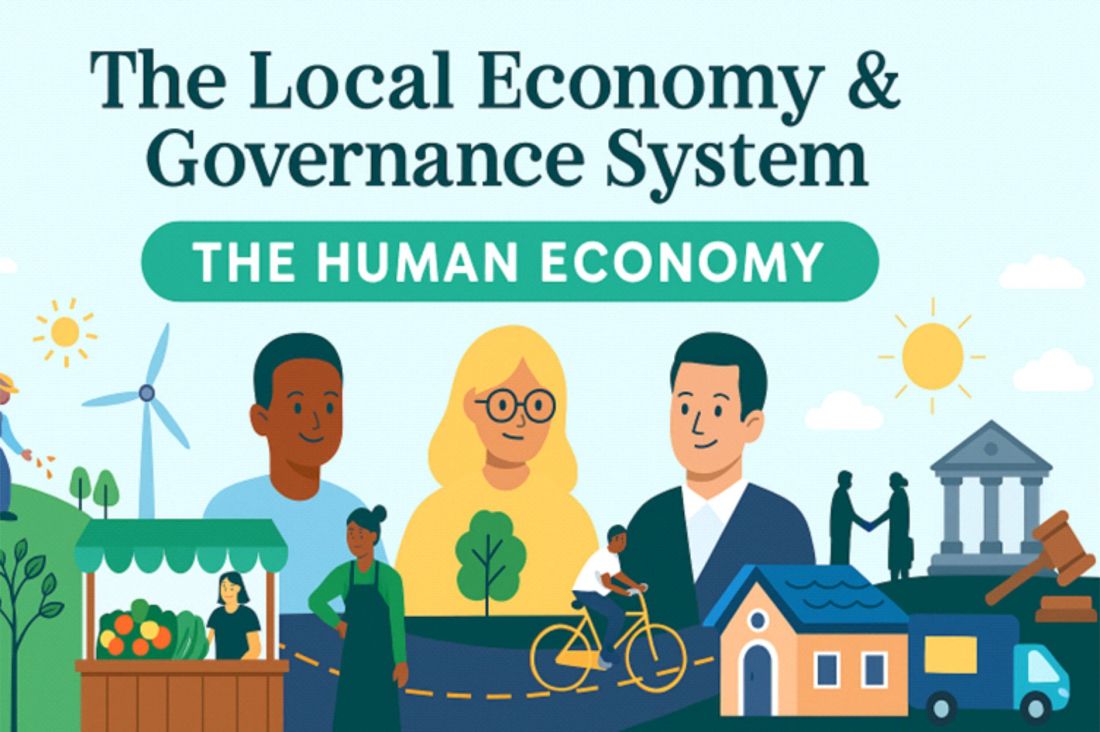
LEGS: The Human Economy – A Blueprint for Transformation

Introduction

In a world increasingly shaped by the pursuit of economic growth and the dominance of monetary values, our understanding of what truly matters has become distorted.

The language of economics, once intended to serve human wellbeing, now often justifies systems that place money above all other forms of value.

This Local Economy & Governance System (LEGS) challenges the prevailing money-centred worldview, exposing the myths that underpin it and the consequences for individuals and society.

By re-examining the purpose of the economy and redefining value at the level of the individual, we offer a blueprint for transformation – one that places human needs, freedom, and wellbeing at the heart of economic life.

The following pages invite you to reconsider what it means to live well, to recognise the moral costs of excess, and to envision an economy built on natural abundance, justice, and personal sovereignty.

The Rise of a Money‑Centred Worldview

Over time, the words economy, economics, economic policy, and economic theory have been shaped by a money centred worldview.

They became part of a language and narrative designed to justify systems that placed money above all other forms of value.

This worldview gradually embedded itself into culture, until money was positioned at the centre of almost every aspect of life and treated as the primary measure of worth.

How Policy Reinforced the Myth of Economic Growth

Governments, politicians, and established institutions reinforced this belief by placing the economy at the heart of public policy.

They encouraged the idea that a good life was only possible if the economy was considered healthy and growing.

Measures such as GDP were promoted as the ultimate indicators of national wellbeing, and people were led to believe – often without explanation – that their personal success was somehow tied to the financial success of the economy itself.

Reducing Human Value to Economic Data

By turning everything of tangible value into something economic, measurable, and defined only in relation to the economy, society gradually stripped away the inherent value of each person.

Individuals became reduced to data points – digits on a screen – an effect amplified by digital tracking and the rapid development of AI.

The Hidden Myth of External Power

The central myth that upheld this money centric system was not only the false belief that money is inherently valuable.

The deeper, more powerful myth was the idea – never openly stated but widely accepted – that real power lies outside the individual.

Because money appears external to us, it became easy to believe that our worth and our agency also exist outside ourselves.

The Illusion of Money as Value

In truth, money has no intrinsic value. It is simply a tool for exchange.

The belief that money is value created the foundation for many of society’s problems.

The FIAT System and the Concentration of Power

This belief was further exploited through the rise of the modern FIAT monetary system, which used complexity, misplaced trust, and practices that would otherwise be considered unethical or criminal to shift wealth – and therefore power – from the many to the few.

All of this was presented as progress. As the natural direction of a modern world.

The Moral Cost of Excess

Yet in any genuinely civilised society, there is no moral justification for one person to hold more than they need when that excess comes at the expense of others.

When someone accumulates far beyond their needs, someone else – often someone they will never meet – is forced to go without the essentials required for a life free from deprivation.

How Scarcity Is Manufactured

Taking more than we need, in any form, inevitably creates shortage elsewhere.

Possession alone does not justify allowing others to suffer lack.

No individual has the fundamental right to hold more than they require when doing so directly or indirectly harms others.

Economics as a Tool of Justification

In this way, the language of economics became a tool to legitimise imbalance and injustice.

It normalised greed and elevated the pursuit of material wealth and power to something admirable – something to be celebrated above all else.

The Local Economy & Governance System: Defining the Economy and Economics for a Humane Existence and Way of Life

Real value does not exist within money itself, nor within the material possessions that money – despite having no intrinsic substance – can be used to persuade others to “buy or sell.”

True value can only be defined at the level of the individual. It arises from the meaning and importance a person attributes to something from within themselves, not from any external price tag or monetary label.

Money is simply a practical tool. Its purpose is to make the exchange of value easier when direct barter or exchange – trading goods, services, or labour – is not possible or convenient.

Money is a facilitator. Not the source of value itself.

In reality, people are the economy.

People are the reason the economy exists, the purpose behind it, and the driving force within it.

Every meaningful economic activity begins and ends with human needs, human choices, and human wellbeing.

With this understanding, the LEGS interpretation of economy can be defined as follows:

Economy is the collective presence, activity, and contribution of people working together to provide and supply all the goods, services, and forms of support that are essential for every individual within a community to live well.

Its purpose is to ensure that no person experiences need or scarcity severe enough to undermine the natural state of abundance – a condition in which all basic and essential needs are reliably met.

In this state of abundance, individuals are freed from the pressures of deprivation or want, allowing them to experience a form of personal freedom that is not compromised by the struggle to secure the necessities of life.

Thus, the economy is not merely a system of production and exchange, but a shared human effort to sustain the conditions that make genuine freedom, well‑being and the experience of Personal Sovereignty possible for all.

Summary

These pages challenge the prevailing money-centred worldview, revealing how economic language and policy have often placed monetary value above human wellbeing.

They expose the myths that underpin this system – especially the illusion that real power and value exist outside the individual – and highlight the moral costs of excess and manufactured scarcity.

The Local Economy & Governance System (LEGS) offers a transformative blueprint: it redefines the economy as a collective human effort, focused on meeting essential needs and fostering abundance, justice, and personal sovereignty.

True value, as argued here, arises from within each person – not from external price tags or monetary labels.

Money is a facilitator, not the source of value itself.

By placing human needs, freedom, and wellbeing at the heart of economic life, The Local Economy & Governance System envisions an economy where no individual suffers deprivation, and everyone is empowered to live well.

The path forward is one of re-examining our assumptions, recognising the moral imperative to share resources fairly, and building systems that sustain genuine freedom and wellbeing for all.
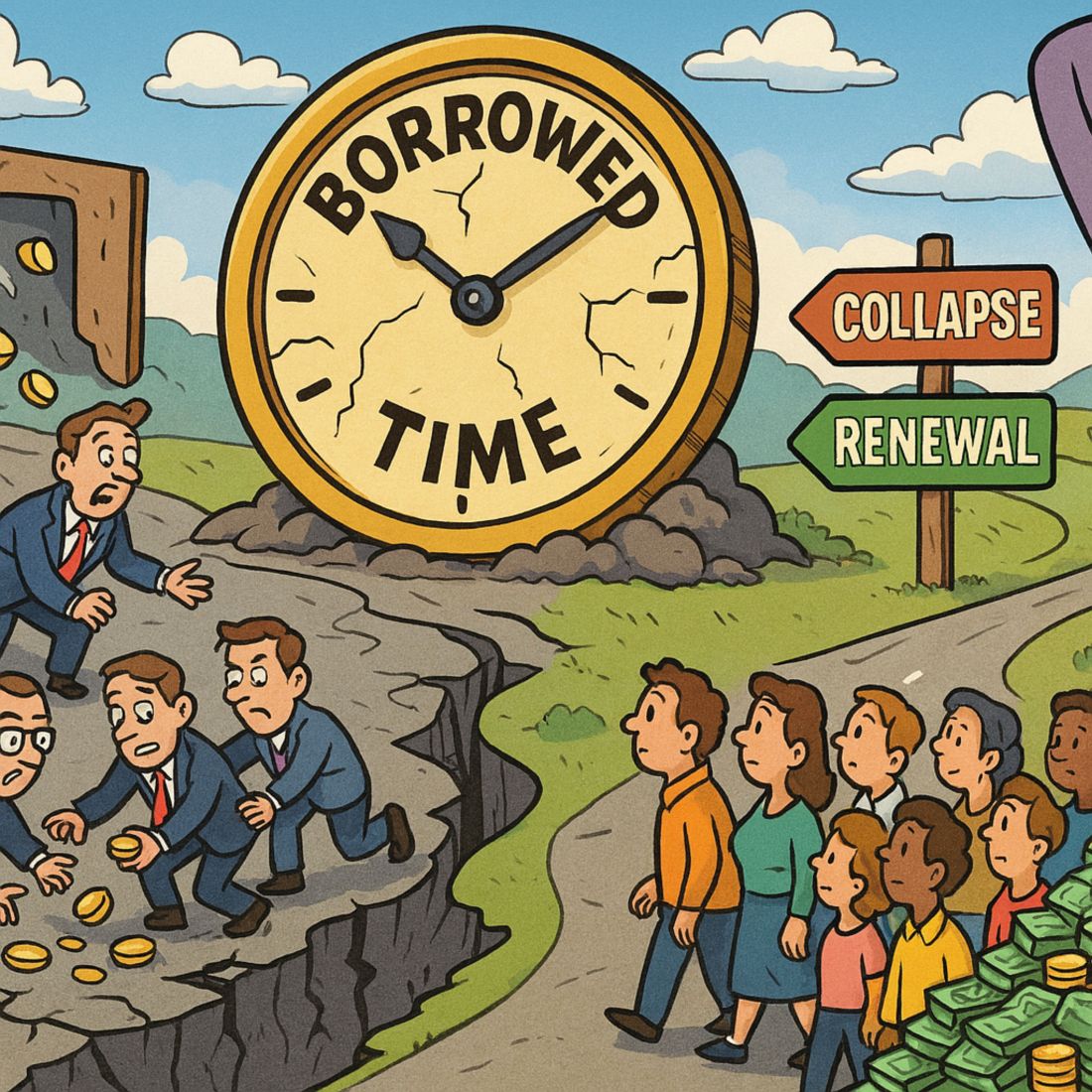
The Borrowed Time Budget: A System Running Out of Road

The November budget, with its push toward higher taxation, is not simply a matter of fiscal policy. It is a warning sign, a flare in the night sky that tells us the system we live under is running out of road.

Few people recognise what this shift truly signals, and fewer still are willing to confront it. That blindness is not accidental. Our economy has been carefully designed to mislead, to disguise its fragility, and to keep even the sharpest minds chasing illusions.

For decades, governments have expanded the flow of money, not by creating genuine value, but by inflating the system.

They bailed out the banks that caused the crash of 2007- 08, rewarding failure with public funds. Later, they unleashed torrents of money during the Covid pandemic, not to rebuild resilience, but to keep the machine ticking over.

These interventions did not repair the foundations; they merely propped up a broken structure. The result is a distorted reality in which the government can no longer borrow what it needs to sustain public services. Instead, it faces crises that today’s politicians are neither prepared nor equipped to lead us through.

To keep the illusion alive – to make it appear that everything is functioning as normal – the government must find money somewhere.

If banks cannot provide it (and in truth, they never had it to lend in the first place), then the state will take it from us. Taxation becomes not a tool of governance but a desperate grab for survival, a way to scrape together whatever can be found to keep the plates spinning.

This is the trap of the political class. They value their positions and the power they believe they hold more than the consequences of their choices.

Whether they admit the truth now or continue draining the public first, the end is the same: collapse.

The system is already hurting millions, and it cannot endure indefinitely. The only uncertainty is whether we lose what remains of our wealth before the collapse, or when it finally arrives.

The bitter irony is that our money is tied to nothing of real value. That emptiness is what has allowed politicians and elites to manipulate the system for so long. Could anyone become an overnight billionaire if wealth were grounded in tangible worth? Of course not. Their fortunes exist because people buy into offerings with money that, in essence, does not even exist.

This government – and likely the next one too – is living on borrowed time. Real change will only come when leaders emerge who understand the true nature of the crisis and are willing to act decisively to rebuild on solid ground.

Until then, the charade continues – as does the damage that it causes.

Few will welcome the upheaval that is coming, but it is inevitable: the world will soon operate very differently than it does today.

That shift need not be catastrophic. We still have choices, and we still have the chance to take a better path.

But this requires honesty. It requires accepting that the obsession with money at the centre of everything must end.

Unlike the politicians driving the UK bus towards the cliff, we must recognise that we have already reached a place called stop.

From here, the only way forward is to put people first.

Minimum Wage, Maximum Exploitation: A Collapsing System Propped Up by Rising Taxes

Introduction

As the cost of living continues to climb across the United Kingdom, many households find themselves struggling to maintain even the most basic standards of financial independence.

With impending tax rises on the horizon, the pressure on those already living near the edge is set to intensify, pushing even greater numbers below the threshold of self-sufficiency.

This is not a temporary crisis, but a symptom of a deeper, systemic failure—a collapsing economic model that now survives only by extracting more from those who can afford it least.

The money-centric economic system that we have – The “Moneyocracy” – perpetuates itself by shifting the burden onto workers and taxpayers, while the promise of prosperity grows ever more distant for the majority.

Against this backdrop, it is essential to confront a fundamental question – one that exposes the uncomfortable realities at the heart of our economy.

A Question:

Do you believe the minimum wage is enough for a full-time worker to live on – and if so, why?

The answer to this question, which varies depending on one’s relationship with the minimum wage, reveals uncomfortable truths about the foundations of our economy and the way work is valued in this country.

What is not surprising is that those who already have financial security often agree in principle that low-paid workers should earn more. Yet when confronted with the implications of paying every worker enough to live independently, many recoil. Why? Because such a change would disrupt their own relationship with the economy.

The Minimum Wage Reality

Let us be clear: the national minimum wage in the UK is not enough for anyone working a full-time 40-hour week to live independently—free from reliance on benefits, charity, or debt.

The widespread acceptance of this wage stems from government and establishment narratives.

What is legally mandated is presented as morally and practically sufficient.

Yet, in truth, the minimum wage is a carefully placed rock covering a pit of myths and lies.

Those who benefit from the system prefer not to lift that rock, because doing so would expose their complicity in maintaining the illusion.

The Employee

A worker earning the minimum wage – currently £12.21 per hour, equating to £488.40 per week or £25,396.80 annually – cannot afford the basic essentials required for independent living.

The gap between what they earn and what they need is effectively the amount by which they are underpaid.

Employers exploit workers by failing to cover the true cost of living.

Regardless of how the deficit is filled—through benefits, charity, or debt—someone else is subsidising both the employee and the employer.

The Employer (Small Business)

Small business owners often insist they pay fairly because they comply with the law. Yet compliance does not equate to fairness.

Paying the legal minimum is not the same as paying enough for employees to live independently.

Common justifications include:

• “They can top up with benefits.”

• “I can’t pay more or I’ll go out of business.”

But these arguments miss the point. The government—and by extension, taxpayers—should not subsidise businesses that cannot afford to pay workers a living wage.

In reality, small businesses are also exploited: they cannot operate independently within the current economic system, because they too are constrained by models that undervalue their work.

The Employer (Big Business)

Large corporations differ because they can afford to pay more.

Supermarkets and other major employers of minimum-wage staff generate enormous profits – even during a cost-of-living crisis, like the one we are experiencing now.

They could easily pay wages that allow workers financial independence, if boards and shareholders accepted smaller returns.

Instead, big businesses exploit both employees and taxpayers. Workers are underpaid, while the government subsidises wages through benefits.

This allows corporations to maximise profits while keeping the mechanics of exploitation hidden from public debate.

The Government

Why does the government subsidise wages so small businesses can survive and big businesses can thrive? Why not simply set a minimum wage that reflects the true cost of living?

The answer is stark: doing so would collapse the system.

The economy functions by undervaluing the majority of jobs deemed “low-skilled” or of “little value.”

If wages reflected reality, the house of cards would fall.

The Taxpayer

The system is a con. The complex machinery of what can be called a Moneyocracy manipulates trust and deference so effectively that taxpayers rarely ask basic questions.

Why, in an economy where corporations make billions annually, must taxpayers top up their employees’ wages through taxes?

Why are we threatened with price hikes whenever government policy shifts, while corporate profits remain largely unscrutinised?

Following the money reveals the truth: wealth is funnelled in one direction, made possible only by exploiting workers, taxpayers, and weak governments.

Corporations profit by underpaying staff, then spin narratives that justify charging consumers more.

Reality Bites

Exploitation of normal people has gone too far. The system enriches the few by exploiting the many – sometimes multiple times over – so profits can grow while wages stagnate or reduce in real terms.

The Moneyocracy survives by perpetuating the myth that it is acceptable for many to grow poorer while a few grow disproportionately rich.

The promise dangled before workers – that if they play the game long enough, they too might “live the dream” – is false.

Humanity is destroying itself chasing a dream that continually recedes, because playing the game requires forgetting our true worth.

The basic equation of the Moneyocracy is simple: for some to be rich, most must be poor.

This is neither humane nor true.

The Alternative

There is another way. A system built on real values – where people, communities, and the environment come first – can replace the current money-centric model.

This alternative requires transparency, local systems, and a commitment to prioritising human worth over profit. Instead of hiding self-interest behind complex structures, society must embrace a model where business and life are conducted openly, sustainably, and with fairness at the core.

The choice is absolute: continue with a Moneyocracy that exploits us all or build a future centred on people.

Path Forward

The Local Economy & Governance System provides the foundational framework for a truly people‑centric future – one where People, Community, and Environment sit at the heart of every decision.

At its core lies a new benchmark: The Basic Living Standard, a guarantee that every individual receives a weekly wage sufficient to cover all essential needs.

This principle of equity and equality is not an optional add‑on, but the priority that guides every part of the system.

By shifting away from exploitation and toward fairness, transparency, and sustainability, this model offers a pathway to rebuild trust and resilience in our economic and social structures.

To explore how this vision can be realised and what it means for the future, please follow these links:

Plastic Productivity and the Debt Trap: What the November Budget Won’t Fix

Governments do not collapse in the same way that individuals or businesses do. If they did, the United Kingdom would have gone under financially long ago. Instead, the state continues to function by rolling debt forward, reshaping obligations, and presenting the appearance of stability. For ordinary people, however, the rules are very different. When we cannot meet our commitments, we fail — unless someone steps in to bail us out.

Meeting financial obligations requires honesty. You must know whether you can truly pay your debts or whether survival depends on wishful thinking. Throughout history, people and businesses have thrived or failed for both good and bad reasons. As long as they appear to function, few question what lies beneath.

For tradesmen, small business owners, and entrepreneurs, the reality is harsh. None of us are “too big to fail.” Once obligations can no longer be met, collapse follows unless a benefactor intervenes.

We like to believe the same standards apply to everyone, whether sweeping streets or running government. Yet elites have always bent rules to their advantage. They forget that all people, high or low, share the same human experience. Power corrupts, and politicians often forget they were elected simply to fill a seat, not because they are uniquely qualified to decide what is best for everyone.

The shift to fiat money in 1971 changed everything. It allowed governments, banks, and corporations to manipulate the system, creating the illusion of endless funds. Behind closed doors, decisions were shaped by business and banking interests, while politicians no longer had to worry about the true responsibilities of leadership.

Debt became hidden behind GDP figures. Growth and transaction volumes disguised the reality of an exploding debt pile. To the untrained eye, it looked as though debt was shrinking, when in fact it was spiralling out of control.

This illusion was sustained by what might be called “plastic productivity.”* Assets and infrastructure were bought cheaply, production was outsourced overseas, and consumers were encouraged to buy more and more goods they didn’t need. People became indebted to the same banks that lent to government, yet could just about service their loans. It seemed as though prosperity was endless, and few questioned the narrative.

But the system was never sustainable. Its architects knew it would transfer wealth and ownership to a small elite. By making money and material wealth addictive, they ensured control. With industries hollowed out, productivity now depends almost entirely on expanding debt — by government, business, and individuals alike.

Politicians face a broken system. To keep the machinery of government running, they must tax normal people more heavily. Yet much of public spending delivers little benefit. Policies have been rewritten, words twisted, and meanings changed to allow politicians to cling to power while the wealthy grow richer. Assets of real value have been transferred to people who could never have owned them otherwise.

If the system collapses, the establishment will impose new rules. They may impoverish citizens further, leaving people no choice but to accept whatever is dictated. Many politicians may not even understand the system they oversee. They follow instructions blindly, blamed for decisions that are not theirs, lacking the skills to lead differently.

The situation could drag on for months or years. Collapse may come when the public finally says “enough,” or when the establishment has drained the country dry. Even if a new government is elected — Reform UK, Nigel Farage, or anyone else — they will face the same reality. Cutting spending or taxes cannot fix a nation that is broke and owns nothing. Wealth has already been transferred to lenders.

The system is broken. We must either accept subjugation under a corrupt structure built on trickery, or take a leap of faith and start again from scratch.

***

*”Plastic productivity” refers to the illusion of economic growth created by outsourcing production, encouraging over‑consumption, and sustaining debt, rather than building genuine, sustainable value. It’s not about plastics as a material, but about a system that mimics productivity while hollowing out real industries and transferring wealth.

The introduction of Price controls on foods, goods and services may become essential as this cost-of-living crisis develops. We would be fools to rule out rationing becoming necessary too

Yes, it does feel a bit like being the voice of doom and gloom as I write and produce videos about all the things that are going on and talk about what we can realistically expect as being likely to happen next.

The point is, that if someone like me can see what is happening and what is likely to happen next, the people we have elected as MPs have absolutely no excuse not to do so too.

In fact, our public representatives should be well ahead of the curve in both their horizon scanning and thinking than most.

Regrettably, they are not.

To be fair, the complexity of the growing problems and how each and every one of them interacts with the others is mind bogglingly scary to say the least.

Yet it is the culture of ‘let’s always take the easy option’ that exists, top to bottom within the British Political System, that has made the difficulties that are only just starting for us, significantly worse.

There are many people in this Country today who cannot afford to feed themselves, home themselves, clothe themselves, transport themselves or function normally in any way on the wages or income they have, without debt or benefits – or what is really a subsidy from the Government and therefore everyone else in some way.

Prices of the foods, goods and services that provide the basic essentials for life are spiraling out of control. Living at the standard we are experiencing even today, will soon become unaffordable for most.

Yet the complexities I mentioned above, all come back to just one thing: That the economic system we have today has been developed to benefit the self-interests of the few. That those driving it have continued to push prices up in the pursuit of ever-growing profits for as long as our stupid politicians have printed money and kept handing it out. When instead good politicians would have faced up to reality and dealt with the problems for wider society that have been caused by that same greedy few.

The Covid Pandemic has caused stupid politicians and greedy business and financial leaders to overplay their hand.

In fact, the inflationary spiral they have created together is now out of reach of any form of control they possess. Indeed, the only actions our weak-minded politicians have to address the issues are only serving to make the whole problem worse.

Events, or a coming chronology of them – which will have been caused by so many different profit-driven people with influence behaving in the same way, will combine to make basic food unaffordable where it is available. It will be absent from the supermarket and shop shelves where it would otherwise be not.

Food riots, as the system collapses and the old order makes way for a new one that will work for all will settle the mind of many. Especially the politicians that we have for the time that their waning power remains.

Greed, hoarding and any kind of self-driven prioritisation will have to go out of the window.

That will mean supermarket rationing as we experienced during the early Lockdowns. There will be an immediate need for Government to step in and fix prices along the entire food and essential goods supply chain, so that nobody can use this time of crisis to profit off the backs of us all.

Some of the more economically minded will baulk at the idea of any kind of price fixing, price regulation or price controls, because of its non-capitalist and non-market-friendly nature.

But the reality is that the epoch of easy money and making massive profits by exploiting the many to benefit the already bloated few, is now reaching its end.

A new system will emerge that will be fair to all. But it will not resemble anything that we’ve seen or experienced before.

As we walk the pathway to get there, it will be necessary to ensure that what we still have available – which will plenty for all of us without the influence or intervention of ongoing greed – will be made available fairly to all.

Money as we know it is likely to become only one of many different ways to make payment as change takes place. And it is therefore just as likely that rationing of the essentials that are available will also be necessary for everyone.

The times ahead may prove to be painful. But it’s the future which is possible for everyone once the change has been completed that we should look forward to.

The opportunities for a fair and just way of living, where everyone and everything matters are not just a pipe dream. They really exist and are there for us all.

After the pain, we have much happier times in store.