Sustainable Agriculture is part of the pathway to UK Food Security. But it wont work well for anyone until it works for everyone in the same way

My focus on Agri politics and the mass of issues that surround UK Food Security, Sustainable Agriculture and the growing problem of Food Poverty in the UK has made the past few months and my time at the Royal Agricultural University highly beneficial. Especially as I have began to look further and further outside my own social and professional circles to see if the troubling patterns that I already recognised, were evident in the same way elsewhere.

I have to be blunt and say that nothing I have experienced has given me any comfort. In all honesty, everything that I have seen has made me realise that the UKs Food Security and self-sustainability issues are significantly worse than I’d already concluded, and they are getting worse the whole time.

As you will have already read, Sustainability and Sustainable Agriculture are issues that are important to what I wish to share. However, the English language, the way that we multipurpose words and the obsession with subtext that most of us have, make communicating difficult issues that need to easily be grasped very difficult. Especially when alternative terms and their meanings can be used as a barrier that allow emotional ties to get in the way of progress and constructive dialogue.

There are very important distinctions to be made about Sustainable Farming in the context of what sustainability really is. Given that terms such as Regenerative Agriculture, Conservation Agriculture and Rewilding have been pushing their way into the Rural, Green, Environmental and Agricultural lexicon. As despite what should be very distinctive threads of commonality running throughout all of them, the differences between them and more importantly what everyone believes to be the most important priorities of each of them, are endlessly getting in the way.

Misunderstanding, misinterpreting and misrepresenting key benefits and issues is preventing everyone coming together to build upon shared commonality to identify and implement ways of working for the future that are meaningful and beneficial for everyone involved.

To add to the complication of addressing these issues, there is also a need to focus on methods and thinking that are likely to seem counterintuitive in a way that requires many of the most logical and business minded people that we could meet, to think about a future that looks very different to how it does today. A comfort zone we are resistant to leaving where every system, policy and story we encounter tell us all that the basics of everything that we accept without thinking, are always set to remain the same.
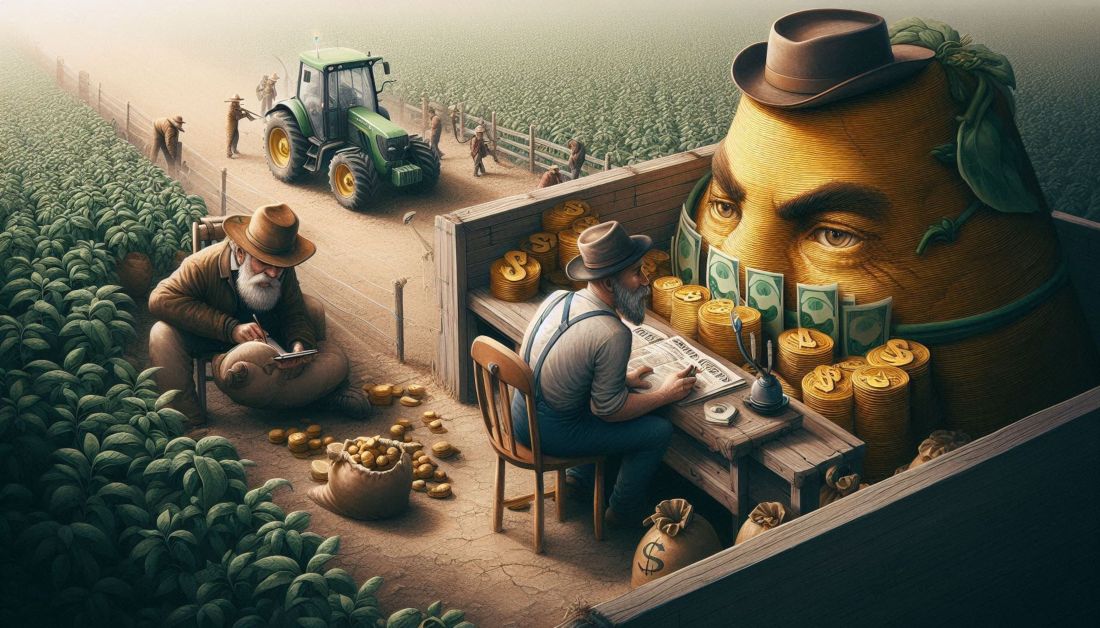
The priority of Farmers today is money. But farms cannot run profitably with profit being the priority anymore

So, this is a statement that will need some more thought. Surely it’s the case that every business is run to make money, isn’t it?

On the face of it, the argument that all businesses exist to make a profit is very sound. However, it is only sound because of the way that the world currently works and how we think, placing money at the heart of everything. Instead of prioritising the real reasons that any business exists, which are the products or the services that they provide to customers (or end users).

We can take this thought further. The real reason for providing those goods or services are to help, support or enable people to live, in whatever way that product or service will help those people to do so.

At risk of stating what should be obvious to everyone but actually isn’t, UK Agriculture, Food Production and UK Farms are about or should be about providing the UK population with a secure, accessible, ongoing supply of healthy, nutritional basic or essential foods. And they should do this collectively on the basis of providing the UK Population with the widest variety that is available to us from being grown, ideally as local to the end user as possible, but at the very least, from somewhere from within the geography of the nation state that we all share.

I don’t know a farmer who isn’t passionate about what they do.

Farming isn’t just a business. Farming is a vocation and lifestyle choice for all those who are genuinely committed to the industry, in what I will suggest is a healthy way.

However, as we have moved further and further away from subsistence farming the scale of risk has grown at the same pace as the commitment to production growth.

It has naturally followed that the power that Farmers and Food Producers in the UK once had, has progressively been surrendered to whoever will guarantee the greatest longevity of income. Even though it has now been arguably many years since such guarantees have also offered anything like what we would likely agree to be viable prices.

One of the reasons that Clarkson’s Farm on Amazon Prime has been such a good champion for UK Farmers is that it has lifted the lid on just how precarious Farming in the UK has now become. Yet few Farmers have the opportunity to do TV work or lean on the marketing power of celebrity to make a new farm shop or a brewery buy-in an instant hit.

The reality is that for many Farmers, it has been the culture of payments and subsidies that have taken over everything in Agriculture, alongside the ‘deals with the devil’ that have been made with traders and supermarkets, that are the only reason that what should be ridiculously successful food producing businesses stay afloat.

It is impossible for Farmers to stand still at a static or subsistence level as it once was, as ‘growth’ and therefore growing ‘turnover’ is the only way that earnings can be kept static.

The alternative for many being either to sell up or go broke.

Farmers, Food Producers and the entire UK Agricultural Industry are vulnerable to whatever the supermarkets, retailers, traders and the establishment demands of them next. Because they have surrendered their power to money, and forgotten how to do what they really do best.

Current thinking and every message that we hear tells us that big and bigger are the only way that things can now go. That ‘growth’ equals progress. Yet none of this is in any way true.

The future of Farming is the return to being a predominantly local, community-focused industry with emphasis on the production of foods and goods that local people need. Not what some want and only they can afford.

I realise that the immediate argument that will come back from many farmers who are thinking about the situation that they are really now in, will be that the infrastructure, support networks and governance (laws, rules and regulations) simply don’t exist to make anything like this work without financial support, and that just this factor alone, before anything like the economies of scale are considered, make any such move one that would be impossible to work.

It certainly looks that way. But without UK Farmers, Food Producers and Agriculturally aligned industries taking back their own power by taking those risks necessary for themselves now, the reality is that within perhaps only a few years, Farming as we recognise it in the UK today, will simply no longer exist.