
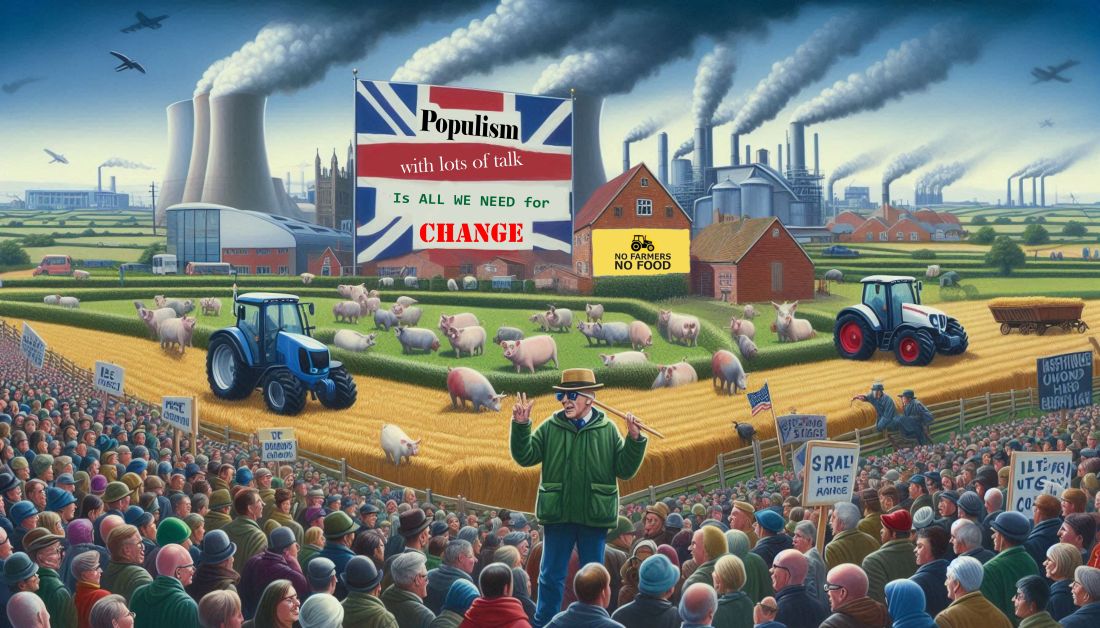
The one thing that everyone linked to U.K. Agriculture and Food Production will agree on is that the industry is in crisis. But what the crisis is, what caused it, what will fix it and what approach or what thinking must be prioritised to do so are very different things.
The stakes could not be higher. Farming is quickly becoming unviable for growing numbers of farmers. The land they vacate is coming out of production and not being passed to the next generation or anyone fighting to find their way in. Retailers are exhaustively abusing their relationships with farmers and growers, and the establishment remains blithely confident that the U.K. will never be short of supplies.
Because countries as far away as Australia and New Zealand will always be there to step into the gap and meet every shortfall.
All of this whilst the latest figures suggest that the amount of food that the U.K. produces for its own use only reaches around 52-54%.
That the food we all eat just seems to keep on coming gives the lie to what the real food crisis is. And the fragility of our food supply is hiding in plain sight.
The complexity of the issues involved regrettably mean it is increasingly easy for anyone within the industry who is worried about the future, to be looking for a banner or message to get behind. One that relates enough to their own experience and makes sense of whatever they believe everyone else going through the same experience needs to do.
Unfortunately, messages that can become such a point of focus are therefore very dangerous. They deceive people into believing in a shared purpose that isn’t necessarily there.
This means that time, energy and perhaps even risks or gambles are taken on political vehicles or strands of unanchored activism that sound as if they will deliver results and perhaps even become the next big thing.
Some call this populism. It’s happening within farming right now, fuelled in no small part by the growing unrest involving farmers across Europe who have even gone as far as laying a meadow along once of the key routes into Paris.
Ploughing roads, fertilising the walls of ministry offices, shutting down travel or even manning the barricades might sound very attractive to people even beyond the farming and food production community itself. But what would be the purpose? What would U.K. farmers be trying to achieve? What would it all be for?
Everyone has a different perspective on the issues; what is happening and what really needs to happen, to get the result and to sort all the problems out.
By rushing to protest, no matter how inspiring the pictures from Europe might seem, the real opportunity could be so easily lost. The growing power of the frustration, impatience and lack of trust of the establishment, retailers and big money, who are collectively causing so much harm and distress, could too easily be lost. Worse still, misdirection of this untapped potential could too easily be used against what’s left of the power the industry has to influence its own future.
Protests without purpose will also always fail. Wasting a lot of time and probably money that few can really afford. However, the real cost of responding to the dog whistles rarely blown by those with skin in the game, will be the future of UK Farming and Food Production itself.
Any form of protest that isn’t really thought out in terms of what it needs to achieve and then fails, will inevitably be seen as a whimsical exercise by people ‘on the extreme’.
There is a high probability that any form of mass protest implemented without thought will be repurposed by the establishment to fit the narrative that UK Agriculture is archaic in its current form and must adhere to new ways of thinking and practices. Systems and ways of working that in the longer term, don’t feature what you and I recognise as Farming in any relevant form.
I wish that I could say that the alternative way to facilitate change is easy, and just as easy to understand.
There are people working within and supporting the industry who in some cases have overseen massively useful work on the future of farming in the UK and what needs to change.
The evidence is there to demonstrate that a whole range of problems genuinely exists.
Some of the work done is incredibly good and well-informed. But even in the case of those working very closely with Government, politicians and industry leaders every day, there is not enough appreciation of just how complex the political-government-establishment-public sector relationship and the interaction between them has become.
Worse still, there is very little focus on how the massively misled expectations of members of the public as well as industry professionals and small business owners can possibly be met, when the realities of the future we face are now undoubtedly facing in a very different way.
There are barriers to progress everywhere, and the lens of best intentions doesn’t see these for the problem that they really are. Yet we have years of disappointments with public policy to confirm that it is so.
The control of food is power.
Once we are able to understand the role of food in every one of its aspects and forms, we then and only then, have a chance to recognise that the whole direction of farming and the current production and output-based focus it has, is constructed of policies that simply make no economic sense. We can see what they are really there for.
UK Agriculture has no power and no say in its future today. This must change.
Over the past 40-50 years, all that power and influence has been slowly and yes, deliberately been drained away to wherever we think the money still is, and then beyond.
The future of farming that works for us all is one that fits with and interacts closely with the benefits of production and supply to the surrounding community fixed firmly in mind.
Its form more closely resembles the kind of farm structures and sizes that older generations will remember well. It builds upon community, true localism and a healthy relationship with social enterprises or not-for-profit cooperatives in every potential form.
However, the narratives we overwhelmingly hear today tell us that progress can only ever go one way.
Yet the progress the establishment is driving us all towards isn’t focused on humans, on health, on being happy. It’s all about money, and the wealth of an ever smaller few.
But as the friction in the markets, the talk of politicians and the cost-of-living crisis keep warning us, the monetary and financial system that we have, has actually had its day.
The real progress that will keep farmers farming and people healthy and fed adequately with what they need, isn’t based on a direction where money and all the forces that drive it can continue to be in the driving seat for very long.
The future of food and food production is about community, locality, smaller or more tradition scale and about people working in and around food production being remunerated properly for doing proper, fulfilling jobs.
Local Farms and the role they will play in providing many of the foods, drinks and goods that will make that possible, are at the heart of the future of Food Production.
Farmers have the power to influence this change of direction in a very practical way. But government and the big money interests riding off the destruction of UK farming aren’t going to pay for it.
It’s time for the industry to take a worthwhile risk on its future.
Otherwise, it won’t be long before there isn’t anything left taking a risk for.
 Adam Tugwell