When Legality Replaced Morality

We’ve reached a point where the law is treated like a moral compass, even though it no longer points anywhere near true north. People talk as if legality and morality are the same thing, as if the moment something is written into legislation it becomes right by default. But anyone paying attention can see that the law no longer serves the best interests of the public in any meaningful way. It has become a tool – a flexible, shape‑shifting instrument that bends to the will of those who write it, not those who live under it.

And this is happening at the very moment when we should be thinking more independently than ever. We have endless information, endless access, endless opportunity to question what we’re told. Yet somehow, we’ve drifted further away from genuine independent thought.

People feel that something is wrong – you can hear it in conversations everywhere – but they haven’t yet reached the point of understanding why.

That’s why the times feel so strange. It’s not that people can’t see the cracks. It’s that they’ve been conditioned to doubt their own instincts, to assume that if something is legal, it must be normal, and if it’s normal, it must be acceptable.

Meanwhile, the lid on the septic tank – the one that hides the real workings of the system – is rattling harder than ever. And every time it shakes, more people catch a glimpse of what’s really going on underneath.

Because when you look around, so much simply doesn’t add up. We’re told the system is fair, yet money is consistently prioritised over people, even when the human cost is obvious.

We’re told decisions are made for the “greater good,” yet the outcomes rarely reflect anything other than the interests of those who benefit.

We’re told to trust the process, even when the process produces results that defy common sense. And the more people try to reconcile what they’re told with what they see, the more they feel that something fundamental is off.

Over the past few days, this disconnect has been thrown into even sharper relief. The latest events in the Eastern Mediterranean, the Persian Gulf, and Iran have pushed the lid on that septic tank to the point of shaking loose. And the most revealing part hasn’t been the prospect of a US‑led war. It’s been the behaviour of our own government.

The Prime Minister has looked out of step, slow to approve US use of bases in Diego Garcia and the UK, and hesitant even about basic security commitments in Cyprus. The obsession in Number 10 seems to be whether the war is legal – as if legality is the highest moral test – rather than what leadership requires or what is right.

This should tell us everything. Yet many people still trip over the question of legality, when the deeper question – the one that should always come first – is morality itself.

The PM’s behaviour suggests a belief that if something is legal, it is automatically right. But that mindset is dangerous. It allows those in power to hide behind the law, using it as a shield for decisions that may be questionable, harmful, or outright wrong. Once something is made legal, it becomes almost impossible to challenge – even when it hurts the very people the law is supposed to protect.

And this isn’t new. Governments and the establishment behind them have been doing this for decades, if not centuries.

The idea that legality equals morality has become so ingrained that all a government needs to do is pass a rule, and suddenly the policy it supports is treated as ethically sound.

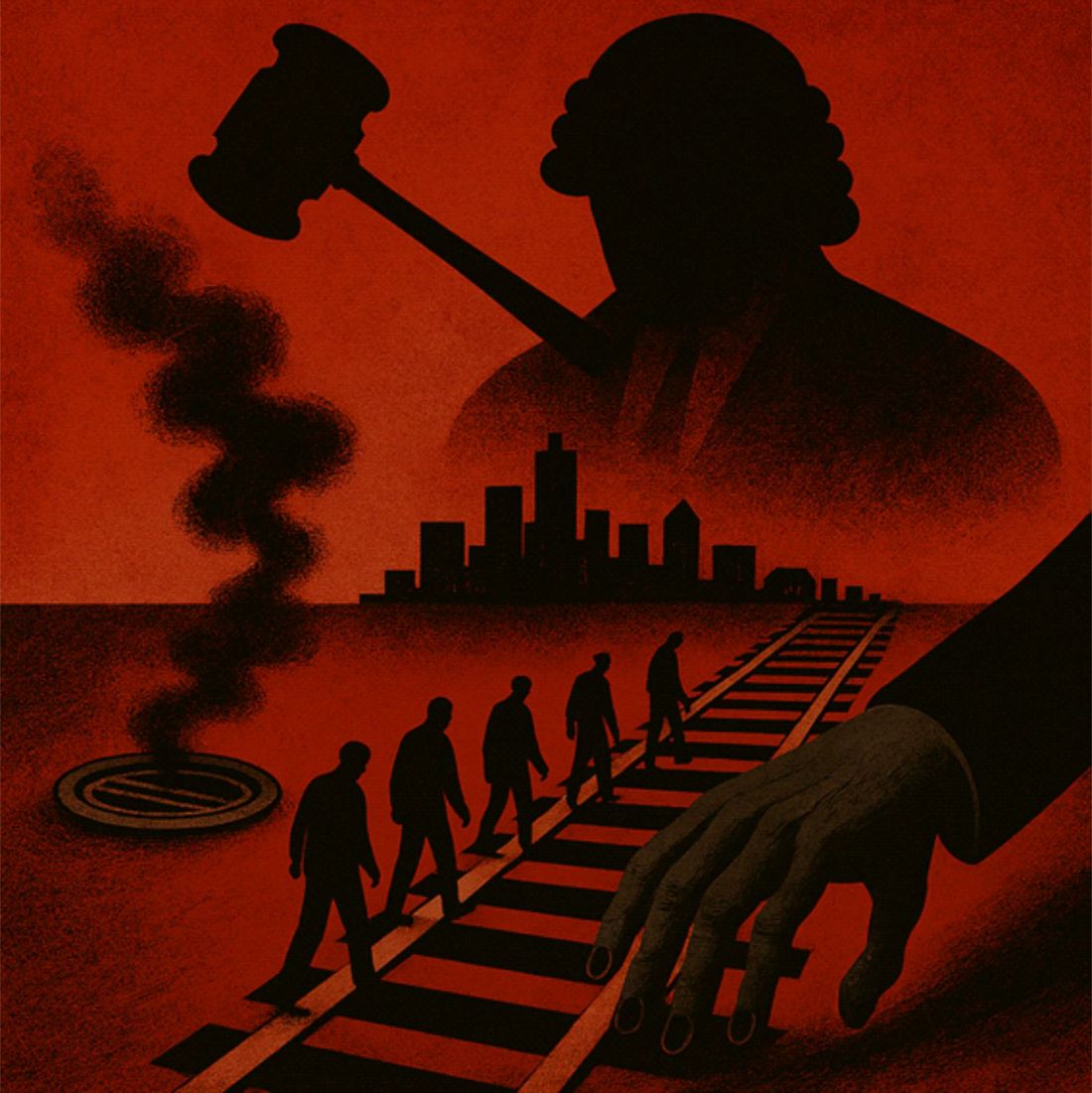
But law and morality are not the same. They cannot be the same. Laws are rail tracks laid by those in power, pointing society in the direction they choose. They are not – and must never be confused with – personal agency, independence, sovereignty, or genuine freedom of choice.

Real freedom of choice means decisions made without pressure, manipulation, or engineered constraints. Only in that space can morality exist. Only there can individuals decide what is genuinely right or wrong – and only from that foundation can society do the same.

Yet today, fixed direction is imposed everywhere. People believe they have freedom, but most of their choices have already been made for them. They’re offered false options that maintain the illusion of autonomy while keeping them on rails laid by someone else.

And here’s the heart of it: people have been conditioned to accept things that are wrong – even things that harm them – simply because a law exists that allows those things to happen. If it’s legal, it must be normal. If it’s normal, it must be acceptable. And if it’s acceptable, why should anyone question it?

This is how we end up with everyday absurdities that everyone recognises but few challenge. Healthy food becomes too expensive for the poorest to eat, yet nobody in authority calls that immoral – because the pricing is legal. Councils charge residents to park on their own streets and fine them when they don’t comply, and we’re told this is “policy,” as if that makes it right. Entire communities are reshaped to suit the aims of people who have no connection to them, and somehow their objectives are treated as the standard the rest of us should follow.

None of this happens by accident. It’s what you get when every new layer of legal complexity is built to serve an agenda rather than the public. And every time another pillar is added, the consequences are ignored – because selfish actions never look downstream. They don’t consider who gets hurt, who gets priced out, who gets silenced, who gets left behind, or the gaps that are created for more unscrupulous operators to hide behind. They only consider the goal.

Worse still, the legal system and our legislative processes have become a tool for gaslighting the public. They make ordinary people doubt their own moral instincts. It teaches them to override what their natural conditioning tells them is fundamentally right. If the law says it’s fine, then who are you to question it? If the law says it’s normal, then your discomfort must be the problem.

But nobody can learn what is right if all guidance comes from authority. And while those in authority may have the power to create laws, those laws cannot be considered legitimate unless they clearly and undeniably serve the best interests of everyone.

Within this context, it’s absurd to argue that any war can be morally justified simply because it is legal. At the same time, the right to defend ourselves or others should never be questioned – even if that defence requires full engagement in conflict. The difference lies in motive, not legality.

This is why the world feels upside‑down. It’s why so many things that are obviously wrong are treated as if they’re perfectly fine. Laws have been shaped and reshaped to make questionable policies appear right, and people have been taught to override their own moral instincts in favour of whatever the rulebook says today.

But that spell is breaking. People are waking up to the fact that a system built on extraction, complexity, and self‑interest cannot possibly have their wellbeing at heart.

They’re beginning to see how the law – the very thing they trusted to protect them – has been used to confuse them, restrain them, and in many cases exploit them.

They’re realising that the discomfort they’ve been made to feel isn’t a flaw in their thinking; it’s a sign that their natural sense of right and wrong is still intact.

And once people understand that, they start asking the questions they were never meant to ask. They start looking for the people who hid behind legal language to justify selfish decisions. They start recognising that morality doesn’t come from legislation – it comes from freedom of choice, from agency, from the ability to think without being pushed down a predetermined track.

When enough people reach that point, the system that relied on their compliance begins to lose its power. And that is exactly what we’re watching happen now.

1647

Overview: The Human Sovereignty Charter for Artificial Intelligence

The Human Sovereignty Charter for Artificial Intelligence – Published on 3 March 2026 – establishes a constitutional‑style framework designed to ensure that AI systems always remain subordinate to human authority, aligned with human dignity, and governed in ways that protect individuals, communities, and democratic values.

It provides a principled foundation for organisations, institutions, and governments seeking to adopt responsible, human‑centred approaches to AI.

The Charter is built on the belief that technology must enhance human life rather than replace human judgement, labour, or autonomy.

It sets out clear obligations for those who design, deploy, or manage AI systems, and it defines the rights and protections that individuals and communities retain in an AI‑enabled society.

Key Takeaways

1. Human sovereignty is non‑negotiable

The Charter asserts that humans must always remain the final decision‑makers. AI may support judgement, but it must never override, replace, or diminish human agency.

2. AI must serve human dignity and wellbeing

Every use of AI must be evaluated through the lens of human impact. Systems that undermine dignity, fairness, or community cohesion are incompatible with the Charter.

3. Transparency and accountability are mandatory

Organisations must be able to explain how AI systems work, what data they use, and how decisions are made. Hidden or unaccountable systems are prohibited.

4. Communities have rights, not just individuals

The Charter recognises that AI affects groups as well as people. Communities have the right to protection from harmful deployment, surveillance, or automated decision‑making.

5. AI must not replace human labour or judgement

Automation cannot be used to remove meaningful work, displace human expertise, or centralise power in ways that weaken democratic or social structures.

6. Oversight must be independent and ongoing

AI governance cannot be left to the organisations that build or profit from the systems. Independent oversight, community participation, and transparent review processes are essential.

7. Consent and understanding are essential

People have the right to know when AI is being used, how it affects them, and what alternatives exist. Consent must be informed, meaningful, and revocable.

8. Data belongs to people, not systems

The Charter reinforces that personal and community data must be protected, minimised, and used only with clear justification and safeguards.

9. AI must be designed for safety, not optimisation

The goal is not to make AI as powerful or efficient as possible, but to ensure it remains safe, predictable, and aligned with human values.

10. The Charter is adaptable and future‑proof

It includes mechanisms for amendment, review, and evolution as technology changes, ensuring it remains relevant and effective over time.

What the Charter Enables

  • A shared ethical foundation for organisations adopting AI
  • A governance model that prioritises human rights and community wellbeing
  • A practical framework for policymakers and institutions
  • A safeguard against harmful, opaque, or exploitative AI practices
  • A clear statement of human‑centred values in a rapidly changing technological landscape

Who the Charter Is For

  • Policymakers and public institutions
  • Educators and academic researchers
  • Technologists and AI developers
  • Community leaders and civil society organisations
  • Citizens seeking clarity on their rights in an AI‑enabled world

Why It Matters Now

AI is advancing faster than most governance systems can respond. Without clear principles, societies risk drifting into forms of automation that erode human judgement, weaken democratic accountability, and centralise power.

The Charter provides a structured, principled response – one that protects what is uniquely human while still enabling responsible technological progress.

1646

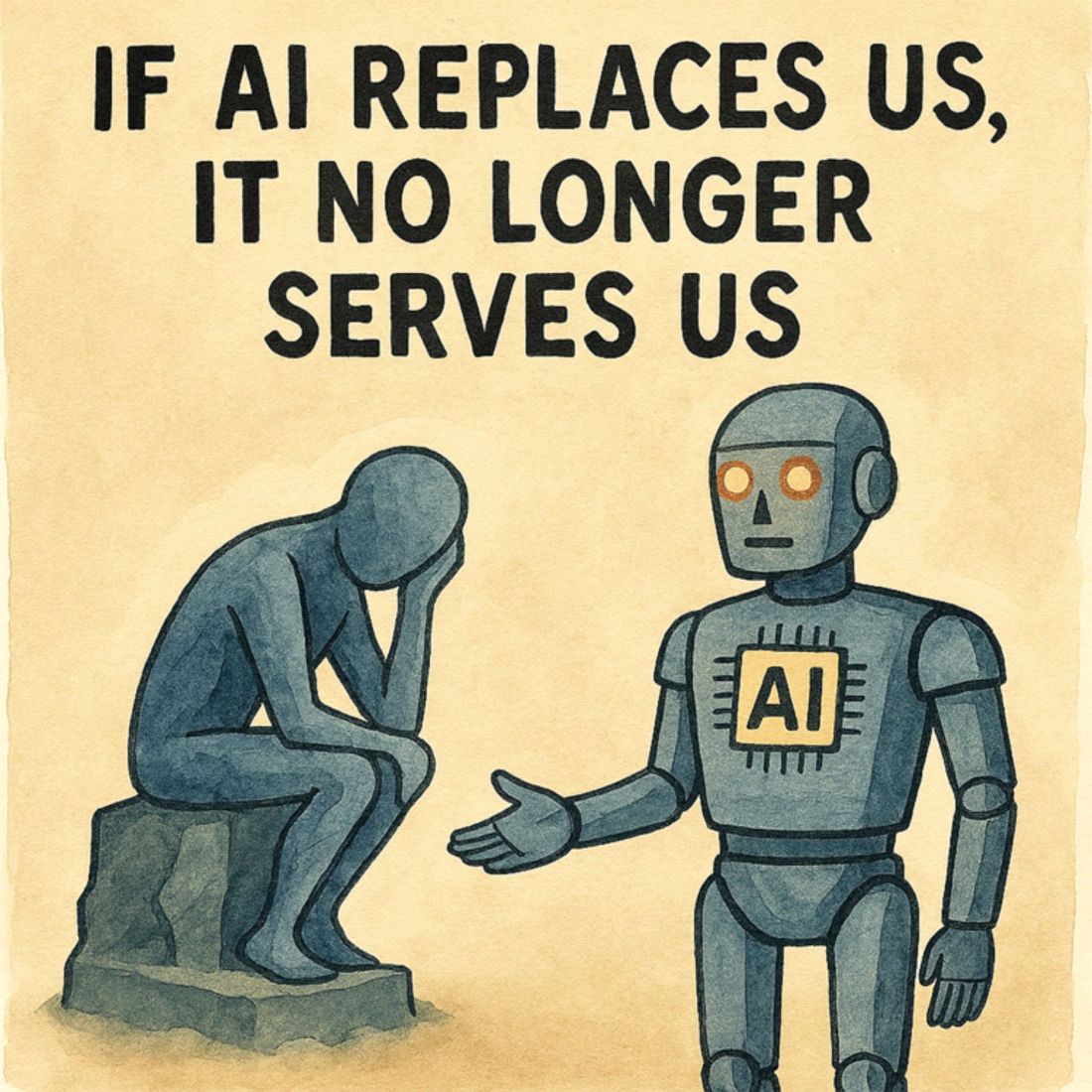
If AI Replaces Us, It No Longer Serves Us

Selective morality in business and government is still self‑interest – and AI exposes that truth.

“Selective morality in business and government is self‑interest nonetheless.”

Selective morality in business and government is still self‑interest. You either act ethically in every instance, or you aren’t acting ethically at all.

Amid the fear, excitement, and confusion surrounding the rapid rise of AI, remarkably little attention is paid to the words and behaviour of the people driving it. Tech leaders tend to appear only when unveiling the next breakthrough, not when answering for the consequences of the last one.

Much of the public debate focuses on whether AI will destroy more jobs than it creates, and whether ideas like universal basic income could soften the blow.

Industry figures often speak as if a post‑work utopia is inevitable – a world where everything is paid for and nobody needs to labour. But this narrative conveniently ignores the obvious question: who funds such a system when millions, perhaps billions, are stripped of agency, purpose, and the ability to contribute?

We may be heading toward a future in which vast numbers of people have nothing to do, no way to regain independence, and no meaningful choices left.

The myth that AI will “improve life for everyone” is easy to sell while the technology still feels novel and addictive. But nobody has invested billions into AI for altruistic reasons. The motivation is profit, power, and control – and the benefits will not be evenly shared.

Some of those leading the charge may genuinely believe they are building a utopia. But intelligence is not morality, and we routinely mistake technical brilliance for ethical authority.

We make the same mistake in politics when we assume legality and morality are interchangeable.

Recent events have made this clearer. A major AI company publicly pushed back against the US government’s desire to use its systems for military purposes. Whatever one thinks about AI on the battlefield, the episode revealed something crucial: the industry can say “no” when it wants to. The idea that AI’s advance is unstoppable or outside human control is a convenient fiction. The people building these systems can halt or redirect progress – they simply choose not to when the consequences fall on everyone else.

I’m not opposed to technological progress. I’ve written about AI for years, and I believe it can improve human life in extraordinary ways. But the greatest danger is not sentience or runaway autonomy. It is the fact that AI is being built and steered by people whose incentives are profit and dominance, not human flourishing.

AI should exist to elevate human life, not to replace human purpose.

Yet those controlling its development are already choosing which impacts they want and which they don’t. Their occasional flashes of “morality” appear only when their own interests are threatened.

If genuine morality had guided AI’s development, we would already see clear safeguards, transparent policies, and protections against the harms we are now scrambling to address.

Instead, we see selective ethics deployed only when convenient.

Policymakers and tech companies share responsibility for what AI becomes. But morality applied only at moments of their choosing is not morality at all. It is strategy – and we should treat it as such.

Further Reading: Context, Consequences, and Control

The essays below expand on the central claim of this piece: that AI is not a neutral force, and that selective ethics – applied only when convenient – undermine both human dignity and democratic control.

Together, they form a coherent critique of technological inevitability, post‑work mythology, and the moral shortcuts taken by those shaping the AI future.

I. First Principles: Work, Human Worth, and Moral Limits

These pieces establish the ethical baseline: why work matters beyond income, and why technological capability does not equal moral justification.

People Need Jobs More Than AI – and the Tech Revolution
https://adamtugwell.blog/2025/09/01/people-need-jobs-more-than-ai-and-the-tech-revolution/

This essay argues that work is not merely an economic function but a cornerstone of identity, agency, and social stability. It challenges the assumption that replacing human labour is an unqualified good, framing job displacement as a moral issue rather than a technical inevitability. It provides essential grounding for the claim that AI should serve human life, not hollow it out.

Just Because AI and Tech Can Make Roles Redundant Doesn’t Mean That We Should
https://adamtugwell.blog/2024/02/01/just-because-ai-and-tech-can-make-roles-redundant-doesnt-mean-that-we-should-make-them-so/

Building on the above, this piece confronts the “can therefore should” logic that dominates technology discourse. It draws a clear distinction between capability and responsibility, reinforcing the argument that ethical restraint is a choice – one that is currently being avoided rather than exercised.

Technology and Artificial Intelligence Should Only Fill Jobs When No Humans Are Available
https://adamtugwell.blog/2025/11/13/technology-and-artificial-intelligence-should-only-fill-jobs-when-no-humans-are-available/

This essay proposes a human‑first principle for automation: AI should supplement human effort, not pre‑empt it. It directly supports the central thesis that AI replacing human purpose is a failure of governance and values, not progress.

II. The Economic Myth: UBI, Abundance, and the Illusion of Care

These essays dismantle the comforting narrative that mass automation will be offset by generosity, redistribution, or effortless abundance.

As AI Ends Work: Waking Up to the Illusion of UBI and the Need for a New System
https://adamtugwell.blog/2026/01/20/as-ai-ends-work-waking-up-to-the-illusion-of-ubi-and-the-need-for-a-new-system/

This piece directly interrogates the promise of universal basic income as a solution to large‑scale job loss. It exposes UBI as a political placeholder rather than a structural answer, asking who truly benefits from a system where agency is removed and compensation replaces participation.

AI Won’t Make Life Cheaper for Those Who Cannot Work – and the Mega‑Rich Would Be Helping Now If They Planned To Later
https://adamtugwell.blog/2025/01/15/ai-wont-make-life-cheaper-for-those-who-cannot-work-and-the-mega-rich-would-be-using-their-money-to-help-others-right-now-if-they-were-going-to-do-it-for-everyone-in-the-future/

This essay challenges the faith placed in future benevolence from those currently accumulating unprecedented wealth through automation. It reinforces the argument that selective morality is strategic, not principled – and that promises of future fairness ring hollow when present injustice is ignored.

III. Power, Control, and the Fiction of Inevitability

These works expose how narratives of inevitability mask human decision‑making, profit incentives, and political convenience.

Do You Believe That AI Is About Progress? Think Profit, Think Greed – Then Think Again
https://adamtugwell.blog/2024/08/26/do-you-believe-that-ai-is-about-progress-think-profit-think-greed-then-think-again/

This essay strips away the rhetoric of progress to reveal the economic motivations driving AI adoption. It aligns closely with the claim that AI is not being developed altruistically, and that public benefit is often an afterthought rather than a design goal.

Just Like AI, the Tools, Actions, Rules, and Infrastructure of Tomorrow Will Be Good or Bad Depending Upon Who – and What – Is in Control
https://adamtugwell.blog/2024/09/24/just-like-ai-the-tools-actions-rules-and-infrastructure-of-tomorrow-will-be-good-or-bad-for-us-depending-upon-who-and-what-is-in-control/

This piece broadens the lens from AI alone to systems of governance and infrastructure. It reinforces the idea that outcomes are shaped by power structures, not technology itself – supporting the argument that “unstoppable AI” is a narrative used to avoid accountability.

IV. Actions vs. Words: When Ethics Become Strategy

This final piece directly confronts performative morality and selective restraint.

Actions Speak Louder Than Digital Words (Full Text)
https://adamtugwell.blog/2025/03/20/actions-speak-louder-than-digital-words-full-text/

Serving as a thematic bridge to the present essay, this work critiques public ethical posturing unaccompanied by meaningful change. It underlines the central warning of If AI Replaces Us, It No Longer Serves Us: morality applied only when convenient is not morality – it is strategy.

If the Borough goes, Cheltenham Must Have a Town Council

As someone who has served as a Borough Councillor (Tewkesbury), Town Councillor (Tewkesbury Town), and Parish Councillor (Ashchurch Rural), and who has long-standing ties across Gloucestershire, I find it deeply regrettable that the county and its six districts are now being pushed toward amalgamation.

The direction of travel appears clear: the creation of two unitary authorities that absorb all responsibilities currently held by the different tiers of local government.

The financial crisis facing councils is well known, and Gloucester City Council’s reported bailout only underlines the severity of the situation. But the argument that “efficiency” now requires the dissolution of district councils and the centralisation of services into large unitary bodies rings hollow. Yes, some service delivery efficiencies may exist – but they are far from the whole story.

In reality, councils have been sharing services for years. Ubico is a prime example that people local to Gloucestershire can consider: a jointly owned company delivering waste and street services across multiple authorities.

Legal services are similarly pooled between some of the different local authorities, with officers in one district often handling caseloads for several others. Shared services already exist, and they work.

What does not make sense is the idea that the councils themselves – the democratic bodies, the meetings of elected representatives – must be dissolved simply because services can be delivered jointly.

The push toward unitary authorities is not really about efficiency. It is about centralising democratic power into fewer, more distant hands. And at a time when many people already feel disconnected from those elected to represent them, this shift will only widen the gap.

The public is being told there is “no alternative”. But that is not true. There is no reason why local councils – parish, town, borough, district – cannot remain as democratic bodies and points of public contact, even if services are delivered from a centralised structure. The technology exists. The administrative cost would be modest. And the democratic value would be significant.

Fewer decision-makers do not lead to better decisions, especially when those decision-makers are further removed from the communities they serve.

It may be inevitable that Gloucestershire’s councils are amalgamated. The system has become too unwieldy, too financially fragile, and too dependent on a model that is no longer sustainable. But if Cheltenham Borough Council is abolished, we must not allow a democratic vacuum to form in its place.

A Town Council – even one with limited powers – would still provide local oversight, local accountability, and a local voice.

It would be far better than having nothing at all, especially when major decisions affecting Cheltenham may soon be made by people who do not live here, do not work here, and may have little connection to the town beyond a line on their job description.

Democracy should never be treated as an optional extra or a cost to be cut. The influence of money on public life is already too great, and the erosion of local representation only accelerates that trend.

If the Borough goes, Cheltenham must have a Town Council. And every community across Gloucestershire that loses a tier of representation must have a parish or town council to replace it.

Local democracy matters – and within this system, once lost, it is rarely restored.

The Government’s Biodiversity & National Security Report Misses the Real Threat: Our Food System is Already on the Brink

A response to HM Government – Global biodiversity loss, ecosystem collapse and national security: A National Security Assessment (Published 20 January 2026)

When the UK Government publishes a national security assessment warning that global biodiversity loss and ecosystem collapse threaten our food supply, you would expect honesty, clarity, and a sober assessment of the risks we face.

Instead, the report released on 20 January 2026 offers a strange mixture of stark warnings and comforting illusions – particularly around the UK’s food security.

It acknowledges that ecosystem degradation could destabilise global food production, disrupt supply chains, and trigger geopolitical competition for food. All of that is true.

But then it slips in a familiar, misleading reassurance:

“The UK imports 40% of its food.”

This figure is presented as if it reflects our real‑world vulnerability. It doesn’t.

It’s a net figure, not a resilience figure.

And it hides the truth that the UK is far more dependent on foreign food systems than the report admits.

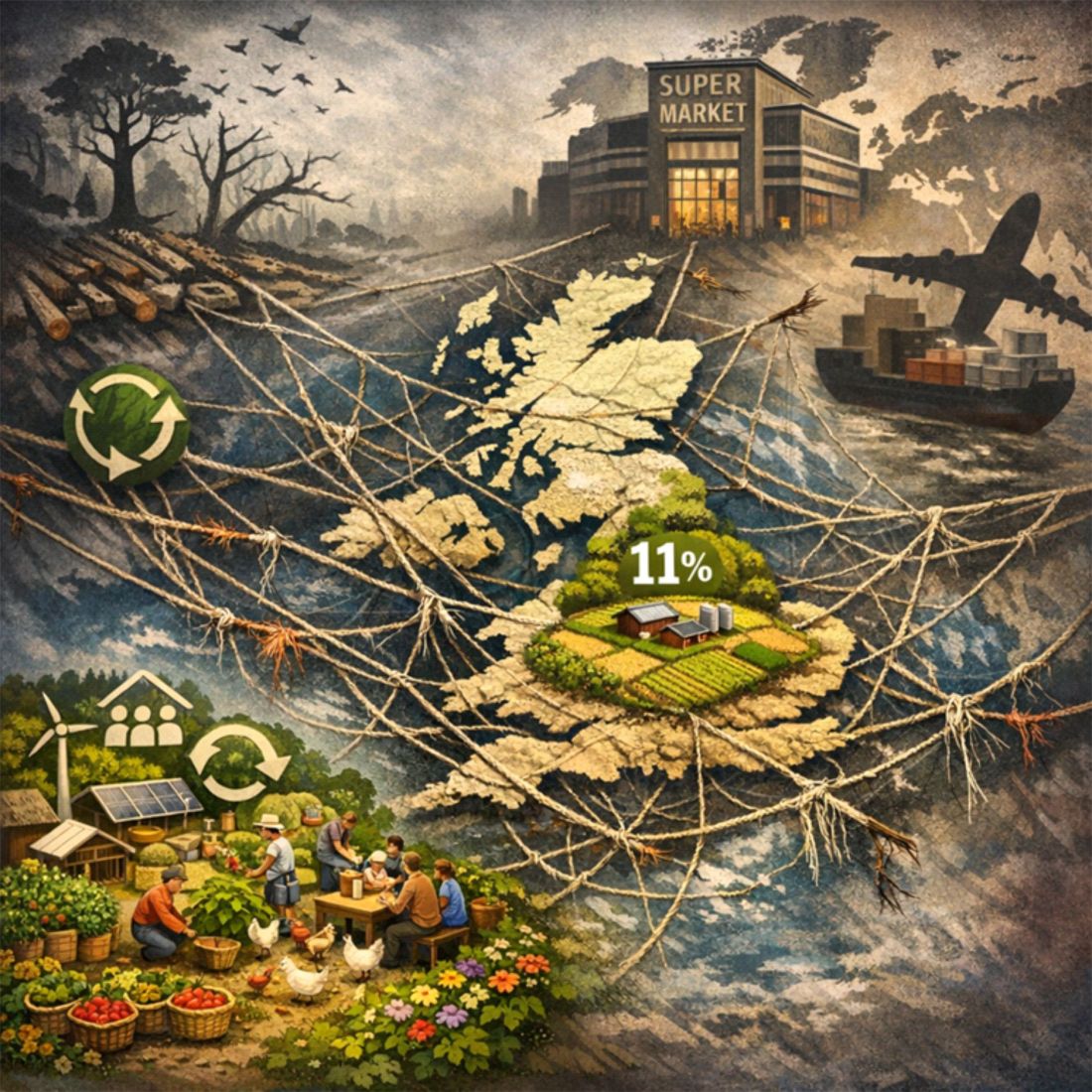
In fact, if the UK’s borders closed tomorrow, the amount of food immediately available for the population is closer to 11%.

That is the real national security threat – and it has nothing to do with future ecosystem collapse.

It is the result of decades of political choices, corporate control, and a food system designed around globalisation rather than public need.

The 40% Myth: A Convenient Political Fiction

The government’s “40% import dependence” statistic is based on food by value, not food by:

  • calories
  • volume
  • nutritional availability
  • immediate edibility
  • or domestic accessibility

It also ignores the dynamic reality of the UK food chain:

1. UK‑produced food is routinely exported

Much of what we grow or rear here is not eaten here.

We export beef, lamb, dairy, fish, cereals, and vegetables – then import substitutes.

2. “British food” often depends on foreign inputs

Even domestic harvests rely on imported:

  • fertiliser
  • feed
  • seed
  • chemicals
  • machinery
  • packaging
  • labour

A UK-grown crop is not a UK-secure crop.

3. The UK’s food system is globally entangled

Ingredients cross borders multiple times before becoming something we can eat.

A “British” ready meal may contain components from 10–20 countries.

4. The UK cannot feed itself under current systems

Even the report admits:

“The UK cannot currently produce enough food to feed its population based on current diets.”

But it fails to explain why:

Because the UK no longer has a food system designed to feed its own people.

The Real National Security Threat is Already Here

The government frames biodiversity loss as a future risk. But the UK’s food insecurity is a present reality, engineered over decades.

This is the uncomfortable truth:

The UK dismantled its own food resilience long before ecosystems began collapsing.

  • Traditional farming was replaced by industrial, globalised supply chains.
  • Local food systems were hollowed out.
  • Supermarkets and processors gained total control over production.
  • Farmers became contract‑bound suppliers rather than independent producers.
  • Policy after policy pushed the UK away from self-sufficiency.

The result?

A nation that produces food – but cannot feed itself.

This is why the 11% figure matters.

It reflects the food that is:

  • edible immediately
  • consumed domestically
  • not dependent on foreign inputs
  • not locked into export contracts
  • not reliant on overseas processing

This is the food that would still be available if global supply chains failed.

And it is terrifyingly small.

Biodiversity Collapse Will Hurt Us – But It Will Hit a System Already Broken

The government report is right about one thing:

Ecosystem collapse will make global food production more volatile.

But the UK’s vulnerability is not caused by ecological decline.

It is caused by:

  • globalisation
  • supermarket dominance
  • financialisation of land
  • industrialised processing
  • loss of local food infrastructure
  • policy choices that prioritised profit over people

Ecosystem collapse will simply expose the fragility we have already created.

The Missing Piece: A Food System Built Around People, Not Profit

The report warns that the UK must “increase food system resilience”.

But it offers no meaningful pathway to achieve it.

It talks about:

  • lab-grown protein
  • AI
  • alternative proteins
  • technological innovation

But it barely mentions the one thing that actually works:

Traditional, regenerative, localised farming.

The kind of farming that:

  • Builds soil
  • Restores biodiversity
  • Strengthens communities
  • Reduces dependency on imports
  • Shortens supply chains
  • Produces real food, not processed substitutes
  • Keeps value circulating locally
  • Increases national resilience

This is the farming model that the UK abandoned.

And it is the farming model we must return to.

LEGS: A Framework for the Food Security We Actually Need

The Local Economy & Governance System (LEGS) offers exactly the kind of structural shift the government report refuses to contemplate.

Under LEGS:

Food is treated as a Public Good

Not a commodity.

Not a profit centre.

Not a tool of corporate control.

Local farming is prioritised

Communities produce the food they eat.

Farmers regain independence.

Supply chains shrink.

Resilience grows.

Traditional and regenerative methods become the norm

Because they work.

Because they protect ecosystems.

Because they feed people.

Because they build long-term security.

The economy becomes circular and local

Value stays within communities.

Food sovereignty becomes real.

Dependency on global systems collapses.

People, Community, and The Environment become the organising principles

Not money.

Not shareholder value.

Not global trade flows.

This is the only credible pathway to genuine food security.

The Government Report Is a Warning – But Not the One It Thinks It Is

The report warns that biodiversity loss threatens our food supply.

It’s right.

But the deeper warning is this:

The UK’s food system is already so fragile that any external shock – ecological, geopolitical, or economic – could collapse it.

We do not need to wait for the Amazon to fall or coral reefs to die.

We are already exposed.

The real national security threat is not future ecosystem collapse.

It is the current food system, built on:

  • Global dependency
  • Corporate control
  • Industrial processing
  • Financialised land
  • Political complacency

We cannot fix this with technology, trade deals, or emergency stockpiles.

We fix it by rebuilding the one thing that has always fed people:

Local, traditional, community-rooted farming.

And we fix it by adopting a governance and economic model – like LEGS – that puts food, people, and the environment back at the centre of national life.

If the Government Is Serious About Food Security, It Must Change Course Now

The UK cannot continue:

  • Exporting food we need
  • Importing food we could grow
  • Relying on global supply chains
  • Allowing supermarkets to dictate farming
  • Treating food as a commodity
  • Ignoring the collapse of local food systems

If we want real food security, we must:

  • Rebuild local food production
  • Restore traditional farming
  • Shorten supply chains
  • Treat food as a public good
  • Prioritise people over profit
  • Adopt community‑based governance
  • Embrace the principles of LEGS

Because the truth is simple:

A nation that cannot feed itself is not secure.

A nation that depends on global systems is not resilient.

A nation that abandons its farmers abandons its future.

The government’s report is a wake‑up call.

But the real alarm has been ringing for years.

It’s time we listened.

Further Reading: Navigating the Real Threats to UK Food Security

The blog’s central argument is that the UK’s food system is already dangerously fragile -not just because of future biodiversity loss, but due to decades of policy choices that prioritised global supply chains and corporate control over local resilience.

The following resources are curated to help readers move from understanding the government’s official stance, through critical analysis, to actionable frameworks for rebuilding food security.

1. Official Context: The Government’s Assessment

Nature security assessment on global biodiversity loss, ecosystem collapse and national security

https://www.gov.uk/government/publications/nature-security-assessment-on-global-biodiversity-loss-ecosystem-collapse-and-national-security
Summary:
This is the UK Government’s own national security assessment, published on 20 January 2026. It warns that global biodiversity loss and ecosystem collapse threaten food supply and national security. While it acknowledges risks to food production and supply chains, the report is critiqued in this blog for offering misleading reassurances about UK food resilience and failing to address the deeper, present-day vulnerabilities in the food system.

(Please note that a copy of the Report can be downloaded as a PDF below)

2. Critical Analysis & Solutions: The Author’s Portfolio

Adam’s Food and Farming Portfolio: A Guide to Books, Blogs, and Solutions

https://adamtugwell.blog/2025/12/18/adams-food-and-farming-portfolio-a-guide-to-books-blogs-and-solutions/
Summary:
This curated portfolio gathers key writings, books, and practical solutions from the blog’s author. It’s designed for readers who want to go beyond critique and discover actionable ideas for food system reform, regenerative agriculture, and community-based resilience. The portfolio reflects the blog’s ethos: prioritising people, local economies, and ecological health over profit and global dependency.

3. Deep Dive: The LEGS Ecosystem

Visit the LEGS Ecosystem

https://adamtugwell.blog/2025/12/31/visit-the-legs-ecosystem/
Summary:
LEGS (Local Economy & Governance System) is the framework proposed in the blog as the structural shift needed for genuine food security. This resource introduces LEGS in detail, showing how it treats food as a public good, rebuilds local farming, and fosters circular economies. It’s essential reading for those interested in systemic change and practical pathways to resilience.

4. In-Depth Reference: LEGS Online Text

The Local Economy Governance System – Online Text

https://adamtugwell.blog/2025/11/21/the-local-economy-governance-system-online-text/
Summary:
For readers seeking a comprehensive understanding of the LEGS framework, this online text provides the full theoretical and practical foundation. It expands on the principles outlined in the blog, offering guidance for communities, policymakers, and advocates aiming to rebuild food sovereignty and resilience from the ground up.

Guidance for Readers

Start with the government’s official report to understand the mainstream narrative and its limitations.

Move to the author’s portfolio for critical analysis and practical solutions.

Explore the LEGS resources to discover a transformative framework for food security rooted in local economies and regenerative practices.

This order will help readers progress from context, through critique, to concrete action – mirroring the blog’s call for urgent, systemic change in the UK’s approach to food and farming.