
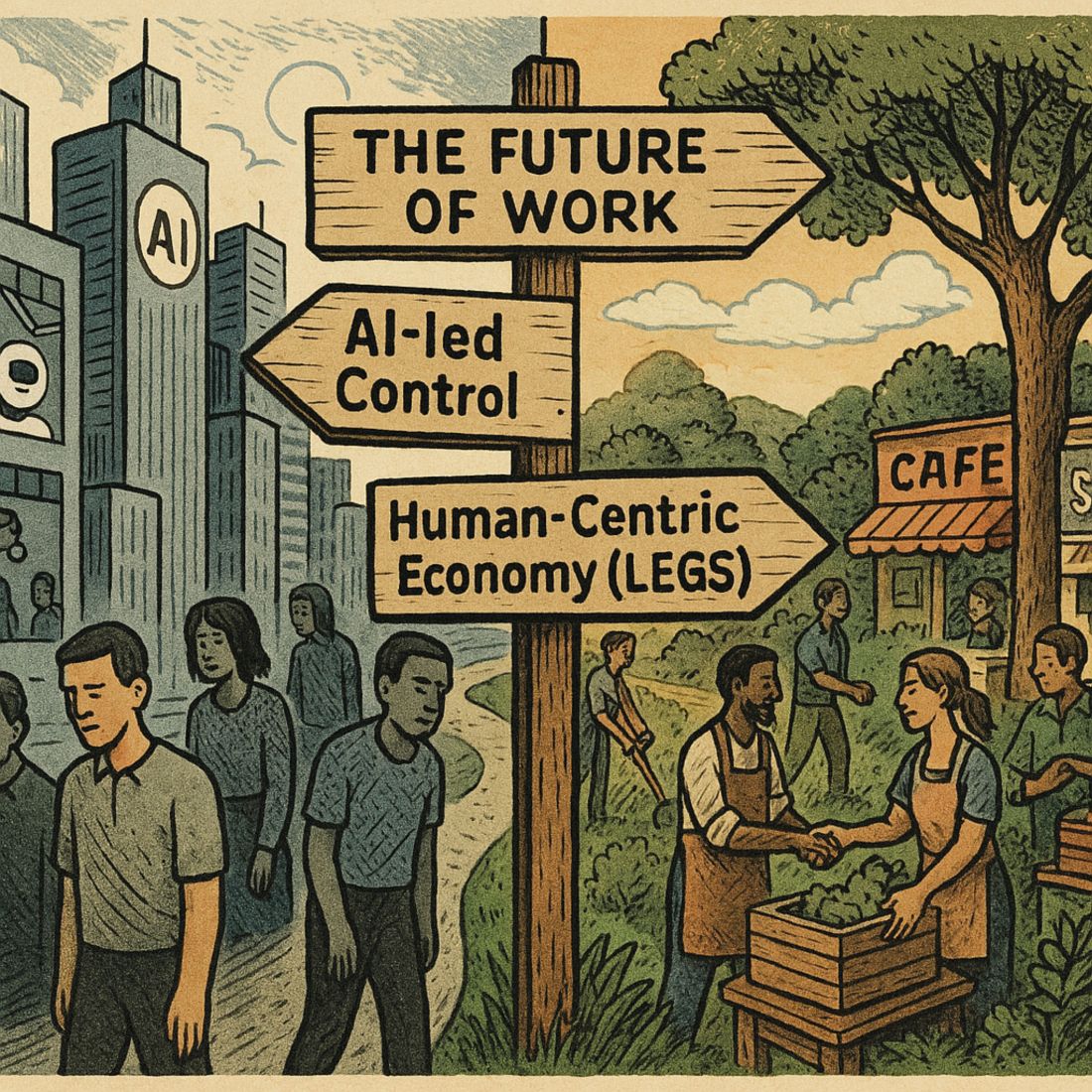
AI’s Crossroads: Choosing a Human-Centric Future for Work and Society
Artificial intelligence is rapidly transforming the world of work, automating roles created by money-driven systems and exposing the fragility of an economy built on profit and status rather than genuine human need.
Without a deliberate change in direction, society risks deepening inequality, eroding community, and reducing work to a function of control and dependency.
The current trajectory, shaped by decades of economic and technological planning, threatens to devalue essential contributions and undermine the foundations of freedom and dignity.
But this path is not inevitable. There is an alternative: a future where work is meaningful, communities are empowered, and the economy serves people – not the other way around.
This work challenges the prevailing narrative and introduces The Local Economy and Governance System (LEGS) – a model for a human economy built on the basic living standard.
LEGS offers a practical framework for restoring value to real work, strengthening local governance, and ensuring that technological progress enriches lives rather than diminishes them.
The choice is ours: continue down the AI-led road of exclusion and control, or embrace a system that prioritizes human well-being, fairness, and genuine prosperity for all.
Rethinking Work in a Human-Centric Future
Beyond Money-Driven Roles
The work and employment of a better, human‑centric future will be real, tangible, and deeply meaningful. Unlike many roles today that exist primarily to prioritise the flow of money, this future will focus on impact, purpose, and the enrichment of human life.
The Challenge of New Realities
The near future is poised to introduce truths, realities, and perspectives about our lives that many will find extremely difficult to accept.
This difficulty arises because true freedom – freedom to do, freedom to think, and freedom to be – requires us to revalue everything: how we see, how we interact, and how we set expectations.
These expectations will need to operate in a completely different, yet ultimately rewarding, way.
Shifting Perceptions of Good and Bad
In this transformation, what seems good today may quickly be seen as bad, while what appears deficient or undesirable now may suddenly reveal itself as profoundly valuable.
One of the most striking areas where this reversal will become evident is in our daily relationship with work – what we do, and how we define the very act of working.
The Distortion of Work by Money
The concept of work itself has become twisted by its association with money and the reward of money for labour.
Work is widely accepted as “work” only if it pays a wage.
Within this framework, society has conditioned us to undervalue technical, hands‑on, manual, and physically demanding forms of labour.
These roles, despite their essential contribution, are treated as if they hold little real value.
The Rise of Professional Roles
Meanwhile, a whole range of so‑called “professional” roles – many of which either had no necessity or no clear purpose until recently – have emerged and now dominate the employment landscape.
Some of these roles did not even exist a few decades ago, yet they are rewarded and elevated far above the practical, human‑centric work that sustains daily life.
The Devaluation of Real Work in a Money-Centric Culture
When Real Jobs Lost Their Value
Money‑centric culture has made “non‑jobs” real while rendering real jobs valueless in the eyes of society.
Historically, work was simply whatever it took to make life function. People played different roles – some paid, some unpaid – to sustain a household.
There was an unspoken recognition that it takes diverse contributions from everyone to enjoy life together, no matter what those contributions might be.
The Shift to Consumerism and Financial Systems
This balance changed with the rise of consumerism and the adoption of the moneocratic FIAT financial system, reinforced by GDP metrics and decades of law and regulatory changes.
These shifts progressively pushed households into a world where every member had to work for financial reward before the essential tasks of maintaining a home could even be addressed.
Even self‑sufficiency – achieved through both employment and domestic work – was no longer enough to live on if one was engaged in “real jobs.”
Such jobs now attract only ‘minimum wage’, a measure that has never represented the true benchmark of what it takes for a household to live independently and for its members to experience genuine financial freedom and the peace of mind that it facilitates.
The Mechanics of Wealth Transfer
With an economic system so fundamentally bogus, it should come as little surprise that its clever mechanics were designed to transfer wealth to those in control.
To achieve this, the system had to create a mindset that persuaded the masses to facilitate what is, in reality, a crime against humanity – not only against those they were conditioned to believe were ‘lesser’, but ultimately also against themselves.
This required that people be “bought in” to a value set where a select few and those who took every step necessary to be like them, could become disproportionately rich by doing ‘jobs’ that required little effort – or none at all.
The Creation of Jobs and Economies of Scale
Jobs were reshaped and split off from existing roles as money began to demand output.
Economies of scale, hailed as progress, destroyed local businesses and community systems that had worked perfectly well and had the ability to facilitate self-sustained models of family life.
These practices imposed a new slavery to money, progressively making it our master.
Careers as Money Machines
Jobs that supported the growth of money‑centric culture became the new measure of success.
Young people have shifted from more traditional aims of living a balanced, all‑round life to pursuing careers defined not by trade, service, or goods, but by the pursuit of money.
Careers have become all about making money, expanding the ways to make money, and protecting every part of the machinery involved.
Quality of customer experience and the delivery that brings it seldom now sit at any industry or profession’s heart.
Entitlement and the Multigenerational Workforce
The splitting of systems into job categories defined people not by the real work they did, but by the possessions and status attached to their roles.
This slowly created a culture of entitlement.
A multigenerational workforce has emerged that takes much in life for granted, including the myth that wealth can only grow while jobs become less like work.
The belief that “what one wants is what one deserves” has spread, with the expectation that such entitlement can be imposed upon everyone encountered without consequence – even in the digital, parallel world.
Sleight of Hand at Scale
Those in created jobs believe life can only get easier, while those performing the essential tasks that make life work for everyone cannot earn enough to escape the constraints of their labour.
These ideas and the narratives that underpin them are little more than a distraction – a sleight of hand on an epic scale – deliberately hiding what has truly been happening at the cost of everyone involved.
The Switch in Values
The shift from valuing people and the work required to live, to valuing money as the only important thing, has made society lazy, entitled, and ill‑prepared.
People now accept change passively, no matter how illogical or damaging, even when the same destructive process repeats with increasingly bizarre and counterintuitive outcomes.
These changes almost always come at a cost to people, communities, and the environment, whilst being presented as having the best interests of everyone at their heart.
The Direction of Travel that the World as we know it is on
The Difficulty of Belief
People often find it hard to accept that all of this was deliberately planned by others.
Yet money – and the possession of wealth, power, control, and influence – is an extraordinarily powerful motivator.
For those who become addicted to it, there is almost no limit to what they will attempt or achieve.
The Mechanics of Power
When such individuals hold power, or gain access to those who do, they can reshape systems so that authority itself works in their best interests.
Slowly, almost imperceptibly, they change the structures of life so that everything begins to function in ways that serve them.
Long-Term Planning
The plans that have brought the world to its current state have not emerged overnight.
They have been underway for well over 150 years, steadily unfolding across generations.
This long trajectory has seen massive changes in the way international business is conducted. Changes that were only made possible through the upheaval of two world wars.
Unseen Problems Do Not Cease to Exist just because they are Unseen
The Hidden Nature of Change
Just because we cannot see or fully understand a problem does not mean it does not exist.
The adoption of a financial system that has created unprecedented wealth transfer – not only in the value of money itself, has also resulted in the ownership of business, property, and infrastructure, which has all steadily shifted into the hands of the few – at what could now be a disastrous cost to us all.
Technology as a Companion to Wealth Transfer
Alongside this financial transformation, technological progress has advanced in lockstep.
The chronology of events, from digital systems to information technology and hardware innovations, shows that these developments did not simply arrive at the moment we first experienced them.
They were planned, anticipated, and in many cases known to be possible for long periods of time.
Artificial Intelligence, and the AI takeover we now hear so much about, is not an isolated phenomenon. It is part of this broader strategy and plan, woven into the same trajectory that has shaped finance, ownership, and control.
The AI Takeover and Its First Victims
It is no accident that the first jobs to disappear in the AI takeover are those that are tied directly to the money project itself.
These roles, created and sustained by a system designed to prioritise financial mechanics and the transfer of wealth over human value, were always the most vulnerable to replacement.
Collective Choice and the Future of Work
The loss of other jobs, however, is not predetermined. It is our collective choice.
How we respond, adapt, and redefine the meaning of work in response to what is happening around us will ultimately determine the direction of the future.
Opening Ourselves to an Alternative Future
Awakening to a New Reality
Influencers are now beginning to ask the pressing question: “What happens to everyone whose job is taken by AI?”
At the same time, members of the elite openly declare that many jobs will no longer be needed within a decade.
People are slowly awakening to a new reality – one where the expectations we have been spoon‑fed and accepted so willingly, because life has seemed distractingly good, no longer add up.
This awakening is compounded by the fact that the economy itself sits on a knife edge.
Governments, behaving with illogical static rigidity, offer no meaningful response.
The contradictions are glaring, and the narrative no longer holds together.
The World Envisioned by the Few
The architects of this system – the people who designed and intend to run the world as they envisage it – have exploited and legitimised the theft of wealth, resources, and tools from the masses.
Through this process, they have been creating the foundations of a new world order built on control and deprivation.
Technology, ownership, and finance have been reshaped not to empower humanity, but to strip it of independence and place power firmly in the hands of the few.
The promise of “you will own nothing and be happy” is not a utopian vision. It is the culmination of a strategy that has taken from everyone to enrich the few, ensuring that the majority remain dependent while the architects consolidate control.
Systematic Devaluation of Real Work
It was purposefully engineered that people in manual, technical, and real jobs have been systematically devalued.
This devaluation has been reinforced by every institution and system.
Governments have deliberately abused their mechanisms to top up and subsidise wages, hiding the reality that the lowest paid wages are insufficient.
At best, this is exploitation; at worst, it is slavery – successfully concealed from view.
The True Value of Real Jobs
These real jobs are the ones that should be paying what it actually costs to live.
Yet the people in these roles – the very ones the new system will still need – will not willingly participate in servicing its demands if they are free to choose otherwise, especially when everyone else has been effectively cast aside.
Freedom as the Ultimate Threat
Freedom itself is the greatest threat to greed and to the furtherance of the moneycratic system.
Everything aligned with that system depends upon control.
True freedom undermines it, exposes it, and ultimately resists it.
Choosing Jobs That Make Life Work Rather Than Making Life Out of Work
The Dystopian System Already in Place
The dystopian system you may now be able to visualise is already baked in.
Within this dynamic, all the “non‑jobs” that the system has encouraged us to hero‑worship will inevitably disappear, replaced by AI.
The flow of money and wealth these roles facilitated has already reached its destination.
The elites are openly telling us this, and they are not trying to hide it.
The Fate of Technical Work
Yet not all jobs will vanish on the same timeline.
Technical roles – or at least a restricted number of them – will remain for longer than the created non jobs will.
This reality matters. It may be the knowledge of which jobs endure, and why, that provides people with the opportunity to resist and to choose a new direction, rather than surrendering to what otherwise appears to be a very dark fate.
All Jobs Must Have Meaning for People to Understand Their Value
The Illusion of a Life Without Work
Whilst we may like the idea of never working again and having every conceivable need met, there is nothing about this that is real.
The reality of being provided for in this way requires conformity and restricted behaviour.
No matter what toys or distractions we are given, such a life would resemble what we recognise today as being no different to that of a caged pet.
Activity as the Source of Value
Activity that contributes to a good life is not only necessary; it is fundamental to the value we each hold.
In the alternative future we must now consider seriously, contribution matters not because it is labelled as “work” or “employment,” but because it makes life good.
Any act that sustains or enriches life carries meaning, regardless of whether it fits the narrow definitions imposed by what the current system teaches us, or not.
The Irony of Non‑Jobs
It is ironic that people in high‑flying “non‑jobs” today often dream of simpler lives -baking cakes, crafting cheese, keeping animals, growing food, building with bricks and wood, or fabricating metal – rather than being controlled by the rules of a game and chained to a city desk.
The truth is that jobs with meaning are those that provide or support the provision of life’s essentials.
This is what every form of work, employment, or contribution should actually be about.
A Future That Serves People, Not Money
The future that serves people instead of money will be built upon direct relationships and locality.
In such a future, everything will be transparent, and people will work and provide only for the people, communities, and environments that directly touch their own lives.
This is the foundation of meaningful work: activity that sustains life, nurtures community, and strengthens the bonds between people and the world around them.
Quality of Customer Experience and Locality Will Define Business Sizes – Not the Myth That Bigger Is Best
Freedom Through Localised Business
To choose freedom from the unnecessary oppression and exclusion that serves the few – and exists only by design – requires that we create businesses and operations focused on people, community, the environment, and their genuine needs.
True freedom lies in resisting the structures that prioritise profit over humanity and in building enterprises that serve life directly.
Rethinking Work and Economy
Some question how a future can exist where everyone works and still has enough.
Yet when work is about life rather than money, the realisation emerges that there is indeed enough of everything for everyone – provided we focus on need rather than the want that money‑centric thinking encourages for the benefit of the few.
In such a system, the economy ceases to be about job titles and power; it becomes about what we all do and achieve together.
Enough for Everyone
Everyone can work. Everyone can have a job. And everyone can have their needs met if we accept that there is no legitimate reason for any person to accumulate more than what meets their own needs.
Exploiting even the smallest advantage to gain whatever one desires undermines fairness and perpetuates inequality.
Integrity, Fairness, and Justice
Balance, fairness, and justice require integrity.
Everyone must act with the awareness that their choices affect others.
Taking more than one needs – no matter the opportunity, no matter how easy it may seem – always results in others having less. Even when the outcome is invisible to the one who takes.
Work With Meaning, Not Slavery
Work is necessary for everyone. But fulfilling work – work that sustains life and community – is not the same as financial slavery, where greed and exploitation are the only measures of value.
The future must be built on meaningful contribution, not on the hollow pursuit of wealth which can never and was never intended to be made available to and shared by everyone.
Key Takeaways
Before moving on to further resources, here are the central messages and insights from this work.
- AI is Transforming Work: Artificial intelligence is rapidly automating roles created by money-driven systems, exposing the weaknesses of an economy built on profit and status rather than genuine human need.
- Current Trajectory is Unsustainable: Without a deliberate change, society risks deepening inequality, eroding communities, and reducing work to a function of control and dependency.
- Devaluation of Real Work: Essential manual and technical roles have been systematically undervalued, while “nonjobs” and money-centric careers have been elevated, distorting the meaning and value of work.
- Freedom and Dignity at Stake: The existing system undermines freedom and dignity, making people passive in the face of damaging change and reinforcing cycles of exploitation and dependency.
- A Human-Centric Alternative Exists: The Local Economy and Governance System (LEGS) offers a practical, human-centred framework for restoring value to real work, strengthening local governance, and ensuring that technological progress enriches lives rather than diminishes them.
- The Choice is Ours: Society can continue down the AI-led path of exclusion and control, or embrace a system that prioritises human well-being, fairness, and genuine prosperity for all.
Further Reading
The following works are arranged to guide you through a clear progression: beginning with the foundational principles that challenge the myths of money and value, moving through critiques of collapse and exploitation, examining the role of technology and AI, and finally presenting the Local Economy Governance System (LEGS) as a practical blueprint for transformation. Taken together, they form a journey from diagnosis of the problem to the design of solutions, and ultimately to the vision of a sustainable, human‑focused future.
Foundations of Change
- One Rule Changes Everything – full text (20 December 2024)
Introduces the single guiding principle that underpins systemic change, framing the rest of the discussion. - Future economics must be tied only to people, their contribution, what is important to sustain good, fair and balanced lives – and legal currency must never again be open to speculation and manipulation (25 July 2025)
Outlines the foundational principle that economics must serve people directly, not speculation or manipulation. - The basic living standard explained (24 October 2025)
Defines what a fair and sustainable living standard should look like in practice.
Collapse and Critique
- Breaking the money myth: rethinking value, exchange and equality (12 November 2025)
Challenges the myths surrounding money and explores alternative ways of defining value and fairness. - Money is the greatest crime of our time (12 November 2025)
A powerful critique of how money has been weaponised against society and freedom. - The coming collapse and the revaluation of everything needed to regain personal freedom and control (12 November 2025)
Explores the inevitability of collapse and how revaluing essentials can restore freedom. - Facing the economic collapse: the real crisis behind money, wages and freedom (14 November 2025)
Examines the deeper crisis of wages, freedom, and exploitation hidden beneath economic collapse.
Technology and AI
- People need jobs more than AI and the tech revolution (1 September 2025)
Argues that human work is essential for dignity and meaning, beyond the promises of automation. - Technology and artificial intelligence should only fill jobs when no humans are available (13 November 2025)
Argues for a human‑first approach to work, with AI as a last resort rather than a replacement.
Workforce and Revaluation
- Revaluing the workforce: escaping the grip of greed (26 November 2025)
Calls for a revaluation of the workforce, freeing people from exploitation and restoring dignity to work.
LEGS and Transformation
- The Local Economy Governance System – online text (21 November 2025)
Provides the full text of the Local Economy Governance System (LEGS) as a framework for change. - LEGS – The Human Economy: a blueprint for transformation (1 December 2025)
Introduces LEGS as a practical blueprint for building a human‑centric economy. - The Local Economy Governance System (LEGS): escaping the AI takeover and building a human future (4 December 2025)
Explains how LEGS can resist the AI takeover and create a sustainable, human‑focused future.
Closing Note
Taken together, these works reveal both the depth of the crisis and the clarity of the solutions.
They show how money has distorted value, how collapse is inevitable under the current system, and how technology – if left unchecked – will accelerate exploitation rather than liberation.
Yet they also illuminate a path forward: one built on fairness, locality, transparency, and human‑centric governance.
The choice is ours. By engaging with these ideas, we prepare ourselves not only to understand the scale of what is happening, but to act with integrity and courage in shaping a future that serves people, community, and the environment above all else.


 Adam Tugwell