Improving Social Mobility is about addressing the way decision makers think, not about academic education alone

The three key misunderstandings and fallacious barriers to Social Mobility are:

  • That Social Mobility issues only affect young people who are in their career development years
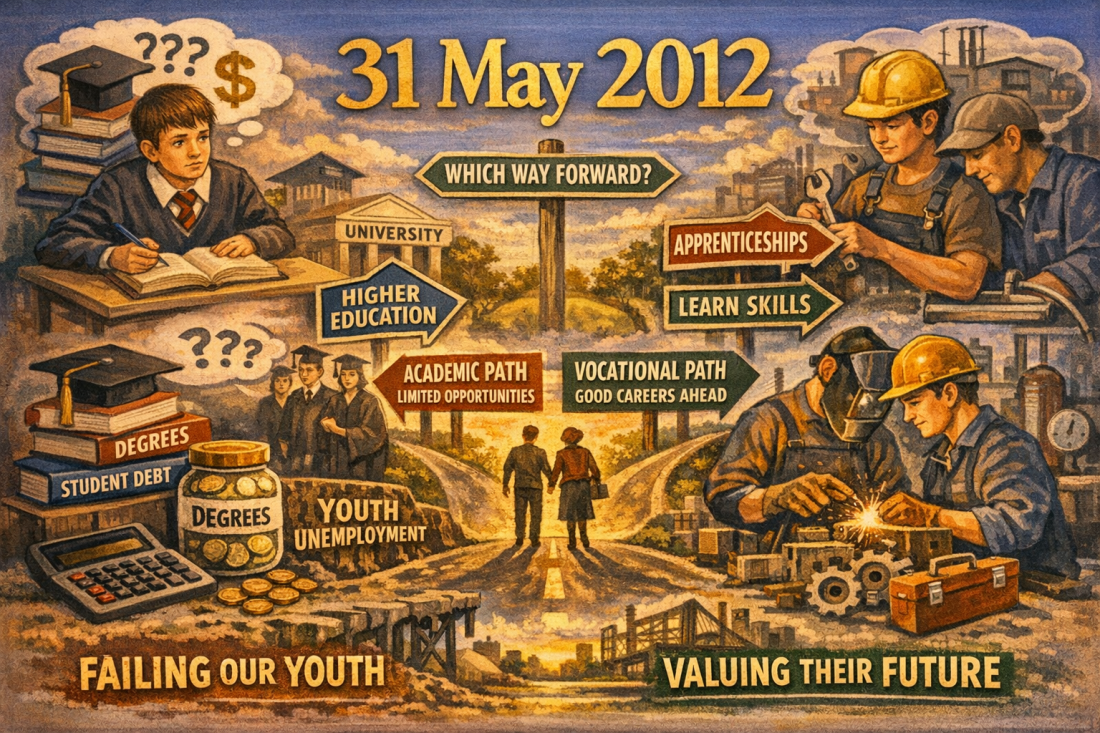
  • That the only way to improve Social Mobility is through ensuring that everyone achieves a ‘full’ academic education and that the attainment of degrees is key
  • That Social Mobility issues relate to the achievement, progress or outlook of the individual and nobody else

With one evolution of the Social Mobility Commission having resigned because of lack of Government support and another now appointed in the image of all the same Establishment ideas, the key issues underpinning lack of progress in tackling the barriers to Social Mobility are still being overlooked and this travesty is set to continue further still.

As is often the case when a cause is given a label, the Social Mobility problem is an issue which has become closely aligned with just one interpretation of its cause. This closes down debate and dialogue about the much wider range of issues which attribute to reducing opportunities. It also excludes consideration of a wider malaise and certainly overlooks the real impact on not only the individuals affected themselves, but also upon the wider community as a whole.

Yes, many young people are overlooked because of the start they had in life. The place in which they lived. The schools which they did and did not attend. The qualifications which they did or didn’t gain.

But the reality is that it is a very long list of factors which prevent any one person from progressing.

The interpretation of someone’s validity on the road to progress and passing these barriers is not simply restricted to that of employers, educators or any of the external gatekeepers of opportunity.

No. The perception of not being good enough to overcome any barrier to Social Mobility can be that of the individual all on their own.

The obstruction to unhindered Social Mobility, is the many prejudices which are not and cannot be managed by regulation or by the methods of review and reform which have become the cultural norm in this Country.

In a society which has learned to make effect synonymous with cause, we overlook the real causes of societal problems and as such have no way to address the consequential effects.

The social justice warriors, the politically correct, the rights lobby and liberal left all congratulate themselves on the strangle hold of regulation which decades of manipulation and social engineering have helped them impose.

Yet the rules which govern Equality of Opportunity in their purest sense have actually made prejudices easier to employ.

Only now, beyond the scope of the processes which assure us that prejudices have been all but removed, they are less likely to be evidenced and hide in plain sight.

Yes, we have regulation against gender and sex discrimination. Race discrimination. Disabilities discrimination, Religion, Age and sexual orientation too.

But in creating these frameworks or safety notes, the idealistic engineers of this ill-considered social plan have provided the perfect opportunity for people to surrender ethical responsibility to being seen to adhere to the set of rules which now exist. They have been given a set of pillars that once worshipped, allow them to do whatever they want to by behaving in ways which legitimately go around these rules or sit somewhere in the spaces in between.

We now not only have a situation where decision makers can quietly be racist, sexist, or are allowed to quietly indulge any other prejudice we might not collectively like. They can continue to do so unimpeded.

The consequences of this ‘big vision’ engineering project create many other problems too. Problems which include disadvantaging the already disadvantaged and building barriers to progress which the very same people will now never cross.

And guess what. Yes. We find again that achievements exist only for the same few to easily win all over again.

Take for example the assault on the education system that the Blair Government undertook, with the overt aim of giving everyone the opportunity to gain a degree.

The result has been the commercialisation of the further and higher education system, leading to the prioritisation of winning fees, rather than focusing on the quality and commercial durability of the education provided. Running education as a business has almost certainly put its future in serious doubt.

It is a process which has already led hundreds and thousands of hopeful young people to begin professional life in serious debt and with academic qualifications which are to many businesses completely worthless.

Yet the debt-laden graduates only find out too late that these quack qualifications don’t mean much at all to the world around them once they have left the supposed safety of the academic universe behind.

The world of big business and its new world of ‘created roles and specialisms’ has responded to the glorifying of academic qualification over the benefit of time-served experience by recognising degrees as a standard for anybody worth looking at. Not as a way to recognise specialism in itself. But as a like-for-like replacement in recent years for what would previously have been well illustrated by the attainment of 3 A ‘Levels, and only a few years before that just 5 GCSE’s.

Not everyone is cut out to be a CEO, Director or even a manager and non-academic people bring value to business which only when added to the contribution of real academics can it add up to a formula which is so much more.

The dangerous mix created by this non-stop meddling has fuelled the entitlement culture. Qualification has become more valuable than experience and experience is not of value to those who have qualifications.

Letters on a CV are seen as more important than attitude, motivation, or the many other life skills which business used to intrinsically value, which they now overlook. The system now unwittingly leads them to place applications from people who could and should be the next generation of commercial superstars straight in the bin.

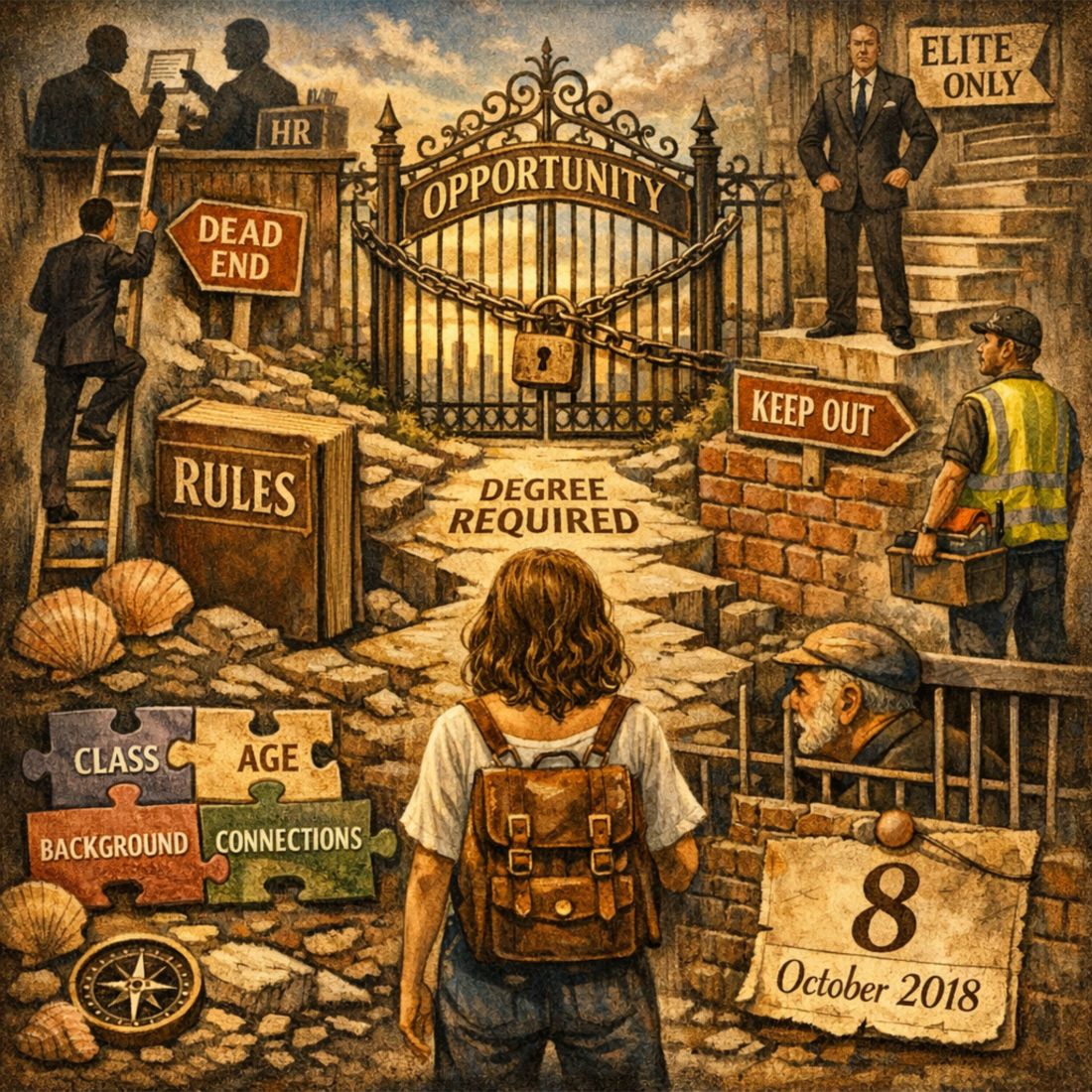
It doesn’t stop there, and within a tick box, risk-averse culture where Recruiters and HR Officers – that’s people who have and never will do these jobs themselves – have overwhelming power over recruitment processes, there is an untamed focus on identifying reasons to not even shortlist candidates – usually because they don’t have a degree.

Good people are now denied jobs where they can thrive and the employers and companies themselves never gain access to the wider pool of candidates where the real benefits of selecting people with the right experience rather than just a paper qualification lies.

The consequences of this social meddling are already far reaching indeed and because the UK could never afford to provide education to 21 years as a standard – which in itself was never needed, it was inevitable that a new form of educational discrimination would introduce itself. And it’s the worst one of all. The preclusion from opportunity for even more young people based simply on cost.

Just in this one example of social meddling focusing on education alone, where impractical idealists have tried to impose a system of restrictions based upon no experience that they have or have in no way never known, we can see how far reaching the impact on consequences of quixotic thinking can be.

This is a pattern which is unfolding itself over and over again within all the areas of our lives where lack of consideration has been applied to the consequences of imposing the ‘consideration’ of rights and ‘positive’ discrimination on a society which will always have its own mind and not the one which political busy-bodies wish to create for it.

The barriers to Social Mobility are all about the way that we think.

But the change needed and the tools which will enable us to break down those barriers and make that change will only come when decision makers with the power and therefore the ability to oversee that change go through a voluntary process of accepting that they themselves need to think differently.

That change will come about as a direct result.

That change cannot and never will be imposed.
 

Young people and rural voters could all be kept happy with solutions to the Foxhunting debate that are already hiding in plain sight

Like Brexit, Hunting has become an emotive subject which is safest left far away from discussion with people we know little about.

Few of us consciously acknowledge why this really is, and the elements of a solution which has the potential to be one supported by all have become hidden by the polarisation of ideas. The inevitable isolation of facts which follows is seen as an unacceptable compromise for each party as they become ever reluctant to recognise validity in any idea which extends beyond the scope and value set of their own.

The biggest elephant in the room for Hunting, is that no matter what supporters or those against this pastime tell us, the debate has long since been anything to do with either the activities or survival of a fox. Yet the actions of both groups in the debate present a story which is very different. If a resolution that works for all is genuinely to be found, each side and the politicians in between them will have to accept that both sides will have to be far more practical in the way they manage the pathways of their respective idealistic ground.

With the various truths presented as fact by some and interpreted as myth by others, the objective reality of this ‘sport’ is that it has very little to do with being competitive and everything to do with a highly social and lifestyle movement, which to its own detriment has become obsessive about a perceived right to hunt our indigenous wild-dog.

The world has moved on. Very few of us believe that the most efficient way to control any kind of mammalian pest, is to become hierarchically attired, mount a very expensive and well-kept horse and then charge around what is left of the open countryside with forty or more others doing exactly the same. Trundling alongside a pack of perhaps a hundred English Foxhounds who are never as happy as when they are simply out for a very long run.

In the years since the implementation of the ‘hunting ban’ under the tenure of the last Labour Government, Hunts around the Country have been doing surprisingly well without any genuine need to reverse the purpose of the Legislation. Hunt protesters and saboteurs would beg to differ, as foxes can often be disturbed and find themselves at the mercy of a brutal, but nonetheless non-intentional act, and it is at this point that we should perhaps all be minded of the propensity of accidents and the fact that many, many more foxes are likely to be killed on the roads during hunting season, than those uncovered accidentally by any hunt which should happen to gallop past.

Open discussion regarding the experience of death for any human or animal concludes quickly for any rational person, as soon as the presence of any deliberate cause or intent is removed. Like it or not, we cannot control that which cannot be controlled, and seeking to prevent any form of accident would easily bring into question just about everything that we do.

Those against hunting – even in its current form should remember this well and be ever mindful of the progressive leap which has already been achieved. There now needs to be an acceptance that this fieldsport is nothing like what it once was and that any form of resentment based upon perception alone, whilst dressed up as a legitimate debate will help no one.

Hunts and the hunt lobby itself would likewise do well to recognise and accept that killing foxes at any costs by applying the law in its most literal sense is a self-defeating act. Using devices such as large birds of prey to kill foxes they have uncovered, gives the true lie to an unnecessary intention and mindset which itself continues to fuel the antagonistic fervour and physical-activist approach of those against whom they have in some cases become violently opposed.

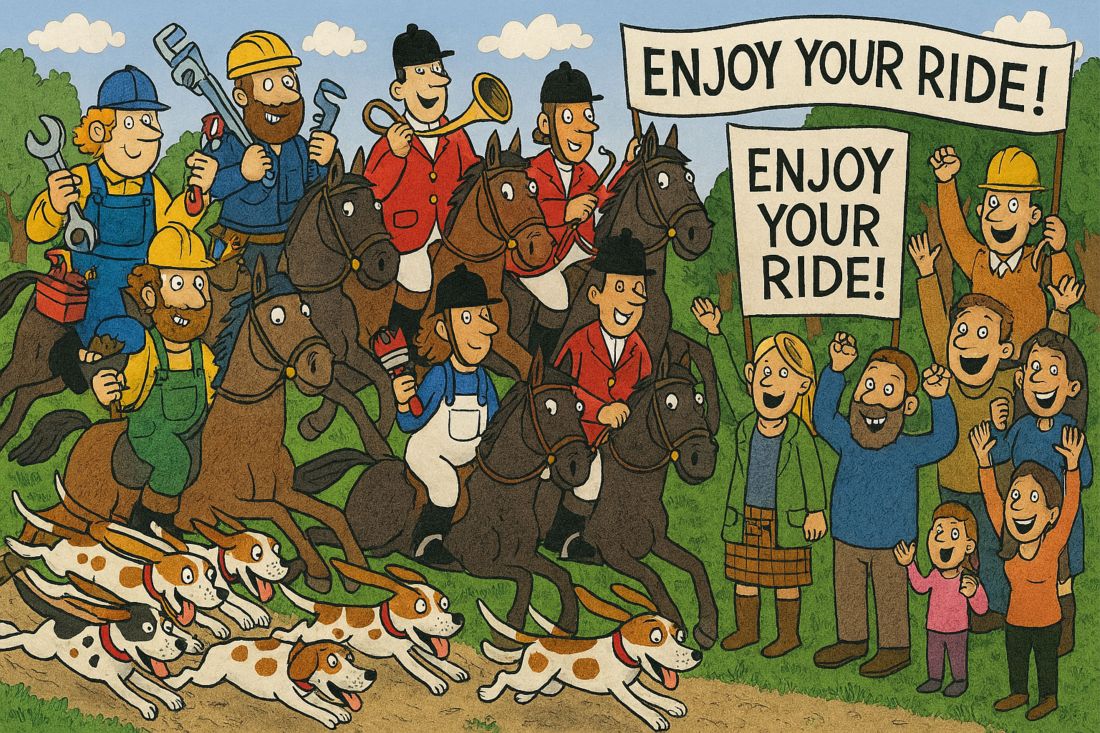
Hunting in its current form and in the way it really should now evolve, is not just the preserve of the wealthy and the one percent which many now love to hate. It is a lifestyle enjoyed by people from all backgrounds and we are as likely to see a plumber, builder or chef taking part as a rider, as we would a landowner or a London banker out for a day from their country home.

It is time that we recognised that Hunting is not about foxes and can be enjoyed by anyone. The Hunts need to stop attempting to play the rules and accept the spirit of the hunting ban in the manner in which it was implemented. The anti-hunt lobby should accept and recognise that they themselves have no legitimate right to police the activities of any hunt, and that holding a set of different ideas to someone else doesn’t mean that we have no choice but to physically collide.

The Hunting Act desperately needs intelligent and considered reform. There is nothing to be gained from it simply being overturned. The direct and related steps that a government seeking to deliver a revised act that would appropriately consider the rights, welfare and respect for the genuine rule of law for all – including the fox itself, could however include:-

Making it illegal to:

  • Intentionally and/or proactively pursue a fox as, for or as part of a social gathering, either directly with dogs or indirectly with alternative measures such as firearms or birds of prey.
  • Intentionally and/or proactively interfere with the activities of any hunt, its members, supporters or guests so convened as a social gathering

Recognising that:

  • Genuine intent is everything. That accidents do occur and no hunt, officer, member, guest or supporter thereof should ever be held liable for the result of any fox or other mammal being uncovered by a group of hounds during the course of a social hunt

Reviewing the role of the RSPCA:

  • Either restructuring the Governance structure of the Charity’s ‘Council’ to ensure that appointments are democratic and reflective of the impartial and non-political nature of the responsibilities with which the RSPCA has been entrusted
  • Or removing the responsibility and prosecutorial role of the RSPCA altogether, perhaps passing them to local authorities where democratic transparency and professional impartiality would be easier to monitor and define

With the current political environment having made hunting feel almost impossible to discuss, it is little wonder that our embattled Prime Minister is looking to secure votes by being perceived to be considering switching sides. The irony of such a choice is that divisive as Foxhunting may be, the very best solution will be making the effort and winning the arguments which will deliver a less than perfect, but nonetheless beneficial win for all.

Odd as it may seem to many of today’s political class, solutions which work for all of us are always possible, whenever there is a genuine willingness to talk.


Money: Terrorism, the cost of living crisis and the collapse of religion & morality

“Money is the root of all evil” was a phrase I often heard as I grew up. I like to think that it was a simple ruse that both my Mother and Grandmother employed to make the lack of cash and the weekly wait for Thursday morning’s ritual trip to the Post Office to ‘cash the giro’  seem all that more holy. But years in Businesses, Charities and Local Government have given me a very different view and it is now clear that this New Testament derived saying has an application which is a whole lot more universal.

Like it or not almost every facet of life has some link with money. Making money, spending money, borrowing money, saving money, winning money, being awarded money, being in some way dishonest for money, selling for money, earning money, playing for money or just thinking about money will almost certainly have a relationship with something that any one of us is doing at any one time whether we realise it or not.

What is in many cases an unconscious or involuntary obsession with money has become so ingrained within our present day existences that many of us have reached a point where we simply overlook the part that it plays in virtually every part of life and how its influence, directly or otherwise is on the way to making communities and cultures within Great Britain, Europe and far beyond almost unrecognisable from what they were less than a hundred years ago.

The “money men” of today and their commercialisation of just about everything that we could imagine are no doubt responsible for many of the problems that people are now experiencing. But payday loans, credit worthiness, spiralling energy bills and the explosion of food prices are only one part of the problem; just as ineptitude on the part of politicians who through successive Governments have taxed almost everything whilst they have taken borrowing to bankruptcy and beyond is another.

The far reaching and what could yet prove to be devastatingly real implications of decisions taken many years ago, primarily based upon freedoms and rights, but effectively about money, ownership and the formulation of private wealth have yet to fully manifest themselves. But to many, the harsh realities of an effectively unregulated free-market in the hands of those out to make money without any sense of ethics, morality or whatever the true cost may be, are already very real indeed.

The apparent liberation of the masses from servitude and the arrival of our perceived freedoms has been accompanied by the growth of a culture which recognises the accumulation of personal wealth and standing above all else.

People en masse are no longer content just to ‘be’, but relate their position in the world to what they do or don’t have and as such take a far more self-centred or self indulgent approach to life, even when they have very little to show for it.

Perhaps one of the noticeable casualties of this change may be the Church of England which has arguably witnessed a significant if not exponential fall in congregation size in parallel with this change. It is fast becoming ill equipped to maintain its standing as the default faith within what the Libertarians amongst us would have us believe to be a secular state – which itself was just a station at where the UK stopped and which our population may have already left way behind it.

It’s not just those who are now struggling to pay their bills who will have noticed; in fact, they have come pretty late to the game.

To those outside the UK and the West, a cultural obsession with money and its related exploitation of people and resources is even more historical than the change that has taken place for individuals in just Great Britain alone. The resentment and in many cases hatred that this has fostered is now manifesting itself in some of the most frightening ways possible through the rise of Islamic Fundamentalism and the extremist acts of terror by which it is closely accompanied.

It is ironic that the very same causes of the problems that we are now experiencing because of money and our obsession with it in this Country may well be the very same motivator that fuels the fire of extremism amongst people who have already recognised it through different eyes and want to deal with it, but in a way that would see us returned to the dark ages.

Sadly and as in most cases where one form of religious or political philosophy is at work and in control, those who are opposed to what some may call the money-based malignancy of this Westernised culture simply want to see it replaced with one which is oppressive in a wholly different way. Regrettably, the indifference of the majority towards what are two extremes does not reduce the likelihood that one could just be replaced by the alternative in any way.

Indifference itself is only exacerbated by the rights culture which has installed a sense of unjustified wrongdoing and often guilt when people speak out about changes and what are effectively the removal of freedoms that we may one day have to fight to regain.

The ‘rights’ of what are minorities within minorities are being preserved, promoted and upheld at the cost of not only the majority of UK Citizens, but the majorities within those very communities too, and we are being frogmarched towards a whole new and unrecognisable culture within the UK at the cost of what two generations fought and suffered for in the First and Second World Wars and the identity-bearing British traditions that we have held dear for so very long.

Many think that if there should be a World War III or Armageddon, it will be a wholly violent conflict that originates in the Middle East and then spreads to physically embrace the World, probably using weapons which will do unspeakable harm. Acts of terrorist violence such as 9/11, 7/7, Mumbai, Woolwich and Nairobi Westgate serve only to bring the news time realities of armed conflicts in Egypt, Libya and Syria all that closer to us.

The arrival of violence on our own shores – albeit on a comparatively small scale – is just another terrible warning of the realities that lie ahead if our politicians and the people with monetary power over our lives continue to go about their work without any real thought for the consequences of their actions.

The human condition dictates that group think will always encourage a level of emotional buy-in, servitude or passion within individuals whom given the right motivation will override any feeling of humanity towards their fellow man.

Encouraged by the belief that the ‘haves’ are somehow deliberately seeking to harm the ‘have not’s’ as part of some elaborate conspiracy – this indirect consequence is enough for indoctrinated people to see no value in their own life and therefore have no respect for that of others. Picking up the gun and delivering their messages with bombs is then just a simple step beyond.

However, whilst this really is the extreme end of the wedge in every possible sense, we should be grateful that the polarised or violent aspects of the rise of this ‘god called money’ have so far affected us at home to date in such limited ways.

It will not remain this way if radical Islam continues its rise within the communities of Britain or worse still, if the financial or cost of living crisis that is facing a significant and growing number of British households continues to be ignored, and frustrated and frightened people reach the point where they feel the time has come to take to the streets.

So could these terrorist attacks, Middle-Eastern battles, wars and the rise of radical Islam really be just be the symptom of the next Great War which is already underway?

If they are such a symptom, terrifying as terrorism and even civil disorder can be, tackling both may only be a small part of dealing with any turmoil that lies ahead, and an issue that our crowd-pleasing political classes will only find slightly harder to deal with than continually focussing on what it takes to win the next elections. Instructing and unleashing the police and security services from the realms of political correctness and claim culture will after all be an easy decision by comparison to dealing with the powers associated with money and reigning in a force beyond nature which has saturated our lives so deeply that it affects the very way that almost every one of us actually thinks.

If you need any evidence of the real battlefield that already exists around us, look at the hollow lives that some in Britain already live.

There are normal everyday people in this Country who feel empty and go in search of meaning. Where some of them once felt happy and content within their communities, they have withdrawn into solitary lives obsessing about what they have or what they don’t have. They seek distractions in whatever form they come, whether it manifests as obsessive behaviour with drink, drugs, sex, junk food, video games, TV, mobile phones, porn, the internet or perhaps even the fringe forms of religion which offer the same addictive power as all of the above and fill the void now deserted by a much happier and less monetary orientated world, where people found a much less invasive form of contentment with a whole lot less.

Whatever direction people who feel empty take; whatever they look for to fill their void; whatever they already possess; people will always willingly accept something if it is perceived to be ‘free’.

Cynical, self-serving politicians know this and flourish off the back of giveaways that somebody somewhere will always end up paying for. This rule extends across party lines, demographics, occupations or whatever your level of wealth or personal standing.

It won’t be difficult to get agreement that others need to change their behaviour from any one of us. But at the level of the individual, this reality will rarely prove to be the problem.

The failure of Westminster Politicians from successive Governments to consider the consequences of their actions or lack of them when it comes to dealing with a cultural and economic problem of this magnitude is astounding. It would be frankly quite laughable, were it not the case that for many people and businesses right across the UK, the outcomes already are and will progressively become so much more serious if nothing is done.

Time is running out for democracy in the way that we have come to know it, and if we don’t begin to witness the evolution of British politics to a form where fairness, what is right and what’s best for everyone becomes the priority and motivation of all in power and of those who aspire to having it, the consequences could be far more extreme for many than even living within a medieval caliphate where heads roll as easy as marbles and women are allowed to do very little other than simply exist.

It really is therefore difficult to conclude anything other than that all the evils facing our society have money unquestionably at their root and whatever your take on it, there is certainly nothing holy about any of it.

Principles for meaningful change in British Politics

grass-roots-header

Most people think that Politicians always lie and that they don’t have principles.

To achieve meaningful change for this Country, this perception must change. The sense of what is right and the sense of justice which inspired many Politicians into seeking Public Office, must no longer be compromised because of decisions made which are best for the individual concerned, or for the benefit of the Political Party to which they have become affiliated.

When I was first Elected on 2007, I was not alone in being horrified at how quickly it became apparent that decisions were made in Government on the pure basis of what was good for the Party, the Group Leaders, or was most likely to result in ‘good press’ or electability in the long run, before anything or anybody else was ever really considered.

Only sheer weight of numbers would ever result in any meaningful results which went against this non-democratic tsunami, primarily because many ‘junior’ Politicians do not want to risk disfavour or risk losing their Seats because they have been seen to disagree with the Party ‘line’.

This is not democracy in its correct sense and every voter is being failed at one point or another. The way that decisions are made in a proper democratic process is by majority, but the way that majorities usually get formed today is wrong, and this means that we are getting wronged the majority of the time.

People before Politics.

Every decision that Politicians make should be focused on the benefit to the majority of people; not the priorities of the few or of the Politicians themselves.

Practicality before Perfection.

We all like the idea of living in a perfect world, but perfection can only ever be an aim in an imperfect world and Politicians must make decisions based upon their practical impact; not just on what they would like to see.

Policies made in isolation lead to isolationist Policies.

Just as one policy may be used as an excuse not for enacting another, new policies should not be created without consideration of their real impact upon or collectively with others. Politicians now need to review the whole System and not use the size of this task as an excuse for not doing so.

Politics is better when it isn’t Personal.

Politics should never be about personalities and when it is, it is a sure sign that those talking are thinking primarily about themselves.

Fear is no excuse in itself.

Any policy made only with emotion and feeling in mind does not consider the wider picture and the full implications. Too many decisions have historically been made by Politicians because of a climate of fear. Over-reaction and under-reaction can be destructive in equal measure and however emotive a subject can be, emotions are personal and do not reflect consideration for what is best for the majority in its strictest and most comprehensive sense.

One size never fits all.

We are all different and policies must recognise and embrace those differences in all ways, but without recourse to any form of discrimination whether that be positive or negative.

Decisions affecting us all similarly should be made by Central Government, whilst decisions based upon Locality should rest in the Locality with Local People and their Political Representatives.

Central Government has as much responsibility to reflect, consider and act upon the decisions made by Local Representatives as it does have the right to ask others to respect the decisions which are made universally for us all.

Lifestyle choices should be for those living that life.

The preferences and actions of individuals should never be questioned or put in doubt so long as they do not compromise the physical safety, security, lifestyle and freedom of choice of others.

A crisis of conscience for one, is no excuse in itself to prevent the lifestyle choices of another and Government should never support it as such.

Equality in Education has been destroyed by the idea that all can make the best of the same opportunities

images (31)

I seem to have the phrase ‘cause and effect’ branded in my thought processes right now as I look at all of the problems with Government and no less so when recently reading yet more bad news about struggling school pupils failing to catch up.  But is anybody really surprised?

One of the greatest problems with modern government and law-making is that once an issue has been addressed, the people who have been put in place to deal with that issue then have nothing to do – unless of course they create something else to justify their existence. Have a good look at every area of life where some kind of policy has been created or exists and you might just begin to see what I mean.

The problem with this process is that whilst you can easily see that some things do benefit from being revised from their original form to meet a need which was not originally considered or indeed, to bring that a policy or law up-to-date to meet or to be applicable to contemporary need, the rise of the bureaucrat and ‘professional’ politician has led to unnecessary meddling and the creation of having laws for laws sake. This is particularly evident in matters such as education.

The value of education has been appreciated for a long time but the system we have probably began the headlong descent that we are now experiencing when the concept of real apprenticeships was lost and the school leaving age was raised to 16 in 1972. Speak to what some might call ‘old school’ educators and they will tell you that children were either ‘heads or hands’; the inference being that they were academic or practically inclined. Would you hear a teacher say the same in a similar conversation today? No.

The 1997-2010 New Labour project oversaw much of the destructive push towards blanket qualification levels which now seem to be the accepted way to enhance an evolving society. Put simply, the approach of such meddlers is to work on the basis that the easiest way to improve education is to make the education fit the population, rather than encourage the population to meet the demands of the time. Now is that real equality or just a twisted view of it which is taking our once highly educated and envied Nation backwards?

Everyone is different for many reasons, not least because of their genetics, demographics and social conditioning. It is therefore sheer folly to believe that by applying the one-size-fits-all mentality that you will create a perfect and fully functioning society by making everyone equal ‘by default’. We currently see high levels of youth unemployment and dissatisfaction with the system (Something apparently highlighted by the August 2011 Riots), but again no real attempts to address the causes of these problems being made by the very people who could genuinely make a difference.

There are many young people who don’t want to be in ‘school’ and others who just don’t get the benefit from a dumbed-down degree system where 3 years of undergraduate study provides what could be a lifelong debt and a qualification that industry views as useless, all against the backdrop of a Government that cannot afford to provide such diversions in the first place. The balance has been lost and somebody needs to get this all back where it should be so that each and every individual can follow a route to a career which gives them the best opportunities to realise all that they can achieve based on what they are capable of doing; not what some idealist in London thinks it right that they should do.

Rather than scratching heads about the escalating problems created by the decline in standards in education, why not get back to a basic appreciation of the fact that everyone has something unique to offer and that in itself requires real diversity of opportunities and not one which is offered by an encyclopaedic exam syllabus. Put 14 year-olds who have no academic inclination – or don’t recognise one at that age – into real 7-year vocational apprenticeships in industry and SME’s where time and application give them the career footing that they would otherwise never achieve?

Why not begin to rebuild the ‘time-served’ bank of talent and experience that no amount of schoolroom activity can provide our dwindling industries and hungry-for-help businesses with, in a cost effective way which reduces the burden on the State and will probably address all manner of other issues hurting society at the same time such as youth crime?

I can almost hear the ‘it won’t work because…’ right now. What – because of employment laws or other legislation? – That’s exactly the point and the very reason we are getting into more and more of a mess isn’t it?