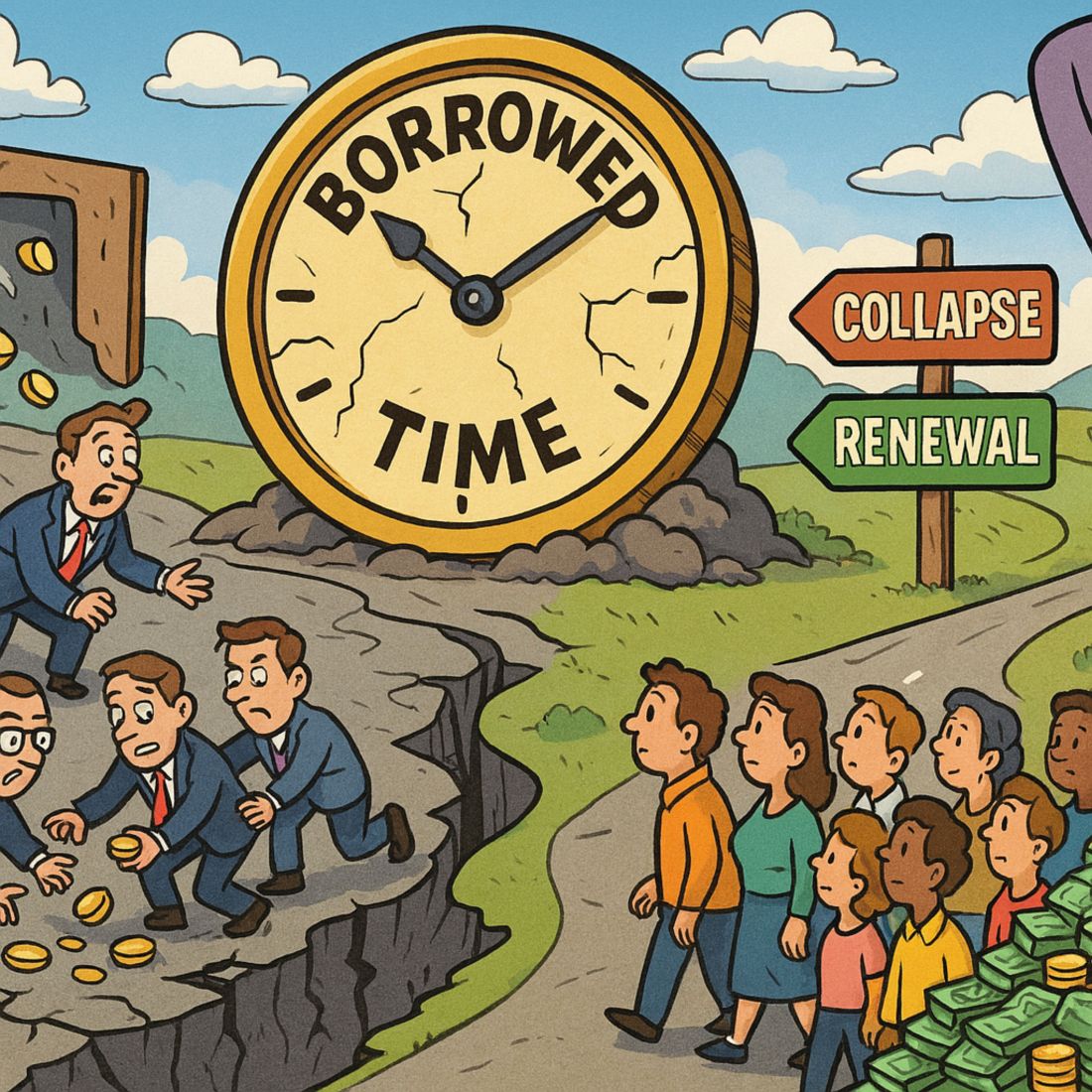
The Borrowed Time Budget: A System Running Out of Road

The November budget, with its push toward higher taxation, is not simply a matter of fiscal policy. It is a warning sign, a flare in the night sky that tells us the system we live under is running out of road.

Few people recognise what this shift truly signals, and fewer still are willing to confront it. That blindness is not accidental. Our economy has been carefully designed to mislead, to disguise its fragility, and to keep even the sharpest minds chasing illusions.

For decades, governments have expanded the flow of money, not by creating genuine value, but by inflating the system.

They bailed out the banks that caused the crash of 2007- 08, rewarding failure with public funds. Later, they unleashed torrents of money during the Covid pandemic, not to rebuild resilience, but to keep the machine ticking over.

These interventions did not repair the foundations; they merely propped up a broken structure. The result is a distorted reality in which the government can no longer borrow what it needs to sustain public services. Instead, it faces crises that today’s politicians are neither prepared nor equipped to lead us through.

To keep the illusion alive – to make it appear that everything is functioning as normal – the government must find money somewhere.

If banks cannot provide it (and in truth, they never had it to lend in the first place), then the state will take it from us. Taxation becomes not a tool of governance but a desperate grab for survival, a way to scrape together whatever can be found to keep the plates spinning.

This is the trap of the political class. They value their positions and the power they believe they hold more than the consequences of their choices.

Whether they admit the truth now or continue draining the public first, the end is the same: collapse.

The system is already hurting millions, and it cannot endure indefinitely. The only uncertainty is whether we lose what remains of our wealth before the collapse, or when it finally arrives.

The bitter irony is that our money is tied to nothing of real value. That emptiness is what has allowed politicians and elites to manipulate the system for so long. Could anyone become an overnight billionaire if wealth were grounded in tangible worth? Of course not. Their fortunes exist because people buy into offerings with money that, in essence, does not even exist.

This government – and likely the next one too – is living on borrowed time. Real change will only come when leaders emerge who understand the true nature of the crisis and are willing to act decisively to rebuild on solid ground.

Until then, the charade continues – as does the damage that it causes.

Few will welcome the upheaval that is coming, but it is inevitable: the world will soon operate very differently than it does today.

That shift need not be catastrophic. We still have choices, and we still have the chance to take a better path.

But this requires honesty. It requires accepting that the obsession with money at the centre of everything must end.

Unlike the politicians driving the UK bus towards the cliff, we must recognise that we have already reached a place called stop.

From here, the only way forward is to put people first.
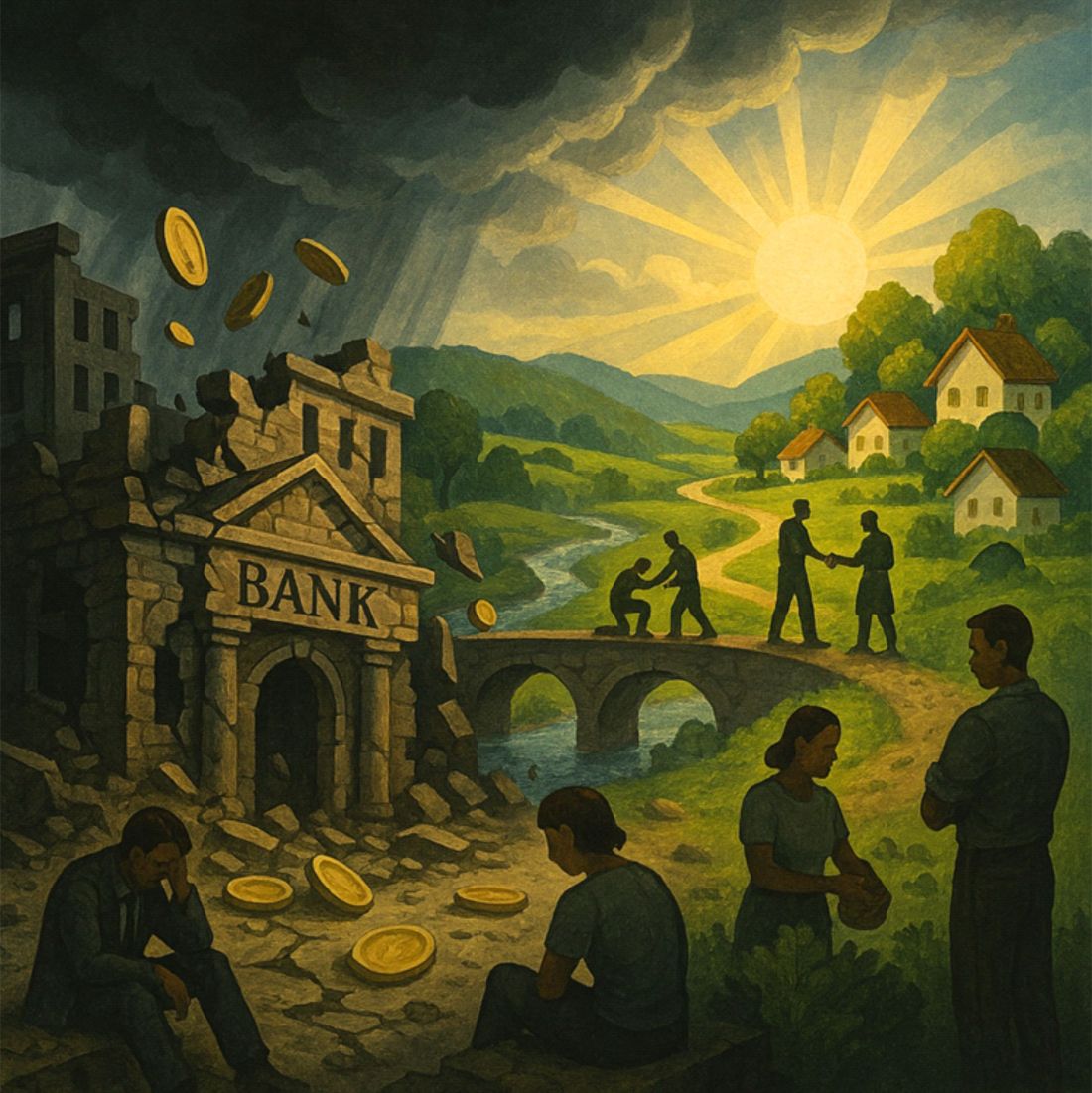
Plastic Productivity and the Debt Trap: What the November Budget Won’t Fix

Governments do not collapse in the same way that individuals or businesses do. If they did, the United Kingdom would have gone under financially long ago. Instead, the state continues to function by rolling debt forward, reshaping obligations, and presenting the appearance of stability. For ordinary people, however, the rules are very different. When we cannot meet our commitments, we fail — unless someone steps in to bail us out.

Meeting financial obligations requires honesty. You must know whether you can truly pay your debts or whether survival depends on wishful thinking. Throughout history, people and businesses have thrived or failed for both good and bad reasons. As long as they appear to function, few question what lies beneath.

For tradesmen, small business owners, and entrepreneurs, the reality is harsh. None of us are “too big to fail.” Once obligations can no longer be met, collapse follows unless a benefactor intervenes.

We like to believe the same standards apply to everyone, whether sweeping streets or running government. Yet elites have always bent rules to their advantage. They forget that all people, high or low, share the same human experience. Power corrupts, and politicians often forget they were elected simply to fill a seat, not because they are uniquely qualified to decide what is best for everyone.

The shift to fiat money in 1971 changed everything. It allowed governments, banks, and corporations to manipulate the system, creating the illusion of endless funds. Behind closed doors, decisions were shaped by business and banking interests, while politicians no longer had to worry about the true responsibilities of leadership.

Debt became hidden behind GDP figures. Growth and transaction volumes disguised the reality of an exploding debt pile. To the untrained eye, it looked as though debt was shrinking, when in fact it was spiralling out of control.

This illusion was sustained by what might be called “plastic productivity.”* Assets and infrastructure were bought cheaply, production was outsourced overseas, and consumers were encouraged to buy more and more goods they didn’t need. People became indebted to the same banks that lent to government, yet could just about service their loans. It seemed as though prosperity was endless, and few questioned the narrative.

But the system was never sustainable. Its architects knew it would transfer wealth and ownership to a small elite. By making money and material wealth addictive, they ensured control. With industries hollowed out, productivity now depends almost entirely on expanding debt — by government, business, and individuals alike.

Politicians face a broken system. To keep the machinery of government running, they must tax normal people more heavily. Yet much of public spending delivers little benefit. Policies have been rewritten, words twisted, and meanings changed to allow politicians to cling to power while the wealthy grow richer. Assets of real value have been transferred to people who could never have owned them otherwise.

If the system collapses, the establishment will impose new rules. They may impoverish citizens further, leaving people no choice but to accept whatever is dictated. Many politicians may not even understand the system they oversee. They follow instructions blindly, blamed for decisions that are not theirs, lacking the skills to lead differently.

The situation could drag on for months or years. Collapse may come when the public finally says “enough,” or when the establishment has drained the country dry. Even if a new government is elected — Reform UK, Nigel Farage, or anyone else — they will face the same reality. Cutting spending or taxes cannot fix a nation that is broke and owns nothing. Wealth has already been transferred to lenders.

The system is broken. We must either accept subjugation under a corrupt structure built on trickery, or take a leap of faith and start again from scratch.

***

*”Plastic productivity” refers to the illusion of economic growth created by outsourcing production, encouraging over‑consumption, and sustaining debt, rather than building genuine, sustainable value. It’s not about plastics as a material, but about a system that mimics productivity while hollowing out real industries and transferring wealth.

Facing the Economic Collapse: the Real Crisis Behind Money, Wages, and Freedom

Facing Uncomfortable Truths

It is regrettable that most people avoid confronting uncomfortable truths about the crisis we’re in.

Many actively ignore or dismiss what they know deep down to be true, preferring comfort over honesty.

But this habit of hiding from inconvenient realities isn’t new. It’s been passed down for generations. People have often chosen what feels good over what’s obviously right, leading us to our current predicament.

Pretending everything is normal, focusing only on ourselves, and letting others make decisions for us has brought us to the brink of systemic collapse.

The comfortable system we rely on is failing, and we must face this reality.

The Source of the Problem: Money

Many prefer to hear hard truths from trusted figures like academics or politicians, but deep down, we know the truth doesn’t depend on who says it.

It’s time to think, research, and analyse for ourselves.

At the heart of our problems is the money system. We’ve been conditioned to believe money is everything, shaping our choices and values around financial cost, reward, and status.

Yet, the money system itself is artificial. A belief system manipulated by private bankers, big businesses, and the politicians they control.

They change the rules to enrich themselves, transferring wealth and ownership away from ordinary people, all under the guise of normality.

Imminent System Collapse

Politicians obsess over “growth.” But for them, growth means increasing the size of the economy (GDP). Not helping small businesses or working people.

Real productivity has vanished as industries and assets have been sold off to those who profit from the system, while jobs have been outsourced.

GDP figures are misleading, counting money created through private finance and government borrowing multiple times. Politicians have tried to spend their way out of trouble, but even that strategy is failing.

With rising unemployment due to AI and unproductive sectors and a government so possessed by fear that they are regularly changing their minds, lenders are now worried the scam will be exposed.

Desperation has set in, and the government seems set to resort to ever-increasing taxes, hoping to keep the system afloat and their secrets hidden.

The System Enriches the Few

Prices keep rising while wages lag behind, making it harder for most people to keep up.

This isn’t new—it’s how the system was designed.

Once, a single working adult could support a family. But now, financial independence is reserved for the wealthy, while dependence and poverty are imposed on the rest of us.

The Myth of the Minimum Wage

The national minimum wage is misleading. It’s not enough to live on, but rather the lowest acceptable wage set by those in power, regardless of the real cost of living.

However, even the average wage isn’t enough for genuine financial freedom.

Financial Freedom Is the Solution

Almost every social problem can be traced back to the fact that the lowest-paid jobs don’t pay enough for people to live independently.

Admitting this would expose the system’s flaws and those who benefit from it.

The system survives by prioritizing money over people. Every decision made by those in power serves the money system. Not human needs.

Choosing People Over Money

If we want a better world, we must redirect government, business, and our rules to prioritize people, not money or the economy.

Unfortunately, our political leaders hide the truth instead of addressing it, covering up the growing cracks in the system.

Collapse Is Inevitable. But We Have a Choice

Systemic collapse is inevitable. But we can choose what comes next and who benefits.

If we do nothing, things will only get worse.

Those who created this mess believe they can protect themselves with wealth and security, but ordinary people will lose freedom.

The powerful will restrict our freedoms to protect their own interests.

Paradoxically, a collapse could be an opportunity.

If we embrace it, we can build a freer, fairer system for everyone. Something only possible when the current corrupt system is removed.