Out of the Abstract: Stepping Into a Reality That Isn’t Confusing, Even If It Seems Unreal from Here | Full Text

“Locality is the natural scale of human life. Everything else is a managed simulation.”

A Note from Adam

This essay sits within a wider body of work that includes The Local Economy & Governance System, The Basic Living Standard, The Revaluation, The Contribution Culture, Foods We Can Trust – A Blueprint’ and Centralisation Only Rewards Those at the Centre.

All of these pieces are attempts to describe something that should be obvious, but has become strangely difficult to see: that the world we live in today is not built on real life, but on layers of abstraction that have replaced it.

The tragedy – and the reason this work is necessary – is that when people are raised inside an abstract world, the real world begins to look abstract.

Locality looks naïve.

Community looks unrealistic.

Contribution looks idealistic.

Real food looks nostalgic.

Real governance looks impossible.

Real value looks imaginary.

Real life looks like a fantasy.

This inversion is not accidental. It is the predictable outcome of a system that has normalised distance, centralisation, and money as the organising principles of life.

When the abstract becomes normal, the real becomes suspicious.

People reject the very things that would make them healthy, grounded, connected, and free – not because they are wrong, but because they have been conditioned to believe that the real is impractical, inefficient, or outdated.

This rejection is not a rational act. It is a form of self‑harm.

It is the moment when a person turns away from the only scale of life that can sustain them – the local, the human, the grounded – and chooses instead the familiar discomfort of the abstract world.

This essay is written to break that spell.

It is written to help people see the abstract world clearly, perhaps for the first time.
It is written to show how the real world has been hidden in plain sight.
It is written to reveal why the real feels abstract, and why the abstract feels real.
It is written to open the doorway back to a life that makes sense.

If the ideas inside this essay feel unfamiliar, strange, or even unsettling, that is not a sign that they are wrong. It is a sign of how deeply the abstract world has shaped our perception.

The work that follows – including LEGS, the Basic Living Standard, and the wider architecture of a local, human or people-first economy – is not an attempt to invent a new world.

It is an attempt to return to the only world that has ever truly worked.

A world where life is lived at the scale of human beings.
A world where value is real.
A world where community is lived.
A world where food is understood.
A world where governance is accountable.
A world where health is natural.
A world where meaning is visible.
A world where people are whole.

This essay is the beginning of that return.

Stepping Out of the Abstract: Why This Essay Exists

We live in a world where almost everything that matters has been lifted out of daily life and placed somewhere distant, managed by people we never meet, shaped by systems we never see, and justified by narratives we never question.

This distance has become so normal that most people no longer recognise it as distance at all.

They mistake abstraction for reality because they have never known anything else.

This is the quiet tragedy of the money‑centric, centralised world:

When you are raised inside the abstract, the real begins to look abstract.

Locality – the natural scale of human life – begins to feel naïve.
Community begins to feel unrealistic.
Contribution begins to feel idealistic.
Real food begins to feel nostalgic.
Real governance begins to feel impossible.
Real value begins to feel imaginary.

And because the abstract world is all we have been shown, many people reject the real world when they first encounter it – not because it is wrong, but because it feels unfamiliar.

This rejection is not a failure of intelligence.

It is a consequence of conditioning.

It is also a form of self‑harm.

Because the real world – the local, the human, the grounded – is the only place where health, meaning, agency, and freedom can genuinely exist.

This essay is written for the moment when people begin to sense that something is wrong, even if they cannot yet name it.

It is written for the moment when the abstract world stops feeling natural.
It is written for the moment when the doorway to the real world becomes visible – even if only faintly.

It draws on the wider body of work – including Centralisation Only Rewards Those at the Centre – to show how the abstract world hides in plain sight, how it shapes our behaviour without our consent, and how it convinces us to reject the very things that would make our lives whole again.

This essay is not an argument.

It is an invitation.

An invitation to see clearly.
An invitation to understand deeply.
An invitation to step back into the real.

SECTION 1 – Life Inside the Abstract

Most people can feel that something is wrong with the world today, even if they can’t quite name it. There is a sense of disconnection running through everything – work, community, politics, food, even our relationship with ourselves.

Life feels harder than it should be. Nothing seems to add up. And yet, when we look around, the structures that shape our lives appear normal, familiar, even inevitable.

The truth is far more uncomfortable.

We are not living real lives anymore.

We are living in an abstract world – a world built on systems, narratives, and mechanisms that sit outside our direct experience, yet govern almost every part of it.

We have been conditioned to treat these abstractions as reality, even when they bear no resemblance to the lives we actually live.

We mistake the abstract for the real because we have forgotten what real life feels like.

Real life is local.

Real life is human.

Real life is experienced directly – through people, places, relationships, and the natural world.

But the world we inhabit today is mediated through layers of distance, bureaucracy, digital interfaces, centralised systems, and economic structures that most of us never see.

We live inside a world of processes we do not control, rules we did not write, and decisions made by people we will never meet.

We have been taught to believe that this is normal.

It isn’t.

It is simply the result of a system that has replaced lived experience with abstraction – and then convinced us that the abstraction is real.

This is why so many people feel exhausted, anxious, or powerless. It is why work feels meaningless. It is why communities feel hollow. It is why food feels fragile. It is why politics feels distant. It is why life feels precarious.

We are trying to live real lives inside an abstract world.

And the abstract world is collapsing.

To understand why – and to understand the alternative – we must first see the architecture of the abstract world clearly. Because once you see it, you cannot unsee it. And once you understand how abstraction has replaced reality, you begin to understand why the only real solution is to return life to the scale where humans actually exist.

That scale is the local.

And the system that makes that return possible is the Local Economy & Governance System (LEGS).

But before we can reach that point, we must first understand how the abstract world was built – and why it has taken us so far away from the lives we were meant to live.

SECTION 2 – How Abstraction Shapes Daily Life

One of the most important things we have to recognise – and perhaps the hardest – is just how much of the world we take for granted without ever questioning how it really works.

We assume that because something is familiar, it must also be real. We assume that because something is normal, it must also be natural. And we assume that because something has always been presented to us in a certain way, that way must be the truth.

But much of what we now treat as “real life” is nothing of the sort.

We are living in an abstract world – a world built on ideas, systems, and processes that sit far outside our direct experience, yet shape almost everything we do. And because these abstractions have been with us for so long, we rarely notice them. They hide in plain sight, precisely because we have stopped looking for anything else.

Food is the clearest example.

Recently, the website Farming UK asked whether food production and farming should be compulsory in schools. On the surface, it sounds like a sensible suggestion. Many people – especially those who live rurally – instinctively feel that children should understand where food comes from, how it is grown, and why it matters.

But the question itself reveals something much deeper.

Because we already have compulsory subjects in schools.

And yet almost none of them connect children to real life.

They are taught in the abstract.

They are delivered through textbooks, screens, worksheets, and exam specifications – not through lived experience. Children learn about the world through representations of the world, not through the world itself. They learn about life without ever touching life.

So when we say “make food education compulsory,” we are really saying “add food to the list of things we teach abstractly.”

We don’t even notice the contradiction.

We don’t notice that the very structure of schooling has become abstract – detached from the realities of life, detached from the skills that sustain us, detached from the communities we live in. We don’t notice that the way we teach children about the world is itself part of the problem.

We don’t notice because abstraction has become normal.

We have been conditioned to believe that learning happens in classrooms, not in fields, kitchens, workshops, or communities.

We have been conditioned to believe that knowledge comes from institutions, not from experience.

We have been conditioned to believe that the abstract version of life is the real one – and that the real one is somehow outdated, inefficient, or unnecessary.

This is how deeply the abstract world has embedded itself.

We no longer see the distance between the representation and the reality.
We no longer see the gap between what we are taught and what we need.
We no longer see that the systems we rely on are not built around life at all.

Food education is just one example – but it is the example that exposes the whole pattern.

Because food is not abstract.

Food is life.
Food is local.
Food is real.

And yet most people now understand food only through the abstract lens of supermarkets, supply chains, packaging, and price labels.

They understand food as something they buy, not something they grow, prepare, preserve, or share.

They understand food as a product, not a relationship.

So when we talk about teaching food in schools, we are really talking about teaching the abstract version of food – the version that fits neatly into a curriculum, not the version that sustains life.

This is the heart of the problem.

We are trying to fix the consequences of abstraction by adding more abstraction.

We are trying to reconnect people to real life through systems that are themselves disconnected from real life.

We are trying to solve a problem we have not yet recognised.

Because the problem is not that children don’t understand food.

The problem is that children – and adults – no longer live in a world where real life is visible.

We live in the abstract.
We think in the abstract.
We learn in the abstract.
We work in the abstract.
We eat in the abstract.
We govern in the abstract.

And because abstraction has become normal, we no longer see what it has taken from us.

But once you begin to see it – once you notice how much of life has been lifted out of reality and placed into distant systems – you begin to understand why so much feels wrong, disconnected, or hollow.

You begin to understand why the sums no longer add up.

You begin to understand why people feel lost.

You begin to understand why communities feel empty.

You begin to understand why the world feels fragile.

And you begin to understand why the only real solution is to return life to the scale where it actually exists.

The local.

The human.

The real.

SECTION 3 – Food: The Evidence for Local Reality

If there is one place where the difference between real life and the abstract world becomes impossible to ignore, it is food. Food exposes the truth that sits beneath everything else:

Local is real.
Local is healthy.
Local is human.

Abstract is false.
Abstract is unhealthy.
Abstract is dehumanising.

Food shows us this more clearly than anything else because food cannot be understood in the abstract. You cannot learn food from a worksheet. You cannot respect food from a PowerPoint. You cannot understand food from a supermarket shelf.

Food is something you learn by living with it.

For most of human history, food was part of daily life. Children didn’t need lessons about food – they absorbed it simply by being present.

They saw seeds planted, animals cared for, bread made, meals prepared, leftovers preserved, and seasons change.

They learned respect for food because they saw the work, the patience, the skill, and the care that food requires.

Food was not a subject.
Food was a relationship.
Food was real.

And because food was real, it made life real.

It grounded people physically, mentally, emotionally, and socially. It connected them to nature, to community, and to themselves.

This is what locality does.

Locality makes life real.

Locality makes life healthy.

But today, food has been lifted out of daily life and placed into the abstract.

Most people no longer grow food.
Most people no longer prepare food from scratch.
Most people no longer understand where food comes from or what it takes to produce it.

Instead, food arrives through a system that is distant, centralised, and invisible. We experience food through packaging, branding, supply chains, and price labels. We “know” food only as something we buy – not something we understand.

And because food has become abstract, our relationship with life has become abstract.

We no longer see the soil.
We no longer see the seasons.
We no longer see the labour.
We no longer see the community.
We no longer see the meaning.

We see only the abstraction – and we mistake it for reality.

This is why the suggestion that food production should be compulsory in schools misses the point so completely. It assumes that the problem is lack of information. It assumes that the solution is more teaching. It assumes that adding food to the curriculum will reconnect children to real life.

But compulsory subjects are already taught in the abstract.

They are delivered through screens, worksheets, and exam specifications – not through lived experience. They are disconnected from the world they claim to describe. They teach children about life without ever letting them touch life.

So when we say “teach food in schools,” we are really saying “teach the abstract version of food.”

We don’t even notice the contradiction because abstraction has become normal.

But food refuses to be abstract.

Food exposes the lie.

Food reveals the truth.

Because food can only be understood locally.

Food can only be respected locally.

Food can only be lived locally.

And when food is local, life becomes local.

When food is real, life becomes real.

When food is part of daily life, people become grounded, connected, and healthy – physically and mentally.

This is the deeper truth hiding in plain sight:

Anything that is real must be lived locally.

Anything that is abstract becomes unhealthy – for people, for communities, and for the world.

Food shows us this with absolute clarity.

When food is local, people are independent.

When food is local, communities are resilient.

When food is local, life makes sense.

But when food becomes abstract, people become dependent.

Communities become hollow.
Skills disappear.
Respect disappears.
Meaning disappears.
Health – physical and mental – declines.

Food is the proof that abstraction is not just a philosophical idea.

It is a lived experience with real consequences.

And it is also the proof that the way back to a healthy, grounded, human life is through locality.

Because food cannot be centralised without becoming abstract. And life cannot be centralised without becoming abstract.

Food shows us the truth we have forgotten:

Local is real.
Local is healthy.

Abstract is false.
Abstract is unhealthy.

And once you see this in food, you begin to see it everywhere.

SECTION 4 – When Abstraction Disrupts Meaning

Once you begin to see how food reveals the difference between the real and the abstract, something else becomes clear: the reason so much of life feels confusing, unstable, or unhealthy today is because we are trying to live real lives inside systems that are not real.

When life is local, it is grounded.

When life is local, it is human.

When life is local, it makes sense.

But when life becomes abstract, it becomes distorted.
It becomes stressful.
It becomes unhealthy – physically, mentally, emotionally, socially.

And because abstraction has become normal, we rarely connect the dots.

We feel the symptoms, but we don’t see the cause.

We feel overwhelmed, but we don’t see the distance that created it.
We feel powerless, but we don’t see the systems that removed our agency.
We feel disconnected, but we don’t see how far we’ve been pulled from real life.
We feel anxious, but we don’t see that the world we live in is built on instability.
We feel lost, but we don’t see that the map we were given was abstract all along.

Food shows us this clearly.

When food was part of daily life, people understood the world around them. They understood seasons, weather, soil, animals, and the rhythms of nature. They understood effort, patience, and consequence. They understood community, because food required community.

This understanding created stability – not just physical stability, but mental and emotional stability too.

Locality grounds people.

Locality gives life shape.

Locality gives life meaning.

But when food becomes abstract, that grounding disappears.

People no longer understand the rhythms of life.
They no longer see the connection between effort and outcome.
They no longer experience the satisfaction of contribution.
They no longer feel part of anything bigger than themselves.
They no longer feel capable of providing for themselves.

This creates a deep, quiet anxiety – the kind that sits beneath everything else.

Because when the most essential part of life becomes abstract, everything else becomes abstract too.

Work becomes abstract – disconnected from purpose.
Community becomes abstract – disconnected from place.
Governance becomes abstract – disconnected from people.
Value becomes abstract – disconnected from meaning.
Identity becomes abstract – disconnected from reality.

And when everything becomes abstract, life stops making sense.

People feel like they are constantly running but never arriving.
They feel like they are constantly working but never secure.
They feel like they are constantly consuming but never satisfied.
They feel like they are constantly connected but never seen.
They feel like they are constantly informed but never understanding.

This is not a personal failing. It is the predictable outcome of living in a world that has replaced reality with abstraction.

A world where:

  • food is a product, not a relationship
  • work is a transaction, not a contribution
  • community is a slogan, not a lived experience
  • governance is a bureaucracy, not a responsibility
  • value is a price tag, not a truth
  • identity is a profile, not a person

A world where the things that should be local – food, work, community, governance, meaning – have been centralised, standardised, and abstracted.

A world where the things that should be lived have been turned into things that are managed.

A world where the things that should be experienced have been turned into things that are consumed.

A world where the things that should be human have been turned into things that are economic.

And because this world is abstract, it is unhealthy.

It is unhealthy for bodies.
It is unhealthy for minds.
It is unhealthy for communities.
It is unhealthy for the environment.
It is unhealthy for democracy.
It is unhealthy for life.

Locality is not a lifestyle choice.

Locality is the natural scale of human existence.

When life is local, it becomes real again.
When life is local, it becomes healthy again.
When life is local, it becomes meaningful again.

Food shows us this.
Food proves this.
Food is the doorway into this understanding.

And once you see how food reveals the truth about locality and abstraction, you begin to see the deeper structure behind it – the mechanism that created the abstract world and keeps it in place.

That mechanism is centralisation.

And centralisation only ever rewards those at the centre.

SECTION 5 – How Centralisation Sustains Abstraction

Once you see how abstraction pulls life away from the local, the next questions become unavoidable:

Why has so much of life been lifted out of the local in the first place?

Who benefits from life becoming abstract?

And why does the system keep moving further away from the real?

The answer is centralisation.

Centralisation is not an accident. It is not a side‑effect. It is not an unfortunate by‑product of “modern life.”

Centralisation is the mechanism that makes the abstract world possible.

It is the structure that takes power, ownership, and decision‑making away from the local – away from the people who live with the consequences – and moves it upward, into the hands of those who benefit from distance.

And once you understand centralisation, you understand why the world feels the way it does.

Centralisation grows because abstraction feeds it

The money‑centric system we live in today is built on a simple equation:

Money → Wealth → Power → Control → Centralisation

Everyone understands the first step.

Even people with very little money know that money gives them more control over their own lives.

But as you move up the hierarchy, the dynamic changes.

Money no longer gives control over your own life – it gives control over other people’s lives.

And once that dynamic exists, centralisation becomes inevitable.

Because the more centralised a system becomes, the easier it is for those at the centre to extract value from everyone else.

Centralisation rewards the centre.

Abstraction hides the extraction.

Locality is the only thing that resists it.

This is why the system keeps pulling life away from the local.

Locality is real.
Locality is human.
Locality is healthy.
Locality is accountable.

And centralisation cannot survive in a world where people live real, local lives.

Centralisation always removes the local – and replaces it with the abstract

You can see this pattern everywhere once you know what to look for.

Food used to be local.
Now it is controlled by global supply chains, supermarket monopolies, and distant corporations.

Work used to be local.
Now it is shaped by national policy, global markets, and corporate structures that have no relationship to the communities they affect.

Governance used to be local.
Now decisions are made by people who will never meet those they govern.

Education used to be rooted in community life.
Now it is delivered through standardised curricula designed far away from the children they are meant to serve.

Health used to be grounded in local knowledge, local relationships, and local responsibility.
Now it is managed through centralised systems that treat people as data points.

In every case, the pattern is the same:

Centralisation removes life from the local and replaces it with the abstract.

And because abstraction is unhealthy – physically, mentally, socially, environmentally – centralisation always harms the people furthest from the centre.

Centralisation creates distance – and distance removes empathy

When decisions are made locally, they are made by people who see the consequences.

When decisions are made centrally, they are made by people who never do.

Distance removes empathy.
Distance removes accountability.
Distance removes humanity.

This is why centralised systems feel cold, bureaucratic, and indifferent.

It is not because the people inside them are bad.

It is because the structure itself removes the human connection that makes good decisions possible.

A policymaker in Westminster does not see the farmer whose livelihood is destroyed by a regulation.
A supermarket executive does not see the community that loses its last local shop.
A global corporation does not see the soil degraded by its supply chain.
A distant official does not see the child who never learns where food comes from.

Centralisation makes harm invisible – and therefore easy.

Centralisation is the opposite of locality – and the opposite of health

Locality is real.
Locality is grounding.
Locality is healthy.

Centralisation is abstract.
Centralisation is distancing.
Centralisation is unhealthy
.

Locality connects people to life.
Centralisation disconnects people from life.

Locality builds resilience.
Centralisation creates fragility.

Locality builds community.
Centralisation creates dependency.

Locality builds understanding.
Centralisation creates confusion.

Locality builds meaning.
Centralisation creates emptiness.

Food shows us this more clearly than anything else.

When food is local, people are healthy – physically and mentally.

When food is abstract, people become dependent, disconnected, and unwell.

This is not a coincidence. It is the structure of the system.

Centralisation only rewards those at the centre

This is the truth that sits beneath everything:

Centralisation always rewards the centre and always harms the local.

It cannot do anything else.

Because centralisation is built on extraction – the extraction of wealth, power, autonomy, and meaning from the many to benefit the few.

And the only way to maintain that extraction is to keep life abstract.

Because abstraction hides the mechanism.
Abstraction hides the harm.
Abstraction hides the loss of agency.
Abstraction hides the loss of independence.
Abstraction hides the loss of community.
Abstraction hides the loss of health.

Once you see this, you understand why nothing will change until we stop living in the abstract and return life to the local.

And that is where the doorway opens.

Because if centralisation is the engine of the abstract world, then locality is the engine of the real one.

And LEGS is the structure that makes that return possible.

SECTION 6 – Locality: Where Life Becomes  Real

Once you understand how abstraction pulls life away from the real, and how centralisation keeps everything abstract, the next truth becomes impossible to ignore:

Real life only exists at the local scale.

Everything else is a managed simulation.

This isn’t ideology.
It isn’t nostalgia.
It isn’t a romantic longing for the past.

It is simply how human beings work.

Locality is the natural scale of human life because it is the only scale where life can be experienced directly – through our senses, our relationships, our responsibilities, and our contributions.

Locality is where we see the consequences of our actions.

Locality is where we understand the world around us.

Locality is where we feel connected to something bigger than ourselves.

Locality is where we experience meaning.

Locality is where we experience health – physical, mental, emotional, social.

Locality is real.
Locality is grounding.
Locality is human.
Locality is healthy.

And food shows us this more clearly than anything else.

Food proves that locality is the natural scale of life

When food is local, it is part of daily life.

You see it.
You touch it.
You smell it.
You prepare it.
You share it.
You understand it.

Food becomes a relationship – not a product.

And because food is real, life becomes real.

People who live close to their food systems are more grounded, more resilient, more connected, and more mentally healthy.

They understand the rhythms of nature. They understand the value of effort. They understand the meaning of contribution. They understand the importance of community.

Local food systems create local understanding.
Local understanding creates local agency.
Local agency creates local resilience.
Local resilience creates local freedom.

This is why every healthy society in history has been rooted in locality.

Not because people were primitive.
Not because they lacked technology.
But because locality is the only scale where life can be lived fully.

Abstraction destroys the grounding that locality provides

When food becomes abstract, life becomes abstract.

People no longer understand the world around them.
They no longer feel connected to anything real.
They no longer feel capable of providing for themselves.
They no longer feel part of a community.
They no longer feel grounded in place.
They no longer feel secure.

This is why anxiety rises.
This is why depression rises.
This is why loneliness rises.
This is why communities fracture.
This is why people feel lost.

It is not because people have changed.
It is because the scale of life has changed.

We are trying to live human lives inside systems that are not human.

Locality restores what abstraction removes

When life returns to the local, everything changes.

People begin to feel connected again.
They begin to feel capable again.
They begin to feel responsible again.
They begin to feel valued again.
They begin to feel grounded again.
They begin to feel healthy again.

Locality restores:

  • meaning
  • agency
  • contribution
  • community
  • resilience
  • identity
  • belonging
  • stability
  • health

Locality is not small.
Locality is not limiting.
Locality is not backward.

Locality is the scale at which human beings thrive.

And this is the doorway into the next part of the argument:

If locality is the natural scale of life, then we need a system that is built around locality – not around centralisation, abstraction, or money.

We need a system that:

  • restores real life
  • restores real value
  • restores real contribution
  • restores real community
  • restores real governance
  • restores real independence
  • restores real health

This is where LEGS enters the picture.

LEGS is not an idea.
LEGS is not a theory.
LEGS is not an ideology.

LEGS is the practical structure that makes locality work – economically, socially, and politically.

And the first step in that structure is the Basic Living Standard.

SECTION 7 – The Basic Living Standard: Security for Real Life

If locality is the natural scale of human life, then the next questions are simple:

What stops people from living locally today?

What prevents people from reconnecting with real life?

What keeps them trapped in the abstract world?

The answer is fear.

Not dramatic fear.
Not panic.
Not terror.

A quieter fear – the fear of falling.

The fear of not being able to pay the rent.
The fear of not being able to heat the home.
The fear of not being able to feed the family.
The fear of losing work.
The fear of losing stability.
The fear of losing everything.

This fear is the glue that holds the abstract world together.

It is the mechanism that keeps people compliant, exhausted, distracted, and dependent.
It is the reason people stay in jobs that drain them.
It is the reason people accept systems that harm them.
It is the reason people tolerate centralisation, even when it destroys their communities.
It is the reason people cannot step back into real life, even when they can see the doorway.

Fear is the invisible chain that binds people to the abstract world.

And that is why the Basic Living Standard exists.

The Basic Living Standard removes the fear that keeps people trapped in the abstract

The Basic Living Standard (BLS) is not a benefit.
It is not welfare.
It is not charity.
It is not a safety net.

It is the foundation of a healthy society – the point at which survival is no longer tied to employment, and life is no longer held hostage by money.

The BLS guarantees that every person who works a full week at the lowest legal wage can meet all of their essential needs:

  • food
  • housing
  • heat
  • water
  • clothing
  • healthcare
  • transport
  • communication
  • basic participation in community life

This is not generosity.
This is not ideology.
This is not utopian.

This is the minimum requirement for a real life.

Because without security, people cannot live locally.
Without security, people cannot contribute freely.
Without security, people cannot think clearly.
Without security, people cannot be healthy – physically or mentally.
Without security, people cannot resist centralisation.
Without security, people cannot step out of the abstract world.

The BLS removes the fear that centralisation depends on.

It breaks the coercive link between survival and employment.
It breaks the psychological link between money and worth.
It breaks the structural link between centralisation and control.

It gives people the ground beneath their feet.

The BLS makes locality possible again

Locality is not just a preference. It is a way of living that requires stability.

You cannot grow food if you are terrified of losing your home.
You cannot contribute to your community if you are working three jobs to survive.
You cannot learn real skills if you are constantly firefighting your finances.
You cannot participate in local governance if you are exhausted by insecurity.
You cannot build a real life if you are trapped in the abstract one.

The BLS creates the conditions in which locality can flourish.

It gives people the freedom to:

  • choose meaningful work
  • contribute to their community
  • learn real skills
  • participate in local governance
  • grow food
  • support neighbours
  • build resilience
  • live with dignity

The BLS is not the end of the journey. It is the beginning.

It is the point at which people can finally lift their heads from the grind of survival and see the world around them – the real world, not the abstract one.

The BLS restores the meaning of contribution

In the abstract world, work is a transaction.

In the real world, work is a contribution.

The BLS makes this shift possible.

When survival is guaranteed, people no longer work out of fear.
They work out of purpose.
They work out of interest.
They work out of ability.
They work out of connection.
They work out of contribution.

This is the foundation of a healthy local economy.

Not competition.
Not scarcity.
Not extraction.
Not centralisation.

Contribution.

And contribution only becomes possible when people are no longer trapped in the abstract world by fear.

The BLS is the first structural step back into real life

Locality is the natural scale of human life. But locality cannot function without security.

The BLS provides that security.

It is the point at which:

  • fear dissolves
  • agency returns
  • contribution becomes possible
  • community becomes real
  • locality becomes viable
  • centralisation loses its grip
  • abstraction loses its power

The BLS is the foundation of LEGS because it is the foundation of real life.

It is the moment where the abstract world begins to fall away, and the real world begins to reappear.

And once the foundation is in place, the next step becomes clear:

Food must return to the centre of life.

Because food is the centre of locality.

And locality is the centre of everything real.

SECTION 8 – Beyond Food: Recognising Abstraction Everywhere

Food is the clearest example of how life has been lifted out of the real and placed into the abstract. But it is only the doorway. Once you step through it, you begin to see the same pattern everywhere.

Because the truth is this:

We are not just eating in the abstract.

We are living in the abstract.

Food simply makes the invisible visible.

When you realise that your relationship with food has become abstract, you begin to notice that your relationship with almost everything else has too.

Work has become abstract

Work used to be something people did for each other – a contribution to the life of the community. You could see the value of your work. You could see who it helped. You could see the difference it made.

Today, work is defined by:

  • job titles
  • performance metrics
  • compliance systems
  • productivity dashboards
  • wages
  • contracts
  • HR policies

Work has become a transaction, not a contribution.

You don’t see who benefits.
You don’t see the outcome.
You don’t see the meaning.
You only see the abstraction.

And because work is abstract, it is unhealthy – mentally, emotionally, socially.

Value has become abstract

Value used to be rooted in usefulness, skill, care, and contribution.

Today, value is defined by price – a number that often has no relationship to the real worth of anything.

A handmade loaf of bread is “worth” less than a factory loaf.

A neighbour who cares for an elderly parent is “worth” nothing in economic terms.

A farmer who grows real food is “worth” less than a corporation that processes it.

Price has replaced meaning.
Money has replaced value.
Abstraction has replaced reality.

Governance has become abstract

Governance used to be local, human, and accountable.

Decisions were made by people who lived among those affected by them.

Today, governance is:

  • distant
  • bureaucratic
  • centralised
  • opaque
  • unaccountable

Policies are written by people who will never meet the communities they shape.

Rules are imposed by people who will never experience their consequences.

Governance has become abstract – and therefore unhealthy.

Community has become abstract

Community used to be lived.

It used to be physical.
It used to be relational.
It used to be local.

Today, “community” is:

  • a slogan
  • a marketing term
  • a digital group
  • a brand identity
  • a political talking point

People live near each other, but not with each other.

They share space, but not life.

They share information, but not responsibility.

Community has become abstract – and therefore fragile.

Identity has become abstract

Identity used to be shaped by:

  • relationships
  • contribution
  • place
  • experience
  • responsibility
  • community

Today, identity is shaped by:

  • job titles
  • income brackets
  • digital profiles
  • algorithms
  • branding
  • labels

Identity has become abstract – and therefore unstable.

Food is not the whole story – it is the proof

Food is the example that exposes the pattern.

Because food cannot be abstract without consequences.

Food cannot be centralised without harm.

Food cannot be disconnected from daily life without disconnecting people from life itself.

Food shows us the truth we have forgotten:

Local = real
Local = grounding
Local = healthy

Abstract = false
Abstract = distancing
Abstract = unhealthy

And once you see this in food, you begin to see it everywhere.

You begin to see that the abstract world is not natural.
You begin to see that the abstract world is not inevitable.
You begin to see that the abstract world is not healthy.
You begin to see that the abstract world is not sustainable.
You begin to see that the abstract world is not human.

And you begin to see why life feels the way it does.

Food is the doorway. But the destination is understanding the entire structure of the abstract world – and why we must leave it behind.

And that brings us to the next step:

If abstraction is the problem, and locality is the solution, then we need a system built entirely around locality.

That system is LEGS.

SECTION 9 – LEGS: Rebuilding Real Life

By now, the pattern is clear:

  • The abstract world is unhealthy.
  • Centralisation keeps life abstract.
  • Locality is the natural scale of human life.
  • The Basic Living Standard removes the fear that keeps people trapped in the abstract.

But recognising the problem is only half the journey.

The next step is understanding the structure that replaces it.

Because locality is not just a feeling.
It is not just a preference.
It is not just a philosophy.

Locality requires a system – a practical, grounded, human system – that allows people to live real lives again.

That system is the Local Economy & Governance System (LEGS).

LEGS is not an ideology.

LEGS is not a political programme.

LEGS is not a utopian dream.

LEGS is a design – a structure built around the natural scale of human life.

It is the opposite of the abstract world.
It is the opposite of centralisation.
It is the opposite of the money‑centric system.

LEGS is what life looks like when it returns to the local.

LEGS begins with a simple truth: people are the value of the economy

In the abstract world, value is defined by money.

In the real world, value is defined by people.

LEGS restores this truth.

It recognises that:

  • people create value
  • people sustain communities
  • people maintain the environment
  • people are the economy

Money is not the centre.

People are.

This single shift changes everything.

Because when people are the value, the economy must be built around people – not the other way around.

LEGS restores the natural relationship between people, work, and community

In the abstract world, work is a transaction.

In the real world, work is a contribution.

LEGS makes this shift possible by:

  • removing fear through the Basic Living Standard
  • grounding work in the needs of the community
  • recognising contribution in all its forms
  • ensuring that work is visible, meaningful, and connected to real life

Work becomes something you do with your community, not something you do for a distant system.

This is how work becomes healthy again – mentally, physically, socially.

LEGS restores locality to the centre of economic life

The abstract world depends on distance.

LEGS depends on proximity.

It brings:

  • production
  • exchange
  • governance
  • responsibility
  • contribution
  • decision‑making

back to the scale where life is actually lived.

This is not small.
This is not limiting.
This is not backward.

This is the scale at which human beings thrive.

LEGS makes food local again – because food is the anchor of real life

Food is not the whole story, but it is the centre of the story.

Because food is the one part of life that cannot be abstract without consequences.

LEGS restores:

  • local food production
  • local food processing
  • local food exchange
  • local food skills
  • local food resilience

Food becomes part of daily life again – not a distant system controlled by people you will never meet.

And when food becomes local, life becomes local.

LEGS restores governance to the people who live with the consequences

In the abstract world, governance is distant and unaccountable.

In the real world, governance is local and human.

LEGS replaces:

  • hierarchy with participation
  • bureaucracy with responsibility
  • distance with proximity
  • abstraction with lived experience

Decisions are made by the people who live with the outcomes – not by distant institutions.

This is what real democracy looks like.

This is what real accountability looks like.

This is what real community looks like.

LEGS is not a theory – it is a practical system built on natural principles

LEGS works because it is built on the same principles that have sustained human life for thousands of years:

  • locality
  • contribution
  • reciprocity
  • transparency
  • shared responsibility
  • community
  • stewardship
  • human scale

These are not political ideas.

These are human truths.

LEGS simply gives them structure.

LEGS is the system that replaces the abstract world

The abstract world is collapsing – socially, economically, environmentally, psychologically.

LEGS is not a reaction to that collapse.

LEGS is the alternative that makes sense once you understand why the collapse is happening.

Because LEGS is:

  • local where the abstract world is centralised
  • real where the abstract world is false
  • human where the abstract world is mechanical
  • healthy where the abstract world is harmful
  • grounded where the abstract world is unstable
  • meaningful where the abstract world is empty

LEGS is not the future because it is new.

LEGS is the future because it is natural.

It is the structure that allows people to live real lives again – lives that are grounded, connected, meaningful, and healthy.

And once you see the abstract world clearly, LEGS stops looking radical.

It starts looking obvious.

SECTION 10 – The Revaluation: Seeing the Real World Anew

There is a moment – sometimes sudden, sometimes gradual – when the abstract world stops feeling normal.

A moment when the distance, the confusion, the instability, the disconnection, the exhaustion, the sense that life is happening somewhere else finally becomes visible.

A moment when you realise that the world you have been living in is not the real world at all – it is a constructed world, an abstract world, a world built on distance, centralisation, and money.

That moment is the beginning of The Revaluation.

The Revaluation is not a policy.

It is not a programme.

It is not a political movement.

The Revaluation is a shift in perception – a change in how you see value, meaning, contribution, community, and life itself.

It is the moment when you stop accepting the abstract world as inevitable, and begin to see it for what it is: a system built on distance, dependency, and fear.

And it is the moment when you begin to see locality – real life – again.

The Revaluation begins when you see the abstract world clearly

For most people, the abstract world is invisible because it is normal.

We grow up inside it.
We are educated inside it.
We work inside it.
We consume inside it.
We are governed inside it.

We mistake the abstract for the real because we have never known anything else.

But once you see the pattern – once you see how food has become abstract, how work has become abstract, how value has become abstract, how governance has become abstract – you cannot unsee it.

You begin to notice the distance everywhere.

You begin to notice the disconnection everywhere.

You begin to notice the centralisation everywhere.

You begin to notice the harm everywhere.

This is the first stage of The Revaluation: seeing clearly.

The Revaluation deepens when you understand what locality really means

Locality is not small.
Locality is not nostalgic.
Locality is not backward.

Locality is the natural scale of human life.

It is the scale at which:

  • meaning is created
  • relationships are formed
  • contribution is visible
  • responsibility is shared
  • governance is human
  • food is real
  • work is purposeful
  • value is grounded
  • identity is stable
  • health is supported

Locality is not a political idea.

Locality is a human truth.

And once you see locality clearly, you begin to understand what has been taken from you – and what can be restored.

This is the second stage of The Revaluation: understanding deeply.

The Revaluation becomes real when you recognise your own place in it

The abstract world teaches people to feel powerless.

It teaches people to believe that change is something done by others.

It teaches people to believe that systems are fixed, permanent, immovable.

But once you see the abstract world clearly, and once you understand locality deeply, something else happens:

You begin to feel your own agency again.

You begin to feel your own value again.

You begin to feel your own contribution again.

You begin to feel your own connection again.

You begin to feel your own responsibility again.

You begin to feel your own humanity again.

This is the third stage of The Revaluation: reclaiming yourself.

The Revaluation is the bridge between the abstract world and the real one

The Revaluation is not the end of the journey. It is the beginning.

It is the moment when:

  • the abstract world becomes visible
  • the real world becomes imaginable
  • locality becomes desirable
  • centralisation becomes unacceptable
  • fear becomes unnecessary
  • contribution becomes meaningful
  • community becomes possible
  • LEGS becomes obvious

The Revaluation is the shift in consciousness that makes the return to real life possible.

It is the moment when the reader – without being told – begins to feel:

“I want to live in the real world again.”

And that is the doorway into the final section.

Because once you see the abstract world clearly, and once you understand locality deeply, and once you recognise your own agency, the next questions become simple:

What does a real life actually look like?

And how do we build it?

That is where we go next.

SECTION 11 – What Local Life Truly Means

By now, the shape of the truth is visible.

You can see the abstract world for what it is: a system built on distance, centralisation, and money – a system that disconnects people from the real, from each other, and from themselves.

You can see how food exposes the pattern – not because food is the whole story, but because food refuses to be abstract without consequences.

You can see how centralisation maintains the abstract world by removing life from the local and placing it in the hands of people who never experience the outcomes of their decisions.

You can see how locality is the natural scale of human life – the scale at which meaning, health, contribution, and community become possible again.

You can see how the Basic Living Standard removes the fear that keeps people trapped in the abstract world.

You can see how LEGS provides the structure that allows real life to function again – economically, socially, and politically.

And you can see how The Revaluation is not a policy or a programme, but a shift in consciousness – the moment when the real world becomes visible again.

So what does a real, local, human life actually look like?

It looks like this:

A life where food is part of daily experience, not a distant system

You know where your food comes from.
You know who grew it.
You know how it was made.
You know what it means.

Food becomes grounding again – physically, mentally, emotionally, socially.

Food becomes a relationship, not a product.

Food becomes the anchor of real life.

A life where work is contribution, not coercion

You work because you want to contribute, not because you fear falling.

You see the impact of what you do.
You see who benefits.
You see the meaning.

Work becomes human again.

Work becomes visible again.

Work becomes part of community life again.

A life where value is real, not abstract

Value is no longer defined by price.

Value is defined by usefulness, contribution, care, skill, and meaning.

A neighbour who helps an elder is valued.
A farmer who grows real food is valued.
A craftsperson who repairs what others throw away is valued.
A parent who raises children is valued.

Value becomes grounded again.

A life where governance is local, human, and accountable

Decisions are made by people who live with the consequences.

Governance is not distant.
Governance is not abstract.
Governance is not bureaucratic.

It is participatory.
It is transparent.
It is relational.
It is human.

This is what real democracy looks like.

A life where community is lived, not imagined

Community is not a slogan.

It is not a digital group.
It is not a marketing term.

Community is the people you see, speak to, help, support, and rely on.

It is the people who share responsibility with you.
It is the people who share the place with you.
It is the people who share life with you.

Community becomes real again.

A life where identity is grounded, not constructed

Identity is no longer defined by job titles, income brackets, or digital profiles.

Identity is shaped by:

  • contribution
  • relationships
  • place
  • responsibility
  • experience
  • community

Identity becomes stable again.

A life where health is supported by the structure of daily living

Locality reduces stress.

Contribution reduces anxiety.

Community reduces loneliness.

Real food improves physical health.

Real relationships improve mental health.

Real responsibility improves emotional health.

Health becomes a natural outcome of real life – not a service purchased in the abstract world.

A life where the environment is cared for because people live close to it

When life is local, the environment is not an idea.

It is the place you live.
It is the soil you depend on.
It is the water you drink.
It is the air you breathe.

Stewardship becomes natural again.

A life where money is a tool, not a master

Money circulates.
Money supports.
Money facilitates.

Money does not dominate.
Money does not accumulate.
Money does not control.

Money becomes what it always should have been: a tool for exchange, nothing more.

A life where fear no longer dictates behaviour

The Basic Living Standard removes the fear of falling.

And when fear disappears, something else appears:

  • agency
  • dignity
  • contribution
  • creativity
  • responsibility
  • connection
  • meaning

Fear is the foundation of the abstract world.

Security is the foundation of the real one.

A life where the abstract world finally loses its power

Once you see the abstract world clearly, it stops feeling inevitable.

Once you understand locality deeply, it stops feeling small.

Once you recognise your own agency, you stop feeling powerless.

Once you see LEGS, you stop feeling trapped.

And once you experience even a glimpse of real life – grounded, local, human – the abstract world begins to feel as strange as it truly is.

This is a doorway

This essay is not the whole journey.
It is a doorway.

It is the moment where the abstract world becomes visible, and the real world becomes imaginable.

It is the moment where you begin to see that the life you have been living is not the only life available.

It is the moment where you begin to understand that locality is not a step backward – it is the only step forward that makes sense.

It is the moment where LEGS stops looking radical and starts looking obvious.

It is the moment where The Revaluation begins.

And once you step through this doorway, the rest of the work – the deeper structures, the practical mechanisms, the full system – are waiting for you.

Not as theory.
Not as ideology.
Not as abstraction.

But as the architecture of a real, local, human life.

Closing Reflection

When the Real World Stops Looking Abstract

If you have reached this point, something important has already happened.

You have seen the abstract world clearly enough to recognise its shape.

You have seen how distance, centralisation, and money have replaced the real with the artificial.

You have seen how food reveals the pattern.

You have seen how locality restores what abstraction removes.

You have seen how the Basic Living Standard and LEGS make real life possible again.

But more importantly, you have felt something shift.

The real world – the local, the human, the grounded – no longer looks abstract.

It no longer looks naïve.
It no longer looks unrealistic.

It looks obvious.

This is the beginning of The Revaluation – the moment when the real becomes visible again, and the abstract begins to lose its power.

It is the moment when you realise that rejecting the real was never a rational choice – it was a conditioned response.

It is the moment when you recognise that the systems we inherited were never designed for human wellbeing.

It is the moment when you understand that stepping back into the real is not a risk – it is a return.

A return to meaning.
A return to agency.
A return to contribution.
A return to community.
A return to health.
A return to life.

This essay is not the end of the journey.

It is the threshold.

Beyond this point lies the deeper work – the full architecture of The Local Economy & Governance System, the Basic Living Standard, the Local Market Exchange, the redefinition of work, the restoration of value, the rebuilding of governance, and the practical steps that make a real, local, human life possible again.

If the abstract world once felt like the only world available, and the real world once felt like an abstraction, that illusion has now begun to dissolve.

You are standing at the doorway.

The rest of the journey is yours to choose.

Further Reading: Stepping Beyond Abstraction

The essay “Out of the Abstract” invites readers to step through a doorway – leaving behind a world shaped by distance, centralisation, and abstraction, and returning to a life grounded in locality, contribution, and real value.

The following readings are curated to guide you further along this path, each expanding on the foundational concepts and practical steps introduced in the essay.

Whether you seek philosophical context, practical frameworks, or blueprints for change, these resources offer a coherent continuation of the journey.

1. Foundations of a People-First Society

The Philosophy of a People-First Society
https://adamtugwell.blog/2026/01/02/the-philosophy-of-a-people-first-society/
Summary:
This piece lays the philosophical groundwork for a society that prioritises human wellbeing over abstract systems. It explores the values, principles, and mindset shifts necessary to move from centralised, money-centric structures to local, people-first communities. The essay provides context for why locality is not just preferable, but essential for meaningful, healthy lives.

2. The Architecture of Locality: LEGS and Its Ecosystem

The Local Economy & Governance System (LEGS) – Online Text
https://adamtugwell.blog/2025/11/21/the-local-economy-governance-system-online-text/
Summary:
This comprehensive resource details the LEGS framework, the practical system designed to restore locality as the natural scale of human life. It explains how LEGS re-centres value, work, and governance around people and communities, providing the structure for economic and social resilience.

Visit the LEGS Ecosystem
https://adamtugwell.blog/2025/12/31/visit-the-legs-ecosystem/
Summary:
This link offers a guided exploration of the LEGS ecosystem, showcasing real-world applications, solutions, and the impact of locality-driven systems. It’s an invitation to see how theory can become practice, and how communities can thrive when grounded in local principles.

From Principle to Practice: Bringing the Local Economy & Governance System to Life – Full Text
https://adamtugwell.blog/2025/12/27/from-principle-to-practice-bringing-the-local-economy-governance-system-to-life-full-text/
Summary:
This essay bridges the gap between conceptual understanding and practical implementation of LEGS. It provides actionable steps, case studies, and reflections on how communities can reclaim agency and rebuild local systems.

3. Revaluing Work, Contribution, and Community

The Contribution Culture: Transforming Work, Business, and Governance for Our Local Future with LEGS
https://adamtugwell.blog/2025/12/30/the-contribution-culture-transforming-work-business-and-governance-for-our-local-future-with-legs/
Summary:
This essay explores the shift from transactional work to meaningful contribution, showing how LEGS enables a culture where work is valued for its impact on community and wellbeing. It discusses the transformation of business and governance when contribution, not extraction, becomes the central principle.

4. Food, Security, and Community Resilience

Foods We Can Trust – A Blueprint for Food Security and Community Resilience in the UK
https://adamtugwell.blog/2025/12/15/foods-we-can-trust-a-blueprint-for-food-security-and-community-resilience-in-the-uk-online-text/
Summary:
Building on the essay’s theme that food is the anchor of real life, this blueprint offers practical strategies for restoring local food systems, ensuring food security, and strengthening community resilience. It demonstrates how food education, production, and sharing can reconnect people to the real world.

5. The Basic Living Standard: Security as Foundation

The Basic Living Standard Explained
https://adamtugwell.blog/2025/10/24/the-basic-living-standard-explained/
Summary:
This resource clarifies the concept of the Basic Living Standard (BLS), the foundation that removes fear and enables people to live locally. It explains how BLS guarantees essential needs, liberates individuals from the coercion of abstract systems, and creates the conditions for genuine contribution and community.

6. Centralisation and Its Consequences

Centralisation Only Rewards Those at the Centre
https://adamtugwell.blog/2026/01/31/centralisation-only-rewards-those-at-the-centre/
Summary:
This essay exposes the mechanisms and consequences of centralisation, showing how it perpetuates abstraction, distance, and inequality. It complements the main text’s argument by detailing why centralisation undermines locality and how reclaiming the local is essential for health, agency, and democracy.

Conclusion

Together, these readings form a coherent pathway for anyone seeking to move “out of the abstract” and into a reality that is local, human, and whole.

They offer philosophical depth, practical frameworks, and actionable blueprints – each one a step further into the architecture of a life that makes sense.

Frequently Asked Questions & Common Objections

1. Isn’t locality just nostalgia or romanticism?

Answer:
Locality is not about longing for the past or rejecting progress. It’s the natural scale at which human beings thrive – where relationships, meaning, and health are experienced directly.

The argument for locality is grounded in practical realities: when life is lived locally, people are more resilient, communities are stronger, and systems are more accountable. Locality is not backward; it’s the foundation for a future that makes sense.

2. Is centralisation always bad?

Answer:
Centralisation isn’t inherently evil, but when it becomes the dominant organising principle, it creates distance, removes empathy, and undermines accountability.

The problem arises when centralisation replaces local agency and turns lived experience into abstraction.

The goal is not to eliminate all central systems, but to restore balance – ensuring that decisions and value creation happen at the scale where people actually live.

3. Isn’t locality inefficient compared to global systems?

Answer:
Efficiency is often measured in terms of speed, scale, or profit, but these metrics can hide the true costs: loss of meaning, health, and resilience.

Local systems may appear less “efficient” in narrow economic terms, but they excel at creating stability, agency, and wellbeing.

Locality is not small or limiting – it’s the scale at which human beings can flourish, adapt, and sustain themselves.

4. How can locality work in urban or highly connected environments?

Answer:
Locality is not limited to rural areas. Urban communities can – and do – build local food systems, governance structures, and networks of mutual support.

The principles of locality apply wherever people live: grounding life in relationships, contribution, and shared responsibility.

Technology can be harnessed to strengthen local connections, not just to centralise control.

5. What about global challenges like climate change or pandemics?

Answer:
Global challenges require cooperation across scales, but local resilience is essential for effective response.

Local systems are better able to adapt, mobilise, and care for their members.

The argument is not for isolation, but for restoring the capacity of communities to act meaningfully – while still collaborating globally where needed.

6. Isn’t the Basic Living Standard (BLS) just another form of welfare?

Answer:
The BLS is not welfare, charity, or a safety net.

It’s a structural guarantee that every person who works a full week at the lowest legal wage can meet their essential needs.

The BLS removes the fear that keeps people trapped in the abstract world, enabling genuine contribution, agency, and community. It’s the foundation for a healthy society, not a handout.

7. How does LEGS differ from other economic or governance models?

Answer:
LEGS – The Local Economy & Governance System – is not an ideology or utopian dream. It’s a practical structure built around the natural scale of human life.

LEGS centres value, work, and governance on people and communities, rather than money or distant institutions.

It restores visibility, accountability, and meaning to everyday life.

8. Isn’t this vision unrealistic in today’s world?

Answer:
What’s truly unrealistic is expecting people to thrive in systems that disconnect them from meaning, agency, and community.

The abstract world is collapsing – socially, economically, and environmentally.

The vision of locality, BLS, and LEGS is not radical; it’s obvious once you see the costs of abstraction.

The journey begins with a shift in consciousness, and practical steps are possible for individuals, communities, and policymakers.

9. How do I start making my life more local and real?

Answer:
Begin by noticing where abstraction has replaced reality in your daily life – food, work, relationships, governance.

Seek out opportunities to reconnect: grow or source local food, participate in community initiatives, support local businesses, and engage in local decision-making.

The journey is incremental, but every step toward locality restores meaning, agency, and health.

Glossary of Key Terms

Abstraction
The process by which real, lived experiences are replaced by distant systems, representations, or mechanisms.

In the context of this book, abstraction refers to the way modern life is organised around concepts, structures, and processes that are removed from direct human experience.

Locality
The natural scale of human life, where relationships, value, and meaning are experienced directly.

Locality emphasises living, working, and governing at the community or human scale, as opposed to distant or centralised systems.

Centralisation
The concentration of power, decision-making, and resources in distant institutions or authorities, often at the expense of local agency and accountability.

Centralisation is identified as the engine that perpetuates abstraction and undermines local resilience.

Basic Living Standard (BLS)
A structural guarantee that every person who works a full week at the lowest legal wage can meet all essential needs – food, housing, heat, water, clothing, healthcare, transport, communication, and basic participation in community life.

The BLS is designed to remove the fear that keeps people trapped in abstract systems.

Local Economy & Governance System (LEGS)
A practical framework for organising economic and social life at the local scale.

LEGS centres value, work, and governance on people and communities, restoring visibility, accountability, and meaning to everyday life.

Contribution
Work or effort that benefits the community or others, as opposed to transactional labour driven by fear or necessity.

Contribution is valued for its impact on wellbeing and community, not just its economic output.

Revaluation
A shift in consciousness where individuals begin to see the abstract world clearly, understand the importance of locality, and reclaim agency, meaning, and connection.

The Revaluation marks the beginning of the journey back to real, local, human life.

Food Security
The condition in which communities have reliable access to sufficient, safe, and nutritious food produced and distributed locally.

Food security is presented as a cornerstone of local resilience and wellbeing.

Community
A group of people who share responsibility, relationships, and lived experience at the local scale.

Community is distinguished from abstract or digital groups by its grounding in place and mutual support.

Agency
The capacity of individuals or communities to act meaningfully, make decisions, and shape their own lives.

Agency is diminished by abstraction and centralisation, but restored through locality and the Basic Living Standard.

Resilience
The ability of individuals or communities to adapt, recover, and thrive in the face of challenges.

Local systems are described as more resilient than centralised ones because they are grounded in relationships and direct experience.
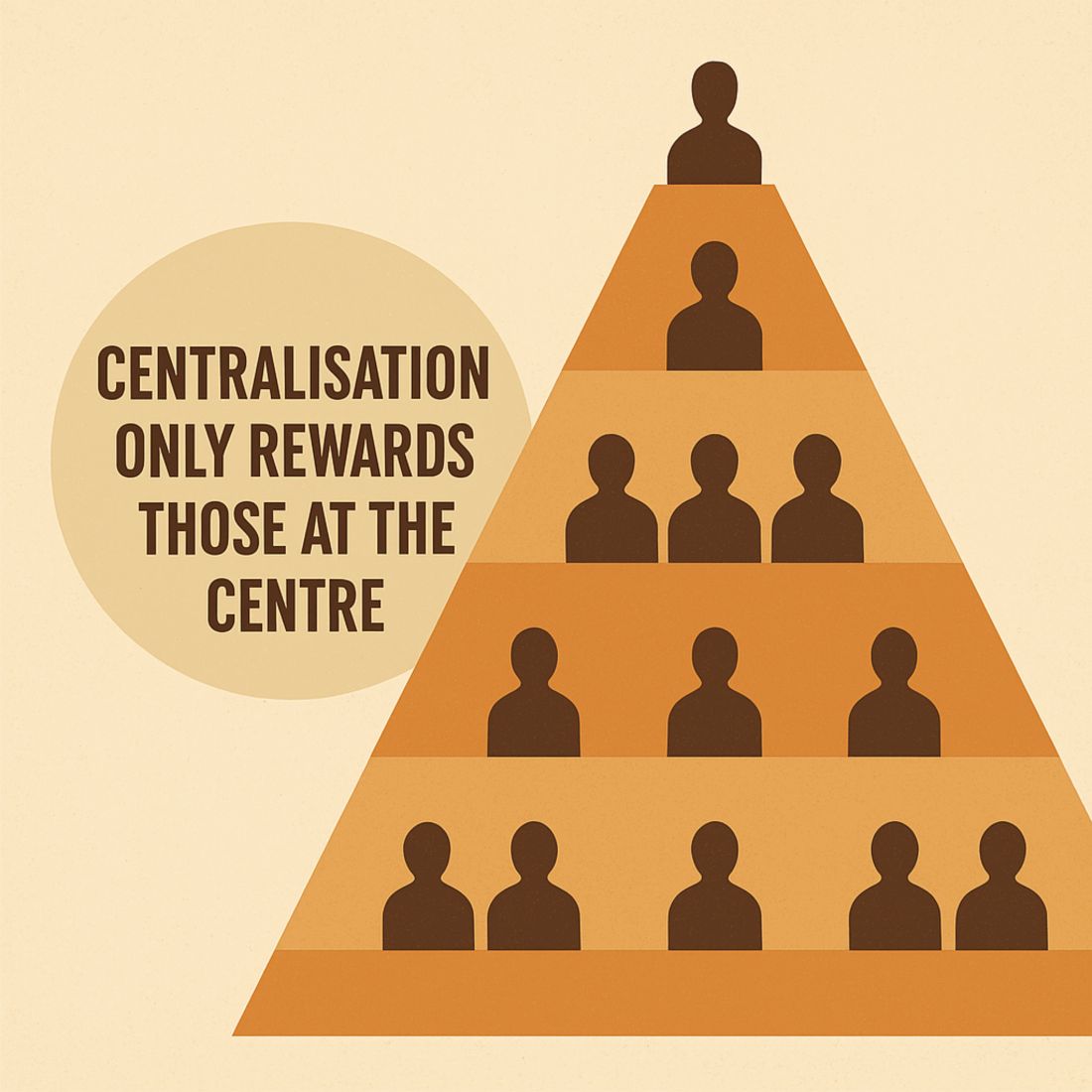
Centralisation Only Rewards Those at The Centre

For months I’ve been writing about The Local Economy & Governance System (LEGS) and The Basic Living Standard. Yet I’m always aware of a deeper challenge: until people truly see the mechanics of the money‑centric system we live in – not just the symptoms, but the structure – the need for a paradigm shift can feel abstract.

The irony is that the evidence sits in front of us every day. The system hides in plain sight. But because we have been conditioned to treat money as the unquestionable centre of life, we rarely recognise how deeply it shapes our behaviour, our morality, our relationships, our communities, and even our understanding of what it means to be human.

Money today is not simply a medium of exchange. It has become the organising principle of society – the lens through which value is defined, the gatekeeper of freedom, the arbiter of worth, and the mechanism through which power is accumulated. And because money has been elevated to this position, the consequences extend far beyond currency itself. They reach into motivation, identity, governance, and the very structure of our lives.

This is why centralisation exists.

This is why it grows.

This is why it always rewards those at the centre – and harms everyone else.

The money–power–centralisation equation

The relationship is simple:

Money → Wealth → Power → Control → Centralisation

Everyone understands this at some level. Even those with the least money know that having money gives them more control over their own lives.

But as you move up the hierarchy of the money‑centric system, the dynamic changes. Money no longer gives control over your own life – it gives control over other people’s lives.

And once that dynamic exists, centralisation becomes inevitable.

Centralisation is not an accident.

It is not a side‑effect.

It is the natural outcome of a system built on scarcity, hierarchy, and accumulation.

The more money someone has, the more they can centralise power. The more power they centralise, the more money they can extract.

The cycle feeds itself.

This is the architecture of the money‑centric paradigm.

What centralisation really is

People often imagine centralisation as a simple chain of command. But in reality, it is a network of overlapping chains – each one transferring power, ownership, and influence upward, away from the people affected by decisions and toward a distant centre.

Every chain works the same way:

  • power flows upward
  • responsibility flows downward
  • accountability disappears
  • humanity is lost

And because these chains replicate across every sector – politics, business, food, media, technology, governance – they form a vast web of dependency and control.

Centralisation is not just structural.

It is psychological.
It is cultural.
It is economic.
It is moral.

It is the mechanism through which the money‑centric system maintains itself.

The trick: centralisation is sold as “efficiency”

One of the most effective illusions of the money-centric system is the way centralisation is presented as:

  • reasonable
  • intelligent
  • cost‑effective
  • efficient
  • modern
  • inevitable

People are told that centralisation “reduces duplication”, “streamlines services”, “saves money”, or “improves coordination”.

But the truth is simple:

Centralisation always reduces the number of people with power.

It always increases the distance between decision‑makers and those affected.

It always concentrates wealth and influence in fewer hands.

And because distance removes empathy, centralisation always leads to dehumanisation.

Where we see centralisation at work

You can see the pattern everywhere:

  • Politics – power pulled upward into party machines, donor networks, and distant executives.
  • Government – “devolution” used as a cover for regional centralisation, reducing local representation and increasing control from Westminster.
  • Globalisation – local economies hollowed out as production and decision‑making move offshore.
  • Corporate structures – small businesses replaced by multinational giants.
  • Supply chains – farmers and producers trapped by supermarket monopolies.

In every case, the story is the same:

Centralisation removes local agency and transfers power upward.

The dehumanisation effect

As centralisation grows, the number of links between people and the centre increases. Each link removes a layer of humanity.

When decision‑makers have no direct contact with the people affected by their decisions, they stop seeing them as people at all.

This is why:

  • Policies harm communities without anyone taking responsibility
  • Corporations exploit workers and environments without remorse
  • Governments impose rules without understanding consequences
  • Systems become cold, bureaucratic, and indifferent

Centralisation creates distance.

Distance removes empathy.

Lack of empathy enables harm.

This is the psychological architecture of the money‑centric world.

The damage centralisation has caused

We have been told for decades that centralisation “makes life easier” and “reduces cost”. But the lived reality is the opposite:

  • People cannot afford to live independently on a minimum wage.
  • Communities have lost identity, cohesion, and purpose.
  • Local businesses have been replaced by corporate monoliths.
  • Supply chains have become fragile and exploitative.
  • The environment has been degraded for profit.
  • Wealth has been transferred upward at unprecedented speed.

Centralisation has not reduced cost.

It has redistributed cost – downward.

Onto the people least able to bear it.

This is not a glitch. It is the design.

Localisation: the antithesis of centralisation

Centralisation only exists because the system is built on hierarchy, scarcity, and accumulation.

Remove those foundations, and centralisation has no purpose.

This is why genuine localisation – not the fake “devolution” offered by governments, but true community‑level autonomy – is the natural alternative.

Local systems:

  • Operate without hierarchy
  • Are built on relationships
  • Are grounded in lived reality
  • Prioritise needs over profit
  • Are transparent and accountable
  • Reconnect people to the consequences of decisions

People trust local leadership because it is human, visible, and accountable.

They do not trust distant leaders they never meet, cannot reach, and did not choose.

Locality is the natural scale of human systems. Centralisation is the unnatural one.

Why this matters now

Centralisation is not just a political or economic issue.

It is the structural expression of the money‑centric worldview.

And because the money‑centric system is collapsing – financially, socially, environmentally, morally – the centralised structures built upon it are collapsing too.

This is the doorway moment.

We can continue rearranging the furniture inside a collapsing room.

Or we can step through the doorway into a new paradigm – one built on locality, contribution, community, and human dignity.

Centralisation is the problem.

Localisation is the solution.

LEGS is the structure that makes localisation possible.

The Basic Living Standard is the foundation that makes it humane.

The Revaluation is the shift in consciousness that makes it visible.

Once you see the doorway, you cannot unsee it.

And once you understand centralisation, you understand why nothing will change until we leave the old room behind.

An Economy for the Common Good | Full Text

Building, enabling and maintaining good governance, self-sufficiency and freedom for all people and our communities

The Greek Stoic Philosopher Epictetus said “It is not possible to learn what you think you already know.” 

Today, one of the greatest challenges that humanity faces is the reality that almost every one of us believes that we already understand how the world works and subsequently believe that how it works today will always continue to provide the basis of how the world will work tomorrow.

With even the most educated academics and experienced experts suffering from what can be argued as a situational bias, where virtually nobody can picture a way of living where the fundamental factors like money and the economic system that we have today aren’t exactly the same, it seems that we have just as easily slipped into the tragic and passive acceptance that the things that we want to be changed, either cannot or will not be changed. For no better reason that we refuse to give up the things that those changes will necessitate, that we still believe to profit or benefit us personally in some way.

For any speaker or writer who dares venture into the realms of sharing even just one or two layers of the massively multilayered truths that underpin the workings of today’s world using a lens or microscope to focus upon one area of life, government or business, the complexities quickly become too hard for others to believe and the label or badge of being a conspiracy theorist or perhaps worse fits just as easily whilst serving the purposes of those who ride the ‘blissful ignorance’ of the masses ridiculously well.

The truth that even the many who do accept that change has now become more than necessary cannot deal with, is that neither the majority nor the critical mass of people required to initiate meaningful levels of societal change can be reached whilst we remain ‘bought in’ to the current paradigm at any level.

Indeed, the change that our lucid moments allow us to recognise as being the only possible direction for a just, fair and balanced society and culture, will not be accepted and certainly not embraced, until enough of us have felt the real pain that the way mankind lives today will inevitably inflict upon us all. For as long as money and material wealth rule the day.

A HAPPY WORLD isn’t coin operated

The world could not only work as well as it does today. But it would actually work much better. IF everyone did what they did, without being tied into the shared belief that everything has monetary value.

Yet it doesn’t take much for any one of us to build a wall against this truth when we will almost inevitably fall into the trap of believing that whilst we might personally be able to accept a different system of values, we believe that nobody else will. Because they are selfish and coin operated. And that as such, the world will always be destined to work the same way.

What I will say to you now is that the world does not and has never needed to be coin operated or run by money. And it can no longer continue to operate in this same way.

The way that the world works today is a manmade construct. One that has fear – not happiness, peace or love at its heart.

What is more, each of us may well have had the free will to choose fear as our motivation and our guide in times past.

But when the impact and consequences of that motivation on the part of any one of us leads to a situation where the free will to choose between fear and the alternative is no longer available for others to decide, the imbalance that is created is one that will  inevitably lead to inescapable pain and impoverished circumstances for those others from which it will be impossible for the world itself to hide.

The contradictory belief that unsustainable living is sustainable, because the narrative says so

Fanciful as it may sound, the reality we all face is that the unsustainable ways in which we have all been living have already gone too far.

The decisions that legislators and leaders make do not reflect what is in the best interests of humanity and everything they now do is progressively making a very bad situation even worse.

We do not and have never needed the world to work as it does now.

The benefits of a whole world and everything within it being twisted and manipulated to serve the interests of just a few, are worth nothing and do nothing but cause pain and harm to the masses.

This is an incalculable level of tragedy when we realise that the fundamental basis of everything we need, is being able to or having the ability to live a good life.

A Good Life cannot be bought

A good life isn’t created or achieved on the basis of what we have, what we accumulate or what other people think.

A good life is a state of mind.

And it is a state of mind that allows each and every one of us the opportunity to open the door and rediscover who we really are.

Those committed to the current paradigm will certainly argue that only wealth, influence, power and control can provide the circumstances where this kind of peace can be achieved.

Yet there is nothing peaceful, beneficial and certainly not spiritual about living a life that may be perceived as being good. But can only be achieved where at least one and potentially many others are having to pay some kind of cost.

Just like our bodies are an ecosystem that work to their very best when they are looked after, our communities and localities are all that groups of us need to survive and thrive, whilst showing and maintaining that same respect for all others and sharing between all of us the things that different communities can do that we cannot and vice versa, with the express belief and understanding that cooperation and collaboration rather than control are all any of us need to have very good lives.

Our Future is Local

Plenty has been said and written about the virtues of looking within ourselves rather than continually looking outside for all of the answers, truths and directions that we expect to make our lives work.

Indeed, the purpose of this work isn’t to focus upon the benefits of self-awareness and levels of self-knowing that reach way beyond any basic understanding of self-help fashions such as mindfulness which can be found in seemingly endless numbers online and on channels such as YouTube and TikTok. As that is a journey for each of us to pursue and conclude upon personally.

However, the circumstances and situations that lend themselves to that journey of personal learning and progress are a different matter altogether.

In very basic terms, the most  productive and beneficial way for us to live our lives, to experience a good life and to live a life where we will know that we will genuinely succeed, is to live locally, or in ways where everything to which we attribute real value is experienced as first hand, through people we meet face to face and through life experiences which are fully lived and not accessed at  any level through the equivalent of a screen.

To experience the human condition and human relationships, it is necessary to have relationships directly with other humans that will condition us to understand how and why other humans behave the way they do and how they think.

Living any other way immediately adds unnecessary levels of complexity in which the behaviours and choices that harm others can easily hide, that just like any other lie, require many other lies and layers of lies in order to protect the original lie.

Despite many convincing narratives that suggest otherwise, progress doesn’t only travel one way. Just like technology doesn’t automatically mean the redundancy and erasure of methodologies that came before it. And it certainly doesn’t mean that advances of any kind that benefit those who control them, should ever come at the cost, hardship, loss or pain of those who would have been involved in any accepted practice that came before it.

In fact, technology driven by the correct motives and the desire to improve life, rather than replace it, is representative of genuine progress, whereas technology used to replace and impoverish people so that those who own and control it can profit is most certainly not representative of any kind of progress.

Just because jobs can be replaced by technology doesn’t mean that they either need to be, or that they should be. And if money wasn’t the only real consideration that was being involved, neither would anyone believe that there would be any need to be either.

Indeed, if money were not in the equation, the need for big companies or big anything, wouldn’t even exist.

The only businesses or organisations that we would need at any level, would be those that have the structures necessary to provide for all our essential needs and the goods and services that make a genuinely good life work.

These aren’t big businesses. Because they aren’t driven by the suggestion that costs can be lowered so that more profit can be made or one business can undercut another that does the same thing, because it can do the same things more cheaply in some way.

These are businesses that exist to provide the best at what they do and provide the best experience that they can for the people that they serve.

These are businesses that are local, that are part  of a local supply chain and work within a local circular economy in its truest sense, that have no need to be bigger or biggest, because the one set of values that we all share is built around the belief  that every one of us is worth and has value that is exactly the same.

Our Local Future

The default setting that most of us have from the way that our lives and understanding of life has been conditioned will tell even the most learned and intelligent of us that money centric living will always be the way and that everything we are working through here is little more than some kind of utopian dream that is wholly impractical and will never come true.

Yet unsustainable living is by its very nature unsustainable at every level, at that means that to live and believe that it is sustainable is itself untrue.

Those who are looking more closely at the narratives and the truths that they hide will know that life is going to change in one way or another. It is not a question of if, but when, and the only real question that none of us can accurately answer – even though it is easy to speculate, is what event or series of events will be responsible for setting off what we can almost be sure will be a process of change, if we are not already now within it?

Because we tend to be obsessed over the journey and who has decision making control over the next step(s), rather than the outcomes of everything we do, we use outcomes in the sense of what they mean only to us as the basis of any argument over what should come next – in real terms, whose ideas and suggestions should come first.

From this perspective and the conflict that we can see as soon as we begin to be open to how everything works, it can easily feel impossible to visualise an outcome or range of outcomes that could be achievable after having gained buy-in from everyone and the pathways they are demanding, so that the result is meaningful to all as well as being something that actually works.

The paradox is of course that without being able to visualise the destination and what that destination will actually feel like, what it will be to experience it and what being there will actually mean, we don’t have a collective cat in hells chance of ever getting there or doing anything that will actually succeed.

Minded of this, I wrote Our Local Future and took the leap to create a vision or picture of what a world that works for us all would actually look like, feel like and work like. And you can read and work through the structure of Our Local Future and download a copy of the book by visiting HERE.

Putting the first steps towards tomorrow’s world in today’s terms

Whereas Our Local Future may provide the reader with a picture of what a fully functioning just, fair and balanced locality-based world would look like, whether they agree with that vision or not, it does not and will not provide a guide or map that includes all the different steps that we will collectively need to get there. For no better reason than dogmatically sticking to any plan will create more problems than it will ever solve and that in a world of complexity and contradictions like the one we are experiencing today, plans can never replace the choices made by decision makers who make the right decision in the moment, and ultimately will not work.

However, what is not only possible, but is also required with the outlook that we tend to share, is an example of the stepping off point; a signpost in the direction of travel, or rather an outline of the first steps that we could and that we arguably should be taking now. So that what we are doing to ourselves today is no longer destined to be our end, but can be the point from which we make a conscious decision to take each step, and then keep moving and changing step by step, to transform from a world that doesn’t work for everyone, into a world that works for us all, as it always  should.

Who does this is not something we should worry about, unless we remain captured by that idea that the next step and who controls it is more important than the outcome or destination itself. And without recognising this, it continues to be unlikely that we will ever agree on how we will recognise that outcome, because the outcome and destination will never have become the topic of our discussion or debate.

From this perspective, I would rather have my work taken apart so that it can be improved upon by all those who can improve upon it, than for the work to have never started at all. And with this in mind, I have created and committed to digital pages An Economy for the Common Good, as a model for how we could all come together as communities and within our localities work together to make a start.

The Glos Community Project

I began this work or project in the summer of 2023, and at that point simply intended to turn an idea in to a practical or turnkey model of how a group of well-intended and appropriately motivated volunteers could begin creating a structure that would lead to a fully functioning and localised economy, that would lead to outcomes that would place localism, circular economy, sustainability and sustainable living, awakened forms of governance and therefore real democracy at its heart.

Because the whole point is about our own communities and where we live and work, I created this model around the areas in which I have lived and live today, so that it would be as realistic as it can be from the very start.

The model is called The Glos Community Project and follows in the next section of this book as a structured and self-explanatory plan that goes as far as to provide the basic adverts and job specs for the social entrepreneurs and community volunteers who are envisaged as being the leaders and pioneers of building An Economy for the Common Good.

The Glos Community Project model is only a guide, providing that first step that I have already alluded to, and one that I hope will invite every reader to think about how our world can and will operate very differently, once we have accepted and are ready to embrace that we must place people, community and the environment we live in at its heart.

The content that follows has been structured in the form of a website that can be found HERE, where comments can be added at the bottom of each page.

If you would like to make suggestions about the subjects raised, please share them there or do get in touch by email at acommunityroute@gmail.com if you would prefer not to share your thoughts publicly.

Please note that I will be happy to publish anything that is well intended and clearly shared with the intention of achieving the best outcome(s) for all, even where such an example directly improves upon the work that has been shared.

Thank you for reading and for your interest in creating An Economy for the Common Good.

Adam Tugwell

February 2025

The Glos Community Project

Introduction

Hello there!

I’m Adam and Gloucestershire is my home. Gloucestershire is the County where I was born and where my family live. It’s where I went to school, where I first worked in farming, where I first trained as a manager for an international company, where I first ran and developed projects for a charity and where I set up my first business. Gloucestershire is also where I was an elected Councillor and Member of three of Gloucestershire’s Local Authorities.

As you can already see, I have a very strong affiliation with Gloucestershire, and with Cheltenham, Cirencester, Tewkesbury and Winchcombe in particular. However, all these places are important to me, not just because of the role and part they have already played in my life. But especially so, because they are all parts of the same community and local communities of which I am or have also been a part.

Community can mean a lot of things and could easily be considered to be different, depending on who you talk to. However, to me a community is the group of people who you share all of the important things in life with, rather than being the people who you share the same things with that are important in your own life.

Community is People and Place

The Community and what the community can do has never been as important as it is becoming and as it will soon become. Given all of the turbulence and difficulties that are beginning to affect everyone in some way, right across the world.

Yes, the world is itself a community. And it would certainly be a much happier, healthier, safe and secure place, if world leaders could cast their own agendas aside, and put the benefits of what they do for the People and the communities they should be serving first.

It’s no excuse, but at the level of world or even national leadership, it’s very easy to lose sight of how important every other person’s life experience is.

That’s why when we think about the basic or essential food, goods and services that each and every one of us needs to live and have self-sufficient lives every day, it is locality, localism and keeping every part of day-to-day life as local as possible, that is going to become the key ingredient to ensuring that everyone has a balanced, fair, just and above all, meaningful life.

Recognising that The System today, isn’t about ‘us’; BUT the Future will be

The Establishment no longer works for any of us, even though the amount that we pay in taxes means that on average, we work until May or June each year and ‘Tax Freedom Day’, when any of the money we earn thereafter is actually ours to spend as if it were our own.

One way or another, the help that we now need doesn’t and will not come from those who we should be able to expect to provide it.

Necessity now requires that whatever help we and our communities now or will need, we will all have to step up and do whatever we can to help ourselves, the people who are in our lives and the way of life and everything within it in the localities that surround us.

Our power lies wherever we focus it

Asking people to help themselves or even making the suggestion that public policy is very much ours to influence and change for the better, is something that many – perhaps even you – will feel some immediate resistance to.

We are, after all, living through a period of our own, if not world history, where we have been conditioned to feel helpless and that solving problems that affect us all is something that somebody, somewhere else is responsible for and always does.

Learned helplessness is a human disaster in the making. Simply because it encourages everyone who believes they are powerless to stand still.

In the circumstances we are experiencing, standing still is like going backwards. Because those who have power are abusing it to take everything that we understand forward, in to a future, in ways that only benefit them and their kind.

However, life isn’t something that happens out there, somewhere.

Life is happening right here, right now, in your mind and in the space or spaces around you that you walk in, talk in, feel in, touch in, eat in, wash in and experience every part of life in – each and every day.

Life isn’t happening remotely in a device somewhere.

But the picture that devices give us of someone else’s life can certainly make it feel like whatever is important in the digital world, is relevant and all-encompassing within our own.

It’s not. And the most painful lesson that we all have to learn, understand and accept in real terms, is that life doesn’t work as it should for more and more of us, because we aren’t living real lives.

Our lives are being dictated by people who are completely out of touch with us and who we are. But have a pedestal, lectern and platform in front of us, just because they are on a digital screen.

The current economic model and system of power doesn’t work for us

There isn’t much that needs to be said to anyone, no matter who you are, where you come from or what you do, for us to reach agreement that there is something fundamentally wrong with the way that everything works.

Whatever your relationship with money, the chances are that you are also concerned by the creeping feeling that less and less of the aspects of your life that you used to feel in charge of, still remain within your control.

In simple terms, it works this way and will continue to get worse in this way, as every decision that’s having an impact on the value of everything we have is being made by people who we are unlikely to ever meet.

The challenge that we all face today, is that the rules that allow all the things that are going wrong for us – no matter what they are – have been created or adapted to serve the purposes of those same people, and these are the people who we have not only trusted, but also put in charge.

Out of sight is out of mind for most.

And people who have power, influence and control by the truckload, are very dangerous when they have no integrity or respect for the responsibilities they have to others.

Localism or Going Local

I’ve written a whole series of books that focus on localism and how the focus of power must be brought back to local communities and for decisions that affect our daily lives to be made as close to us as possible and by people who we know and can trust.

However, the problem that I have faced throughout, is that when talking about anything in a broader or national sense, it quickly becomes as abstract as national politics and national news streams are, even though that’s how we often judge important things to be.

The problem is, real life and what is important to us isn’t abstract.

In fact, the real things that are important and all the things that can have the biggest impact upon everything that is happening to us is not abstract and is very specific indeed.

But we have somehow allowed the abstract, or what is outside of us, to influence all of our specific choices.

With AI and technologies now forcing their way into our digital lives, with consequences that will make real life feel so much easier, whilst teaching us to forget how making decisions for ourselves and even learning new things, the choice between being led by an abstract world where the real influences are never seen or understood, or taking back control and regaining conscious choice in everything we do has never appeared to be such an easy one that is actually so very hard.

Awakening to the reality that hides in plain sight

The damage of centralisation, globalisation and of allowing decisions that affect everyone to be taken by people who are unlikely to ever visit or have reason to understand the things that are happening in our streets and neighbourhoods are very easy for us to see in the news every night.

People who have zero understanding of the consequences and impact on the policies they write for every reason other than those that they should, are condemning increasing numbers of people to harder and more challenging lives, and then blaming them for the problems that they themselves have through their own incompetence caused.

It can only work for us, if we can reach out and touch it

A genuinely self-sufficient and fully localised system of public services and the governance that underpins the systems and processes that affect and impact daily lives would not be in danger of being abused or mismanaged in this way.

Indeed, the only way that we will be able to create a genuinely level playing field of opportunity and a public or community sector that works in the way that it should will be for the full balance of power, influence and decision making to be brought back to the People and local communities and administered openly, transparently and without any bias in the way that it always should.

Real Localism is what Authentic Governance looks like and what it would be.

Localism in its real sense

The most simple way to explain the change of focus from where it is today (Global, Central, European etc.) to where it should be (Local, Community etc.), is to think of it as being a switch from a values set based on money, profit and the accumulation of power and wealth, to the alternative values set which is focused on People, humanity and what we genuinely need for everyone to be happy, healthy, secure and safe.

Real localism isn’t rocket science.

But real localism certainly meets with a lot of resistance when the true depth and scope of what it means are openly discussed, because for many who do so well out of exploiting others (whether they are aware of it or not), localism represents what they believe to be a loss.

Sadly, because the Establishment know and understand that local communities are where the power of the people and everything that supports us should be, they frequently pay lip service to the principle of ‘localism’.

But as in the case of New Labour’s ‘Devolution’ from the 1997 General Election on, and then the Cameron Conservatives ‘Localism’ in the years that have followed since 2010, the type of localism and the return of power to local people that politicians from all sides having been selling us, all add up to no such thing.

Politicians today are desperately promoting what they call localism or any one of a number of similar things, which is Regional Centralisation by another name.

We face a challenging, but achievable course of action, that requires us, our communities, charities and businesses to by-pass the Establishment and begin putting localism into everything we do and are motivated by, if we genuinely want to solve all of the societal problems that not only our communities, but the Country and the whole world faces.

We need a new Economic Model that evolves itself from the community up

If you want to learn about economics, the last person you should ask is an economist.

History – albeit history that is used as a model and translated for the contemporary age, is another thing entirely.

We do not need to return to the dark ages or some kind of feudal system to see that life worked much better for everyone when everything that was needed for day-to-day life was available locally and provided by people that everyone knew.

Simple living is far more intelligent than the ‘connected’ world that we live in where relationships are being dehumanised and we have all become little more than a number or code to every company or organisation that we have any reason to buy something from or to do business with.

We will bypass and reject the heartless and inhumane way of living we experience today by

  1. Prioritising local growing, processing, manufacture and supply.

We will improve life for everyone dramatically by rejecting the money-based value system by

  • Putting People First.

We will change the world for the better by rejecting the hierarchical structures and system of governance by

  • Bringing power back to the most local level within our communities – creating a clean, authentic form of democracy that has never been allowed by the power hungry to exist before.

The new enlightenment that we are told we are experiencing is only enlightening for those who believe that they are in control.

People who don’t have any reason to even acknowledge the realities that many of the people whose lives they influence now face, because technology insulates them from all the pain that they cause.

PLEASE Remember: Just because technology can do so many ‘amazing’ things, it doesn’t mean that we are obliged to use it, or that we have no choice when it comes to doing so.

Priority 1: Local, Local, Local

Life isn’t a theory.

Yet we have life dictated to us as if it is.

The only way that things can really work in the best way possible for us all, is for whole supply chains, the route of food from farm to fork and how business works and money or currencies flow to be in circles that are as local as it is possible for them to be.

Forget any ideas, philosophies or narratives that identify with localism purely as ‘circular’ or ‘doughnut’ economics.

Whilst they may be well intended, these are theories that are based upon the current money-centric system continuing to be prevalent across all areas of life.

They are NOT what real localised economies are really about.

Localism and Locality Economics are about everything in life and the business streams that support life, people, communities and the environment, working locally and in a very localised way.

Priority 2: People First

Money isn’t everything. But people, our relationships and the world we live in really are.

People or human based values are in short supply, so the most effective way to change everything is to put People and our communities first.

We don’t need to make massive profits to experience happy, healthy, safe and secure lives. But we do need to have faith that changing minds – beginning with our own, is the most important step to changing the world to one that is just, fair and balanced for all – and that social enterprises that help everyone without charging more than anyone involved genuinely needs within local communities is the best place to begin.

Priority 3: Local Governance from local Communities and the grassroots up

We may have learned helplessness, but we have the ability to change things right now, by-passing the assumed behaviour that the Establishment expects and by making the system work for us and taking power back, rather than engaging in actions we have been brought up to expect which just continues to funnel power at people who abuse it and use it only to benefit themselves.

In the recent book Officially NONE OF THE ABOVE, we discussed the need for us all to act and take part so that the focus of political power is brought back to people we know and the decisions that affect us daily are made by people who have genuine skin in the game when it comes to knowing and understanding what we are experience, how we feel, and how we think.

No, we don’t need a revolution and the destruction of the current electoral system to do this. But we do all need to take part. However, in the long term, we must work towards the removal of any parts of the electoral system or system of democracy that can allow specific interests and the agendas of particular groups of people to manipulate and play the system, as is the case right now.

Social Enterprise and Community Enterprises | Bringing not-for-profit and key local businesses together to work as one

Putting People First isn’t just the long-term aim. Putting People First is the most important stepping off point in the series of practical steps that have the power to influence and deliver large scale change, even without the Establishment giving it its blessing, a green light or any kind of consent.

The way that we can do this is by creating a series of social enterprises that can immediately begin to tackle the issues that are being most acutely felt by what we today recognise as growing wealth inequality and the cost of living crisis, but in reality is a direct result of the broken economic model that the Establishment remains committed to, even though it is continuing to deliver increasing  levels of harm to People from all areas and across the whole spectrum of society.

It is certainly true that many will not have even considered the realities that many of the people they pass on the street daily are facing from the growing problems that are a direct result of this broken economic model. Of those that do or are open to the existence of a problem, even more cannot see an alternative way of running a 21st century model of society where money doesn’t have its current role.

Many People genuinely believe that creating a model of society that functions around what everyone needs, rather than what the reducing few just want, cannot deliver happiness, health, security and safety in any way. This is because of the genuine belief that money always has a role to play.

But money or rather inflated prices, excess prices and the greed and profiteering that sits behind it doesn’t have a role to play in any fair, balanced and just society. The only way to demonstrate this is to show the people that need to be convinced, and that’s why those who can see and understand this truth need to be the pioneers when it comes to taking action, as well as having and maintaining a lot of faith.

We can deliver different outcomes and with them, a different life experience for people across our communities very quickly, just by making a start

That start will be social enterprises that follow similar development and growth models in every local area, along with a very small number of new multimodal charity units that provide services for those in very specific cases of need, who have no way to pay.

By passing the Establishment and organisations profiting from essential goods and services that everyone needs

There is no point in attempting to reinvent the wheel. There are already some magnificent social enterprises and not for profit organisations operating in many areas that are doing the very best to help people on a cost-related or free basis already. The Glos Community Project will not seek to replicate or replace any of these within their tangible area of operation, and where or when possible, will also seek to redirect support that might become available to them.

However, The Glos Community Project will operate in any area where we have the volunteers/social business leaders, support and resources, where no such organisation already exists.

The Establishment has had plenty of opportunity to demonstrate that it can reform and get things right. Those involved no longer have the right to demand that we keep waiting for them to get things right, or to expect that we will continue to trust them, just because of the job title or responsibility that they supposedly hold.

This time and the future are ours to decide. They have had their chance and have cast what’s good for everyone rather than just them aside.

In time, many of those from within the current Establishment will accept that there was always a better way and that they made the decision not to exercise the responsibility that they held on our behalf, to do what is right.

We cannot trust anyone from within the Establishment today, to do what is right, until they can see and accept that putting People First is the new paradigm and how everything is going to run.

Who are The Establishment?

We have mentioned the Establishment and the reality that obtaining meaningful change will require bypassing the establishment at the very least.

Knowing who the Establishment are is therefore very important.

As a rule, anyone involved with or directly employed by any of the following will represent the establishment. There are exceptions right across the board, but for the purpose of excluding as much of the risk that comes from those who are invested in obstructing change as possible, in the first instances and until there is definite evidence to support otherwise, we will not trust or knowingly engage with any of the following:

The Establishment includes (but is not limited to):

  • The Civil Service
  • Town Councils
  • Parish Councils
  • Borough Councils
  • District Councils
  • County Councils
  • Unitary Authorities
  • Schools
  • Colleges
  • Universities
  • Social Services
  • Public Services of all kinds
  • Non-Government Organisations (NGOs) e.g. The Highways Agency / Highways England, The Environment Agency
  • National Charities that are well-funded and in the public eye
  • Elected Councillors
  • Elected Mayors
  • Members of Parliament
  • Police & Crime Commissioners
  • Mainstream Media
  • Media Companies
  • Corporate Businesses
  • Most Celebrities
  • The Military

Why | The Glos Community Project

Right now, even on the rare occasion that politics does something positive for People, it comes and works its way through the system at a pace that is simply too slow to help and benefit people who genuinely need help in their real lives.

Gloucestershire is no different. And whilst there are at least a few politicians on the seats of local Parish, Town, The Borough and Districts and the County Council who are still genuine in their aim of putting the needs of People first, the reality is that many of them don’t even understand just how little influence they – and therefore the People who elected them – have, over the things that we are expecting them to deal with on our behalf, each and every day.

The elephant trap that we can easily fall into is to think that bitching about any of this or that following, liking and supporting people who are saying all the things that we want to hear will somehow result in change.

It won’t. And that’s why I am here – as just another person from the community we share, who loves Gloucestershire and everything about it, with the aim of connecting like-minded people and taking the very practical steps that we can by working together, to help other members of our community and take the first leaps towards making the Towns, Villages and the Countryside that we love, a much better place and one that reflects the aims, values and aspirations of us all.

We really can change things for the better by doing the things that we can, rather than losing faith because the problems look too big and we believe that we can’t.

HP | The opportunity for change will be what WE make it | The Glos Community Project

You may have already heard of something called social enterprise, businesses that are run on a not-for-profit basis, or businesses that are set up not with the aim of making money, but creating some benefit to the community in some way.

The Glos Community Project is here to explore the opportunities that already exists and that are yet to be identified that will benefit the wider community through the services or products that they provide, whilst providing opportunities for budding social entrepreneurs and practical change activists, along with work opportunities for anyone and everyone – and especially those who might feel that the world has been passing them by.

Right now, I am looking for people who want to be the pioneers of social change within Gloucestershire’s communities. Individuals who are ideally looking for the opportunity to lead and to learn, but are driven by working collaboratively and for the benefit of everyone, rather than long or short term, about what they themselves can earn.

These are voluntary opportunities in the first instance, with the only immediate cost being the time and commitment that it will take, along with the determination that any successful entrepreneur would need to set up a business from scratch – but with the benefit of having the support and guidance of someone who has seen and experienced all of the ups and downs of creating, launching and managing businesses before.

Theres nothing good about global, but local builds love for others every time

Many of us struggle with understanding and identifying the difference between the things we need in life, and the things that we want in our life.

Don’t worry, there will be no judgement coming from me or anyone else who is closely involved in what we are doing if this does or has ever applied to you. The whole system is skewed and the messaging and advertising that is being constantly pumped at all of us has helped blurred the lines so much between need and want, that unless you are awake to anything being wrong with all of this, the two have merged and become one.

In my recent Book Levelling Level, we focused on identifying the difference between basic or essential needs and what many consider to be essential – but are actually just what those people want. We also focused on the reality that with the Establishment having worked tirelessly on behalf of specific interests to make just about every supply chain you could imagine operate to make excessive profits by delivering what everyone who can afford to buy it, wants, the same people who have been responsible have also destroyed the ability of communities and even our whole Country to provide just the basic or essential foods, goods and services that we all need.

Even talking about supply chains and terms like self-sufficiency will sound like gobbledygook or some kind of esoteric language to some. One of the many challenges we face is that this is intentional too. And the myth that we have been conditioned to believe is that everything costs less for us this way, that it is a better, healthier and more enlightened way of living, and that making us all dependent upon people that we have nothing in common with, will get rid of any problems because we all think the same way.

Regrettably, the same way or same thinking is based on nothing more than shared greed, profiteering and a complete lack of care for the human cost, such as loss of local jobs, overuse and unnecessary use of natural resources, exploitation of people and less developed cultures, and the enslavement to debt that is quickly overtaking populations across the world.

Target Business areas | Foods, Goods & Services that are ESSENTIAL to life

The Glos Community Project is all about the basics. The essentials that everyone needs to be able to access each and every day, so that they can lead happy, healthy, safe and secure lives within a fair, balanced and just environment.

Humans don’t get addicted to anything that they need. But the humanity in everyone is quickly destroyed by having too much of what they want.

Whilst the aims of The Glos Community Project will have many points of controversy, depending upon who you are, it’s the definition between what we need and what is essential to life, rather that what we want that will probably get the most backs up, whilst the world is able to continue in the way that it has been.

For the sake of repeating a lot of information that is available in my other books, the basics or the essentials for everyday living look very similar to this:

Food:

  • Fruits and vegetables that can be grown locally, either on farms, allotments or at home
  • Bread made using local flour with minimal processing that can be completed by hand or traditional milling methods.
  • Dairy products including Milk, Cheeses and Yoghurts that are made locally using traditional methods and without chemical additives, extensive processing or refinement
  • Meats that are farmed, prepared, stored, dressed and retailed locally, without unnecessary miles to heavily and unnecessarily bureaucratised abattoirs and processing facilities.
  • Fish and seafoods, either farmed inland, or transported from the nearest UK seaport.

Goods:

  • Clothing (basic)
  • Cleaning (To keep homes and anything for personal use clean and hygienic)
  • Kitchen (to cook, prepare and store food and drink)
  • Laundry (to wash and prepare clothing)
  • Health & Hygiene (Essential medicines, and goods used to keep clean and healthy such as toothbrushes, toothpaste, sanitary products etc.)
  • Transport (Bikes, Cars) – Only where regular transport cannot be provided in another or shared way

Services:

  • Clothing repairs
  • Vehicle repairs & maintenance where vehicles are owned
  • Building repairs and construction
  • Electricity
  • Water
  • Gas
  • Communication (mobile phone, broadband)
  • Unpaid apps
  • Entertainment (Free channels)
  • Transport (where vehicles are not owned or available for essential or irregular journeys)
  • Banking & Currency (outside of Establishment control)

The More People involved, the more local The Glos Community Project will become

In the first instance, it is difficult to estimate how much interest there will be and which social enterprises will be the most popular, even though I have a good idea what these will be.

If one person per social enterprise model were to come forward for each of them, we would certainly begin by opening up the first of each operation to the widest number of People that it would be possible for us to do so.

However, as interest grows, covering these same areas might be difficult and result in the level of service offered being reduced because there are too many people for one business unit to serve.

When this happens, the area will be divided up, so that every service that The Glos Community Project provides will be offered to the most local area possible.

The growth of The Glos Community Project will be a pathway of decentralization in every sense, focusing on improving accessibility and transparency at each and every step of the way.

Theres nothing about The Glos Community Project that can’t be done. The voices that say otherwise are from people who just have selfish reasons not to do it

No matter how you came to discover The Glos Community Project, there is a good chance that unless you have been searching for other like-minded people to do the things that you have already been thinking about, you will read through the list of social businesses that we want to see available to every community – just to begin with, and that you will think that this is something that cannot be done.

If you have an open mind, please ask yourself the question what makes you believe that, and then follow up by asking yourself why.

Everything listed on this site is achievable. Not only that. As more People from our communities sign up, commit to our aims and provide us with whatever support they can, more and more of us will understand that putting people first is a very good, mutually beneficial and happy way to live, where the results will speak for themselves.

Whilst it will be challenging to get the first few of each social business model planned, where necessary funded, launched and then running, we will very quickly have turnkey frameworks or plans available for every new area, that only then have to be tailored to ensure that whatever is being offered, will meet that specific community’s needs.

Areas outside of Gloucestershire

I will be as happy to hear from you if you are outside of Gloucestershire as I will be if you get in touch with me from any of the communities and local areas within.

We might need to take a different approach, depending on what you are able to do, but The Glos Community Project is just a model or incubator where we can all learn, and we must aspire to a much wider roll-out if community or grassroots power is to have the revival that it now can.

If you are from outside Gloucestershire, please consider all the opportunities that have been listed on this site and then get in touch.

I will be happy to arrange a one-to-one meeting via Zoom, WhatsApp, Facetime or Teams. Or if you have a question or questions that would be helpful for others too, I will be happy to post a blog or a video to explain or discuss what we can do.

Area Organisers – Other areas

If you have been reading The Glos Community Project and feel that you might have what it would take to get the ball rolling with a like-for-like Project in your own County or Region, I would really like to hear from you.

Please e-mail me and provide me with whatever information you would want to know about me, if you were already set up in your area and were thinking about inviting me to work alongside you to set up over here in Gloucestershire right now.

Funding Opportunities

We are actively searching for philanthropic support for specific projects or to support them all.

If you would like to provide support through a donation, through sponsorship or through a grant of some kind, we would be very pleased to hear from you at the earliest opportunity.

We are aware that many substantial grants are offered on the basis of meeting very specific aims. Where possible, we will build the services offered in ways that will meet those aims, as long as doing so will not compromise the key principles and aims of The Glos Community Project.

Regrettably, we cannot accept support that would be allocated in support of any political agendas other than bringing back power to communities themselves, through the creation and development of Community Meetings.

If you would like to discuss your idea, please get in touch with Adam for a chat. 

Every penny counts and if you are supportive of what we are trying to achieve, but can only afford to make a small donation, we will appreciate and value your support just the same. Please find our Crowdfunder HERE.

About You | Social Entrepreneur

The most important thing about you won’t be anything to do with how creative, innovative or entrepreneurial you are or can be. These are all words that get misused and there are lots of people who genuinely believe myths such as being self-employed means that you are an entrepreneur.

The most important fact or truth about you will be that you are driven by helping others, by genuine social change (no matter how challenging that might appear to be) and that you have accepted that change of the kind that we all need will not come from anyone that most people are expecting it to come from.

I’m not keen on bullet points for something like this, so please treat the following as a framework only, and if there are things that resonate but you are not sure about anything else, please just get in touch and we can have a chat.

You Should

  • Be motivated by helping others
  • See everyone as an equal, no matter who or what society suggests that they are
  • Be open to learning new things
  • Be able to see everything objectively and be aware of how your feelings might influence this when and if anything leaves you emotionally ‘triggered’.
  • Think critically – no matter the situation
  • See a crisis as an opportunity
  • Able to work in the moment, without a plan or guide to help you
  • Be sure that you can see commitments and agreements through, even if you are not being watched or monitored
  • Have a genuine passion for the type of social business(es) that you are interested in and know that you will gain a sense of achievement from being successful within it.
  • Be open to learning and carrying out any of the jobs or tasks that will be required to make this business run and be successful
  • Be comfortable with talking to people, to journalists and anyone who has a genuine interest in what you are doing
  • Have experience working with different social groups, either professionally or voluntarily
  • Be aiming to earn a wage which relates only to the genuine cost of living at the time
  • Understand that volunteers are not paid employees and will only do their best for you, if they enjoy and see a benefit to them or what they believe in from doing whatever you ask them to do
  • Be happy to sign and keep to the terms of a Non-Disclosure Agreement (NDA)

These Opportunities are unlikely to be for you if you:

  • Believe that someone else will solve all of society’s problems
  • Knowingly hold prejudices of any kind about other people
  • Are aiming to own your own commercial company or business
  • Are motivated only by the potential of what you could earn
  • Have any hang ups about doing any kind of job
  • Believe that you must be qualified to do anything
  • Make excuses or tell lies to cover up mistakes, problems or any issues that are outside of your control
  • Are already committed to any political or social agenda – no matter how good or beneficial you might consider it to be (This includes any political party, green or climate focused movements, groups with a spiritual ‘agenda’, ‘alt’ movements or anything that promotes ideologies built on ‘us vs them’ thinking at any level or of any kind.

Opportunities for Social Entrepreneurs in Gloucestershire

There are a number of different opportunities for people who would like to lead the development of a social business across Gloucestershire.

These will include:

  • Local News
  • Clothing Hire & Resale
  • Car and Bike Loan Hubs
  • Local Food Circuits
  • Allotments & Home Growing
  • Local Exchange Platforms
  • Local Currency
  • Homeless Hubs
  • Community Pubs
  • Community Brewing
  • Community Marketplace
  • Mend & Make Do Repair Centres
  • Community Meetings
  • Skills for Life Courses
  • Community Helpers
  • Farm Direct Cooperatives
  • Community Bakeries

Opportunities will be local community specific, with the aim that there will be at least one of every business type listed within walking distance of homes in suburban or town areas, or available and shared between no more than 4 to 6 villages in remote areas.

We will not seek to establish any new social business where a community-focused social business of the same kind, or offering a service of the same kind exists, unless it is being delivered as part of an Establishment agenda.

Opportunities for Volunteers in Gloucestershire

We are also looking for specialist project and management support

  • Web & Software Developers
  • Social Media Creation & Support
  • App Developers
  • Fundraisers
  • Citizen Journalists

Areas of Gloucestershire where you might be | The Glos Community Project

Forest of Dean

  • Coleford
  • Cinderford
  • Newent
  • Longhope & Mitcheldean
  • Newnham on Severn

Cotswold (South)

  • Cirencester
  • Tetbury
  • Northleach
  • Fairford
  • Lechlade

North Cotswold

  • Bourton on the Water
  • Stow on the Wold
  • Moreton in Marsh

Cheltenham

  • Town
  • Prestbury
  • Leckhampton
  • Hatherley

Tewkesbury (North)

  • Town
  • Winchcombe
  • Bishops Cleeve & Woodmancote

Tewkesbury (South)

  • Churchdown
  • Brockworth
  • Hucclecote
  • Highnam
  • Innsworth

Gloucester

  • City
  • Quedgeley
  • Longlevens
  • Barnwood
  • Tuffley

Stroud

  • Town
  • Stonehouse
  • Wotton under Edge
  • Dursley
  • Painswick
  • Berkeley & Sharpness

What you will need to provide | Social Entrepreneur

Your time and commitment are the most important requirement.

There is no requirement for you to pay any type of joining or membership fee as a The Glos Community Project Volunteer. You just need to be confident in what you are doing and be prepared to put your name on your project right from the moment you start.

Together we will build the platform that will be required to attract support and any necessary funding to get your social business started.

It is very easy for anyone considering going into business for the first time to believe that they have to buy everything new and have new everything. You don’t.

My aim is to minimalise the risk to everyone who joins The Glos Community Project in whatever role, and to build every new service and the organisation that supports it with the absolute minimum financial cost to those who get involved (i.e. you may need to pay for fuel to travel, use your phone etc.)

Local News

The news ‘industry’ has undergone a massive transformation within the past two decades.

The national news or mainstream media and regional news or what we once referred to as the ‘local papers’ – or what’s left of them all, are completely under the spell or influence of their owners, who pays them or both, and the only losers have been the general public and the people who read, watch or listen to anything that branded media companies produce.

Sadly, local news was one of the biggest casualties of the internet’s arrival, when the ‘cash cow that once was classified advertising’ dried up overnight, pushing the evening paper that everyone went to for everything online, with the outcome very quickly giving the lie to the idea that the local paper was actually about news.

Stories that are important about local life don’t get the coverage that they should do. And the absence of real-life stories from the next village or the school on the other side of the town have only served to fuel the idea that news in the mainstream is representative of real life, and that what comes from outside of our communities is the only news that there is.

Unfortunately, with most of the national or branded news, and much of the stories that come from well-known names and personalities online all being little better than opinion, people have very quickly lost touch with what real life really is.

We need to change this. And we need to make the news interesting to everyone again, without there being any kind of agenda at work.

The Opportunity to set up and contribute to new local community news platforms

We would like to set up news services in every local area, using all of the media options that are available to us to focus on all the stories that are genuine news, rather than being about what someone else wants us all to think.

Focusing on the opportunity to harness citizen journalism at its very best, I am looking for social media, tech and internet-savvy people with the ability to research and write genuine news stories objectively, and where commentary is required, to do so in ways that cover all relevant points of view.

The ability to edit other people’s work will be important, as one of the aims of these local news platforms will be to give people across our communities the opportunity to tell the stories they have that will help and inspire others.

If you are already visualising what you could do with this opportunity, it could very well be one for you.

If you are interested in this opportunity, please e-mail me and include:

  • Your name, contact and social media details
  • A copy of your current CV (If you have one)
  • How much time you have available to commit to The Glos Community Project
  • A short note explaining why local news provision is interesting to you, what your priorities would be if you were leading the development of this social business in your local area, and how you would get started.
  • Links to any examples of articles you have written or any media you have created that is available online.

Clothing Hire, Repair, Recycling & Resale

Everyone needs clothing. But fashion itself is one of the most obvious ‘wants’ that the age of consumerism has encouraged us to have, with very small differences existing between clothes carrying or not carrying a name, but that brand itself means that cost itself is one of the key issues when it comes to what clothes any one of us can have.

The media age creates the perceived need, whilst the banks and financiers now provide the credit that is building a time bomb of debt that only exists because of greed. Worse still, the real cost to our communities through the loss of jobs and to the planet from clothing being needlessly made thousands of miles away on the cheap, where working rules don’t exist and costs are cheap so that profit margins can be exponentially increased, really gives the lie to what globalism has really been about.

The more expensive the clothing, the less likely we are to regularly wear or even wear it. Recent data suggests that a significant percentage of new clothing is either never sold or never even worn.

Recycling clothing through apps such as Vinted is already becoming popular and clothing libraries are being tried in some places too. But we could do a lot more and with the long-term aim of returning sustainable clothing manufacture and production to the UK and our communities, we need to make good affordable clothing available to everyone for all occasions – and without the need for anyone to go into debt, whether they can afford it or not.

The opportunity to set up Clothing Libraries and Resale, Recycling and Repair hubs

We would like to set up Clothing hubs in all areas, leveraging the technology that is available, to make Recycling, Repair and Reuse of good clothing a part of normal life once again. 

Focusing on creating local stores that are accessible to all, whilst using apps and the internet to make services and sales available online, I am looking for entrepreneurial leaders with a passion for clothes and the drive to make thrifty wardrobes fashionable, to help create a service that will have the ability to help people from all backgrounds in a multitude of ways.

Ideally, you will already have the ability to mend repairable clothing and be comfortable using the existing resale apps and platforms as a start. However, this is certainly one of the social business models that could easily be developed not just by one community-focused individual, but perhaps a few.

If ideas are already flowing through your mind about how clothing libraries, clothing hire and clothing recycling and repair could work even better than what people already know, this could certainly be the opportunity that is reaching out to you.

If you are interested in this opportunity, please e-mail me and include:

  • Your name, contact and social media details
  • A copy of your current CV (If you have one)
  • How much time you have available to commit to The Glos Community Project
  • If not already included in your CV, an addendum that covers any skills and experience you already have that would help you to make a clothing hub in your area to thrive
  • Pictures or links to anything that you have done
  • A short overview of what appeals to you about the concept of Community Clothing Hubs and what you believe the priorities would be at the beginning and during the stages of the early roll-out.

Community Vehicle Lending Hubs | Car and Bike Loans

Sadly, because of the impractical and tyrannical way that Green Policy, Climate Change and ridiculous Policies such as Net Zero have been rolled out and are being adopted by local authorities through polices such as the switch to EPVs, ULEZ and 15 Minute Cities, the practical reality that we don’t need 4-car households and shouldn’t be wasting money that we cannot afford on journeys that we simply don’t need to make are being overlooked and are in danger of being passed by.

We don’t need cars that sit in car parks all day and on driveways or by the sides of roads during holidays, weekends and overnight. But we do need to have access to the most appropriate forms of transport for the journeys that we need to make, as and when we need to make them, and we need a localised system that makes this happen – and happen well, for us all.

The opportunity to set up Community Vehicle Lending Hubs

I am looking for people with an interest in cars, motorbikes, epvs and emerging transport technology to help create and build local vehicle lending hubs that make shared vehicle use both normal and respectable, and in a way that means consistent quality of experience for users, with the minimization of vehicle abuse.

Whilst experience in things like fleet management, repairs, vehicle hire and areas of work like that would clearly be very helpful, starting with a clean sheet and no experience of these areas is likely to be just as helpful, as we really do need to get this offering right to create the buy-in that we need from members of our communities from the start.

If you are interested in this opportunity, please e-mail me and include:

  • Your name, contact and social media details
  • A copy of your current CV (If you have one)
  • How much time you have available to commit to The Glos Community Project
  • If not already included in your CV, an addendum that covers any skills and experience you already have that would help you to make a Community Vehicle Lending Hub in your area to thrive
  • A short overview of what appeals to you about the concept of Community Vehicle Lending Hubs and what you believe the priorities would be that will encourage People to trust and rely on borrowing vehicles in your local area, rather than falling back on ones that they own

Community Public Transport

Yes, we already have a large number of community transport organisations and providers such as Dial-a-rides. However, many of these are now driven by and focused upon contracts and provision that has been identified by County Councils and Government Agencies in ways that make them subservient to the Establishment, creating the perception that they are just there for ‘old people’ or children with special educational needs.

On the other hand, the ‘public transport’ that we have, which includes both buses and trains, stopped being public in the genuine sense, the moment that the operating companies, transport providers, and infrastructure companies were privatised and became tools in profit-making hands.

Yes, they provide services that are accessible to the public. But they are not in any way focused on the need for genuine public transport to be universally accessible, and they never will be for as long as private shareholder interest and earnings or dividends being paid to owners remains involved.

In the absence of any will on the part of the Establishment to take back and maintain public transport services without the involvement of privately owned companies or the influence of unions who by holding any organisation to ransom are in effect doing exactly the same thing, we must work to create a Community Public Transport Service that begins by ensuring that transport provision exists within local communities where any services that can be provided by Community Vehicle Lending Hubs ends.

The opportunity to set up a Community Public Transport Hub in your area

The big focus for developing Community Public Transport Hubs is understanding local need, creativity and innovation when it comes to meeting that need, and a very open and positive approach to working with customers from within the local community, as well as being able to engage with and build good working relationships with the stakeholders who will be unavoidably involved.

Unlike the majority of the social entrepreneur roles and opportunities listed with The Glos Community Project, this one does require that those interested already have a Full, preferably clean Driving License which will ideally include minibus driving (up to 17 seats) – NOT for Hire or Reward.

There may also be a requirement for those running or contributing to the management of our Community Public Transport services to hold or qualify for a Certificate of Professional Competence (CPC) in bus service operations, and/or that they can apply for and hold a Private Hire License, which will require a basic DBS check and no previous driving disqualifications or other forms of conviction that will exclude them from applying to or being registered by the Licensing Department at the local District or Borough Council.

If you have any past convictions or problems with your driving license, you should be able to check the Licensing Policy for Private Hire & Hackney Taxi Licenses online. Please note that we will check every existing local policy before beginning work on any new hub.

If you are interested in this opportunity, please e-mail me and include:

  • Your name, contact and social media details
  • A copy of your current CV (If you have one)
  • How much time you have available to commit to The Glos Community Project
  • If not already included in your CV, an addendum that covers any skills and experience you already have that would help you to build a very successful Community Public Transport Service within your local community area
  • A short overview of what appeals to you about the concept of universal transport provision and Community Public Transport, and what you believe will be necessary for People to experience daily, so that the service genuinely works.

Food Supply

By far the most important areas of the social or community businesses that The Glos Community Project is aiming to focus on is the growing, harvesting, preparation, production and supply of basic or essential foods within the shortest and most reliable supply chains possible.

Sadly, we take for granted that food will always be available either online or at the local supermarket. Even though there were some minor shortages during the Covid Pandemic and some supplies of vegetables were temporarily out of stock or in reduced supply earlier in 2023, the reality is that none of us have yet experienced the shortages and changes to the food supply that are now almost certain to come in the months and years ahead.

Globalisation, centralization and the economics of big business have made our communities and the whole of the UK itself dependent upon the supply of basic and essential foods that we could easily grow ourselves. For the sake of somebody somewhere making bigger and bigger profits, whilst power has been taken further and further away from the people so that it can be concentrated in the hands of the few, we have been sold the lie that it’s better for all of us if food comes to us across whole continents, and that it’s also better for us and will make us all happier if it comes to us in increasingly processed or ultra processed forms.

Many don’t even  realize that we have become dependent on foods that are not in any way healthy for us, whilst our agricultural and growing sectors have themselves surrendered or given up the ability to grow and provide a range of food stuffs for local supply, whilst the politics of money and globalism have made farmers reliant upon incomes they have little or no influence over, whilst growing fewer and fewer things.

Farm shops are not a luxury or non-essential choice. But it serves the current economic model for us to see them that way

Many of us visit farm shops – where they are available, and do so with the belief that to do so is a luxury or a treat, because we can be fairly sure that whatever they sell to us will cost more than what we would pay for it at a supermarket – even though the levels of quality and the provenance are nowhere near being the same.

Farm shops and any retail business that sells locally made, perhaps organic, high-quality foods with the absolute minimum of processing involved seem expensive, because the way that most foods are mass produced and massively processed has made them that way. It is quite literally the economics of scale that not only appear to make food cheaper, but also guarantee that the marketplace is controlled by very few hands, and that the people involved make ridiculous profits from whatever they do.

Whilst we need affordable basic or essential foods more than ever, we do not need any part of the process that only appears to benefit us by lowering the purchase price, but then goes on to cost us in every other possible sense – including the increasing risks to our health and our lives.

If the whole of the UK Farming, Growing and Fishing Industries were reformed and restructured so that their priority and focus was always on local supply – through complete supply chains that are as local as it is possible for them to be, the price of all essential and basic foods of a much higher quality and standard would quickly come down and be accessible to everyone too.

Our Farmers are struggling because the Establishment is failing them too

One of the most regrettable parts of the Food Supply Question today is the reality that Farmers are already acutely aware that the self-sufficiency or food security of the whole of the UK is now at very high risk.

Sadly, although Farmers are some of the most creative, resourceful and entrepreneurial people you could ever meet or know, the Industry and its leaders like the National Farmers Union, is still very much committed to the misplaced belief that the Establishment will come to the rescue and provide the support they all want for whatever they currently envision as being the necessary change.

For those from the farming community who read this, it is time to realise, understand and accept that there are many different agendas at work within and beyond the Establishment, but none of them place a priority on anything like the traditional model of farming even in the way that we currently know or believe it to be.

Like so many other areas of business and life, we must now take a very practical approach and different view of food production, and continue to do so for as long as the current Establishment is able to maintain its hold.

We must bypass the Establishment food strategies and incentive plans, and point all farming and food producing businesses back to community focused production using up to date methodology and thinking, but in a very traditional, perhaps even shops-around-the-village-green kind of way.

On the current trajectory, more and more farmers will lose or have to give up farms, whilst communities will be pushed further and further away from being able to sustain themselves as we unnecessary lose more and more productive land.

Local Food Circuits

The Glos Community Project aims to work with farmers, and all locally aligned businesses to champion and recreate localised Community Food Chains that keep the growing, production, necessary processing and preparation, transport and supply of all basic and essential foods as local and as self-sufficient as possible, so that local communities can quite literally fend for themselves.

This is an ambitious task. Not least of all, because many will see the return of fully localised markets as a regressive or backwards step, simply because of the way that certain interests and the focus upon profit always being the key priority has conditioned them to think.

However, farmers, aligned business leaders and members of the wider community coming together to discuss a mutually beneficial strategy will quickly open up doors and a dialogue that very few would currently consider to be viable – but that is quickly going to make a massive amount of sense in what are very turbulent and changing times.

The Opportunity to Facilitate and Coordinate Farm Direct Cooperatives

I am actively looking for a number of social entrepreneurs who have the people skills, the ability and the motivation to knock on doors, open up and build new relationships with a range of very different people who are very worried about the future, but are at least initially likely to be very resistant to considering stepping away from the business model where the establishment makes all the rules and only they can offer any help.

You may be from the Farming or Rural Community or from outside of them. But you will have both fluency and understanding not only what farmers and growers have the ability to do, as well as what might be their needs, along with a very innovative and entrepreneurial view and understanding of what it is likely to take to get the right people, businesses and agencies together, to make robust local food supply chains work, so that the self-sufficiency and food security of local communities can be guaranteed.

It is very important to accept that the really exciting part of this social or community business platform will be just how much knowledge already exists within all of businesses that would gain from being involved and that the success of this part of The Glos Community Project will depend on getting everyone who could contribute and benefit from this, not only to open up and share their ideas, but to also commit to becoming actively involved.

If you are interested in this opportunity, please e-mail me and include:

  • Your name, contact and social media details
  • A copy of your current CV (If you have one)
  • How much time you have available to commit to The Glos Community Project
  • If not already included in your CV, an addendum that covers any skills and experience you already have that would help you to open doors within the farming community and with business leaders within the community who will all need to be inspired by the story that makes real the truth that there is another way.
  • A short overview of why you believe that Local Food Circuits will provide food security and what you believe the common USP will be that will engage, create buy-in and get everyone important on board

Allotments & Home Growing

Whilst farmers and the Grower community have the ability to change their working practices and to create and employ new infrastructure quickly, the industry wide change that will be needed may not happen as quickly as we might all like – once the need for this massive change really begins to hit home.

To help and support the creation, development and implementation of Local Food Circuits, there is a part that the majority of us can play in helping ourselves and contributing to the local community effort, if we are prepared to ‘Home Grow’ any foods that we can.

There are a range of ways that Home Growing from the smallest scale up to a level where you might be able to supply certain fruits or vegetables to your whole area could be possible, depending on what resources you already have access to. These might include a garden, a deep window sill, an allotment, or an area within your home where you could set up a hydroponics system.

Today, Home Growing is seen as being quirky or excentric by many. Yet it could be a very easy and quick way for everyone who is able, to ensure that they have ongoing or regular access to a source of the vital nutrition that everyone genuinely needs.

The opportunity to Facilitate and Coordinate Home Growing Hubs

To support Local Food Circuits and also feed into our new Community Marketplace, it is an aim of The Glos Community Project to support homeowners to utlise the space and resources that they have available for Home Growing, and to identify land and develop the availability of allotments so that Home Grown fruits or vegetables of one kind or another are available to everyone.

I am looking for social entrepreneurs who can either set up and run, or coordinate others to provide the following:

  • Purchase, sale and supply of gardening equipment
  • Purchase, sale and supply of hydroponics equipment
  • Rental, purchase, preparation and letting of allotments
  • Developing an online signposting service to quickly identify anything that will help
  • Work with our Skills for Life facilitators to provide online, classroom and one-to-one training

Like Farm Direct Facilitators and Coordinators, the ability and desire to collaborate with others who have knowledge and skills that will help is vital to the success of this role, as if having a very open mind and the ability to inspire people across the community to think about the meaning of self-sufficiency in a very different way.

If you are interested in this opportunity, please e-mail me and include:

  • Your name, contact and social media details
  • A copy of your current CV (If you have one)
  • How much time you have available to commit to The Glos Community Project
  • If not already included in your CV, an addendum that covers any skills and experience you already have that would help to demonstrate the kind of approach you would have to getting people to commit to and stay committed to Home Growing.
  • A short overview of what appeals to you about Home Growing and the role you see that it will play in providing food security at the most local level.

Building Local Economies

‘But we already have a local economy?’ I hear you think.

Yes, we do. But they are very much part of the national and international economy and the real question you might want to ask yourself is how does the economic system that we have really benefit or work for you?

Unless you are a) a billionaire b) a massive corporate shareholder c) playing the markets in some way or d) working for one or someone very similar to all of the above, the economic and monetary system that we have is not working for you or benefiting you in any way – whatever the common, constructed or urban myths tell you.

In my book Levelling Level, we discussed the certain reality that Money isn’t worth anything other than what any of us believe it to be. But that doesn’t stop a great many people who are otherwise probably very sensible from attributing great value to it and letting the accumulation and manipulation of it takeover their lives – all without even a second thought for the cost to everyone else.

Regrettably, the journey that the Establishment is now pushing us along toward the extinction of cash and the use of central digital bank currencies (CDBC) or government derived cryptocurrencies isn’t one that will end well for anyone whose interests aren’t closely aligned with whatever the narrative of the Establishment might be.

The immense power that will be held by people we will never meet, because they can see where every penny of our money has come from and how it is then spent is only surpassed in terms of the danger to our freedom to do whatever we legally want to, by the reality that just because they might disagree with something we have said or whatever we might believe in, they would have the power to switch our money off and prevent us from accessing it whenever they might like.

You only need to think about the political figures who are already having their banking facilities closed down and are being denied access to alternatives to see an illustration of how this will all work. It doesn’t matter whether you agree with their politics or not today, this type of action will become a growing threat to the entire population if the management of money remains in the hands of the Establishment – and that’s before we even get to the discussion about the damage a financial system where the Establishment can just create money as and when it feels like it is doing and has done to our lives already – before thinking about what absolute control and tracking of money will allow them to make it become.

Making money and currencies nothing more than a unit of exchange, once again

The value of money dictates everything today. And the value of money is in the hands of the establishment and very greedy and profit hungry people who have zero understanding and no care about the consequences that come from what they do, as long as the system continues to benefit them.

Whilst a return to the gold standard and pegged or anchored economies would be a sensible step, the reality is that the system is now so rotten and influenced by speculation and private interests that are on the make, that the governance that exists is unlikely to ever deliver a monetary or economic system that genuinely works in the best interest of us all.

We have no choice but to start the money system all over again.

People, their presence and their value and input into the economy is the method that should be the basis for all financial value, not how much anything and everything costs us, or when we possess it, it can then be considered to be worth.

Through The Glos Community Project, the long term aim will be to create a system of new, localised currencies that will be available in a cash equivalent and cryptocurrency or digital form, but will be administered locally and be geographically specific, with the national level currency only being used for transactions between areas or as the baseline that maintains a fixed value between what the basic unit of each currency is worth.

In the short term, the creation of local economies will be focused on allowing people to trade anything they want to, including their labour, their knowledge and their skills, in a way that will quickly become insulated against greed and stupidity driven forms of inflation that are quite literally on the verge of collapsing the existing financial system or ‘bringing down the bank’.

We have no choice but to go back to basics and reject a monetary system that is destroying lives whilst it manipulates all of us and abuses our trust.

Bartering and Fair Exchange

Nobody other than the individual themselves, should be able to define and police a system of values that can exclude or disenfranchise them, based on issues that are outside of their own influence.

With increasing numbers of people missing meals or being forced to make the conscious decision between what essentials they can or can no longer afford, the return to a system where everything can be traded openly and fairly has never been needed by so many as it is right now.

The Glos Community Project is  focusing upon bartering and exchange of new and used goods, basic and essential foods and the services that People genuinely need so that anything and everything that any person has or is able to legally able to offer for sale or for exchange can be traded for something that they need, or for a monetary or currency value that is based solely on what the trading parties agree that the specific item or offering is worth.

Community Marketplaces & Local Exchanges

The New Local Economy is built around Local Exchanges, where all goods and services are available and accessible to all, whether they are provided by a business or an individual.

Membership is open to everyone from within the area of the community and trading is available both at a Local Exchange Hub and online with any costs being covered by a membership and/or access fee on a not-for-profit basis.

Local Currency

The ultimate aim is that each local community will have its own currency that will be available in both a cash equivalent and digital or cryptocurrency form.

The local currency will be fixed in value so that outside influences are then unable to profit from trading the currency or damage the stability of the Local Economy by either crashing or over inflating the total value of the money that is in circulation, held by any person or business and in use.

Local currencies will be the normal method of exchange within the community, but will be interchangeable with the national currency.

The only circumstances where the value of the currency will be negotiable would be within the circumstances of essential international trade

Building The Community Marketplace

Increasing numbers of People are unable to afford to buy the basic food, essential goods and services that they need, just to remain healthy, safe and secure.

Communities must take the steps necessary to help everyone who needs to turn the food they grow, the goods they make or no longer want, or the spare time that they have into whatever they need most, without middle men or profit-making businesses inflating the costs of anything and everything they touch.

The Glos Community Project is building a Community Marketplace that will pivot around a Local Exchange that is both physical and online, and will be supported by a fixed value local currency that will be available in both cash and digital forms.

The opportunity to Facilitate and Coordinate the Community Marketplace

I am looking for social entrepreneurs who already have a good practical understanding of the real economy, as well as the basic theories that underpin both classical and neoclassical economics in the sense that they relate to how the world works today.

However, that in itself is not enough. Being visionary in your outlook, you must be able to look beyond a world where money is the common factor in everything, and replace it with a much happier and healthier one where people and humanity are the common factor instead.

Stepping through and navigating between the world as most people see it today, and how it’s going to be, you will become a key collaborator, helping to develop the Community Marketplace person by person and business by business, as we complete the design and planning of the Local Exchanges and Currencies that will provide the necessary infrastructure, and then roll the whole system out.

Able to work as easily with the abstract as well as the practical, whilst making allowances for how others may not easily be able to do the same, any knowledge of cryptocurrencies, software and app design as well as existing trading and auction sites online will all be a great help.

Above all, like all the roles working with others within The Glos Community Project, it’s the relationship with people and understanding how others think and what influences them to do so that will help you most of all.

If you are interested in this opportunity, please e-mail me and include:

  • Your name, contact and social media details
  • A copy of your current CV (If you have one)
  • How much time you have available to commit to The Glos Community Project
  • If not already included in your CV, an addendum that covers any skills and experience you already have that would help show your fluency in economics and money management,
  • A short overview of what appeals to you about Community Marketplaces whilst demonstrating that you not only grasp but are fully committed to the principle of building community tools that put People First too.

Mend & Make Do | Repair Centres

Recycle, Reuse, Repair, Restore, Refurbish, Reclaim, Revitalise are all words that our current throw-away culture has taught us to look down on, unless you are either trying to make some kind of statement about your values, or you already have no choice but to recognise the value that remains within all sorts of goods that we use every day, but would otherwise just replace.

Those who still have the luxury of being able to afford and access goods that in many cases have deliberately been created with planned obsolescence or the ongoing need for them to be replaced in mind, rarely consider the reality that the option of recycling, reusing and repairing exists. Yet beyond the waste of money that every new purchase that could have been avoided really is, these are too often the same people that tell us they are the champions of green and ethical issues that run completely contrary to the profit driven exploitation and overuse of natural resources that their buying habits have legitimized, and that the greater percentage of all purchases made today are for goods that they want, but don’t actually need.

Theres nothing wrong with making maximum use of everything that we need. Ultimately, we must embrace a new view of standards for all goods so that quality will ensure longevity, and ongoing reuse, so that industry only delivers the goods that we need them too, and returns to both a size, standard and locality that works for our communities and our country as it should.

The Glos Community Project aims to promote the Make Do and Mend or Mend and Make do mindset, that successfully got British People through the very challenging period that surrounded the Second World War, but also demonstrated that there is nothing wrong with making the best of everything that we have – and that the problems only arise when narratives change or the messages that are shared publicly suggest that this isn’t a healthy way to think.

We want anyone and everyone who has goods, clothes or equipment that they have previously thrown away to start thinking again, and to start thinking recycle, repair, reuse, even if they don’t need them for their own use and then sell or exchange them, so that those items can then make someone else happy elsewhere.

The Opportunity to Coordinate and facilitate Local Repair & Refurbishment Hubs

These are roles that will work closely with the Facilitators & Coordinators of our Local Market Exchanges and Clothing Libraries and depending upon the skills and background of the applicant, they could oversee the development and management of both.

For stand-alone operations, I am looking for socially entrepreneurial people who have a background as a professional, voluntarily or even as a hobby, in repairing furniture, bikes, electrical goods and general household items to a very high standard – and to meet legislative requirements where necessary.

Repair Hubs are likely to run better with a number of people pooling their different skills and experience together, and it is therefore likely that applicants can expect to be collaborating with others very closely, from very early on.

If you are interested in this opportunity, please e-mail me and include:

  • Your name, contact and social media details
  • A copy of your current CV (If you have one)
  • How much time you have available to commit to The Glos Community Project
  • If not already included in your CV, an addendum that covers any skills and experience you already have that makes clear any technical training, experience and time served that you have.
  • A short overview of what appeals to you about being a champion of ‘Make Do and Mend’ thinking, and how making a social business out of the processes involved is a very exciting prospect for you.

Skills for Life Courses

Regrettably, education has lost sight of the relationship between being able to live a good, healthy and self-sufficient life, and what political and academic idealism currently dictates that it should be.

The problems that many people face throughout their lifetimes, just because a one-size-fits-all model has been imposed on a significant part of the population that either has a very different learning style, or for reasons outside of conscious control aren’t engaged with schooling in the way they are currently expected, do not fit a modern society that champions equality in all things.

In the longer term, the consequences of not having an education system that genuinely respects the reality that all young people of school age are generally either heads or hands, will be addressed by forms of government that actually do what public representation says it will on the box.

Until then we need to create new ways to help not only young people, but people of all ages to learn skills for life that the education system failed to give them, or doesn’t even offer any of us as standard anyway.

Life skills are predominantly practical or about the way that we perceive the world or think about it. So, unless the objectivity of academically trained or qualified teachers is clearly demonstrated, using ‘teachers’ to ‘teach’ anyone these skills or guide them to achieve this kind of understanding isn’t likely to be the best way.

The Glos Community Project aims to create an experientially led syllabus of skills and ideas that can be accessed and delivered locally within the community, by people from that community who genuinely have things that will be of use to others to share.

Courses are planned and will include:

  • Politics and how Politics and Government works
  • Basic Economics and how the current economy works
  • Critical Thinking and the dangers of Groupthink
  • Living without being influenced by AI
  • Surviving Social Media
  • Growing your own Food
  • Planning your own work-from-home business
  • Spiritual & Religious Independence

The Opportunity to Coordinate and Facilitate Community Skills for Life Hubs

I am looking for socially entrepreneurial people who have an understanding of education, but also see the value in providing learning opportunities in a more tailored form.

Openly bypassing the Establishment education offering for young people and adults of all ages and abilities, you will be able to speak credibly and create learning tools that are objective and give an accurate view of the areas you specialise in.

Where necessary, you will have a technical understanding that can be demonstrated by qualifications, by experience or both. But whatever background you have, you will be committed to The Glos Community Project principles of freedom of the person and freedom of thought.

If you are interested in this opportunity, please e-mail me and include:

  • Your name, contact and social media details
  • A copy of your current CV (If you have one)
  • How much time you have available to commit to The Glos Community Project
  • If not already included in your CV, an addendum that covers any skills and experience you already have that makes clear you have skills and experience that will be of great value to others when shared (If  you’ve read this far and sharing your learning with others is what interests you, please don’t be put off if this question makes you feel like you might not be qualified. Just tell me what you thought of when the question came to you ‘what can you share?’

Other Opportunities

If you don’t feel able or wouldn’t have the time to take on a facilitation or coordination role, we are also seeking people from all backgrounds to share their experience with others.

The list of planned Course above is also by no means exhaustive. So, if you have recognised the need for some kind of training that can be shared and will be genuinely beneficial for everyone within your community – without any kind of aim to influence the way that they think in some way, please get in touch.

Other Project Services The Glos Community Project is working on

As you will already realise, having read this far, we are very motivated by the prospect of what people within our communities coming together have the power to deliver and to do.

We have lots of ideas that we would like to consider, discuss and flesh out with the input of anyone and everyone who feels they can bring useful ideas, knowledge and understanding to the table, so that we can go on to achieve all the things that we would like to.

The list below only represents what we are going to begin looking more carefully at next.

If you have ideas about any of these, or are already considering or working on a social enterprise or charity project in Gloucestershire that sounds like it might overlap with any of these in some way, please get in touch and lets have a chat about how we might be able to help or collaborate so that together, we can achieve our mutual aims.

  • Community Helpers
  • Homeless Hubs
  • Community Pubs
  • Community Brewing
  • Community Supermarket
  • Community Bakery

And there will be more…

Community Meetings | Building a Real Democracy

Politics is the subject that we love to hate and we hate politics for all of the reasons that have made the way that politics is being done across the UK so very wrong.

Whilst it has not been publicly recognised, a very different way of doing politics in the UK exists right now, that has the ability to deliver very different outcomes for us all – just by working together from within our communities, to ensure that when elections are called, we have proper community representatives on the ballot paper, rather than someone or some organisations self-interested choice.

For those who want to see real political change and for us to have public representatives who actually represent the public, once they have been elected, there are opportunities across every community to set up and facilitate Community Meetings where communities can select and appoint candidates for all elections, who are qualified and endorsed as the community choice.

The whole process is covered in my recent book Officially NONE OF THE ABOVE, which is available as a book for Kindle on Amazon, or can be read without cost if you would like to visit my Blog, HERE.

I will be very happy to offer the same kind of help and support to anyone who has read through the whole book and feels that the process tabled is one that they can commit to and follow.

Please get in touch, if you would like to discuss the book and the opportunity to collaborate on this very exciting community building project.

How we will create and develop each social enterprise

The really exciting part for anyone joining The Glos Community Project as a social entrepreneur, is we will step off and into this journey in the same way that you would have to alone, if you were about to set up a business of your own from scratch.

The difference is that I will be there as a mentor, advisor, sounding board and strategic guide to help in every possible way.

Yes, there are many different things that we will need to look at very closely and consider. But we will go through the process of researching and writing the business plan that your specific local community will need and this will be there to help us as we get to work and build the relationships that we need to, as well as being a formal document, presentation and application tool for us to use in gaining any specific kinds of support such as grants and licenses that might be needed, to make sure that everything will work as it should, and that everything is done the right way from the start.

You will be required to play a significant part in this process and you must be ready to apply a very open mind to every experience that creating a new business in these circumstances is likely to throw your way.

This is a prospect that should excite you, rather than intimidate you. Getting it right will be fantastic for you and as the ideas and the effort that you contribute begin to make this new social business take shape, the only thing that will feel better than recognising your own success and the outcome from the work you have done, will be seeing the benefits to so many others make a difference to other People’s lives.

Aims

Immediate Aim 1

To address poverty and the growing shortages of basic essentials with practical solutions delivered for the community by members of the community

Immediate Aim 2

To counter the narrative that only the Establishment can help and overcome learned helplessness by demonstrating that the help we need will come from us ourselves

Immediate Aim 3

To begin the process of creating New Local Economies, championing self-sufficiency, food security and the relocalisation of all supply chains that meet the basic and essential needs of life

Immediate Aim 4

To engage everyone in the process of taking back political decision making from centralised government, focusing the centre of power to the most localised and people-centric form

Principles

Local buy, Local supply

No speculation, agents or middle men

People First

Money or Currency is a unit of exchange and doesn’t vary in value

Technology is there to support roles, not to replace them

Just because we can, doesn’t mean we should

The lowest paid should be able to support themselves fully and provide all the basic essentials for life that they need on the equivalent of the basic or minimum weekly wage, without going into debt or requiring third party support of any kind.

Power must be as local to the people and the community in which they live and contribute as much as possible

Collaborate and make it even better

If any part of all of The Glos Community Project proposal is ringing bells or making sense to you and you can see a way we can improve on what you can see, or extend into a service offering that you are currently unable to see, please get in touch and share your thoughts.

We are not precious about the offer we are making. It’s a beginning and certainly not the end. So, by the time we are really off and running and in the business of delivering real change, we appreciate and value the input that will inevitably come from many different people and sources.

You really don’t have to join as a social entrepreneur or volunteer a specific set of skills to be able to help. The only thing we will insist on is that you really can live by and embrace the approach that whoever we are and wherever we are from, we are all 100% in this together, and that any advice, support or direction is given freely and without any form of direction or conditions attached.

Can we help you with a project that has similar aims?

If you are already working on a project serving your community that is aligned with The Glos Community Project offering in any way, we would be very happy to consider supporting you and collaborating with you wherever you are.

Regrettably, we cannot support projects or work where specific agendas or political motives are involved – no matter how good or harmless you may consider them to be.

More Reading

An Economy for the Common Good and The Glos Community Project were not written in isolation and are part of a series of books that I began writing about three years ago in early 2022.

Each of the following list of Books is a variation on a theme, but works very much under the principle that it is not only possible but actually healthy to be able to understand, value and even hold different views or perspectives of the same situation or set of circumstances at the same time, whether that be in the Past, Present or Future tense.

Equally, it is also important to be able to consider different pathways for the future that sit beyond what many consider to be the obvious, simply because the obvious itself is usually inextricably linked with what has already been done and what sits in the past.

All of the following titles are available to purchase as complete eBooks for Kindle from Amazon using the links provided.

Where indicated, titles may also be available to download FREE as PDF Copies from my Blogsite in different forms, using the links provided.

If you would like to discuss any of the works listed, please get in touch.

Levelling Level (30 Mar 2022)

Amazon

From Here to There Through Now (3 Oct 2022)

Amazon

The Way of Awakened Politics for Good Government (3 Dec 2022)

Amazon

A Community Route (28 Mar 2023)

Amazon

The Grassroots Manifesto (18 Apr 2023)

Amazon

Officially None of the Above (18 May 2023)

Amazon

Actions Speak Louder than Digital Words (8 Jun 2023)

Amazon

PDF Download

One Rule Changes Everything (23 Dec 2023)

Amazon

PDF Download

Food From Farms Guaranteed (3G) (15 Feb 2024)

Amazon

PDF Download

Days of Ends and New Beginnings (7 Apr 2024)

Amazon

The Basic Living Standard (14 Apr 2024)

Amazon

Our Local Future (18 Aug 2024)

Amazon

PDF Download

Who Controls Our Food Controls Our Future (14 Nov 2024)

Amazon

PDF Download

Your Beliefs Today create Everyone’s Experiences Tomorrow (11 Jan 2025)

Amazon

Manifesto for a Good Dictator (26 Jan 2025)

Amazon

Back Page

When we hear the word ‘economics’ or ‘economy’, what does it make us think?

Money, business, growth, commerce, profit, wealth, trade are all likely to be terms that will spring to mind.

But what if the way we think about economics and what an economy or the economy really are is completely wrong?

What if a genuine economy were not about money or any type of material gain and instead had people, community, the environment, living good happy lives and the common good at its heart?

An Economy for the Common Good opens the door to thinking differently about the role of money, finance and economics in our lives and provides examples of the steps that we could take at any time to begin the creation of a new localised economic system that will lead to us all having much better experiences of everything in our lives.

To download a FREE to read PDF copy of An Economy for the Common Good, please follow the link immediately below. If you would like to download a copy for Kindle for the price of £1.99 (UK – correct at time of publication), please follow the link to Amazon at the bottom.

Why we need a Good Dictator, and our phoney democracy should take a rest

In the immediate run up to the December 2019 General Election, I wrote and published The Makeshift Manifesto, here online and as an e-book that’s available on Amazon.

Even though the political terrain was different, from the point of view that the British Electorate were days away from trusting Boris Johnson with an Election Result that very few saw coming because the Conservatives promised to get Brexit done, the truth of the matter was that many areas of the UKs public policy had already gone massively wrong.

Regrettably, it had been doing so for a time that has spanned many different governments, led by different political parties, before.

Within months, we were all subjected to the stupidity and poor leadership that manifested itself in the form of both the Government and the wider political response to Covid 19 and the Covid Pandemic.

We are unlikely to have experienced all the fall-out and consequences of such levels of incompetence and political delinquency that were set in motion, even now.

However, back in early December 2019, I decided to commit all the things a ‘good’ government would actually do to paper. I then shared it with the world.

Since then, The Makeshift Manifesto seems to have been a popular read. So, earlier this year, as I contemplated the run up to the coming General Election, I began to question whether I should revisit the book and update it to reflect what has changed and where the further problems with Public Policy have developed over the 4+ years of time since the first edition was published.

With the original work set up on a screen and being sat ready to dive straight in, it didn’t take many moments for me to realise that if ‘good’ policy was no more than a wish list at the time of the last General Election, because of the quality  of the politicians we had back then, the uncomfortable fact is that with the political options we have available today, such suggestions would be pretty much impossible to deliver through the current structure of government, in any meaningful way.

I’d written about the concept of and asked the question ‘Is it possible to have a Good Dictator’ before.

But at this point I realised, that without people being open to the change that is possible now and which I covered in the book Officially None Of The Above, or there being some kind of Black Swan event that has the power to change everyone’s minds, the only way that meaningful change could be delivered throughout government, the public sector and within every area of Public Policy itself, would be with pure single-mindedness. The kind that could only be achieved if it was driven and directed by one person with the power necessary to command and dictate that massive scale of change.

I worked this thorough as briefly as it was possible to do so.

Leaning on different books that I have written and published over the past two years that included A Community Route and The Grassroots Manifesto, I also added a policy wish list that would be good for everyone, but that in today’s reality, it would only be possible for Good Dictator to deliver and achieve.

There remains a very big question about whether the individual exists who:

  1. Would have the knowledge and experience necessary to change such a massively broken system for the better
  2. Has the desire, drive, motivation and public spiritedness to see it through
  3. Possesses the ethics, morality and principles to stay true to the public cause, when there would be so much temptation to cast what’s in the best interests of others aside

After completing and publishing the book, I concluded that in times as we face today, where politicians and those who aspire to be politicians don’t see any route other than their own, and the public itself has surrendered to the idea that all ‘public’ problems are the responsibility of someone, somewhere else, if nothing else should change in the way we view the importance of the things that are common to us all, the solution of having a Good Dictator, might end up being the only way forward for us all.